


The History of William Marshal was commissioned by his son shortly after William’s death in 1219 to celebrate the Marshal’s remarkable life; it is an authentic, contemporary voice. The manuscript was discovered in 1861 by French historian Paul Meyer. Meyer published the manuscript in its original Anglo-French in 1891 in two books. This book is a line by line translation of the first of Meyer’s books; lines 1-10152. Book 1 of the History begins in 1139 and ends in 1194. It describes the events of the Anarchy, the role of William’s father John, John’s marriages, William’s childhood, his role as a hostage at the siege of Newbury, his injury and imprisonment in Poitou where he met Eleanor of Aquitaine and his life as a knight errant. It continues with the accusation against him of an improper relationship with Margaret, wife of Henry the Young King, his exile, and return, the death of Henry the Young King, the rebellion of Richard, the future King Richard I, war with France, the death of King Henry II, and the capture of King Richard, and the rebellion of John, the future King John. It ends with the release of King Richard and the death of John Marshal.
Available at Amazon in eBook and Paperback format.
Around 1284 Piers Gaveston 1st Earl Cornwall was born.
Around 1305 Piers Gaveston 1st Earl Cornwall (age 21) assigned to the household of the young (future) King Edward II of England (age 20).
On 22nd May 1306 the Feast of the Swans was a collective knighting of two hundred and sixty seven men at Westminster Abbey [Map].
At the feast, following the knightings, two swans were brought in. King Edward I of England (age 66) swore before God and the swans to avenge the death of John Comyn 3rd Lord Baddenoch - see Murder of John "Red" Comyn.
King Edward I of England first knighted his son King Edward II of England (age 22).
King Edward II of England then knighted the remaining two-hundred and sixty-six including...
Hugh "Younger" Despencer 1st Baron Despencer (age 20)
Edmund Fitzalan 2nd or 9th Earl of Arundel (age 21)
John le Blund, Mayor of London
William Brabazon
Roger Mortimer 1st Baron Mortimer of Chirk (age 50)
Piers Gaveston 1st Earl Cornwall (age 22) - this may have been the first time Piers Gaveston 1st Earl Cornwall and King Edward II of England met?
John Harrington 1st Baron Harington (age 25)
John Maltravers 1st Baron Maltravers (age 16)
Roger Mortimer 1st Earl March (age 19)
William Montagu 2nd Baron Montagu (age 31)
John Mowbray 2nd Baron Mowbray (age 19)
Thomas Multon 1st Baron Multon (age 30)
John Warenne 7th Earl of Surrey (age 19)
 Become a Member via our Buy Me a Coffee page to read more.
Annals Londonienses. [1307]. At that time, the King of England, observing that his son, the Prince of Wales, loved a certain Gascon knight (age 23) beyond measure, from which the king himself conjectured that many troubles might befall the kingdom after his death, upon the advice of his earls and barons, compelled the knight to abjure his kingdom for as long as he lived. The name of this knight was Peter de Gaveston.
Sub illo quoque tempore cernens rex Angliæ quod filius suus, princeps Walliæ, adamaret quendam Vasconiensem militem ultra modum, ex quo multa incommoda conjecturabat ipse rex post mortem suam regno posse contingere, ex consilio comitum et baronum suorum compulit rex ipsum militem abjurare quoad viveret regnum suum. Huic autem militi Petrus de Gavastone nomen erat.
On 26th February 1307 Piers Gaveston 1st Earl Cornwall (age 23) exiled by King Edward I of England (age 67) for being his son Edward's (age 22) favourite.
Chronicle of Walter of Guisborough. [26th February 1307] And he (the prince) sent him to his father the king on that very matter. And the messenger said to the king: "My lord king, though unwilling, I come on behalf of my lord, your son the prince, to request in his name, by the living Lord that with your permission, he might grant the earldom of Ponthieu to his bachelor, Lord Peter of Gaveston (age 23)." But the king, greatly enraged, said: "Who are you, to dare ask such a thing? By the living Lord, were it not for your saying at the outset that you undertook this task unwillingly and out of fear of God, you would not escape my hands. But now I will see what the one who sent you has to say do not leave." When the prince was called in, the king said to him: "What business did you send this man for?" And he replied: "That, with your blessing, I might give the earldom of Ponthieu to Lord Peter of Gaveston." Then the king said: "Son of a whore, ill-born! Would you now presume to grant lands, when you have never yet won any for yourself? As the Lord lives, were it not for fear of the kingdom falling into disorder, you would never enjoy your inheritance." And seizing him by the hair with both hands, he tore at it as much as he could, and finally, exhausted, threw him out.
Immediately afterward, he summoned his nobles who were with him in his war against Scotland, and after taking counsel with them, he made Lord Peter of Gaveston swear an oath that, whether the king were alive or dead, he would never accept lands from his son, and that he would go into perpetual exile from the kingdom of England, being given a fixed day by which he must depart, under penalty of death. And so he did. The king also made his son swear that he would never grant lands to him. But after the king died, and before he had even been buried, his son the new king sent swift messengers and recalled Peter.
Misitque eum ad regem patrem suum pro eodem negotio: et dixit regi, Domine mi rex, exparte domini mei domini principis filii vestri missus, licet invitus, vivit Dominus, ut ipsius nomine petam a vobis quod bachalarium suum, dominum Petrum de Caberston, possit promovere, de licentia vestra, ad comitatum de Pontyff. Et iratus rex nimis, ait: Quis es tu, qui talia audes postulare? Vivit Dominus nisi essct timor Domini, et quod ab initio dixisti, quod invitus suscepisti negotium, non evaderes manus meas. Nunc autem videbo, quid dicturus erit qui misit te, et non recedas. Quo vocato, dixit ei rex; Quid negotii misisti per hominem istum? Qui ait, Ut cum pace vestra dare possem domino Petro de Caberston comitatum de Pontyff. Et ait rex, Fili meretricis, male generate, vis tu modo terras dare qui nunquam aliquas impetrasti? Vivit Dominus, nisi esset timor dispersionis regni, nunquam gauderes hæreditate tua. Et apprehensis capillis utraque manu, dilaceravit eos in quantum potuit, et in fine lassus ejecit eum.
Statimque, vocatis proceribus suis, qui cum eo erant in guerra sua versus Scotiam, et, communicato cum eis consilio, fecit ipsum dominum Petrum de Gaverston jurare, quod ipso vivente neque mortuo nunquam a filio suo terras acciperet, et quod exularet regno Angliæ suo perpetuo, certum diem habens ut exiret sub pœna capitis; qui sicita fecit. Fecitque rex filium suum jurare quod nunquam ei terras daret. Mortuo autem rege, et nondum adhuc sepulto, misit ipse filius novus rex celeres nuncios, et revocavit Petrum.
Become a Member via our Buy Me a Coffee page to read more.
On 7th July 1307 King Edward I of England (age 68) died at Burgh by Sands [Map] whilst on his way north to Scotland. His son Edward (age 23) succeeded II King of England. Earl Chester merged with the Crown.
Edward had gathered around him Thomas Plantagenet 2nd Earl of Leicester, 2nd Earl Lancaster, Earl of Salisbury and Lincoln (age 29), Guy Beauchamp 10th Earl Warwick (age 35), Aymer de Valence 2nd Earl Pembroke (age 32) and Robert Clifford 1st Baron Clifford (age 33) and charged them with looking after his son in particular ensuring Piers Gaveston 1st Earl Cornwall (age 23) didn't return from exile.
Close Rolls Edward II 1307-1313. 6th August 1307 King Edward II (age 23). Dumfries [Map]. To the treasurer and the barons of the Exchequer. Order to discharge the Abbot of Hayles of £50 Yearly, which he used to pay for the town of Leechelade [Map] to the late Edmund Earl of Cornwall, and, after his death, to the late King, the king having granted the earldom of Cornwall and all the lands of the said Edmund to Peter de Gavaston (age 23), knight.
To the like favour of Michael de Meldon for 4 marks annually for his lands in Worton.
On 6th August 1307 Piers Gaveston 1st Earl Cornwall (age 23) was created 1st Earl Cornwall by King Edward II of England (age 23); Earl Cornwall usually reserved for the heir. The earldom gave Gaveston substantial landholdings over great parts of England, to the value of £4,000 a year. These possessions consisted of most of Cornwall, as well as parts of Devonshire in the south-west, land in Berkshire and Oxfordshire centred on the honour of Wallingford, most of the eastern part of Lincolnshire, and the honour of Knaresborough in Yorkshire, with the territories that belonged to it.
Chronicle of Walter of Guisborough. And, without consulting his magnates, he [King Edward II] granted to him [Piers Gaveston] the county of Cornwall1 and exalted him above all his relatives and kin. But Piers, thus raised up, looked down upon others, and in the end he was himself despised. When the body of the dead king was being carried, by short stages, from the place where he had died to the southern parts, the son, the new king, together with Lord Piers, went on ahead at a distance. The treasurer, however, the aforesaid Bishop of Chester, accompanied the body of the dead king and rendered to it every honour that he could. When they had come to Waltham, near London, and the bishop was there with the body, the new king and Lord Piers conspired against him, because, in the lifetime of the father, he had refused to place entirely at their disposal the treasure of the deceased king. And so, having sent knights, they seized him and placed him in the Tower of London, and afterwards from castle to castle for many days. Nor would the king release him either at the command of the pope, or at the request of the two archbishops of Canterbury and York with their clergy, or of the magnates of his realm; but he always kept him in prison. And all his lands, which he had acquired during the life of the late king2, to the value of five thousand marks annually, the king seized into his own hand, and he gave all the profits of them to Lord Piers.
Deditque ei, irrequisitis magnatibus suis, comitatum Cornubiæ, et exaltavit eum supra omnes propinquos ejus et parentes. Ipse vero Petrus sic elevatus supra se despexit alios, et in fine despectus est. Cumque duceretur corpus regis mortui a loco quo obiit ad partes australes per modicas dietas, ipse filius novus rex cum domino Petro præcessit a longe. Dominus vero thesaurarius episcopus Cestriæ prædictus fecit comitivam corpori regis mortui, et omnem honorem quem potuit eidem exhibebat. Cumque venisset apud Waltham juxta Londonias, et esset The Lord cum corpore, rex novus et dominus Petrus conjuraverunt contra eum, pro eo quod in vita patris noluit eis omnia ad libitum ministrare de thesauro patris regis mortui; et missis militibus, comprehenderunt eum, et posuerunt eum in Turri Londoniis, et deinde de castro in castrum per multa tempora; nec voluit liberare eum rex ad mandatum papæ, neque ad rogatum duorum archiepiscoporum Cantuariæ et Eborum cum clero suo vel magnatum regni sui, sed semper eum tenuit in carcere, et omnes terras suas, quas ipse adquisierat in vita patris sui regis, ad valentiam quinque millia marcarum annuatim, in manu sua seisivit, omnesque exitus illarum dedit domino Petro.
Note 1. Piers Gaveston was created Earl of Cornwall by charter, dated at Dumfries on the 6th of August, by writ of Privy Seal, dated at 1307. Rymer, Fœdera, 2.2: "The King to archbishops, bishops, abbots, priors, earls, barons, justiciars, sheriffs, provosts, ministers, and all bailiffs and his faithful subjects, greetings.
Know that we have given, granted, and by this our charter have confirmed to our beloved and faithful knight, Piers Gaveston, our entire County of Cornwall, together with its castles, towns, manors, hundreds, demesnes, homages, and services of free tenants, rents, villeinages, villeins, their chattels and offspring, knight's fees, and the advowsons of churches, abbeys, priories, hospitals, chapels, fairs, markets, warrens, wreck of the sea, and all other liberties, free customs, rights, and all other things whatsoever pertaining to the said county. We also grant the office of sheriff of the said county, the tin works, and all mines of tin and lead that belonged to Edmund, the late Earl of Cornwall, within the aforesaid county."
Note 2. The possessions of Bishop of Lichfield and Coventry, were seized into the King's hand by writ of Privy Seal, dated at Clipston on the 20th September, 1307. Rymer, Fœdera, 2.7.
Become a Member via our Buy Me a Coffee page to read more.
On 2nd November 1307 Piers Gaveston 1st Earl Cornwall (age 23) and Margaret Clare Countess Gloucester were married. Arranged by King Edward II of England (age 23). Margaret Clare Countess Gloucester grand-daughter of Edward I through his daughter Joan and, as such, significantly higher than Gaveston in the nobility. She the daughter of Gilbert "Red Earl" Clare 7th Earl Gloucester 6th Earl Hertford and Joan of Acre Countess Gloucester and Hertford.
Chronicle of Walter of Guisborough. In the year of our Lord 1309, on the fifteenth day after Easter, the king held his parliament in London, and the magnates granted him twenty-five pence in return for his confirmation of Magna Carta and the Charter of the Forest, but they would not agree that Piers (age 25) should remain Earl of Cornwall. Because of this, at the king's request, the magnates met again on the morrow [26th July 1309] of the Feast of Saint James the Apostle, at Stamford; and in the meantime the king had Piers marry the sister of the Earl of Gloucester1. Thus, by means of the king and the same earl whose sister he had married, some of the earls consented that Piers should remain earl for the term of his life.
Anno Domini MCCCIX in quindena Paschæ tenuit rex parliamentum suum Londoniis, et concesserunt sibi magnates XXV denarium pro confirmatione Magna Charta et Chartæ de Foresta, et noluerunt consentire regi ut Petrus remaneret comes Cornubiæ. Propter quod, ad rogatum regis, in crastino Sancti Jacobi apostoli convenerunt iterato magnates apud Stamfordiam, et interim fecit rex ipsum Petrum ducere in uxorem sororem comitis Gloucestriæ; et sic, mediante rege et ipso comite cujus sororem duxerat, consenserunt aliqui ex comitibus quod iste Petrus remaneret comes pro termino vitæ suæ.
Note 1. This lady was Margaret, niece of King Edward, being the daughter of Gilbert de Clare, seventh earl of Gloucester, and Joan of Acre, second daughter of Edward I. The marriage occurred in November 1307.
On 2nd December 1307 King Edward II of England (age 23) held a tournament to celebrate Piers Gaveston's (age 23) recent wedding. Gaveston took the opportunity to humiliate the older nobility including John Warenne 7th Earl of Surrey (age 21), Humphrey Bohun 4th Earl Hereford 3rd Earl Essex (age 31) and Edmund Fitzalan 2nd or 9th Earl of Arundel (age 22) further increasing his unpopularity.
Abbot John Whethamstede’s Chronicle of the Abbey of St Albans
Abbot John Whethamstede's Register aka Chronicle of his second term at the Abbey of St Albans, 1451-1461, is a remarkable text that describes his first-hand experience of the beginning of the Wars of the Roses including the First and Second Battles of St Albans, 1455 and 1461, respectively, their cause, and their consequences, not least on the Abbey itself. His text also includes Loveday, Blore Heath, Northampton, the Act of Accord, Wakefield, and Towton, and ends with the Coronation of King Edward IV. In addition to the events of the Wars of the Roses, Abbot John, or his scribes who wrote the Chronicle, include details in the life of the Abbey such as charters, letters, land exchanges, visits by legates, and disputes, which provide a rich insight into the day-to-day life of the Abbey, and the challenges faced by its Abbot.
Available at Amazon in eBook and Paperback format.
After 2nd December 1307 Piers Gaveston 1st Earl Cornwall (age 23) was exiled as a result of the nobility forcing King Edward II of England (age 23) to do so.
After 2nd December 1307 Piers Gaveston 1st Earl Cornwall (age 23) was appointed Lord Lieutenant of Ireland.
Close Rolls Edward II 1307-1313. 8th January 1308 King Edward II of England (age 23) To the Sheriff of Leicester. Order to cause a coroner for that county to be elected in place of John de Noveray, of Burton, lately elected in the late King's reign, who is insufficiently qualified.
Memorandum, that on Sunday before the Feast of St Vincent the Martyr [22 Jan], at Dover, Kent [Map] in the King's chamber in the Priory of St Martin, Dover [Map], in the evening (crepsusculo noctis), in the presence of William Inge, knight, William de Melton and Adam de Osgoodby, clerks, Bishop John Langton, the King's Chancellor, delivered under his seal to the said King his great seal; and the King received the said seal in his own hands, and delivered it to Sir William Melton (age 33) to be carried with him in the wardrobe beyond sea; and the King straightaway delivered by his own hand another seal of his shortly before made anew at London for the government of the realm in the King's absence in a red bag (bursa) sealed with the seal of William Inge to the chancellor. With which seal the chancellor caused writs to be sealed, after the King's passage, in the hospital of Domus Dei, under the testimony of Piers Gaveston 1st Earl Cornwall (age 24) then Keeper of the realm of England, on the Monday next following, on which day the King in the early morning (summo mane) passed the sea at Dover, Kent [Map].
Close Rolls Edward II 1307-1313. 22nd January 1308 King Edward II of England (age 23). Dover, Kent [Map] To the Sheriff of Kent. Order to provide 75 thousands of wood and 200 quarters of charcoal for the expenses of the King's household on his return from parts beyond the sea, so that he have at Dover, Kent [Map] against the King's return 25 thousands of wood and 30 quarters of coal, and at Canterbury, Kent [Map] 30 thousands of wood and 100 quarters of coal, and at Rochester, Kent [Map] (Rofham) 20 thousands of wood and 70 quarters of coal; to be delivered by indenture to John de Sumery, scullion (scutell') of the king's household, or such as supply his place. Witness: Piers Gaveston 1st Earl Cornwall (age 24).
Close Rolls Edward II 1307-1313. 22nd January 1308 King Edward II of England (age 23). Dover, Kent [Map]. Robert Terry, of Whytefield, imprisoned at Northampton [Map] for the death of Galianus de Bek, has letters to the Sheriff of Nottingham to bail him until the first assize. Witness: Piers Gaveston 1st Earl Cornwall (age 24).
Close Rolls Edward II 1307-1313. 24th January 1308 King Edward II of England (age 23). Canterbury, Kent [Map]. To the Sheriffs of London. Order to deliver John de la Dune, Roger de Hopton, Richard le Harpour, Roger de Soppewalle, Roger le Keu, Rober le Hunt, Thomas de Sydenham, Henry le Gardener, Thomas de la More, Philip Kemp, John le Wayt, and John le Wodeward, the men and servants of Adam de Kyngeshemede, in the King's prison of Newgate [Map] for a trespass committed by them upon the King's men at Westminster [Map], from prison upon their finding sufficient mainpernor's to have them before the King or his Lieutenant in the quinzaine of the Purification of St Mary to stand to right concerning the said trespass. Witness: Piers Gaveston 1st Earl Cornwall (age 24).
Close Rolls Edward II 1307-1313. 3rd February 1308 King Edward II of England (age 23). Ewell, Surrey [Map]. To the Treasurer and the Barons of the Exchequer. Whereas the king lately commanded them to put into execution all the writs of the late King pending in the exchequer, and although the late King commanded his treasurer and barons of the exchquer, at the supplication of the burgesses of Great Yarmouth, Norfolk [Map], by his writ now in the exchequer, as the said burgesses assert, to allow them 1,000 marks in which the late king was bound to them for a loan in the time when John de Kirkeby was his treasurer, and 1,£760 for the arrears of the wages of divers men sent by them to the late King's command into Gascony for the expedition of this war and for remaining there for a great time, and also for £250which they expended, by the order of the late King, in the making of two galleys (galiarum) in the said town, and also £780 for the wages of certain sailors and divers other costs expended by them at divers times for the expedition of the war in Scotland, to be allowed to them out of the debts owing by them to the said late King, as well as the tenth, eleventh, sixth, seventh, twentieth, and thirtieth granted by the community of the kingdom to the late King, as from other causes whatsoever; they are ordered to execute the said writs. Witness: Piers Gaveston 1st Earl Cornwall (age 24).
Fine Rolls. On 7th February 1308 King Edward II of England (age 23) and Isabella of France Queen Consort England (age 13) returned from their wedding in Boulogne sur Mer [Map] to Dover, Kent [Map].
7th February 1308. Be it remembered that on Wednesday after the Purification, Edward II, the king, returning from beyond seas, to wit, from Boulogne sur Mer [Map], where he took to wife Isabel, daughter of the king of France (age 39), touched at Dover, Kent [Map] in his barge about the ninth hour [1500], Hugh le Despenser (age 46) and the lord of Castellione of Gascony being in his company, and the Queen a little afterward touched there with certain ladies accompanying her, and because the great seal which had been taken with him beyond seas then remained in the keeping of the keeper of the wardrobe who could not arrive on that day, no writ was sealed from the hour of the king's coming until Friday following on which day the bishop of Chichester, chancellor, about the ninth hour [1500] delivered to the king in his chamber in Dover castle [Map] the seal used in England during the king's absence, and the king, receiving the same, delivered it to William de Melton (age 33), controller of the wardrobe, and forthwith delivered with his own hand to the chancellor the great seal under the seal of J. de Benstede, keeper of the wardrobe, and Master John Painter Fraunceis, in the presence of Thomas, Earl of Lancaster (age 30), Peter, Earl of Cornwall (age 24), and Hugh le Despenser, William Martyn and William Inge, knights, and Adam de Osgodby, clerk; and the chancellor on that day after lunch in his room (hospicio) in God's House, Dover, sealed writs with the great seal.
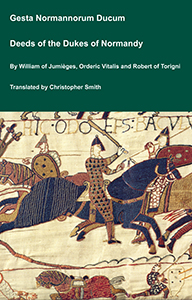
The Deeds of the Dukes of Normandy
The Gesta Normannorum Ducum [The Deeds of the Dukes of Normandy] is a landmark medieval chronicle tracing the rise and fall of the Norman dynasty from its early roots through the pivotal events surrounding the Norman Conquest of England. Originally penned in Latin by the monk William of Jumièges shortly before 1060 and later expanded at the behest of William the Conqueror, the work chronicles the deeds, politics, battles, and leadership of the Norman dukes, especially William’s own claim to the English throne. The narrative combines earlier historical sources with firsthand information and oral testimony to present an authoritative account of Normandy’s transformation from a Viking settlement into one of medieval Europe’s most powerful realms. William’s history emphasizes the legitimacy, military prowess, and governance of the Norman line, framing their expansion, including the conquest of England, as both divinely sanctioned and noble in purpose. Later chroniclers such as Orderic Vitalis and Robert of Torigni continued the history, extending the coverage into the 12th century, providing broader context on ducal rule and its impact. Today this classic work remains a foundational source for understanding Norman identity, medieval statesmanship, and the historical forces that reshaped England and Western Europe between 800AD and 1100AD.
Available at Amazon in eBook and Paperback format.
Close Rolls Edward II 1307-1313. 9th February 1308 King Edward II of England (age 23). Dover, Kent [Map]. To Alice, late wife of Roger Bigod, Earl of Norfolk and Marshall of England. Order to meet the king at Dover, Kent [Map] on his return from France with his consort about Sunday next after the Feast of the Purification of St Mary. Witnessed by Piers Gaveston 1st Earl Cornwall (age 24).
The like to:
Elizabeth, Countess of Hereford and Essex (age 25).
Henry de Lancastre (age 27).
Robert de Monte Alto.
Almaric de Sancto Amando[Ibid].
To R Archbishop of Canterbury (age 63). Order to attend the king's coronaion on Sunday next after the feast of St Valentine [14 Feb] at Westminster [Map], to execute what pertains to his office.
To the Sheriff of Surrey. Order to proclaim in market towns, etc., that no knight, esquire, or other shall, under pain of forfeiture, pressure to tourney or make jousts or bordices (torneare, justos seu burdseicas facere), or otherwise go armed at Croydon, Surrey [Map] or elsewhere before the king's coronation.
Become a Member via our Buy Me a Coffee page to read more.
On 25th February 1308 King Edward II of England (age 23) was crowned II King of England at Westminster Abbey [Map] by Henry Woodlock, Bishop of Winchester. Isabella of France Queen Consort England (age 13) was crowned Queen Consort England.
Piers Gaveston 1st Earl Cornwall (age 24) carried the Royal Crown.
William Marshal 1st Baron Marshal (age 30) carried the Gilt Spurs.
Humphrey Bohun 4th Earl Hereford 3rd Earl Essex (age 32) carried the Royal Sceptre.
Edmund Fitzalan 2nd or 9th Earl of Arundel (age 22) was Chief Butler, a heriditary office.
Henry Plantagenet 3rd Earl of Leicester 3rd Earl Lancaster (age 27) carried the Royal Rod.
Thomas Plantagenet 2nd Earl of Leicester, 2nd Earl Lancaster, Earl of Salisbury and Lincoln (age 30) carried the sword Curtana.
Roger Mortimer 1st Earl March (age 20) carried the table bearing the Royal Robes.
Thomas Grey (age 28) and Robert Fitzwalter 1st Baron Fitzwalter (age 61) attended.
Become a Member via our Buy Me a Coffee page to read more.
Close Rolls Edward II 1307-1313. 6th March 1308 King Edward II of England (age 23). Westminster Palace [Map]. To Thomas de la Hide, late steward of Cornwall and Sheriff of the same. Order to deliver to Peter de Gavaston (age 24), knight, all the farms, rents, and issues of the said County from Michaelmas last, and of the lands of the late Edmund Earl of Cornwall, the king having granted to the said Peter the county of Cornwall, and all the lands of the said Edmund.
The like to John de Tresimple, for the ferms, etc., of the manor, etc.
The like to Walter de Gloucester, escheator this side of Trent, for the ferms, etc., of the manors.
On 5th August 1309 Piers Gaveston 1st Earl Cornwall (age 25) was restored 1st Earl Cornwall.
Close Rolls Edward II 1307-1313. 16th January 1310 King Edward II of England (age 25). The Grove, Watford [Map]. To the Treasurer and the Barons of the Exchequer. Order to discharge the Abbot of Hayles of £100 yearly, the rent of the manor of Lychelad [Map], as the King granted it to Piers Gaveston 1st Earl Cornwall (age 26) and Margaret his wife.
To the same. Order to discharge the men of Wallingford, Oxfordshire [Map] of the ferm of that town from August 5 last, to Piers Gaveston 1st Earl Cornwall and Margaret his wife.
Close Rolls Edward II 1307-1313. On 16th January 1310 King Edward II of England (age 25). Stamford [Map]. To the Sheriff of York. Order to proclaim that the king does not intend to change the money current in the Kingdom in the late King's time, as had been rumoured, and to forbid anyone from thinking little of it, whereby victuals and other necessaries may be sold more dearly.
The like to all the Sheriffs of England [Ibid].
Enrolment of deed of Peter de Gavaston (age 26), knight, surrendering to the king the castle, manor, and honour of Knaresborough [Map], with the free chase of Knaresborough, and the manors of Routheclyve and Auldburgh, lately granted to him by the King for his lifetime. Witnesses: [his brother-in-law] Gilbert de Clare 8th Earl Gloucester 7th Earl Hertford (age 18), Henry Lacy 4th Earl Lincoln, Earl Salisbury (age 59), John Warenne 7th Earl of Surrey (age 23), John de Brittania, Earl of Richmond, Hugh "Elder" Despencer 1st Earl Winchester (age 48), Henry Percy 9th and 1st Baron Percy (age 36), Robert son of Walter, Robert son of Payn, William de Burford, William Inge. Dated at Stamford [Map] July 26, 3 Edward II.
Enrolment of like surrender by the said Peter of the county of Gaure and the castles of Talanon, Tantalon, and Mauleon, the provostships (preposituras) and Camparian(um) called 'la Cointal' and of the city of Bayonne, the manor of Erebafaveyra, Born, Comtad, Salmun, Dagenes, and the island of Oleron, and the lands of Marempne and of Lancras in Saintogne, and all rights, appurtenances, etc., etc., thereto pertaining to the king, which the king lately granted him for life. Witnesses as above. Dated August 4, 3 Edward II.
Memorandum, that this deed was delivered to the king in his chamber in the House of the Friars Preachers, Stamford [Map] at Stamford, by the hands of the said Peter and the king delivered the said deed to J his chancellor, to be enrolled in the chancery, and it was afterwards delivered to Ingelard de Warle, keeper of the King's Wardrobe to be kept in the king's wardrobe, but the king's charters that the said Peter hereof were not then restored.[CONTINUES].
Become a Member via our Buy Me a Coffee page to read more.
In April 1311 Parliament exiled Piers Gaveston 1st Earl Cornwall (age 27). Piers Gaveston 1st Earl Cornwall was appointed Lord Lieutenant of Ireland by King Edward II of England (age 26) who immediately started to plot for his return.
In August 1311 Piers Gaveston 1st Earl Cornwall (age 27) withdrew to Bamburgh Castle, Northumberland [Map].
On 3rd November 1311 Piers Gaveston 1st Earl Cornwall (age 27) exiled by "The New Ordinances", a series of regulations imposed upon King Edward II by the peerage and clergy of the Kingdom of England to restrict the power of the English monarch. The twenty-one signatories, consisting of eight earls, seven bishops and six barons, of the Ordinances are referred to as the Lords Ordainers:
Earls:
John Capet 4th Earl Richmond (age 45)
Henry Lacy 4th Earl Lincoln, Earl Salisbury
Guy Beauchamp 10th Earl Warwick (age 39)
[his brother-in-law] Gilbert de Clare 8th Earl Gloucester 7th Earl Hertford (age 20)
Aymer de Valence 2nd Earl Pembroke (age 36)
Bishops:
Archbishop Robert Winchelsey (age 66)
Barons:
Hugh de Vere 1st Baron Vere (age 54)
Hugh Courtenay, Baron of Okehampton (age 35).
William Marshal 1st Baron Marshal (age 34)
Robert Clifford 1st Baron Clifford (age 37)
Article 20 describes at length the offences committed by Gaveston; he was once more condemned to exile and was to abjure the realm by 1 November.
Become a Member via our Buy Me a Coffee page to read more.
On 13th January 1312 King Edward II of England (age 27) and Piers Gaveston 1st Earl Cornwall (age 28) were reunited at Knaresborough Castle [Map].
On 4th May 1312 King Edward II of England (age 28) and Piers Gaveston 1st Earl Cornwall (age 28) were at Newcastle upon Tyne Castle where they barely escaped a force led by Thomas Plantagenet 2nd Earl of Leicester, 2nd Earl Lancaster, Earl of Salisbury and Lincoln (age 34), Henry Percy 9th and 1st Baron Percy (age 39) and Robert Clifford 1st Baron Clifford (age 38). Piers Gaveston 1st Earl Cornwall escaped to Scarborough, North Yorkshire [Map], King Edward II of England to York [Map].
On 19th May 1312 Piers Gaveston 1st Earl Cornwall (age 28) surrendered to Aymer de Valence 2nd Earl Pembroke (age 37), John Warenne 7th Earl of Surrey (age 25), Henry Percy 9th and 1st Baron Percy (age 39) and Piers Gaveston 1st Earl Cornwall who were besieging the castle. The terms of the surrender were that Pembroke, Warenne and Percy would take Gaveston to York, where the barons would negotiate with the king.
On 9th June 1312 Piers Gaveston 1st Earl Cornwall (age 28), under the protection of Aymer de Valence 2nd Earl Pembroke (age 37), stayed at The Rectory, Deddington whilst en route south. Aymer de Valence 2nd Earl Pembroke left Piers Gaveston 1st Earl Cornwall there whilst he left to visit his wife. The following morning Guy Beauchamp 10th Earl Warwick (age 40), with Edmund Fitzalan 2nd or 9th Earl of Arundel (age 27), Humphrey Bohun 4th Earl Hereford 3rd Earl Essex (age 36) and John Botetort 1st Baron Botetort (age 47) arrested Piers Gaveston 1st Earl Cornwall and took him to Warwick Castle [Map].
Around 15th June 1312 Piers Gaveston 1st Earl Cornwall (age 28) was tried at Warwick Castle [Map] by Guy Beauchamp 10th Earl Warwick (age 40), Humphrey Bohun 4th Earl Hereford 3rd Earl Essex (age 36), Thomas Plantagenet 2nd Earl of Leicester, 2nd Earl Lancaster, Earl of Salisbury and Lincoln (age 34) and Edmund Fitzalan 2nd or 9th Earl of Arundel (age 27). He was condemned to death.
The Deeds of the Dukes of Normandy
The Gesta Normannorum Ducum [The Deeds of the Dukes of Normandy] is a landmark medieval chronicle tracing the rise and fall of the Norman dynasty from its early roots through the pivotal events surrounding the Norman Conquest of England. Originally penned in Latin by the monk William of Jumièges shortly before 1060 and later expanded at the behest of William the Conqueror, the work chronicles the deeds, politics, battles, and leadership of the Norman dukes, especially William’s own claim to the English throne. The narrative combines earlier historical sources with firsthand information and oral testimony to present an authoritative account of Normandy’s transformation from a Viking settlement into one of medieval Europe’s most powerful realms. William’s history emphasizes the legitimacy, military prowess, and governance of the Norman line, framing their expansion, including the conquest of England, as both divinely sanctioned and noble in purpose. Later chroniclers such as Orderic Vitalis and Robert of Torigni continued the history, extending the coverage into the 12th century, providing broader context on ducal rule and its impact. Today this classic work remains a foundational source for understanding Norman identity, medieval statesmanship, and the historical forces that reshaped England and Western Europe between 800AD and 1100AD.
Available at Amazon in eBook and Paperback format.
On 19th June 1312 Piers Gaveston 1st Earl Cornwall (age 28) was taken to Blacklow Hill, Warwickshire [Map] where he was beheaded. Earl Cornwall extinct. Blacklow Hill, Warwickshire [Map] being outside of the lands of Guy Beauchamp 10th Earl of Warwick (age 40). Gaveston's body was left where it lay eventually being recovered by Dominican friars who took it to King's Langley Priory, Hertfordshire [Map].
Lanercost Chronicle. 19th June 1312. Having surrendered, he [Piers Gaveston 1st Earl Cornwall (age 28)] was committed to the custody of Sir Aymer de Valence (age 37), Earl of Pembroke, who had ever before been his chief enemy, and about the feast of the nativity of John the Baptist, in the absence of Aymer de Valence, he was beheaded on the high road [Map] near the town of Warwick by command of the Earl of Lancaster (age 34) and the Earl of Warwick (age 40).
Patent Rolls. 16th October 1313. Westminster.
Pardon to Thomas, Earl of Lancaster (age 35), and his adherents, followers, and confederates, of all causes of anger, indignation, suits, accusations, &c, arisen in any manner on account of Peter de Gavaston, from the time of the king's marriage with his dear companion Isabella, whether on account of the capture, detention, or death of Peter de Gavaston, or on account of any forcible entries into any towns or castles, or any sieges of the same; or on account of having borne arms, or of having taken any prisoners, or of having entered into any confederacies whatever, or in any other manner touching or concerning Peter de Gavaston, or that which befel him. French. [Fœdera: Parl. Writs.]
The like, word for word, to the under-mentioned persons, adherents of Thomas, Earl of Lancaster, for the death of Peter de Gavaston, viz.-
Humphrey de Bohun (age 37), Earl of Hereford and Essex.
Guy de Beauchamp, Earl of Warwick (age 41).
Henry de Percy (age 40).
Robert de Clyfford (age 39).
John Boteturte (age 48).
Robert de Holand.
Griffith de la Pole.
John de Heselarton.
Alexander de Cave.
Thomas le fiz Johan de Heselarton.
Robert de Stepelton.
Jordan de Dalden.
Robert le Conestable of Halsham.
William du Lunde and Thomas le fiz Phelip le Mareschal of Milford.
William Trussel.
William de Dacre (age 47).
William de Holand (age 60).
William la Zusche of Haringworthe (age 48).
Continues with another two hundred or so names.
Become a Member via our Buy Me a Coffee page to read more.
On 2nd January 1315 Piers Gaveston 1st Earl Cornwall was buried at King's Langley Priory, Hertfordshire [Map] some two and a half years after his murder. The ceremony was attended by King Edward II of England (age 30) and his wife Isabella of France Queen Consort England (age 20) as well as Humphrey Bohun 4th Earl Hereford 3rd Earl Essex (age 39), Aymer de Valence 2nd Earl Pembroke (age 40), Thomas of Brotherton 1st Earl Norfolk (age 14), Bartholomew Badlesmere 1st Baron Badlesmere (age 39), Hugh Despencer 1st Baron Despencer (age 7) and his son Hugh "Younger" Despencer 1st Baron Despencer (age 29).
Annals Londonienses. [2nd January 1315] In the same year, Piers Gaveston, Earl of Cornwall, who had been killed and had not yet been buried but lay unburied at Oxford with the Friars Preachers, was now committed to the earth at Langley [Map] with great honour. For this, the king constructed a church of the Friars Preachers at that place.
Eodem anno Petrus de Gavastone, comes Cornubiæ, interfectus, et qui non fuit adhue humatus, sed apud Oxoniam jacuit inhumatus ad Fratres Prædicatores, nunc terre traditur apud Langeleie, cum maximo honore; pro quo rex construxit ecclesiam Fratrum Prædicatorum ibidem.
On 28th April 1317 Hugh Audley 1st Earl Gloucester (age 26) and [his former wife] Margaret Clare Countess Gloucester were married. She the daughter of Gilbert "Red Earl" Clare 7th Earl Gloucester 6th Earl Hertford and Joan of Acre Countess Gloucester and Hertford. They were third cousin once removed. He a great x 3 grandson of King Henry "Curtmantle" II of England. She a granddaughter of King Edward I of England.
Around 6th April 1342 [his former wife] Margaret Clare Countess Gloucester died.
Chronicle of the Monastery of Melsa Appendix 9. About King Edward II and his deeds
John de Mowbray, Roger de Clifford, and other nobles captured with him were unjustly hanged in various places in England. Indeed, King Edward himself took great delight in the vice of sodomy. He had an excessive affection for the aforementioned Peter de Gaveston and the two Hugh Despensers, who had been the instigators of the aforementioned evils. Fortune and favour seemed to be with him at all times. He hardly dared to confront his enemies in the field.
Johannes de Mowbray, Eogerus de Clyfforth, et alii nobiliores cum eo capti, in diversis locis Anglian injuste sunt suspensi. Ipse quidem Edwardus rex in vitio sodomitico nimium delectabat; dictum Petrum de Gavestona et duos Hugones Dispensatores, qui pranscriptorum malorum fuerant incentores, nimis peramabat. Fortuna ac gratia omni suo tempore carcre videbatur. Inimicos suos in campo attendere vix audebat.
Chronicle of Walter of Guisborough. Meanwhile, the truces having been broken by the Scots, who had committed many outrages, the king assembled a great army and ordered all his military service to be ready, with horses and arms, at Newcastle on the feast of the Assumption of the Blessed Virgin Mary. With the king came the Earl of Gloucester, the Earl of Warenne, and the Earl of Cornwall (whom he had newly created), Sir Henry de Percy, Sir James de Clifford, and many other barons and magnates. But the Earl of Lincoln, whom the king had appointed as keeper of all England in his absence, the Earl of Lancaster, the Earl of Pembroke, the Earl of Warwick, and the Earl of Hereford did not go with the king on account of Piers [Gaveston]. Instead, they sent their military service and, together with the Archbishop of Canterbury, they worked vigorously in London on their ordinances. On All Saints' Day, the archbishop himself, in the church of St Paul's in London, during the solemn celebration of Mass which he conducted, delivered a sermon to the people; and there, in the presence of the said earls, with all his suffragan bishops vested in full pontificals, he excommunicated all who impeded their ordinances or revealed their secrets, whether in whole or in part, before their general publication. He added that it was the will of all to ordain such things as would be to the honour of God, the exaltation of the Church and the realm, and the common peace of the people. The king, meanwhile, set out for Scotland, and, finding no resistance, destroyed, burned, and did whatever he wished, even to the coast of Scotland. When winter came, he returned to Berwick-upon-Tweed and wintered there with Queen Isabella his wife and his magnates. When the month of March arrived, the king began another ride into Scotland; but, finding no resistance, and as fodder for the horses ran short, he again returned to Berwick and stayed there. He then sent the new Earl of Cornwall [Gaveston] with the strength of the army against the Scots, so that he might gain a name for himself and win renown. The earl crossed into Scotland and made a vigorous show for many days; but he could not achieve any good result, because the Scots, fleeing before him, always had their refuges in the mountains and marshes.
Interim fractis treugis ex parte Scotorum, cum The King multa mala fecissent, congregavit rex exercitum invade grandem, et omne servitium suum militare mandavit ut die Assumptionis beatæ Mariæ essent cum equis et armis apud Novum Castrum parati. Veneruntque cum rege comes Gloucestriæ, comes Warennæ, et comes Cornubiæ quem de novo creaverat, dominus Henricus de Percy, dominus Jacobus de Clyfford, et multi alii barones et magnates. Comes vero Lincolniæ, quem præfecerat rex custodem totius Angliæ in absentia sua, comes Langcestriæ, comes de Penbrok, comes de Warwick et comes de Hereford, non iverunt cum rege propter Petrum. Servitium autem suum mandaverunt, et ipsi cum domino archiepiscopo Cantuariensi Londoniis viriliter insisterunt circa ordinationes suas. Ita quod die Omnium Sanctorum ipse dominus archiepiscopus in ecclesia Sancti Pauli Londoniis, intra missarum solemnia quæ celebravit, facto sermone ad populum, coram ipsis comitibus, cum omnibus suffraganeis suis in pontificalibus revestitis, excommunicavit omnes impedientes ordinationes suas, vel eorum secreta revelantes in toto vel in parte, usque ad communem earundem publicationem; adjecitque, quod omnium erat una voluntas ordinare talia quæ essent ad honorem Dei, exaltationem ecclesiæ et regni, et communem quietem populi. Rex vero cum suis profectus in Scotiam, et nullo invento obstaculo, consumpsit, combussit, et omnia quæcunque voluit fecit, usque ad mare Scotia; et superniente hieme reversus est usque ad Berewick super Tuedam, et hiemavit ibi cum regina uxore sua et magnatibus suis. Adveniente vero mense. Martii, cœpit rex equitare in Scotiam; et cum nullum invenisset obstaculum, defeceruntque paleæ pro pabulo equorum, reversus est iterato ad Berewick et mansit ibidem. Misitque novum comitem Cornubiæ cum robore exercitus contra Scotos, ut nomen sibi acquireret et laudem. Qui mare Scotiæ transiit, et strenue se per multos dies; ad factum tamen bonum non potuit pervenire pro eo quod Scoti, eum fugientes, in montibus et mariscis sua semper receptacula habuerunt.
Become a Member via our Buy Me a Coffee page to read more.
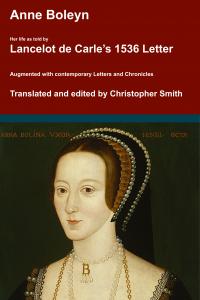
Anne Boleyn. Her Life as told by Lancelot de Carle's 1536 Letter.
In 1536, two weeks after the execution of Anne Boleyn, her brother George and four others, Lancelot du Carle, wrote an extraordinary letter that described Anne's life, and her trial and execution, to which he was a witness. This book presents a new translation of that letter, with additional material from other contemporary sources such as Letters, Hall's and Wriothesley's Chronicles, the pamphlets of Wynkyn the Worde, the Memorial of George Constantyne, the Portuguese Letter and the Baga de Secrets, all of which are provided in Appendices.
Available at Amazon in eBook and Paperback format.
Chronicle of Walter of Guisborough. During his fathers lifetime, the king (i.e., Edward II) had a certain knight who was most familiar and dear to him, a man of Gascon origin, whom he had raised, while still Prince of Wales, from almost nothing1, and whom because of the depth of his affection he enriched as much as he could. This man was named Peter de Gaveston. Wishing to promote him even further, he summoned his fathers treasurer, whom the king his father had loved singularly, and whom he had elevated from a poor cleric to the rank of bishop. This man was the Bishop of Chester and the overseer of the kingdoms most difficult affairs, a man of great imagination and cunning, named Walter de Langton.
In vita patris sui habuit rex quendam militem sibi familiarissimum de Wasconia oriundum, quem cum esset princeps Walliæ, quasi ex nihilo suscitaverat, et pro amoris magnitudine quo dilexit eum pro posse ditaverat, Petrum de Caberston proprio nomine nominatum. Hunc cum adhuc uberius promovere vellet, vocavit ad se thesaurarium patris sui, quem pater suus rex singulariter dilexit, et a clerico paupere usque in episcopalem gradum fecerat promoveri; erat enim episcopus Cestriæ et ordinator negotiorum arduorum totius regni, sicut homo imaginosus et cautissimus, nomine Walterus de Langeton.
Note 1. Edward I caused Piers Gaveston to be educated with the Prince of Wales, in reward for the brave services of his father. Trokelowe, Annal. Edward II ed. Hearne, p. 5.