

Annals of the six Kings of England by Nicholas Trivet
Translation of the Annals of the Six Kings of England by that traces the rise and rule of the Angevin aka Plantagenet dynasty from the mid-12th to early 14th century. Written by the Dominican scholar Nicholas Trivet, the work offers a vivid account of English history from the reign of King Stephen through to the death of King Edward I, blending political narrative with moral reflection. Covering the reigns of six monarchs—from Stephen to Edward I—the chronicle explores royal authority, rebellion, war, and the shifting balance between crown, church, and nobility. Trivet provides detailed insight into defining moments such as baronial conflicts, Anglo-French rivalry, and the consolidation of royal power under Edward I, whose reign he describes with particular immediacy. The Annals combines careful year-by-year reporting with thoughtful interpretation, presenting history not merely as a sequence of events but as a moral and political lesson. Ideal for readers interested in medieval history, kingship, and the origins of the English state, this chronicle remains a valuable and accessible window into the turbulent world of the Plantagenet kings.
Available at Amazon in eBook and Paperback format.
02 Dec is in December.
1307 Tournament at Wallingford
1529 Henry VIII Creates New Peerages
1546 Execution of Henry Howard, Earl of Surrey
1551 Trial and Execution of Edward Seymour Duke of Somerset and his Supporters
On 2nd December 1022 Alfonso "Noble" V King Leon (age 28) and Urraca Jiménez Queen Consort Leon were married. She by marriage Queen Consort Leon. She the daughter of García Sánchez "Tremulous" II King Pamplona and Jimena Fernández Bermúdez Queen Consort Pamplona. He the son of Bermudo "Gouty" II King Galicia II King Leon and Elviro Garcia Queen Galicia. They were half first cousins.
On 2nd December 1022 Elvira González Queen Consort Leon (age 26) died.
On 2nd December 1079 Mabel de Bellême (age 44) was murdered.
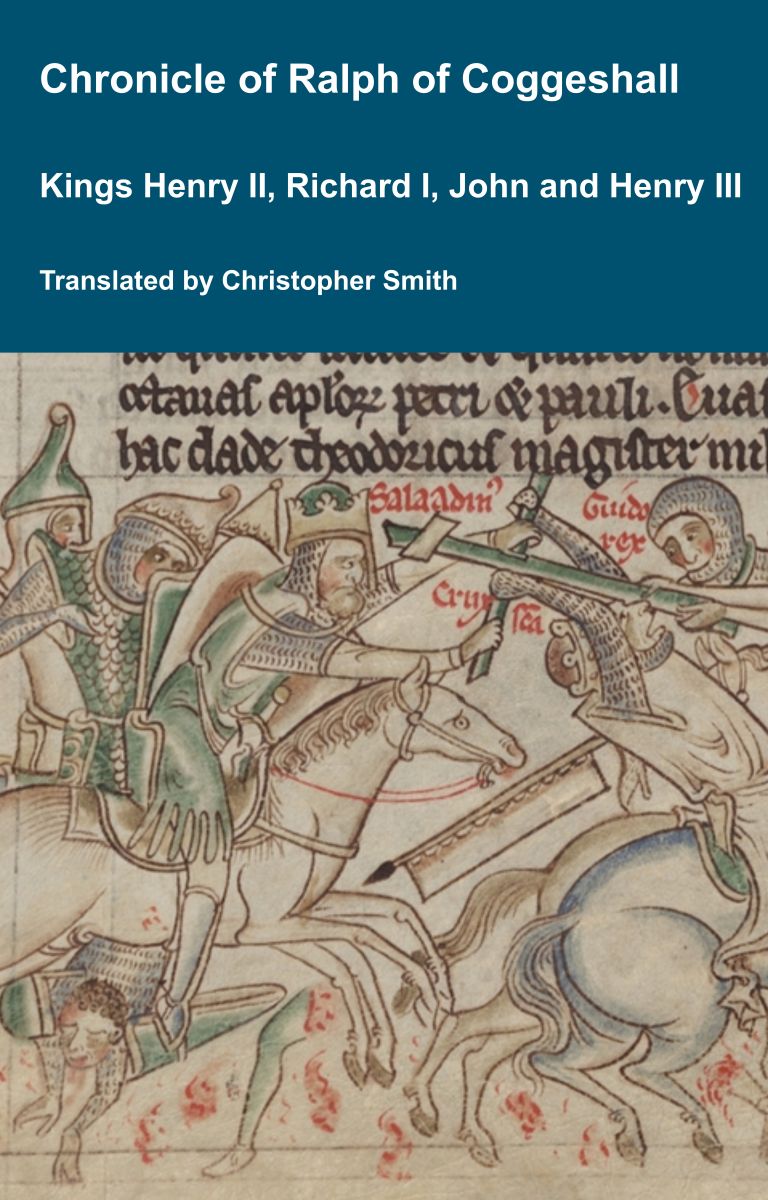 Chronicum Anglicanum by Ralph Coggeshall. King Henry I died1 the fourth day before the Nones of December [2nd December 1135]. His body was embalmed with salt after being eviscerated and was transported to England, where it was buried at Reading Abbey, a monastery he himself had founded. His nephew Stephen succeeded him as king. Stephen was the son of Stephen, Count of Blois, and Adela, daughter of King William the Conqueror. Adela had also given birth to Count Theobald. King Stephen had married Matilda, whose mother Maria was the sister of Queen Matilda. Their father was King Malcolm of Scotland. Matilda was the daughter of Eustace, Count of Boulogne, who held the honour of Boulogne. This Eustace was the brother of Godfrey, Duke of Lower Lorraine, who later became King of Jerusalem, and of Baldwin, Count of Rethel, who succeeded his brother Godfrey as King of Jerusalem. From Queen Matilda and King Stephen, two sons were born: Eustace, Count of Boulogne William, Count of Warenne They also had a daughter, who was removed from a convent and given in marriage to Count Matthew, the brother of Philip, Count of Flanders. From this marriage, two daughters were born: one married the Duke of Brabant, the other, after three marriages, married the son of the Count of Dammartin.
Obiit rex Henricus quarto nonas Decembris, cujus corpus exenteratum ac sale conditum delatum est in Angliam, et apud monasterium de Redinghes, quod ipse fundaverat, humatum est. Cui successit Stephanus, nepos ejus ex sorore, filius Stephani comitis Blesensis, qui illum et comitem Theobaldum ex filia regis Willelmi Bastardi genuerat. Porro rex Stephanus duxerat uxorem Mathildem (cujus mater dicebatur Maria, soror regine Mathildis, quarum pater rex Malcomus) filiam Eustachii comitis Boloniensis, cum honore Bolonize. Hic Eustachius frater extitit Godefridi ducis Lothariz, et postmodum regis Hierosolymitani, et frater Baldewini comitis de Roheise, qui postea rex Hierosolymitanus post fratrem suum Godefridum effectus est. De ista regina Mathildi et pio rege Stephano natus est Eu stachius comes Bolonize, et Willelinus comes Warenniz. Quamdam etiam filiam habuerunt, quae de monasterio sanctimonialium postmodum abstracta, comiti Matthaeo fratri Philippi comitis Flandrensis traditur in uxorem ex qua duas habuit filias, quarum una data est duci Luvane, alia vero post tertium maritum nupsit filio comitis de Dammartin.
Note 1. Most sources state King Henry died on the Kalends i.e. the 1st of December 1135.
Roger of Wendover: "Whilst king Henry was in Normandy, he one day returned from hunting, and stopped at St. Denys, in the wood of Lions, to eat some lampreys, a fish which he was very fond of, though they always disagreed with him, and the physicians had often cautioned him against eating them, but he would not listen to their advice. This food mortally chilled the old man's blood, and caused a sudden and violent illness, against which nature struggled, and brought on an acute fever, in the effort to resist the worst effects of the disease. Unable to overcome the malady, this great king died on the first day of December, after he had reigned thirty-five years and three months."
Orderic Vitalis: "Meanwhile, Henry king of England, having arrived at the castle of Lions on the seventh of the calends of December [25th November 1135], gave orders to his huntsmen to be ready to attend him for the chace in the woods on the next day. But during the night he suddenly fell sick, and lay at the point of death from Tuesday till the following Sunday. In the course of that time he confessed his sins to his chaplains; and then, sending for Hugh, archbishop of Rouen, he requested his spiritual counsels. ... Lastly, this catholic prince besought all persons to preserve peace and protect the poor. Then, after having made his confession, he received penance and absolution from the priests, and receiving extreme unction, and being strengthened by the holy eucharist, commended himself to God, and departed this life on the calends of December [1st December 1135], being Sunday, early in the night."
William of Malmesbury: "He [King Henry] reigned, then, thirty-five years, and from the nones of August to the kalends of December [1st December 1135], that is, four months, wanting four days. Engaged in hunting at Lihun, he was taken suddenly ill. His malady increasing, he summoned to him, Hugo, whom, from prior of Lewes, he had made abbot of Reading, and afterwards archbishop of Rouen, who was justly indebted to him and his heirs for such great favours. The report of his sickness quickly gathered the nobility around him. Robert, too, his son, the earl of Gloucester, was present; who, from his unblemished fidelity and matchless virtue, has deserved to be especially signalized throughout all ages. Being interrogated by these persons, as to his successor, he awarded all his territories, on either side of the sea, to his daughter, in legitimate and perpetual succession; being somewhat displeased with her husband, as he had irritated him both by threats and by certain injuries. Having passed the seventh day of his sickness, he yielded to nature about midnight."
History of the Dukes of Normandy by William of Jumieges. After a long administration of his realm, the oft-mentioned Henry, king of the English and duke of the Normans, died on the fourth day before the Nones of December [2nd December]1 in the year of the Incarnation of our Lord Jesus Christ 1135, in Normandy, at the place called Lyons-la-Forêt, which by a kind of metonymy they call Saint-Denis. He reigned thirty-four years and four months in England, and ruled the duchy of Normandy twenty-nine years and four months. His body, however, having been brought to England, was honourably buried in the church of St. Mary at Reading, which he himself had built from its foundations at his own expense. May Christ, the King of the Ages, grant to him, through the prayers of His Mother, forgiveness of his sins and mercifully bestow upon him the joys of the blessed. He who with the Father and the Holy Spirit lives and reigns, God, forever and ever. Amen.
Decessit autem post longam regni administrationem sæpe nominatus Henricus rex Anglorum et dux Northmannorum, IV Nonas Decembris, anno ab Incarnatione Domini nostri Jesu Christi 1135, in Northmannia, apud Villamregiam sitam in silva Leonis, quam per metonomiam Sanctum Dionysium vocant. Regnavit autem annis 34 et 4 mensibus in Anglia. Ducatui vero Northmanniæ præfuit annis 29 et mensibus quatuor. Corpus autem ipsius delatum in Angliam, honorifice sepultum est in ecclesia Sanctæ Mariæ Radingis, quam ipse a fundamentis suis sumptibus ædificaverat. Cui rex sæculorum Christus precibus suæ genitricis indulgentiam suorum ex cessuum conferens, beatorum gaudia misericorditer tribuat. Qui cum Patre et Spiritu sancto vivit et regnat Deus, per omnia sæcula sæculorum. Amen.
Note 1. Other sources described King Henry dying on the 1st of December: Roger of Wendover: "Whilst king Henry was in Normandy, he one day returned from hunting, and stopped at St. Denys, in the wood of Lions, to eat some lampreys, a fish which he was very fond of, though they always disagreed with him, and the physicians had often cautioned him against eating them, but he would not listen to their advice. This food mortally chilled the old man's blood, and caused a sudden and violent illness, against which nature struggled, and brought on an acute fever, in the effort to resist the worst effects of the disease. Unable to overcome the malady, this great king died on the first day of December [1135], after he had reigned thirty-five years and three months. His death was foreshown by a violent wind, which, on the eve of the apostles Simon and Jude [28th October], cast down towers, and houses, and trees on every side: the moon also was eclipsed the same year, on the 29th of July.
Orderic Vitalis: "Lastly, this catholic prince besought all persons to preserve peace and protect the poor. Then, after having made his confession, he received penance and absolution from the priests, and receiving extreme unction, and being strengthened by the holy eucharist, commended himself to God, and departed this life on the calends [1st] of December, being Sunday, early in the night. There were then assembled five counts, Robert of Gloucester, William de Warrenne, Rotrou of Mortain, Waleran of Mellent, and Robert of Leicester, besides several other lords, captains, and noble castellans: all of whom were entreated by Hugh the archbishop, and Ouen, bishop of Evreux, not to forsake their master's corpse unless by common consent, but to conduct it to the sea side, all together, in an honourable escort."
Richard Baker: "A discontent of minde upon some differences between him and his son-in-law, the Earl of Anjou, brought upon him a distemper which encreased by eating against his Physicians advice, of a Lamprey, a meat alwayes pleasing to him, but never agreeing with him, cast him into a Feaver, which in few dayes put a period to his life: So certain it is, that one intemperate action is enough to overthrow the temperance of a whole life; as of this King Henry it is said, that he seldom did eat but when he was hungry never did drink but when he was a thirst: yet this but once yieldiing to his sensual appetite, made him forfeit all benefit of his former abstinence, though some write he took his death by a fall off his Horse. He dyed upon the first of December at night, in the year 1155. when he had reigned five and thirty years, lived threescore and seven."
On 2nd December 1307 King Edward II of England (age 23) held a tournament to celebrate Piers Gaveston's (age 23) recent wedding. Gaveston took the opportunity to humiliate the older nobility including John Warenne 7th Earl of Surrey (age 21), Humphrey Bohun 4th Earl Hereford 3rd Earl Essex (age 31) and Edmund Fitzalan 2nd or 9th Earl of Arundel (age 22) further increasing his unpopularity.
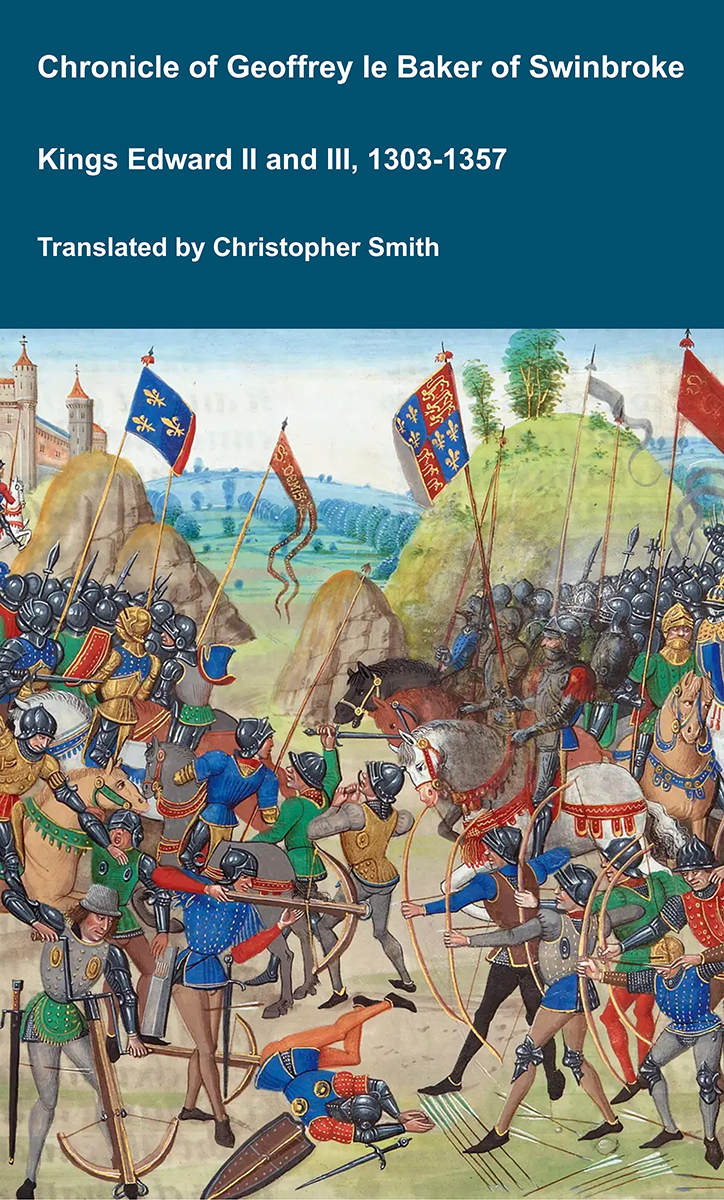 Chronicle of Geoffrey le Baker of Swinbroke [-1360]. In this year, around the Feast of the Nativity of the Lord, Henry (age 48),1 Bishop of Lincoln, and Sir Geoffrey Scrope (deceased), the king's chief justice and one of his principal counsellors, died in Ghent.
Hoc anno, circa Nativitatem Domini, Henricus episcopus Lin-colniensis et dominus Galfridus Scroup, iusticiarius, regis principales conciliarii, in Gandavo obierunt.
Note 1. On 4th December 1340 and 2nd December 1340 respectively.
Chronicle of Geoffrey le Baker of Swinbroke [-1360]. On Wednesday, the prince arrived at La Réole, whose horses and wagons crossed the River Garonne at a place where, according to memory, no horse had ever crossed before. At La Réole, following a council held by the prince, lords and barons were assigned to winter in various designated locations along the frontier, within the interior of Gascony, in order to defend against the cunning of the French. These men, often departing1 from the positions wisely assigned and well-guarded for them, undertook many distinguished efforts and brought back rich plunder from enemy territory, both to sustain the armed youth and to enrich their loyal homeland, of which I cannot treat in detail without overstepping the limits of this account.
Die Mercurii dominus princeps advenit Regulam, cuius equi et quadrige transierunt flumen de Geronde in loco ubi numquam antea memoratu aliquis equus transmeavit. In Regula concilio principis consulto, ordinati fuerunt principes et barones ad hyemandum in distinctis locis super marchiam, patriam intrinsecam Vasconie contra versucias Gallicorum protecturi, qui, a locis eis deputatis et sapienter custoditis crebro digressi, multos egregios labores superarunt, nec minus predas opulentas ab hostili patria detulerunt, in sustentacionem armate iuventutis et ditacionem patrie devote, de quibus singillatim sine dispendio non potero tractare.
Note 1. See, for example, the letter of sir John Wingfield to sir Richard Stafford, giving an account of military movements Avesbury 445.
Chronicle of Gregory [1400-1467]. 2nd December 1450. Ande that same year, the ij day of Decembyr, the Duke of Somersett (age 44) was a-tachide in the Fryer Prechourys at London. And that day he was robbyde of alle his goodys, and his jewyllys were takyn and borne a-way by lordys mayny. Ande in the morowe they dyspoylyd the placys and longgynges of many dyvers lordys, and they bare away alle the goodys that were with ynne hem, that is to say, Syr Thomas Stodenham (age 49)a, a thenne beynge wardroper, Syr Thomas Hoo (age 54) the lord Hastynge, some tyme the Chambyrlayne of Normandy.
Note a. Todenham.
Chronicle of Gregory [1400-1467]. 2nd December 1450. And that same day, the aftyr non, the Duke of Yorke (age 39) roode - thoroughe London. And he made to be cryde in dyvers placys that whatb maner a man that robbyd or ryfylde any persone schulde have as hastely jewys as the said man hadde. And uppon Thursday nexte folowynge the King come fro Westemyster, ryddyng thoroughe London; and whythe the Duke of Yorke, and the moste dele in substans of alle the lordys in this londe, with her retenowys of fensabylle men; whyche was a gay and a gloryus syght if hit hadde ben in Fraunce, but not in Ingelonde, for it boldyd some mennys hertys that it causyd aftyr many mannys dethe. Wher was or is the defaute I wotte not, &c.
Note b. what repeated in the MS.
Patent Rolls. 2nd December 1461. Westminster Palace [Map]. Grant for life to the king's (age 19) kinsman John, Earl of Worcester (age 34), of the office of the constable of the Tower of London, with the accustomed fees.
In early December 1529 King Henry VIII of England and Ireland (age 38) created five Baronies...
On 1st December 1529...
Andrew Windsor 1st Baron Windsor (age 62) was created 1st Baron Windsor of Stanwell in Buckinghamshire. Elizabeth Blount Baroness Windsor (age 60) by marriage Baroness Windsor of Stanwell in Buckinghamshire.
John Hussey 1st Baron Hussey of Sleaford (age 64) was created 1st Baron Hussey of Sleaford. Anne Grey Baroness Hussey Sleaford (age 39) by marriage Baroness Hussey of Sleaford.
On 2nd December 1529...
Thomas Wentworth 1st Baron Wentworth (age 28) was created 1st Baron Wentworth. Margaret Fortescue Baroness Wentworth (age 27) by marriage Baroness Wentworth.
Thomas Burgh 7th Baron Cobham 5th Baron Strabolgi 1st Baron Burgh (age 41) was created 1st Baron Burgh. Agnes Tyrwhitt Baroness Cobham, Strabolgi and Burgh (age 48) by marriage Baroness Burgh. This is regarded as a new creation rather than a continuation of the previous creation Baron Burgh since Thomas's father was never summoned to Parliament due to his insanity. Some sources refer to Thomas as the 3rd Baron Burgh.
On 4th December 1529 Edmund Braye 1st Baron Braye (age 45) was created 1st Baron Braye by writ, which means that it can descend through both male and female lines.


The History of England under Henry VIII 1546. 2nd December 1546. The first that manifested himself was Sir Richard Southwel (age 43), who (Dec. 2.) said that he knew certain things of the earl, that touched his fidelity to the king: the earl, before the Lord Chancellor Wriothesley (age 40), the Lord St. John, the Earl of Hertford, and others, vehemently (Dec. 2.) affirmed himself a true man, desiring to be try'd by justice, or else offering himself to fight in his shirt with Southwel: but the lords for the present only committed them. The duke this while, hearing his son was in trouble, sends (Dec. 3. 4.) to divers of his friends to know the cause, and particularly to the Bishop of Winchester: those letters yet (it is probable) fell into the king's council's hands; but could not preserve him from being involved in his son's fortune: so that (Dec. 12.) he was sent for, and the same day, not long after his son, committed to the Tower. Divers persons also were examined concerning his affairs. Mrs. Elizabeth Holland being disposed, confess'd, that the duke had told her, that none of the king's council loved him, because they were no noblemen born themselves; as also because he believ'd too truly in the sacrament of the altar. Moreover, that the king loved him not, because he was too much lov'd in his country; but that he would follow his father's lesson, which was. that the less others set by him, the more he would set by himself. As also, that the duke complain'd that he was not of the most secret (or, as it is there term'd, the privy) council. And that the king was much grown of his body, and that he could not go up and down the stairs, but was let up and down by a device. And that his majesty was sickly, and could not long endure; and the rea.lm like to be in an ill case thro' diversity of opinions. And that if he were a young man, and the realm in quiet, he would ask leave to see the vernacle; which he said, was the picture of Christ given to women by himself as he went to death. As touching his arms, that she had not heard the duke speak of his own, but of his son's, that he liked them not, and that he had gather'd them, himself knew not from whence; and that he placed the Norfolk's arms wrong, and had found fault with him: and therefore that she should take no pattern of his son's arms to work them with her needle in his house, but as he gave them. Furthermore, she confess'd that the Earl of Surrey lov'd her not, nor the Dutchess of Richmond him; and that she addicted herself much to the said dutchess.
Mary Dutchess of Richmond being examin'd, confess'd that the duke her father wou'd have had her marry Sir Thomas Seymour, brother to the Earl of Hertford, which her brother also desir'd, wishing her withal to endear her self so into the king's favour, as she might the better rule here as others had done; and that she refused: and that her father would have had the Earl of Surrey to have matched with the Earl of Hertford's daughter, which her brother likewise heard of (and that this was the cause of his father's displeasure) as taking Hertford to be his enemy. And that her brother was so much incens'd against the said earl, as the duke his father said thereupon, his son would lose as much as he had gather'd together.


Chronicle of Greyfriars. 2nd December 1551. Item the nexte day was the lorde Gray with dyvers other that ware in the tower [Map] was browte unto Westmester unto the starre chamber, and sent home agayne.
Abbot John Whethamstede’s Chronicle of the Abbey of St Albans
Abbot John Whethamstede's Register aka Chronicle of his second term at the Abbey of St Albans, 1451-1461, is a remarkable text that describes his first-hand experience of the beginning of the Wars of the Roses including the First and Second Battles of St Albans, 1455 and 1461, respectively, their cause, and their consequences, not least on the Abbey itself. His text also includes Loveday, Blore Heath, Northampton, the Act of Accord, Wakefield, and Towton, and ends with the Coronation of King Edward IV. In addition to the events of the Wars of the Roses, Abbot John, or his scribes who wrote the Chronicle, include details in the life of the Abbey such as charters, letters, land exchanges, visits by legates, and disputes, which provide a rich insight into the day-to-day life of the Abbey, and the challenges faced by its Abbot.
Available at Amazon in eBook and Paperback format.
Henry Machyn's Diary. 2nd December 1554. The ij day of Desember dyd com to Powlles all prestes and clarkes with ther copes and crosses, and all the craftes in ther leverey, and my lorde mayre and the althermen, agaynst my lord cardenall('s) (age 54) commyng; and at the bysshopes of London plase my lord chansseler and alle the bysshopes tarehyng for my lord cardenall commyng, that was at ix of the cloke, for he landyd at Beynard Castell [Map]; and ther my lord mayre reseyvyd hym, and browgth ym to the Powllse, and so my lord chanseler (age 71) and my lord cardenall and all the byshopes whent up in-to the[choir] ]with ther meyturs; and at x of the cloke the Kyng('s) (age 27) grace cam to Powlles to her mase with iiij C. of gaard, on C. Englys, on C. HeAlmen, on C. Spaneards, on C. of Swechenars [Switzers], and mony lords and knyghtes, and hard masse. Boyth the quen('s) chapell and the kynges and Powlles qwer [choir] song.
Note. P. 77. The cardinal's coming to St. Paul's. A fuller account of this solemnity will be found in Stowe, p. 625. Like his predecessor Wolsey, Pole went in procession "with a cross, two pillars, and two poleaxes of silver borne before him."


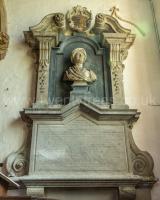
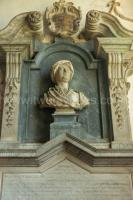
After 2nd December 1608. St Vincent's Church, Caythorpe [Map]. Memorial to Charles Hussey of Honington (deceased).
Charles Hussey of Honington: Around 1535 he was born to Robert Hussey and Jane Stydolf. Before 10th October 1585 Charles Hussey of Honington and Ellen Birch were married. On 2nd December 1608 Charles Hussey of Honington died.
On 2nd December 1660 Archbishop Richard Sterne (age 64) was consecrated Bishop of Carlisle.
John Evelyn's Diary. 2nd December 1666. Dined with me Monsieur Kiviet (age 39), a Dutch gentleman-pensioner of Rotterdam, who came over for protection, being of the Prince of Orange's (age 16) party, now not welcome in Holland. The King (age 36) knighted him for some merit in the Prince's behalf. He should, if caught, have been beheaded with Monsieur Buat, and was brother-in-law to Van Tromp, the sea-general. With him came Mr. Gabriel Sylvius, and Mr. Williamson (age 33), secretary to Lord Arlington (age 48); M. Kiviet came to examine whether the soil about the river of Thames would be proper to make clinker bricks, and to treat with me about some accommodation in order to it.

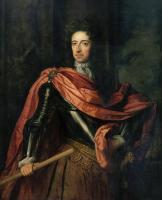


Samuel Pepys' Diary. 2nd December 1666. Lord's Day. Up, and to church, and after church home to dinner, where I met Betty Michell and her husband, very merry at dinner, and after dinner, having borrowed Sir W. Pen's (age 45) coach, we to Westminster, they two and my wife and I to Mr. Martin's, where find the company almost all come to the christening of Mrs. Martin's child, a girl. A great deal of good plain company. After sitting long, till the church was done, the Parson comes, and then we to christen the child. I was Godfather, and Mrs. Holder (her husband, a good man, I know well), and a pretty lady, that waits, it seems, on my Lady Bath (age 53), at White Hall, her name, Mrs. Noble, were Godmothers. After the christening comes in the wine and the sweetmeats, and then to prate and tattle, and then very good company they were, and I among them. Here was old Mrs. Michell and Howlett, and several married women of the Hall, whom I knew mayds. Here was also Mrs. Burroughs and Mrs. Bales, the young widow, whom I led home, and having staid till the moon was up, I took my pretty gossip to White Hall with us, and I saw her in her lodging, and then my owne company again took coach, and no sooner in the coach but something broke, that we were fain there to stay till a smith could be fetched, which was above an hour, and then it costing me 6s. to mend.
Samuel Pepys' Diary. 2nd December 1667. Thence to Lord Crew's, and there dined with him; where, after dinner, he took me aside, and bewailed the condition of the nation, how the King (age 37) and his brother are at a distance about this business of the Chancellor (age 58), and the two Houses differing. And he do believe that there are so many about the King like to be concerned and troubled by the Parliament, that they will get him to dissolve or prorogue the Parliament; and the rather, for that the King is likely, by this good husbandry of the Treasury, to get out of debt, and the Parliament is likely to give no money. Among other things, my Lord Crew (age 69) did tell me, with grief, that he hears that the King of late hath not dined nor supped with the Queen (age 29), as he used of late to do. After a little discourse, Mr. Caesar, he dining there, did give us some musique on his lute (Mr. John Crew being there) to my great content, and then away I, and Mr. Caesar followed me and told me that my boy Tom hath this day declared to him that he cared not for the French lute and would learn no more, which Caesar out of faithfulness tells me that I might not spend any more money on him in vain. I shall take the boy to task about it, though I am contented to save my money if the boy knows not what is good for himself. So thanked him, and indeed he is a very honest man I believe, and away home, there to get something ready for the Lords Commissioners of the Treasury, and so took my wife and girle and set them at Unthanke's, and I to White Hall, and there with the Commissioners of the Treasury, who I find in mighty good condition to go on in payment of the seamen off, and thence I to Westminster Hall [Map], where I met with my cozen Roger (age 50) and walked a good while with him; he tells me of the high vote of the Commons this afternoon, which I also heard at White Hall, that the proceedings of the Lords in the case of my Lord Clarendon are an obstruction to justice, and of ill precedent to future times. This makes every body wonder what will be the effect of it, most thinking that the King will try him by his own Commission. It seems they were mighty high to have remonstrated, but some said that was too great an appeale to the people. Roger is mighty full of fears of the consequence of it, and wishes the King would dissolve them. So we parted, and I bought some Scotch cakes at Wilkinson's in King Street, and called my wife, and home, and there to supper, talk, and to bed. Supped upon these cakes, of which I have eat none since we lived at Westminster. This night our poor little dogg Fancy was in a strange fit, through age, of which she has had five or six.


Samuel Pepys' Diary. 2nd December 1668. Up, and at the office all the morning upon some accounts of Sir Prince, and at noon abroad with W. Hewer (age 26), thinking to have found Mr. Wren (age 39) at Captain Cox's, to have spoke something to him about doing a favour for Will's uncle Steventon, but missed him. And so back home and abroad with my wife, the first time that ever I rode in my own coach, which do make my heart rejoice, and praise God, and pray him to bless it to me and continue it. So she and I to the King's playhouse, and there sat to avoid seeing Knepp in a box above where Mrs. Williams happened to be, and there saw "The Usurper"; a pretty good play, in all but what is designed to resemble Cromwell and Hugh Peters, which is mighty silly. The play done, we to White Hall; where my wife staid while I up to the Duchesse's (age 31) and Queen's (age 30) side, to speak with the Duke of York (age 35): and here saw all the ladies, and heard the silly discourse of the King (age 38), with his people about him, telling a story of my Lord Rochester's (age 21) having of his clothes stole, while he was with a wench; and his gold all gone, but his clothes found afterwards stuffed into a feather bed by the wench that stole them. I spoke with the Duke of York, just as he was set down to supper with the King, about our sending of victuals to Sir Thomas Allen's (age 35) fleet hence to Cales [Cadiz] to meet him. And so back to my wife in my coach, and so with great content and joy home, where I made my boy to make an end of the Reall Character, which I begun a great while ago, and do please me infinitely, and indeed is a most worthy labour, and I think mighty easy, though my eyes make me unable to attempt any thing in it. To-day I hear that Mr. Ackworth's cause went for him at Guildhall [Map], against his accusers, which I am well enough pleased with.


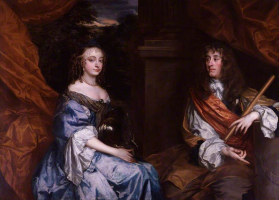


On 2nd December 1680 William Ellis (age 71) died. He was buried at Nocton, North Kesteven where he has a monument attributed to William Stanton (age 41).
William Ellis: In 1609 he was born.

On 2nd December 1682 Henry Somerset 1st Duke Beaufort (age 53) was created 1st Duke Beaufort by King Charles II of England Scotland and Ireland (age 52). Mary Capell Duchess Beaufort (age 52) by marriage Duchess Beaufort.

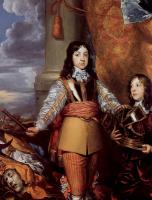


John Evelyn's Diary. 2nd December 1688. Dr. Tenison (age 52) preached at St. Martin's [Map] on Psalm xxxvi. 5, 6, 7, concerning Providence. I received the blessed Sacrament. Afterward, visited my Lord Godolphin (age 43), then going with the Marquis of Halifax (age 55) and Earl of Nottingham (age 41) as Commissioners to the Prince of Orange (age 38); he told me they had little power. Plymouth, Devon [Map] declared for the Prince. Bath, Somerset [Map], York [Map], Hull [Map], Bristol, Gloucestershire [Map], and all the eminent nobility and persons of quality through England, declare for the Protestant religion and laws, and go to meet the Prince, who every day sets forth new Declarations against the Papists. The great favorites at Court, Priests and Jesuits, fly or abscond. Everything, till now concealed, flies abroad in public print, and is cried about the streets. Expectation of the Prince coming to Oxford, Oxfordshire [Map]. The Prince of Wales and great treasure sent privily to Portsmouth, Hampshire [Map], the Earl of Dover (age 52) being Governor. Address from the Fleet not grateful to his Majesty (age 55). The Papists in offices lay down their commissions, and fly. Universal consternation among them; it looks like a revolution.


On 2nd December 1690 John Ernest Saxe Coburg Saalfeld IV Duke Saxe Coburg Saalfeld (age 32) and Charlotte Johanna Waldeck Wildungen Duchess Saxe Coburg Saalfeld were married at Maastricht. She by marriage Duchess Saxe Coburg Saalfeld. He the son of Ernest "The Pious" Saxe Gotha I Duke Saxe Gotha and Elisabeth Sophie Saxe Altenburg Duchess Saxe Gotha.
John Evelyn's Diary. 2nd December 1697. Thanksgiving Day for the Peace, the King (age 47) and a great Court at Whitehall [Map]. The Bishop of Salisbury (age 54) preached, or rather made a florid panegyric, on 2 Chron. ix. 7, 8. The evening concluded with fireworks and illuminations of great expense.


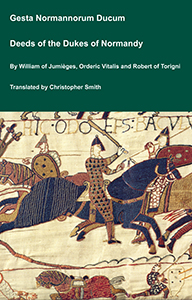
The Deeds of the Dukes of Normandy
The Gesta Normannorum Ducum [The Deeds of the Dukes of Normandy] is a landmark medieval chronicle tracing the rise and fall of the Norman dynasty from its early roots through the pivotal events surrounding the Norman Conquest of England. Originally penned in Latin by the monk William of Jumièges shortly before 1060 and later expanded at the behest of William the Conqueror, the work chronicles the deeds, politics, battles, and leadership of the Norman dukes, especially William’s own claim to the English throne. The narrative combines earlier historical sources with firsthand information and oral testimony to present an authoritative account of Normandy’s transformation from a Viking settlement into one of medieval Europe’s most powerful realms. William’s history emphasizes the legitimacy, military prowess, and governance of the Norman line, framing their expansion, including the conquest of England, as both divinely sanctioned and noble in purpose. Later chroniclers such as Orderic Vitalis and Robert of Torigni continued the history, extending the coverage into the 12th century, providing broader context on ducal rule and its impact. Today this classic work remains a foundational source for understanding Norman identity, medieval statesmanship, and the historical forces that reshaped England and Western Europe between 800AD and 1100AD.
Available at Amazon in eBook and Paperback format.

On 2nd December 1706 Grace Fenwick Lady Loraine (age 67) died. She was buried at St Wilfrid's Church, Kirkharle [Map].
Grace Fenwick Lady Loraine: Around 1639 she was born to William Fenwick 2nd Baronet and Jane Stapilton. On 15th May 1651 Thomas Loraine 1st Baronet and she were married. On 26th September 1664 Thomas Loraine 1st Baronet was created 1st Baronet Loraine of Kirkharle in Northumberland. She by marriage Lady Loraine of Kirkharle in Northumberland.
On 2nd December 1716 James Scudamore 3rd Viscount Scudamore (age 32) died from a fall from a horse. Viscount Scudamore extinct.
On 2nd December 1723 Philippe Bourbon II Duke Orléans (age 49) died. His son Louis (age 20) succeeded Duke Orléans.
On 2nd December 1748 Charles Seymour 6th Duke of Somerset (age 86) died at Petworth. His son Algernon (age 64) succeeded 7th Duke Somerset, 7th Earl Hertford, 7th Baron Beauchamp of Hatch Beauchamp in Somerset, 5th Baron Seymour of Trowbridge. Frances Thynne Duchess Somerset (age 49) by marriage Duchess Somerset.
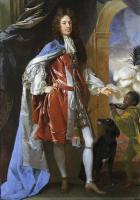


On 2nd December 1791 Charles Alexander Hohenzollern Margrave Brandenburg-Ansbach (age 55) Abdicated as Margrave Brandenburg-Ansbach at Bordeaux [Map].

On 2nd December 1792 Joseph Yorke 1st Baron Dover (age 68) died without issue. Baron Dover extinct. He was buried at St Andrew's Church, Wimpole [Map].
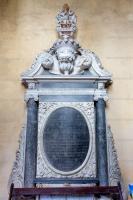
Inscription panel surmounted by a sarcophagus with flanking trophies and small medallions of arms in the apron; signed 'J. Bacon Sculptor (age 52): London 1798'
On 2nd December 1797 William Owen (age 28) and Lener Leaf were married.
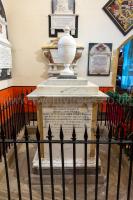
After 2nd December 1813 Ellen Thresher Lady Wrey (deceased) was buried at St Peter's Church, Tawstock [Map]. Beneath this Marble are also deposited the earthly Remains of Ellen Lady Wrey, Relict of Sir Bourchier Wrey Baronet, She died at the venerable Age of eighty, affectionately regretted by her surviving family, and closing on the 2d of December 1813, a Life of habitual piety, active Benevolence & every christian Virtue, in the humble hope, through her Redeemers merits. Immortality.
Ellen Thresher Lady Wrey: In 1731 she was born. In 1755 Bourchier Wrey 6th Baronet and she were married at Corsham, Wiltshire. She by marriage Lady Wrey of Trebitch in Cornwall. On 2nd December 1813 she died.
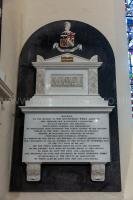
On 2nd December 1826. Bourchier Wrey 7th Baronet (deceased) was buried at St Peter's Church, Tawstock [Map]. SACRED to the memory of SIR BOURCHIER WREY Baronet, who through life maintained a character equally revered and beloved. Intelligent, upright, and benevolent he discharged with integrity the public duties of his station; whilst in the more amiable relations of society, suavity of manners, and goodness of heart procured him universal esteem. As a friend, he was social and sincere: as a parent, anxious and kind. Thus regarded by all, he expired on the 20th day of November 1826, in the 70th year of his age. He was twice married; first to Anne, the daughter of Sir Robert Palk, Bart. of Haldon House in this county, by whom he left two sons and a daughter. And secondly, to Anne, the daughter of John Osborne Esqre of Monksmill, in the county of Gloucester, by whom also he left one son and a daughter.

On 2nd December 1849 Queen Adelaide of England (age 57) died.
The Deeds of the Dukes of Normandy
The Gesta Normannorum Ducum [The Deeds of the Dukes of Normandy] is a landmark medieval chronicle tracing the rise and fall of the Norman dynasty from its early roots through the pivotal events surrounding the Norman Conquest of England. Originally penned in Latin by the monk William of Jumièges shortly before 1060 and later expanded at the behest of William the Conqueror, the work chronicles the deeds, politics, battles, and leadership of the Norman dukes, especially William’s own claim to the English throne. The narrative combines earlier historical sources with firsthand information and oral testimony to present an authoritative account of Normandy’s transformation from a Viking settlement into one of medieval Europe’s most powerful realms. William’s history emphasizes the legitimacy, military prowess, and governance of the Norman line, framing their expansion, including the conquest of England, as both divinely sanctioned and noble in purpose. Later chroniclers such as Orderic Vitalis and Robert of Torigni continued the history, extending the coverage into the 12th century, providing broader context on ducal rule and its impact. Today this classic work remains a foundational source for understanding Norman identity, medieval statesmanship, and the historical forces that reshaped England and Western Europe between 800AD and 1100AD.
Available at Amazon in eBook and Paperback format.
Statue to Charles William Vane 3rd Marquess Londonderry in Durham Marketplace unveiled on 2nd December 1861 in a ceremony involving the rifle volunteers of Seaham, Sunderland and Durham City. Among those in attendance was the future prime minister, Benjamin Disraeli (age 56). When the Marquis of Londonderry died in 1854, his widow set up a subscription committee to raise money for a statue of him. The artist commissioned was Rafaelle Monti (age 43).
Rafaelle Monti: In 1818 he was born in Milan. In 1881 he died.


On 2nd December 1865 Lisa Romana Stillman was born to William James Stillman (age 37) and Marie Spartali aka Stillman (age 21).
On 2nd December 1893 Elizabeth Catherine Gubbins Duchess St Albans (age 75) died in St Leonards On Sea.
The London Gazette 27465. The Rifle Brigade, (the Prince Consort's Own), Supernumerary Captain the Honourable Arthur W. de B. S. Foljambe (age 31), M.V.O., to be Captain, to complete establishment. Dated 2nd December, 1901

2nd December 1910. Bassano Ltd. Photograph of Algernon George de Vere Capell 8th Earl of Essex (age 26) with his son Reginald George de Vere Capell 9th Earl of Essex (age 4).
Reginald George de Vere Capell 9th Earl of Essex: In 1906 he was born to Algernon George de Vere Capell 8th Earl of Essex and Mary Eveline Stewart Freeman. On 8th December 1966 Algernon George de Vere Capell 8th Earl of Essex died. His son Reginald succeeded 9th Earl Essex, 10th Baron Capell Hadham. In 1981 Reginald George de Vere Capell 9th Earl of Essex died. His third cousin once removed Robert succeeded 10th Earl Essex, 11th Baron Capell Hadham.

2nd December 1910. Bassano Ltd. Photograph of Algernon George de Vere Capell 8th Earl of Essex (age 26), Mary Eveline Stewart Freeman and their son Reginald George de Vere Capell 9th Earl of Essex (age 4).
Mary Eveline Stewart Freeman: she was born to William Russell Stewart Freeman. On 28th September 1905 Algernon George de Vere Capell 8th Earl of Essex and she were married. He the son of George Capell 7th Earl of Essex and Ellenor Harriet Maria Harford. In 1925 Algernon George de Vere Capell 8th Earl of Essex and Mary Eveline Stewart Freeman were divorced. On 30th October 1955 she died.
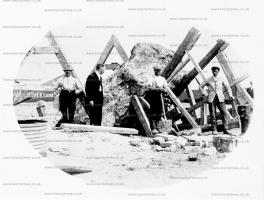
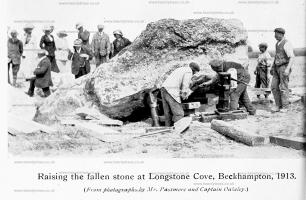
Wiltshire Archaeological Magazine 1913 V38 Pages 1-11. Between 8 and 9 o'clock on the morning of December 2nd, 1911, one of the standing stones at Avebury fell. The stone is one of the two remaining stones of the three which are believed to have once formed a kind of cell, or cove, on the northern side of the Beckhampton, or western avenue, that issued from the great circle of Avebury. The third stone fell and was broken up many years ago. The group was known as "Longstone Cove [Map]," or the "Longstones," but the two remaining stones are now sometimes spoken of locally as "Adam and Eve." The cove is described by Stukeley2 as consisting of two stones set at an angle to each other outside the avenue, the other stone that Stukeley regarded as the third member of the cove group, being at the same time one of the stones of the avenue. This latter stone is the smaller of the two now remaining, known as "Eve"; the larger one, "Adam," which fell in 1911, being one of the two original outstanding stones of the cove.
Note 1. These notes, so far as they relate to the discovery of the skeleton and drinking cup, were printed in Man, Vol. xii., No. 12, Dec, 1912, pp. 200 — 203, and the Society is indebted to the Council of the Royal Anthropological Institute for the loan of the two blocks which illustrate the paper.
Note 2. The Rev. W. C. Lukis, in a report on Stonehenge and Abury, printed in Proc. Soc. Ant., IX., 131, says (p. 155) of the Longtones Cove, "Stukeley says this cove is 'composed of three stones like that most magnificent one we described in the centre of the northern temple at Abury [Map]. They are set upon the arc of a circle regarding each other, with an obtuse angle,' and are placed on the north side of the avenue, one of the stones of that side making the back of the Cove.... Twining saw two stones only in 1723, therefore Stukeley saw no more; and his knowledge of a third stone must be derived from Aubrey, whose sketch given in his 'Monumenta Britannica' shows how unfaithful his drawings are as to the form and position of the stones. It is altogether an assumption on Stukeley's part that one of the stones of the Cove was one of the supposed avenue.... My own opinion is that these stones are the remains of a large circle — a monument entirely distinct from Avebury."
The Era 1899 Dec 02 Page 13. 2nd December 1913. Review of Rip Van Wincle. Produced at the Princess of Wales's Theatre, Kennington, on Monday, Nov. 27th starring Sylvia Storey (age 24) as Little Meenie.


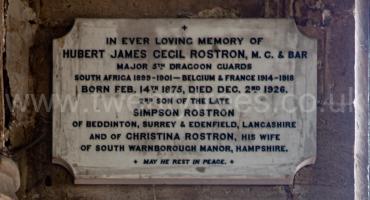
After 2nd December 1926. Hasting's Chapel, St Helen's Church, Ashby-de-la-Zouch [Map]. Monument to Major Hubert James Cecil Rostron (deceased).
Major Hubert James Cecil Rostron: On 14th February 1875 he was born to Simpson Rostron of Beddington in Surrey. On 20th September 1916 he and Isabel Jacqueline Rawdon-Hastings were married. On 2nd December 1926 he died.
On 2nd December 1956 Edward Fitzalan-Howard 18th Duke of Norfolk was born to Miles Stapleton Fitzalan Howard 17th Duke of Norfolk (age 41) and Anne Constable-Maxwell Duchess Norfolk (age 29). He married (1) 27th June 1987 Georgina Susan Gore Duchess of Norfolk.
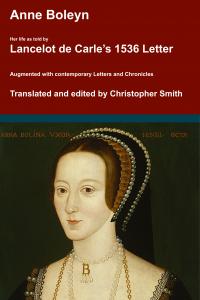
Anne Boleyn. Her Life as told by Lancelot de Carle's 1536 Letter.
In 1536, two weeks after the execution of Anne Boleyn, her brother George and four others, Lancelot du Carle, wrote an extraordinary letter that described Anne's life, and her trial and execution, to which he was a witness. This book presents a new translation of that letter, with additional material from other contemporary sources such as Letters, Hall's and Wriothesley's Chronicles, the pamphlets of Wynkyn the Worde, the Memorial of George Constantyne, the Portuguese Letter and the Baga de Secrets, all of which are provided in Appendices.
Available at Amazon in eBook and Paperback format.
On 2nd December 1565 Toby Caulfeild 1st Baron Caulfeild was born to Alexander Caulfeild of Great Milton in Oxfordshire.
On 2nd December 1630 Frances Manners Countess Exeter was born to John Manners 8th Earl of Rutland (age 26) and Frances Montagu Countess Rutland (age 16). She married before 1648 her half sixth cousin John Cecil 4th Earl Exeter, son of David Cecil 3rd Earl Exeter and Elizabeth Egerton Countess Exeter, and had issue.
On 2nd December 1659 John Brereton 4th Baron Brereton was born to William Brereton 3rd Baron Brereton (age 28) and Frances Willoughby Baroness Brereton (age 34). He married 4th December 1659 Mary Tipping Baroness Brereton.
On 2nd December 1661 Nicholas L'Estrange 4th Baronet was born to Nicholas L'Estrange 3rd Baronet (age 29) and Mary Coke (age 44). He married 2nd December 1686 Ann Wodehouse Lady Strange and had issue.
On 2nd December 1678 Edmund Winn was born to Edmund Winn 2nd Baronet (age 34) and Catherine Jackson.
On 2nd December 1700 Robert Spencer was born to Charles Spencer 3rd Earl of Sunderland (age 25) and Anne Churchill Countess Sunderland (age 17). He died aged less than one years old.

On 2nd December 1774 Lieutenant-Colonel Philip James Cocks was born to Charles Cocks 1st Baron Somers (age 49) and Anne Pole (age 22).

On 2nd December 1777 Henry Grey Bennet was born to Charles Bennet 4th Earl Tankerville (age 34) and Emma Colebrooke Countess Tankerville (age 25). He married 1816 his sixth cousin Gertrude Frances Russell.
On 2nd December 1777 Jane Elizabeth Coke was born to Thomas Coke 1st Earl of Leicester (age 23) and Jane Dutton (age 24). She married (1) 21st June 1796 Charles Nevinson Howard (2) 17th April 1806 Admiral Henry Digby, son of William Digby and Charlotte Cox, and had issue.


On 2nd December 1777 Horace Beckford aka Pitt-Rivers 3rd Baron Rivers was born to Peter Beckford (age 37) and Louisa Pitt (age 23) at Sudeley Castle [Map]. He married 8th April 1788 Frances Rigby and had issue.
On 2nd December 1782 Thomas Digby Aubrey 7th Baronet was born to Richard Aubrey (age 38) and Frances Digby (age 30). He married 9th December 1813 Mary Wright.
On 2nd December 1782 Gerard Thomas Noel was born to Gerard Edwardes aka Noel 2nd Baronet (age 23) and Diana Middleton 2nd Baroness Barham (age 20). He married (1) 1806 Charlotte Sophia O'Brien and had issue (2) 1841 Susan Kennaway, daughter of John Kennaway 1st Baronet and Charlotte Amyatt Lady Kennaway.
On 2nd December 1804 Oswald Mosley was born to Oswald Mosley 2nd Baronet (age 19) and Sophia Anne Every Lady Mosley.
William of Worcester's Chronicle of England
William of Worcester, born around 1415, and died around 1482 was secretary to John Fastolf, the renowned soldier of the Hundred Years War, during which time he collected documents, letters, and wrote a record of events. Following their return to England in 1440 William was witness to major events. Twice in his chronicle he uses the first person: 1. when writing about the murder of Thomas, 7th Baron Scales, in 1460, he writes '… and I saw him lying naked in the cemetery near the porch of the church of St. Mary Overie in Southwark …' and 2. describing King Edward IV's entry into London in 1461 he writes '… proclaimed that all the people themselves were to recognize and acknowledge Edward as king. I was present and heard this, and immediately went down with them into the city'. William’s Chronicle is rich in detail. It is the source of much information about the Wars of the Roses, including the term 'Diabolical Marriage' to describe the marriage of Queen Elizabeth Woodville’s brother John’s marriage to Katherine, Dowager Duchess of Norfolk, he aged twenty, she sixty-five or more, and the story about a paper crown being placed in mockery on the severed head of Richard, 3rd Duke of York.
Available at Amazon in eBook and Paperback format.
On 2nd December 1814 George Cadogan was born to George Cadogan 3rd Earl Cadogan (age 31).
On 2nd December 1821 Mary Frances Grosvenor Countess Macclesfield was born to Richard Grosvenor 2nd Marquess Westminster (age 26) and Elizabeth Mary Leveson-Gower Marchioness Westminster (age 24). She married before 24th July 1896 Thomas Parker 6th Earl Macclesfield, son of Thomas Parker 5th Earl Macclesfield and Eliza Wolstenholme Countess Macclesfield, and had issue.

On 2nd December 1833 Schomberg Henry Kerr Kerr 9th Marquess Lothian was born to John Kerr 7th Marquess Lothian (age 39) and Cecil Chetwynd-Talbot Marchioness Lothian (age 25). He married 1865 his sixth cousin Victoria Alexandrina Montagu-Douglas-Scott Marchioness Lothian, daughter of Walter Scott 5th Duke Buccleuch 7th Duke Queensberry and Charlotte Anne Thynne Duchess Buccleuch Duchess Queensbury, and had issue.
On 2nd December 1845 Robert James Graham 10th Baronet was born to Edward Graham 9th Baronet (age 25). He was baptised on 31st December 1845 at St Pancras Old Church [Map].
On 2nd December 1860 Wentworth Canning Blackett Beaumont 1st Viscount Allendale was born to Wentworth Beaumont 1st Baron Allendale (age 31) and Margaret Anne Burgh (age 29). He married 12th November 1889 Alexandrina Louise Maud Vane-Tempest Viscountess Allendale, daughter of George Henry Vane-Tempest 5th Marquess Londonderry and Mary Cornelia Edwards Marchioness Londonderry, and had issue.
On 2nd December 1865 Lisa Romana Stillman was born to William James Stillman (age 37) and Marie Spartali aka Stillman (age 21).
On 2nd December 1866 George Bridger Shiffner was born to George Croxton-Shiffner 4th Baronet (age 47).
On 2nd December 1870 Beatrice Adine Bridgeman was born to George Cecil Orlando Bridgeman 4th Earl Bradford (age 25) and Ida Frances Annabella Lumley Countess Bradford (age 22).
On 2nd December 1877 Katherine Augusta Victoria Egerton was born to Francis Egerton 3rd Earl Ellesmere (age 30) and Katherine Louisa Phipps Countess Ellesmere (age 27).
On 2nd December 1884 Edward Robert Blount 11th Baronet was born to Walter de Sodington Blount 9th Baronet (age 50).
On 2nd December 1898 William Jolliffe 4th Baron Hylton was born to Hylton Jolliffe 3rd Baron Hylton (age 36) and Alice Adeliza Hervey Baroness Hylton (age 24). He married 1931 Perdita and had issue.
On 2nd December 1901 Robert Charles Gunning 8th Baronet was born to Charles Archibald John Gunning (age 42).
The History of William Marshal was commissioned by his son shortly after William’s death in 1219 to celebrate the Marshal’s remarkable life; it is an authentic, contemporary voice. The manuscript was discovered in 1861 by French historian Paul Meyer. Meyer published the manuscript in its original Anglo-French in 1891 in two books. This book is a line by line translation of the first of Meyer’s books; lines 1-10152. Book 1 of the History begins in 1139 and ends in 1194. It describes the events of the Anarchy, the role of William’s father John, John’s marriages, William’s childhood, his role as a hostage at the siege of Newbury, his injury and imprisonment in Poitou where he met Eleanor of Aquitaine and his life as a knight errant. It continues with the accusation against him of an improper relationship with Margaret, wife of Henry the Young King, his exile, and return, the death of Henry the Young King, the rebellion of Richard, the future King Richard I, war with France, the death of King Henry II, and the capture of King Richard, and the rebellion of John, the future King John. It ends with the release of King Richard and the death of John Marshal.
Available at Amazon in eBook and Paperback format.
On 2nd December 1920 Moyra Rosamund Butler was born to James George Anson Butler 5th Marquess Ormonde (age 30) and Sybil Fellowes Marchioness of Ormonde (age 32). She married (1) 30th April 1940 her sixth cousin Charles Robert Cecil Weld-Forester.
On 2nd December 1934 John Baring 5th Baron Revelstoke was born to Rupert Baring 4th Baron Revelstoke (age 23) and Flora Breckinridge Fermor-Hesketh (age 21).
On 2nd December 1938 Richard Pole-Carew 13th Baronet was born to John Pole-Carew 12th Baronet (age 36) and Cynthia Mary Burns Lady Pole (age 30). He married 1974 his fourth cousin Mary Dawnay Lady Pole-Carew.

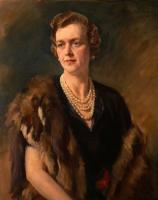
On 2nd December 1939 Ivor Fox-Strangways Guest 3rd Viscount Wimborne was born to Ivor Grosvenor Guest 2nd Viscount Wimborne (age 36) and Mabel Edith Fox-Strangways Viscountess Wimborne (age 21).
On 2nd December 1948 Rupert Carrington 7th Baron Carrington was born to Peter Carrington 6th Baron Carrington (age 29).
On 2nd December 1956 Edward Fitzalan-Howard 18th Duke of Norfolk was born to Miles Stapleton Fitzalan Howard 17th Duke of Norfolk (age 41) and Anne Constable-Maxwell Duchess Norfolk (age 29). He married (1) 27th June 1987 Georgina Susan Gore Duchess of Norfolk.
On 2nd December 1022 Alfonso "Noble" V King Leon (age 28) and Urraca Jiménez Queen Consort Leon were married. She by marriage Queen Consort Leon. She the daughter of García Sánchez "Tremulous" II King Pamplona and Jimena Fernández Bermúdez Queen Consort Pamplona. He the son of Bermudo "Gouty" II King Galicia II King Leon and Elviro Garcia Queen Galicia. They were half first cousins.
On 2nd December 1630 John Carey 2nd Earl Dover (age 22) and Abigail Cockayne Countess Dover (age 20) were married. She the daughter of William Cockayne and Mary Morris Countess Dover (age 65). He the son of Henry Carey 1st Earl Dover (age 50) and Judith Pelham Countess Dover.
On 2nd December 1683 George Verney 20th Baron Latimer 12th Baron Willoughby (age 24) and Margaret Heath Baroness Latimer and Willoughby were married.
On 2nd December 1686 Nicholas L'Estrange 4th Baronet (age 25) and Ann Wodehouse Lady Strange were married. She by marriage Lady Strange of Hunstanton in Norfolk.
Chronicle of Walter of Guisborough
A canon regular of the Augustinian Guisborough Priory, Yorkshire, formerly known as The Chronicle of Walter of Hemingburgh, describes the period from 1066 to 1346. Before 1274 the Chronicle is based on other works. Thereafter, the Chronicle is original, and a remarkable source for the events of the time. This book provides a translation of the Chronicle from that date. The Latin source for our translation is the 1849 work edited by Hans Claude Hamilton. Hamilton, in his preface, says: 'In the present work we behold perhaps one of the finest samples of our early chronicles, both as regards the value of the events recorded, and the correctness with which they are detailed; Nor will the pleasing style of composition be lightly passed over by those capable of seeing reflected from it the tokens of a vigorous and cultivated mind, and a favourable specimen of the learning and taste of the age in which it was framed.'
Available at Amazon in eBook and Paperback format.
On 2nd December 1690 John Ernest Saxe Coburg Saalfeld IV Duke Saxe Coburg Saalfeld (age 32) and Charlotte Johanna Waldeck Wildungen Duchess Saxe Coburg Saalfeld were married at Maastricht. She by marriage Duchess Saxe Coburg Saalfeld. He the son of Ernest "The Pious" Saxe Gotha I Duke Saxe Gotha and Elisabeth Sophie Saxe Altenburg Duchess Saxe Gotha.
On 2nd December 1764 George Robinson 5th Baronet (age 34) and Dorothea Chester Lady Robinson were married.
On 2nd December 1771 Henry Dashwood aka Peyton 1st Baronet (age 35) and Frances Rous Lady Peyton were married.
On 2nd December 1773 James Cecil 1st Marquess Salisbury (age 25) and Mary Amelia Hill Marchioness Salisbury (age 23) were married. She the daughter of Wills Hill 1st Marquess Downshire (age 55) and Margaretta Fitzgerald. He the son of James Cecil 6th Earl of Salisbury (age 60) and Elizabeth Keet Countess of Salisbury (age 52). They were fifth cousin once removed.
On 2nd December 1780 Henry St John 13th Baron St John (age 22) and Emma Maria Elizabeth Whitbread Baroness St John Bletso (age 19) were married. She by marriage Baroness St John of Bletso.
On 2nd December 1797 William Owen (age 28) and Lener Leaf were married.
On 2nd December 1858 Wilbraham Tollemache 2nd Baron Tollemache (age 26) and Emma Georgiana Stewart (age 18) were married. She the daughter of Randolph Stewart 9th Earl Galloway (age 58) and Harriet Blanche Somerset Countess Galloway (age 47). They were sixth cousins.
On 2nd December 1905 Thomas William Coke 4th Earl of Leicester (age 25) and Marion Gertrude Trefusis Countess Leicester (age 23) were married. He the son of Thomas William Coke 3rd Earl of Leicester (age 57) and Alice Emily White Countess Leicester (age 50).
On 2nd December 1958 William Bingham Compton 6th Marquess Northampton (age 73) and Elspeth Grace Whitaker Marchioness Northampton (age 54) were married. She by marriage Marchioness Northampton. He the son of William George Spencer Scott Compton 5th Marquess Northampton and Mary Florence Baring Marchioness Northampton.
On 2nd December 1022 Elvira González Queen Consort Leon (age 26) died.
On 2nd December 1360 John Beauchamp 1st Baron Beauchamp Warwick (age 44) died. Baron Beauchamp Warwick extinct.
Abbot John Whethamstede’s Chronicle of the Abbey of St Albans
Abbot John Whethamstede's Register aka Chronicle of his second term at the Abbey of St Albans, 1451-1461, is a remarkable text that describes his first-hand experience of the beginning of the Wars of the Roses including the First and Second Battles of St Albans, 1455 and 1461, respectively, their cause, and their consequences, not least on the Abbey itself. His text also includes Loveday, Blore Heath, Northampton, the Act of Accord, Wakefield, and Towton, and ends with the Coronation of King Edward IV. In addition to the events of the Wars of the Roses, Abbot John, or his scribes who wrote the Chronicle, include details in the life of the Abbey such as charters, letters, land exchanges, visits by legates, and disputes, which provide a rich insight into the day-to-day life of the Abbey, and the challenges faced by its Abbot.
Available at Amazon in eBook and Paperback format.
On 2nd December 1558 Archibald Campbell 4th Earl Argyll (age 51) died. His son Archibald (age 24) succeeded 5th Earl Argyll.
On 2nd December 1568 Margery Golding Countess of Oxford (age 42) died.
On 2nd December 1624 Thomas Pelham 1st Baronet (age 84) died. His son Thomas (age 27) succeeded 2nd Baronet Pelham of Laughton.Mary Wilbraham Lady Pelham (age 34) by marriage Lady Pelham of Laughton.
On 2nd December 1662 Josias Stewart 4th Baron Castle Stuart (age 27) died without issue. His uncle John succeeded 5th Baron Castle Stuart of County Tyrone.
On 2nd December 1664 Charles Hussey 1st Baronet (age 38) died. He was buried at St Vincent's Church, Caythorpe [Map]. His son Charles succeeded 2nd Baronet Hussey of Caythorpe in Lincolnshire.
On 2nd December 1667 Henry Winchcombe 1st Baronet (age 25) died. His son Henry (age 8) succeeded 2nd Baronet Winchcombe of Bucklebury in Berkshire.
On 2nd December 1680 William Ellis (age 71) died. He was buried at Nocton, North Kesteven where he has a monument attributed to William Stanton (age 41).
William Ellis: In 1609 he was born.
On 2nd December 1691 Isabel Douglas Countess Queensberry (age 49) died.
On 2nd December 1705 Thomas Miller 1st Baronet died. His son John succeeded 2nd Baronet Miller of Chichester in Sussex.
On 2nd December 1706 Grace Fenwick Lady Loraine (age 67) died. She was buried at St Wilfrid's Church, Kirkharle [Map].
Grace Fenwick Lady Loraine: Around 1639 she was born to William Fenwick 2nd Baronet and Jane Stapilton. On 15th May 1651 Thomas Loraine 1st Baronet and she were married. On 26th September 1664 Thomas Loraine 1st Baronet was created 1st Baronet Loraine of Kirkharle in Northumberland. She by marriage Lady Loraine of Kirkharle in Northumberland.
Abbot John Whethamstede’s Chronicle of the Abbey of St Albans
Abbot John Whethamstede's Register aka Chronicle of his second term at the Abbey of St Albans, 1451-1461, is a remarkable text that describes his first-hand experience of the beginning of the Wars of the Roses including the First and Second Battles of St Albans, 1455 and 1461, respectively, their cause, and their consequences, not least on the Abbey itself. His text also includes Loveday, Blore Heath, Northampton, the Act of Accord, Wakefield, and Towton, and ends with the Coronation of King Edward IV. In addition to the events of the Wars of the Roses, Abbot John, or his scribes who wrote the Chronicle, include details in the life of the Abbey such as charters, letters, land exchanges, visits by legates, and disputes, which provide a rich insight into the day-to-day life of the Abbey, and the challenges faced by its Abbot.
Available at Amazon in eBook and Paperback format.
On 2nd December 1716 James Scudamore 3rd Viscount Scudamore (age 32) died from a fall from a horse. Viscount Scudamore extinct.
On 2nd December 1723 Philippe Bourbon II Duke Orléans (age 49) died. His son Louis (age 20) succeeded Duke Orléans.
On 2nd December 1748 Charles Seymour 6th Duke of Somerset (age 86) died at Petworth. His son Algernon (age 64) succeeded 7th Duke Somerset, 7th Earl Hertford, 7th Baron Beauchamp of Hatch Beauchamp in Somerset, 5th Baron Seymour of Trowbridge. Frances Thynne Duchess Somerset (age 49) by marriage Duchess Somerset.
On 2nd December 1790 John Bourke 1st Earl Mayo (age 90) died. His son John (age 61) succeeded 2nd Earl Mayo, 2nd Viscount Mayo of Monycrower in Mayo, 2nd Baron Naas of Naas in Kildare. Mary Leeson Countess Mayo (age 56) by marriage Countess Mayo.
On 2nd December 1792 Joseph Yorke 1st Baron Dover (age 68) died without issue. Baron Dover extinct. He was buried at St Andrew's Church, Wimpole [Map].
Inscription panel surmounted by a sarcophagus with flanking trophies and small medallions of arms in the apron; signed 'J. Bacon Sculptor (age 52): London 1798'
On 2nd December 1807 Tryphena Scawen Countess Bathurst Sussex (age 76) died.
On 2nd December 1813 Ellen Thresher Lady Wrey (age 82) died.
On 2nd December 1849 Queen Adelaide of England (age 57) died.
On 2nd December 1863 Charles Brodrick 6th Viscount Midleton (age 72) died. His brother William Brodrick (age 65) succeeded 6th Viscount Midleton of Midleton in Cork, 6th Baron Brodrick of Midleton in Cork, 4th Baron Brodrick of Peper Harrow in Surrey.
On 2nd December 1876 Henry de Hoghton 9th Baronet (age 55) died. His brother Charles (age 53) succeeded 10th Baronet Hoghton of Hoghton Tower in Lancashire.
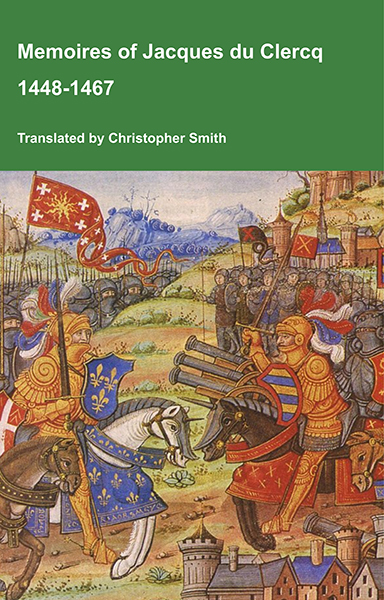
This is a translation of the 'Memoires of Jacques du Clercq', published in 1823 in two volumes, edited by Frederic, Baron de Reissenberg. In his introduction Reissenberg writes: 'Jacques du Clercq tells us that he was born in 1424, and that he was a licentiate in law and a counsellor to Philip the Good, Duke of Burgundy, in the castellany of Douai, Lille, and Orchies. It appears that he established his residence at Arras. In 1446, he married the daughter of Baldwin de la Lacherie, a gentleman who lived in Lille. We read in the fifth book of his Memoirs that his father, also named Jacques du Clercq, had married a lady of the Le Camelin family, from Compiègne. His ancestors, always attached to the counts of Flanders, had constantly served them, whether in their councils or in their armies.' The Memoires cover a period of nineteen years beginning in in 1448, ending in in 1467. It appears that the author had intended to extend the Memoirs beyond that date; no doubt illness or death prevented him from carrying out this plan. As Reissenberg writes the 'merit of this work lies in the simplicity of its narrative, in its tone of good faith, and in a certain air of frankness which naturally wins the reader’s confidence.' Du Clercq ranges from events of national and international importance, including events of the Wars of the Roses in England, to simple, everyday local events such as marriages, robberies, murders, trials and deaths, including that of his own father in Book 5; one of his last entries.
Available at Amazon in eBook and Paperback format.
On 2nd December 1893 Elizabeth Catherine Gubbins Duchess St Albans (age 75) died in St Leonards On Sea.
On 2nd December 1893 George Greville 4th Earl Warwick 4th Earl Brooke (age 75) died at Warwick Castle [Map]. His son Francis (age 40) succeeded 5th Earl Warwick, 5th Earl Brooke Warwick Castle, 12th Baron Brooke of Beauchamps Court in Warwickshire. Frances Evelyn "Daisy" Maynard Countess Warwick (age 31) by marriage Countess Warwick.


On 2nd December 1900 Francis George Manningham Boileau 2nd Baronet (age 70) died. His son Maurice (age 34) succeeded 3rd Baronet Boileau of Tacolneston Hall in Norfolk.
On 2nd December 1903 Isabel Harriet Fuller-Palmer-Acland Lady Hood (age 71) died.
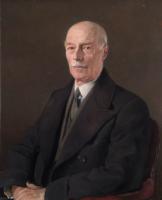
On 2nd December 1909 Algernon Greville-Nugent 2nd Baron Greville (age 68) died. His son Charles (age 38) succeeded 3rd Baron Greville of Clonyn in Westmeath. Olive Agnes Grace Baroness Greville (age 33) by marriage Baroness Greville of Clonyn in Westmeath.
On 2nd December 1914 John Crichton 4th Earl Erne (age 75) died. His grandson John (age 7) succeeded 5th Earl Erne of Crom Castle in County Fermanagh, 5th Viscount Erne of Crom Castle in County Fermanagh, 4th Baron Erne of Crom Castle in Fermanagh.
On 2nd December 1914 John Dalrymple 11th Earl of Stair (age 66) died. His son John (age 35) succeeded 12th Earl of Stair.
On 2nd December 1925 Edwyn Hoskyns 12th Baronet (age 74) died. His son Edwyn (age 41) succeeded 13th Baronet Hoskyns of Harewood in Herefordshire.
On 2nd December 1928 Hallam Tennyson 2nd Baron Tennyson (age 76) died. His son Lionel (age 39) succeeded 3rd Baron Tennyson of Aldworth in Sussex and of Freshwater in the Isle of Wight. Clarissa Madeline Tennant Baroness Tennyson (age 32) by marriage Baroness Tennyson of Aldworth in Sussex and of Freshwater in the Isle of Wight.
On 2nd December 1928 Sophia Strutt Lady Le Marchant (age 83) died.
William of Worcester's Chronicle of England
William of Worcester, born around 1415, and died around 1482 was secretary to John Fastolf, the renowned soldier of the Hundred Years War, during which time he collected documents, letters, and wrote a record of events. Following their return to England in 1440 William was witness to major events. Twice in his chronicle he uses the first person: 1. when writing about the murder of Thomas, 7th Baron Scales, in 1460, he writes '… and I saw him lying naked in the cemetery near the porch of the church of St. Mary Overie in Southwark …' and 2. describing King Edward IV's entry into London in 1461 he writes '… proclaimed that all the people themselves were to recognize and acknowledge Edward as king. I was present and heard this, and immediately went down with them into the city'. William’s Chronicle is rich in detail. It is the source of much information about the Wars of the Roses, including the term 'Diabolical Marriage' to describe the marriage of Queen Elizabeth Woodville’s brother John’s marriage to Katherine, Dowager Duchess of Norfolk, he aged twenty, she sixty-five or more, and the story about a paper crown being placed in mockery on the severed head of Richard, 3rd Duke of York.
Available at Amazon in eBook and Paperback format.
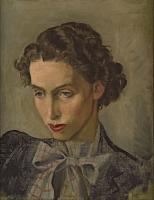
On 2nd December 1947 Rosamond Cornelia Gwladys Guest Viscountess Ridley died.
On 2nd December 1968 Mary Borden Lady Spears (age 82) died at Warfield, Berkshire. She was buried in the churchyard of St Michael the Archangel Church, Warfield.


On 2nd December 1996 Henry Milles 5th Earl Sondes (age 56) died. Earl Sondes, Viscount Throwley, Baron Sondes extinct.
On 2nd December 2008 Patrick Maitland 17th Earl of Lauderdale (age 97) died. His son Ian (age 71) succeeded 18th Earl Lauderdale, 18th Viscount Maitland, 18th Viscount Lauderdale, 13th Baronet Maitland of Ravelrig in Nova Scotia.