


09 Jun is in June.
1312 Capture, Trial and Execution of Piers Gaveston
1483 Robert Stillington Claims Edward IV's Marriage to Elizabeth Woodville to be Bigamous
Chronica Majora by Matthew Paris. The confirmation of Master Nicholas of Farnhamy in the bishopric of Durham
On the 9th of June, in this year. Master Nicholas of Farnham, bishop elect of Durham, was consecrated bishop of that see in St. Oswald's church [Map] at Gloucester, by Walter, archbishop of York (age 61), in the presence of the king (age 33) and queen (age 18), with numerous bishops and abbats. But inasmuch as a question had been mooted concerning his profession, amongst some who wished to excite discord, the said Nicholas refused to claim a liberty that was not his due, or to show himself insolent or recalcitrant; he therefore, at his consecration, in public, before all the prelates and nobles, and in the presence of his metropolitan, the said Archbishop Walter, solemnly and distinctly made his profession in a loud voice, according to custom, as follows; "I Nicholas, bishop elect of the church of Durham, acknowledge canonical subjection, reverence, and obedience to the church of York, and to you, father Walter, its archbishop, and this I subscribe with my own hand." He then immediately, in the presence of all assembled, marked the sign of the cross in ink at the head of the charter, and delivered the same to the archbishop to be kept in his possession in his treasury.
On 9th June 1252 Otto "Child" Brunswick-Lüneburg Duke Brunswick-Lüneburg (age 48) died.
On 9th June 1267 Catherine Wittelsbach was born to Henry Wittelsbach I Duke Lower Bavaria I Duke Bavaria (age 31) and Elizabeth Duchess Bavaria (age 31). She a great x 3 granddaughter of King Henry "Curtmantle" II of England.
On 9th June 1286 Latino Malabranca Orsini Cardinal was enthroned Archbishop of York.
On 9th June 1312 Piers Gaveston 1st Earl Cornwall (age 28), under the protection of Aymer de Valence 2nd Earl Pembroke (age 37), stayed at The Rectory, Deddington whilst en route south. Aymer de Valence 2nd Earl Pembroke left Piers Gaveston 1st Earl Cornwall there whilst he left to visit his wife. The following morning Guy Beauchamp 10th Earl Warwick (age 40), with Edmund Fitzalan 2nd or 9th Earl of Arundel (age 27), Humphrey Bohun 4th Earl Hereford 3rd Earl Essex (age 36) and John Botetort 1st Baron Botetort (age 47) arrested Piers Gaveston 1st Earl Cornwall and took him to Warwick Castle [Map].
Rymer's Fœdera Volume 2. Concerning the burning of the town of Portsmouth by the enemies.
The King, to all to whom [these letters] shall come, greeting. Considering the losses, damages, and hardships which our beloved men of our town of Portsmouth have suffered in many ways through the burning of their houses and other possessions by our enemies, who lately entered those parts, and being willing to aid their need, for the relief of their condition in this matter: We have pardoned them that which they owe us for the future, from the three-yearly tenth lately granted to us by the community of our realm at Westminster, arising from their goods in the same town; and by the tenor of these presents we acquit and discharge them thereof. In witness whereof, etc. Witness the King at Lopham, the 9th day of June [1338]. By writ of the privy seal. And mandate is given to the taxors and collectors of the tenth and fifteenth granted to the King by the laity for three years in the county of Southampton, that they permit the said men, as to what they owe to the King for the future of the aforesaid tenth, arising from their goods and possessions in the same town, to be quit, according to the tenor of the King's aforesaid letters. Witness as above.
De combustione ville de Portesmuth' per hostes.
REX, omnibus ad quos, &c. salutem. Considerantes dampna, jacturas, & gravamina, quæ dilecti nobis homines villæ nostræ de Portesmuth', per combustionem domorum & aliarum rerum suarum, per hostes nostros, qui partes illas nuper ingressi fuerunt, multipliciter sunt perpessi; ac volentes eorum indigentiæ, in relevationem status sui, subvenire in hâc parte; Pardonavimus eis id quod nobis debent pro tempore futuro, de decimâ triennali, nobis nuper, per communitatem regni nostri apud Westm' concessâ, ipsos de bonis suis in eadem villâ contingente, & ipsos indè, tenore præsentium, quietamus & exoneramus. In cujus, &c. T. R. apud Lopham, ix. die Junii. Per breve de privato sigillo. Et mandatum est taxatoribus & collectoribus decima & quintadecimæ Regis per laicos per triennium concessarum in comitatu Suth't, quod ipsos homines, de eo quod Regi debent pro tempore futuro de decimâ prædictâ, ipsos de bonis & rebus suis in eadem villâ contingente quietos esse permittant, juxta tenorem litterarum Regis prædictarum. Teste ut supra.
 Become a Member via our Buy Me a Coffee page to read more.
On 9th June 1360 Gerard Lisle 1st Baron Lisle (age 56) died at Stowe, Northamptonshire. His son Warin (age 30) succeeded 2nd Baron Lisle of Kingston Lisle in Oxfordshire. Margaret Pipard Baroness Lisle (age 37) by marriage Baroness Lisle of Kingston Lisle in Oxfordshire.
He was buried at St Michael's Church, Stowe Nine Churches [Map]. His effigy is of the Early Medieval Period with right leg over left.
Warin Lisle 2nd Baron Lisle: Around 1330 he was born to Gerard Lisle 1st Baron Lisle and Eleanor Fitzalan at Kingston Lisle, Oxfordshire. Before 1360 Warin Lisle 2nd Baron Lisle and Margaret Pipard Baroness Lisle were married. After 1360 Warin Lisle 2nd Baron Lisle and Joan Unknown Baroness Lisle were married. She by marriage Baroness Lisle of Kingston Lisle in Oxfordshire. On 28th June 1382 Warin Lisle 2nd Baron Lisle died. His daughter Margaret succeeded 3rd Baroness Lisle of Kingston Lisle in Oxfordshire.
Margaret Pipard Baroness Lisle: Around 1323 she was born to William Pipard. On 3rd August 1373 she died.


Patent Rolls. 9th June 1378. Westminster. Inspeximus and confirmation, in favour of Margaret Mareschall, countess of Norfolk, and Anne, late the wife of John Hastynges earl of Pembroke, the late king's kinswomen, of (1) letters patent dated 22 January, 49 Edward III, committing to them the custody, during the minority of the heir, of two-thirds of the manors, lands, and tenements, late of the said John, excepting those in Kent, at the yearly rent of £413 2s 2d; and (2) letters patent dated 24 December, 50 Edward III., remitting £100 yearly of the said rent. By the Great Council.
On 9th June 1454 Barbara Wittelsbach was born to Albert Wittelsbach III Duke Bavaria (age 53) and Anna Brunswick Grubenhagen Duchess Bavaria (age 40) at Munich.

Around 9th June 1483 Bishop Robert Stillington (age 63) informed a Council meeting that the coronation of King Edward V of England (age 12) could not proceed since he was illegitimate since his father's marriage to his mother Elizabeth Woodville Queen Consort England (age 46) had been bigamous since King Edward IV of England had previously married Eleanor Talbot at which Bishop Robert Stillington presided. The only witness being Bishop Robert Stillington.
On 9th June 1511 William Courtenay 1st Earl Devon (age 36) died of pleurisy. His son Henry (age 15) succeeded 2nd Earl Devon. His widow Catherine York Countess Devon (age 31) subsequently took a vow of celibacy in the presence of Bishop Richard Fitzjames on 13th July 1511.

On 9th June 1513 Claude Lorraine 1st Duke Guise (age 16) and Antoinette Bourbon Duchess of Guise (age 20) were married. She the daughter of Francis Bourbon Count Vendôme and Soissons and Marie Luxemburg Countess Vendôme and Soissons. He the son of René Lorraine II Duke Lorraine Duke of Bar and Philippa Egmont Duchess of Bar Duchess Lorraine (age 46). They were fourth cousins. She a great x 5 granddaughter of King Edward III of England.
Chronicle of Abbot Ralph of Coggeshall
The Chronicle of Abbot Ralph of Coggeshall (Chronicon Anglicanum) is an indispensable medieval history that brings to life centuries of English and European affairs through the eyes of a learned Cistercian monk. Ralph of Coggeshall, abbot of the Abbey of Coggeshall in Essex in the early 13th century, continued and expanded his community’s chronicle, documenting events from the Norman Conquest of 1066 into the tumultuous reign of King Henry III. Blending eyewitness testimony, careful compilation, and the monastic commitment to record-keeping, this chronicle offers a rare narrative of political intrigue, royal power struggles, and social upheaval in England and beyond. Ralph’s work captures the reigns of pivotal figures such as Richard I and King John, providing invaluable insights into their characters, decisions, and the forces that shaped medieval rule. More than a simple annal, Chronicon Anglicanum conveys the texture of medieval life and governance, making it a rich source for scholars and readers fascinated by English history, monastic authorship, and the shaping of the medieval world.
Available at Amazon in eBook and Paperback format.
On 9th June 1537 Louis Valois II Duke Longueville (age 27) died at Rouen, France [Map]. His son François (age 1) succeeded III Duke Longueville.
Diary of Edward VI. 9th June 1550. The duke of Somerset (age 50), marquis Northampton (age 38), lord tresorer (age 67) (St. John, the earl of) Bedford, and the secretary Petre (age 45), went to the bishope of Winchester (age 67)2, to know to what he wold stike. He mad(e) answer that he wold obey, and set furth al thinges set furth by me and my parliement; and if he were troubled in conscience he wold revele it to the counsel, and not reason openly against it.3
Note 2. Gardiner was now a prisoner in the Tower. The King paid great attention to the course of the proceedings directed by the council against the bishop, in relation to which several passages will occur in the succeeding pages. Foxe, in the first edition of his Actes and Monuments, inserted the record of these proceedings at very great length; which in subsequent editions was materially abridged, but in the last, by the Rev. S. E. Cattley, it is restored to its place, and occupies pp. 24-267 of the sixth volume. The depositions of many of the principal nobility and courtiers who had been present at Gardiner's trial sermon (already noticed in p. 59), contain many remarkable statements and biographical particulars.
Note 3. See the report made by the duke of Somerset and the rest, in Foxe, (edit. Cattley,) iv. 79, and Gardiner's own more particular account of this conference at p. 113.


Diary of Edward VI. 9th June 1550. The erle of Warwick (age 46), the lord treasorer (age 67), sir Wiliam Herbert (age 49), and the secretari Petre (age 45) went to the bishop of Winchester (age 67) with certain articles signed by me and the counsel, conteining the confessing of his faut, the supremici, the establissing of holy dayes, the abolishing of sixe articles, and divers other, wherof the copie is in the counsel chest1, wherunto he put his hand, saving to the confes(sion).

On 9th June 1572 Jeanne Albret III Queen Navarre (age 43) died.
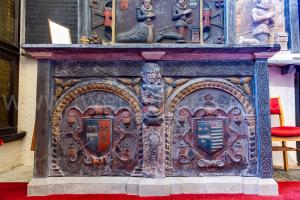
9th June 1597. On 9th June 1597 John Wrey of North Russell was buried at St Peter's Church, Tawstock [Map].
On 16th December 1595 Blanch Killigrew (age 60) was buried at St Peter's Church, Tawstock [Map].
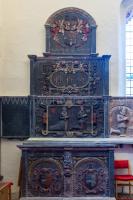
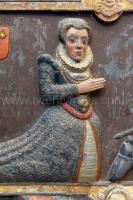
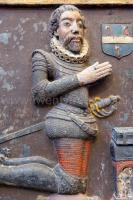
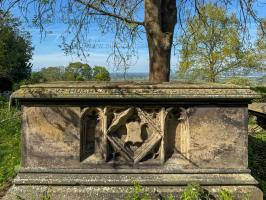
Gothic altar tomb monument with three-tiered altarpiece or reredos behind, the lowest tier of which resembles a triptych. It was moved from St Ive Church in Cornwall in 1924 by Philip Bourchier Sherard Wrey 12th Baronet.
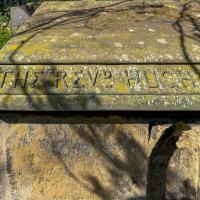
The large slate slab on top of the chest tomb is inscribed within a ledger line: Ye body of John Wrey Esquier who was buried ye 9th of June Ano Domini 1597 Heere lieth the body of Blannch Wrey who was buried ye 16 of December 1595
On the left panel of the triptych is inscribed the following verse:
Loe here he lieth though dead yet living still,
His famous name resounding echo saye,
Whereby report of hym the ayre doth fyll
The lastinge fame & name of rightful Wreye,
Good to ye poore bribes never woulde he take,
Voyde of oppression all kind of waye,
He faithful frynds of enemyes did make,
Of quarels greate ceast lawe ech daye by daye.
Death doe they worst this Wreye yet lives & shall,
Thy darte his deeds cannot extyrpe or quayle.
Thousands are they which thou hast causde to fall,
And yet on hym no waye thou canst prevayle.
What resteth then but cease to mourne & moane
For hym whose vertues shine like to the sonne.
Though here he lieth his Sowle to Heave is gone,
Where Angells see hym though his threads be spoone [spun].
John Wrey of North Russell: he was born to Walter Wrey of North Russell and Bridget Shilstone. In 1585 he was appointed High Sheriff of Cornwall. In or before 1595 John Wrey of North Russell and Blanch Killigrew were married. She was heiress to the lordship of the manor of Trebeigh, Cornwall. They had six sons and two daughters. In 1597 John Wrey of North Russell died.
Blanch Killigrew: In 1535 she was born to Henry Killigrew of Woolstone St Ive Cornwall. On 14th December 1596 she died.
Atropos: Atropos is one of the Three Fates. She cuts the thread of human life.
Become a Member via our Buy Me a Coffee page to read more.
Diary of Anne Clifford. 9th June 1617. The 9th I wrote a letter to the Bishop of London against Mathew. The same day Mt Hodgson came home, who had been with my Coz. Russell (age 24) at Chiswick, and [told me?] what a deal of care he had of me, and my Coz. Russell and my Coz. George sent me word that all my businesses would go on well but they could not find that the business or agreement was fully concluded, in regard there was nothing had passed the Great Seal.
On 9th June 1640 Leopold Habsburg Spain I Holy Roman Emperor was born to Ferdinand III Holy Roman Emperor (age 31) and Maria Anna of Spain Holy Roman Empress (age 33). Coefficient of inbreeding 15.19%. He married (1) 1666 his niece Margaret Theresa Habsburg Holy Roman Empress, daughter of Philip IV King Spain and Mariana of Austria Queen Consort Spain, and had issue (2) before 1676 his second cousin Claudia Felicitas of Holy Roman Empress and had issue (3) 14th December 1676 his third cousin once removed Eleonore Magdalene of Neuburg and had issue.


John Evelyn's Diary. 9th June 1654. Dined at Marlborough [Map], which having been lately fired, was now new built. At one end of this town, we saw my Lord Seymour's (age 64) house, but nothing observable save the Mount, to which we ascended by windings for near half a mile. It seems to have been cast up by hand. We passed by Colonel Popham's (age 49), a noble seat, park, and river. Thence, to Newbury [Map], a considerable town, and Donnington, famous for its battle, siege, and castle, this last had been in the possession of old Geoffrey Chaucer. Then to Aldermaston, a house of Sir Humphrey Forster's, built à la moderne. Also, that exceedingly beautiful seat of my Lord Pembroke (age 33), on the ascent of hill, flanked with wood, and regarding the river, and so, at night, to Cadenham, the mansion of Edward Hungerford (age 21), Esq, uncle to my wife (age 19), where we made some stay. The rest of the week we did nothing but feast and make good cheer, to welcome my wife.
John Evelyn's Diary. 9th June 1658. I went to see the Earl of Northumberland's (age 55) pictures, whereof that of the Venetian Senators was one of the best of Titian's and another of Andrea del Sarto, viz, a Madonna, Christ, St. John, and an Old Woman; a St. Catherine of Da Vinci, with divers portraits of Vandyck; a Nativity of Georgioni; the last of our blessed Kings (Charles I.), and the Duke of York, by Lely (age 39), a Rosary by the famous Jesuits of Brussels, and several more. This was in Suffolk House, Suffolk Street: the new front toward the gardens is tolerable, were it not drowned by a too massy and clumsy pair of stairs of stone, without any neat invention.


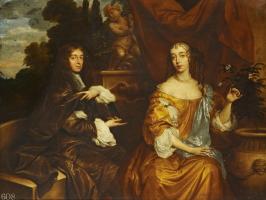
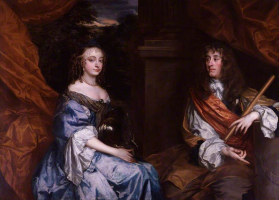
Samuel Pepys' Diary. 9th June 1661. Lord's Day. This day my wife put on her black silk gown, which is now laced all over with black gimp lace, as the fashion is, in which she is very pretty. She and I walked to my Lady's at the Wardrobe, and there dined and was exceeding much made of. After dinner I left my wife there, and I walked to Whitehall, and then went to Mr. Pierce's and sat with his wife a good while (who continues very pretty) till he came, and then he and I, and Mr. Symons (dancing master), that goes to sea with my Lord, to the Swan [Map] tavern, and there drank, and so again to White Hall, and there met with Dean Fuller (age 53), and walked a great while with him; among other things discoursed of the liberty the Bishop (by name the of Galloway) takes to admit into orders any body that will; among others, Roundtree, a simple mechanique that was a person [parson?] formerly in the fleet. He told me he would complain of it.
John Evelyn's Diary. 9th June 1662. Hampton Court [Map] is as noble and uniform a pile, and as capacious as any Gothic architecture can have made it. There is an incomparable furniture in it, especially hangings designed by Raphael, very rich with gold; also many rare pictures, especially the Cæsarean Triumphs of Andrea Mantegna, formerly the Duke of Mantua's; of the tapestries, I believe the world can show nothing nobler of the kind than the stories of Abraham and Tobit. The gallery of horns is very particular for the vast beams of stags, elks, antelopes, etc. The Queen's bed was an embroidery of silver on crimson velvet, and cost £8,000, being a present made by the States of Holland when his Majesty (age 32) returned, and had formerly been given by them to our King's sister, the Princess of Orange, and, being bought of her again, was now presented to the King. The great looking-glass and toilet, of beaten and massive gold, was given by the Queen-Mother (age 52). The Queen (age 23) brought over with her from Portugal such Indian cabinets as had never before been seen here. The great hall is a most magnificent room. The chapel roof excellently fretted and gilt. I was also curious to visit the wardrobe and tents, and other furniture of state. The park1, formerly a flat and naked piece of ground, now planted with sweet rows of lime trees; and the canal for water now near perfected; also the air-park. In the garden is a rich and noble fountain, with Sirens, statues, etc., cast in copper, by Fanelli; but no plenty of water. The cradle-work of horn beam in the garden is, for the perplexed twining of the trees, very observable. There is a parterre which they call Paradise, in which is a pretty banqueting-house set over a cave, or cellar. All these gardens might be exceedingly improved, as being too narrow for such a palace.
Note 1. The gardener at Hampton Court being Hendrick Danckerts (age 37).


Become a Member via our Buy Me a Coffee page to read more.
Jean de Waurin's Chronicle of England Volume 6 Books 3-6: The Wars of the Roses
Jean de Waurin was a French Chronicler, from the Artois region, who was born around 1400, and died around 1474. Waurin’s Chronicle of England, Volume 6, covering the period 1450 to 1471, from which we have selected and translated Chapters relating to the Wars of the Roses, provides a vivid, original, contemporary description of key events some of which he witnessed first-hand, some of which he was told by the key people involved with whom Waurin had a personal relationship.
Available at Amazon in eBook and Paperback format.
Samuel Pepys' Diary. 9th June 1664. Then at night by coach to attend the Duke of Albemarle (age 55) about the Tangier [Map] ship.
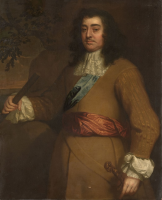

John Evelyn's Diary. 8th June 1665. Came news of his highness's (age 35) victory, which indeed might have been a complete one, and at once ended the war, had it been pursued, but the cowardice of some, or treachery, or both, frustrated that. We had, however, bonfires, bells, and rejoicing in the city. Next day, the 9th, I had instant orders to repair to the Downs, so as I got to Rochester, Kent [Map] this evening. Next day I lay at Deal, Kent [Map], where I found all in readiness: but, the fleet being hindered by contrary winds, I came away on the 12th, and went to Dover, Kent [Map], and returned to Deal, Kent [Map]; and on the 13th, hearing the fleet was at Solbay, I went homeward, and lay at Chatham, Kent [Map], and on the 14th, I got home. On the 15th, came the eldest son of the present Secretary of State to the French King, with much other company, to dine with me. After dinner, I went with him to London, to speak to my Lord General for more guards, and gave his Majesty an account of my journey to the coasts under my inspection. I also waited on his Royal Highness (age 31), now come triumphant from the fleet, gotten into repair. See the whole history of this conflict in my "History of the Dutch War"..


Samuel Pepys' Diary. 9th June 1665. Lay long in bed, my head akeing with too much thoughts I think last night. Up and to White Hall, and my Lord Treasurer's (age 58) to Sir Ph. Warwicke (age 55), about Tangier business, and in my way met with Mr. Moore, who eases me in one point wherein I was troubled; which was, that I heard of nothing said or done by my Lord Sandwich (age 39): but he tells me that Mr. Cowling, my Lord Camberlain's secretary, did hear the King (age 35) say that my Lord Sandwich had done nobly and worthily. The King, it seems, is much troubled at the fall of my Lord of Falmouth (deceased); but I do not meet with any man else that so much as wishes him alive again, the world conceiving him a man of too much pleasure to do the King any good, or offer any good office to him. But I hear of all hands he is confessed to have been a man of great honour, that did show it in this his going with the Duke, the most that ever any man did.
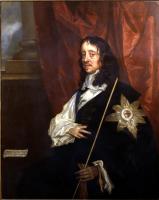

Samuel Pepys' Diary. 9th June 1666. Thence to White Hall in expectation of a meeting of Tangier, and we did industriously labour to have it this morning; but we could not get a fifth person there, so after much pains and thoughts on my side on behalfe of Yeabsly, we were fain to breake up. But, Lord! to see with what patience Lord Ashly (age 44) did stay all the morning to get a Committee, little thinking that I know the reason of his willingnesse.


Samuel Pepys' Diary. 9th June 1666. So to White Hall, and there when we were come all together in certain expectation of doing our business to Yeabsly's full content, and us that were his friends, my Lord Peterborough (age 44) (whether through some difference between him and my Lord Ashly (age 44), or him and me or Povy (age 52), or through the falsenesse of Creed, I know not) do bring word that the Duke of Yorke (age 32) (who did expressly bid me wait at the Committee for the dispatch of the business) would not have us go forward in this business of allowing the losse of the ships till Sir G. Carteret (age 56) and Sir W. Coventry (age 38) were come to towne, which was the very thing indeed which we would have avoided. This being told us, we broke up doing nothing, to my great discontent, though I said nothing, and afterwards I find by my Lord Ashly's discourse to me that he is troubled mightily at it, and indeed it is a great abuse of him and of the whole Commissioners that nothing of that nature can be done without Sir G. Carteret or Sir W. Coventry. No sooner was the Committee up, and I going [through] the Court homeward, but I am told Sir W. Coventry is come to town; so I to his chamber, and there did give him an account how matters go in our office, and with some content I parted from him, after we had discoursed several things of the haste requisite to be made in getting the fleete out again and the manner of doing it. But I do not hear that he is at all pleased or satisfied with the late fight; but he tells me more newes of our suffering, by the death of one or two captains more than I knew before. But he do give over the thoughts of the safety of The Swiftsure or Essex.


Samuel Pepys' Diary. 9th June 1667. Lord's Day. Up, and by water to White Hall, and so walked to St. James's, where I hear that the Duke of Cambridge (age 3), who was given over long since by the Doctors, is now likely to recover; for which God be praised!
Samuel Pepys' Diary. 9th June 1667. To Sir W. Coventry (age 39), and there talked with him a great while; and mighty glad I was of my good fortune to visit him, for it keeps in my acquaintance with him, and the world sees it, and reckons my interest accordingly. In comes my Lord Barkeley (age 65), who is going down to Harwich, Essex [Map] also to look after the militia there: and there is also the Duke of Monmouth (age 18), and with him a great many young Hectors, the Lord Chesterfield (age 33), my Lord Mandeville (age 33), and others: but to little purpose, I fear, but to debauch the country women thereabouts. My Lord Barkeley wanting some maps, and Sir W. Coventry recommending the six maps of England that are bound up for the pocket, I did offer to present my Lord with them, which he accepted: and so I will send them him.


John Evelyn's Diary. 9th June 1689. Visited Dr. Burnet (age 45), now Bishop of Sarum; got him to let Mr. Kneller (age 42) draw his picture.


John Evelyn's Diary. 9th June 1698. To Deptford, to see how miserably the Czar had left my house [Map], after three months making it his Court. I got Sir Christopher Wren (age 74), the King's surveyor, and Mr. London, his gardener, to go and estimate the repairs, for which they allowed £150 in their report to the Lords of the Treasury. I then went to see the foundation of the Hall and Chapel at Greenwich Hospital [Map].
On 9th June 1698 Amabel Grey was born to Henry Grey 1st Duke Kent (age 27) and Jemima Crew Marchioness Kent (age 23). She married 20th February 1718 John Campbell 3rd Earl Breadalbaine and Holland, son of John Campbell 2nd Earl Breadalbaine and Holland and Henrietta Villiers Countess Breadalbaine and Holland, and had issue.


On 9th June 1701 Philip Bourbon I Duke Orléans (age 60) died. His son Philippe (age 26) succeeded II Duke Orléans.
On 9th June 1714 Edward Murray was born to John Murray 1st Duke Atholl (age 54) and Mary Ross Duchess Atholl (age 26).
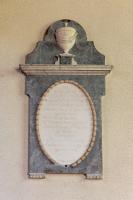
After 9th June 1720. Monument at St Mary the Virgin Church, Overton to Mary Hamner, her son Thomas Hamner and his wife Jane sculpted by V Hagen, Shropshire.
Chronicle of Abbot Ralph of Coggeshall
The Chronicle of Abbot Ralph of Coggeshall (Chronicon Anglicanum) is an indispensable medieval history that brings to life centuries of English and European affairs through the eyes of a learned Cistercian monk. Ralph of Coggeshall, abbot of the Abbey of Coggeshall in Essex in the early 13th century, continued and expanded his community’s chronicle, documenting events from the Norman Conquest of 1066 into the tumultuous reign of King Henry III. Blending eyewitness testimony, careful compilation, and the monastic commitment to record-keeping, this chronicle offers a rare narrative of political intrigue, royal power struggles, and social upheaval in England and beyond. Ralph’s work captures the reigns of pivotal figures such as Richard I and King John, providing invaluable insights into their characters, decisions, and the forces that shaped medieval rule. More than a simple annal, Chronicon Anglicanum conveys the texture of medieval life and governance, making it a rich source for scholars and readers fascinated by English history, monastic authorship, and the shaping of the medieval world.
Available at Amazon in eBook and Paperback format.
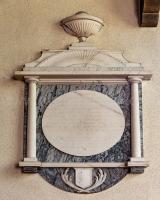
After 9th June 1720. Monument at St Mary the Virgin Church, Overton to Thomas Hamner, Roger Hamner and John Hanmer sculpted by I Nelson, Shropshire.

Stonehenge by William Stukeley. Table IV. A view a little beyond Woodyates where the Ikening Street crosses part of a Druid's barrow. Jun 9 1724.

On 9th June 1727 Richard Fitzpatrick 1st Baron Gowran died. His son John (age 8) succeeded 2nd Baron Gowran of Bowran in County Kilkenny. Monument in St James the Apostle Church, Grafton Underwood, Northamptonshire [Map]. Sculpted by Richard "The Elder" Westmacott.
Richard Fitzpatrick 1st Baron Gowran: On 27th April 1715 Richard Fitzpatrick 1st Baron Gowran was created 1st Baron Gowran of Bowran in County Kilkenny. In 1718 he and Anne Robinson Baroness Gowran were married. She by marriage Baroness Gowran of Bowran in County Kilkenny.
On 9th June 1735 George Bussy Villiers 4th Earl Jersey was born to William Villiers 3rd Earl Jersey (age 28) and Anne Egerton Duchess Bedford. He married March 1770 Frances Twysden and had issue.
Random Records by George Colman. Notes to the foregoing list, by Mr. Winston.
The Theatre open 'd with the Comedy of the English Merchant, and Lilliput, on the 15th May; — closed till the 28th, and then perform'd 3 nights a week, till the 11th June.
9th June [1777]. Miss Farren (age 18) first appeard in London, in the Character of Miss Hardcastle, in the Comedy of "She Stoops to Conquer."
11th June. Mr. Henderson (from Bath) first appear'd in London, in the Character of Shylock.
Mr. Foote acted 11th July, 25th and 30th, only; — was to perform again, but was prevented by illness.
Mr. Digges made his first appearance in London, in the Character of Cato, — (August 14) — which he perform'd twice; — next, Cardinal Wolsey, twice; Sir John Brute, twice; and repeated Sir John Brute, for a Benefit on the 18th of Sept. after the close of the regular season.


On 9th June 1792 William Lowther 1st Earl Lonsdale (age 34) fought a duel with a Captain Cuthbert of the Guards, when, the previous day, the latter had refused to let the former's carriage pass through Mount Street in London where some rioting had been taking place. After shots were fired both parties concluded with a handshake.
On 9th June 1800 James aka John Wilson Carmichael was born to William Carmichael. His father was a ship's carpenter. He married before 28th February 1833 Mary Sweet and had issue.
On 9th June 1804 Henry William Cavendish-Scott-Bentinck was born to William Henry Cavendish-Scott-Bentinck 4th Duke Portland (age 35) and Henrietta Scott Duchess Portland (age 30).
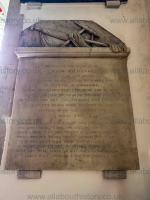
On 9th June 1805 Admiral Mark Milbanke (age 81) died. Memorial at St Etheldreda's Church, Hatfield [Map].
Admiral Mark Milbanke: On 12th April 1724 he was born to Ralph Milbanke 4th Baronet and Anne Delaval Lady Milbanke.
On 9th June 1806 Louis Hesse Darmstadt III Grand Duke was born to Louis Hesse Darmstadt II Grand Duke (age 28) and Princess Wilhelmine Baden (age 17). Coefficient of inbreeding 7.03%.

On 9th June 1814 Susan Harriet Catherine Hamilton Duchess Newcastle under Lyne was born to Alexander Hamilton 10th Duke Hamilton 7th Duke Brandon (age 46) and Susanna Euphemia Beckford Duchess Hamilton Duchess Brandon (age 28). She married 27th November 1832 Henry Pelham-Clinton 5th Duke Newcastle-under-Lyne, son of Henry Pelham-Clinton 4th Duke Newcastle-under-Lyne and Georgiana Elizabeth Mundy Duchess Newcastle under Lyne, and had issue.
The History of William Marshal was commissioned by his son shortly after William’s death in 1219 to celebrate the Marshal’s remarkable life; it is an authentic, contemporary voice. The manuscript was discovered in 1861 by French historian Paul Meyer. Meyer published the manuscript in its original Anglo-French in 1891 in two books. This book is a line by line translation of the first of Meyer’s books; lines 1-10152. Book 1 of the History begins in 1139 and ends in 1194. It describes the events of the Anarchy, the role of William’s father John, John’s marriages, William’s childhood, his role as a hostage at the siege of Newbury, his injury and imprisonment in Poitou where he met Eleanor of Aquitaine and his life as a knight errant. It continues with the accusation against him of an improper relationship with Margaret, wife of Henry the Young King, his exile, and return, the death of Henry the Young King, the rebellion of Richard, the future King Richard I, war with France, the death of King Henry II, and the capture of King Richard, and the rebellion of John, the future King John. It ends with the release of King Richard and the death of John Marshal.
Available at Amazon in eBook and Paperback format.

The London Gazette 18256. War-Office, 9th June 1826.
8th Regiment of Light Dragoons, Captain John Earl of Wiltshire (age 25) to be Major, by purchase, vice Craufurd, promoted in the 94th Foot. Dated 9th June 1826,
Lieutenant James Thomas Lord Brudenell (age 28) to be Captain, by purchase, vice Lord Wiltshire Dated 9th June 1826
continues
Thomas Bateman 1845. June the 9th, 1845, another small barrow in Painstor, upon Alsop Moor was opened, it proved to have been before examined, and its contents removed or destroyed; thus nothing was found on this occasion more interesting than the remains of two human skeletons, and some fragments of an urn of coarse red ware.
Thomas Bateman 1845. The afternoon of the same day was occupied in opening a barrow at Bostom [Map], near Dovedale. In the centre of this tumulus was a very large cist, the sides of which were formed of limestones, standing edgeways upon the rock, which served for the floor, whilst the cover was made by several large and heavy stones lying upon the upper edges of the side stones; nevertheless the cist when opened was found to be full of fine soil which being removed presented the following results: the most ancient interment was the skeleton of a man whose knees were contracted, accompanied by two rude instruments of flint; he lay upon the rocky floor at the extremity of the cist. About one yard distant from this interment and in the centre of the cist was a small hexagonal cist, containing a deposit of calcined human bones; these interments were both upon the floor of the cist and were of higher antiquity than those about to be described, though it is by no means clear that the former were deposited at the same time. On a higher level, within the cist, were two more human skeletons, in a fine and perfect state of preservation, one of which lay with its knees contracted, immediately above the small cist containing the burnt bones; the other, which was the skeleton of a female, lay in a similar position, midway between the small dst and the first-mentioned interment, at the extremity of the vault, but, as before stated, on a higher level. It is both remarkable and worthy of notice, that the female skeleton was without head, though undisturbed and perfect in every other respect, none even of the most minute bones being deficient. Neither of the two later interments was enriched by urns or ornaments, and nothing else was found but pieces of stags' horns and animal teeth. The rats' bones in this barrow were both numerous and in excellent preservation, their skulls being perfect, which is not usually the case.
On 9th June 1847 Augustus Charles Lennox Fitzroy 7th Duke Grafton (age 25) and Anne Balfour (age 22) were married. He the son of Henry Fitzroy 5th Duke Grafton (age 57) and Mary Caroline Berkeley Duchess Grafton (age 51).
Ten Years' Digging. June the 9th we opened the second of three large barrows at Booth Low, the first of which had been excavated not long before by a resident in the neighbourhood, who discovered a deposit of calcined human bones near the centre of the tumulus, unaccompanied by any urn or instrument. Each of the barrows is about forty yards ill circumference, and eight feet high: that under consideration is nearest the village of Longnor [Note. Booth Low Barrow 1 [Map]]. One successful section through the middle shewed that the funeral rites had been performed upon the spot, the body having been reduced to ashes on the natural level of the ground, the remains were then gathered into a heap and covered with a layer of clay, above which a large fire of oak timber was made, the remains of which, in the shape of large pieces of charcoal, perfectly exhibiting the characteristic grain of oak, were then covered up with successive layers of tempered earth, mixed with a few stones, by which means the mound was formed. A few chippings of flint and a small piece of stag's horn were noticed in the course of the excavation.
On 9th March 1850 William Hamo Thornycroft was born to Thomas Thornycroft (age 34) and Mary Francis (age 41). He was baptised on 9th June 1850 at St Pancras Old Church [Map]. He married May 1884 Agatha Cox and had issue.
The Diary of George Price Boyce 1852. 9th June 1852. Went with Joanna (age 20) to an evening party at McArthur's. Mrs. and Helen Field were there; the former, as usual, behaved very distantly and rudely to me, saying goodnight to Helen and Joanna and not noticing me who sat by them. Fortunately she left before supper appeared, and I had some very pleasant chat with Helen who is as pretty, artless, and winning as ever; and with none of her mother's low-bred pride. Recommended Ruskin's "Modern Painters" to Helen's reading.
Ten Years' Digging. On the same day we examined a low mound [Ricklow Dale Barrow [Map]] a short distance east from Ringham Low, in the direction of Ricklow Dale, measuring about 14 yards across. It was so much destroyed as to yield no remains, except two pieces of an extremely thick human skull, and the usual rats' bones; in fact, the whole mound had been removed to within a few inches of the natural surface, on which lay some flat stones.
Ten Years' Digging. On the 9th of June, we made several cuttings in the northern half of the mound, one only affording traces of interment. A little to the east of the cist examined on the 7th of June, we met with another enclosure contracted in like manner, with three large stones, one end being absent. (No. 2 on the Plan.) It contained the imperfect skeletons of four persons, and the only instrument found was part of a bone pin. This cist having the same orientation as the former, was connected with another similar enclosure extending from its western end, which, owing to the wetness of the day, was not then opened. The dimensions of No. 2 are:-
Presumed length, one end being absent 5ft
Width at east end 2ft 8in.
Ditto west end 4ft
Average depth 2ft
like the cist of the 7th of June, it was paved with limestone slabs.
On 9th June 1856 Edward Coley Burne-Jones 1st Baronet (age 22) and Georgiana Macdonald Lady Burne-Jones (age 15) were engaged.
William of Worcester's Chronicle of England
William of Worcester, born around 1415, and died around 1482 was secretary to John Fastolf, the renowned soldier of the Hundred Years War, during which time he collected documents, letters, and wrote a record of events. Following their return to England in 1440 William was witness to major events. Twice in his chronicle he uses the first person: 1. when writing about the murder of Thomas, 7th Baron Scales, in 1460, he writes '… and I saw him lying naked in the cemetery near the porch of the church of St. Mary Overie in Southwark …' and 2. describing King Edward IV's entry into London in 1461 he writes '… proclaimed that all the people themselves were to recognize and acknowledge Edward as king. I was present and heard this, and immediately went down with them into the city'. William’s Chronicle is rich in detail. It is the source of much information about the Wars of the Roses, including the term 'Diabolical Marriage' to describe the marriage of Queen Elizabeth Woodville’s brother John’s marriage to Katherine, Dowager Duchess of Norfolk, he aged twenty, she sixty-five or more, and the story about a paper crown being placed in mockery on the severed head of Richard, 3rd Duke of York.
Available at Amazon in eBook and Paperback format.
Memorials of Edward Burne-Jones 1860. 9th June 1860. The 9th of June fell on a Saturday, and we decided to go no further that day than to Chester, where we should see its curious streets and attend service at the Cathedral [Map] on Sunday; Gabriel (age 32) and his wife (age 30) were by this time in Paris [Map], and we hoped to join them a few days later. But this was not in store for us, for unhappily Edward (age 26) had been caught in a rain-storm a day or two before and already had a slight sore-throat, which now so quickly grew worse that by noon on Sunday he was almost speechless from it and in the hands of a strange doctor. This illness was a sharp check, and we found ourselves shut up for some days in a dreary hotel in an unknown place; but a gleam of satisfaction reached us when the doctor spoke of me to Edward as "your good lady," and gave me directions about what was to be done for the patient, with no apparent suspicion that I had not often nursed him before. Trusting in this and in some half-used reels of sewing cotton ostentatiously left about, as well as a display of boots which had already been worn, we felt great confidence that no one would guess how ignominiously newly-married we were.
On 9th June 1860 Edward Coley Burne-Jones 1st Baronet (age 26) and Georgiana Macdonald Lady Burne-Jones (age 19) were married at Manchester Cathedral [Map].
On 9th June 1876 Arthur Charles Wellesley 5th Duke Wellington was born to Arthur Charles Wellesley 4th Duke Wellington (age 27) and Kathleen Emily Bulkeley Williams Duchess Wellington (age 27). He married 1909 Lillian Maud Glen Coats Duchess Wellington and had issue.
The Life and Death of Llewelly Jewitt Chapter 54. Again, on the ninth of June [1886], the solemn cavalcade winds through the lovely valley of the Derwent, along that route which young Fairholt traversed and described; through the now sweet and smiling Via Gellia, and over the hills to that Churchyard at Winster [Map]. And there, at that grave over which the fond mother used to weep for her children; at which her heart-broken husband had so recently stood in anguish at the loss of her; there, exactly three months later, strong men unused to tears stand and weep the loss of that noble model of a friend, a father, and a husband. It is now a thrice hallowed shrine, at which in ages to come the touching story of these true and constant lovers will be told. But in our sorrow there is comfort, as a friend has eloquently expressed it, saying, "I was inexpressibly touched by the sad news of Mr. Jewitt's (deceased) death; touched none the less that the strong love which had bridged over the great gulf during the last three months should have triumphed over the material separation he bewailed, and brought them together again. Those who love him cannot rejoice at losing him, and I feel deeply for you, who in him have lost so much; but he would not have had it otherwise himself; and true humanity can rejoice with them that do rejoice, though it may feel itself stricken by the very occasion of their joy."
Note 1. Rev. George W. Skene, M.A., Rector of Barthomley.
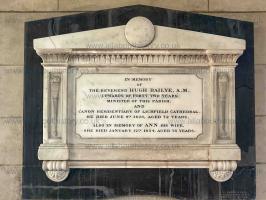
St Werburgh's Church, Hanbury [Map]. Memorial to Hugh Bailye, died 9th June 1933.
On 9th June 1267 Catherine Wittelsbach was born to Henry Wittelsbach I Duke Lower Bavaria I Duke Bavaria (age 31) and Elizabeth Duchess Bavaria (age 31). She a great x 3 granddaughter of King Henry "Curtmantle" II of England.
On 9th June 1454 Barbara Wittelsbach was born to Albert Wittelsbach III Duke Bavaria (age 53) and Anna Brunswick Grubenhagen Duchess Bavaria (age 40) at Munich.
On 9th June 1609 Randall MacDonnell 1st Marquess Antrim was born to Randal "Arranach" Macdonnell 1st Earl Antrim and Alice O'Neill Countess Antrim. He married 1635 Katherine Manners Duchess Buckingham, daughter of Francis Manners 6th Earl of Rutland and Frances Knyvet Lady Bevill.
On 9th June 1640 Leopold Habsburg Spain I Holy Roman Emperor was born to Ferdinand III Holy Roman Emperor (age 31) and Maria Anna of Spain Holy Roman Empress (age 33). Coefficient of inbreeding 15.19%. He married (1) 1666 his niece Margaret Theresa Habsburg Holy Roman Empress, daughter of Philip IV King Spain and Mariana of Austria Queen Consort Spain, and had issue (2) before 1676 his second cousin Claudia Felicitas of Holy Roman Empress and had issue (3) 14th December 1676 his third cousin once removed Eleonore Magdalene of Neuburg and had issue.
On 9th June 1654 Catherine Herbert was born to Philip Herbert 5th Earl Pembroke 2nd Earl Montgomery (age 33) and Catherine Villiers Countess Pembroke and Montgomery (age 33). She was baptised on 10th June 1654 at St Benet's Church, Paul's Wharf [Map].
On 9th June 1680 Carey Newton was born to John Newton 3rd Baronet (age 29) and Abigail Heveningham (age 20). She married 1696 her third cousin Edward Coke and had issue.
William of Worcester's Chronicle of England
William of Worcester, born around 1415, and died around 1482 was secretary to John Fastolf, the renowned soldier of the Hundred Years War, during which time he collected documents, letters, and wrote a record of events. Following their return to England in 1440 William was witness to major events. Twice in his chronicle he uses the first person: 1. when writing about the murder of Thomas, 7th Baron Scales, in 1460, he writes '… and I saw him lying naked in the cemetery near the porch of the church of St. Mary Overie in Southwark …' and 2. describing King Edward IV's entry into London in 1461 he writes '… proclaimed that all the people themselves were to recognize and acknowledge Edward as king. I was present and heard this, and immediately went down with them into the city'. William’s Chronicle is rich in detail. It is the source of much information about the Wars of the Roses, including the term 'Diabolical Marriage' to describe the marriage of Queen Elizabeth Woodville’s brother John’s marriage to Katherine, Dowager Duchess of Norfolk, he aged twenty, she sixty-five or more, and the story about a paper crown being placed in mockery on the severed head of Richard, 3rd Duke of York.
Available at Amazon in eBook and Paperback format.
On 9th June 1698 Amabel Grey was born to Henry Grey 1st Duke Kent (age 27) and Jemima Crew Marchioness Kent (age 23). She married 20th February 1718 John Campbell 3rd Earl Breadalbaine and Holland, son of John Campbell 2nd Earl Breadalbaine and Holland and Henrietta Villiers Countess Breadalbaine and Holland, and had issue.
On 9th June 1709 Nathaniel Booth 4th Baron Delamer was born to Dean Robert Booth (age 47) and Mary Hales.
On 9th June 1714 Edward Murray was born to John Murray 1st Duke Atholl (age 54) and Mary Ross Duchess Atholl (age 26).

On 9th June 1723 Mary Theresa Throckmorton was born to Robert Throckmorton 4th Baronet (age 20) and Theresa Herbert Lady Throckmorton (age 17). She married 1743 her fifth cousin once removed Thomas Fitzherbert and had issue.
On 9th June 1735 George Bussy Villiers 4th Earl Jersey was born to William Villiers 3rd Earl Jersey (age 28) and Anne Egerton Duchess Bedford. He married March 1770 Frances Twysden and had issue.
On 9th June 1749 Frederick Irby 2nd Baron Boston was born to William Irby 1st Baron Boston (age 42) and Albania Selwyn Baroness Boston (age 30) He married 15th May 1775 Christian Methuen and had issue.
On 9th June 1751 Charles Watson 1st Baronet was born to Vice-Admiral Charles Watson (age 37). He married 16th July 1789 Juliana Moyle aka Copley, daughter of Joseph Moyle aka Copley 1st Baronet and Mary Buller Lady Copley, and had issue.
On 9th June 1800 James aka John Wilson Carmichael was born to William Carmichael. His father was a ship's carpenter. He married before 28th February 1833 Mary Sweet and had issue.
On 9th June 1803 Very Reverend John Wolseley 8th Baronet was born to Arthur Wolseley (age 31).
On 9th June 1804 Henry William Cavendish-Scott-Bentinck was born to William Henry Cavendish-Scott-Bentinck 4th Duke Portland (age 35) and Henrietta Scott Duchess Portland (age 30).
Henrici Quinti, Angliæ Regis, Gesta, is a first-hand account of the Agincourt Campaign, and subsequent events to his death in 1422. The author of the first part was a Chaplain in King Henry's retinue who was present from King Henry's departure at Southampton in 1415, at the siege of Harfleur, the battle of Agincourt, and the celebrations on King Henry's return to London. The second part, by another writer, relates the events that took place including the negotiations at Troye, Henry's marriage and his death in 1422.
Available at Amazon in eBook and Paperback format.
On 9th June 1806 Louis Hesse Darmstadt III Grand Duke was born to Louis Hesse Darmstadt II Grand Duke (age 28) and Princess Wilhelmine Baden (age 17). Coefficient of inbreeding 7.03%.
On 9th June 1809 Geoffrey Palmer 8th Baronet was born to John Henry Palmer 7th Baronet (age 34) and Mary Grace Watson.
On 9th June 1814 Susan Harriet Catherine Hamilton Duchess Newcastle under Lyne was born to Alexander Hamilton 10th Duke Hamilton 7th Duke Brandon (age 46) and Susanna Euphemia Beckford Duchess Hamilton Duchess Brandon (age 28). She married 27th November 1832 Henry Pelham-Clinton 5th Duke Newcastle-under-Lyne, son of Henry Pelham-Clinton 4th Duke Newcastle-under-Lyne and Georgiana Elizabeth Mundy Duchess Newcastle under Lyne, and had issue.
On 9th June 1834 George Maryon Wilson was born to John Maryon Wilson 9th Baronet (age 31).
On 9th June 1846 Herbert Colstoun Gardner 1st Baron Burghclere was born illegitimately to Alan Legge Gardner 3rd Baron Gardner (age 36). He was born two years before his parents marriage and, therefore, was not elibigle to succeed to his father's barony. He married 4th March 1890 Winifred Herbert Baroness Burghclere, daughter of Henry Howard Molyneux Herbert 4th Earl Carnarvon and Evelyn Stanhope Countess Carnarvon, and had issue.
On 9th March 1850 William Hamo Thornycroft was born to Thomas Thornycroft (age 34) and Mary Francis (age 41). He was baptised on 9th June 1850 at St Pancras Old Church [Map]. He married May 1884 Agatha Cox and had issue.
On 9th June 1856 Francis Montagu Stuart-Wortley-Mackenzie 2nd Earl of Wharncliffe was born to Francis Dudley Stuart-Wortley-Mackenzie (age 26) and Maria Elizabeth Martin (age 23). He married 17th August 1886 Ellen Gallwey Countess of Wharncliffe and had issue.
On 9th June 1866 George Kemp 1st Baron Rochdale was born to George Tawke Kemp and Emily Lydia Kelsall in Rochdale, Lancashire. He married 5th August 1896 Beatrice Mary Egerton Baroness Rochdale, daughter of Francis Egerton 3rd Earl Ellesmere and Katherine Louisa Phipps Countess Ellesmere, and had issue.
On 9th June 1876 Arthur Charles Wellesley 5th Duke Wellington was born to Arthur Charles Wellesley 4th Duke Wellington (age 27) and Kathleen Emily Bulkeley Williams Duchess Wellington (age 27). He married 1909 Lillian Maud Glen Coats Duchess Wellington and had issue.
On 9th June 1878 Victoria Sybil Mary Grey was born to Albert Henry George Grey 4th Earl Grey (age 26) and Alice Holford Countess Grey. She married 23rd July 1901 Arthur Morton Grenfell.
On 9th June 1881 Captain John Banks Jenkinson was born to George Banks Jenkinson 12th Baronet (age 30) and Madeline Holme-Sumner Lady Jenkinson (age 20). He married November 1907 Joan Hill and had issue.
The History of William Marshal was commissioned by his son shortly after William’s death in 1219 to celebrate the Marshal’s remarkable life; it is an authentic, contemporary voice. The manuscript was discovered in 1861 by French historian Paul Meyer. Meyer published the manuscript in its original Anglo-French in 1891 in two books. This book is a line by line translation of the first of Meyer’s books; lines 1-10152. Book 1 of the History begins in 1139 and ends in 1194. It describes the events of the Anarchy, the role of William’s father John, John’s marriages, William’s childhood, his role as a hostage at the siege of Newbury, his injury and imprisonment in Poitou where he met Eleanor of Aquitaine and his life as a knight errant. It continues with the accusation against him of an improper relationship with Margaret, wife of Henry the Young King, his exile, and return, the death of Henry the Young King, the rebellion of Richard, the future King Richard I, war with France, the death of King Henry II, and the capture of King Richard, and the rebellion of John, the future King John. It ends with the release of King Richard and the death of John Marshal.
Available at Amazon in eBook and Paperback format.
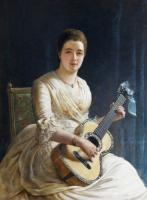
On 9th June 1887 Arthur Victor Agar-Robartes 8th Viscount Clifden was born to Thomas Agar-Robartes 6th Viscount Clifden (age 43) and Mary Dickinson Viscountess Clifden. He married 1920 Patience Mary Basset.
On 9th June 1891 Cecil Gustavus Jacques Neumann aka Newman 2nd Baronet was born to Sigmund Neumann 1st Baronet (age 34) and Anna Allegra Hakim Lady Neumann (age 27). He married 1922 Joan Grimston Lady Neumann and had issue.
On 9th June 1892 Tankerville Morris 5th Baronet was born to Robert Armine Morris 4th Baronet (age 43).
On 9th June 1948 Vicary Gibbs 4th Baron Hunsdon 6th Baron Aldenham was born to Antony Gibbs 3rd Baron Hunsdon 5th Baron Aldenham (age 26) and Mary Elizabeth Tyser Baroness Hunsdon and Aldenham.
On 9th June 1513 Claude Lorraine 1st Duke Guise (age 16) and Antoinette Bourbon Duchess of Guise (age 20) were married. She the daughter of Francis Bourbon Count Vendôme and Soissons and Marie Luxemburg Countess Vendôme and Soissons. He the son of René Lorraine II Duke Lorraine Duke of Bar and Philippa Egmont Duchess of Bar Duchess Lorraine (age 46). They were fourth cousins. She a great x 5 granddaughter of King Edward III of England.
On 9th June 1618 John Lyon 2nd Earl Kinghorne (age 22) and Margaret Erskine Countess Kinghorne (age 19) were married. She by marriage Countess Kinghorne. She the daughter of John Erskine 19th Earl of Mar (age 56) and Mary Stewart Countess Mar (age 36). He the son of Patrick Lyon 1st Earl Kinghorne. They were fourth cousin once removed.
On 9th June 1655 Gilbert Holles 3rd Earl de Clare (age 22) and Grace Pierrepont Countess de Clare (age 22) were married at St Giles' in the Fields Church [Map]. He the son of John Holles 2nd Earl de Clare (age 59) and Elizabeth Vere Countess Clare.

On 9th June 1665 Robert Spencer 2nd Earl of Sunderland (age 23) and Anne Digby Countess Sunderland (age 19) were married. She by marriage Countess of Sunderland. She the daughter of George Digby 2nd Earl Bristol (age 52) and Anne Russell Countess Bristol (age 45). He the son of Henry Spencer 1st Earl of Sunderland and Dorothy Sidney Countess Sunderland (age 47). They were half fifth cousins.

On 9th June 1683 Robert Dashwood 1st Baronet (age 20) and Penelope Chamberlayne Lady Dashwood (age 20) were married.

On 9th June 1741 John Wallop 1st Earl Portsmouth (age 51) and Elizabeth Griffin Countess Portsmouth (age 49) were married. She by marriage Viscountess Lymington. They were fifth cousin once removed.
Jean de Waurin's Chronicle of England Volume 6 Books 3-6: The Wars of the Roses
Jean de Waurin was a French Chronicler, from the Artois region, who was born around 1400, and died around 1474. Waurin’s Chronicle of England, Volume 6, covering the period 1450 to 1471, from which we have selected and translated Chapters relating to the Wars of the Roses, provides a vivid, original, contemporary description of key events some of which he witnessed first-hand, some of which he was told by the key people involved with whom Waurin had a personal relationship.
Available at Amazon in eBook and Paperback format.
On 9th June 1749 James Ogilvy 6th Earl Findlater 3rd Earl Seafield (age 35) and Mary Murray Countess Findlater (age 29) were married. She the daughter of John Murray 1st Duke Atholl and Mary Ross Duchess Atholl (age 61). He the son of James Ogilvy 5th Earl Findlater 2nd Earl Seafield (age 60) and Elizabeth Hay.
On 9th June 1785 James Graham 1st Baronet (age 24) and Catherine Stewart Lady Graham (age 20) were married. She the daughter of John Stewart 7th Earl Galloway (age 49) and Anne Dashwood Countess Galloway (age 42).
On 9th June 1846 William Legge 5th Earl Dartmouth (age 22) and Augusta Finch Countess Dartmouth (age 24) were married. She the daughter of Heneage Finch 5th Earl Aylesford (age 60) and Augusta Sophia Greville Countess Aylesford. He the son of William Legge 4th Earl Dartmouth (age 61) and Frances Charlotte Chetwynd-Talbot Countess Dartmouth. They were second cousins.
On 9th June 1847 Augustus Charles Lennox Fitzroy 7th Duke Grafton (age 25) and Anne Balfour (age 22) were married. He the son of Henry Fitzroy 5th Duke Grafton (age 57) and Mary Caroline Berkeley Duchess Grafton (age 51).
On 9th June 1860 Edward Coley Burne-Jones 1st Baronet (age 26) and Georgiana Macdonald Lady Burne-Jones (age 19) were married at Manchester Cathedral [Map].
On 9th June 1864 Edward Heneage 1st Baron Heneage (age 24) and Eleanor Cecilia Hare (age 19) were married. She the daughter of William Hare 2nd Earl Listowel and Maria Augusta Windham Countess Listowel (age 59).
On 9th June 1873 Edward Marjoribanks 2nd Baron Tweedmouth (age 23) and Fanny Octavia Louise Spencer-Churchill (age 20) were married. She the daughter of John Winston Spencer-Churchill 7th Duke of Marlborough (age 51) and Frances Anne Emily Vane Duchess of Marlborough (age 51).
On 9th June 1877 Albert Henry George Grey 4th Earl Grey (age 25) and Alice Holford Countess Grey were married. She by marriage Countess Grey.
On 9th June 1903 Mervyn Wingfield 8th Viscount Powerscourt (age 23) and Sybil Pleydell-Bouverie Viscountess Powerscout (age 24) were married at St George's Church, Hanover Square.
On 9th June 1909 Walter Keppel 9th Earl Albermarle (age 27) and Judith Sydney Myee Wynn-Carington (age 20) were married at St Margaret's Church, Westminster [Map]. She the daughter of Charles Robert Wynn-Carington 1st Marquess of Lincolnshire (age 66) and Cecilia Margaret Harbord Marchioness (age 52). He the son of Arnold Keppel 8th Earl Albermarle (age 51) and Gertrude Egerton Countess Albemarle (age 48). They were fourth cousin once removed.


On 9th June 1910 Roundell Palmer 3rd Earl Selborne (age 23) and Grace Ridley Countess Selborne (age 21) were married. He the son of William Palmer 2nd Earl Selborne (age 50) and Beatrix Maud Gascoyne-Cecil Countess Selborne (age 52).
On 9th June 1101 Hugh Clermont Count of Clermont-en-Beauvaisis (age 70) died. His son Renaud (age 26) succeeded II Count Clermont.
On 9th June 1238 Bishop Peter de Roches died.
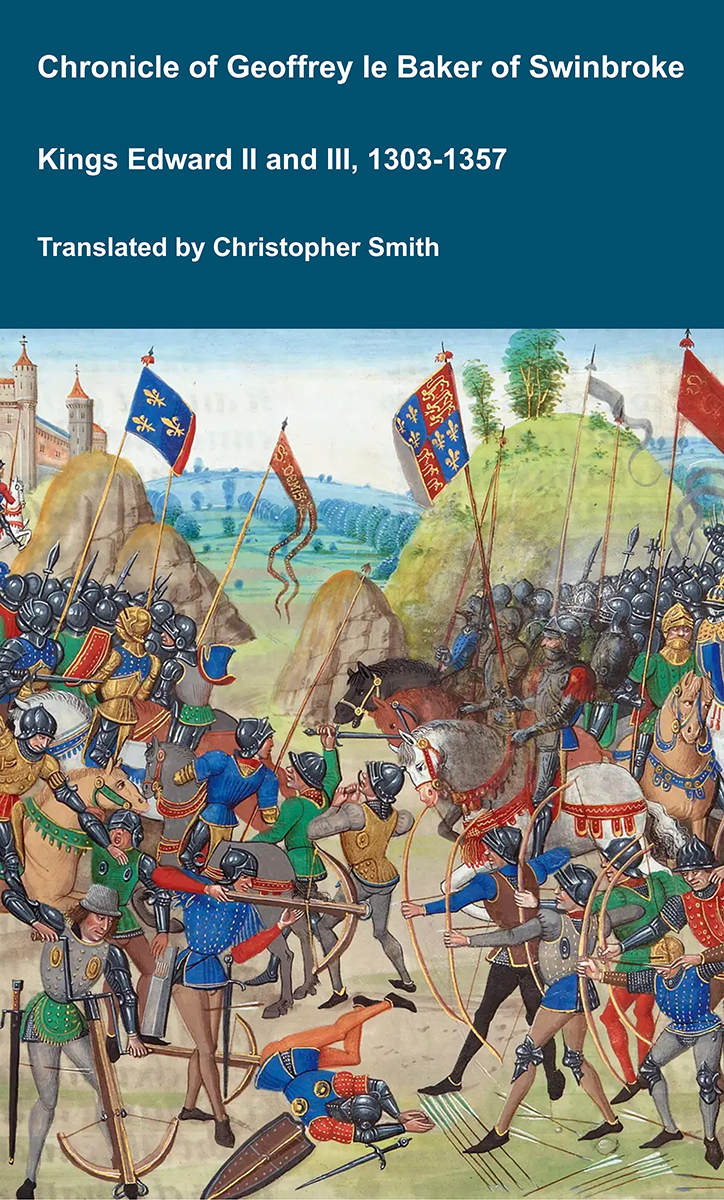
Chronicle of Geoffrey le Baker of Swinbroke
Baker was a secular clerk from Swinbroke, now Swinbrook, an Oxfordshire village two miles east of Burford. His Chronicle describes the events of the period 1303-1356: Gaveston, Bannockburn, Boroughbridge, the murder of King Edward II, the Scottish Wars, Sluys, Crécy, the Black Death, Winchelsea and Poitiers. To quote Herbert Bruce 'it possesses a vigorous and characteristic style, and its value for particular events between 1303 and 1356 has been recognised by its editor and by subsequent writers'. The book provides remarkable detail about the events it describes. Baker's text has been augmented with hundreds of notes, including extracts from other contemporary chronicles, such as the Annales Londonienses, Annales Paulini, Murimuth, Lanercost, Avesbury, Guisborough and Froissart to enrich the reader's understanding. The translation takes as its source the 'Chronicon Galfridi le Baker de Swynebroke' published in 1889, edited by Edward Maunde Thompson.
Available at Amazon in eBook and Paperback format.
On 9th June 1252 Otto "Child" Brunswick-Lüneburg Duke Brunswick-Lüneburg (age 48) died.
On 9th June 1360 Gerard Lisle 1st Baron Lisle (age 56) died at Stowe, Northamptonshire. His son Warin (age 30) succeeded 2nd Baron Lisle of Kingston Lisle in Oxfordshire. Margaret Pipard Baroness Lisle (age 37) by marriage Baroness Lisle of Kingston Lisle in Oxfordshire.
He was buried at St Michael's Church, Stowe Nine Churches [Map]. His effigy is of the Early Medieval Period with right leg over left.
Warin Lisle 2nd Baron Lisle: Around 1330 he was born to Gerard Lisle 1st Baron Lisle and Eleanor Fitzalan at Kingston Lisle, Oxfordshire. Before 1360 Warin Lisle 2nd Baron Lisle and Margaret Pipard Baroness Lisle were married. After 1360 Warin Lisle 2nd Baron Lisle and Joan Unknown Baroness Lisle were married. She by marriage Baroness Lisle of Kingston Lisle in Oxfordshire. On 28th June 1382 Warin Lisle 2nd Baron Lisle died. His daughter Margaret succeeded 3rd Baroness Lisle of Kingston Lisle in Oxfordshire.
Margaret Pipard Baroness Lisle: Around 1323 she was born to William Pipard. On 3rd August 1373 she died.
On 9th June 1396 Margaret Stafford Baroness Neville Raby (age 32) died. She was buried at St Brandon's Church, Brancepeth.
On 9th June 1401 Constance Sutton Baroness Haversham (age 45) died.
On 9th June 1479 Elizabeth Crichton Countess Huntley (age 69) died.
On 9th June 1511 William Courtenay 1st Earl Devon (age 36) died of pleurisy. His son Henry (age 15) succeeded 2nd Earl Devon. His widow Catherine York Countess Devon (age 31) subsequently took a vow of celibacy in the presence of Bishop Richard Fitzjames on 13th July 1511.
On 9th June 1537 Louis Valois II Duke Longueville (age 27) died at Rouen, France [Map]. His son François (age 1) succeeded III Duke Longueville.
On 9th June 1572 Jeanne Albret III Queen Navarre (age 43) died.
On 9th June 1583 Thomas Radclyffe 3rd Earl of Sussex (age 58) died. His brother Henry (age 51) succeeded 4th Earl of Sussex, 4th Viscount Fitzwalter, 13th Baron Fitzwalter. Honora Pound Viscountess Fitzwalter by marriage Countess of Sussex.

On 9th June 1691 Charles Maitland 3rd Earl Lauderdale died. His son Richard (age 37) succeeded 4th Earl Lauderdale, 4th Viscount Maitland, 4th Viscount Lauderdale although the Earldom was outlawed on 23rd July 1694 as a consequence of his being a Jacobite.
Chronicle of Walter of Guisborough
A canon regular of the Augustinian Guisborough Priory, Yorkshire, formerly known as The Chronicle of Walter of Hemingburgh, describes the period from 1066 to 1346. Before 1274 the Chronicle is based on other works. Thereafter, the Chronicle is original, and a remarkable source for the events of the time. This book provides a translation of the Chronicle from that date. The Latin source for our translation is the 1849 work edited by Hans Claude Hamilton. Hamilton, in his preface, says: 'In the present work we behold perhaps one of the finest samples of our early chronicles, both as regards the value of the events recorded, and the correctness with which they are detailed; Nor will the pleasing style of composition be lightly passed over by those capable of seeing reflected from it the tokens of a vigorous and cultivated mind, and a favourable specimen of the learning and taste of the age in which it was framed.'
Available at Amazon in eBook and Paperback format.
On 9th June 1701 Philip Bourbon I Duke Orléans (age 60) died. His son Philippe (age 26) succeeded II Duke Orléans.
On 9th June 1727 Richard Fitzpatrick 1st Baron Gowran died. His son John (age 8) succeeded 2nd Baron Gowran of Bowran in County Kilkenny. Monument in St James the Apostle Church, Grafton Underwood, Northamptonshire [Map]. Sculpted by Richard "The Elder" Westmacott.
Richard Fitzpatrick 1st Baron Gowran: On 27th April 1715 Richard Fitzpatrick 1st Baron Gowran was created 1st Baron Gowran of Bowran in County Kilkenny. In 1718 he and Anne Robinson Baroness Gowran were married. She by marriage Baroness Gowran of Bowran in County Kilkenny.
On 22nd May 1739 John Coryton 4th Baronet (age 49) died. He was buried on 9th June 1739 at St Melanus' Church, St Mellion. Baronet Coryton of Newton extinct. Despite having a sister Susanna Coryton his estates appear to have devolved to his cousin Peter Goodall, who took the name Coryton, grandson of Elizabeth Coryton who was daughter of John Coryton 1st Baronet.

On 9th June 1777 Joshua Vanneck 1st Baronet (age 76) died. His son Gerard (age 33) succeeded 2nd Baronet Vanneck of Putney.
On 9th June 1780 Paulet St John 1st Baronet (age 76) died. His son Henry (age 43) succeeded 2nd Baronet St John-Mildmay of Farley in Southampton. Dorothy Maria Tucker Lady St John Mildmay by marriage Lady St John-Mildmay of Farley in Southampton.
On 9th June 1781 Edward Plunkett 12th Baron Dunsany (age 68) died. His son Randall (age 42) succeeded 13th Baron Dunsany.
On 9th June 1783 Annabella Bayley Lady Blakiston died.
On 9th June 1802 Charles Stanley Monck 1st Viscount Monck (age 48) died. His son Henry (age 16) succeeded 2nd Viscount Monck.
On 9th June 1831 John Edward Harington 8th Baronet (age 71) died. His son James (age 42) succeeded 9th Baronet Harington of Ridlington in Rutlandshire.
On 9th June 1887 George Finch-Hatton 6th Earl Nottingham 11th Earl Winchilsea (age 72) died. His half brother Murray (age 36) succeeded 7th Earl Nottingham, 12th Earl Winchilsea, 12th Viscount Maidstone, 7th Baron Finch Daventry, 13th Baronet Finch of Eastwell in Kent. Edith Harcourt Countess Winchelsea and Nottingham (age 31) by marriage Countess Nottingham, Countess Winchilsea.
Chronicle of Abbot Ralph of Coggeshall
The Chronicle of Abbot Ralph of Coggeshall (Chronicon Anglicanum) is an indispensable medieval history that brings to life centuries of English and European affairs through the eyes of a learned Cistercian monk. Ralph of Coggeshall, abbot of the Abbey of Coggeshall in Essex in the early 13th century, continued and expanded his community’s chronicle, documenting events from the Norman Conquest of 1066 into the tumultuous reign of King Henry III. Blending eyewitness testimony, careful compilation, and the monastic commitment to record-keeping, this chronicle offers a rare narrative of political intrigue, royal power struggles, and social upheaval in England and beyond. Ralph’s work captures the reigns of pivotal figures such as Richard I and King John, providing invaluable insights into their characters, decisions, and the forces that shaped medieval rule. More than a simple annal, Chronicon Anglicanum conveys the texture of medieval life and governance, making it a rich source for scholars and readers fascinated by English history, monastic authorship, and the shaping of the medieval world.
Available at Amazon in eBook and Paperback format.
On 9th June 1894 Bishop Arthur Hervey (age 85) died.


On 9th June 1922 Anthony Fane 13th Earl of Westmoreland (age 62) died. His son Vere (age 29) succeeded 14th Earl of Westmoreland.
On 9th June 1922 Charles Lyttelton 8th Viscount Cobham (age 79) died. His son John (age 40) succeeded 9th Viscount Cobham, 6th Baron Lyttelton of Frankley in Worcestershire, 6th Baron Westcote, 12th Baronet Lyttelton of Frankley. Violet Leonard Viscountess Cobham by marriage Viscountess Cobham.
On 9th June 1939 Francis Dyke Acland 14th Baronet (age 65) died. His son Richard (age 32) succeeded 15th Baronet Acland of Columb John in Devon.
On 9th June 1945 Richard William Alan Onslow 5th Earl Onslow (age 68) died. His son William (age 31) succeeded 6th Earl Onslow, 6th Viscount Cranley, 9th Baron Onslow, 10th Baronet Onslow of West Clandon in Surrey, 11th Baronet Foote of London.
On 9th June 1946 Thomas Henry Thynne 5th Marquess of Bath (age 83) died. His son Henry (age 41) succeeded 6th Marquess of Bath, 8th Viscount Weymouth, 8th Baron Thynne of Warminster in Wiltshire, 9th Baronet Thynne of Kempsford in Gloucestershire. Daphne Vivian Marchioness Bath (age 41) by marriage Marchioness of Bath.
On 9th June 1950 Francis Barrow 4th Baonet (age 87) died. His son Wilfred (age 52) succeeded 5th Baronet Barrow of Ulverstone in Lancashire.
On 9th June 1962 Philip Reginald le Belward Grey-Egerton 14th Baronet (age 76) died. His son Philip (age 42) succeeded 15th Baronet Egerton and Oulton.
On 9th June 1975 Albert Edward John Spencer 7th Earl Spencer (age 83) died. His son John (age 51) succeeded 8th Earl Spencer, 8th Viscount Althorp, 8th Viscount Spencer, 8th Baron Spencer Althorp. Frances Ruth Roche Countess Spencer (age 39) by marriage Countess Spencer.