

This is a translation of the 'Memoires of Jacques du Clercq', published in 1823 in two volumes, edited by Frederic, Baron de Reissenberg. In his introduction Reissenberg writes: 'Jacques du Clercq tells us that he was born in 1424, and that he was a licentiate in law and a counsellor to Philip the Good, Duke of Burgundy, in the castellany of Douai, Lille, and Orchies. It appears that he established his residence at Arras. In 1446, he married the daughter of Baldwin de la Lacherie, a gentleman who lived in Lille. We read in the fifth book of his Memoirs that his father, also named Jacques du Clercq, had married a lady of the Le Camelin family, from Compiègne. His ancestors, always attached to the counts of Flanders, had constantly served them, whether in their councils or in their armies.' The Memoires cover a period of nineteen years beginning in in 1448, ending in in 1467. It appears that the author had intended to extend the Memoirs beyond that date; no doubt illness or death prevented him from carrying out this plan. As Reissenberg writes the 'merit of this work lies in the simplicity of its narrative, in its tone of good faith, and in a certain air of frankness which naturally wins the reader’s confidence.' Du Clercq ranges from events of national and international importance, including events of the Wars of the Roses in England, to simple, everyday local events such as marriages, robberies, murders, trials and deaths, including that of his own father in Book 5; one of his last entries.
Available at Amazon in eBook and Paperback format.
19 Jun is in June.
1312 Capture, Trial and Execution of Piers Gaveston
1535 Execution of the Carthusians
History of the Dukes of Normandy by William of Jumieges. When Æthelstan1, king of the English, heard of the magnificent fame of the renowned duke, he sent envoys to him with many gifts, asking him to strive to restore Louis2, his nephew, the son of King Charles, to his father's kingdom, and also to pardon Alan the Breton, who had offended him, out of regard for the king's affection. The duke, gladly agreeing to these requests, granted pardon to Alan for what was owed and allowed him by his command to return to his lands. And Louis, recalled from across the sea, with the support of Hugh the Great, and with the bishops and the leading men of the Franks assisting, he anointed with holy oil and raised to the kingship2. But after he had governed the realm in peace for the space of five years, the Franks once again conspired against him, seeking to drive him from the kingdom.
Audiens autem Elstannus, rex Anglorum, tam magnificam inclyti ducis famam, cum donariis multis legatos illi mittit, orans ut Ludovicum, suum videlicet nepotem, Caroli regis filium, paterno restituere regno satageret, atque Alanno Britoni sibi infenso commissa pro suo amore ignosceret. Cujus precibus dux libenti animo annuens, Alanno debita indulsit atque ad sua redire jussu concessit; et Ludovicum transmarinis partibus revocatum, Hugone magno favente, cum episcopis, cæterisque Francorum primoribus sancto inunctum oleo regno sublimavit. Quod cum lustro uno sub quiete disponeret, iterum Franci adversus eum conspirant, molientes a regnis illum pellere.
Note 1. King Æthelstan, ~894-939, was son of King Edward the Elder and his first wife, Ecgwynn, and grandson of King Alfred the Great. He was King of the Anglo-Saxons from 924-927, and the first King of the English, following his conquest of York, from 927-939.
Note 2. King Louis IV of France, known as 'd'Outermer' or 'Transmarinus' i.e. from overseas, was a son of King Charles the Simple and his wife Eadgifu of Wessex, sister of King Æthelstan, and daughter of King Edward the Elder. Following the Battle of Soissons [see Chapter 2.21] at which King Charles was captured and held in captivity, his mother Eadgifu took Louis, aged around two years old, to her father in England at which he stayed until he was a teenager. He was crowned at Laon on 19th June 936 by Archbishop Artald of Reims.
Annals of Flodoard. Count Hugh sends across the sea to summon Louis, the son of Charles, to assume the throne of the kingdom; and King Æthelstan, his uncle, after first receiving an oath from the envoys of the Franks, sends him into Francia with certain bishops and other of his faithful men. Hugh and the other nobles of the Franks, having gone out to meet him, immediately upon his entering the ship, meet him on the very sands of the shore at Boulogne, as had been agreed on both sides; and from there he is led by them to Laon, and enriched with the royal blessing he is anointed and crowned by lord Archbishop Artald [Sunday 19th June 936], in the presence of the princes of the realm with twenty bishops and more.
Hugo comes trans mare mittit pro accersendo ad apicem regni suscipiendum Ludovico, Karoli filio, quem rex Alstanus avunculus ipsius, accepto prius jurejurando a Francorum legatis, in Franciam cum quibusdam episcopis et aliis fidelibus suis dirigit : cui Hugo et cæteri Francorum proceres obviam profecti, mox navim ingresso in ipsis littoreis arenis apud Bononiam sese committunt, ut erat utrimque depactum, indeque ab ipsis Laudunum deductus, ac regali benedictione ditatus ungitur atque coronatur a domno Artaldo archiepiscopo præsentibus regni principibus cum episcopis viginti et amplius.
Anglo-Saxon Chronicle. [19th June 1052]. In the same year advised the king and his council, that ships should be sent out to Sandwich, Kent [Map], and that Earl Ralph and Earl Odda (age 59) should be appointed headmen thereto. Then went Earl Godwin (age 51) out from Bruges [Map] with his ships to Ysendyck; and sailed forth one day before midsummer-eve, till he came to the Ness that is to the south of Romney. When it came to the knowledge of the earls out at Sandwich, Kent [Map], they went out after the other ships; and a land-force was also ordered out against the ships. Meanwhile Earl Godwin had warning, and betook himself into Pevensey [Map]: and the weather was so boisterous, that the earls could not learn what had become of Earl Godwin. But Earl Godwin then went out again until he came back to Bruges [Map]; and the other ships returned back again to Sandwich, Kent [Map]. Then it was advised that the ships should go back again to London, and that other earls and other pilots should be appointed over them. But it was delayed so long that the marine army all deserted; and they all betook themselves home. When Earl Godwin understood that, he drew up his sail and his ship: and they70 went west at once to the Isle of Wight [Map]; and landing there, they plundered so long that the people gave them as much as they required of them. Then proceeded they westward until they came to Portland, where they landed and did as much harm as they could possibly do.
Note 70 i.e. Earl Godwin and his crew.
On 19th June 1270 Alan Zouche (age 67) and his son Roger Zouche (age 27) were attacked at during a trial between him and John Warenne 6th Earl of Surrey (age 39). Alan was seriously injured and left on the spot, his son escaped. On 4th August 1270 John Warenne 6th Earl of Surrey agreed to pay substantial compensation to the injured. Alan died eight days later.
On 19th June 1282 Eleanor Montfort Princess of Wales (age 30) died in childbirth.
On 19th June 1294 Charles IV King France I King Navarre was born to King Philip IV of France (age 26) and Joan Blois I Queen Navarre (age 21). Coefficient of inbreeding 2.11%. He married (1) 1307 his second cousin Blanche of Burgundy Queen Consort France, daughter of Otto Ivrea IV Count Burgundy and Mahaut Artois Countess Burgundy, and had issue (2) after 19th May 1322 his fourth cousin Marie Luxemburg Queen Consort France, daughter of Henry Luxemburg VII Holy Roman Emperor and Margaret Brabant Countess Luxemburg and Namur, and had issue (3) 5th July 1324 his half first cousin Joan Évreux Queen Consort France, daughter of Louis I Count Évreux and Margaret Artois Countess Évreux, and had issue.
 Chronicle of Walter of Guisborough. Meanwhile, the new king of Scotland received homages and performed great feats; and, having gathered a large army, he marched around that region as far as the town of St. John of Perth. There in the garrison was Lord Aymer de Valence with nearly three hundred armed men and some infantry. The Scots appeared in white in great numbers; for, by the order and arrangement of their king, all the mounted men-at-arms wore a linen garment over all their armour, so that they all looked as if in white shirts, and no one could tell who each was or what kind of armour he bore. The king [of Scotland] sent messengers, bidding our men either to come out and fight him, or to surrender to him. But they, seeing that they were fewer in number, replied cautiously that they would not come out then, but would gladly fight him the next day, because it was a feast day. For it was the Sunday next after the [19th June 1306]. The king, being too trusting, drew back at these words, and pitched his tents about a mile from the town, and they began preparing food. Our men, however, said to each other: "If we wait until tomorrow, we will not be able to prevail against him, for he is stronger than we are; but if we go out in the evening, we will win against him, because right now they are busy preparing their food."
Interim ipse novus rex Scotia cepit homagia, et fecit mirabilia magna; congregatoque exercitu copioso circuivit illam regionem usque ad villam Sancti Johannis de Perte. Et erat ibi in præsidio dominus Emericus de Walence fere cum trecentis armatis et pedestribus aliquibus. Apparueruntque Scoti in albis in magna multitudine; ex præcepto enim et ordinatione regis eorum, omnes armati in equis habuerunt super omnia arma vestem lineam, ita quod omnes quasi in camiseis albis viderentur, nec discerni poterat quisque vel qualia deferret arma. Misitque rex nuncios ut egrederentur nostri ad pugnandum cum eo, vel darent se ei; at illi videntes se numero pauciores, responderunt ei caute quod non egrederentur tunc, sed die crastina pugnarent cum eo libenter quia dies festus erat. Erat enim dies Dominica proxima post festum nativitatis beati Johannis Baptistæ. Rex vero nimis credulus, retraxit se in verbis istis, et tentoria fixit quasi ab uno miliario ab urbe, et præparaverunt cibaria Nostri vero loquebantur ad invicem dicentes: "Si expectaverimus usque in crastinum non prævalebimus ei, quia fortior nobis est; sed si exierimus in vesperis, obtinebimus contra eum, quia modo vacant circa cibaria præparanda."
On 19th June 1306 the forces of Aymer de Valence 2nd Earl Pembroke (age 31), including Robert Pierrepont, ambushed and routed the Scottish army of King Robert the Bruce I of Scotland (age 31) including Simon Fraser, Christopher Seton and John Strathbogie 9th Earl Atholl (age 40) at Methven. John Strathbogie 9th Earl Atholl was captured as well as many others.
John of Fordun's Chronicle. 119. Battle of Methven
The same year [1306], on the 19th day of June, King Robert was overcome and put to flight, at Methven, by Odomar of Valence, who was then warden of Scotland on behalf of the king of England, and was staying at the then well - walled town of Perth, with a great force of both English and Scots who owed fealty and submission to the king of England, Now, though the foresaid king did not lose many of his men in this struggle, yet, because of the bad beginning, which is often crowned by an unhappy ending, his men began to be disheartened, and the victorious side to be much emboldened by their victory. Then, all the wives of those who had followed the king were ordered to be outlawed by the voice of a herald, so that they might follow their husbands; by reason whereof, many women, both single and married, lurked with their people in the woods, and cleaved to the king, abiding with him, under shelter.
Chronicle of a Bourgeois of Valenciennes
Récits d’un bourgeois de Valenciennes aka The Chronicle of a Bourgeois of Valenciennes is a vivid 14th-century vernacular chronicle written by an anonymous urban chronicler from Valenciennes in the County of Hainaut. It survives in a manuscript that describes local and regional history from about 1253 to 1366, blending chronology, narrative episodes, and eyewitness-style accounts of political, military, and social events in medieval France, Flanders, and the Low Countries. The work begins with a chronological framework of events affecting Valenciennes and its region under rulers such as King Philip VI of France and the shifting allegiances of local nobility. It includes accounts of conflicts, sieges, diplomatic manoeuvres, and the impact of broader struggles like the Hundred Years’ War on urban life in Hainaut. Written from the perspective of a burgher (bourgeois) rather than a monastery or royal court, the chronicle offers a rare lay viewpoint on high politics and warfare, reflecting how merchants, townspeople, and civic institutions experienced the turbulence of the 13th and 14th centuries. Its narrative style combines straightforward reporting of events with moral and civic observations, making it a valuable source for readers interested in medieval urban society, regional politics, and the lived experience of war and governance in pre-modern Europe.
Available at Amazon in eBook and Paperback format.
Chronicle of Walter of Guisborough. [19th June 1306] So they went out in the evening as they had agreed, and found them lying about at ease; and before they could all mount up, they fell upon them fiercely. Many were cut down, and the king, with a few men resisting for a while, was at length put to flight. The new king fled, and they pursued him as far as the island of Kintyre; and they besieged the castle of that place [Methven Castle], believing that he had taken refuge there, but he had gone into the farthest islands of that region. When they had taken the castle, they found one of the new king's brothers, namely Lord Nigel Bruce (age 30), along with the new queen [Elizabeth de Burgh (age 22)] and many others. Bringing them with them to Berwick, there before the justiciars of the lord king of England, who by the king's command had assembled there, they were formally condemned: the men were drawn, hanged, and beheaded. But the new queen, because she was the daughter of the earl of Ulster (age 47) (and that earl, at the beginning of the war started by his son-in-law, Lord Robert de Bruce, so that the lord king of England should suspect no ill will from him, had sent two of his sons to the king to be kept at the king's pleasure, as an excuse that he had always been loyal), and because of a certain remark she had made to her husband, when at his coronation he had spoken to her and said, "Rejoice now, my consort, for you have become queen and I king," she is reported to have answered him thus: "I fear, my lord, that we have become king and queen as children do in their summer games", for these two reasons, the king sent her with an honourable household to be lodged at his manor of Burstwick, and ordered that she be maintained with honour.
Exierunt ergo in vesperis ut condixerant, et invenerunt eos recumbentes secure, et antequam possent omnes ascendere, irruerunt in eos vehementer, cæsisque multis, regem cum paucis aliquamdiu resistentem, in fugam tandem converterunt. Fugitque rex novus, et insecuti sunt eum usque in insulam de Kentyr; obsederuntque castrum loci illius, credentes eum se ibidem recepisse sed ille abierat in extremas insulas regionis illius. Expugnatoque castro, invenerunt unum ex fratribus novi regis dominum scilicet Nigellum de Brus, cum nova regina, et multis Nigel Bruce aliis; quos adducentes secum usque Berewyk, Kildrummie ibi coram justitiariis domini regis Angliæ, qui is hanged at ex præcepto regis ibidem convenerant, judicialiter damnati sunt homines, tracti, suspensi et decollati. Reginam autem novam, quia filia comitis de Huluerster erat, (qui quidem comes, in principio guerræ motæ per generum dominum Robertum de Brus, ne dominus rex Angliæ quicquam mali contra eum suspicaretur, misit ad regem duos filios suos pro voluntate regis retinendos in excusationem sui quod semper ei fidelis extiterat,) et propter unum verbum quod marito suo dixerat cum in coronatione sua loqueretur ei et diceret, "Lætare modo consocia, quia regina effecta es, et ego rex," fertur eam sic respondisse ei: "Timeo, domine, quod sumus effecti rex et regina, sicut efficiuntur pueri in ludis æstivalibus:" propter istas ergo duas causas, misit eam rex cum honesta familia perendinandam in manerio suo de Bruscewych, et jussit eam honorifice sustentari.
On 19th June 1312 Piers Gaveston 1st Earl Cornwall (age 28) was taken to Blacklow Hill, Warwickshire [Map] where he was beheaded. Earl Cornwall extinct. Blacklow Hill, Warwickshire [Map] being outside of the lands of Guy Beauchamp 10th Earl of Warwick (age 40). Gaveston's body was left where it lay eventually being recovered by Dominican friars who took it to King's Langley Priory, Hertfordshire [Map].
 Chronicle of Geoffrey le Baker of Swinbroke [-1360]. In the year of Christ 1312,1 around the Feast of the Nativity of St. John the Baptist [24th June], for the defence of Piers Gaveston, he was removed from Bamburgh Castle [Map] and placed under the custody of Aymer de Valence (age 37), Earl of Pembroke. The Earl had sworn before the King, having taken the most sacred oath upon the altar, that he would protect Gaveston from all his enemies for a certain period, within which the King intended to reconcile him with the barons. However, envy, which corrupts even the greatest loyalties, and the desire to please Gaveston's enemies, led his guardian to abandon his oath through negligence. Eventually, Gaveston was taken against his will by one of his familiar enemies and delivered into the hands of his foes at Deddington Manor, located between Oxford and Warwick. There, neither natural hiding places nor fortifications could shield him from the proximity of the Earl of Warwick. That night, Pembroke departed from Gaveston, and at dawn, Guy de Beauchamp (age 40), Earl of Warwick, accompanied by a small force and great commotion, arrived. Gaveston was then taken to Warwick Castle, where, after deliberation with Thomas, Earl of Lancaster, and Humphrey, Earl of Hereford, he was executed in their presence at a place called Blacklow Hill [Map] on the 19th June 1312. His body was entrusted to an honourable burial2 in the Dominican friary at Langley [Map] by order of the King.
Anno Christi MCCCXJ, circa festum Nativitatis Ioannis Baptiste, pro defensione Petri, Petrus revocatus a castro de Bamborgh committitur custodie Adomari de Valence, comitis Penbrochie, adiurati coram rege, inspecto sancto sanctorum sacramento altaris, quod ipsum indempnem quatenus posset contra omnes adversarios suos custodiret ad certum tempus, citra quod intendebat rex alico modo Petrum regni proceribus reconciliasse. Set fidem invidia inter summa lacescens et amor placendi inimicis Petri tutorem ipsius contra iuramentum in negligenciam abduxerunt. Ducitur tandem Petrus quo non vellet per familiarem inimicum in mediam potestatem inimicorum, in manerium videlicet Dathintone, que est inter Oxoniam et Warewyc, ubi nec latibulum naturale nec castrum aut munimentum aliquod artificiale posset a vicinitate comitis Warewyc Petrum sequestrare, Adomarus nocte ab ipso Petro recessit, et in aurora Guido Warewyc cum comitiva mediocri et cum hutesio accessit. Petrum quoque ductum ad castrum Warewyk, habita deliberacione cum Thoma comite Lancastrie et comite Herefordie, in ipsorum conspectu in loco qui dicitur Caveresich XIX die mensis Iunii fecit decapitari; cuius corpus in ecclesia fratrum ordinis Predicatorum de Langliþe rex honourifice commisit sepulture.
Note 1. Baker has entirely omitted Gaveston's movements in 1311-12. He seems to have confused Bamburgh and Scarborough. By the Ordinances, Gaveston was again banished 1st November 1311. He went to Flanders, but returned almost immediately, and rejoined Edward at York at the beginning of the new year; the king's writ declaring his banishment illegal bearing date the 18th January 1312. Rymer's Fœdera 2.153; Annales Londonienses 203.
On the approach of the confederate lords Gaveston fled from Newcastle and took refuge in Scarborough early in May; was besieged, and surrendered, 19th May, to the earl of Pembroke. Annales Londonienses 204.
The Chronicle of Lanercost 217.
The story of his surrender and subsequent capture by Warwick is told by the Monk of Malmesbury, Vita Edward II, 177.
Warwick made Gaveston his prisoner at Deddington on the 10th June, Annales Londonienses 206.
He gave him over to Lancaster, who with his confederates led him out to execution, the earl of Warwick remaining in his castle. Murimuth (Rolls Series), p. 17, is evidently wrong in stating that Warwick dismissed him and that he was afterwards made prisoner again. In the following extract from the Annales Londonienses 207.
The nicknames which Gaveston gave, with such deadly offence, to certain lords are noticed by several of the chroniclers. All does not appear to have been properly explained. The Chronicle of Lanercost 216.
The prose Brute chronicle has also some interesting particulars on this point. This chronicle is extant in both a French and an English version. Of the French version there are two editions, both compiled in the reign of Edward III, and ending with the account of the battle of Halidon Hill in 1333. From the second edition of this French version the English version was translated; and to this translation further additions were subsequently made. The names of the writers are unknown, but it appears that one of the later editions of the English version is due to John Maundeville, rector of Burnham Thorp, co. Norfolk, 1427-1441 (Notes and Queries, 1856, p. 1.) To the authorship of the second edition of the French version perhaps a clue may be found in certain extracts, or rather translations, from a French chronicle, which are printed in Leland's Collectanea, 1.454. Many of these extracts prove that much of Pakington's chronicle must have been word for word the same as the revised edition of the French Brute. The English Brute chronicle was printed by Caxton in 1480, with the title Chronicles of England.
Caxton's Chronicles do not appear to have had the attention of modern historians as much as they deserve. Barnes, the writer of the History of Edward III, 1688, did not know the book; but he found in the library of Corpus Christi College, Cambridge, a MS. of the English Brute chronicle, and made ample use of it, referring to it as MS. Vet. Angl. in C.C.C. Cantab. Barnes's quotations have been cited by later writers, who have failed to recognize in them the text of Caxton. In the following notes I have printed some interesting passages from the English Brute, making use of Harley MS. 2279 and Egerton MS. 650.
Gaveston's nicknames for the barons are thus described: "Kyng Edward lovede Piers of Gavastone so moche that he mygte nougte forlete his companye; and so moche the kyng yaf and behigte to the peple of Engelonde that the exiling of the forsaide Piers shulde bene revokede atte Staunford thurj hem that him exilede. Wherfore Peris of Gavastone come ayen into Engelonde, and, when he was come ayen into this lande, he despisede the gretteste lordes of this lande, and callede sire Robert of Clare, erle of Gloucestre, horeson; and the erle of Nicole, sire Henry Lacy, brust bely; and sir Guy, erle of Warwyke, blak hounde of Arderne; and also he callede the noble erle and gentil Thomas of Lancastre cherle; and meny other scornes and shame hem saide, and by many other grete lordes of Engelonde. Wherfor thei were towardis him ful angry and sore annoyede." The terms for these names in the French version (Royal Ms. 20 A. 3) are 'filz a puteyne', 'boele crevee,' 'noir chien de Ardene,' and 'vielers.' This last word the English translator has not understood. In the extract in Leland's Collectanea there are additional words: 'vielers, porceo quil est greles et de bel entaille.' Misunderstanding the first two words of this sentence, Lingard has made out that Lancaster was called 'Old Hog.' But the words mean: 'Fiddler, because he is slim and tall.' This seems to be confirmed by Walsingham (Historia Anglicana, 1.115) who says that Gaveston called Lancaster 'histrionem,' and further that Pembroke was nicknamed 'Joseph the Jew,' the reason being 'quod pallidus erat et longus [because he was pale and tall].' The 'pallidus' and 'longus,' which do not appear to be specially descriptive of a Jew, would perhaps belong better to the 'Play-actor,' just as 'greles' and 'de bel entaille' are applied to the 'Fiddler.'
Note 2. Gaveston's body lay for two years at Oxford, Vita Edward II, 209: "A few days after Christmas, the lord King Edward had the body of Piers Gaveston, his former special friend, transferred from Oxford to Langley. For now more than two years had passed since Peter's beheading, and until this time he had lain unburied among the friars at Oxford. It is said that the king had intended first to avenge Peter's death, and only afterward to commit his body to burial. But now those from whom the king had once sought vengeance had been reconciled with him in friendship. So the king, at Langley, where he had previously established a house for the Dominican friars, had the body of his Peter buried with great honour.
See also Knighton 2533, Annales Londonienses 232 and Annales Paulini 273.
Lanercost Chronicle. 19th June 1312. Having surrendered, he [Piers Gaveston 1st Earl Cornwall (age 28)] was committed to the custody of Sir Aymer de Valence (age 37), Earl of Pembroke, who had ever before been his chief enemy, and about the feast of the nativity of John the Baptist, in the absence of Aymer de Valence, he was beheaded on the high road [Map] near the town of Warwick by command of the Earl of Lancaster (age 34) and the Earl of Warwick (age 40).
Annals Londonienses. On the Monday immediately before the feast of Saint John the Baptist, in the aforementioned year, that is, on the 19th day of June, the aforesaid counts came to Warwick with their men and requested the body of the said Peter from the aforementioned Earl of Warwick; the aforementioned Earl of Warwick delivered the body to the said counts, safe and sound; and they had the body of the said Peter taken out of the town of Warwick, and out of the fief of the said Earl of Warwick to Gaversweche [Map], between Warwick and Kenilworth, in the fief of the Earl of Lancaster, and there he was beheaded, around noon, by the hands of a certain Breton, in front of all the people assembled there. And thus each returned to his own place, leaving the body of the said Peter in the area where he was beheaded. Then four cobblers from Warwick placed the body of the deceased on a ladder, carrying it back towards Warwick, there to be buried; but the Earl of Warwick, who had not left the castle throughout the time of the beheading, had the body taken back to the same place where he was first beheaded, outside his fief; and behold, the Dominican friars led his body to Oxford, where it is kept with much honor: hence, they are greatly hated by the aforementioned counts.
Die ergo Lunæ proxima ante festum Sancti Johannis Baptistæ, anno prædicto, videlicet xix die Junii, prædicti comites cum suis venerunt apud Warwyke et petierunt corpus dicti Petri a prædicto comite Warwiciæ; quem prædictus comes Warwiciæ dictis comitibus tradidit corpus ejus sanum et salvum; at ipsi fecerunt conduci corpus dicti Petri extra villam Warwiciæ, et extra feodum dicti comitis Warwiciæ ad Gaverissweche, inter Warwyk et Kilneworthe, in feodo comitis Lancastriæ, et ibidem fuit decollatus, circa horam meridiei, per manus cujusdam Britonis, coram omni populo ibidemn coadunato. Et sic recesserunt unusquisque ad propria, relinquentes corpus dicti Petri in area ubi ipse decollatus est. Tunc quatuor sutores de Warwick posuerunt corpus mortui super scalam, reportantes versus Warwyk, ibidem sepeliendum; sed et comes Warwiciæ, qui toto tempore decollationis non exivit de castro, fecit corpus reportare ad ecundem locum, ubi prius decollatus fuit extra feodum suum; et ecce fratres Jacobini conduxerunt corpus ejus apud Oxoniam, ubi multum honorifice custoditur: unde multum sunt in odio de comitibus prædietis.
Rymer's Fœdera Volume 1. 19th June 1320. Memorandum as to various transactions connected with the delivery of the royal seals, and of the departure of the K. from Dover. R. ii. 428. O. iii. 838. H. ii. p. ii. 3.
Chronicle of Geoffrey le Baker of Swinbroke [-1360]. However, at the following feast of Saint John,1 the king received the homage of the said King of Scotland at Newcastle-upon-Tyne. And soon afterward, he also received the homage of the Duke of Brittany for the County of Richmond.
Attamen ad sequens festum sancti Iohannis rex predicti conquestoris recepit homagium apud Novum castrum super Tyne; et cito post recepit homagium ducis Britannie pro comitatu Richemundie.
Note 1. Baker is again careless in his dating. Balliol did homage to Edward at Newcastle on the 19th June 1334. The Nativity of St. John Baptist falls on the 24th June. The form of homage, in French, is given in Gesta Edwardi III, 118.
On 19th June 1369 Philip "Bold" Valois II Duke Burgundy (age 27) and Margaret Dampierre Duchess Burgundy (age 21) were married. She by marriage Duchess Burgundy. She the daughter of Louis of Male III Count Nevers II Count Flanders (age 38) and Margaret of Brabant Countess Nevers and Flanders (age 46). He the son of King John "The Good" II of France and Bonne Luxemburg Queen Consort France. They were half third cousins. He a great x 5 grandson of King Henry "Curtmantle" II of England. She a great x 2 granddaughter of King Edward I of England.
On 19th June 1488 Francis Lovell 1st Viscount Lovell (age 32) was issued a safe conduct by King James IV of Scotland (age 15).
On 19th June 1500 he died at the Royal Palace, Hatfield; possibly of plague of which an outbreak was occurring. He was buried in Westminster Abbey [Map]. Duke Somerset extinct.
Wriothesley's Chronicle [1508-1562]. 19th June 1500. This yeare, in June, deceased the third sonne (age 1) of the Kinge (age 43), named Duke of Somersett, and was buried at Westminster [Map].a
Note a. Our author follows Arnold, but others say that the infant Prince Edmond did not die till the fifth year of his age.

Chronicle of Edward Hall [1496-1548]. 19th June 1535. And the nineteenth day of June was three monks of the Charterhouse hanged, drawn, and quartered at Tyborne [Map] and their quarters set up about London or denying the King to be Supreme Head of the Church. Their names were Exmewe, Myddlemore, and Nudigate. These men when they were arraigned at Westminster, behaved themselves very stiffly and stubbornly, for hearing their inditement read how traitorously they had spoken against the King's Majesty his crown and dignity, they neither blushed nor bashed at it, but very foolishly and hypocritically acknowledged their treason which maliciously they avouched, having no learning for their defence, but rather being asked diverse questions, they used a malicious silence, thinking as by their examinations afterward in the Tower of London it did appear, for so they said, that they thought those men which was the Lord Cromwell (age 50) and other that there sat upon them in judgement to be heretics and not of the Church of God, and therefore not worthy to be either answered or spoken unto. And therefore as they deserved, they received as you have heard before.
Wriothesley's Chronicle [1508-1562]. 19th June 1535. The 19th day of June, beinge Saterday, the 3 muncks of the Charterhowsse, afore written, were drawne from the Tower to Tyborne, and there were executed accordinge to their judgment, and their heades and bodies hanged at diverse gates aboute the Cittie.
Abbot John Whethamstede’s Chronicle of the Abbey of St Albans
Abbot John Whethamstede's Register aka Chronicle of his second term at the Abbey of St Albans, 1451-1461, is a remarkable text that describes his first-hand experience of the beginning of the Wars of the Roses including the First and Second Battles of St Albans, 1455 and 1461, respectively, their cause, and their consequences, not least on the Abbey itself. His text also includes Loveday, Blore Heath, Northampton, the Act of Accord, Wakefield, and Towton, and ends with the Coronation of King Edward IV. In addition to the events of the Wars of the Roses, Abbot John, or his scribes who wrote the Chronicle, include details in the life of the Abbey such as charters, letters, land exchanges, visits by legates, and disputes, which provide a rich insight into the day-to-day life of the Abbey, and the challenges faced by its Abbot.
Available at Amazon in eBook and Paperback format.
Diary of Edward VI. 19th June 1550. I went to Detford [Map], being bidden to supper by the lord Clinton (age 38), where before souper I saw certain stand upon th' end of a bote without hold of any thing, and rane one at another till one was cast into the water. At supper mons. vicedam (age 28) and Henadoy supped with me. After supper was ther a fort made upon a great lighter on the Temps, wich had three walles and a watch towre in the middes, of wich mr. Winter (age 25)2 was captain, with forty or fifty other souldiours in yelow and blake. To the fort also apperteined a galey of yelow colour, with men and munition in it, for defence of the castel. Wherefor ther cam 4 pinessis with their men in wight ansomely dressed, wich entending to geye assault to the castel, first drove away the yelow piness, and after with cloddes, scuibes, canes of fire, dartes made for the nonce, and bombardes, assaulted the castel; and at lenght came with their pices, and burst the utter walles of the castill, beating them of the castil into the second ward, who after issued out and drove away the pinessis, sinking one of them, out of wich al the men in it, being more than twenty, leaped out, and swamme in the Temps. Then came th' admiral of the navy with three other pinessis and wanne the castil by assault, and burst the tope of it downe, and toke the captain and undercaptain. Then the admiral went forth to take the yelow ship, and at lenght clasped with her, toke her, and assautid also her toppe, and wane it by composicion, and so returned home.
Note 2. William Wynter, surveyor of the ships: see hereafter under August 23.


Henry Machyn's Diary. 19th June 1561. The xix day of June was a grett wager shott in Fynsbere feld be-twyn my lord Robartt Dudley (age 28) and my (unfinished)


On 19th June 1566 King James I of England and Ireland and VI of Scotland was born to Henry "Lord Darnley" Stewart (age 20) and Mary Queen of Scots (age 23) at Edinburgh Castle [Map]. He a great x 2 grandson of King Henry VII of England and Ireland. Coefficient of inbreeding 3.67%. He married 23rd November 1589 his third cousin once removed Anne of Denmark Queen Consort Scotland England and Ireland, daughter of Frederick II King of Denmark and Sophie Mecklenburg-Schwerin Queen Consort Denmark, and had issue.
On 19th June 1598 Archbishop Gilbert Sheldon was born to Robert Sheldon at Stanton Wyvill, Staffordshire. He was baptised at St Peter's Church, Ellastone.
On 19th June 1606 James Hamilton 1st Duke Hamilton was born to James Hamilton 2nd Marquess Hamilton (age 17) and Ann Cunningham Marchioness Hamilton (age 21) at Hamilton Palace, Hamilton. He married 16th June 1622 Margaret aka Mary Feilding, daughter of William Feilding 1st Earl Denbigh and Susan Villiers Countess Denbigh, and had issue.


Diary of Anne Clifford. 19th June 1616. Upon the 19th my Lord (age 27) came down for me and Dr Layfield with him when my Lord persuaded me to consent to his business and assured me how kind and good a husband he would be to me.
In June 1660 King Charles II of England Scotland and Ireland (age 30) rewarded those who supported his Restoration...
6th William Wray 1st Baronet (age 35) and John Talbot of Lacock (age 29) were knighted.
7th Geoffrey Palmer 1st Baronet (age 62) was created 1st Baronet Palmer of Carlton in Northampton
7th Orlando Bridgeman 1st Baronet (age 54) was created 1st Baronet Bridgeman of Great Lever in Lancashire.
7th John Langham 1st Baronet (age 76) was created 1st Baronet Langham of Cottesbrooke in Northamptonshire.
11th Henry Wright 1st Baronet (age 23) was created 1st Baronet Wright of Dagenham. Ann Crew Lady Wright by marriage Lady Wright of Dagenham.
13th Nicholas Gould 1st Baronet was created 1st Baronet Gould of the City of London.
14th Thomas Allen 1st Baronet (age 27) was created 1st Baronet Allen of Totteridge in Middlesex.
18th Thomas Cullum 1st Baronet (age 73) was created 1st Baronet Cullum of Hastede in Suffolk.
19th Thomas Darcy 1st Baronet (age 28) was created 1st Baronet Darcy of St Osith's.
22nd Robert Cordell 1st Baronet was created 1st Baronet Cordell of Long Melford.
22nd John Robinson 1st Baronet (age 45) was created 1st Baronet Robinson of London. Anne Whitmore Lady Robinson (age 48) by marriage Lady Robinson of London.
25th William Bowyer 1st Baronet (age 47) was created 1st Baronet Bowyer of Denham Court. Margaret Weld Lady Bowyer (age 43) by marriage Lady Bowyer of Denham Court.
25th Thomas Stanley 1st Baronet (age 63) was created 1st Baronet Stanley of Alderley in Cheshire.
26th Jacob Astley 1st Baronet (age 21) was created 1st Baronet Astley of Hill Morton.
27th William Wray 1st Baronet was created 1st Baronet Wray of Ashby in Lincolnshire. Olympia Tufton Lady Ashby (age 36) by marriage Lady Wray of Ashby in Lincolnshire.
28th Oliver St John 1st Baronet (age 36) was created 1st Baronet St John of Woodford in Northamptonshire.
29th Ralph Delaval 1st Baronet (age 37) was created 1st Baronet Delaval of Seaton in Northumberland. Anne Leslie Lady Delaval by marriage Lady Delaval of Seaton in Northumberland.
30th Andrew Henley 1st Baronet (age 38) was created 1st Baronet Henley of Henley in Somerset.
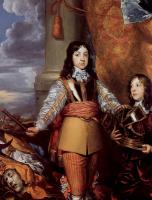


John Evelyn's Diary. 19th June 1662. I went to Albury, to visit Mr. Henry Howard (age 33), soon after he had procured the Dukedom to be restored. This gentleman had now compounded a debt of £200,000, contracted by his grandfather. I was much obliged to that great virtuoso, and to this young gentleman, with whom I stayed a fortnight.


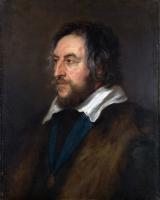

Samuel Pepys' Diary. 19th June 1663. Thence to Wilkinson's after a good walk in the Park, where we met on horseback Captain Ferrers; who tells us that the King of France (age 24) is well again, and that he saw him train his Guards, all brave men, at Paris; and that when he goes to his mistress, Madame la Valiere (age 18), a pretty little woman, now with child by him, he goes with his guards with him publiquely, and his trumpets and kettle-drums with him, who stay before the house while he is with her; and yet he says that, for all this, the Queen (age 24) do not know of it, for that nobody dares to tell her; but that I dare not believe.


Samuel Pepys' Diary. 19th June 1663. Lay till 6 o'clock, and then up and to my office, where all the morning, and at noon to the Exchange [Map], and coming home met Mr. Creed, and took him back, and he dined with me, and by and by came Mr. Moore, whom I supplied with £30, and then abroad with them by water to Lambeth, expecting to have seen the Archbishop (deceased) lie in state; but it seems he is not laid out yet.
Samuel Pepys' Diary. 19th June 1665. Up, and to White Hall with Sir W. Batten (age 64) (calling at my Lord Ashly's (age 43), but to no purpose, by the way, he being not up), and there had our usual meeting before the Duke with the officers of the Ordnance with us, which in some respects I think will be the better for us, for despatch sake.


Henrici Quinti, Angliæ Regis, Gesta, is a first-hand account of the Agincourt Campaign, and subsequent events to his death in 1422. The author of the first part was a Chaplain in King Henry's retinue who was present from King Henry's departure at Southampton in 1415, at the siege of Harfleur, the battle of Agincourt, and the celebrations on King Henry's return to London. The second part, by another writer, relates the events that took place including the negotiations at Troye, Henry's marriage and his death in 1422.
Available at Amazon in eBook and Paperback format.
Samuel Pepys' Diary. 19th June 1666. Up, and to my office, there to fit business against the rest meet, which they did by and by, and sat late. After the office rose (with Creed with me) to Wm. Joyce's to dinner, being invited, and there find my father (age 65) and sister (age 25), my wife and Mercer, with them, almost dined. I made myself as complaisant as I could till I had dined, but yet much against my will, and so away after dinner with Creed to Penny's, my Tailor, where I bespoke a thin stuff suit, and did spend a little time evening some little accounts with Creed and so parted, and I to Sir. G. Carteret's (age 56) by appointment; where I perceive by him the King (age 36) is going to borrow some money of the City; but I fear it will do no good, but hurt. He tells me how the Generall [The Duke of Albemarle (age 57).] is displeased, and there have been some high words between the Generall and Sir W. Coventry (age 38). And it may be so; for I do not find Sir W. Coventry so highly commending the Duke (age 32) as he used to be, but letting fall now and then some little jerkes: as this day, speaking of newes from Holland, he says, "I find their victory begins to shrinke there, as well as ours here".
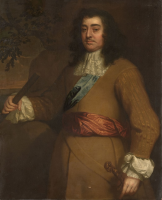


Samuel Pepys' Diary. 19th June 1667. At noon comes Sir W. Batten (age 66) and Sir W. Pen (age 46), and we to Sir W. Pen's house, and there discoursed of business an hour, and by and by comes an order from Sir R. Browne (age 62), commanding me this afternoon to attend the Council-board, with all my books and papers touching the Medway. I was ready [to fear] some mischief to myself, though it appears most reasonable that it is to inform them about Commissioner Pett (age 56). I eat a little bit in haste at Sir W. Batten's, without much comfort, being fearful, though I shew it not, and to my office and get up some papers, and found out the most material letters and orders in our books, and so took coach and to the Council-chamber lobby, where I met Mr. Evelyn (age 46), who do miserably decry our follies that bring all this misery upon us.


Samuel Pepys' Diary. 19th June 1667. And after Sir W. Coventry's (age 39) telling them what orders His Royal Highness had made for the safety of the Medway, I told them to their full content what we had done, and showed them our letters. Then was Peter Pett (age 56) called in, with the Lieutenant of the Tower (age 52). He is in his old clothes, and looked most sillily. His charge was chiefly the not carrying up of the great ships, and the using of the boats in carrying away his goods; to which he answered very sillily, though his faults to me seem only great omissions. Lord Arlington (age 49) and Coventry very severe against him; the former saying that, if he was not guilty, the world would think them all guilty1. The latter urged, that there must be some faults, and that the Admiral must be found to have done his part. I did say an unhappy word, which I was sorry for, when he complained of want of oares for the boats: and there was, it seems, enough, and good enough, to carry away all the boats with from the King's occasions. He said he used never a boat till they were all gone but one; and that was to carry away things of great value, and these were his models of ships; which, when the Council, some of them, had said they wished that the Dutch had had them instead of the King's ships, he answered, he did believe the Dutch would have made more advantage of the models than of the ships, and that the King (age 37) had had greater loss thereby; this they all laughed at.
Note 1. Pett was made a scapegoat. This is confirmed by Marvel: "After this loss, to relish discontent, Some one must be accused by Parliament; All our miscarriages on Pett must fall, His name alone seems fit to answer all. Whose counsel first did this mad war beget? Who all commands sold through the Navy? Pett. Who would not follow when the Dutch were beat? Who treated out the time at Bergen? Pett. Who the Dutch fleet with storms disabled met, And, rifling prizes, them neglected? Pett. Who with false news prevented the Gazette, The fleet divided, writ for Ruhert? Pett. Who all our seamen cheated of their debt? And all our prizes who did swallow? Pett. Who did advise no navy out to set? And who the forts left unprepared? Pett. Who to supply with powder did forget Languard, Sheerness, Gravesend, Kent [Map], and Upnor? Pett. Who all our ships exposed in Chatham, Kent [Map] net? Who should it be but the fanatick Pett? Pett, the sea-architect, in making ships, Was the first cause of all these naval slips. Had he not built, none of these faults had been; If no creation, there had been no sin But his great crime, one boat away he sent, That lost our fleet, and did our flight prevent". Instructions to a Painter.-B.


Samuel Pepys' Diary. 19th June 1667. After having heard him for an hour or more, they bid him withdraw. I all this while showing him no respect, but rather against him, for which God forgive me! for I mean no hurt to him, but only find that these Lords are upon their own purgation, and it is necessary I should be so in behalf of the office. He being gone, they caused Sir Richard Browne (age 62) to read over his minutes; and then my Lord Arlington (age 49) moved that they might be put into my hands to put into form, I being more acquainted with such business; and they were so.
Samuel Pepys' Diary. 19th June 1667. While we were discoursing over our publique misfortunes, I am called in to a large Committee of the Council: present the Duke of Albemarle (age 58), Anglesey (age 52), Arlington (age 49), Ashly (age 45), Carteret (age 57), Duncomb (age 44), Coventry (age 39), Ingram (age 52), Clifford (age 36), Lauderdale (age 51), Morrice (age 64), Manchester (age 65), Craven (age 59), Carlisle (age 38), Bridgewater (age 44).
Samuel Pepys' Diary. 19th June 1668. So homeward, and stopped at Mr. Mills's, where he and she at the door, and Mrs. Turner (age 45), and Betty, and Mrs. Hollworthy, and there I stayed and talked, and up to the church leads, and saw the fire, which spent itself, till all fear over. I home, and there we to bed again, and slept pretty well, and about nine rose, and then my wife fell into her blubbering again, and at length had a request to make to me, which was, that she might go into France, and live there, out of trouble; and then all come out, that I loved pleasure and denied her any, and a deal of do; and I find that there have been great fallings out between my father and her, whom, for ever hereafter, I must keep asunder, for they cannot possibly agree. And I said nothing, but, with very mild words and few, suffered her humour to spend, till we begun to be very quiet, and I think all will be over, and friends, and so I to the office, where all the morning doing business. Yesterday I heard how my Lord Ashly (age 46) is like to die, having some imposthume in his breast, that he hath been fain to be cut into the body1.
Note 1. "Such an operation was performed in this year, after a consultation of medical men, and chiefly by Locke's advice, and the wound was afterwards always kept open, a silver pipe being inserted. This saved Lord Ashley's life, and gave him health"-Christie's Life of the first Earl of Shaftesbury, vol. ii., p. 34. 'Tapski' was a name given to Shaftesbury in derision, and vile defamers described the abscess, which had originated in a carriage accident in Holland, as the result of extreme dissipation. Lines by Duke, a friend and imitator of Dryden (age 36): "The working ferment of his active mind, In his weak body's cask with pain confined, Would burst the rotten vessel where 'tis pent, But that 'tis tapt to give the treason vent"..


Samuel Pepys' Diary. 19th June 1668. Home, have been at the King's playhouse to-day, thinking to spy me there; and saw the new play, "Evening Love", of Dryden's (age 36), which, though the world commends, she likes not.
Samuel Pepys' Diary. 19th June 1668. At noon home to dinner, and thence by coach to White Hall, where we attended the Duke of York (age 34) in his closet, upon our usual business. And thence out, and did see many of the Knights of the Garter, with the King (age 38) and Duke of York, going into the Privychamber, to elect the Elector of Saxony (age 55) into that Order, who, I did hear the Duke of York say, was a good drinker: I know not upon what score this compliment is done him.

John Evelyn's Diary. 19th June 1671. To a splendid dinner at the great room in Deptford Trinity House [Map], Sir Thomas Allen [Note. Possibly Thomas Allen 1st Baronet (age 38), Thomas Allen (age 68).] chosen Master, and succeeding the Earl of Craven (age 63).

John Evelyn's Diary. 19th June 1673. Congratulated the new Lord Treasurer, Sir Thomas Osborne (age 41), a gentleman with whom I had been intimately acquainted at Paris, and who was every day at my father-in-law's (age 68) house and table there; on which account I was too confident of succeeding in his favor, as I had done in his predecessor's; but such a friend shall I never find, and I neglected my time, far from believing that my Lord Clifford (age 42) would have so rashly laid down his staff, as he did, to the amazement of all the world, when it came to the test of his receiving the Communion, which I am confident he forbore more from some promise he had entered into to gratify the Duke, than from any prejudice to the Protestant religion, though I found him wavering a pretty while.
On 19th June 1673 Thomas Osborne 1st Duke Leeds (age 41) was created 1st Viscount Latimer, 1st Baron Osborne of Kinderton.
On 19th June 1681 Augustine Warner (age 39) died at Warner Hall.
John Evelyn's Diary. 19th June 1682. The Bantam, or East India Ambassadors (at this time we had in London the Russian, Moroccan, and Indian Ambassadors), being invited to dine at Lord George Berkeley's (age 54) (now Earl), I went to the entertainment to contemplate the exotic guests. They were both very hard-favored, and much resembling in countenance some sort of monkeys. We ate at two tables, the Ambassadors and interpreter by themselves. Their garments were rich Indian silks, flowered with gold, viz, a close waistcoat to their knees, drawers, naked legs, and on their heads caps made like fruit baskets. They wore poisoned daggers at their bosoms, the hafts carved with some ugly serpents' or devils' heads, exceedingly keen, and of Damascus metal. They wore no sword. The second Ambassador (sent it seems to succeed in case the first should die by the way in so tedious a journey), having been at Mecca, wore a Turkish or Arab sash, a little part of the linen hanging down behind his neck, with some other difference of habit, and was half a negro, bare legged and naked feet, and deemed a very holy man. They sat cross-legged like Turks, and sometimes in the posture of apes and monkeys; their nails and teeth as black as jet, and shining, which being the effect, as to their teeth, of perpetually chewing betel to preserve them from the toothache, much raging in their country, is esteemed beautiful.
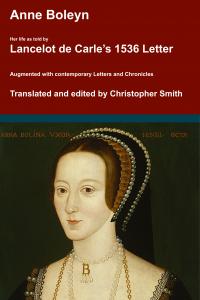
Anne Boleyn. Her Life as told by Lancelot de Carle's 1536 Letter.
In 1536, two weeks after the execution of Anne Boleyn, her brother George and four others, Lancelot du Carle, wrote an extraordinary letter that described Anne's life, and her trial and execution, to which he was a witness. This book presents a new translation of that letter, with additional material from other contemporary sources such as Letters, Hall's and Wriothesley's Chronicles, the pamphlets of Wynkyn the Worde, the Memorial of George Constantyne, the Portuguese Letter and the Baga de Secrets, all of which are provided in Appendices.
Available at Amazon in eBook and Paperback format.
John Evelyn's Diary. 19th June 1683. I returned to town in a coach with the Earl of Clarendon, when passing by the glorious palace of his father, built but a few years before, which they were now demolishing, being sold to certain undertakers, I turned my head the contrary way till the coach had gone past it, lest I might minister occasion of speaking of it; which must needs have grieved him, that in so short a time their pomp was fallen.
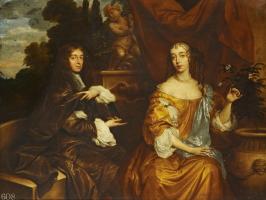


On 19th June 1697 Henry Mordaunt 2nd Earl Peterborough (age 75) died. His nephew Charles (age 39) succeeded 3rd Earl Peterborough. His daughter Mary (age 38) succeeded 7th Baroness Mordaunt. Carey Fraser Countess Peterborough and Monmouth (age 37) by marriage Countess Peterborough.


On 19th June 1722 George Gordon 3rd Earl Aberdeen was born to William Gordon 2nd Earl Aberdeen (age 43) and Susan Murray (age 23). He married 1759 Catherine Elizabeth Hanson Couness Aberdeen and had issue.
On 19th June 1725 Charles Noel Somerset 4th Duke Beaufort (age 15) matriculated University College, Oxford University. He was awarded MA on 16th October 1727.
The Journal of the Reverend John Wesley 1745. 19th June 1745. Tresmere church was filled within and without, while I preached on Rom. iv. '7. Here I took leave of a poor, mad, original enthusiast, who had been scattering abroad lies in every quarter. In the evening Mr. Thompson and Shepherd rode with me to St. Eath, and the next day to Redruth.
Being informed here of what had befallen Mr. Maxfield, we turned aside toward Crowan church-town. But in the way, we received information, that he had been removed from thence the night before. It seems, the valiant Constables who guarded him, having received timely notice, that a. body of five hundred Methodists were coming to take him away by force, had, with great precipitation, carried him two miles further, to the house of one Henry Tomkins.
Here we found him, nothing terrified by his adversaries. I desired Henry Tomkins to show me the warrant. It was directed by Dr. Borlase (age 49), and his father, and Mr. Eustick, to the Constables and Overseers of several parishes,requiring them to "apprehend all such able-bodied men as had no lawful calling or sufficient maintenance;" and to bring them before the aforesaid gentlemen at Marazion, on Friday, 21, to be examined, whether they were proper persons to serve His Majesty in the land-service.
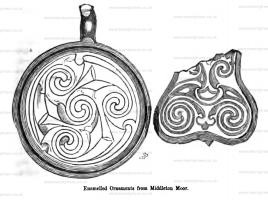
Vestiges of the Antiquities of Derbyshire. On the 15th of March, 1788, a farmer, who occupied the land on Middleton Moor, known as the Garratt Piece, having occasion to burn some lime upon that ground, dug for the purpose into a tumulus [Map] [Garratts Piece Barrow [Map]], or lowe, there situate.
He began his work on the outer edge of the barrow, clearing it away as he proceeded, to the level of the natural surface. On reaching the centre, he found, lying immediately under the usual depression of the summit of the barrow, and placed upon the level of the ground, a skeleton, whose extremities were towards the east and west; near the point of the shoulder was a very extraordinary ornament of copper neatly enamelled with various colours, red being the most predominant; it is circular, and has a hook in the form of a serpent's head, probably for suspension. In addition to this, part of another ornament of similar workmanship; part of the iron umbo of a shield and a shallow basin of thin brass, much broken and crushed, were found abont the same place. (For a similar basin see Archæologia, vol. xviii, page 80.) The design visible upon the circular and enamelled ornament is precisely similar to an illuminated capital Q in the Saxon manuscript entitled, 'Textus Sancti Cuthberti,' a production of the seventh century, formerly preserved in the cathedral of Durham, but now in the Cottonian library, (Nero, D. 4.) There is a good engraving of it in Astle's 'Origin of Writing,' plate 14, a. This interesting barrow was reopened by Mr. William Bateman (age 39), on the 19th of June, 1826, but was found to have been entirely rifled on the occasion above described.
On 19th June 1790 John Gibson was born at Gyffin. He moved with his family to Liverpool aged nine.
The London Gazette 13210. Whitehall, June 19 [1790]. The King has been pleased to grant the Dignity of a Baron of the Kingdom of Great Britain to the several Noblemen and Gentlemen following, and the Heirs Male of their respective Bodies lawfully begotten, by the Names, Stiles and Titles undermentioned, viz.
The Right Honorable Arthur Earl of Donegall (age 51), of the Kingdom of Ireland, Baron Fisherwick, of Fisherwick in the County of Stafford.
The Right Honorable James Earl of Fife, of the Kingdom of Ireland, Baron of Fife, of Fife in the County of Fife.
The Right Honorable James Bucknall Grimston (age 43), Viscount Grimston, of the Kingdom of Ireland, Baron Verulam, of Gorhambury in the County of Hertford.
The Right Honorable Constantine John (age 46) Lord Mulgrave, of the Kingdom of Ireland, Baron Mulgrave, of Mulgrave, in the County of York.
Archibald Douglas, Esquire, Baron Douglas, of Douglas in the County of Lanerk; and
Edwin Laascelles (age 77), Esquire, Baron Harewwood, of Harewood in the County of York. [Jane Coleman Baroness Harewood (age 59) by marriage Baroness Harewood of Harewood in Yorkshire.]

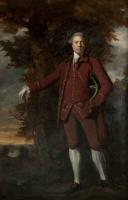
On 19th June 1804 Louis Hesse Darmstadt II Grand Duke (age 26) and Princess Wilhelmine Baden (age 15) were married. She by marriage Grand Duchess of Hesse and by Rhine. They were first cousins.
On 18th June 1815 the Battle of Waterloo was fought.
Beaumont Hotham 3rd Baron Hotham (age 20) was present.
Charles Augustus Fitzroy (age 19) was wounded.
Lieutenant-Colonel Henry Edward Irby (age 31) fought.
Henry William Paget 1st Marquess Anglesey (age 47) led the charge of the British heavy cavalry against Comte d'Erlon's column which checked and in part routed the French Army. He was hit by one of the last cannon shots of the day necessitating the amputation of this leg during the Battle of Quatre Bras.
Fletcher Norton 3rd Baron Grantley (age 16) fought and was wounded.
Charles Francis Rowley Lascelles fought.
Edward Kerrison 1st Baronet (age 38) commanded his Regiment.
George Orlando Gunning (age 18) was killed whilst serving as a Lieutenant in the 10th Hussars.
On 19th June 1815 Lieutenant Colonel Alexander Gordon (age 29) died having had his leg amputated the previous day.
Charles Henry Farrington 2nd Baronet (age 20) fought.


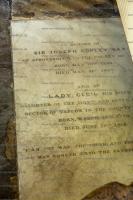
On 19th June 1819 Cecil Hamilton Marchioness Abercorn (age 49) died. She was buried at St Mary's Church, Sprotbrough [Map].
Cecil Hamilton Marchioness Abercorn: On 13th March 1770 she was born to George Hamilton. On 4th March 1792 John Hamilton 1st Marquess Abercorn and Cecil Hamilton were married. She by marriage Marchioness Abercorn. They were divorced in April 1799. She married the Joseph Copley 3rd Baronet the following month; he being the brother of the Marquess' first wife Catherine Moyle Marchioness Abercorn. They were first cousins. On 23rd May 1799 Joseph Copley 3rd Baronet and she were married. She by marriage Lady Copley Sprotborough. He was the younger brother of her first husband's [John Hamilton 1st Marquess Abercorn] first wife Catherine Moyle Marchioness Abercorn.
Vestiges of the Antiquities of Derbyshire. The only barrow yet discovered in a low situation in the neighbourhood of Middleton is placed in a meadow called Larks Lowe [Map], and near the rivulet called the Bradford; this tumulus was opened on the 20th of May 1825 when the cist was found to be constructed of large flat stones placed edge-ways with similar ones serving for the cover; it contained the decayed fragments of a human skeleton. On the eastern side of the barrow was found an urn of coarse earthy full of calcined bones and dry mould, the top protected by a flat piece of lime-stone, upon which was placed a small, shallow, earthen vessel very firmly baked, (of the kind denominated by Sir Richard Hoare (age 66) "incense cups"), a pin of bronze, two and a quarter inches long; several animal teeth and bones, amongst them a horse's tooth, a circular pebble, and a stone of peculiar shape; the large urn was of so friable a nature, that it probably had no other baking than what it received in the funeral fire, from this cause it was found impracticable to preserve it entire. June 19, 1826, it was thought advisable to reopen the very interesting barrow [Map] on Garratt Piece, Middleton, which was opened by Dr. Pegge in 1788, and described in the Archæologia, vol. ix, page 189; in it were found animal bones, one of which was calcined; a portion of the lower branch of an antler of the red deer, six inches in length, which had been tooled at the root by a sharp instrument; also some rats' bones. (See a subsequent examination of this barrow.)


The History of William Marshal was commissioned by his son shortly after William’s death in 1219 to celebrate the Marshal’s remarkable life; it is an authentic, contemporary voice. The manuscript was discovered in 1861 by French historian Paul Meyer. Meyer published the manuscript in its original Anglo-French in 1891 in two books. This book is a line by line translation of the first of Meyer’s books; lines 1-10152. Book 1 of the History begins in 1139 and ends in 1194. It describes the events of the Anarchy, the role of William’s father John, John’s marriages, William’s childhood, his role as a hostage at the siege of Newbury, his injury and imprisonment in Poitou where he met Eleanor of Aquitaine and his life as a knight errant. It continues with the accusation against him of an improper relationship with Margaret, wife of Henry the Young King, his exile, and return, the death of Henry the Young King, the rebellion of Richard, the future King Richard I, war with France, the death of King Henry II, and the capture of King Richard, and the rebellion of John, the future King John. It ends with the release of King Richard and the death of John Marshal.
Available at Amazon in eBook and Paperback format.

On 19th June 1826 Rachel Evelyn Russell was born to John Russell 6th Duke Bedford (age 59) and Georgiana Gordon Duchess Bedford (age 44). She a great x 3 granddaughter of King Charles II of England Scotland and Ireland. She married James Wandesford Butler, son of James Wandesford Butler 1st Marquess Ormonde and Grace Louisa Staples Marchioness Ormonde.

After 19th June 1835. Monument to Henry Willoughby 6th Baron Middleton (deceased) and Jane Lawley in St Leonard's Church, Wollaton [Map] sculpted by Richard Westmacott (age 59).
Henry Willoughby 6th Baron Middleton: On 24th April 1761 he was born to Henry Willoughby 5th Baron Middleton and Dorothy Cartright Baroness Middleton. Before 11th March 1793 Henry Willoughby 6th Baron Middleton and Jane Lawley were married. On 14th June 1800 Henry Willoughby 5th Baron Middleton died. His son Henry succeeded 6th Baron Middleton, 7th Baronet Willoughby of Wollaton. On 19th June 1835 Henry Willoughby 6th Baron Middleton died. His first cousin Digby succeeded 7th Baron Middleton, 8th Baronet Willoughby of Wollaton.
Jane Lawley: Around 1767 she was born to Robert Lawley 5th Baronet and Jane Thompson. 11th March 1793 Jane Lawley died.
St Werburgh's Church, Hanbury [Map]. Memorials to Captain Arthur Harper who died at New Lodge, Hanbury [Map] on 1st September 1838 aged twenty-nine. And to Samuel Harper who died at Ackyab in the East Indies 19th June 1831 aged twenty-four, and to Robert John Harper who died on the March 8th, 1846.
Note. Arthur Harper was born on the 7th January 1810. He was appointed Ensign, 9th Foot on the 17th January 1828, Lieutenant, 22nd October 1830; Captain, 17th October 1837; abd retired 28th August 1838.


On 19th June 1839 Henry Granville Fitzalan 14th Duke of Norfolk (age 24) and Augusta Mary Minna Catherine Lyons Duchess Norfolk (age 17) were married. She by marriage Duchess Norfolk. He the son of Henry Charles Howard 13th Duke of Norfolk (age 47) and Charlotte Sophia Leveson-Gower Duchess Norfolk (age 51).
Ten Years' Digging. June 19th [1848], we opened another barrow at Deepdale, in the immediate vicinity of the others. The field in which it is situated is called Burnet's Low, the prefix being derived from a late occupier of the land. The mound was 17 yards across, and having no great elevation it promised an easy task; but having dug to the depth of two feet, we arrived at the side of a very large grave, about six feet wide, cut at least three feet deep in the rock; it was filled with stones without any earth, except what had been washed in during the lapse of ages. We cleared it out for the distance of ten feet from the southern end, without meeting with the other extremity, which time would not allow of our doing. The sides were cut down perpendicularly, and were blackened by charcoal. On the west side within the grave, was a skeleton, deposited on the left side with the head to the south, and the knees drawn up; under the shoulders of which was a well preserved bronze dagger, with three rivets for the purpose of fastening the semilunar handle, which had imparted a green tint to the bones with which it had been in contact. The earth above was mixed with pebbles and bouldered pieces of sandstone, and in it we found an arrow point of flint
After 19th June 1878. St Saeran's Church, Llanynys [Map]. Monument to Peter Ellis Eyton (deceased) sculpted by Lunt of Rhyl.
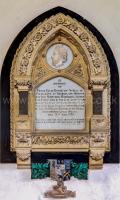
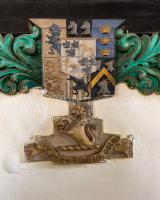
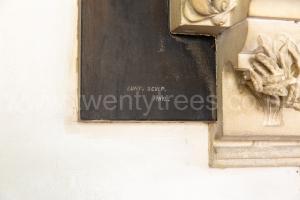
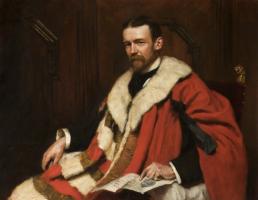
On 19th June 1890 Harry Grey 8th Earl Stamford 4th Earl Warrington (age 78) died of pneumonia without legitimate male issue. He was buried in St. John's Cemetery, Wynberg. His nephew William (age 40) succeeded 9th Earl Stamford, 11th Baron Grey of Groby.
On 19th June 1911 Alexander Duff 1st Duke Fife (age 61) was appointed 838th Knight of the Garter by King Edward VII of the United Kingdom.

19th June 1918. The Sketch.
It may seem, perhaps, a little premature to designate any particular ceremony "the" wedding of the season, yet few, if any, which may be celebrated between now and the autumn are likely to be of more interest or importance than that of the Earl of St. Germans (age 28) and Lady Blanche Somerset (age 21), which was celebrated at St. Margaret's [Map], Westminster, last week. The bridegroom has served abroad since the early days of the war, and was awarded the Military Cross in 1916. The bride is the elder daughter of the Duke and Duchess of Beaufort. The church was prettily decorated with palms, maple, and many flowers, and troopers of the bridegroom's regiment formed a guard of honour, between the ranks of which Lady Blanche Somerset, with her father, the Duke of Beaufort, passed to the chancel, where Lord St. Germans and his best man, the Earl of Leven and Melville, were awaiting her. The bride wore a beautiful dress of silver tissue over charmeuse, with a train of old Brussels point, lined with silver, and was attended by quite a pre-war bevy of bridesmaids: Lady Diana Somerset (age 19), Miss Betty Harford (her cousin), the Hon. Ivy Somerset (cousin of the bride and the bridegroom), Miss Betty Eliot (cousin of the bridegroom), Lady Morvyth Ward, and Lady Avice Sackville, all of whom wore pale yellow georgette edged with silver. Small transparent hats of black gauze were worn, and each carried a bouquet of yellow tiger-lilies. The bridegroom's presents to the bridesmaids were pendants of red cornelian and jade. A small reception was afterwards held at 11, Portman Square, for relatives and intimate friends, after which Lord and Lady St. Germans left for Walmer Castle, lent for the honeymoon by Earl and Countess Beauchamp. Princess Arthur of Connaught and the Marquess and Marchioness of Carisbrooke were present in the distinguished congregation. The ushers were Baron de Tuyll, Mr. Christian Eliot, the Hon. Sir Arthur Walsh, Viscount Ednam, Major Brinton, and Captain Burton.
Diana Maud Nina Fitzroy: On 12th September 1898 she was born to Henry Adelbert Wellington Fitzroy 9th Duke Beaufort and Louise Emily Harford 9th Duchess Beaufort. On 6th May 1935 Diana Maud Nina Fitzroy died.
On 19th June 1931 Iain Murray 10th Duke of Atholl was born to George Murray (age 81).
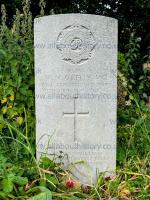
Grave of Major William Mathias O'Kelly, MC, died 19th June 1941, aged 52, at St Peter and St Paul Church, Little Gaddesden. Battalion Order No. 91, dated 1st July (1941), records the death, in Ashridge Hospital, of the Adjutant, in the following words, "the funeral of the late Captain W. M. O'Kelly, M.C., having been held privately, it was not possible for the Battalion to give military honours, nor for his many friends in it to pay public tribute to the memory of a man well liked and admired both as an officer and as a sportsman. He was Adjutant of this Battalion for only a short period, but long enough for his new acquaintances to appreciate him as keenly as did his old friends."
On 19th June 1976 Carl XVI King Sweden (age 30) and Silvia Sommerlath Queen Consort Sweden were married.
Jean de Waurin's Chronicle of England Volume 6 Books 3-6: The Wars of the Roses
Jean de Waurin was a French Chronicler, from the Artois region, who was born around 1400, and died around 1474. Waurin’s Chronicle of England, Volume 6, covering the period 1450 to 1471, from which we have selected and translated Chapters relating to the Wars of the Roses, provides a vivid, original, contemporary description of key events some of which he witnessed first-hand, some of which he was told by the key people involved with whom Waurin had a personal relationship.
Available at Amazon in eBook and Paperback format.
On 19th June 1294 Charles IV King France I King Navarre was born to King Philip IV of France (age 26) and Joan Blois I Queen Navarre (age 21). Coefficient of inbreeding 2.11%. He married (1) 1307 his second cousin Blanche of Burgundy Queen Consort France, daughter of Otto Ivrea IV Count Burgundy and Mahaut Artois Countess Burgundy, and had issue (2) after 19th May 1322 his fourth cousin Marie Luxemburg Queen Consort France, daughter of Henry Luxemburg VII Holy Roman Emperor and Margaret Brabant Countess Luxemburg and Namur, and had issue (3) 5th July 1324 his half first cousin Joan Évreux Queen Consort France, daughter of Louis I Count Évreux and Margaret Artois Countess Évreux, and had issue.
On 19th June 1416 Thomas Talbot was born to John "Old Talbot" Talbot 1st Earl of Shrewsbury (age 33) and Maud Neville 6th Baroness Furnivall (age 23) at Finglas, County Dublin. He died aged less than one years old.
On 19th June 1555 Anne Knollys Baroness De La Warr was born to Francis Knollys (age 43) and Catherine Carey (age 31). She married 19th November 1571 Thomas West 2nd Baron De La Warr, son of William West 1st Baron De La Warr and Elizabeth Strange Baroness De La Warr, and had issue.


On 19th June 1566 King James I of England and Ireland and VI of Scotland was born to Henry "Lord Darnley" Stewart (age 20) and Mary Queen of Scots (age 23) at Edinburgh Castle [Map]. He a great x 2 grandson of King Henry VII of England and Ireland. Coefficient of inbreeding 3.67%. He married 23rd November 1589 his third cousin once removed Anne of Denmark Queen Consort Scotland England and Ireland, daughter of Frederick II King of Denmark and Sophie Mecklenburg-Schwerin Queen Consort Denmark, and had issue.
On 19th June 1598 Archbishop Gilbert Sheldon was born to Robert Sheldon at Stanton Wyvill, Staffordshire. He was baptised at St Peter's Church, Ellastone.
On 19th June 1606 James Hamilton 1st Duke Hamilton was born to James Hamilton 2nd Marquess Hamilton (age 17) and Ann Cunningham Marchioness Hamilton (age 21) at Hamilton Palace, Hamilton. He married 16th June 1622 Margaret aka Mary Feilding, daughter of William Feilding 1st Earl Denbigh and Susan Villiers Countess Denbigh, and had issue.
On 19th June 1700 Charles Bourbon Condé Count Charolais was born to Louis Bourbon Condé (age 31) and Louise Françoise Bourbon (age 27). He a great x 3 grandson of King James I of England and Ireland and VI of Scotland. He married Jeanne Valois Saint Remy. He died aged six in 1706.
On 19th June 1709 Thomas Villiers 1st Earl Clarendon was born to William Villiers 2nd Earl Jersey (age 27). He married 30th March 1752 his second cousin once removed Charlotte Capell Countess Clarendon, daughter of William Capell 3rd Earl Essex and Jane Hyde Countess Essex, and had issue.
On 19th June 1719 Thomas Clavering 7th Baronet was born to James Clavering 6th Baronet (age 39) and Catherine Yorke (age 36).
On 19th June 1721 Richard Wrottesley 7th Baronet was born to John Wrottesley 4th Baronet (age 39) and Frances Grey Lady Wrottesley. He married 1739 his sixth cousin Mary Leveson-Gower Lady Wrottesley, daughter of John Leveson-Gower 1st Earl Gower and Evelyn Pierrepont Baroness Gower, and had issue.
Chronicle of a Bourgeois of Valenciennes
Récits d’un bourgeois de Valenciennes aka The Chronicle of a Bourgeois of Valenciennes is a vivid 14th-century vernacular chronicle written by an anonymous urban chronicler from Valenciennes in the County of Hainaut. It survives in a manuscript that describes local and regional history from about 1253 to 1366, blending chronology, narrative episodes, and eyewitness-style accounts of political, military, and social events in medieval France, Flanders, and the Low Countries. The work begins with a chronological framework of events affecting Valenciennes and its region under rulers such as King Philip VI of France and the shifting allegiances of local nobility. It includes accounts of conflicts, sieges, diplomatic manoeuvres, and the impact of broader struggles like the Hundred Years’ War on urban life in Hainaut. Written from the perspective of a burgher (bourgeois) rather than a monastery or royal court, the chronicle offers a rare lay viewpoint on high politics and warfare, reflecting how merchants, townspeople, and civic institutions experienced the turbulence of the 13th and 14th centuries. Its narrative style combines straightforward reporting of events with moral and civic observations, making it a valuable source for readers interested in medieval urban society, regional politics, and the lived experience of war and governance in pre-modern Europe.
Available at Amazon in eBook and Paperback format.
On 19th June 1722 George Gordon 3rd Earl Aberdeen was born to William Gordon 2nd Earl Aberdeen (age 43) and Susan Murray (age 23). He married 1759 Catherine Elizabeth Hanson Couness Aberdeen and had issue.

On 19th June 1760 Barbara Yelverton was born to Henry Yelverton 3rd Earl of Sussex (age 31). She married 18th December 1775 Colonel Edward Thoroton Gould and had issue.
On 19th June 1764 John Barrow 1st Baronet was born. He married 26th August 1799 Anna Maria Truter Lady Barrow and had issue.
On 19th June 1777 William Courtenay 10th Earl Devon was born to Bishop Reginald Courtenay (age 35) and Elizabeth Howard. He married before 14th April 1807 Henrietta Leslie Pepys Countess Devon, daughter of Lucas Pepys 1st Baronet and Jane Elizabeth Leslie 12th Countess of Rothes, and had issue.
On 19th June 1790 John Gibson was born at Gyffin. He moved with his family to Liverpool aged nine.
On 19th June 1808 Montagu Bertie 6th Earl of Abingdon was born to Montagu Bertie 5th Earl of Abingdon (age 24) and Emily Gage Countess of Abingdon at Dover Street. He married 7th January 1835 his fourth cousin twice removed Elizabeth Lavinia Harcourt Countess Abingdon and had issue.
On 19th June 1809 Robert Moncton Milnes 1st Baron Houghton was born to Robert Pemberton Milnes (age 25) and Henrietta Maria Monckton-Arundell. He married 30th July 1851 Annabella Hungerford Crewe, daughter of John Crewe 2nd Baron Crewe and Henrietta Maria Anna Walker-Hungerford, and had issue.
On 19th June 1826 Rachel Evelyn Russell was born to John Russell 6th Duke Bedford (age 59) and Georgiana Gordon Duchess Bedford (age 44). She a great x 3 granddaughter of King Charles II of England Scotland and Ireland. She married James Wandesford Butler, son of James Wandesford Butler 1st Marquess Ormonde and Grace Louisa Staples Marchioness Ormonde.

On 19th June 1834 William Henry Forester Denison 1st Earl Londesborough was born to Albert Conygham aka Denison 1st Baron Londesborough (age 28) and Henrietta Maria Weld-Forester. He married 1863 his third cousin Edith Somerset Countess Londesborough, daughter of Henry Somerset 7th Duke Beaufort and Emily Frances Smith Duchess Beaufort, and had issue.
On 19th June 1834 Hussey Vivian 3rd Baron Vivian was born to Charles Vivian 2nd Baron Vivian (age 25).
Adam Murimuth's Continuation and Robert of Avesbury’s 'The Wonderful Deeds of King Edward III'
This volume brings together two of the most important contemporary chronicles for the reign of Edward III and the opening phases of the Hundred Years’ War. Written in Latin by English clerical observers, these texts provide a vivid and authoritative window into the political, diplomatic, and military history of fourteenth-century England and its continental ambitions. Adam Murimuth Continuatio's Chronicarum continues an earlier chronicle into the mid-fourteenth century, offering concise but valuable notices on royal policy, foreign relations, and ecclesiastical affairs. Its annalistic structure makes it especially useful for establishing chronology and tracing the development of events year by year. Complementing it, Robert of Avesbury’s De gestis mirabilibus regis Edwardi tertii is a rich documentary chronicle preserving letters, treaties, and official records alongside narrative passages. It is an indispensable source for understanding Edward III’s claim to the French crown, the conduct of war, and the mechanisms of medieval diplomacy. Together, these works offer scholars, students, and enthusiasts a reliable and unembellished account of a transformative period in English and European history. Essential for anyone interested in medieval chronicles, the Hundred Years’ War, or the reign of Edward III.
Available at Amazon in eBook and Paperback format.
On 19th June 1841 William Pleydell-Bouverie 5th Earl Radnor was born to Jacob Pleydell-Bouverie 4th Earl Radnor (age 25) and Mary Augusta Frederica Grimston (age 19). He married 19th June 1866 Helen Matilda Chaplin Countess Radnor and had issue.
On 19th June 1842 Elma Bruce was born to James Bruce 12th Earl Kincardine 8th Earl Elgin (age 30) and Elizabeth Mary Cumming Bruce Countess Kincardine and Elgin.
On 19th June 1851 Henry Bruce 2nd Baron Aberdare was born to Henry Bruce 1st Baron Aberdare (age 36). He married 10th February 1880 Constance Mary Beckett Baroness Aberdare and had issue.
On 19th June 1855 John George Lambton 3rd Earl Durham was born to George Frederick D'Arcy Lambton 2nd Earl Durham (age 26) and Beatrix Frances Hamilton Countess Durham (age 20). He was the elder of twins, the younger being Frederick Lambton 4th Earl Durham. He married 28th October 1882 Ethel Milner Countess Durham.
On 19th June 1855 Frederick Lambton was born to George Frederick D'Arcy Lambton 2nd Earl Durham (age 26) and Beatrix Frances Hamilton Countess Durham (age 20). He was the younger of twins, the elder being John George Lambton 3rd Earl Durham. He married 26th May 1879 his second cousin Beatrix Bulteel Countess Durham and had issue.
On 19th June 1861 Hilaro William Wellesley Barlow 5th Baronet was born to Richard Wellesley Barlow 4th Baronet (age 25).

On 19th June 1864 William Henry Francis Denison 2nd Earl Londesborough was born to William Henry Forester Denison 1st Earl Londesborough (age 30) and Edith Somerset Countess Londesborough (age 26). He married 11th August 1887 his third cousin Grace Adelaide Fane Countess Londesborough, daughter of Francis William Henry Fane 12th Earl of Westmoreland and Adelaide Ida Curzon Howe Countess of Westmoreland, and had issue.
On 19th June 1868 Christopher Addison 1st Viscount Addison was born. He married (1) 25th March 1902 Isobel Gray and had issue (2) 4th November 1937 Dorothy Low Viscountess Addison.
On 19th June 1869 Lucy Ridsdale Countess Baldwin was born to Edward Lucas Ridsdale of Rottingdean, Sussex (age 36) and Esther Lucy Thacker (age 26). She married 12th September 1892 Stanley Baldwin 1st Earl Baldwin and had issue.

On 19th June 1876 Forster Gurney Goring 12th Baronet was born to Harry Yelverton Goring 11th Baronet (age 36).
On 19th June 1881 Alexander Young Spearman 3rd Baronet was born to Joseph Spearman 2nd Baronet (age 24).
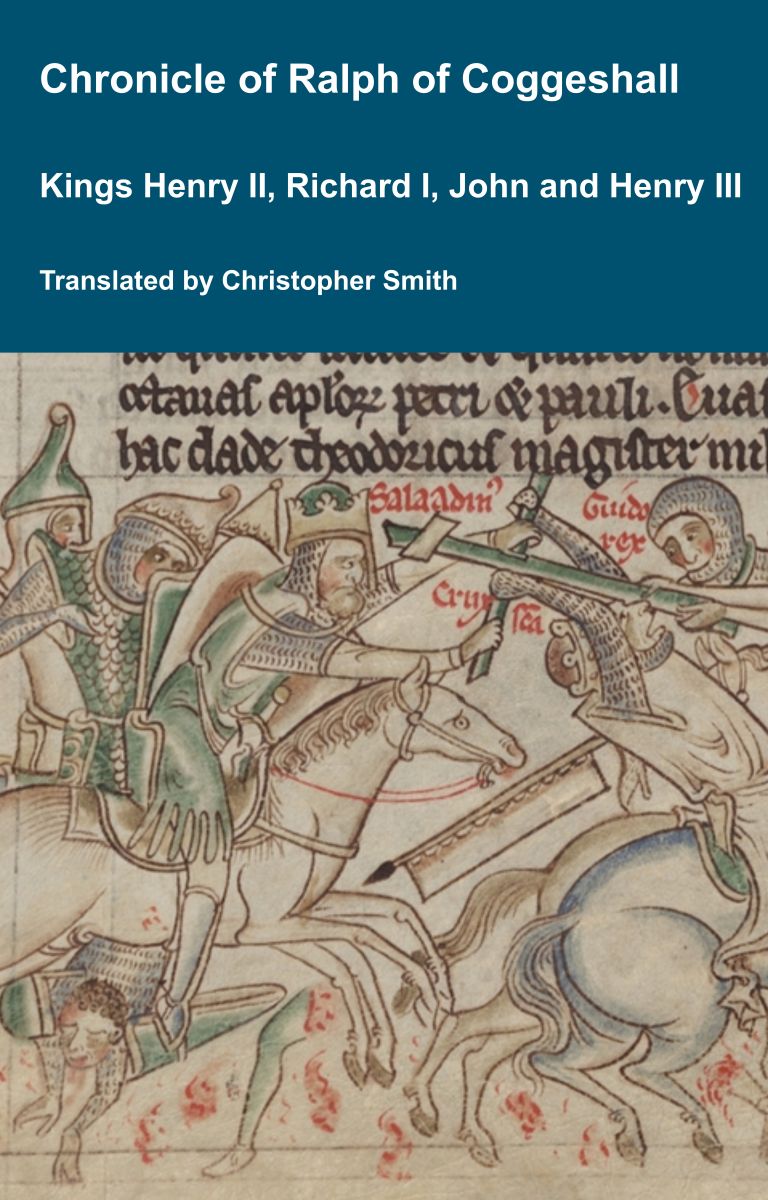
Chronicle of Abbot Ralph of Coggeshall
The Chronicle of Abbot Ralph of Coggeshall (Chronicon Anglicanum) is an indispensable medieval history that brings to life centuries of English and European affairs through the eyes of a learned Cistercian monk. Ralph of Coggeshall, abbot of the Abbey of Coggeshall in Essex in the early 13th century, continued and expanded his community’s chronicle, documenting events from the Norman Conquest of 1066 into the tumultuous reign of King Henry III. Blending eyewitness testimony, careful compilation, and the monastic commitment to record-keeping, this chronicle offers a rare narrative of political intrigue, royal power struggles, and social upheaval in England and beyond. Ralph’s work captures the reigns of pivotal figures such as Richard I and King John, providing invaluable insights into their characters, decisions, and the forces that shaped medieval rule. More than a simple annal, Chronicon Anglicanum conveys the texture of medieval life and governance, making it a rich source for scholars and readers fascinated by English history, monastic authorship, and the shaping of the medieval world.
Available at Amazon in eBook and Paperback format.
On 19th June 1884 Elizabeth Frances Abney-Hastings Viscountess St Davids was born to Major Paulyn Abney-Hastings (age 27) and Maud Grimston (age 27). She married 27th April 1916 John Wynford Philipps 1st Viscount St Davids, son of James Eramus Philipps 12th Baronet and Mary Margaret Best, and had issue.

On 19th June 1888 Thurstan Holland-Hibbert 4th Viscount Knutsford was born to Arthur Holland 3rd Viscount Knutsford (age 33) and Ellen Lawson Viscountess Knutsford.
On 19th June 1898 Philip Harvey du Cros 2nd Baronet was born to Arthur Du Cros 1st Baronet (age 27).
On 19th June 1900 Victor Alexander Henry Desmond Ponsonby was born to Frederick "Fritz" Ponsonby 1st Baron Sysonby (age 32). He died aged less than one years old.
On 19th June 1922 Anthony Philip Harbord-Hamond 11th Baron Suffield was born to Richard Morden Harbord 10th Baron Suffield (age 56).
On 19th June 1931 Iain Murray 10th Duke of Atholl was born to George Murray (age 81).
On 19th June 1935 Charles Theodore Gunning 9th Baronet was born to Robert Charles Gunning 8th Baronet (age 33).
On 19th June 1935 Richard Rhys 9th Baron Dynevor was born to Charles Arthur Uryan Rhys 8th Baron Dynevor (age 35).
On 19th June 1946 James Harris 7th Earl Malmesbury was born to William James Harris 6th Earl Malmesbury (age 38) and Diana Claudia Carleton Countess of Malmesbury (age 33).
On 19th June 1971 John Crichton 7th Earl Erne was born to Henry Crichton 6th Earl Erne (age 33) and Camilla Marguerite Roberts Countess Erne (age 34).
On 19th June 1972 Robert Edward Fiennes-Clinton 19th Earl of Lincoln was born to Edward Gordon Fiennes-Clinton (age 29).
Chronicle of Abbot Ralph of Coggeshall
The Chronicle of Abbot Ralph of Coggeshall (Chronicon Anglicanum) is an indispensable medieval history that brings to life centuries of English and European affairs through the eyes of a learned Cistercian monk. Ralph of Coggeshall, abbot of the Abbey of Coggeshall in Essex in the early 13th century, continued and expanded his community’s chronicle, documenting events from the Norman Conquest of 1066 into the tumultuous reign of King Henry III. Blending eyewitness testimony, careful compilation, and the monastic commitment to record-keeping, this chronicle offers a rare narrative of political intrigue, royal power struggles, and social upheaval in England and beyond. Ralph’s work captures the reigns of pivotal figures such as Richard I and King John, providing invaluable insights into their characters, decisions, and the forces that shaped medieval rule. More than a simple annal, Chronicon Anglicanum conveys the texture of medieval life and governance, making it a rich source for scholars and readers fascinated by English history, monastic authorship, and the shaping of the medieval world.
Available at Amazon in eBook and Paperback format.
On 19th June 1993 Thomas Hardinge 8th Viscount Hardinge was born to Andrew Hardinge 7th Viscount Hardinge (age 33).
On 19th June 1369 Philip "Bold" Valois II Duke Burgundy (age 27) and Margaret Dampierre Duchess Burgundy (age 21) were married. She by marriage Duchess Burgundy. She the daughter of Louis of Male III Count Nevers II Count Flanders (age 38) and Margaret of Brabant Countess Nevers and Flanders (age 46). He the son of King John "The Good" II of France and Bonne Luxemburg Queen Consort France. They were half third cousins. He a great x 5 grandson of King Henry "Curtmantle" II of England. She a great x 2 granddaughter of King Edward I of England.
On 19th June 1683 George Cooke 3rd Baronet (age 21) and Catherine Copley Lady Cooke were married. She by marriage Lady Cooke of Wheatley Hall in Yorkshire.
On 19th June 1712 Nicholas Williams 1st Baronet (age 31) and Mary Cocks were married at St Mildred's Church, Poultry [Map].
On 19th June 1759 Thomas Butler 6th Baronet and Dorothea Bayly Lady Butler were married.

On 19th June 1762 William Dalrymple Crichton 5th Earl Dumfries 4th Earl of Stair (age 63) and Anne Duff Countess Dumfries (age 24) were married. She by marriage Countess Dumfries. The difference in their ages was 39 years. He the son of Colonel William Dalrymple Earl Dumfries (age 88) and Penelope Crichton 4th Countess of Dumfries.
On 19th June 1777 James Lamb aka Burges 1st Baronet (age 25) and Elizabeth Noel were married. There was no issue from the marriage.
On 19th June 1777 Thomas Carew 6th Baronet (age 22) and Jane Smallwood Lady Carew were married. She by marriage Lady Carew of Haccombe in Devon.

On 19th June 1780 Richard Griffin 2nd Baron Braybrook (age 29) and Catherine Granville (age 19) were married.
On 19th June 1804 Louis Hesse Darmstadt II Grand Duke (age 26) and Princess Wilhelmine Baden (age 15) were married. She by marriage Grand Duchess of Hesse and by Rhine. They were first cousins.
Chronicle of Abbot Ralph of Coggeshall
The Chronicle of Abbot Ralph of Coggeshall (Chronicon Anglicanum) is an indispensable medieval history that brings to life centuries of English and European affairs through the eyes of a learned Cistercian monk. Ralph of Coggeshall, abbot of the Abbey of Coggeshall in Essex in the early 13th century, continued and expanded his community’s chronicle, documenting events from the Norman Conquest of 1066 into the tumultuous reign of King Henry III. Blending eyewitness testimony, careful compilation, and the monastic commitment to record-keeping, this chronicle offers a rare narrative of political intrigue, royal power struggles, and social upheaval in England and beyond. Ralph’s work captures the reigns of pivotal figures such as Richard I and King John, providing invaluable insights into their characters, decisions, and the forces that shaped medieval rule. More than a simple annal, Chronicon Anglicanum conveys the texture of medieval life and governance, making it a rich source for scholars and readers fascinated by English history, monastic authorship, and the shaping of the medieval world.
Available at Amazon in eBook and Paperback format.

On 19th June 1826 James Brudenell 7th Earl Cardigan (age 28) and Elizabeth Tollemache Countess Cardigan (age 28) were married. Separated in 1846. He the son of Robert Brudenell 6th Earl Cardigan (age 57) and Penelope Cooke Countess Cardigan.
On 19th June 1827 Charles Wager Watson 2nd Baronet (age 27) and Jemima Colleton Lady Watson (age 19) were married.
On 19th June 1828 James Hay Langham 11th Baronet (age 25) and Margaret Emma Kenyon were married. She died a eight months later.
On 19th June 1838 Henry Benedict Arundell 11th Baron Arundel (age 33) and Theresa Stourton Baroness Arundel Wardour (age 26) were married. She by marriage Baroness Arundel of Wardour in Wiltshire.
On 19th June 1839 Henry Granville Fitzalan 14th Duke of Norfolk (age 24) and Augusta Mary Minna Catherine Lyons Duchess Norfolk (age 17) were married. She by marriage Duchess Norfolk. He the son of Henry Charles Howard 13th Duke of Norfolk (age 47) and Charlotte Sophia Leveson-Gower Duchess Norfolk (age 51).
On 19th June 1849 James Carnegie 9th Earl Southesk (age 21) and Catherine Hamilton Noel (age 19) were married at Exton, Rutlandshire. She the daughter of Charles Noel 1st Earl Gainsborough (age 67) and Arabella Hamlyn-Williams. He the son of James Carnegie 5th Baronet.
On 19th June 1866 William Pleydell-Bouverie 5th Earl Radnor (age 25) and Helen Matilda Chaplin Countess Radnor (age 20) were married. He the son of Jacob Pleydell-Bouverie 4th Earl Radnor (age 50) and Mary Augusta Frederica Grimston (age 44).
On 19th June 1976 Carl XVI King Sweden (age 30) and Silvia Sommerlath Queen Consort Sweden were married.
On 19th June 1054 Lambert Reginar II Count Louvain died at Tournai [Map]. His son Henry (age 34) succeeded II Count Louvain.
On 19th June 1312 Piers Gaveston 1st Earl Cornwall (age 28) was taken to Blacklow Hill, Warwickshire [Map] where he was beheaded. Earl Cornwall extinct. Blacklow Hill, Warwickshire [Map] being outside of the lands of Guy Beauchamp 10th Earl of Warwick (age 40). Gaveston's body was left where it lay eventually being recovered by Dominican friars who took it to King's Langley Priory, Hertfordshire [Map].
On 19th June 1411 Elizabeth Boteler Baroness Ferrers Wem (age 66) died. Baron Wem and Oversley extinct.
On 19th June 1500 he died at the Royal Palace, Hatfield; possibly of plague of which an outbreak was occurring. He was buried in Westminster Abbey [Map]. Duke Somerset extinct.
On 19th June 1569 George Zouche 10th Baron Zouche Harringworth (age 43) died at Harringworth, Northamptonshire [Map]. His son Edward (age 13) succeeded 11th Baron Zouche Harringworth.
Chronicle of Walter of Guisborough
A canon regular of the Augustinian Guisborough Priory, Yorkshire, formerly known as The Chronicle of Walter of Hemingburgh, describes the period from 1066 to 1346. Before 1274 the Chronicle is based on other works. Thereafter, the Chronicle is original, and a remarkable source for the events of the time. This book provides a translation of the Chronicle from that date. The Latin source for our translation is the 1849 work edited by Hans Claude Hamilton. Hamilton, in his preface, says: 'In the present work we behold perhaps one of the finest samples of our early chronicles, both as regards the value of the events recorded, and the correctness with which they are detailed; Nor will the pleasing style of composition be lightly passed over by those capable of seeing reflected from it the tokens of a vigorous and cultivated mind, and a favourable specimen of the learning and taste of the age in which it was framed.'
Available at Amazon in eBook and Paperback format.
On 19th June 1652 Francis Cottingham 1st Baron Cottingham (age 73) died at Valladolid [Map]. Baron Cottingham of Hanworth in Middlesex and Baronet Cottingham of Hanworth in Middlesex extinct.
On 19th June 1661 Charles Cockayne 1st Viscount Cullen (age 58) died. He was buried at St Peter's Church, Rushton. His son Brien (age 29) succeeded 2nd Viscount Cullen.
On 19th June 1680 John Webb 1st Baronet died. His son John succeeded 2nd Baronet Webb of Odstock in Wiltshire.
On 19th June 1681 Augustine Warner (age 39) died at Warner Hall.
On 19th June 1697 Henry Mordaunt 2nd Earl Peterborough (age 75) died. His nephew Charles (age 39) succeeded 3rd Earl Peterborough. His daughter Mary (age 38) succeeded 7th Baroness Mordaunt. Carey Fraser Countess Peterborough and Monmouth (age 37) by marriage Countess Peterborough.
On 19th June 1724 John Shuckburgh 3rd Baronet (age 40) died. His son Stewkley succeeded 4th Baronet Schuckburgh of Schuckburgh in Warwickshire.
On 19th June 1729 Elizabeth Sackville Viscountess Weymouth (age 18) died.

On 19th June 1730 Thomas Trevor 1st Baron Trevor Bromham (age 72) died. His son Thomas (age 38) succeeded 2nd Baron Trevor Bromham.
On 11th June 1767 John Evelyn 2nd Baronet (age 60) died. He was buried at St John's Church, Wotton on 19th June 1767. His son Frederick (age 33) succeeded 3rd Baronet Evelyn of Wotton in Surrey.
On 18th June 1815 the Battle of Waterloo was fought.
Beaumont Hotham 3rd Baron Hotham (age 20) was present.
Charles Augustus Fitzroy (age 19) was wounded.
Lieutenant-Colonel Henry Edward Irby (age 31) fought.
Henry William Paget 1st Marquess Anglesey (age 47) led the charge of the British heavy cavalry against Comte d'Erlon's column which checked and in part routed the French Army. He was hit by one of the last cannon shots of the day necessitating the amputation of this leg during the Battle of Quatre Bras.
Fletcher Norton 3rd Baron Grantley (age 16) fought and was wounded.
Charles Francis Rowley Lascelles fought.
Edward Kerrison 1st Baronet (age 38) commanded his Regiment.
George Orlando Gunning (age 18) was killed whilst serving as a Lieutenant in the 10th Hussars.
On 19th June 1815 Lieutenant Colonel Alexander Gordon (age 29) died having had his leg amputated the previous day.
Charles Henry Farrington 2nd Baronet (age 20) fought.
On 19th June 1819 Cecil Hamilton Marchioness Abercorn (age 49) died. She was buried at St Mary's Church, Sprotbrough [Map].
Cecil Hamilton Marchioness Abercorn: On 13th March 1770 she was born to George Hamilton. On 4th March 1792 John Hamilton 1st Marquess Abercorn and Cecil Hamilton were married. She by marriage Marchioness Abercorn. They were divorced in April 1799. She married the Joseph Copley 3rd Baronet the following month; he being the brother of the Marquess' first wife Catherine Moyle Marchioness Abercorn. They were first cousins. On 23rd May 1799 Joseph Copley 3rd Baronet and she were married. She by marriage Lady Copley Sprotborough. He was the younger brother of her first husband's [John Hamilton 1st Marquess Abercorn] first wife Catherine Moyle Marchioness Abercorn.
On 19th June 1820 Joseph Banks 1st Baronet (age 77) died at Spring Grove House. Baronet Banks of Revesby Abbey extinct.


William of Worcester's Chronicle of England
William of Worcester, born around 1415, and died around 1482 was secretary to John Fastolf, the renowned soldier of the Hundred Years War, during which time he collected documents, letters, and wrote a record of events. Following their return to England in 1440 William was witness to major events. Twice in his chronicle he uses the first person: 1. when writing about the murder of Thomas, 7th Baron Scales, in 1460, he writes '… and I saw him lying naked in the cemetery near the porch of the church of St. Mary Overie in Southwark …' and 2. describing King Edward IV's entry into London in 1461 he writes '… proclaimed that all the people themselves were to recognize and acknowledge Edward as king. I was present and heard this, and immediately went down with them into the city'. William’s Chronicle is rich in detail. It is the source of much information about the Wars of the Roses, including the term 'Diabolical Marriage' to describe the marriage of Queen Elizabeth Woodville’s brother John’s marriage to Katherine, Dowager Duchess of Norfolk, he aged twenty, she sixty-five or more, and the story about a paper crown being placed in mockery on the severed head of Richard, 3rd Duke of York.
Available at Amazon in eBook and Paperback format.
On 19th June 1835 Henry Willoughby 6th Baron Middleton (age 74) died. His first cousin Digby (age 65) succeeded 7th Baron Middleton, 8th Baronet Willoughby of Wollaton.
On 19th June 1886 Charles Edward Trevelyan 1st Baronet (age 79) died. His son George (age 47) succeeded 2nd Baronet Trevelyan of Wallington.


On 19th June 1890 Harry Grey 8th Earl Stamford 4th Earl Warrington (age 78) died of pneumonia without legitimate male issue. He was buried in St. John's Cemetery, Wynberg. His nephew William (age 40) succeeded 9th Earl Stamford, 11th Baron Grey of Groby.
On 10 or 19th June 1901 Octavia Willoughby Lady Beaumont (age 67) died. She was buried at St Mary the Virgin Church, Coleorton [Map].
On 19th June 1902 John Dalberg-Acton 1st Baron Acton (age 68) died. His son Richard (age 31) succeeded 2nd Baron Acton of Aldenham in Shropshire, 9th Baronet Acton of Aldenham Hall.
On 19th June 1935 Frederick Leslie Courtenay 16th Earl of Devon (age 59) died. His son Charles (age 19) succeeded 17th Earl Devon.
On 19th June 1938 Victoria Alexandrina Montagu-Douglas-Scott Marchioness Lothian (age 93) died.
On 19th June 1992 John Aubrey-Fletcher 7th Baronet (age 79) died. His son Henry (age 46) succeeded 8th Baronet Fletcher of Clea Hall in Cumberland.
On 19th June 1994 Hermione Gregson Lady Hawley (age 78) died.
On 19th June 1994 Anthony Louis Lovel Coke 6th Earl of Leicester (age 84) died. His son Edward (age 58) succeeded 7th Earl of Leicester.