

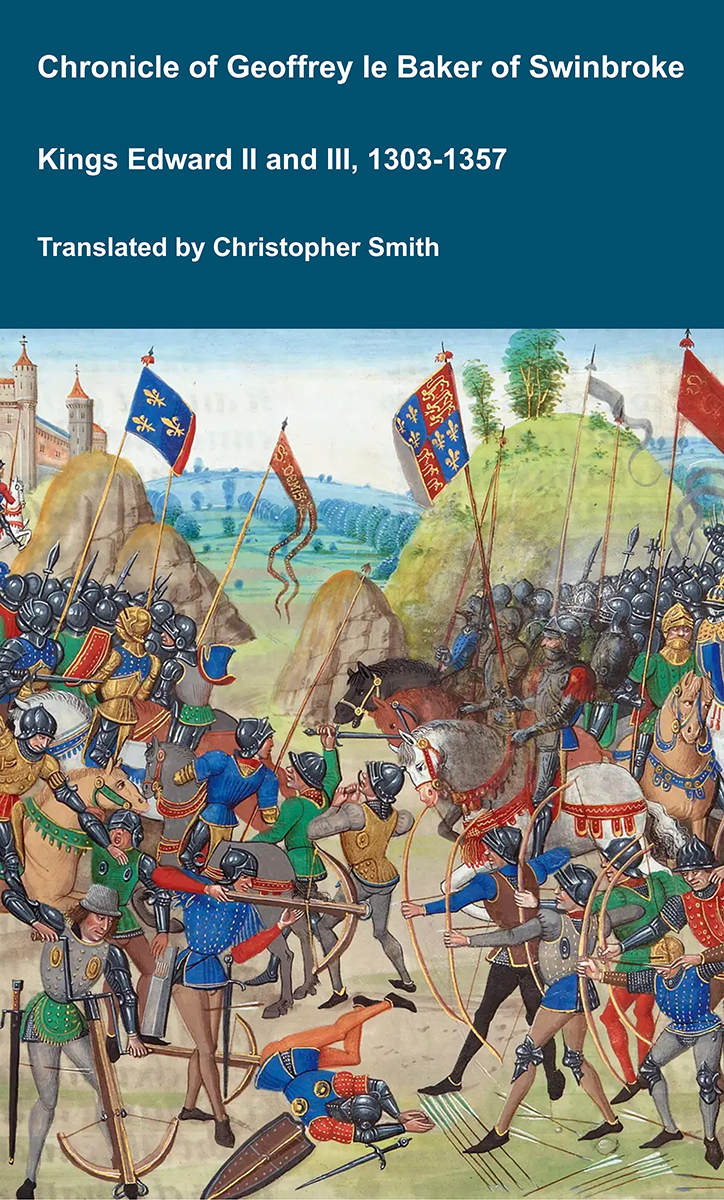
Chronicle of Geoffrey le Baker of Swinbroke
Baker was a secular clerk from Swinbroke, now Swinbrook, an Oxfordshire village two miles east of Burford. His Chronicle describes the events of the period 1303-1356: Gaveston, Bannockburn, Boroughbridge, the murder of King Edward II, the Scottish Wars, Sluys, Crécy, the Black Death, Winchelsea and Poitiers. To quote Herbert Bruce 'it possesses a vigorous and characteristic style, and its value for particular events between 1303 and 1356 has been recognised by its editor and by subsequent writers'. The book provides remarkable detail about the events it describes. Baker's text has been augmented with hundreds of notes, including extracts from other contemporary chronicles, such as the Annales Londonienses, Annales Paulini, Murimuth, Lanercost, Avesbury, Guisborough and Froissart to enrich the reader's understanding. The translation takes as its source the 'Chronicon Galfridi le Baker de Swynebroke' published in 1889, edited by Edward Maunde Thompson.
Available at Amazon in eBook and Paperback format.
22 Mar is in March.
On 22nd March 841 Bernard Plantapilosa Poitiers Margrave Aquitaine was born to Bernard Poitiers Duke Septimania (age 46). He married Ermengard Auvergne and had issue.
Around 22nd March 871 Halfdan Ragnarsson defeated the Wessex army led by King Æthelred of Wessex (age 24) and King Alfred "The Great" of Wessex (age 22) at the Battle of Merton. The location of 'Marton' is not known; suggestions include Marden, Wiltshire in Wiltshire and Winterborne St Martin, Dorset. Bishop Heahmund of Wessex was killed.
Anglo-Saxon Chronicle. Around 22nd March 871. About two months after this, King Ethered (age 24) and Alfred (age 22) his brother fought with the army at Marden. They were in two divisions; and they put them both to flight, enjoying the victory for some time during the day; and there was much slaughter on either hand; but the Danes became masters of the field; and there was slain Bishop Heahmund, with many other good men. After this fight came a vast army in the summer to Reading. And after the Easter of this year died King Ethered. He reigned five years, and his body lies at Winburn-minster [Map]. Then Alfred, his brother, the son of Ethelwulf, took to the kingdom of Wessex.
On 22nd March 875 William "Pious" Poitiers I Duke Aquitaine was born to Bernard Plantapilosa Poitiers Margrave Aquitaine (age 34) and Ermengard Auvergne. He married Engelberge Bivinids Queen Consort West Francia, daughter of Boso Bivinids and Ermengard Carolingian.
On 22nd March 880 Carloman King Bavaria (age 51) died.
Deeds of King Stephen. Among others present was Robert, Earl of Gloucester, son of King Henry, but illegitimate, a man of proven talent and praiseworthy prudence. When, as rumour had it, he was urged upon his father's death to assume the kingdom, being guided by sounder counsel, he by no means consented; saying that it was more just to yield the kingdom to the son of his sister, to whom it more rightly belonged, than presumptuously to usurp it for himself. He therefore, being repeatedly summoned by royal commands and letters to present himself, at last came; and having been received graciously and with distinction, and having done homage to the king, he obtained whatever he asked for, according to his wish. With him finally reconciled, nearly the whole kingdom of England followed the king.
Affuit et inter alios Robertus comes Glaorniæ, filius regis Henrici, sed nothus, vir probati ingenii, laudabilisque prudentiæ. Qui cum de regni susceptione, patre defuncto, ut fama erat, admoneretur, saniori præventus consilio nullatenus adquievit; dicens æquius esse filio sororis suæ, cui justius competebat, regnum cedere, quam præsumptive sibi usurpare. Hic itaque cum regiis mandatis et scriptis sæpius ad se venire commonitus tandem affuisset, gratiose et excellenter susceptus, quæcumque postulavit, exhibito regi hominio, fuit ad votum assecutus; ipsoque postremo pacificato, totum pæne Angliæ regnum fuit regem secutum.
Note 1. He came after Easter [22nd March 1136], William of Malmesbury, 705: "In the same year, after Easter, Robert earl of Gloucester, of whose prudence Stephen chiefly stood in awe, came to England."
Note 2. His itinerary seems to have been Reading (W. of M., 705: "and, in the presence of his successor in the kingdom, was buried at the monastery of Reading"; Hunt., 258: "At last, the royal remains were brought over to England, and interred, within twelve days of Christmas, in the abbey at Reading, which King Henry had founded and richly endowed. There, King Stephen, after holding his court at London during Christmas, came to meet the body of his uncle, and William, archbishop of Canterbury, with many earls and great men, buried King Henry with the honours due to so great a prince."); Oxford (Hunt., 258: "From thence the king went to Oxford, where he recorded and ratified the solemn promises which he had made to God and the people, and to holy church, on the day of his coronation."); Durham, Feb. 4 or 5 (R. Hex.; W. of M., 705; Hunt., 259); York (R. Hexham, and charter in Monasti. con, v., p. 372 ); London, March 22 (R. Hex.; Hunt., 259); Oxford, after Easter (W. of M., 707; R. Hex.). 4 A festina, D.
 Become a Member via our Buy Me a Coffee page to read more.
Before 22nd March 1322, the date he was executed, Thomas Plantagenet 2nd Earl of Leicester, 2nd Earl Lancaster, Earl of Salisbury and Lincoln (age 44) was tried by a tribunal consisting of, among others, Hugh "Elder" Despencer 1st Earl Winchester (age 61), Hugh "Younger" Despencer 1st Baron Despencer (age 36) and Edmund Fitzalan 2nd or 9th Earl of Arundel (age 36). He was not allowed to speak in his defence, nor was he allowed to have anyone speak for him. He was convicted of treason and sentenced to death.
On 22nd March 1322 Thomas Plantagenet 2nd Earl of Leicester, 2nd Earl Lancaster, Earl of Salisbury and Lincoln (age 44) was beheaded at Pontefract Castle [Map] following his capture six days before at the Battle of Boroughbridge. He was buried at Pontefract Priory [Map]. Earl of Leicester, Earl Lancaster forfeit.
The Deeds of the Dukes of Normandy
The Gesta Normannorum Ducum [The Deeds of the Dukes of Normandy] is a landmark medieval chronicle tracing the rise and fall of the Norman dynasty from its early roots through the pivotal events surrounding the Norman Conquest of England. Originally penned in Latin by the monk William of Jumièges shortly before 1060 and later expanded at the behest of William the Conqueror, the work chronicles the deeds, politics, battles, and leadership of the Norman dukes, especially William’s own claim to the English throne. The narrative combines earlier historical sources with firsthand information and oral testimony to present an authoritative account of Normandy’s transformation from a Viking settlement into one of medieval Europe’s most powerful realms. William’s history emphasizes the legitimacy, military prowess, and governance of the Norman line, framing their expansion, including the conquest of England, as both divinely sanctioned and noble in purpose. Later chroniclers such as Orderic Vitalis and Robert of Torigni continued the history, extending the coverage into the 12th century, providing broader context on ducal rule and its impact. Today this classic work remains a foundational source for understanding Norman identity, medieval statesmanship, and the historical forces that reshaped England and Western Europe between 800AD and 1100AD.
Available at Amazon in eBook and Paperback format.
Chronicle of Geoffrey le Baker of Swinbroke. Indeed, the chief instigator of so great a disaster,1 Thomas, Earl of Lancaster (age 44), whose noble birth and immense wealth led others to follow him as though he were immortal, was, on the sixth day after the king's triumph [22nd March 1322], condemned by public justice to the penalty of hanging. But royal compassion did not permit such a shameful death for one of the king's own blood; instead, the punishment for treason was mercifully commuted to beheading. Of the others,2 eighteen were drawn and hanged in various places throughout England. Five fugitives were punished with exile. As for the rest, seized and worn down by the filth of prison, the king, showing mercy to the many, released them to redemption.
Nempe tante cladis principalem presumptorem Thomam comitem Lancastrie, cuius generositas et diviciarum amplitudo quasi immortali ceteros fecerunt aderere, vj. die post regis triumphum pupplica iusticia suspendio dampnatum, morte turpissima suum consanguineum non permisit tractari pietas regalis, set decapitacioni penam prodicionis misericorditer remisit. De numero ceterorum X et octo in diversis locis Anglie tractis et suspensis, V fugitivis exilio castigatis, ceteros squalore carcerali correptos, parcens multitudini, regia miseracio dimisit redempcioni.
Note 1. Vita Edward II, 270.
The story of Lancaster's capture and execution is told graphically in the Brute chronicle (Harley MS. 2279): "Whan sir Andrewe of Herkela sawe that sir Thomas men of Lancastre laskede and slakede, anone he and his companye come to the gentil knyghte Thomas of Lancastre and seyden: 'Yelde the, treytour, yelde the.' The gentil erle answerde tho and seide: 'Nay, lordes, traytours be we none; and to yow wil we nevere us yelde while that oure lyves lasten, but levere we have to bene slayn in oure treuthe than yelde us to yow.' And sir Andrewe ayen grad upone sir Thomas companye, yollyng as a wode wolfe, and seide: 'Yelde yow, treytours taken, yelde yow.' And with an hie vois and seide: 'Beth ware, seres, that none of yow be so bardie uppon life and lyme to mysdone Thomas bodie of Lancastre." And with that worde the good erle Thomas wente into a chapel and seide, knelyng don uppon his kneys, and turnede his visage towarde the crois and seide: 'Almyghti God, to the I me yelde, and holiche putte me into thi mercy.' And with that the vilaynes ribaudes lepte aboute him in evere side that gentile erle, as tirauntes and wode turmentours, and dispoylede him of his armure, and closed him in a robe of raye that was of his squyers lyvery, and furth lad him unto Yorke by water. Whan he was taken and broughte to Yorke, meny of the cite were ful glade, and uppon him criede with hie voi: 'A! sire traytour, ye erne wel come, blessid be God, for now shal ye have the rewarde that longe tyme ye have deservede'; and cast uppon him meny snow ballis, and meny other reproves dede him. But the gentil erle that suffred and seide nether one ne other. And in the same tyme the kyng herd of that scomfiture and was ful glad, and in haste come to Pountfret, and sir Hugh the Spencer, and sire Hugh his sone, and sir John erle of Arundelle, and sir Edmunde of Wodestoke, the kyngis brother, erle of Kente, and sire Aymer of Valence, erle of Penbroke, and maister Robert of Baldok, a fals pillede clerk, that was pryve and dwellyng in the kyngis courte; and alle come thider with the kyng. And sire Raufe of Beestone yaf up the castel to the kyng, and the kyng enterede into the castelle. And sire Andrewe of Herkela, a fak tiraunt, thurgh jie kynges comaundement nome with him the gentil erle Thomas to Pountfret; and ther he was prisonede in his owen castelle that he had newe made, that stode ayens the abbay of kyng Edwarde. And sir Hugh the Spencer, the fader, and sir Hugh his sone caste and thoughte how and in what maner the good erle Thomas of Lancastre shulde ben dede, withoute eny iugement of his peris. Wherfor hit was ordeynede thurgh the kynges Justices that the kyng shuld putte uppone him poyntes of tretry. And so hit bifelle that he was lad to the barre bifore the kynges Justices, bare heed, as a these, in a faire halle within his owen castel that he had made therin meny a faire feste bothe to riche and eke to pore. And these were his Justices: sir Hugh the Spencer, the fader, sir Aymer the Valance, erle of Penbroke, sire Edmunde of Wodestoke, erle of Kente, sire John of Britaigne, erle of Richemonde, and sir Robert of Malmethorpe, iustice. And sir Robert him acoupede in this maner: 'Thomas, atte the first oure lorde the kyng and this courte excludeth yow of almaner answer. Thomas, our lorde the kyng putte uppon yow fat ye have in his lande riden with baner displayede, ayens his pees, as a treytour.' And with that worde the gentile erle Thomas with an hie vois sayde: 'Naye, forsothe, lordes, and by seynt Thomas I was never traytour.' The iustice seide ayen tho: 'Thomas, oure lorde the kyng putte uppon the that ye have robbede his folk and mordred his peple, as a thefe. Thomas, the kyng also putte uppon the that he descomfited yow and youre peple with his folke in his owen reame; wherfor ye wente and fley to the wode as an owtelawe, and also ye were taken as an outelawe. And, Thomas, as a treytour ye shulde ben hangede by resonn; but the kyng hath foryeve yow that iewes [punishment] for the love of quene Isabelle. And, Thomas, reson wolde that ye shulde ben honged, but the kyng hath foryeve hit yow for cause and love of your lynage. But, Thomas, for as moche as ye were take fleyng and as an outelawe, the kyng wil that youre hede be smyten of, as ye have wel deservede. Anone done him oute of prees, and anone bring him to his iugemente.' The gentile knyjte, whan he had herde alle these wordes, with an hie voys criede, sore wepyng, and seide: 'Alias, seint Thomas, faire fader, alias, shal I ben dede thus? Graunte me now, blissful Lord God, answer.' But alle hit avayle him noujte, for the cursede Gascoigne putte him hider and thider, and on him criede with an hie voys: 'O kyng Arthure, most dredful, wel knowe now fine opyn traytrye; in evel deth shall thow die, as thou hast wel deservede.' Tho sette thei uppon his hevede, in scorne, an olde chapelet alle torente and torne, that was not worth an halpeny. And, after, thei sette him uppon a lene white palfreye ful unsemeliche and eke al bare, with an olde bridel; and with an horrible noys they drow him oute of the castelle towarde his deth, and caste on him many ballis of snawe. And as the turmentours ladde him oute of the castelle, tho seide he thise petous wordis, and his handis helde up in hie towardes hevene: 'Now the Kyng of hevene yeve us mercie, for the erthely kyng hath us forsake.' And a frere prechoure wente with him oute of the castelle til that he come til the place that he endid his life, and to whome he shrofe him alle his life. And the gentile erle helde him faste bi the clothis, and saide: 'Faire fader, abide with us til that I be dede; for my flessh quaketh for drede of deth.'And soth for to saye the gentil erle sette him uppon his kneys and turnede him in to the est. But a ribaude, that men callede Higon of Mostone, sette hande uppon the gentil erle and seide in despite of him: 'Sir treytour, turne the towarde the Scottis, thine foule deth to underfonge'; and turnede the erle toward the north. The noble erle Thomas answerede tho with a mylde voys and seide: 'Now, faire lordes, I shal done alle youre wille.' And with that worde the frere wente fro him, ful sore wepyng. And anone a rebaude wente to him and smote of his hevede."
Note 2. See particulars of the executions in:
Close Rolls 1339-41. 22nd March 1339. To the prior of St. Swithin's, Winchester, collector in the diocese of Winchester of the triennial tenth granted by the clergy of the province of Canterbury. Order to permit the rectors of Holy Rood, St. Michael's and All Saints' churches, Southampton, and the prior of St. Denys near Southampton to have respite until St. Peter ad Vincula next for the sums of that tenth due from them since Southampton was burned by the king's enemies, so that in the meantime the council may ordain what is to be done, as the houses and buildings in the said parishes and the churches are burned, and the issues do not now suffice to pay for the maintenance of a priest at any of the churches or the pensions due therefrom or any other charges, and the prior, to whom the churches owe pension (pensionare existunt), has besought the king to order the rectors and himself to be discharged of the said tenth
After 22nd March 1354. Monument to Edmund Cornwall (deceased) at St Mary's Church, Burford [Map]. Early Plate Bascinet and Gorget Period. Feet resting on a Lion. Curious laminated gorget.
Edmund Cornwall: Edmund Cornwall and Elizabeth Brampton were married. Around 1280 he was born to Richard Cornwall and Joan Fitzalan at Asthall Leigh, Oxfordshire. He a great grandson of King John of England. On 22nd March 1354 Edmund Cornwall died at Cleobury Mortimer, Shropshire. He was buried at St Mary's Church, Burford [Map].


On 22nd March 1368 Thomas Mowbray 1st Duke of Norfolk was born to John Mowbray 4th Baron Mowbray Baron Segrave and Elizabeth Segrave 5th Baroness Segrave Baroness Mowbray. He a great x 2 grandson of King Edward I of England. He married (1) 20th February 1383 his second cousin once removed Elizabeth Strange Countess Nottingham, daughter of John Strange 4th Baron Strange Blackmere and Mary Fitzalan Baroness Strange Blackmere (2) before 17th September 1385 his second cousin Elizabeth Fitzalan Duchess Norfolk, daughter of Richard Fitzalan 9th Earl of Surrey 4th or 11th Earl of Arundel and Elizabeth Bohun Countess Arundel and Surrey, and had issue.

On 22nd March 1421 the Dauphin's (age 18) French army and a Scottish army heavily defeated the English army at the Battle of Baugé. On the French side Étienne Vignolles "La Hire" fought. On the Scottish side John Stewart 2nd Earl Buchan (age 40) and John Stewart of Darnley 1st Count Évreux (age 41) fought. William Douglas (age 37) was killed.
On the English side John Beaufort 1st Duke of Somerset (age 18), Thomas Beaufort 1st Duke Exeter (age 44), Thomas Beaufort Count Perche (age 16) and John Holland 2nd Duke Exeter (age 26) were captured. John Beaufort 1st Duke of Somerset would be captive for the next seventeen years. Thomas Beaufort 1st Duke Exeter was released in 1422. Thomas Beaufort Count Perche was released around 1427 in a prisoner exchange.
Thomas Lancaster 1st Duke of Clarence (age 33) was killed in battle. Duke Clarence extinct.
John Lumley (age 38) was killed in battle.
John Ros 7th Baron Ros Helmsley (age 24) was killed in battle. His brother Thomas (age 13) succeeded 8th Baron Ros Helmsley.
William Ros (age 23), and Gilbert V Umfraville were killed.
John Grey 1st Earl Tankerville (age 37) was killed in battle. His son Henry (age 3) succeeded 2nd Earl Tankerville.
William Douglas 1st Lord Drumlanrig was present.
Become a Member via our Buy Me a Coffee page to read more.
Deeds of King Henry V [1413-1421]. [22nd March 1421] In the vigil of the most holy Paschal feast, the assertion of the scouts signified to the Duke that a hostile army, numerous and splendid in the multitude of fighters, was preparing for battle at a nearby distance. On this matter, the excessive ferocity of the brave Duke, kindled to great anger, did not wait for the arrival of his men, nor did he gather his army, but with his forces scattered and the necessary arrangements neglected, at that same hour, in haste and without careful consideration, without calling the archers, and postponing counsel, he rushed forward with a few captains and nobles whom fate had found more eager to assist him, against the enemy's positions. After passing through a sufficiently narrow passage by the stream near the castle of Baugé, he found the cavalry sent by the enemies, all of whom he quickly turned into flight, although they were more numerous. A part of those few English whom he had brought with him pursued the fleeing ones, and the Duke himself remained in the field with very few of the nobility. However, the hostile army, which until now had been overshadowed from the Duke's sight by the summit of a certain mountain, soon, as the time and place suited their desires, with a sudden, horrifying, and merciless assault, rushed upon the noble Duke and his handful of fighters. And although he nobly fought until the very last breath, as the outcome of the matter proved, he was engulfed by the flood of the stream, and in this sudden conflict, the illustrious Duke, the honour and glory of knighthood, perished along with all the others1.
In sacrosanctæ verò Paschalis festivitatis vigiliâ significavit Duci exploratorum assertio, quod hostilis exercitus innumerosus ac pomposus pugnatorum multitudine in vicinâ distantiâ se præpararent ad proelium . Quâ de re animosi Ducis nimium accensa ferocitas non expectato suorum adventu, nec congregato suo exercitu, sed disperso, ordinationis requisitæ industriâ neglectui traditâ, eâdem horâ, festino et nudo circumspectionis impetu arcitenentibus non vocatis, postposito consilio, cum paucis capitaneis et nobilioribus quos prætextu propinquioris assistentiæ, personæ suæ promptiores sors adversatrix reperit, usque adversariorum stationes accelerat, pertransiensque arcto satis passagio rivulum juxta castrum de Bawge, invenit equestres præmissos per hostes, quos omnes quamquàm plures mox in fugam convertit . Parsque ipsorum Anglicorum paucorum quos secum adduxerat fugientes insecuta est, et ipse dux cum paucissimis nobilioribus tum in campo remansit . Hostilis vero exercitus, quem hucusque à ducis conspectu montis cujusdam obumbravit summitas, mox jam ut tempus et locum suis desideriis opportuna perpendit, repentino, horrendo ac immisericordi impetu in prænobilem ducem the Duke of et ipsum pugnatorum manipulum irruit . Et quamvis ipse cum suis ut exitus rei probarat usque ad extremum anhelitum nobiliter dimicavit, obsorbuit tum rivulum pelagus, interiitque in hoc subitaneo conflictu ille decus et decor militiæ, dux illustris, et alii omnes.
Note 1. This calamity was occasioned by the over-confidence of the English earls, "who would not take with them archers, but thought to have done with the Frenchmen themselves without them. And yet when he was slain the archers came and rescued the body of the duke, which they would have carried with them. God have mercy on his soul! He was a valiant man." (MS. Claud. A, viii.) Richard Rede remarks that on this occasion [translated from Latin] "The bastard of Clarence and several others escaped." (Rawlinson MS. c. 398. Bodl.) Sir John Swinton, a Scottish knight, first struck the duke, whose coronet sparkling with jewels, pointed him out as an object of attack. (Buchanan Hist, Scot,) John Stuart, Seigneur de Darnellé (Darnley) et Concressault, was created Seigneur d'Aubigné sur Nievre, in consequence of his having taken the Earl of Somerset prisoner. See Letters of Charles VI. to the Court of Scotland, informing them of this circumstance, not in very good faith with his lately-signed treaty at Troyes.
Become a Member via our Buy Me a Coffee page to read more.
After 22nd March 1421 John Ros 7th Baron Ros Helmsley (deceased) was buried at Belvoir Priory [Map]. His remains and monument were subsequently relocated to the Chancel of St Mary the Virgin Church, Bottesford, Leicestershire [Map]. Early Plate Bascinet Period.
John Ros 7th Baron Ros Helmsley: Around 1397 he was born to William Ros 6th Baron Ros Helmsley and Margaret Fitzalan Baroness Ros of Helmsley. He a great x 4 grandson of King Henry III of England. On 1st September 1414 William Ros 6th Baron Ros Helmsley died. His son John succeeded 7th Baron Ros Helmsley. Before 22nd March 1421 John Ros 7th Baron Ros Helmsley and Margery Despencer 3rd Baroness Despencer, Baroness Ros were married. She by marriage Baroness Ros Helmsley. They were third cousins. He a great x 4 grandson of King Henry III of England.

Detail of Lancastrian Esses Collar and the trefoil fixing holding the Lancastrian Esses Collar to the bottom of the Camail.

Detail of IHC NASARE Lettering and Decorated Orle and decorated Vervelle Cover. Bascinet with Gorget. Lancastrian Esses Collar.

Detail of the Ros Peacock Crest which surmounted his Great Helm; only the feet remain.

Detail of the Hourglass Gauntlets and graffiti.
Become a Member via our Buy Me a Coffee page to read more.
After 22nd March 1426. All Saints Church Harewood [Map]. Monument to Richard Redman (deceased) and Elizabeth Aldeburgh. Early Plate Bascinet and Gorget Period. Lancastrian Esses and Inter-twined Knots Collar. Horses Head Crest. Elaborate Crespine Headress. Chest with Angels with Rounded Wings holding Shields.
Elizabeth Aldeburgh: Brian Stapleton and she were married. Richard Redman and she were married. Around 1362 she was born to William Aldeburgh 1st Baron Aldeburgh Harewood and Elizabeth Lisle Baroness Ferrers Harewood. On 21st December 1417 Elizabeth Aldeburgh died.


In 22nd March 1454 Cardinal John Kempe (age 74) died.
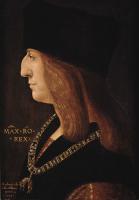
On 22nd March 1459 Maximilian Habsburg I Holy Roman Emperor was born to Frederick "Peaceful or Fat" Habsburg III Holy Roman Emperor (age 43) and Eleanor Aviz Holy Roman Empress (age 24). He a great x 3 grandson of King Edward III of England. He married (1) 18th August 1477 his second cousin Mary Valois Duchess Burgundy, daughter of Charles "Bold" Valois Duke Burgundy and Isabella Bourbon, and had issue (2) 1494 his third cousin Bianca Maria Sforza Holy Roman Empress, daughter of Galeazzo Maria Sforza 5th Duke Milan and Bona of Savoy.

On 22nd March 1519 Catherine Willoughby Duchess Suffolk was born to William Willoughby 11th Baron Willoughby (age 37) and Maria de Salinas Baroness Willoughby (age 29) at Parham Old Hall, Suffolk [Map]. She married (1) 7th September 1533 her fifth cousin once removed Charles Brandon 1st Duke of Suffolk and had issue (2) after 1551 Richard Bertie Baron Willoughby and had issue.
Wriothesley's Chronicle [1508-1562]. The second Soundaie of Lent preached at Paules Crosse [Map] the Bishop of Worcestre (age 49).b
Note b. Hugh Latimer.
Chronicle of a Bourgeois of Valenciennes
Récits d’un bourgeois de Valenciennes aka The Chronicle of a Bourgeois of Valenciennes is a vivid 14th-century vernacular chronicle written by an anonymous urban chronicler from Valenciennes in the County of Hainaut. It survives in a manuscript that describes local and regional history from about 1253 to 1366, blending chronology, narrative episodes, and eyewitness-style accounts of political, military, and social events in medieval France, Flanders, and the Low Countries. The work begins with a chronological framework of events affecting Valenciennes and its region under rulers such as King Philip VI of France and the shifting allegiances of local nobility. It includes accounts of conflicts, sieges, diplomatic manoeuvres, and the impact of broader struggles like the Hundred Years’ War on urban life in Hainaut. Written from the perspective of a burgher (bourgeois) rather than a monastery or royal court, the chronicle offers a rare lay viewpoint on high politics and warfare, reflecting how merchants, townspeople, and civic institutions experienced the turbulence of the 13th and 14th centuries. Its narrative style combines straightforward reporting of events with moral and civic observations, making it a valuable source for readers interested in medieval urban society, regional politics, and the lived experience of war and governance in pre-modern Europe.
Available at Amazon in eBook and Paperback format.
Henry Machyn's Diary. 22nd March 1556. The Sonday xxij day of Marche was at the Gray-ffrers at Grenwyche was my lord cardenall Polle (age 56) was consecratyd, with x byshopes mytyred-the iij yer of the quen Mare.
Note. P. 102. Consecration of Cardinal Pole. An account of this ceremony, at which the queen (age 40) was present, will be found in Strype, Memorials, iii. 287.


Henry Machyn's Diary. 22nd March 1558. The xxij day of Marche my lord mayre and the althermen whent unto Yeld-Halle [Map], and ther the quen('s) consell cam theder, furst my lord chanseler (age 57), my lord treysorer (age 75), my lord of preve-selle (age 52), the bysshope of Ele (age 52), and ser John Baker, secretore Peter, and mony more, and after whent to my lord mare to dener.


Henry Machyn's Diary. 22nd March 1560. [The xxij day of March preached at court the same master Bentham (age 46),] byshope of Lychfeld and Coventre.

On 22nd March 1582 Archbishop John Williams was born to Edmund Williams in Conwy [Map].
On 22nd March 1592 Duke John VII of Mecklenburg-Schwerin (age 34) committed suicide.

On 22nd March 1599 Anthony Van Dyck was born in Antwerp [Map].
Diary of Anne Clifford. 22nd March 1616. Upon the 22nd my Lady and I went in a coach to Whingfield and rode about the Park and saw all the woods.1
Note 1. Upon the 24th my Lady Somerset (age 25) was sent by water from Blackfriars as Prisoner to the Tower.


Diary of Anne Clifford. 22nd March 1617. The 22nd my Cook Hortitius came down from London by Dr Layfield and the Steward came from Buckhurst and told me my Lord (age 28) had not been well, so as his going to London had him put off till the next week and that he had lent out his house to my Lord Keeper for 2 terms till the Lady Derby was gone out of York House, and my Brother Sackville had written to my Lord to lend him the letter to bring up my Sister Sackville to town, who was 13 weeks. gone with child. This day I began a new Irish stitch cushion, not one of those for Lady Rich, but finer canvas. The 24th we made rosemary cakes.
Samuel Pepys' Diary. 22nd March 1663. So home to dinner, and after dinner my wife and I and her woman by coach to Westminster, where being come too soon for the Christening we took up Mr. Creed and went out to take some ayre, as far as Chelsey and further, I lighting there and letting them go on with the coach while I went to the church expecting to see the young ladies of the school, Ashwell desiring me, but I could not get in far enough, and so came out and at the coach's coming back went in again and so back to Westminster, and led my wife and her to Captain Ferrers, and I to my Lord Sandwich (age 37), and with him talking a good while; I find the Court would have this Indulgence go on, but the Parliament are against it. Matters in Ireland are full of discontent.


Henrici Quinti, Angliæ Regis, Gesta, is a first-hand account of the Agincourt Campaign, and subsequent events to his death in 1422. The author of the first part was a Chaplain in King Henry's retinue who was present from King Henry's departure at Southampton in 1415, at the siege of Harfleur, the battle of Agincourt, and the celebrations on King Henry's return to London. The second part, by another writer, relates the events that took place including the negotiations at Troye, Henry's marriage and his death in 1422.
Available at Amazon in eBook and Paperback format.

Samuel Pepys' Diary. 22nd March 1665. Thence to Mr. Povy's (age 51), and with Creed to the 'Change [Map] and to my house, but, it being washing day, dined not at home, but took him (I being invited) to Mr. Hubland's, the merchant, where Sir William Petty (age 41), and abundance of most ingenious men, owners and freighters of "The Experiment", now going with her two bodies to sea. Most excellent discourse. Among others, Sir William Petty did tell me that in good earnest he hath in his will left such parts of his estate to him that could invent such and such things. As among others, that could discover truly the way of milk coming into the breasts of a woman; and he that could invent proper characters to express to another the mixture of relishes and tastes. And says, that to him that invents gold, he gives nothing for the philosopher's stone; for (says he) they that find out that, will be able to pay themselves. But, says he, by this means it is better than to give to a lecture; for here my executors, that must part with this, will be sure to be well convinced of the invention before they do part with their money.
Samuel Pepys' Diary. 22nd March 1666. After dinner to my office close, and did very much business, and so late home to supper and to bed. The plague increased four this week, which troubles me, though but one in the whole.
Samuel Pepys' Diary. 22nd March 1667. Up and by coach to Sir Ph. Warwicke (age 57) about business for Tangier about money, and then to Sir Stephen Fox (age 39) to give him account of a little service I have done him about money coming to him from our office, and then to Lovett's and saw a few baubling things of their doing which are very pretty, but the quality of the people, living only by shifts, do not please me, that it makes me I do no more care for them, nor shall have more acquaintance with them after I have got my Baroness Castlemayne's (age 26) picture home.


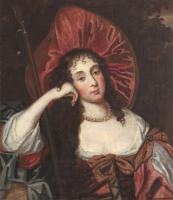


Samuel Pepys' Diary. 22nd March 1667. So home and to the office, where did business, and so home to my chamber, and then to supper and to bed. Landing at the Tower [Map] to-night I met on Tower Hill [Map] with Captain Cocke (age 50) and spent half an hour walking in the dusk of the evening with him, talking of the sorrowful condition we are in, that we must be ruined if the Parliament do not come and chastize us, that we are resolved to make a peace whatever it cost, that the King (age 36) is disobliging the Parliament in this interval all that may be, yet his money is gone and he must have more, and they likely not to give it, without a great deal of do. God knows what the issue of it will be. But the considering that the Duke of York (age 33), instead of being at sea as Admirall, is now going from port to port, as he is at this day at Harwich, Essex [Map], and was the other day with the King at Sheernesse [Map], and hath ordered at Portsmouth, Hampshire [Map] how fortifications shall be made to oppose the enemy, in case of invasion, [which] is to us a sad consideration, and as shameful to the nation, especially after so many proud vaunts as we have made against the Dutch, and all from the folly of the Duke of Albemarle (age 58), who made nothing of beating them, and Sir John Lawson he always declared that we never did fail to beat them with lesser numbers than theirs, which did so prevail with the King as to throw us into this war.
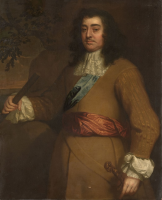


Around 22nd March 1668, Easter Day, the 1668 Bawdy House Riots were riots over several days caused by Dissenters who resented the King's proclamation against conventicles aka private lay worship while turning a blind eye to the equally illegal brothels. Thousands of young men besieged and demolished brothels throughout the East End, assaulting the prostitutes and looting the properties.
Samuel Pepys' Diary. 22nd March 1669. Thence with W. Hewer (age 27) at noon to Unthanke's, where my wife stays for me and so to the Cocke (age 52), where there was no room, and thence to King Street, to several cook's shops, where nothing to be had; and at last to the corner shop, going down Ivy Lane, by my Lord of Salisbury's, and there got a good dinner, my wife, and W. Newer, and I: and after dinner she, with her coach, home; and he and I to look over my papers for the East India Company, against the afternoon: which done, I with them to White Hall, and there to the Treasury-Chamber, where the East India Company and three Councillors pleaded against me alone, for three or four hours, till seven at night, before the Lords; and the Lords did give me the conquest on behalf of the King (age 38), but could not come to any conclusion, the Company being stiff: and so I think we shall go to law with them. This done, and my eyes mighty bad with this day's work, I to Mr. Wren's, and then up to the Duke of York (age 35), and there with Mr. Wren (age 40) did propound to him my going to Chatham, Kent [Map] to-morrow with Commissioner Middleton, and so this week to make the pay there, and examine the business of "The Defyance" being lost, and other businesses, which I did the rather, that I might be out of the way at the wedding, and be at a little liberty myself for a day, or two, to find a little pleasure, and give my eyes a little ease. The Duke of York mightily satisfied with it; and so away home, where my wife troubled at my being so late abroad, poor woman! though never more busy, but I satisfied her; and so begun to put things in order for my journey to-morrow, and so, after supper, to bed.


John Evelyn's Diary. 22nd March 1670. I went to Westminster, where in the House of Lords I saw his Majesty (age 39) sit on his throne, but without his robes, all the peers sitting with their hats on; the business of the day being the divorce of my Lord Ross. Such an occasion and sight had not been seen in England since the time of Henry VIII.
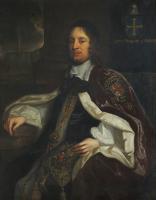
John Evelyn's Diary. 22nd March 1675. Supped at Sir William Petty's (age 51), with the Bishop of Salisbury, and divers honorable persons. We had a noble entertainment in a house gloriously furnished; the master and mistress (age 39) of it were extraordinary persons. Sir William was the son of a mean man somewhere in Sussex, and sent from school to Oxford, where he studied Philosophy, but was most eminent in Mathematics and Mechanics; proceeded Doctor of Physic, and was grown famous, as for his learning so for his recovering a poor wench [Anne Greene] that had been hanged for felony; and her body having been begged (as the custom is) for the anatomy lecture, he bled her, put her to bed to a warm woman, and, with spirits and other means, restored her to life. The young scholars joined and made a little portion, and married her to a man who had several children by her, she living fifteen years after, as I have been assured. Sir William came from Oxford to be tutor to a neighbour of mine; thence, when the rebels were dividing their conquests in Ireland, he was employed by them to measure and set out the land, which he did on an easy contract, so much per acre. This he effected so exactly, that it not only furnished him with a great sum of money; but enabled him to purchase an estate worth £4,000 a year. He afterward married the daughter of Sir Hardress Waller; she was an extraordinary wit as well as beauty, and a prudent woman.
John Evelyn's Diary. 22nd March 1675. The Map of Ireland made by Sir William Petty (age 51) is believed to be the most exact that ever yet was made of any country. He did promise to publish it; and I am told it has cost him near £1,000 to have it engraved at Amsterdam. There is not a better Latin poet living, when he gives himself that diversion; nor is his excellence less in Council and prudent matters of state; but he is so exceedingly nice in sifting and examining all possible contingencies, that he adventures at nothing which is not demonstration. There was not in the whole world his equal for a superintendent of manufacture and improvement of trade, or to govern a plantation. If I were a Prince, I should make him my second Counsellor, at least. There is nothing difficult to him. He is, besides, courageous; on which account, I cannot but note a true story of him, that when Sir Aleyn Brodrick sent him a challenge upon a difference between them in Ireland, Sir William, though exceedingly purblind, accepted the challenge, and it being his part to propound the weapon, desired his antagonist to meet him with a hatchet, or axe, in a dark cellar; which the other, of course, refused.
John Evelyn's Diary. 22nd March 1675. Sir William (age 51) was, with all this, facetious and of easy conversation, friendly and courteous, and had such a faculty of imitating others, that he would take a text and preach, now like a grave orthodox divine, then falling into the Presbyterian way, then to the fanatical, the Quaker, the monk and friar, the Popish priest, with such admirable action, and alteration of voice and tone, as it was not possible to abstain from wonder, and one would swear to hear several persons, or forbear to think he was not in good earnest an enthusiast and almost beside himself; then, he would fall out of it into a serious discourse; but it was very rarely he would be prevailed on to oblige the company with this faculty, and that only among most intimate friends. My Lord Duke of Ormond (age 64) once obtained it of him, and was almost ravished with admiration; but by and by, he fell upon a serious reprimand of the faults and miscarriages of some Princes and Governors, which, though he named none, did so sensibly touch the Duke, who was then Lieutenant of Ireland, that he began to be very uneasy, and wished the spirit laid which he had raised, for he was neither able to endure such truths, nor could he but be delighted. At last, he melted his discourse to a ridiculous subject, and came down from the joint stool on which he had stood; but my lord would not have him preach any more. He never could get favour at Court, because he outwitted all the projectors that came near him. Having never known such another genius, I cannot but mention these particulars, among a multitude of others which I could produce. When I, who knew him in mean circumstances, have been in his splendid palace, he would himself be in admiration how he arrived at it; nor was it his value or inclination for splendid furniture and the curiosities of the age, but his elegant lady could endure nothing mean, or that was not magnificent. He was very negligent himself, and rather so of his person, and of a philosophic temper. "What a to-do is here!" would he say, "I can lie in straw with as much satisfaction"..


Become a Member via our Buy Me a Coffee page to read more.
John Evelyn's Diary. 22nd March 1675. Sir William (age 51), among other inventions, was author of the double-bottomed ship, which perished, and he was censured for rashness, being lost in the Bay of Biscay in a storm, when, I think, fifteen other vessels miscarried. This vessel was flat-bottomed, of exceeding use to put into shallow ports, and ride over small depths of water. It consisted of two distinct keels cramped together with huge timbers, etc., so as that a violent stream ran between; it bore a monstrous broad sail, and he still persists that it is practicable, and of exceeding use; and he has often told me he would adventure himself in such another, could he procure sailors, and his Majesty's (age 44) permission to make a second Experiment; which name the King gave the vessel at the launching.
On 22nd March 1676 Anne Clifford Countess Dorset and Pembroke (age 86) died at Brougham Castle [Map]. She was buried in St Lawrence's Church, Appleby-in-Westmoreland [Map]. Free-standing with Reredos displaying family tree.


Before 21st March 1683 the Rye House Plot was an attempt to assassinate King Charles II of England Scotland and Ireland (age 52) and his brother King James II of England Scotland and Ireland (age 49) as they passed Rye House, Hoddesdon when were returning from the races at Newmarket, Suffolk on 1st April 1683. In the event a fire at Newmarket, Suffolk on the 22nd March 1683 the races were cancelled.




John Evelyn's Diary. 22nd March 1694. Came the dismal news of the disaster befallen our Turkey fleet by tempest, to the almost utter ruin of that trade, the convoy of three or four men-of-war, and divers merchant ships, with all their men and lading, having perished.
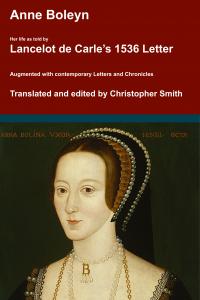
Anne Boleyn. Her Life as told by Lancelot de Carle's 1536 Letter.
In 1536, two weeks after the execution of Anne Boleyn, her brother George and four others, Lancelot du Carle, wrote an extraordinary letter that described Anne's life, and her trial and execution, to which he was a witness. This book presents a new translation of that letter, with additional material from other contemporary sources such as Letters, Hall's and Wriothesley's Chronicles, the pamphlets of Wynkyn the Worde, the Memorial of George Constantyne, the Portuguese Letter and the Baga de Secrets, all of which are provided in Appendices.
Available at Amazon in eBook and Paperback format.
On 22nd March 1713 Robert Petre 7th Baron Petre (age 24) died of smallpox. His son Robert succeeded 8th Baron Petre.
On 22nd March 1728 Anton Raphael Mengs was born.
On 22nd March 1729 Hugh Smithson 3rd Baronet (age 72) died. His grandson Hugh (age 13) succeeded 4th Baronet Smithson of Stanwick in Yorkshire. Monument in Church of St John the Baptist, Stanwick, North Yorkshire [Map].
Hugh Smithson 3rd Baronet: In 1657 he was born to Jerome Smithson 2nd Baronet. In 1684 Jerome Smithson 2nd Baronet died. His son Hugh succeeded 3rd Baronet Smithson of Stanwick in Yorkshire.


On 22nd March 1741 Aubrey Beauclerk was killed in action during the Battle of Cartgenas.
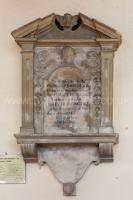
After 22nd March 1742. St Martin's Church, Ancaster [Map]. Memorial to John Black.
On 22nd March 1743 Francis Scott 2nd Duke Buccleuch (age 48) was restored 2nd Earl Doncaster, 2nd Baron Scott of Tynedale.
On 22nd March 1753 James Brydges 3rd Duke Chandos (age 21) and Margaret Nicol were married. He the son of Henry Brydges 2nd Duke Chandos (age 45) and Mary Bruce.
On 22nd March 1767 Francis Russell (age 27) died from a fall from a horse while out hunting.

On 22nd March 1797 William I King Prussia was born to Frederick William III King Prussia (age 26) and Queen Louise of Prussia (age 21).
The Deeds of the Dukes of Normandy
The Gesta Normannorum Ducum [The Deeds of the Dukes of Normandy] is a landmark medieval chronicle tracing the rise and fall of the Norman dynasty from its early roots through the pivotal events surrounding the Norman Conquest of England. Originally penned in Latin by the monk William of Jumièges shortly before 1060 and later expanded at the behest of William the Conqueror, the work chronicles the deeds, politics, battles, and leadership of the Norman dukes, especially William’s own claim to the English throne. The narrative combines earlier historical sources with firsthand information and oral testimony to present an authoritative account of Normandy’s transformation from a Viking settlement into one of medieval Europe’s most powerful realms. William’s history emphasizes the legitimacy, military prowess, and governance of the Norman line, framing their expansion, including the conquest of England, as both divinely sanctioned and noble in purpose. Later chroniclers such as Orderic Vitalis and Robert of Torigni continued the history, extending the coverage into the 12th century, providing broader context on ducal rule and its impact. Today this classic work remains a foundational source for understanding Norman identity, medieval statesmanship, and the historical forces that reshaped England and Western Europe between 800AD and 1100AD.
Available at Amazon in eBook and Paperback format.
On 22nd March 1831 John Warwick Smith (age 81) died.
On 22nd March 1834 John Bathurst Deane (age 36) and Louisa Elizabeth Fourdrinier were married. They had thirteen children.
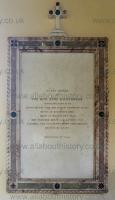
On 22nd March 1871 Anne Otway (age 62) died without issue. Memorial at St Nicholas' Church, Stanford-on-Avon [Map].
Anne Otway: Before 1809 she was born to Henry Otway of Castle Otway in Tipperary and Sarah Cave 3rd Baroness Braye.
On 22nd March 1874 Albert Way (age 68) died.
On 22nd March 1883 Alfred Clint (age 76) died. He was buried in the same grave as his father, in Kensal Green Cemetery [Map].
On 22nd March 1886 Augusta Mary Minna Catherine Lyons Duchess Norfolk (age 64) died at Norfolk House, St James' Square. She was buried at the Fitzalan Chapel, Arundel Castle [Map].
On 22nd March 1890 William Drogo Montagu 7th Duke Manchester (age 66) died. His son George (age 36) succeeded 8th Duke Manchester, 11th Earl Manchester, 11th Viscount Mandeville, 11th Baron Montagu of Kimbolton. Consuelo Yznaga Duchess Manchester (age 37) by marriage Duchess Manchester.


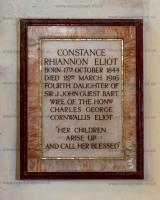
On 22nd March 1916 Constance Rhiannon Guest (age 71) died. Memorial at St Germans Priory [Map].
Constance Rhiannon Guest: On 17th October 1844 she was born to John Josiah Guest 1st Baronet and Charlotte Elizabeth Bertie. On 26th October 1865 Charles George Cornwallis Eliot and she were married. He the son of Edward Granville Eliot 3rd Earl St Germans and Jemima Cornwallis Countess St Germans.

In 22nd March 1916 Lavinia Mary Strutt Duchess Norfolk was born to Algernon Strutt 3rd Baron Belper (age 32) and Eva Isabel Countess Rosebery (age 23). She married 27th January 1937 Bernard Fitzalan 16th Duke of Norfolk, son of Henry Fitzalan Howard 15th Duke of Norfolk and Gwendolen Constable-Maxwell Duchess Norfolk, and had issue.
The Deeds of the Dukes of Normandy
The Gesta Normannorum Ducum [The Deeds of the Dukes of Normandy] is a landmark medieval chronicle tracing the rise and fall of the Norman dynasty from its early roots through the pivotal events surrounding the Norman Conquest of England. Originally penned in Latin by the monk William of Jumièges shortly before 1060 and later expanded at the behest of William the Conqueror, the work chronicles the deeds, politics, battles, and leadership of the Norman dukes, especially William’s own claim to the English throne. The narrative combines earlier historical sources with firsthand information and oral testimony to present an authoritative account of Normandy’s transformation from a Viking settlement into one of medieval Europe’s most powerful realms. William’s history emphasizes the legitimacy, military prowess, and governance of the Norman line, framing their expansion, including the conquest of England, as both divinely sanctioned and noble in purpose. Later chroniclers such as Orderic Vitalis and Robert of Torigni continued the history, extending the coverage into the 12th century, providing broader context on ducal rule and its impact. Today this classic work remains a foundational source for understanding Norman identity, medieval statesmanship, and the historical forces that reshaped England and Western Europe between 800AD and 1100AD.
Available at Amazon in eBook and Paperback format.

After 22nd March 1920. Church of St Michael and All Angels, Edenham [Map]. Monument to Elizabeth Sophia Heathcote-Willoughby-Drummond (deceased).
Elizabeth Sophia Heathcote-Willoughby-Drummond: On 20th April 1838 she was born to Gilbert John Heathcote 1st Baron Aveland and Clementina Drummond Willoughby 24th Baroness Willoughby of Eresby Baroness Aveland. On 22nd March 1920 Elizabeth Sophia Heathcote-Willoughby-Drummond died.
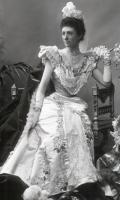
On 22nd March 1937 Mary Caurroy Tribe Duchess Bedford (age 71) died in a plane crash.
On 22nd March 1951 Ian Campbell 11th Duke of Argyll (age 47) and Margaret Whigham Duchess of Argyll (age 38) were married. His third marriage, her second. She by marriage Duchess Argyll.


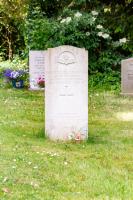
All Saints Church, Hough-on-the-Hill [Map]. Commonwealth War Grave. Lieutenant Philip Daniel Green killed 22nd March 2003 in a helicopter collision.
Government Report:
Six Royal Navy personnel killed in Iraq.
At around 0130 GMT on Saturday 22 March 2003, two Royal Navy Sea King Mk 7 Airborne Early Warning helicopters collided over the northern Arabian Gulf.
The helicopters were from 849 Squadron A Flight, which is based at the Royal Naval Air Station Culdrose, in Cornwall. The crash was not the result of enemy action and tragically there were no survivors from the six British and one US crew members aboard.
The six British personnel were:
Lieutenant Philip D Green RN, aged 30 from Caythorpe, Lincolnshire,
Lieutenant Antony King RN, aged 35 from Helston, Cornwall,
Lieutenant Marc Lawrence RN, aged 26 from Westgate-on-Sea, Kent,
Lieutenant Philip West RN, aged 32 from Budock Water, Cornwall,
Lieutenant James Williams RN, aged 28 from Falmouth, Cornwall, and
Lieutenant Andrew Wilson RN, aged 36 from Exeter all from 849 Squadron, RNAS Culdrose
Become a Member via our Buy Me a Coffee page to read more.
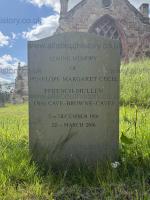
St Nicholas' Church, Stanford-on-Avon [Map]. Grave of Penelope Margaret Cecil Cave-Browne-Cave (age 84), died 22nd March 2016.
Penelope Margaret Cecil Cave-Browne-Cave: On 5th December 1931 she was born to Cecil Beckwith Cave-Browne-Cave. On 22nd March 2016 Penelope Margaret Cecil Cave-Browne-Cave died.
On 22nd March 841 Bernard Plantapilosa Poitiers Margrave Aquitaine was born to Bernard Poitiers Duke Septimania (age 46). He married Ermengard Auvergne and had issue.
On 22nd March 875 William "Pious" Poitiers I Duke Aquitaine was born to Bernard Plantapilosa Poitiers Margrave Aquitaine (age 34) and Ermengard Auvergne. He married Engelberge Bivinids Queen Consort West Francia, daughter of Boso Bivinids and Ermengard Carolingian.
On 22nd March 1327 Hugh Courtenay was born to Hugh Courtenay 2nd or 10th Earl Devon (age 23) and Margaret Bohun Countess Devon (age 15). He a great grandson of King Edward I of England. He married 3rd September 1341 his third cousin once removed Elizabeth de Vere, daughter of John de Vere 7th Earl of Oxford and Maud Badlesmere Countess of Oxford, and had issue.
Chronicle of Geoffrey le Baker of Swinbroke
Baker was a secular clerk from Swinbroke, now Swinbrook, an Oxfordshire village two miles east of Burford. His Chronicle describes the events of the period 1303-1356: Gaveston, Bannockburn, Boroughbridge, the murder of King Edward II, the Scottish Wars, Sluys, Crécy, the Black Death, Winchelsea and Poitiers. To quote Herbert Bruce 'it possesses a vigorous and characteristic style, and its value for particular events between 1303 and 1356 has been recognised by its editor and by subsequent writers'. The book provides remarkable detail about the events it describes. Baker's text has been augmented with hundreds of notes, including extracts from other contemporary chronicles, such as the Annales Londonienses, Annales Paulini, Murimuth, Lanercost, Avesbury, Guisborough and Froissart to enrich the reader's understanding. The translation takes as its source the 'Chronicon Galfridi le Baker de Swynebroke' published in 1889, edited by Edward Maunde Thompson.
Available at Amazon in eBook and Paperback format.
On 22nd March 1368 Thomas Mowbray 1st Duke of Norfolk was born to John Mowbray 4th Baron Mowbray Baron Segrave and Elizabeth Segrave 5th Baroness Segrave Baroness Mowbray. He a great x 2 grandson of King Edward I of England. He married (1) 20th February 1383 his second cousin once removed Elizabeth Strange Countess Nottingham, daughter of John Strange 4th Baron Strange Blackmere and Mary Fitzalan Baroness Strange Blackmere (2) before 17th September 1385 his second cousin Elizabeth Fitzalan Duchess Norfolk, daughter of Richard Fitzalan 9th Earl of Surrey 4th or 11th Earl of Arundel and Elizabeth Bohun Countess Arundel and Surrey, and had issue.
On 22nd March 1459 Maximilian Habsburg I Holy Roman Emperor was born to Frederick "Peaceful or Fat" Habsburg III Holy Roman Emperor (age 43) and Eleanor Aviz Holy Roman Empress (age 24). He a great x 3 grandson of King Edward III of England. He married (1) 18th August 1477 his second cousin Mary Valois Duchess Burgundy, daughter of Charles "Bold" Valois Duke Burgundy and Isabella Bourbon, and had issue (2) 1494 his third cousin Bianca Maria Sforza Holy Roman Empress, daughter of Galeazzo Maria Sforza 5th Duke Milan and Bona of Savoy.
On 22nd March 1519 Catherine Willoughby Duchess Suffolk was born to William Willoughby 11th Baron Willoughby (age 37) and Maria de Salinas Baroness Willoughby (age 29) at Parham Old Hall, Suffolk [Map]. She married (1) 7th September 1533 her fifth cousin once removed Charles Brandon 1st Duke of Suffolk and had issue (2) after 1551 Richard Bertie Baron Willoughby and had issue.

On 22nd March 1538 Unamed Radclyffe was born to Robert Radclyffe 1st Earl of Sussex (age 55) and Mary Arundell Countess Arundel.
On 22nd March 1582 Archbishop John Williams was born to Edmund Williams in Conwy [Map].
On 22nd March 1599 Anthony Van Dyck was born in Antwerp [Map].
On 22nd March 1601 John Scudamore 1st Viscount Scudamore was born to James Scudamore (age 33) and Mary Throckmorton (age 61).
On 22nd March 1615 Katherine Boyle Viscountess Ranelagh was born to Richard Boyle 1st Earl Cork (age 48) and Catherine Fenton Countess Cork (age 30) in Youghal. She married 1630 Arthur Jones 2nd Viscount Ranelagh and had issue.
Jean de Waurin's Chronicle of England Volume 6 Books 3-6: The Wars of the Roses
Jean de Waurin was a French Chronicler, from the Artois region, who was born around 1400, and died around 1474. Waurin’s Chronicle of England, Volume 6, covering the period 1450 to 1471, from which we have selected and translated Chapters relating to the Wars of the Roses, provides a vivid, original, contemporary description of key events some of which he witnessed first-hand, some of which he was told by the key people involved with whom Waurin had a personal relationship.
Available at Amazon in eBook and Paperback format.
On 22nd March 1644 James Rushout 1st Baronet was born to John Rushout of St Dionis Backchurch in London. He married 1670 Alice Pitt Lady Rushout and had issue.
On 22nd March 1649 Charles Holte 3rd Baronet was born to Robert Holte 2nd Baronet (age 24) and Jane Brereton. He married 5th August 1680 Anne Clobery Lady Holte and had issue.
On 22nd March 1672 George Tempest 2nd Baronet was born to John Tempest 1st Baronet (age 27) and Henrietta Cholmley.
On 22nd March 1684 William Pulteney 1st Earl Bath was born to William Pulteney. He married 27th December 1714 Anne Maria Gumley Countess Bath and had issue.
On 22nd March 1686 James Hamilton 7th Earl Abercorn was born to James Hamilton 6th Earl Abercorn (age 25) and Elizabeth Reading. He married April 1711 Anne Plumer Countess Abercorn and had issue.
On 22nd March 1717 Dorothy Fane Countess Sandwich was born to Charles Fane 1st Viscount Fane (age 41) and Mary Stanhope Viscountess Fane (age 31). She married 14th March 1741 John Montagu 4th Earl Sandwich and had issue.
On 22nd March 1728 Anton Raphael Mengs was born.
On 22nd March 1751 William Tollemache was born to Lionel Tollemache 4th Earl Dysart (age 42) and Grace Carteret Countess Dysart (age 37).


On 22nd March 1752 Thomas Lister 1st Baron Ribblesdale was born to Thomas Lister of Gisburne Park. He married 7th November 1789 Rebecca Fielding Baroness Ribblesdale and had issue.

On 22nd March 1767 Robert Grosvenor 1st Marquess Westminster was born to Richard Grosvenor 1st Earl Grosvenor (age 35) at Hanover Square. He married 28th April 1794 Eleanor Egerton Marchioness Westminster, daughter of Thomas Egerton 1st Earl Wilton and Eleanor Assheton Viscountess Wilton, and had issue.
Chronicle of Abbot Ralph of Coggeshall
The Chronicle of Abbot Ralph of Coggeshall (Chronicon Anglicanum) is an indispensable medieval history that brings to life centuries of English and European affairs through the eyes of a learned Cistercian monk. Ralph of Coggeshall, abbot of the Abbey of Coggeshall in Essex in the early 13th century, continued and expanded his community’s chronicle, documenting events from the Norman Conquest of 1066 into the tumultuous reign of King Henry III. Blending eyewitness testimony, careful compilation, and the monastic commitment to record-keeping, this chronicle offers a rare narrative of political intrigue, royal power struggles, and social upheaval in England and beyond. Ralph’s work captures the reigns of pivotal figures such as Richard I and King John, providing invaluable insights into their characters, decisions, and the forces that shaped medieval rule. More than a simple annal, Chronicon Anglicanum conveys the texture of medieval life and governance, making it a rich source for scholars and readers fascinated by English history, monastic authorship, and the shaping of the medieval world.
Available at Amazon in eBook and Paperback format.
On 22nd March 1774 William Domville 2nd Baronet was born to William Domville 1st Baronet (age 31).
On 22nd March 1778 Thomas Joseph Trafford 1st Baronet was born.
On 22nd March 1782 James Parke 1st Baron Wensleydale was born.
On 22nd March 1785 Edward Herbert 2nd Earl Powis was born to Edward Clive 1st Earl Powis (age 31) and Henrietta Antonia Herbert 3rd Countess Powis (age 26). He a great x 4 grandson of King James II of England Scotland and Ireland. He married 9th February 1818 Lucy Graham Countess Powis, daughter of James Graham 3rd Duke Montrose and Caroline Maria Montagu Duchess Montrose, and had issue.


On 22nd March 1786 Charles Gough-Calthorpe 2nd Baron Calthorpe was born to Henry Gough-Calthorpe 1st Baron Calthorpe (age 37) and Frances Carpenter Baroness Calthorpe (age 24).
On 22nd March 1797 William I King Prussia was born to Frederick William III King Prussia (age 26) and Queen Louise of Prussia (age 21).

On 22nd March 1809 Beatrice Trevelyan was born to John Trevelyan 5th Baronet (age 48) and Maria Wilson (age 37). She married 13th May 1830 her half first cousin Ernest Augustus Perceval.
On 22nd March 1831 Edward William Blackett 7th Baronet was born to Edward Blackett 6th Baronet (age 26) and Julia Monck Lady Blackett. He married 23rd November 1871 Julia Frances Somerville Lady Blackett and had issue.
On 22nd March 1846 Evelyn Elizabeth Gordon Countess Ancaster was born to Charles Gordon 10th Marquess Huntly (age 54) and Maria Antoinetta Pegus Marchioness Huntly (age 25). She married 14th July 1863 Gilbert Henry Heathcote Drummond Willoughby 1st Earl Ancaster, son of Gilbert John Heathcote 1st Baron Aveland and Clementina Drummond Willoughby 24th Baroness Willoughby of Eresby Baroness Aveland, and had issue.
On 22nd March 1857 Lionel Eldred Pottinger Smith-Gordon 3rd Baronet was born to Lionel Eldred Smith-Gordon 2nd Baronet (age 23) and Fanny Pottinger Lady Smith (age 24). Coefficient of inbreeding 3.12%.
Chronicle of Walter of Guisborough
A canon regular of the Augustinian Guisborough Priory, Yorkshire, formerly known as The Chronicle of Walter of Hemingburgh, describes the period from 1066 to 1346. Before 1274 the Chronicle is based on other works. Thereafter, the Chronicle is original, and a remarkable source for the events of the time. This book provides a translation of the Chronicle from that date. The Latin source for our translation is the 1849 work edited by Hans Claude Hamilton. Hamilton, in his preface, says: 'In the present work we behold perhaps one of the finest samples of our early chronicles, both as regards the value of the events recorded, and the correctness with which they are detailed; Nor will the pleasing style of composition be lightly passed over by those capable of seeing reflected from it the tokens of a vigorous and cultivated mind, and a favourable specimen of the learning and taste of the age in which it was framed.'
Available at Amazon in eBook and Paperback format.
On 22nd March 1869 Frances Charlotte Guest was born to Ivor Bertie Guest (age 33) and Cornelia Henrietta Maria Spencer-Churchill Baroness Wimborne (age 21).
On 22nd March 1869 Gilbert Sackville 8th Earl De La Warr was born to Reginald Windsor Sackville 7th Earl De La Warr (age 52) and Constance Mary Elizabeth Baillie-Cochrane Countess De La Warr (age 23). He married (1) 1890 Muriel Agnes Brassey Countess De La Warr and had issue.
On 22nd March 1882 Schomberg Charles Hepburn-Stuart-Forbes-Trefusis was born to Charles Hepburn-Stuart-Forbes-Trefusis 20th Baron Clinton (age 48) and Margaret Walrond Baroness Clinton (age 32).

On 22nd March 1904 Arthur Baldwin 3rd Earl Baldwin of Bewdley was born to Stanley Baldwin 1st Earl Baldwin (age 36) and Lucy Ridsdale Countess Baldwin (age 34).
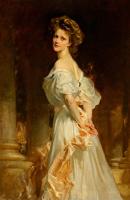
On 22nd March 1909 Nancy Phyllis Louise Astor Countess Astor was born to Waldorf Astor 2nd Viscount Astor (age 29) and Nancy Witcher Langhorne Viscountess Astor (age 29). She married 27th July 1933 Gilbert James Heathcote-Willoughby-Drummond 3rd Earl Ancaster, son of Gilbert Heathcote-Willoughby-Drummond 2nd Earl Ancaster and Eloise Lawrence Breese Countess Ancaster, and had issue.

On 22nd March 1915 Romayne Elizabeth Algitha Brownlow-Cecil was born to William Cecil 5th Marquess Exeter (age 38) and Myra Rowena Sibell Orde-Powlett Marchioness of Exeter (age 35).
On 22nd March 1925 Hugh Smith-Marriott 11th Baronet was born to Ralph Smith-Marriott 10th Baronet (age 24).
On 22nd March 1927 Kenneth Oliver Musgrave St John 7th Viscount Bolingbroke 8th Viscount St John was born to Captain Geoffrey Robert St John (age 38).
On 22nd March 1932 Peter Richard David Hoare 8th Baronet was born to Peter William Hoare 7th Baronet (age 33) and Laura Ray Esplen Lady Hoare.
William of Worcester's Chronicle of England
William of Worcester, born around 1415, and died around 1482 was secretary to John Fastolf, the renowned soldier of the Hundred Years War, during which time he collected documents, letters, and wrote a record of events. Following their return to England in 1440 William was witness to major events. Twice in his chronicle he uses the first person: 1. when writing about the murder of Thomas, 7th Baron Scales, in 1460, he writes '… and I saw him lying naked in the cemetery near the porch of the church of St. Mary Overie in Southwark …' and 2. describing King Edward IV's entry into London in 1461 he writes '… proclaimed that all the people themselves were to recognize and acknowledge Edward as king. I was present and heard this, and immediately went down with them into the city'. William’s Chronicle is rich in detail. It is the source of much information about the Wars of the Roses, including the term 'Diabolical Marriage' to describe the marriage of Queen Elizabeth Woodville’s brother John’s marriage to Katherine, Dowager Duchess of Norfolk, he aged twenty, she sixty-five or more, and the story about a paper crown being placed in mockery on the severed head of Richard, 3rd Duke of York.
Available at Amazon in eBook and Paperback format.
On 22nd March 1710 Thomas Samwell 2nd Baronet (age 22) and Millicent Fuller were married. They had two sons and four daughters.
On 22nd March 1753 James Brydges 3rd Duke Chandos (age 21) and Margaret Nicol were married. He the son of Henry Brydges 2nd Duke Chandos (age 45) and Mary Bruce.
On 22nd March 1770 Frederick Howard 5th Earl Carlisle (age 21) and Margaret Caroline Leveson-Gower Countess Carlisle were married. She by marriage Countess Carlisle. She the daughter of Granville Leveson-Gower 1st Marquess Stafford (age 48) and Louisa Egerton Countess Gower. He the son of Henry Howard 4th Earl Carlisle and Isabella Byron Countess Carlisle (age 48). They were fourth cousin once removed.


On 22nd March 1834 John Bathurst Deane (age 36) and Louisa Elizabeth Fourdrinier were married. They had thirteen children.
On 22nd March 1891 Henry Abdy 4th Baronet (age 37) and Anna Adele Coronn were married.
On 22nd March 1951 Ian Campbell 11th Duke of Argyll (age 47) and Margaret Whigham Duchess of Argyll (age 38) were married. His third marriage, her second. She by marriage Duchess Argyll.
On 22nd March 880 Carloman King Bavaria (age 51) died.
On 22nd March 1322 Thomas Plantagenet 2nd Earl of Leicester, 2nd Earl Lancaster, Earl of Salisbury and Lincoln (age 44) was beheaded at Pontefract Castle [Map] following his capture six days before at the Battle of Boroughbridge. He was buried at Pontefract Priory [Map]. Earl of Leicester, Earl Lancaster forfeit.
On 22nd March 1329 Robert Capet V Count Dreux (age 36) died. His brother John (age 34) succeeded III Count Dreux.
On 22nd March 1421 the Dauphin's (age 18) French army and a Scottish army heavily defeated the English army at the Battle of Baugé. On the French side Étienne Vignolles "La Hire" fought. On the Scottish side John Stewart 2nd Earl Buchan (age 40) and John Stewart of Darnley 1st Count Évreux (age 41) fought. William Douglas (age 37) was killed.
On the English side John Beaufort 1st Duke of Somerset (age 18), Thomas Beaufort 1st Duke Exeter (age 44), Thomas Beaufort Count Perche (age 16) and John Holland 2nd Duke Exeter (age 26) were captured. John Beaufort 1st Duke of Somerset would be captive for the next seventeen years. Thomas Beaufort 1st Duke Exeter was released in 1422. Thomas Beaufort Count Perche was released around 1427 in a prisoner exchange.
Thomas Lancaster 1st Duke of Clarence (age 33) was killed in battle. Duke Clarence extinct.
John Lumley (age 38) was killed in battle.
John Ros 7th Baron Ros Helmsley (age 24) was killed in battle. His brother Thomas (age 13) succeeded 8th Baron Ros Helmsley.
William Ros (age 23), and Gilbert V Umfraville were killed.
John Grey 1st Earl Tankerville (age 37) was killed in battle. His son Henry (age 3) succeeded 2nd Earl Tankerville.
William Douglas 1st Lord Drumlanrig was present.
Become a Member via our Buy Me a Coffee page to read more.
On 22nd March 1458 Antoine Count of Vaudémont (age 58) died.
On 22nd March 1639 Mary Ford Viscountess Fairfax Lady Bamburgh died.
On 22nd March 1648 Edward Hussey 1st Baronet (age 62) died. His grandson Thomas (age 9) succeeded 2nd Baronet Hussey of Honington in Lincolnshire.
On 22nd March 1676 Anne Clifford Countess Dorset and Pembroke (age 86) died at Brougham Castle [Map]. She was buried in St Lawrence's Church, Appleby-in-Westmoreland [Map]. Free-standing with Reredos displaying family tree.
On 22nd March 1686 Hugh Williams 5th Baronet (age 58) died. His son Griffith succeeded 6th Baronet Williams of Penrhyn in Caernarfonshire.
Jean de Waurin's Chronicle of England Volume 6 Books 3-6: The Wars of the Roses
Jean de Waurin was a French Chronicler, from the Artois region, who was born around 1400, and died around 1474. Waurin’s Chronicle of England, Volume 6, covering the period 1450 to 1471, from which we have selected and translated Chapters relating to the Wars of the Roses, provides a vivid, original, contemporary description of key events some of which he witnessed first-hand, some of which he was told by the key people involved with whom Waurin had a personal relationship.
Available at Amazon in eBook and Paperback format.
On 22nd March 1713 Robert Petre 7th Baron Petre (age 24) died of smallpox. His son Robert succeeded 8th Baron Petre.
On 22nd March 1714 Elizabeth Churchill Countess Bridgewater (age 27) died. She was buried at St Peter and St Paul Church, Little Gaddesden on 29th March 1714.
On 22nd March 1715 Richard Bellew 3rd Baron Bellew died. His son John (age 13) succeeded 3rd Baron Bellew of Duleek.
On 22nd March 1715 Francis Wyndham 3rd Baronet (age 61) died. His grandson Francis (age 8) succeeded 4th Baronet Wyndham of Trent.
On 22nd March 1729 Hugh Smithson 3rd Baronet (age 72) died. His grandson Hugh (age 13) succeeded 4th Baronet Smithson of Stanwick in Yorkshire. Monument in Church of St John the Baptist, Stanwick, North Yorkshire [Map].
Hugh Smithson 3rd Baronet: In 1657 he was born to Jerome Smithson 2nd Baronet. In 1684 Jerome Smithson 2nd Baronet died. His son Hugh succeeded 3rd Baronet Smithson of Stanwick in Yorkshire.
On 22nd March 1730 Elizabeth Manners Viscountess Galway (age 21) died.
On 22nd March 1740 Elizabeth Grantham Lady Palmer (age 76) died.

On 22nd March 1753 Thomas Trevor 2nd Baron Trevor Bromham (age 61) died. His brother John (age 57) succeeded 3rd Baron Trevor Bromham.
Chronicle of a Bourgeois of Valenciennes
Récits d’un bourgeois de Valenciennes aka The Chronicle of a Bourgeois of Valenciennes is a vivid 14th-century vernacular chronicle written by an anonymous urban chronicler from Valenciennes in the County of Hainaut. It survives in a manuscript that describes local and regional history from about 1253 to 1366, blending chronology, narrative episodes, and eyewitness-style accounts of political, military, and social events in medieval France, Flanders, and the Low Countries. The work begins with a chronological framework of events affecting Valenciennes and its region under rulers such as King Philip VI of France and the shifting allegiances of local nobility. It includes accounts of conflicts, sieges, diplomatic manoeuvres, and the impact of broader struggles like the Hundred Years’ War on urban life in Hainaut. Written from the perspective of a burgher (bourgeois) rather than a monastery or royal court, the chronicle offers a rare lay viewpoint on high politics and warfare, reflecting how merchants, townspeople, and civic institutions experienced the turbulence of the 13th and 14th centuries. Its narrative style combines straightforward reporting of events with moral and civic observations, making it a valuable source for readers interested in medieval urban society, regional politics, and the lived experience of war and governance in pre-modern Europe.
Available at Amazon in eBook and Paperback format.
On 22nd March 1754 Charlotte Godfrey Viscountess Falmouth died. She was buried in St Michael Pentivel, Penkevile.
On 22nd March 1757 Anne Tufton Countess of Salisbury died.
On 22nd March 1802 James Alexander 1st Earl Caledon (age 72) died at his house in Parnell aka Rutland Square. His son Du (age 24) succeeded 2nd Earl Caledon in County Tyrone. Catherine Yorke Countess Caledon (age 15) by marriage Countess Caledon in County Tyrone.
On 22nd March 1806 Charles Tottenham aka Loftus 1st Marquess Ely (age 68) died. His son John (age 36) succeeded 2nd Marquess Ely in County Wexford, 2nd Viscount Loftus of Ely. Anna Maria Dashwood Marchioness Ely (age 16) by marriage Marchioness Ely in County Wexford.
On 22nd March 1815 Willoughby Aston 6th Baronet (age 67) died. Baronet Aston of Aston extinct.
On 22nd March 1831 John Warwick Smith (age 81) died.
On 22nd March 1834 George Bishopp 9th Baronet (age 42) died. His son Cecil (age 12) succeeded 10th Baronet Bishopp of Parham in Sussex.
On 22nd March 1840 John Dalrymple 7th Earl of Stair (age 55) died without issue. His third cousin once removed John (age 68) succeeded 8th Earl of Stair.
William of Worcester's Chronicle of England
William of Worcester, born around 1415, and died around 1482 was secretary to John Fastolf, the renowned soldier of the Hundred Years War, during which time he collected documents, letters, and wrote a record of events. Following their return to England in 1440 William was witness to major events. Twice in his chronicle he uses the first person: 1. when writing about the murder of Thomas, 7th Baron Scales, in 1460, he writes '… and I saw him lying naked in the cemetery near the porch of the church of St. Mary Overie in Southwark …' and 2. describing King Edward IV's entry into London in 1461 he writes '… proclaimed that all the people themselves were to recognize and acknowledge Edward as king. I was present and heard this, and immediately went down with them into the city'. William’s Chronicle is rich in detail. It is the source of much information about the Wars of the Roses, including the term 'Diabolical Marriage' to describe the marriage of Queen Elizabeth Woodville’s brother John’s marriage to Katherine, Dowager Duchess of Norfolk, he aged twenty, she sixty-five or more, and the story about a paper crown being placed in mockery on the severed head of Richard, 3rd Duke of York.
Available at Amazon in eBook and Paperback format.
On 22nd March 1863 Admiral Anthony Maitland 10th Earl of Lauderdale (age 77) died. His first cousin Thomas (age 60) succeeded 11th Earl Lauderdale, 11th Viscount Maitland, 11th Viscount Lauderdale, 7th Baronet Maitland of Ravelrig in Nova Scotia. Baron Lauderdale of Thirlestane in Berwickshire extinct.
On 22nd March 1864 George John Hamilton-Gordon 5th Earl Aberdeen (age 47) died. His son George (age 22) succeeded 6th Earl Aberdeen.
On 22nd March 1865 George Bridgeman 2nd Earl Bradford (age 75) died. His son Orlando (age 45) succeeded 3rd Earl Bradford, 3rd Viscount Newport of Shropshire, 4th Baron Bradford in Shropshire, 8th Baronet Bridgeman of Great Lever in Lancashire. Selina Weld-Forester Countess Bradford by marriage Countess Bradford.


On 22nd March 1874 Albert Way (age 68) died.
On 22nd March 1883 Jane Elizabeth Liddell Viscountess Barrington (age 78) died.
On 22nd March 1883 Alfred Clint (age 76) died. He was buried in the same grave as his father, in Kensal Green Cemetery [Map].
On 22nd March 1886 Augusta Mary Minna Catherine Lyons Duchess Norfolk (age 64) died at Norfolk House, St James' Square. She was buried at the Fitzalan Chapel, Arundel Castle [Map].
On 22nd March 1890 William Drogo Montagu 7th Duke Manchester (age 66) died. His son George (age 36) succeeded 8th Duke Manchester, 11th Earl Manchester, 11th Viscount Mandeville, 11th Baron Montagu of Kimbolton. Consuelo Yznaga Duchess Manchester (age 37) by marriage Duchess Manchester.
On 22nd March 1927 Ermytrude Sackville Russell Lady Malet (age 70) died.
Chronicle of a Bourgeois of Valenciennes
Récits d’un bourgeois de Valenciennes aka The Chronicle of a Bourgeois of Valenciennes is a vivid 14th-century vernacular chronicle written by an anonymous urban chronicler from Valenciennes in the County of Hainaut. It survives in a manuscript that describes local and regional history from about 1253 to 1366, blending chronology, narrative episodes, and eyewitness-style accounts of political, military, and social events in medieval France, Flanders, and the Low Countries. The work begins with a chronological framework of events affecting Valenciennes and its region under rulers such as King Philip VI of France and the shifting allegiances of local nobility. It includes accounts of conflicts, sieges, diplomatic manoeuvres, and the impact of broader struggles like the Hundred Years’ War on urban life in Hainaut. Written from the perspective of a burgher (bourgeois) rather than a monastery or royal court, the chronicle offers a rare lay viewpoint on high politics and warfare, reflecting how merchants, townspeople, and civic institutions experienced the turbulence of the 13th and 14th centuries. Its narrative style combines straightforward reporting of events with moral and civic observations, making it a valuable source for readers interested in medieval urban society, regional politics, and the lived experience of war and governance in pre-modern Europe.
Available at Amazon in eBook and Paperback format.
On 22nd March 1937 Mary Caurroy Tribe Duchess Bedford (age 71) died in a plane crash.
On 22nd March 1940 Winifred Coke Countess of Leitrim (age 89) died.
On 22nd March 1983 John Pratt 5th Marquess Camden (age 83) died. His son David (age 52) succeeded 6th Marquess Camden, 6th Earl Brecknock, 7th Earl Camden, 7th Viscount Bayham of Bayham Abbey in Kent, 7th Baron Camden of Camden Place in Kent.
On 22nd March 1993 Sylvia Mary Straker Baroness Barnard (age 94) died.
On 22nd March 2003 Richard La Touche Colthurst 9th Baronet (age 74) died. His son Charles (age 47) succeeded 10thth Baronet Colthurst of Ardum in County Cork.
On 22nd March 2011 Llewellyn Roger Lloyd-Mostyn 6th Baron Mostyn (age 62) died. His son Gregory (age 26) succeeded 7th Baron Mostyn of Mostyn in Flintshire, 8th Baronet Lloyd of Pengwerra in Flintshire.
On 22nd March 2012 Matthew White Ridley 4th Viscount Ridley (age 86) died. His son Matthew (age 54) succeeded 5th Viscount Ridley of Blagdon and Blyth in Northumberland, 5th Baron Wensleydale of Blagdon and Blyth in Northumberland, 9th Baronet Ridley of Blagdon in Northumberland.
On 22nd March 2021 John Crichton-Stuart 7th Marquess of Bute (age 62) died. His son John (age 31) succeeded 8th Marquis of the Isle of Bute, 11th Earl Bute, 8th Earl of Windsor, 8th Viscount Mountjoy of the Isle of Wight.