

The History of William Marshal was commissioned by his son shortly after William’s death in 1219 to celebrate the Marshal’s remarkable life; it is an authentic, contemporary voice. The manuscript was discovered in 1861 by French historian Paul Meyer. Meyer published the manuscript in its original Anglo-French in 1891 in two books. This book is a line by line translation of the first of Meyer’s books; lines 1-10152. Book 1 of the History begins in 1139 and ends in 1194. It describes the events of the Anarchy, the role of William’s father John, John’s marriages, William’s childhood, his role as a hostage at the siege of Newbury, his injury and imprisonment in Poitou where he met Eleanor of Aquitaine and his life as a knight errant. It continues with the accusation against him of an improper relationship with Margaret, wife of Henry the Young King, his exile, and return, the death of Henry the Young King, the rebellion of Richard, the future King Richard I, war with France, the death of King Henry II, and the capture of King Richard, and the rebellion of John, the future King John. It ends with the release of King Richard and the death of John Marshal.
Available at Amazon in eBook and Paperback format.
1700-1714 Queen Anne is in 18th Century Events.
On 16th September 1701 King James II of England Scotland and Ireland [aged 67] died at Château de Saint Germain en Laye. He was buried in the Church of the English Benedictines.
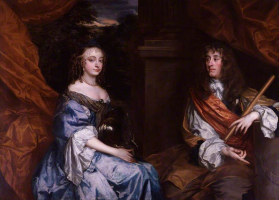


John Evelyn's Diary. 2nd September 1701. The death of King James [aged 67], happening on the 15th of this month, N. S., after two or three days' indisposition, put an end to that unhappy Prince's troubles, after a short and unprosperous reign, indiscreetly attempting to bring in Popery, and make himself absolute, in imitation of the French, hurried on by the impatience of the Jesuits; which the nation would not endure.
On 8th March 1702 King William III of England, Scotland and Ireland [aged 51] died of Pneumonia at Kensington Palace. His demise was the direct result of a fall from his horse, named Sorrel, which stumbled on a molehill causing King William to fall and break his collarbone. For many years afterwards, Jacobites would raise their glasses and toast "the little gentleman in the black velvet waistcoat". His first cousin Anne [aged 37] succeeded I Queen England Scotland and Ireland. She, Anne, being the sister of his wife Mary Stewart II Queen England Scotland and Ireland.

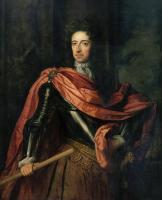


John Evelyn's Diary. 8th March 1702. The King [aged 51] had a fall from his horse, and broke his collar bone, and having been much indisposed before, and anguish, with a long cough and other weakness, died this Sunday morning, about four o'clock.

In 1702 Thomas Coke [aged 27] was elected MP Derbyshire at the 1702 General Election.
On 23rd April 1702 Queen Anne of England Scotland and Ireland [aged 37] was crowned I Queen England Scotland and Ireland at Westminster Abbey [Map] by Archbishop Thomas Tenison [aged 65].
On 20th August 1702 William Bowes of Streatlam [aged 45] was elected MP Durham during the Parliament 1702.
In 1702 at the commencement of the War of the Spanish Succession the Allied Army commanded by John Churchill 1st Duke of Marlborough [aged 51] captured Venlo, Roermond, Stevensweert and Liège.


John Evelyn's Diary. 1st December 1702. After the excess of honor conferred by the Queen [aged 37] on the Earl of Marlborough [aged 52], by making him a Knight of the Garter and a Duke, for the success of but one campaign, that he should desire £5,000 a year to be settled on him by Parliament out of the Post Office, was thought a bold and unadvised request, as he had, besides his own considerable estate, above £30,000 a year in places and employments, with £50,000 at interest. He had married one daughter [aged 21] to the son [aged 24] of my Lord Treasurer Godolphin [aged 57], another [aged 19] to the Earl of Sunderland [aged 27], and a third [aged 15] to the Earl of Bridgewater [aged 21]. He is a very handsome person, well-spoken and affable, and supports his want of acquired knowledge by keeping good company.


On 11th March 1702 the Daily Courant, the first daily newspaper, was first published. It was produced by Elizabeth Mallet at her premises next to the King's Arms tavern at Fleet Bridge in London. The newspaper consisted of a single page, with advertisements on the reverse side. After only forty days Mallet sold The Daily Courant to Samuel Buckley, who moved it to premises in the area of Little Britain in London, at "the sign of the Dolphin". Buckley later became the publisher of The Spectator. The Daily Courant lasted until 1735, when it was merged with the Daily Gazetteer.
William of Worcester's Chronicle of England
William of Worcester, born around 1415, and died around 1482 was secretary to John Fastolf, the renowned soldier of the Hundred Years War, during which time he collected documents, letters, and wrote a record of events. Following their return to England in 1440 William was witness to major events. Twice in his chronicle he uses the first person: 1. when writing about the murder of Thomas, 7th Baron Scales, in 1460, he writes '… and I saw him lying naked in the cemetery near the porch of the church of St. Mary Overie in Southwark …' and 2. describing King Edward IV's entry into London in 1461 he writes '… proclaimed that all the people themselves were to recognize and acknowledge Edward as king. I was present and heard this, and immediately went down with them into the city'. William’s Chronicle is rich in detail. It is the source of much information about the Wars of the Roses, including the term 'Diabolical Marriage' to describe the marriage of Queen Elizabeth Woodville’s brother John’s marriage to Katherine, Dowager Duchess of Norfolk, he aged twenty, she sixty-five or more, and the story about a paper crown being placed in mockery on the severed head of Richard, 3rd Duke of York.
Available at Amazon in eBook and Paperback format.

August 1702. The West Indies Action was a naval engagement between the English West-Indies Fleet commanded by Vice Admiral John Benbow [aged 49] and the French Fleet commanded by Admiral Jean du Casse [aged 55]. The action lasted five days during with the English eventually being beaten off and Vice Admiral John Benbow being mortally wounded. The action was notable for a number of English ships refusing to engage with the French. Following the action the English Fleet returned to Port Royal where a number of captains were court-martialed for cowardice and disobedience. Found guilty Captains Richard Kirkby and Copper Wade were returned to Plymouth, Devon [Map] where they were shot aboard Bristol in the presence of other officers. Captain Constable was cleared of the charge of cowardice, but was convicted on other charges and cashiered. Captain Hudson died before he could be tried. Captains Fogg and Vincent were charged with having signed a paper with the other captains of the squadron, stating they would not fight, but they represented this as a device to keep Captain Kirkby from deserting; Benbow testifying in their favour, they were merely suspended.
Benbow's leg was amputated; but a fever developed. On 4th November 1702 he died.
John Evelyn's Diary. 1st January 1703. News of Vice-Admiral Benbow's conflict with the French fleet in the West Indies, in which he gallantly behaved himself, and was wounded, and would have had extraordinary success, had not four of his men-of-war stood spectators without coming to his assistance; for this, two of their commanders were tried by a Council of War, and executed; a third was condemned to perpetual imprisonment, loss of pay, and incapacity to serve in future. The fourth died.
On 23rd October 1702 the Battle of Vigo Bay was a naval engagement at which the English fleet captured or sank the Spanish Treasure fleet.

John Evelyn's Diary. 1st December 1702. The expectation now is, what treasure will be found on breaking bulk of the galleon brought from Vigo by Sir George Rooke [aged 52], which being made up in an extraordinary manner in the hold, was not begun to be opened till the fifth of this month, before two of the Privy Council, two of the chief magistrates of the city, and the Lord Treasurer [aged 57].
On 26th May 1703 Samuel Pepys [aged 70] died.


John Evelyn's Diary. 26th May 1703. This day died Mr. Samuel Pepys [aged 70], a very worthy, industrious and curious person, none in England exceeding him in knowledge of the navy, in which he had passed through all the most considerable offices, Clerk of the Acts and Secretary of the Admiralty, all which he performed with great integrity. When King James II went out of England, he laid down his office, and would serve no more; but withdrawing himself from all public affairs, he lived at Clapham with his partner, Mr. Hewer [aged 61], formerly his clerk, in a very noble house and sweet place, where he enjoyed the fruit of his labors in great prosperity. He was universally beloved, hospitable, generous, learned in many things, skilled in music, a very great cherisher of learned men of whom he had the conversation. His library and collection of other curiosities were of the most considerable, the models of ships especially. Besides what he published of an account of the navy, as he found and left it, he had for divers years under his hand the History of the Navy, or Navalia, as he called it; but how far advanced, and what will follow of his, is left, I suppose, to his sister's son, Mr. Jackson [aged 30], a young gentleman, whom Mr. Pepys had educated in all sorts of useful learning, sending him to travel abroad, from whence he returned with extraordinary accomplishments, and worthy to be heir. Mr. Pepys had been for near forty years so much my particular friend, that Mr. Jackson sent me complete mourning, desiring me to be one to hold up the pall at his magnificent obsequies; but my indisposition hindered me from doing him this last office.
On 1st August 1704 Admiral George Rooke [aged 54] attacked Gibraltar both by sea and by land (commanded by Prince George of Hesse Darmstadt [aged 35]). After the three days of fighting the Spanish surrendered.
On 13th August 1704 John Mordaunt [aged 23] fought losing his left-arm at Blenheim during the Battle of Blenheim.
Major Richard Creed was killed in action.
John Evelyn's Diary. 7th September 1704. This day was celebrated the thanksgiving for the late great victory, with the utmost pomp and splendor by the Queen [aged 39], Court, great Officers, Lords Mayor, Sheriffs, Companies, etc. The streets were scaffolded from Temple Bar, where the Lord Mayor presented her Majesty with a sword, which she returned. Every company was ranged under its banners, the city militia without the rails, which were all hung with cloth suitable to the color of the banner. The Lord Mayor, Sheriffs, and Aldermen were in their scarlet robes, with caparisoned horses; the Knight Marshal on horseback; the Foot-Guards; the Queen in a rich coach with eight horses, none with her but the Duchess of Marlborough [aged 44] in a very plain garment, the Queen full of jewels. Music and trumpets at every city company. The great officers of the Crown, Nobility, and Bishops, all in coaches with six horses, besides innumerable servants, went to St. Paul's, where the Dean preached. After this, the Queen went back in the same order to St. James's. The city companies feasted all the Nobility and Bishops, and illuminated at night. Music for the church and anthems composed by the best masters. The day before was wet and stormy, but this was one of the most serene and calm days that had been all the year.


On 24th August 1704 the largest naval of the War of the Spanish Sucession was fought at Vélez Málaga a week after the capture of Gibraltar by the British.
On 2nd July 1704 John Mordaunt [aged 23] fought at Donauwörth during the Battle of Schellenberg.
In 1705 Thomas Coke [aged 30] was elected MP Derbyshire at the 1705 General Election.
On 1705 Samuel Garrard 4th Baronet [aged 55] was elected MP Amersham in the 1705 General Election.
Chronicle of Walter of Guisborough
A canon regular of the Augustinian Guisborough Priory, Yorkshire, formerly known as The Chronicle of Walter of Hemingburgh, describes the period from 1066 to 1346. Before 1274 the Chronicle is based on other works. Thereafter, the Chronicle is original, and a remarkable source for the events of the time. This book provides a translation of the Chronicle from that date. The Latin source for our translation is the 1849 work edited by Hans Claude Hamilton. Hamilton, in his preface, says: 'In the present work we behold perhaps one of the finest samples of our early chronicles, both as regards the value of the events recorded, and the correctness with which they are detailed; Nor will the pleasing style of composition be lightly passed over by those capable of seeing reflected from it the tokens of a vigorous and cultivated mind, and a favourable specimen of the learning and taste of the age in which it was framed.'
Available at Amazon in eBook and Paperback format.
The 1707 Scilly Naval Disaster was the loss of four warships of a Royal Navy fleet off the Scilly Isles [Map] in severe weather on 22nd October 1707. Around 1,700 sailors lost their lives; one of the worst maritime disasters in British naval history.
On 22nd October 1707 Rear-Admiral Cloudesley Shovell [aged 56] drowned.

Between 14th September 1705 and 19th October 1705 a multinational Grand Alliance army led by Lord Peterborough [aged 47] captured the city of Barcelona [Map] from its Spanish defenders, most of whom then joined the Grand Aliance army.
On 13th September 1705 Prince George of Hesse Darmstadt [aged 36] was killed.
On 31st December 1705 Catherine of Braganza Queen Consort England [aged 67] died at the Bemposta Palace some twenty years after the death of her husband King Charles II of England Scotland and Ireland. She was buried at Monastery of São Vicente de Fora.
On 23rd May 1706 Arnold Keppel 1st Earl Albermarle [aged 36] and Harry Trelawny 5th Baronet [aged 19] were present at Ramilles during the Battle of Ramilles.
Colonel James Gardiner [aged 18] was shot through the mouth and nearly killed by a French soldier who had returned to plunder the dead. However, Gardiner was spared after being mistaken for a French soldier.
In 1708 Thomas Coke [aged 33] was elected MP Derbyshire at the 1708 General Election.
On 1708 Samuel Garrard 4th Baronet [aged 58] was elected MP Amersham in the 1708 General Election.
On 11th July 1708 Arnold Keppel 1st Earl Albermarle [aged 38] was present at Oudenaarde during the Battle of Oudenarde.
John Wallop 1st Earl Portsmouth [aged 18] fought as a volunteer.
After 11th July 1708 Arnold Keppel 1st Earl Albermarle [aged 38] distinguished himself at Lille during the Siege of Lille.
On 11th September 1709 at the Battle of Maplaquet Colonel Edmund Revett and John Murray [aged 25] were killed.
In 1710 Thomas Frankland 3rd Baronet [aged 25] was elected MP Harwich during the 1710 General Election.
Jean de Waurin's Chronicle of England Volume 6 Books 3-6: The Wars of the Roses
Jean de Waurin was a French Chronicler, from the Artois region, who was born around 1400, and died around 1474. Waurin’s Chronicle of England, Volume 6, covering the period 1450 to 1471, from which we have selected and translated Chapters relating to the Wars of the Roses, provides a vivid, original, contemporary description of key events some of which he witnessed first-hand, some of which he was told by the key people involved with whom Waurin had a personal relationship.
Available at Amazon in eBook and Paperback format.
In 1710 Robert Furnese 2nd Baronet [aged 22] was elected MP New Romney during the 1710 General Election.
In 1710 Thomas Coke [aged 35] was elected MP Grampound at the 1710 General Election.
On 9th December 1710 the Battle of Briheuga was concluded at Brihuega, Guadalajara. The British rearguard under Lord Stanhope [aged 37] was surrounded in Brihuega by a Franco-Spanish army under Duc de Vendôme [aged 56]. James Stanhope 1st Earl Stanhope surrendered once Vendôme's men had breached the town. The British troops were released and returned home in Oct 1711.
In 1711 Joseph I Holy Roman Emperor [aged 32] died of smallpox. His brother Charles [aged 25] succeeded VI Holy Roman Emperor.
In 1711 William Henry Osborne [aged 21] died of smallpox in Utrecht.
On 14th April 1711 Louis "Le Grand Dauphin" Bourbon Duke Burgundy [aged 49] died of smallpox. Louis Bourbon Duke Burgundy [aged 28] was appointed Duke Burgundy and Dauphin.
On 17th May 1711 William Henry Granville 3rd Earl of Bath [aged 19] died of smallpox. Earl Bath, Baron Granville of Kilkhampton and Biddeford extinct.
On 1st January 1712 Queen Anne of England Scotland and Ireland [aged 46], on behalf of Robert Harley 1st Earl of Oxford and Earl Mortimer [aged 50], created a number of new Baronies to balance power in Parliament, known as Harley's Dozen,...
Allen Bathurst 1st Earl Bathurst [aged 27] was created 1st Baron Bathurst.
Charles Bruce 4th Earl Elgin 3rd Earl Ailesbury [aged 29] by writ of acceleration 3rd Baron Bruce of Skelton in Yorkshire.
James Compton 5th Earl of Northampton [aged 24] by writ of acceleration 6th Baron Compton of Compton in Warwickshire.
Thomas Foley 1st Baron Foley [aged 38] was created 1st Baron Foley.
George Granville 1st Baron Lansdowne [aged 45] was created 1st Baron Lansdowne of Bideford in Devon. Mary Villiers Baroness Lansdowne by marriage Baroness Lansdowne of Bideford in Devon.
George Henry Hay 8th Earl Kinnoull [aged 22] was created 1st Baron Hay of Pedwardine in Herefordshire.
Thomas Mansel 1st Baron Mansel [aged 44] was created 1st Baron Mansel of Margam. Martha Millington Baroness Mansel by marriage Baroness Mansel of Margam.
Samuel Masham 1st Baron Masham [aged 33] was created 1st Baron Masham of Otes in Essex. Abigail Hill Baroness Masham [aged 42] by marriage Baroness Masham of Otes in Essex.
Henry Paget 1st Earl Uxbridge [aged 48] was created 1st Baron Burton.
Thomas Trevor 1st Baron Trevor Bromham [aged 53] was created 1st Baron Trevor Bromham.
Thomas Willoughby 1st Baron Middleton [aged 39] was created 1st Baron Middleton. Elizabeth Rothwell Baroness Willoughby and Middleton by marriage Baroness Middleton.
Thomas Windsor 1st Viscount Windsor [aged 42] was created 1st Baron Mountjoy.


 Become a Member via our Buy Me a Coffee page to read more.
On 12th February 1712 Maria Adelaide Savoy [aged 26] died of measles at Versailles.
On 18th February 1712 Louis Bourbon Duke Burgundy [aged 29] died of measles contracted when nursing his wife Maria Adelaide Savoy who had died six days previously.
On 8th March 1712, their eldest son, heir to the throne, Louis Bourbon Duke Brittany [aged 5] died of measles.
The heir to the French throne their only remaining son Louis [aged 1], aged two, great-grandson of the reigning monarch Louis "Sun King" XIV King France [aged 73] who succeeded his great-grandfather three years later in 1715.


On 15th November 1712 Charles Mohun 4th Baron Mohun Okehampton [aged 37] duelled with James Hamilton Duke Hamilton, 1st Duke Brandon [aged 54] at Hyde Park [Map] over a legal dispute about the estate and inheritance of the late Earl Macclesfield. Mohun had married Charlotte Orby Baroness Mohun Okehampton grand-daughter of Charles Gerard 1st Earl Macclesfield. James Hamilton Duke Hamilton, 1st Duke Brandon had married Elizabeth Gerard Duchess Brandon [aged 32]. The two seconds, Macartney and Colonel Hamilton, were both charged as accessories to murder. Hamilton gave himself up, Macartney fled into exile in Hanover. Colonel Hamilton was found guilty of manslaughter.
James Hamilton Duke Hamilton, 1st Duke Brandon died from wounds received duelling. His son James [aged 9] succeeded 5th Duke Hamilton, 2nd Duke Brandon of Suffolk, 2nd Baron Dutton of Cheshire.
Charles Mohun 4th Baron Mohun Okehampton died from wounds received duelling; his father had also been killed in a duel. Baron Mohun Okehampton and Baronet Mohun of Boconnoc in Cornwall extinct.
On 22nd August 1713 Thomas Frankland 3rd Baronet [aged 28] was elected MP Thirsk during the 1713 General Election.
Abbot John Whethamstede’s Chronicle of the Abbey of St Albans
Abbot John Whethamstede's Register aka Chronicle of his second term at the Abbey of St Albans, 1451-1461, is a remarkable text that describes his first-hand experience of the beginning of the Wars of the Roses including the First and Second Battles of St Albans, 1455 and 1461, respectively, their cause, and their consequences, not least on the Abbey itself. His text also includes Loveday, Blore Heath, Northampton, the Act of Accord, Wakefield, and Towton, and ends with the Coronation of King Edward IV. In addition to the events of the Wars of the Roses, Abbot John, or his scribes who wrote the Chronicle, include details in the life of the Abbey such as charters, letters, land exchanges, visits by legates, and disputes, which provide a rich insight into the day-to-day life of the Abbey, and the challenges faced by its Abbot.
Available at Amazon in eBook and Paperback format.
On 22nd August 1713 Leonard Smelt [aged 30] was elected MP Northallerton during the 1713 General Election.
In 1713 John Eden 2nd Baronet [aged 35] was elected MP County Durham unopposed succeeding his father at the 1713 General Election.
In 1713 John Rushout 4th Baronet [aged 27] stood for MP Evesham without success at the 1713 General Election.

