

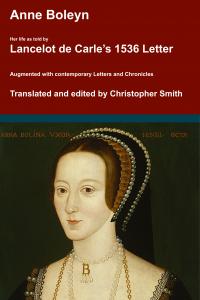
Anne Boleyn. Her Life as told by Lancelot de Carle's 1536 Letter.
In 1536, two weeks after the execution of Anne Boleyn, her brother George and four others, Lancelot du Carle, wrote an extraordinary letter that described Anne's life, and her trial and execution, to which he was a witness. This book presents a new translation of that letter, with additional material from other contemporary sources such as Letters, Hall's and Wriothesley's Chronicles, the pamphlets of Wynkyn the Worde, the Memorial of George Constantyne, the Portuguese Letter and the Baga de Secrets, all of which are provided in Appendices.
Available at Amazon in eBook and Paperback format.
1850-1900 Second Half of the 19th Century is in 19th Century Events.
In 1851 Queen Victoria of the United Kingdom [aged 31] appointed two Knights of the Garter:
706th Constantine Phipps 1st Marquess Normanby [aged 53].
707th Charles Wentworth-Fitzwilliam 5th and 3rd Earl Fitzwilliam [aged 64].


On 2nd February 1852. Around 1am, following a period of heavy rain, the embankment of the Bilberry reservoir collapsed, releasing 86 million gallons of water down the River Holme. It caused 81 deaths and a large amount of damage to property in the valley leaving many homeless and without work. The buildings and structures destroyed included four mills, ten dye houses, three drying stoves, 27 cottages, seven tradesmen's houses, seven shops, seven bridges crossing the River Holme, ten warehouses, eight barns and stables.
The flood was featured on the front page of the Illustrated London News the following day.
Between 7th July 1852 and 31 Jul 1852 Robert Windsor-Clive [aged 28] was elected MP Ludlow.
On Friday 6th November 1854 a great fire in which significant parts of Newcastle upon Tyne, Northumberland [Map] and Gateshead, County Durham, were destroyed in a series of fires and an explosion which killed 53 and injured hundreds. There is only one building extant on the Newcastle Quayside which predated the fire.
The 1854 Broad Street Cholera Outbreak, aka Golden Square Cholera Outbreak, as a severe outbreak of cholera that occurred in 1854 near Broad Street (which has since been renamed Broadwick Street) in Soho, London. This outbreak, which killed 616 people, is best known for the physician John Snow's study of its causes and his hypothesis that germ-contaminated water was the source of cholera
In 1855 Queen Victoria of the United Kingdom [aged 35] appointed five Knights of the Garter:
709th George Howard 7th Earl Carlisle [aged 52].
711th Francis Leveson Gower aka Egerton 1st Earl Ellesmere [aged 54].
712th George Hamilton-Gordon 4th Earl Aberdeen [aged 70].
713th Emperor Napoléon III [aged 46].
714th King Victor Emmanuel II of Sardinia [aged 34].


On 6th June 1855 Captain George Frederick Dawson [aged 28] was killed at the Siege of Sevastopol.
On 23rd July 1855 Edward Fitz-Clarence [aged 18] was killed at the Siege of Sevastopol.
Edwyn Sherard Burnaby [aged 25] and Henry Hugh Manvers Percy [aged 37] fought.

After 1855. St Asaph Cathedral [Map]. Memorial to John and James Blewer killed at the Siege of Sevastopol.
The Deeds of the Dukes of Normandy
The Gesta Normannorum Ducum [The Deeds of the Dukes of Normandy] is a landmark medieval chronicle tracing the rise and fall of the Norman dynasty from its early roots through the pivotal events surrounding the Norman Conquest of England. Originally penned in Latin by the monk William of Jumièges shortly before 1060 and later expanded at the behest of William the Conqueror, the work chronicles the deeds, politics, battles, and leadership of the Norman dukes, especially William’s own claim to the English throne. The narrative combines earlier historical sources with firsthand information and oral testimony to present an authoritative account of Normandy’s transformation from a Viking settlement into one of medieval Europe’s most powerful realms. William’s history emphasizes the legitimacy, military prowess, and governance of the Norman line, framing their expansion, including the conquest of England, as both divinely sanctioned and noble in purpose. Later chroniclers such as Orderic Vitalis and Robert of Torigni continued the history, extending the coverage into the 12th century, providing broader context on ducal rule and its impact. Today this classic work remains a foundational source for understanding Norman identity, medieval statesmanship, and the historical forces that reshaped England and Western Europe between 800AD and 1100AD.
Available at Amazon in eBook and Paperback format.
The Battle of the Great Redan was a major battle during the Crimean War, fought between British forces against Russia on 18 June [1855] and 8th of September 1855.
On the 7th September the bombardment opened, and continued until noon of the 8th. The signal for the British to begin their assault (the flag of St. George raised over the Mamelon) was then made and the British then assaulted the Great Redan.
The London Gazette 21997. 7th Regiment. Lieutenant William Hope. Date of Act of Bravery, 18th June, 1855.
After the troops had retreated on the morning of the 18th June, 1855, Lieutenant W. Hope being informed by the late Serjeant-Major William Bacon, who was himself wounded, that Lieutenant and Adjutant Hobson was lying outside the trenches badly wounded, went out to look for him, and found him lying in the old agricultural ditch running towards the left flank of the Redan. He then returned, and got four men to bring him in. Finding, however, that Lieutenant Hobson could not be removed without a stretcher, he then ran back across the open to Egerton's Pit, where he procured one, and carried it to where Lieutenant Hobson was lying.
All this was done under a very heavy fire from the Russian batteries.
7th Regiment. Assistant-Surgeon Thomas Egerton Hale, M.D. Date of Act of Bravery, 8th September, 1855
First. For remaining with an officer who was dangerously wounded, (Captain H. M. Jones, 7th Regiment), in the fifth parallel, on 8th September, 1855, when all the men in the immediate neighbourhood retreated, excepting Lieutenant W. Hope and Dr. Hale; and for endeavouring to rally the men, in conjunction with Lieutenant W. Hope, 7th Royal Fusiliers.
Secondly. For having, on 8th September, 1855, after the regiments had retired into the trenches, cleared the most advanced sap of the wounded, and carried, into the sap, under a heavy fire, several wounded men from the open ground, being assisted by Serjeant Charles Fisher, 7th Royal Fusiliers, Coldstream Guards (late of the 49th Regiment). Brevet-Major John Augustus Conolly Date of Act of Bravery, 26th October, 1854.
In the attack by the Russians against the position held by the Second Division, 26th October, 1854, Major Conolly, then a Lieutenant in the 49th Regiment, while in command of a company of that regiment, on outlying picket, made himself most conspicuous by the gallantry of his behaviour. He came particularly under the observation of the late Field-Marshal Lord Raglan [aged 66], while in personal encounter with several Russians, in defence of his post. He ultimately fell, dangerously wounded. Lieutenant Conolly was highly praised in General Orders, and promoted into the Coldstream Guards, as a reward for his exemplary behaviour on this occasion.
 Become a Member via our Buy Me a Coffee page to read more.
The London Gazette 21997. 7th Regiment.Assistant-Surgeon Thomas Egerton Hale, M.D. Date of Act of Bravery, 8th September, 1855
First. For remaining with an officer who was dangerously wounded, (Captain H. M. Jones, 7th Regiment), in the fifth parallel, on 8th September, 1855, when all the men in the im mediate neighbourhood retreated, excepting Lieutenant W. Hope and Dr. Hale; and for endeavouring.to rally the men, in conjunction with Lieutenant W. Hope, 7th Royal Fusi liers.
Secondly. For having, on 8th September, 1855, after the regiments had retired into the trenches, cleared the most advanced sap of the wounded, and carried, into the sap, under a heavy fire, several wounded men from the open ground, being assisted by Serjeant Charles Fisher, 7th Royal Fusiliers
In 1856 Queen Victoria of the United Kingdom [aged 36] appointed three Knights of the Garter:
715th Hugh Fortescue 2nd Earl Fortescue [aged 72].
716th Henry John Temple 3rd Viscount Palmerston [aged 71].
717th Sultan Abdulmejid I [aged 32].

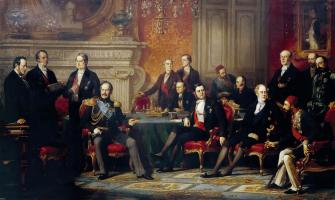
On 30th March 1856 the Treaty of Paris was signed at the Congress of Paris bringing to an end the Crimean War between the Russian Empire and an alliance of the Ottoman Empire, the United Kingdom, the Second French Empire and the Kingdom of Sardinia, which had begun in 1853. The treaty diminished Russian influence in the region. It returned Sevastopol and other towns and cities in the south of Crimea to Russia, but prohibited Russia to establish naval or military arsenal on the coast of the Black Sea, that was made neutral territory, closing it to all warships and prohibiting fortifications and the presence of armaments on its shores.
30th March 1856. Édouard Dubufe [aged 36]. The Congress of Paris. Those portayed include Camillo Benso, conte di Cavour, Henry Wellesley [aged 51], Earl Cowley, Karl Ferdinand von Buol-Schauenstein, Aleksej Fëdorovič, Orlov François-Adolphe de Bourqueney, Alexander von Hübner, Otto Theodor von Manteuffel, Alexandre Colonna Walewski, George Villiers [aged 56], Earl of Clarendon, Mehmed Alì Pascià, Philipp von Brunnow, Salvatore Pes, VIII marchese di Villamarina, Max von Hatzfeldt, Mehemmed Djemil Bey, Vincent Benedetti, Napoleone III di Francia [aged 47], Napoleone Bonaparte.

In 1857 Queen Victoria of the United Kingdom [aged 37] appointed two Knights of the Garter:
718th Granville Leveson-Gower 2nd Earl Granville [aged 41].
719th Richard Grosvenor 2nd Marquess Westminster [aged 61].
On 26th June 1857 the first sixty-two recipients of the Victoria Cross had the decoration pinned to their breasts by Queen Victoria [aged 38] in Hyde Park [Map]. Henry Hugh Manvers Percy [aged 39], who was the most senior office present to receive the Victoria Cross, commanded on the day.
In September 1857 Edward Adolphus Ferdinand Seymour [aged 22] was present at Lucknow during the Relief of Lucknow.
In 1858 Queen Victoria of the United Kingdom [aged 38] appointed five Knights of the Garter:
720th Frederick III King Prussia [aged 26].
721st Arthur Wellesley 2nd Duke Wellington [aged 50].
722nd William Cavendish 7th Duke Devonshire [aged 49].
723rd King Pedro V of Portugal [aged 20].
724th The Prince of Wales [aged 16].


The Deeds of the Dukes of Normandy
The Gesta Normannorum Ducum [The Deeds of the Dukes of Normandy] is a landmark medieval chronicle tracing the rise and fall of the Norman dynasty from its early roots through the pivotal events surrounding the Norman Conquest of England. Originally penned in Latin by the monk William of Jumièges shortly before 1060 and later expanded at the behest of William the Conqueror, the work chronicles the deeds, politics, battles, and leadership of the Norman dukes, especially William’s own claim to the English throne. The narrative combines earlier historical sources with firsthand information and oral testimony to present an authoritative account of Normandy’s transformation from a Viking settlement into one of medieval Europe’s most powerful realms. William’s history emphasizes the legitimacy, military prowess, and governance of the Norman line, framing their expansion, including the conquest of England, as both divinely sanctioned and noble in purpose. Later chroniclers such as Orderic Vitalis and Robert of Torigni continued the history, extending the coverage into the 12th century, providing broader context on ducal rule and its impact. Today this classic work remains a foundational source for understanding Norman identity, medieval statesmanship, and the historical forces that reshaped England and Western Europe between 800AD and 1100AD.
Available at Amazon in eBook and Paperback format.
On 25th January 1858 Frederick III King Prussia [aged 26] and Victoria Empress Germany Queen Consort Prussia [aged 17] were married in the Chapel Royal, St James's Palace. She the daughter of Prince Albert Saxe Coburg Gotha [aged 38] and Queen Victoria of the United Kingdom [aged 38]. He the son of William I King Prussia [aged 60]. They were third cousins.



In 1859 Queen Victoria of the United Kingdom [aged 39] appointed two Knights of the Garter:
725th Dudley Ryder 2nd Earl of Harrowby [aged 60].
726th Edward Smith-Stanley 14th Earl of Derby [aged 59].
On 2nd January 1861 Frederick William IV King Prussia [aged 65] died. His brother William [aged 63] succeeded I King Prussia.