

The History of William Marshal was commissioned by his son shortly after William’s death in 1219 to celebrate the Marshal’s remarkable life; it is an authentic, contemporary voice. The manuscript was discovered in 1861 by French historian Paul Meyer. Meyer published the manuscript in its original Anglo-French in 1891 in two books. This book is a line by line translation of the first of Meyer’s books; lines 1-10152. Book 1 of the History begins in 1139 and ends in 1194. It describes the events of the Anarchy, the role of William’s father John, John’s marriages, William’s childhood, his role as a hostage at the siege of Newbury, his injury and imprisonment in Poitou where he met Eleanor of Aquitaine and his life as a knight errant. It continues with the accusation against him of an improper relationship with Margaret, wife of Henry the Young King, his exile, and return, the death of Henry the Young King, the rebellion of Richard, the future King Richard I, war with France, the death of King Henry II, and the capture of King Richard, and the rebellion of John, the future King John. It ends with the release of King Richard and the death of John Marshal.
Available at Amazon in eBook and Paperback format.
1940-1950 Second World War is in 20th Century Events.
On 30th May 1940 Frederick Cambridge [aged 32] was killed during the World War Two.
In 1940 Oswald Phipps 4th Marquess Normanby [aged 27] was captured at the Battle of Dunkirk.
On 27th May 1940 George Coventry 10th Earl Coventry [aged 39] was killed in action during the Battle of Wytschaete at La Bassée. His son George [aged 6] succeeded 11th Earl Coventry.
On 27th May 1941 the German Battleship "Bismarck" sank following an engagement with British ships. Some survivors reported they saw Captain Lindemann standing at attention at the stem of the ship as she sank. Out of a crew of over 2,200 men, only 114 survived.
On 17th July 1942 Peter Fortescue [aged 21] was killed in action at the First Battle of El Alamein. He was unmarried. There is a memorial at the Church of St Paul, Filliegh: "In proud and ever-loving memory of Hugh Peter, Viscount Ebrington, only son of the Fifth Earl and Countess Fortescue, Lieutenant Royal Scots Greys, who was born on 9 December 1920 and killed near El Alamein on 17 July 1942. He leaves a white unbroken glory, a gathered radiance, a shining peace"
In 1942 William Legge [aged 29] was killed in action at El Alamein during the 2nd Battle of El Alamein.
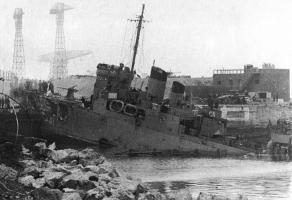
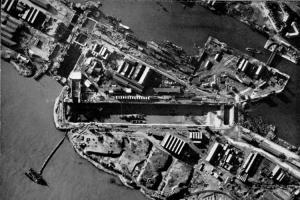
On 28th March 1942 a British amphibious attack on the heavily defended 'Normandie' dry dock at St Nazaire, Western France, resulted in putting out of action the only dry-dock in the Atlantic that was large enough to accomodate the Tirpitz. The obsolete destroyer HMS Campbeltown, accompanied by eighteen smaller craft, crossed the English Channel to the Atlantic coast of France and rammed into the dry dock south gate. The ship had been packed with delayed-action explosives, well hidden within a steel and concrete case, that detonated later that day, putting the dock out of service until 1948. Of the 612 men who undertook the raid, 228 returned to Britain, 169 were killed and 215 became prisoners of war. German casualties included over 360 dead, some of whom were killed after the raid when Campbeltown exploded. Eighty-nine members of the raiding party were awarded decorations, including five Victoria Crosses.
Photos. 1. HMS Campbeltown wedged in the dock gates. 2. Normandie Dock months after the raid. The wreck of HMS Campbeltown is visible inside the dry dock.

On 25th August 1942 the Dunbeath Air Crash at Eagle's Rock [Map] near Dunbeath killed 14 of 15 passengers and crew, including Prince George, Duke of Kent, who was on duty as an Air Commodore in the Royal Air Force on a mission to Reykjavik. A Royal Air Force Board of Inquiry determined that the crash was the result of a navigational error by the crew.
Prince George Windsor 1st Duke Kent [aged 39] died in a plane crashEdward Windsor 2nd Duke Kent [aged 6] succeeded 2nd Duke Kent.
Also killed were:
Lt. John Crowther, RNVR Private Secretary.
LAC. John Walter Holes, Batman.
Flt Lt. Frank McKenzie Goyen, 42057 RAF, Captain (Pilot).
Wg Cdr. Thomas Lawton Moseley, 33064 RAF, CO of 228 Squadron, 1st pilot.
Pilot Officer Sydney Wood Smith, 403961 RAAF, 2nd pilot.
Pilot Officer George Richard Saunders, 126975 RAFVR, Navigator.
Pilot Officer Michael Strutt [aged 28] J15062 RCAF, Air Gunner.
Flight Sargeant William Royston Jones 523047 RAF, Flight Mechanic Engineer / Air Gunner.
Flight Sargeant Charles Norman Lewis 517386 RAF, Airframe Fitter.
Flight Sargeant Ernest James Hewerdine 566884 RAF, Wireless Operator / Air Gunner.
Flight Sargeant Andrew Simpson Wilson Jack 970168 RAFVR, Air Gunner (Rear).
Sgt. Edward Francis Blacklock 405467 RNZAF, Wireless Operator / Air Gunner.
Sgt. Arthur Rowland Catt 1252994 RAFVR, Wireless Operator / Air Gunner.
Sgt. Leonard Edward Sweett 570678 RAF, Fitter.
 Become a Member via our Buy Me a Coffee page to read more.
On 3rd March 1943 the air-raid Civil Defence siren sounded at 8:17 p.m., beginning a large and orderly flow of people down the blacked-out at Bethnal Green Tube Station staircase. A middle-aged woman and a child fell over, three steps up from the base, and others fell around her. 173, most of them women and children, were crushed and asphyxiated.
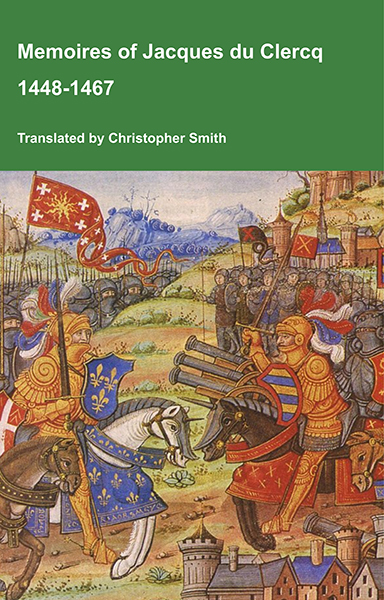
This is a translation of the 'Memoires of Jacques du Clercq', published in 1823 in two volumes, edited by Frederic, Baron de Reissenberg. In his introduction Reissenberg writes: 'Jacques du Clercq tells us that he was born in 1424, and that he was a licentiate in law and a counsellor to Philip the Good, Duke of Burgundy, in the castellany of Douai, Lille, and Orchies. It appears that he established his residence at Arras. In 1446, he married the daughter of Baldwin de la Lacherie, a gentleman who lived in Lille. We read in the fifth book of his Memoirs that his father, also named Jacques du Clercq, had married a lady of the Le Camelin family, from Compiègne. His ancestors, always attached to the counts of Flanders, had constantly served them, whether in their councils or in their armies.' The Memoires cover a period of nineteen years beginning in in 1448, ending in in 1467. It appears that the author had intended to extend the Memoirs beyond that date; no doubt illness or death prevented him from carrying out this plan. As Reissenberg writes the 'merit of this work lies in the simplicity of its narrative, in its tone of good faith, and in a certain air of frankness which naturally wins the reader’s confidence.' Du Clercq ranges from events of national and international importance, including events of the Wars of the Roses in England, to simple, everyday local events such as marriages, robberies, murders, trials and deaths, including that of his own father in Book 5; one of his last entries.
Available at Amazon in eBook and Paperback format.
On 17th March 1943 Nicholas Townshend Durham was killed in action at the Battle of the Mareth Line.
On 6th May 1944 William Cavendish [aged 26] and Kathleen "Kick" Kennedy [aged 24] were married at Chelsea Register Office. She the daughter of Joseph Patrick Kennedy [aged 55] and Rose Elizabeth Fitzgerald [aged 53]. He the son of Edward William Spencer Cavendish 10th Duke Devonshire [aged 49] and Mary Alice Gascoyne-Cecil Duchess Devonshire [aged 48].
The Duke of Devonshire and the bride's eldest brother Joseph P. Kennedy Jr [aged 28], a lieutenant in the United States Navy, signed the marriage register. The Duke of Rutland [aged 24] served as best man.
The photos, from left to right, Mary, Duchess of Devonshire, the groom William, Marquess of Hartington, the bride Kathleen Kennedy, Joseph Kennedy, Edward, 10th Duke of Devonshire.
Kathleen "Kick" Kennedy: On 20th February 1920 she was born to Joseph Patrick Kennedy and Rose Elizabeth Fitzgerald at Brookline Massachusetts. On 13th May 1948 Kathleen "Kick" Kennedy and William Henry Lawrence Peter Wentworth-Fitzwilliam 8th and 6th Earl Fitzwilliam died in a plane crash at the Plateau du Coiron, Saint-Bauzile during the course of their journey from Paris [Map] to the French Riviera for a vacation aboard a de Havilland DH.104 Dove.. His first cousin once removed Eric succeeded 9th Earl Fitzwilliam, 7th Earl Fitzwilliam, 11th Baron Fitzwilliam of Liffer in Donegal. His wealth, estimated at 45 million pounds, including half of the Wentworth Woodhouse estate, the Coolattin estate in County Wicklow, Ireland, and a large part of the Fitzwilliam art collection went to his daughter Ann Juliet Dorothea Maud Wentworth-Fitzwilliam Marchioness Bristol.
Joseph Patrick Kennedy: On 25th July 1915 he was born to Joseph Patrick Kennedy and Rose Elizabeth Fitzgerald. On 12th August 1944 Joseph Patrick Kennedy was killed at Blythburgh, Suffolk when his plane exploded over the English Channel during a top-secret mission.


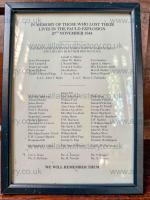
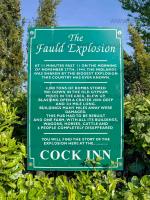
On 27th November 1944 at eleven minutes past eleven in the morning 4,000 tons of bombs stored 30m down in the old gypsum mines at RAF Fauld, Staffordshire, blew up making a crater 125m deep, and 1.2km wide. The exact death toll is uncertain; it is believed that about 70 people died in the explosion and resulting flood. The crater is still visible just south of Fauld, to the east of Hanbury, Staffordshire. It is now known as the Hanbury Crater [Map]. It was one of the largest non-nuclear explosions in history and the largest on UK soil.
Memorial at St Werburgh's Church, Hanbury [Map].
On 24th March 1944 a heavily laden B-17G Flying Fortress of 422nd Bomb Squadron, 305th Bomb Group (Heavy) crashed on take-off from RAF Chelveston. All twelve crew were killed. Tragically the plane struck Glebe Farm killing two children, Keith and Monica Phillips, aged 14 and 4 respectively; their parents survived. Also killed were eight other American service personnel from the staff of the 1121st Quartermaster Company who were sleeping in a nearby barrack block.
The USAAF personnel on the aircraft were: First Lieutenant William D Sellers, the pilot, from Birmingham, Alabama; Second Lieutenant David A Rementeria, the co-pilot, from Canyon City, Oregon; First Lieutenant Jack E George from Texas*; Second Lieutenant Myer Silber, buried in the United Hebrew Cemetery, Halethorpe Maryland; First Lieutenant Charles Wesley Leake from Markham, Illinois; Top Sergeant Jessie or Jesse H Lehr from Bolivar, Mississippi; Staff Sergeant Kenneth I Mace, buried in Delawanna, New Jersey; Top Sergeant Donald C Parrish, buried at Troy, Michigan; Sergeant Dale E Rishel from Uniontown, Pennsylvania; Staff Sergeant Loyde J Judd from Freeport, Maine; Corporal Joseph N A Grugnale, from Dedham Massachusetts
The Quartermaster Company personnel were: Private Frank J Amato, buried in North Arlington, New Jersey; Private First Class Michael R Arato, from New York; Corporal Sebastian J Attilio, buried in Fort Lee, New Jersey; Private First Class Arnold N Chipoletti, 30, buried at New Kensington, Pennsylvania; Sergeant Edward W Dell, buried in Lincoln, Nebraska; Private First Class William Loren Dickerson, buried in Largen, Virginia; Nils S Johnson, from Worcester, Colorado; Robert Paul McClain buried in Shelbyville, Indiana.
On 3rd March 1945 the Royal Air Force mistakenly bombed the Bezuidenhout neighbourhood in the Dutch city of The Hague, resulting in the death of 532 people. The bombers were intended to bomb the Haagse Bos ("Forest of the Hague") district where the Germans had installed V-2 launching facilities that had been used to attack English cities.
On 9th August 1945 the United States Army Air Forces B-29 bomber "Bockscar" dropped the atomic bomb "Fat Man" on the Japanese city of Nagasaki instantly killing around 35,000 people, and injuring around 60,000. The pilots were issued with the wrong coordinates, the vertical and horizontal interchanged), navigational instruments of the bombers had been set incorrectly, and combined with low fog and clouds which obscured their vision, the bombs were instead dropped on the Bezuidenhout residential neighbourhood.
On 23rd August 1944 a United States Army Air Forces (USAAF) Consolidated B-24 Liberator crashed during a test flight into the centre of the village of Freckleton, Lancashire, England, killing all three crewmen aboard the aircraft and 58 individuals on the ground, including 38 children aged four to six.
On approach from, the pilot First Lieutenant John Bloemendal reported to the control tower that he was aborting landing at the last moment and would perform a go-around. Shortly afterwards, and out of sight of the second aircraft, the aircraft hit the village of Freckleton, just east of the airfield.
Already flying very low to the ground and with wings near vertical, the B-24's right wing tip hit a tree-top and was ripped away as it impacted with the corner of a building. The rest of the wing continued, ploughing along the ground and through a hedge. The fuselage partly demolished three houses and the Sad Sack Snack Bar that catered specifically for American servicemen from the airbase, before crossing Lytham Road and bursting into flames.
After part of the aircraft hit the infants' wing of Freckleton Holy Trinity School, fuel from the ruptured tanks ignited and produced another sea of flames.
52 people (the three crew members on the B-24, 34 children, one teacher, six American servicemen, one RAF airman and seven Snack Bar staff) died instantly, with nine others (four children, one teacher, an American serviceman and three RAF airmen) later dying in hospital from their injuries.


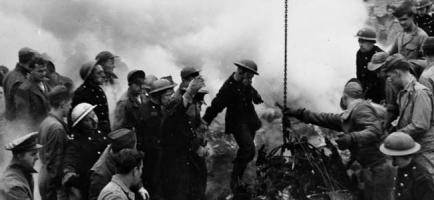


On 14th March 1945 fourteen Tallboys and the first Grand Slam bomb were dropped on the Bielefeld Viaduct. At 4:28 p.m. and from 3,647m the Grand Slam fell from PD112 S, which jumped 150m higher at the loss of weight. After 35 seconds, the bomb hit the ground about 27m short and exploded the site erupting as the Tallboys came down.
On 9th March 1946 a crowd crush that occurred on 9 March 1946 at Burnden Park football stadium, then the home of Bolton Wanderers. The crush resulted in the deaths of 33 people and injuries to hundreds of Bolton fans. The match, an FA Cup Sixth Round second-leg tie between Bolton and Stoke City, was allowed to continue, with the game ending goalless. The disaster brought about the Moelwyn Hughes report, which recommended more rigorous control of crowd sizes.
On 23rd December 1947 Walter Brattain and H. R. Moore demonstrated the first working transistor; the commencement of the Computer Age.
At midnight on the night of the 17th and 18th April 1949 the Republic of Ireland Act 1948 came into force by which Ireland became a Republic.