

Abbot John Whethamstede’s Chronicle of the Abbey of St Albans
Abbot John Whethamstede's Register aka Chronicle of his second term at the Abbey of St Albans, 1451-1461, is a remarkable text that describes his first-hand experience of the beginning of the Wars of the Roses including the First and Second Battles of St Albans, 1455 and 1461, respectively, their cause, and their consequences, not least on the Abbey itself. His text also includes Loveday, Blore Heath, Northampton, the Act of Accord, Wakefield, and Towton, and ends with the Coronation of King Edward IV. In addition to the events of the Wars of the Roses, Abbot John, or his scribes who wrote the Chronicle, include details in the life of the Abbey such as charters, letters, land exchanges, visits by legates, and disputes, which provide a rich insight into the day-to-day life of the Abbey, and the challenges faced by its Abbot.
Available at Amazon in eBook and Paperback format.
Marriage of Henry VIII and Anne Boleyn is in 1532-1535 Marriage and Coronation of Anne Boleyn.
On 25th January 1533 Henry VIII [aged 41] and Queen Anne Boleyn of England [aged 32] were married by Rowland Leigh [aged 46] at Whitehall Palace [Map]. Anne Savage Baroness Berkeley [aged 37], Thomas Heneage [aged 53] and Henry Norreys [aged 51] were present. She the daughter of Thomas Boleyn 1st Earl Wiltshire and Ormonde [aged 56] and Elizabeth Howard Countess of Wiltshire and Ormonde [aged 53]. He the son of King Henry VII of England and Ireland and Elizabeth York Queen Consort England. They were fifth cousin once removed.
Sometime after the marriage Eleanor Paston Countess Rutland [aged 38] was appointed Lady in Waiting to Queen Anne Boleyn of England. She would go to serve Henry's next three wives.


Chronicle of Edward Hall [1496-1548]. [14th November 1532]. The King after his return, married privately the lady Anne Boleyn [aged 31], on Saint Erkenwaldes day, which marriage was kept so secrete, that very few knew it, til she was great with child, at Easter after.
Ellis' Letters. But nowe Sir you may nott ymagyn that this Coronacion was before her mariege, for she was maried muche about sainte Paules daye [25th January 1533] last, as the condicion therof dothe well appere by reason she ys nowe sumwhat bygg with chylde. Notwithstandyng yt hath byn reported thorowte a greate parte of the realme that I [aged 43] maried her; whiche was playnly false, for I myself knewe not therof a fortenyght after yt was donne. And many other thyngs be also reported of me, whiche be mere lyes and tales.
Extracts from The Life of Anne Boleyn. [25th January 1533] After so many cross billets of cunning polities, surmounted by the guiding providence of God, after so many trials of her truth, passed through by her wise and virtuous governance, the king having every way made so thorough proof how deep root honour had taken in her bosom, and having found it not to be shaken even by him, this royal and famous prince Henry the Eighth, resolving her matchless perfections meet alone to be joined with his, now at the length concluded forthwith to knit up this marriage, although for certain causes the same was thought more convenient to be performed some what privately and secretly. On the twenty-fifth of January8, therefore, the ceremony was consummate. The king also, shortly after having himself more ascertained, and by more inward trial more assured of her spousal truth, would yet farther testify that his opinion of her, by giving her that highest honour he could give her virtues, in having her solemnly and royally crowned. And thus we see they lived and loved, tokens of increasing love perpetually increasing between them. Her mind brought him forth the rich treasures of love of piety, love of truth, love of learning. Her body yielded him the fruits of marriage, inestimable pledges of her faith and loyal love. And touching the former of these, it is here first not to be forgotten, that of her time (that is during the three years that she was queen) it is found by good observation, that no one suffered for religion, which is the more worthy to be noted for that it could not so be said of any time of the queens after married to the king. And amongst other proofs of her love to religion to be found in others, this here of me is to be added. That shortly after her marriage, divers learned and christianly disposed persons resorting to her, presented her with sundry books of those controversies that then began to be questioned touching religion, and specially, of the authority of the pope and his clergy, and of their doings against kings and states. And amongst other, there happened9 one of these, which, as her manner was, she having read, she had also noted with her nail as of matter worthy the king's knowledge10. The book lying in her window, her maid (of whom hath been spoken) took it up, and as she was reading it, came to speak with her one11 then suitor to her, that after married her; and as they talked he took the book of her, and she withal, called to attend on the queen, forgot it in his hands, and she not returning in some long space, he walked forth with it in his hand, thinking it had been hers. There encountered him soon after a gentleman of the cardinal's of his acquaintance, and after salutations, perceiving the book, requested to see it, and finding what it was, partly by the title, partly by some what he read in it, he borrowed it and showed it to the cardinal. Hereupon the suitor was sent for to the cardinal and examined of the book, and how he came by it, and had like to have come in trouble about it, but that it being found to have pertained to one of the queen's chamber, the cardinal thought better to defer the matter till he had broken it to the king first, in which meantime the suitor delivered the lady what had fallen out, and she also to the queen, who, for her wisdom knowing more what might grow thereupon, without delay went and imparted the matter to the king, and showed him of the points that she had noted with her finger. And she was but newly come from the king, but the cardinal came in with the book in his hands to make com plaint of certain points in it that he knew the king would not like of, and withal to take occasion with him against those that countenanced such books in general, and specially women, and as might be thought with mind to go farther against the queen more directly if he had perceived the king agreeable to his meaning. But the king that somewhat afore distasted the cardinal, as we have showed, finding the notes the queen had made, all turned the more to hasten his ruin, which was also furthered on all sides.
Note 8. A. D. 1533.
Note 9. Tyndal's Obedience of a Christian Man.
Note 10. This curious and interesting occurrence, which probably had considerable effect in furthering the progress of the Reformation, is told with more circumstance by Strype, from the manuscripts of Fox. It is so entirely corroborated by what is here said, that I think it incumbent upon me to place it in juxtaposition with Wyatt's narrative.
"Upon the Lady Anne [aged 32] waited a young fair gentlewoman, named Mrs. Gainsford; and in her service was also retained Mr. George Zouch. This gentleman, of a comely sweet person, a Zouch in deed, was a suitor in the way of marriage to the said young lady: and among other love tricks, once he plucked from her a book in English, called Tyndall's Obedience, which the Lady Anne had lent her to read. About which time the Cardinal had given commandment to the prelates, and especially to Dr. Sampson, dean of the king's chapel, that they should have a vigilant eye over all people for such books, that they came not abroad; that so as much as might be, they might not come to the king's reading. But this which he most feared fell out upon this occasion. For Mr. Zouch (I use the words of the MS.) was so ravished with the spirit of God speaking now as well in the heart of the reader, as first it did in the heart of the maker of the book, that he was never well but when he was reading of that book. Mrs. Gainsford wept because she could not get the book from her wooer, and he was as ready to weep to deliver it. But see the providence of God: -Mr. Zouch standing in the chapel before Dr. Sampson, ever reading upon this book; and the dean never having his eye off the book, in the gen tleman's hand, called him to him, and then snatched the book out of his hand, asked his name, and whose man he was. And the book he delivered to the cardinal. In the meantime, the Lady Anne asketh her woman for the book. She on her knees told all the circumstances. The Lady Anne showed herself not sorry nor angry with either of the two. But, said she, ' Well, it shall be the dearest book that ever the dean or cardinal took away. ' The noblewoman goes to the king, and upon her knees she desireth the king's help for her book. Upon the king's token the book was restored. And now bringing the book to him, she besought his grace most tenderly to read it. The king did so, and delighted in the book. For (saith he) this book is for me and all kings to read. And in a little time, by the help of this virtuous lady, by the means aforesaid, had his eyes opened to the truth, to advance God's religion and glory, to abhor the pope's doctrine, his lies, his pomp, and pride, to deliver his subjects out of the Egyptian darkness, the Babylonian bonds that the pope had brought his sub jects under. And so contemning the threats of all the world, the power of princes, rebellions of his subjects at home, and the raging of so many and mighty potentates abroad; set forward a reformation in religion, beginning with the triple crowned head at first, and so came down to the members, bishops, abbots, priors, and such like." - Strype's Ecclesiastical Memorials, vol. i. p. 112.
Note 11. Mr. George Zouch.
Annales of England by John Stow. King Henry privily married the Lady Anne Boleine in his closet at Whitehall, on the five and twentith day of January [1533] being S. Paules day: Mistresses Anne Savage [aged 37] bore up Quene Annes traine, and was her selfe shortly after married to the lorde Barkeley [aged 28], doctor Rowland Lee [aged 46], that married the king to Queene Anne, was made Bishop of Chester, then Bishop of Coventry and Lichfield1, and president of Wales.
Note 1. The see of Coventry and Lichfield was for a time known as the see of Chester; Lee was Bishop of Chester aka Coventry and Lichfield.
Nicholas Harpsfield. [25th January 1533] At which time Mr. Rowland being come accordingly, and seeing all things ready for celebration of mass and to solemnize the marriage, being in a great dump and staggering, came to the King and said—"Sir, I trust you have the Pope’s lycence, both that you may marry and that I may join you together in marriage." "What else?" quoth the King. Upon this he turned to the altar and revested himself, but yet not so satisfied, and troubled in mind he cometh eftsoones to the King and saith—"This matter toucheth us all very nighe, and therefore it is expedient that the lycence be read before us all, or else we run all—and I more deep than any other —into excommunication in marrying your grace without any baynes asking, and in a place unhallowed, and no divorce as yet promulged of the first matrimony." The King, looking upon him very amiably, "Why, Master Rowland," quoth he, "think you me a man of so small faith and credit, you, I say, that do well know my life passed, and even now have heard my confession? or think you me a man of so small and slender foresight and consideration of my affairs that unless all things were safe and sure l would enterprize this matter? I have truly a lycence, but it is reposed in another sure[r] place whereto no man resorteth but myself, which, if it were seen, should discharge us all. But if I should, now that it waxeth towards day, fetch it, and be seen so early abroad, therc would rise a rumour and talk thereof other than were convenient. Goe forth in God’s name, and do that which appertaineth to you. I will take upon me all other danger." Whereupon he went to mass, and celebrated also all ceremonies belonging to marriage. This is, then, one error and fault. For, though the first marriage were not good, yet could not the King marry before the sentence of divorce, unless he should have [had] two wives living all at one time. But now let us dig another hole or two in the wall with Ezechiell, and then shall we sce two other great filthinesses and abhominations.

Letters and Papers Foreign and Domestic Henry VIII 1533. 23rd February 1533. Vienna Archives. 180. Chapuys [aged 43] to Charles V.
As the Queen sees that the obstinacy of the King increases daily, and the appearances of disorder in view of the new marriage, she is compelled to employ your aid. Since my last of the 15th, the King does not cease to press the archbishops of Canterbury and York, the bishops of London, Winchester, and Lincoln, and many others, Italians as well as English, to subscribe a document he has drawn up to his taste, of a very strange nature, as you will see. The archbishop of York and the bishop of Winchester have not yet agreed to do so. The elect of Canterbury [aged 43] has made no difficulty about it, and has even solicited it, as if it were his own business; and if it be true, as I am told today on good authority, that he has gone to give the Queen special notice of it, he has given good earnest of maintaining the opinion of the King in this divorce without variation. He has married (esposé) the King to the Lady [aged 32], in presence of the father [aged 56], mother [aged 53], brother [aged 30], and two of her favorites, and one of his priests. If it be so, the King has taken the best means of preventing him from changing his opinions when raised to his dignity, as the archbishop of York has done. It is very probable either that the said elect has solemnised these espousals, or has promised to do so for certain considerations, as I have written to your Majesty, especially as since he has been elected he has dared to say openly that he would maintain, on pain of being burned, that the King might take the Lady to wife. The bruit continues, that in order to accomplish the said marriage the King waits for nothing else except the bulls of the elect; and for this purpose he has commanded those who have the charge of it to summon a provincial synod for the 16th. It is said that the King means to demand money for a war with Scotland, and to make harbours on the coast; and the better to colour the matter, the king of France has sent him a master architect. The French ambassador had intended to visit me, but was prevented by company, and proposes to do so tomorrow. It is said that Melanchthon is in one of the King's lodgings, and has been there for eight days, but it is kept such a secret that I can find no one who knows the certainty of it. The King has written for him expressly, I think merely for the Queen's affair, for he favors her, and because he pretends and wishes to have in his hands all ecclesiastical ordinances,—not only the synodical ones of this kingdom, but the papal as well. And in order the better to conduct the affair, last year he induced the prelates, by menaces and devices, to submit to whatever should be decided by 40 persons, of whom one half should be appointed by himself, and the other by the prelates, and himself above all. For this reformation, or rather deformation, it seems he could find no fitter instrument than Melanchthon, so as to give the utmost possible trouble to the Pope, that his previous boasts might not be without effect.
Letters and Papers Foreign and Domestic Henry VIII 1533. 7th May 1533. Add. MS. 28,585, f. 244. B. M. 454. Count Of Cifuentes to Charles V.
Was told by the Pope that he had letters from his Nuncio [in England] of April 12, saying, that the King had married "la Anna [aged 32]" publicly, with all the usual ceremonies. A few days previously he had convoked the Estates for this purpose, and many opposed the King in both Houses (?) (asi de unos como de otros); and this was in the first Parliament. At the second the same thing happened, and the King rose to his feet, bidding those of his party help him, as he wished to marry. The opposition of the other party was at last overcome by money, promises, and threats. To give a colour to what the King wished to do, it was determined that all cases of tithes, marriages, or wills should be decided in the kingdom before ordinary judges, of whom the chief was the principal Archdeacon (archidiano mayor) of London1. The judge of the first and second appeal was the archbishop of Canterbury, with certain prelates. The King summoned the Archbishop, and told him that he should marry (casasse) this Anna. The dukes of Norfolk and Suffolk were sent to intimate this to the Queen.
Note 1. William Clyff, LL.D.
Letters and Papers Foreign and Domestic Henry VIII 1533. 10th May 1533. 465. The King's marriage was celebrated, as it is reported, on the day of the Conversion of St. Paul [25th January 1533]; and because at that time Dr. Bonner [aged 33] had returned from Rome, and the Nuncio of the Pope was frequently at Court, some suspect that the Pope had given a tacit consent which I cannot believe. It is true that from that time the said Nuncio did not go very frankly into business; and although before the said statute I had solicited him according to the charge he had from his Holiness, and to the promise he had made me, when I presented your Majesty's letters to him, to put the brief in execution against the Archbishop, or that he would assist me in it, he has done nothing about it, and I fear that, "à la sourde," [in secret] he has not always done his duty. The duke of Norfolk's mission to France is only founded on the Pope's journey to Nice, as I lately wrote. He came eight days ago, accompanied by the King's physician, to visit the French ambassador, who is ill of a tertian fever; and being there at dinner, some one asked if he was not going to Rome as reported; to which he replied, either for brag or to disguise his going to the Pope, that he would never go to Rome except with lance on thigh.
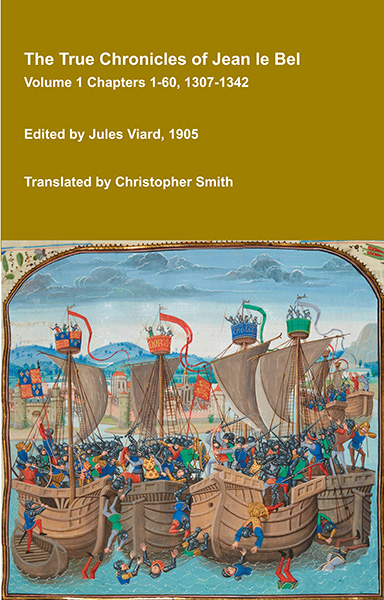
The True Chronicles of Jean le Bel Volume 1 Chapters 1-60 1307-1342
The True Chronicles of Jean le Bel offer one of the most vivid and immediate accounts of 14th-century Europe, written by a knight who lived through the events he describes, and experienced some of them first hand. Covering the early decades of the Hundred Years’ War, this remarkable chronicle follows the campaigns of Edward III of England, the politics of France and the Low Countries, and the shifting alliances that shaped medieval warfare. Unlike later historians, Jean le Bel writes with a strong sense of eyewitness authenticity, drawing on personal experience and the testimony of fellow soldiers. His narrative captures not only battles and sieges, but also the realities of military life, diplomacy, and the ideals of chivalry that governed noble society. A key source for Jean Froissart, Le Bel’s chronicle stands on its own as a compelling and insightful work, at once historical record and literary achievement. This translation builds on the 1905 edition published in French by Jules Viard, adding extensive translations from other sources Rymer's Fœdera, the Chronicles of Adam Murimuth, William Nangis, Walter of Guisborough, a Bourgeois of Valenciennes, Geoffrey le Baker of Swinbroke and Richard Lescot to enrich the original text and Viard's notes.
Available at Amazon in eBook and Paperback format.
Letters and Papers Foreign and Domestic Henry VIII 1533. 23rd May 1533 Lanz, II. 66. 523. Charles V. to Ferdinand of Hungary.
I wrote on the 12th what I had learned about the marriage (l'esposement) of the king of England to Anne Boleyn [aged 32]. I have since received letters from my ambassador, by which you will see that the said marriage is accomplished, and that the King holds her as his wife and queen of England. Although the injury done to the Queen and Princess is extreme, and there is little hope of bringing Henry to reason, considering the delays and subterfuges used by him and the Pope, yet after careful consideration it has been thought best to persist in the demand for justice, as you will see by the copy of our despatches to Rome and England; and that you also should send some one to Rome to urge the matter. I write also to the king of Portugal to do the like. Barcelona, 23 May 1533. Fr.
Letters and Papers Foreign and Domestic Henry VIII 1533. 24th May 1533. Granvelle Papers, II. 30. 534. Charles V. to his Ambassador in France.
Since his last, touching the marriage of Henry VIII. and Anne Boleyn [aged 32], has received letters from his ambassadors, stating that it has certainly taken place, and that the Queen has been forbidden to call herself Queen, and the Princess to write to her, &c. The people of England are scandalised at the King's barbarity. Is to show these things to Francis, and urge him as a Christian prince, and as related to Katharine by his wife, to denounce this marriage, or at least not to countenance it in any way or interfere with justice. He is also to deliver the Emperor's letters to the Queen, and urge her to use her best efforts in the matter. De Leyva writes that Montferrat is reduced all but Alba. Barcelona, 24 May 1533. Fr.
Nicholas Harpsfield. The first whereof was that the King was married to [the] Lady Anne Bulleyne long ere there was any divorce made by the said Archbishop [of Canterbury]. The which marriage was secretly made at Whitehall very early before day, none being present but Mr. Norris and Mr. Henage of the Privy Chamber and the Lady Barkeley, with Mr. Rowland the King's chaplain, that was afterward made Bishop of Coventry and Lichfield. To whom the King told that now he had gotten of the Pope a lycence to marry another wife, and yet to avoid business and tumult the thing must be done (quoth the King) very secretly; and thereupon a time and place was appointed to the said Master Rowland to solemnize the said marriage.