

Abbot John Whethamstede’s Chronicle of the Abbey of St Albans
Abbot John Whethamstede's Register aka Chronicle of his second term at the Abbey of St Albans, 1451-1461, is a remarkable text that describes his first-hand experience of the beginning of the Wars of the Roses including the First and Second Battles of St Albans, 1455 and 1461, respectively, their cause, and their consequences, not least on the Abbey itself. His text also includes Loveday, Blore Heath, Northampton, the Act of Accord, Wakefield, and Towton, and ends with the Coronation of King Edward IV. In addition to the events of the Wars of the Roses, Abbot John, or his scribes who wrote the Chronicle, include details in the life of the Abbey such as charters, letters, land exchanges, visits by legates, and disputes, which provide a rich insight into the day-to-day life of the Abbey, and the challenges faced by its Abbot.
Available at Amazon in eBook and Paperback format.
Chief is in Charges.
Chief. The Chief is the uppermost part of the arms occupying around one third of the arms.
 Acheson Arms. Argent, a double-headed eagle displayed sable, beaked and membered or, on a chief vert, two mullets or. Source.
 Kitson Arms. Sable three fishes hauriant in fess argent a chief or. Source.
 Clement Arms. Argent, two bendlets wavy sable on a chief gules three leopard's faces or a bordure compony or and azure. Source.
 Dormer Arms. Azure, ten billets or 4,3,2,1 issuant from a chief of the second a demi lion rampant sable langued gules.
 Babington Arms. Argent, ten torteau in chief a label three points azure. Source.
 Chichester Arms. Chequy or and gules, a chief vair. Source.
 Mortimer Arms. Barry or and azure, on a chief of the first two pallets between two base esquires of the second over all an inescutcheon argent. Source.
Chronicle of Walter of Guisborough
A canon regular of the Augustinian Guisborough Priory, Yorkshire, formerly known as The Chronicle of Walter of Hemingburgh, describes the period from 1066 to 1346. Before 1274 the Chronicle is based on other works. Thereafter, the Chronicle is original, and a remarkable source for the events of the time. This book provides a translation of the Chronicle from that date. The Latin source for our translation is the 1849 work edited by Hans Claude Hamilton. Hamilton, in his preface, says: 'In the present work we behold perhaps one of the finest samples of our early chronicles, both as regards the value of the events recorded, and the correctness with which they are detailed; Nor will the pleasing style of composition be lightly passed over by those capable of seeing reflected from it the tokens of a vigorous and cultivated mind, and a favourable specimen of the learning and taste of the age in which it was framed.'
Available at Amazon in eBook and Paperback format.
 Narborough Arms. Gules, a chief ermine. Source.
 Berkeley Arms. Gules a chevron between ten crosses pattee six in chief and four in base argent.
 Bacon Arms. Gules, on a chief argent two mullets pierced sable. Source.
 Turner Baronets Arms. Sable, a chevron ermine between three fers de moline or on a chief argent a lion passant gules. Source.
 Chaplin Arms. Ermine a chief azure three griffin's heads erased or.
 Clinton Arms. Argent, six cross crosslets fitchée sable three two and one on a chief azure two mullets or pierced gules. Source.
NO IMAGE. Argent, on a chief azure three mullets of the first.
 Saluzzo Arms. Argent, a chief azure. Source.
 Weston Arms. Ermine, on a chief azure five bezants.

Around 1577 George Gower (age 37). Portrait of Richard Drake (age 42). The heraldic escutcheon shows seven quarters as follows:
1:  Drake of Ash Arms. Drake of Ash in the parish of Musbury, Devon.
2: Argent, on a chief gules three cinquefoils of the first; Billet of Ash.
3: Gules, on a fess argent two mullets sable; Hamton of Rockbere and Ash.
4: Ermine, on a chief indented sable three crosslets fitchee or; Orwey of Orwey and Ash.
5: Barry of seven argent and sable.
6: Azure, six lions rampant argent crowned Gules, 3, 2, 1; Forde of Forde.
7: Argent, two chevrons sable (Esse/Ash of Ash); Esse or Ash of Ash.
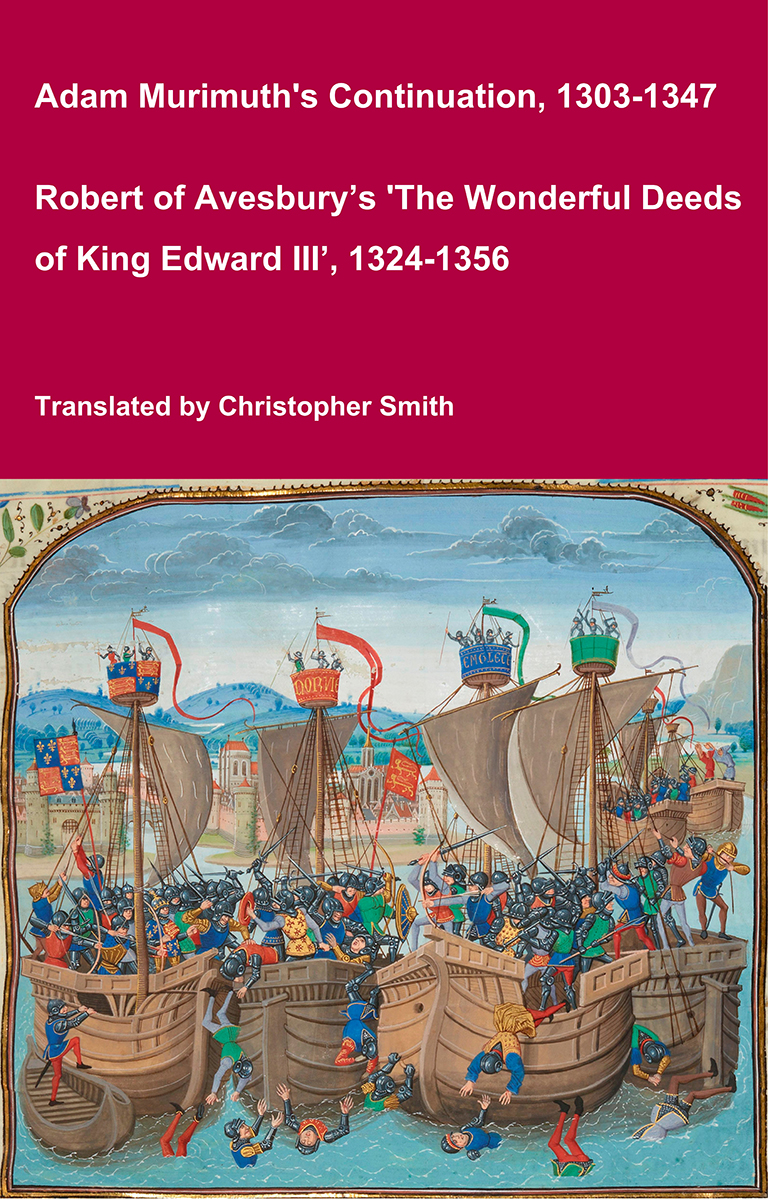
Adam Murimuth's Continuation and Robert of Avesbury’s 'The Wonderful Deeds of King Edward III'
This volume brings together two of the most important contemporary chronicles for the reign of Edward III and the opening phases of the Hundred Years’ War. Written in Latin by English clerical observers, these texts provide a vivid and authoritative window into the political, diplomatic, and military history of fourteenth-century England and its continental ambitions. Adam Murimuth Continuatio's Chronicarum continues an earlier chronicle into the mid-fourteenth century, offering concise but valuable notices on royal policy, foreign relations, and ecclesiastical affairs. Its annalistic structure makes it especially useful for establishing chronology and tracing the development of events year by year. Complementing it, Robert of Avesbury’s De gestis mirabilibus regis Edwardi tertii is a rich documentary chronicle preserving letters, treaties, and official records alongside narrative passages. It is an indispensable source for understanding Edward III’s claim to the French crown, the conduct of war, and the mechanisms of medieval diplomacy. Together, these works offer scholars, students, and enthusiasts a reliable and unembellished account of a transformative period in English and European history. Essential for anyone interested in medieval chronicles, the Hundred Years’ War, or the reign of Edward III.
Available at Amazon in eBook and Paperback format.
 Chaucer Modern Arms. Argent, a chief gules overall a lion rampant double queued or.
 Manners Arms. Or, two fess azure a chief gules.
 St John Arms. Argent, a chief gules two estoiles or. Source.
 Worsley Arms. Argent, a chief gules. Source.
Around 1577 George Gower (age 37). Portrait of Richard Drake (age 42). The heraldic escutcheon shows seven quarters as follows:
1: Drake of Ash Arms. Drake of Ash in the parish of Musbury, Devon.
2: Argent, on a chief gules three cinquefoils of the first; Billet of Ash.
3: Gules, on a fess argent two mullets sable; Hamton of Rockbere and Ash.
4: Ermine, on a chief indented sable three crosslets fitchee or; Orwey of Orwey and Ash.
5: Barry of seven argent and sable.
6: Azure, six lions rampant argent crowned Gules, 3, 2, 1; Forde of Forde.
7: Argent, two chevrons sable (Esse/Ash of Ash); Esse or Ash of Ash.
 Butler Arms. Or, a chief indented azure. Source.
 Harsick Arms. Or, a chief indented sable.
 Lathom Arms. Or, on a chief indented azure three plates. Source.
The History of William Marshal was commissioned by his son shortly after William’s death in 1219 to celebrate the Marshal’s remarkable life; it is an authentic, contemporary voice. The manuscript was discovered in 1861 by French historian Paul Meyer. Meyer published the manuscript in its original Anglo-French in 1891 in two books. This book is a line by line translation of the first of Meyer’s books; lines 1-10152. Book 1 of the History begins in 1139 and ends in 1194. It describes the events of the Anarchy, the role of William’s father John, John’s marriages, William’s childhood, his role as a hostage at the siege of Newbury, his injury and imprisonment in Poitou where he met Eleanor of Aquitaine and his life as a knight errant. It continues with the accusation against him of an improper relationship with Margaret, wife of Henry the Young King, his exile, and return, the death of Henry the Young King, the rebellion of Richard, the future King Richard I, war with France, the death of King Henry II, and the capture of King Richard, and the rebellion of John, the future King John. It ends with the release of King Richard and the death of John Marshal.
Available at Amazon in eBook and Paperback format.
 Perceval Arms. Argent, a chief indented gules three crosses pattee of the field. Source.
 St Leger Arms. Azure fretty argent, a chief or. Source.
 Preston Arms. Or, a chief sable three crescents or.


#/media/File%3AClement_OfIghtham_Arms_(Bordure_OrAndAzure).svg)


#/media/File:BaconArms.svg)


_arms#/media/File:Butler_arms.svg)
#/media/File:Butler_arms_(Earl_of_Carrick).svg)
