

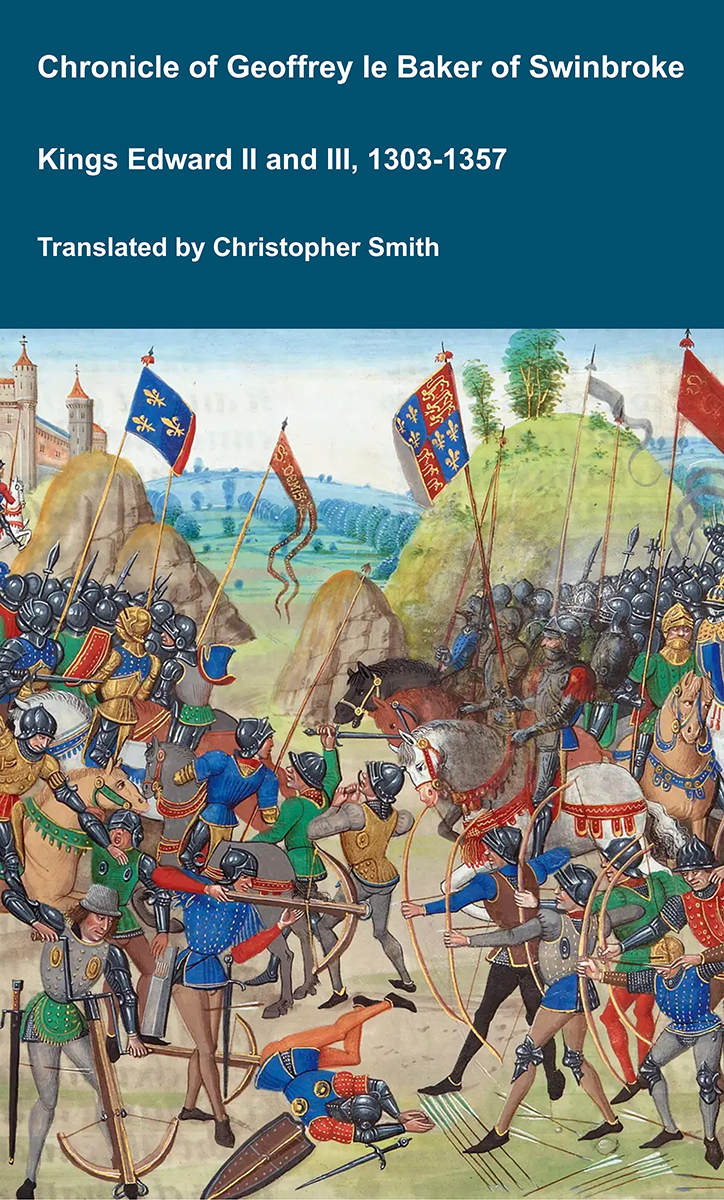
Chronicle of Geoffrey le Baker of Swinbroke
Baker was a secular clerk from Swinbroke, now Swinbrook, an Oxfordshire village two miles east of Burford. His Chronicle describes the events of the period 1303-1356: Gaveston, Bannockburn, Boroughbridge, the murder of King Edward II, the Scottish Wars, Sluys, Crécy, the Black Death, Winchelsea and Poitiers. To quote Herbert Bruce 'it possesses a vigorous and characteristic style, and its value for particular events between 1303 and 1356 has been recognised by its editor and by subsequent writers'. The book provides remarkable detail about the events it describes. Baker's text has been augmented with hundreds of notes, including extracts from other contemporary chronicles, such as the Annales Londonienses, Annales Paulini, Murimuth, Lanercost, Avesbury, Guisborough and Froissart to enrich the reader's understanding. The translation takes as its source the 'Chronicon Galfridi le Baker de Swynebroke' published in 1889, edited by Edward Maunde Thompson.
Available at Amazon in eBook and Paperback format.
Mullet is in Stars.
See: Three Mullets, Two Mullets.
Mullet. A five pointed star.
 Bonville Arms. Sable, six mullets argent pierced gules. Source.
 Peyton Arms. Sable, a cross engrailed or a mullet in the first quarter argent.
 Scott Arms. Or, on a bend azure a mullet of six points between two crescents of the field. Source.
 Pakington Arms. Quarterley 1&4 Per chevron sable and argent, in chief three mullets or, in base as many garbs gules 2 a variation of the Washbourne Arms 3
  Harding Arms.
 Gresham Arms. Argent, a chevron ermine between three mullets pierced sable.
 Carr Arms. Gules, on a chevron argent, three mullets, of the field.
 Conyngham Arms. Argent, a shake-fork between three mullets, sable. Source.
The Deeds of the Dukes of Normandy
The Gesta Normannorum Ducum [The Deeds of the Dukes of Normandy] is a landmark medieval chronicle tracing the rise and fall of the Norman dynasty from its early roots through the pivotal events surrounding the Norman Conquest of England. Originally penned in Latin by the monk William of Jumièges shortly before 1060 and later expanded at the behest of William the Conqueror, the work chronicles the deeds, politics, battles, and leadership of the Norman dukes, especially William’s own claim to the English throne. The narrative combines earlier historical sources with firsthand information and oral testimony to present an authoritative account of Normandy’s transformation from a Viking settlement into one of medieval Europe’s most powerful realms. William’s history emphasizes the legitimacy, military prowess, and governance of the Norman line, framing their expansion, including the conquest of England, as both divinely sanctioned and noble in purpose. Later chroniclers such as Orderic Vitalis and Robert of Torigni continued the history, extending the coverage into the 12th century, providing broader context on ducal rule and its impact. Today this classic work remains a foundational source for understanding Norman identity, medieval statesmanship, and the historical forces that reshaped England and Western Europe between 800AD and 1100AD.
Available at Amazon in eBook and Paperback format.
NO IMAGE. Argent, on a chief azure three mullets of the first.
 Blackett Arms. Argent a chevron sable three escallops argent between three mullets sable. Source.
 Liddell Arms. Gules, on a bend argent, three mullets sable. Source.
 Murray Arms. Azure, three mullets argent, within a double tressure flory counter-flory or. Source.
 Duke Atholl Arms.
  Earl Atholl Arms overall, an inescutcheon en surtout azure three mullets argent within a double tressure flory or ensigned of a Marquess's coronet. Source.

Around 1577 George Gower (age 37). Portrait of Richard Drake (age 42). The heraldic escutcheon shows seven quarters as follows:
1:  Drake of Ash Arms. Drake of Ash in the parish of Musbury, Devon.
2: Argent, on a chief gules three cinquefoils of the first; Billet of Ash.
3: Gules, on a fess argent two mullets sable; Hamton of Rockbere and Ash.
4: Ermine, on a chief indented sable three crosslets fitchee or; Orwey of Orwey and Ash.
5: Barry of seven argent and sable.
6: Azure, six lions rampant argent crowned Gules, 3, 2, 1; Forde of Forde.
7: Argent, two chevrons sable (Esse/Ash of Ash); Esse or Ash of Ash.
 Bacon Arms. Gules, on a chief argent two mullets pierced sable. Source.
 Clinton Arms. Argent, six cross crosslets fitchée sable three two and one on a chief azure two mullets or pierced gules. Source.
 Jermyn Arms. Sable, a crescent between two mullets in pale argent. Source.


.svg)


.svg)

.svg)


#/media/File:BaconArms.svg)

