

William of Worcester's Chronicle of England
William of Worcester, born around 1415, and died around 1482 was secretary to John Fastolf, the renowned soldier of the Hundred Years War, during which time he collected documents, letters, and wrote a record of events. Following their return to England in 1440 William was witness to major events. Twice in his chronicle he uses the first person: 1. when writing about the murder of Thomas, 7th Baron Scales, in 1460, he writes '… and I saw him lying naked in the cemetery near the porch of the church of St. Mary Overie in Southwark …' and 2. describing King Edward IV's entry into London in 1461 he writes '… proclaimed that all the people themselves were to recognize and acknowledge Edward as king. I was present and heard this, and immediately went down with them into the city'. William’s Chronicle is rich in detail. It is the source of much information about the Wars of the Roses, including the term 'Diabolical Marriage' to describe the marriage of Queen Elizabeth Woodville’s brother John’s marriage to Katherine, Dowager Duchess of Norfolk, he aged twenty, she sixty-five or more, and the story about a paper crown being placed in mockery on the severed head of Richard, 3rd Duke of York.
Available at Amazon in eBook and Paperback format.
Or is in Field.
 Wrottesley Arms. Or, three piles sable, a canton ermine. Source.
 Lisle Arms. Or a fess between two chevrons sable. Source.
 Aragon Arms. Or, four pallets gules. Source.
 Lowther Arms. Or, six annulets sable, three, two, one. Source.
 Bigod Arms. Or a cross gules. Source.
 Manners Arms. Or, two fess azure a chief gules.
 Bugge Arms. Or fretty azure. Source.
 Mohun Arms. Or a cross engrailed sable.
 Butler Arms. Or, a chief indented azure. Source.
Jean de Waurin's Chronicle of England Volume 6 Books 3-6: The Wars of the Roses
Jean de Waurin was a French Chronicler, from the Artois region, who was born around 1400, and died around 1474. Waurin’s Chronicle of England, Volume 6, covering the period 1450 to 1471, from which we have selected and translated Chapters relating to the Wars of the Roses, provides a vivid, original, contemporary description of key events some of which he witnessed first-hand, some of which he was told by the key people involved with whom Waurin had a personal relationship.
Available at Amazon in eBook and Paperback format.
 Monson Arms. Or two chevronels gules. Source.
 Camden Arms. Or, a fess engrailed between six crosses crosslet fitchy sable. Source.
 Monthermer Arms. Or, an eagle displayed vert beaked and membered gules. Source.
 Chicheley Arms. Or, a chevron between three cinquefoils gules. Source.
 Morrison Arms. Or, on a chief gules three chaplets of the first. Source.
 Constable Arms. Or three bars. Source.
 Nelson Arms. Or, a cross flory sable a bendlet gules. Source.
 Daubeney Arms. Or, two chevrons gules three griffin's heads. Source.
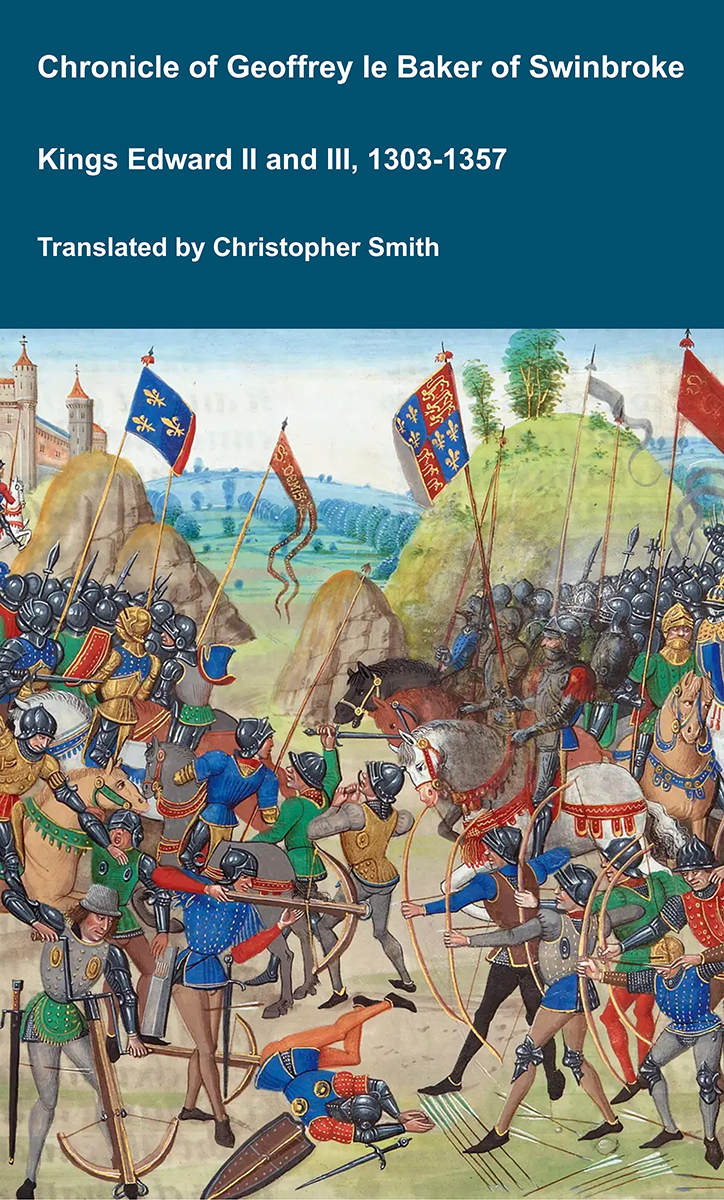
Chronicle of Geoffrey le Baker of Swinbroke
Baker was a secular clerk from Swinbroke, now Swinbrook, an Oxfordshire village two miles east of Burford. His Chronicle describes the events of the period 1303-1356: Gaveston, Bannockburn, Boroughbridge, the murder of King Edward II, the Scottish Wars, Sluys, Crécy, the Black Death, Winchelsea and Poitiers. To quote Herbert Bruce 'it possesses a vigorous and characteristic style, and its value for particular events between 1303 and 1356 has been recognised by its editor and by subsequent writers'. The book provides remarkable detail about the events it describes. Baker's text has been augmented with hundreds of notes, including extracts from other contemporary chronicles, such as the Annales Londonienses, Annales Paulini, Murimuth, Lanercost, Avesbury, Guisborough and Froissart to enrich the reader's understanding. The translation takes as its source the 'Chronicon Galfridi le Baker de Swynebroke' published in 1889, edited by Edward Maunde Thompson.
Available at Amazon in eBook and Paperback format.
 Fanshawe Arms. Or a chevron between three fleur de lys sable. Source.
 Percy Arms. Or, a lion rampant azure. Source.
 Fitzwalter Arms. Or, a fess gules between two chevrons of the last. Source.
 Portman Arms. Or, a fleur-de-lis azure. Source.
 Graham Arms. Or an a chief sable three escallops argent. Source.
 Powys Arms. Or, a lion gules armed and langued azure. Source.
 Harding Arms. Or, a bend azure three martlets argent.
 Preston Arms. Or, a chief sable three crescents or.
 Hornby Arms. Or, two chevronels between three bugle-horns sable stringed gules on a chief of the second as many eagle's legs erased of the first. Source.
 Redvers Arms. Or, a lion rampant azure. Source.
 Lacy Arms. Or, a lion rampant purpure. Source.
 Rolle Arms. Or, a fess dancetté between three billets azure each charged with a lion rampant of the first three bezants. Source.
 Bayning Arms. Or two bars sable on each as many escallops of the first. Source.
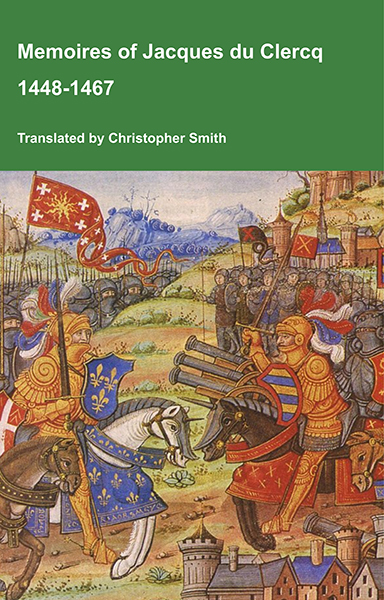
This is a translation of the 'Memoires of Jacques du Clercq', published in 1823 in two volumes, edited by Frederic, Baron de Reissenberg. In his introduction Reissenberg writes: 'Jacques du Clercq tells us that he was born in 1424, and that he was a licentiate in law and a counsellor to Philip the Good, Duke of Burgundy, in the castellany of Douai, Lille, and Orchies. It appears that he established his residence at Arras. In 1446, he married the daughter of Baldwin de la Lacherie, a gentleman who lived in Lille. We read in the fifth book of his Memoirs that his father, also named Jacques du Clercq, had married a lady of the Le Camelin family, from Compiègne. His ancestors, always attached to the counts of Flanders, had constantly served them, whether in their councils or in their armies.' The Memoires cover a period of nineteen years beginning in in 1448, ending in in 1467. It appears that the author had intended to extend the Memoirs beyond that date; no doubt illness or death prevented him from carrying out this plan. As Reissenberg writes the 'merit of this work lies in the simplicity of its narrative, in its tone of good faith, and in a certain air of frankness which naturally wins the reader’s confidence.' Du Clercq ranges from events of national and international importance, including events of the Wars of the Roses in England, to simple, everyday local events such as marriages, robberies, murders, trials and deaths, including that of his own father in Book 5; one of his last entries.
Available at Amazon in eBook and Paperback format.
 Scott Arms. Or, on a bend azure a mullet of six points between two crescents of the field. Source.
 Burgh Arms. Or a cross gules. Source.
NO IMAGE. Or, on a pile gules between six fleur de lys azure three lions of England. Augmentation of honour granted to Edward Seymour 1st Duke of Somerset when his sister Queen Jane Seymour married King Henry VIII of England and Ireland. Source.


 Carew Arms. Or, three lions passant in pale sable. Source.
 Sidney Arms. Or, a pheon azure.
 Courtenay Arms. Or, three torteaux. Source.
 Stafford Arms. Or, a chevron gules.
 Dunkeld Arms. Or a lion rampant gules armed and langued azure a double tressure flory counter-flory gules.
 Stewart Arms. Or a fess chequy. Source.
 Stewart Royal Arms. Or a lion rampant gules armed and langued azure within a double tressure flory counter-flory of the second.
Abbot John Whethamstede’s Chronicle of the Abbey of St Albans
Abbot John Whethamstede's Register aka Chronicle of his second term at the Abbey of St Albans, 1451-1461, is a remarkable text that describes his first-hand experience of the beginning of the Wars of the Roses including the First and Second Battles of St Albans, 1455 and 1461, respectively, their cause, and their consequences, not least on the Abbey itself. His text also includes Loveday, Blore Heath, Northampton, the Act of Accord, Wakefield, and Towton, and ends with the Coronation of King Edward IV. In addition to the events of the Wars of the Roses, Abbot John, or his scribes who wrote the Chronicle, include details in the life of the Abbey such as charters, letters, land exchanges, visits by legates, and disputes, which provide a rich insight into the day-to-day life of the Abbey, and the challenges faced by its Abbot.
Available at Amazon in eBook and Paperback format.
 Harsick Arms. Or, a chief indented sable.
 Lathom Arms. Or, on a chief indented azure three plates. Source.
 Vavasour Arms. Or, a fess dancetté sable. Source.
NO IMAGE. Or, a chief indented azure, a crescent for difference. Source.
 Verdun Arms. Or, a fret gules.
 Vesci Arms. Or, a Cross sable. Source.
 Hainault Arms. Or, three chevrons sable. Source.
 Wake Arms. Or, two bars gules in chief three torteaux. Source.
This is a translation of the 'Memoires of Jacques du Clercq', published in 1823 in two volumes, edited by Frederic, Baron de Reissenberg. In his introduction Reissenberg writes: 'Jacques du Clercq tells us that he was born in 1424, and that he was a licentiate in law and a counsellor to Philip the Good, Duke of Burgundy, in the castellany of Douai, Lille, and Orchies. It appears that he established his residence at Arras. In 1446, he married the daughter of Baldwin de la Lacherie, a gentleman who lived in Lille. We read in the fifth book of his Memoirs that his father, also named Jacques du Clercq, had married a lady of the Le Camelin family, from Compiègne. His ancestors, always attached to the counts of Flanders, had constantly served them, whether in their councils or in their armies.' The Memoires cover a period of nineteen years beginning in in 1448, ending in in 1467. It appears that the author had intended to extend the Memoirs beyond that date; no doubt illness or death prevented him from carrying out this plan. As Reissenberg writes the 'merit of this work lies in the simplicity of its narrative, in its tone of good faith, and in a certain air of frankness which naturally wins the reader’s confidence.' Du Clercq ranges from events of national and international importance, including events of the Wars of the Roses in England, to simple, everyday local events such as marriages, robberies, murders, trials and deaths, including that of his own father in Book 5; one of his last entries.
Available at Amazon in eBook and Paperback format.
 Ferneley Arms. Or, on a bend vert three buck's heads caboshed argent.
 La Marck Arms. Or, a fess chequered argent and gules. Source.
 Clare Arms. Or three chevrons gules. Source.
 Walpole Arms. Or a fess between two chevrons sable three cross crosslets of the field. Source.
 Willoughby Arms. Or fretty azure. Source.
 Brownlow Arms. Or an escutcheon within an orle of martlets sable. Source


.svg)


_arms#/media/File:Butler_arms.svg)


#/media/File:MorrisonArms.PNG)

#/media/File:Arms_Nelson_(of_Mawdesley,_Lancs).svg)
.svg)


.svg)


.svg)


#/media/File:Butler_arms_(Earl_of_Carrick).svg)


.svg)


