

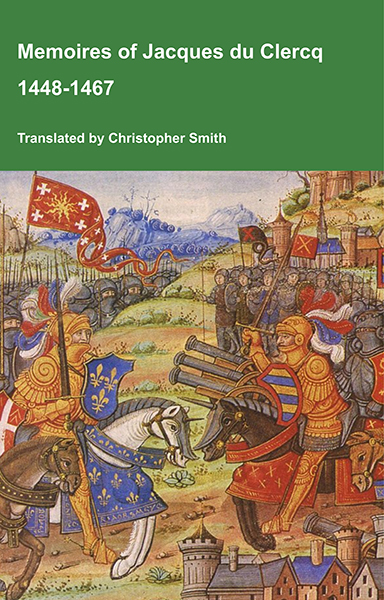
This is a translation of the 'Memoires of Jacques du Clercq', published in 1823 in two volumes, edited by Frederic, Baron de Reissenberg. In his introduction Reissenberg writes: 'Jacques du Clercq tells us that he was born in 1424, and that he was a licentiate in law and a counsellor to Philip the Good, Duke of Burgundy, in the castellany of Douai, Lille, and Orchies. It appears that he established his residence at Arras. In 1446, he married the daughter of Baldwin de la Lacherie, a gentleman who lived in Lille. We read in the fifth book of his Memoirs that his father, also named Jacques du Clercq, had married a lady of the Le Camelin family, from Compiègne. His ancestors, always attached to the counts of Flanders, had constantly served them, whether in their councils or in their armies.' The Memoires cover a period of nineteen years beginning in in 1448, ending in in 1467. It appears that the author had intended to extend the Memoirs beyond that date; no doubt illness or death prevented him from carrying out this plan. As Reissenberg writes the 'merit of this work lies in the simplicity of its narrative, in its tone of good faith, and in a certain air of frankness which naturally wins the reader’s confidence.' Du Clercq ranges from events of national and international importance, including events of the Wars of the Roses in England, to simple, everyday local events such as marriages, robberies, murders, trials and deaths, including that of his own father in Book 5; one of his last entries.
Available at Amazon in eBook and Paperback format.
Water Bougets is in Charges.
Water Bougets. A yoke with two large skins appended to it, formerly used for the conveyance of water to an army.
 Bourchier Arms. Argent, argent a cross engrailed gules between four water bougets sable. Source.
In 1528 Henry Willoughby (age 77) was buried at St Leonard's Church, Wollaton [Map]. A fine chest tomb monument in sandstone (rather than alabaster), somewhat damaged, with his four wives, two each side.Lancastrian Esses Collar somehwat unusual given the 1528 date of his death. Sphinx Crest. Cadaver Underneath. Henry Willoughby's Arms including Willoughby top left hand corner (Water Bougets from Willoughy family original name Bugge). Lancastrian Esses and Inter-twined Knots Collar.


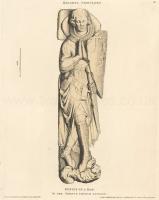
Effigy of Robert Ros. [Robert Ros] WAS descended from the noble family of Ros or Roos, of Hamlake. His father Everard died when he was thirteen years of age, and he had livery of his lands from the wardship of the Crown in the second year of the reign of Richard I. on payment of a hne of one thousand marks; which shows that his possessions must have been very large.
He was one of the Barons who leagued together to obtain the Great and the Forest Charter from John; and when that King had signed them at Runnemede, he was one of the chief persons who undertook to constrain him to observe thema He married Isabella, the daughter of William the Lion, King of Scotland, by whom he had two sons, William and Robert. He gave the first his castle of Helmesley [Map], with the patronage of the monasteries of Kirkham, Rievaulx [Map], and Warden, to the other his castle of Werke and a barony in Scotland, held by knight's service of his brother-in-law. Of both the above-mentioned castles he was the founder. He confirmed to the Templars his manor of Ribstone, with other possessions, assumed the habit of their order, died in 1231, and was buried in the Temple church [Map]. The effigy of Ros is cross-legged, and his hands raised in the act of prayer; the hood of his hauberk is thrown back to show his visage. His sword depends from a belt adorned with broad studs; his surcoat reaches to his heels, which are armed with the pryck spur, and rest on a lion. On his shield are three water bougets, which were the bearing of Ros, Argent, in a held Gules. This figure, like that of Robert de Vere, is of a period subsequent to that of the decease of the person whom it is said to represent.

