

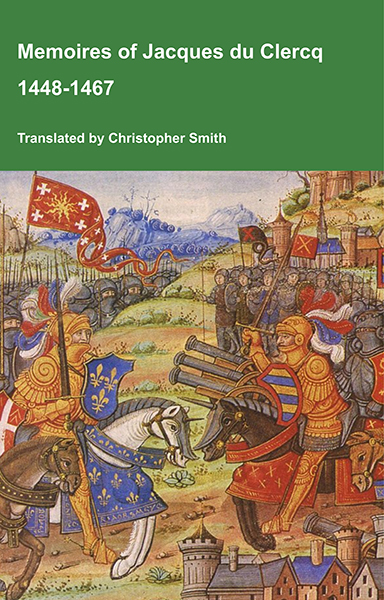
This is a translation of the 'Memoires of Jacques du Clercq', published in 1823 in two volumes, edited by Frederic, Baron de Reissenberg. In his introduction Reissenberg writes: 'Jacques du Clercq tells us that he was born in 1424, and that he was a licentiate in law and a counsellor to Philip the Good, Duke of Burgundy, in the castellany of Douai, Lille, and Orchies. It appears that he established his residence at Arras. In 1446, he married the daughter of Baldwin de la Lacherie, a gentleman who lived in Lille. We read in the fifth book of his Memoirs that his father, also named Jacques du Clercq, had married a lady of the Le Camelin family, from Compiègne. His ancestors, always attached to the counts of Flanders, had constantly served them, whether in their councils or in their armies.' The Memoires cover a period of nineteen years beginning in in 1448, ending in in 1467. It appears that the author had intended to extend the Memoirs beyond that date; no doubt illness or death prevented him from carrying out this plan. As Reissenberg writes the 'merit of this work lies in the simplicity of its narrative, in its tone of good faith, and in a certain air of frankness which naturally wins the reader’s confidence.' Du Clercq ranges from events of national and international importance, including events of the Wars of the Roses in England, to simple, everyday local events such as marriages, robberies, murders, trials and deaths, including that of his own father in Book 5; one of his last entries.
Available at Amazon in eBook and Paperback format.
Robert Fitzhamon was born to [his father] Hamo Dapifer.
Before 1090 Robert Fitzhamon and Sibyl Montgomery (age 11) were married. She the daughter of Roger "The Great" Montgomery 1st Earl of Shrewsbury and Mabel de Bellême.
In 1094 [his father-in-law] Roger "The Great" Montgomery 1st Earl of Shrewsbury died. His son [his brother-in-law] Hugh (age 36) succeeded 2nd Earl of Shrewsbury 1C 1071. His son [his brother-in-law] Robert (age 38) succeeded 2nd Count Ponthieu. Agnes Ponthieu Countess Ponthieu and Shrewsbury (age 14) by marriage Countess Ponthieu.
In 1098 [his brother-in-law] Robert II Belleme 2nd Count Ponthieu 3rd Earl of Shrewsbury (age 42) succeeded 3rd Earl of Shrewsbury 1C 1071. Agnes Ponthieu Countess Ponthieu and Shrewsbury (age 18) by marriage Countess of Shrewsbury.
In 1098 [his brother-in-law] Hugh Montgomery 2nd Earl of Shrewsbury (age 40) died.
Around 1100 [his father] Hamo Dapifer died.
On 13th October 1100 Guy aka Wido I Count of Ponthieu (age 80) died. His daughter Agnes (age 20) succeeded I Countess Ponthieu. [his brother-in-law] Robert II Belleme 2nd Count Ponthieu 3rd Earl of Shrewsbury (age 44) by marriage Count Ponthieu.
Newcastle Castle, Bridgend [Map] is believed to date from 1106 when a ringwork was created at the site by the Norman baron Robert Fitzhamon. Some of the fine stonework survives, but today the castle is ruinous.
In 1107 Robert Fitzhamon died.
In 1107 [his wife] Sibyl Montgomery (age 28) died.
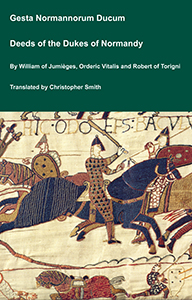
The Deeds of the Dukes of Normandy
The Gesta Normannorum Ducum [The Deeds of the Dukes of Normandy] is a landmark medieval chronicle tracing the rise and fall of the Norman dynasty from its early roots through the pivotal events surrounding the Norman Conquest of England. Originally penned in Latin by the monk William of Jumièges shortly before 1060 and later expanded at the behest of William the Conqueror, the work chronicles the deeds, politics, battles, and leadership of the Norman dukes, especially William’s own claim to the English throne. The narrative combines earlier historical sources with firsthand information and oral testimony to present an authoritative account of Normandy’s transformation from a Viking settlement into one of medieval Europe’s most powerful realms. William’s history emphasizes the legitimacy, military prowess, and governance of the Norman line, framing their expansion, including the conquest of England, as both divinely sanctioned and noble in purpose. Later chroniclers such as Orderic Vitalis and Robert of Torigni continued the history, extending the coverage into the 12th century, providing broader context on ducal rule and its impact. Today this classic work remains a foundational source for understanding Norman identity, medieval statesmanship, and the historical forces that reshaped England and Western Europe between 800AD and 1100AD.
Available at Amazon in eBook and Paperback format.
The Itinerary of Archbishop Baldwin through Wales: Book 1 Chapter 2. I have determined not to omit mentioning those occurrences worthy of note which happened in these parts in our days. It came to pass before that great war, in which nearly all this province was destroyed by the sons of Jestin,28 that the large lake, and the river Leveni,29 which flows from it into the Wye, opposite Glasbyry [Map], were tinged with a deep green colour. The old people of the country were consulted, and answered, that a short time before the great desolation30 caused by Howel, son of Meredyth, the water had been coloured in a similar manner. About the same time, a chaplain, whose name was Hugo, being engaged to officiate at the chapel of Saint Nicholas, in the castle of Aberhodni [Map], saw in a dream a venerable man standing near him, and saying, "Tell thy lord William de Braose,31 who has the audacity to retain the property granted to the chapel of Saint Nicholas for charitable uses, these words: 'The public treasury takes away that which Christ does not receive; and thou wilt then give to an impious soldier, what thou wilt not give to a priest.'" This vision having been repeated three times, he went to the archdeacon of the place, at Landeu [Map], and related to him what had happened. The archdeacon immediately knew them to be the words of Augustine; and shewing him that part of his writings where they were found, explained to him the case to which they applied. He reproaches persons who held back tithes and other ecclesiastical dues; and what he there threatens, certainly in a short time befell this withholder of them: for in our time we have duly and undoubtedly seen, that princes who have usurped ecclesiastical benefices (and particularly king Henry the Second, who laboured under this vice more than others), have profusely squandered the treasures of the church, and given away to hired soldiers what in justice should have been given only to priests.
Note 28. Iestyn ap Gwrgant was lord of the province of Morganwg, or Glamorgan, and a formidable rival to Rhys ap Tewdwr, prince of South Wales; but unable to cope with him in power, he prevailed on Robert Fitzhamon, a Norman knight, to come to his assistance.
Note 29. This little river rises near the ruins of Blanllyfni castle [Map], between Llangorse pool and the turnpike road leading from Brecknock to Abergavenny, and empties itself into the river Usk, near Glasbury.
Note 30. The great desolation here alluded to, is attributed by Dr. Powel to Howel and Meredyth, sons of Edwyn ap Eineon; not to Howel, son of Meredith. In the year 1021, they conspired against Llewelyn ap Sitsyllt, and slew him: Meredith was slain in 1033, and Howel in 1043.
Note 31. William de Breusa, or Braose, was by extraction a Norman, and had extensive possessions in England, as well as Normandy: he was succeeded by his son Philip, who, in the reign of William Rufus, favoured the cause of king Henry against Robert Curthose, duke of Normandy; and being afterwards rebellious to his sovereign, was disinherited of his lands. By his marriage with Berta, daughter of Milo, earl of Hereford, he gained a rich inheritance in Brecknock, Overwent, and Gower. He left issue two sons: William (age 43) and Philip: William married Maude de Saint Wallery (age 32), and succeeded to the great estate of his father and mother, which he kept in peaceable possession during the reigns of king Henry II. and king Richard I. In order to avoid the persecutions of king John, he retired with his family to Ireland; and from thence returned into Wales; on hearing of the king's arrival in Ireland, his wife Maude fled with her sons into Scotland, where she was taken prisoner, and in the year 1210 committed, with William, her son and heir, to Corf castle [Map], and there miserably starved to death, by order of king John; her husband, William de Braose, escaped into France, disguised, and dying there, was buried in the abbey church of Saint Victor, at Paris. The family of Saint Walery, or Valery, derived their name from a sea-port in France.

Founders and Benefactors of Tewkesbury Abbey. fol. 013r: Robert Fitzhamon (d. 1107), son of Hamon Dentatus, lord of Creully, Calvados in Normandy, a descendant of Rollo, and his wife, [his former wife] Sybil, as patrons of Tewkesbury Abbey's reconstruction. Robert wears a red bonnet and blue tunic with a large golden lion rampant guardant over his armour. Sibyl wears a 'gable'- hood with embroidered lappets, a red dress with slashed sleeves and a studded belt, tipped with metal. Their coats of arms below.
Sibyl Montgomery: Before 1079 she was born to Roger "The Great" Montgomery 1st Earl of Shrewsbury and Mabel de Bellême. Before 1090 Robert Fitzhamon and she were married. She the daughter of Roger "The Great" Montgomery 1st Earl of Shrewsbury and Mabel de Bellême. In 1107 Sibyl Montgomery died.
[his daughter] Mabel Fitzhamon Countess Gloucester was born to Robert Fitzhamon and Sibyl Montgomery. She married June 1119 Robert Normandy 1st Earl Gloucester and had issue.
King John Balliol I of Scotland [1]
King Robert the Bruce I of Scotland [2]
Philippa of Lancaster Queen Consort Portugal [1]
Philippa Lancaster Queen Consort Denmark [3]
Joan Beaufort Queen Consort Scotland [2]
King Edward IV of England [11]
King Richard III of England [11]
Anne Neville Queen Consort England [23]
King Henry VII of England and Ireland [4]
Queen Anne Boleyn of England [22]
Queen Jane Seymour [30]
Catherine Parr Queen Consort England [30]
Mary of Guise Queen Consort Scotland [1]
Queen Catherine Howard of England [25]
Maximilian Habsburg Spain II Holy Roman Emperor [3]
Jane Grey I Queen England and Ireland [42]
King James I of England and Ireland and VI of Scotland [7]
Maximilian "The Great" Wittelsbach I Duke Bavaria I Elector Bavaria [3]
Maria Anna Wittelsbach Holy Roman Empress [3]
Marie de Medici Queen Consort France [3]
Ferdinand of Spain II Holy Roman Emperor [6]
George Wharton [224]
Margaret of Austria Queen Consort Spain [6]
Anna of Austria Holy Roman Empress [6]
John George Wettin Elector Saxony [3]
Frederick William "Great Elector" Hohenzollern Elector Brandenburg [3]
Eleonora Gonzaga Queen Consort Bohemia [6]
Maria Leopoldine Habsburg Spain Queen Consort Bohemia [6]
Charlotte Amalie Hesse-Kassel Queen Consort Denmark and Norway [3]
Louise of Mecklenburg Güstrow Queen Consort Denmark and Norway [3]
Maria Anna Neuburg Queen Consort Spain [6]
Joseph I Holy Roman Emperor [6]
Charles Habsburg Spain VI Holy Roman Emperor [6]
Adolph Frederick King Sweden [3]
President George Washington [14]
King George III of Great Britain and Ireland [6]
Charlotte Mecklenburg Strelitz Queen Consort England [3]
Caroline Matilda Hanover Queen Consort Denmark and Norway [6]
Marie Sophie Hesse-Kassel Queen Consort Denmark and Norway [9]
Caroline of Brunswick Queen Consort England [6]
Frederick William III King Prussia [3]
Frederica Mecklenburg Strelitz Queen Consort Hanover [6]
Queen Fredrika Dorotea Vilhelmina [6]
King Christian I of Norway and VIII of Denmark [9]
Frederick William IV King Prussia [6]
Frederick VII King of Denmark [15]
Queen Louise Hesse-Kassel of Denmark [18]
King Christian IX of Denmark [9]
Queen Victoria of the United Kingdom [12]
Queen Sophia of Sweden and Norway [15]
Victoria Empress Germany Queen Consort Prussia [33]
King Edward VII of the United Kingdom [33]
Maria Christina of Austria Queen Consort Spain [9]
Brigadier-General Charles Fitz-Clarence [994]
Victoria Mary Teck Queen Consort England [18]
Frederick Charles I King Finland [18]
Alexandrine Mecklenburg-Schwerin Queen Consort Denmark [24]
Victoria Eugénie Mountbatten Queen Consort Spain [42]
Louise Mountbatten Queen Consort Sweden [51]
Ingrid Bernadotte Queen Consort Denmark [39]
Philip Mountbatten Duke Edinburgh [60]
Queen Elizabeth II of the United Kingdom [4013]
Carl XVI King Sweden [81]
Queen Consort Camilla Shand [1360]
Diana Spencer Princess Wales [12227]
GrandFather: Hamon Dentatus
Father: Hamo Dapifer