

Abbot John Whethamstede’s Chronicle of the Abbey of St Albans
Abbot John Whethamstede's Register aka Chronicle of his second term at the Abbey of St Albans, 1451-1461, is a remarkable text that describes his first-hand experience of the beginning of the Wars of the Roses including the First and Second Battles of St Albans, 1455 and 1461, respectively, their cause, and their consequences, not least on the Abbey itself. His text also includes Loveday, Blore Heath, Northampton, the Act of Accord, Wakefield, and Towton, and ends with the Coronation of King Edward IV. In addition to the events of the Wars of the Roses, Abbot John, or his scribes who wrote the Chronicle, include details in the life of the Abbey such as charters, letters, land exchanges, visits by legates, and disputes, which provide a rich insight into the day-to-day life of the Abbey, and the challenges faced by its Abbot.
Available at Amazon in eBook and Paperback format.
Paternal Family Tree: Oldenburg
Maternal Family Tree: Sophie Mecklenburg-Schwerin Queen Consort Denmark 1557-1631
On 20th July 1572 [her father] Frederick II King of Denmark [aged 38] and [her mother] Sophie Mecklenburg-Schwerin Queen Consort Denmark [aged 14] were married. She by marriage Queen Consort Denmark. The difference in their ages was 23 years. He the son of [her grandfather] Christian III King of Denmark and [her grandmother] Dorothea of Saxe Lauenburg Queen Consort Denmark and Norway. They were second cousin once removed.
On 12th December 1574 Anne of Denmark Queen Consort Scotland England and Ireland was born to [her father] Frederick II King of Denmark [aged 40] and [her mother] Sophie Mecklenburg-Schwerin Queen Consort Denmark [aged 17].
On 4th April 1588 [her father] Frederick II King of Denmark [aged 53] died. His son [her brother] Christian [aged 10] succeeded IV King of Denmark.
On 23rd November 1589 King James I of England and Ireland and VI of Scotland [aged 23] and Anne of Denmark Queen Consort Scotland England and Ireland [aged 14] were married at Bishop's Palace. She by marriage Queen Consort Scotland. She the daughter of Frederick II King of Denmark and Sophie Mecklenburg-Schwerin Queen Consort Denmark [aged 32]. He the son of Henry "Lord Darnley" Stewart and Mary Queen of Scots. They were third cousin once removed. He a great x 2 grandson of King Henry VII of England and Ireland.


On 19th February 1594 [her son] Henry Frederick Stewart Prince of Wales was born to [her husband] King James I of England and Ireland and VI of Scotland [aged 27] and Anne of Denmark Queen Consort Scotland England and Ireland [aged 19] at Stirling Castle [Map]. He was baptised on the 30th August 1594.


1595. Circle of Adrian Vanson. Portrait of Anne of Denmark Queen Consort Scotland England and Ireland [aged 20].
On 19th August 1596 [her daughter] Princess Elizabeth Stewart Queen Bohemia was born to [her husband] King James I of England and Ireland and VI of Scotland [aged 30] and Anne of Denmark Queen Consort Scotland England and Ireland [aged 21] at Falkland Palace, Falkland, Fife. She married 14th February 1613 her fourth cousin once removed Frederick Palatinate Simmern V Elector Palatine Rhine, son of Frederick IV Elector Palatine and Electress Louise Juliana of the Palatine Rhine, and had issue.


On 24th December 1598 [her daughter] Margaret Stewart was born to [her husband] King James I of England and Ireland and VI of Scotland [aged 32] and Anne of Denmark Queen Consort Scotland England and Ireland [aged 24]. She died aged one in 1600.

In 1599 Catherine Knyvet Countess Suffolk [aged 35] was appointed Keeper of the Jewels to Anne of Denmark Queen Consort Scotland England and Ireland [aged 24].
Chronicle of Walter of Guisborough
A canon regular of the Augustinian Guisborough Priory, Yorkshire, formerly known as The Chronicle of Walter of Hemingburgh, describes the period from 1066 to 1346. Before 1274 the Chronicle is based on other works. Thereafter, the Chronicle is original, and a remarkable source for the events of the time. This book provides a translation of the Chronicle from that date. The Latin source for our translation is the 1849 work edited by Hans Claude Hamilton. Hamilton, in his preface, says: 'In the present work we behold perhaps one of the finest samples of our early chronicles, both as regards the value of the events recorded, and the correctness with which they are detailed; Nor will the pleasing style of composition be lightly passed over by those capable of seeing reflected from it the tokens of a vigorous and cultivated mind, and a favourable specimen of the learning and taste of the age in which it was framed.'
Available at Amazon in eBook and Paperback format.
On 5th February 1600 John Gordon 13th Earl Sutherland [aged 24] and Agnes Elphinstone were married. The marriage was celebrated ovre two days at his lodgings Royal Mint aka Cunyiehous. [her husband] King James VI of Scotland [aged 33] and Queen Anne of Denmark [aged 25] were house guests. As wedding gifts, James VI gave Agnes and Jean Elphinstone suites of gold and pearl accessories comprising, a necklace, a belt, and back and fore "garnishings" for their hair, which cost £1,333-6s-8d Scots. He the son of Alexander Gordon 12th Earl Sutherland. They were fourth cousin once removed.
In March 1600 [her daughter] Margaret Stewart [aged 1] died.
On 5th August 1600. The Gowrie Conspiracy was an attempt by John Ruthven 3rd Earl Gowrie [aged 23] and his brother Alexander Ruthven [aged 20] to kill [her husband] King James I [aged 34]. He, King James, had had their father William Ruthven 1st Earl Gowrie executed for his part in the Raid of Ruthven eighteen years earlier.
The attempt was botched. John Ruthven 3rd Earl Gowrie and Alexander Ruthven were killed, the former by John Ramsay 1st Earl Holderness [aged 20].
William Ruthven fled to France.
Patrick Ruthven was imprisoned for nineteen years at the Tower of London [Map].
On 19th November 1600 [her son] King Charles I of England, Scotland and Ireland was born to [her husband] King James I of England and Ireland and VI of Scotland [aged 34] and Anne of Denmark Queen Consort Scotland England and Ireland [aged 25] at Dunfermline Palace, Dunfermline. He married 1st May 1625 his third cousin once removed Henrietta Maria Bourbon Queen Consort England, daughter of Henry IV King France and Marie de Medici Queen Consort France, and had issue.


On 18th January 1602 [her son] Robert Stewart was born to [her husband] King James I of England and Ireland and VI of Scotland [aged 35] and Anne of Denmark Queen Consort Scotland England and Ireland [aged 27]. He died aged less than one years old.
On 27th May 1602 [her son] Robert Stewart died.
In 1603 Anne Keilway Baroness Harington [aged 49] and her daughter Lucy Harrington Countess Bedford [aged 23] travelled to Scotland to gain favour with the new Queen Anne of Denmark Queen Consort Scotland England and Ireland [aged 28]. She was subsequently appointed Lady of the Bedchamber and governess to Princess Elizabeth Stewart Queen Bohemia [aged 6].


On 24th March 1603 Elizabeth I [aged 69] died at Richmond Palace [Map] around three in the morning. Her first cousin twice removed [her husband] James [aged 36] succeeded I King England Scotland and Ireland.
Immediately following her death Robert Carey 1st Earl Monmouth [aged 43] started on horseback for Edinburgh to inform King James I of England and Ireland and VI of Scotland arriving at Holyrood Palace [Map] late on the 26 Mar 1603. His conduct met with general disapproval and merited censure as contrary to all decency, good manners and respect. George Carew and Thomas Lake [aged 35] were sent by the Council to formally inform James of her death.




On 3rd June 1603 a number of English noble ladies selected by the Privy Council greeted Anne of Denmark Queen Consort Scotland England and Ireland [aged 28] at Berwick-upon-Tweed, Northumberland [Map] with two-hundred horse including...
Frances Howard Countess Kildare
Elizabeth Hastings Countess of Worcester [aged 57]
Philadelphia Carey Baroness Scrope Bolton
Penelope Devereux Countess Devonshire [aged 40].
Anne Lady Herbert [aged 20]
Audrey Shelton Lady Walsingham [aged 34].
 Become a Member via our Buy Me a Coffee page to read more.
On 18th June 1603 William Skipwith [aged 39] met Anne of Denmark Queen Consort Scotland England and Ireland [aged 28] at Worksop Manor, and she and her son Prince Henry [aged 9] went on to stay in his house at Leicester on 23rd June 1603, despite fears of plague. Princess Elizabeth [aged 6] stayed at the house of Mr Pilkington.
On 25th June 1603 the Ben Johnson [aged 31] Masque The Entertainment at Althorp was performed at Althorp House, Northamptonshire [Map] to welcome the new Royal Family on their journey from Edinburgh to London following the death of Queen Elizabeth. The performance was attended by Anne of Denmark Queen Consort Scotland England and Ireland [aged 28] and her son Henry Frederick Stewart Prince of Wales [aged 9].

On 21st July 1603 [her husband] King James I of England and Ireland and VI of Scotland [aged 37] created a number of new Baronies...
Thomas Egerton [aged 63] was created 1st Baron Ellesmere. Alice Spencer Countess Derby [aged 54] by marriage Baroness Ellesmere.
Robert Spencer [aged 33] was created 1st Baron Spencer Wormleighton.
John Harrington [aged 63] was created 1st Baron Harington of Exton. Anne Keilway Baroness Harington [aged 49] by marriage Baroness Harington of Exton.
In August 1603 during a plague in London the royal court moved to Basing House, Old Basing. Francis Palmes of Lindley [aged 49] entertained courtiers at his house nearby at Lancelevy, Sherfield on Loddon. The party included Lady Anne Clifford [aged 13], her mother Margaret Clifford [aged 43], Countess of Cumberland and Elizabeth Bourchier, Countess of Bath, who used Lancelevy as a base to visit Anne of Denmark [aged 28] and Arbella Stuart [aged 28].


On 8th January 1604 the Masque of the Twelve Goddesses was performed in the Great Hall at Hampton Court Palace, Richmond [Map]. The performers included:
Anne of Denmark Queen Consort Scotland England and Ireland [aged 29] played Pallas.
Catherine Knyvet Countess Suffolk [aged 40] played Juno.
Frances Howard Duchess Lennox and Richmond [aged 25] played Diana.
Lucy Harrington Countess Bedford [aged 24] played Vesta.
Elizabeth Vere Countess Derby [aged 28] played Proserpine.
Margaret Stewart 1st Countess Nottingham [aged 13] played Concordia.
Penelope Devereux Countess Devonshire [aged 41] played Venus.
Elizabeth Cecil Lady Hatton [aged 26] played Macaria.
Audrey Shelton Lady Walsingham [aged 35] played Astraea.
Susan Vere Countess Montgomery [aged 16] played Flora.
Dorothy Hastings [aged 25] played Ceres.
Elizabeth Howard Countess Banbury [aged 21] played Tethys.


Become a Member via our Buy Me a Coffee page to read more.

Around 1605 John Critz [aged 54]. Portrait of Anne of Denmark Queen Consort Scotland England and Ireland [aged 30].
Around 1605 Dorothy Bulstrode [aged 13] was appointed Lady in Waiting to Anne of Denmark Queen Consort Scotland England and Ireland [aged 30].
Around 1605 Cecily Bulstrode [aged 20] was appointed Lady in Waiting to Anne of Denmark Queen Consort Scotland England and Ireland [aged 30].

On 6th January 1605, Twelfth Night, the Ben Johnson [aged 33] Masque of Blackness was performed at the Banqueting House, Whitehall Palace [Map]. The performers included:
Anne of Denmark Queen Consort Scotland England and Ireland [aged 30] played Euphoris.
Lucy Harrington Countess Bedford [aged 25] played Aglaia.
Anne Lady Herbert [aged 22] played Diaphane.
Elizabeth Vere Countess Derby [aged 29] played Eucampse.
Catherine Knyvet Countess Suffolk [aged 41] played Kathare.
Penelope Devereux Countess Devonshire [aged 42] played Ocyte.
Frances Knyvet Lady Bevill [aged 39] played Notis.
Anne St John Lady Effingham [aged 30] played Psychrote.
Elizabeth Howard Countess Banbury [aged 22] played Glycyte.
Susan Vere Countess Montgomery [aged 17] played Malacia.
Mary Sidney Lady Wroth [aged 18] played Baryte.
Audrey Shelton Lady Walsingham [aged 36] played Periphere.
Become a Member via our Buy Me a Coffee page to read more.
Memorials of affairs of state in the reigns of Q Elizabeth and K James I Volume 2. At Night we had the Queen's Maske in the Banqueting-House [Map], or rather her Pagent. There was a great Engine at the lower end of the Room, which had Motion, and in it were the Images of Sea-Horses with other terrible Fishes, which were ridden by Moors: The Indecorum was, that there was all Fish and no Water. At the further end was a great Shell in form of a Skallop,wherein were four Seats; on the lowest sat the Queen [aged 30] with my Lady Bedford [aged 25]; on the left were placed the Ladies Suffolk [aged 41], Darby [aged 29], Rich [aged 42], Effingham [aged 30], Ann Herbert [aged 22], Susan Herbert [aged 17], Elizabeth Howard [aged 22], Walsingham [aged 36] and Bevil [aged 39]. Their Apparell was rich, but too light and Currizan-light for such great ones. Instead of Vizzards, their Faces, and Arms up to the Elbows, were painted black, which was Disguise sufficient, for they were hard to be known; but it became them nothing so well as their red and white, and you cannot imagine a more ugly Sight, then a Troop of lean-cheeked Moors. The Spanish and Venetian Ambassadors were both present, and sate by the King in State; at which Monsieur Beaumont quarrells so extreamly, that he saith the whole Court is Spanish. But by his Favour, he should fall out with none but himself, for they were all indifferently invited to come as private Men, to a private Sport; which he refusing, the Spanish Ambassador willingly accepted, and being there, feeing no Cause to the contrary, he put off Don Taxis, and took upon him El Senor Embaxadour, wherein he outstript our little Monsieur. He was privately at the first Mask, and fate amongst his Men disguised; at this he was taken out to dance, and footed it like a lusty old Gallant with his Country Woman. He took out the Queen, and forgot not to kiss her Hand, though there was Danger it would have left a Mark on his Lips. The Night's Work was concluded with a Banquet in the great Chamber, which was so furioufly assaulted, that down went Table and Tresses before one bit was touched. They say the Duke Holst will come upon us with an after reckoning, and that we shall see him on Candlemas Night in a Mask, as he hath shewed himself a lusty Reveller all this Christmas.
Become a Member via our Buy Me a Coffee page to read more.
Abbot John Whethamstede’s Chronicle of the Abbey of St Albans
Abbot John Whethamstede's Register aka Chronicle of his second term at the Abbey of St Albans, 1451-1461, is a remarkable text that describes his first-hand experience of the beginning of the Wars of the Roses including the First and Second Battles of St Albans, 1455 and 1461, respectively, their cause, and their consequences, not least on the Abbey itself. His text also includes Loveday, Blore Heath, Northampton, the Act of Accord, Wakefield, and Towton, and ends with the Coronation of King Edward IV. In addition to the events of the Wars of the Roses, Abbot John, or his scribes who wrote the Chronicle, include details in the life of the Abbey such as charters, letters, land exchanges, visits by legates, and disputes, which provide a rich insight into the day-to-day life of the Abbey, and the challenges faced by its Abbot.
Available at Amazon in eBook and Paperback format.
Memorials of affairs of state in the reigns of Q Elizabeth and K James I Volume 2. The [her husband] King [aged 38] is gone to Huntington where he will stay till towards Candlemas. The Queen [aged 30] goes to Greenwich, Kent [Map] this Week, to give Whitehall some Ayre against that time; and presently after the King goes back sur ses brisees, and the Queen returns to Greenwich to lay down her great Belly, which is iook'd for about three Months hence.
On 8th April 1605 [her daughter] Princess Mary Stewart was born to [her husband] King James I of England and Ireland and VI of Scotland [aged 38] and Anne of Denmark Queen Consort Scotland England and Ireland [aged 30] at the Palace of Placentia, Greenwich [Map]. Alice Dennis was chosen as midwife for which she received a reward of £100. She died aged two in 1607.

On 5th May 1605 [her daughter] Princess Mary Stewart was christened at the Palace of Placentia [Map]. Elizabeth Vere Countess Derby [aged 29] carried the child. The infant's clothing, a train of purple velvet, embroidered with gold and furred with Ermines, was supported by two countesses, being so long that it fell to the ground. Archbishop Richard Bancroft [aged 60] performed the christening. The Queen's [aged 30] brother Prince Ulrik Oldenburg [aged 26], the King's [aged 38] first cousin Arabella Stewart [aged 30] and Dorothy Devereux Countess Northumberland [aged 41] were godparents. The King presented Queen Anne (who was not present) with new jewelry.
On 27th December 1605 Philip Herbert 4th Earl Pembroke 1st Earl Montgomery [aged 21] and Susan Vere Countess Montgomery [aged 18] were married at Whitehall. The bride was escorted into the church by the Queen's [aged 31] brother Prince Ulrik Oldenburg [aged 26] and her son Henry Frederick Stewart Prince of Wales [aged 11]. She the daughter of Edward de Vere 17th Earl of Oxford and Anne Cecil Countess of Oxford. He the son of Henry Herbert 2nd Earl Pembroke and Mary Sidney Countess Pembroke [aged 44].


Memorials of affairs of state in the reigns of Q Elizabeth and K James I Volume 2. Jan 1605. Dudley Carleton [aged 32] to Ralph Winwood [aged 42]
Sir
I had written unto you at this time, though I had not been invited by your Letters I received by Captain Doyly. For in Mr. Chamberlain's Absense, I come in quarter, and have waited so diligently at Court this Christmas, that I have Matter enough, if the Report of Masks and Mummings can please you.
On St. John's Day we had the Marriage of Sir Philip Herbert [aged 21] and the Lady Susan [aged 18] performed at Whitehall, with all the Honour could be done a great Favourite. The Court was great, and for that Day put on the best Bravery. The [her son] Prince [aged 11] and [her brother] Duke of Holst [aged 26] led the Bride to Church, the Queen [aged 31] follow'd her from thence. The [her husband] King [aged 39] gave her, and she in her Tresses, and Trinketts brided and bridled it so handsomly, and indeed became her self so well, that the King said, if he were unmarried he would not give her, but keep her himself. The Marriage Dinner was kept in the great Chamber, where the Prince and the Duke of Holst, and the great Lords and Ladies accompanied the Bride. The Ambassador of Venice was the only bidden Guest of Strangers, and he had place above the Duke of Holst, which the Duke took not well. But after Dinner he was as little pleased himself; for being brought into the Closet to retire himself, he was there suffered to walk out his Supper unthought of. At Night there was a Mask in the Hall, which for Conceit and Fashion was fuitable to the Occasion. The Actors, were the Earle of Pembrook [aged 25], the Lord Willoby, Sir Samuel Hays, Sir Thomas Germain, Sir Robert Cary [aged 22], Sir John Lee, Sir Richard Preston, and Sir Thomas Eager. There was no smal Loss that Night of Chaines and Jewells, and many great Ladies were made shorter by the Skirts, and were well enough served that they could keep cut no better. The Presents of Plate, and other Things given by the Noblemen, were valued at £2500, but that which made it a good Marriage, was a Gift of the King's of £500 Land for the Bride's Joynture. They were lodged in the Councill Chamber, where the King in his Shirt and NightGown gave them a Reveille Matin before they were up, and spent a good time in or upon the Bed, chuse which you will believe. No Ceremony was omitted of Bride-Cakes, Points, Garters, and Gloves, which have been ever since the Livery of the Court; and at Night there was sewing into the Sheet, casting off the Bride's left Hose, with many other petty Sorceries.
Become a Member via our Buy Me a Coffee page to read more.
On 22nd June 1607 [her daughter] Princess Sophia Stewart was born to [her husband] King James I of England and Ireland and VI of Scotland [aged 41] and Anne of Denmark Queen Consort Scotland England and Ireland [aged 32]. She died aged less than one years old.
In 23rd June 1607 [her daughter] Princess Sophia Stewart died. She was buried in Westminster Abbey were she has a monument resembling a crib by Maximilian Colt [aged 32], gilded by John Critz [aged 56].
On 16th September 1607 Princess Mary Stewart [aged 2] died of pneumonia at the Stanwell Park Stanwell, Surrey home of Thomas Knyvet 1st Baron Knyvet [aged 62] in whose care she had been placed. As soon as Mary died, the Earl of Worcester [aged 57], the Earl of Leicester [aged 43] and the Earl of Totnes [aged 52] went to Hampton Court Palace [Map], to inform the Queen [aged 32] of her daughter's death. Seeing the three men before her, Queen Anne realized what had happened and spared the men the task of telling her.


On 10th January 1608 the Ben Johnson [aged 36] Masque of Beauty was performed at the Banqueting House, Whitehall Palace [Map] to celebrate the completion of its refurburbishment. [her husband] King James I of England and Ireland and VI of Scotland [aged 41] attended.
The performers included:
Anne of Denmark Queen Consort Scotland England and Ireland [aged 33].
Alethea Talbot Countess Arundel, Surrey and Norfolk [aged 23].
Catherine Brydges Countess Bedford [aged 28].
Elizabeth Vere Countess Derby [aged 32].
Susan Vere Countess Montgomery [aged 20].
Lettice Perrot Baroness Chichester [aged 48].
Audrey Shelton Lady Walsingham [aged 39].
Catherine Somerset Baroness Windsor [aged 33].
Anne Clifford Countess Dorset and Pembroke [aged 17].
Elizabeth Barkham Lady Garrard [aged 15].
Elizabeth Somerset [aged 18].
Elizabeth Cecil Lady Hatton [aged 30].
Mary Neville 7th and 5th Baroness Abergavenny 3rd Baroness Despencer [aged 54].
Catherine Somerset Baroness Windsor.
Arabella Stewart [aged 33].
Become a Member via our Buy Me a Coffee page to read more.
On 5th June 1610 the Tethy's Festival Masque was performed at Whitehall Palace [Map] to celebrate the investiture of [her son] Prince Frederick [aged 16] as Prince of Wales. The script was written by Samuel Daniel at the request of the Queen [aged 35], who appeared in person as Tethys a goddess of the sea. Inigo Jones [aged 36] designed the staging and scenery.
Prince Charles [aged 9] took the part of Zephyrus,.
Princess Elizabeth Stewart Queen Bohemia [aged 13] appeared as the companion or daughter of Tethys, the "Nymph of Thames",.
Arabella Stewart [aged 35] took the part of the "Nymph of Trent",.
Alethea Talbot Countess Arundel, Surrey and Norfolk [aged 25] as "Nymph of Arun".
Elizabeth Vere Countess Derby [aged 34] as "Nymph of Derwent",.
Frances Howard Countess Essex and Somerset [aged 20] as "Nymph of Lee",.
Anne Clifford Countess Dorset and Pembroke [aged 20] as "Nymph of Air",.
Susan Vere Countess Montgomery [aged 23] as "Nymph of Severn",.
Elizabeth Radclyffe Viscountess Haddington as "Nymph of Rother",.
Elizabeth Talbot Countess Kent [aged 28] as "Nymph of Medway",.
Four sisters, daughters of Edward Somerset 4th Earl of Worcester [aged 60] and Elizabeth Hastings Countess of Worcester [aged 64], danced as the rivers of Monmouthshire:
Catherine Somerset Baroness Windsor [aged 35] the "Nymph of Usk".
Katherine Somerset Baroness Petre [aged 35] the "Nymph of Olwy".
Elizabeth Somerset [aged 20] the "Nymph of Dulesse" (Dulas), and.
Mary Wintour the "Nymph of Wye".


Become a Member via our Buy Me a Coffee page to read more.
On 22nd June 1610 William Seymour 2nd Duke of Somerset [aged 22] and Arabella Stewart [aged 35] were married in secret at Palace of Placentia, Greenwich [Map]. For having married without permission [her husband] King James I of England and Ireland and VI of Scotland [aged 44] had Arabella Stewart imprisoned in Sir Thomas Perry's House, Lambeth and he in the Tower of London [Map]. She the daughter of Charles Stewart 5th Earl Lennox and Elizabeth Cavendish Countess Lennox. They were third cousin once removed. He a great x 3 grandson of King Henry VII of England and Ireland. She a great x 2 granddaughter of King Henry VII of England and Ireland.
On 4th July 1610 Anne of Denmark Queen Consort Scotland England and Ireland [aged 35] gave Dorothy Bulstrode [aged 18] a gown of ash-colour taffeta.
On 14th October 1610 Anne of Denmark Queen Consort Scotland England and Ireland [aged 35] gave Dorothy Bulstrode [aged 18] a gown of black satin.

On 24th March 1611 Robert Carr 1st Earl Somerset [aged 24] was created 1st Viscount Rochester and admitted to the Privy Council. Robert Carr 1st Earl Somerset was now the [her husband] Kings [aged 44] favourite.
William of Worcester's Chronicle of England
William of Worcester, born around 1415, and died around 1482 was secretary to John Fastolf, the renowned soldier of the Hundred Years War, during which time he collected documents, letters, and wrote a record of events. Following their return to England in 1440 William was witness to major events. Twice in his chronicle he uses the first person: 1. when writing about the murder of Thomas, 7th Baron Scales, in 1460, he writes '… and I saw him lying naked in the cemetery near the porch of the church of St. Mary Overie in Southwark …' and 2. describing King Edward IV's entry into London in 1461 he writes '… proclaimed that all the people themselves were to recognize and acknowledge Edward as king. I was present and heard this, and immediately went down with them into the city'. William’s Chronicle is rich in detail. It is the source of much information about the Wars of the Roses, including the term 'Diabolical Marriage' to describe the marriage of Queen Elizabeth Woodville’s brother John’s marriage to Katherine, Dowager Duchess of Norfolk, he aged twenty, she sixty-five or more, and the story about a paper crown being placed in mockery on the severed head of Richard, 3rd Duke of York.
Available at Amazon in eBook and Paperback format.
Around 1612 Henry Vane "The Elder" [aged 22] and Frances Darcy [aged 21] were married. She being one of the heirs, possibly the only heir, of her father Thomas Darcy. She brought considerable wealth to the marriage as evidenced by Henry's subsequent spending on court positions. Immediately after the marriage Vane writes... I put myself into court, and bought a carver's place by means of the friendship of Sir Thomas Overbury [aged 31], which cost me £5,000.' Next year he devoted the £3,000 of his wife's portion to purchasing from Sir Edward Gorges a third part of the subpoena office in chancery, and later so ingratiated himself with the [her husband] king [aged 45] that James gave him the reversion of the whole office for forty years.
On 6th November 1612 [her son] Henry Frederick Stewart Prince of Wales [aged 18] died. Earl Chester extinct. The death of the heir to the throne significant; compare William Adelin Duke Normandy, Edward "Black Prince", Prince Arthur Tudor, Frederick Louis Hanover Prince of Wales, perhaps Edward York Prince of Wales.
On 14th February 1613 [her son-in-law] Frederick Palatinate Simmern V Elector Palatine Rhine [aged 16] and Princess Elizabeth Stewart Queen Bohemia [aged 16] were married at Chapel Royal, Whitehall Palace. She the daughter of King James I of England and Ireland and VI of Scotland [aged 46] and Anne of Denmark Queen Consort Scotland England and Ireland [aged 38]. He the son of Frederick IV Elector Palatine and Electress Louise Juliana of the Palatine Rhine [aged 36]. They were fourth cousin once removed.
A grand occasion that saw more royalty than ever visit the court of England. The marriage was an enormously popular match and was the occasion for an outpouring of public affection with the ceremony described as "a wonder of ceremonial and magnificence even for that extravagant age".
It was celebrated with lavish and sophisticated festivities both in London and Heidelberg, including mass feasts and lavish furnishings that cost nearly £50,000, and nearly bankrupted King James. Among many celebratory writings of the events was John Donne's [aged 41] "Epithalamion, Or Marriage Song on the Lady Elizabeth, and Count Palatine being married on St Valentine's Day".


Letters of the Court of James I 1613. 15th July 1613. London. Reverend Thomas Lorkin to Thomas Puckering 1st Baronet [aged 21].
Since my last letters, the king hath signed the book for the prince's household, and *** first entry thereupon on Friday last. The same day were sworn unto him all such officers as have been thought fit to be about him for the present. In the bed-chamber - Sir Robert Carey [aged 30], Sir James Fullerton [aged 50], Robert Carr of Ancram [aged 35], were sworn gentlemen, whereof the last came in by my Lord of Rochester's [aged 26] means. Sir David Murray was not only rejected, but taxed openly at the council-table, for having suggested none of the best counsels to the late prince deceased. Into the same place were sworn, as grooms, Mr. Kirk, Mr. Gray (who was formerly his highness's page), and Pitcairne, who, till then, supplied the office of carver. This man is likewise one of my Lord of Rochester's creatures. In the privy-chamber were sworn gentlemen-ushers, Sir William Irwin and Mr. Heydon, to the prejudice of Sir Robert Darcy, who is left out for a wrangler, notwithstanding his continual attendance since his last master's death ***. In quality of gentlemen were sworn into the same place, Sir Arthur Mainwaring [aged 33], Sir Edward Vemey [aged 23], Sir Edward Lewis, Mr. Clare, and Mr. Dallington. The grooms are taken out of the gentlemen-waiters to the prince, while he was Duke of York, without the addition of any, unless it be Trotter, who is either already come in, or like to obtain the like condition very soon. Mr. Young and Mr. Alexander are sworn gentlemen-ushers of the presence. For carvers, cup-bearers, and sewers, I have not yet learned certainly who they be; but I hear there is little alteration. Ramsay is the first equerry, and Sir Thomas Howard [aged 28] master of the horse. The great officers rest still in expectation. Sir David Foulis, it seems, promiseth himself the best assurance; for he executes his place still, though more by permission and sufferance than any commission he hath received to that purpose. D. Ramsay and **** have been great suitors, but with as bad success as may be.
The court is at Theobalds, where his [her husband] majesty [aged 47] hath been much afflicted with a flux and griping of the belly. He is much amended; and, if the occasion of this sickness alter, not his purpose, begins his progress in [Wiltshire], and so to Salisbury, Wiltshire, next Saturday. The queen [aged 38], likewise, returns to the Bath, Somerset [Map] the Saturday following.
The chief subject of our French news is the compounding of the quarrel between the Dukes of Savoy [aged 51] and Mantua; whereof to write aught to you, who live so near them, were to send owls to Athens.
There hath lately fallen out a great difference between the Duke de Rohan and Monsieur de Plessis (both men of principal mark of them of the Religion, though in a several kind); but what is the cause of their quarrel I yet know not. The chief church there is not a little troubled at it, insomuch that the deputies-general have sent Monsieur Durand, one of the ministers of Paris, down into those parts, to clear the matter, and to mediate a friendly peace between both. The Duke of Lennox [aged 38] hath received there a very honourable entertainment. He was expected in the condition of ambassador; but on his arrival took no other quality than of a private person, which gives many occasion to think, that his first commission was countermanded upon the Duke of Savoy's late ambassage hither. These are but conjectures.
I wish your return into these quarters as soon as the season of the year will permit you; it was your purpose when I left you, and I trust you still keep that resolution. The knowledge of that state is chiefly necessary, and the use of that language. I am sure you understand these things better than myself, and therefore dare not [presume] to advise you. Only my desire is the more earnestly led hereunto by an opinion I have of being able to do you there some pleasing service, and of putting into your hands the commodity of advantaging yourself [into] his highnesses favour, than either your friends or money are like to do in haste. I have heard that you have formerly had some inward acquaintance with Sir Robert Carr of Ancram. It will not be unworthy your entertaining still.


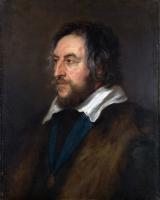


Become a Member via our Buy Me a Coffee page to read more.
On 3rd February 1614 Robert Ker 1st Earl Roxburghe [aged 44] and Jean Drummond Countess Roxburghe [aged 29] were married at Somerset House [Map]. She, Jean, was the sister of his son-in-law John Drummond 2nd Earl Perth [aged 26] who had married his daughter Jean Ker Countess Perth. The wedding was attended by the [her husband] King [aged 47] and Queen [aged 39]. There was a masque Hymen's Triumph written by Samuel Daniel.
In 1617 the Masque of Cupid's Banishment by Robert White was a Masque performed for Anne of Denmark Queen Consort Scotland England and Ireland [aged 42] at Deptford, Kent [Map]. Richard Browne 1st Baronet [aged 12] played the part of "Diana".
On 5th January 1617 George Villiers 1st Duke of Buckingham [aged 24] was created 1st Earl Buckingham by [her husband] King James I of England and Ireland and VI of Scotland [aged 50]; his favourite.
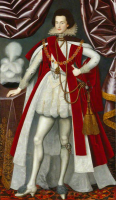


On 29th September 1617 John Villiers 1st Viscount Purbeck [aged 26] and Frances Coke Viscountess Purbeck [aged 15] were married at Hampton Court Palace, Richmond [Map]. [her husband] King James I of England and Ireland and VI of Scotland [aged 51] gave away the bride. He the son of George Villiers of Brokesby and Mary Beaumont 1st Countess Buckingham [aged 47].
Letters of the Court of James I 1618. 31st October 1618. London. John Chamberlain [aged 65], Esq., to Sir Dudley Carleton [aged 45].
I remember, that in my last letter, I said that Sir Walter Raleigh [aged 64] was not secure. But now he is past all peradventure; for, upon Thursday morning [29th October 1618], he was be-headed, in the old Palace at Westminster, 'twixt the Parliament House and the church. On Wednesday, he was brought from the Tower to the King's Bench bar, as they say, the manner is when a man lives above a year and a day after he is condemned; and there demanded what he could say for himself, why the sentence pronounced against him at Winchester should not be put in execution. The sum of his answer was, that the king had employed him in his service, and given him a commission, wherein he styled him "his loyal subject;" and withal given him potestatem vitæ et mortis [the power of life and death]; which did amount to a pardon. For in all reason he must be master of his own life, that hath power over other men's. The judges replied, that there is no pardon for treason by implication. Wherefore, he must find a better plea, or undergo the sentence. Thus he spoke of his trial at Winchester, and avowed that all, or the far greater part of those that were present, did acquit him in their consciences; and that the king's gracious forbearing him so long, and, but for this late accident, longer would have done, even to a hundred years, if nature could have drawn out his life so long, did show that his majesty approved his innocence. But, in conclusion, he was willed to prepare himself, and so was delivered to the sheriffs of London, and conveyed to the Gatehouse, where he spent the rest of that day in writing letters to the king, and others, and in prayer with the Dean of Westminster, who came the next morning at five o'clock, and ministered to him the communion; and, when he had broken his fast, about eight o'clock, came to the scaffold, where he found the Earls of Arundel, Oxford, Northampton, the Lord of Doncaster, and divers others. He made a speech of more than half an hour, wherein he cleared himself of having any intelligence with France, which had been objected to him, more than to save his life, and hide himself from the king's indignation. Then, that he never said any ill intent words towards his majesty, not so much as in thought. That he had no other pretence, nor end in his last voyage, than the enriching of the king, the realm, himself, and his followers. That he never had any undutiful speech concerning his majesty with the runagate French physician, nor ever offered to Sir Lewis Stukely £10,000 to go with him into France, nor told him that the Lord Arran had given him advice to be gone; and that he and the Lord of Doncaster would maintain him in France, of which points he had been accused by them. And, though he protested not only to forgive them, but to pray God to forgive them, yet he thought fit to give men warning of such persons. To all this, and much more, he took God, so often, and so solemnly to witness, that he was believed of all that heard him.
He spake somewhat of the death of the Earl of Essex, and how sorry he was for him; for though he was of a contrary faction, yet he foresaw that those who esteemed him then in that respect, yet would cast him off, as they did afterwards. He confessed himself the greatest sinner that he knew; and no marvel, as having been a soldier, a seaman, and a courtier. He excused the disfiguring of himself, by the example of David, who feigned himself mad, to avoid danger, and never heard it imputed to him for a sin. In conclusion, he spake and behaved himself so, without any show of fear or affectation, that he moved much commiseration; and all that saw him confessed that his end was, as far as man can discern, every way perfect.
It will not be amiss to set down some few passages, of divers that I have heard. The morning that he went to execution, there was a cup of excellent sack brought him, and, being asked how he liked it, "As the fellow,"said he, " that, drinking of St. Giles's bowl, as he went to Tyburn, said, that was good drink if a man might tarry by it." As he went from Westminster Hall to the Gatehouse, he spied Sir Hugh Beeston in the throng, and, calling to him, prayed he would see him die to-morrow. Sir Hugh, to make sure work, got a letter from Secretary Lake to the sheriffs, to see him placed conveniently; and meeting them, as they came near to the scaffold, delivered his letter, but the latter, by mishap, had left his spectacles at home, and put the letter in his pocket. In the mean time, Sir Hugh being thrust by, Sir Walter bade him farewell, and said, "I know not what shift you will make, but I am sure to have a place." When the hangman asked his forgiveness, he desired to see the axe; and, feeling the edge, he said, that was a sharp medicine, to cure him of all his diseases and miseries. When he was laid down, some found fault that his face was westward, and would have him turned. Whereupon, rising, he said, "It was no great matter which way a man's head stood, so his heart lay right." He had given order to the executioner, that, after some short meditation, when he stretched forth his hands, he should despatch him; ´after once or twice putting forth his hands, the fellow, out of timorousness (or what other cause), forbearing, he was fain to bid him strike, and so, at two blows, he took off his head, though he stirred not a whit after the first. The people were much affected at the sight, insomuch that one was heard to say, that we had not such another head to cut off. Another wished the head and brains to be upon S. N.'s shoulders.
There was great means made for his life; and I hear the queen [aged 43] wrote very earnestly to the king, as he tendered her health, to spare him, for that she had received great good by his receipts. I hear not so much of her recovery of late, as when I wrote last, but rather that she goes peggiorando1, insomuch that it is doubted whether the king will come hither to-day from Theobalds, or go direct to Hampton Court, where she lies.
peggiorando i.e. getting worse.


Become a Member via our Buy Me a Coffee page to read more.
Letters of John Chamberlain Volume 2.315. [30th January 1619] The Quene [aged 44] begins to recover and this weeke gave audience to the Venetian ambassador1 and the next day to the Baron of Donau2, and the States commissioners3 have sent to be admitted likewise. They were at a stand some ten dayes since, but now are fallen to yt again, though I doubt yt will prove a fruitles labour, unles the King and States interpose themselves and overrule the marchants on both sides: the Lord Digbie as he is prime in place, so he is held the prime man for under- standing and sufficiencie, and they say hath shewed himself in this treatie every way very able, as I have heard by divers that (I know) care not for his person, and yet commend his extraordinarie parts. The alarme of the Spanish preparations sounds lowde here at last, and minis- ters much matter of discourse: most men doubt!* they have a meaning to Ireland, the rather for that they have entertained many Scottish and Irish pilots, and that the earle of Argile [aged 44] and Tirones sonne [aged 19] are saide to be gon for Spaine: we talke of order taken for twenty ships to be presently made redy, half of the Kings, the rest marchants the best that can be had. Though we cannot be perswaded that he hath any intent hitherward yet is yt not goode to stand in his curtesie: for my part by all that I can gather I shold rather thincke he hath a mind to the Venetians, or to land his forces thereabout and go for Austria or Bohemia to settle and make sure all on that side, that he may the better hereafter follow his other desseigns a bell' agio and as occasions shall fall out.
Note 1. Antonio Donat.
Note 2. Christopher von Dohna, ambassador of Frederick, Elector Palatine.
Note 3. Cf. Letter 306, 309-312.
On 2nd March 1619 Anne of Denmark Queen Consort Scotland England and Ireland [aged 44] died.
On 13th May 1619 Anne of Denmark Queen Consort Scotland England and Ireland was buried in the north eastern area Henry VII Chapel in Westminster Abbey [Map].
The principal mourner was Alethea Talbot Countess Arundel, Surrey and Norfolk [aged 34].
Anne Carey [aged 27] and Mary Woodhouse walked in the procession.
As Keeper of the Wardrobe Lionel Cranfield 1st Earl Middlesex [aged 44] supervised the spending of £20,000 on the funeral.
Richard Young 1st Baronet [aged 39] carried the banner roll.
Her grave has the inscription: "ANNE OF DENMARK QUEEN OF KING JAMES 1st 1619". her coffin has the inscription: "Here lies buried the Most Serene Queen Anne, consort of James, King of Great Britain, France and Ireland, daughter of Frederick II, King of Denmark and Norway and of the Vandals and Goths, sister of Christian IV and mother of many Princes. She died at Hampton Court, in the year of salvation 1618, on the 4th March, aged 43 years, 4 months and 18 days."


On 27th March 1625 [her former husband] King James I of England and Ireland and VI of Scotland [aged 58] died at Theobalds House, Hertfordshire. His son Charles [aged 24] succeeded I King England Scotland and Ireland. Duke York merged with the Crown.
Kings Wessex: Great x 17 Grand Daughter of King Edmund "Ironside" I of England
Kings Godwinson: Great x 16 Grand Daughter of King Harold II of England
Kings England: Great x 12 Grand Daughter of King Henry "Curtmantle" II of England
Kings Scotland: Great x 16 Grand Daughter of King Duncan I of Scotland
Kings Franks: Great x 23 Grand Daughter of Charles "Charlemagne aka Great" King of the Franks King Lombardy Holy Roman Emperor
Kings France: Great x 18 Grand Daughter of Hugh I King of the Franks
Kings Duke Aquitaine: Great x 21 Grand Daughter of Ranulf I Duke Aquitaine
Great x 3 Grandfather: Dietrich Count of Oldenburg 
Great x 2 Grandfather: Christian I King of Denmark
Great x 3 Grandmother: Helvig of Schauenburg
Great x 1 Grandfather: King Frederick I of Denmark
Great x 4 Grandfather: Frederick I Elector Brandenburg
Great x 3 Grandfather: John "The Alchemist" Margrave of Brandenburg-Kulmbach
Great x 2 Grandmother: Dorothea of Brandenburg
Great x 4 Grandfather: Rudolf III Duke of Saxe-Wittenberg
Great x 3 Grandmother: Barbara of Saxe-Wittenberg
GrandFather: Christian III King of Denmark 10 x Great Grand Son of King Henry "Curtmantle" II of England
Great x 4 Grandfather: Frederick I Elector Brandenburg
Great x 3 Grandfather: Albert "Achilles" Elector Brandenburg
Great x 2 Grandfather: John "Cicero" Hohenzollern Elector Brandenburg
Great x 1 Grandmother: Anna of Brandenburg 9 x Great Grand Daughter of King Henry "Curtmantle" II of England
Great x 4 Grandfather: Frederick I Duke Saxony
Great x 3 Grandfather: William III Duke of Luxemburg 7 x Great Grand Son of King Henry "Curtmantle" II of England
Great x 4 Grandmother: Catherine of Brunswick-Lüneburg 6 x Great Grand Daughter of King Henry "Curtmantle" II of England
Great x 2 Grandmother: Margaret of Thuringia 8 x Great Grand Daughter of King Henry "Curtmantle" II of England
Great x 4 Grandfather: Albert Habsburg V Duke Austria 6 x Great Grand Son of King Henry "Curtmantle" II of England
Great x 3 Grandmother: Anne Habsburg 7 x Great Grand Daughter of King Henry "Curtmantle" II of England
Great x 4 Grandmother: Elizabeth Luxemburg Duchess Austria  9 x Great Grand Daughter of King William "Conqueror" I of England
Father: Frederick II King of Denmark 11 x Great Grand Son of King Henry "Curtmantle" II of England
GrandMother: Dorothea of Saxe Lauenburg Queen Consort Denmark and Norway
Anne of Denmark Queen Consort Scotland England and Ireland 12 x Great Grand Daughter of King Henry "Curtmantle" II of England
Great x 3 Grandfather: Henry IV Duke of Mecklenburg
Great x 2 Grandfather: Magnus II Duke of Mecklenburg
Great x 1 Grandfather: Albrecht VII Duke Mecklenburg
GrandFather: Ulrich Mecklenburg-Schwerin 11 x Great Grand Son of King Henry "Curtmantle" II of England
Great x 4 Grandfather: Albert "Achilles" Elector Brandenburg
Great x 3 Grandfather: John "Cicero" Hohenzollern Elector Brandenburg
Great x 2 Grandfather: Joachim "Nestor" Hohenzollern Elector Brandenburg 9 x Great Grand Son of King Henry "Curtmantle" II of England
Great x 4 Grandfather: William III Duke of Luxemburg 7 x Great Grand Son of King Henry "Curtmantle" II of England
Great x 3 Grandmother: Margaret of Thuringia 8 x Great Grand Daughter of King Henry "Curtmantle" II of England
Great x 4 Grandmother: Anne Habsburg 7 x Great Grand Daughter of King Henry "Curtmantle" II of England
Great x 1 Grandmother: Anna Hohenzollern Duchess Mecklenburg 10 x Great Grand Daughter of King Henry "Curtmantle" II of England
Mother: Sophie Mecklenburg-Schwerin Queen Consort Denmark 12 x Great Grand Daughter of King Henry "Curtmantle" II of England