

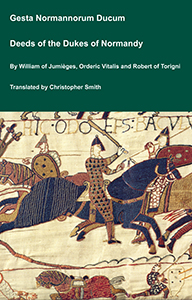
The Deeds of the Dukes of Normandy
The Gesta Normannorum Ducum [The Deeds of the Dukes of Normandy] is a landmark medieval chronicle tracing the rise and fall of the Norman dynasty from its early roots through the pivotal events surrounding the Norman Conquest of England. Originally penned in Latin by the monk William of Jumièges shortly before 1060 and later expanded at the behest of William the Conqueror, the work chronicles the deeds, politics, battles, and leadership of the Norman dukes, especially William’s own claim to the English throne. The narrative combines earlier historical sources with firsthand information and oral testimony to present an authoritative account of Normandy’s transformation from a Viking settlement into one of medieval Europe’s most powerful realms. William’s history emphasizes the legitimacy, military prowess, and governance of the Norman line, framing their expansion, including the conquest of England, as both divinely sanctioned and noble in purpose. Later chroniclers such as Orderic Vitalis and Robert of Torigni continued the history, extending the coverage into the 12th century, providing broader context on ducal rule and its impact. Today this classic work remains a foundational source for understanding Norman identity, medieval statesmanship, and the historical forces that reshaped England and Western Europe between 800AD and 1100AD.
Available at Amazon in eBook and Paperback format.
Paternal Family Tree: Aberffraw
Maternal Family Tree: Angharad Queen Consort Gwynedd 1065-1162
Around 1113 [his father] Gruffudd ap Rhys King Deheubarth (age 32) and [his mother] Gwenllian Aberffraw Queen Consort Deheubarth (age 13) were married. She by marriage Queen Consort Deheubarth. She the daughter of [his grandfather] King Gruffudd ap Cynan of Gwynedd (age 58) and [his grandmother] Angharad Queen Consort Gwynedd (age 48). He the son of [his grandfather] Rhys ap Tewdwr King Deheubarth and [his grandmother] Gwladys ferch Rhiwallon Mathrafal Queen Consort Deheubarth (age 53). They were half second cousin once removed.
In 1132 Rhys ap Gruffydd "The Lord Rhys" Dinefwr was born to [his father] Gruffudd ap Rhys King Deheubarth (age 51) and [his mother] Gwenllian Aberffraw Queen Consort Deheubarth (age 32).
In 1136 a battle, or skirmish, was fought at Maes Gwenllian [Map] between the Welsh forces of [his mother] Gwenllian (age 36), wife of [his father] Gruffydd (age 55), with her two sons, and the Norman force of Maurice de Londres. Gwenllian and her two sons [his brother] Morgan Dinefwr and [his brother] Maelgwn Dinefwr were killed.
On 10th October 1136 [the date is uncertain] the Battle of Crug Mawr aka Cardigan between Welsh and Normans for control of Ceredigion, West Wales. The Welsh, led by [his uncle] Owain "Great" King Gwynedd (age 36), [his uncle] Cadwaladr ap Gruffudd Aberffraw (age 36) and [his father] Gruffudd ap Rhys King Deheubarth (age 55) defeated Normans led by Robert Fitzmartin,; a significant setback to Norman expansion in Wales.
Einion Aberffraw was killed.
The exact location of the battle is unknown. Possibly near Crug Mawr [Map]. However, Annales Cambriae has "A battle was fought before the castle" followed by "others drowned in the river Teifi" suggesting the castle referred to may have been Cilgerran Castle [Map] which is on the River Teifi.
Chronicon ex Chronicis by Florence and John of Worcester. 1137. [his father] Griffyth-ap-Rhys (age 56), king of Wales, perished through the artifices of his [his mother] wife.1
Note 1. So far from this being the case, Gwenlian, the wife of Griffythap-Rhys, prince of South Wales, a woman of a gallant spirit, seconded her husband's efforts for independence, and, in his absence, took the field in person at the head of her forces. See Giraldus Cambrensis Itin. i., c. iv., and Dr. Powell's notes: see also Warrington's History of Wales, p. 293.
In 1146 Rhys ap Gruffydd "The Lord Rhys" Dinefwr (age 14) was captured at Llanstephan Castle [Map].
In 1153 [his brother] Maredudd King Deheubarth (age 23) succeeded King Deheubarth.
Around 1155 Rhys ap Gruffydd "The Lord Rhys" Dinefwr (age 23) and Gwenllian ferch Madog Mathrafal were married. She the daughter of Madog ap Maredudd Mathrafal Prince Powys and Susanna Aberffraw (age 18). He the son of Gruffudd ap Rhys King Deheubarth and Gwenllian Aberffraw Queen Consort Deheubarth. They were first cousins.
In 1155 [his brother] Maredudd King Deheubarth (age 25) died.
Around 1165 [his son] Rhys Gryg ap Rhys Dinefwr was born to Rhys ap Gruffydd "The Lord Rhys" Dinefwr (age 33) and [his wife] Gwenllian ferch Madog Mathrafal at Carmarthenshire. Coefficient of inbreeding 6.94%. He married Mathilde Clare, daughter of Richard Clare 3rd Earl Hertford and Amice Fitzrobert Countess Hertford, and had issue.
Around 1170 [his son] Maelgwn Dinefwr was born to Rhys ap Gruffydd "The Lord Rhys" Dinefwr (age 38) and [his wife] Gwenllian ferch Madog Mathrafal. Coefficient of inbreeding 6.94%.
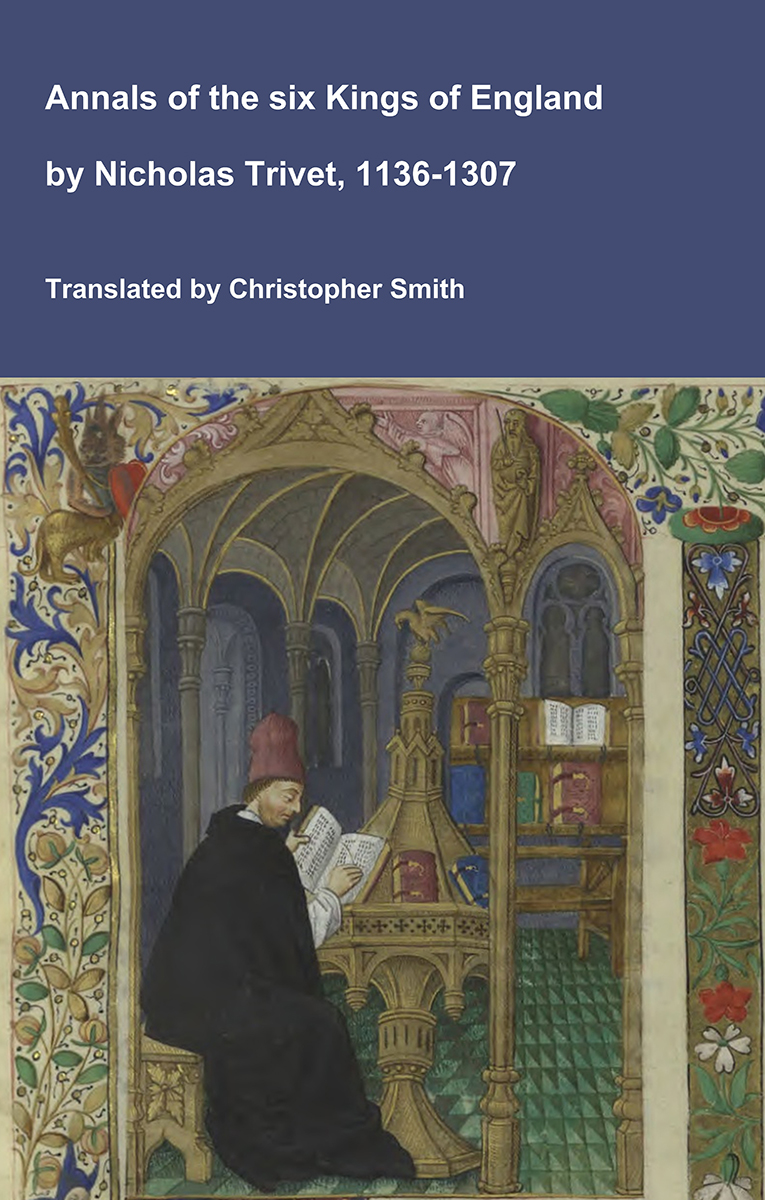
Annals of the six Kings of England by Nicholas Trivet
Translation of the Annals of the Six Kings of England by that traces the rise and rule of the Angevin aka Plantagenet dynasty from the mid-12th to early 14th century. Written by the Dominican scholar Nicholas Trivet, the work offers a vivid account of English history from the reign of King Stephen through to the death of King Edward I, blending political narrative with moral reflection. Covering the reigns of six monarchs—from Stephen to Edward I—the chronicle explores royal authority, rebellion, war, and the shifting balance between crown, church, and nobility. Trivet provides detailed insight into defining moments such as baronial conflicts, Anglo-French rivalry, and the consolidation of royal power under Edward I, whose reign he describes with particular immediacy. The Annals combines careful year-by-year reporting with thoughtful interpretation, presenting history not merely as a sequence of events but as a moral and political lesson. Ideal for readers interested in medieval history, kingship, and the origins of the English state, this chronicle remains a valuable and accessible window into the turbulent world of the Plantagenet kings.
Available at Amazon in eBook and Paperback format.
The Itinerary of Archbishop Baldwin through Wales: Book 1 Chapter 10. Having crossed the river Tywy in a boat, we proceeded towards Caermardyn [Map], leaving Lanstephan [Map] and Talachar [Map]90 on the sea-coast to our left. After the death of king Henry II., Rhys (age 55), the son of [his father] Gruffydd, took these two castles by assault; then, having laid waste, by fire and sword, the provinces of Penbroch and Ros, he besieged Caermardyn [Map], but failed in his attempt. Caermardyn91 signifies the city of Merlin, because, according to the British History, he was there said to have been begotten of an incubus.
Note 90. The castle of Talachar [Map] is now better known by the name of Llaugharne.
Note 91. Much has been said and written by ancient authors respecting the derivation of the name of this city, which is generally allowed to be the Muridunum, or Maridunum, mentioned in the Roman itineraries. Some derive it from Caer and Merddyn, that is, the city of the prophet Merddyn; and others from Mur and Murddyn, which in the British language signify a wall. There can, however, be little doubt that it is derived simply from the Roman name Muridunum. The county gaol occupies the site of the old castle, a few fragments of which are seen intermixed with the houses of the town.
The Itinerary of Archbishop Baldwin through Wales: Book 2 Chapter 2. I shall not pass over in silence the circumstance which occurred in the principal castle of Cemmeis at Lanhever [Map],122 in our days. Rhys (age 55), son of [his father] Gruffydd, by the instigation of his son Gruffydd, a cunning and artful man, took away by force, from William, son of Martin (de Tours), his son-in-law, the castle of Lanhever [Map], notwithstanding he had solemnly sworn, by the most precious relics, that his indemnity and security should be faithfully maintained, and, contrary to his word and oath, gave it to his son Gruffydd; but since "A sordid prey has not a good ending," the Lord, who by the mouth of his prophet, exclaims "Vengeance is mine, and I will repay!" ordained that the castle should be taken away from the contriver of this wicked plot, Gruffydd, and bestowed upon the man in the world he most hated, his brother Malgon. Rhys, also, about two years afterwards, intending to disinherit his own daughter, and two granddaughters and grandsons, by a singular instance of divine vengeance, was taken prisoner by his sons in battle, and confined in this same castle; thus justly suffering the greatest disgrace and confusion in the very place where he had perpetrated an act of the most consummate baseness. I think it also worthy to be remembered, that at the time this misfortune befell him, he had concealed in his possession, at Dinevor, the collar of St. Canauc of Brecknock, for which, by divine vengeance, he merited to be taken prisoner and confined.
Note 122. The "castrum apud Lanhever [Map]" was at Nevern, a small village between Newport and Cardigan, situated on the banks of a little river bearing the same name which discharges itself into the sea at Newport. On a hill immediately above the western side of the parish church, is the site of a large castle [Nevern Castle, Pembrokeshire [Map]], undoubtedly the one alluded to by Giraldus.
The Itinerary of Archbishop Baldwin through Wales: Book 1 Chapter 1. The archbishop proceeded to Radnor [Map], on Ash Wednesday (Caput Jejunii), accompanied by Ranulph de Glanville (age 75), privy counsellor and justiciary of the whole kingdom, and there met Rhys (age 55),11 son of Gruffydd, prince of South Wales, and many other noble personages of those parts; where a sermon being preached by the archbishop, upon the subject of the Crusades, and explained to the Welsh by an interpreter, the author of this Itinerary, impelled by the urgent importunity and promises of the king, and the persuasions of the archbishop and the justiciary, arose the first, and falling down at the feet of the holy man, devoutly took the sign of the cross. His example was instantly followed by Peter, bishop of St. David's,12 a monk of the abbey of Cluny, and then by Eineon, son of Eineon Clyd,13 prince of Elvenia, and many other persons. Eineon rising up, said to Rhys, whose daughter he had married, "My father and lord! with your permission I hasten to revenge the injury offered to the great father of all." Rhys himself was so fully determined upon the holy peregrination, as soon as the archbishop should enter his territories on his return, that for nearly fifteen days he was employed with great solicitude in making the necessary preparations for so distant a journey; till his [his wife] wife, and, according to the common vicious licence of the country, his relation in the fourth degree, Guendolena, (Gwenllian), daughter of [his father-in-law] Madoc, prince of Powys, by female artifices diverted him wholly from his noble purpose; since, as Solomon says, "A man's heart deviseth his way, but the Lord directeth his steps." As Rhys before his departure was conversing with his friends concerning the things he had heard, a distinguished young man of his family, by name Gruffydd, and who afterwards took the cross, is said thus to have answered: "What man of spirit can refuse to undertake this journey, since, amongst all imaginable inconveniences, nothing worse can happen to any one than to return."
Note 11. Rhys ap Gruffydd was grandson to [his grandfather] Rhys ap Tewdwr, prince of South Wales, who, in 1090 [Note. 1093?], was slain in an engagement with the Normans. He was a prince of great talent, but great versatility of character, and made a conspicuous figure in Welsh history. He died in 1196, and was buried in the cathedral of St. David's [Map]; where his [Rhys ap Gruffydd's] effigy, as well as that of his son [his son] Rhys Gryg (age 22), still remain in a good state of preservation.
Note 12. Peter de Leia, prior of the Benedictine monastery of Wenlock [Map], in Shropshire, was the successful rival of Giraldus for the bishopric of Saint David's, vacant by the death of David Fitzgerald, the uncle of our author; but he did not obtain his promotion without considerable opposition from the canons, who submitted to the absolute sequestration of their property before they consented to his election, being desirous that the nephew should have succeeded his uncle. He was consecrated in 1176, and died in 1199.
Note 13. In the Latin of Giraldus, the name of Eineon is represented by Aeneas, and Eineon Clyd by Aeneas Claudius.
The Itinerary of Archbishop Baldwin through Wales: Book 1 Chapter 1. On the arrival of Rhys (age 55) in his own territory, certain canons of Saint David's, through a zeal for their church, having previously secured the interest of some of the prince's courtiers, waited on Rhys, and endeavoured by every possible suggestion to induce him not to permit the archbishop to proceed into the interior parts of Wales, and particularly to the metropolitan see of Saint David's (a thing hitherto unheard of), at the same time asserting that if he should continue his intended journey, the church would in future experience great prejudice, and with difficulty would recover its ancient dignity and honour. Although these pleas were most strenuously urged, the natural kindness and civility of the prince would not suffer them to prevail, lest by prohibiting the archbishop's progress, he might appear to wound his feelings.
In 1189 [his son] Gruffydd ap Rhys Dinefwr Prince Deheubarth and [his daughter-in-law] Maud de Braose were married. They were half fourth cousin twice removed.
Around 1192 Rhys ap Gruffydd "The Lord Rhys" Dinefwr (age 60) took Llawhaden Castle [Map].
Before 1197 Rhys ap Gruffydd "The Lord Rhys" Dinefwr (age 64) commissioned (probably) the building of Carreg Cennen Castle [Map].
On 28th April 1197 Rhys ap Gruffydd "The Lord Rhys" Dinefwr (age 65) died. He was buried at St David's Cathedral, Pembrokeshire [Map].
[his son] Hywel ap Rhys Dinefwr was born to Rhys ap Gruffydd "The Lord Rhys" Dinefwr and Gwenllian ferch Madog Mathrafal. Coefficient of inbreeding 6.94%.
[his daughter] Gwenllian ferch Rhys Dinefwr was born to Rhys ap Gruffydd "The Lord Rhys" Dinefwr and Gwenllian ferch Madog Mathrafal. Coefficient of inbreeding 6.94%. She married Ednyfed "Fychan aka Younger" Tudor and had issue.
[his son] Gruffydd ap Rhys Dinefwr Prince Deheubarth was born to Rhys ap Gruffydd "The Lord Rhys" Dinefwr and Gwenllian ferch Madog Mathrafal. Coefficient of inbreeding 6.94%. He married 1189 his half fourth cousin twice removed Maud de Braose, daughter of William de Braose 4th Baron Bramber and Maud "Lady of Hay" St Valery Baroness Bramber, and had issue.
[his daughter] Angharad ferch Rhys Dinefwr was born to Rhys ap Gruffydd "The Lord Rhys" Dinefwr and Gwenllian ferch Madog Mathrafal. Coefficient of inbreeding 6.94%.
Kings Gwynedd: Great Grand Son of Cynan ab Iago King Gwynedd
Kings Seisyllwg: Great x 5 Grand Son of Hywel "Dda aka Good" King Seisyllwg King Deheubarth
Kings Powys: Great x 3 Grand Son of Maredudd ab Owain King Deheubarth King Powys King Gwynedd
Great x 4 Grandfather: Owain King Deheubarth
Great x 3 Grandfather: Einion Dinefwr
Great x 2 Grandfather: Cadell Dinefwr
Great x 1 Grandfather: Tewdwr ap Cadell Dinefwr
GrandFather: Rhys ap Tewdwr King Deheubarth
Father: Gruffudd ap Rhys King Deheubarth
Great x 3 Grandfather: Gwerystan ap Gwaithfoed Mathrafal
Great x 2 Grandfather: Cynfyn ap Gwersytan Mathrafal
Great x 3 Grandmother: Nest ferch Cadell ap Brochfael King Powys
Great x 1 Grandfather: Rhiwallon ap Cynfyn Mathrafal
Great x 4 Grandfather: Owain King Deheubarth
Great x 3 Grandfather: Maredudd ab Owain King Deheubarth King Powys King Gwynedd
Great x 2 Grandmother: Angharad ferch Maredudd
GrandMother: Gwladys ferch Rhiwallon Mathrafal Queen Consort Deheubarth
Rhys ap Gruffydd "The Lord Rhys" Dinefwr
Great x 4 Grandfather: Meurig ap Idwal Aberffraw
Great x 3 Grandfather: Idwal ap Meurig Aberffraw
Great x 2 Grandfather: Iago ab Idwal ap Meurig Aberffraw Prince Gwynedd
Great x 1 Grandfather: Cynan ab Iago King Gwynedd
GrandFather: King Gruffudd ap Cynan of Gwynedd
Great x 3 Grandfather: Sitric Silkbeard King Dublin
Great x 2 Grandfather: Olaf mac Sitriuc
Great x 1 Grandmother: Ragnaillt Unknown Queen Consort Gwynedd
Mother: Gwenllian Aberffraw Queen Consort Deheubarth
Great x 4 Grandfather: Einion Dinefwr
Great x 3 Grandfather: Gronwy Ap Einion Dinefwr
Great x 2 Grandfather: Edwin of Tegeingl
Great x 4 Grandfather: Edwin Earl of Mercia
Great x 3 Grandmother: Ethelfleda or Aldgyth of Mercia
Great x 1 Grandfather: Owain ab Edwin
Great x 4 Grandfather: Gwerystan ap Gwaithfoed Mathrafal
Great x 3 Grandfather: Cynfyn ap Gwersytan Mathrafal
Great x 4 Grandmother: Nest ferch Cadell ap Brochfael King Powys
Great x 2 Grandmother: Iwerydd Mathrafal
Great x 4 Grandfather: Sitric Silkbeard King Dublin
Great x 3 Grandmother: Unnamed d Sitric Silkbeard King Dublin
GrandMother: Angharad Queen Consort Gwynedd