

Chronicle of Walter of Guisborough
A canon regular of the Augustinian Guisborough Priory, Yorkshire, formerly known as The Chronicle of Walter of Hemingburgh, describes the period from 1066 to 1346. Before 1274 the Chronicle is based on other works. Thereafter, the Chronicle is original, and a remarkable source for the events of the time. This book provides a translation of the Chronicle from that date. The Latin source for our translation is the 1849 work edited by Hans Claude Hamilton. Hamilton, in his preface, says: 'In the present work we behold perhaps one of the finest samples of our early chronicles, both as regards the value of the events recorded, and the correctness with which they are detailed; Nor will the pleasing style of composition be lightly passed over by those capable of seeing reflected from it the tokens of a vigorous and cultivated mind, and a favourable specimen of the learning and taste of the age in which it was framed.'
Available at Amazon in eBook and Paperback format.
Paternal Family Tree: Aberffraw
Rhys ap Tewdwr King Deheubarth succeeded King Deheubarth. Gwladys ferch Rhiwallon Mathrafal Queen Consort Deheubarth by marriage Queen Consort Deheubarth.
Rhys ap Tewdwr King Deheubarth and Gwladys ferch Rhiwallon Mathrafal Queen Consort Deheubarth were married. They were third cousins.
Before 1065 Rhys ap Tewdwr King Deheubarth was born to [his father] Tewdwr ap Cadell Dinefwr.
Around 1081 [his son] Gruffudd ap Rhys King Deheubarth was born to Rhys ap Tewdwr King Deheubarth (age 16) and Gwladys ferch Rhiwallon Mathrafal Queen Consort Deheubarth (age 21) at Llandeilo. He married 1113 his half second cousin once removed Gwenllian Aberffraw Queen Consort Deheubarth, daughter of King Gruffudd ap Cynan of Gwynedd and Angharad Queen Consort Gwynedd, and had issue.
In 1081 King Gruffudd ap Cynan of Gwynedd (age 26) and Rhys ap Tewdwr King Deheubarth (age 16) met at St David's at which they agreed to combine forces.
In 1081 the Battle of Mynydd Carn was fought between the armies of King Gruffudd ap Cynan of Gwynedd (age 26) and Rhys ap Tewdwr King Deheubarth (age 16), and the army of Caradog ap Gruffydd Prince of Gwent and Trahaearn ap Caradog (age 46) as part of a dynastic struggle for control of the Welsh kingdoms of Gwynedd and Deheubarth. The result of the battle had a radical effect on the history of Wales.
Caradog ap Gruffydd Prince of Gwent, Meilir ap Rhiwallon (age 46) and Trahaearn ap Caradog were killed.
In 1081 Rhys ap Tewdwr King Deheubarth (age 16) sought sanctuary at St David's Cathedral, Pembrokeshire [Map].
Around 1085 [his daughter] Nest ferch Rhys Dinefwr was born to Rhys ap Tewdwr King Deheubarth (age 20) and Gwladys ferch Rhiwallon Mathrafal Queen Consort Deheubarth (age 25). She married before 1135 Gerald of Windsor and had issue.
In April 1093 Rhys ap Tewdwr King Deheubarth (age 28) was killed by Bernard de NeufMaré at Brecon [Map] during the Battle of Brecon.
Chronicon ex Chronicis by Florence and John of Worcester. April 1093. Rhys, king of Wales (age 28), was slain in battle during Easter-week, near Brecknock castle. From that day kings ceased to reign in Wales1.
Note 1. Rhys-ap-Tewdwr, the last king, properly so called, of South Wales, died at the age of 90, fighting for the independence of his country, on the Black Mountains, near Brecknock, ad, 1091. according to Warrington. The country was then finally parcelled out among the Norman Lord-Wardens and inferior Welsh chiefs; Rhys's son never having been able to establish his rights.
The Itinerary of Archbishop Baldwin through Wales: Book 1 Chapter 9. Thence we proceeded towards the river Lochor,86 through the plains in which Howel, son of Meredyth of Brecheinoc, after the decease of king Henry I., gained a signal victory over the English. Having first crossed the river Lochor, and afterwards the water called Wendraeth,87 we arrived at the castle of Cydweli [Map].88 In this district, after the death of king Henry, whilst [his son] Gruffydd son of Rhys, the prince of South Wales, was engaged in soliciting assistance from North Wales, his wife [his former daughter-in-law] Gwenliana (like the queen of the Amazons, and a second Penthesilea) led an army into these parts [1136 Battle of Kidwelly]; but she was defeated by Maurice de Londres, lord of that country, and Geoffrey, the bishop's constable.89 Morgan, one of her sons, whom she had arrogantly brought with her in that expedition, was slain, and the other, Malgo, taken prisoner; and she, with many of her followers, was put to death. During the reign of king Henry I., when Wales enjoyed a state of tranquillity, the above-mentioned Maurice had a forest in that neighbourhood, well stocked with wild animals, and especially deer, and was extremely tenacious of his venison. His wife (for women are often very expert in deceiving men) made use of this curious stratagem. Her husband possessed, on the side of the wood next the sea, some extensive pastures, and large flocks of sheep. Having made all the shepherds and chief people in her house accomplices and favourers of her design, and taking advantage of the simple courtesy of her husband, she thus addressed him: "It is wonderful that being lord over beasts, you have ceased to exercise dominion over them; and by not making use of your deer, do not now rule over them, but are subservient to them; and behold how great an abuse arises from too much patience; for they attack our sheep with such an unheard-of rage, and unusual voracity, that from many they are become few; from being innumerable, only numerous." To make her story more probable, she caused some wool to be inserted between the intestines of two stags which had been embowelled; and her husband, thus artfully deceived, sacrificed his deer to the rapacity of his dogs.
Note 86. Lochor, or Llwchwr [Map], was the Leucarum mentioned in the Itineraries, and the fifth Roman station on the Via Julia. This small village is situated on a tide-river bearing the same name, which divides the counties of Glamorgan and Caermarthen, and over which there is a ferry. "Lochor river partith Kidwelli from West Gowerlande." - Leland, Itin. tom. v. p. 23. [The ferry is no more. The river is crossed by a fine railway bridge.]
Note 87. Wendraeth, or Gwen-draeth, from gwen, white, and traeth, the sandy beach of the sea. There are two rivers of this name, Gwendraeth fawr [Map], and Gwendraeth fychan, the great and the little Gwendraeth, of which Leland thus speaks: "Vendraeth Vawr and Vendraith Vehan risith both in Eskenning commote: the lesse an eight milys of from Kydwelli, the other about a ten, and hath but a little nesche of sand betwixt the places wher thei go into the se, about a mile beneth the towne of Kidwely."
Note 88. Cydweli [Map] was probably so called from cyd, a junction, and wyl, a flow, or gushing out, being situated near the junction of the rivers Gwendraeth fawr and fychan; but Leland gives its name a very singular derivation, and worthy of our credulous and superstitious author Giraldus. "Kidwely, otherwise Cathweli, i.e. Catti lectus, quia Cattus olim solebat ibi lectum in quercu facere:- There is a little towne now but newly made betwene Vendraith Vawr and Vendraith Vehan. Vendraith Vawr is half a mile of." - Leland, Itin. tom. v. p. 22.
Note 89. The scene of the battle [1136 Battle of Kidwelly] fought between Gwenllian and Maurice de Londres is to this day called Maes Gwenllian [Map], the plain or field of Gwenllian; and there is a tower in the castle of Cydweli still called Tyr Gwenllian. [Maes Gwenllian [Map] is now a small farm, one of whose fields is said to have been the scene of the battle.]
[his son] Hywel ap Rhys Dinefwr was born to Rhys ap Tewdwr King Deheubarth and Gwladys ferch Rhiwallon Mathrafal Queen Consort Deheubarth.
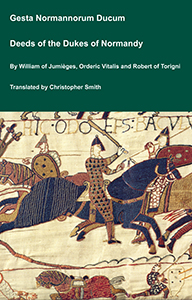
The Deeds of the Dukes of Normandy
The Gesta Normannorum Ducum [The Deeds of the Dukes of Normandy] is a landmark medieval chronicle tracing the rise and fall of the Norman dynasty from its early roots through the pivotal events surrounding the Norman Conquest of England. Originally penned in Latin by the monk William of Jumièges shortly before 1060 and later expanded at the behest of William the Conqueror, the work chronicles the deeds, politics, battles, and leadership of the Norman dukes, especially William’s own claim to the English throne. The narrative combines earlier historical sources with firsthand information and oral testimony to present an authoritative account of Normandy’s transformation from a Viking settlement into one of medieval Europe’s most powerful realms. William’s history emphasizes the legitimacy, military prowess, and governance of the Norman line, framing their expansion, including the conquest of England, as both divinely sanctioned and noble in purpose. Later chroniclers such as Orderic Vitalis and Robert of Torigni continued the history, extending the coverage into the 12th century, providing broader context on ducal rule and its impact. Today this classic work remains a foundational source for understanding Norman identity, medieval statesmanship, and the historical forces that reshaped England and Western Europe between 800AD and 1100AD.
Available at Amazon in eBook and Paperback format.
[his son] Goronwy Dinefwr was born to Rhys ap Tewdwr King Deheubarth and Gwladys ferch Rhiwallon Mathrafal Queen Consort Deheubarth.
[his son] Cadwgan Dinefwr was born to Rhys ap Tewdwr King Deheubarth and Gwladys ferch Rhiwallon Mathrafal Queen Consort Deheubarth.
Kings Gwynedd: Great x 5 Grand Son of Rhodri ap Mervyn "The Great" King Gwynedd
Kings Seisyllwg: Great x 3 Grand Son of Hywel "Dda aka Good" King Seisyllwg King Deheubarth
Kings Powys: Great x 7 Grand Son of Cadell ap Brochfael King Powys
Gruffudd ap Rhys King Deheubarth [1]
Philippa Lancaster Queen Consort Denmark [1]
King Richard III of England [2]
Anne Neville Queen Consort England [2]
Queen Anne Boleyn of England [4]
Catherine Parr Queen Consort England [2]
Queen Catherine Howard of England [3]
Jane Grey I Queen England and Ireland [5]
George Wharton [33]
President George Washington [2]
Brigadier-General Charles Fitz-Clarence [121]
Queen Elizabeth II of the United Kingdom [506]
Queen Consort Camilla Shand [170]
Diana Spencer Princess Wales [1492]
Great x 4 Grandfather: Cadell ap Rhodri King Seisyllwg
Great x 3 Grandfather: Hywel "Dda aka Good" King Seisyllwg King Deheubarth
Great x 2 Grandfather: Owain King Deheubarth
Great x 1 Grandfather: Einion Dinefwr
GrandFather: Cadell Dinefwr
Father: Tewdwr ap Cadell Dinefwr