All About History Books on Amazon
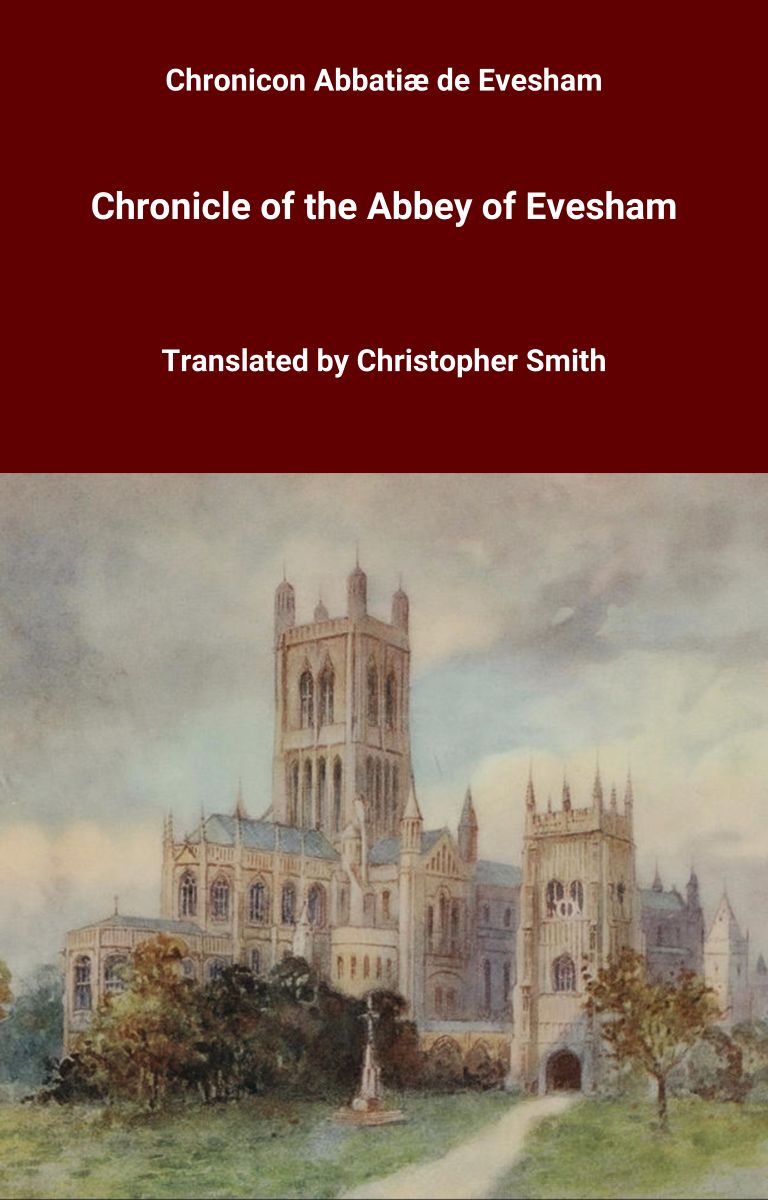
Chronicle of the Abbey of Evesham
The Chronicle of the Abbey of Evesham is a remarkable medieval history of one of England’s great Benedictine monasteries. Beginning with the abbey’s legendary and royal foundations, it traces the fortunes of Evesham through centuries of religious devotion, political conflict, legal struggle, rebuilding, reform, and royal patronage. At the heart of the chronicle is the abbey’s determination to defend its ancient liberties. Its monks record disputes with bishops, appeals to popes and papal legates, contested elections of abbots, lawsuits over lands and privileges, and the long struggle to preserve Evesham’s exemption from episcopal control. Alongside these institutional battles are vivid accounts of saints and miracles, including St Ecgwine, St Odulf and the royal martyr St Wistan, whose relics and cult formed an important part of the abbey’s identity. The chronicle also preserves a wealth of detail about everyday monastic life. It describes the building and repair of churches, cloisters, chapels, halls, mills, granges and fishponds; the acquisition of estates and revenues; the making of vestments, shrines, bells and liturgical books; and the provision of food, clothing, recreation and medical care for the monks. Successive abbots emerge not merely as religious superiors but as administrators, builders, patrons, diplomats and defenders of the community. Extending into the later Middle Ages, the narrative reflects the changing political world around Evesham, from the Norman Conquest and the Angevin kings to the Wars of the Roses and the reign of Henry VIII. The result is both a history of a single monastery and a richly detailed record of medieval English religious, legal, economic and political life. This edition offers modern readers direct access to one of the most important monastic chronicles of medieval England, revealing how the monks of Evesham understood their saints, their privileges, their rulers and their place in history.
Available at Amazon in eBook and Paperback format.
Around 635 Pepin II of Herstal was born to Ansegisel [aged 33].
Around 670 Pepin II of Herstal [aged 35] and Plectrude were married.
Before 679 [his father] Ansegisel [aged 76] was murdered.
Bede. 690. How Wilbrord preaching in Frisland converted many to Christ; and how his two companions the Hewalds suffered martyrdom. [690 a.d.]
When the man of God, Egbert, perceived that neither he himself was permitted to go and preach to the nations, being withheld for the sake of some other advantage to the holy Church, whereof he had been forewarned by a revelation; nor that Wictbert, when he went into those parts, had availed to do anything; he nevertheless still attempted to send holy and industrious men to the work of the Word, among whom the most notable was Wilbrord [aged 32], a man eminent for his merit and rank as priest. They arrived there, twelve in number, and turning aside to Pippin [aged 55], duke of the Franks, were gladly received by him; and as he had lately subdued the nearer part of Frisland, and expelled King Rathbed, he sent them thither to preach, supporting them at the same time with his sovereign authority, that none might molest them in their preaching, and bestowing many favours on those who consented to receive the faith. Thus it came to pass, that with the help of the Divine grace, in a short time they converted many from idolatry to the faith of Christ.
Bede. When they who had gone thither had spent some years teaching in Frisland, Pippin [aged 60], with the consent of them all, sent the venerable Wilbrord [aged 37] to Rome, Italy [Map], where Sergius was still pope, desiring that he might be consecrated archbishop over the nation of the Frisians; which was accordingly done, as he had made request, in the year of our Lord 696. He was consecrated in the church of the Holy Martyr Cecilia, on her festival; and the said pope gave him the name of Clement, and forthwith sent him back to his bishopric, to wit, fourteen days after his arrival in the city.
Anglo-Saxon Chronicle. 714. This year died Guthlac [aged 40] the holy, and King Pepin [aged 79].
On 16th December 714 Pepin II of Herstal [aged 79] died.
Bede. The said Suidbert, being made bishop, returned from Britain, and not long after departed to the Boructuari; and by his preaching brought many of them into the way of truth; but the Boructuari being not long after subdued by the Old Saxons, those who had received the Word were dispersed abroad; and the bishop himself with certain others went to Pippin, who, at the request of his wife, Blithryda, gave him a place of abode in a certain island on the Rhine, called in their tongue, Inlitore; there he built a monastery, which his successors still possess, and for a time dwelt in it, leading a most continent life, and there ended his days.
Bede. Miracles from Heaven were not lacking at their martyrdom. For their dead bodies, having been cast into the river by the pagans, as has been said, were carried against the stream for the space of almost forty miles, to the place where their companions were. Moreover, a long ray of light, reaching up to heaven, shone every night above them wheresoever they chanced to be, and that too in the sight of the very pagans that had slain them. Moreover, one of them appeared in a vision by night to one of his companions, whose name was Tilmon, a man of renown and of noble birth in this world, who having been a thegn had become a monk, telling him that he might find their bodies in that place, where he should see rays of light reaching from heaven to the earth. And so it befell; and their bodies being found, were buried with the honour due to martyrs; and the day of their passion or of the finding of their bodies, is celebrated in those parts with fitting veneration. Finally, Pippin, the most glorious duke of the Franks, learning these things, caused the bodies to be brought to him, and buried them with much honour in the church of the city of Cologne, on the Rhine. And it is said that a spring burst forth in the place where they were killed, which to this day affords a plentiful stream in that same place.
Bede. Pippin gave him a place for his episcopal see, in his famous fort, which in the ancient language of those people is called Wiltaburg, that is, the town of the Wilts; but, in the Gallic tongue, Trajectum. The most reverend prelate having built a church there, and preaching the Word of faith far and near, drew many from their errors, and built many churches and not a few monasteries. For not long after he himself constituted other bishops in those parts from the number of the brethren that either came with him or after him to preach there; of whom some are now fallen asleep in the Lord; but Wilbrord himself, surnamed Clement, is still living, venerable for his great age, having been thirty-six years a bishop, and now, after manifold conflicts of the heavenly warfare, he longs with all his heart for the recompense of the reward in Heaven.
Grandfather: Saint Arnulf of Metz
Father: Ansegisel