All About History Books on Amazon

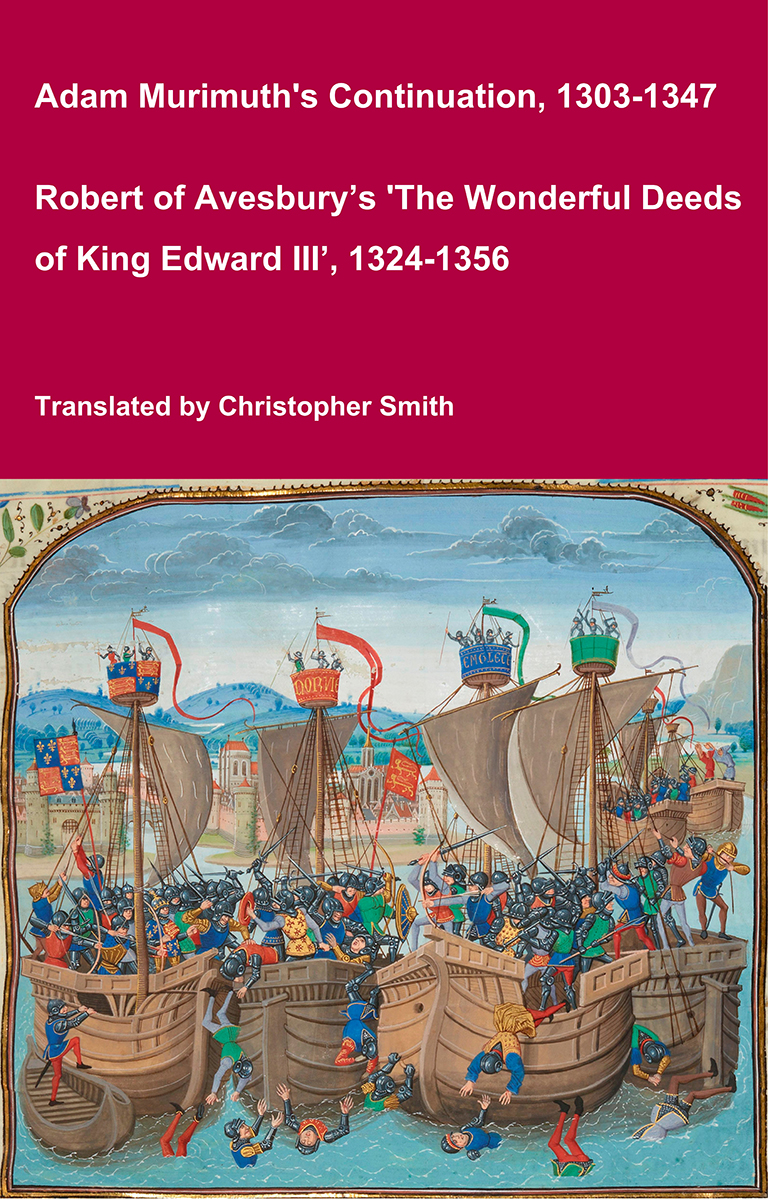
Adam Murimuth's Continuation and Robert of Avesbury’s 'The Wonderful Deeds of King Edward III'

This volume brings together two of the most important contemporary chronicles for the reign of Edward III and the opening phases of the Hundred Years’ War. Written in Latin by English clerical observers, these texts provide a vivid and authoritative window into the political, diplomatic, and military history of fourteenth-century England and its continental ambitions. Adam Murimuth Continuatio's Chronicarum continues an earlier chronicle into the mid-fourteenth century, offering concise but valuable notices on royal policy, foreign relations, and ecclesiastical affairs. Its annalistic structure makes it especially useful for establishing chronology and tracing the development of events year by year. Complementing it, Robert of Avesbury’s De gestis mirabilibus regis Edwardi tertii is a rich documentary chronicle preserving letters, treaties, and official records alongside narrative passages. It is an indispensable source for understanding Edward III’s claim to the French crown, the conduct of war, and the mechanisms of medieval diplomacy. Together, these works offer scholars, students, and enthusiasts a reliable and unembellished account of a transformative period in English and European history. Essential for anyone interested in medieval chronicles, the Hundred Years’ War, or the reign of Edward III.

Available at Amazon in eBook and Paperback format.

Throwley, Staffordshire, North-Central England, British Isles [Map]

Throwley, Staffordshire is in Staffordshire.

Arbor Hill Barrow, Throwley, Staffordshire, North-Central England, British Isles [Map]

Ten Years' Digging. May 20th [1848], opened a barrow about 30 yards diameter, on Arbor Hill [Arbor Hill Barrow [Map]], near Throwley Hall [Map]. Proceeding towards the middle from the south side, through very compact earth, to ihe depth of from three to four feet, in which were bits of charcoal and chippings of flint, we found the ground on the right hand side of the cutting, about the centre of the tumulus, to be more open and stony, and intermixed with rats' bones: following these indications, a cist was soon discovered, constructed of flat slabs of limestone, six of which placed edgeways in a rectangular form served for the basement, whilst above them the sides of the structure were continued by a neat wall, terminating with large flat stones which covered all in. On removing a portion of the wall, the contents, consisting of burnt human bones, amongst which was a flint arrow point, were found covered with fine earth which had penetrated in the course of ages. Adjoining the eastern end of this cist was erected a smaller one, composed of three flat and two rounded stones, so securely covered over that no earth had penetrated through the joints; this also contained burnt bones. The ground on the west side of the trench appearing loose also, we directed our attention that way, and found two more interments of a different character, namely: - two entire skeletons which lay in a contracted position very near to each other; one of them, a young person, had a slender arrow head of flint. A few more human bones and an iron spike about 3 inches long which had been inserted into wood, were found in another part of the tumulus.

Ten Years' Digging. On the 30th and 31st of July we re-opened the barrow on Arbor Hill [Arbor Hill Barrow [Map]], first investigated by us on the 20th of May, 1858, when we limited the search to the centre. On the present occaslion we began by sinking through the north-east side, which being done to the depth of six feet without affording anything of interest, we then undercut the side nearest the middle of the barrow, where the stones were larger and more open, and soon discovered a skeleton, accompanied by a deposit of calcined bones, laid without protection about a yard below the turf. The skull shows the individual to have been young, and the following articles were placed on a flat stone near the skeleton — a barbed arrow-head with a serrated edge, and a prism-shaped instrument of burnt flint, the latter polished; a small flat piece of wrought bone, that may have been part of a larger implement; and the root end of a horn of the red deer, which has been obliquely broken, and measures about nine inches in length. We examined the contrary side on the 31st of July, and found In the earth a very compact mass of black ashes, having amongst them part of a coarse um, in small pieces, accompanied by a few burnt bones and one flake of flint. Chippings of the same and pieces of firmly-baked pottery were found during the two days' excavation.

Rushley Barrow, Throwley, Staffordshire, North-Central England, British Isles [Map]

Ten Years' Digging. On the 16th of February [1850] we opened a barrow at Rushley [Map], near Throwley, twelve yards diameter, and two feet six inches high. We found no interment, but near the centre were fragments of bone, horses' teeth, burnt flint, and rats' bones.

We afterwards re-examined the mound [Throwley Moor Barrow [Map]] behind Throwley Moor House, where an urn and stone axe were found in 1849, but found it to consist almost entirely of natural rock, the inequalities having been smoothed over into barrow form by the addition of a little earth.

Throwley Hall, Staffordshire, North-Central England, British Isles [Map]

On 20th July 1496 Thomas Meverell [aged 71] died at Throwley Hall, Staffordshire [Map].

On 4th October 1502 Thomas Meverell [aged 52] died at Throwley Hall, Staffordshire [Map].

On 25th December 1526 George Meverell [aged 44] died at Throwley Hall, Staffordshire [Map].

On 5th February 1628 Robert Meverell died. His daughter Elizabeth Meverell Countess Ardglass and her husband Thomas Cromwell 1st Earl Ardglass [aged 33] inherited Throwley Hall, Staffordshire [Map].

On 26th November 1687 Vere Essex Cromwell 4th Earl Ardglass [aged 62] died. Earl Ardglass, Baron Cromwell Oakham extinct. His daughter Elizabeth Cromwell [aged 12] and her husband Edward Southwell [aged 16] inherited Throwley Hall, Staffordshire [Map].

In 1790 Edward Southwell 21st Baron Clifford [aged 22] sold Throwley Hall, Staffordshire [Map] to Samuel Crompton 1st Baronet [aged 4].

Throwley Moor Barrow, Staffordshire, North-Central England, British Isles [Map]

Ten Years' Digging. 18th August, we opened a barrow [Throwley Moor Barrow [Map]] on the hill behind Throwley Moor House, the dimensions of which are not ascertainable, from the greatest part of the mound being natural. We commenced digging on the north-west side, through earth one foot deep, beneath which was rock. We soon, however, arrived at a flat stone, placed upright beneath a wall that crossed the barrow; and having removed sufficient of the latter to allow us to proceed, found immediately below its foundation a large sepulchral urn, which, contrary to general usage, stood with the mouth upwards in a hole in the rock eighteen inches deep; the upper edge, from having been long exposed to the influence of the atmosphere from being so near the surface, was so much disintegrated as to be at first taken for charcoal, but we ascertained the diameter to be about fourteen inches; it is quite plain, and composed of coarse friable clay, of a brick red outside and black within. It contained calcined human bones, amongst which were the following articles - two fine pins, made from the tibia of an animal probably not larger than a sheep; a short piece cut from a tubular bone, and laterally perforated, possibly intended for a whistle; a bronze awl, upwards of three inches long, which has been inserted into a handle, and is now covered with a very dark and polished aerugo; a flint spear head; and a bipennis, or double-edged axe, of basaltic stone. All these, except the whistle and the awl, have been submitted to the fire, by which the axe had been so much injured that it was difficult to extricate it from its position under the bones at the bottom of the urn without its falling to pieces. The urn itself, being very thin and adhering to the rock, was taken out in small fragments. The few stone axes found during our researches have uniformly been associated with the brazen daggers, and were replaced by the plain axe-shaped celt at a slightly later period, but in no other instance have they accompanied an interment by cremation; indeed the instances in which the brass dagger has been found with burnt bones bear so small a proportion to those in which it accompanies the skeleton, that we may conclude there was a marked, though gradual change in the mode of burial introduced about the time when the knowledge of metallurgy was acquired. There is, however, evidence that the ancient rite of burial was resumed at a later period, dating but little, if at all, previous to the occupation of the country by the Romans.

Click to read more ...

Ten Years' Digging. On the 16th of February [1850] we opened a barrow at Rushley [Map], near Throwley, twelve yards diameter, and two feet six inches high. We found no interment, but near the centre were fragments of bone, horses' teeth, burnt flint, and rats' bones.

We afterwards re-examined the mound [Throwley Moor Barrow [Map]] behind Throwley Moor House, where an urn and stone axe were found in 1849, but found it to consist almost entirely of natural rock, the inequalities having been smoothed over into barrow form by the addition of a little earth.