All About History Books on Amazon

Anne Boleyn. Her Life as told by Lancelot de Carle's 1536 Letter.

In 1536, two weeks after the execution of Anne Boleyn, her brother George and four others, Lancelot du Carle, wrote an extraordinary letter that described Anne's life, and her trial and execution, to which he was a witness. This book presents a new translation of that letter, with additional material from other contemporary sources such as Letters, Hall's and Wriothesley's Chronicles, the pamphlets of Wynkyn the Worde, the Memorial of George Constantyne, the Portuguese Letter and the Baga de Secrets, all of which are provided in Appendices.

Available at Amazon in eBook and Paperback format.

John Evelyn's Diary March 1702 Greenwich Hospital John Evelyn's Diary April 1702 Wotton, Surrey John Evelyn's Diary June 1702 Bath, Somerset John Evelyn's Diary November 1702 St Paul's Cathedral

John Evelyn's Diary 1702

John Evelyn's Diary 1702 is in John Evelyn's Diary 1700s.

John Evelyn's Diary January 1702

21st January 1702. At the Royal Society there was read and approved the delineation and description of my Tables of Veins and Arteries, by Mr. Cooper, the chirurgeon, in order to their being engraved.

John Evelyn's Diary March 1702

8th March 1702. The King [aged 51] had a fall from his horse, and broke his collar bone, and having been much indisposed before, and anguish, with a long cough and other weakness, died this Sunday morning, about four o'clock.

8th March 1702. I carried my accounts of Greenwich Hospital [Map] to the Committee.

John Evelyn's Diary April 1702

12th April 1702. My brother-in-law [aged 83], Glanville, departed this life this morning after a long languishing illness, leaving a son by my sister, and two granddaughters. Our relation and friendship had been long and great. He was a man of excellent parts. He died in the 84th year of his age, and willed his body to be wrapped in lead and carried down to Greenwich, put on board a ship, and buried in the sea, between Dover and Calais, about the Goodwin sands; which was done on the Tuesday, or Wednesday after. This occasioned much discourse, he having no relation at all to the sea. He was a gentleman of an ancient family in Devonshire, and married my sister Jane. By his prudent parsimony he much improved his fortune. He had a place in the Alienation Office, and might have been an extraordinary man, had he cultivated his parts.

12th April 1702. My steward at Wotton, Surrey [Map] gave a very honest account of what he had laid out on repairs, amounting to £1,900.

John Evelyn's Diary May 1702

3rd May 1702. The report of the committee sent to examine the state of Greenwich Hospital [Map] was delivered to the House of Commons, much to their satisfaction. Lord Godolphin [aged 56] made Lord High Treasurer.

3rd May 1702. Being elected a member of the Society lately incorporated for the propagation of the Gospel in foreign parts, I subscribed £10 per annum toward the carrying it on. We agreed that every missioner, besides the £20 to set him forth, should have £50 per annum out of the stock of the Corporation, till his settlement was worth to him £100 per annum. We sent a young divine to New York.

John Evelyn's Diary June 1702

22nd June 1702. I dined at the Archbishop's [aged 65] with the newly made Bishop of Carlisle, Dr. Nicolson, my worthy and learned correspondent.

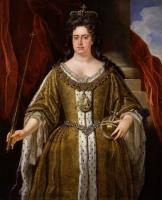
27th June 1702. I went to Wotton, Surrey [Map] with my family for the rest of the summer, and my son-in-law, Draper, with his family, came to stay with us, his house at Addiscombe being new-building, so that my family was above thirty. Most of the new Parliament were chosen of Church of England principles, against the peevish party. The Queen [aged 37] was magnificently entertained at Oxford and all the towns she passed through on her way to Bath, Somerset [Map].

John Evelyn's Diary October 1702

31st October 1702. Arrived now to the 82d year of my age, having read over all that passed since this day twelvemonth in these notes, I render solemn thanks to the Lord, imploring the pardon of my past sins, and the assistance of his grace; making new resolutions, and imploring that he will continue his assistance, and prepare me for my blessed Savior's coming, that I may obtain a comfortable departure, after so long a term as has been hitherto indulged me. I find by many infirmities this year (especially nephritic pains) that I much decline; and yet of his infinite mercy retain my intellect and senses in great measure above most of my age. I have this year repaired much of the mansion house and several tenants' houses, and paid some of my debts and engagements. my wife [aged 67], children, and family in health: for all which I most sincerely beseech Almighty God to accept of these my acknowledgments, and that if it be his holy will to continue me yet longer, it may be to the praise of his infinite grace, and salvation of my soul. Amen!

John Evelyn's Diary November 1702

8th November 1702. My kinsman, John Evelyn, of Nutfield [aged 25], a young and very hopeful gentleman, and Member of Parliament, after having come to Wotton to see me, about fifteen days past, went to London and there died of the smallpox. He left a brother, a commander in the army in Holland, to inherit a fair estate.

All About History Books on Amazon

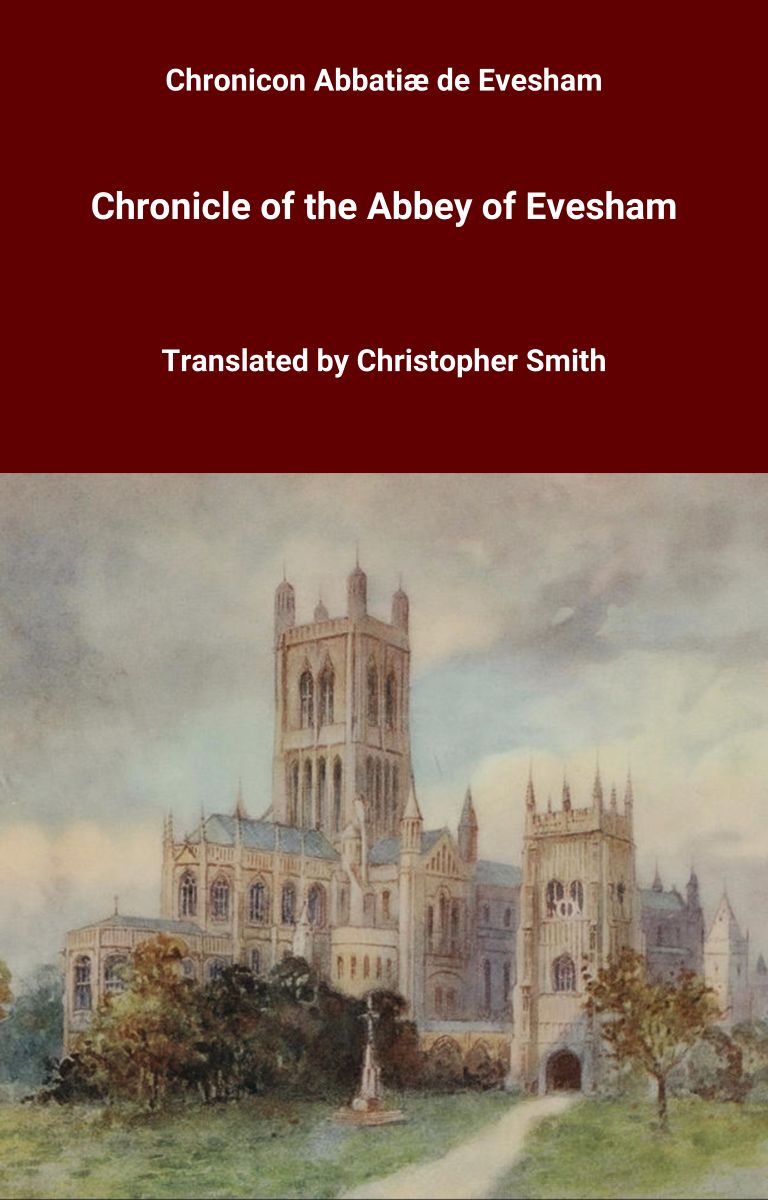
Chronicle of the Abbey of Evesham

The Chronicle of the Abbey of Evesham is a remarkable medieval history of one of England’s great Benedictine monasteries. Beginning with the abbey’s legendary and royal foundations, it traces the fortunes of Evesham through centuries of religious devotion, political conflict, legal struggle, rebuilding, reform, and royal patronage. At the heart of the chronicle is the abbey’s determination to defend its ancient liberties. Its monks record disputes with bishops, appeals to popes and papal legates, contested elections of abbots, lawsuits over lands and privileges, and the long struggle to preserve Evesham’s exemption from episcopal control. Alongside these institutional battles are vivid accounts of saints and miracles, including St Ecgwine, St Odulf and the royal martyr St Wistan, whose relics and cult formed an important part of the abbey’s identity. The chronicle also preserves a wealth of detail about everyday monastic life. It describes the building and repair of churches, cloisters, chapels, halls, mills, granges and fishponds; the acquisition of estates and revenues; the making of vestments, shrines, bells and liturgical books; and the provision of food, clothing, recreation and medical care for the monks. Successive abbots emerge not merely as religious superiors but as administrators, builders, patrons, diplomats and defenders of the community. Extending into the later Middle Ages, the narrative reflects the changing political world around Evesham, from the Norman Conquest and the Angevin kings to the Wars of the Roses and the reign of Henry VIII. The result is both a history of a single monastery and a richly detailed record of medieval English religious, legal, economic and political life. This edition offers modern readers direct access to one of the most important monastic chronicles of medieval England, revealing how the monks of Evesham understood their saints, their privileges, their rulers and their place in history.

Available at Amazon in eBook and Paperback format.
8th November 1702. Our affairs in so prosperous a condition both by sea and land, that there has not been so great an union in Parliament, Court, and people, in memory of man, which God in mercy make us thankful for, and continue! The Bishop of Exeter [aged 52] preached before the Queen [aged 37] and both Houses of Parliament at St. Paul's [Map]; they were wonderfully huzzaed in their passage, and splendidly entertained in the city.

John Evelyn's Diary December 1702

1st December 1702. The expectation now is, what treasure will be found on breaking bulk of the galleon brought from Vigo by Sir George Rooke [aged 52], which being made up in an extraordinary manner in the hold, was not begun to be opened till the fifth of this month, before two of the Privy Council, two of the chief magistrates of the city, and the Lord Treasurer [aged 57].

1st December 1702. After the excess of honor conferred by the Queen [aged 37] on the Earl of Marlborough [aged 52], by making him a Knight of the Garter and a Duke, for the success of but one campaign, that he should desire £5,000 a year to be settled on him by Parliament out of the Post Office, was thought a bold and unadvised request, as he had, besides his own considerable estate, above £30,000 a year in places and employments, with £50,000 at interest. He had married one daughter [aged 21] to the son [aged 24] of my Lord Treasurer Godolphin [aged 57], another [aged 19] to the Earl of Sunderland [aged 27], and a third [aged 15] to the Earl of Bridgewater [aged 21]. He is a very handsome person, well-spoken and affable, and supports his want of acquired knowledge by keeping good company.