All About History Books on Amazon
Henrici Quinti, Angliæ Regis, Gesta, is a first-hand account of the Agincourt Campaign, and subsequent events to his death in 1422. The author of the first part was a Chaplain in King Henry's retinue who was present from King Henry's departure at Southampton in 1415, at the siege of Harfleur, the battle of Agincourt, and the celebrations on King Henry's return to London. The second part, by another writer, relates the events that took place including the negotiations at Troye, Henry's marriage and his death in 1422.
Available at Amazon in eBook and Paperback format.
John Evelyn's Diary 1678 is in John Evelyn's Diary 1670s.
23rd January 1678. Dined with the Duke of Norfolk [aged 49], being the first time I had seen him since the death of his elder brother, who died at Padua in Italy, where he had resided above thirty years. The Duke had now newly declared his marriage to his concubine [aged 35], whom he promised me he never would marry. I went with him to see the Duke of Buckingham [aged 49], thence to my Lord Sunderland [aged 36], now Secretary of State, to show him that rare piece of Vosterman's (son of old Vosterman), which was a view, or landscape of my Lord's palace, etc., at Althorpe [Map] in Northamptonshire.
8th February 1678. Supping at my Lord Chamberlain's [aged 60] I had a long discourse with the Count de Castel Mellor, lately Prime Minister in Portugal, who, taking part with his master, King Alphonso [aged 34], was banished by his brother, Don Pedro [aged 28], now Regent; but had behaved himself so uncorruptly in all his ministry that, though he was acquitted, and his estate restored, yet would they not suffer him to return. He is a very intelligent and worthy gentleman.
18th February 1678. My Lord Treasurer [aged 45] sent for me to accompany him to Wimbledon, which he had lately purchased of the Earl of Bristol [aged 44]; so breaking fast with him privately in his chamber, I accompanied him with two of his daughters, my Lord Conway [aged 55], and Sir Bernard Gascoyne [aged 64]; and, having surveyed his gardens and alterations, returned late at night.
22nd February 1678. Dr. Pierce preached at Whitehall [Map], on 2 Thessalonians iii. 6, against our late schismatics, in a rational discourse, but a little over-sharp, and not at all proper for the auditory there.
22nd March 1678. Dr. South [aged 43] preached coram Rege, an incomparable discourse on this text, "A wounded spirit who can bear!" Note: Now was our Communion table placed altarwise; the church steeple, clock, and other reparations finished.
16th April 1678. I showed Don Emmanuel de Lyra (Portugal Ambassador) and the Count de Castel Mellor, the Repository of the Royal Society, and the Royal College of Physicians.
18th April 1678. I went to see new Bedlam Hospital, magnificently built, and most sweetly placed in Moorfields [Map], since the dreadful fire in London.
28th June 1678. I went to Windsor, Berkshire [Map] with my Lord Chamberlain [aged 60] (the castle now repairing with exceeding cost) to see the rare work of Verrio [aged 42], an incomparable carving of Gibbons [aged 30].
29th June 1678. Returned with my Lord [aged 60] by Hounslow Heath [Map], where we saw the newly raised army encamped, designed against France, in pretense, at least; but which gave umbrage to the Parliament. His Majesty [aged 48] and a world of company were in the field, and the whole army in battalia; a very glorious sight. Now were brought into service a new sort of soldiers, called Grenadiers, who were dexterous in flinging hand grenades, everyone having a pouch full; they had furred caps with coped crowns like Janizaries, which made them look very fierce, and some had long hoods hanging down behind, as we picture fools. Their clothing being likewise piebald, yellow and red.
8th July 1678. Came to dine with me my Lord Longford [aged 46], Treasurer of Ireland, nephew to that learned gentleman, my Lord Aungier, with whom I was long since acquainted; also the Lady Stidolph, and other company.
All About History Books on Amazon
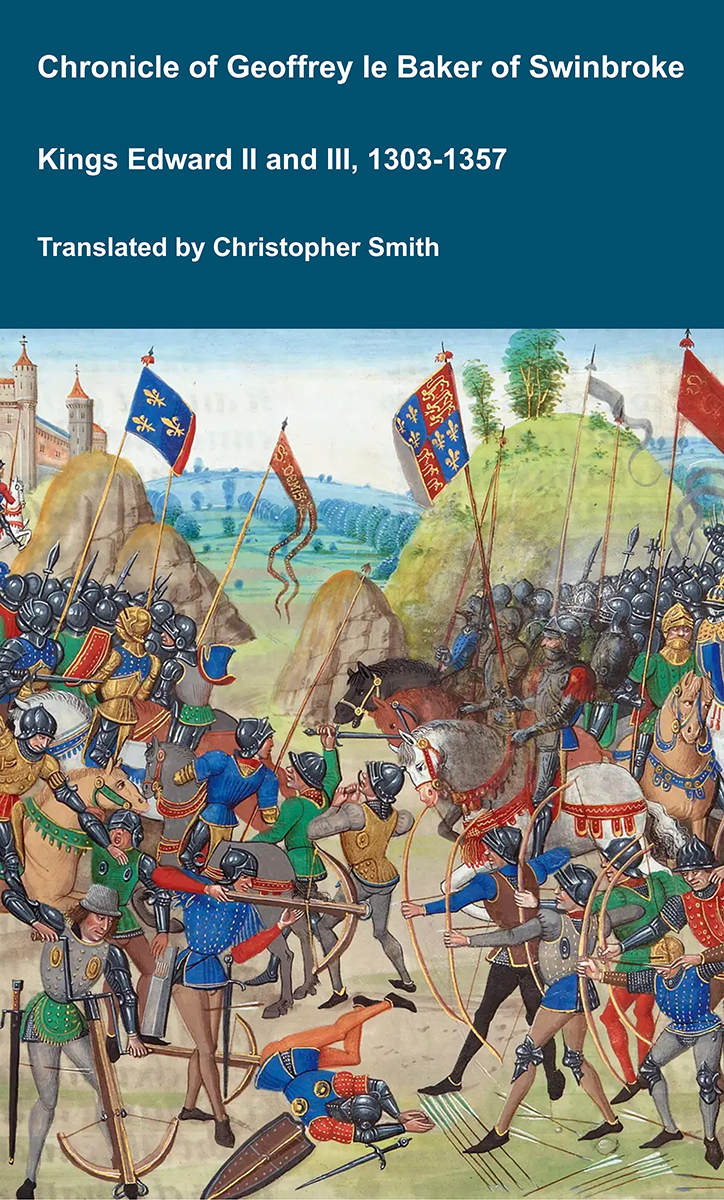
Chronicle of Geoffrey le Baker of Swinbroke
Baker was a secular clerk from Swinbroke, now Swinbrook, an Oxfordshire village two miles east of Burford. His Chronicle describes the events of the period 1303-1356: Gaveston, Bannockburn, Boroughbridge, the murder of King Edward II, the Scottish Wars, Sluys, Crécy, the Black Death, Winchelsea and Poitiers. To quote Herbert Bruce 'it possesses a vigorous and characteristic style, and its value for particular events between 1303 and 1356 has been recognised by its editor and by subsequent writers'. The book provides remarkable detail about the events it describes. Baker's text has been augmented with hundreds of notes, including extracts from other contemporary chronicles, such as the Annales Londonienses, Annales Paulini, Murimuth, Lanercost, Avesbury, Guisborough and Froissart to enrich the reader's understanding. The translation takes as its source the 'Chronicon Galfridi le Baker de Swynebroke' published in 1889, edited by Edward Maunde Thompson.
Available at Amazon in eBook and Paperback format.
19th July 1678. The Earl of Ossory [aged 44] came to take his leave of me, going into Holland to command the English forces.
20th July 1678. I went to the Tower [Map] to try a metal at the Assay-master's, which only proved sulphur; then saw Monsieur Rotière [aged 47], that excellent graver belonging to the Mint, who emulates even the ancients, in both metal and stone; he was now molding a horse for the King's [aged 48] statue, to be cast in silver, of a yard high. I dined with Mr. Slingsby [aged 57], Master of the Mint.
23rd July 1678. Went to see Mr. Elias Ashmole's [aged 61] library and curiosities, at Lambeth. He had divers MSS., but most of them astrological, to which study he is addicted, though I believe not learned, but very industrious, as his History of the order of the Garter proves. He showed me a toad included in amber. The prospect from a turret is very fine, it being so near London, and yet not discovering any house about the country. The famous John Tradescant bequeathed his Repository to this gentleman, who has given them to the University of Oxford, and erected a lecture on them, over the laboratory, in imitation of the Royal Society.
23rd July 1678. Mr. Godolphin [aged 33] was made Master of the Robes to the King [aged 48].
25th July 1678. There was sent me £70; from whom I knew not, to be by me distributed among poor people; I afterward found it was from that dear friend (Mrs. Godolphin [aged 25]), who had frequently given me large sums to bestow on charities.
16th August 1678. I went to Baroness Mordaunt [aged 56], who put £100 into my hand to dispose of for pious uses, relief of prisoners, poor, etc. Many a sum had she sent me on similar occasions; a blessed creature she was, and one that loved and feared God exemplarily.
23rd August 1678. Upon Sir Robert Reading's [aged 38] importunity, I went to visit the Duke of Norfolk [aged 50], at his new palace at Weybridge, where he has laid out in building near £10,000, on a copyhold, and in a miserable, barren, sandy place by the street side; never in my life had I seen such expense to so small purpose. The rooms are wainscotted, and some of them richly pargeted with cedar, yew, cypress, etc. There are some good pictures, especially that incomparable painting of Holbein's, where the Duke of Norfolk, Charles Brandon and Henry VIII., are dancing with the three ladies, with most amorous countenances, and sprightly motion exquisitely expressed. It is a thousand pities (as I told my Lord of Arundel [aged 23], his son), that that jewel should be given away.
24th August 1678. I went to see my Lord of St. Alban's [aged 73] house, at Byfleet, Surrey, an old, large building. Thence, to the papermills, where I found them making a coarse white paper. They cull the rags which are linen for white paper, woolen for brown; then they stamp them in troughs to a pap, with pestles, or hammers, like the powder mills, then put it into a vessel of water, in which they dip a frame closely wired with wire as small as a hair and as close as a weaver's reed; on this they take up the pap, the superfluous water draining through the wire; this they dexterously turning, shake out like a pancake on a smooth board between two pieces of flannel, then press it between a great press, the flannel sucking out the moisture; then, taking it out, they ply and dry it on strings, as they dry linen in the laundry; then dip it in alum water, lastly, polish and make it up in quires. They put some gum in the water in which they macerate the rags. The mark we find on the sheets is formed in the wire.
25th August 1678. After evening prayer, visited Mr. Sheldon (nephew to the late Archbishop of Canterbury), and his pretty melancholy garden; I took notice of the largest arbor thuyris I had ever seen. The place is finely watered, and there are many curiosities of India, shown in the house.
25th August 1678. There was at Weybridge the Duchess of Norfolk [aged 35], Lord Thomas Howard [aged 21] (a worthy and virtuous gentleman, with whom my son [aged 23] was sometime bred in Arundel House [Map]), who was newly come from Rome, where he had been some time; also one of the Duke's daughters, by his first lady. My Lord [aged 50] leading me about the house made no scruple of showing me all the hiding places for the Popish priests, and where they said mass, for he was no bigoted Papist. He told me he never trusted them with any secret, and used Protestants only in all businesses of importance.
25th August 1678. I went this evening with my Lord Duke [aged 50] to Windsor, Berkshire [Map], where was a magnificent Court, it being the first time of his Majesty's [aged 48] removing thither since it was repaired.
27th August 1678. I took leave of the Duke [aged 50], and dined at Mr. Henry Bruncker's [aged 51], at the Abbey of Sheene [Map], formerly a monastery of Carthusians, there yet remaining one of their solitary cells with a cross. Within this ample inclosure are several pretty villas and fine gardens of the most excellent fruits, especially Sir William Temple's (lately Ambassador into Holland), and the Lord Lisle's [aged 29], son to the Earl of Leicester [aged 59], who has divers rare pictures, above all, that of Sir Brian Tuke's, by Holbein.
All About History Books on Amazon
Chronicle of Walter of Guisborough
A canon regular of the Augustinian Guisborough Priory, Yorkshire, formerly known as The Chronicle of Walter of Hemingburgh, describes the period from 1066 to 1346. Before 1274 the Chronicle is based on other works. Thereafter, the Chronicle is original, and a remarkable source for the events of the time. This book provides a translation of the Chronicle from that date. The Latin source for our translation is the 1849 work edited by Hans Claude Hamilton. Hamilton, in his preface, says: 'In the present work we behold perhaps one of the finest samples of our early chronicles, both as regards the value of the events recorded, and the correctness with which they are detailed; Nor will the pleasing style of composition be lightly passed over by those capable of seeing reflected from it the tokens of a vigorous and cultivated mind, and a favourable specimen of the learning and taste of the age in which it was framed.'
Available at Amazon in eBook and Paperback format.
27th August 1678. After dinner I walked to Ham, to see the house and garden of the Duke of Lauderdale [aged 62], which is indeed inferior to few of the best villas in Italy itself; the house furnished like a great Prince's; the parterres, flower-gardens, orangeries, groves, avenues, courts, statues, perspectives, fountains, aviaries, and all this at the banks of the sweetest river in the world, must needs be admirable.
27th August 1678. Hence, I went to my worthy friend, Sir Henry Capel [aged 40] [at Kew], brother to the Earl of Essex [aged 46]; it is an old timber-house; but his garden has the choicest fruit of any plantation in England, as he is the most industrious and understanding in it.
29th August 1678. I was called to London to wait upon the Duke of Norfolk [aged 50], who having at my sole request bestowed the Arundelian Library on the Royal Society; sent to me to take charge of the books, and remove them, only stipulating that I would suffer the Herald's chief officer, Sir William Dugdale [aged 72], to have such of them as concerned heraldry and the marshal's office, books of armory and genealogies, the Duke being Earl Marshal of England. I procured for our Society, besides printed books, near one hundred MSS. some in Greek of great concernment. The printed books being of the oldest impressions, are not the less valuable; I esteem them almost equal to MSS. Among them, are most of the Fathers, printed at Basil, before the Jesuits abused them with their expurgatory Indexes; there is a noble MS. of Vitruvius. Many of these books had been presented by Popes, Cardinals, and great persons, to the Earls of Arundel and Dukes of Norfolk; and the late magnificent Earl of Arundel bought a noble library in Germany, which is in this collection. I should not, for the honor I bear the family, have persuaded the Duke to part with these, had I not seen how negligent he was of them, suffering the priests and everybody to carry away and dispose of what they pleased; so that abundance of rare things are irrecoverably gone.
29th August 1678. Having taken order here, I went to the Royal Society to give them an account of what I had procured, that they might call a Council and appoint a day to wait on the Duke to thank him for this munificent gift.
3rd September 1678. I went to London, to dine with Mrs. Godolphin [aged 26], and found her in labor; she was brought to bed of a son, who was baptized in the chamber, by the name of Francis, the susceptors being Sir William Godolphin [aged 38] (head of the family), Mr. John Hervey [aged 62], Treasurer to the Queen, and Mrs. Boscawen [aged 35], sister to Sir William and the father [aged 33].
8th September 1678. While I was at church came a letter from Mr. Godolphin [aged 33], that my dear friend his lady [aged 26] was exceedingly ill, and desiring my prayers and assistance. My wife [aged 43] and I took boat immediately, and went to Whitehall [Map], where, to my inexpressible sorrow, I found she had been attacked with a new fever, then reigning this excessive hot autumn, and which was so violent, that it was not thought she could last many hours.
9th September 1678. She died in the 26th year of her age, to the inexpressible affliction of her dear husband [aged 33], and all her relations, but of none in the world more than of myself, who lost the most excellent and inestimable friend that ever lived. Never was a more virtuous and inviolable friendship; never a more religious, discreet, and admirable creature, beloved of all, admired of all, for all possible perfections of her sex. She is gone to receive the reward of her signal charity, and all other her Christian graces, too blessed a creature to converse with mortals, fitted as she was, by a most holy life, to be received into the mansions above. She was for wit, beauty, good nature, fidelity, discretion, and all accomplishments, the most incomparable person. How shall I ever repay the obligations to her for the infinite good offices she did my soul by so often engaging me to make religion the terms and tie of the friendship there was between us! She was the best wife, the best mistress, the best friend, that ever husband had. But it is not here that I pretend to give her character, HAVING DESIGNED TO CONSECRATE HER WORTHY LIFE TO POSTERITY.
9th September 1678. Her husband, struck with unspeakable affliction, fell down as dead. The King [aged 48] himself, and all the Court, expressed their sorrow. To the poor and miserable, her loss was irreparable; for there was no degree but had some obligation to her memory. So careful and provident was she to be prepared for all possible accidents, that (as if she foresaw her end) she received the heavenly viaticum but the Sunday before, after a most solemn recollection. She put all her domestic concerns into the exactest order, and left a letter directed to her husband [aged 33], to be opened in case she died in childbed, in which with the most pathetic and endearing expressions of the most loyal and virtuous wife, she begs his kindness to her memory might be continued by his care and esteem of those she left behind, even to her domestic servants, to the meanest of which she left considerable legacies, as well as to the poor. It was now seven years since she was maid of honor to the Queen, that she regarded me as a father, a brother, and what is more, a friend. We often prayed, visited the sick and miserable, received, read, discoursed, and communicated in all holy offices together. She was most dear to my wife [aged 43], and affectionate to my children. But she is gone! This only is my comfort, that she is happy in Christ, and I shall shortly behold her again. She desired to be buried in the dormitory of his family, near three hundred miles from all her other friends. So afflicted was her husband at this severe loss, that the entire care of her funeral was committed to me. Having closed the eyes, and dropped a tear upon the cheek of my dear departed friend, lovely even in death, I caused her corpse to be embalmed and wrapped in lead, a plate of brass soldered thereon, with an inscription, and other circumstances due to her worth, with as much diligence and care as my grieved heart would permit me; I then retired home for two days, which were spent in solitude and sad reflection.
17th September 1678. She was, accordingly, carried to Godolphin, in Cornwall, in a hearse with six horses, attended by two coaches of as many, with about thirty of her relations and servants. There accompanied the hearse her husband's brother, Sir William [aged 38], two more of his brothers, and three sisters; her husband [aged 33] was so overcome with grief, that he was wholly unfit to travel so long a journey, till he was more composed. I went as far as Hounslow with a sad heart; but was obliged to return upon some indispensable affairs. The corpse was ordered to be taken out of the hearse every night, and decently placed in the house, with tapers about it, and her servants attending, to Cornwall; and then was honourably interred in the parish church of Godolphin. This funeral cost not much less than £1,000.
17th September 1678. With Mr. Godolphin [aged 33], I looked over and sorted his lady's papers, most of which consisted of Prayers, Meditations, Sermon-notes, Discourses, and Collections on several religious subjects, and many of her own happy composing, and so pertinently digested, as if she had been all her life a student in divinity. We found a diary of her solemn resolutions, tending to practical virtue, with letters from select friends, all put into exact method. It astonished us to see what she had read and written, her youth considered.
1st October 1678. The Parliament and the whole Nation were alarmed about a conspiracy of some eminent Papists for the destruction of the King [aged 48] and introduction of Popery, discovered by one Oates [aged 29] and Dr. Tongue, which last i knew, being the translator of the "Jesuits' Morals"; I went to see and converse with him at Whitehall, with Mr. Oates, one that was lately an apostate to the church of Rome, and now returned again with this discovery. He seemed to be a bold man, and, in my thoughts, furiously indiscreet; but everybody believed what he said; and it quite changed the genius and motions of the Parliament, growing now corrupt and interested with long sitting and court practices; but, with all this, Popery would not go down. This discovery turned them all as one man against it, and nothing was done but to find out the depth of this. Oates was encouraged, and everything he affirmed taken for gospel; the truth is, the Roman Catholics were exceedingly bold and busy everywhere, since the Duke [aged 27] forbore to go any longer to the chapel.
16th October 1678. Mr. Godolphin [aged 33] requested me to continue the trust his wife [deceased] had reposed in me, in behalf of his little son, conjuring me to transfer the friendship I had for his dear wife, on him and his.
21st October 1678. The murder of Sir Edmondbury Godfrey [aged 56], found strangled about this time, as was manifest, by the Papists, he being the Justice of the Peace, and one who knew much of their practices, as conversant with Coleman [aged 42] (a servant of the ... now accused), put the whole nation into a new ferment against them.
All About History Books on Amazon
Chronicle of Geoffrey le Baker of Swinbroke
Baker was a secular clerk from Swinbroke, now Swinbrook, an Oxfordshire village two miles east of Burford. His Chronicle describes the events of the period 1303-1356: Gaveston, Bannockburn, Boroughbridge, the murder of King Edward II, the Scottish Wars, Sluys, Crécy, the Black Death, Winchelsea and Poitiers. To quote Herbert Bruce 'it possesses a vigorous and characteristic style, and its value for particular events between 1303 and 1356 has been recognised by its editor and by subsequent writers'. The book provides remarkable detail about the events it describes. Baker's text has been augmented with hundreds of notes, including extracts from other contemporary chronicles, such as the Annales Londonienses, Annales Paulini, Murimuth, Lanercost, Avesbury, Guisborough and Froissart to enrich the reader's understanding. The translation takes as its source the 'Chronicon Galfridi le Baker de Swynebroke' published in 1889, edited by Edward Maunde Thompson.
Available at Amazon in eBook and Paperback format.
31st October 1678. Being the 58th of my age, required my humble addresses to Almighty God, and that he would take off his heavy hand, still on my family; and restore comforts to us after the death of my excellent friend.
5th November 1678. Dr. Tillotson [aged 48] preached before the Commons at St. Margaret's [Map]. He said the Papists were now arrived at that impudence, as to deny that there ever was any such as the gunpowder-conspiracy; but he affirmed that he himself had several letters written by Sir Everard Digby (one of the traitors), in which he gloried that he was to suffer for it; and that it was so contrived, that of the Papists not above two or three should have been blown up, and they, such as were not worth saving.
15th November 1678. The Queen's [aged 39] birthday. I never saw the Court more brave, nor the nation in more apprehension and consternation. Coleman [aged 42] and one Staly had now been tried, condemned, and executed. On this, Oates grew so presumptuous as to accuse the Queen of intending to poison the King [aged 48]; which certainly that pious and virtuous lady abhorred the thoughts of, and Oates's circumstances made it utterly unlikely in my opinion. He probably thought to gratify some who would have been glad his Majesty should have married a fruitful lady; but the King was too kind a husband to let any of these make impression on him. However, divers of the Popish peers were sent to the Tower of London [Map], accused by Oates; and all the Roman Catholic lords were by a new Act forever excluded the Parliament; which was a mighty blow. the King's, Queen's, and Duke's servants, were banished, and a test to be taken by everybody who pretended to enjoy any office of public trust, and who would not be suspected of Popery. I went with Sir William Godolphin [aged 38], a member of the Commons' House, to the Bishop of Ely (Dr. Peter Gunning [aged 64]), to be resolved whether masses were idolatry, as the text expressed it, which was so worded, that several good Protestants scrupled, and Sir William, though a learned man and excellent divine himself, had some doubts about it. The Bishop's opinion was that he might take it, though he wished it had been otherwise worded in the text.