All About History Books on Amazon
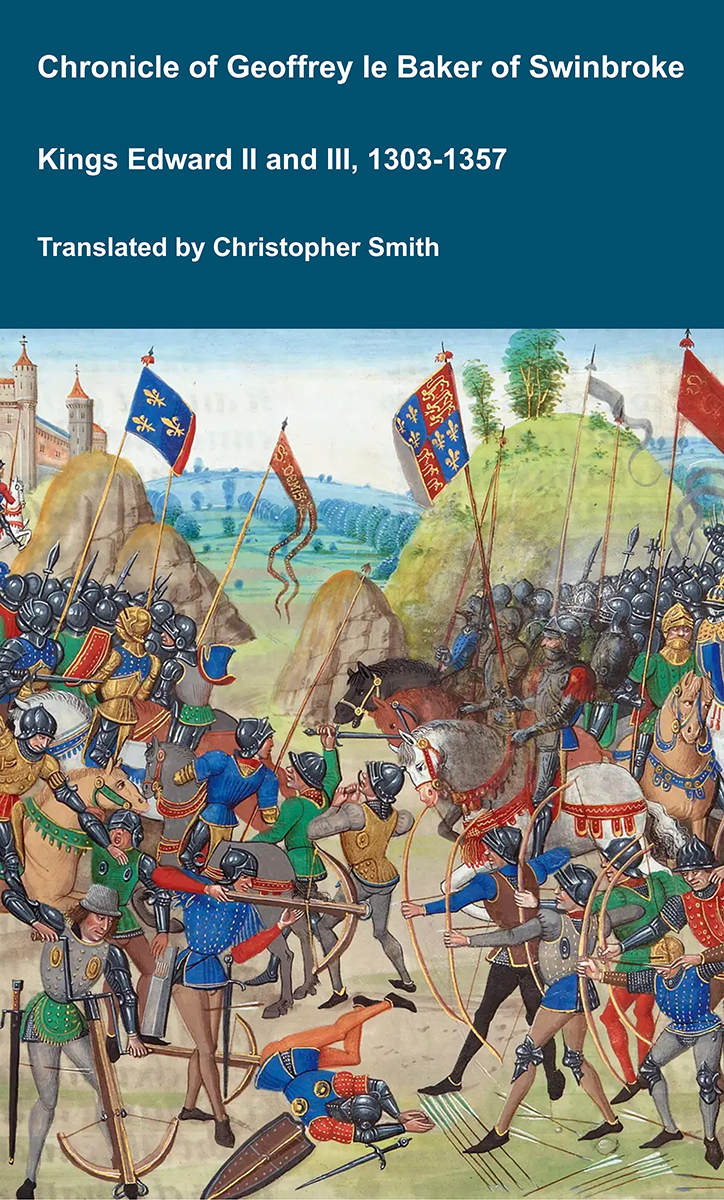
Chronicle of Geoffrey le Baker of Swinbroke
Baker was a secular clerk from Swinbroke, now Swinbrook, an Oxfordshire village two miles east of Burford. His Chronicle describes the events of the period 1303-1356: Gaveston, Bannockburn, Boroughbridge, the murder of King Edward II, the Scottish Wars, Sluys, Crécy, the Black Death, Winchelsea and Poitiers. To quote Herbert Bruce 'it possesses a vigorous and characteristic style, and its value for particular events between 1303 and 1356 has been recognised by its editor and by subsequent writers'. The book provides remarkable detail about the events it describes. Baker's text has been augmented with hundreds of notes, including extracts from other contemporary chronicles, such as the Annales Londonienses, Annales Paulini, Murimuth, Lanercost, Avesbury, Guisborough and Froissart to enrich the reader's understanding. The translation takes as its source the 'Chronicon Galfridi le Baker de Swynebroke' published in 1889, edited by Edward Maunde Thompson.
Available at Amazon in eBook and Paperback format.
John Evelyn's Diary 1659 is in John Evelyn's Diary 1650s.
17th January 1659. Our old vicar preached, taking leave of the parish in a pathetical speech, to go to a living in the city.
24th March 1659. I went to London, to speak to the patron, Alderman Cuttler, about presenting a fit pastor for our destitute parish church.
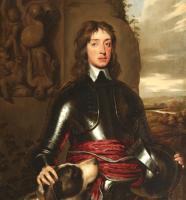
5th April 1659. Came the Earl of Northampton [aged 36] and the famous painter, Mr. Wright [aged 41], to visit me.
10th April 1659. One Mr. Littler, being now presented to the living of our parish, preached on John vi. 55, a sermon preparatory to the Holy Sacrament.
25th April 1659. A wonderful and sudden change in the face of the public; the new protector, Richard [aged 32], slighted; several pretenders and parties strive for the government: all anarchy and confusion; Lord have mercy on us!
5th May 1659. I went to visit my brother [aged 41] in London; and next day, to see a new opera, after the Italian way, in recitative music and scenes, much inferior to the Italian composure and magnificence; but it was prodigious that in a time of such public consternation such a vanity should be kept up, or permitted. I, being engaged with company, could not decently resist the going to see it, though my heart smote me for it.
7th May 1659. Came the Ambassador of Holland and his lady to visit me, and stayed the whole afternoon.
12th May 1659. I returned the visit, discoursing much of the revolutions, etc.
19th May 1659. Came to dine with me my Lord Galloway [aged 49] and his son, a Scotch Lord and learned: also my brother [aged 41] and his lady, Lord Berkeley and his lady, Mrs. Shirley, and the famous singer, Mrs. Knight, and other friends.
23rd May 1659. I went to Rookwood, Surrey, and dined with Sir William Hicks [aged 63], where was a great feast and much company. It is a melancholy old house, environed with trees and rooks.
All About History Books on Amazon
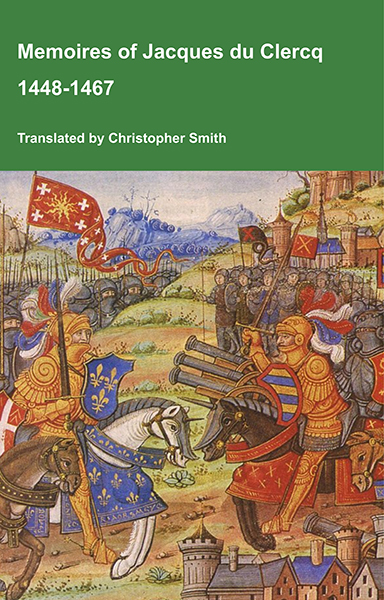
This is a translation of the 'Memoires of Jacques du Clercq', published in 1823 in two volumes, edited by Frederic, Baron de Reissenberg. In his introduction Reissenberg writes: 'Jacques du Clercq tells us that he was born in 1424, and that he was a licentiate in law and a counsellor to Philip the Good, Duke of Burgundy, in the castellany of Douai, Lille, and Orchies. It appears that he established his residence at Arras. In 1446, he married the daughter of Baldwin de la Lacherie, a gentleman who lived in Lille. We read in the fifth book of his Memoirs that his father, also named Jacques du Clercq, had married a lady of the Le Camelin family, from Compiègne. His ancestors, always attached to the counts of Flanders, had constantly served them, whether in their councils or in their armies.' The Memoires cover a period of nineteen years beginning in in 1448, ending in in 1467. It appears that the author had intended to extend the Memoirs beyond that date; no doubt illness or death prevented him from carrying out this plan. As Reissenberg writes the 'merit of this work lies in the simplicity of its narrative, in its tone of good faith, and in a certain air of frankness which naturally wins the reader’s confidence.' Du Clercq ranges from events of national and international importance, including events of the Wars of the Roses in England, to simple, everyday local events such as marriages, robberies, murders, trials and deaths, including that of his own father in Book 5; one of his last entries.
Available at Amazon in eBook and Paperback format.
26th May 1659. Came to see me my Lord George Berkeley [aged 31], Sir William Ducie, and Sir George Pott's son of Norfolk.
29th May 1659. The nation was now in extreme confusion and unsettled, between the Armies and the Sectaries, the poor Church of England breathing as it were her last; so sad a face of things had overspread us.
7th June 1659. To London, to take leave of my brother [aged 41], and see the foundations now laying for a long street and buildings in Hatton Garden, designed for a little town, lately an ample garden.
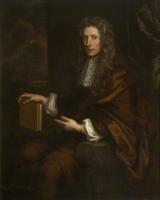
1st September 1659. I communicated to Mr. Robert Boyle [aged 32], son to the Earl of Cork, my proposal for erecting a philosophic and mathematic college.
15th September 1659. Came to see me Mr. Brereton [aged 28], a very learned gentleman, son to my Lord Brereton [aged 48], with his wife and divers other ladies. Also, Henry Howard of Norfolk [aged 31], since Duke of Norfolk.
30th September 1659. I went to visit Sir William Ducie and Colonel Blount [aged 55], where I met Sir Henry Blount [aged 57], the famous traveler and water drinker.
10th October 1659. I came with my wife [aged 24] and family to London: took lodgings at the Three Feathers [Map], in Russell Street, Covent Garden, for the winter, my son being very unwell.
11th October 1659. Came to visit me Mr. William Coventry [aged 31] (since secretary to the Duke), son to the Lord Keeper, a wise and witty gentleman.
11th October 1659. The Army now turned out the Parliament. We had now no government in the nation: all in confusion; no magistrate either owned or pretended; but the soldiers, and they not agreed. God Almighty have mercy on us, and settle us!
17th October 1659. I visited Mr. Howard [aged 31], at Arundel House [Map], who gave me a fair onyx set in gold, and showed me his design of a palace there.
All About History Books on Amazon
Chronicles of the Reigns of Edward I and II Volume 2
The Chronicles of the Reigns of Edward I and Edward II, Volume 2, comprising A Sorrowful Commendation on King Edward, the Life of Edward II by a Monk of Bridlington, Life of Edward II by a Monk of Malmesbury and Life of Edward by Thomas de la More, presents a rich collection of medieval English chronicles illuminating the political, military, ecclesiastical and social upheavals of the late thirteenth and early fourteenth centuries. The volume offers contemporary and near-contemporary accounts of the reigns of Edward I and Edward II, a period marked by war with Scotland, conflict between Crown and nobility, disputes over royal government, ecclesiastical tensions, rebellion, deposition and civil violence. Particular attention is given to the struggle surrounding Piers Gaveston, Thomas of Lancaster and the Despensers, as well as the turbulent final years of Edward II and the political circumstances that shaped the early reign of Edward III. These chronicles are especially valuable for their vivid narrative detail. They preserve speeches, political arguments, descriptions of battles and executions, accounts of parliaments and royal councils, reports of diplomatic missions, ecclesiastical controversies, prodigies and natural events, and contemporary judgements on the conduct of kings, magnates and churchmen. Written from differing institutional and regional perspectives, the texts reveal not only what happened but how medieval observers interpreted events, often through ideas of divine judgement, legitimate kingship, loyalty, treason and moral retribution. An important primary-source collection for readers interested in Edward I, Edward II, medieval politics, the Scottish wars, the baronial opposition, the fall of Edward II, church history and fourteenth-century England, Volume 2 provides an indispensable window into one of the most turbulent periods of the English Middle Ages.
Available at Amazon in eBook and Paperback format.
21st October 1659. A private fast was kept by the Church of England Protestants in town, to beg of God the removal of his judgments, with devout prayers for his mercy to our calamitous Church.
7th November 1659. Was published my bold "Apology for the King" in this time of danger, when it was capital to speak or write in favour of him. It was twice printed; so universally it took.
9th November 1659. We observed our solemn Fast for the calamity of our Church.
12th November 1659. I went to see the several drugs for the confection of treacle, dioscordium, and other electuaries, which an ingenious apothecary had not only prepared and ranged on a large and very long table, but covered every ingredient with a sheet of paper, on which was very lively painted the thing in miniature, well to the life, were it plant, flower, animal, or other exotic drug.
15th November 1659. Dined with the Dutch Ambassador. He did in a manner acknowledge that his nation mind only their own profit, do nothing out of gratitude, but collaterally as it relates to their gain, or security; and therefore the English were to look for nothing of assistance to the banished King. This was to me no very grateful discourse, though an ingenuous confession.
18th November 1659. Mr. Gunning [aged 45] celebrated the wonted Fast, and preached on Phil. II 12, 13.
24th November 1659. Sir John Evelyn [of Godstone, Surrey] invited us to the forty-first wedding-day feast, where was much company of friends.
26th November 1659. I was introduced into the acquaintance of divers learned and worthy persons, Sir John Marsham, Mr. Dugdale [aged 19], Mr. Stanley, and others.
9th December 1659. I supped with Mr. Gunning [aged 45], it being our fast day, Dr. Fearne, Mr. Thrisco, Mr. Chamberlain, Dr. Henchman [aged 67], Dr. Wild, and other devout and learned divines, firm confessors, and excellent persons. Note: Most of them since made bishops.
10th December 1659. I treated privately with Colonel Morley [aged 43], then Lieutenant of the Tower, and in great trust and power, concerning delivering it to the King [aged 29], and the bringing of him in, to the great hazard of my life, but the Colonel had been my schoolfellow, and I knew would not betray me.
12th December 1659. I spent in public concerns for his Majesty [aged 29], pursuing the point to bring over Colonel Morley [aged 43], and his brother-in-law, Fay, Governor of Portsmouth.
All About History Books on Amazon
William of Worcester's Chronicle of England
William of Worcester, born around 1415, and died around 1482 was secretary to John Fastolf, the renowned soldier of the Hundred Years War, during which time he collected documents, letters, and wrote a record of events. Following their return to England in 1440 William was witness to major events. Twice in his chronicle he uses the first person: 1. when writing about the murder of Thomas, 7th Baron Scales, in 1460, he writes '… and I saw him lying naked in the cemetery near the porch of the church of St. Mary Overie in Southwark …' and 2. describing King Edward IV's entry into London in 1461 he writes '… proclaimed that all the people themselves were to recognize and acknowledge Edward as king. I was present and heard this, and immediately went down with them into the city'. William’s Chronicle is rich in detail. It is the source of much information about the Wars of the Roses, including the term 'Diabolical Marriage' to describe the marriage of Queen Elizabeth Woodville’s brother John’s marriage to Katherine, Dowager Duchess of Norfolk, he aged twenty, she sixty-five or more, and the story about a paper crown being placed in mockery on the severed head of Richard, 3rd Duke of York.
Available at Amazon in eBook and Paperback format.
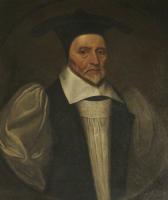
18th December 1659. Preached that famous divine, Dr. Sanderson [aged 72] (since Bishop of Lincoln), now eighty years old, on Jer. xxx. 13, concerning the evil of forsaking God.
29th December 1659. Came my Lord Count Arundel, of Wardour [aged 51], to visit me. I went also to see my Lord Viscount Montague [aged 49].
31st December 1659. Settling my domestic affairs in order, blessed God for his infinite mercies and preservations the past year.