

Bachelor of Arts is in Bachelor.
In 1518 Edward Hall [aged 22] graduated Bachelor of Arts.
In 1522 George Carew [aged 24] graduated Bachelor of Arts at Broadgates Hall, Oxford University.
In 1559 Thomas Egerton 1st Viscount Brackley [aged 19] graduated Bachelor of Arts at Brasenose College, Oxford University.
From 1578 William Ravenscroft [aged 17] was educated at Brasenose College, Oxford University and awarded Bachelor of Arts in 1580.
In 1588 Henry Wallop [aged 19] graduated Bachelor of Arts at St John's College, Oxford University.
On 14th February 1593 Maurice Berkeley [aged 17] was awarded Bachelor of Arts at Queen's College, Oxford University.
In 1594 Archbishop William Laud [aged 20] graduated Bachelor of Arts at St John's College, Oxford University.


In 1598 Robert More [aged 16] was awarded Bachelor of Arts at Corpus Christi College, Oxford University.
In 1607 Richard Newport 1st Baron Newport [aged 19] graduated Bachelor of Arts at Brasenose College, Oxford University.
On 1st July 1612 Vivian Molyneux [aged 16] was awarded Bachelor of Arts.
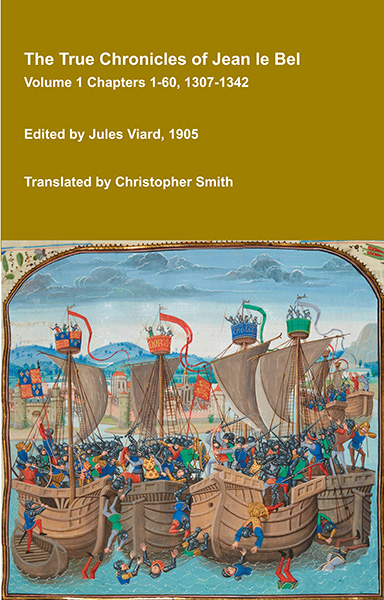
The True Chronicles of Jean le Bel Volume 1 Chapters 1-60 1307-1342
The True Chronicles of Jean le Bel offer one of the most vivid and immediate accounts of 14th-century Europe, written by a knight who lived through the events he describes, and experienced some of them first hand. Covering the early decades of the Hundred Years’ War, this remarkable chronicle follows the campaigns of Edward III of England, the politics of France and the Low Countries, and the shifting alliances that shaped medieval warfare. Unlike later historians, Jean le Bel writes with a strong sense of eyewitness authenticity, drawing on personal experience and the testimony of fellow soldiers. His narrative captures not only battles and sieges, but also the realities of military life, diplomacy, and the ideals of chivalry that governed noble society. A key source for Jean Froissart, Le Bel’s chronicle stands on its own as a compelling and insightful work, at once historical record and literary achievement. This translation builds on the 1905 edition published in French by Jules Viard, adding extensive translations from other sources Rymer's Fœdera, the Chronicles of Adam Murimuth, William Nangis, Walter of Guisborough, a Bourgeois of Valenciennes, Geoffrey le Baker of Swinbroke and Richard Lescot to enrich the original text and Viard's notes.
Available at Amazon in eBook and Paperback format.
On 6th June 1614 Dean Thomas Turner [aged 23] graduated Bachelor of Arts.
In 1626 Thomas Jermyn [aged 9] was awarded Bachelor of Arts at Emmanuel College, Cambridge University.
On 3rd March 1631 Bishop Nicholas Monck [aged 21] graduated Bachelor of Arts at Wadham College, Oxford University.
On 13th June 1639 William Parr [aged 22] commenced his Bachelor of Arts.
On 4th July 1639 Thomas Tully Divine [aged 18] graduated Bachelor of Arts.
In 1649 John Temple [aged 16] was awarded Bachelor of Arts at Christ Church College, Oxford University.
On 19th February 1664 Bishop William Moreton [aged 23] graduated Bachelor of Arts.
In 1668 Henry Godolphin [aged 19] was awarded Bachelor of Arts at Wadham College, Oxford University.
In 1699 Brian Broughton 3rd Baronet [aged 21] was awarded Bachelor of Arts.
In 1709 Thomas Wyndham [aged 23] was awarded Bachelor of Arts at King's College, Cambridge University [Map].
In 1716 Wriothesley Digby [aged 18] was awarded Bachelor of Arts at Magdalen College, Oxford University.
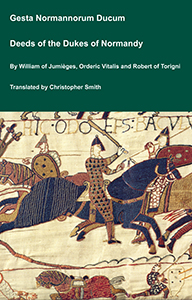
The Deeds of the Dukes of Normandy
The Gesta Normannorum Ducum [The Deeds of the Dukes of Normandy] is a landmark medieval chronicle tracing the rise and fall of the Norman dynasty from its early roots through the pivotal events surrounding the Norman Conquest of England. Originally penned in Latin by the monk William of Jumièges shortly before 1060 and later expanded at the behest of William the Conqueror, the work chronicles the deeds, politics, battles, and leadership of the Norman dukes, especially William’s own claim to the English throne. The narrative combines earlier historical sources with firsthand information and oral testimony to present an authoritative account of Normandy’s transformation from a Viking settlement into one of medieval Europe’s most powerful realms. William’s history emphasizes the legitimacy, military prowess, and governance of the Norman line, framing their expansion, including the conquest of England, as both divinely sanctioned and noble in purpose. Later chroniclers such as Orderic Vitalis and Robert of Torigni continued the history, extending the coverage into the 12th century, providing broader context on ducal rule and its impact. Today this classic work remains a foundational source for understanding Norman identity, medieval statesmanship, and the historical forces that reshaped England and Western Europe between 800AD and 1100AD.
Available at Amazon in eBook and Paperback format.
In 1746 Walter Shirley [aged 20] was awarded Bachelor of Arts at New College, Oxford University.
In 1747 James Brudenell 5th Earl Cardigan [aged 21] graduated Bachelor of Arts at Oriel College, Oxford University.
In 1752 Bishop Frederick Keppel [aged 23] graduated Bachelor of Arts at Christ Church College, Oxford University.
In 1763 Bishop Reginald Courtenay [aged 21] graduated Bachelor of Arts at Christ Church College, Oxford University.
In 1778 Benjamin Hobhouse 1st Baronet [aged 21] graduated Bachelor of Arts at Brasenose College, Oxford University.
In 1795 Reverend Robert Hodgson [aged 21] graduated Bachelor of Arts as 14th Wrangler.
In 1807 Spencer Rodney 5th Baron Rodney [aged 21] was awarded Bachelor of Arts at All Souls College, Oxford University.
In 1822 Edward Chichester 4th Marquess Donegal [aged 22] graduated Bachelor of Arts at Trinity College, Dublin.
In 1828 John Allen Giles [aged 19] was awarded a double first class, and graduated Bachelor of Arts. In 1831 he was awared Master of Arts.
In 1830 Sidney Godolphin Osborne [aged 21] graduated Bachelor of Arts at Brasenose College, Oxford University.
The History of William Marshal was commissioned by his son shortly after William’s death in 1219 to celebrate the Marshal’s remarkable life; it is an authentic, contemporary voice. The manuscript was discovered in 1861 by French historian Paul Meyer. Meyer published the manuscript in its original Anglo-French in 1891 in two books. This book is a line by line translation of the first of Meyer’s books; lines 1-10152. Book 1 of the History begins in 1139 and ends in 1194. It describes the events of the Anarchy, the role of William’s father John, John’s marriages, William’s childhood, his role as a hostage at the siege of Newbury, his injury and imprisonment in Poitou where he met Eleanor of Aquitaine and his life as a knight errant. It continues with the accusation against him of an improper relationship with Margaret, wife of Henry the Young King, his exile, and return, the death of Henry the Young King, the rebellion of Richard, the future King Richard I, war with France, the death of King Henry II, and the capture of King Richard, and the rebellion of John, the future King John. It ends with the release of King Richard and the death of John Marshal.
Available at Amazon in eBook and Paperback format.
In 1840 Edward Frederick Leveson-Gower [aged 20] graduated Bachelor of Arts at Christ Church College, Oxford University.
In 1867 Sewallis Edward Shirley 10th Earl Ferrers [aged 19] was awarded Bachelor of Arts at Trinity College, Cambridge University [Map].