


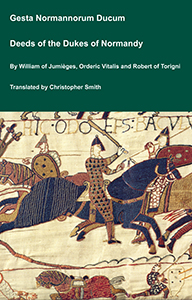
The Deeds of the Dukes of Normandy
The Gesta Normannorum Ducum [The Deeds of the Dukes of Normandy] is a landmark medieval chronicle tracing the rise and fall of the Norman dynasty from its early roots through the pivotal events surrounding the Norman Conquest of England. Originally penned in Latin by the monk William of Jumièges shortly before 1060 and later expanded at the behest of William the Conqueror, the work chronicles the deeds, politics, battles, and leadership of the Norman dukes, especially William’s own claim to the English throne. The narrative combines earlier historical sources with firsthand information and oral testimony to present an authoritative account of Normandy’s transformation from a Viking settlement into one of medieval Europe’s most powerful realms. William’s history emphasizes the legitimacy, military prowess, and governance of the Norman line, framing their expansion, including the conquest of England, as both divinely sanctioned and noble in purpose. Later chroniclers such as Orderic Vitalis and Robert of Torigni continued the history, extending the coverage into the 12th century, providing broader context on ducal rule and its impact. Today this classic work remains a foundational source for understanding Norman identity, medieval statesmanship, and the historical forces that reshaped England and Western Europe between 800AD and 1100AD.
Available at Amazon in eBook and Paperback format.
Paternal Family Tree: Despencer
Maternal Family Tree: Aoife ni Diarmait Macmurrough Countess Pembroke and Buckingham 1145-1188
Around 1280 Patrick Chaworth (age 30) and [his mother] Isabella Beauchamp (age 17) were married. She the daughter of [his grandfather] William Beauchamp 9th Earl Warwick (age 43) and [his grandmother] Maud Fitzjohn Countess Warwick (age 42).
Before 1286 [his father] Hugh "Elder" Despencer 1st Earl Winchester (age 24) and [his mother] Isabella Beauchamp (age 22) were married. She the daughter of [his grandfather] William Beauchamp 9th Earl Warwick (age 48) and [his grandmother] Maud Fitzjohn Countess Warwick (age 47).
In 1286 Hugh "Younger" Despencer 1st Baron Despencer was born to [his father] Hugh "Elder" Despencer 1st Earl Winchester (age 24) and [his mother] Isabella Beauchamp (age 23).
On 24th June 1295 [his father] Hugh "Elder" Despencer 1st Earl Winchester (age 34) was created 1st Baron Despencer with precedence from 24th June 1264. The precedence is based on his being summoned to a Parliament by Simon de Montfort 6th Earl of Leicester 1st Earl Chester, the validity of which is subject to discussion.
After 3rd May 1302 [his brother-in-law] Edward Burnell (age 16) and [his sister] Aline Despencer Baroness Burnell were married. She the daughter of [his father] Hugh "Elder" Despencer 1st Earl Winchester (age 41) and [his mother] Isabella Beauchamp (age 39). They were fourth cousins. He a great x 4 grandson of King John of England. She a great x 5 granddaughter of King Henry I "Beauclerc" England.
On 22nd May 1306 the Feast of the Swans was a collective knighting of two hundred and sixty seven men at Westminster Abbey [Map].
At the feast, following the knightings, two swans were brought in. King Edward I of England (age 66) swore before God and the swans to avenge the death of John Comyn 3rd Lord Baddenoch - see Murder of John "Red" Comyn.
King Edward I of England first knighted his son King Edward II of England (age 22).
King Edward II of England then knighted the remaining two-hundred and sixty-six including...
Hugh "Younger" Despencer 1st Baron Despencer (age 20)
Edmund Fitzalan 2nd or 9th Earl of Arundel (age 21)
John le Blund, Mayor of London
William Brabazon
Roger Mortimer 1st Baron Mortimer of Chirk (age 50)
Piers Gaveston 1st Earl Cornwall (age 22) - this may have been the first time Piers Gaveston 1st Earl Cornwall and King Edward II of England met?
John Harrington 1st Baron Harington (age 25)
John Maltravers 1st Baron Maltravers (age 16)
Roger Mortimer 1st Earl March (age 19)
William Montagu 2nd Baron Montagu (age 31)
John Mowbray 2nd Baron Mowbray (age 19)
Thomas Multon 1st Baron Multon (age 30)
John Warenne 7th Earl of Surrey (age 19)
 Become a Member via our Buy Me a Coffee page to read more.
Before 30th May 1306 [his mother] Isabella Beauchamp (age 43) died.
After 14th July 1306 Hugh "Younger" Despencer 1st Baron Despencer (age 20) and Eleanor Clare Baroness Zouche Mortimer (age 13) were married. She the daughter of Gilbert "Red Earl" Clare 7th Earl Gloucester 6th Earl Hertford and Joan of Acre Countess Gloucester and Hertford (age 34). He the son of Hugh "Elder" Despencer 1st Earl Winchester (age 45) and Isabella Beauchamp. They were third cousin once removed. He a great x 5 grandson of King Henry I "Beauclerc" England. She a granddaughter of King Edward I of England.
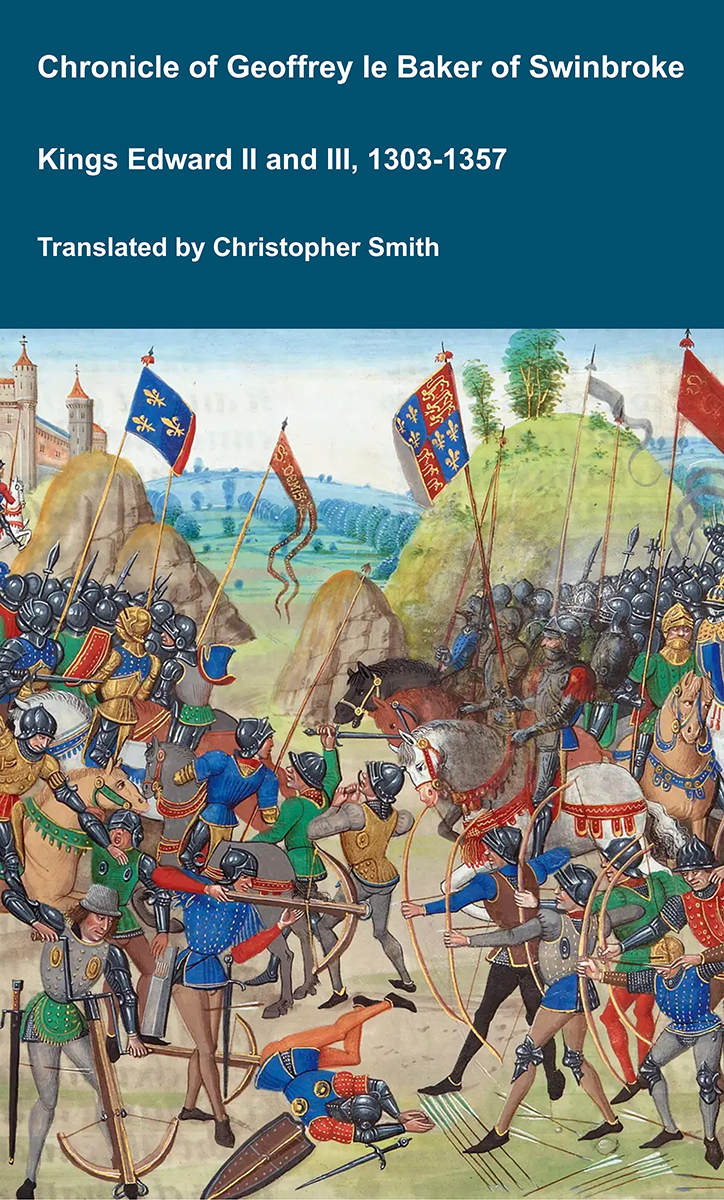
Chronicle of Geoffrey le Baker of Swinbroke
Baker was a secular clerk from Swinbroke, now Swinbrook, an Oxfordshire village two miles east of Burford. His Chronicle describes the events of the period 1303-1356: Gaveston, Bannockburn, Boroughbridge, the murder of King Edward II, the Scottish Wars, Sluys, Crécy, the Black Death, Winchelsea and Poitiers. To quote Herbert Bruce 'it possesses a vigorous and characteristic style, and its value for particular events between 1303 and 1356 has been recognised by its editor and by subsequent writers'. The book provides remarkable detail about the events it describes. Baker's text has been augmented with hundreds of notes, including extracts from other contemporary chronicles, such as the Annales Londonienses, Annales Paulini, Murimuth, Lanercost, Avesbury, Guisborough and Froissart to enrich the reader's understanding. The translation takes as its source the 'Chronicon Galfridi le Baker de Swynebroke' published in 1889, edited by Edward Maunde Thompson.
Available at Amazon in eBook and Paperback format.
In 1308 [his son] Hugh Despencer 1st Baron Despencer was born to Hugh "Younger" Despencer 1st Baron Despencer (age 22) and [his wife] Eleanor Clare Baroness Zouche Mortimer (age 15). He a great grandson of King Edward I of England. He married before 27th April 1341 Elizabeth Montagu Baroness Badlesmere and Despencer, daughter of William Montagu 1st Earl Salisbury and Catherine Grandison Countess of Salisbury.
In 1309 [his son] Gilbert Despencer was born to Hugh "Younger" Despencer 1st Baron Despencer (age 23) and [his wife] Eleanor Clare Baroness Zouche Mortimer (age 16). He a great grandson of King Edward I of England.
Before 1310 [his brother-in-law] John Hastings 13th Baron Abergavenny 1st Baron Hastings (age 47) and [his sister] Isabel Despencer Baroness Hastings and Bergavenny were married. She by marriage Baroness Hastings, Baroness Abergavenny Feudal Creation. She the daughter of [his father] Hugh "Elder" Despencer 1st Earl Winchester (age 48) and [his mother] Isabella Beauchamp. They were third cousin once removed. He a great x 5 grandson of King Henry I "Beauclerc" England. She a great x 5 granddaughter of King Henry I "Beauclerc" England.
In 1310 [his son] Edward Despencer was born to Hugh "Younger" Despencer 1st Baron Despencer (age 24) and [his wife] Eleanor Clare Baroness Zouche Mortimer (age 17). He a great grandson of King Edward I of England. He married before 24th March 1335 his second cousin Anne Ferrers, daughter of William Ferrers 1st Baron Ferrers of Groby and Ellen or Margaret Segrave Baroness Ferrers Groby, and had issue.
In 1311 [his son] John Despencer was born to Hugh "Younger" Despencer 1st Baron Despencer (age 25) and [his wife] Eleanor Clare Baroness Zouche Mortimer (age 18). He a great grandson of King Edward I of England.
On 19th December 1311 [his brother-in-law] Edward Burnell (age 25) was created 1st Baron Burnell. [his sister] Aline Despencer Baroness Burnell by marriage Baroness Burnell.
In 1312 [his daughter] Isabel Despencer Countess Arundel was born to Hugh "Younger" Despencer 1st Baron Despencer (age 26) and [his wife] Eleanor Clare Baroness Zouche Mortimer (age 19). She a great granddaughter of King Edward I of England. She married (1) 9th February 1321 her half third cousin once removed Richard Fitzalan 3rd or 10th Earl of Arundel 8th Earl of Surrey, son of Edmund Fitzalan 2nd or 9th Earl of Arundel and Alice Warenne Countess Arundel, and had issue.
Around 1313 [his brother-in-law] Ralph Monthermer 1st Earl of Gloucester and Hertford (age 43) and [his sister] Isabel Despencer Baroness Hastings and Bergavenny were married. She the daughter of [his father] Hugh "Elder" Despencer 1st Earl Winchester (age 51) and [his mother] Isabella Beauchamp.
On 29th July 1314 Hugh "Younger" Despencer 1st Baron Despencer (age 28) was created 1st Baron Despencer.
In 1315 [his daughter] Eleanor Despencer was born to Hugh "Younger" Despencer 1st Baron Despencer (age 29) and [his wife] Eleanor Clare Baroness Zouche Mortimer (age 22). She a great granddaughter of King Edward I of England.
In 1315 [his brother-in-law] Edward Burnell (age 29) died. Baron Burnell extinct. His widow Aline Despencer Baroness Burnell retained Acton Burnell Castle [Map]. His sister Maud Burnell Baroness Lovel and Burnell (age 25) inherited his estates.
On 2nd January 1315 Piers Gaveston 1st Earl Cornwall was buried at King's Langley Priory, Hertfordshire [Map] some two and a half years after his murder. The ceremony was attended by King Edward II of England (age 30) and his wife Isabella of France Queen Consort England (age 20) as well as Humphrey Bohun 4th Earl Hereford 3rd Earl Essex (age 39), Aymer de Valence 2nd Earl Pembroke (age 40), Thomas of Brotherton 1st Earl Norfolk (age 14), Bartholomew Badlesmere 1st Baron Badlesmere (age 39), Hugh Despencer 1st Baron Despencer (age 7) and his son Hugh "Younger" Despencer 1st Baron Despencer (age 29).
In 1317 [his daughter] Joan Despencer was born to Hugh "Younger" Despencer 1st Baron Despencer (age 31) and [his wife] Eleanor Clare Baroness Zouche Mortimer (age 24). She a great granddaughter of King Edward I of England.
Henrici Quinti, Angliæ Regis, Gesta, is a first-hand account of the Agincourt Campaign, and subsequent events to his death in 1422. The author of the first part was a Chaplain in King Henry's retinue who was present from King Henry's departure at Southampton in 1415, at the siege of Harfleur, the battle of Agincourt, and the celebrations on King Henry's return to London. The second part, by another writer, relates the events that took place including the negotiations at Troye, Henry's marriage and his death in 1422.
Available at Amazon in eBook and Paperback format.
After 15th September 1317 William Zouche 1st Baron Zouche Mortimer (age 52) and [his wife] Eleanor Clare Baroness Zouche Mortimer (age 24) were married. The difference in their ages was 27 years. She the daughter of Gilbert "Red Earl" Clare 7th Earl Gloucester 6th Earl Hertford and [his mother-in-law] Joan of Acre Countess Gloucester and Hertford.
Around 1319 [his daughter] Margaret Despencer was born to Hugh "Younger" Despencer 1st Baron Despencer (age 33) and [his wife] Eleanor Clare Baroness Zouche Mortimer (age 26) at Stoke, Gloucestershire. She a great granddaughter of King Edward I of England.
On 19th April 1319 Thomas Beauchamp 11th Earl Warwick (age 6) and Katherine Mortimer Countess Warwick (age 5) were married. She by marriage Countess Warwick. An arranged marriage although not clear who arranged it or whose ward Thomas Beauchamp 11th Earl Warwick was (his father [his uncle] Guy Beauchamp 10th Earl Warwick had died four years before) - possibly by King Edward II of England (age 34) as a means of securing the Welsh March. The Beauchamp family established, the Mortimer family aspirational. The marriage took place after Roger Mortimer 1st Earl March (age 31) had returned from his tenure as Lord Lieutenant of Ireland and before he rebelled against King Edward II of England in opposition to Hugh "Younger" Despencer 1st Baron Despencer (age 33). She the daughter of Roger Mortimer 1st Earl March and Joan Geneville Baroness Mortimer 2nd Baroness Geneville (age 33). He the son of Guy Beauchamp 10th Earl Warwick and Alice Tosny Countess Warwick (age 34). They were half second cousin once removed. She a great x 4 granddaughter of King John of England.
In 1321 [his father] Hugh "Elder" Despencer 1st Earl Winchester (age 59) and his son Hugh "Younger" Despencer 1st Baron Despencer (age 35) were exiled.
On 9th February 1321 [his son-in-law] Richard Fitzalan 3rd or 10th Earl of Arundel 8th Earl of Surrey (age 15) and [his daughter] Isabel Despencer Countess Arundel (age 9) were married at Havering atte Bower, Essex [Map]. She by marriage Countess Arundel. He the son of Edmund Fitzalan 2nd or 9th Earl of Arundel (age 35) and Alice Warenne Countess Arundel. They were half third cousin once removed. He a great x 5 grandson of King John of England. She a great granddaughter of King Edward I of England.
Before 22nd March 1322, the date he was executed, Thomas Plantagenet 2nd Earl of Leicester, 2nd Earl Lancaster, Earl of Salisbury and Lincoln (age 44) was tried by a tribunal consisting of, among others, [his father] Hugh "Elder" Despencer 1st Earl Winchester (age 61), Hugh "Younger" Despencer 1st Baron Despencer (age 36) and Edmund Fitzalan 2nd or 9th Earl of Arundel (age 36). He was not allowed to speak in his defence, nor was he allowed to have anyone speak for him. He was convicted of treason and sentenced to death.
On 10th May 1322 [his father] Hugh "Elder" Despencer 1st Earl Winchester (age 61) was created 1st Earl Winchester.
In 1323 William Zouche 1st Baron Zouche Mortimer (age 58) was created 1st Baron Zouche Mortimer. [his wife] Eleanor Clare Baroness Zouche Mortimer (age 30) by marriage Baroness Zouche Mortimer.
In 1325 [his daughter] Elizabeth Despencer Baroness Berkeley was born to Hugh "Younger" Despencer 1st Baron Despencer (age 39) and [his wife] Eleanor Clare Baroness Zouche Mortimer (age 32). She a great granddaughter of King Edward I of England. She married August 1338 her half third cousin once removed Maurice Berkeley 9th and 4th Baron Berkeley, son of Thomas Berkeley 8th and 3rd Baron Berkeley and Margaret Mortimer Baroness Berkeley, and had issue.

After 1326. Tewkesbury Abbey [Map]. The remnants of the monument to Hugh "Younger" Despencer 1st Baron Despencer (age 40).
On 27th October 1326 [his father] Hugh "Elder" Despencer 1st Earl Winchester (age 65) was hanged, drawn and quartered at Bristol, Gloucestershire [Map]. Earl Winchester, Baron Despencer forfeit as a result of attainder.
On 24th November 1326 Hugh "Younger" Despencer 1st Baron Despencer (age 40) was hanged, drawn and quartered in Hereford [Map]. Baron Despencer forfeit.
Simon of Reading was also hanged, drawn and quartered the same day.
Isabella of France Queen Consort England (age 31) and Roger Mortimer 1st Earl March (age 39) were present - see Chronicle of Geoffrey le Baker.
The Deeds of the Dukes of Normandy
The Gesta Normannorum Ducum [The Deeds of the Dukes of Normandy] is a landmark medieval chronicle tracing the rise and fall of the Norman dynasty from its early roots through the pivotal events surrounding the Norman Conquest of England. Originally penned in Latin by the monk William of Jumièges shortly before 1060 and later expanded at the behest of William the Conqueror, the work chronicles the deeds, politics, battles, and leadership of the Norman dukes, especially William’s own claim to the English throne. The narrative combines earlier historical sources with firsthand information and oral testimony to present an authoritative account of Normandy’s transformation from a Viking settlement into one of medieval Europe’s most powerful realms. William’s history emphasizes the legitimacy, military prowess, and governance of the Norman line, framing their expansion, including the conquest of England, as both divinely sanctioned and noble in purpose. Later chroniclers such as Orderic Vitalis and Robert of Torigni continued the history, extending the coverage into the 12th century, providing broader context on ducal rule and its impact. Today this classic work remains a foundational source for understanding Norman identity, medieval statesmanship, and the historical forces that reshaped England and Western Europe between 800AD and 1100AD.
Available at Amazon in eBook and Paperback format.
Froissart Book 1: 1307-1340. [27th October 1326] 14. When the queen (age 31), the barons, and the others were comfortably lodged, they laid siege to the castle as closely as they could. Then the queen had Sir [his father] Hugh Despenser the elder (age 65) and the Earl of Arundel (age 41) brought before her eldest son and all the barons who were there, and said that she and her son would give them justice and a fair trial, according to their deeds and actions. Then Sir Hugh replied: 'Ah, lady, may God grant us a just judge and a fair judgment; and if we cannot have it in this world, may He give it to us in the next!' Then rose Sir Thomas Wake (age 29), a good knight, wise and courteous, who was marshal of the army. He recited all their deeds from a written record, and then turned to an old knight who was there, so that he might deliver a judgment, based on the faith owed by men in such matters, and on the nature of such crimes. The knight consulted with the other barons and knights and then delivered his full judgment: that they had well deserved death, based on the many horrible deeds recounted there against them, which were held to be true and clear. And they had, by the diversity of their crimes, deserved to be executed in three ways: first to be drawn, then beheaded, and finally hanged from the gallows. And just as they were judged, so were they immediately executed before the castle of Bristol, in sight of the king and of the said Sir Hugh the younger (age 40), and of all those inside, who were filled with deep grief and outrage. And it may be understood that they were in great anguish of heart. This execution was carried out in the year of grace 1326, on the feast of Saint Denis, in October.
14. Quant la royne et tout li baron et li aultre furent herbergiet à leur aise, il assegièrent le chastiel, au plus priès qu'il peurent. Et puis fist la royne ramener monsigneur Huon le Despensier le vielle et le conte d'Arondiel devant son ainsnet fil, et devant tous les barons qui là estoient, et leur dist que elle et ses filz leur feroient droit et loy et bon jugement, selonch leurs fais et leurs œuvres. Adonc respondi messires Hues et dist: «Ha! dame, Diex nous voelle donner bon juge et bon jugement; et se nous ne le poons avoir en ce siècle, si le nous doinst en l'autre!» Adonc se leva messires Thumas Wage, bons chevaliers, sages et courtois, qui estoit mareschaus de l'ost, et leur racompta tous leurs fais par escript, et tourna en droit sus un viel chevalier qui là estoit, afin qu'il raportast sus se feauté que à faire avoit de telz personnes, par jugement, et de telz fais. Li chevaliers se consilla as autres barons et chevaliers, et raporta par plainne sieute que il avoient bien mort desservie, par pluiseurs horribles fais qu'il avoient là endroit oys racompter, et les tenoient pour vrais et tous clers. Et avoient desservi, par le diversité de leurs fais, à estre justiciés en trois manières, c'est à savoir, premiers traynés, et puis decolés, apriès pendus à un gibet. Tout en tel manière qu'il furent jugiet, furent il tantost justiciet par devant le chastiel de Bristo, veant le roy, et veant le dit monsigneur Huon le fil, et tous ceulz de laiens qui grant despit en eurent. Et puet çascuns savoir que il estoient à grant meschief de cuer. Ceste justice fu faite l'an de grasce mil trois cens vingt et six, le jour saint Denis, en octembre.
Become a Member via our Buy Me a Coffee page to read more.
. [17th November 1326]. Lord Hugh Despenser the Younger (age 40), Robert de Baldock, and Simon of Reading were brought to the Queen, who was at Hereford. However, before their arrival, the Earl of Arundel (age 41), John Daniel, and Thomas de Micheldever were beheaded in Hereford through the agency of Lord Roger Mortimer (age 39), who harbored a deep hatred for them and whose advice the Queen followed in all matters.
Dominum vero Hugonem Dispenser filium, Robertum de Baldok, et Simonem de Redynges ad reginam, que fuit Herefordiæ, conduxerunt. Sed ante eorum adventum fuerunt decollati Herefordiæ comes de Arundel, Johannes Daniel, et Thomas de Michedeure, per procurationem domini Rogeri de Mortuo mari, qui perfecto odio oderat illos et cujus consilium regina per omnia sequebatur.
Chronicle of Geoffrey le Baker of Swinbroke. Afterwards, the Earl of Gloucester,1 Hugh Despenser the Younger (age 40), was brought forth in chains to the fierce and wrathful gaze of the queen. Without waiting for the reasoning of any judge, he was dragged [24th November 1326] from the city, namely, Hereford, hanged, beheaded, and quartered. His head was sent to London Bridge, and his four quarters were distributed to the four corners of the realm. Simon of Reading2 was likewise drawn and hanged there.
Postea comes Gloucestrie, Hugo de Spenser filius, in vinculis oblatus oculis terribilibus indignate, non expectata raciocinacione cuiuscumque iudicis, fuit ab eadem civitate, scilicet Herefordie, tractus, suspensus, decollatus, et in quarterias divisus; cuius capud fuit missum ad pontem Londoniarum, et quatuor quarteria ad quatuor regni partes fuerunt distributa. Simon eciam de Redynge fuit ibidem tractus et suspensus.
Note 1. Knighton 2546.
A passage from the Brute chronicle [Harley MS. 2279] may be here quoted: "But sir Hugh the Spencer, after the tyme that he was take, wolde ete no manor mete nother drink no maner drink, for he wiste to have no mercie, but oneliche he wiste he shulde bene dede. And the quene and her councel tho had ordeynede that he shulde have bene don to deth atte London; but he was so febil for his mychel fastyng that he was dede almoste for fastyng, and therfor hit was ordeynede that he shulde have his iugement atte Herforde. And atte a place of the toune his hood was take fro his heed, and also from Robert of Baldok, that was a fals piled clerk also and the kynges chaunceler. And men sette uppon hire heedes chaplettis of sharpe nettelis, and ij squyers blewe in hire eeres ij grete bugle homes uppon tho ij prisoners, fat men myjte hure there blowyng oute with homes mo than a thousand. And on Symounde of Redyng, the kyngis marshal, bifore hem bare her armes uppon a spere reversid, in tokene that thei shulde bene undone for evermore. And uppon the morue was sir Hugh the Spencer, the sone, dampnede to the dethe, and was drawe and hongede, biheveded, and his bowellis taken oute of his bodie and his bowellis brente; and, after, he was quarterede and his quarteres sente to iiij tounes of Engelonde, and his heed sente to London brigge. And this Symounde, for inchesone he despisede the quene Isabella, he was drawe and hongede in a stage made amydde the forsaid sir Hughes galwes. And the same day, a litel fro thennes, was sir John of Arundel bihedede, for he was one of sir Hugh the Spencers councellers. And anone after was sir Hugh the Spencer drawe and hongede and bihedede atte Bristowe, and, after, hongede ayein by the armes with ij strong ropis; and, fe iiij day after, he was hewe al to peces, and houndes eten him. And, for that inchesone that the kyng had geven the erle of Wynchestre his heed, hit was lad thider and putte uppon a spere. And the fals Baldok was sente to London, and ther he deide in prison emong theves; for men dede him no more reverence fan men wolde done unto an hounde. And so deyden the treytours of Engelonde, blessid be almyjti God; and hit was no wonder, for thurgh hire councele the good erle Thomas of Lancastre was done unto deth."
Froissart Book 1: 1307-1340. [24th November 1326] 18. After the feast had ended, the said Sir Hugh (age 40), who was thoroughly hated, was brought before the queen and all the assembled barons and knights. There, all his deeds were recited to him from a written record, and he said nothing in his defence. As a result, he was judged then and there, unanimously by all the barons and knights, to die and to be executed in the manner you shall now hear. First, he was drawn through the streets of Hereford on a hurdle, accompanied by trumpets and horns, from one street to another. Then he was brought to a large square in the town, where all the people were assembled. There, he was placed high upon a scaffold, so that everyone, both great and small, could see him. A large fire had been built in that same square. When he was thus displayed, his genitals were first cut off, because he was accused of being a heretic and a sodomite — as was also said of the king himself. It was claimed that it was through his urging that the king had driven the queen away. When his genitals were cut off, they were thrown into the fire and burned. Next, his belly was slit open, and his heart and entrails were taken out and thrown into the fire to burn — because he was judged to be false of heart and a traitor, and because, by his treacherous counsel and persuasion, the king had brought shame and misfortune upon the realm and had caused the execution of the greatest barons of England, who should have upheld and defended the kingdom. Furthermore, he had so manipulated the king that he would neither see nor acknowledge his queen nor his eldest son, who ought to have been their lord; rather, he had driven them from the kingdom, endangering their lives. After Sir Hugh had been thus dealt with, as described, his head was cut off and sent to the city of London. His body was then cut into four quarters, which were sent to the four greatest cities in England after London.
18. Quant li feste fu passée, li dis messires Hues qui point n'estoit amés, là endroit fu amenés par devant le royne et tous les barons et chevaliers, qui là estoient assamblet. Là li furent recordet tout si fet par escript, que onques ne dist riens à l'encontre: si ques là endroit il fu jugiés, par plainne sieute, de tous les barons et chevaliers, à mort, et à justicier, en tel manière com vous orés. Premierement, il fu traynés sour un bahut, à trompes et à trompètes, par toute la ville de Harfort, de rue en rue. Et puis fu amenés en une grant place, en le ville, là où tous li peuples estoit assamblés. Là endroit fu il loiiés haut sus une eschielle, si ques çascuns, petis et grans, le pooient veoir. Et avoit on fait en le ditte place un grant feu. Quant il fut ensi loiiés, on li copa tout premiers le vit et les coulles, par tant qu'il estoit herites et sodomites, ensi que on disoit meismement del roy. Et pour ce avoit decaciet li rois la royne ensus de lui et par son enhort. Quant li vis et les coulles li furent coppées, on les getta ou feu, et furent arses. Apriès, on li fendi le ventre, et li osta on tout le coer et le coraille, et le getta on ou feu pour ardoir, par tant qu'il estoit faulz de coer et traittes, et que, par son traitte conseil et enhort, li rois avoit honni son royaume et mis à meschief, et avoit fait decoler les plus grans barons d'Engleterre, par les quels li royaumes devoit estre soustenus et deffendus. Et avoech ce il avoit si enhortet le roy qu'il ne pooit ou ne voloit veoir la royne sa femme, ne son ainsnet fil, qui devoit estre leurs sires; ains les avoit decaciés, par doubtance de leurs corps, hors dou royaume. Apriès, quant li dis messires Hues fu ensi atournés, comme dit est, on li coppa le teste, et fu envoiie en le chité de Londres; et puis fu il decopés en quatre quartiers. Et furent tantost envoiiet as quatre milleurs cités d'Engleterre apriès Londres.
Become a Member via our Buy Me a Coffee page to read more.
The Brut. [24th November 1326]. And oppon þe morwe was Sir Hugh þe Spenser (age 40) þe sone dampnede to deþ; and was draw and hongede, biheuedet, & his boweiles taken out of his body, and his bowelles brent. And after he was quarterede, & his quarteres sent to iiij tounes of Engeland, and his heuede sent to London Brigge.
Froissart Book 1: 1307-1340. 15. After this execution had taken place, as you have heard, the king and Sir Hugh Despenser (age 40), who found themselves besieged in such anguish and peril, and saw no hope of comfort or rescue from anywhere, set out one morning, the two of them with only a small company, in a small boat, by sea, from behind the castle, intending to flee to the kingdom of Wales, if they could for they would gladly have escaped. But God did not will to allow it, for their sins weighed against them. And what happened was a great wonder and a great miracle: for they spent eleven full days in that little boat, trying as hard as they could to row, but no matter how far they tried to go, every day the wind, by God's will, blew against them and carried them back, once or twice each day, to within barely a quarter-league of the same castle [Map] from which they had departed. So every day, they were clearly seen by those in the queen's army.
15. Apriès ce que ceste justice fu faite, si com vous avés oy, li rois et messires Hues li Despensiers, qui se veoient assegiet à tèle angousse et à tel meschief, et ne savoient nul confort qui leur peuist là endroit de nulle part venir, se misent à une matinée, entre yaus deus, à peu de mesnie, en un petit batiel, en mer, par derrière le chastiel, pour aler ou royaume de Galles, s'il peuissent, comme cil qui volentiers se fuissent sauvé. Mais Diex ne le volt mies souffrir, car leurs pechiés les encombra. Si lor avint grant merveille et grant miracle, car il furent onze jours tous plains en ce batelet, et s'efforçoient de nagier tant qu'il pooient, mais il ne pooient si lonch nagier que tous les jours li vens, qui leur estoit contraires par le volenté de Dieu, les ramenoit çascun jour, une fois ou deus, à mains de le quarte partie d'une liewe priès dou dit chastiel dont il estoient parti; si ques tous les jours les veoient bien cil de l'ost le royne.
On 16th November 1326 King Edward II of England (age 42) was captured at Pant y Brâd, Llantrisant. He was imprisoned at Llantrisant Castle, Glamorganshire [Map]. Thereafter he was taken to Kenilworth Castle [Map], then Berkeley Castle [Map]. With him at the time of his capture were Hugh "Younger" Despencer 1st Baron Despencer (age 40), Robert Holden, controller of his wardrobe; Robert Baldock, chancellor of England; two knights, one sergeant-at-arms, one valet and one clerk.
On 30th June 1337 [his former wife] Eleanor Clare Baroness Zouche Mortimer (age 44) died.

Founders and Benefactors of Tewkesbury Abbey. fol. 021r: Hugh II Despenser, Earl of Gloucester (d. 1326), became lord through marriage to Gilbert III's sister [[his former wife] Eleanor Clare Baroness Zouche Mortimer]. A youthful figure in a ruff, wearing a hat with the three feathers of the Prince of Wales, plate armour and a mantle over his heraldic surcoat; he holds a hawk on his unprotected left hand. He was Lord Chamberlain to King Edward of Carnarvon. Three shields.
Henrici Quinti, Angliæ Regis, Gesta, is a first-hand account of the Agincourt Campaign, and subsequent events to his death in 1422. The author of the first part was a Chaplain in King Henry's retinue who was present from King Henry's departure at Southampton in 1415, at the siege of Harfleur, the battle of Agincourt, and the celebrations on King Henry's return to London. The second part, by another writer, relates the events that took place including the negotiations at Troye, Henry's marriage and his death in 1422.
Available at Amazon in eBook and Paperback format.
Chronicle of Geoffrey le Baker of Swinbroke. An old hatred against the Earls of Winchester and Gloucester, Hugh and Hugh, resurfaced. Though it had somewhat abated after the king's victory at Boroughbridge, or had at least been hidden out of fear of royal power, it now regained strength, rekindled with even greater clarity than before. Many nobles who had taken up arms under the Earl of Lancaster had, as mentioned, been spared by royal clemency. But these earls, Hugh Despenser the Elder and Hugh Despenser the Younger, manipulated the king's will, as if he were under a spell, and brought about the execution of men who had only survived due to that same royal mercy. These men believed they could only escape death by purchasing the goodwill of the two Hughs. As a result, many of them, not out of joy but under pressure and grief, gave up beautiful manors from their hereditary estates to the said earls in exchange for the promise of safety.
Contra comites Wintonie et Gloucestrie Hugonem et Hugonem procerum regni odium antiquum, post regis victoriam apud Borowbrigge aliqualiter mitigatum aut cercius timore potencie regalis occultatum, causa clariore quam fuerat antiquum vires non erectum set repens resumpsit. Multis nempe nobilibus sub comite Lancastrie contra regem armatis pepercit, ut dictum est, regia clemencia, quibus comites prefati, animum regis quasi fascinatum ad libitum tractantes, intulerunt mortem de merito, quam non nisi per graciam predictorum comitum Hugonis et Hugonis evadere se posse non putabant; unde multi istorum diversas manerias pulcherrimas de sua hereditate pro securitate vite promissa predictis comitibus sepe nominandis non hilares datores set ex tristicia et ex necessitate vendiderunt.
Chronicle of Geoffrey le Baker of Swinbroke. In the following year, by the counsel and ordinance of the prelates and other nobles, Hugh Despenser the Younger was appointed chamberlain of the king,1 in place of Peter, who had previously been removed. Unless the common reports are entirely false, the king had not only never loved him before but had even hated him. And so they more willingly chose him for this office, though later, when the king's disposition toward him changed for the better, those who had first promoted him came to despise him. Hugh's father was then still alive and prospering, a knight of great virtue, prudent in counsel, and valiant in arms. However, the downfall and ignominious end that eventually befell him were largely due to the excessive and disordered love he bore for his son, a man of striking physical beauty, but possessed of an insufferable arrogance and utterly depraved in his actions. Driven by ambition and greed, he advanced from disinheriting widows and orphans to the destruction of the king's chief nobles, and ultimately to his own ruin and that of his father.
Anno sequenti, ex consilio et ordinacione prelatorum et aliorum nobilium, Hugo Despenser filius fuit ordinatus camerarius regis loco Petri prius de medio subtracti, quem, nisi valentes dicere wlgo menciantur, rex antea nedum minime dilexit immo odivit; et eo libencius ad idem officium ipsum elegerunt, qui postmodum, regis animo erga ipsum in benignius commutato, eundem exosum habuerunt. Istius Hugonis pater tunc feliciter superstes erat, magne probitatis miles, consilio providus, armis strenuus, cuius confusionem et ignominiosum finem accumulavit amor naturalis set deordinatus quem visceribus paternis gessit erga predictum filium suum, corpore formosissimum, spiritu superbissimum, actu flagiciosissimum; quem spiritus ambicionis et cupiditatis a viduarum et orfanorum exheredacione in necem nobilium regis precipuorum et sui ipsius atque patris interitum precipitarunt.
Note 1. For a summary of the different estimates formed by contemporary writers of the conduct of the two Despensers, see Bishop Stubbs's Introduction to his Chronicles of the Reigns of Edward I and Edward II, volume 2 pp. 1. The younger Despenser was at first of Lancaster's party. He was continued in his office of chamberlain by the parliament of 1318, in which Lancaster's influence predominated.
Chronicle of Geoffrey le Baker of Swinbroke. These matters concluded, the queen turned her attention to the Marches and remained at Hereford for a month. There, she divided her army and sent part of it with Henry, Earl of Leicester, and Master Rhys ap Howell,1 a Welsh cleric, to capture the king and those with him. The aforementioned earl was the brother and heir of the oft-mentioned Earl Thomas of Lancaster, and the said Rhys, who was sent with him, had once been imprisoned by royal justice in the Tower of London, but had been restored to liberty through the queen's power. Both the said earl and Rhys held estates and wide dominions near the place where the king was hiding; moreover, Rhys was very well known throughout the entire region. At last, the said earl and the cleric, through the corruption of the Welsh with a large sum of money, found the king in the monastery of Neath, along with Hugh Despenser the Younger, who had been left behind, seeking safety in flight. They were discovered by Welsh spies. Thus the king was captured, along with the said Hugh, the Earl of Gloucester, Master Robert de Baldock, and Simon de Reading; the others were left behind without pursuit.
Hiis ita confectis, ad partes marchie regina conversa, apud Herefordiam per mensem commorata, exercitum dividit, et cum eius una parte misit Henricum comitem Laicestrie et magistrum Resum ap Howel clericum, nacione Wallicum, comprehendere regem et sibi aderentes. Predictus comes erat germanus sepenominati et heres comitis Thome Lancastrie; et iste Resus, secum missus, quondam iusticia regali in turri Londoniarum incarceratus erat, set per regine potenciam sue libertati restitutus. Tam comes predictus quam iste Resus habuerunt possessiones et ampla dominia iuxta locum in quo rex latitabat; fuitque preterea Reso tota patria valde nota. Predicti finaliter comes et clericus, non sine magne pecunie interventu Wallicis corruptis, regem in monasterio de Neth, Hugonem Dispenser filium, desertum pro fuge presidio capescentem, per exploratores Wallicos invenerunt.
Note 1. Rhys ap Howell was implicated in the rebellion of 1322 but surrendered to the king. He was sent prisoner to Dover. .
Kings Wessex: Great x 13 Grand Son of King Alfred "The Great" of Wessex
Kings Gwynedd: Great x 11 Grand Son of Maredudd ab Owain King Deheubarth King Powys King Gwynedd
Kings Seisyllwg: Great x 13 Grand Son of Hywel "Dda aka Good" King Seisyllwg King Deheubarth
Kings Powys: Great x 11 Grand Son of Maredudd ab Owain King Deheubarth King Powys King Gwynedd
Kings England: Great x 5 Grand Son of King Henry I "Beauclerc" England
Kings Franks: Great x 16 Grand Son of Charles "Charlemagne aka Great" King of the Franks King Lombardy Holy Roman Emperor
Kings France: Great x 9 Grand Son of Hugh I King of the Franks
Kings Duke Aquitaine: Great x 13 Grand Son of Ranulf I Duke Aquitaine
Great x 3 Grandfather: Geoffrey Despencer 
Great x 2 Grandfather: Thomas Despencer
Great x 1 Grandfather: Hugh Despencer
Great x 2 Grandmother: Recuara Harcourt 
GrandFather: Hugh Despencer
Father: Hugh "Elder" Despencer 1st Earl Winchester 4 x Great Grand Son of King Henry I "Beauclerc" England
Great x 4 Grandfather: Gilbert Basset 
Great x 3 Grandfather: Thomas Basset
Great x 4 Grandmother: Cecily Englefield
Great x 2 Grandfather: Alan Basset
Great x 4 Grandfather: Alan Dunstanville
Great x 3 Grandmother: Adeliza Dunstanville
Great x 1 Grandfather: Philip Basset 2 x Great Grand Son of King Henry I "Beauclerc" England
Great x 4 Grandfather: Robert Normandy 1st Earl Gloucester  Son of King Henry I "Beauclerc" England
Great x 3 Grandfather: Philip Fitzrobert Grand Son of King Henry I "Beauclerc" England
Great x 4 Grandmother: Mabel Fitzhamon Countess Gloucester
Great x 2 Grandmother: Aline Fitzrobert Great Grand Daughter of King Henry I "Beauclerc" England
GrandMother: Aline Basset 3 x Great Grand Daughter of King Henry I "Beauclerc" England
Great x 4 Grandfather: Godfrey Reginar VIII Duke Lower Lorraine
Great x 3 Grandfather: Godfrey Reginar
Great x 4 Grandmother: Imagina Loon Duchess Lower Lorraine
Great x 2 Grandfather: Matthew Reginar
Great x 4 Grandfather: Robert Fitzwilliam Hastings 
Great x 3 Grandmother: Alice Hastings 
Great x 1 Grandmother: Hawise Reginar
Hugh "Younger" Despencer 1st Baron Despencer 5 x Great Grand Son of King Henry I "Beauclerc" England
Great x 4 Grandfather: William Beauchamp 1st Baron Beauchamp 
Great x 3 Grandfather: William Beauchamp
Great x 4 Grandmother: Bertha de Braose Baroness Beauchamp 
Great x 2 Grandfather: Walter Beauchamp
Great x 3 Grandmother: Jeanne de Saint Valéry
Great x 1 Grandfather: William Beauchamp
Great x 4 Grandfather: Hugh Mortimer 
Great x 3 Grandfather: Roger Mortimer
Great x 4 Grandmother: Matilda Gernon
Great x 2 Grandmother: Joan Mortimer
Great x 4 Grandfather: Walchelin Ferrers 
Great x 3 Grandmother: Isabel Ferrers
GrandFather: William Beauchamp 9th Earl Warwick
Great x 2 Grandfather: William Maudit
Great x 1 Grandmother: Isabel Maudit
Great x 4 Grandfather: Roger Beaumont 2nd Earl Warwick 
Great x 3 Grandfather: Waleran Beaumont 4th Earl Warwick
Great x 4 Grandmother: Gundred Warenne Countess Warwick 
Great x 2 Grandmother: Alice Beaumont
Great x 4 Grandfather: Robert de Harcourt
Great x 3 Grandmother: Alice Harcourt Countess Warwick
Great x 4 Grandmother: Isabel Camville
Mother: Isabella Beauchamp
Great x 2 Grandfather: Geoffrey Fitzpeter 1st Earl Essex
Great x 1 Grandfather: John Fitzgeoffrey
Great x 4 Grandfather: Richard de Clare
Great x 3 Grandfather: Roger Clare 2nd Earl Hertford
Great x 4 Grandmother: Alice Gernon
Great x 2 Grandmother: Aveline Clare Countess Essex
Great x 3 Grandmother: Maud St Hilary Countess Hertford
GrandMother: Maud Fitzjohn Countess Warwick
Great x 4 Grandfather: Hugh Bigod 1st Earl Norfolk 
Great x 3 Grandfather: Roger Bigod 2nd Earl Norfolk
Great x 4 Grandmother: Juliana de Vere 
Great x 2 Grandfather: Hugh Bigod 3rd Earl Norfolk
Great x 4 Grandfather: Ralph Tosny 
Great x 3 Grandmother: Ida Tosny Countess Norfolk
Great x 4 Grandmother: Margaret Beaumont
Great x 1 Grandmother: Isabel Bigod
Great x 4 Grandfather: John Fitzgilbert 
Great x 3 Grandfather: William Marshal 1st Earl Pembroke
Great x 4 Grandmother: Sybil of Salisbury
Great x 2 Grandmother: Maud Marshal Countess Norfolk and Surrey
Great x 4 Grandfather: Richard "Strongbow" Clare 2nd Earl Pembroke
Great x 3 Grandmother: Isabel Clare Countess Pembroke
Great x 4 Grandmother: Aoife ni Diarmait Macmurrough Countess Pembroke and Buckingham