


Chronicle of Walter of Guisborough
A canon regular of the Augustinian Guisborough Priory, Yorkshire, formerly known as The Chronicle of Walter of Hemingburgh, describes the period from 1066 to 1346. Before 1274 the Chronicle is based on other works. Thereafter, the Chronicle is original, and a remarkable source for the events of the time. This book provides a translation of the Chronicle from that date. The Latin source for our translation is the 1849 work edited by Hans Claude Hamilton. Hamilton, in his preface, says: 'In the present work we behold perhaps one of the finest samples of our early chronicles, both as regards the value of the events recorded, and the correctness with which they are detailed; Nor will the pleasing style of composition be lightly passed over by those capable of seeing reflected from it the tokens of a vigorous and cultivated mind, and a favourable specimen of the learning and taste of the age in which it was framed.'
Available at Amazon in eBook and Paperback format.
Paternal Family Tree: Ros
Around 1172 Robert Ros was born.
In or before 1191 Robert Bruce and [his future wife] Isabella Mac William Dunkeld were married. She the illegitmate daughter of [his future father-in-law] King William I of Scotland (age 47) and Isabel d'Avenel Abenel.
In 1191 Robert Ros (age 19) and Isabella Mac William Dunkeld were married at Haddington, Haddingtonshire. She the illegitmate daughter of King William I of Scotland (age 48) and Isabel d'Avenel Abenel.
In or before 1200 Robert Ros (age 27) and Isabell Bruce were married.
Around 1200 [his son] William Ros was born to Robert Ros (age 28) and [his wife] Isabella Mac William Dunkeld at Hamlake Holderness. He married before 1237 Lucy Fitzpiers and had issue.
Around 1206 [his son] Robert Ros 1st Baron Ros Werke was born to Robert Ros (age 34) and [his wife] Isabella Mac William Dunkeld at Helmsley Castle, Yorkshire [Map]. He married in or before 1237 Christian Bertam Baroness Ros Werke and had issue.
On 15th June 1215 King John of England (age 48) met with his Baron's at Runnymede [Map] where he agreed to the terms of the Magna Carta which attempted to reduce the King's authority through political reform. Those who signed as surety included:
Roger Bigod 2nd Earl Norfolk (age 71)
his son Hugh Bigod 3rd Earl Norfolk (age 33)
Henry Bohun 1st Earl Hereford (age 39)
Richard Clare 3rd Earl Hertford (age 62)
his son Gilbert Clare 5th Earl Gloucester 4th Earl Hertford (age 35)
William "The Younger" Marshal 2nd Earl Pembroke (age 25)
William Mowbray 6th Baron Thirsk (age 42)
Saer Quincy 1st Earl Winchester (age 45)
Robert Ros (age 43), Richard Percy 5th Baron Percy Topcliffe (age 45)
Robert de Vere 3rd Earl of Oxford (age 50)
Eustace Vesci (age 46)
John Fitzrobert 3rd Baron Warkworth (age 25)
John Lacy Earl Lincoln (age 23).
William de Albini (age 64), Geoffrey Mandeville 2nd Earl Essex (age 24)
William Forz 3rd Earl Albemarle
William Hardell
William Huntingfield
William Llanvallei
William Malet 1st Baron Curry Mallet
Roger Montbegon, Richard Montfichet
Geoffrey Saye (age 60) signed as surety the Magna Carta.
Ranulf de Blondeville Gernon 6th Earl Chester 1st Earl Lincoln (age 45) witnessed.
 Become a Member via our Buy Me a Coffee page to read more.
In 1225 Robert de Ros (age 53), Baron of Wark-on-Tweed, and his wife Isabella, daughter of King William I of Scotland, founded a leper hospital at Bolton [Map] dedicated to St Thomas the Martyr. The chaplains at the hospital were granted a licence to build a chapel at the hospital for their own use, and this seems to have been a way of restoring to use the existing church here. Less positively those running the hospital seem to have been amongst the earliest Border reivers, as in 1285 the master and a number of the chaplains were accused of burning houses and stealing goods in the village of Branxton, close to the Scottish border.
William of Worcester's Chronicle of England
William of Worcester, born around 1415, and died around 1482 was secretary to John Fastolf, the renowned soldier of the Hundred Years War, during which time he collected documents, letters, and wrote a record of events. Following their return to England in 1440 William was witness to major events. Twice in his chronicle he uses the first person: 1. when writing about the murder of Thomas, 7th Baron Scales, in 1460, he writes '… and I saw him lying naked in the cemetery near the porch of the church of St. Mary Overie in Southwark …' and 2. describing King Edward IV's entry into London in 1461 he writes '… proclaimed that all the people themselves were to recognize and acknowledge Edward as king. I was present and heard this, and immediately went down with them into the city'. William’s Chronicle is rich in detail. It is the source of much information about the Wars of the Roses, including the term 'Diabolical Marriage' to describe the marriage of Queen Elizabeth Woodville’s brother John’s marriage to Katherine, Dowager Duchess of Norfolk, he aged twenty, she sixty-five or more, and the story about a paper crown being placed in mockery on the severed head of Richard, 3rd Duke of York.
Available at Amazon in eBook and Paperback format.
Before 12th December 1226 Robert Ros (age 54) died. He was buried at Temple Church, London [Map].
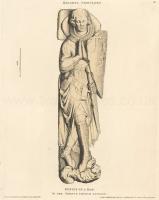
Effigy of Robert Ros. [Robert Ros] WAS descended from the noble family of Ros or Roos, of Hamlake. His father Everard died when he was thirteen years of age, and he had livery of his lands from the wardship of the Crown in the second year of the reign of Richard I. on payment of a hne of one thousand marks; which shows that his possessions must have been very large.
He was one of the Barons who leagued together to obtain the Great and the Forest Charter from John; and when that King had signed them at Runnemede, he was one of the chief persons who undertook to constrain him to observe thema He married [his wife] Isabella, the daughter of [his father-in-law] William the Lion, King of Scotland, by whom he had two sons, William and Robert. He gave the first his castle of Helmesley [Map], with the patronage of the monasteries of Kirkham, Rievaulx [Map], and Warden, to the other his castle of Werke and a barony in Scotland, held by knight's service of his brother-in-law. Of both the above-mentioned castles he was the founder. He confirmed to the Templars his manor of Ribstone, with other possessions, assumed the habit of their order, died in 1231, and was buried in the Temple church [Map]. The effigy of Ros is cross-legged, and his hands raised in the act of prayer; the hood of his hauberk is thrown back to show his visage. His sword depends from a belt adorned with broad studs; his surcoat reaches to his heels, which are armed with the pryck spur, and rest on a lion. On his shield are three water bougets, which were the bearing of Ros, Argent, in a held Gules. This figure, like that of Robert de Vere, is of a period subsequent to that of the decease of the person whom it is said to represent.
Queen Anne Boleyn of England [1]
Catherine Parr Queen Consort England [5]
Jane Grey I Queen England and Ireland [1]
George Wharton [15]
President George Washington [2]
Brigadier-General Charles Fitz-Clarence [48]
Queen Elizabeth II of the United Kingdom [206]
Queen Consort Camilla Shand [86]