

Abbot John Whethamstede’s Chronicle of the Abbey of St Albans
Abbot John Whethamstede's Register aka Chronicle of his second term at the Abbey of St Albans, 1451-1461, is a remarkable text that describes his first-hand experience of the beginning of the Wars of the Roses including the First and Second Battles of St Albans, 1455 and 1461, respectively, their cause, and their consequences, not least on the Abbey itself. His text also includes Loveday, Blore Heath, Northampton, the Act of Accord, Wakefield, and Towton, and ends with the Coronation of King Edward IV. In addition to the events of the Wars of the Roses, Abbot John, or his scribes who wrote the Chronicle, include details in the life of the Abbey such as charters, letters, land exchanges, visits by legates, and disputes, which provide a rich insight into the day-to-day life of the Abbey, and the challenges faced by its Abbot.
Available at Amazon in eBook and Paperback format.
01 Jan is in January.
1136 Battle of Llwchwr aka Gower
1136 Coronation of King Stephen
1511 Birth and Death of Prince Henry
1513 New Years Day Gift Giving
1515 Louis XII King France succeeded by Francis I
1562 News Years Day Gift Giving
1616 The Golden Age Restored Masque
1644 Trial and Execution of the Hothams
01 Jan is the first day of the year under the Gregorian Calendar adopted in England in 1752; see 1752 Adoption of the Gregorian Calendar.

Chronicle of Edward Hall [1496-1548]. On whiche day [1st January 140] the kyng whiche sore desired to see her grace [Anne of Cleves Queen Consort England] accompanied with no more then viii. persons of his prevy chamber, and both he and they all apparelled in marble coates prevely came to Rochester, and sodainly came to her presence, which therwith was sumwhat astonied: but after he had spoken and welcomed her, she with most gracious and lovyng countenaunce and behavior hym received and welcomed on her knees, whom he gently toke up and kyssed: and all that after none commoned and devised with her, and that nyght supped with her, and the next day he departed to Grenewyche, and she came to Dartford.
On 1st January 898 Odo I King West Franks [aged 41] died. Charles "Simple" III King West Francia [aged 18] succeeded III King West Francia.
On 1st January 951 Ramiro II King Leon [aged 51] died. His son Ordoño [aged 25] succeeded III King Leon.
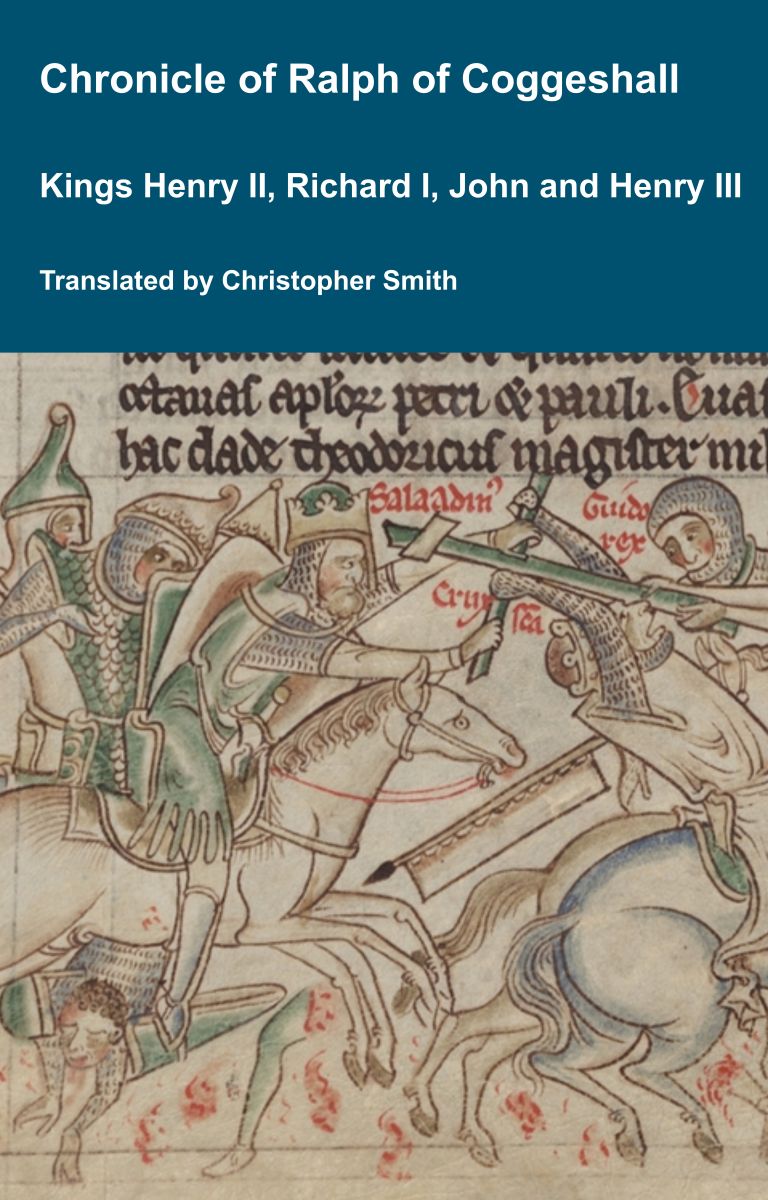 Chronicum Anglicanum by Ralph Coggeshall. 1136. An lunar eclipse took place on the Kalends of January [1st January].
MCXXXVI. Eclipsis lunae facta est calendis Januarii.
Annals of Winchester. 1st January 1136. His [King Henry I's] nephew Stephen [aged 42] came to England, and after breaking the treaty he had made with a solemn oath, a treaty made with the consent of his daughter, Queen Matilda, and witnessed by his brother Henry, Bishop of Winchester, Roger of Salisbury, William, Archbishop of Canterbury, and the people of London, he was crowned in London almost clandestinely on the 22nd day after the death of his uncle, on the 1st of January.1
Stephanus autem nepos ejus venit Angliam, et rupto fœdere quod cum sacramento fide interposita filiæ Leonis justitiæ fecerat, consentientibus sibi tantum Henrico Wintoniensi episcopo fratre suo, et Rogero Saresbiriensi, et Willelmo archiepiscopo Cantuariensi, et Londoniensibus, apud Londoniam quasi furtive coronatus est kal. Januarii, die vicesima secunda post decessum avunculi.
Note. His uncler King Henry I died on the 1st of December so the twenty-second day after would be the 22nd or 23rd of December?
On 1st January 1136 a Welsh army defeated a Norman army between Loughor and Swansea. The Normans lost around 500 men.
Chronicon ex Chronicis by Florence and John of Worcester. Speedily after the death of king Henry on the fourth of the nones [the 2nd] of December a severe battle was fought in Gower1, between the Normans and the Welsh, on the calends [1st] of January, in which five hundred and sixteen of the two armies perished. Their bodies were horribly dragged about the fields and devoured by the wolves. Afterwards the Welsh made a desperate inroad, attended with the destruction, far and wide, of churches, vills, corn, and cattle, the burning of castles and other fortified places, and the slaughter, dispersion, and sale into captivity in foreign lands of countless numbers, both of the rich and poor.
Note 1. A district of South Wales, nearly corresponding with the county of Glamorgan. Neither Huntingdon nor Malmesbury mention this expedition; but the anonymous author of the "Gesta Stephani" describes it in some detail. 16. pp. 329–332.
Chronicum Anglicanum by Ralph Coggeshall. On the Feast of the Circumcision of the Lord [1st January 1216], at Coggeshall, while the service was being said at Tierce, they violently entered the church and led away twenty-two horses, which belonged to the bishop of London, the treasurer, his brother, and others. Then, hurrying on to Bury St Edmunds, they there laid siege to the Isle of Ely, because many knights and noble ladies, trusting in the strength of the place, had fled thither from Bury St Edmunds in the face of the marauders. At last, having entered the isle, they made a grievous devastation there, just as everywhere they had come: sparing neither age, nor sex, nor condition, nor religion. They even broke into churches and carried off what had been stored in them; and men, to extort their money, they forced by dreadful tortures, most of all the followers of the aforesaid Buc.
In die quoque Circumcisionis Domini, apud Cogeshale, dum hora tertia diceretur, in ecclesia violenter ingressi, XXII equos, qui erant episcopi Londoniensis et thesaurarii fratris et aliorum, abduxerunt. Deinde ad Sanctum-Edmundum convolantes, inde insulam Elyensem obsidione cinxerunt propter plurimos milites et nobiles feminas, qui illuc, loci munimine confisi a Sancto-Edmundo ante facies prædonum confugerant. Tandem vero insulam ingressi, gravem fecerunt exterminationem in ea, sicut ubique quocumque devenerant, nec ætati parcentes, nec sexui, nec conditioni, nec religioni; ecclesias quoque confregerunt, et quæ in eis deposita fuerant abstulerunt; homines etiam, ut pecunias eorum emungerent, horrendis pœnarum cruciatibus adegerunt; maxime satellites prædicti Buc.
Annales Paulini. [1st January 1322] In the same year, on the Feast of the Circumcision of the Lord [1st January], in the church of Saint Paul in London, it was publicly declared by the Lord Archbishop of Canterbury that Lord Hugh Despenser the son had not been lawfully exiled. And on the Feast of the Epiphany [6th January] immediately following, the lord king had it proclaimed throughout the city of London that peace was restored to the said Lord Hugh Despenser. On the morrow of the Epiphany [7th January], one hundred foot soldiers from the county of Kent, strong, able-bodied, and well-armed, were marching to the king, who was then at Shrewsbury. But when they came near Chipping Norton, they were struck with fear and dread, and fled quickly all the way back to Oxford, and from there returned individually to their own homes. In the same year, on the feast of Saint Hilary (13th of January), Lord Rigaud, Bishop of Winchester, set out toward the Roman Curia on various matters concerning the kingdom of England. Also in that same year, shortly after Christmas, the lord king departed from Chichester toward Wales, and arriving at Shrewsbury before the start of Lent, the Lords Roger de Mortimer, both uncle and nephew, at the urging and assurance of peace given by the Earls of Richmond and Arundel and other good men, surrendered themselves to the peace of the said lord king. But afterward they were captured and imprisoned, and both were led to London and committed to the Tower as prisoners. Later, the lord king, departing from Shrewsbury and advancing northward with an army of 3,000 armed men, lingered for some time near the River Humber.
Eodem anno, die Circumecisionis Domini, in ecclesia Sancti Pauli Londoniis, pronunciatum fuit per dominum archiepiscopum Cantuariensem, quod dominus Hugo Despenser filius non rite fuit exulatus; et in festo Epiphaniæ proximo sequente, dominus rex fecit proclamare pacem dicti domini Hugonis Despenser per medium civitatis Londoniarum. In crastino Epiphaniæ centum homines pedites de comitatu Kantiæ fortes et wvalidi et bene armati, euntes versus regem, qui fuit apud Salopiam, sicut venerunt versus Chepinge Northone et deprope, perterriti et pavidi usque ad villam Oxoniæ celeriter fugerunt, et sic redierunt in patriam suam particulariter. Eodem anno, die Sancti Hillarii, dominus Rigaldus episcopus Wintoniensis arripuit iter versus curiam Romanam pro diversis negotiis regnum Angliæ tangentibus. Eodem anno, cito post Natale Domini, dominus rex amovit se de Cicestria versus Walliam, et veniens Salopiam ante tempus Quadragesiæ, ubi domini Rogerus de Mortuomari, avunculus et nepos, ad predictionem et promotionem pacis per comites de Richemund et Arundel et alios bonam formam pacis regis promittentium, ad pacem dicti domini regis se reddiderunt; qui postea capti et incarcerati, deinde ambo ducti Londonias, in turrim carcere sunt mancipati. Et postea dominus rex, de Salopia movens versus Boream, cum exercitu IIIml virorum armatorum, prope Humber aliquantulum morabatur.
Annales Paulini. On the fourth Sunday of Advent, Archbishop Simon [Mepham] came to St Paul's, followed the choir procession, and afterwards preached in the nave of the church. On the following day he returned, along with other bishops, namely, the Bishops of London and Winchester, together with the Earl Marshal, the Earl of Kent, Thomas de Wake, Hugh de Audley, and other leading and powerful men of the realm, to discuss the welfare and condition of the kingdom. They remained there until the vigil of Christmas. Because of this, the king, becoming angry with certain individuals and acting under poor counsel, intended to raise his banner and ride out against some of the realm. Messengers were sent to the king, namely, Master John de Elham, Archdeacon of Essex, and others, carrying letters earnestly pleading with him to abandon his intention. Throughout the Christmas season, the archbishops, bishops, earls, and barons mentioned above remained in London awaiting a response to their letters and the arrival of the Earl of Lancaster, who spent Christmas at Waltham. On the Feast of the Circumcision of the Lord [1st January 1329], he came to London with a great company, and, descending at St Paul's, held a meeting there with the bishops and magnates. Afterwards, he went to the Dominican friars, where the Earl Marshal awaited him; and they were reconciled and embraced one another, for they had previously been at odds over the death of Robert de Holland and for certain other reasons.
Dominica quarta Adventus Domini venit Symon archiepiscopus ad Sanctum Paulum, et secutus est processionem chori et postea prædicavit in navi ecclesisiæ. In crastino venit similiter, et alii episcopi cum eo, videlicet Londoniensis et Wyntoniensis, una cum comite Marescallo et Cantiæ, T. de Wake, Hugo de Audele et alii potentiores et majores regni, ad tractandum de utilitate et statu regni, et moram traxerunt usque ad vigiliam Natalis Domini. Et pro eo rex indignatus erga aliquos, et malo consilio usus, intendebat vexillum suum levare et contra aliquos de regno equitare. Miserunt nuncios domino regi, videlicet magistrum Johannem de Elham archidiaconumn Essexiæ et alios, cum litteris eum obnixe deprecantes, ut a proposito suo desisteret. Per totum Natale archiepiscopi et episcopi, comites et barones prædicti moram traxerunt Londoniis expectantes responsionem litterarum suarum, et adventum comitis Lancastriæ, qui Natale tenuit apud Waltham. In festo vero Circumeisionis Domini, venit Londonias cum magno comitatu, et descendens apud Sanctum Paulum habuit ibidem cum episcopis et magnatibus colloquium, et postea ivit ad fratres Prædicatores, ubi comes Marescallus eum expectabat; et facti sunt amici et adinvicem osculati, nam prius erant adinvicem discordati pro morte R, de Holande aliquibus de causis.
Rymer's Fœdera Volume 2. Most dread lord, please know that the most sovereign thing which keeps kings and princes in due and proper estate is good and wise counsel. For it is written, and the wise man says, that "where there are many counsels, there is safety" And thus it is written in the Book of Kings, that Solomon, who was the wisest king that ever was, took to himself the most ancient and wisest men of the land; and by their advice and by his own wisdom, he kept all the land of Israel in quiet and peace, and beyond that, all the kings who were round about him were at his will. And after his death his son Rehoboam reigned; and he left aside the good counsel of his father, and of the ancients and wise men who had been with his father, and afterwards followed the counsel of young men, who wished to please him but knew little; whereby he lost all the land of Israel save for the twelfth part. In the same manner, many kings of Israel and of other lands have been brought to misfortune through evil counsel. And, sire, if it please you not to be displeased, you may remember from your own time that, through the evil counsel which our lord your father (whom God assoil) had, he caused, against the law of his land and the Great Charter, the peers and other men of the land to be taken; and he had some put to a vile death, some deprived of their goods and all that they possessed, and some put to ransom; and what came of him for that cause, you, sire, know well. And then, sire, in your own time you have had some counsellors through whom you had all but lost the hearts of your people, of whom God delivered you, as it pleased Him. And from that time until now, by the good advice of prelates, peers, great men, and the wise of the council of the land, your affairs have been so conducted that you have wholly the hearts of your people, who have aided you so that you have had as much or more ready money than ever any king of England before you; so that, by your good counsel, the aid of your people, and the grace that God has given you, you have had the victory over your enemies in Scotland and in France and on all sides; so that to this day, praised be God, you are held the noblest prince among Christians. And now, by the evil counsel of certain folk of this land, who are not as wise as need requires, and by the counsel of others who desire more their own profit than your honour or the salvation of the land, you are beginning to proceed against clerks, peers, and other men of the land, and to carry out processes not fitting to the law of the land, which you are bound by oath taken at your coronation to keep and maintain, and against the Great Charter, against which all those who act are excommunicated by all the prelates of England who come to enforce it, by the sentence confirmed by a bull of the Pope, which we have with us. These things are done to the great peril of your soul and to the lessening of your honour. And, sire, as for those same people who now make themselves governors and counsellors, beyond what their station gives them, by making you believe that what you are now doing is, and will be, pleasing to your common people, know for certain, sire (and you will find it so) that the matter, begun in the way now commenced, will turn out otherwise. And truly, sire, we greatly fear, unless God provide a remedy, that if you pursue the said manner begun, you may lose the hearts of your people and your good and rightful enterprise, and you will be shaken in such a way thereafter that you will have no power to carry through your enterprise, and you will strengthen your enemies to destroy you, and cause you to lose good fame and your land, God forbid. Wherefore, sire, for the salvation of your honour and of your land, and to maintain your enterprise, please take to yourself the great men and the wise of your land, and conduct your business through them and their counsel, as has been the custom before now; without whose help and counsel you cannot maintain your enterprise nor govern your land well. And because there are some now near you who are falsely accused of treason and felony, by which they are excommunicated, and we hold them to be such; and, as your spiritual father, we pray you to hold them as such. And also there are some others who say that they have served you badly and falsely, by which you have lost the town of Tournai and many other honours that you might have had there in honour, please, sire, if it please you, have the prelates, great men, and peers of the land come together in a suitable place, where we and other men may come safely. And do, if it please you, see and inquire into whose hands, since the beginning of your war, the wool, money, and other things whatsoever that have been granted to you in aid of your war up to this day have come, and how they have been spent; and by whose fault you lost the town of Tournai. And those who are found guilty in any point against you, as a good lord, have them well punished according to the law. And as far as concerns us, we will in all points stand to the judgment of our peers, saving always the state of Holy Church, of ourselves, and of our order, as we have written before this. And, by God, sire, do not believe ill of us, nor of your good people, before you know the truth; for if your people are punished without answer, there will be one judgment for the good and the bad alike. And, sire, please think well upon your great enterprise, and upon the strong enemy you have because of it, and upon your enemies in Scotland, and upon the great peril of your land. For if your prelates, great men, and all the wise of your land were about you day and night, and of good will without division, to ordain what would be best to do in such weighty matters, they would have enough to think upon to maintain your enterprise to your honour, and to the salvation of your land. And, sire, do not take it amiss that we send you the truth so plainly; for the great trust we have in you, and always shall have toward you, and in the safeguarding of your honour and your realm, moves us to speak. And also because it belongs to us, since we are, though all unworthy, the Primate of all England and your spiritual father, it stirs us to tell and send you what may be perilous to your soul, and lead to the ruin of yourself, your realm, and your estate. May the Holy Spirit preserve you, body and soul, and grant you the grace to have and to take good counsel, and to win victory over your enemies. Written at Canterbury, the first day of January [1341], by your chaplain, the Archbishop of Canterbury.
Tredouce seigneur, vous please assavoir qe la plus souveraigne chose qe tient les Rois & les princes en du & en couvenable estat si est bon & sage consail. Et pourceo est escript, & li sage dist, ou sont molds des consails illoeques il y a sauvete. Et pourceo est escript en le livre de Rois, que Solomon, qi fust li plus sage Roy qe unques fust, pris devers luy les pluis auncientz gentz, & pluis sages de la terre, par qi avisement & son sen il tient toutz voies la terre de Israel en quiete & pees, & oultre ceo toutz les Rois qi fusrent entour luy, estoyent a sa volunte. Et apres sa mort regna son filtz Roboam, & entrelessa le bon consail son pere, & des aunciens & sages q'avoient este ove soun piere, & fist apres le consail de jeune gentz qi luy voleient pleare, & poi ensavoient, par qei il pardy toute la terre de Israel, salve la xiime partie. En mesme la manere plusours Rois de Israel, & des aultres terres, ount este mys a meschief par malveis consail. Et sire, qu'il ne vous desplease, vous le poez remembrer de vostre temps; qar par la malveis consail qe nostre sire, vostre piere, qi DIEUX assoile, avoit, il fist prendre, countre la lei de sa terre & la graunt chartre, les peres & aultres gentz de la terre, & mist ascuns a vilain mort, dascuns fist prendre lour biens & ceo q'ils en avoient, & ascuns mist a raunzon; & q'est avenuz de luy par cele cause, vous, sire, le savetz. Et puis, sire, en vostre temps avez ascuns consailleres par les queux Vous aviez a poi perduz les coers de vostre people: des queux DIEU vous delivera, sicome luy pluist. Et puis tanqe encea par bon avisement des prelatz, peeres, grauntz & sages du consail de la terre, vos busoignez ount este mesnez en tiele manere qe vous avez entierement les coers de voz gentz; qi vous ount eydez auxi qe averetz auxi bien clers come aultres si avaunt ou pluis come unqes Roy d'Engleterre; issint qe parmy vostre bon consail, l'aide de voz gentz, & la grace qe DIEUX vous a done, vouz avez eu la victorie devers voz enemiz d'Escoce & de Fraunce, & de tutz parties; issint qe a jour huy, honourez soit DIEUX, vous estez tenuz le pluis noble prince des Cristiens. Et ore, par malveis consail abettiz dascuns gentz de ceste terre, qi ne sount pas si sages come mestier fust, & par conseil d'autres qi pluis desirent lour profit qe vostre honeur, ou salvacion de la terre, vous commencez deprendre devers clers, peeres & aultres gentz de la terre, & faire proces nient covenable countre la ley de la terre, a la quele garder & maintenir vous estez tenuz par serment fait a vostre coronnement, & ecountre la graunt chartre, dount touz sount escomengez par toutz les prelatz d'Engleterre qi vienent al ecountre, par la sentence conferme par bulle du Pape, la quele nous avoms devers nous; les queles choses sount faitz en graunt peril de vostre alme, & en amenousement de vostre honeur. Et, sire, comentge mesmes ceaux q'ore se fount governours & conseillers, plus avaunt qe lour estat lour done, en vouz donaunt entendre qe ceo qe vous ore faitez est & serra plesaunt a vostre comune people, sachez, sire, de certain, & ceo trouveretz vous, qe vient en la manere ore commencee. Et certeinement, sire, nous dotoms mult, si DIEUX ne y met remedie, qe si vous pursuez la dit manere comence vous purrez perdre les coers de vos gentz, & vostre bone & droiturelle emprise; & vous branler en tiele manere par de cea, qe vous ne averez poair de perfourmer vostre emprise, & enforcerez voz enemys pour vous destruire, & vous faire perdre bone fame & vostre terre, qe DIEUX defende. Par qei, sire, pour la salvacion de vostre honeur & de vostre terre, & pour vostre emprise maintenir, voillez prendre a vous les grauntz & les sages de vostre terre, & overir en vos busoignes par eux & lour consails, sicome einz ces heures ad este usez; saunz aide & consail des qeux vous ne poetz vostre emprise maintenir, ne vostre terre gouvernir bien. Et pourceo qascuns qi sount pres de vous, vous sourmencient fauscement tresoun & fauxine, par qei ils sount escomengez, & por tieux les tenoms; &, come vostre piere espirituel, vous prioms qe vous les voillez por tieux tenir. Et auxi dient qascuns aultres q'ils vous ount malement & fauxcement servi, par qei vous avez perdu la ville de Tourneye, & plusours aultres honours, qe vous puissez avoir eu illeosques en honeur, voilliez, sire, si vous plest, faire venir les prelatz, grauntz & peeres de la terre en lieu covenable, ou nous & aultres gentz purroms saluement venir. Et faitez, si vous please, veer & enquere en qi mains, puis le comencement de vostre guerre, layns, deneries, & aultres choses qele qeles soient, qe vous ount este grauntez en ayde de vostre guerre tanqe a jour de huy, sount devenuz, & coment despenduz; & par qi defalte vous pardites la ville de Tourneye; & ceaux qi serrount trovez coupables en ascune point devers vous, come bon seignor les faitez bien chastier solonc la ley. Et en qant qe a nous apent, nous esteroms en toutz pointz a juggement de nos peeres, salve toutz foies l'estat de seint esglise, de nous, & de nostre ordre, sicome nous avoms escript einz ces heures. Et par DIEUX, sire, ne voillez crere de nous, ne de vos bones gentz si bien noun, avaunt qe vous sachez la verite: qar si vos gentz serront puniz saunz response, tout serra un juggement des bones & des malveis. Et, sire, voilliez bien penser de vostre graunt emprise, & de fort enemy qe vous avez par cele cause, & de vos enemys d'Escoce, & du graunt peril de vostre terre. Qar si vos prelatz, grauntz, & toutz les sages de vostre terre, fussent entour jour & nuyt, & dune bone volente, saunz division, d'ordeigner ceo qe serroit meultz affaire en si grosses busoignes, ils en avereyent assetz apenser a maintenir vostre emprise al honour de vous, & a la salvacion de vostre terre. Et sire, ne voillez ne prendre a mal de ceo qe nous vous envoioms si grossement la verite, qar la graunt affiaunce qe nous avoms en vous, & toutz jours averoms devers vous, & a la salvacion de vostre honeur, & de vostre terre, & auxi pourceo q'il a nous, pourceo qe nous sumes, tut seioms indigne, primat de tut Engleterre, & vostre piere espirituel, nous excite a vous dire & maunder ceo qe poet estre en peril de vostre alme, & en peirissement de vous, & de vostre terre & de vostre estat. Le Seint Esprit vous salve agarde, corps & alme, & vous deigne grace d'avoir & de gerer bon consail & victorie de vos enemys. Escript a Cauntirbirs, le primer jour de Janever, par le vostre capelein Percevesqe de Cauntirbirs.
Murimuth and Avesbury. "Most gentle lord, please you to know that the most sovereign thing that holdeth kings and princes in due and fitting estate is good and wise counsel And therefore saith the wise man: 'In multitude of counsellors there is safety.' And therefore is it written in the Book of Kings that Solomon, who was the wisest king that ever was, took unto him the most aged men and the wisest of the earth, by whose advice and by his own sense he ever held the land of Israel in quiet and in peace, and moreover all the kings that were round about him altogether at his will. And after his death reigned his son, Rehoboam, who left the good counsel of his father and of the aged and wise men that had been with his father, and did according to the counsel of young men who would fain please him and who knew little; whereby he lost all the land of Israel, save only the twelfth part. In like manner have many kings of Israel and of other lands been brought to trouble by evil counsel. And, sire, let it displease you not, you may remember it in your own time: for by the evil counsel which our lord your father, whom God assoil, had, he made seize, against tho law of his land and the great charter, tt the peers and other people, and put some to shameful death, and of othors he madc seize their goods and what they possessed, and some he put to ransom; and what happened to him for that cause, you, sire, do know. And next, sire, in your own timc, you had certain counsellors by whom you did near lose the hearts of your people; from whom God delivered you, as it pleased Him. And then, even till now, by good avisement of the prelates, peers, the great men and wise of the council of the land, your affairs have been brougbt into such state that you entirely have the hearts of your people, who, as well clerks as others, have given you aid, even as you shall have henceforth, or more, a8 never had king of England; sothat, by means of your good council, the help of your people, and the grace which God hath given you, you have bad the victory in presence of your enemies of Bootland and of France and of all parts; so that at this day, honour be to God, you are held the most noble prince of Christendom. And now, by evil counsel, abetted by certain people of this land which are not so wise as wero needful, and by counsel of others which seek rather their own profit than your honour or the safety of the land, you begin to Beize divers clerks, peers, and other folk of the land, and to make suit nothing fitting, against the law of the land, tho which to keep and maintain you aro bound by the oath taken at your coronation, and contrary to the great charter, against which all who como counter are excommunicate by all the prelates of England, and the sentence confirmed by the pope's bull, which we have by us: the which things are done at the great peril of your soul and the minishing of your honour. And, aire, although those same men who now make themselves governors and counsellors, more than their estate doth warrant, give you to understand that that which you now are doing is and will be pleasing to your common people, know, sire, for certain, and this shall you find, that it i8 not so in the course that is now begun. And assuredly, sire, we doubt much, if God sct not thereto a remedy, that, if you follow the same way that you have begun, you may lose the hearts of your poople and your good and righteous enterprise, and be so shaken yonder, that you shall not have strength to accomplish your enterprise, and shall give your enemies the power to destroy you and make you lose fair fame and your land, which God forbid. Wherefore, sire, for the salvation of your honour and your land and for the maintenance of your enterprise, be willing to take to you the great and the wise of your land and to act in your affairs by them and their counsels, as heretofore hath been used, without whose aid and counsel you cannot maintain your enterprise nor govern well your land. And, forasmuch as certain who are near to you do falsely charge us with treason and falsehood, therefore they are excommunicate, and for such we hold them and, as your spiritual father, we pray that you will hold them for such; and also they say of some others that they have evilly and falsely served you, whereby you have lost the town of Tournay and many other honours that you might have had there; be willing, sire, if it please you, to make come the prelates, great men, and peers of the land, in fitting place, where we and others may securely come, and cause, if it please you, to see and enquire in whose hands, since the beginning of your war, wools, moneys, and other things whatsoever, which have been granted to you in aid of your war even to this day, have come and have been expended, and by whose default you thus departed from Tournay; and those which sball be found guilty in any whit before you, as a good lord, make them to be chastised wellaccording to law. Andin whatsoever concerneth us, we will stand in all points at the judgment of our peers, saving always the estate of holy church, of us, and of our order, as we have written before this time. And for God's sake, sire, be unwilling to believe of us and of your good people aught but good, before that you know the truth; for, if folk shall be punished without answer, judgment of the good and of the evil shall be all one. And, sire, consider well of your great undertaking, and of the strong adversary whom you have for that cause, and of your enemies of Scotland, and of the great peril of your land; for, if your prelates, great men, and allthe wise men of your land were, day and night, of one will, without division, to ordain that which should be best to do in so great matters, there would be enough io think on, to uphold your undertaking, your honour, and the safety of your land. And, sire, take it not ill that we send you so largely the truth; for the great affection which we have, and ever shall have, towards you, the safety of your honour and of your land, and also because it belongeth to us, for that we are, all unworthy though we be, primate of all England and your spiritual father, moveth us to tell you and gend unto you what may be to the peril of your soul and the impoverishing of your land and of your estate. The Holy Ghost keep you, body and soul, and give you grace to have and to trust good counsel, and victory over your enemies. Written at Canterbury, the first day of January [1341], by your chaplain, the archbishop of Canterbury."
"Tresdouce seignur, vous please assavoir qe la plus soveraigne chose qe tiengt lez rois et lez princes en due et en covenable estat si est bon et sage counsail. Et purceo dit li sages: 'En ses motz de counsails, ceo est assavoir bons, il y aad sauvete.'S Ft purceo est escript el livre de Rois qe Salomon, ge feust li plus sage roy ge unqes feust, prist devers lui lez plus aunciens gentz et plus sagez de la terre, par qi avisement et son sen il tiengt toutz voies la terre de Israel en quiete et poes, et oultre ceo toutz lez rois qe fusrent entour lui le pluis a sa volunte. Et apres sa mort regna son filtz Roboam, et entrelessa le bon counsail soun piere et des aunciens et sages qavoient este od soün piere, et fist apres le consail de jeueno gentz ge luy voleient pleare et poi en savoient, par qei il perdi toute la terre de Israel, sauve la XIJ partie. En mesme la manere plusours rois de Israel et dez aultres terres ount este mys & meschief par malveis counsail. Et, sire, qil ne vous desplease, vous le poetz remembrer do vostre temps: qar par la malveis counsail ge nostre sire voz pieeres, qe Dieux assoile, avoit, il fist prendre, countre la ley de sa terre et le graunt chartre, lez peres et aultres gentz de la terre, et mist ascuns a vilain mort, dascuns fist prendre lour biens et ceo qils en avoient, et ascuns mist à raunzon; et gest avenutz de lui par cele cause vous, sire, le savetz. Et puis, sire, en vostre temps avetz ascuns consaillers par lez qeux vous avetz & poi perduz les coers de vostre people; des qeux Dieux vous delivera, sicome luy pluist. Et puis, tauncqe en cea, par bone avisement des prelatz, piers, grauntz et sages du counsail de la terre, voz busoignez ount este mesneez en tieu manere ge vous avetz entierment lez coers de voz gentz qi vous ount eydez, auxi ge averetz, auxi bien clers comes aultres, si avaunt od pluis, come unges fuist roy Dengleterre; issint qe, parmi vostre bon consail, laide de voz gentz, et la grace qe Dieux vous aad done, vous avetz eu la victorie devers voz enemis Descoce et de Fraunce et de toutz parties; issint qe a jour huy, honurez soit Dieux, vous estez tenuz le plus noble prince de Crestiens. Et ore, par malveis consail, abettiz dascuns gentz de ceste terre qe ne sount pas si sages come mestier feust, et par consail daultres ge plus desirrent lour profit qe vostre honur od salvacion de la terre, vous comences de prendre devers clers, peeres, et aultres gentz de la terre, et faire proces nient covenable, countre la ley de la terre, à le quele garder et maintenir vous estez tenuz par serement fait a vostre coronement, et encontre la graunt chartre, dount toutz sount excomengez par toutz lez prelatz Dengleterre qe vienent al encountre et la sentence conferme par bulle de pape, la quele nous avomps devers nous: lez queles choses sount faitz en graunt peril de vostre alme et amenusement de vostre honur. Et, sire, coment mesmes ceaux qe ore se fount governours et conseillers, pluis avaunt qe lour estat lour done, en vous donant entendre qe ceo ge vous ore faitez est et serra plesaunt a vostre comune people, sachetz, sire, de certein, et ceu troveretz vous, qe nient en la manere ore comencee. Et certeinement, sire, nous dotoms mult, si Dieu ne y met remedie, qe, si vous pursuez la dite manere comence, vous purretz perdre lez coers de voz gentz et vostre bone et droiturele emprise, et vous branler en tieu rnanere par de cea, qe vous ne averez poair de perfourner vostre emprise, et enforceretz voz enemis pour vous destruire et vous faire perdre bone fame et vostre terre, qe Dienx defende. Par qoi, sire, par la salvacion de vostre honar et de vostre tierre et pur vostre enprise maintenir, voilletz prendre a vous les graunts et lez sages de vostre terre et overir en voz busoignes par eaux et lour consails, si come einz ces heures aad este usez, sauntz eaide et counsail dez qeux vous ne poetz vostre enprise maintenir ne vostre terre bien governer. Et purceo ge ascuns qe sount pres de vous nous sourmetient faucement tresoun et faucine, par quei ils sount excomengets, et pur tieux lez tenoms et, come vostre espirituel, vous prioms qe vous lez voilletz pur tieux tenir; et auxi dient dascuns aultres qils vous ount malement et faucement servi, par quei vous avetz perdue la ville de Tourneye et plusors aultrez honurs qe vous puissetz avoir eu illeosges; voilletz, sire, si vous plest, faire venir lez prelatz, grauntz, et peeres de la tierre en lieu covenable, od nous et aultres gentz purrons seurement venir, et faites, si vous plest, veer et enquere en qi mains, puis le comencement de vostre guerre, laynes, deniers, et aultres choses, qelles qe' soient, qe vous ount este grauntezs en eaide de vostre guerre tancge a jour de huy, sount devenuz et vient despenduz, et par qi defalte vous depertistes issint de Tournaye; et ceaux qe serrount trovez coupables en ascun point devers vous, come bon seignur, lez faitez bien chastier solonc la ley. Et en qaunt ge a nous appent, nous esterroms en toutz pointz a juggement de noz peres, sauve toutes voies lestat de seint eaglise, de nous, et de nostre ordre, sicom nous avomps escript einz ces heures. Et pur Dieu, sire, ne voilletz crere de nous ne do voz bones gentz si bien noun, avaunt qe vous sachetz la verite; car, si gentz serrount puniz saunz respounse, tout serra un juggement dez bones et dez malveis. Et, sire, voilletz bien penser de vostre graunt emprise, et de fort annemy! ge vous avetz par cele cause, et de voz enemis Descuce, de graunt peril de vostre terre; car, si voz prelatz, grauntz, et toutz les sages de vostre terre fuissent entre jour et nuyt dune volente, saunz division, dordeigner ceo qe serroit meltz affaire en si grosses busoignez, il y averoit assetz a penser, pur maintenir vostre emprise, lonur de vous, et la salvacion de vostre terre. Et, sire, ne -voilletz prendre a mal ge nous vous envoioms si grossement la verite; qar la graund affeccion qe nous avons et tutz jours averoms devers vous, la salvacion de vostre honur et de vostre terre, et ausi purceo qil apertent a nous, purceo ge nous sumes, tout seioms indigne, primat de tout Engleterre et votre piere espirituel, nous excite à vous dire oh maunder ceo qe peot estre en peril de vostre alme et empovrisment de vostre terre et de vostre estat. Le Seint Espirit vous sauve, corps et alme, et vous doignt grace davoir et de crere bon counsail, et victorie de voz enemys. Escript a Cauntirbirs, le primer jour de Janever, par lo vostre chapelain, lercevesqe de Cauntirbirs."
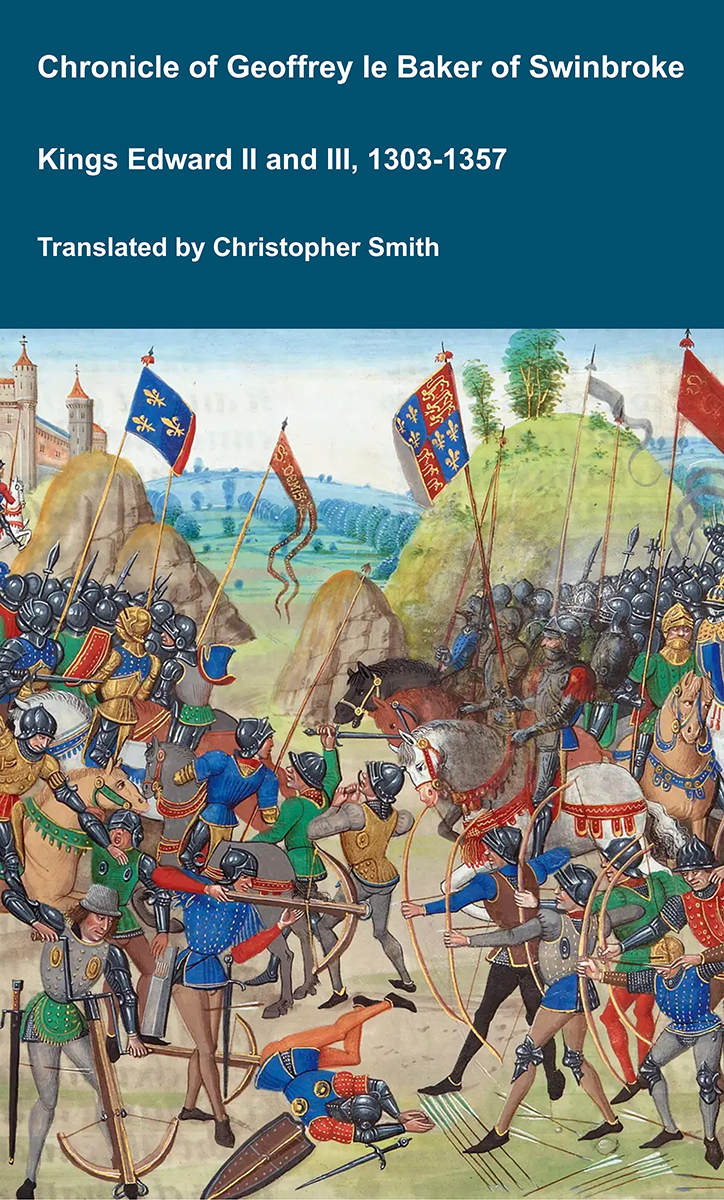 Chronicle of Geoffrey le Baker of Swinbroke. As the aforementioned solemnity1 was approaching, the king was informed, through the secretaries of Americo of Padua,2 a mercenary knight, that on the 14th day of January, Geoffroi de Charny,3 a French knight, and a great number of other Frenchmen were to be admitted into Calais, which had been sold to them by the said Americo, but was by the king's grace rescued by the following intervention. The said Americo of Padua, who had been staying in Calais during its siege among the Genoese, served for pay under the tyrant of the French [the King of France], against the English king, who was then besieging the city. But after the surrender of the town, like the others, he was granted clemency of life, limbs, and knightly liberty, and remained in the king's service as a mercenary, assigned to the defence of Calais. At the time, Geoffroi, Lord of Matas, was regarded, so the rumours spread, as the most experienced of all the French in military affairs: a man of long experience in arms, endowed with keen natural intelligence, and thus principal counsellor to the French "tyrants" [the French royalists], until his death and the capture of the crowned French king at the Battle of Poitiers. This man, a most cunning schemer of crimes, attempted to corrupt the loyalty of Americo, who had been summoned by letters and lured with gifts of gold and deceitful promises. Finally, driven by greed, Americo agreed that for thousands of gold écus,4 he would open a tower under his command to provide the French with easy access into the town, and help them as much as he could in seizing the town and castle. Thus, this treacherous pact, though confirmed by oath and even by sharing the sacrament of the altar, was still a most wicked undertaking, initiated in treacherous cunning and false faith. Indeed, not at the walls of Ilium,5 but at the walls of Calais, sin was committed both without and within: for although a truce was still in effect, the laws of moral conscience would have forbidden the French from any deceit, open or secret, that could violate the peaceful possession of Calais by the English king. Moreover, Americo should have been deterred, by reverence for knightly honour, from any betrayal or unworthy promise, even one not binding, for by right, faith must be kept even with an enemy. But he kept faith with neither enemy nor king, serving the King of Heaven most wickedly, when he falsely invoked the Body of the Savior to seal his deceitful agreement, and furthermore received the communion of the chalice. Nevertheless, he wrote to the king, disclosing the entire affair without hiding anything, thus keeping himself prepared either to support the French, if they succeeded, or to retain the favour of the king, if the French plot failed and they were convicted of breaking the truce, and possibly many would be captured for ransom. And so it happened.
Instante prefata solempnitate, nunciatum est regi per secretarios. Americoi de Padua, militis stipendiarii, quod quartadecima die mensis Ianuarii forent in Calesiam recipiendi Galfridus de Charny, miles, et alii Gallici in magno numero, quibus Calesia per predictum Americoum fuerat vendita, set per regem graciose rescutata tali processu. Predictus Americous Paduensis inter ceteros Ianuenses morabatur in Calesia obsessa, ad stipendia tiranni Francorum contra regem obsidentem; set sibi, sicud ceteris, post ville dedicionem concessa gracia vite et membrorum atque libertatis militaris, de cetero mansit cum rege stipendiarius ad eiusdem Calesie tuicionem. Erat pro tunc Galfridus dominus de Matas miles plus quam aliquis Gallicus, ut fama ventilavit, in re militari exercitatus atque, cum longa experiencia armorum, nature vivacis sagacitate excellenter dotatus, et ideo Francie tirannorum, usque ad suum interitum et coronati Francorum capcionem in prelio Pictavensi, conciliarius principalis. Iste facinorum calidissimus machinator fidem prefati Americoi literis sibi evocati auri donis et sofisticis promissis conatus pervertere. Finaliter cum falso cupidus convenit quod, pro milibus scutatorum aureorum, per turrim, cui Americous preficiebatur, facilem introitum Gallicis in villam prepararet, atque ad ville et castri plenam capcionem quatenus posset adiuvaret. Pactum itaque prodiciosum quantumcunque per iuramentum et communionem sacramenti altaris utrimque confirmatum, attamen ut plenum versuta calliditate et fide mentita pessime fuerat iniciatum. Equidem non iam 'IIiacos,' set Calesios, 'muros extra peccatur et intra,' nam Gallicos, treuge adhuc durantes, pie consciencie legibus proibuissent ob omni circumvencione pupplica vel occulta, qua pacifice possessioni regis Anglie, quoad predictam villam, poterant derogasse. Eciam prefatum Americoum reverencia fidei militaris terruisset ab omni prodicione et inonesta, non eciam servanda, sponsione, cum de iure sit hosti servanda fides; set ipse nec hosti fidem servavit, nec regi terreno aliter quam dubie militavit, et Eterno Principi impiissime servivit, quando corpus Salvatoris, in testimonium sue versute convencionis, fallaciter invocavit, et insuper communionem calicis recepit. Scripsit tamen regi literas de toto negocio, nihil occultans, itaque paratus ad Gallicorum amiciciam, si ipsi expedivissent, et in regis benevolenciam, casu quo Gallici a proposito frustrati fuissent convicti de fraccione treugarum et insuper forte multi redimendi caperentur. Set ita contingebat.
Note 1. Stow Annales 387.
The story of the attempt on Calais is best known from Froissart's picturesque narrative, founded on Le Bel. It is curious that there should be confusion regarding the date of the event. Le Bel gives the year 1348, and in this he is followed by certain MSS. of Froissart while in others the more correct date 1349 is found. Baker also, as we have seen, inclines to 1348. The actual attempt took place in the night between the last day of 1349 and New Year's day 1350. The Grandes Chroniques de France, 5.491, and Avesbury 408, whose account of the affair is very well given, are both in the right as regards the year. The confusion between 1348 and 1349 may have arisen (as it does appear to have arisen in Baker's mind) from the fact that Edward was at Calais at about the same time in both years.
Avesbury 408-410: "In the year of our Lord 1349, while a certain Genoese [Amerigo of Pavia] served as captain of the castle of Calais under the King of England, Sir Geoffroy de Charny, a knight and a native of Picardy, who was one of the principal counsellors of King Philip of Valois, plotted and conspired to seize the castle of Calais deceitfully and secretly since he could not take it by open assault. Having held a secret discussion with the said Genoese, Charny promised him many thousands of florins if he would agree and lend his effort to help carry out the scheme in secret. However, the Genoese, unwilling to betray the King of England, his lord, whose bread he ate and who placed great trust in him, wanted nonetheless to pocket the promised gold. So, speaking peacefully with Sir Geoffroy de Charny, he feigned agreement, cleverly pretending to go along with the plan. On the appointed day, namely on the morrow of the Feast of the Circumcision of the Lord 1st January 1349
Note 2. Americo di Pavia. The description here given of him seems to be a true one. He was apparently a Lombard mercenary. Avesbury calls him a Genoese; see previous note. Jean Le Bel 2.177. Froissart 317 Le Bel tells us that Edward discovered the intended treachery, not through the traitor's confession, but by some other means. Americo's position in Calais has been exaggerated. He is generally represented as captain of the castle; Froissart also puts him in command of the town, whereas John Beauchamp had held that command since 1st January 1349. He was probably nothing more than captain of one of the towers forming part of the walls of the town, as stated in the text. He had been appointed captain of the king's galleys, 24th April 1348; Rymer's Fœdera 3.159.
Note 3. Geoffroi de Charny, seigneur de Pierre-Perthuis, de Montfort et de Savoisy, a soldier, who was at this time captain of Saint-Omer. In 1352 he was made one of the knights of the newly-founded order of the Star. He fell at Poitiers. In the present affair he was taken prisoner by sir John de Potenhale (Devon, Issue Rolls of the Exchequer, 158). Baker gives him the title of 'dominus de Matas' i.e. 'Lord of Matas', which however is not found attached to his name in the French accounts of him. But it is a coincidence, if nothing else, that Chandos Herald, the author of The Black Prince (Roxburghe Club), names 'Matas' as one of the chief men who fell at Poitiers; and that Bartholomew, lord Burghersh, in his letter describing the battle (ibid. 369), gives the two names 'mons. Geffray Charny; mons. Geffrey Matas' in juxtaposition, in his list of the slain; and also that, in the same manner, the two names 'Mounsire Geffray Charny; Le sire de Mathas' come together in the list at the end of Avesbury's chronicle. With Baker's statement confronting us, we are tempted to think that in the Poitiers lists two men have been made out of one.
Note 4. The amount of the bribe was 20,000 ecus d'or. This coin was worth a little more than a half-noble, or about 2s 10d.
Note 5. Paraphrasing Horace's Epistles Book 1 Chapter 2 Line 16: 'Iliacos intra muros peccatur et extra.' i.e. 'There is sin both within the walls of Ilium and outside them.'
Annals of the six Kings of England by Nicholas Trivet
Translation of the Annals of the Six Kings of England by that traces the rise and rule of the Angevin aka Plantagenet dynasty from the mid-12th to early 14th century. Written by the Dominican scholar Nicholas Trivet, the work offers a vivid account of English history from the reign of King Stephen through to the death of King Edward I, blending political narrative with moral reflection. Covering the reigns of six monarchs—from Stephen to Edward I—the chronicle explores royal authority, rebellion, war, and the shifting balance between crown, church, and nobility. Trivet provides detailed insight into defining moments such as baronial conflicts, Anglo-French rivalry, and the consolidation of royal power under Edward I, whose reign he describes with particular immediacy. The Annals combines careful year-by-year reporting with thoughtful interpretation, presenting history not merely as a sequence of events but as a moral and political lesson. Ideal for readers interested in medieval history, kingship, and the origins of the English state, this chronicle remains a valuable and accessible window into the turbulent world of the Plantagenet kings.
Available at Amazon in eBook and Paperback format.
On 1st January 1387 Charles "Bad" II King Navarre [aged 54] burned to death. His son Charles [aged 26] succeeded III King Navarre. Eleanor of Castile Queen Consort Navarre [aged 24] by marriage Queen Consort Navarre.
See Note p Harleian Library 6217: ""
On 1st January 1424 Louis IV Count Palatine of the Rhine was born to Louis Wittelsbach III Elector Palatine [aged 45] and Matilda of Savoy [aged 34]. He married 1445 his fifth cousin Margaret of Savoy, daughter of Amadeus Savoy VIII Count Savoy and Mary Valois Countess Savoy, and had issue.
On 31st December 1426 Thomas Beaufort 1st Duke Exeter [aged 49] died at Greenwich, Kent [Map]. Some sources say 27th December 1426 and 1st January 1427. Duke Exeter and Earl Dorset extinct.
On 1st January 1442 Margaret Wittelsbach was born to Albert Wittelsbach III Duke Bavaria [aged 40] and Anna Brunswick Grubenhagen Duchess Bavaria [aged 28]. She married 1463 Frederico Gonzaga Marquess Mantua, son of Ludovico III Marquis of Mantua and Barbara of Brandenburg Marquise of Mantua, and had issue.
On 1st January 1507 Anna Hohenzollern Duchess Mecklenburg was born to Joachim "Nestor" Hohenzollern Elector Brandenburg [aged 22]. She married 17th January 1524 Albrecht VII Duke Mecklenburg and had issue.
On 1st January 1511 Prince Henry Duke of Cornwall was born to Henry VIII [aged 19] and Catherine of Aragon [aged 25] at Richmond Palace [Map]. He was appointed Duke of Cornwall at birth.
On 22nd February 1511 Prince Henry Duke of Cornwall died. He was buried at Westminster Abbey [Map]. He died aged less than one years old.


Wriothesley's Chronicle [1508-1562]. 1st January 1511. This yeare, Prince Henrie, the Kings [aged 19] first sonne, was borne at Richmonde [Map] on Newe Yeares dayeb, and on St. Mathie's day [Note. 23 Feb] after the saide Prince died, and was buried at Westminster [Map].
Note b. On the 1st January, 1510 [Note. 1511 if years are adjusted to begin on 01 Jan.]
Note c. Or rather St. Mathias' eve, February 23. Hall, howerer, says that this Prince died on "the 22 Feb. being the Even of Saint Mathy," which would seem to show that St. Mathias' day was sometimes kept on the 23rd, instead of the 24th February, in which case our text is correct.
1st January 1513. The following pieces of plate received from William Holland of London, goldsmith, 1 Jan. 4 Henry VIII.
[Given in three columns (1) name of a person (to whom the article has been presented); (2), description of the article; and (3), its weight.]
Bishop of Canterbury [aged 63], a cup with a gilt cover, 34 oz.
Lady Hastings [aged 30], the same, 30¾ oz.
Sir H. Marney [aged 66], the same, 23 oz.
Mr. Lupton [aged 57], the same, 23 oz.
Sir E. Ponyngs [aged 54], the same, 22¼ oz.
The Abbot of Abingdon, the same, 23¾ oz.
Sir Edward Haward, the same, 24 oz.
The old Lady Guylford [aged 50], a little pot gilt, 17 7/8 oz.
Lady Lucy, the same, 16 7/8 oz. [Possibly Catherine Hastings [aged 35] who married John Melton of Aston Yorkshire 10th Baron Lucy [aged 37] before 1506]
Lady Mountjoy, the same, 16 7/8 oz.
Lady Bulleyn [aged 33], the same, 16½ oz.
Lord Audeley [aged 30], a salt with a gilt cover, 15¾ oz.
The Queen's grace [aged 27], a pair of great pots gilt, 575 oz.
Mrs. Catesby, a proper bottle for rose water, 4 oz.
Mrs. Briget, the same, 3 7/8 oz.
Mrs. Lacy, the same, 4 oz. Which, at 5s. the oz., is £212 11s 10½d.
James Worsley, a proper pot, parcel gilt, 10 oz. Copynger, 8 spoons, part gilt, 9¾ oz., Amadas. Which is, at 4s. the oz., 76s. 6d.
In part payment, old plate to the value of £194 16s. 8d. has been delivered to him. The remainder paid by J. Heron [aged 43].
On the dorse [reverse]:-Holland beseeches the King to reward him for the workmanship of the Queen's great pots, "for he cannot live to make such curious work at the price within written"; and £6 13s. 4d. is added in another hand, making a total due of £28 5s. Signed by the King.


On 1st January 1515 Louis XII King France [aged 52] died. His first cousin once removed Francis [aged 20] succeeded I King France: Capet Valois Angoulême.


Wriothesley's Chronicle [1508-1562]. 1st January 1515. The French King [aged 52] died,h and a new peace concluded with the Kinge [aged 23] and Francis [aged 20],a that tyme new made King of France. And the Ladie Marye [aged 18], French Queene, was grawnted her dowrie to be brought into England, and was suffred to have all her goodes and riches. The Duke of Suffolke [aged 31], with Sir Richard Wingfeilde [aged 46] and Dr. West, and other, sent into France as ambassadors.b A conclusion was made that the saide Duke was weddid to the saide Lady Marie in France and thereupon cam over into Englande, and with them brought oyer all thinges after their mynde.d
Note h. Louis XII died 1st January, 1515.
Note a. The Duke of Valois, who succeeded under the title of Francis I, renewed the alliance with Henry.
Note b. Charles Brandon, Duke of Suffolk, Sir Richard Wingfield, and Dr. West, "with a goodly bande of yeomen, all in black" (says Hall), had been sent in embassy to Paris to negociate a settlement of the ex-queen's dower.
Note c. It had been arranged that the Duke should conduct the ex-queen back to England, and there have married her, but (says Stow) "for doubt of change he married her secretly at Paris, as was said;" it is now ascertained that such was the fact, and that the Duke was reproved for it by Wolsey [aged 41], a draught of whose letter is still extant; as is also a letter of Mary to her brother, Heniy Ym., taking the blame on herself.
Note d. The French Chroniclers assert that Mary brought over with her into England jewels, plate, and tapestry belonging to Louis XII. to the value of 200,000 crowns, besides a great diamond called "le miroir de Naples."


Letters and Papers Foreign and Domestic Henry VIII 1533. 1st January 1533. R. O. 6. Anne Boleyn [aged 32].
Warrant under the King's sign manual to Cromwell, master of the Jewels, to deliver to the lady of Pembroke these parcels of gilt plate, late of Sir Henry Guldeford, controller of the Household:—2 gilt pots with round knobs behind the lids, which came to Sir Henry as executor to Sir William Compton, weighing 133 oz.; a pair of gilt flagons with the arms of France, 147 oz.; 6 gilt bowls without a cover, 200½oz.; 3 gilt salts with a cover of Parres touch," which belonged to Sir Will. Compton, 77 oz.; 12 gilt spoons with demi-knops at the end, 18 oz.; a pair of parcel-gilt pots, 99½ oz.; another, 97¾ oz.; another, 71 oz.; 6 parcel-gilt bowls without cover, 199¼ oz.; the cover of the same, 19¾ oz.; a basin and ewer, parcel-gilt, 77 oz.; another basin and ewer, parcel-gilt, 64 oz.; 11 white spoons with roses at the ends, 20¼ oz.; 4 candles, white, with high sockets, 86½ oz.; "a round bason of silver for a chamber, and a silver pot to the same, weighing together 138½ oz."; and a chafing dish, parcel-gilt, 39¾ oz. "And that ye make entry of the foresaid parcels of plate into our book of Extra for the rather noticing the same hereafter." Greenwich, 1 Jan. 24 Hen. VIII.


On 1st January 1534 Henry Longford was murdered during the attack by Thomas Foljambe and his followers during a service in Chesterfield church on New Year's Day 1434, killing two of his companions - Henry Longford and William Bradshaw - and mutilating Pierrepont by cutting off the fingers of his right-hand.
Letters and Papers Foreign and Domestic Henry VIII 1535. 1st January 1535. 1. The Princess [aged 18] has been informed that, by virtue of the statute lately passed, which has been made more severe against those who refuse to swear and acknowledge the second marriage, after these holydays she must renounce her title and take the oath, and that on pain of her life she must not call herself Princess or her mother Queen, but that if ever she does she will be sent to the Tower. She will never change her purpose, nor the Queen either. The Council here, owing to what has been discovered in France touching the Zwinglian heresy, have prohibited a book printed here a year ago in English, which is full of the said heresy. I am told also that of late the Chancellor has caused 15 books of the New Testament in English to be burned. Booksellers have been forbidden to sell or keep a prognostication lately made in Flanders, which threatens the King with war and misfortune this year; and some of the leading men of the Council have said that, matters being as they are, nothing is wanted to set the realm topsy turvy but to translate and publish the said prognostication in English. The Governor and Burgomaster of Belguez (Berghes) have come with a good company to treat, as it is said, in anticipation of the "festes" which are held at Belguez. I am told the King and Council care little about their coming, giving the people to understand that they have come for fear the English take other measures, and that they would not obey the Emperor if he forbade intercourse. I am told a kinsman of Kildare made overtures to deliver him to the King's men; and Kildare, being informed of it, gave such a banquet to those who watched him as they intended to give him,—took 500 or 600 of them along with his said kinsman, and sent them to execution. I am inclined to think this true, because of late Cromwell has several times said that before many days the said Kildare would be brought hither prisoner. London, 1 Jan. 1535.
Fr., from a modern copy, pp. 5.


Henrici Quinti, Angliæ Regis, Gesta, is a first-hand account of the Agincourt Campaign, and subsequent events to his death in 1422. The author of the first part was a Chaplain in King Henry's retinue who was present from King Henry's departure at Southampton in 1415, at the siege of Harfleur, the battle of Agincourt, and the celebrations on King Henry's return to London. The second part, by another writer, relates the events that took place including the negotiations at Troye, Henry's marriage and his death in 1422.
Available at Amazon in eBook and Paperback format.

Letters and Papers Foreign and Domestic Henry VIII 1535. 1st January 1535. 1. I doubt not he will be very glad to hear that the Earl of Northumberland [aged 33] is not too well pleased either with the King or with his ministers, as the said Earl's physician informed me two days ago, declaring that his master had said the whole realm was so indignant at the oppressions and enormities now practised, that if the Emperor would make the smallest effort, the King would be ruined. The King's only hope was in the Turk, of whose strength those here shamefully boast. The Earl then began to enlarge on the arrogance and malice of the King's lady [aged 34], saying that lately she had spoken such shameful words to the Duke of Norfolk [aged 62] as one would not address to a dog, so that he was compelled to quit the chamber. In his indignation he declared himself to one to whom he did not generally show good-will, and uttered reproaches against the said Lady, of which the least was to call her "grande putain1".
Note 1. great whore.
On 1st January 1537 King James V of Scotland [aged 24] and Madeleine Valois [aged 16] were married at Notre Dame de Paris Cathedral [Map]. She the daughter of King Francis I of France [aged 42] and Claude Valois Orléans Queen Consort France. He the son of King James IV of Scotland and Margaret Tudor Queen Scotland [aged 47]. They were third cousin once removed. He a grandson of King Henry VII of England and Ireland.


Chronicle of Edward Hall [1496-1548]. 1st January 1538. This yere James King of Scottes [aged 25], married the Lady Magdalene the Frenche King's [aged 43] eldest daughter.
On 1st January 1559 Christian III King of Denmark [aged 55] died. His son Frederick [aged 24] succeeded II King of Denmark.
On 1st January 1559 Queen Mary I of England and Ireland ordered her officers to collect arms and armour from Cawarden's house to counter Wyatt's rebellion.
Henry Machyn's Diary. 1st January 1560. The furst day of January the prynche of Swaythen [aged 26] rod to the cowrt gorgyusle and rychele, and in gard in velvet jerkyns and holbardes in ther handes, and mony gentyll-men gorgyosly with chenes of gold.
On 1st January 1562 the New Years Gift Giving was held. Those who gave gifts provide an interesting who's who of the Elizabethan Court soon after Elizabeth I's Coronation. Queen Elizabeth [aged 28] was present since a number are described as "With the Qene her Majestie."
For 'dimy' read 'demi' ie half-sovereigns.
Neweeyeur's Gyftes gevon to the Quene her Majestie by those Parsons whose Names hereafter ensue, the first of January, the Yere above wrytten.
By the Lady Margaret Strainge [aged 22], a little round mounte of golde to conteyne a pomaunder in it. With the Qene her Majestie. Note. Lady Margaret Strange married Henry Stanley Lord Strange [aged 30] on 07 Feb 1555. In 1561 he had not succeeded to Earldom of Derby and was known by the courtesy title Lord Strange. She is listed first since she was one of the few remaining direct descendants of Henry VII, being a great-granddaughter by his daughter Mary Tudor. Margaret Clifford was first in line to succeed in 1568 but died in 1596 before Elizabeth I.
Dukes, Marquises and Earls.
By the Duke of Norfolke [aged 25], in a purse of purple silke and golde knit, in sundry coynes of golde £20 0s 0d.
By the Marquis of Winchester [aged 79], High Threasourer of Englande, in a purse of crymsen satten, in angells £20 0s 0d.
By the Marquis of Northampton [aged 50], in a purse of crymsen silke and gold knit, in dimy soveraignes £20 0s 0d.
By the Earle of Arundell [aged 49], Lord Steward, in a paper, in angels, £30 0s 0d.
By the Earle of Shrewesburye [aged 34], in a red silke purse, in dimy soveraignes £20 0s 0d.
By the Earle of Darbye [aged 52], in a purse of crymsen satten, embraudered with golde, in dimy soveraignes £20 0s 0d.
By the Earle of Pembroke [aged 61], in a purse of black silk and silver knit, in new angells £30 0s 0d.
By the Earle of Bedforde [aged 35], in a purse of black silk and golde knytt, in dimy soveraignes £20 0s 0d.
By the Earle of Rutlande [aged 35], in a purse of red silk and golde knytt, in dimy soveraigns and angells £20 0s 0d.
By the Earle of Huntingdon, in a red silk purse, in angells £15 0s 0d.
By the Earle of Westmerlande [aged 37], in a red silk purse, in dimy soveraigns £10 0s 0d.
By the Earle of Oxforde [aged 46], in a red silk purse, in dimy soveraigns £10 0s 0d.
By the Earle of Northumberlande [aged 34], in a purse of black silke and silver knytt, in angells £10 0s 0d. With the Quene her Highness.
By the Earle of Warwike [aged 32], a smocke wrought with black silk, a peire of slevis, and a partelett wrought with gold, silver, and black silke. Delivered to the Baroness Cobham [aged 23].
By the Viscounte Mountague [aged 33], in a purse of cloth of golde, in dimy soveraignes £10 0s 0d. With her said Majestie.
Bishops. The list of Bishops ends with "With her said Majestie"; unclear whether this refers to all the Bishops listed.
By the Archbusshop of Caunterbury [aged 57], in a red silk purse, in dimy soveraigns £40 0s 0d.
By the Archbusshop of York [aged 61], in soveraigns £30 0s 0d.
By the Busshop of Duresme [aged 42], in a purse of crymson silk and gold knytt, in angells £30 0s 0d.
By the Busshop of Ely [aged 69], in a red vellat purse, in angells £30 0s 0d.
By the Busshop of Wynchester [aged 52], in a purse of crymsen silk and gold knytt and set with pearles, in angells £20 0s 0d.
By the Busshop of London [aged 43], in a red satten purse, in dimy soveraignes £20 0s 0d.
By the Busshop of Salisbury [aged 39], in a red satten purse, in dimy soveraignes £20 0s 0d.
By the Busshop of Worcester [aged 43], in a black vellat purse, in dimy soveraignes £20 0s 0d.
By the Busshop of Lyncoln [aged 42], in a red purse, in dimy soveraignes £20 0s 0d.
By the Busshop of Chychester [aged 64], in a red purse, in dimy soveraignes £10 0s 0d.
By the Busshop of Norwich [aged 50], in a blew silk purse £13 6s 8d.
By the Busshop of Hereforde [aged 52], in a green silk purse, in dimy soveraignes £10 0s 0d.
By the Busshop of Lychfield and Coventry [aged 48], in a red satten purse, in angells £13 0s 0d.
By the Busshop of Rochester [aged 48], in a red purse, in gold £13 6s 8d.
By the Busshop of Saint Davies [aged 55], in a red silk purse, in angells £10 0s 0d.
By the Busshop of Bathe, in a purse of red silk, in angells £10 0s 0d.
By the Busshop of Exetour, in a blew silk purse, in angells £10 0s 0d.
By the Busshop of Peterborowe, in a red purse, in dimy soveraignes £10 0s 0d.
By the Busshop of Chester, in a red purse, in angells and soveraignes £10 0s 0d.
Duchesses and Countesses.
By the Duchess of Norfolke [aged 22], in a prse of crymsen silk and gold knyt, in angells £20 0s 0d.
By the Duchess of Somerset [aged 65], in a purse of silver and black silk, in royalls and ducketts £14 0s 0d. Probably the Dowager Duchess of Somerset since her husband Edward Seymour 1st Duke of Somerset had been executed in 1552, and their children disinherited as a result.
By the Countess of Surrey, in a purse of tawny silk and gold, in dimy soveraignes £5 0s 0d. Dowager since her husband Henry Howard 1516-1547, by courtesy Earl Surrey, had been executed in 1547.
By the Countess of Pembroke [aged 38], in a cherry bag of crymsen satten, in new angells £15 0s 0d.
By the Countess of Bedford [aged 36], in a purse of crymsen silk and silver knytt, in dimy soveraignes £10 0s 0d.
By the Countess of Darby [aged 51], in a purse of crymson sattin embrodred with gold, in dimy soveraignes £10 0s 0d.
By the Countess of Oxford [aged 36], in a red purse, in dimy soveraignes £5 0s 0d.
By the Countess of Shrewisbury, Dowager [aged 62], in a purse of black silk knytt, in dimy soveraignes £12 0s 0d.
By the Countess of Shrewisbury [aged 37], in a red silk purse knytt, in dimy soveraignes £10 0s 0d.
By the Countess of Huntingdon, Dowager [aged 51], in a red purse, in dimy soveraignes £10 0s 0d.
By the Countess of Huntingdon [aged 24], in a red purse, in angells £10 0s 0d.
By the Countess of Northumberland [aged 24], in a purse of black silk and silver knytt, in angells £10 0s 0d.
By the Countess of Rutland [aged 29], in a red purse, in dimy soveraignes £13 6s 8d.
Viscountesses.
By the Vicountess Hereford, Dowager [aged 42], six hankercheffes edged with gold delivered to the said Baroness Cobham.
By the Vicountess Mountague [aged 23], in a purse of cloth of gold, in dimy soveraignes £10 0s 0d.
Lordes.
By the Lorde Keeper of the Great Seale, Bacon [aged 51], in a purse of silver knytt, in angells £13 6s 8d.
By the Lorde William Howard, Lord Chamberlen [aged 52], in a purse of crymsen silk and gold knytt, in dimy soveraignes £10 0s 0d.
By the Lorde Pagett [aged 56], in a greene purse in dimy soveraignes £13 6s 8d.
By the Lorde Clynton, Lord Admyrall [aged 50], in gold £10 0s 0d.
By the Lorde Riche [aged 65], in a red satten purse, in dimy soveraignes £20 0s 0d.
By the Lorde North [aged 66], in a purse of purple silk and silver, in dimy soveraignes £20 0s 0d.
By the Lorde Lumley [aged 29], in a paper, in angells £20 0s 0d.
By the Lorde Hastings of Loughboro [aged 41], in a red silk purse, in French crowns £13 0s 0d.
By the Lorde Stafford [aged 60], in a red purse, in dimy soveraignes £5 0s 0d.
By the Lorde Windsor [aged 30], in a purse of crymsn silk and gold knytt, in dimy soveraignes £10 0s 0d. With her said Majestie.
by Lorde John Graye [aged 38], a haunce pott of allabaster garnished with silver gilt. Delivered in charge to John Asteley, Esq Master and Threasourer of her Highnes Jewels and Plate. Lord John Grey assumed to be a courtesy title his father being Thomas Grey 2nd Marquess Dorset.
By the Lorde Barkeley [aged 27], in a red purse, in gold £10 0s 0d.
By the Lorde Mountejoye [aged 29], in a red purse, in dimy soveraignes £10 0s 0d.
By the Lorde Abergavennye [aged 36], in a purse of red silke, in dimy soveraignes £5 0s 0d.
By the Lorde Scrowpe [aged 28], in a purse of blak silk and silver knytt, in angells £10 0s 0d.
By the Lorde Caree of Hundesdon [aged 35], in a purse of crymsen silk, in double ducketts £13 6s 8d.
By the Lorde Strainge, in a purse of red silk and gold, in dimy soveraignes £5 0s 0d. Lord Strange being the courtesy title for the Earldom of Derby. He wouldn't inherit until 1572.
By the Lorde Darcey of Chichey [aged 30], in a red purse, in dimy soveraignes, £10 0s 0d.
By the Lorde Shefild [aged 24], in a red silk purse, in gold £10 0s 0d.
By the Lorde Shandowes [aged 40], in a blak silk purse, in angells £10 0s 0d. With her said Majestie.
Ladyes.
By the Baroness Howarde [aged 47], in a purse of crymsen silk and knytt, in dimy soveraignes £10 0s 0d. With her said Majestie.
By the Baroness Clinton [aged 35], a peire of sleevis of gold, pulled out with lawne. Delivered to the said Baroness Cobham.
By the Baroness Genevillet, in gold £6 13s 4d.
By the Lady Barkeley [aged 24], Lord Barkeley's wife, in gold £5 0s 0d.
By the Lady Mountejoye [aged 30], in a red silk purse, in angells £10 0s 0d.
By the Lady Abergavenny, in a red satten purse, in dimy soveraignes £5 0s 0d.
By the Lady Caree of Hundesdon [aged 33], in a blak purse knytt, in angells £10 0s 0d.
By the Lady Taylboyes, Sir Peter Carewe's [aged 48] wyfe, in a purse of blak silk and silver, in dimy soveraignes £10 0s 0d. With her said Majestie.
By the Baroness Cobham, a partelett and a peire of sleeves of sypers wrought with silver and blak silke. Re-delivered to herself.
By the Lady Dakers [aged 21], a warming ball of gold, per oz. 3 oz. dim. With her said Majestie.
By the Lady Shefilde [aged 20], a paire of sleeves wrought with fringe of blak silk and lozeng of gold. Delivered to the said Baroness Cobham.
By the Margaret Baroness Scrope [aged 18], in a purse of blak silk and silver, in angells £7 0s 0d. With her said Majestie.
By the Lady Shandowes [aged 38], a peire of sleeves and a partlett of gold and silver knytt, cawle fashion. Delivered to the said Baroness Cobham.
By the Lady Knowlles [aged 38], a feyne carpett of needleworke, theverende frienged and buttoned with gold and silk. Delivered to John Torneworth, Groom of the Privy Chamber.
By the Lady Butler, in a little white purse, in French crowns £6 0s 0d. With her said Majestie. Unclear as to who Lady Butler refers to.
By the Lady Raclyef, a peire of sleeves of cameryk, all over sett with purle, and two sweet bags. Delivered to the said Baroness Cobham.
On 1st January 1614 Frederick Henry Palatinate Simmern was born to Frederick Palatinate Simmern V Elector Palatine Rhine [aged 17] and Princess Elizabeth Stewart Queen Bohemia [aged 17]. He a grandson of King James I of England and Ireland and VI of Scotland.


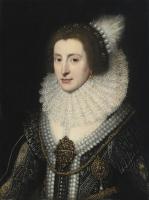

The The Golden Age Restored Masque was a Jacobean era masque, written by Ben Johnson [aged 44] and designed by Inigo Jones [aged 42]; it was performed on 1st January 1616 and 06 Jan 1616, almost certainly at Whitehall Palace.


On 1st January 1616 George Villiers 1st Duke of Buckingham [aged 23] was appointed Master of the Horse. See Diary of Anne Clifford.
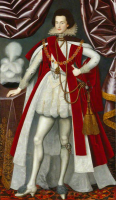


Diary of Anne Clifford. 1st January 1617. Upon New Year's day presently after dinner I went to the Savoy to my Lady Carey and from thence he and I went to Somerset House to the Queen where I met Lady Derby, my Lady Bedford [aged 37], my Lady Montgomery, and a great deal of company that came along with the King and the Prince. My Lady Arundel had much talk with me about the business and persuaded me to yield to the King in all things. From Somerset House we went to Essex House to see my Lady of Northumberland. From thence I went to see my Lady Rich and so came home. After supper I went to see my Sister Beauchamp and stay'd with her an hour or two for my Lord [aged 27] was at the play at Whitehall that night1.
Note 1. As the King passed by, he kissed me. Afterwards the Queen came out into the Drawing Chamber where she kissed me and used me very kindly.
This was the rst time I ever saw the King, Queen, or Prince since they came out of the North.
On 1st January 1629 Frederick Henry Palatinate Simmern [aged 15] drowned. He was on his way to Amsterdam to see the captured Spanish treasure fleet there and drowned crossing the Haarlemmermeer.
In December 1644 Parliament decided to execute the Hothams, father and son, John Hotham 1st Baronet [aged 55] and John Hotham [aged 34].
On 1st January 1645 John Hotham was beheaded for treason by Parliamentarians at Tower Hill [Map]. His father was executed the next day.
On 2nd January 1645 John Hotham 1st Baronet was beheaded for treason by Parliamentarians; his son having been executed the previous day. His grandson John [aged 12] succeeded 2nd Baronet Hotham of Scorborough in Yorkshire.
Diary of Isabella Twysden 1645. 1st January 1645. The first of Janua Mr Jo: hothum [aged 35] was beheaded on tower hill [Map].
Annals of the six Kings of England by Nicholas Trivet
Translation of the Annals of the Six Kings of England by that traces the rise and rule of the Angevin aka Plantagenet dynasty from the mid-12th to early 14th century. Written by the Dominican scholar Nicholas Trivet, the work offers a vivid account of English history from the reign of King Stephen through to the death of King Edward I, blending political narrative with moral reflection. Covering the reigns of six monarchs—from Stephen to Edward I—the chronicle explores royal authority, rebellion, war, and the shifting balance between crown, church, and nobility. Trivet provides detailed insight into defining moments such as baronial conflicts, Anglo-French rivalry, and the consolidation of royal power under Edward I, whose reign he describes with particular immediacy. The Annals combines careful year-by-year reporting with thoughtful interpretation, presenting history not merely as a sequence of events but as a moral and political lesson. Ideal for readers interested in medieval history, kingship, and the origins of the English state, this chronicle remains a valuable and accessible window into the turbulent world of the Plantagenet kings.
Available at Amazon in eBook and Paperback format.
On 1st January 1648 John Leslie 1st Duke Rothes [aged 18] and Anne Lindsay were married. She by marriage Countess Rothes. She the daughter of John Lindsay 1st Earl Lindsay 17th Earl Crawford [aged 36] and Margaret Hamilton Countess Lindsay and Crawford [aged 36]. He the son of John Leslie 6th Earl Rothes and Anne Erskine Countess of Rothes. They were fourth cousin twice removed.
On 1st January 1651 King Charles II of England Scotland and Ireland [aged 20] was crowned II King Scotland at Scone Abbey [Map].
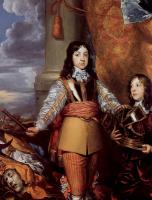


Samuel Pepys' Diary. 1st January 1660. (Lord's Day) This morning (we living lately in the garret) I rose, put on my suit with great skirts, having not lately worn any other, clothes but them. Went to Mr. Gunning's [aged 46] chapel at Exeter House [Map], where he made a very good sermon upon these words: - "That in the fulness of time God sent his Son, made of a woman", &c.; showing, that, by "made under the law", is meant his circumcision, which is solemnized this day.
Note 1. Unbeknown to Pepys the diarist John Evelyn was also present. See John Evelyn's Diary.
Samuel Pepys' Diary. 1st January 1660. The new Common Council of the City do speak very high; and had sent to Monk [aged 51] their sword-bearer, to acquaint him with their desires for a free and full Parliament, which is at present the desires, and the hopes, and expectation of all. Twenty-two of the old secluded members having been at the House-door the last week to demand entrance, but it was denied them; and it is believed that they nor the people will be satisfied till the House be filled.

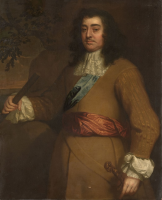
Samuel Pepys' Diary. 1st January 1660. The condition of the State was thus; viz. the Rump, after being disturbed by my Lord Lambert [aged 40], was lately returned to sit again. The officers of the Army all forced to yield. Lawson [aged 45] lies still in the river, and Monk [aged 51] is with his army in Scotland. Only my Lord Lambert is not yet come into the Parliament, nor is it expected that he will without being forced to it.


John Evelyn's Diary. 1st January 1660. Annus Mirabilis. Begging God's blessings for the following year, I went to Exeter Chapel [Map], when Mr. Gunning [aged 46] began the year on Galatians iv. 3-7, showing the love of Christ in shedding his blood so early for us.
Note 1. Unbeknown to Evelyn the diarist Samuel Pepys, whose diary was commenced this day, was also present. See Samuel Pepy's Diary.
Samuel Pepys' Diary. 1st January 1661. After dinner I took my wife to Whitehall, I sent her to Mrs. Pierces (where we should have dined today), and I to the Privy Seal, where Mr. Moore took out all his money, and he and I went to Mr. Pierces; in our way seeing the Duke of York [aged 27] bring his Lady this day to wait upon the Queen, the first time that ever she did since that great business; and the Queen [aged 51] is said to receive her now with much respect and love; and there he cast up the fees, and I told the money, by the same token one £100 bag, after I had told it, fell all about the room, and I fear I have lost some of it. That done I left my friends and went to my Lord's, but he being not come in I lodged the money with Mr. Shepley, and bade good night to Mr. Moore, and so returned to Mr. Pierces, and there supped with them, and Mr. Pierce, the purser, and his wife and mine, where we had a calf's head carboned1, but it was raw, we could not eat it, and a good hen. But she is such a slut that I do not love her victualls. After supper I sent them home by coach, and I went to my Lord's and there played till 12 at night at cards at Best with J. Goods and N. Osgood, and then to bed with Mr. Shepley.
Note 1. Meat cut crosswise and broiled was said to be carboned. Falstaff says in "King Henry IV"., Part L, act v., sc. 3, "Well, if Percy be alive, I'll pierce him. If he do come in my way, so; if he do not, if I come in his willingly, let him make a carbonado of me".


Diary of John Nicoll. 1st January 1661. We find in the Inglifche Diurnell, that Charles, fone to his Royall hynes James Duke of York [aged 27], (onlie brother to our lord the King) wes, upone the firft day of this moneth of Januar, baptized by Gilbert Lord Bifhop of Lundon, at Worchefter hous, quhair wes prefent his Majeftie himfelf; quho, with the Duke of Albemarle [aged 52], wer the two godfatheris, and the Marchiones of Ormond [aged 45] godmother; thair being alfo prefent his heynes Prince Rupert [aged 41], the Lord Heigh Treafaurer, the Lord Stewart, and Lord Chalmerland of his Majefteis counfall, with many uther perfonages of honor, befyde the Lord Heigh Chancellar [aged 51] himfelf, father to hir heynes Anne Dutches of York [aged 23], quho that fame nycht fuped with the Quene, and the nixt day dyned with his Majeftie and his hynes the Duke of York (hir hulband) in the prefence chalmer at Quhytehall. And now the good pepill of England haif thair wifches, feing thai lie a grandchyld of that verteous king, Charles the Confeffor and martyre, borne in England, quhome it hath pleafed his Majeftie to creat Duke of Cambridge; and a Dutches of York of thair awin cuntrie, and of thair awin religion.
John Evelyn's Diary. 1st January 1662. I went to London, invited to the solemn foolery of the Prince de la Grange, at Lincoln's Inn, where came the King [aged 31], Duke, etc. It began with a grand masque, and a formal pleading before the mock Princes, Grandees, Nobles, and Knights of the Sun. He had his Lord Chancellor [aged 52], Chamberlain, Treasurer, and other Royal Officers, gloriously clad and attended. It ended in a magnificent banquet. One Mr. Lort was the young spark who maintained the pageantry.


Samuel Pepys' Diary. 1st January 1663. After dinner I did reckon with Mrs. Sarah for what we have eat and drank here, and gave her a crown, and so took coach, and to the Duke's house, where we saw "The Villaine" again; and the more I see it, the more I am offended at my first undervaluing the play, it being very good and pleasant, and yet a true and allowable tragedy. The house was full of citizens, and so the less pleasant, but that I was willing to make an end of my gaddings, and to set to my business for all the year again tomorrow. Here we saw the old Roxalana [aged 20] in the chief box, in a velvet gown, as the fashion is, and very handsome, at which I was glad. Hence by coach home, where I find all well, only Sir W. Pen [aged 41] they say ill again.
Samuel Pepys' Diary. 1st January 1663. Lay with my wife at my Lord's lodgings, where I have been these two nights, till 10 o'clock with great pleasure talking, then I rose and to White Hall, where I spent a little time walking among the courtiers, which I perceive I shall be able to do with great confidence, being now beginning to be pretty well known among them. Then to my wife again, and found Mrs. Sarah with us in the chamber we lay in. Among other discourse, Mrs. Sarah tells us how the King [aged 32] sups at least four or [five] times every week with my Baroness Castlemaine's [aged 22]; and most often stays till the morning with her, and goes home through the garden all alone privately, and that so as the very centrys take notice of it and speak of it. She tells me, that about a month ago she [Baroness Castlemaine] quickened at my Lord Gerard's [aged 45] at dinner, and cried out that she was undone; and all the lords and men were fain to quit the room, and women called to help her. In fine, I find that there is nothing almost but bawdry at Court from top to bottom, as, if it were fit, I could instance, but it is not necessary; only they say my Lord Chesterfield [aged 29], groom of the stole to the Queen [aged 24], is either gone or put away from the Court upon the score of his lady's [aged 22] having smitten the Duke of York [aged 29], so as that he is watched by the Duchess of York [aged 25], and his lady is retired into the country upon it. How much of this is true, God knows, but it is common talk.
Samuel Pepys' Diary. 1st January 1667. Lay long, being a bitter, cold, frosty day, the frost being now grown old, and the Thames covered with ice. Up, and to the office, where all the morning busy..

Samuel Pepys' Diary. 1st January 1668. Up, and all the morning in my chamber making up some accounts against this beginning of the new year, and so about noon abroad with my wife, who was to dine with W. Hewer [aged 26] and Willet at Mrs. Pierce's, but I had no mind to be with them, for I do clearly find that my wife is troubled at my friendship with her and Knepp, and so dined with my Lord Crew [aged 70], with whom was Mr. Browne, Clerk of the House of Lords, and Mr. John Crew. Here was mighty good discourse, as there is always: and among other things my Lord Crew did turn to a place in the Life of Sir Philip Sidney, wrote by Sir Fulke Greville, which do foretell the present condition of this nation, in relation to the Dutch, to the very degree of a prophecy; and is so remarkable that I am resolved to buy one of them, it being, quite throughout, a good discourse. Here they did talk much of the present cheapness of corne, even to a miracle; so as their farmers can pay no rent, but do fling up their lands; and would pay in corne: but, which I did observe to my Lord, and he liked well of it, our gentry are grown so ignorant in every thing of good husbandry, that they know not how to bestow this corne: which, did they understand but a little trade, they would be able to joyne together, and know what markets there are abroad, and send it thither, and thereby ease their tenants and be able to pay themselves. They did talk much of the disgrace the Archbishop [aged 69] is fallen under with the King [aged 37], and the rest of the Bishops also.

Samuel Pepys' Diary. 1st January 1668. Thence I to White Hall, and there walked up and down the house a while, and do hear nothing of anything done further in this business of the change of Privy-counsellors: only I hear that Sir G. Savile [aged 34], one of the Parliament Committee of nine, for examining the Accounts, is by the King [aged 37] made a Lord, the Lord Halifax; which, I believe, will displease the Parliament.
John Evelyn's Diary. 1st January 1684. The weather continuing intolerably severe, streetes of booths were set upon the Thames; the aire was so very cold and thick, as of many yeares there had not ben the like. The smallpox was very mortal.
Chronicle of Abbot Ralph of Coggeshall
The Chronicle of Abbot Ralph of Coggeshall (Chronicon Anglicanum) is an indispensable medieval history that brings to life centuries of English and European affairs through the eyes of a learned Cistercian monk. Ralph of Coggeshall, abbot of the Abbey of Coggeshall in Essex in the early 13th century, continued and expanded his community’s chronicle, documenting events from the Norman Conquest of 1066 into the tumultuous reign of King Henry III. Blending eyewitness testimony, careful compilation, and the monastic commitment to record-keeping, this chronicle offers a rare narrative of political intrigue, royal power struggles, and social upheaval in England and beyond. Ralph’s work captures the reigns of pivotal figures such as Richard I and King John, providing invaluable insights into their characters, decisions, and the forces that shaped medieval rule. More than a simple annal, Chronicon Anglicanum conveys the texture of medieval life and governance, making it a rich source for scholars and readers fascinated by English history, monastic authorship, and the shaping of the medieval world.
Available at Amazon in eBook and Paperback format.
On 1st January 1684 Prince George of Denmark 1st Duke Cumberland [aged 30] was appointed 487th Knight of the Garter by King Charles II of England Scotland and Ireland [aged 53].


On 1st January 1685 Frederick Louis Oldenburg I Duke Schleswig-Holstein-Sonderburg-Beck [aged 31] and Louise Charlotte Oldenburg Duchess Schleswig-Holstein-Sonderburg-Beck [aged 26] were married. She by marriage Duchess Schleswig-Holstein-Sonderburg-Beck. She the daughter of Ernest Günther Oldenburg I Duke Schleswig Holstein Sonderburg Augustenburg [aged 75] and Auguste Oldenburg Duchess Schleswig Holstein Sonderburg Augustenburg [aged 51]. He the son of August Philipp Oldenburg I Duke Schleswig-Holstein-Sonderburg-Beck and Marie Sibylle Nassau Saarbrücken Duchess Schleswig-Holstein-Sonderburg-Beck. They were first cousins.
John Evelyn's Diary. 1st January 1686. Imploring ye continuance of God's providential care for the yeare now entered, I went to the public devotions. The Deane of the Chapell and Cleark of the Closset put out, viz. Bp. of London [aged 54] and ..., and Rochester [aged 51] and Durham [aged 52] put in their places; the former had oppos'd the toleration intended, and shewn a worthy zeale for the Reform'd Religion as establish'd.


John Evelyn's Diary. 1st January 1687. Mr. Wake [aged 29] preached at St. Martin's on 1 Tim. iii. 16, concerning the mystery of godliness. He wrote excellently, in answer to the Bishop of Meaux.
John Evelyn's Diary. 1st January 1693. Contest in Parliament about a self-denying Act, that no Parliament man should have any office; it wanted only two or three voices to have been carried. The Duke of Norfolk's [aged 37] bill for a divorce thrown out, he having managed it very indiscreetly. The quarrel between Admiral Russell [aged 40] and Lord Nottingham [aged 45] yet undetermined.


John Evelyn's Diary. 1st January 1699. My cousin Pierrepoint died. She was daughter to Sir John Evelyn, of Wilts, my father's nephew; she was widow to William Pierrepoint, brother to the Marquis of Dorchester, and mother to Evelyn Pierrepoint, Earl of Kingston [aged 44]; a most excellent and prudent lady.


On 1st January 1701 Henri Gascar [aged 66] died.
John Evelyn's Diary. 1st January 1703. News of Vice-Admiral Benbow's conflict with the French fleet in the West Indies, in which he gallantly behaved himself, and was wounded, and would have had extraordinary success, had not four of his men-of-war stood spectators without coming to his assistance; for this, two of their commanders were tried by a Council of War, and executed; a third was condemned to perpetual imprisonment, loss of pay, and incapacity to serve in future. The fourth died.
John Evelyn's Diary. 1st January 1704. The King of Spain [aged 20] landing at Portsmouth, Hampshire [Map], came to Windsor, Berkshire [Map], where he was magnificently entertained by the Queen [aged 38], and behaved himself so nobly, that everybody was taken with his graceful deportment. After two days, having presented the great ladies, and others, with valuable jewels, he went back to Portsmouth, Hampshire [Map], and immediately embarked for Spain.


On 1st January 1712 Queen Anne of England Scotland and Ireland [aged 46], on behalf of Robert Harley 1st Earl of Oxford and Earl Mortimer [aged 50], created a number of new Baronies to balance power in Parliament, known as Harley's Dozen,...
Allen Bathurst 1st Earl Bathurst [aged 27] was created 1st Baron Bathurst.
Charles Bruce 4th Earl Elgin 3rd Earl Ailesbury [aged 29] by writ of acceleration 3rd Baron Bruce of Skelton in Yorkshire.
James Compton 5th Earl of Northampton [aged 24] by writ of acceleration 6th Baron Compton of Compton in Warwickshire.
Thomas Foley 1st Baron Foley [aged 38] was created 1st Baron Foley.
George Granville 1st Baron Lansdowne [aged 45] was created 1st Baron Lansdowne of Bideford in Devon. Mary Villiers Baroness Lansdowne by marriage Baroness Lansdowne of Bideford in Devon.
George Henry Hay 8th Earl Kinnoull [aged 22] was created 1st Baron Hay of Pedwardine in Herefordshire.
Thomas Mansel 1st Baron Mansel [aged 44] was created 1st Baron Mansel of Margam. Martha Millington Baroness Mansel by marriage Baroness Mansel of Margam.
Samuel Masham 1st Baron Masham [aged 33] was created 1st Baron Masham of Otes in Essex. Abigail Hill Baroness Masham [aged 42] by marriage Baroness Masham of Otes in Essex.
Henry Paget 1st Earl Uxbridge [aged 48] was created 1st Baron Burton.
Thomas Trevor 1st Baron Trevor Bromham [aged 53] was created 1st Baron Trevor Bromham.
Thomas Willoughby 1st Baron Middleton [aged 39] was created 1st Baron Middleton. Elizabeth Rothwell Baroness Willoughby and Middleton by marriage Baroness Middleton.
Thomas Windsor 1st Viscount Windsor [aged 42] was created 1st Baron Mountjoy.


On 1st January 1713 John Manners 2nd Duke Rutland [aged 36] and Lucy Sherard Duchess Rutland [aged 28] were married. She by marriage Duchess Rutland. He the son of John Manners 1st Duke Rutland and Catherine Noel Duchess Rutland [aged 56].
After 1st January 1738. All Saints Church, Harmston [Map]. Monument to Samuel Thorold 2nd Baronet [deceased].
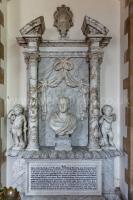

On 1st January 1741 Peregrine Bertie 2nd Duke Ancaster and Kesteven [aged 54] died. His son Peregrine [aged 27] succeeded 3rd Duke Ancaster and Kesteven, 3rd Marquess Lindsay, 6th Earl Lindsey, 19th Baron Willoughby de Eresby.
After 1st January 1741. Church of St Michael and All Angels, Edenham [Map]. Monument to Peregrine Bertie 2nd Duke Ancaster and Kesteven [deceased]. Flat Obelisk before which stands life sized carving of the deceased leaning on an Urn, in Roman dress, a putto holding a medallion of the Duchess Jane Brownlow Duchess Ancaster and Kesteven. Sculpted by Louis Francois Roubiliac [aged 38].


On 1st January 1755 Henry Bromley 1st Baron Montfort [aged 49] shot himself. He was buried at the Trinity Chapel, Conduit Street. Baron Montfort of Horseheath extinct. He left debts of £30,000 with an estate out of repair and in a very ruinous condition.
On 1st January 1800 Francis Leveson Gower aka Egerton 1st Earl Ellesmere was born to George Granville Leveson-Gower 1st Duke Sutherland [aged 41] and Elizabeth Sutherland Duchess Sutherland 19th Countess Sutherland [aged 34] at 21 Arlington Street, Piccadilly. He married 18th June 1822 his fourth cousin once removed Harriet Greville Countess Ellesmere and had issue.


On 1st January 1801 the Act of Union came into force by which Great Britain and Ireland were united creating the United Kingdom. Actually two Acts of Union with the same title: one for the Parliament of Great Britain and one for the Parliament of Ireland.
On 1st January 1805 Nicholas Ridley of Link House, Blyth [aged 55] died. He was buried at Bath Abbey [Map]. Memorial at Cathedral Church St Nicholas, Newcastle upon Tyne [Map]
Nicholas Ridley of Link House, Blyth: On 5th March 1749 he was born to Matthew Ridley and Elizabeth White. On 23rd November 1790 Nicholas Ridley of Link House, Blyth and Letitia Atkins were married.
On 1st January 1832 Jane Hermione Seymour Lady Graham was born to Edward Adolphus Seymour 12th Duke of Somerset [aged 27] and Jane Georgiana Sheridan Duchess Somerset [aged 22]. She married before 10th September 1854 her first cousin once removed Frederick Ulric Graham 3rd Baronet, son of James Graham 2nd Baronet and Frances "Fanny" Callander Lady Graham, and had issue.

Greville Memoirs. 1st January 1832. Panshanger [Map]. Distress seems to increase hereabouts, and crime with it. Methodism and saintship increase too. The people of this house are examples of the religion of the fashionable world, and the charity of natural benevolence, which the world has not spoiled. Lady Cowper [aged 44] and her family go to church, but scandalise the congregation by always arriving half an hour too late. The hour matters not; if it began at nine, or ten, or twelve, or one o'clock, it would be the same thing; they are never ready, and always late, but they go. Lord Cowper never goes at all; but he employs multitudes of labourers, is ready to sanction any and every measure which can contribute to the comfort and happiness of the peasantry. Lady Cowper and her daughters inspect personally the cottages and condition of the poor. They visit, enquire, and give; they distribute flannel, medicines, money, and they talk to and are kind to them, so that the result is a perpetual stream flowing from a real fountain of benevolence, which waters all the country round and gladdens the hearts of the peasantry, and attaches them to those from whom it emanates.
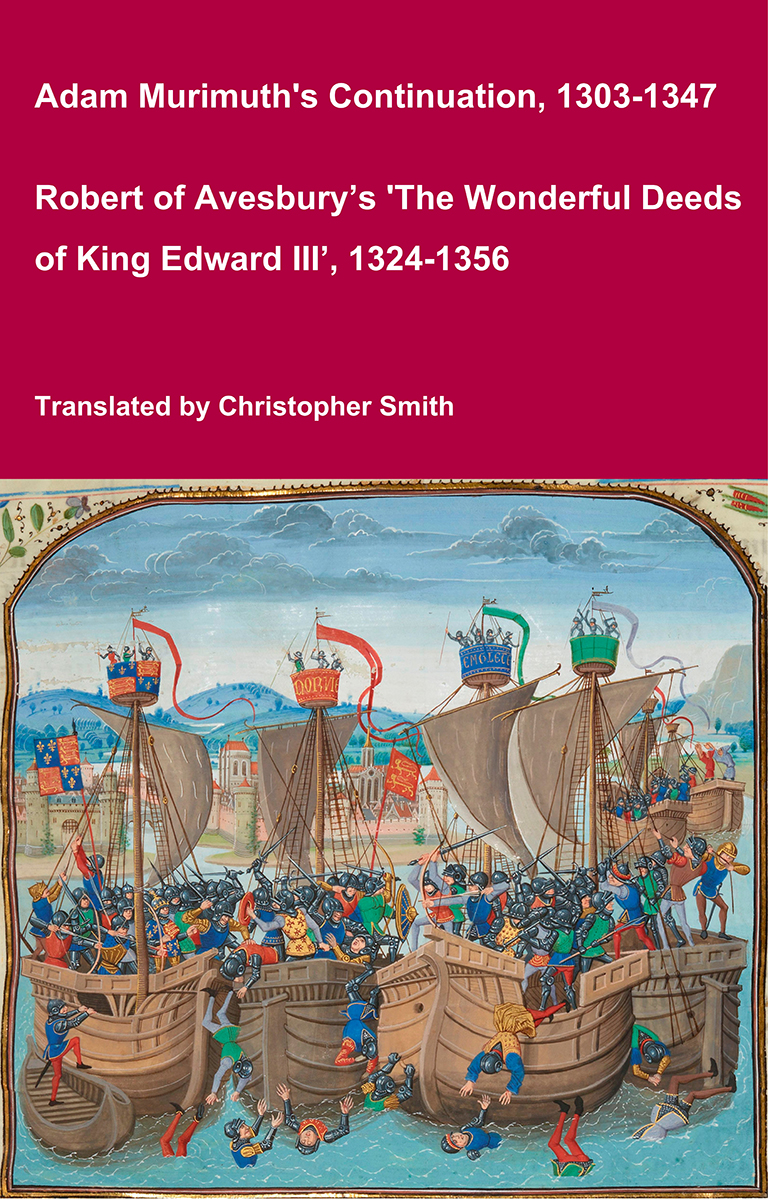
Adam Murimuth's Continuation and Robert of Avesbury’s 'The Wonderful Deeds of King Edward III'
This volume brings together two of the most important contemporary chronicles for the reign of Edward III and the opening phases of the Hundred Years’ War. Written in Latin by English clerical observers, these texts provide a vivid and authoritative window into the political, diplomatic, and military history of fourteenth-century England and its continental ambitions. Adam Murimuth Continuatio's Chronicarum continues an earlier chronicle into the mid-fourteenth century, offering concise but valuable notices on royal policy, foreign relations, and ecclesiastical affairs. Its annalistic structure makes it especially useful for establishing chronology and tracing the development of events year by year. Complementing it, Robert of Avesbury’s De gestis mirabilibus regis Edwardi tertii is a rich documentary chronicle preserving letters, treaties, and official records alongside narrative passages. It is an indispensable source for understanding Edward III’s claim to the French crown, the conduct of war, and the mechanisms of medieval diplomacy. Together, these works offer scholars, students, and enthusiasts a reliable and unembellished account of a transformative period in English and European history. Essential for anyone interested in medieval chronicles, the Hundred Years’ War, or the reign of Edward III.
Available at Amazon in eBook and Paperback format.
The Diary of George Price Boyce 1853. 1st January 1853. Mr. Topham [aged 44] called on me in Gt. Russell St., looked over my drawings; recommended me candidly not to try for the Old Water-Colour Society this season. Hoped Anthony and I would join him in Spain this summer. Drew at Clipstone St. for 1½ hrs. Last sitting of Miss Nicholl. She has been sitting to D. G. Rossetti [aged 24] in a sitting posture.


1st January 1916. Bassano Ltd. Photograph of Henry Evelyn Wood [aged 77].
Henry Evelyn Wood: On 9th February 1838 he was born to Reverend John Page-Wood 2nd Baronet. On In 1867 Henry Evelyn Wood and Mary Paulina Southwell were married. On 2nd December 1919 Henry Evelyn Wood died.

The London Gazette 31712. Central Chancery Of The Orders Of Knighthood. St. James's Palace, S.W., 1st January, 1920
The King has been graciously pleased to signify His Majesty's intention of conferring Peerages of the United Kingdom on the following:
To be an Earl
The Right Honourable Sir William St. John Fremantle Brodrick [aged 63], Viscount Midleton, K.P.
To be Barons.
Sir Bertrand Edward Dawson, G.C.V.O., C.B., M.D., F.R.C.P., Physician-in-Ordinary to The King; Physician, London Hospital; Dean, Faculty of Medicine and Member of Senate, University of London; Chairman of Consultative Council, Ministry of Health; Public Services in connection with Health matters.
Sir George Allardice Riddell [aged 54], Bart., Vice-Chairman of Newspaper Proprietors' Association, Ltd.; In charge of all the British Press and Colonial Press throughout the Peace Conference in Paris; Public Services.
The Right Honourable Sir Albert Henry Stanley, M.P., late President of the Board of Trade
St Peter and St Paul's Church, Longhoughton [Map]. Grave of 943573 Ldg. Aircraftman, J Wilson, Royal Air Force, 1st January 1943 age 23.
The London Gazette 40053. Central Chancery Of The Orders Of Knighthood. St. James's Palace, S.W.I. 1st January, 1954.
To be Ordinary Knights Commanders of the Civil Division of the said Most Excellent Order:
Sir Thomas Penberthy Bennett, C.B.E., Chairman, Crawley Development Corporation.
Sir Robert Bland Bird [aged 77], Bt, Member of Parliament for West Wolverhampton, 1922-1929 and 1931-1945. For political and public services.
Colonel Douglas Stephenson Branson, C.B., D.S.O., M.C., T.D., D.L., Chairman, Territorial and Auxiliary Forces Association, West Riding of Yorkshire.
Jacob Epstein [aged 73], Esq., Sculptor.
On 1st January 1184 Bethóc Angus was born to Gille Críst Angus 4th Earl Angus and Marjorie Dunkeld Countess Angus. She married Walter Stewart 3rd High Steward and had issue.
On 1st January 1236 Baldwin Redvers 7th Earl Devon was born to Baldwin Redvers 6th Earl Devon [aged 19] and Amice Clare Countess Devon [aged 15]. He a great x 4 grandson of King Henry I "Beauclerc" England. He married 1257 Margherita Savoy Countess Devon, daughter of Thomas Savoy I Count Savoy and Margaret Geneva Countess Savoy, and had issue.
On 1st January 1296 Robert Welles 2nd Baron Welles was born to Adam Welles 1st Baron Welles [aged 47]. He married before 29th August 1320 Maud Clare Baroness Clifford Baroness Welles and had issue.
On 1st January 1424 Louis IV Count Palatine of the Rhine was born to Louis Wittelsbach III Elector Palatine [aged 45] and Matilda of Savoy [aged 34]. He married 1445 his fifth cousin Margaret of Savoy, daughter of Amadeus Savoy VIII Count Savoy and Mary Valois Countess Savoy, and had issue.
On 1st January 1442 Margaret Wittelsbach was born to Albert Wittelsbach III Duke Bavaria [aged 40] and Anna Brunswick Grubenhagen Duchess Bavaria [aged 28]. She married 1463 Frederico Gonzaga Marquess Mantua, son of Ludovico III Marquis of Mantua and Barbara of Brandenburg Marquise of Mantua, and had issue.
The History of William Marshal was commissioned by his son shortly after William’s death in 1219 to celebrate the Marshal’s remarkable life; it is an authentic, contemporary voice. The manuscript was discovered in 1861 by French historian Paul Meyer. Meyer published the manuscript in its original Anglo-French in 1891 in two books. This book is a line by line translation of the first of Meyer’s books; lines 1-10152. Book 1 of the History begins in 1139 and ends in 1194. It describes the events of the Anarchy, the role of William’s father John, John’s marriages, William’s childhood, his role as a hostage at the siege of Newbury, his injury and imprisonment in Poitou where he met Eleanor of Aquitaine and his life as a knight errant. It continues with the accusation against him of an improper relationship with Margaret, wife of Henry the Young King, his exile, and return, the death of Henry the Young King, the rebellion of Richard, the future King Richard I, war with France, the death of King Henry II, and the capture of King Richard, and the rebellion of John, the future King John. It ends with the release of King Richard and the death of John Marshal.
Available at Amazon in eBook and Paperback format.
On 1st January 1507 Anna Hohenzollern Duchess Mecklenburg was born to Joachim "Nestor" Hohenzollern Elector Brandenburg [aged 22]. She married 17th January 1524 Albrecht VII Duke Mecklenburg and had issue.
On 1st January 1511 Prince Henry Duke of Cornwall was born to Henry VIII [aged 19] and Catherine of Aragon [aged 25] at Richmond Palace [Map]. He was appointed Duke of Cornwall at birth.
On 22nd February 1511 Prince Henry Duke of Cornwall died. He was buried at Westminster Abbey [Map]. He died aged less than one years old.
On 1st January 1558 Elizabeth Stanley Baroness Marshal Morley was born to William Stanley 3rd Baron Monteagle [aged 30] and Anne Leybourne [aged 26]. She married before 1575 her third cousin once removed Edward Parker 13th Baron Marshal 12th Baron Morley, son of Henry Parker 12th Baron Marshal 11th Baron Morley and Elizabeth Stanley Baroness and Morley, and had issue.
On 1st January 1563 Elizabeth Brooke was born to William Brooke 10th Baron Cobham [aged 35] and Frances Newton Baroness Cobham [aged 24]. She married 1589 Robert Cecil 1st Earl Salisbury, son of William Cecil 1st Baron Burghley and Mildred Cooke Baroness Burghley, and had issue.
On 1st January 1575 Thomas Palmer was born to Thomas Palmer 1st Baronet [aged 35] and Margaret Poley Lady Palmer [aged 33] at Putney, Surrey [Map].
On 1st January 1591 Bishop Benjamin Lany was born.
On 1st January 1614 Frederick Henry Palatinate Simmern was born to Frederick Palatinate Simmern V Elector Palatine Rhine [aged 17] and Princess Elizabeth Stewart Queen Bohemia [aged 17]. He a grandson of King James I of England and Ireland and VI of Scotland.
On 1st January 1618 Mary Leslie Countess of Eglinton was born to John Leslie 6th Earl Rothes [aged 18] and Anne Erskine Countess of Rothes [aged 20]. She married 1631 her fourth cousin Hugh Montgomerie 7th Earl Eglinton, son of Alexander Seton aka Montgomerie 6th Earl Eglinton and Anne Livingstone Countess Eglinton, and had issue.

On 1st January 1619 Robert Bertie was born to Robert Bertie 1st Earl Lindsey [aged 36] and Elizabeth Montagu Countess Lindsey. He married (1) Elizabeth Bennett (2) Mary Halsey (3) Alice Barnard.
On 1st January 1632 Thomas Darcy 1st Baronet was born to Thomas Darcy of Tiptree Priory and Mary Astley.
On 1st January 1634 Elizabeth Freschville Countess Holderness was born to John Freschville 1st Baron Frescheville [aged 26] and Sarah Harrington. She married 8th January 1685 her half sixth cousin Conyers Darcy 2nd Earl Holderness, son of Conyers Darcy 1st Earl Holderness and Grace Rokeby.
Chronicle of Abbot Ralph of Coggeshall
The Chronicle of Abbot Ralph of Coggeshall (Chronicon Anglicanum) is an indispensable medieval history that brings to life centuries of English and European affairs through the eyes of a learned Cistercian monk. Ralph of Coggeshall, abbot of the Abbey of Coggeshall in Essex in the early 13th century, continued and expanded his community’s chronicle, documenting events from the Norman Conquest of 1066 into the tumultuous reign of King Henry III. Blending eyewitness testimony, careful compilation, and the monastic commitment to record-keeping, this chronicle offers a rare narrative of political intrigue, royal power struggles, and social upheaval in England and beyond. Ralph’s work captures the reigns of pivotal figures such as Richard I and King John, providing invaluable insights into their characters, decisions, and the forces that shaped medieval rule. More than a simple annal, Chronicon Anglicanum conveys the texture of medieval life and governance, making it a rich source for scholars and readers fascinated by English history, monastic authorship, and the shaping of the medieval world.
Available at Amazon in eBook and Paperback format.
On 1st January 1659 Margaret Wemyss Countess Cromartie 3rd Countess Wemyss was born to David Wemyss 2nd Earl of Wemyss [aged 48] and Margaret Leslie Countess Buccleuch and Wemyss [aged 38]. She married (1) 28th March 1672 James Wemyss 1st Lord Burntisland and had issue (2) after December 1682 George Mackenzie 1st Earl Cromartie.
On 1st January 1707 Henry Howard 10th Earl Suffolk was born to Charles Howard 9th Earl Suffolk [aged 32] and Henrietta Hobart Countess Suffolk [aged 18]. He married 13th May 1735 Sarah Inwen Countess Suffolk.


On 1st January 1711 Richard Acton 5th Baronet was born to Whitmore Acton 4th Baronet [aged 34]. He married 21st September 1744 Anne Grey Lady Acton, daughter of Henry Grey 3rd Earl Stamford and Dorothy Wright Countess Stamford.
On 1st January 1722 George Baker 1st Baronet was born to George Baker [aged 35] and Mary Weston at Modbury, Devon. He married 28th June 1768 Jane Morris and had issue.
On 1st January 1740 William Weller Pepys 1st Baronet was born to William Pepys [aged 41].

On 1st January 1740 Bishop Lewis Bagot was born to Walter Wagstaffe Bagot 5th Baronet [aged 37] and Barbara Legge Baroness Bagot [aged 31].
On 1st January 1743 Grace Foley Countess Clanbrassil was born to Thomas Foley 1st Baron Foley [aged 26] and Grace Granville. She married 21st May 1744 James Hamilton 2nd Earl Clanbrassil, son of James Hamilton 1st Earl Clanbrassil and Harriet Bentinck Countess Clanbrassil.
On 1st January 1748 Archibald Cochrane 9th Earl of Dundonald was born to Thomas Cochrane 8th Earl of Dundonald [aged 57] and Jane Stuart.
On 1st January 1748 Henry Johnson 1st Baronet was born to Allen Johnson of Kilternan in County Dublin.
On 1st January 1749 Henry Gough-Calthorpe 1st Baron Calthorpe was born to Henry Gough 1st Baronet [aged 40] and Barbara Calthorpe Lady Gough [aged 33]. He married 1st May 1783 Frances Carpenter Baroness Calthorpe and had issue.
On 1st January 1765 William Champion de Crespigny 2nd Baronet was born to Claude Champion de Crespgny 1st Baronet [aged 30]. He married 4th August 1786 Sarah Windsor Lady Champion de Crespigny, daughter of Other Lewis Windsor 4th Earl Plymouth and Catherine Archer Countess Plymouth, and had issue.
Chronicle of Walter of Guisborough
A canon regular of the Augustinian Guisborough Priory, Yorkshire, formerly known as The Chronicle of Walter of Hemingburgh, describes the period from 1066 to 1346. Before 1274 the Chronicle is based on other works. Thereafter, the Chronicle is original, and a remarkable source for the events of the time. This book provides a translation of the Chronicle from that date. The Latin source for our translation is the 1849 work edited by Hans Claude Hamilton. Hamilton, in his preface, says: 'In the present work we behold perhaps one of the finest samples of our early chronicles, both as regards the value of the events recorded, and the correctness with which they are detailed; Nor will the pleasing style of composition be lightly passed over by those capable of seeing reflected from it the tokens of a vigorous and cultivated mind, and a favourable specimen of the learning and taste of the age in which it was framed.'
Available at Amazon in eBook and Paperback format.
On 1st January 1779 Bishop Edward Stanley was born to John Thomas Stanley 6th Baronet [aged 43].
On 1st January 1793 Francis Bond Head 1st Baronet was born to James Roper Head [aged 36]. He married 20th May 1816 Julia Valenza Somerville Lady Head and had issue.

On 1st January 1797 Thomas Cecil was born to Henry Cecil 1st Marquess Exeter [aged 42] and Sarah Hoggins Countess Exeter. He married 8th August 1838 Sophia Georgiana Lennox, daughter of Charles Lennox 4th Duke Richmond and Charlotte Gordon Duchess Richmond.
On 1st January 1799 Harriet Anne Butler Marchioness Donegal was born to Richard Butler 1st Earl Glengall [aged 23]. She married 1822 George Chichester 3rd Marquess Donegal, son of George Chichester 2nd Marquess Donegal, and had issue.
On 1st January 1800 Francis Leveson Gower aka Egerton 1st Earl Ellesmere was born to George Granville Leveson-Gower 1st Duke Sutherland [aged 41] and Elizabeth Sutherland Duchess Sutherland 19th Countess Sutherland [aged 34] at 21 Arlington Street, Piccadilly. He married 18th June 1822 his fourth cousin once removed Harriet Greville Countess Ellesmere and had issue.

On 1st January 1815 Samuel Cunliffe Lister 1st Baron Masham was born.
On 1st January 1820 Edward Graham 9th Baronet was born to Robert Graham 8th Baronet [aged 50] and Elizabeth Young Lady Graham.
On 1st January 1832 Jane Hermione Seymour Lady Graham was born to Edward Adolphus Seymour 12th Duke of Somerset [aged 27] and Jane Georgiana Sheridan Duchess Somerset [aged 22]. She married before 10th September 1854 her first cousin once removed Frederick Ulric Graham 3rd Baronet, son of James Graham 2nd Baronet and Frances "Fanny" Callander Lady Graham, and had issue.
On 1st January 1839 John Harvey Blunt 8th Baronet was born to William Blunt [aged 58].
On 1st January 1840 Alan Brodrick was born to William Brodrick [aged 41] and Harriet Brodrick. Coefficient of inbreeding 6.26%.
Abbot John Whethamstede’s Chronicle of the Abbey of St Albans
Abbot John Whethamstede's Register aka Chronicle of his second term at the Abbey of St Albans, 1451-1461, is a remarkable text that describes his first-hand experience of the beginning of the Wars of the Roses including the First and Second Battles of St Albans, 1455 and 1461, respectively, their cause, and their consequences, not least on the Abbey itself. His text also includes Loveday, Blore Heath, Northampton, the Act of Accord, Wakefield, and Towton, and ends with the Coronation of King Edward IV. In addition to the events of the Wars of the Roses, Abbot John, or his scribes who wrote the Chronicle, include details in the life of the Abbey such as charters, letters, land exchanges, visits by legates, and disputes, which provide a rich insight into the day-to-day life of the Abbey, and the challenges faced by its Abbot.
Available at Amazon in eBook and Paperback format.
On 1st January 1844 Thomas Agar-Robartes 6th Viscount Clifden was born to Thomas James Agar aka Agar-Robartes 1st Baron Robartes [aged 35] and Juliana Pole-Carew Baroness Robartes [aged 31] at Grosvenor Place, Belgravia. He married 1878 Mary Dickinson Viscountess Clifden and had issue.


On 1st January 1845 Bishop Francis Jayne was born to John Jayne and Elisabeth Haines at Pant-y-beiliau, Gilwern, Llanelli. He was educated at Rugby School and Wadham College, Oxford. He took his BA in 1868 and MA in 1870.
On 1st January 1856 Louis Greville was born to George Greville 4th Earl Warwick 4th Earl Brooke [aged 37] and Anne Charteris Countess Warwick [aged 27].

On 1st January 1888 Dorothy Margaret Browne was born to Valentine Charles Browne 5th Earl of Kenmare [aged 27] and Elizabeth Baring Countess Kenmare [aged 20]. She married (1) 5th August 1914 her half fourth cousin twice removed Edward Arthur Grosvenor, son of Hugh Lupus Grosvenor 1st Duke Westminster and Katherine Cavendish Duchess Westminster, and had issue (2) 9th August 1930 Evan Edward Charteris, son of Francis Richard Charteris 10th Earl of Wemyss and Anne Frederica Anson Countess Wemyss.
On 1st January 1910 John Bowes-Lyon was born to Patrick Bowes-Lyon 15th Earl Strathmore and Kinghorne [aged 25] and Dorothy Beatrix Godolphin Osborne [aged 21].
On 1st January 1925 John Vivian 4th Baron Swansea was born to Odo Vivian 3rd Baron Swansea [aged 49].
On 1st January 1537 King James V of Scotland [aged 24] and Madeleine Valois [aged 16] were married at Notre Dame de Paris Cathedral [Map]. She the daughter of King Francis I of France [aged 42] and Claude Valois Orléans Queen Consort France. He the son of King James IV of Scotland and Margaret Tudor Queen Scotland [aged 47]. They were third cousin once removed. He a grandson of King Henry VII of England and Ireland.
On 1st January 1624 Henry de Vere 18th Earl of Oxford [aged 30] and Diana Cecil Countess of Oxford and Elgin [aged 28] were married. She by marriage Countess of Oxford. She the daughter of William Cecil 2nd Earl Exeter [aged 58] and Elizabeth Drury Countess Exeter [aged 45]. He the son of Edward de Vere 17th Earl of Oxford and Elizabeth TrenthamCountess of Oxford. They were fifth cousin once removed.


On 1st January 1638 Gervase Clifton 1st Baronet [aged 50] and Anne South Lady Clifton were married. She by marriage Lady Clifton of Clifton in Nottinghamshire.
On 1st January 1648 Maurice Berkeley 3rd Viscount Fitzhardinge [aged 19] and Anne Lee Viscountess Fitzhardinge [aged 25] were married.
On 1st January 1648 John Leslie 1st Duke Rothes [aged 18] and Anne Lindsay were married. She by marriage Countess Rothes. She the daughter of John Lindsay 1st Earl Lindsay 17th Earl Crawford [aged 36] and Margaret Hamilton Countess Lindsay and Crawford [aged 36]. He the son of John Leslie 6th Earl Rothes and Anne Erskine Countess of Rothes. They were fourth cousin twice removed.
On 1st January 1685 Frederick Louis Oldenburg I Duke Schleswig-Holstein-Sonderburg-Beck [aged 31] and Louise Charlotte Oldenburg Duchess Schleswig-Holstein-Sonderburg-Beck [aged 26] were married. She by marriage Duchess Schleswig-Holstein-Sonderburg-Beck. She the daughter of Ernest Günther Oldenburg I Duke Schleswig Holstein Sonderburg Augustenburg [aged 75] and Auguste Oldenburg Duchess Schleswig Holstein Sonderburg Augustenburg [aged 51]. He the son of August Philipp Oldenburg I Duke Schleswig-Holstein-Sonderburg-Beck and Marie Sibylle Nassau Saarbrücken Duchess Schleswig-Holstein-Sonderburg-Beck. They were first cousins.
On 1st January 1687 Henry St John 1st Viscount St John [aged 34] and Angelica Magdalena Pellissary Viscountess St John [aged 21] were married.


Adam Murimuth's Continuation and Robert of Avesbury’s 'The Wonderful Deeds of King Edward III'
This volume brings together two of the most important contemporary chronicles for the reign of Edward III and the opening phases of the Hundred Years’ War. Written in Latin by English clerical observers, these texts provide a vivid and authoritative window into the political, diplomatic, and military history of fourteenth-century England and its continental ambitions. Adam Murimuth Continuatio's Chronicarum continues an earlier chronicle into the mid-fourteenth century, offering concise but valuable notices on royal policy, foreign relations, and ecclesiastical affairs. Its annalistic structure makes it especially useful for establishing chronology and tracing the development of events year by year. Complementing it, Robert of Avesbury’s De gestis mirabilibus regis Edwardi tertii is a rich documentary chronicle preserving letters, treaties, and official records alongside narrative passages. It is an indispensable source for understanding Edward III’s claim to the French crown, the conduct of war, and the mechanisms of medieval diplomacy. Together, these works offer scholars, students, and enthusiasts a reliable and unembellished account of a transformative period in English and European history. Essential for anyone interested in medieval chronicles, the Hundred Years’ War, or the reign of Edward III.
Available at Amazon in eBook and Paperback format.
On 1st January 1713 John Manners 2nd Duke Rutland [aged 36] and Lucy Sherard Duchess Rutland [aged 28] were married. She by marriage Duchess Rutland. He the son of John Manners 1st Duke Rutland and Catherine Noel Duchess Rutland [aged 56].
On 1st January 1739 Roger Burgoyne 6th Baronet [aged 28] and Frances Montagu Lady Burgoyne were married. She by marriage Lady Burgoyne of Sutton in Bedfordshire. She the daughter of George Montagu 1st Earl Halifax [aged 55] and Mary Lumley Countess Halifax. They were fifth cousins.
On 1st January 1795 Henry Orland Chamberlain 1st Baronet [aged 22] and Elizabeth Harrod were married.
On 1st January 1799 John Minet Henniker-Major 3rd Baron Henniker [aged 21] and Mary Chafy were married. They had five daughters and three sons.
On 1st January 1801 Stapleton Cotton 1st Viscount Combermere [aged 27] and Anna-Maria Clinton [aged 17] were married. She the daughter of Thomas Pelham-Clinton 3rd Duke Newcastle-under-Lyne and Anna Maria Stanhope Countess Lincoln.

On 1st January 1812 John "Radical Jack" Lambton 1st Earl Durham [aged 19] and Harriet Cholmondeley [aged 22] were married at Gretna Green. She the illegitmate daughter of George Cholmondeley 1st Marquess Cholmondeley [aged 62] and Unamed Saint Albin.

On 1st January 1887 Victor Albert Francis Spencer 1st Viscount Churchill [aged 22] and Verena Lowther [aged 21] were married. She by marriage Baroness Churchill Wychwood in Oxfordshire. They had four children. When she wished to divorce Lord Churchill, King Edward forbade it, to avoid a scandal among his social circle. Instead she disappeared in 1909 taking their son, aged 19, and two daughters, aged 13 and 8, with her. In 1927 he obtained a divorce on the grounds of desertion. She the daughter of Henry Lowther 3rd Earl Lonsdale.
On 1st January 1918 Fergus Frederick Graham 5th Baronet [aged 24] and Mary Spencer Revell Reade [aged 20] were married.
On 1st January 1927 Richard James Graham 4th Baronet [aged 68] and Florence Rose Wood Lady Graham were married. She the widow of his younger brother James Reginald Graham; an example of Married to Two Siblings.
On 1st January 1927 Francis Stapleton-Cotton 4th Viscount Combermere [aged 39] and Constance Marie Katherine Williams-Drummond [aged 33] were married. She a first cousin of his first wife Louisa Hazel Agnew Viscountess Combermere [aged 35].
Abbot John Whethamstede’s Chronicle of the Abbey of St Albans
Abbot John Whethamstede's Register aka Chronicle of his second term at the Abbey of St Albans, 1451-1461, is a remarkable text that describes his first-hand experience of the beginning of the Wars of the Roses including the First and Second Battles of St Albans, 1455 and 1461, respectively, their cause, and their consequences, not least on the Abbey itself. His text also includes Loveday, Blore Heath, Northampton, the Act of Accord, Wakefield, and Towton, and ends with the Coronation of King Edward IV. In addition to the events of the Wars of the Roses, Abbot John, or his scribes who wrote the Chronicle, include details in the life of the Abbey such as charters, letters, land exchanges, visits by legates, and disputes, which provide a rich insight into the day-to-day life of the Abbey, and the challenges faced by its Abbot.
Available at Amazon in eBook and Paperback format.
On 1st January 1973 Henry Edward Cubitt 4th Baron Ashcombe [aged 48] and Virginia Carrington Baroness Ashcombe [aged 26] were married. The difference in their ages was 22 years.
On 1st January 898 Odo I King West Franks [aged 41] died. Charles "Simple" III King West Francia [aged 18] succeeded III King West Francia.
On 1st January 951 Ramiro II King Leon [aged 51] died. His son Ordoño [aged 25] succeeded III King Leon.
On 1st January 1128 Prince Bishop Albero Reginar [aged 58] died.
On 1st January 1271 Otto II Count Guelders [aged 56] died. His son Reginald [aged 16] succeeded I Count Guelders.
On 1st January 1325 Alice Tosny Countess Warwick [aged 40] died at Warwick, Warwickshire [Map].
On 1st January 1370 Elizabeth Maxwell Countess Atholl [aged 35] died at Naworth Castle [Map].
On 1st January 1387 Charles "Bad" II King Navarre [aged 54] burned to death. His son Charles [aged 26] succeeded III King Navarre. Eleanor of Castile Queen Consort Navarre [aged 24] by marriage Queen Consort Navarre.
See Note p Harleian Library 6217: ""
On 1st January 1407 Joyce Botetort 3rd Baroness Botetort [aged 39] died. Baron Botetort abeyant.
On 31st December 1426 Thomas Beaufort 1st Duke Exeter [aged 49] died at Greenwich, Kent [Map]. Some sources say 27th December 1426 and 1st January 1427. Duke Exeter and Earl Dorset extinct.
The History of William Marshal was commissioned by his son shortly after William’s death in 1219 to celebrate the Marshal’s remarkable life; it is an authentic, contemporary voice. The manuscript was discovered in 1861 by French historian Paul Meyer. Meyer published the manuscript in its original Anglo-French in 1891 in two books. This book is a line by line translation of the first of Meyer’s books; lines 1-10152. Book 1 of the History begins in 1139 and ends in 1194. It describes the events of the Anarchy, the role of William’s father John, John’s marriages, William’s childhood, his role as a hostage at the siege of Newbury, his injury and imprisonment in Poitou where he met Eleanor of Aquitaine and his life as a knight errant. It continues with the accusation against him of an improper relationship with Margaret, wife of Henry the Young King, his exile, and return, the death of Henry the Young King, the rebellion of Richard, the future King Richard I, war with France, the death of King Henry II, and the capture of King Richard, and the rebellion of John, the future King John. It ends with the release of King Richard and the death of John Marshal.
Available at Amazon in eBook and Paperback format.
On 1st January 1496 Charles Valois Orléans Count Angoulême [aged 37] died.
On 1st January 1498 John Browne [aged 63] died.
On 1st January 1515 Louis XII King France [aged 52] died. His first cousin once removed Francis [aged 20] succeeded I King France: Capet Valois Angoulême.
On 1st January 1559 Christian III King of Denmark [aged 55] died. His son Frederick [aged 24] succeeded II King of Denmark.
On 1st January 1627 Dorothea Stewart Countess Gowrie [aged 86] died.
On 1st January 1637 Roger Townshend 1st Baronet [aged 41] died. His son Roger succeeded 2nd Baronet Townshend.
On 1st January 1681 Bishop John Pritchett died at Harefield where he is buried.
On 1st January 1701 Henri Gascar [aged 66] died.
On 1st January 1707 Honora Belasyse Baroness Bergavenny died.
On 1st January 1710 Bishop William Lloyd [aged 73] died.

On 1st January 1710 William Bruce 1st Baronet [aged 80] died. His son John [aged 39] succeeded 2nd Baronet Bruce of Balcaskie.
The Deeds of the Dukes of Normandy
The Gesta Normannorum Ducum [The Deeds of the Dukes of Normandy] is a landmark medieval chronicle tracing the rise and fall of the Norman dynasty from its early roots through the pivotal events surrounding the Norman Conquest of England. Originally penned in Latin by the monk William of Jumièges shortly before 1060 and later expanded at the behest of William the Conqueror, the work chronicles the deeds, politics, battles, and leadership of the Norman dukes, especially William’s own claim to the English throne. The narrative combines earlier historical sources with firsthand information and oral testimony to present an authoritative account of Normandy’s transformation from a Viking settlement into one of medieval Europe’s most powerful realms. William’s history emphasizes the legitimacy, military prowess, and governance of the Norman line, framing their expansion, including the conquest of England, as both divinely sanctioned and noble in purpose. Later chroniclers such as Orderic Vitalis and Robert of Torigni continued the history, extending the coverage into the 12th century, providing broader context on ducal rule and its impact. Today this classic work remains a foundational source for understanding Norman identity, medieval statesmanship, and the historical forces that reshaped England and Western Europe between 800AD and 1100AD.
Available at Amazon in eBook and Paperback format.

On 1st January 1724 John Sherard 1st Baronet [aged 61] died unmarried. His brother Richard [aged 58] succeeded 2nd Baronet Sherard of Lobthorp in Lincolnshire.
On 1st January 1726 Hester Firebrace Countess Desmond and Denbigh [aged 49] died.
On 1st January 1730 Daniel Finch 2nd Earl Nottingham 7th Earl Winchilsea [aged 82] died. His son Daniel [aged 40] succeeded 8th Earl Winchilsea, 8th Viscount Maidstone, 3rd Earl Nottingham, 3rd Baron Finch Daventry, 9th Baronet Finch of Eastwell in Kent.
On 1st January 1734 Bishop Welbore Ellis [aged 83] died. He was buried at Christ Church Cathedral, Dublin [Map].
On 1st January 1736 Diana Condon Lady Lowther died.
On 1st January 1738 Samuel Thorold 2nd Baronet [aged 65] died unmarried. Baronet Thorold of Harmston extinct.
On 1st January 1740 Henry King 3rd Baronet [aged 59] died. His son Robert [aged 15] succeeded 4th Baronet King of Boyle Abbot.
On 1st January 1741 Peregrine Bertie 2nd Duke Ancaster and Kesteven [aged 54] died. His son Peregrine [aged 27] succeeded 3rd Duke Ancaster and Kesteven, 3rd Marquess Lindsay, 6th Earl Lindsey, 19th Baron Willoughby de Eresby.
On 1st January 1755 Henry Bromley 1st Baron Montfort [aged 49] shot himself. He was buried at the Trinity Chapel, Conduit Street. Baron Montfort of Horseheath extinct. He left debts of £30,000 with an estate out of repair and in a very ruinous condition.
On 1st January 1773 Richard Glyn 1st Baronet [aged 61] died. His son George [aged 34] succeeded 2nd Baronet Glyn of Ewell in Surrey.
Chronicle of Abbot Ralph of Coggeshall
The Chronicle of Abbot Ralph of Coggeshall (Chronicon Anglicanum) is an indispensable medieval history that brings to life centuries of English and European affairs through the eyes of a learned Cistercian monk. Ralph of Coggeshall, abbot of the Abbey of Coggeshall in Essex in the early 13th century, continued and expanded his community’s chronicle, documenting events from the Norman Conquest of 1066 into the tumultuous reign of King Henry III. Blending eyewitness testimony, careful compilation, and the monastic commitment to record-keeping, this chronicle offers a rare narrative of political intrigue, royal power struggles, and social upheaval in England and beyond. Ralph’s work captures the reigns of pivotal figures such as Richard I and King John, providing invaluable insights into their characters, decisions, and the forces that shaped medieval rule. More than a simple annal, Chronicon Anglicanum conveys the texture of medieval life and governance, making it a rich source for scholars and readers fascinated by English history, monastic authorship, and the shaping of the medieval world.
Available at Amazon in eBook and Paperback format.
On 1st January 1789 Fletcher Norton 1st Baron Grantley [aged 72] died. His son William [aged 46] succeeded 2nd Baron Grantley of Markenfield in Yorkshire.
On 1st January 1789 James Agar aka Agar-Ellis 1st Viscount Clifden [aged 54] died. His son Henry [aged 27] succeeded 2nd Viscount Clifden of Gowran in County Kilkenny.
On 1st January 1809 Alan Gardner 1st Baron Gardner [aged 66] died. His son Alan [aged 38] succeeded 2nd Baron Gardner.
On 1st January 1836 John Kennaway 1st Baronet [aged 77] died. His son John [aged 39] succeeded 2nd Baronet Kennaway of Hyderabad. Emily Frances Kingscote Lady Kennaway [aged 30] by marriage Lady Kennaway of Hyderabad.

On 1st January 1844 George Crewe 8th Baronet [aged 48] died at Calke Abbey [Map]. His son John [aged 20] succeeded 9th Baronet Harpur of Calke Abbey in Derbyshire.

On 1st January 1849 George Eden 1st Earl Auckland [aged 64] died unmarried. Earl of Auckland and Baron Eden of Norwood in Surrey extinct. His brother Robert [aged 49] succeeded 3rd Baron Auckland of West Auckland.
On 1st January 1853 Jonathan Wathen Phipps aka Waller 1st Baronet [aged 83] died at Cavendish Square Marylebone. He was buried at Holy Trinity Church Marylebone. His son Thomas [aged 47] succeeded 2nd Baronet Waller of Braywick Lodge in Berkshire.
On 1st January 1862 Eliza Wolstenholme Countess Macclesfield [aged 81] died.
On 1st January 1872 William Edwardes 3rd Baron Kensington [aged 70] died. His son William [aged 36] succeeded 4th Baron Kensington. Grace Elizabeth Johnstone-Douglas Baroness Kensington by marriage Baroness Kensington.
On 1st January 1883 Francis Charles Charteris 9th Earl of Wemyss [aged 86] died. His son Francis [aged 64] succeeded 10th Earl Wemyss, 3rd Baron Wemyss of Wemyss in Fife. Anne Frederica Anson Countess Wemyss [aged 59] by marriage Countess Wemyss.
On 1st January 1883 Henry Meux 2nd Baronet [aged 65] died. His son Henry [aged 26] succeeded 3rd Baronet Meux of Theobald's Park in Hertfordshire.
On 1st January 1889 Harriet Lascelles Countess Sheffield [aged 87] died.
William of Worcester's Chronicle of England
William of Worcester, born around 1415, and died around 1482 was secretary to John Fastolf, the renowned soldier of the Hundred Years War, during which time he collected documents, letters, and wrote a record of events. Following their return to England in 1440 William was witness to major events. Twice in his chronicle he uses the first person: 1. when writing about the murder of Thomas, 7th Baron Scales, in 1460, he writes '… and I saw him lying naked in the cemetery near the porch of the church of St. Mary Overie in Southwark …' and 2. describing King Edward IV's entry into London in 1461 he writes '… proclaimed that all the people themselves were to recognize and acknowledge Edward as king. I was present and heard this, and immediately went down with them into the city'. William’s Chronicle is rich in detail. It is the source of much information about the Wars of the Roses, including the term 'Diabolical Marriage' to describe the marriage of Queen Elizabeth Woodville’s brother John’s marriage to Katherine, Dowager Duchess of Norfolk, he aged twenty, she sixty-five or more, and the story about a paper crown being placed in mockery on the severed head of Richard, 3rd Duke of York.
Available at Amazon in eBook and Paperback format.
On 1st January 1928 Aubrey Fitz-Clarence 4th Earl Munster [aged 65] died. His nephew George [aged 21] succeeded 5th Earl Munster, 5th Viscount Fitzclarence, 5th Baron Tewkesbury.
On 1st January 1947 Nicholas Henry Bacon 13th and 12th Baronet [aged 89] died. His son Edmund [aged 43] succeeded 14th Baronet Bacon of Mildenhall in Suffolk and 13th Baronet Bacon of Redgrave in Suffolk.
On 1st January 1954 Alfred Duff Cooper 1st Viscount Norwich [aged 63] died. His son John [aged 24] succeeded 2nd Viscount Norwich of Aldwick in Sussex.
On 1st January 1974 Charles John Wilson 3rd Baron Nunburnholme [aged 69] died. His son Ben [aged 45] succeeded 4th Baron Nunburnholme.
On 1st January 1977 Griffin Wyndham Hanmer 7th Baronet [aged 83] died. His son John [aged 48] succeeded 8th Baronet Hamner of Hamner in Flintshire.
On 1st January 1989 Joseph Petre 17th Baron Petre [aged 74] died. His son John [aged 46] succeeded 18th Baron Petre.
On 1st January 1997 Charles Edwin Hlll Trevor 4th Baron Trevor [aged 68] died. His son Marke [aged 26] succeeded 5th Baron Trevor of Brynkinalt in Denbighshire.