

Adam Murimuth's Continuation and Robert of Avesbury’s 'The Wonderful Deeds of King Edward III'
This volume brings together two of the most important contemporary chronicles for the reign of Edward III and the opening phases of the Hundred Years’ War. Written in Latin by English clerical observers, these texts provide a vivid and authoritative window into the political, diplomatic, and military history of fourteenth-century England and its continental ambitions. Adam Murimuth Continuatio's Chronicarum continues an earlier chronicle into the mid-fourteenth century, offering concise but valuable notices on royal policy, foreign relations, and ecclesiastical affairs. Its annalistic structure makes it especially useful for establishing chronology and tracing the development of events year by year. Complementing it, Robert of Avesbury’s De gestis mirabilibus regis Edwardi tertii is a rich documentary chronicle preserving letters, treaties, and official records alongside narrative passages. It is an indispensable source for understanding Edward III’s claim to the French crown, the conduct of war, and the mechanisms of medieval diplomacy. Together, these works offer scholars, students, and enthusiasts a reliable and unembellished account of a transformative period in English and European history. Essential for anyone interested in medieval chronicles, the Hundred Years’ War, or the reign of Edward III.
Available at Amazon in eBook and Paperback format.
01 May is in May.
1191 Richard I arrives Limassol
1450 Murder of William de la Pole
29th March 1461 Battle of Towton
1464 Marriage of Edward IV and Elizabeth Woodville
1483 Arrest of the Woodville Affinity
1587 Singeing the King of Spain's Beard
1625 Proxy Marriage of Charles I and Henrietta Maria of France
Anglo-Saxon Chronicle. 1048. This year came Sweyne [aged 29] back to Denmark; and Harold [aged 33], the uncle of Magnus, went to Norway on the death of Magnus, and the Northmen submitted to him. He sent an embassy of peace to this land, as did also Sweyne from Denmark, requesting of King Edward [aged 45] naval assistance to the amount at least of fifty ships; but all the people resisted it.
This year also there was an earthquake, on the calends of May, in many places; at Worcester, at Wick, and at Derby, and elsewhere wide throughout England; with very great loss by disease of men and of cattle over all England; and the wild fire in Derbyshire and elsewhere did much harm. In the same year the enemy plundered Sandwich, Kent [Map], and the Isle of Wight [Map], and slew the best men that were there; and King Edward and the earls went out after them with their ships. The same year Bishop Siward resigned his bishopric from infirmity, and retired to Abingdon [Map]; upon which Archbishop Edsy resumed the bishopric; and he died within eight weeks of this, on the tenth day before the calends of November.
Chronicon ex Chronicis by Florence and John of Worcester. 1st May 1048. There was a great earthquake on Sunday the first of May, at Worcester [Map], Wick, Derby [Map], and many other places. Many districts of England were visited with a mortality among men and cattle; and a fire in the air, commonly called wild-fire, burnt many vills and cornfields in Derbyshire and some other districts. Edmund, bishop of Lindisfarne, died at Gloucester, but was carried by his people to Durham, and buried there. Edred succeeded him, but being struck by the divine vengeance, Ethelric, a monk of Peterborough, was appointed in his stead.
Chronicon ex Chronicis by Florence and John of Worcester. 1st May 1118. Matilda [aged 38], queen of England, died at Westminster on the calends [the 1st] of May, and was interred with due ceremony in that monastery. Many of the Normans broke the fealty they had sworn to king Henry, and regardless of the rights of their natural lord, transferred their homage to Lewis, king of France, and his great lords, although they were enemies. The before-mentioned pope, Gelasius, came by sea to Burgundy, and his arrival was immediately notified to all parts of France.
On 1st May 1118 Edith aka Matilda Dunkeld Queen Consort England [aged 38] died at Westminster Palace [Map]. She was buried at Westminster Abbey [Map].
 Chronicum Anglicanum by Ralph Coggeshall. 1118. Matilda1, Queen of England, passed away at Westminster on the Kalends of May [1st May] and was buried in the same monastery. Pope Paschal also passed away.
MCXVIII. Mathildis regina Anglorum apud Westmonasterium calendis Maii obiit, et in ipso monasterio est sepulta. Paschalis papa obiit.
Note 1. Edith aka Matilda was the daughter of King Malcolm III of Scotland and Margaret of Wessex, great granddaughter of King Edmund "Ironside" I of England. She married King Henry I of England in 1100. They had two children: Empress Matilda and William Adelin. The latter died in the Sinking of the White Ship in 1120 leaving Empress Matilda as Henry's heir. After her death in 1118 Henry married Adeliza of Louvain in 1121; they had no issue.
On 1st May 1191 King Richard "Lionheart" I of England [aged 33] arrived in Limassol [Map] where he met with Guy I King Jerusalem [aged 41].
On 1st May 1218 Rudolph I King Romans was born to Albert IV Count of Habsburg [aged 30] and Hedwig of Kyburg. He married (1) 1245 Gertrude Hohenburg and had issue (2) 1284 his fifth cousin Isabella Burgundy Queen Consort Germany, daughter of Hugh IV Duke Burgundy.
On 1st May 1238 or 3rd May 1238 King Magnus VI of Norway was born to King Haakon IV of Norway [aged 34]. He married 11th September 1261 Queen Ingeborg of Norway and had issue.
On 1st May 1255 Archbishop Walter Grey [aged 75] died.
The History of William Marshal was commissioned by his son shortly after William’s death in 1219 to celebrate the Marshal’s remarkable life; it is an authentic, contemporary voice. The manuscript was discovered in 1861 by French historian Paul Meyer. Meyer published the manuscript in its original Anglo-French in 1891 in two books. This book is a line by line translation of the first of Meyer’s books; lines 1-10152. Book 1 of the History begins in 1139 and ends in 1194. It describes the events of the Anarchy, the role of William’s father John, John’s marriages, William’s childhood, his role as a hostage at the siege of Newbury, his injury and imprisonment in Poitou where he met Eleanor of Aquitaine and his life as a knight errant. It continues with the accusation against him of an improper relationship with Margaret, wife of Henry the Young King, his exile, and return, the death of Henry the Young King, the rebellion of Richard, the future King Richard I, war with France, the death of King Henry II, and the capture of King Richard, and the rebellion of John, the future King John. It ends with the release of King Richard and the death of John Marshal.
Available at Amazon in eBook and Paperback format.
On 1st May 1256 Mafalda Burgundy Queen Consort Castile [aged 60] died.
 Annals of Six Kings of England by Nicholas Trivet [1258-1328]. 1274. At the Kalends of [1st] May at Lyon, under Pope Gregory the Tenth, a general council was held, to which the Greeks and the Tartars sent solemn envoys. The Greeks promised that they would return to the unity of the Church, and as a clear sign of this, when the Creed was sung, at the urging of the lord pope, their envoys solemnly and devoutly repeated three times, "And in the Holy Spirit, the Lord and giver of life, who proceeds from the Father and the Son." The envoys of the Tartars, however, having been baptised during the council, returned to their own lands. The number of prelates who attended this council was five hundred bishops and sixty abbots, with other prelates numbering about a thousand. In this holy synod, among other things, certain orders of Mendicants which had arisen after the confirmation of the Orders of Preachers and Minors were suppressed, the council approving. Bigamists were also forbidden to wear the first tonsure. On the way to this council the venerable doctor, Friar Thomas Aquinas, of the Order of Preachers, ended his life in a certain abbey of Cistercian monks called Fossanova. To extol his most acute intellect and outstanding learning with private praise we judge superfluous, since the monuments of his wisdom are so well known that he is called by scholars the 'Common Doctor'. He was by birth an Apulian, the son of the Count of Aquino, and, against the wishes of his parents, who did not want him to become a monk, he entered the Order of Preachers. In this order he made such progress that he was sent to the schools of Paris to perform the office of doctor, where among others he shone more brightly, like the full moon among the stars. He laboured to instruct not only those present by word, but also those absent through writings produced with great effort and usefulness. First, he wrote on the four books of the Sentences. He also wrote the first part on disputed questions concerning truth and beyond, which he disputed at Paris. Likewise the second part on disputed questions concerning the people of God and beyond, which he disputed in Italy. Also a third part of disputed questions, beginning with the Virtues, which he disputed when he lectured at Paris a second time. He also composed eleven disputations 'On Quodlibets' ['On matters of whatever kind'], of which six were determined at Paris and five in Italy. He wrote four books Against the Gentiles. He also composed the Summa of theology, which he divided into three parts, and the second part into two sections. Prevented by death, he did not complete the third and final part. He glossed the four Gospels in a continuous exposition from the sayings of the saints. He also produced a literal exposition in one book on Job. On the Epistle to the Romans, and on ten chapters of the Epistle to the Corinthians, as well as on Isaiah, Jeremiah, and Lamentations, he composed commentaries. He expounded the books of Dionysius 'On the Divine Names', and Boethius 'On the Hebdomads', but did not complete his exposition of Boethius 'On the Trinity'. He also expounded many works of philosophy, namely eight books of the Physics in full, the first, second, and third of 'On the Heavens and the World', the third of the Meteorology, the first and second of 'On the Soul', the second and third of 'Generation and Corruption', two books 'On Sense and the Sensible', and 'On Memory and Recollection'. He expounded ten books of the Ethics, twelve of the Metaphysics, the books of the Posterior Analytics, and the first of 'On Interpretation', and he composed the beginning of the second. He also wrote various treatises, for example on Faith, Hope, and Charity, for his companion Brother Reginald, likewise to him 'On Separate Substances', also against Master William of Saint-Amour and those who attacked the religious orders in the time of Pope Alexander, also 'On the Hidden Works of Nature', also 'On the lawful use of astrological judgements', also 'On the Principles of Nature' for Brother Sylvester, also 'On Kingship' for the King of Cyprus, also 'On the Reasons of the Faith' for the precentor of Antioch, also 'On the Perfection of the Spiritual Life' against Master Gerold, also against the teaching of the Geroldines and those who drew men away from religion, also 'On Lots' for Lord James of Benevento, also 'On the Form of Sacramental Absolution' for the Master of the Order, also for Pope Urban against the errors of the Greeks, also a Declaration of thirty-six questions for the Venetian lector, also a Declaration of four questions for the Master of the Order, also a Declaration of six questions for the lector of Besançon, also 'On Being and Essence' for his brethren and companions, also 'On the Mixture of the Elements', also 'On the Motion of the Heart' for Master Philip of Castro Caeli, also 'On the Unity of the Intellect' against the Averroists, also 'On the Eternity of the World' against those who murmured. He also expounded the first decretal 'On the Catholic Faith' and the second, 'We condemn', at the request of the archdeacon of Trent, and composed a treatise 'On the Articles of Faith and the Sacraments of the Church' for the archbishop of Palermo.
1274. KALENDIS Maii apud Lugdunum sub papa Gregorio decimo generale celebratur concilium, ad quod Græci et Tartari solemnes nuntios transmiserunt. Græci ad unitatem ecclesiæ se redire spondebant: in cujus evidens signum, cum cantaretur Symbolum, hortante domino papa, trina vice nuntii eorum, Et in Spiritum Sanctum Dominum vivificantem, qui ex Patre Filioque procedit,’ replicaverunt celebriter et devote. Nuntii vero Tartarorum infra concilium baptizati ad propria redierunt. Fait autem prælatorum numerus qui huic concilio interfuerunt episcopi quingenti, abbates sexaginta: prælati vero alii circa mille. In hac sacra synodo inter alia quidam ordines Mendicantium, qui post confirmationem ordinum Prædicatorum et Minorum exorti sunt, cassantur concilio approbante: prohibiti sunt etiam bigami primam tonsuram deferre. In via versus istud concilium venerabilis doctor frater Thomas de Aquino, de ordine Prædicatorum, in quadam abbatia monachorum Cisterciensium, quæ dicitur Fossa-nova, diem clausit extremum; cujus acutissimum ingenium, excellentemque scientiam laudibus extollere privatis supervacuum judicamus, cum sapientiæ ejus tam publica sint monumenta, ut 'Doctor communis' a viris scholasticis nuncupetur. Hic natione Apulus, filius comitis de Aquino, invitis parentibus, qui eum monachari nolebant, Prædicatorum ordinem est ingressus; in quo tantum profecit, ut missus ad Parisiense studium doctoris fungeretur officio, quo inter alios velut luna plena inter stellas clarius noscitur effulsisse; qui non tantum verbo præsentes, sed etiam absentes scriptis, laboriose et perutiliter editis, studuit informare. In primis namque super libros Sententiarum quatuor scriptum fecit; scripsit et primam partem de quæstionibus disputatis de veritate et ultra, quas Parisiis disputavit. Item secundam partem de quæstionibus disputatis de populo Dkr et ultra, quas in Italia disputavit. Item et tertiam partem de quæstionibus disputatis, quarum initium est de Virtutibus, quas disputavit cum secundo Parisiis legeret. Item disputationes undecim de Quolibet, quarum sex Parisiis, et quinque determinavitin Italia. Item contra Gentiles quatuor libros scripsit. Item Summam thevlogiæ, quam in tres partes divisit, et secundam in duas partes. Morte autem præventus tertiam totius et ultimam non complevit. Quatuor Evangelia continuata expositione de dictis sanctorum glossavit. Litteralis etiam expositionis in Job edidit librum unum. Super Epistolam vero ad Romanos, et super decem capitula Epistolæ ad Corinthios, item super Isaiam, Jeremiam et Threnos postillas conscripsit. Libros Dionysii de Divinis Nominibus, et Boetii de Hebdomadibus exposuit; sed super librum ejusdem de Trinitate expositionem inchoatam nequaquam perfecit. Exposuit etiam libros Philosophiæ plurimos, puta Physicorum libros octo complete, Cœli et Mundi primum, secundum et tertium Meteororum, primum et secundum de Anima, secundum et tertium de Generatione et Corruptione, libros duos de Sensu et Sensato, de Memoria et Reminiscentia. Ethicorum libros decem; Metaphysicæ duodecim; libros Posteriorum, et primum Perihermenias, principiumque secundi edidit; et tractatus diversos, puta de Fide, Spe, et Caritate, ad fratrem Reginaldum socium suum. Item ad eundem de Substantiis separatis. Item contra magistrum Willelmum de Sancto Amore, et impugnantes religionem tempore Alexandri papæ. Item de Occultis operibus Naturæ. Item in quibus licite potest homo uti astrorum judiciis. Item de Principiis Naturæ, ad fratrem Sylvestrum. Item de Regno, ad regem Cypri. Item de Rationibus fidei, ad lcantorem Antiochenam. Item de Pertectione vitæ spiritualis, contra magistrum Geroldum. Item contra doctrinam Geroldinorum et retrahentium a religione. Item de Sortibus, ad dominum Jacobum de Bonoso. Item de Forma absolutionis sacramentali, ad magistrum Ordinis. Item ad Urbanum papam, contra errores Græcorum. Item Declarationem triginta sex quæstionum, ad lectorem Venetorum. Item Declarationem quatuor quæstionum, ad magistrum Ordinis. Item Declarationem sex quæstionum, ad lectorem Bisuntinum. Item de Ente et Essentia, ad fratres et socios suos. Item de Mixtione elementorum. Item de Motu cordis, ad magistrum Philippum de Castro-cœli. Item de Unitate intellectus, contra Averroistas. Item de Æternitate mundi, contra murmurantes. Exposuit et primam decretalem de Fide catholica, et secundam Damnamus,’ ad instantiam archidiaconi Tridentini. Fecit et tractatum de Articulis fidei et de Sacramentis Ecclesiæ, ad archiepiscopum Panormitanum.
Annals of Dunstable. At the county court of Bedford, on Monday on the feast of the Apostles Philip and James [1st May 1284], the said Christiana pursued her appeal against John and others for the death of Simon, etc. They, when called a third time, did not come. Therefore a day was given to the aforesaid Christiana for one month hence.
Ad comitatum Bedefordiæ, die Lunæ in festo Apostolorum Philippi et Jacobi, dicta Cristiana secuta est appellum suum versus Johannem et alios, pro morte Simonis etc. Qui tertio interrogati non venerunt. Ideo datus est dies prædictæ Cristianæ in unum mensem.
On 1st May 1308 Albert Habsburg I Duke Austria [aged 52] was murdered by his nephew John "Parricide" Habsburg [aged 18] who he had deprived of his inheritance when Albert Habsburg I Duke Austria forced John's eleven year old father Rudolf Habsburg II Duke Austria to waive his rights to the Habsburg duchies of Austria and Styria as part of the Treaty of Rheinfelden.
On 1st May 1308 Joan Capet Duchess Burgundy was born to Philip V King France I King Navarre [aged 15] and Joan of Burgundy Queen Consort France [aged 16]. Coefficient of inbreeding 2.29%. She married 1318 her first cousin twice removed Odo IV Duke Burgundy, son of Robert II Duke Burgundy and Agnes Capet Duchess Burgundy, and had issue.
On 1st May 1447 Louis "Bearded" Wittelsbach VII Duke Bavaria [aged 79] died.
Before 1st May 1450, the day he was murdered, William "Jackanapes" de la Pole 1st Duke of Suffolk [aged 53] was impeached, and sentenced to the exiled. Duke Suffolk, Marquess Suffolk, Earl Pembroke forfeit.
Before 1st May 1450 William "Jackanapes" de la Pole 1st Duke of Suffolk [aged 53] exiled for five years for having lost the English possessions in Northern France including Anjou and Maine which were part of Margaret of Anjou's wedding settlement. Before he left he wrote to his eight year old son John de la Pole 2nd Duke of Suffolk [aged 7]:
My dear and only well-beloved son, I beseech our Lord in Heaven, the Maker of all the World, to bless you, and to send you ever grace to love him, and to dread him, to the which, as far as a father may charge his child, I both charge you, and pray you to set all your spirits and wits to do, and to know his holy laws and commandments, by the which you shall, with his great mercy, pass all the great tempests and troubles of this wretched world.
And that also, knowingly, you do nothing for love nor dread of any earthly creature that should displease him. And there as any frailty maketh you to fall, beseech his mercy soon to call you to him again with repentance, satisfaction, and contrition of your heart, never more in will to offend him.
Secondly, next him above all earthly things, to be true liegeman in heart, in will, in thought, in deed, unto the king our aldermost high and dread sovereign lord, to whom both you and I be so much bound to; charging you as father can and may, rather to die than to be the contrary, or to know anything that were against the welfare or prosperity of his most royal person, but that as far as your body and life may stretch you live and die to defend it, and to let his highness have knowledge thereof in all the haste you can.
Thirdly, in the same way, I charge you, my dear son, always as you be bounden by the commandment of God to do, to love, to worship, your lady and mother; and also that you obey always her commandments, and to believe her counsels and advices in all your works, the which dread not but shall be best and truest to you. And if any other body would steer you to the contrary, to flee the counsel in any wise, for you shall find it naught and evil.
Thirdly, in the same way, I charge you, my dear son, always as you be bounden by the commandment of God to do, to love, to worship, your lady and mother; and also that you obey always her commandments, and to believe her counsels and advices in all your works, the which dread not but shall be best and truest to you. And if any other body would steer you to the contrary, to flee the counsel in any wise, for you shall find it naught and evil.
Moreover, never follow your own wit in nowise, but in all your works, of such folks as I write of above, ask your advice and counsel, and doing thus, with the mercy of God, you shall do right well, and live in right much worship, and great heart's rest and ease.
And I will be to you as good lord and father as my heart can think.
And last of all, as heartily and as lovingly as ever father blessed his child in earth, I give you the blessing of Our Lord and of me, which of his infinite mercy increase you in all virtue and good living; and that your blood may by his grace from kindred to kindred multiply in this earth to his service, in such wise as after the departing from this wretched world here, you and they may glorify him eternally amongst his angels in heaven.
Written of mine hand,
The day of my departing from this land.
Your true and loving father
On 1st May 1450 William "Jackanapes" de la Pole 1st Duke of Suffolk [aged 53] was beheaded at sea whilst travelling into exile his ship having been intercepted by the Nicholas of the Tower, or by Admiral Nicholas of the Tower. His son John [aged 7] succeeded 2nd Marquess Suffolk, 5th Earl Suffolk, 5th Baron Pole. Margaret Beaufort Countess Richmond [aged 6] by marriage Marchioness Suffolk. Earl Pembroke forfeit.


Chronicle of Gregory. 1st May 1450. Ande at his passynge ovyr the see warde he was mette with by-twyne Dovyr and Calys by dyvers schyppys, of the whyche was here Admyralle Nycholas of the Towre; and yn that shyppe soo beyng in the see they smote of his hedde of the fore said Duke of Sowthefolke [aged 53], and they caste bothe body and his hedde in to the see. And aftyr that it was takyn uppe and brought unto the towne of Dovyr [Map], and aftyr from thens brought unto Wynkylfylde [Map] in Sowthefolke, and there it is i-buryde; whos name was Syr Wylliam Pole.
Patent Rolls. 1st May 1452. Grant to Edmund, earl of Richemond [aged 21], and Jasper, earl of Pembroke [aged 20], and their heirs, of the manor and lordship of Hide, co. Hertford, with a messuage called "Hide," 100 acres of land, 2 acres of meadow and 20 acres of wood in Langley Abbots, co. Hertford, worth 62s. 6d. a year, and of the manor and lordship of Bondby, co. Lincoln, worth 101. 12d., and of all appurtenant rents, services, customs, waters, knights' fees, patronages, advowsons, and profits; in lieu of a grant thereof to the same for a term of twelve years at the usual rent by letters patent dated 28 March last, surrendered. By K. etc.
On 1st May 1455 the Douglas rebellion was brought to an end at the Battle of Arkinholm near Langholm. Archibald Douglas Earl of Moray [aged 29] was killed. Hugh Douglas 1st Earl Ormonde was executed. John Douglas [aged 22] escaped.
 Memoires Jacques du Clercq. In the said year also, on the 24th day of April, died Dom Jehan Jonglet, monk and prior of the church of Saint-Vaast of Arras, who, as all who saw him could attest, ended in very true faith and had a very good end, like a true Christian, and had also lived all his life in a very honourable and upright manner, and had served God well. In the said year also, on the 1st day of May, in the town of Avesnes-le-Comte, on the feast day, there came a gentleman named Philippe de Brimeu, captain of Lucheux, who was in the service of the Count of Saint-Pol, accompanied by about twenty-four men-at-arms, both on foot and on horseback; and there, about two hours after midday, they found Aignieux de Croix, a man-at-arms, to whom they gave seventeen or eighteen wounds, and he was cut all over the arms, legs, face, head, and elsewhere, for they did not wish to kill him, but Philippe always said that they should not kill him; yet with each blow they gave him, they said that the Count of Saint-Pol commended himself to him. And the reason why this was done to him was that the said Aignieux, about eight years earlier, accompanied by several companions, had beaten and insulted the bailiff and sergeants of the town of Saint-Pol, of whom some companions had been hanged and executed for that and other matters, and had likewise been cut down; and it was said that those who had been with the said Aignieux in beating the bailiff would still be treated in the same manner.
Audit an aussy, le xxiiije d'apvril, mourut damp Jehan Jonglet, religieux et prieur de l'eglise de St Vaast d'Arras, lequel, comme il pooit apparoir a touts ceulx qui le veirent, fina en moult vraye foy et olt moult belle fin, comme vray chrestien, et aussy avoit il esté tout son temps de très belle et honneste vie, et très bien servi Dieu. Oudit an aussy, le premier jour de may, en la ville d'Avesne le Comte, lequel jour estoit la feste, vint ung gentilhomme, nommé Philippe de Brimeu, capitaine de Lucheux, lequel estoit au comte de St Pol, accompagnié de bien xxiiij hommes de guerre tant de pied qu'a cheval, et illecq, environ deux heures après midy, trouverent Aignieux de Croix, compagnon de guerre, auquel Aignieux ils donnerent bien xvij ou xviij playes, et illecq fust descouppé tant es bras, jambes, visaige, teste que ailleurs, car ils ne le volloient point tuer, ains disoit toujours ledit Philippe, qu'ils ne le tuassent point, mais a chacun horion que on lui donnoit, on lui disoit que le comte de St Pol se recommandoit a lui; et la cause pourquoy on lui feit ce, estoit pour tant que ledit Aignieux, environ viij ans devant, accompagnié de plusieurs compagnons, avoit battu et vilenné le bailly et sergeans de la ville de St Pol, desquels compagnons aulcuns avoient esté pendus et executés a mort, tant pour ce que pour aultres choses, et en avoient esté pareillement descoppés, et disoit on que encoires seroient ainsy habilliés ceulx qui avoient esté avecq ledit Aignieux ledit bailly battre.
The History of William Marshal was commissioned by his son shortly after William’s death in 1219 to celebrate the Marshal’s remarkable life; it is an authentic, contemporary voice. The manuscript was discovered in 1861 by French historian Paul Meyer. Meyer published the manuscript in its original Anglo-French in 1891 in two books. This book is a line by line translation of the first of Meyer’s books; lines 1-10152. Book 1 of the History begins in 1139 and ends in 1194. It describes the events of the Anarchy, the role of William’s father John, John’s marriages, William’s childhood, his role as a hostage at the siege of Newbury, his injury and imprisonment in Poitou where he met Eleanor of Aquitaine and his life as a knight errant. It continues with the accusation against him of an improper relationship with Margaret, wife of Henry the Young King, his exile, and return, the death of Henry the Young King, the rebellion of Richard, the future King Richard I, war with France, the death of King Henry II, and the capture of King Richard, and the rebellion of John, the future King John. It ends with the release of King Richard and the death of John Marshal.
Available at Amazon in eBook and Paperback format.
Memoires Jacques du Clercq. On the first day of May in the year 1461, on a Friday, Philip, Duke of Burgundy, held the feast of the Golden Fleece, which was the order worn by him and his knights, who were in number. He held this feast in his town of Saint-Omer, in the county of Artois, and there he made the greatest celebration that he had held for a long time at any feast of the Order of the Golden Fleece. And there were present the knights of the Order of the Golden Fleece.
Le premier jour de may mil iiij lxj, par ung vendredy, Philippe, duc de Bourgogne, feit la feste du Toison, qui estoit l'ordre que lui et ses chevalliers portoient, qui estoient en nombre, et feit icelle feste en sa ville de Saint-Omer, en la comté d'Artois, et illecq feit la plus grande feste que piecha il n'avoit fait a feste qu'il fit de la Toison, et y estoient chevalliers du Toison.
On 1st May 1461 James Butler 1st Earl Wiltshire 5th Earl Ormonde [aged 40] was beheaded at Newcastle upon Tyne, Northumberland [Map] having been captured at, or after, the Battle of Towton. His brother John [aged 39] succeeded 6th Earl Ormonde. Earl Wiltshire forfeit.
Memoires Jacques du Clercq. In that same year also, on the 1st day of May, there was found outside the Baudimont gate near Arras a young boy of sixteen years, nephew of Robert de Calonne, a labourer. This young boy, having gone to fetch a foal in the meadows and bringing it back with the cows, tied the halter by which he led it around himself. The foal became startled and dragged him so violently that he died there and never spoke again.
Audit an aussy, au premier jour de may, fust trouvé hors de le porte de Baudimont lez Arras ung josne fils de seize ans, nepveu de Robert de Caloune, laboureur; lequel josne fils, comme il estoit allé querir ung poullain es prés et le ramenoit avecq les vacques, il loya le licol dont il l'amenoit autour de lui; le poullain s'epanta et le traisna tellement, qu'il y mourut et puis oncques ne parla.
On 1st May 1464 King Edward IV of England [aged 22] and Elizabeth Woodville Queen Consort England [aged 27] were married at Grafton Regis, Northamptonshire [Map]. Jacquetta of Luxemburg Duchess Bedford [aged 49], Elizabeth's mother, being the only witness. The date not certain. She the daughter of Richard Woodville 1st Earl Rivers [aged 59] and Jacquetta of Luxemburg Duchess Bedford. He the son of Richard Plantagenet 3rd Duke of York and Cecily "Rose of Raby" Neville Duchess York [aged 48]. They were sixth cousins. He a great x 2 grandson of King Edward III of England.
 Chronicle of Jean de Waurin Books 3-5 [1400-1474]. [1st May 1464] When King Edward of England heard what those of his blood and council were saying to him, as it seemed reasonable to them to speak to their sovereign lord, he responded that he wanted to have and would have her without any other, for his pleasure was such. Therefore, the lords, upon hearing this absolute response, dared not speak against it anymore. Thus, the marriage was arranged and promised as befitting such a case, causing great dissatisfaction among the common people and especially among the princes and lords of the Kingdom.
Quant le roy Edouard dAngleterre entendy ce que s luy disoient ceulz de son sang et conseil, comme il leur sambloit raison nable a dire a leur souverain seigneur, il leur respondy quil voulloit avoir et auroit celle sans autre, car son plaisir estoit tel, parquoy les seigneurs oyans celle absolute responce nen oserent plus parler du contraire, si fut le mariage fait et promis comme en tel cas apartient, dont tout le commun et peuple dAngleterre furent tres mal contens, mesmement les princes et seigneurs du royaulme nen estoient riens joieulx.
Warkworth's Chronicle [1461-1474]. 1st May 1464. And while the said Earl of Warwick [aged 35] was in France, the King was wedded to Elisabeth Gray [aged 27]1, widow, the which Sir John Gray that was her husband was slaine at York field1 in King Harry's party, and the same Elisabeth was daughter to the Lord Rivers, and the wedding was privately in a secret place, the first day of May the year above said. And when the Earl of Warwick came hame and heard thereof, then was he greatly displeased with the King, and after that rose great dissension ever more and more between the King and him, for that and other, &c, And then the King put out of the Chancellorership the Bishop of Exeter [aged 32]2, brother to the Earl of Warwik, and made the Bishop of Bath [aged 44]3 Chancellor of England. After that the Earl of Warwick took to him in fee as many knights, squires, and gentlemen as he might, to be strong, and King Edward did that he might to feeble the Earl's power4. And yet they were accorded diverse times, but they never loved togedere after.
Note 1. The Kynge was wedded to Elizabethe Gray. See a most quaint narrative of this marriage in William Habington's Historie of Edward the Fourth, fol. 1640, pp. 33-35. I find it stated in one place (MS. Harl. 2408.) that Edward's mother attempted to hinder the marriage, by causing "another contract to be alleadged made by him with the Lady Elizabeth Lucy, on whom he had begot a child befor." She seems, indeed, to have been most hostile to this imprudent and unpopular connexion:
Married a woman? married indeed!
Here is a marriage that befits a king!
It is no marvaile it was done in hast:
Here is a bridall, and with hell to boote,
You have made worke."
Heywood's First Part of Edward IV. Sig. A. ij.
The author of Hearne's fragment, however, speaks in praise of the marriage, "Howbeit that lewde felow that drew this last brent cronicles, abusid himsel gretely in his disordrid wrizting for lakke of knowlege." (P. 293.)
Note 1. Slayne at Yorke felde. Sir John Grey2 was slain at the second battle of St. Alban's, fought on the 17th Feb. 1460-1. - J.G.N.
Note 2. The Bysshope of Excetre. George Neville, made Chancellor the 25th July 1460. He was translated to the archbishopric of York, 17th June 1465. - J.G.N.
Note 3. The Bysshope of Bath. Robert Stillington. He did not receive the seal until the 8th June 1468, previously to which Robert Kirkham had been Keeper. - J.G.N.
Note 4. Kyng Edwarde dide that he might to feble the Earls powere. We have, however, in an act passed subsequently to this period, an especial clause that the same act "be not prejudiciall or hurtyng unto Richard Neville, Earl of Warrewyk." — Rot. Parl. 4 Edw. IV.
Chronicle of Gregory. 1st May 1464. That same year, the first day of May before said or written, our sovereign lord the King, Edward the iiij [aged 22], was wedded to the Lord Rivers [aged 59] daughter; her name is Dame Elizabeth [aged 27], that was wife unto Syr John Grey, son and heir unto the Lady Ferrers of Groby [aged 45]. And this marriage was kept full secretly long and many a day, that no man knew it; but men marvelled that our sovereign lord was so long without any wife, and were ever feared that he had be not chaste of his living.
A Brief Latin Chronicle. [1st May 1464] Also in this year, on the feast of the Apostles Philip and James, King Edward took as his wife Elizabeth, daughter of Lord Rivers and the Duchess of Bedford.
Hoc etiam anno in festo Apostolorum Philippi et Jacobi duxit rex Edwardus in uxorem Elizabetham filiam domini de Rivaye (?) et ducisse Bedfordie.
Memoires Jacques du Clercq. While the men-at-arms were assembling, a nobleman named Jean de Longueval, lord of Vaulx and captain of the archers of the Bastard of Burgundy, set out with several soldiers. On May 1st, around midday, he entered the town of Arleux, where the King of France had recently installed new officials, as he had also done in Crèvecœur and Saint-Souplet. From there, Jean de Longueval went to Crèvecœur, arriving the same day around four in the afternoon. Some of the less trustworthy inhabitants had already fled out of fear of the Bastard of Burgundy, they had offended him, and had gone to stay in Cambrai and its surroundings. When Jean de Longueval and his men entered the town, they went to the castle, where the bailiff was present. He asked who they were and who had sent them. Jean replied that they were in the service of the Bastard of Burgundy, and that he should let them in, or they would enter by force. The bailiff, who had been appointed there by the King of France, answered that he was not strong enough to resist them. Since they had come by force, and since he was acting under royal authority, he asked at least to be allowed to leave safely with his body and his goods. This was granted. Jean de Longueval then entered the castle and expelled the bailiff, who was a man from Normandy. After this, Longueval departed, leaving behind a garrison of about one hundred soldiers, and returned to Arleux.
Durant ce temps que les gensdarmes se mectoient sups, ung gentilhomme nommé Jehan de Longueval, sieur de Vaulx, capitaine des archiers du bastard de Bourgogne, accompagnié de plusieurs gens de guerre, le premier jour de may, environ le midy, entra en le ville d'Arloeux, en laquelle le roy de Franche avoit fait mectre nouveaux officiers, et a Crevecoeur, et a St Souplet; et d'illecq ledit Jehan alla a Crevecoeur, et y entra cedit jour environ quatre heures après midy, duquel lieu aulcuns maulvais de la dedans s'estoient partis pour doubte du bastard de Bourgogne, vers lequel ils pensoient bien avoir mesprins, et estoient allés demourer a Cambray, et ailleurs ou Cambray. Quant icelluy Jehan et ses gens feurent dedans ladite ville, ils allerent au chastel auquel estoit le bailly dudit lieu, qui demanda a qui ils estoient, et qui les envoyoit illecq; a quoy Jehan de Longueval respondit qu'ils estoient au bastard de Bourgogne, et qu'il les laissat dedans ou ils entreroient par forche; a quoy ledit bailly qui mys y estoit de par le roy, dit qu'il n'estoit fort point assés pour tenir contre eulx, et puis qu'ils y vindrent par forche, eulx sçachant que le roy de Franche le avoit illecq commys; que au moings ils le laissassent widier saulfs son corps et ses biens, ce qui lui fust accordé; et entra icelluy Jehan, et wida ledit bailly qui estoit de Normandie. Ce fait, se partist Jehan de Longueval, et y laissa en garnison environ cent compagnons de guerre, et s'en envoya dedans Arloeux.
Transactions of the Bristol and Gloucestershire Archaeological Society Volume 26 1903. On Wednesday, the 1st [May 1471], seeing no sign of the enemy's approach, Edward proceeded to Malmesbury, to find that the Lancastrian army had turned aside and occupied Bristol. This ancient borough, which at that time ranked next to London in wealth and population, was divided in its sympathies, but the Queen obtained the provisions she greatly needed, as well as money, men and artillery1; and on Thursday, May 2nd, she marched by the Patchway and Ridgeway to Berkeley Castle, where she rested that night.
Note 1. As we shall see, Harvey, the Recorder of Bristol, was one of those who died for the Lancastrian cause at Tewkesbury.

On 1st May 1483 Richard, Duke of Gloucester, [aged 30] arrested Richard Grey [aged 26], Anthony Woodville 2nd Earl Rivers [aged 43] and Thomas Vaughan [aged 73] at Stony Stratford, Buckinghamshire [Map]. King Edward V of England [aged 12] was taken under his uncle Richard's Protection to London.
Bishop John Alcock [aged 53] was arrested and removed from office.
Croyland Chronicle 1483. 1st May 1483. When the morning, and as it afterwards turned out, a most disastrous one, had come, having taken counsel during the night, all the lords took their departure together, in order to present themselves before the new king at Stony Stratford, a town a few miles distant firom Northampton; and now, lo and behold! when the two dukes had nearly arrived at the entrance of that town, they arrested the said earl of Rivers [aged 43] and his nephew Richard [aged 26], the king's brother, together with some others who had come with them, and commanded them to be led prisoners into the north of England. Immediately after, this circumstance being not yet known in the neighbouring town, where the king was understood to be, they suddenly rushed into the place where the youthful king was staying, and in like manner made prisoners of certain others of his servants who were in attendance on his person. One of these was Thomas Vaughan [aged 73], an aged knight and chamberlain of the prince before-named.
The History of King Richard the Third by Thomas More. 1st May 1483. And as soon as they came in his presence, they alighted down with all their company about them. To whom the Duke of Buckingham [aged 28] said, "Go before, gentlemen and yeomen, keep your rooms." And thus in a goodly array, they came to the King [aged 12] and, on their knees in very humble fashion, assuaged his Grace, who received them in very joyous and amiable manner, nothing earthly knowing nor mistrusting as yet. But even by and by, in his presence, they picked a quarrel with the Lord Richard Grey [aged 26], the King's other brother by his mother, saying that he, with the Lord Marquis [aged 28] his brother and the Lord Rivers [aged 43] his uncle, had planned to rule the King and the realm, and to set variance among the lords, and to subdue and destroy the noble blood of the realm. Toward the accomplishing whereof, they said that the Lord Marquis had entered into the Tower of London [Map], and thence taken out the King's treasure, and sent men to the sea. All of which things, these dukes knew well, were done for good purposes and necessary ones by the whole council at London, except that they must say something.
Unto which words, the King answered, "What my brother marquis has done I cannot say. But in good faith I dare well answer for mine uncle Rivers and my brother here, that they be innocent of any such matters.".
"Yea, my Liege," said the Duke of Buckingham, "they have kept their dealing in these matters far from the knowledge of your good Grace.".
And forthwith they arrested the Lord Richard and Sir Thomas Vaughan [aged 73], knight, in the King's presence, and brought the King and all back unto Northampton [Map], where they took again further counsel. And there they sent away from the King whomever it pleased them, and set new servants about him, such as liked them better than him. At which dealing he wept and was nothing content, but it remedied not. And at dinner the Duke of Gloucester [aged 30] sent a dish from his own table to the Lord Rivers, praying him to be of good cheer, all should be well enough. And he thanked the Duke, and prayed the messenger to bear it to his nephew, the Lord Richard, with the same message for his comfort, who he thought had more need of comfort, as one to whom such adversity was foreign. But for himself, he had been all his days used to a life therewith, and therefore could bear it the better. But for all this comfortable courtesy of the Duke of Gloucester, he sent the Lord Rivers and the Lord Richard with Sir Thomas Vaughan into the north country to different places to prison and, afterwards, all to Pomfrait [Map], where they were, in conclusion, beheaded.
On 1st May 1488 Sidonie Wittelsbach was born to Albert Wittelsbach IV Duke Bavaria [aged 40] and Kunigunde Habsburg Duchess Bavaria [aged 23]. She a great x 4 granddaughter of King Edward III of England.
On 1st May 1517 Thomas Howard 2nd Duke of Norfolk [aged 74] entered the City with 1300 of his retainers to suppress the Riots.
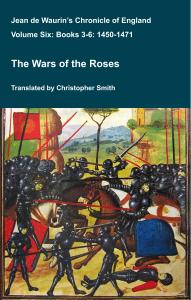
Jean de Waurin's Chronicle of England Volume 6 Books 3-6: The Wars of the Roses
Jean de Waurin was a French Chronicler, from the Artois region, who was born around 1400, and died around 1474. Waurin’s Chronicle of England, Volume 6, covering the period 1450 to 1471, from which we have selected and translated Chapters relating to the Wars of the Roses, provides a vivid, original, contemporary description of key events some of which he witnessed first-hand, some of which he was told by the key people involved with whom Waurin had a personal relationship.
Available at Amazon in eBook and Paperback format.
Memorial of George Constantyne. Apon Setterdaye, beinge the xxiij daye of August, we rode toward Kermarddyn [Map], And in our journey in the mornynge we communed as foloweth:
Deane. George.
A my fayth the gere ye showed us of the maryage ys lyckly. But I never hearde of the Quenes that they shuld be thus handled.
George. In good fayth nor I; nother yet I never suspected, but I promise you there was moch mutteringe of Quene Annes deeth.
Deane. There was in deade.
George. And it ys the thinge that I marked as well, as ever I marked any thinge.
Deane. Did ye so? And I can tell nothinge of it for I was at that tyme at St. Dauids.
George. Na, ye were in the diocese of St. Assaph. For my Lorde was that tyme in Scotlonde. And I was the same tyme Mr. Norice's [aged 54] servante. I wrote a Letter of comforth vnto hym, and that after he was condemned. I haue the copie of the same Letter in my howse.
Deane. He had not your Letter.
George. Yes I delyvered it vnsealed vnto Mr. Lieutenant, And he delyvered it Mr. Noryce.
Deane. I pray the what canst thow tell of the matter? Let us heare.
Chronicle of Edward Hall [1496-1548]. 1st May 1536. On Maye day were a solemn jousts kept at Grenewyche [Map], and suddenly from the jousts the King departed having not above six persons with him, and came in the evening from Greenwich to his place at Westminster. Of this sudden departure many men mused, but most chiefly the Queen [aged 35],


Wriothesley's Chronicle [1508-1562]. This yeare, on Maye daie, 1536, beinge Moundaie, was a great justing at Greenewych [Map], where was chalengers my Lorde of Rochforde [aged 33] and others, and defenders Mr. Noris [aged 54] and others.d.
Note d. Stow adds: "From these joustes King Henry sodainely departed to Westminster, haying only with him six persons, of which sodaine departore men manreiled."
Memorial of George Constantyne. 1st May 1536. Apon May daye Mr. Noryce justed. And after justinge the Kynge rode sodenly to Westminster, and all the waye as I heard saye, had Mr. Noryce in examinacyon and promised hym his pardon in case he wolde utter the trewth. But what so ever cowld be sayed or done, Mr. Norice wold confess no thinge to the Kynge.
On 1st May 1540 a tournament was held at Westminster [Map]. Gregory Cromwell 1st Baron Cromwell Oakham [aged 20], Thomas Poynings 1st Baron Poynings [aged 28], Thomas Seymour 1st Baron Seymour [aged 32], John Dudley 1st Duke Northumberland [aged 36], Richard Cromwell aka Williams [aged 45] and George Carew [aged 36] were challengers.
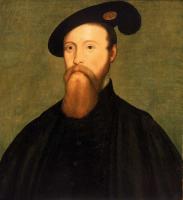


Henry Machyn's Diary. 1st May 1557. The furst day of May was creatyd at Whytt-halle master Perse [aged 29] the yerle of Northumberland, with viij haroldes and a dosen of trumpeters thrugh the quen('s) chambur, and thrugh the hall, and a-for hym my lord of Penbroke [aged 56] and my lord Montyguw [aged 28] and then my lord of Arundell [aged 45] and my lord of Rutland [aged 30], and hym-self whent in the myddes, alle in cremesun welvett in ther parlement robes, and whyt a hatt of velvett and cronet of gold on ys hed.


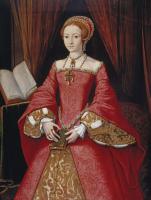
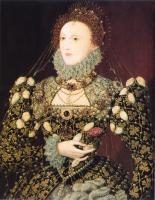
Henry Machyn's Diary. 1st May 1559. The furst day of May ther was ij pennys [pinnaces] was dekyd with stremars, baners, and flages, and trumpetes and drumes and gones, gahyng a Mayng [going a Maying], and a-ganst the Quen('s) plasse at Westmynster, and ther they shott and thruw eges [eggs] and oregns [against] on a-gaynst a-nodur, and with sqwybes, and by chanse on fell on a bage of gune-powdur and sett dyvers men a'fyre, and so the men drue to on syd of the penus [pinnaces], and yt dyd over-swelmed the pennus [pinnaces], and mony fell in the Temes, butt, thanke be God, ther was but on man drownyd, and a C [100] bottes [boats] abowtt here, and the Quen('s) [aged 25] grace and her lordes and lades lokyng out of wyndows; thys was done by ix [4] of the cloke on May evyn last.


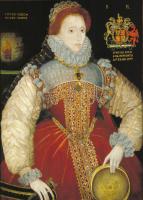


On 1st May 1566 Michiel Janszoon van Mierevelt was born in Delft.
On 29th April 1587 the English fleet commanded by Francis Drake [aged 47] entered the Bay of Cádiz Spain in the evening to discover sixty Spanish and twenty French ships. The Spanish ships, under the command of Pedro de Acuña, sailed out to meet the English fleet but were forced to retire back to Cadiz before the superiority of the English. Gun positions on the shore opened fire, shelling the English fleet from the coast with little effect. During the night of the 29th and all the following day and night the battle raged in the bay. At dawn on 1 May, the English withdrew having destroyed around thirty-two Spanish ships, with a combined capacity of 10,000 tons, and captured four other ships, laden with provisions.


A History of the Seton Family. [1st May 1603] As it would appear that the second Earl of Winton was born in 1583, he was about twenty years of age when he succeeded his father in 1603. In or before that year, he married the Hon. Anne Maitland [aged 14], only daughter of John, first Lord Thirlstane, Chancellor of Scotland, and father of the first Earl of Lauderdale, by whom he had no issue. Seeing that his bride was under twenty years of age when she died in July 1609, she could not have been more than fifteen at the time of her marriage. According to Scotstarvet2, her husband showed undoubted symptoms of insanity on the night of the wedding, and behaved in such an outrageous manner that he was imprisoned in Seton Palace, where he 'lay in fetters till he died.' There appears to be no trace of him after 1636.
'We did enjoy great mirth; but now, ah me!
Our joyful song's turned to an elegie.
A virtuous lady, not long since a bride,
Was to a hopeful plant by marriage tied,
And brought home hither. We did all rejoice,
Even for her sake. But presently our voice
Was turned to mourning for that little time
That she'd enjoy: she wan£d in her prime,
For Atropos, with her impartial knife,
Soon cut her thread, and therewithal her life3.'
Note 1. This appears from the inscription on her monument in the 'Lamp of Lothian' at Haddington.
Note 2. Staggering State of Scots Statesmen, pp. 1 3 and 94.
Note 3. Lines quoted in the Introduction to the Bride of Lammemoor.
On 1st May 1614 Nathaniel Bacon [aged 29] and Jane Meautys [aged 33] were married.

Diary of Anne Clifford. 1st May 1619. The 1st after supper Mr Davis came and did read to my Lord [aged 30] and me the Bill my Uncle Cumberland and my Coz. Clifford put in the Chancery against the tenants of King's Meaborne.
On 1st May 1625 King Charles I of England, Scotland and Ireland [aged 24] and Henrietta Maria Bourbon Queen Consort England [aged 15] were married by proxy at Notre Dame de Paris Cathedral [Map]. She by marriage Queen Consort England. She the daughter of Henry IV King France and Marie de Medici Queen Consort France [aged 50]. He the son of King James I of England and Ireland and VI of Scotland and Anne of Denmark Queen Consort Scotland England and Ireland. They were third cousin once removed.


On 1st May 1632 Frances Coleclough [aged 74] died. On 16th June 1643 William Smethwich [aged 80] died. They were buried at St Oswald's Church, Brereton [Map]
Inscriptions on the monument "Here lieth the body of William Smethwicke of Smethwicke esq. who, mindful of his death, erected this monument for himself and, his wife, pious to God, pious in good workes which William was born Oct. 1, Anno D'ni 1551 and died June 16 Anno Dni' 1643." and
"Here alsoe lieth the body of Frances Smethwicke, daughter of Sir Anthony Coleclough, Knight, married to William Smethwicke aforesaid and lived in wedlocke with him 48 years a devout and hospitall matron, born Anno Dom: 1557, in the Castle of Kildare, in Ireland, Novemb. 6, and died 1st of May, 1632."
Frances Coleclough: On 6th November 1557 she was born to Anthony Coleclough at Kildare Castle. In 1585 William Smethwich and she were married.
William Smethwich: On 1st October 1551 he was born to Thomas Smethwick and Ann Vernon.


4th April 1660 The Declaration of Breda [Map], written on 04 Apr 1660, was a part of the process of King Charles II of England Scotland and Ireland [aged 29] being restored to the English throne written in response to a message sent by George Monck 1st Duke Albemarle [aged 51]. Initially secret the Declaration was made public on 1st May 1660. The Declaration promised a general pardon, retention of property religious toleration, payment of arrears to the army and continued army service.


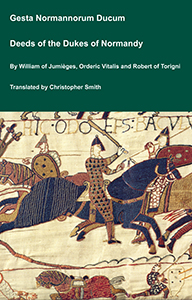
The Deeds of the Dukes of Normandy
The Gesta Normannorum Ducum [The Deeds of the Dukes of Normandy] is a landmark medieval chronicle tracing the rise and fall of the Norman dynasty from its early roots through the pivotal events surrounding the Norman Conquest of England. Originally penned in Latin by the monk William of Jumièges shortly before 1060 and later expanded at the behest of William the Conqueror, the work chronicles the deeds, politics, battles, and leadership of the Norman dukes, especially William’s own claim to the English throne. The narrative combines earlier historical sources with firsthand information and oral testimony to present an authoritative account of Normandy’s transformation from a Viking settlement into one of medieval Europe’s most powerful realms. William’s history emphasizes the legitimacy, military prowess, and governance of the Norman line, framing their expansion, including the conquest of England, as both divinely sanctioned and noble in purpose. Later chroniclers such as Orderic Vitalis and Robert of Torigni continued the history, extending the coverage into the 12th century, providing broader context on ducal rule and its impact. Today this classic work remains a foundational source for understanding Norman identity, medieval statesmanship, and the historical forces that reshaped England and Western Europe between 800AD and 1100AD.
Available at Amazon in eBook and Paperback format.
Samuel Pepys' Diary. 1st May 1662. Sir G. Carteret [aged 52], Sir W. Pen [aged 41], and myself, with our clerks, set out this morning from Portsmouth, Hampshire [Map] very early, and got by noon to Petersfield, Hampshire; several officers of the Yard accompanying us so far. Here we dined and were merry. At dinner comes my Lord Carlingford [aged 59] from London, going to Portsmouth, Hampshire [Map]: tells us that the Duchess of York [aged 25] is brought to bed of a girl, [Mary, afterwards Queen of England.] at which I find nobody pleased; and that Prince Rupert [aged 42] and the Duke of Buckingham [aged 34] are sworn of the Privy Councell. He himself made a dish with eggs of the butter of the sparagus, which is very fine meat, which I will practise hereafter.


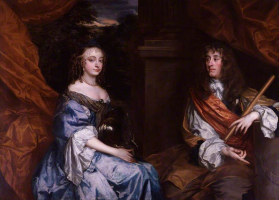


Samuel Pepys' Diary. 1st May 1663. That being done, and all things agreed on, we went down, and after a glass of wine we all took horse, and I, upon a horse hired of Mr. Game, saw him out of London, at the end of Bishopsgate Street, and so I turned and rode, with some trouble, through the fields, and then Holborn, &c., towards Hide Park, whither all the world, I think, are going, and in my going, almost thither, met W. Howe coming galloping upon a little crop black nag; it seems one that was taken in some ground of my Lord's, by some mischance being left by his master, a thief; this horse being found with black cloth ears on, and a false mayne, having none of his own; and I back again with him to the Chequer, at Charing Cross, and there put up my own dull jade, and by his advice saddled a delicate stone-horse of Captain Ferrers's, and with that rid in state to the Park, where none better mounted than I almost, but being in a throng of horses, seeing the King's riders showing tricks with their managed horses, which were very strange, my stone-horse was very troublesome, and begun to, fight with other horses, to the dangering him and myself, and with much ado I got out, and kept myself out of harm's way. Here I saw nothing good, neither the King [aged 32], nor my Baroness Castlemaine's [aged 22], nor any great ladies or beauties being there, there being more pleasure a great deal at an ordinary day; or else those few good faces that there were choked up with the many bad ones, there being people of all sorts in coaches there, to some thousands, I think. Going thither in the highway, just by the Park gate, I met a boy in a sculler boat, carried by a dozen people at least, rowing as hard as he could drive, it seems upon some wager.


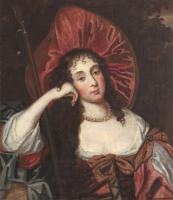


Samuel Pepys' Diary. 1st May 1665. Thence back by coach to Greenwich, Kent [Map], and in his pleasure boat to Deptford, Kent [Map], and there stopped and in to Mr. Evelyn's [aged 44]1, which is a most beautiful place; but it being dark and late, I staid not; but Deane Wilkins [aged 51] and Mr. Hooke [aged 29] and I walked to Redriffe [Map]; and noble discourse all day long did please me, and it being late did take them to my house to drink, and did give them some sweetmeats, and thence sent them with a lanthorn home, two worthy persons as are in England, I think, or the world.
Note 1. Sayes Court [Map], the well-known residence of John Evelyn.


Samuel Pepys' Diary. 1st May 1665. Thence to the Duke of Albemarle [aged 56], where I was sorry to find myself to come a little late, and so home, and at noon going to the 'Change [Map] I met my Lord Brunkard [aged 45], Sir Robert Murry [aged 57], Deane Wilkins [aged 51], and Mr. Hooke [aged 29], going by coach to Colonell Blunts [aged 61] to dinner. So they stopped and took me with them. Landed at the Tower-wharf, and thence by water to Greenwich, Kent [Map]; and there coaches met us; and to his house, a very stately sight for situation and brave plantations; and among others, a vineyard, the first that ever I did see. No extraordinary dinner, nor any other entertainment good; but only after dinner to the tryall of some experiments about making of coaches easy. And several we tried; but one did prove mighty easy (not here for me to describe, but the whole body of the coach lies upon one long spring), and we all, one after another, rid in it; and it is very fine and likely to take. These experiments were the intent of their coming, and pretty they are.
Samuel Pepys' Diary. 1st May 1667. Up, it being a fine day, and after doing a little business in my chamber I left my wife to go abroad with W. Hewer [aged 25] and his mother in a Hackney coach incognito to the Park, while I abroad to the Excise Office first, and there met the Cofferer [aged 63] and Sir Stephen Fox [aged 40] about our money matters there, wherein we agreed, and so to discourse of my Lord Treasurer [aged 60], who is a little better than he was of the stone, having rested a little this night. I there did acquaint them of my knowledge of that disease, which I believe will be told my Lord Treasurer.


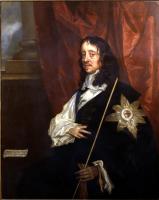
Samuel Pepys' Diary. 1st May 1667. Thence to Westminster; in the way meeting many milk-maids with their garlands upon their pails, dancing with a fiddler before them1 and saw pretty Nelly [aged 17] standing at her lodgings' door in Drury-lane in her smock sleeves and bodice, looking upon one: she seemed a mighty pretty creature. To the Hall and there walked a while, it being term. I thence home to the Rose, and then had Doll Lane venir para me.... [Missing text: 'but it was in a lugar mighty ouvert, so as we no poda hazer algo; so parted and then met again at the Swan, where for la misma reason we no pode hazer, but put off to recontrar anon, which I only used as a put-off;']. To my Lord Crew's [aged 69], where I found them at dinner, and among others. Mrs. Bocket, which I have not seen a long time, and two little dirty children, and she as idle a prating and impertinent woman as ever she was.
Note 1. On the 1st of May milkmaids used to borrow silver cups, tankards, &c., to hang them round their milkpails, with the addition of flowers and ribbons, which they carried upon their heads, accompanied by a bagpipe or fiddle, and went from door to door, dancing before the houses of their customers, in order to obtain a small gratuity from each of them. "In London thirty years ago, When pretty milkmaids went about, It was a goodly sight to see Their May-day pageant all drawn out. "Such scenes and sounds once blest my eyes And charm'd my ears; but all have vanish'd, On May-day now no garlands go, For milkmaids and their dance are banish'd". Hone's Every-Day Book, vol. i., pp. 569, 570.


Samuel Pepys' Diary. 1st May 1667. Then to talk of my Lord Sandwich [aged 41], whom my Lord Crew [aged 69] hath a great desire might get to be Lord Treasurer [aged 60] if the present Lord should die, as it is believed he will, in a little time; and thinks he can have no competitor but my Lord Arlington [aged 49], who, it is given out, desires it: but my Lord thinks it is not so, for that the being Secretary do keep him a greater interest with the King [aged 36] than the other would do at least, do believe, that if my Lord would surrender him his Wardrobe place, it would be a temptation to Arlington to assist my Lord in getting the Treasurer's. I did object to my Lord [Crew] that it would be no place of content, nor safety, nor honour for my Lord, the State being so indigent as it is, and the [King] so irregular, and those about him, that my Lord must be forced to part with anything to answer his warrants; and that, therefore, I do believe the King had rather have a man that may be one of his vicious caball, than a sober man that will mind the publick, that so they may sit at cards and dispose of the revenue of the Kingdom. This my Lord was moved at, and said he did not indeed know how to answer it, and bid me think of it; and so said he himself would also do. He do mightily cry out of the bad management of our monies, the King having had so much given him; and yet, when the Parliament do find that the King should have £900,000 in his purse by the best account of issues they have yet seen, yet we should report in the Navy a debt due from the King of £900,000; which, I did confess, I doubted was true in the first, and knew to be true in the last, and did believe that there was some great miscarriages in it: which he owned to believe also, saying, that at this rate it is not in the power of the Kingdom to make a war, nor answer the King's wants.


Samuel Pepys' Diary. 1st May 1667. Thence away to the King's playhouse, by agreement met Sir W. Pen [aged 46], and saw "Love in a Maze" but a sorry play: only Lacy's [aged 52] clowne's part, which he did most admirably indeed; and I am glad to find the rogue at liberty again. Here was but little, and that ordinary, company. We sat at the upper bench next the boxes; and I find it do pretty well, and have the advantage of seeing and hearing the great people, which may be pleasant when there is good store. Now was only Prince Rupert [aged 47] and my Lord Lauderdale [aged 50], and my Lord, the naming of whom puts me in mind of my seeing, at Sir Robert Viner's [aged 36], two or three great silver flagons, made with inscriptions as gifts of the King [aged 36] to such and such persons of quality as did stay in town the late great plague, for the keeping things in order in the town, which is a handsome thing. But here was neither Hart [aged 41], Nell [aged 17], nor Knipp; therefore, the play was not likely to please me.


Samuel Pepys' Diary. 1st May 1667. Thence Sir W. Pen [aged 46] and I in his coach, Tiburne way, into the Park, where a horrid dust, and number of coaches, without pleasure or order. That which we, and almost all went for, was to see my Lady Newcastle [aged 44]; which we could not, she being followed and crowded upon by coaches all the way she went, that nobody could come near her; only I could see she was in a large black coach, adorned with silver instead of gold, and so white curtains, and every thing black and white, and herself in her cap, but other parts I could not make [out]. But that which I did see, and wonder at with reason, was to find Pegg Pen [aged 16] in a new coach, with only her husband's [aged 26] pretty sister [aged 18] with her, both patched and very fine, and in much the finest coach in the park, and I think that ever I did see one or other, for neatness and richness in gold, and everything that is noble. My Baroness Castlemayne [aged 26], the King [aged 36], my Lord St. Albans [aged 62], nor Mr. Jermyn, have so neat a coach, that ever I saw.
Samuel Pepys' Diary. 1st May 1667. And, Lord! to have them have this, and nothing else that is correspondent, is to me one of the most ridiculous sights that ever I did see, though her present dress was well enough; but to live in the condition they do at home, and be abroad in this coach, astonishes me. When we had spent half an hour in the Park, we went out again, weary of the dust, and despairing of seeing my Lady Newcastle [aged 44]; and so back the same way, and to St. James's, thinking to have met my Lady Newcastle before she got home, but we staying by the way to drink, she got home a little before us: so we lost our labours, and then home; where we find the two young ladies come home, and their patches off, I suppose Sir W. Pen [aged 46] do not allow of them in his sight, and going out of town to-night, though late, to Walthamstow, Essex [Map].
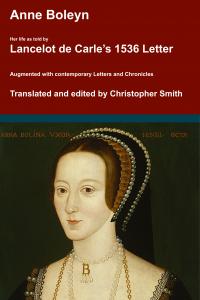
Anne Boleyn. Her Life as told by Lancelot de Carle's 1536 Letter.
In 1536, two weeks after the execution of Anne Boleyn, her brother George and four others, Lancelot du Carle, wrote an extraordinary letter that described Anne's life, and her trial and execution, to which he was a witness. This book presents a new translation of that letter, with additional material from other contemporary sources such as Letters, Hall's and Wriothesley's Chronicles, the pamphlets of Wynkyn the Worde, the Memorial of George Constantyne, the Portuguese Letter and the Baga de Secrets, all of which are provided in Appendices.
Available at Amazon in eBook and Paperback format.
Samuel Pepys' Diary. 1st May 1667. After dinner my Lord took me alone and walked with me, giving me an account of the meeting of the Commissioners for Accounts, whereof he is one. How some of the gentlemen, Garraway [aged 50], Littleton [aged 46], and others, did scruple at their first coming there, being called thither to act, as Members of Parliament, which they could not do by any authority but that of Parliament, and therefore desired the King's direction in it, which was sent for by my Lord Bridgewater [aged 43], who brought answer, very short, that the King [aged 36] expected they should obey his Commission. Then they went on, and observed a power to be given them of administering and framing an oath, which they thought they could not do by any power but Act of Parliament; and the whole Commission did think fit to have the judges' opinion in it; and so, drawing up their scruples in writing, they all attended the King, who told them he would send to the judges to be answered, and did so; who have, my Lord tells me, met three times about it, not knowing what answer to give to it; and they have met this week, doing nothing but expecting the solution of the judges in this point. My Lord tells me he do believe this Commission will do more hurt than good; it may undo some accounts, if these men shall think fit; but it can never clear an account, for he must come into the Exchequer for all this. Besides, it is a kind of inquisition that hath seldom ever been granted in England; and he believes it will never, besides, give any satisfaction to the People or Parliament, but be looked upon as a forced, packed business of the King, especially if these Parliament-men that are of it shall not concur with them: which he doubts they will not, and, therefore, wishes much that the King would lay hold of this fit occasion, and let the Commission fall.
On 1st May 1668 Frans Luycx [aged 64] died.

On or before 1st May 1679, the day he was buried at St Mary's Church, Long Newton [Map], George Vane of Long Newton [aged 61] died.
George Vane of Long Newton: In 1618 he was born to Henry Vane "The Elder" and Frances Darcy. On 27th March 1640 George Vane of Long Newton and Elizabeth Maddison were married. They had thirteen children.
On 1st May 1700 John Dryden [aged 68] died.


On 1st May 1714 Henry Paget 1st Earl Uxbridge [aged 51] was appointed Envoy Extraordinary to the Elector of Hanover [aged 53], the future King George I. He requested he be made an Earl but Queen Anne of England Scotland and Ireland [aged 49] declined his request.


On 1st May 1718 Frances Carteret Marchioness Tweddale was baptised at St Martin in the Fields Church [Map].
On 1st May 1729 Brownlow Bertie 5th Duke Ancaster and Kesteven was born to Peregrine Bertie 2nd Duke Ancaster and Kesteven [aged 43] and Jane Brownlow Duchess Ancaster and Kesteven at Lindsey House Cheyne Walk, Chelsea. He married (1) 11th November 1762 Harriot Pitt (2) 2nd January 1769 Mary Anne Layard and had issue.
On 1st May 1730 Francois de Troy [aged 85] died.
On 1st May 1740 Charles Noel Somerset 4th Duke Beaufort [aged 30] and Elizabeth Berkeley Duchess Beaufort [aged 27] were married. He the son of Henry Somerset 2nd Duke Beaufort and Rachel Noel Duchess Beaufort.

After 1st May 1752. St Swithun's Church, Leadenham [Map]. Memorial to William Key [deceased]
William Key: Around 1688 he was born. In or before 1717 he and Ann Wife of William Key were married. On 1st May 1752 he died.
Chronicle of Walter of Guisborough
A canon regular of the Augustinian Guisborough Priory, Yorkshire, formerly known as The Chronicle of Walter of Hemingburgh, describes the period from 1066 to 1346. Before 1274 the Chronicle is based on other works. Thereafter, the Chronicle is original, and a remarkable source for the events of the time. This book provides a translation of the Chronicle from that date. The Latin source for our translation is the 1849 work edited by Hans Claude Hamilton. Hamilton, in his preface, says: 'In the present work we behold perhaps one of the finest samples of our early chronicles, both as regards the value of the events recorded, and the correctness with which they are detailed; Nor will the pleasing style of composition be lightly passed over by those capable of seeing reflected from it the tokens of a vigorous and cultivated mind, and a favourable specimen of the learning and taste of the age in which it was framed.'
Available at Amazon in eBook and Paperback format.
On 1st May 1762 William Bentinck 2nd Duke Portland [aged 53] died. His son William [aged 24] succeeded 3rd Duke Portland, 4th Earl of Portland.
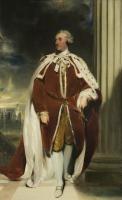

On 1st May 1769 Arthur Wellesley 1st Duke Wellington was born to Garrett Wellesley 1st Earl Mornington [aged 33] and Anne Hill Countess Mornington [aged 26] at Dublin [Map]. He married 10th April 1806 Catherine "Kitty" Pakenham Duchess Wellington, daughter of Edward Pakenham 2nd Baron Longford and Catherine Rowley Baroness Longford, and had issue.


On 1st May 1775 Mary Montagu Duchess of Montagu [aged 64] died. Monument in St Edmund's Church, Warkton [Map]. Sculpted by Peter Mathias Van Gelder [aged 33]. Mary's monument is more decorative that her parent's; Rococo. The composition of the monument centres around an ornate funerary Urn, which stands upon a Pedestal containing an inscription to Mary. To the right sits a grief stricken woman, inconsolable over the loss of an aristocrat considered a great benefactor to the poor and needy. In her left arm she cradles a baby, and a second, tearful child sits at her feet. To the right of the woman is that of an older woman draped in a shawl, who gently caresses the hand of the first babe. To the left of the Urn, an angel comforts the mourners, pointing to heaven.




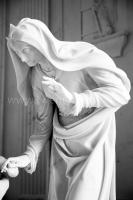

On 10th February 1780 Samuel Egerton [aged 68] died. On 19th February 1780 he was buried at St Mary's Church, Rostherne, Tatton [Map]. Monument sculpted by John "The Elder" Bacon [aged 39]. Figures representing Hope and Patience.
The monument inscription describes those also buried in the vault: John Egerton, his wife Elizabeth Barbour buried 10th February 1743, her mother Elizabeth Hill [aged 85] buried 17th April 1713 and John and Elizabeth's daughter-in-law Beatrix Copley [aged 22] buried 1st May 1755.


On 1st May 1780 Princess Augusta of Prussia was born to Frederick William II King Prussia [aged 35] and Queen Frederica Louisa of Prussia [aged 28]. She married 13th February 1797 her third cousin Wilhelm Hesse-Kassel, son of William Elector of Hesse and Electress Wilhelmina Caroline Oldenburg.
On 1st May 1800 Peter Hollins was born at 17 Great Hampton Street, Birmingham.
On 25th March 1807 the Slave Trade Act received Royal Assent. The Act prohibited the slave trade in the British Empire. The Bill was first introduced to Parliament in January 1807. It went to the House of Commons on 10th February 1807. After a debate lasting ten hours, the House agreed to the second reading of the bill to abolish the Atlantic slave trade by an overwhelming 283 votes for to 16. The Act took effect on 1st May 1807.
The last legal slave voyage was that of Kitty's Amelia which sailed on 27th July 1807 having received permission to sail on 27th April 1807 before the Act came into force. Kitty's Amelia arrived with 233 slaves at Jamaica 25th January 1808.
On 1st May 1829 Frederick Sandes was born to Anthony Sands [aged 23] and Mary Ann Brown. His birth name being Antonio Frederic Augustus Sands. He married (1) 28th May 1853 Georgiana Creed.

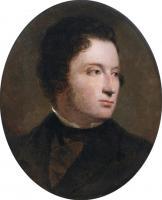


On 1st May 1830 Isabella Elizabeth Byng Marchioness Bath [aged 56] died. Monument in Saints Peter and Paul Church, Longbridge Deverill [Map]. Probably sculpted by Francis Leggatt Chantrey [aged 49].
Isabella Elizabeth Byng Marchioness Bath: On 21st September 1773 she was born to George Byng 4th Viscount Torrington and Lucy Boyle Viscountess Torrington. On 14th April 1794 Thomas Thynne 2nd Marquess of Bath and she were married. He the son of Thomas Thynne 1st Marquess of Bath and Elizabeth Bentinck Marchioness Bath. They were fifth cousins. On 19th November 1796 Thomas Thynne 1st Marquess of Bath died. His son Thomas succeeded 2nd Marquess of Bath, 4th Viscount Weymouth, 4th Baron Thynne of Warminster in Wiltshire, 5th Baronet Thynne of Kempsford in Gloucestershire. She by marriage Marchioness of Bath.

On 1st May 1846 Constance Evelyn Primrose Baroness Leconfield was born to Archibald John Primrose [aged 36] and Catherine Lucy Wilhelmina Stanhope Duchess of Cleveland [aged 26]. She married 15th July 1867 Henry Wyndham 2nd Baron Leconfield, son of George Wyndham 1st Baron Leconfield and Mary Fanny Blunt, and had issue.
On 1st May 1850 Prince Arthur Windsor 1st Duke Connaught and Strathearn was born to Prince Albert Saxe Coburg Gotha [aged 30] and Queen Victoria of the United Kingdom [aged 30] at Buckingham Palace [Map]. Coefficient of inbreeding 7.25%. He married 13th March 1879 his third cousin once removed Luise Margarete Hohenzollern Duchess Connaught and had issue.
Anne Boleyn. Her Life as told by Lancelot de Carle's 1536 Letter.
In 1536, two weeks after the execution of Anne Boleyn, her brother George and four others, Lancelot du Carle, wrote an extraordinary letter that described Anne's life, and her trial and execution, to which he was a witness. This book presents a new translation of that letter, with additional material from other contemporary sources such as Letters, Hall's and Wriothesley's Chronicles, the pamphlets of Wynkyn the Worde, the Memorial of George Constantyne, the Portuguese Letter and the Baga de Secrets, all of which are provided in Appendices.
Available at Amazon in eBook and Paperback format.

1st May 1853. Dante Gabriel Rossetti [aged 24]. Drawing of Emma Matilda Hill [aged 23].
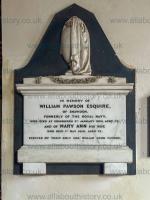
St Bartholomew's Church, Whittingham [Map]. Memorials to William Pawson, died 5th January 1854, and is wife Mary Anne, died 1st May 1858, and their daughter Mary Ann,
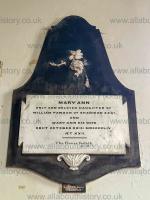
On 1st May 1868 Frederick Charles I King Finland was born to Friedrich Wilhelm Hesse-Kassel [aged 47]. He a great x 3 grandson of King George II of Great Britain and Ireland. He married 25th January 1893 his third cousin twice removed Margaret Hohenzollern, daughter of Frederick III King Prussia and Victoria Empress Germany Queen Consort Prussia, and had issue.

On 1st May 1874 Romaine Brooks aka Goddard was born.

On 1st May 1878 James Graham 6th Duke Montrose was born to Douglas Graham 5th Duke Montrose [aged 25] and Violet Hermione Graham Duchess Montrose [aged 23]. He married 14th June 1906 his third cousin once removed Mary Louise Douglas Hamilton Duchess Montrose, daughter of William Douglas Hamilton 12th Duke Hamilton 9th Duke Brandon and Mary Louisa Elizabeth Montagu Duchess Hamilton Duchess Brandon, and had issue.
On 1st May 1882 Evelyn Francis Edward Seymour 17th Duke of Somerset was born to Edward Hamilton Seymour 16th Duke of Somerset [aged 21] and Rowena Wall Duchess Somerset [aged 20]. He married 3rd January 1906 Edith Mary Parker Duchess Somerset and had issue.
After 1st May 1883. All Saints Church, Sudbury [Map]. Monument to Augustus Henry Vernon 6th Baron Vernon [deceased] and his wife Harriet Frances Maria Anson Baroness Vernon [aged 55] commissioned by their son George William Henry Venables-Vernon 7th Baron Vernon [aged 29] who died before the monument was completed.


After 1st May 1883 Memorial to Augustus Henry Vernon 6th Baron Vernon [deceased] at All Saints Church, Sudbury [Map].

1st May 1897. Godfrey Bingley [aged 54]. Bolton Castle [Map].
On 1st May 1958 Edward Alexander Somerset was born to David Fitzroy 11th Duke Beaufort [aged 30] and Caroline Jane Thynne 11th Duchess Beaufort [aged 30]. He married 1982 Georgiana Caroline Davidson and had issue.
Abbot John Whethamstede’s Chronicle of the Abbey of St Albans
Abbot John Whethamstede's Register aka Chronicle of his second term at the Abbey of St Albans, 1451-1461, is a remarkable text that describes his first-hand experience of the beginning of the Wars of the Roses including the First and Second Battles of St Albans, 1455 and 1461, respectively, their cause, and their consequences, not least on the Abbey itself. His text also includes Loveday, Blore Heath, Northampton, the Act of Accord, Wakefield, and Towton, and ends with the Coronation of King Edward IV. In addition to the events of the Wars of the Roses, Abbot John, or his scribes who wrote the Chronicle, include details in the life of the Abbey such as charters, letters, land exchanges, visits by legates, and disputes, which provide a rich insight into the day-to-day life of the Abbey, and the challenges faced by its Abbot.
Available at Amazon in eBook and Paperback format.
On 1st May 1218 Rudolph I King Romans was born to Albert IV Count of Habsburg [aged 30] and Hedwig of Kyburg. He married (1) 1245 Gertrude Hohenburg and had issue (2) 1284 his fifth cousin Isabella Burgundy Queen Consort Germany, daughter of Hugh IV Duke Burgundy.
On 1st May 1218 John of Avesnes I Count Hainaut was born to Bouchard Avesnes [aged 36] and Margaret II Countess Flanders [aged 15]. He a great x 4 grandson of King William "Conqueror" I of England. He married 1246 his third cousin Adelaide Gerulfing Countess Hainaut, daughter of Floris Gerulfing IV Count Holland and Mathilde Reginar Countess Holland and Palatine, and had issue.
On 1st May 1238 or 3rd May 1238 King Magnus VI of Norway was born to King Haakon IV of Norway [aged 34]. He married 11th September 1261 Queen Ingeborg of Norway and had issue.
On 1st May 1285 Edmund Fitzalan 2nd or 9th Earl of Arundel was born to Richard Fitzalan 1st or 8th Earl of Arundel [aged 18] and Alice Saluzzo Countess Arundel at Marlborough Castle [Map]. He a great x 4 grandson of King John of England. He married before 1306 his third cousin once removed Alice Warenne Countess Arundel and had issue.
On 1st May 1308 Joan Capet Duchess Burgundy was born to Philip V King France I King Navarre [aged 15] and Joan of Burgundy Queen Consort France [aged 16]. Coefficient of inbreeding 2.29%. She married 1318 her first cousin twice removed Odo IV Duke Burgundy, son of Robert II Duke Burgundy and Agnes Capet Duchess Burgundy, and had issue.
On 1st May 1488 Sidonie Wittelsbach was born to Albert Wittelsbach IV Duke Bavaria [aged 40] and Kunigunde Habsburg Duchess Bavaria [aged 23]. She a great x 4 granddaughter of King Edward III of England.
On 1st May 1566 Michiel Janszoon van Mierevelt was born in Delft.
On 1st May 1622 Henry Goring 2nd Baronet was born to Henry Goring [aged 44] and Mary Eversfield [aged 33]. He married 1642 Frances Bishopp, daughter of Edward Bishopp 2nd Baronet and Mary Tufton, and had issue.
On 1st May 1637 Anne Bayning Countess of Oxford was born to Paul Bayning 2nd Viscount Bayning [aged 21]. She married 1647 Aubrey de Vere 20th Earl of Oxford, son of Robert de Vere 19th Earl of Oxford and Beatrice Van Hemmema Countess of Oxford.
On 1st May 1654 Edmund Fettiplace 2nd Baronet was born to John Fettiplace 1st Baronet [aged 28] and Anne Wenman Lady Fettiplace [aged 24].
Henrici Quinti, Angliæ Regis, Gesta, is a first-hand account of the Agincourt Campaign, and subsequent events to his death in 1422. The author of the first part was a Chaplain in King Henry's retinue who was present from King Henry's departure at Southampton in 1415, at the siege of Harfleur, the battle of Agincourt, and the celebrations on King Henry's return to London. The second part, by another writer, relates the events that took place including the negotiations at Troye, Henry's marriage and his death in 1422.
Available at Amazon in eBook and Paperback format.
On 1st May 1662 Francis Brereton 5th Baron Brereton was born to William Brereton 3rd Baron Brereton [aged 30] and Frances Willoughby Baroness Brereton [aged 37]. He was baptised at St Paul's Church, Covent Garden on 2nd May 1662.

On 1st May 1708 Lionel Tollemache 4th Earl Dysart was born to Lionel Tollemache [aged 25] and Henrietta Cavendish [aged 9]. He married 1729 his sixth cousin Grace Carteret Countess Dysart, daughter of John Carteret 2nd Earl Granville and Frances Worsley Countess Granville, and had issue.

On 1st May 1721 George Pitt 1st Baron Rivers was born to George Pitt of Stratfield Saye [aged 31] in Geneva. He married 4th January 1746 Penelope Atkins and had issue.
On 1st May 1729 Brownlow Bertie 5th Duke Ancaster and Kesteven was born to Peregrine Bertie 2nd Duke Ancaster and Kesteven [aged 43] and Jane Brownlow Duchess Ancaster and Kesteven at Lindsey House Cheyne Walk, Chelsea. He married (1) 11th November 1762 Harriot Pitt (2) 2nd January 1769 Mary Anne Layard and had issue.
On 1st May 1745 Reverend Philip Wodehouse was born to Armine Wodehouse 5th Baronet [aged 31] and Letitia Bacon Lady Woodhouse [aged 30].
On 1st May 1769 Arthur Wellesley 1st Duke Wellington was born to Garrett Wellesley 1st Earl Mornington [aged 33] and Anne Hill Countess Mornington [aged 26] at Dublin [Map]. He married 10th April 1806 Catherine "Kitty" Pakenham Duchess Wellington, daughter of Edward Pakenham 2nd Baron Longford and Catherine Rowley Baroness Longford, and had issue.
On 1st May 1772 Galbraith Lowry-Cole was born to William Willoughby Cole 1st Earl Enniskillen [aged 36] and Anne Lowry-Corry Countess Enniskillen [aged 30]. He married 15th June 1815 Frances Harris, daughter of James Harris 1st Earl Malmesbury and Harriet Maria Amyand Countess Malmesbury.


On 1st May 1780 Princess Augusta of Prussia was born to Frederick William II King Prussia [aged 35] and Queen Frederica Louisa of Prussia [aged 28]. She married 13th February 1797 her third cousin Wilhelm Hesse-Kassel, son of William Elector of Hesse and Electress Wilhelmina Caroline Oldenburg.
On 1st May 1784 John Fletcher aka Boughey 2nd Baronet was born to Thomas Fletcher 1st Baronet [aged 37] and Anne Fenton. He married 9th February 1808 Henrietta Dorothy Chetwode and had issue.
On 1st May 1785 Cholmeley Charles William Dering was born to Edward Dering 7th Baronet [aged 28]. He married (1) 30th July 1846 Charlotte Mary Yea and had issue (2) 30th July 1846 Charlotte Bucknall Hale.
Adam Murimuth's Continuation and Robert of Avesbury’s 'The Wonderful Deeds of King Edward III'
This volume brings together two of the most important contemporary chronicles for the reign of Edward III and the opening phases of the Hundred Years’ War. Written in Latin by English clerical observers, these texts provide a vivid and authoritative window into the political, diplomatic, and military history of fourteenth-century England and its continental ambitions. Adam Murimuth Continuatio's Chronicarum continues an earlier chronicle into the mid-fourteenth century, offering concise but valuable notices on royal policy, foreign relations, and ecclesiastical affairs. Its annalistic structure makes it especially useful for establishing chronology and tracing the development of events year by year. Complementing it, Robert of Avesbury’s De gestis mirabilibus regis Edwardi tertii is a rich documentary chronicle preserving letters, treaties, and official records alongside narrative passages. It is an indispensable source for understanding Edward III’s claim to the French crown, the conduct of war, and the mechanisms of medieval diplomacy. Together, these works offer scholars, students, and enthusiasts a reliable and unembellished account of a transformative period in English and European history. Essential for anyone interested in medieval chronicles, the Hundred Years’ War, or the reign of Edward III.
Available at Amazon in eBook and Paperback format.
On 1st May 1787 Jemima Rachel Drummond was born to James Drummond 11th Earl Perth [aged 43] and Clementia Elphinstone Countess Perth [aged 37]. She died aged less than one years old.
On 1st May 1789 George Hobart-Hampden 5th Earl of Buckinghamshire was born to George Vere Hobart [aged 28].
On 1st May 1800 Peter Hollins was born at 17 Great Hampton Street, Birmingham.
On 1st May 1808 Humphrey de Trafford 2nd Baronet was born to Thomas Joseph Trafford 1st Baronet [aged 30]. He married Annette Mary Talbot and had issue.
On 1st May 1820 Georgiana Campbell was born to John Campbell 1st Earl Cawdor [aged 29] and Elizabeth Thynne Countess Cawdor [aged 25] at Grosvenor Square, Belgravia. She married 25th June 1840 Colonel John Balfour 7th of Balbirnie and had issue.
On 1st May 1829 Frederick Sandes was born to Anthony Sands [aged 23] and Mary Ann Brown. His birth name being Antonio Frederic Augustus Sands. He married (1) 28th May 1853 Georgiana Creed.

On 1st May 1838 Agnes Elizabeth Courtenay Viscountess Halifax was born to William Courtenay 11th Earl Devon [aged 31] and Elizabeth Fortescue Countess Devon [aged 36]. She married 22nd April 1869 Charles Lindley Wood 2nd Viscount Halifax, son of Charles Wood 1st Viscount Halifax and Mary Grey Viscountess Halifax, and had issue.
On 1st May 1846 Constance Evelyn Primrose Baroness Leconfield was born to Archibald John Primrose [aged 36] and Catherine Lucy Wilhelmina Stanhope Duchess of Cleveland [aged 26]. She married 15th July 1867 Henry Wyndham 2nd Baron Leconfield, son of George Wyndham 1st Baron Leconfield and Mary Fanny Blunt, and had issue.
On 1st May 1850 Prince Arthur Windsor 1st Duke Connaught and Strathearn was born to Prince Albert Saxe Coburg Gotha [aged 30] and Queen Victoria of the United Kingdom [aged 30] at Buckingham Palace [Map]. Coefficient of inbreeding 7.25%. He married 13th March 1879 his third cousin once removed Luise Margarete Hohenzollern Duchess Connaught and had issue.
On 1st May 1868 Frederick Charles I King Finland was born to Friedrich Wilhelm Hesse-Kassel [aged 47]. He a great x 3 grandson of King George II of Great Britain and Ireland. He married 25th January 1893 his third cousin twice removed Margaret Hohenzollern, daughter of Frederick III King Prussia and Victoria Empress Germany Queen Consort Prussia, and had issue.
Chronicle of a Bourgeois of Valenciennes
Récits d’un bourgeois de Valenciennes aka The Chronicle of a Bourgeois of Valenciennes is a vivid 14th-century vernacular chronicle written by an anonymous urban chronicler from Valenciennes in the County of Hainaut. It survives in a manuscript that describes local and regional history from about 1253 to 1366, blending chronology, narrative episodes, and eyewitness-style accounts of political, military, and social events in medieval France, Flanders, and the Low Countries. The work begins with a chronological framework of events affecting Valenciennes and its region under rulers such as King Philip VI of France and the shifting allegiances of local nobility. It includes accounts of conflicts, sieges, diplomatic manoeuvres, and the impact of broader struggles like the Hundred Years’ War on urban life in Hainaut. Written from the perspective of a burgher (bourgeois) rather than a monastery or royal court, the chronicle offers a rare lay viewpoint on high politics and warfare, reflecting how merchants, townspeople, and civic institutions experienced the turbulence of the 13th and 14th centuries. Its narrative style combines straightforward reporting of events with moral and civic observations, making it a valuable source for readers interested in medieval urban society, regional politics, and the lived experience of war and governance in pre-modern Europe.
Available at Amazon in eBook and Paperback format.
On 1st May 1874 Romaine Brooks aka Goddard was born.
On 1st May 1878 James Graham 6th Duke Montrose was born to Douglas Graham 5th Duke Montrose [aged 25] and Violet Hermione Graham Duchess Montrose [aged 23]. He married 14th June 1906 his third cousin once removed Mary Louise Douglas Hamilton Duchess Montrose, daughter of William Douglas Hamilton 12th Duke Hamilton 9th Duke Brandon and Mary Louisa Elizabeth Montagu Duchess Hamilton Duchess Brandon, and had issue.
On 1st May 1880 James Arthur Joicey 2nd Baron Joicey was born to James Joicey 1st Baron Joicey [aged 34] and Elizabeth Amy Robinson [aged 24]. He married 10th September 1904 Georgiana Wharton Burdon Baroness Joicey.
On 1st May 1882 Evelyn Francis Edward Seymour 17th Duke of Somerset was born to Edward Hamilton Seymour 16th Duke of Somerset [aged 21] and Rowena Wall Duchess Somerset [aged 20]. He married 3rd January 1906 Edith Mary Parker Duchess Somerset and had issue.
On 1st May 1884 Francis Curzon 5th Earl Howe was born to Richard George Penn Curzon 4th Earl Howe [aged 23] and Georgiana Elizabeth Spencer-Churchill Countess Howe [aged 23]. He married 28th October 1907 his half first cousin once removed Mary Curzon Countess Howe and had issue.
On 1st May 1886 James Knyvett Estcourt Howard was born to Henry Charles Howard 18th Earl Suffolk 11th Earl Berkshire [aged 52] and Mary Eleanor Coventry Countess Suffolk and Berkshire [aged 38].
On 1st May 1891 Thomas Carew Trollope 3rd Baron Kesteven was born to Major Robert Cranmer Trollope [aged 38] and Ethel Mary Carew.
On 1st May 1907 William Law Williams 8th Baronet was born to Frederick Law Williams 7th Baronet [aged 43].
On 1st May 1915 Richard Neville Brooke 10th Baronet was born to Richard Christopher Brooke 9th Baronet [aged 26]. He married (1) 21st July 1937 Mabel Jocelyn, daughter of Robert Jocelyn 8th Earl Roden and Elinor Jessie Parr Countess Roden, and had issue.
On 1st May 1921 Digby Michael Godfrey John Willoughby 12th Baron Middleton was born to Michael Guy Percival Willoughby 11th Baron Middleton [aged 33].
Annals of the six Kings of England by Nicholas Trivet
Translation of the Annals of the Six Kings of England by that traces the rise and rule of the Angevin aka Plantagenet dynasty from the mid-12th to early 14th century. Written by the Dominican scholar Nicholas Trivet, the work offers a vivid account of English history from the reign of King Stephen through to the death of King Edward I, blending political narrative with moral reflection. Covering the reigns of six monarchs—from Stephen to Edward I—the chronicle explores royal authority, rebellion, war, and the shifting balance between crown, church, and nobility. Trivet provides detailed insight into defining moments such as baronial conflicts, Anglo-French rivalry, and the consolidation of royal power under Edward I, whose reign he describes with particular immediacy. The Annals combines careful year-by-year reporting with thoughtful interpretation, presenting history not merely as a sequence of events but as a moral and political lesson. Ideal for readers interested in medieval history, kingship, and the origins of the English state, this chronicle remains a valuable and accessible window into the turbulent world of the Plantagenet kings.
Available at Amazon in eBook and Paperback format.
On 1st May 1924 Peter Griffiths aka Abney-Hastings Earl Loudon was born.

On 1st May 1927 Henry Allen John Bathurst 8th Earl Bathurst was born to Allen Bathurst [aged 31] and Violet Meeking [aged 32].
On 1st May 1940 Henry Milles 5th Earl Sondes was born to George Milles 4th Earl Sondes [aged 26].
On 1st May 1958 Edward Alexander Somerset was born to David Fitzroy 11th Duke Beaufort [aged 30] and Caroline Jane Thynne 11th Duchess Beaufort [aged 30]. He married 1982 Georgiana Caroline Davidson and had issue.
On 1st May 1464 King Edward IV of England [aged 22] and Elizabeth Woodville Queen Consort England [aged 27] were married at Grafton Regis, Northamptonshire [Map]. Jacquetta of Luxemburg Duchess Bedford [aged 49], Elizabeth's mother, being the only witness. The date not certain. She the daughter of Richard Woodville 1st Earl Rivers [aged 59] and Jacquetta of Luxemburg Duchess Bedford. He the son of Richard Plantagenet 3rd Duke of York and Cecily "Rose of Raby" Neville Duchess York [aged 48]. They were sixth cousins. He a great x 2 grandson of King Edward III of England.
On 1st May 1509 Richard Sacheverell Baron Hungerford, Botreaux and Moleyns [aged 42] and Mary Hungerford Baroness Hastings, 4th Baroness Hungerford, 5th Baroness Botreaux and 2nd Baroness Moleyns [aged 43] were married. He by marriage Baron Botreaux, Baron Hungerford, Baron Moleyns.
On 1st May 1603 Robert Seton 2nd Earl Winton [aged 19] and Ann Maitland Countess Winton [aged 14] were married. He, apparently, went mad on his wedding night - see A History of the Seton Family. She by marriage Countess Winton. She the daughter of John Maitland 1st Lord Maitland of Thirlestane and Jean Fleming Countess Cassilis [aged 49]. He the son of Robert Seton 1st Earl Winton and Margaret Montgomerie Countess Winton. They were half third cousins.
On 1st May 1614 Nathaniel Bacon [aged 29] and Jane Meautys [aged 33] were married.
On 1st May 1625 King Charles I of England, Scotland and Ireland [aged 24] and Henrietta Maria Bourbon Queen Consort England [aged 15] were married by proxy at Notre Dame de Paris Cathedral [Map]. She by marriage Queen Consort England. She the daughter of Henry IV King France and Marie de Medici Queen Consort France [aged 50]. He the son of King James I of England and Ireland and VI of Scotland and Anne of Denmark Queen Consort Scotland England and Ireland. They were third cousin once removed.
On 1st May 1651 Edmund Alleyn 2nd Baronet [aged 19] and Frances Gent Lady Allen [aged 15] were married at St Giles' in the Fields Church [Map]. She brought an estate of about £600 a year to the marriage. Arabella, their only daughter, who was heir to her brother Edmund Alleyn 3rd Baronet, eventually inherited their large estates. She married firstly, Francis Thompson; secondly, the Honorable George Howard. Under her will, dat. 20 June 1746, these estates passed in 1751 (after the death of Arthur Dobbs to whom she had conveyed them for life) to her cousin Sir Edmund Aleyn, the 8th Bart.

On 1st May 1655 Lionel Cranfield 3rd Earl Middlesex [aged 30] and Rachael Fane Countess Bath and Middlesex [aged 42] were married at St Bride's Church, Fleet Street. She by marriage Countess Middlesex. She the daughter of Francis Fane 1st Earl of Westmoreland and Mary Mildmay Countess of Westmoreland. He the son of Lionel Cranfield 1st Earl Middlesex and Anne Brett Countess Middlesex.
On 1st May 1740 Charles Noel Somerset 4th Duke Beaufort [aged 30] and Elizabeth Berkeley Duchess Beaufort [aged 27] were married. He the son of Henry Somerset 2nd Duke Beaufort and Rachel Noel Duchess Beaufort.
On 1st May 1752 George Brodrick 3rd Viscount Midleton [aged 21] and Albinia Townshend were married. She by marriage Viscountess Midleton of Midleton in Cork. They were fourth cousin once removed.
On 1st May 1783 Henry Gough-Calthorpe 1st Baron Calthorpe [aged 34] and Frances Carpenter Baroness Calthorpe [aged 21] were married. Frances Carpenter Baroness Calthorpe by marriage Lady Gough-Calthorpe of Edgbaston in Warwickshire.
Henrici Quinti, Angliæ Regis, Gesta, is a first-hand account of the Agincourt Campaign, and subsequent events to his death in 1422. The author of the first part was a Chaplain in King Henry's retinue who was present from King Henry's departure at Southampton in 1415, at the siege of Harfleur, the battle of Agincourt, and the celebrations on King Henry's return to London. The second part, by another writer, relates the events that took place including the negotiations at Troye, Henry's marriage and his death in 1422.
Available at Amazon in eBook and Paperback format.
On 1st May 1797 Edward Smith-Stanley 12th Earl of Derby [aged 44] and Elizabeth Farren Countess Derby [aged 38] were married. She by marriage Countess Derby. The marriage taking place six weeks after the death of his estranged wife Elizabeth Hamilton Countess Derby.


On 1st May 1822 Henry Winston Barron 1st Baronet [aged 26] and Anna Leigh Guy Page-Turner Lady Barron were married.

On 1st May 1879 Llewelyn Nevill Vaughan Lloyd-Mostyn 3rd Baron Mostyn [aged 23] and Mary Florence Edith Clements [aged 22] were married.
On 1st May 596 St Asaph died.
On 1st May 1118 Edith aka Matilda Dunkeld Queen Consort England [aged 38] died at Westminster Palace [Map]. She was buried at Westminster Abbey [Map].
On 1st May 1255 Archbishop Walter Grey [aged 75] died.
On 1st May 1256 Mafalda Burgundy Queen Consort Castile [aged 60] died.
On 1st May 1308 Albert Habsburg I Duke Austria [aged 52] was murdered by his nephew John "Parricide" Habsburg [aged 18] who he had deprived of his inheritance when Albert Habsburg I Duke Austria forced John's eleven year old father Rudolf Habsburg II Duke Austria to waive his rights to the Habsburg duchies of Austria and Styria as part of the Treaty of Rheinfelden.
On 1st May 1325 Ida Odingsells Baroness Clinton [aged 60] died at Maxstoke Castle [Map].
On 1st May 1360 Elizabeth Verdun Baroness Burghesh [aged 60] died. She was buried at Croxden Abbey, Staffordshire [Map].
On 1st May 1447 Louis "Bearded" Wittelsbach VII Duke Bavaria [aged 79] died.
On 1st May 1450 William "Jackanapes" de la Pole 1st Duke of Suffolk [aged 53] was beheaded at sea whilst travelling into exile his ship having been intercepted by the Nicholas of the Tower, or by Admiral Nicholas of the Tower. His son John [aged 7] succeeded 2nd Marquess Suffolk, 5th Earl Suffolk, 5th Baron Pole. Margaret Beaufort Countess Richmond [aged 6] by marriage Marchioness Suffolk. Earl Pembroke forfeit.
On 1st May 1455 the Douglas rebellion was brought to an end at the Battle of Arkinholm near Langholm. Archibald Douglas Earl of Moray [aged 29] was killed. Hugh Douglas 1st Earl Ormonde was executed. John Douglas [aged 22] escaped.
On 1st May 1461 James Butler 1st Earl Wiltshire 5th Earl Ormonde [aged 40] was beheaded at Newcastle upon Tyne, Northumberland [Map] having been captured at, or after, the Battle of Towton. His brother John [aged 39] succeeded 6th Earl Ormonde. Earl Wiltshire forfeit.
Chronicle of Walter of Guisborough
A canon regular of the Augustinian Guisborough Priory, Yorkshire, formerly known as The Chronicle of Walter of Hemingburgh, describes the period from 1066 to 1346. Before 1274 the Chronicle is based on other works. Thereafter, the Chronicle is original, and a remarkable source for the events of the time. This book provides a translation of the Chronicle from that date. The Latin source for our translation is the 1849 work edited by Hans Claude Hamilton. Hamilton, in his preface, says: 'In the present work we behold perhaps one of the finest samples of our early chronicles, both as regards the value of the events recorded, and the correctness with which they are detailed; Nor will the pleasing style of composition be lightly passed over by those capable of seeing reflected from it the tokens of a vigorous and cultivated mind, and a favourable specimen of the learning and taste of the age in which it was framed.'
Available at Amazon in eBook and Paperback format.
On 1st May 1539 Edmund Knyvet Baron Berners [aged 55] died.
On 1st May 1571 Thomas Plunkett 2nd Baron Louth [aged 51] died. His son Patrick [aged 22] succeeded 3rd Baron Louth.
On 1st May 1656 Francis Englefield 2nd Baronet [aged 60] died. His son Francis succeeded 3rd Baronet Englefield of Wootton Bassett in Wiltshire.
On 1st May 1668 Frans Luycx [aged 64] died.
On 1st May 1700 John Dryden [aged 68] died.
On 20th April 1718 Michael Biddulph 2nd Baronet [aged 64] died. He was buried at Greenwich, Kent [Map] on 1st May 1718. His son Theophilus [aged 33] succeeded 3rd Baronet Biddulph of Westcombe in Kent.
On 1st May 1718 Gilbert Elliot 1st Baronet [aged 68] died. His son Gilbert [aged 25] succeeded 2nd Baronet Elliot of Minto.
On 1st May 1729 Thomas Coningsby 1st Earl Coningsby [aged 72] died. His daughter Margaret [aged 20] succeeded 2nd Countess Coningsbury.
On 1st May 1730 Francois de Troy [aged 85] died.
On 1st May 1738 Charles Howard 3rd Earl Carlisle [aged 69] died at Bath, Somerset [Map]. He was buried at Castle Howard Mausoleum. His son Henry [aged 43] succeeded 4th Earl Carlisle. Frances Spencer Countess Carlisle [aged 42] by marriage Countess Carlisle.
Chronicle of Abbot Ralph of Coggeshall
The Chronicle of Abbot Ralph of Coggeshall (Chronicon Anglicanum) is an indispensable medieval history that brings to life centuries of English and European affairs through the eyes of a learned Cistercian monk. Ralph of Coggeshall, abbot of the Abbey of Coggeshall in Essex in the early 13th century, continued and expanded his community’s chronicle, documenting events from the Norman Conquest of 1066 into the tumultuous reign of King Henry III. Blending eyewitness testimony, careful compilation, and the monastic commitment to record-keeping, this chronicle offers a rare narrative of political intrigue, royal power struggles, and social upheaval in England and beyond. Ralph’s work captures the reigns of pivotal figures such as Richard I and King John, providing invaluable insights into their characters, decisions, and the forces that shaped medieval rule. More than a simple annal, Chronicon Anglicanum conveys the texture of medieval life and governance, making it a rich source for scholars and readers fascinated by English history, monastic authorship, and the shaping of the medieval world.
Available at Amazon in eBook and Paperback format.

On 1st May 1748 John Perceval 1st Earl Egmont [aged 64] died. His son John [aged 37] succeeded 2nd Earl Egmont, 2nd Viscount Perceval of Kanturk in County Cork, 2nd Baron Perceval of Burton in County Cork, 6th Baronet Perceval of Kanturk in County Cork. Catherine Cecil Countess Egmont [aged 26] by marriage Countess Egmont.
On 1st May 1762 William Bentinck 2nd Duke Portland [aged 53] died. His son William [aged 24] succeeded 3rd Duke Portland, 4th Earl of Portland.
On 1st May 1775 Mary Montagu Duchess of Montagu [aged 64] died. Monument in St Edmund's Church, Warkton [Map]. Sculpted by Peter Mathias Van Gelder [aged 33]. Mary's monument is more decorative that her parent's; Rococo. The composition of the monument centres around an ornate funerary Urn, which stands upon a Pedestal containing an inscription to Mary. To the right sits a grief stricken woman, inconsolable over the loss of an aristocrat considered a great benefactor to the poor and needy. In her left arm she cradles a baby, and a second, tearful child sits at her feet. To the right of the woman is that of an older woman draped in a shawl, who gently caresses the hand of the first babe. To the left of the Urn, an angel comforts the mourners, pointing to heaven.
On 10th February 1780 Samuel Egerton [aged 68] died. On 19th February 1780 he was buried at St Mary's Church, Rostherne, Tatton [Map]. Monument sculpted by John "The Elder" Bacon [aged 39]. Figures representing Hope and Patience.
The monument inscription describes those also buried in the vault: John Egerton, his wife Elizabeth Barbour buried 10th February 1743, her mother Elizabeth Hill [aged 85] buried 17th April 1713 and John and Elizabeth's daughter-in-law Beatrix Copley [aged 22] buried 1st May 1755.
On 1st May 1781 Bishop John Thomas [aged 84] died.
On 1st May 1788 Jane Westenra Viscountess Galway [aged 78] died.

On 1st May 1804 Henry Cecil 1st Marquess Exeter [aged 50] died. His son Brownlow [aged 8] succeeded 2nd Marquess Exeter, 11th Earl Exeter, 12th Baron Burghley.
On 1st May 1826 Elizabeth Powys Viscountess Sydney [aged 90] died.
On 1st May 1827 Frances Carpenter Baroness Calthorpe [aged 65] died.
On 1st May 1829 Katherine Mary Manners Baroness Forester died.
On 1st May 1830 Isabella Elizabeth Byng Marchioness Bath [aged 56] died. Monument in Saints Peter and Paul Church, Longbridge Deverill [Map]. Probably sculpted by Francis Leggatt Chantrey [aged 49].
Isabella Elizabeth Byng Marchioness Bath: On 21st September 1773 she was born to George Byng 4th Viscount Torrington and Lucy Boyle Viscountess Torrington. On 14th April 1794 Thomas Thynne 2nd Marquess of Bath and she were married. He the son of Thomas Thynne 1st Marquess of Bath and Elizabeth Bentinck Marchioness Bath. They were fifth cousins. On 19th November 1796 Thomas Thynne 1st Marquess of Bath died. His son Thomas succeeded 2nd Marquess of Bath, 4th Viscount Weymouth, 4th Baron Thynne of Warminster in Wiltshire, 5th Baronet Thynne of Kempsford in Gloucestershire. She by marriage Marchioness of Bath.
This is a translation of the 'Memoires of Jacques du Clercq', published in 1823 in two volumes, edited by Frederic, Baron de Reissenberg. In his introduction Reissenberg writes: 'Jacques du Clercq tells us that he was born in 1424, and that he was a licentiate in law and a counsellor to Philip the Good, Duke of Burgundy, in the castellany of Douai, Lille, and Orchies. It appears that he established his residence at Arras. In 1446, he married the daughter of Baldwin de la Lacherie, a gentleman who lived in Lille. We read in the fifth book of his Memoirs that his father, also named Jacques du Clercq, had married a lady of the Le Camelin family, from Compiègne. His ancestors, always attached to the counts of Flanders, had constantly served them, whether in their councils or in their armies.' The Memoires cover a period of nineteen years beginning in in 1448, ending in in 1467. It appears that the author had intended to extend the Memoirs beyond that date; no doubt illness or death prevented him from carrying out this plan. As Reissenberg writes the 'merit of this work lies in the simplicity of its narrative, in its tone of good faith, and in a certain air of frankness which naturally wins the reader’s confidence.' Du Clercq ranges from events of national and international importance, including events of the Wars of the Roses in England, to simple, everyday local events such as marriages, robberies, murders, trials and deaths, including that of his own father in Book 5; one of his last entries.
Available at Amazon in eBook and Paperback format.
On 1st May 1878 Charlotte Earle Beechey Baroness Grantley died.
On 1st May 1883 Augustus Henry Vernon 6th Baron Vernon [aged 54] died. His son George [aged 29] succeeded 7th Baron Vernon of Kinderton in Cheshire.
On 1st May 1911 Louis John Francis Twysden 9th Baronet [aged 81] died. His second cousin once removed Roger [aged 17] succeeded 10th Baronet Twysden of Roydon in Kent.
On 1st May 1927 Weetman Dickinson Pearson 1st Viscount Cowdray [aged 70] died. His son Harold [aged 45] succeeded 2nd Viscount Cowdray of Cowdray in Sussex. Agnes Beryl Spencer-Churchill Viscountess Cowdray [aged 45] by marriage Viscountess Cowdray of Cowdray in Sussex.
On 1st May 1956 Forster Gurney Goring 12th Baronet [aged 79] died. His nephew William [aged 22] succeeded 13th Baronet Bowyer aka Goring of Highden in Sussex.
On 1st May 1974 Vernon Henry St John 6th Viscount Bolingbroke 7th Viscount St John [aged 78] died. His second cousin twice removed Kenneth [aged 47] succeeded 8th Viscount St John, 7th Viscount Bolingbroke, 11th Baronet St John Lydiard Tregoze in Wiltshire.
On 1st May 1994 Gerard Charles Arcedeckne Vanneck 6th Baron Huntingfield [aged 78] died. His son Joshua [aged 39] succeeded 7th Baron Huntingfield of Heveningham Hall in Suffolk, 9th Baronet Vanneck of Putney.
On 1st May 1995 William Anthony Furness 2nd Viscount Furness [aged 66] died unmarried. Viscount Furness of Grantley in the West Riding of Yorkshire, Baron Furness of Grantley in the West Riding of Yorkshire extinct.
On 1st May 1999 Anthony Henry Thorold 15th Baronet [aged 95] died. His son Anthony [aged 54] succeeded 16th Baronet Thorold of Marston in Lincolnshire.
On 1st May 2000 Nigel Hadley D'Oyly 14th Baronet [aged 85] died. His son Hadley [aged 43] succeeded 15th Baronet D'Oyly of Shottisham in Suffolk.
On 1st May 2016 Mary Sheila Gibbs Countess Morton [aged 89] died.