

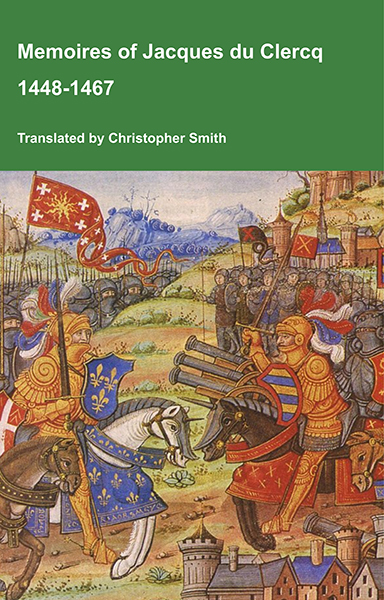
This is a translation of the 'Memoires of Jacques du Clercq', published in 1823 in two volumes, edited by Frederic, Baron de Reissenberg. In his introduction Reissenberg writes: 'Jacques du Clercq tells us that he was born in 1424, and that he was a licentiate in law and a counsellor to Philip the Good, Duke of Burgundy, in the castellany of Douai, Lille, and Orchies. It appears that he established his residence at Arras. In 1446, he married the daughter of Baldwin de la Lacherie, a gentleman who lived in Lille. We read in the fifth book of his Memoirs that his father, also named Jacques du Clercq, had married a lady of the Le Camelin family, from Compiègne. His ancestors, always attached to the counts of Flanders, had constantly served them, whether in their councils or in their armies.' The Memoires cover a period of nineteen years beginning in in 1448, ending in in 1467. It appears that the author had intended to extend the Memoirs beyond that date; no doubt illness or death prevented him from carrying out this plan. As Reissenberg writes the 'merit of this work lies in the simplicity of its narrative, in its tone of good faith, and in a certain air of frankness which naturally wins the reader’s confidence.' Du Clercq ranges from events of national and international importance, including events of the Wars of the Roses in England, to simple, everyday local events such as marriages, robberies, murders, trials and deaths, including that of his own father in Book 5; one of his last entries.
Available at Amazon in eBook and Paperback format.
03 Nov is in November.
On 3rd November 1220 Urraca Ivrea Queen Consort Portugal (age 33) died.
Annals of Dunstable. In the same year, on the morrow of All Souls [3rd November 1283], the prior and Brother Michael of Peak, and Brother John Trespasse of Hallinges, and certain others of our household were summoned to Rokeshawe by writ of trespass, to answer at London to David of Flitwick, on the charge that by night they had fished his ditches and fishponds, against the peace, as he says.
Eodem anno, in crastino Animarum, summonitus est prior et frater Michael de Pecco, et frater Johannes trespass de Hallingges, et quidam alii de familia nostra apud prior and Rokeshoc per breve de transgressione, ad respondendum others. Londoniæ, Davidi de Flittewie, super eo quod noctanter piscati sunt fossata et vivaria ipsius David, contra pacem, ut dicit.
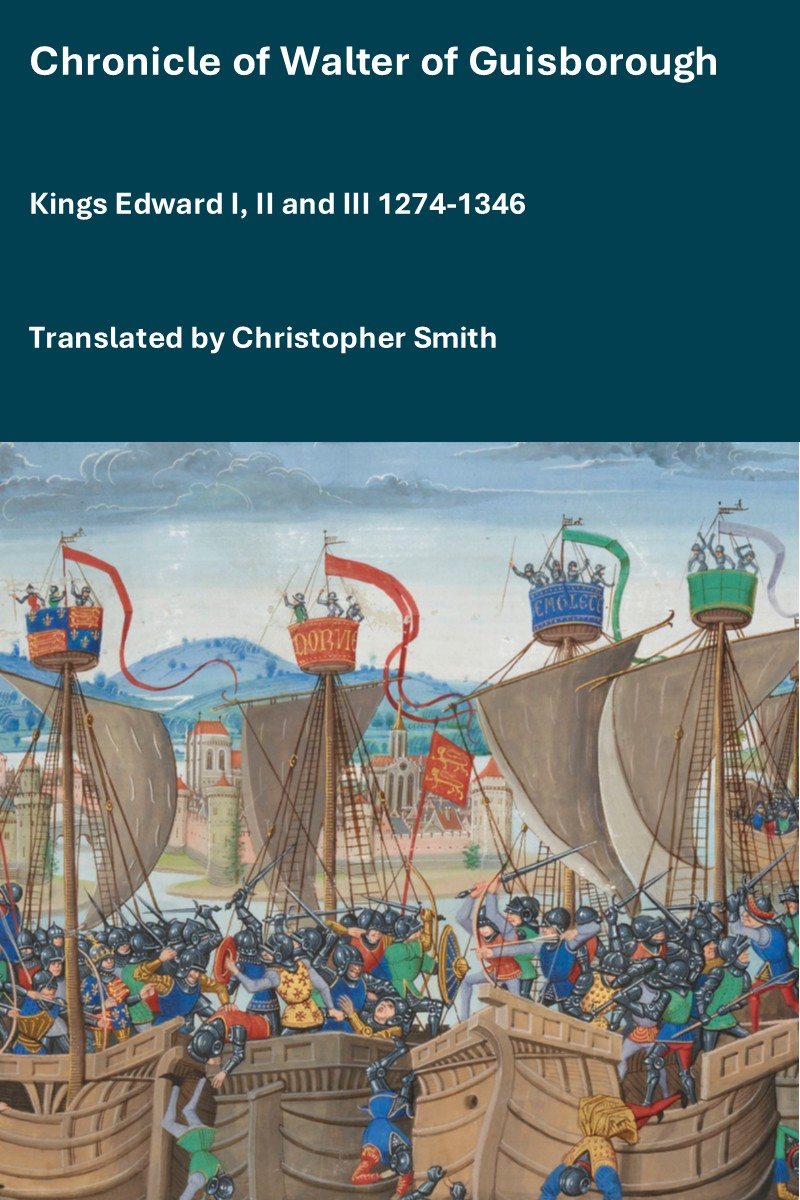 Chronicle of Walter of Guisborough. On the day after All Souls [3rd November 1296] of that same year, the king held his parliament at Bury St Edmunds, where, at his request, a twelfth penny was granted by the people, an eighth by the cities and boroughs, and a fifth by the clergy. It was answered, however, that neither the clergy could grant, nor the king receive, anything, unless both parties would incur the sentence of excommunication as contained in the bull. They added that they did not believe the king wished for this, nor would it be to his advantage. But the king was displeased with this reply, so the clergy were summoned to another parliament at London on the morrow of St Hilary [14th January 1297], in order that, with more time for deliberation, they might give a better answer. When the day came and the clergy were gathered there, the Archbishop of Canterbury, Master Robert of Winchelsey (age 51), having consulted with those sent on the king's behalf, gave this reply: "It is well known to you, my lords, and cannot be hidden, that under Almighty God we have two masters: a spiritual one and a temporal one. The spiritual is the pope, and the temporal is our lord the king. Though we owe obedience to both, we owe more to the spiritual than to the temporal. Nevertheless, wishing to please both, we agree and intend at our own expense to send special messengers to our spiritual father the pope, to ask for permission to grant this, or at least to receive his instruction on what we should do. We also believe that our lord the king, just like us, fears and seeks to avoid the excommunication contained in the bull." To this, the king's envoys replied: "Choose among yourselves certain persons who will report these words to the king on your behalf; for we, knowing his anger is already kindled, dare not relay such a message." When they did so, the king's fury ignited, and burning with wrath, he placed the Archbishop of Canterbury and the whole English clergy outside of his protection and favour, ordering that all church lands, even the endowed lands, throughout England be seized into his hands. And as many believed, it happened miraculously that on the very same day the king excluded the clergy from his protection, his soldiers in Gascony were routed and defeated by the French, as will be shown later. Furthermore, the king's chief justice, seated on the bench, declared publicly before all: "You, the attorneys of archbishops, bishops, abbots, priors, and all other clergy: tell your lords that from now on no justice will be granted to them in the king's court, no matter how grievous the injury they may have suffered. But justice will be done against them for all who bring complaints and seek it." Astonishing to say! The common justice granted to all the people is, by some strange spirit, denied to the clergy, and Mother Church, who once ruled over her sons, now serves and is enslaved by them. Now, Henry of Newark, elected archbishop of York, along with the bishops of Durham, Ely, Salisbury, and others, fearing the king's great wrath, and sensing grave danger approaching, arranged to voluntarily deposit a fifth of their church income for that year in sacred places, claiming it was for the defence of the English Church in its urgent need, so they might escape the king's wrath without violating the pope's bull. Yet whatever the clergy deposited, the royal treasury seized; and so, those who arranged and gave a fifth under that guise won back royal protection. But the Archbishop of Canterbury held firm. He would neither agree to the tax nor deposit anything, choosing instead to suffer the king's wrath rather than fall under the sentence of excommunication. As a result, all his goods were seized, his gold and silver vessels taken, and all his horses confiscated. His household abandoned him, and nothing remained from which even a poor man of Christ could be fed. The king issued a strict command that no one, monastic or lay, should give him shelter, under pain of forfeiture. Thus was the Apostle's exhortation "Welcome one another as Christ welcomed you", emptied of meaning. He remained cast out, sheltering in the house of a humble parish priest, with only a chaplain and one clerk, having nowhere in his entire archbishopric to lay his head. Still, he preached the word of God boldly, begging publicly, and protesting everywhere that all who gave the king or any secular person anything without the pope's consent had without doubt fallen into the bull's sentence of excommunication, always declaring himself ready to die for the Church of God. Meanwhile, the friends of Oliver, Bishop of Lincoln, though he too had refused the king's demands, arranged that the Sheriff of Lincoln take a fifth of the bishop's goods, after which his lands and possessions were restored to him. All the monasteries of his diocese and of the province of Canterbury had also been seized into the king's hands, with custodians appointed to provide the religious only with bare necessities, the rest going to the treasury. So abbots and priors, compelled by necessity, approached the king's court, not to confess sins, but to ransom back their own goods, paying a fourth. At that time, no justice was available to the clergy, and they suffered many injuries. Monks and other religious were robbed of their horses on public roads, and they received no justice until they paid for royal protection through a redemption fee.
In crastino Animarum ejusdem anni tenuit rex The clergy parliamentum suum apud Sanctum Edmundum, ubi, ad rogatum ipsius, concessus est duodecimus denarius a populo, octavus a civitatibus et burgis, a clero quintus. Responsum est, quod nec ipsi dare vel concedere, nec ipse quicquam accipere posset, nisi uterque eorum sententiam excommunicationis incurreret in bulla latam; quod tamen regem velle non credebant, nec sibi expedire sciebant. Sed non placuit regi responsum hoc, unde adjornati sunt ad aliud parliamentum Londoniis in crastino Sancti Hilarii, ut interim cum deliberatione consulti melius responderent. Adveniente tandem die, et ibidem clero congregato, Cantuariensis archiepiscopus, magister Robertus de Wynchelse, communicato consilio hiis qui a facie regis' mittebantur, respondit in hæc verba: "Satis vobis constat, domini mei, nec latere potest, quod sub omnipotenti Deo duos etiam dominos habemus, spiritualem scilicet et temporalem; spiritualem vero dominum papam, et temporalem dominum nostrum regem; et quamvis utrique obedientiam debeamus, majorem tamen temporali quam spirituali. Verum ut placere possimus utrique, concedimus et mittere volumus sumptibus nostris nuncios nostros spciales ad ipsum patrem spiritualem dominum papam, ut licentiam ad concedendum habere possimus, vel saltem responsum habeamus ab ipso quid facere debeamus: credimus etiam dominum nostrum regem, sicut et nos, ipsam excommunicationis sententiam in bulla latam et timere et effugere velle." Ad hæc nuncii regis: "Ordinate ex vobis, domini carissimi, personas certas, qui talia domino regi ex parte vestra. renuncient; nos enim, scientes indignationem ejus accensam, veremur omnino talia nunciare." Quod cum ipsi fecissent, mox furor regis insævit, They are et excandens in iram, ipsum Cantuariensem archiepiscopum cum toto clero Anglicano extra suam defensionem et protectionem posuit; præcepitque ut omnes terræ etiam dotales totius ecclesiæ Anglicanæ in manum ipsius seisirentur. Et, ut creditur, miraculose contigit, eadem enim die qua extra protectionem suam rex clerum posuerat," confusi sunt milites sui in Vasconia, et a Francis devicti, ut infra patet. Justitiarius etiam regis in banco ex parte regis pro tribunali sedens, omnibus circumstantibus publice dixit, "Vos domini attornati archiepiscoporum, episcoporum, abbatum et priorum, cæterarumque personarum omnium ex clero, nunciate dominis vestris et dicite,' quod de cætero in curia domini regis nulla fiet eis justitia de quacunque re, etiam si illata fuerit eis injuria atrocissima. Justitia tamen de eis fiet omnibus conquerentibus, et eam habere volentibus. Mirabile dictu! communis justitia quæ populo conceditur, nescio quo spiritu, ipsi clero denegatur, ancillaturque et servit mater ecclesia, quæ solebat antiquitus filiis dominari." Electus autem Eborum Henricus de Newerk, item Dunolmensis, Eliensis, Salesbiriensis episcopi,' et quidam alii, timentes iram regis maximam, et conjecturantes grave periculum imminere, ordinaverunt se deponere velle in æde sacra quintam partem bonorum ecclesiasticorum illius anni, ad tuitionem ecclesiæ Anglicanæ, et defensionem urgentissimæ necessitatis, ut sic iram regis evaderent, et sententiam in bulla latam non incurrerent. Quicquid tamen deponebat clerus, tollebat fiscus; et sic ordinantes, et sub colore quintam partem concedentes, protectionem regis consecuti sunt. Canterbury's tuariensis vero archiepiscopus, animum non mutans, nec concedere nec deponere quicquam voluit, elegitque potius iram regis quam sententiam excommunicationis incurrere; unde seisita sunt omnia bona sua, et vasa ejus aurea et argentea occupata sunt, et equi omnes; recesseruntque ab eo familiares ejus, nec remansit quicquam unde Christi pauper aleretur; præceptumque est, sub gravi forisfactura regis, ne quis eum hospitio susciperet in monasterio vel extra, evacuatumque est illud apostoli, "Suscipite invicem sicut et Christus suscepit vos:" mansitque sic ejectus in domo cujusdam simplicis rectoris, cum solo sacerdote et uno clerico, non habens ex toto archiepiscopatu ubi caput reponeret; constanter tamen egit in verbo Domini, publice mendicans, et ubique protestans omnes qui vel regi vel personæ seculari præter voluntatem domini papæ quicquam concederent, in canonem latæ sententiæ eo facto proculdubio incidisse, semper existens paratus ad moriendum pro ecclesia Dei. Amici vero Lincolniensis episcopi Oliveri, etiam ipso voluntatem regis non ratificante, procuraverunt tamen quod vicecomes Lincolniensis, levata quinta parte de bonis ipsius episcopi, extunc ei possessiones et terras restitueret. Omnia etiam monasteria episcopatus ipsius, et totius provinciæ Cantuariensis, seisita fuerant in manum regis, et ex præcepto ipsius custodes appositi qui ipsis religiosis solummodo necessaria ministrarent, et reliqua converterentur in fiscum. Unde abbates et priores necessitate compulsi curiam regis adierunt, non peccata quidem sed bona propria redimentes, data quarta. Nulla tunc temporis fiebat justitia clero, et passi sunt clerici injurias multas. Religiosi etiam in via regia equis suis spoliabantur, et nullam consecuti sunt justitiam, quousque, redemptione facta, eis daretur regia protectio.
On 3rd November 1311 Piers Gaveston 1st Earl Cornwall (age 27) exiled by "The New Ordinances", a series of regulations imposed upon King Edward II by the peerage and clergy of the Kingdom of England to restrict the power of the English monarch. The twenty-one signatories, consisting of eight earls, seven bishops and six barons, of the Ordinances are referred to as the Lords Ordainers:
Earls:
John Capet 4th Earl Richmond (age 45)
Henry Lacy 4th Earl Lincoln, Earl Salisbury
Guy Beauchamp 10th Earl Warwick (age 39)
Gilbert de Clare 8th Earl Gloucester 7th Earl Hertford (age 20)
Aymer de Valence 2nd Earl Pembroke (age 36)
Bishops:
Archbishop Robert Winchelsey (age 66)
Barons:
Hugh de Vere 1st Baron Vere (age 54)
Hugh Courtenay, Baron of Okehampton (age 35).
William Marshal 1st Baron Marshal (age 34)
Robert Clifford 1st Baron Clifford (age 37)
Article 20 describes at length the offences committed by Gaveston; he was once more condemned to exile and was to abjure the realm by 1 November.
Calendar Fine Rolls 1319-1327. 3rd November 1321. Leeds [Map]. Commitment during pleasure to the king's chaplain, Richard de Potesgrave, of the keeping of all the lands, goods and chattels late of Walter Colpeper, Roger de Coumbe, Richard Prat, Thomas de Chidecroft, Richard de Chidecroft, Robert de Bromere, Roger de Rokayle, Nicholas de Bradefeld, Adam le Wayte, Robert de Cheigny, Richard Brisynge, Simon de Tyerst and William Colyn, which are in the king's hand as forfeit because the said Walter and others were hanged for the felony done by them, so that he answer for the issues thereof in the chamber; commitment also to him during pleasure of the keeping of all the lands, goods and chattels late of Thomas Colpeper, which have been taken into the king's hand because he withdrew cited for certain seditions done to the king, so that he answer for the issues thereof in the chamber. By K. Order to the sheriff of Kent to take the said lands, goods and chattels into the king's hand, if he has not yet done so, and to deliver the same to the said Richard.
Calendar Fine Rolls 1319-1327. 3rd November 1321. Leeds [Map]. Order to the abbot of St. Augustine's, Canterbury, to cause the jewels and all goods and chattels of Bartholomew de Badelesmere (age 46) within his abbey to be sealed under the seals of him and the bearer of these presents and to be kept, so that he can answer therefor to the king at the king's order. By K.
Order to the mayor and sheriffs of London to take into the king's hand the houses and all tenements of Bartholomew de Badelesmere in the said city with all his goods and chattels found therein by view of Roger de Swynnerton, keeper of the Tower of London, and to keep the same safely until further order. By K.
On 3rd November 1333 John de Straford (age 58) was appointed Archbishop of Canterbury.
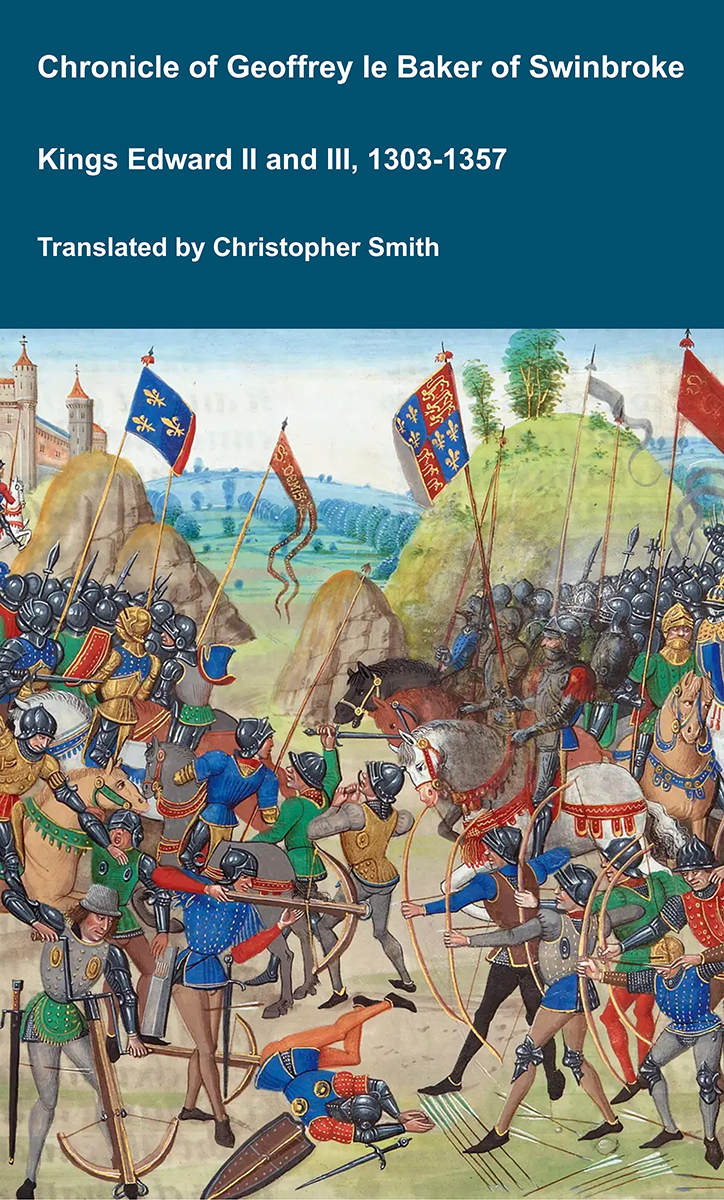 Chronicle of Geoffrey le Baker of Swinbroke [-1360]. On Tuesday [3rd November 1355], they arrived at Carcassonne, a beautiful, exceedingly wealthy, and well-built town, larger than London within its walls. Between the bourg [the lower town] and the citadel [the upper city], which was surrounded by a double wall, ran a river beneath a beautiful stone bridge, at the foot of which stood a fine hospital. In the bourg were four convents of the four mendicant orders, whose friars did not flee, even as the burghers and the Poor Clares who also lived there fled into the citadel. The entire army, though well and lavishly accommodated in the bourg, scarcely occupied three quarters of it, so great was its size, and it was abundant in muscat wine and all sorts of provisions, both luxurious and necessary. That day, the battle lines were drawn up in proper order in front of the bourg, and the sons of the Lord of Albret1 and Lord Basset of Drayton were knighted, the latter immediately taking the field under his own raised banner. Also, Roland Daveys2 and several others were elevated to the order of knighthood.
Die Martis advenerunt Carkasonam, villam pulcram, predivitem, et bene edificatam, ampliorem Londoniis infra muros. Inter villam seu burgum et civitatem circumcinctam dupplici muro currebat aqua vocata sub ponte pulcro petrino, ad cuius pedem pulcrum ospitale fuit situatum. In burgo fuerunt quatuor conventus quatuor pauperum religionum, quorum ministri, scilicet fratres, non fugerunt, burgensibus et minorissis que illic eciam habitabant in civitatem fugientibus. In burgo totus exercitus bene et laute ospitatus vix occupavit tres eius quartas, habundans vino muscato et ceteris victualibus tam delicatis quam necessariis. Isto die acies ante burgum fuerunt bene ordinate, et effecti milites filii domini de Libreto et dominus de Basset Dreitone, qui incontinenti cum erecto proprio vexillo militavit. Item, Rolandus Daveys et plures ad ordinem militarem promovebantur.
Note 1. Bernard Ezi, sire d'Albret, took part in this expedition. Ralph (age 20), lord Basset of Drayton, 1343-1390, was at this time a young man of about twenty.
Note 2. In the Calendar Inquisitions Post Mortem, 2.231, Roland Daveys is found seised of the manor of Lyndon, co. Rutland, in 1361.
On 3rd November 1373 Joan Valois Queen Consort Navarre (age 30) died at Évreux.
Chronicle of Enguerrand de Monstrelet [1400-1453]. [3rd November 1428]. And then, while he [Thomas Montagu 1st Count Perche 4th Earl Salisbury (age 40)] was at the said window, suddenly from the said city, with a rush, came the stone of a cannon1, which struck the window where the said count was, who, already withdrawing inside from the noise of the shot, nevertheless was struck very grievously and mortally by the said stone, and had a large part of his face carried away completely, and a gentleman who was nearby was killed outright by the same shot. For which wound of the said count, all his men generally had great sadness in their hearts, for he was greatly esteemed and loved by them, and they held him to be the most subtle, experienced, and fortunate in arms of all the other princes and captains of the kingdom of England. However, he, thus wounded, lived the space of eight days, and after he had summoned all his captains and admonished them on behalf of the King of England that they should continue to bring the city of Orleans into obedience without any dissimulation, he had himself carried to Meun, and there died after eight days from the said wound.
Et lors, luy estant à ladicte fenestre, vint soudainement de ladite cité, à volant, la pierre d'ung veuglaire1, qui féri la fenestre où estoit ledit conte, lequel, desjà pour le bruit du cop se retiroit dedens, nient mains il fut aconsuy très griefment et mortellement de ladicte fenestre, et eut grant partie de son visage emporté tout jus, et ung gentil homme qui estoit d'alès luy fut d'ycelui cop tué tout mort. Pour laquelle bléceure dudit conte, tous ses gens généralment eurent au cuer grand tristesce, car d'eulx il estoit moult crému et amé, et le tenoit pour le plus subtil, expert et eureux en armes de tous les autres princes et capitaines du royaume d'Angleterre. Toutefois, il, ainsy blécié, vesqui l'espace de huit jours, et après ce qu'il eust mandé tous ses capitaines et à yceulx admonesté de par le roy d'Angleterre qu'ilz continuassent à mettre en obéyssance ycelle ville d'Orliens sans quelque dissimulacion, il se fist porter à Meun, et là morut au bout de huit jours de sadicte bléceure.
Note 1. veuglaire i.e. cannon. The Veuglaire, after a gun manufacturer named Vögler, was a wrought iron cannon, and part of the artillery of France in the Middle Ages.
William of Worcester's Chronicle of England
William of Worcester, born around 1415, and died around 1482 was secretary to John Fastolf, the renowned soldier of the Hundred Years War, during which time he collected documents, letters, and wrote a record of events. Following their return to England in 1440 William was witness to major events. Twice in his chronicle he uses the first person: 1. when writing about the murder of Thomas, 7th Baron Scales, in 1460, he writes '… and I saw him lying naked in the cemetery near the porch of the church of St. Mary Overie in Southwark …' and 2. describing King Edward IV's entry into London in 1461 he writes '… proclaimed that all the people themselves were to recognize and acknowledge Edward as king. I was present and heard this, and immediately went down with them into the city'. William’s Chronicle is rich in detail. It is the source of much information about the Wars of the Roses, including the term 'Diabolical Marriage' to describe the marriage of Queen Elizabeth Woodville’s brother John’s marriage to Katherine, Dowager Duchess of Norfolk, he aged twenty, she sixty-five or more, and the story about a paper crown being placed in mockery on the severed head of Richard, 3rd Duke of York.
Available at Amazon in eBook and Paperback format.
On 3rd November 1428 Thomas Montagu 1st Count Perche 4th Earl Salisbury (age 40) died from wounds received at the Siege of Orléans. His daughter Alice (age 21) succeeded 5th Countess Salisbury, 4th Baroness Montagu, 7th Baroness Montagu, 6th Baroness Monthermer. Richard Neville Earl Salisbury (age 28) by marriage Earl Salisbury.
On 3rd November 1456 Edmund Tudor 1st Earl Richmond (age 26) died of plague at Carmarthen Castle [Map] leaving his thirteen year old wife Margaret Beaufort Countess Richmond (age 13) pregnant with their child Henry Tudor, the future King Henry VII. His son Henry Tudor succeeded 2nd Earl Richmond posthumously.


Chronicle of William of Worcester [1415-1482]. King Edward, indeed, on the 3rd of November [1462], left London for the north, accompanied by armed men sent from all the towns to assist him. The castles of Bamburgh [Map], Alnwick, and Dunstanburgh [Map] were besieged in the month of December, and on Christmas Eve, the said castles of Bamburgh [Map] and Dunstanburgh [Map] were surrendered to the King under agreements, with the lives and limbs of the defenders spared, and with Richard Percy coming into the service of King Edward and being given custody of the said castles.
Rex vero Edwardus iij. die Novembris Londonia egreditur versus partes boriales, cui ex omnibus villis certæ gentes armatæ mittuntur cum eo in adjutorium. Obsessaque sunt castra Bamburgh, Alnewyke, et Dustanburghe mense Decembris, et vigilia Natalis Domini reddita sunt regi dicta castra Banburgh et Dunstanburgh sub appunctumentis, salvis vita et membris, et quod Ricardus Percy veniret in legentiam regis Edwardi haberetque custodiam castrorum prædictorum.
On 3rd November 1473 Peter Bourbon II Duke Bourbon (age 34) and Anne Valois Duchess Bourbon (age 12) were married. She by marriage Duchess Bourbon. The difference in their ages was 22 years. She the daughter of King Louis XI of France (age 50) and Queen Charlotte of Savoy (age 31). He the son of Charles Bourbon I Duke Bourbon and Agnes Valois Duchess Bourbon (age 66). They were second cousin once removed. He a great x 5 grandson of King Edward I of England.
On 3rd November 1534 Parliament enacted the First Act of Supremacy by which Henry VIII (age 43) and his heirs were declared to be Supreme Head of the Church of England.


Chronicle of Edward Hall [1496-1548]. 3rd November 1533. In this year the third day of November the King's Highness held his high court of Parliament, in the which was concluded and made many and sundry good, wholesome, and godly statutes: but among all one special statute, which authorised the King's highness to be Supreme Head of the Church of England, by the which the Pope with all his College of Cardinals abolished, with all their pardons and indulgences was utterly abolished out of this realm, God be everlastingly praised therefore. In this Parliament also was given to the King's highness the first fruits and tenths of all dignities and spiritual promotions. And in the end of the same Parliament the King's Majesty most graciously grannted (and willed it by the same Parliament to be established) his most gracious and general free pardon.
Chronicle of Edward Hall [1496-1548]. 3rd November 1538. The third day of November were Henry Marquess of Exeter and Earl of Devonshire (age 42) and Sir Henry Pole knight and Lord Montague (age 46) and Sir Edward Neville (age 67) brother to the Lord Bergavenny sent to the Tower which three were accused by Sir Geoffrey Pole (age 37) brother to the Lord Montague, of high treason, and the two lords were arraigned the last day of December, at Westminster before the Lord Audley of Walden, Lord Chancellor, and then the High Steward of England, and there found guilty, likewise on the third day after was arraigned Sir Edward Neville, Sir Geoffrey Pole and two priests called Croftes and Collins, and one Holande a mariner and all attainted,
On 3rd November 1601 Gaston Henri Duke Verneuille was born illegitimately to Henry IV King France (age 47) and Catherine Henriette de Balzac d'Entragues (age 22).


Letters of the Court of James I 1618. 3rd November 1618. London. Reverend Thomas Lorkin to Thomas Puckering 1st Baronet (age 26).
My last letter intimated a warrant that was formed for Sir Walter Raleigh's despatch. his end.
Upon Wednesday, therefore, he was brought to Westminster, to receive sentence anew from the lord chief justice, to comply with certain formalities, I hear, in law, for that those who pronounced it were dead. Being presented at the bar, he demanded for what offence he was proceeded against? Answer was made, it was his majesty's pleasure to take his life for the first; and that the cause of his coming again to the bar now was, to declare the former condemnation to stand still in force. He offered to speak somewhat for himself, but it was not permitted. The attorney (age 52) told him that he had lived like a star, and like a star must he fall, when it troubled the firmament. Then he was delivered into the sheriff's charge, and by him carried from thence to the Gatehouse; and the day following (which was, by all good tokens, the lord mayor's day), in the Old Palace Yard, executed. His warning was short; for he had no word to prepare himself for death, till that very morning he was convented before the judge. He sued for four or five days longer, under pretence of having somewhat to communicate with his majesty, in writing, for his behoof and service, which in so short a time could not be performed; and something, I hear, he hath written to the king to that purpose. Yet it was conceived as a device to gain time, that his friends might the more effectually intercede for his pardon, so that suit would not be granted. Whereupon he prepared himself for death. The Dean of Westminster visited him, and, after some · conference between them two, he, at his hands, received the sacrament; and, the night before his execution, made his own Epicedium, or funeral song, which I have here sent you.
He had the favour to die a gentleman's death, and to be beheaded. His end was, by the general report of all that were present, very Christian-like; and so full of resolution, as moved all men to pity and wonder. In going from the prison to the scaffold, amongst others that thronged about to see him, one old man, that was bald, pressed very forward, insomuch as Sir Walter Raleigh took notice of him, and asked him whether he would have aught of him. To whom the old man answered: "Nothing but to see him, and to pray to God to have mercy upon his soul." "I thank thee, good friend," replied Sir Walter; "and I am sorry I have no better thing to return thee for thy good will: but take this night-cap" (which was a very rich one, that he wore, for he had had two fits of a fever), "for thou hast more need of it now than I."
Being come to the scaffold, he saw the lords seated in a place that was provided for them, somewhat far off, and, fearing lest his voice should not well reach them, desired them that they would approach, because what he had then to say, he wished the whole world should take notice of. And so they did, and heard a most grave, Christian, and elegant discourse, as they commonly qualify it. In it he laboured to clear himself from three main aspersions. The first, of atheism; which he did by a worthy profession of his faith, and profession of his hope to be saved thereby. The second was concerning my Lord of Essex's death, whom he was reported to have insulted upon at his death, taking tobacco in a bravery before his face and to have procured and practised his ruin. Against both which he solemnly protested; adding further, that he acknowledged himself to be, indeed, of a contrary faction, because my Lord of Essex had refused him, whom he first sought; but that he was so far from triumphing at his death, as he never was more affected with grief for any man's, and expressed the same with tears, to his prejudice, in the opinion and friendship, as it proved afterwards, of the adverse party. The third was concerning those last occasions wherein he stood charged with a disloyal intention in the voyage he undertook, and with further accusations since his return. The former seemed grounded upon a report that went, of great sums of money which he secretly transported with him to the value of £ 10,000, and the extraordinary provision of artillery he carried with him; both which he satisfied, by showing the falsehood of the first (all his own store not exceeding the sum of one hundred and fifty pieces, whereof he sent back part to his wife), and the necessity of the second, in regard of the Spaniard, upon whose friendship he had no occasion to presume.
Touching the other accusations, they all respected Sir Lewis Stukeley as their author (whom he professed to forgive, by the way, with all his heart, but yet thought fit to désagencer [to put out of order] the world, both the better to justify himself, and to teach every man how to trust him). And, whereas, he first accused him to have practised with the French agent about his escape, he protested he never saw him but once, in the gallery at Whitehall, before he undertook his voyage; neither ever had aught to do with him since. Secondly, whereas, Stukeley charged him to have offered him £ 10,000 if he would consent to his escape; he likewise therein proclaimed him false, sith his largest promises in that kind never exceeded the payment of Stukeley's debts, which he confessed to have undertaken for him. Thirdly, whereas the said Stukely accused him to have laid to Sir Edward Parry's charge, where he was entertained in his coming up to London, the poisoning of him; he took his death upon it that it was most calumnious. He used, indeed, art to counterfeit a poisoning upon himself, ' which he thought was warranted by David's example, who feigned himself, in a case of like danger, mad; but that he had ever fathered it upon him, who had ever been his noble and worthy friend, he utterly disavowed it under a solemn execution. Lastly, whereas his accuser testified against him, that he had, for his encouragement to give way to his escape, assured him that my Lord of Doncaster and Lord Arran were privy to the design, and favourers of it, he assured the contrary under a deep oath; adding that he knew how fearful and dangerous a thing it was to call God to witness to a lie at any time, much more at the hour of a man's death, but he had herein satisfied the obligation of a good conscience.
This done, he embraced all the lords, and other of his friends there present, with such courtly compliments of discourse, as if he had met them at some feast. They then cleared the scaffold; which being done, he takes up the axe and feels the edge, and finding it sharp for the purpose, "This is that," saith he, "that will cure all sorrows;" and so kissing it, laid it down again. After that he went to three several corners of the scaffold, and, kneeling down, desired all the people to pray for him, and conceived a long prayer for himself. Then he began to fit himself for the block, without permitting any help, and first laid himself down, to try how the block fitted him. After rising up, the executioner knelt down, and desired him to forgive him; which, with an embrace, he protested he did, but entreated him not to strike till he gave a token, by lifting up his hand; "and then fear not," said he, "but strike home." So he laid himself down to receive the stroke, and the hangman directed him to lay his face towards the east. "No matter how the head lie," answered he, "so the heart be right." After he had lain a little while upon the block, conceiving some prayers to himself, he gave the watchword, and the executioner, it seems, not minding it, he called aloud unto him, asking him why he did not strike. "Strike man!" said he, and so in two blows was delivered from his pain.
In all the time he was upon the scaffold, nor before, there appeared not the least alteration in him, either in his voice or countenance, but he seemed as free from all manner of apprehension, as if he had been come thither rather to be a spectator than a sufferer. Nay, the beholders seemed much more sensible than did he; so that he hath purchased here, in the opinion of men, such honour and reputation, as, it is thought, his greatest enemies are they that are most sorrowful for his death, which they see is like to turn so much to his advantage.
Štukeley, notwithstanding, hath been at court since, offering to his majesty, by way of his own justification, to take the sacrament upon it, that what he laid to Sir Walter Raleigh's charge was true; and to produce two other witnesses, free from all exception, that would do the like. "Why, then," replied his majesty "the more malicious he to utter those speeches at his death." But Sir Thomas Badger, who stood by and heard it, "Let the king," said he, "take off Stukeley's head, as he hath done the other's, and let him at his death take the sacrament, and his oath upon it, and I'll believe it; but otherwise I shall credit Sir Walter Raleigh's bare affirmative before a thousand of his oaths." And it is strange to see how every man at court declines that Stukeley's company, as treacherous.
Thus I have related at large the discourse at court; whereunto I shall briefly add, for farther news, that the prince, a little before they came from Royston, resigned up his pretensions to the Admiralty (whereof he had received a grant from the king long since) to the Marquis of Buckingham.
John Evelyn's Diary. 30th December 1640. I saw his Majesty (age 40) (coming from his Northern Expedition) ride in pomp and a kind of ovation, with all the marks of a happy peace, restored to the affections of his people, being conducted through London with a most splendid cavalcade; and on the 3d of November following (a day never to be mentioned without a curse), to that long ungrateful, foolish, and fatal Parliament, the beginning of all our sorrows for twenty years after, and the period of the most happy monarch in the world: Quis talia fando!


Samuel Pepys' Diary. 3rd November 1660. Saturday. At home all the morning. In the afternoon to White Hall, where my Lord and Lady were gone to kiss the Queene's (age 50) hand. To Westminster Hall [Map], where I met with Tom Doling, and we two took Mrs. Lane to the alehouse, where I made her angry with commending of Tom Newton and her new sweetheart to be both too good for her, so that we parted with much anger, which made Tom and me good sport. So home to write letters by the post, and so to bed.


Samuel Pepys' Diary. 3rd November 1662. Thence to my Lord Sandwich (age 37), from whom I receive every day more and more signs of his confidence and esteem of me. Here I met with Pierce the chyrurgeon, who tells me that my Baroness Castlemaine's (age 21) is with child; but though it be the King's, yet her Lord (age 28) being still in town, and sometimes seeing of her, though never to eat or lie together, it will be laid to him. He tells me also how the Duke of York (age 29) is smitten in love with my Lady Chesterfield (age 22)1 (a virtuous lady, daughter to my Lord of Ormond (age 52)); and so much, that the Duchess of York (age 25) hath complained to the King (age 32) and her father (age 53) about it, and my Lady Chesterfield is gone into the country for it. At all which I am sorry; but it is the effect of idleness, and having nothing else to employ their great spirits upon.
Note 1. Lady Elizabeth Butler, daughter of James Butler, first Duke of Ormond, second wife of Philip Stanhope (age 28), second Earl of Chesterfield. She died July, 1665 (see "Memoires de Grammont", chap. viii.). Peter Cunningham thinks that this banishment was only temporary, for, according to the Grammont Memoirs, she was in town when the Russian ambassador was in London, December, 1662, and January, 1662- 63. "It appears from the books of the Lord Steward's office... that Lord Chesterfield set out for the country on the 12th May, 1663, and, from his 'Short Notes' referred to in the Memoirs before his Correspondence, that he remained at Bretby, in Derbyshire, with his wife, throughout the summer of that year" ("Story of Nell Gwyn", 1852, p. 189).
Samuel Pepys' Diary. 3rd November 1664. So home to supper and to bed. This night Sir W. Batten (age 63) did, among other things, tell me strange newes, which troubles me, that my Lord Sandwich (age 39) will be sent Governor to Tangier [Map], which, in some respects, indeed, I should be glad of, for the good of the place and the safety of his person; but I think his honour will suffer, and, it may be, his interest fail by his distance.


Chronicle of Geoffrey le Baker of Swinbroke
Baker was a secular clerk from Swinbroke, now Swinbrook, an Oxfordshire village two miles east of Burford. His Chronicle describes the events of the period 1303-1356: Gaveston, Bannockburn, Boroughbridge, the murder of King Edward II, the Scottish Wars, Sluys, Crécy, the Black Death, Winchelsea and Poitiers. To quote Herbert Bruce 'it possesses a vigorous and characteristic style, and its value for particular events between 1303 and 1356 has been recognised by its editor and by subsequent writers'. The book provides remarkable detail about the events it describes. Baker's text has been augmented with hundreds of notes, including extracts from other contemporary chronicles, such as the Annales Londonienses, Annales Paulini, Murimuth, Lanercost, Avesbury, Guisborough and Froissart to enrich the reader's understanding. The translation takes as its source the 'Chronicon Galfridi le Baker de Swynebroke' published in 1889, edited by Edward Maunde Thompson.
Available at Amazon in eBook and Paperback format.
Samuel Pepys' Diary. 3rd November 1665. Was called up about four o'clock and in the darke by lanthorne took boat and to the Ketch and set sayle, sleeping a little in the Cabbin till day and then up and fell to reading of Mr. Evelyn's (age 45) book about Paynting1, which is a very pretty book.
Note 1. This must surely have been Evelyn's "Sculptura, or the History and Art of Chalcography and Engraving in Copper", published in 1662. The translation of Freart's "Idea of the Perfection of Painting demonstrated" was not published until 1668.


Calendar of State Papers Charles II 03 Nov 1666. 3rd November 1666. Declaration [by Lord Arlington]. The King (age 36), haying maturely considered the charges brought against Sir Rob. Holmes (age 44) by Sir Jeremy Smith, finds no cause to suspect Sir Robert of cowardice in the fight with the Dutch of June 25 and 26, but thinks that on the night of the 26th, he yielded too easily to the opinion of his pilot, without consulting those of the other ships, muzzled his ship, and thus obliged the squadron to do the same, and so the enemy, which might have been driven into the body of the King's fleet, then returning from the pursuit, was allowed to escape. [Hnt. Book 23, p. 264.]


Samuel Pepys' Diary. 3rd November 1667. By and by Roger (age 50) went, and Mr. Turner spent an hour talking over my Lord Sandwich's (age 42) condition as to this Parliament, which we fear may be bad, and the condition of his family, which can be no better, and then having little to comfort ourselves but that this humour will not last always in the Parliament, and that [it] may well have a great many more as great men as he enquired into, and so we parted, and I to my chamber, and there busy all the evening, and then my wife and I to supper, and so to bed, with much discourse and pleasure one with another.
On 3rd November 1684 William Douglas 1st Duke Queensberry (age 47) was created 1st Duke Queensberry. Isabel Douglas Countess Queensberry (age 42) by marriage Countess Queensberry.
On 3rd November 1690 Richard Power 1st Earl Tyrone (deceased) was buried in St Peter's Church, Farnborough.
John Evelyn's Diary. 3rd November 1690. Went to the Countess of Clancarty (age 48), to condole with her concerning her debauched and dissolute son (age 22), who had done so much mischief in Ireland, now taken and brought prisoner to the Tower [Map].
On 3rd November 1701 Philippe V King Spain (age 17) and Maria Luisa Savoy (age 13) were married. She the daughter of Victor Amadeus King Sardinia (age 35) and Anne Marie Bourbon Queen Consort Sardinia (age 32). He the son of Louis "Le Grand Dauphin" Bourbon Duke Burgundy (age 40) and Maria Anna Victoria Wittelsbach Duchess Burgundy. They were second cousins. She a great granddaughter of King Charles I of England, Scotland and Ireland.


On 3rd November 1729 Elizabeth Strangeways Duchess Hamilton Duchess Brandon (age 39) died.
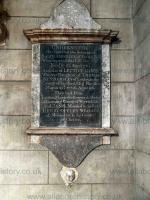
On 3rd November 1751 Ralph Adderley (age 76) died. Lettice Adderley inherited Coton Hall, Staffordshire [Map]. He was buried at St Werburgh's Church, Hanbury [Map]
Ralph Adderley: Around 1675 he was born to Ralph Adderley.
Lettice Adderley: she was born to Ralph Adderley. On 14th July 1741 Bowyer Adderley and she were married at St Werburgh's Church, Hanbury [Map]. They were third cousin once removed. In 1784 Lettice Adderley died. Ralph Adderley inherited Coton Hall, Staffordshire [Map].
On 3rd November 1777 Princess Sophia Hanover was born to King George III of Great Britain and Ireland (age 39) and Charlotte Mecklenburg Strelitz Queen Consort England (age 33).
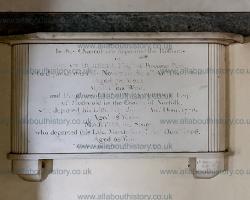
On 3rd November 1806 Bryan Burrell (age 78) died. He was buried at the Chapel of St John the Evangelist, Bolton [Map].
In this Chancel are deposited the Remains of Bryan Burrell Esqre of Broome Park [Map], who departed this Life, November the 3rd Ano Domni 1806, Aged 78 Years Mary his Wife and Daughter of HENRY PARTRIDGE Esqre of Methwold in the County of Norfolk, who departed this Life, July the 12th Ano Domni 1776; Aged 28 Years. MARTHA his Sister, who departed this Life March the 17th Ano Domni 1806, Aged 68 Years. "Their Hope is full of Immortality"
Bryan Burrell: In 1728 he was born to William Burrell of Broome Park and Philadephia Grey. In May 1771 Bryan Burrell and Mary Partridge were married. The difference in their ages was 20 years.
On 3rd November 1807 Archbishop William Markham (age 88) died.
Chronicle of Geoffrey le Baker of Swinbroke
Baker was a secular clerk from Swinbroke, now Swinbrook, an Oxfordshire village two miles east of Burford. His Chronicle describes the events of the period 1303-1356: Gaveston, Bannockburn, Boroughbridge, the murder of King Edward II, the Scottish Wars, Sluys, Crécy, the Black Death, Winchelsea and Poitiers. To quote Herbert Bruce 'it possesses a vigorous and characteristic style, and its value for particular events between 1303 and 1356 has been recognised by its editor and by subsequent writers'. The book provides remarkable detail about the events it describes. Baker's text has been augmented with hundreds of notes, including extracts from other contemporary chronicles, such as the Annales Londonienses, Annales Paulini, Murimuth, Lanercost, Avesbury, Guisborough and Froissart to enrich the reader's understanding. The translation takes as its source the 'Chronicon Galfridi le Baker de Swynebroke' published in 1889, edited by Edward Maunde Thompson.
Available at Amazon in eBook and Paperback format.
On 3rd November 1817 Ernest Hébert was born.
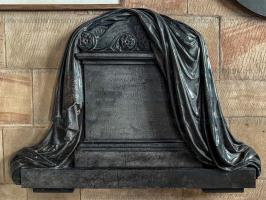
On 3rd November 1822 Abel John Ram of Clonattin, County Wexford (age 46) died at Calwich Hall [Map]. Memorial at St Peter's Church, Ellastone.
Abel John Ram of Clonattin, County Wexford: Around 1776 he was born to Abel Ram. On 11th August 1803 Abel John Ram of Clonattin, County Wexford and Frances Anne Port were married.

On 3rd November 1835 Henry John Montagu-Douglas-Scott 1st Baron Montagu Beaulieu was born to Walter Scott 5th Duke Buccleuch 7th Duke Queensberry and Charlotte Anne Thynne Duchess Buccleuch Duchess Queensbury (age 24). He married 4th August 1865 his fifth cousin Cecily Susan Stuart-Wortley-Mackenzie Baroness Montagu, daughter of John Stuart-Wortley-Mackenzie 2nd Baron Wharncliffe and Georgiana Elizabeth Ryder Baroness Wharncliffe, and had issue.
On 3rd November 1846 Elizabeth Thompson Lady Butler was born to Thomas James Thompson (age 34) and Christiana Weller (age 21) at the Villa Claremont, Lausanne. She married 11th June 1877 Lieutenant-General William Francis Butler.
The Times. 26th December 1910. We regret to state that Lord Ancaster (deceased) died on Saturday night at his Grimsthorpe, Bourne, Lincolnshire seat, in his 81st year.
Gilbert Henry Heathcote-Drummond-Willoughby, created first Earl of Ancaster in 1892, was Joint Hereditary Lord Great Chamberlain of England. This dignity is held jointly by Lord Cholmondeley (age 27), Lord Ancastor, and Lord Carrington (age 67). The late peer filled it during the reign of Queen Victoria, Lord Cholmondeley during that of King Edward, and Lord Carrington fills it during the present reign.
He was born on October 1, 1830, and succeeded his father (age 12) as second Lord Aveland on September 6, 1807, and his mother as 24th Lord Willoughby de Eresby on November 13, 1888.
Few noblemen possessed a longer lineage, for the lordship of Erresby in Lincolnshire was acquired by the family of Bee or Belec bv the marriage of Walter dc Bec with Agnes, daughter and heiress of Hugh Fitz Pincheon, a 12th century magnate of Lincolnshire. A John Beeke received permission from Edward I to make a castle of his manor house at Eresby and was summoned to Parliament as one of the barons of the realm. By his wife, Sarah, daughter of Thomas, Lord Furnival, be had, among other children, Alice, who was married to Sir William de Willoughby, one of those who went with Prince Edward to the Holy Land. His son, Robert, became first Lord Willoughby de Eresby. Subsequent holders of that title played a prominent part in the country's history at home and abroad. The 13th baron was created Earl of Lindsey. The fourth Earl of Lindsey was created Duke of Ancaster and Kesteven in 1713. That dukedom became extinct with the death of the fifth Duke in 1809. The barony of Willoughby de Eresby fell into abeyance between the sisters of the fourth duke until it was terminated by the Crown in 1780 in favour of the elder co-heir, Priscilla Barbara Elizabeth, whom the first Lord Gwydir married in 1779. Their eldest son Peter Robert, 21st Baron Willoughby de Eresby, married the daughter of the first Lord Perth, and one of their daughters became in 1840 the wife of the second Lord Carrington. Almeric, the 22nd Lord Willoughby do Eresby and third Baron Gwydyr of Gwydyr, County Carnarvon, Joint Hereditary Great Chamberlain of England, died in August, 1870. The barony of Willoughby do Eresby again fell into abeyance between his lordship's surviving sisters, and it was terminated in favour of the elder, the Dowager Baroness Aveland, who married in 1827 Sir Gilbert John Heathcote, created Baron Aveland in 1856. Their eldest son was the late Lord Ancaster, whose sister, Clementina Charlotte (age 78), married in 1869 Vice-Admiral Sir George Tryon, who died in her Majesty's ship Victoria in June 1893.
The late Lord Ancaster married in 1863 Lady Evelyn Elizabeth Gordon (age 64), second daughter of the tenth Marquis of Huntly, by whom be had four sons and six daughters. He was educated at Harrow and Trinity College, Cambridge, and sat as Member of Parliament for Rutland from 1856 to 1867. He was a magistrate for Kesteven and chairman of Quarter Sessions, lord of the manor of Thurlbv Baston and Langtoft, as well as chairman of the Stamford Division Conservative and Unionist Association; and was Lord Chamberlain during Queen Victoria's reign and contested the right to continue on King Edward's succession.
He is succeeded in the title by Lord Willoughby de Eresby (age 43),??? for the Hornecastle Division of Lincolnshire, who is a major and hon. lieutenant-colonel of the Lincolnshire Yeomanry and was formerly an officer of the Leicestershire Yeomanry Cavalry. He married in 1905 Eloise Laurence (age 28), eldest daughter of the late Mr. W. L. Breese, of New York, and has a son, Gilbert James (age 3), born in 1907, and two daughters.
The late earl's other children include Major Charles S. Heathcote-Drunmond-Willoughby (age 40), who married Lady Muriel Erskine, daughter of Lord Buchan (age 60); Major Claud Heathcote-Drummond-Willoughby (age 38), who married Lady Florence Astley (age 43), youngest daughter of the third Marquis Ponyngham; Lady Evelyn Clementina (age 46), wife of Major-General Sir Henry Peter Ewart; the Hon. Margaret Mary (age 44), who was married to the late Mr. Gideon Macpherson Rutherford; the Hon. Cecilie (age 36), wife of Mr. T. C. E. Goff; and Lady Dalhousie (age 32). The late peer assumed by Royal licence in 1872 the additional surnames of Willoughby and Drummond. He was a large landowner, owning Drummond Castle Crieff, and extensive deer forests in Perthshire and land in Lincolnshire and Rutland. Recently, however, he sold considerable portion of his estates, in many instances to the tenants who had the option of purchase. He was a very generous landlord, and was highly respected. He used Normanton Castle as his chief country house till Lord Willoughby de Eresby was married; then Normanton became the latter's home, and Lord Ancester lived at Grimsthorpe. He was president of the National Society for the Prevention of Cruelty to Children.


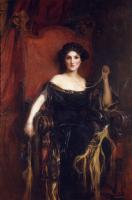

On 3rd November 1916 Auberon Herbert 9th Baron Lucas (age 40) was killed in action. He was unmarried. His sister Nan (age 36) succeeded 10th Baroness Lucas of Crudwell.

On 3rd November 1923 Gustaf Adolph VI King Sweden (age 40) and Louise Mountbatten Queen Consort Sweden (age 34) were married. She the daughter of Prince Louis of Battenburg 1st Marquess Milford Haven and Victoria Hesse Darmstadt Marchioness Milford Haven (age 60). He the son of Gustav V King Sweden (age 65). They were fifth cousin once removed. He a great x 5 grandson of King George II of Great Britain and Ireland. She a great granddaughter of Queen Victoria of the United Kingdom.
On 3rd November 1946 Victoria Marjorie Harriet Manners Marchioness Anglesey (age 62) died. She was buried at St Edwen's Church, Llanedwen [Map].


On 3rd November 2004 Anthony Ashley-Cooper 10th Earl of Shaftesbury (age 66) arrived in Nice, France to meet with his estranged wife Jamila Ben M'Barek Countess of Shaftesbury (age 43).
On 3rd November 1364 John Fitzalan Baron Maltravers 2nd Baron Arundel was born to John Fitzalan 1st Baron Arundel Baron Maltravers (age 16) and Eleanor Maltravers 2nd Baroness Maltravers Baroness Arundel and Cobham (age 19). He a great x 3 grandson of King Henry III of England. He married before 1st August 1385 his half third cousin Elizabeth Despencer Baroness Zouche, Harringworth, Maltravers and Arundel, daughter of Edward Despencer 1st Baron Despencer, Baron Burghesh and Elizabeth Burghesh 3rd Baron Burghesh, and had issue.
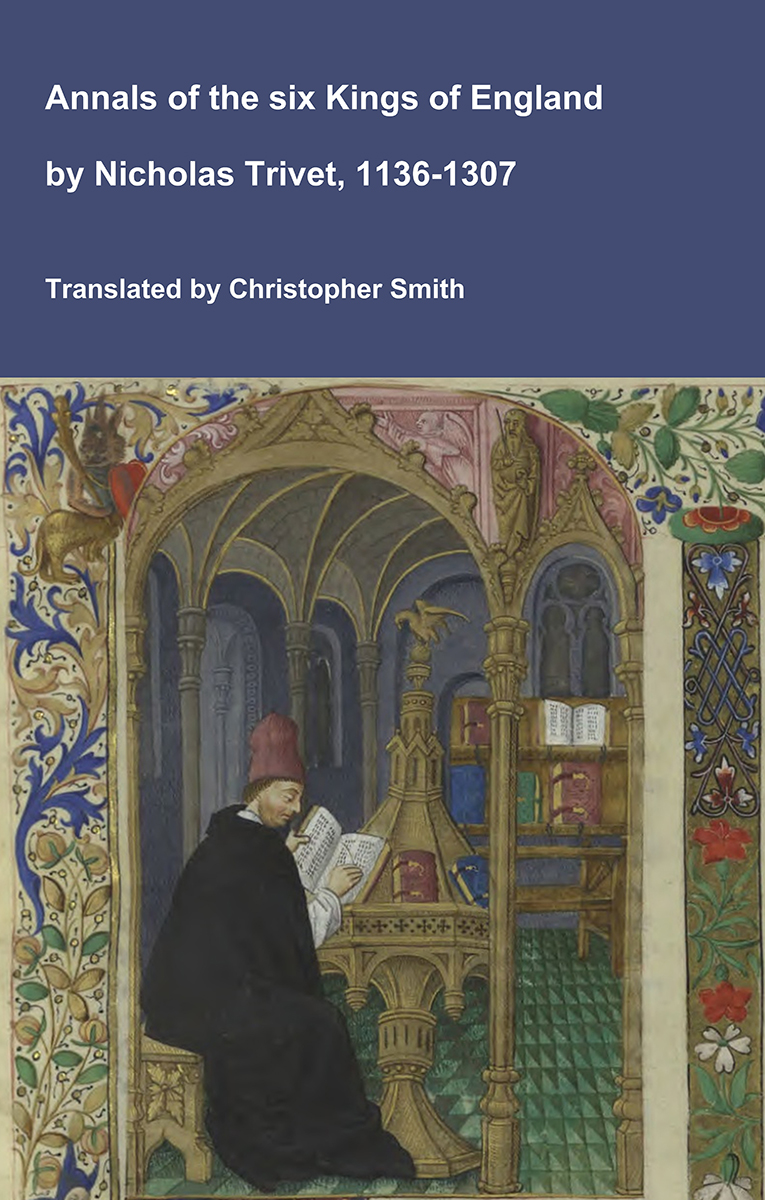
Annals of the six Kings of England by Nicholas Trivet
Translation of the Annals of the Six Kings of England by that traces the rise and rule of the Angevin aka Plantagenet dynasty from the mid-12th to early 14th century. Written by the Dominican scholar Nicholas Trivet, the work offers a vivid account of English history from the reign of King Stephen through to the death of King Edward I, blending political narrative with moral reflection. Covering the reigns of six monarchs—from Stephen to Edward I—the chronicle explores royal authority, rebellion, war, and the shifting balance between crown, church, and nobility. Trivet provides detailed insight into defining moments such as baronial conflicts, Anglo-French rivalry, and the consolidation of royal power under Edward I, whose reign he describes with particular immediacy. The Annals combines careful year-by-year reporting with thoughtful interpretation, presenting history not merely as a sequence of events but as a moral and political lesson. Ideal for readers interested in medieval history, kingship, and the origins of the English state, this chronicle remains a valuable and accessible window into the turbulent world of the Plantagenet kings.
Available at Amazon in eBook and Paperback format.
On 3rd November 1557 Charles Bourbon Condé was born to Louis Bourbon Prince Condé (age 27) and Eléanor de Roucy de Roye Princess Condé (age 22).
On 3rd November 1566 Charles Bourbon Condé Count Soissons was born to Louis Bourbon Prince Condé (age 36) and Francoise Valois Princess Condé (age 17). He married 1601 Anne Montafié Countess Soissons and had issue.
On 3rd November 1598 John Curzon 1st Baronet was born to John Curzon (age 47) and Millicent Sacheverell at Kedleston, Derbyshire [Map]. He married before 1640 Patience Crewe Baroness Curzon and had issue.
On 3rd November 1601 Gaston Henri Duke Verneuille was born illegitimately to Henry IV King France (age 47) and Catherine Henriette de Balzac d'Entragues (age 22).
On 3rd November 1663 Dorothy Davey Baroness Altham was born to John Davey. She married before 1689 Richard Annesley 3rd Baron Altham, son of Arthur Annesley 1st Earl Annesley and Elizabeth Altham Countess Anglesey, and had issue.
On 3rd November 1725 Mary Howe Lady Smith was born to William Howe (age 26) and Elizabeth Pauncefoot (age 20). She a great x 3 granddaughter of King James I of England and Ireland and VI of Scotland. She married 18th August 1747 George Smith 1st Baronet and had issue.
On 3rd November 1775 General Edward Paget was born to Henry Bayly-Paget 1st Earl Uxbridge (age 31) and Jane Champagné Countess Uxbridge (age 33). He married (1) 22nd May 1805 Frances Bagot, daughter of William Bagot 1st Baron Bagot and Elizabeth St John Baroness Bagot, and had issue (2) 22nd February 1815 Harriet Legge, daughter of George Legge 3rd Earl Dartmouth and Frances Finch Countess Dartmouth, and had issue.


On 3rd November 1777 Princess Sophia Hanover was born to King George III of Great Britain and Ireland (age 39) and Charlotte Mecklenburg Strelitz Queen Consort England (age 33).


On 3rd November 1779 Hugh Gough 1st Viscount Gough was born to Lieutenant Colonel George Gough (age 29) and Letitia Bunbury of Lisnavagh (age 25). He married June 1807 Frances Maria Stephens and had issue.
On 3rd November 1785 James Everard Arundell 10th Baron Arundel was born to James Everard Arundell 9th Baron Arundel (age 22) and Mary Christina Arundell Baroness Arundel Wardour at Clifford Street. Coefficient of inbreeding 3.13%. He married 1811 Mary Anne Nugent Temple Granville Baroness Arundel Wardour, daughter of George Nugent Temple Grenville 1st Marquess Buckingham and Mary Elizabeth Nugent Marchioness Buckingham.
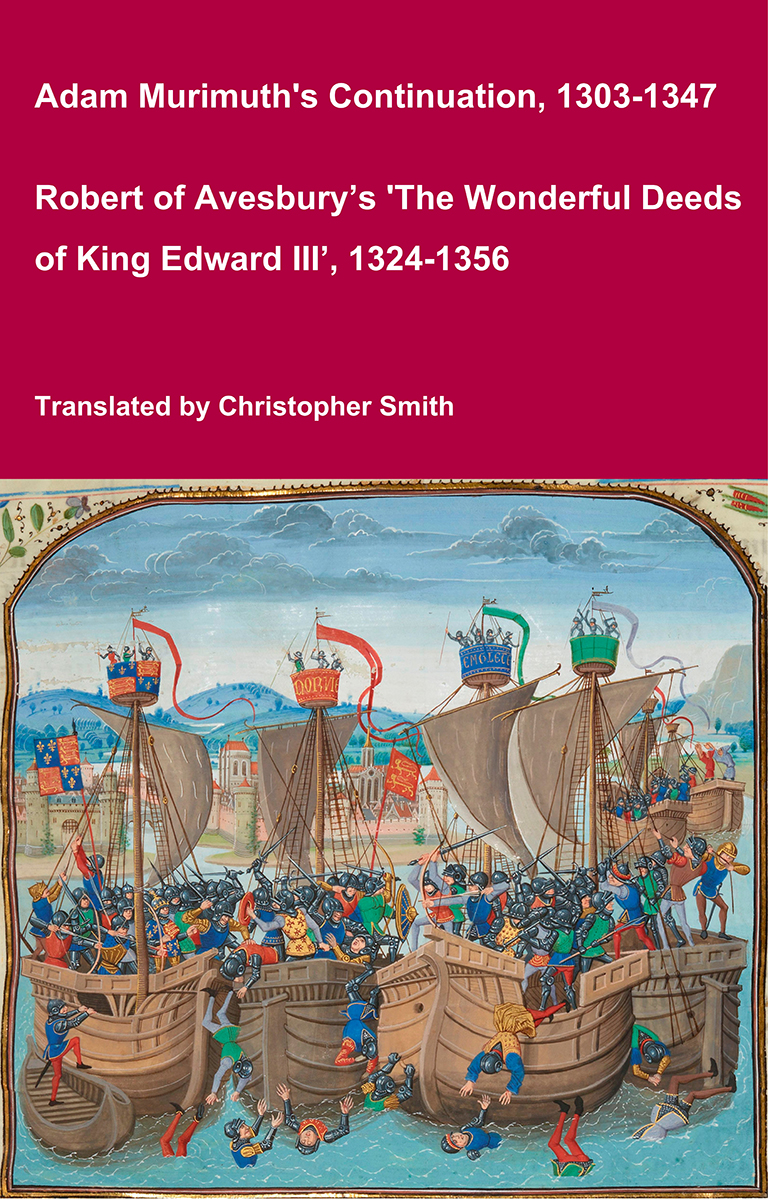
Adam Murimuth's Continuation and Robert of Avesbury’s 'The Wonderful Deeds of King Edward III'
This volume brings together two of the most important contemporary chronicles for the reign of Edward III and the opening phases of the Hundred Years’ War. Written in Latin by English clerical observers, these texts provide a vivid and authoritative window into the political, diplomatic, and military history of fourteenth-century England and its continental ambitions. Adam Murimuth Continuatio's Chronicarum continues an earlier chronicle into the mid-fourteenth century, offering concise but valuable notices on royal policy, foreign relations, and ecclesiastical affairs. Its annalistic structure makes it especially useful for establishing chronology and tracing the development of events year by year. Complementing it, Robert of Avesbury’s De gestis mirabilibus regis Edwardi tertii is a rich documentary chronicle preserving letters, treaties, and official records alongside narrative passages. It is an indispensable source for understanding Edward III’s claim to the French crown, the conduct of war, and the mechanisms of medieval diplomacy. Together, these works offer scholars, students, and enthusiasts a reliable and unembellished account of a transformative period in English and European history. Essential for anyone interested in medieval chronicles, the Hundred Years’ War, or the reign of Edward III.
Available at Amazon in eBook and Paperback format.
On 3rd November 1789 Bellingham Reginald Graham 7th Baronet was born to Bellingham Graham 6th Baronet (age 25). He married (1) 10th November 1810 Harriet Clark Lady Graham and had issue (2) July 1831 Harriet Cottam Lady Graham and had issue.
On 3rd November 1817 Ernest Hébert was born.

On 3rd November 1834 Evelyn Stanhope Countess Carnarvon was born to George Stanhope 6th Earl Chesterfield (age 29) and Anne Weld-Forester Countess Chesterfield (age 32) at Chesterfield House. She married 1861 her half fourth cousin once removed Henry Howard Molyneux Herbert 4th Earl Carnarvon, son of Henry John George Herbert 3rd Earl Carnarvon and Henrietta Anna Howard-Molyneux-Howard Countess Carnarvon, and had issue.
On 3rd November 1835 Morison Barlow 3rd Baronet was born to Robert Barlow 2nd Baronet (age 38).
On 3rd November 1835 Henry John Montagu-Douglas-Scott 1st Baron Montagu Beaulieu was born to Walter Scott 5th Duke Buccleuch 7th Duke Queensberry and Charlotte Anne Thynne Duchess Buccleuch Duchess Queensbury (age 24). He married 4th August 1865 his fifth cousin Cecily Susan Stuart-Wortley-Mackenzie Baroness Montagu, daughter of John Stuart-Wortley-Mackenzie 2nd Baron Wharncliffe and Georgiana Elizabeth Ryder Baroness Wharncliffe, and had issue.
On 3rd November 1846 Elizabeth Thompson Lady Butler was born to Thomas James Thompson (age 34) and Christiana Weller (age 21) at the Villa Claremont, Lausanne. She married 11th June 1877 Lieutenant-General William Francis Butler.
On 3rd November 1852 Henry Finch-Hatton 8th Earl Nottingham 13th Earl Winchilsea was born to George Finch-Hatton 5th Earl Nottingham 10th Earl Winchilsea (age 61) and Fanny Margaretta Rice Countess Nottingham Winchilsea.
On 3rd November 1856 Horace George Proctor-Beauchamp 6th Baronet was born to Thomas William Brograve Proctor-Beauchamp 4th Baronet (age 41) and Catherine Esther Waldegrave Lady Beauchamp-Proctor (age 30).
On 3rd November 1857 Brigadier-General Charles Lambton was born to George Frederick D'Arcy Lambton 2nd Earl Durham (age 29) and Beatrix Frances Hamilton Countess Durham (age 22). He married before 22nd August 1921 Lavinia Marion Garforth and had issue.
On 3rd November 1863 Charles Guy Coventry Pocock 4th Baronet was born to Alfred George Drake Pocock (age 25).
On 3rd November 1890 Lionel Petre 16th Baron Petre was born to Philip Petre 15th Baron Petre (age 26).
The Deeds of the Dukes of Normandy
The Gesta Normannorum Ducum [The Deeds of the Dukes of Normandy] is a landmark medieval chronicle tracing the rise and fall of the Norman dynasty from its early roots through the pivotal events surrounding the Norman Conquest of England. Originally penned in Latin by the monk William of Jumièges shortly before 1060 and later expanded at the behest of William the Conqueror, the work chronicles the deeds, politics, battles, and leadership of the Norman dukes, especially William’s own claim to the English throne. The narrative combines earlier historical sources with firsthand information and oral testimony to present an authoritative account of Normandy’s transformation from a Viking settlement into one of medieval Europe’s most powerful realms. William’s history emphasizes the legitimacy, military prowess, and governance of the Norman line, framing their expansion, including the conquest of England, as both divinely sanctioned and noble in purpose. Later chroniclers such as Orderic Vitalis and Robert of Torigni continued the history, extending the coverage into the 12th century, providing broader context on ducal rule and its impact. Today this classic work remains a foundational source for understanding Norman identity, medieval statesmanship, and the historical forces that reshaped England and Western Europe between 800AD and 1100AD.
Available at Amazon in eBook and Paperback format.
On 3rd November 1892 Major Terence Eden 8th Baron Auckland was born to George Eden (age 31) and Amy Violet Hay-Drummond (age 24). He married 12th September 1925 his first cousin Evelyn Vane Drummond of Cromlix Baroness Auckland and had issue.
On 3rd November 1899 Richard Byron 12th Baron Byron was born to Major Richard Byron (age 29).
On 3rd November 1910 Anthony Brabazon 14th Earl of Meath was born to Reginald Brabazon 13th Earl of Meath (age 40) and Aileen Wyndham-Quin (age 37).
On 3rd November 1922 James Lowther 7th Earl Londsdale was born to Anthony Lowther (age 26). He married (1) 18th June 1945 Tuppina Cecily Bennet and had issue (2) 9th September 1954 his third cousin Jennifer Lowther Countess Lonsdale and had issue (3) 6th March 1963 Nancy Ruth Cobbs Countess Lowther (4) 4th December 1975 Caroline Sheila Ley Countess Lowther.
On 3rd November 1929 Ralph John Assheton 2nd Baron Clitheroe was born to Ralph Assheton 1st Baron Clitheroe (age 28) and Sylvia Benita Frances Hotham Baroness Clitheroe.
On 3rd November 1941 Elizabeth Mairi Keppel Baroness Sudeley was born to Derek Keppel (age 29) and Mary Elizabeth "Mairi" Bury Vane-Tempest-Stewart (age 20). She married (1) 18th January 1980 Merlin Hanbury-Tracy 7th Baron Sudeley.
On 3rd November 1960 Patrick Kendal Farley Coghill 9th Baronet was born to Egerton "Toby" Coghill 8th Baronet (age 30).
On 3rd November 1295 Robert Clifford 1st Baron Clifford (age 21) and Maud Clare Baroness Clifford Baroness Welles (age 19) were married at Clifford Castle, Herefordshire [Map]. They were third cousin once removed. She a great x 3 granddaughter of King Henry "Curtmantle" II of England.
On 3rd November 1473 Peter Bourbon II Duke Bourbon (age 34) and Anne Valois Duchess Bourbon (age 12) were married. She by marriage Duchess Bourbon. The difference in their ages was 22 years. She the daughter of King Louis XI of France (age 50) and Queen Charlotte of Savoy (age 31). He the son of Charles Bourbon I Duke Bourbon and Agnes Valois Duchess Bourbon (age 66). They were second cousin once removed. He a great x 5 grandson of King Edward I of England.
On 3rd November 1701 Philippe V King Spain (age 17) and Maria Luisa Savoy (age 13) were married. She the daughter of Victor Amadeus King Sardinia (age 35) and Anne Marie Bourbon Queen Consort Sardinia (age 32). He the son of Louis "Le Grand Dauphin" Bourbon Duke Burgundy (age 40) and Maria Anna Victoria Wittelsbach Duchess Burgundy. They were second cousins. She a great granddaughter of King Charles I of England, Scotland and Ireland.
On 3rd November 1789 Richard Croft 6th Baronet (age 27) and Margaret Denman were married.
Chronicle of a Bourgeois of Valenciennes
Récits d’un bourgeois de Valenciennes aka The Chronicle of a Bourgeois of Valenciennes is a vivid 14th-century vernacular chronicle written by an anonymous urban chronicler from Valenciennes in the County of Hainaut. It survives in a manuscript that describes local and regional history from about 1253 to 1366, blending chronology, narrative episodes, and eyewitness-style accounts of political, military, and social events in medieval France, Flanders, and the Low Countries. The work begins with a chronological framework of events affecting Valenciennes and its region under rulers such as King Philip VI of France and the shifting allegiances of local nobility. It includes accounts of conflicts, sieges, diplomatic manoeuvres, and the impact of broader struggles like the Hundred Years’ War on urban life in Hainaut. Written from the perspective of a burgher (bourgeois) rather than a monastery or royal court, the chronicle offers a rare lay viewpoint on high politics and warfare, reflecting how merchants, townspeople, and civic institutions experienced the turbulence of the 13th and 14th centuries. Its narrative style combines straightforward reporting of events with moral and civic observations, making it a valuable source for readers interested in medieval urban society, regional politics, and the lived experience of war and governance in pre-modern Europe.
Available at Amazon in eBook and Paperback format.
On 3rd November 1799 Richard White 1st Earl Bantry (age 32) and Margaret Anne Hare Countess Bantry were married. She the daughter of William Hare 1st Earl Listowel (age 48).
On 3rd November 1853 Henry Thomas Tyrwhitt-Jones 3rd Baronet (age 29) and Emma Harriet Wilson 12th Baroness Berners (age 17) were married at St Michael's Church Pimlico.
On 3rd November 1870 Harold Arthur Lee Dillon 17th Viscount Dillon (age 26) and Julia Stanton Viscountess Dillon were married.
On 3rd November 1888 Major-General Peter Ewart 1st Baronet (age 50) and Evelyn Clementina Heathcote-Willoughby-Drummond Lady Ewart (age 24) were married at Lowndes Square, Belgravia. The difference in their ages was 26 years. She the daughter of Gilbert Henry Heathcote Drummond Willoughby 1st Earl Ancaster (age 58) and Evelyn Elizabeth Gordon Countess Ancaster (age 42).
On 3rd November 1894 John Savile Lumley-Savile 2nd Baron Savile (age 41) and Gertrude Violet Webster-Wedderburn were married.
On 3rd November 1923 Gustaf Adolph VI King Sweden (age 40) and Louise Mountbatten Queen Consort Sweden (age 34) were married. She the daughter of Prince Louis of Battenburg 1st Marquess Milford Haven and Victoria Hesse Darmstadt Marchioness Milford Haven (age 60). He the son of Gustav V King Sweden (age 65). They were fifth cousin once removed. He a great x 5 grandson of King George II of Great Britain and Ireland. She a great granddaughter of Queen Victoria of the United Kingdom.
On 3rd November 1219 Saer Quincy 1st Earl Winchester (age 49) died at Damietta. His son Roger (age 24) succeeded 2nd Earl Winchester.
On 3rd November 1220 Urraca Ivrea Queen Consort Portugal (age 33) died.
On 3rd November 1345 Peter Capet I Count Dreux (age 47) died. His half sister Joan (age 36) succeeded I Countess Dreux.
On 3rd November 1373 Joan Valois Queen Consort Navarre (age 30) died at Évreux.
On 3rd November 1415 Margaret Despencer Baroness Ferrers of Chartley died.
The Deeds of the Dukes of Normandy
The Gesta Normannorum Ducum [The Deeds of the Dukes of Normandy] is a landmark medieval chronicle tracing the rise and fall of the Norman dynasty from its early roots through the pivotal events surrounding the Norman Conquest of England. Originally penned in Latin by the monk William of Jumièges shortly before 1060 and later expanded at the behest of William the Conqueror, the work chronicles the deeds, politics, battles, and leadership of the Norman dukes, especially William’s own claim to the English throne. The narrative combines earlier historical sources with firsthand information and oral testimony to present an authoritative account of Normandy’s transformation from a Viking settlement into one of medieval Europe’s most powerful realms. William’s history emphasizes the legitimacy, military prowess, and governance of the Norman line, framing their expansion, including the conquest of England, as both divinely sanctioned and noble in purpose. Later chroniclers such as Orderic Vitalis and Robert of Torigni continued the history, extending the coverage into the 12th century, providing broader context on ducal rule and its impact. Today this classic work remains a foundational source for understanding Norman identity, medieval statesmanship, and the historical forces that reshaped England and Western Europe between 800AD and 1100AD.
Available at Amazon in eBook and Paperback format.
On 3rd November 1415 William Zouche 4th Baron Zouche Harringworth (age 42) died. His son William (age 13) succeeded 5th Baron Zouche Harringworth.
On 3rd November 1428 Thomas Montagu 1st Count Perche 4th Earl Salisbury (age 40) died from wounds received at the Siege of Orléans. His daughter Alice (age 21) succeeded 5th Countess Salisbury, 4th Baroness Montagu, 7th Baroness Montagu, 6th Baroness Monthermer. Richard Neville Earl Salisbury (age 28) by marriage Earl Salisbury.
On 3rd November 1448 Margaret Squery Baroness Poynings died.
On 3rd November 1456 Edmund Tudor 1st Earl Richmond (age 26) died of plague at Carmarthen Castle [Map] leaving his thirteen year old wife Margaret Beaufort Countess Richmond (age 13) pregnant with their child Henry Tudor, the future King Henry VII. His son Henry Tudor succeeded 2nd Earl Richmond posthumously.
On 3rd November 1484 Ralph Neville 2nd Earl of Westmoreland (age 78) died. He was buried at St Brandon's Church, Brancepeth. His nephew Ralph (age 28) succeeded 3rd Earl of Westmoreland.
On 3rd November 1655 Elizabeth Willoughby Lady D'Ewes and Glentworth (age 30) died.
On 3rd November 1687 Thomas Hickman Windsor 1st Earl Plymouth (age 60) died. His grandson Other (age 8) succeeded 2nd Earl Plymouth, 8th Baron Windsor of Stanwell in Buckinghamshire.
On 3rd November 1718 Erasmus Dryden 6th Baronet (age 72) died. His grandson John succeeded 7th Baronet Dryden of Canons Ashby in Northamptonshire.
On 3rd November 1720 Herbert Croft 1st Baronet (age 69) died.
On 3rd November 1729 Elizabeth Strangeways Duchess Hamilton Duchess Brandon (age 39) died.
On 3rd November 1734 Frances Pierrepont Baroness Geneville Beaudasert died.
Abbot John Whethamstede’s Chronicle of the Abbey of St Albans
Abbot John Whethamstede's Register aka Chronicle of his second term at the Abbey of St Albans, 1451-1461, is a remarkable text that describes his first-hand experience of the beginning of the Wars of the Roses including the First and Second Battles of St Albans, 1455 and 1461, respectively, their cause, and their consequences, not least on the Abbey itself. His text also includes Loveday, Blore Heath, Northampton, the Act of Accord, Wakefield, and Towton, and ends with the Coronation of King Edward IV. In addition to the events of the Wars of the Roses, Abbot John, or his scribes who wrote the Chronicle, include details in the life of the Abbey such as charters, letters, land exchanges, visits by legates, and disputes, which provide a rich insight into the day-to-day life of the Abbey, and the challenges faced by its Abbot.
Available at Amazon in eBook and Paperback format.
On 3rd November 1734 Mary Catesby Countess Uxbridge died.
On 3rd November 1754 Brownlow Cecil 8th Earl Exeter (age 53) died. His son Brownlow (age 29) succeeded 9th Earl Exeter, 10th Baron Burghley. Laetitia Townshend Countess Exeter (age 28) by marriage Countess Exeter.
On 3rd November 1769 Bishop Robert Lamb (age 66) died unmarried. His younger brother Matthew Lamb 1st Baronet inherited his estate.
On 3rd November 1770 James Ogilvy 6th Earl Findlater 3rd Earl Seafield (age 56) died. His son James (age 20) succeeded 7th Earl Findlater, 4th Earl Seafield.
On 3rd November 1776 Robert Lee 4th Earl Lichfield (age 70) died without issue. Earl Lichfield and Baronet Lee of Quarrendon in Buckinghamshire extinct.
On 3rd November 1795 Bishop John Hotham 9th Baronet (age 59) died at Bath, Somerset [Map]. He was buried at St Mary's Church, South Dalton. His son Charles (age 29) succeeded 10th Baronet Hotham of Scorborough in Yorkshire.
On 3rd November 1802 Walter Vavasour 6th Baronet (age 58) died. His brother Thomas (age 57) de jure 25th Baron Vavasour, 7th Baronet Vavasour of Hazlewood in Yorkshire.
On 3rd November 1807 Archbishop William Markham (age 88) died.
On 3rd November 1808 Isabella Carr Countess Erroll died.
On 3rd November 1823 Anthony Farrington 1st Baronet (age 81) died. His grandson Charles (age 29) succeeded 2nd Baronet Farrington of Blackheath in Kent.
Adam Murimuth's Continuation and Robert of Avesbury’s 'The Wonderful Deeds of King Edward III'
This volume brings together two of the most important contemporary chronicles for the reign of Edward III and the opening phases of the Hundred Years’ War. Written in Latin by English clerical observers, these texts provide a vivid and authoritative window into the political, diplomatic, and military history of fourteenth-century England and its continental ambitions. Adam Murimuth Continuatio's Chronicarum continues an earlier chronicle into the mid-fourteenth century, offering concise but valuable notices on royal policy, foreign relations, and ecclesiastical affairs. Its annalistic structure makes it especially useful for establishing chronology and tracing the development of events year by year. Complementing it, Robert of Avesbury’s De gestis mirabilibus regis Edwardi tertii is a rich documentary chronicle preserving letters, treaties, and official records alongside narrative passages. It is an indispensable source for understanding Edward III’s claim to the French crown, the conduct of war, and the mechanisms of medieval diplomacy. Together, these works offer scholars, students, and enthusiasts a reliable and unembellished account of a transformative period in English and European history. Essential for anyone interested in medieval chronicles, the Hundred Years’ War, or the reign of Edward III.
Available at Amazon in eBook and Paperback format.
On 3rd November 1832 Thomas Noel-Hill 2nd Baron Berwick (age 62) died in Naples [Map] without issue. His brother William (age 59) succeeded 3rd Baron Berwick of Attingham in Shropshire.


On 3rd November 1849 Samuel John Brooke-Pechell 3rd Baronet (age 64) died without issue at Hill Street, Berkeley Square. His brother George (age 60) succeeded 4th Baronet Brooke-Pechell of Pagelsham in Essex.
On 3rd November 1851 Henry Delves Broughton 8th Baronet (age 74) died. His son Henry (age 43) succeeded 9th Baronet Broughton of Broughton in Staffordshire.
On 3rd November 1852 William Welby 2nd Baronet (age 83) died. His son Glynne (age 46) succeeded 3rd Baronet Welby of Denton Manor in Lincolnshire.

On 3rd November 1854 Charlotte Maria Barrington Countess of Strathmore (age 28) died.
On 3rd November 1888 Benjamin James Chapman 4th Baronet (age 78) died. His son Montagu (age 35) succeeded 5th Baronet Chapman of Killua Castle.
On 3rd November 1899 Julia Sarah Hayfield Fortescue Baroness Gardner (age 82) died.
On 3rd November 1899 Frederick Ellis 7th Baron Howard de Walden 3rd Baron Seaford (age 69) died. His son Thomas (age 19) succeeded 8th Baron Howard de Walden, 4th Baron Seaford of Seaford in Sussex. His inheritance included a large part of Marylebone, London and earned him the title of 'Britain's wealthiest bachelor'. His fortune derived from his grandmother's estates which she had inherited as daughter of the Duke of Portland.
On 3rd November 1916 Auberon Herbert 9th Baron Lucas (age 40) was killed in action. He was unmarried. His sister Nan (age 36) succeeded 10th Baroness Lucas of Crudwell.
On 3rd November 1932 Anthony Cope 13th Baronet (age 90) died. His son Denzil (age 59) succeeded 14th Baronet Cope of Hanwell in Oxfordshire.
On 3rd November 1932 Brien Ibrican Cokayne 1st Baron Cullen (age 68) died. His son Charles (age 20) succeeded 2nd Baron Cullen of Ashbourne in Derbyshire.
On 3rd November 1946 Victoria Marjorie Harriet Manners Marchioness Anglesey (age 62) died. She was buried at St Edwen's Church, Llanedwen [Map].
The History of William Marshal was commissioned by his son shortly after William’s death in 1219 to celebrate the Marshal’s remarkable life; it is an authentic, contemporary voice. The manuscript was discovered in 1861 by French historian Paul Meyer. Meyer published the manuscript in its original Anglo-French in 1891 in two books. This book is a line by line translation of the first of Meyer’s books; lines 1-10152. Book 1 of the History begins in 1139 and ends in 1194. It describes the events of the Anarchy, the role of William’s father John, John’s marriages, William’s childhood, his role as a hostage at the siege of Newbury, his injury and imprisonment in Poitou where he met Eleanor of Aquitaine and his life as a knight errant. It continues with the accusation against him of an improper relationship with Margaret, wife of Henry the Young King, his exile, and return, the death of Henry the Young King, the rebellion of Richard, the future King Richard I, war with France, the death of King Henry II, and the capture of King Richard, and the rebellion of John, the future King John. It ends with the release of King Richard and the death of John Marshal.
Available at Amazon in eBook and Paperback format.
On 3rd November 1958 Nan Ino Cooper 10th Baroness Lucas (age 78) died. Her daughter Anne (age 39) succeeded 11th Baroness Lucas of Crudwell. Major Robert Jocelyn Palmer Baron Lucas (age 39) by marriage Baron Lucas of Crudwell.
On 3rd November 1988 John Every 12th Baronet (age 74) died. His son Henry (age 41) succeeded 13th Baronet Every of Egginton in Derbyshire.
On 3rd November 2000 Michael Wellington Stapleton-Cotton 5th Viscount Combermere (age 71) died. His son Thomas (age 31) succeeded 6th Viscount Combermere, 6th Baron Combermere, 11th Baronet Cotton of Combermere in Cheshire.