

Henrici Quinti, Angliæ Regis, Gesta, is a first-hand account of the Agincourt Campaign, and subsequent events to his death in 1422. The author of the first part was a Chaplain in King Henry's retinue who was present from King Henry's departure at Southampton in 1415, at the siege of Harfleur, the battle of Agincourt, and the celebrations on King Henry's return to London. The second part, by another writer, relates the events that took place including the negotiations at Troye, Henry's marriage and his death in 1422.
Available at Amazon in eBook and Paperback format.
03 Oct is in October.
History of the Dukes of Normandy by William of Jumieges. At that time Pope Leo1 went into Gaul, consecrated the church of Saint Remigius, archbishop of Reims, and transferred his body into the newly dedicated church. Then the same pope held a great council at Reims and sharply reproved the idle bishops and abbots; among whom, as they say, he said to Ivo on account of the burning of the church: "What have you done, traitor? By what law ought you to be condemned, you who have dared to burn your own mother?" The eloquent Ivo openly confessed that he had indeed done wrong, but that he had been gravely compelled to commit the deed, lest worse things be done by the wicked against the children of the Church. Then he received penance according to the command of the wise pope, and took pains to restore the church of Saint Gervase. Therefore he went to Apulia and from there to Constantinople, and collected a great sum of money from wealthy relatives and friends, and brought back as a gift from the emperor a precious relic of the wood of the Lord's Cross. Having returned to Sées, he began to build a church so great that his successors Robert, Gerard, and Serlo were not able to complete it within forty years.
In illo tempore sanctus Leo papa Gallias expetiit, ecclesiam Sancti Remigii Remensis archiepiscopi consecravit, ejusque corpus in ecclesiam nuper dedicatam transtulit. Tunc Remis idem papa grande concilium tenuit et desides episcopos vel abbates acriter redarguit; inter quos, ut dicunt, propter combustionem ecclesiæ Ivoni dixit: "Quid fecisti, perfide? qua lege damnari debes, qui matrem tuam cremare ausus es?" Eloquens Ivo palam confessus est se quidem malum fecisse, sed ad hoc scelus agendum se graviter coactum fuisse, ne deteriora fierent a scelerosis super filios Ecclesiæ. Deinde pœnitentiam secundum sagacis papæ jussum accepit, ac de restituenda Sancti Gervasii ecclesia operam adhibuit. Igitur Apuliam et inde Constantinopolim perrexit et a divitibus cognatis et amicis suis simul multum pecuniæ congessit, donoque imperatoris, de ligno Dominicæ Crucis carum munus deportavit. Reversus autem Sagium, ecclesiam cœpit tam magnam ædificare, ut successores ejus Robertus, Girardus ac Serlo, nequiverint eam per 40 annos consummare.
Note 1. Pope Leo X, 1002-1054. Succeeded Damasus II as Pope in 1054. The Translation of Saint Remegius at Reims Cathedral took place on the 3rd October 1050. Pope Leo's tenure as Pope contributed to the Great Schism of 1054 i.e. the break of the Catholic Church and the Eastern Orthodox Church, which occurred shortly after his death.
Chronicon ex Chronicis by Florence and John of Worcester. Soon after the feast of St. Michael, the archangel, on Monday, the fifth of the nones [3rd] of October [1065], the Northumbrian thanes, Gamelbearn, Dunstan, son of Athelneth, and Glonicorn, son of Heardulf, entered York with two hundred soldiers, to revenge the execrable murder of the noble Northumbrian thane, Cospatric, who was treacherously killed by order of queen Edgitha (age 39) at the king's court on the fourth night of Christmas, for the sake of her brother Tosti (age 39); as also the murder of the thanes Gamel, the son of Orm, and Ulf, the son of Dolfin, whom earl Tosti had perfidiously caused to be assassinated in his own chamber at York, the year before, although there was peace between them. The insurgent thanes were also aggrieved by the enormous taxes which Tosti unjustly levied through the whole of Northumbria. They therefore, on the day of their arrival, first seized his Danish house-carles, Amund and Ravenswart, as they were making their escape, and put them to death outside the walls, and the next day slew more than two hundred of his liege-men, on the north side of the river Humber. They also broke open his treasury, and retired carrying off all that belonged to him. After that, nearly all the men of his earldom assembled in a body, and met, at Northampton, Harold (age 43), earl of Wessex, and others whom the king, at Tosti's request, had sent to restore peace between them. There first, and afterwards at Oxford, on the feast of the apostles St. Simon and St. Jude [28th October], when earl Harold and the rest endeavoured to restore peace between them and earl Tosti, they all unanimously rejected the proposal, and outlawed him and all who had prompted him to enact the oppressive law; and after the feast of All-Saints [1st November], with the assistance of earl Edwin, they banished Tosti from England. Thereupon he went, accompanied by his wife (age 32), to Baldwin (age 53), earl of Flanders, and passed the winter at St. Omer. After this, king Edward (age 62) fell into a lingering sickness, but he held his court at London during Christmas as well as he was able, and on Holy Innocents' day caused the church, which he had built from the foundations [at Westminster], to be dedicated with great splendour to St. Peter, the prince of the apostles.
Gesta Regis Henrici by Benedict of Peterborough. And so it happened that on the third day of October [1190] a discord arose between the army of the king of England and the citizens of Messina; and the anger on both sides grew to such an extent that the citizens shut the gates of the city, and armed themselves upon the walls; some took position in the strongest houses of the city, others in the fortifications above the gates. When the army of the king saw and heard this, they came with great force to the gates of the city. The king, however, riding on a very swift horse, galloped through the army, striking with a staff all of his men whom he could reach, wishing to restrain them from the assault, but he could not. At length he returned to his lodging; and when he had armed himself he went out again to extinguish the malice if he could. Afterwards he entered a small boat and went to the palace of King Tancred to speak with the king of France and to consult him concerning what had happened.
Unde contigit quod tertia die Octobris discordia emersit inter exercitum regis Angliæ et cives Messanæ; et in tantum excrevit ex utraque parte indignatio, quod cives clauserunt portas civitatis, et armati ascenderunt muros; et alii domos civitatis fortissimas, alii munitiones supra portas intraverunt. Cumque exercitus regis hæc audisset et vidisset, venerunt cum impetu magno ad portas civitatis. Rex vero in equo velocissimo cursitabat per exercitum, baculo verberans quoscunque ex suis attingebat; volens illos ab insultu cohibere, sed nequivit. Tandem rediit ad hospitium suum; et cum se armasset iterum exivit ad extinguendam malitiam si posset. Postea intravit cymbam unam, et ivit ad palatium regis Tancredi ad loquendum cum rege Franciæ, et consulere eum super iis quæ contigerant.
On 3rd October 1283 Dafydd ap Gruffudd Aberffraw Prince of Wales (age 45) was hanged, drawn and quartered at Shrewsbury, Shropshire [Map]. The first prominent person known to have suffered being hanged, drawn and quartered. Dafydd was dragged through the streets of Shrewsbury, Shropshire [Map] attached to a horse's tail, then hanged alive, revived, then disembowelled and his entrails burned before him for "his sacrilege in committing his crimes in the week of Christ's passion", and then his body cut into four-quarters "for plotting the king's death". Geoffrey of Shrewsbury was paid 20 shillings for carrying out the act.
Annals of Dunstable. And on the feast of Saint Alban [22nd June 1283] next following, the aforesaid David (age 44), hiding on a certain mountain with a few men, was captured through the treachery of one of his own, and bound in irons was kept in the safest custody until the following feast of Saint Michael [29th June 1283]. His wife [Elizabeth Ferrers (age 43)] also was likewise taken and kept safely. On the said feast of Saint Michael, the said David, by the judgment of all the baronage of England, received four sentences in this manner:
1. Because he had been a traitor to his lord the king, who had made him a knight, he was drawn by horses at a slow pace to the place of execution.
2. Because he had committed the homicide of Fulk Trigald and of other English nobles, he was hanged alive.
3. Because he did this in the time of the Lord's Passion, for that blasphemy his entrails were burned with fire.
4. Because in many places of England he had plotted the death of his lord the king, he was cut limb from limb [on 3rd October 1283], and his members sent through the regions of England for the terror of evil-doers.
But his head was fixed upon the Tower of London on a very high stake, facing the sea. And this likewise was done in the eleventh year of the aforesaid lord King Edward's reign.
Et die Sancti Albani proximo subsequenti, prædictus David in quodam monte latitans cum paucis, captus est per proditionem cujusdam ex suis, et ferro vinctus tutissime servabatur usque ad sequens festum Sancti Michaelis. Uxor etiam sua similiter capta est et salvo custodita. In predicto festo Sancti Michaelis, dictus David per totum barnagium Angliæ quatuor judicia suscepit in hune modum.
1. Quia proditor fuit domini regis, qui eum militem fecerat; tractus est equis lento passu ad locum suspendii.
2. Quia homicidium fecerat Fulconis Trigald, et aliorum nobilium Angliæ; suspensus est vivus.
3. Quia illud fecit tempore Dominicæ Passionis; propter blasphemiam viscera ejus incendio sunt cremata.
4. Quia in pluribus locis Angliæ mortem domini regis fuerat machinatus; membratim est partitus, et per climata Angliæ ad terrorem malignantium destinatus.
Caput autem ejus in Turri Londoniæ super palum altissimam est affixum, versus mare; et hoc similiter factum est anno undecimo prædicti domini regis Edwardi durante.
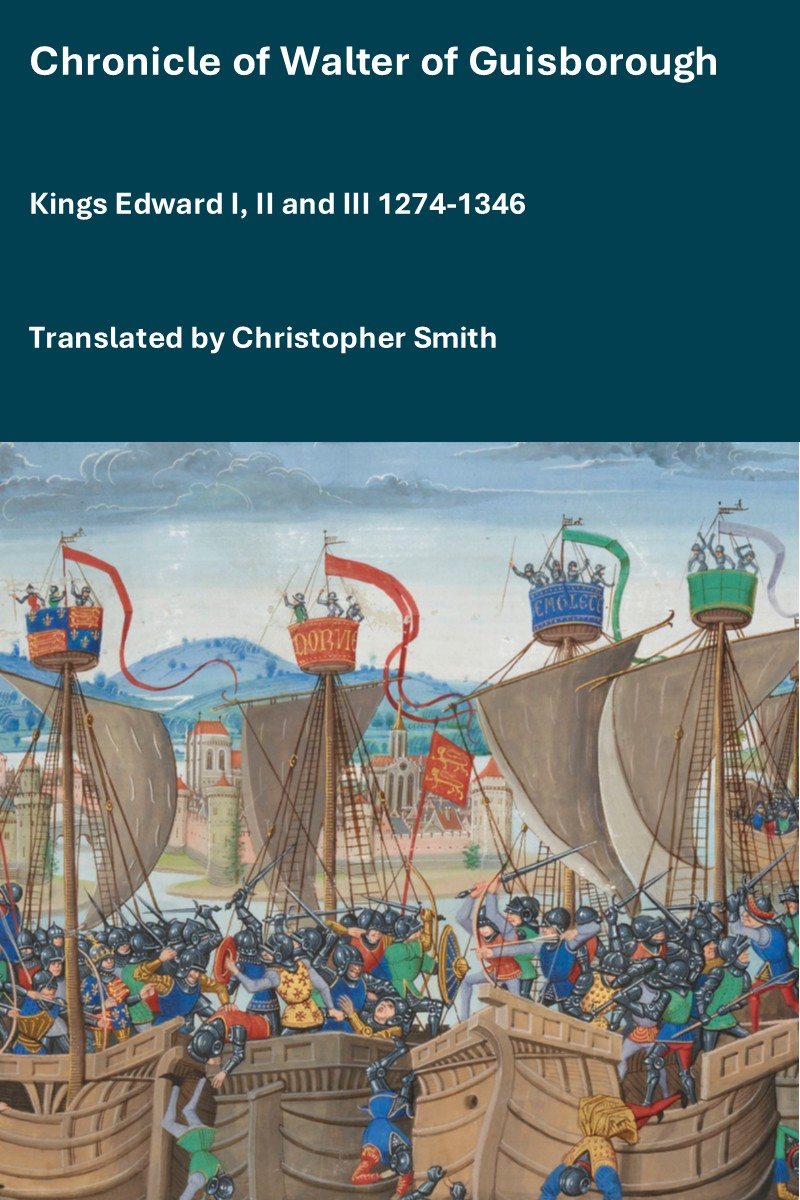 Chronicle of Walter of Guisborough. David (age 45), fleeing from the scene of his brother's death, hid in the woods and marshes for nearly a year. At last, he was captured on the eve of the feast of Saint Maurice [22nd September 1283] and brought to the king. In a parliament held at Shrewsbury after the feast of Saint Michael, he was judged as a deceiver, traitor, thief, and murderer. He was drawn, hanged, and then quartered1, and his four limbs were sent to four parts of England as a perpetual reminder of the event. His head was taken to London, and placed alongside the head of his brother Llywelyn, both erected high on the royal tower. In the same year, during the Welsh war, the king was granted a thirtieth tax from the common people and a twentieth from the clergy, by way of assistance.
David autem, a prædicta cæde as fugiens, in moris et mariscis latitabat fere per annum, tandem vero captus in vigilia Sancti Mauritii ad regem adductus est, et in parliamento de Solopesbire, quod tenuit rex post festum Sancti Michaelis, tanquam seductor et proditor furque et homicida judicatus, tractus est et suspensus, et postea membratim divisus, et quatuor ejus membra in quatuor partes Angliæ missa sunt in memoriam rei perpetue. Caput autem ejus Londoniis delatum est, et cum capite fratris sui Leulini in sublime erectum in turri regia. Eodem anno, durante guerra Walliæ, dabatur regi tricesima a communi populo et vicesima a clero, auxilii nomine.
Note 1. David was executed on 3rd October 1283.
French Chronicle of London. In this year was Davy1, the brother of Leulyn, drawn, hanged, and beheaded, and his head sent to the Tower of London. In the same year, for the death of Laurence Duket1, who was hanged in the church of Our Lady at Arches, seven persons were drawn and hanged, that is to say, Reginald de Lanfar, Robert Pinnot, Paul de Stybbenheth, Thomas Corouner, John de Tholosane, Thomas Russel, and Robert Scot; a woman also, called Alice Atte Bowe, was burnt for the same deed; and Ralph Crepyn, Jordan Godchep, Gilbert le Clerk, and Geoffrey le Clerk, were attainted of the felony, and remained prisoners in the Tower.
Note 1. David, Prince of Wales, was hanged, drawn and quartered on 3rd October 1283.
Note 2. The following were the main circumstances of this case. Laurence Duket, a citizen of London, wounded one Ralph Cropin, or Crepyn, in West Chepe, and fled to the church of Saint Mary le Bow. Being pursued thither by certain persons, he was slain at night in the steeple of the church, and the body was then hanged in one of the windows, in such a way as to deceive the Coroner's inquest, who returned a verdict of felo de se [i.e. suicide]; whereupon the body was dragged thence by the feet, and buried in a ditch without the City. It so happened however that a boy, who lay within the church the same night, witnessed the transaction, and gave information against the murderers; whereupon, numerous persons were apprehended and sixteen hanged. Alice atte Bowe, who was burnt alive, as the chief contriver of the murder, according to one account was the mistress of Crepyn, who, in the same account, is described as a clerk. Those who were imprisoned in the Tower, were only released on paying heavy penalties; and the church was placed under interdict, the doors and windows being filled with thorns until purification had been duly made. Duket's remains also were disinterred, and becomingly buried in the churchyard.
Chronicle of William Rishanger. 3rd October 1283. After the Feast of Saint Michael, the Parliament of Shrewsbury was held; in which David (age 45), having been judicially condemned by judges appointed for this purpose, was dragged and hanged, his entrails burned, his body beheaded, and divided into four parts. These parts were hung in the more prominent cities of England, and his head was placed on a pike in London, as a warning to similar traitors.
Post festum Sancti Michaelis, habitum est Parliamentum Salopiæ; in quo per deputatos ad hoc Justiciarios David judicialiter condemnatus, tractus et suspensus est, visceribusque combustis, corpus capite truncatum, et in quatuor partes est divisum. Quibus in civitatibus Angliæ nobilioribus suspensis, caput Londoniis super palum fixum est, ad terrorem consimilium proditorum.
Lanercost Chronicle. [3rd October 1283] The offspring of David was condemned to perpetual imprisonment; but David himself was first drawn as a traitor, then hanged as a thief, thirdly he was beheaded alive and his entrails burnt, as a burner and slayer; fourthly his body was cut into four parts, and in punishment of a spoiler those parts were hung up as a spectacle in four notable places of England: namely, the right arm with a ring on the finger at York, the left arm at Bristol, the right leg and thigh at Northampton, and the left at Hereford. But the head of the wicked man, lest it should decay by putrefaction, was bound about with iron, and set up high in London on a long spear for mockery. And just as holy Jeremiah composed metrical Lamentations for the desolation of Judah, so the Welsh people composed a heroic plaint for the death of their prince and the desolation of their nation, in which at the end they always join the memory of David with a curse, as the author of this misery. Whence H. says in verse:
David the Welshman — horse, fire, rope, and sword,
Unhappy one, these give you death and torment.
By a fourfold death you perish: thief, traitor, and murderer,
An enemy too of the Church, by law you must die.
Proles David carceri perpetuo adjudicata eft, ipfe vero David prius traétus ut proditor, poft fufpenfus ut latro, tertio vivus decapitatus eft et vifcera ejus combufta ut combuftor et occifor, quarto membra ejus in quatuor partes defeéta in poenam depellatoris per quatuor folemnia Angliz loca fpeétaculo funt fufpenfa; videlicet, brachium dextrum cum annulo in digito apud Eboracum, brachium finiftrum apud Birftow, tibia et coxa dextra apud Northamptoun, finiftra apud Herforde. Caput vero iniqui, ne putrefiendo deficeret, ferro eft circumligatum, et in longo haftili eminenter Londoniz ludibrio pofitum. Quemadmodum fanétus Jeremias Threnos metricos inftituit pro deftitutatione Judee, fic gens Wallica planétum heroicum compofuit pro fui principis morte, in defolatione fuze nationis, in cujus fine femper memoriam David adjiciunt cum malediétione, tanquam auctor fuit hujus miferie; unde H. dicit verfus;
David Walenfis, equus, ignis, funis, et enfis,
Infelix, fatum tibi dant necis et cruciatum.
Es nece quadrifida, fur, proditor ac homicida,
Hoftis et ecclefize debes de jure perire.
Annals of Oseney by Thomas Wykes. [Tiberius A. 9, 3rd October 1283] Around the feast of Saint Michael [29 September], the king, having summoned the magnates of his realm and the leading men of the cities of England to Shrewsbury, held there his parliament, and caused David, who had been taken prisoner at Rhuddlan, to be brought thither. And there, by the judgment of the magnates assembled, his crimes of impiety having been weighed, he was judicially condemned to a death unheard of in former times. First, that he should be drawn by horses; second, that he should be hanged; third, that he should be beheaded; fourth, that his heart and entrails should be taken out and burned; fifth, that his body should be divided into four parts and separately hung up in the four quarters of England. But his head should be carried to London by the citizens who were present there, to be placed upon the Tower of London beside the head of Llewelyn his brother, as a notable spectacle.
Circa festum Sancti Michaelis rex, convocatis regni sui magnatibus et majoribus civium Angliæ apud Salopesbyriam, tenuit and ibi parliamentuni suum, et adduci fecit illuc David qui, apud Rothelan fuerat captivatus; ibique per considerationem magnatum ibidem congregatorum, pensatis impietatis suæ meritis, judicialiter adjudicatus est morti retroactis temporibus inauditæ. Primo equis distractus, secundo suspensus, tertio capite truncatus, quarto ut cor et viscera extracta comburerentur, quinto corpus in quatuor partes divisum per quatuor Angliæ plagas separatim suspenderetur ; caput autem Londonias a civibus qui ibi prsesentes intererant deferretur, super Turrim Londoniarum juxta caput Lewelini fratris sui pro notabili spectaculo deponendum.
Note 1.
Langtoft's Chronicle. David goes skulking about, and expects in certainty
To hold the lordship after the death of his brother.
He has drawn the Welsh to his parliament
At Christmas, in Denbigh, and they make an ordinance
By assent to defend the Welshery.
The king causes him to be hunted; David defends himself;
On the eve of St. Maurice1, by power of people,
David is dismembered very disgracefully;
His head is sent to London for a present,
And his four members cut off completely.
In four cities a man might see how
At each by itself one of the members hangs
Note 1. The Fest Day of St Maurice is the 22nd of September. Other sources [
Walter of Guisborough] describe his captured on the 22nd of September and his execution on the 3rd October 1283.
Jean de Waurin's Chronicle of England Volume 6 Books 3-6: The Wars of the Roses
Jean de Waurin was a French Chronicler, from the Artois region, who was born around 1400, and died around 1474. Waurin’s Chronicle of England, Volume 6, covering the period 1450 to 1471, from which we have selected and translated Chapters relating to the Wars of the Roses, provides a vivid, original, contemporary description of key events some of which he witnessed first-hand, some of which he was told by the key people involved with whom Waurin had a personal relationship.
Available at Amazon in eBook and Paperback format.
The Brut. [3rd October 1283] How David, who was Llewelyn's brother, Prince of Wales, was put to death. Chapter 164.
David, who was Llewelyn's brother, through pride thought to have been Prince of Wales after his brother's death. And upon that, he summoned the Welshmen to his parliament at Denbigh, and in full made Wales rise against the King, and began to move war against the King, and did all the sorrow and harm that he could by his power.
When King Edward heard of this thing, he ordered men to pursue him; and David fiercely defended himself until he came to the town of Saint Maurice1. And there David was taken as he fled, and led to the King; and the King commanded that he should be hanged and drawn, and his head struck off, and quartered, and his head sent to London, and the four quarters sent to the four chief towns of Wales, so that they should take warning and beware.
How Dauid, þat was Lewelynes broþer, Prynce of Walys, was put to deþ. Capitulo Centesimo lxiiijto.
Dauid, þat was Lewelynus broþer, þrouȝ pride wende forto haue bene Prince of Walis after his broþeres deth; and oppon þat, he sent after Walshemen to his parlement at Denbegge, and fulliche made Walys [MS Rawlinson B 171 104a] arise aȝeynes the Kyng, and biganne to meve Werr aȝeyns þe Kyng, and dede al þe sorwe and dissese þat he myght by his power.
When Kyng Edward harde of þis þing, he ordeyned men to pursue oppon him; and Dauid ferseliche him defended til þat he come to þe toun of Seynt Morice; and þere was Dauid take as he fley, and lad to þe Kyng; & þe Kyng commanded þat he shulde ben hongede & ydraw, & smyten of his heuede, & quarter him, & sende his heuede to London, and þe iiij quarters sende to the iiij chief tounes of Walys, for þai shulde take ensample, & þerof be-war.
Note 1. This probably a mistake for the Feast Day of St Maurice, the 22nd of September, on which date David was captured.
Annals of Oseney by Thomas Wykes. [Titus A. 14, 3rd October 1283] Around the feast of Saint Michael [29 September] the king caused the chief men of his realm and the wiser both of the citizens and of the magnates to be summoned to Shrewsbury, and there he caused David, who had been taken prisoner at Rhuddlan, to be brought, that he might undergo corporal judgment according to the measure of his crime. And there it was determined that he should perish by a fivefold death: first, to be drawn by horses; second, to be hanged; third, to be beheaded; fourth, that his heart and entrails should be burned; fifth, that his body should be divided into four parts and separately set up in the four quarters of England. His head was carried to London by citizens of London who were present there, to be set upon the Tower of London beside the head of his brother Llewelyn, as a notable spectacle.
Circa festum Sancti Michaelis rex convocari fecit apud Salopesberiam majores regni sui et sapientiores tam de civibus quam de magnatibus, et fecit illuc of David, adduci David qui apud Rothelan faerat captivatus, ut secundum exigentiam delicti sui corporale subiret judicium. Ibique consideratum est quod morte quinaria interiret, primo equis distractus, secundo suspensus, tertio decollatus, quarto ut cor ejus et viscera comburerentur, quinto ut corpus ejus in quatuor partes divisim per quatuor Angliæ plagas separatim suspenderetur ; caput ejus a civibus Londoniensibus qui nunc ibi præsentes extiterant delatum est Londonias, super Turrim Londoniarum juxta caput Lewelini fratris sui pro nota spectabili deponendum.
On 3rd October 1390 Humphrey Lancaster 1st Duke Gloucester was born to King Henry IV of England (age 23) and Mary Bohun (age 22). Coefficient of inbreeding 2.60%.
French MS 54 at the John Rylands Library in Manchester: "1390 Nat[us] e[st] Humfred[us] dux glouvernie iiij[us] fili[us] henrici Com[iti] Derberie iii die Octob[ris]" i.e. "1390 Humphrey, duke of Gloucester, the fourth son of Henry, earl of Derby, was born the third day of October". He married (1) 1423 his third cousin Jacqueline Wittelsbach Duchess Brabant and Gloucester, daughter of William Wittelsbach IV Count Holland VI Count Hainaut V Count Zeeland and Margaret Valois Countess Holland (2) 1428 his sixth cousin Eleanor Cobham Duchess of Gloucester, daughter of Reginald Cobham 3rd Baron Cobham and Eleanor Culpepper Baroness Cobham Sternborough.
Mary Bohun: Around 1368 she was born to Humphrey Bohun 7th Earl Hereford 6th Earl Essex 2nd Earl of Northampton and Joan Fitzalan Countess Essex, Hereford and Northampton. She a great x 2 granddaughter of King Edward I of England. On 16th January 1373 Humphrey Bohun 7th Earl Hereford 6th Earl Essex 2nd Earl of Northampton died. He was buried at Waldon Priory and Abbey [Map]. Earl Hereford, Earl Essex, Earl of Northampton extinct. His estates were divided between his two daughters Eleanor Bohun Duchess Gloucester, wife of Thomas of Woodstock 1st Duke of Gloucester and Mary Bohun, wife of Henry of Bolingbroke, the future Henry IV, although the title and estates should have been inherited Gilbert Bohun who was a grandson of Humphrey Bohun 2nd Earl Hereford 1st Earl Essex. On 5th February 1381 Henry Bolingbroke and she were married at Arundel Castle [Map]. She the daughter of Humphrey Bohun 7th Earl Hereford 6th Earl Essex 2nd Earl of Northampton and Joan Fitzalan Countess Essex, Hereford and Northampton. He the son of John of Gaunt 1st Duke Lancaster and Blanche Duchess of Lancaster. They were second cousins. He a grandson of King Edward III of England. She a great x 2 granddaughter of King Edward I of England. Froissart Book 4 Chapter 94. Before 19th October 1398. You must know that the earl of Derby and the late duke of Gloucester had married two sisters [Note. Mary Bohun and Eleanor Bohun Duchess Gloucester], daughters to the earl of Hereford and Northampton, constable of England: the children, therefore, of the earl of Derby and duke of Gloucester were cousins-german by their mother's side, and one degree removed by their father's. To say the truth, the death of the duke of Gloucester had displeased many of the great barons of England, who frequently murmured at it when together; but the king had now so greatly extended his power, none dared to speak of it openly, nor act upon the current rumours of the mode of his death. The king had caused it to be proclaimed, that whoever should say anything respecting the duke of Gloucester or the earl of Arundel, should be reckoned a false and wicked traitor and incur his indignation. This threat had caused many to be silent, afraid of what might befal them, who were, nevertheless, much dissatisfied.
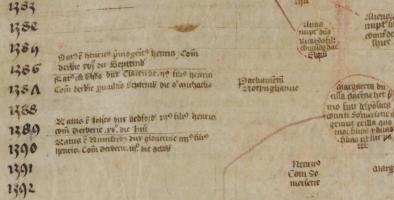

On 3rd October 1399 Eleanor Bohun Duchess Gloucester (age 33) died. She was buried at the Chapel of St Edmund, Westminster Abbey [Map]. She has a monumental brass, representing the deceased in her conventual dress, as a nun of Barking Abbey [Map].
On 3rd October 1431 Thomas Beaufort Count Perche (age 26) was killed at Louviers, Eure, Haute Normandie during the Siege of Louviers.
Henry Machyn's Diary. 3rd October 1553. The iiij day of October was cared to the Towre [Map] the archebysshope of Yorke (age 71), and dyvers odur to (blank)
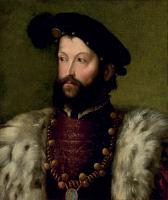
On 3rd October 1559 Ercole Este II Duke Ferrara (age 51) died. His son Alfonso (age 25) succeeded II Duke Ferrara.
Henry Machyn's Diary. 3rd October 1561. [The iij day of October came to London to Gracechurch] strett, to the Cross-keys, xviij grett horses [all pyed-coloured] from the kyng of Swaythland (age 27).
On 3rd October 1568 Elizabeth Valois Queen Consort Spain (age 23) died.


3rd October 1594. The Battle of Glenlivet was battle fought between Protestant forces loyal to King James VI of Scotland (age 28) who were commanded by Archibald Campbell 7th Earl Argyll (age 19), against Catholic forces who were commanded by George Gordon, 6th Earl of Huntly (age 2), and Francis Hay 9th Earl Erroll (age 30). The Catholics won a decisive victory in the battle, but in the aftermath were subdued by King James.

On 3rd October 1608 Nicole Lorraine Duchess Lorraine was born to Henry Lorraine II Duke Lorraine (age 45) and Margherita Gonzaga Duchess Lorraine (age 17). She married 1625 her first cousin Charles Lorraine II Duke Lorraine, son of Francis Lorraine II Duke Lorraine.

On 3rd October 1611 Margaret of Austria Queen Consort Spain (age 26) died.
Autobiography Simon D'Ewes. 3rd October 1621. Having therefore spent some little time during this month in mine own private study and arriving at London upon Wednesday the 3rd day of October, with my father and the rest of his family, I understood that Sir Henry Montague (age 58), Viscount Mandeville was, for some abuses in the place of Lord Treasurer, put out of the same, having not yet continued ten months in it, and was made Lord President of the Council.
John Evelyn's Diary. 3rd October 1642. To Chichester [Map], and hence the next day to see the Siege of Portsmouth; for now was that bloody difference between the King and Parliament broken out, which ended in the fatal tragedy so many years after. It was on the day of its being rendered to Sir William Waller (age 45); which gave me an opportunity of taking my leave of Colonel Goring (age 34), the governor, now embarking for France. This day was fought that signal battle at Edgehill. Thence I went to Southampton, Hampshire [Map] and Winchester, Hampshire [Map], where I visited the castle, school, church, and King Arthur's Round Table; but especially the church [Map], and its Saxon kings' monuments, which I esteemed a worthy antiquity.
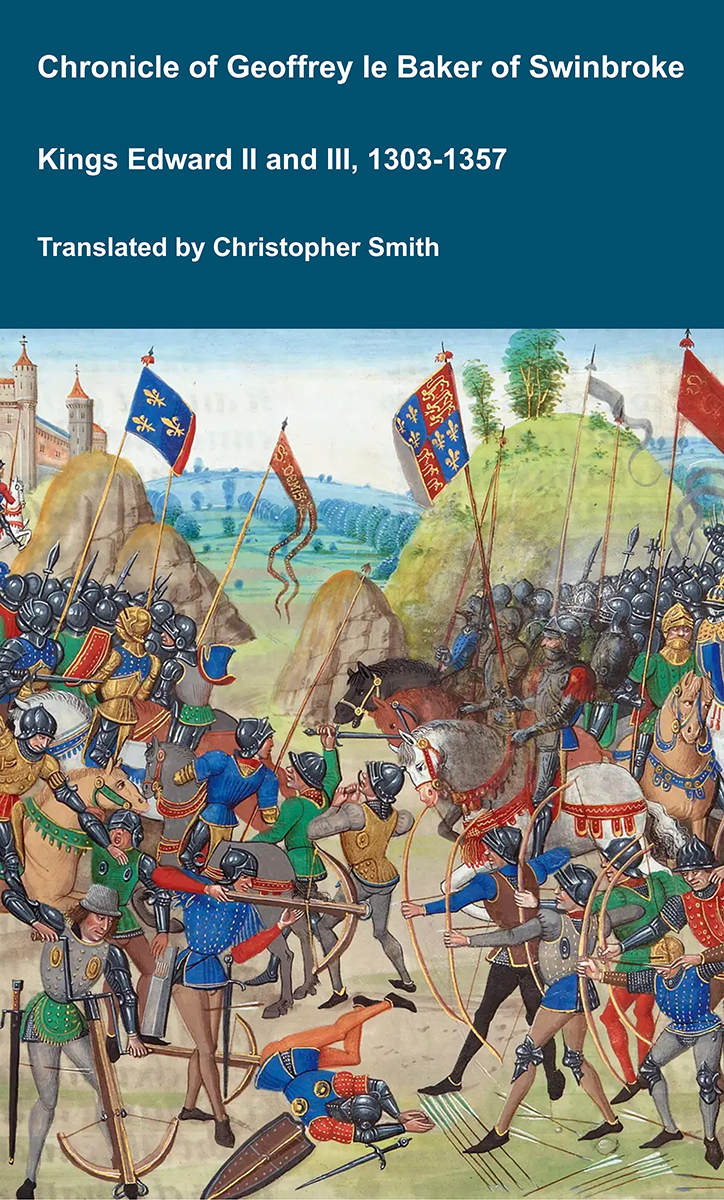
Chronicle of Geoffrey le Baker of Swinbroke
Baker was a secular clerk from Swinbroke, now Swinbrook, an Oxfordshire village two miles east of Burford. His Chronicle describes the events of the period 1303-1356: Gaveston, Bannockburn, Boroughbridge, the murder of King Edward II, the Scottish Wars, Sluys, Crécy, the Black Death, Winchelsea and Poitiers. To quote Herbert Bruce 'it possesses a vigorous and characteristic style, and its value for particular events between 1303 and 1356 has been recognised by its editor and by subsequent writers'. The book provides remarkable detail about the events it describes. Baker's text has been augmented with hundreds of notes, including extracts from other contemporary chronicles, such as the Annales Londonienses, Annales Paulini, Murimuth, Lanercost, Avesbury, Guisborough and Froissart to enrich the reader's understanding. The translation takes as its source the 'Chronicon Galfridi le Baker de Swynebroke' published in 1889, edited by Edward Maunde Thompson.
Available at Amazon in eBook and Paperback format.
John Evelyn's Diary. 3rd October 1660. Arrived the Queen-Mother (age 50) in England, whence she had been banished for almost twenty years; together with her illustrious daughter, the Princess Henrietta (age 16), divers princes and noblemen, accompanying them.


Samuel Pepys' Diary. 3rd October 1660. With Sir W. Batten (age 59) and Pen (age 39) by water to White Hall, where a meeting of the Dukes of York and Albemarle, my Lord Sandwich (age 35) and all the principal officers, about the Winter Guard, but we determined of nothing. To my Lord's, who sent a great iron chest to White Hall; and I saw it carried, into the King's (age 30) closet, where I saw most incomparable pictures. Among the rest a book open upon a desk, which I durst have sworn was a reall book, and back again to my Lord, and dined all alone with him, who do treat me with a great deal of respect; and after dinner did discourse an hour with me, and advise about some way to get himself some money to make up for all his great expenses, saying that he believed that he might have any thing that he would ask of the King. This day Mr. Sheply and all my Lord's goods came from sea, some of them laid of the Wardrobe and some brought to my Lord's house. From thence to our office, where we met and did business, and so home and spent the evening looking upon the painters that are at work in my house. This day I heard the Duke speak of a great design that he and my Lord of Pembroke have, and a great many others, of sending a venture to some parts of Africa to dig for gold ore there. They intend to admit as many as will venture their money, and so make themselves a company. £250 is the lowest share for every man. But I do not find that my Lord do much like it. At night Dr. Fairbrother (for so he is lately made of the Civil Law) brought home my wife by coach, it being rainy weather, she having been abroad today to buy more furniture for her house.


John Evelyn's Diary. 3rd October 1661. Next evening, being in the withdrawing-room adjoining the bedchamber, his Majesty (age 31) espying me came to me from a great crowd of noblemen standing near the fire, and asked me if I had done; and told me he feared it might be a little too sharp, on second thoughts, for he had that morning spoken with the French Ambassador, who it seems had palliated the matter, and was very tame; and therefore directed me where I should soften a period or two, before it was published (as afterward it was). This night also he spoke to me to give him a sight of what was sent, and to bring it to him in his bedchamber; which I did, and received it again from him at dinner, next day. By Saturday, having finished it with all his Majesty's notes, the King being gone abroad, I sent the papers to Sir Henry Bennett (age 43) (Privy-Purse and a great favorite), and slipped home, being myself much indisposed and harassed with going about, and sitting up to write.


John Evelyn's Diary. 3rd October 1662. Visited Mr. Wright (age 45), a Scotchman, who had lived long at Rome, and was esteemed a good painter. The pictures of the Judges at Guildhall are of his hand, and so are some pieces in Whitehall [Map], as the roof in his Majesty's (age 32) old bedchamber, being Astræa, the St. Catherine, and a chimney-piece in the Queen's (age 23) privy chamber; but his best, in my opinion, is Lacy, the famous Roscius or comedian, whom he has painted in three dresses, as a gallant, a Presbyterian minister, and a Scotch highlander in his plaid. It is in his Majesty's dining room at Windsor Castle. He had at his house an excellent collection, especially that small piece of Correggio, Scotus of de la Marca, a design of Paulo; and, above all, those ruins of Polydore, with some good agates and medals, especially a Scipio, and a Cæsar's head of gold.
Samuel Pepys' Diary. 3rd October 1665. This night I hear that of our two watermen that use to carry our letters, and were well on Saturday last, one is dead, and the other dying sick of the plague. The plague, though decreasing elsewhere, yet being greater about the Tower [Map] and thereabouts.
Samuel Pepys' Diary. 3rd October 1666. They gone, and my heart eased of a great deale of fear and pain, and reckoning myself to come off with victory, because not overcome in anything or much foiled, I away to Sir W. Coventry's (age 38) chamber, but he not within, then to White Hall, and there among the ladies, and saw my Baroness Castlemaine's (age 25) never looked so ill, nor Mrs. Stewart (age 19) neither, as in this plain, natural dress. I was not pleased with either of them.


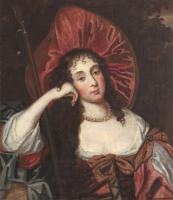


Samuel Pepys' Diary. 3rd October 1667. He gone, I thence to my Lady Peterborough (age 45), who sent for me; and with her an hour talking about her husband's pension, and how she hath got an order for its being paid again; though, I believe, for all that order, it will hardly be; but of that I said nothing; but her design is to get it paid again: and how to raise money upon it, to clear it from the engagement which lies upon it to some citizens, who lent her husband money, without her knowledge, upon it, to vast loss. She intends to force them to take their money again, and release her husband (age 45) of those hard terms. The woman is a very wise woman, and is very plain in telling me how her plate and jewels are at pawne for money, and how they are forced to live beyond their estate, and do get nothing by his being a courtier. The lady I pity, and her family. Having done with her, and drunk two glasses of her meade, which she did give me, and so to the Treasurer's Office, and there find my Lord Bruncker (age 47) and Sir W. Pen (age 46) at dinner with Sir G. Carteret (age 57) about his accounts, where I dined and talked and settled some business, and then home, and there took out my wife and Willet, thinking to have gone to a play, but both houses were begun, and so we to the 'Change [Map], and thence to my tailor's, and there, the coachman desiring to go home to change his horses, we went with him into a nasty end of all St. Giles's [Map], and there went into a nasty room, a chamber of his, where he hath a wife and child, and there staid, it growing dark too, and I angry thereat, till he shifted his horses, and then home apace, and there I to business late, and so home, to supper, and walk in the garden with my wife and girle, with whom we are mightily pleased, and after talking and supping, to bed.
On 3rd October 1675 Catherine Laura Stewart died of convulsions.
On 3rd October 1685 Juan Carreño de Miranda (age 71) died.
On 3rd October 1722 Johann Heinrich Tischbein was born.
On 3rd October 1739 Catalina Ventura Colón Duchess Berwick 9th Duchess Veragua (age 49) died. Her son James (age 20) succeeded 10th Duke Veragua. Maria Teresa Silva Duchess Berwick and Veragua (age 23) by marriage Duchess Veragua.
Diary of William Stukeley. Whitehorse Hill.
Oct. 3, 1758. My daughter [Anna] Fairchild having been in Barkshire, gave me an account of Whitehorse-hill, and the places thereabouts; the remains of a round temple23 of the Druids called Wayland Smith [Map]. Here the country people have a notion of an invisible smith living there; and if a traveller's horse happens to lose a shoe, leave him there, and a penny, and your horse shall be well shooed. I have often taken notice of these magic notions affixed to Druid temples. The figure of the horse24 on the side of the hill is poorly dravi'n, though of an immense bulk: but, she says, very much in the scheme of the Brittish horses on the reverse of their coins. They found a quantity of gold Brittish coins near there lately, hollow, and like of Cunobeline. Near the white horse, upon the hill, is a large tumulus, which they call pendragon. I believe this hill was one of their places of horse and chariot races at the midsummer sacrifice in the times of the Brittish kings, like that of black Hameldon in Yorkshire, it being a fine down. — Diary, vol. xviii., 12.
Note 23. A chambered round barrow, with formerly a ring of stones at the base of the mound. The chamber is cruciform in plan.
Note 24. Near Uffington Castle, a rude figure of a horse, formed by cutting away the turf upon the side of the chalk hill, of great antiquity; supposed by some to have been a work of the Britons, and by others to be a memorial of Alfred's victory over the Danes. Just under whitehorse-hill is a round hill called dragon-hill, but whether artificial or not. is held to be doubtful. The ancient figure of the horse gives its name to the adjoining vale. — Lysons' Magn. Brit, vol. i.. 215,301.
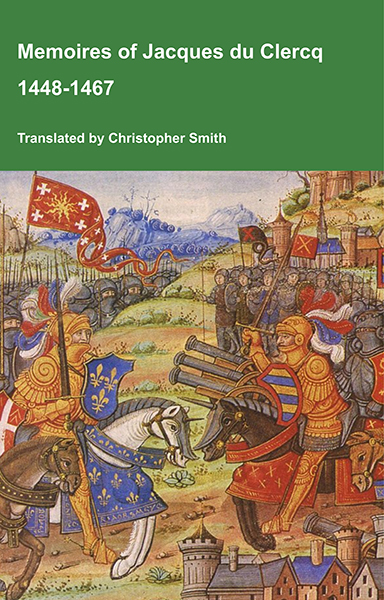
This is a translation of the 'Memoires of Jacques du Clercq', published in 1823 in two volumes, edited by Frederic, Baron de Reissenberg. In his introduction Reissenberg writes: 'Jacques du Clercq tells us that he was born in 1424, and that he was a licentiate in law and a counsellor to Philip the Good, Duke of Burgundy, in the castellany of Douai, Lille, and Orchies. It appears that he established his residence at Arras. In 1446, he married the daughter of Baldwin de la Lacherie, a gentleman who lived in Lille. We read in the fifth book of his Memoirs that his father, also named Jacques du Clercq, had married a lady of the Le Camelin family, from Compiègne. His ancestors, always attached to the counts of Flanders, had constantly served them, whether in their councils or in their armies.' The Memoires cover a period of nineteen years beginning in in 1448, ending in in 1467. It appears that the author had intended to extend the Memoirs beyond that date; no doubt illness or death prevented him from carrying out this plan. As Reissenberg writes the 'merit of this work lies in the simplicity of its narrative, in its tone of good faith, and in a certain air of frankness which naturally wins the reader’s confidence.' Du Clercq ranges from events of national and international importance, including events of the Wars of the Roses in England, to simple, everyday local events such as marriages, robberies, murders, trials and deaths, including that of his own father in Book 5; one of his last entries.
Available at Amazon in eBook and Paperback format.

On 3rd October 1761 Archbishop Robert Hay-Drummond (age 49) was elected at Archbishop of York.
On 3rd October 1767 Alexander Hamilton 10th Duke Hamilton 7th Duke Brandon was born to Archibald Hamilton 9th Duke Hamilton 6th Duke Brandon (age 27) and Harriet Stewart at St James' Square. He was educated at Harrow School. He married 26th April 1810 Susanna Euphemia Beckford Duchess Hamilton Duchess Brandon and had issue.
On 3rd October 1775 Charlotte Cavendish-Bentinck was born to William Cavendish-Bentinck 3rd Duke Portland (age 37) and Dorothy Cavendish 3rd Duchess Portland (age 25). She married before 26th August 1832 her second cousin twice removed Charles Greville and had issue.
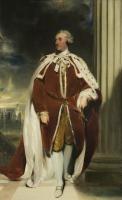


On 3rd October 1793 John George Lennox was born to Charles Lennox 4th Duke Richmond (age 29) and Charlotte Gordon Duchess Richmond (age 25). He a great x 3 grandson of King Charles II of England Scotland and Ireland.
Wiltshire Archaeological Magazine 1885 V22 Pages 234-238. Saturday, 3 October, 1809. Hot sultry day. Drove to Frome, and rode from thence to Chatley, where I breakfasted with my friend Mr. Meade. Accompanied him to Wellow [Map], where on the opposite side of the river, in a large common field, of arable land called the Hayes, Colonel Leigh, of Combe Hay, is now uncovering the pavements and foundations of a Roman villa. A prior discovery had been made of it in 1737, and three engravings made, of three different pavements, by the Antiquarian Society, and published in their "Vetusta Monumenta" Of these two are at present uncovered. The large one is sadly mutilated, but sufficient both of the centre and border is left to show that the drawing made in 1737 is notoriously incorrect. So much so, that were it not for the peacock's tail in the centre, remaining, we might almost suppose it was not the pavement originally engraven. The second sized floor is much more correct. The third (a narrow oblong) has not been yet discovered— unless it should prove to be the slip, adjoining the peacock apartment— but I can hardly suppose that the artist eould have carried his incorrectness so far, when he made the design of it, though, if only the centre pattern of this slip was uncovered, it is possible such an error might have been made. Accurate tracings are now making of the different pavements by the Rev. Mr. Skinner, of Camerton.
"A coin of Alectus, lately found, throws some light on the date of this villa.
The London Gazette 17404. Whitehall, October 3, 1818.
His Royal Highness the Prince Regent has been pleased, in the name and on the behalf of His Majesty, to direct letters patent to be passed under the Great Seal of the United Kingdom of Great Britain and Ireland, for granting the dignity of a Baronet of the said United Kingdom to the following Gentlemen respectively, and to the heirs male of their bodies lawfully begotten, viz.
The Honourable Alexander Maitland (age 90), of Clifton, in the county of Mid-Lothian, and of Rose-Hill, in the county of Hertford, General in the Army, and Colonel of the 49th Regiment.
Henry Johnson (age 70), of the city of Bath, in the county of Somerset, Esq. General in the Army, and Colonel of tine 81st Regiment.
Anthony Farrington (age 76), of Blackheath, in the county of Kent, Esq. General in the Army, Colonel Commandant of the 1st Battalion of the Royal Regiment of Artillery, and Director-General of Artillery and Field Train.
Sir Harry Calvert, Knight Grand Cross of the Most Honourable Military Order of the Bath, Lieutenant-General in the Army, Colonel of the 14th Regiment of Foot, and Adjutant-General of the Forces.
James Campbell, of Inverneil, in the county of Argyll, Esq. Lieutenant-General in the Army, Kitight Grand Cross of the Royal Hanoverian Guelphic Order, and Knight Commander of the Royal Sicilian Order of Saint Ferdinand and of Merit.
Sir James Willoughby Gordon, of Niton, in the Isle of Wight, Knight Commander of the Most Honourable Military Order of the Bath, Major General in the Army, Colonel of the 85th Regiment, and Quarter-Master-General to the Forces.
Felton Elwill Bathurst Hervey (age 36), of Lainston, in the county of Southampton, Esq. Colonel in the Army, Extra Aide-de-Camp to His Royal Highness the Prince Regent, Lieutenant-Colonel of the 14th Regiment of Light Dragoons, and a Companion of the Most Honourable Military Order of the Bath; with remainder, in failure of issue male, to his brother Frederick Anne Hervey (age 35), of Clarendon Park, in the county of Wilts, Esq. and his heirs male.
John Powell (age 65), of Hardwick, and of Worthen, in the county of Salop, Esq. and in default of male issue, to Edward Kynaston (age 60), of Risby and Fornham Saint-Genevieve, in the county of Suffolk, Clerk (brother of the said John Powell), and his heirs male.
John Acland (age 62), of Fairfield, in the county of Somerset, and of Newhouse, in the county of Devon, Esq.
Antony Lechmere (age 51), of the Rhyd, in the county of Worcester, Esq.
Sir Edmond Lacon, of Great Yarmouth, in the county of Norfolk, Knight. [Note. Mary Berwick Lady Lechmere by marriage Lady Lechmere of Rhyd in Worcestershire.]
John Shelley Sidney (age 47), of Penshurst-place, in the county of Kent, Esq.
Thomas Hare, of Stow Hall, in the county of Norfolk, Esq.
Edward Stracey, of Rackheath Hall, in the county of Norfolk, Esq.
George Shiffher, of Combe-place, in the county of Sussex, Esq.
John Croft, of Cowling Hall, in the north riding of the county of York, Esq.
Robert Bateson (age 36), of Belvoir Park, in the county of Down, Esq.
Matthew John Tierney, of Brighthelmstone, in the county of Sussex, and of Dover-street, in the county of Middlesex, Esq. Doctor of Physic, Physician in Ordinary to His Royal Highness the Prince Regent, and Physician to His Royal High ness's Household at Brighthelmstone.
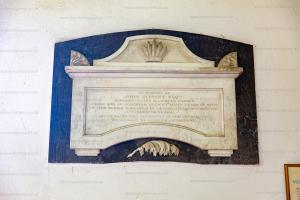
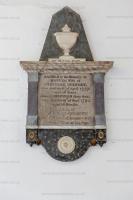
After 3rd October 1827. Memorials to John Quincey, Surgeon to his Majesty's Forces, and Jeremiah Quincey.
On 3rd October 1843 Luke Fildes was born.
On 3rd October 1860 Alfred Edward Chalon (age 80) died at Campden Hill.
On 3rd October 1886 Olga Katherine Godolphin Osborne was born to George Godolphin Osborne 10th Duke Leeds (age 24) and Katherine Frances Lambton Duchess Leeds (age 24).
Life of William Morris. During the last weeks he was attended, beyond his own family, by the untiring devotion of his friends. Miss Mary De Morgan (age 46) brought to this last service all the skill born of long experience, and the intelligent sympathy of an affection which Morris had for many years cordially returned. Sir Edward (age 63) and Lady Burne Jones (age 56), Mr. Webb, and Mr. Ellis were with him almost daily. Mr. Cockerell was ceaseless in his zeal and care; and Mr, Emery Walker nursed him with the patience and tenderness of a woman. On the morning of Saturday the 3rd of October [1896], between eleven and twelve o'clock, he died quietly and without visible suffering.
Chronicle of Geoffrey le Baker of Swinbroke
Baker was a secular clerk from Swinbroke, now Swinbrook, an Oxfordshire village two miles east of Burford. His Chronicle describes the events of the period 1303-1356: Gaveston, Bannockburn, Boroughbridge, the murder of King Edward II, the Scottish Wars, Sluys, Crécy, the Black Death, Winchelsea and Poitiers. To quote Herbert Bruce 'it possesses a vigorous and characteristic style, and its value for particular events between 1303 and 1356 has been recognised by its editor and by subsequent writers'. The book provides remarkable detail about the events it describes. Baker's text has been augmented with hundreds of notes, including extracts from other contemporary chronicles, such as the Annales Londonienses, Annales Paulini, Murimuth, Lanercost, Avesbury, Guisborough and Froissart to enrich the reader's understanding. The translation takes as its source the 'Chronicon Galfridi le Baker de Swynebroke' published in 1889, edited by Edward Maunde Thompson.
Available at Amazon in eBook and Paperback format.
On 3rd October 1896 William Morris (age 62) died after several months of "general organic degeneration", at Kelmscott House, Hammersmith. He died, Mackail says, 'quietly and without visible suffering' (II, 335)'


On 3rd October 1899 Edward Fitz-Clarence 6th Earl of Munster was born to Brigadier-General Charles Fitz-Clarence (age 34) and Violet Spencer-Churchill (age 35). He a great x 2 grandson of King William IV of the United Kingdom. He married (1) 30th July 1925 Monica Sheila Grayson, daughter of Lieutenant-Colonel Henry Grayson 1st Baronet and Dora Beatrice Harrington, and had issue (2) 28th September 1939 Vivian Scholfield.
On 3rd October 1917 Burton Robert Williams 6th Baronet (age 28) was killed in action whilst serving as Lieutenant in the 3rd Battalion, Devon Regiment. His uncle Frederick (age 54) succeeded 7th Baronet Williams of Tregullow in Cornwall.
On 3rd October 1936 Coplestone John de Grey Warwick Bampfylde (age 22) died from a fall from a horse shortly after representing his country as a member of the 1936 Berlin Olympic Games fencing team. The Bampfylde Memorial Garden in the churchyard of All Saints' Church, North Molton was created in his memory, being a walled and sunken lawned garden, in the centre of which stands his gravestone inscribed: In memory of Coplestone John de Grey Warwick Bampfylde, Royal Horse Guards, beloved only son of the 4th Baron Poltimore. Died 3 October 1936 in his 23rd year.
On 3rd October 1292 Eleanor Clare Baroness Zouche Mortimer was born to Gilbert "Red Earl" Clare 7th Earl Gloucester 6th Earl Hertford (age 49) and Joan of Acre Countess Gloucester and Hertford (age 20) at Caerphilly Castle [Map]. She a granddaughter of King Edward I of England. She married (1) after 14th July 1306 her third cousin once removed Hugh "Younger" Despencer 1st Baron Despencer, son of Hugh "Elder" Despencer 1st Earl Winchester and Isabella Beauchamp, and had issue (2) after 15th September 1317 William Zouche 1st Baron Zouche Mortimer, son of Robert Mortimer 2nd Baron Mortimer and Joyce Zouche Baroness Mortimer, and had issue.
On 3rd October 1343 Walter Ufford was born to Robert Ufford 1st Earl Suffolk (age 45) and Margaret Norwich Countess Suffolk (age 57). He married before 1361 Elizabeth Montagu Countess Suffolk, daughter of Edward Montagu 1st Baron Montagu and Alice Plantagenet.
On 3rd October 1390 Humphrey Lancaster 1st Duke Gloucester was born to King Henry IV of England (age 23) and Mary Bohun (age 22). Coefficient of inbreeding 2.60%.
French MS 54 at the John Rylands Library in Manchester: "1390 Nat[us] e[st] Humfred[us] dux glouvernie iiij[us] fili[us] henrici Com[iti] Derberie iii die Octob[ris]" i.e. "1390 Humphrey, duke of Gloucester, the fourth son of Henry, earl of Derby, was born the third day of October". He married (1) 1423 his third cousin Jacqueline Wittelsbach Duchess Brabant and Gloucester, daughter of William Wittelsbach IV Count Holland VI Count Hainaut V Count Zeeland and Margaret Valois Countess Holland (2) 1428 his sixth cousin Eleanor Cobham Duchess of Gloucester, daughter of Reginald Cobham 3rd Baron Cobham and Eleanor Culpepper Baroness Cobham Sternborough.
Mary Bohun: Around 1368 she was born to Humphrey Bohun 7th Earl Hereford 6th Earl Essex 2nd Earl of Northampton and Joan Fitzalan Countess Essex, Hereford and Northampton. She a great x 2 granddaughter of King Edward I of England. On 16th January 1373 Humphrey Bohun 7th Earl Hereford 6th Earl Essex 2nd Earl of Northampton died. He was buried at Waldon Priory and Abbey [Map]. Earl Hereford, Earl Essex, Earl of Northampton extinct. His estates were divided between his two daughters Eleanor Bohun Duchess Gloucester, wife of Thomas of Woodstock 1st Duke of Gloucester and Mary Bohun, wife of Henry of Bolingbroke, the future Henry IV, although the title and estates should have been inherited Gilbert Bohun who was a grandson of Humphrey Bohun 2nd Earl Hereford 1st Earl Essex. On 5th February 1381 Henry Bolingbroke and she were married at Arundel Castle [Map]. She the daughter of Humphrey Bohun 7th Earl Hereford 6th Earl Essex 2nd Earl of Northampton and Joan Fitzalan Countess Essex, Hereford and Northampton. He the son of John of Gaunt 1st Duke Lancaster and Blanche Duchess of Lancaster. They were second cousins. He a grandson of King Edward III of England. She a great x 2 granddaughter of King Edward I of England. Froissart Book 4 Chapter 94. Before 19th October 1398. You must know that the earl of Derby and the late duke of Gloucester had married two sisters [Note. Mary Bohun and Eleanor Bohun Duchess Gloucester], daughters to the earl of Hereford and Northampton, constable of England: the children, therefore, of the earl of Derby and duke of Gloucester were cousins-german by their mother's side, and one degree removed by their father's. To say the truth, the death of the duke of Gloucester had displeased many of the great barons of England, who frequently murmured at it when together; but the king had now so greatly extended his power, none dared to speak of it openly, nor act upon the current rumours of the mode of his death. The king had caused it to be proclaimed, that whoever should say anything respecting the duke of Gloucester or the earl of Arundel, should be reckoned a false and wicked traitor and incur his indignation. This threat had caused many to be silent, afraid of what might befal them, who were, nevertheless, much dissatisfied.
On 3rd October 1554 Fulk Greville 13th Baron Latimer 5th Baron Willoughby 1st Baron Brooke was born to Fulke Greville 12th Baron Latimer 4th Baron Willoughby (age 18) and Anne Neville Baroness Latimer at Beauchamp's Court, Alcester.
On 3rd October 1570 Bishop George Coke was born to Richard Coke of Trusley (age 40).
On 3rd October 1608 Nicole Lorraine Duchess Lorraine was born to Henry Lorraine II Duke Lorraine (age 45) and Margherita Gonzaga Duchess Lorraine (age 17). She married 1625 her first cousin Charles Lorraine II Duke Lorraine, son of Francis Lorraine II Duke Lorraine.
On 3rd October 1637 George Gordon 1st Earl Aberdeen was born to John Gordon 1st Baronet (age 27).
On 3rd October 1672 Penelope Evelyn Lady Alston was born to Edward Evelyn 1st Baronet (age 46). She married 23rd June 1690 Joseph Alston 3rd Baronet, son of Joseph Alston 2nd Baronet and Elizabeth Thompson, and had issue.
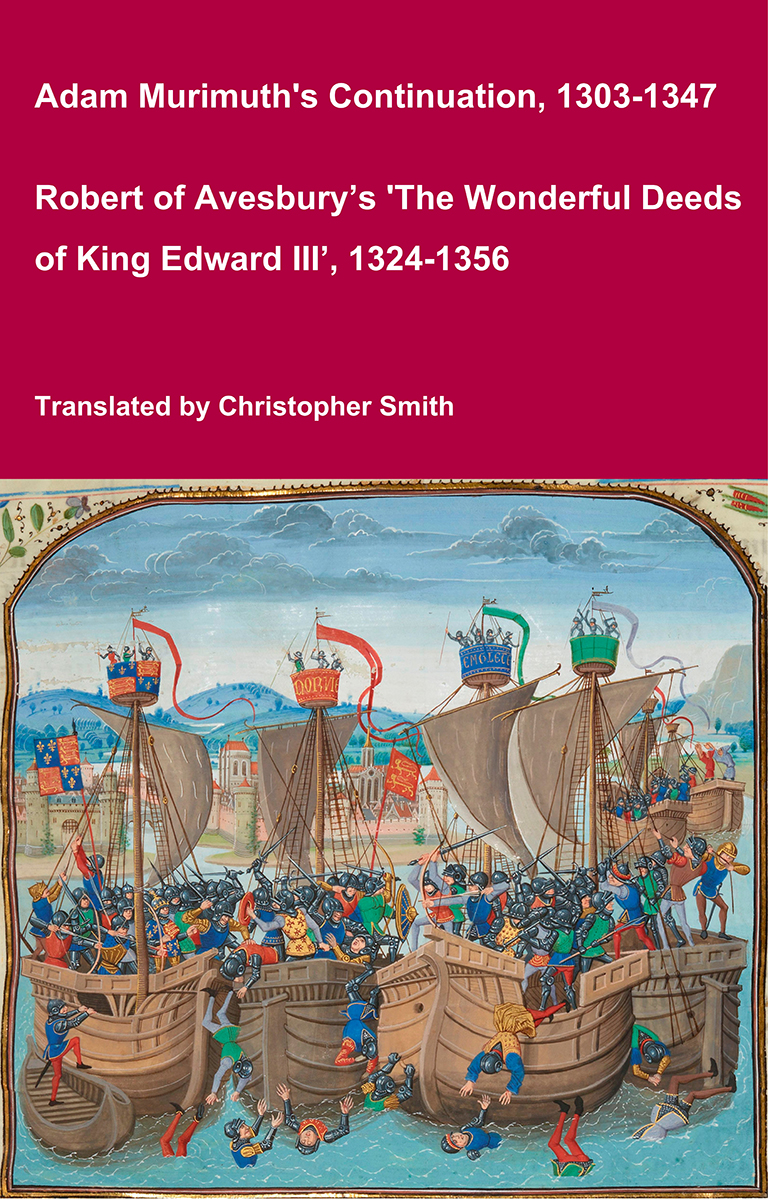
Adam Murimuth's Continuation and Robert of Avesbury’s 'The Wonderful Deeds of King Edward III'
This volume brings together two of the most important contemporary chronicles for the reign of Edward III and the opening phases of the Hundred Years’ War. Written in Latin by English clerical observers, these texts provide a vivid and authoritative window into the political, diplomatic, and military history of fourteenth-century England and its continental ambitions. Adam Murimuth Continuatio's Chronicarum continues an earlier chronicle into the mid-fourteenth century, offering concise but valuable notices on royal policy, foreign relations, and ecclesiastical affairs. Its annalistic structure makes it especially useful for establishing chronology and tracing the development of events year by year. Complementing it, Robert of Avesbury’s De gestis mirabilibus regis Edwardi tertii is a rich documentary chronicle preserving letters, treaties, and official records alongside narrative passages. It is an indispensable source for understanding Edward III’s claim to the French crown, the conduct of war, and the mechanisms of medieval diplomacy. Together, these works offer scholars, students, and enthusiasts a reliable and unembellished account of a transformative period in English and European history. Essential for anyone interested in medieval chronicles, the Hundred Years’ War, or the reign of Edward III.
Available at Amazon in eBook and Paperback format.
On 3rd October 1681 Thomas Fane 6th Earl of Westmoreland was born to Vere Fane 4th Earl of Westmoreland (age 36) and Rachel Bence Countess of Westmoreland. He married 1707 Catherine Stringer Countess Westmoreland.
On 3rd October 1722 Johann Heinrich Tischbein was born.
On 3rd October 1730 George Brodrick was born to Alan Brodrick 2nd Viscount Midleton (age 28) and Mary Capell Viscountess Midleton. He married 1st May 1752 his fourth cousin once removed Albinia Townshend Viscountess Midleton and had issue.
On 3rd October 1755 George Legge 3rd Earl Dartmouth was born to William Legge 2nd Earl Dartmouth (age 24) and Frances Catherine Gounter Nicoll Countess Dartmouth (age 22). He married 24th September 1782 his second cousin once removed Frances Finch Countess Dartmouth, daughter of Heneage Finch 3rd Earl Aylesford and Charlotte Seymour Countess Aylesford, and had issue.


On 3rd October 1763 Arthur Hill-Trevor 2nd Viscount Dungannon was born to Arthur Hill-Trevor (age 24). He married 13th July 1795 Charlotte Fitzroy Viscountess Dungannon, daughter of Charles Fitzroy 1st Baron Southampton and Anne Warren Baroness Southampton, and had issue.
On 3rd October 1767 Alexander Hamilton 10th Duke Hamilton 7th Duke Brandon was born to Archibald Hamilton 9th Duke Hamilton 6th Duke Brandon (age 27) and Harriet Stewart at St James' Square. He was educated at Harrow School. He married 26th April 1810 Susanna Euphemia Beckford Duchess Hamilton Duchess Brandon and had issue.

On 3rd October 1768 Susan Fane was born to John Fane 9th Earl of Westmoreland (age 40) and Susan Gordon Countess of Westmoreland (age 16).
On 3rd October 1775 Charlotte Cavendish-Bentinck was born to William Cavendish-Bentinck 3rd Duke Portland (age 37) and Dorothy Cavendish 3rd Duchess Portland (age 25). She married before 26th August 1832 her second cousin twice removed Charles Greville and had issue.
On 3rd October 1789 Henry Pottinger 1st Baronet was born to Eldred Curwen Pottinger (age 36).

On 3rd October 1790 Eleanor Maitland was born to James Maitland 8th Earl Lauderdale (age 31) and Eleanor Todd Countess Lauderdale (age 28). She married 19th January 1815 James Balfour and had issue.
On 3rd October 1793 John George Lennox was born to Charles Lennox 4th Duke Richmond (age 29) and Charlotte Gordon Duchess Richmond (age 25). He a great x 3 grandson of King Charles II of England Scotland and Ireland.
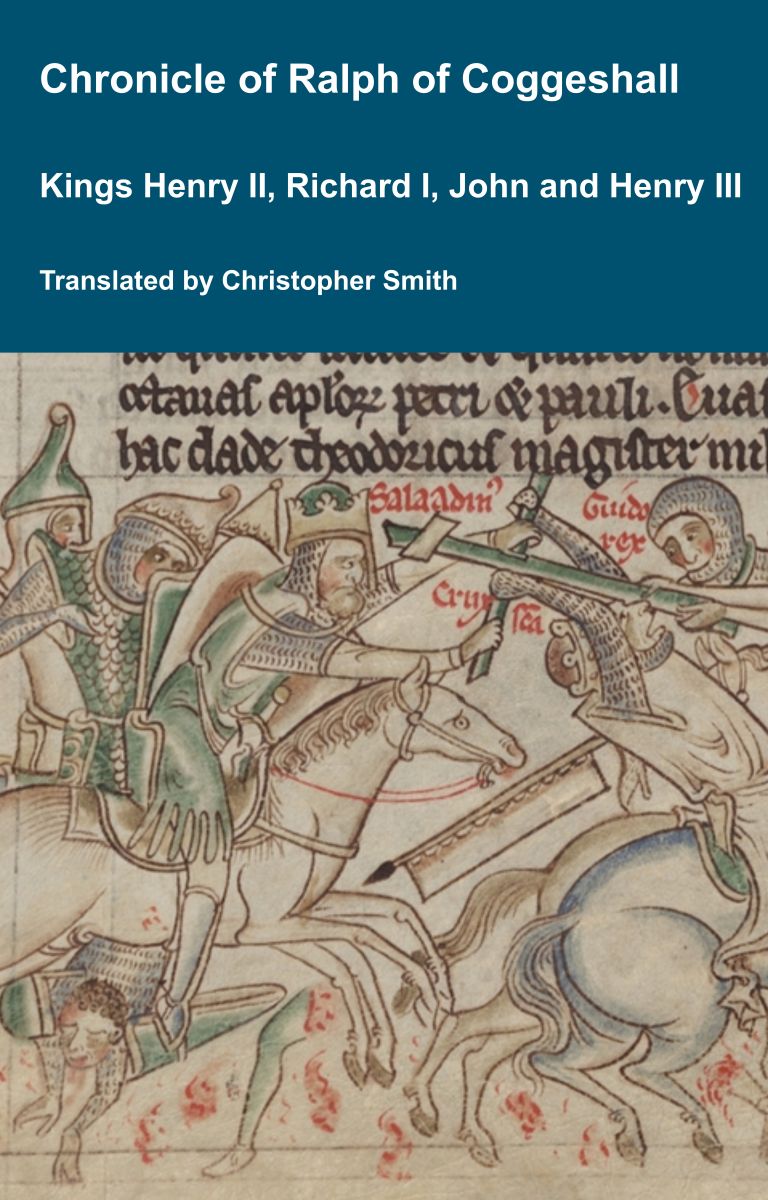
Chronicle of Abbot Ralph of Coggeshall
The Chronicle of Abbot Ralph of Coggeshall (Chronicon Anglicanum) is an indispensable medieval history that brings to life centuries of English and European affairs through the eyes of a learned Cistercian monk. Ralph of Coggeshall, abbot of the Abbey of Coggeshall in Essex in the early 13th century, continued and expanded his community’s chronicle, documenting events from the Norman Conquest of 1066 into the tumultuous reign of King Henry III. Blending eyewitness testimony, careful compilation, and the monastic commitment to record-keeping, this chronicle offers a rare narrative of political intrigue, royal power struggles, and social upheaval in England and beyond. Ralph’s work captures the reigns of pivotal figures such as Richard I and King John, providing invaluable insights into their characters, decisions, and the forces that shaped medieval rule. More than a simple annal, Chronicon Anglicanum conveys the texture of medieval life and governance, making it a rich source for scholars and readers fascinated by English history, monastic authorship, and the shaping of the medieval world.
Available at Amazon in eBook and Paperback format.
On 3rd October 1796 Anna Margaret Anson Countess Camden was born to Thomas Anson 1st Viscount Anson (age 29) and Anne Margaret Coke Viscountess Anson (age 17). She married 1819 Archibald Primrose 4th Earl Rosebery, son of Neil Primrose 3rd Earl Rosebery and Mary Vincent Countess Rosebery, and had issue.


On 3rd October 1811 Hugh Cholmondeley 2nd Baron Delamere was born to Thomas Cholmondeley 1st Baron Delamere (age 44) and Henrietta Elizabeth Williams-Wynn Baroness Delamere (age 41). He married (1) 1848 Sarah Hay-Drummond, daughter of Thomas Hay-Drummond 11th Earl Kinnoull and Louisa Burton Rowley Countess Kinnoul (2) 1860 his fourth cousin Augusta Emily Seymour-Conway Baroness Delamere and had issue.
On 3rd October 1811 Andrew Snape Hamond-Graeme 3rd Baronet was born to Graham Hamond 2nd Baronet (age 31) and Elizabeth Kimber Lady Hamond.
On 3rd October 1818 Charles Grimston was born to James Walter Grimston 1st Earl Verulam (age 43) and Charlotte Jenkinson Countess Verulam.
On 3rd October 1823 Edward Henry Page-Turner 6th Baronet was born to Edward George Page-Turner 5th Baronet (age 34).
On 3rd October 1824 Charles Swinton Hogg was born to James Hogg 1st Baronet (age 34) and Mary Swinton. He married 29th December 1860 Harriet Anne Stirling and had issue.
On 3rd October 1828 Henry Lopes 1st Baron Ludlow was born to Ralph Franco aka Lopes 2nd Baronet (age 40). He married 1854 Cordelia Lucy Clark and had issue.
On 3rd October 1842 George Edward Dallas 3rd Baronet was born to Robert Dallas 2nd Baronet (age 37).
On 3rd October 1843 Charles Bennet Lawes-Wittewronge 2nd Baronet was born to John Bennet Lawes 1st Baronet (age 28) and Caroline Fountaine (age 25). He married 8th April 1869 his first cousin Marie Amelie Rose Fountaine Lady Lawes and had issue.
On 3rd October 1843 Luke Fildes was born.
Chronicle of Geoffrey le Baker of Swinbroke
Baker was a secular clerk from Swinbroke, now Swinbrook, an Oxfordshire village two miles east of Burford. His Chronicle describes the events of the period 1303-1356: Gaveston, Bannockburn, Boroughbridge, the murder of King Edward II, the Scottish Wars, Sluys, Crécy, the Black Death, Winchelsea and Poitiers. To quote Herbert Bruce 'it possesses a vigorous and characteristic style, and its value for particular events between 1303 and 1356 has been recognised by its editor and by subsequent writers'. The book provides remarkable detail about the events it describes. Baker's text has been augmented with hundreds of notes, including extracts from other contemporary chronicles, such as the Annales Londonienses, Annales Paulini, Murimuth, Lanercost, Avesbury, Guisborough and Froissart to enrich the reader's understanding. The translation takes as its source the 'Chronicon Galfridi le Baker de Swynebroke' published in 1889, edited by Edward Maunde Thompson.
Available at Amazon in eBook and Paperback format.
On 3rd October 1847 Syndey Mason Eardley-Wilmot was born to John Eardley-Wilmot 2nd Baronet (age 36) and Eliza Martha Williams Lady Eardley-Williams (age 34). He married 1877 Grace Hoare.

On 3rd October 1860 Grace Adelaide Fane Countess Londesborough was born to Francis William Henry Fane 12th Earl of Westmoreland (age 34) and Adelaide Ida Curzon Howe Countess of Westmoreland (age 25). She married 11th August 1887 her third cousin William Henry Francis Denison 2nd Earl Londesborough, son of William Henry Forester Denison 1st Earl Londesborough and Edith Somerset Countess Londesborough, and had issue.
On 3rd October 1860 Montagu Charles Francis Bertie was born to Montagu Arthur Bertie 7th Earl of Abingdon (age 24) and Caroline Theresa Towneley (age 22). He married 25th July 1885 Rose Riversdale Glyn and had issue.
On 3rd October 1886 Olga Katherine Godolphin Osborne was born to George Godolphin Osborne 10th Duke Leeds (age 24) and Katherine Frances Lambton Duchess Leeds (age 24).
On 3rd October 1899 Edward Fitz-Clarence 6th Earl of Munster was born to Brigadier-General Charles Fitz-Clarence (age 34) and Violet Spencer-Churchill (age 35). He a great x 2 grandson of King William IV of the United Kingdom. He married (1) 30th July 1925 Monica Sheila Grayson, daughter of Lieutenant-Colonel Henry Grayson 1st Baronet and Dora Beatrice Harrington, and had issue (2) 28th September 1939 Vivian Scholfield.
On 3rd October 1902 Mary Sibell Ashley-Cooper Baroness Alington was born to Anthony Ashley-Cooper 9th Earl of Shaftesbury (age 33) and Constance Grosvenor Countess of Shaftesbury (age 27). She married 27th November 1928 her fourth cousin Napier Sturt 3rd Baron Alington, son of Humphrey Napier Sturt 2nd Baron Alington and Feodorowna Yorke Baroness Alington.


On 3rd October 1912 Charles Ingram Courtenay Wood 2nd Earl Halifax was born to Edward Frederick Lindley Wood 1st Earl Halifax (age 31) and Dorothy Evelyn Augusta Onslow Countess Halifax (age 27). He married 1936 his half fourth cousin Ruth Alice Hannah Mary Primrose Countess Halifax and had issue.
On 3rd October 1914 John Addington 7th Viscount Sidmouth was born to Raymond Anthony Addington 6th Viscount Sidmouth (age 27).
On 3rd October 1927 Bertram Stanley Mitford Bowyer 2nd Baron Denham was born to George Bowyer 1st Baron Denham (age 41) and Daphne Mitford Baroness Denham (age 32).
On 3rd October 1930 Nicholas Eden 2nd Earl Avon was born to Robert Anthony Eden 1st Earl Avon (age 33) and Beatrice Helen Beckett (age 25).
Henrici Quinti, Angliæ Regis, Gesta, is a first-hand account of the Agincourt Campaign, and subsequent events to his death in 1422. The author of the first part was a Chaplain in King Henry's retinue who was present from King Henry's departure at Southampton in 1415, at the siege of Harfleur, the battle of Agincourt, and the celebrations on King Henry's return to London. The second part, by another writer, relates the events that took place including the negotiations at Troye, Henry's marriage and his death in 1422.
Available at Amazon in eBook and Paperback format.
On 3rd October 1947 Richard Bridgeman 7th Earl of Bradford was born to Gerald Bridgeman 6th Earl of Bradford (age 36) and Mary Willoughby Montgomery Countess Bradford. He married (1) 15th September 1979 Joanne Elizabeth Miller Countess Bradford.
On 3rd October 1961 David Armstrong-Jones 2nd Earl of Snowdon was born to Antony Armstrong-Jones 1st Earl of Snowdon (age 31) and Princess Margaret (age 31) at Clarence House. He a grandson of King George VI of the United Kingdom. He married 8th October 1993 Serena Alleyne Stanhope Countess of Snowdon, daughter of Charles Stanhope 12th Earl of Harrington.
On 3rd October 1599 William Murray 2nd Earl Tullibardine (age 25) and Cecilia Wemyss were married. She the daughter of John Wemyss 1st Earl of Wemyss (age 13) and Jane Gray Countess Wemyss. He the son of John Murray 1st Earl Tullibardine and Catherine Drummond Countess Tullibardine. They were second cousin once removed. She a great x 4 granddaughter of King Henry VII of England and Ireland.
On 3rd October 1617 William Ramsay 1st Earl Dalhousie and Margaret Carnegie Countess Dalhousie (age 18) were married. She the daughter of David Carnegie 1st Earl Southesk (age 42).
On 3rd October 1620 Lewis Watson 1st Baron Rockingham (age 33) and Eleanor Manners Baroness Rockingham (age 20) were married.
On 3rd October 1725 John St Aubyn 3rd Baronet (age 29) and Catherine Morice Lady St Aubyn were married at St James' Church, Piccadilly. She brough £10,000 cash to the marriage, and the manor of Stoke-Damerel, including Devonport.
On 3rd October 1771 Armar Lowry-Corry 1st Earl Belmore (age 31) and Margaret Butler (age 23) were married. She by marriage Countess Belmore in the County of Fermanagh.


On 3rd October 1781 Henry Neville 2nd Earl Abergavenny (age 26) and Mary Robinson Countess Abergavenny (age 21) were married. He the son of George Neville 1st Earl Abergavenny (age 54) and Henrietta Pelham Baroness Bergavenny.

On 3rd October 1791 Henry Cecil 1st Marquess Exeter (age 37) and Sarah Hoggins Countess Exeter (age 17) were married at St Mildred's Church, Bread Street.
On 3rd October 1808 William à Court 1st Baron Heytesbury (age 29) and Maria Rebecca Bouverie Baroness Heytesbury (age 24) were married at St George's Church, Hanover Square.
On 3rd October 1833 William à Court-Holmes 2nd Baron Heytesbury (age 24) and Elizabeth Holmes Baroness Heytesbury (age 18) were married.
On 3rd October 1861 Arthur Townley Watson 2nd Baronet (age 31) and Rosamund Rushworth Lady Watson were married.
Abbot John Whethamstede’s Chronicle of the Abbey of St Albans
Abbot John Whethamstede's Register aka Chronicle of his second term at the Abbey of St Albans, 1451-1461, is a remarkable text that describes his first-hand experience of the beginning of the Wars of the Roses including the First and Second Battles of St Albans, 1455 and 1461, respectively, their cause, and their consequences, not least on the Abbey itself. His text also includes Loveday, Blore Heath, Northampton, the Act of Accord, Wakefield, and Towton, and ends with the Coronation of King Edward IV. In addition to the events of the Wars of the Roses, Abbot John, or his scribes who wrote the Chronicle, include details in the life of the Abbey such as charters, letters, land exchanges, visits by legates, and disputes, which provide a rich insight into the day-to-day life of the Abbey, and the challenges faced by its Abbot.
Available at Amazon in eBook and Paperback format.
On 3rd October 1933 John Digby Pepys 7th Earl of Cottenham (age 26) and Angela Neville Countess Cottenham (age 23) were married. She the daughter of Guy Larnach Neville 4th Marquess Abergavenny (age 50) and Isabel "Nellie" Larnach Marchioness Abergavenny (age 43). He the son of Kenelm Charles Pepys 4th Earl of Cottenham and Rose Neville Countess Cottentham. They were first cousin once removed.
On 3rd October 1945 Charles James Ruthven Howard 12th Earl Carlisle (age 22) and Ela Helen Aline Beaumont Countess Carlisle (age 20) were married. She by marriage Countess Carlisle. He the son of George Josslyn L'Estrange Howard 11th Earl Carlisle (age 50) and Bridget Helen "Biddy" Ruthven Countess Carlisle (age 49).
On 3rd October 1283 Dafydd ap Gruffudd Aberffraw Prince of Wales (age 45) was hanged, drawn and quartered at Shrewsbury, Shropshire [Map]. The first prominent person known to have suffered being hanged, drawn and quartered. Dafydd was dragged through the streets of Shrewsbury, Shropshire [Map] attached to a horse's tail, then hanged alive, revived, then disembowelled and his entrails burned before him for "his sacrilege in committing his crimes in the week of Christ's passion", and then his body cut into four-quarters "for plotting the king's death". Geoffrey of Shrewsbury was paid 20 shillings for carrying out the act.
On 3rd October 1399 Eleanor Bohun Duchess Gloucester (age 33) died. She was buried at the Chapel of St Edmund, Westminster Abbey [Map]. She has a monumental brass, representing the deceased in her conventual dress, as a nun of Barking Abbey [Map].
On 3rd October 1404 Joan Burghesh Baroness Dunster (age 85) died at Guest House Canterbury Cathedral. She was buried at Canterbury, Kent [Map].
On 3rd October 1431 Thomas Beaufort Count Perche (age 26) was killed at Louviers, Eure, Haute Normandie during the Siege of Louviers.
On 3rd October 1559 Ercole Este II Duke Ferrara (age 51) died. His son Alfonso (age 25) succeeded II Duke Ferrara.
On 3rd October 1568 Elizabeth Valois Queen Consort Spain (age 23) died.
On 3rd October 1584 Gilbert Dethick (age 74) died. Robert Cooke (age 49) served as Acting Garter King of Arms until the appointment of Gilbert's son William Dethick (age 42) on 21st April 1586.
On 3rd October 1611 Margaret of Austria Queen Consort Spain (age 26) died.
On 3rd October 1633 John Gage 1st Baronet (age 63) died. His son Thomas (age 36) succeeded 2nd Baronet Gage of Firley in Sussex.
On 3rd October 1642 Charles Howard 2nd Earl Nottingham (age 63) died. His half brother Charles (age 31) succeeded 3rd Earl Nottingham, 4th Baron Howard of Effingham. Arabella Smith Countess Nottingham by marriage Countess Nottingham.
Chronicle of Abbot Ralph of Coggeshall
The Chronicle of Abbot Ralph of Coggeshall (Chronicon Anglicanum) is an indispensable medieval history that brings to life centuries of English and European affairs through the eyes of a learned Cistercian monk. Ralph of Coggeshall, abbot of the Abbey of Coggeshall in Essex in the early 13th century, continued and expanded his community’s chronicle, documenting events from the Norman Conquest of 1066 into the tumultuous reign of King Henry III. Blending eyewitness testimony, careful compilation, and the monastic commitment to record-keeping, this chronicle offers a rare narrative of political intrigue, royal power struggles, and social upheaval in England and beyond. Ralph’s work captures the reigns of pivotal figures such as Richard I and King John, providing invaluable insights into their characters, decisions, and the forces that shaped medieval rule. More than a simple annal, Chronicon Anglicanum conveys the texture of medieval life and governance, making it a rich source for scholars and readers fascinated by English history, monastic authorship, and the shaping of the medieval world.
Available at Amazon in eBook and Paperback format.
On 3rd October 1668 Wingfield Cromwell 2nd Earl Ardglass (age 44) died. His son Thomas (age 14) succeeded 3rd Earl Ardglass, 6th Baron Cromwell Oakham.
On 3rd October 1685 Juan Carreño de Miranda (age 71) died.
On 3rd October 1739 Catalina Ventura Colón Duchess Berwick 9th Duchess Veragua (age 49) died. Her son James (age 20) succeeded 10th Duke Veragua. Maria Teresa Silva Duchess Berwick and Veragua (age 23) by marriage Duchess Veragua.
On 3rd October 1740 Price Devereux 9th Viscount Hereford (age 77) died. His son Price (age 46) succeeded 10th Viscount Hereford, 7th Baronet Devereux of Castle Bromwich.
On 3rd October 1740 Robert Corbet 4th Baronet (age 70) died. His son William (age 38) succeeded 5th Baronet Corbet of Stoke on Tern in Shropshire.
On 3rd October 1754 James Compton 5th Earl of Northampton (age 67) died. His brother George (age 62) succeeded 6th Earl of Northampton. His daughter Charlotte succeeded 7th Baroness Compton of Compton in Warwickshire.
On 3rd October 1781 William Stourton 16th Baron Stourton (age 77) died. His son Charles (age 29) succeeded 17th Baron Stourton.
On 3rd October 1790 Bellingham Graham 5th Baronet (age 61) died. His son Bellingham (age 26) succeeded 6th Baronet Graham of Norton Conyers in Yorkshire.
On 3rd October 1812 Valentine Browne 1st Earl of Kenmare (age 58) died. His son Valentine (age 24) succeeded 2nd Earl Kenmare, 2nd Viscount Kenmare.
On 3rd October 1819 Gertrude Trevor Roper 19th Baroness Dacre of Gilsland (age 69) died. Her son Thomas (age 45) succeeded 20th Baron Dacre Gilsland, 19th Baron Multon of Gilsland.
On 3rd October 1828 George Grey 1st Baronet (age 60) died at the Commissioner's Residence Portsmouth Dockyard. His son George (age 29) succeeded 2nd Baronet Grey of Fallodon.
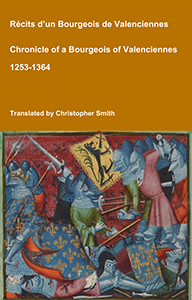
Chronicle of a Bourgeois of Valenciennes
Récits d’un bourgeois de Valenciennes aka The Chronicle of a Bourgeois of Valenciennes is a vivid 14th-century vernacular chronicle written by an anonymous urban chronicler from Valenciennes in the County of Hainaut. It survives in a manuscript that describes local and regional history from about 1253 to 1366, blending chronology, narrative episodes, and eyewitness-style accounts of political, military, and social events in medieval France, Flanders, and the Low Countries. The work begins with a chronological framework of events affecting Valenciennes and its region under rulers such as King Philip VI of France and the shifting allegiances of local nobility. It includes accounts of conflicts, sieges, diplomatic manoeuvres, and the impact of broader struggles like the Hundred Years’ War on urban life in Hainaut. Written from the perspective of a burgher (bourgeois) rather than a monastery or royal court, the chronicle offers a rare lay viewpoint on high politics and warfare, reflecting how merchants, townspeople, and civic institutions experienced the turbulence of the 13th and 14th centuries. Its narrative style combines straightforward reporting of events with moral and civic observations, making it a valuable source for readers interested in medieval urban society, regional politics, and the lived experience of war and governance in pre-modern Europe.
Available at Amazon in eBook and Paperback format.
On 3rd October 1831 Thomas Stapleton 12th Baron Despencer (age 64) died. His granddaughter Mary (age 9) succeeded 13th Baroness Despencer. His son Francis (age 24) succeeded 7th Baronet Stapleton of Leeward Islands.
On 24th September 1837 Susan Coutts Countess Guildford (age 67) died. She was buried at All Saints Church, Wroxton on 3rd October 1837.
On 3rd October 1851 Charles Jenkinson 3rd Earl Liverpool (age 67) died. Earl Liverpool and Baron Hawkesbury of Hawkesbury in Gloucestershire extinct. His half first cousin Charles (age 72) succeeded 10th Baronet Jenkinson of Walcot in Oxfordshire and of Hawkesbury in Gloucestershire. Katherine Campbell Lady Jenkinson (age 71) by marriage Lady Jenkinson of Walcot in Oxfordshire and of Hawkesbury in Gloucestershire.
On 3rd October 1859 George Child-Villiers 5th Earl Jersey (age 86) died. His son George (age 51) succeeded 6th Earl Jersey, 9th Viscount Grandison, 6th Viscount Villiers, 6th Baron Villiers. Julia Peel Countess Jersey by marriage Countess Jersey.
On 3rd October 1860 Alfred Edward Chalon (age 80) died at Campden Hill.
On 3rd October 1875 Charlotte Ann Josephine Tennant Lady Rycroft died.
On 3rd October 1885 John Crichton 3rd Earl Erne (age 83) died. His son John (age 45) succeeded 4th Earl Erne of Crom Castle in County Fermanagh, 4th Viscount Erne of Crom Castle in County Fermanagh, 5th Baron Erne of Crom Castle in Fermanagh. Florence Mary Cole Countess Erne (age 36) by marriage Countess Erne of Crom Castle in County Fermanagh.
On 3rd October 1896 William Morris (age 62) died after several months of "general organic degeneration", at Kelmscott House, Hammersmith. He died, Mackail says, 'quietly and without visible suffering' (II, 335)'
On 3rd October 1917 Burton Robert Williams 6th Baronet (age 28) was killed in action whilst serving as Lieutenant in the 3rd Battalion, Devon Regiment. His uncle Frederick (age 54) succeeded 7th Baronet Williams of Tregullow in Cornwall.
On 3rd October 1932 Frederic Glyn 4th Baron Wolverton (age 68) died. His son Nigel (age 28) succeeded 5th Baron Wolverton.
William of Worcester's Chronicle of England
William of Worcester, born around 1415, and died around 1482 was secretary to John Fastolf, the renowned soldier of the Hundred Years War, during which time he collected documents, letters, and wrote a record of events. Following their return to England in 1440 William was witness to major events. Twice in his chronicle he uses the first person: 1. when writing about the murder of Thomas, 7th Baron Scales, in 1460, he writes '… and I saw him lying naked in the cemetery near the porch of the church of St. Mary Overie in Southwark …' and 2. describing King Edward IV's entry into London in 1461 he writes '… proclaimed that all the people themselves were to recognize and acknowledge Edward as king. I was present and heard this, and immediately went down with them into the city'. William’s Chronicle is rich in detail. It is the source of much information about the Wars of the Roses, including the term 'Diabolical Marriage' to describe the marriage of Queen Elizabeth Woodville’s brother John’s marriage to Katherine, Dowager Duchess of Norfolk, he aged twenty, she sixty-five or more, and the story about a paper crown being placed in mockery on the severed head of Richard, 3rd Duke of York.
Available at Amazon in eBook and Paperback format.
On 3rd October 1942 Arthur Ralph Wilmot 7th Baronet (age 33) died in North Africa; the result of an accident. He was a Major with the 1st Bn, The Black Watch (Royal Highlanders)- Service No:41240. His son Robert (age 2) succeeded 8th Baronet Wilmot of Chaddesden in Derbyshire.
On 3rd October 1947 Anthony St John-Mildmay 8th Baronet (age 53) died. His son Henry (age 21) succeeded 9th Baronet St John-Mildmay of Farley in Southampton.
On 3rd October 1951 Herbert Charles Arthur Langham 13th Baronet (age 81) died. His son John (age 57) succeeded 14th Baronet Langham of Cottesbrooke in Northamptonshire.
On 3rd October 1960 Charles Peter Denys 4th Baronet (age 61) died. Baronet Denys of Stratford Place extinct.
On 3rd October 1978 Richard James Boughey 10th Baronet (age 53) died. His son John (age 19) succeeded 11th Baronet Boughey of Newcastle under Lyme in Staffordshire.