

Annals of the six Kings of England by Nicholas Trivet
Translation of the Annals of the Six Kings of England by that traces the rise and rule of the Angevin aka Plantagenet dynasty from the mid-12th to early 14th century. Written by the Dominican scholar Nicholas Trivet, the work offers a vivid account of English history from the reign of King Stephen through to the death of King Edward I, blending political narrative with moral reflection. Covering the reigns of six monarchs—from Stephen to Edward I—the chronicle explores royal authority, rebellion, war, and the shifting balance between crown, church, and nobility. Trivet provides detailed insight into defining moments such as baronial conflicts, Anglo-French rivalry, and the consolidation of royal power under Edward I, whose reign he describes with particular immediacy. The Annals combines careful year-by-year reporting with thoughtful interpretation, presenting history not merely as a sequence of events but as a moral and political lesson. Ideal for readers interested in medieval history, kingship, and the origins of the English state, this chronicle remains a valuable and accessible window into the turbulent world of the Plantagenet kings.
Available at Amazon in eBook and Paperback format.
06 Apr is in April.
25 Mar is the Feast of the Annunciation aka Lady Day. Under the Julian Calendar the year started on 25 March. In 1750 the start of the year was changed to the Gregorian Calendar which used 01 Jan as the start of the year. At that time the calendar was adjusted to fix the error in the Julian Calendar. Eleven days were lost. The tax year, and rents, and other legal instruments that relied on the calendar were not adjusted hence our tax year now starting on 6th April.
On 6th April 1147 Frederick "One Eyed" Hohenstaufen I Holy Roman Emperor [aged 57] died.
Chronicle of Roger de Hoveden. 6th April 1194. On the sixth day of April, the aforementioned kings came to the house of Peter the Forester of Rutland.
Sexta die mensis Aprilis venerunt prædicti reges ad domum Petri forestarii de Rotelande.
On 26th March 1199 King Richard "Lionheart" I of England [aged 41] was besieging Châlus Chabrol Castle. During the course of the evening King Richard "Lionheart" I of England was shot by a crossbow. Richard died on 6th April 1199. His brother John [aged 32] succeeded I King of England.
There was a brother between Richard and John named Geoffrey Duke of Brittany who had a son Arthur [aged 11], who was around twelve, and a daughter Eleanor [aged 15], who was around fifteen, whose mother was Constance Penthièvre Duchess Brittany [aged 38].
King Philip II of France [aged 33] had planned for Eleanor to marry his son, probably to bring Brittany into the French Royal family, possibly to pursue a claim on England.
King Philip II of France supported Arthur's claim to the English throne. In the resulting war Arthur was captured, imprisoned and never seen again. Eleanor was captured, probably around the same time as Arthur, and imprisoned, more or less, for the remainder of her life, even after King John's death through the reign of King Henry III since she represented a threat to Henry's succession.
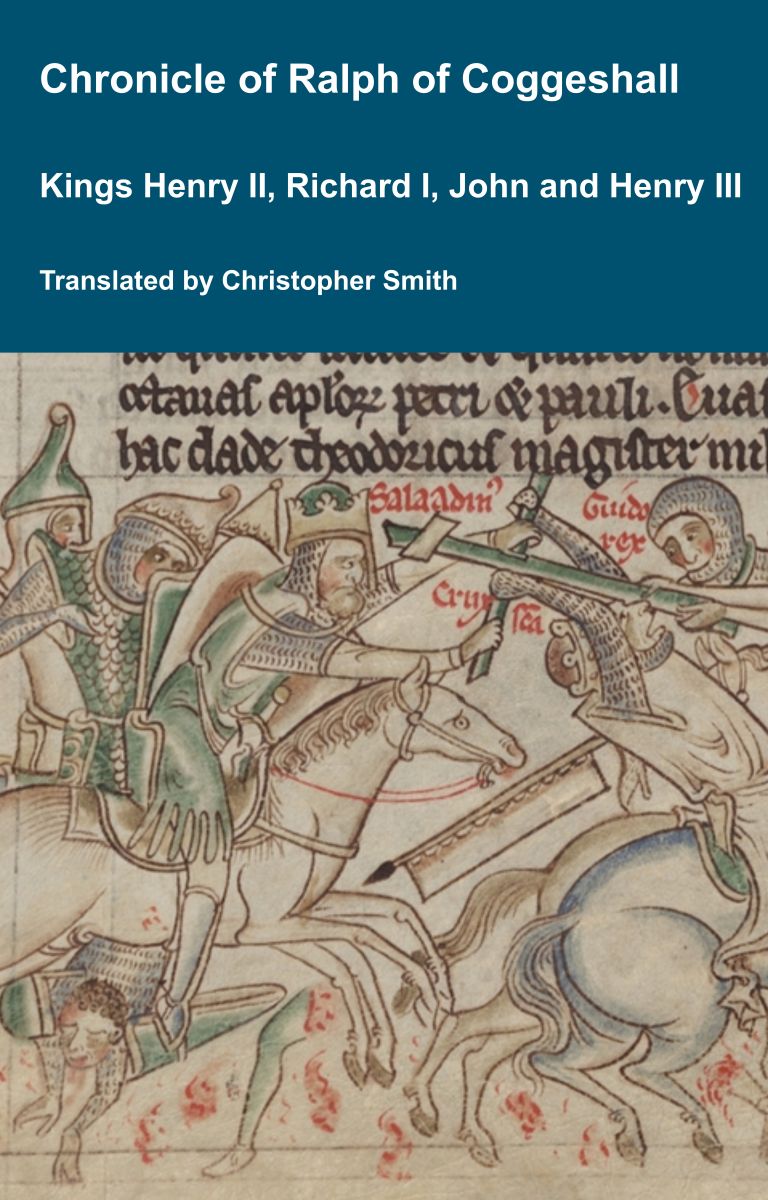 Chronicum Anglicanum by Ralph Coggeshall. Therefore, in the year of the Lord's Incarnation 1199, about the time of Lent, after a conference had been held between the two kings concerning the restoration of peace, at last a truce between them was agreed upon until a certain fixed term. Taking occasion from this, King Richard, having gained an opportunity, moved his private army during Lent against the viscount of Limoges, who, in the time of hostilities, had rebelled against the king his lord and made a pact of friendship with King Philip. Some, however, report that a certain treasure of inestimable price had been found in the land of the viscount, which the king commanded and ordered to be given to him; but when the viscount refused, it inflamed the king's anger against him all the more. And so, while he devastated the land of the viscount with fire and sword, for he knew not how to cease from arms even in that sacred season, at length he came to Châlus-Chabrol and besieged the tower, and fiercely assaulted it for three days, commanding his miners to undermine the tower and cause it to collapse once it had been undercut; which was afterward done. In that tower there were no men of knightly rank or defence, but only certain servants of the viscount, who vainly awaited help from their lord, not thinking that the king himself was present who besieged them, but supposing it to be one of the king's retainers. These the king himself, along with his crossbowmen, so assailed, while the others were undermining, that scarcely any dared appear upon the battlements of the tower or in any way attempt its defence. Yet from time to time they hurled down enormous stones from the highest battlements, which, rushing down with great force, terrified those standing around, but could by no means strike down the miners nor hinder their work, for they were protected on all sides by their customary devices. Now, when the third day was drawing to evening, on the eve of the Annunciation of Blessed Mary, the king, after dinner, unarmed save for an iron cap, confidently approached the tower with his men, and, as usual, assailed the besieged with missiles and arrows. Behold! A certain man-at-arms, who for almost the whole day before dinner had stood upon a certain battlement of the said tower, and had caught unharmed in a frying-pan all the iron missiles shot at him, and had carefully observed all the besiegers, suddenly appeared again; and bending his crossbow, he launched a bolt violently at the king, who was looking on and shouting at him, and struck the king upon his left shoulder near the neck bones1. The bolt, entering with a slanting wound, slipped downward and lodged in his left side, because the king did not bend low enough beneath the square shield that was being carried before him. For this wound, when it was inflicted, the king, ever renowned for boldness, uttered no sighs of the heart, no cry of lamentation, showed no sadness in face or gesture at that moment, lest he make his men sorrowful or fearful, or give the enemy greater courage because of the wound inflicted. Afterwards, as though he had suffered no harm, and many being ignorant of what misfortune had happened, he entered his lodging nearby, and, drawing out the wooden shaft that was fixed with the iron into his body, he broke it off; but the iron, of a hand's breadth in length, remained in his body. When therefore the king lay down in his chamber, a certain surgeon, of that accursed household of the most impious Mercardier, cut into the royal body and sorely, indeed mortally, injured it. With lamps lit in the house, he could not easily find the iron buried deep in the overly fleshy body, nor, once found by cutting, could he draw it out without great violence.
When diligent medicines and poultices had been applied, afterwards the inflicted wounds began to worsen and to blacken, and from day to day to swell all the more, and finally to threaten death, the king meanwhile being disobedient and disregarding the commands of the physicians. All his attendants were kept away from entering the chamber in which he lay, except for four of the more noble men, who were freely allowed to visit him, lest the report of his illness should more quickly be spread abroad. The king, being very uncertain about regaining health, summoned by letter his mother, who was dwelling at Fontevraud. He prepared for his end by receiving the life-giving sacrament of the Lord's Body, first making confession to one of his chaplains, although, out of reverence for so great a mystery, he is said to have refrained for nearly seven years from receiving that sacrament, because he bore mortal hatred in his heart against the king of France. He also freely forgave the man who had struck him with the fatal blow. And so, on the seventh of the Ides of April [6th April 1199] namely the eleventh day after the wound was inflicted on him, anointed with holy oil, when the day was drawing to a close, he closed his last day. His body, disembowelled, was carried to the nuns of Fontevraud, and on Palm Sunday was buried with royal honour beside his father by the bishop of Lincoln.
Igitur anno ab Incarnatione Domini MCXCIX, circa tempus quadragesimale, habito inter utrumque regem colloquio de pacis reformatione, tandem treugæ inter eos usque ad quoddam tempus præfinitum captæ sunt. Ex hac autem occasione rex Ricardus nactus opportunitatem movit privatum exercitum suum in Quadragesima contra vicecomitem Lemovicensem, qui, tempore hostilitatis, contra regem dominum suum rebellaverat, et foedus amicitiae cum rege Philippo pepigerat. Nonnulli vero referunt quod quidam thesaurus inæstimabilis pretii in terra vicecomitis sit repertus, quem rex mandat et jubet sibi dari; quo a vicecomite negato, amplius regis animositatem erga eum exacuit. Cumque terram vicecomitis ferro et flammis devastaret, utpote ab armis infra illud sacrum tempus feriari nesciens, tandem devenit apud Chali Cheperol, turrimque obsedit et atrociter per tres dies expugnavit, præcipiens fossoriis suis ut turrim subfoderent atque subfossam subruerent; quod postmodum factum est. In turri vero prædicta non erant alicujus militiæ vel defensionis viri, nisi quidam ex famulis vicecomitis, qui frustra præstolabantur auxilium domini sui, non æstimantes regem fore præsentem qui eos obsederat, sed aliquem fore ex familia regis. Hos igitur rex ipse cum arcubalistis ita aggressus est, dum cæteri circumfoderent, ut vix aliquis auderet circa propugnacula turris apparere, aut eam quolibet modo defensare. Attamen aliquoties lapides prægrandes de summis propugnaculis præcipitabant, qui magno impetu deorsum ruentes, circumastantes terrificabant, sed fossorios minime poterant prosternere nec ab incoeptis impedire, quippe qui consuetis ingeniis suis undique erant protecti. Jamque die tertia advesperascente, in crastino videlicet Annunciationis Beatæ Mariæ, cum rex, post prandium, inermis, excepto capello ferreo, cum suis ad turrim confidenter accessisset atque obsessos telis et sagittis more solito impeteret, ecce quidam armatus, qui fere per totam diem illam ante prandium in quodam propugnaculo turris prædicta astiterat, atque omnia tela ferrea sartagine opposita illæsus exceperat, omnesque obsidentes diligenter exploraverat, iterum subito adveniens tetendit arcubalistam atque quoddam quarellum violenter direxit ad regem, ipso inspiciente et acclamante, percussitque regem super humerum sinistrum juxta colli spondilia, sicque arcuato vulnere telum dilapsum est deorsum ac lateri sinistro immersum, dum rex se non satis incurvaret sub quadrato scuto quod ante eum præferebatur. Pro quo vulnere inflicto rex, audacitate semper prædicabilis, nulla cordis suspiria, nullam plangentis vocem emittebat, nullam tristitiam in vultu aut in gestu tunc ad præsens præferebat, ne suos tristes aut timidos redderet, atque inimicis de illato vulnere majorem audaciam præberet. Postea vero, quasi nil mali perpessus fuisset, pluribusque ignorantibus quid infortunii accidisset, hospitium suum, quod e vicino erat, ingreditur, lignumque ferro infixum de corpore extrahens confregit, sed ferrum, unius palmi longitudinem habens, in corpore remansit. Rege itaque in conclavi procumbente, quidam chirurgicus, ex nefanda illa familia impiissimi Marchadei, corpus regium secando, graviter, immo lætaliter, sauciavit, lucernis in domo accensis, nec potuit ferrum in corpore nimis obeso immersum leviter reperire, aut secando repertum sine magna violentia extrahere.
Appositis igitur diligenter medicaminibus et emplastris, postmodum coeperunt vulnera inflicta deteriorari et nigrescere, atque de die in diem amplius intumescere, tandemque mortem minari, rege incontinenter se habente et præcepta medicorum non curante. Arcebantur omnes sui ab introitu cubiculi in quo decumbebat, exceptis quatuor de nobilioribus, qui ad eum visitandum libere introibant, ne fama ægritudinis ejus citius per publicum divulgaretur. Rex autem de sospitate consequenda nimis incertus, matrem, quæ apud Fontem Ebraldi morabatur, literis accersivit; exitum suum vivifico sacramento Dominici corporis inunivit, confessione præmissa a quodam suo capellano, a cujus sacramenti perceptione, ob tanti mysterii reverentiam, fere per septennium, ut dicunt, abstinuerat, eo quod mortale odium erga regem Galliæ in corde gestaverat. Mortem etiam sibi illatam percussori suo libenter indulsit; sicque septimo idus Aprilis, scilicet undecimo die a vulnere sibi illato, oleo sacro inunctus, cum jam dies clauderetur, diem clausit extremum. Cujus corpus exenteratum, et apud sanctimoniales Fontis Ebraldi delatum, Dominica in Palmis, juxta patrem suum regio honore ab episcopo Lincolniensi humatum est.
Note 1. Roger Hoveden: "On the same day, as King Richard I and Mercadier (his captain of mercenaries) were riding around the castle, examining from where it would be best to attack, a certain crossbowman, named Bertran de Gourdon, shot an arrow from the castle. The bolt struck the king in the arm, inflicting a mortal wound. Though wounded, the king mounted his horse and rode back to his quarters. There, he ordered Mercadier and his entire army to continue the assault relentlessly until the castle was captured. And so it was done. Once the castle was captured, King Richard ordered that all its defenders be hanged, except for the man who had wounded him. For, as one might expect, had the king recovered, he would have sentenced him to the most disgraceful death. Then the king entrusted himself to a surgeon in Mercadier's service. When the man attempted to extract the arrowhead, he only removed the wooden shaft, leaving the iron tip embedded in the flesh. As the butcher of a surgeon carelessly cut around the king's arm, he finally managed to extract the arrowhead. Realizing he was beyond hope, King Richard bequeathed the Kingdom of England and all his other lands to his brother John. He ordered all those present to swear fealty to John and instructed that his castles be surrendered to him. He divided three-quarters of his treasure among John and Otto, his nephew and King of the Germans, and the remaining quarter was to be distributed to his knights and the poor. Then, he had Bertran de Gourdon, the crossbowman who had wounded him, brought before him and asked: 'What wrong have I done to you, that you have killed me?' To this, Bertran replied: 'You killed my father and my two brothers with your own hands, and you sought to kill me as well. Take whatever revenge you will; I will gladly suffer whatever tortures you devise, as long as you die for you have brought so much evil to the world.' Then the king ordered that he be set free and said: 'I grant you your life.' And thus, with his bonds loosened, he was allowed to depart, and the king ordered that he be given one hundred shillings of English money. However, Mercadier, without the king's knowledge, seized him and, after the king's death, had him flayed and hanged."
Ralph de Decito: "King Richard of the English, when he had reigned for nine years, six months, and nineteen days, in the duchy of Aquitaine, in the territory of Limoges, at the castle of Châlus, was struck on the seventh day before the Kalends of April [26th March 1199] by an arrow from Peter Basileus; and afterwards, on the eighth Ides of April [6th April 1199], on a Tuesday, this man destined for martial deeds closed his last day at the aforesaid castle. He was buried at Fontevraud, at the feet of his father, King Henry II."
On 6th April 1250 the Battle of Fariskur was the last major battle of the Seventh Crusade. The Crusader army was defeated. King Louis IX of France [aged 35] and his two brothers Alphonse Count Poitiers II Count Toulouse [aged 29] and King Charles Capet of Sicily [aged 23] were captured.
On 6th April 1255 Theobald "Young" II King Navarre [aged 15] and Isabella Capet [aged 14] were married. She the daughter of King Louis IX of France [aged 40] and Margaret Provence Queen Consort France [aged 34]. He the son of Theobald IV King Navarre and Margaret Bourbon Queen Consort Navarre [aged 38]. They were half third cousins. He a great x 4 grandson of King William "Conqueror" I of England. She a great x 2 granddaughter of King Henry "Curtmantle" II of England.
On 6th April 1264 the future King Edward I of England [aged 24], Philip Marmion 5th Baron Marmion [aged 30] and Roger Leybourne [aged 49] fought for the King at Northampton Castle [Map] during the Battle of Northampton. Simon de Montfort 6th Earl of Leicester 1st Earl Chester [aged 56] fought for the rebels with his son Simon "Younger" Montfort [aged 24] who was captured.
 Chronicle of Geoffrey le Baker of Swinbroke. In the year of Christ 1305, in the first year of Pope Benedict XI, and the 33rd year of Edward I after the Conquest, the king celebrated the solemnity of Christmas at Lincoln. He appointed justices of Trailbaston1 throughout all of England to punish wrongdoers, and through them, after many were punished, the king's treasury was greatly enriched.2
Anno Christi MCCCV, Benedicti pape XJ anno primo, Edwardi primi post conquestum anno XXXIIJ solempnitatem Natalis Christi Lincolnie rex celebravit; et iusticiarios de trailebaston per totam Angliam malefactores punituros ordinavit, per quos, multis castigatis, regis erarium valde fuerat ditatum.
Note 1. The commission of Trailbaston issued 6th April 1305. See also  Guisborough, 2.235.
The term Trailbaston has been variously interpreted as applying either to the judges or to the offenders. As early as the time of Trivet it appears to have been taken as a popular nickname for the judges: "These justices were called by the common people 'justices of traylebastoun', which means 'drag-stick' or 'club-draggers'." (Chronicle, p. 404). This view is, however, certainly erroneous. The endorsement on the commission itself shows that the offence or offenders are indicated: "Concerning the transgressions called Trailbaston, to be heard and determined." In the Chronological Abstract (p. 66) prefixed to the Parliamentary Writs, volume i., this is pointed out in the following words: The "Ordinatio de Trailbaston" is extant on the Parliamentary Roll (Parliament Rolls, 1.178). The Commission pursues the term of the Ordinance. Lord Coke says that they were called Justices of Trailbaston because they proceeded as speedily as one might draw or trail a staff (4 Inst. 34); and others have supposed that they obtained their title from their staves of office. It is obvious, however, that the name was originally applied either to the offence or to the offenders.
Langtoft (Rolls Series), 2.360, describes these offenders as common quarrellers, banded together and ready, for a few shillings, to beat a goodman who never did harm to any one. Fellows of that company are named Trailbastons:
Men of good will have made a response to the king,
That throughout the land a great grievance is taking place,
By common brawlers, who are bound together by oath
To a shared plan;
They are called Trailbastons by that association.
At fairs and markets, they offer to make an agreement
For three or four pence, or for the price
To beat an honest man who never did any harm
To a Christian body, without any witness.
Matthew of Westminster 450-1, also describes their impartial readiness to beat any one to order: "Around the same time, a new writ of inquisition was issued to the public, which in English is called Trailbaston, against those who had intruded upon others' lands and, out of fear of those bringing complaints, had transferred those lands or holdings into the hands of powerful men; and also against hired thugs and brawlers, who, having been hired by one man for a sum of money to beat another, would then accept a larger payment from the beaten man to beat back the original employer more viciously."
Circa eadem vero tempora processit in publicum novum inquisitionis breve, quod Anglice dicitur Trayllebaston, contra intrusores alienarum terrarum, qui, propter timorem conquerentium, ipsas terras vel prasdia in manus potentium alienarant; et contra conductitios hominum vapulatores, qui, ab uno viro conduct!, volebant, propter unam summam pecuniae, alium vapulare, et iterum a vapulato, propter duplum censum vel amplius, revapulare nequius conductorem
Note 2. So Matthew of Westminster 451: "By this brief decree, indeed, many were killed, many found guilty, and few found innocent. So rigidly, in fact, did the justice of this punishment proceed that a father would not spare his own son, but would rebuke and punish him. Out of fear, moreover, many fled in terror of their own accord, and through flight and the payment of ransoms, the treasury grew rich."
"Per hoc quidem breve multi perempti, multi noxii, pauci innoxii sunt inventi. Adeo quidem rigide processit hujus coercionis justicia, quod pater proprio filio non parceret, sed increpans castigaret. Prae timore autem multi exterriti spontanee exulabant, et per fugam et redemptionem pecunias crevit fiscus."
On 6th April 1320 fifty-one Scottish magnates signed a letter to Pope John XII [aged 76] declaring Scotland to be an independent sovereign state. The signatories included Malcolm Lennox 2nd Earl Lennox.
Archaeologia Volume 35 1853 XXXIII. On the 6th of April [1358], the Prince of Wales [aged 27], attended by four knights, dined with the Queen [aged 63].
On 6th April 1362 Jacques Bourbon I Count La Marche and Ponthieu [aged 43] was killed at the Battle of Brignais. His son Jean [aged 18] succeeded I Count La Marche. His son Pierre Bourbon [aged 20] was also killed.
In 1410 John Mainwaring [aged 66] died. On 6th April 1418 Margaret Stafford [aged 65] died. Both buried at St Lawrence's Church, Over Peover [Map].
Monument at St Lawrence's Church, Over Peover [Map]. Camail and Jupon Period. IHC NASARE Lettering. Hip Belt. Lancastrian Esses Collar. Woman Esses Collar.
John Mainwaring: Around 1344 he was born to William "The Elder" IV Mainwaring in Over Peover, Cheshire. Before 1410 John Mainwaring and Margaret Stafford were married.
Margaret Stafford: Around 1345 she was born to John Stafford and Margaret Stafford.


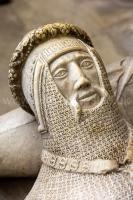


Letters and Papers Foreign and Domestic Henry VIII 1518. 6th April 1518. R.O. 4060. Pace [aged 36] to WOLSEY.
The King has this day summoned his Council, and stated that London was still infected with sickness; therefore he must avoid it. He thinks that the infection is kept from Wolsey's knowledge, as it was from his when he was there; and notwithstanding the scarceness in the country about Abingdon he is compelled to remain in places thereabouts, as comprised in the bill enclosed. Wolsey is to certify the King whether there are a sufficient number of the Council in attendance on him for the business of the next term, and advises him to leave London when it is over. Will be heartily welcome to the King if he chooses to come. Wishes a train of horses to be appointed betwixt himself and Wolsey every seven hours. Of the noblemen now about the King and their order, the King will remember such communication "concerning some of them" as has been between himself and Wolsey. He wishes to know of the progress of the sickness.—"When I had written thus far the King's grace commanded me to add unto the premises, that both his highness and all his Council doth fear the said sickness now at the beginning of these heats, which be great here considering the time of the year." The Queen said yesterday that she had perfect knowledge of the sickness being in London, and "that, though she be no prophet, yet she would lose her finger if some inconvenient should not ensue unto the King's person if he should at this time repass towards London. Et has ego judico esse causas istius subitæ mutationis1." Sends, by the King's command, the names of all the councillors waiting on him this day. Abingdon, 6 April.
Note 1. Et has ego judico esse causas istius subitæ mutationis ie And these I judge to be the causes of this sudden change.

Chronicle of Greyfriars. 6th April 1532. Also this yere was a coke boylyd in a cauderne in Smythfeld for he wolde a powsynd the byshoppe of Rochester Fycher [aged 62] with dy vers of hys servanttes, and he was lockyd in a chayne and pullyd up and downe with a gybbyt at dyvers tymes tyll he was dede.
Note. Poisoning of the household of the bishop of Rochester, and the punishment by Boiling. This crime occasioned great popular excitement at the time, which was probably increased both by the supposition that the life of the bishop (John Fisher) had been attempted, and by the rumour that many of the poor which had partaken of his alms had died, which is directly asserted as the fact by Stowe. Such, however, was not actually the case: only one of the episcopal household, and one poor widow, lost their lives. As the parliament was sitting, the matter was brought before it, and an act (22 Hen. VIII. c. 9) was passed, reciting that " now in the tyme of this presente parliament, that is to saye, in the xviijth daye of Februarye in the xxij. yere of his moste victorious reygn, one Richard Roose late of Rouchester in the countie of Kent, coke, otherwyse called Richard Coke, of his moste wyked and dampnable dysposicyon dyd caste a certyne venym or poyson into a vessell replenysshed with yeste or barme stondyng in the kechyn of the Reverende Father in God John Bysshopp of Rochester at his place in Lamebyth Marsshe, wyth whych yeste or barme and other thynges convenyent porrage or gruell was forth wyth made for his famylye there beyng, wherby nat only the nombre of xvij. persons of his said famylie whych dyd eate of that porrage were mortally enfected and poysoned, and one of them, that is to say, Benett Curwen gentylman therof is deceassed, but also certeyne pore people which resorted to the sayde Bysshops place and were there charytably fedde wyth the remayne of the saide porrage and other vytayles, were in lyke wyse infected, and one pore woman of them, that is to saye, Alyce Tryppytt wydowe, is also thereof now deceassed: our sayde Sovereign Lorde the Kynge, of hys blessed disposicion inwardly abhorryng all such abhomynable offences because that in maner no persone can lyve in suertye out of daunger of death by that meane yf practyse therof should not be exchued, hath ordeyned and enacted by auctorytie of thys presente parlyament that the sayde poysonyng be adjudged and denied as high treason. And that the sayde Richard for the sayd murder and poysonynge of the said two persones as is aforesayde by auctoritie of this presente parlyament shall stande and be attaynted of highe treason: And by cause that detestable offence nowe newly practysed and comytted requyreth condygne punysshemente for the same; It is ordeyned and enacted by auctoritie of this present parlyament that the said Richard Roose shalbe therfore boyled to deathe withoute havynge any advauntage of his clargie. And that from hensforth every wylfull murder of any persone or persones by any whatsoever persone or persones herafter to be comytted and done by meane or waye of poysonyng shalbe reputed, denied, and juged in the lawe to be highe treason; And that all and every persone or persones which hereafter shalbe lawfully indyted, appeled and attaynted or condemned of such treson for any maner poysonyng shall not be admytted to the benefyte of hys or theyre clargye, but shalbe immedyatly committed to execucion of deth by boylynge for the same."
It has been supposed that this was an ex-post facto enactment, so far as Richard Roose was concerned; and yet we find by the present chronicle, p. 30, that, at an earlier period of Henry's reign, nine years before, a man was sodden in a cauldron at Smithfield, "because he would have poisoned divers persons." Therefore the same punishment appears to have previously attached to the offence. It has not, however, been traced to still earlier times. (See "Notes and Queries," 1852, vol. v. pp. 32, 112, 184.) A third instance of its execution has been found in the chronicle of King's Lynn, about the same time as Roose's case: "1531. This year here was a maid boiled to death in the Market-place for poisoning her mistress." (Ibid. p.355.) A fourth occurs in 1542, which is briefly mentioned in p. 45 of the present volume, and somewhat differently by Stowe, as follows: "The 17 March [i.e. a week later] Margaret Davy, a maid, was boiled in Smithfield for poisoning of the household that she had dwelled in." Sir Walter Scott, in his Border Minstrelsy (notes to Leyden's ballad of Lord Soulis), gives this passage with the erroneous date of 1524, following a misprint in Stowe's margin. The punishment by boiling is supposed to have been repealed by the statute 1 Edward VI. c. 12, by which all new treasons were abolished.
William of Worcester's Chronicle of England
William of Worcester, born around 1415, and died around 1482 was secretary to John Fastolf, the renowned soldier of the Hundred Years War, during which time he collected documents, letters, and wrote a record of events. Following their return to England in 1440 William was witness to major events. Twice in his chronicle he uses the first person: 1. when writing about the murder of Thomas, 7th Baron Scales, in 1460, he writes '… and I saw him lying naked in the cemetery near the porch of the church of St. Mary Overie in Southwark …' and 2. describing King Edward IV's entry into London in 1461 he writes '… proclaimed that all the people themselves were to recognize and acknowledge Edward as king. I was present and heard this, and immediately went down with them into the city'. William’s Chronicle is rich in detail. It is the source of much information about the Wars of the Roses, including the term 'Diabolical Marriage' to describe the marriage of Queen Elizabeth Woodville’s brother John’s marriage to Katherine, Dowager Duchess of Norfolk, he aged twenty, she sixty-five or more, and the story about a paper crown being placed in mockery on the severed head of Richard, 3rd Duke of York.
Available at Amazon in eBook and Paperback format.
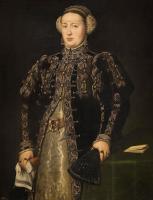
On 6th April 1535 Infante Denis Aviz was born to John III King Portugal [aged 32] and Catherine of Austria Queen Consort Portugal [aged 28]. Coefficient of inbreeding 11.30%. He died aged one in 1537.
On 6th April 1580 an Earthquake occurred in southern England - see A Discourse on the Earthquake by Golding, A Warning to the Wise by Churchyard.
A Discourse on the Earthquake by Golding. A discourse upon the Earthquake that hapned throughe this Realme of Englande, and other places of Christendom, the sixt of Aprill. 1580. betwene the houres of five and six in the Evening. Written by Arthur Golding, Gentleman. At London, Imprinted by Henry Binneman dwelling in Thamis streate nere Baynerds castle.
A Warning to the Wise by Churchyard. A warning for the wise, a feare to the fond, a bridle to the lewde, and a glasse to the good Written of the late earthquake chanced in London and other places, the 6. of April 1580. for the glorie of God, and benefite of men that warely can walke, and wisely can iudge. (London: John Allde & Nicholas Lyng, 1580)
On 6th April 1595 Christian William Wettin was born to Johann Wettin II Duke Saxe Weimar [aged 24] and Dorothea Maria Anhalt at Altenburg. He died aged less than one years old.
On 6th April 1595 Henri Valois II Duke Longueville was born to Henri Valois I Duke Longueville [aged 27] and Catherine Gonzaga Duchess Longueville [aged 27]. He married (1) 10th April 1617 his second cousin Louise Bourbon Condé Duchess Longueville, daughter of Charles Bourbon Condé Count Soissons and Anne Montafié Countess Soissons, and had issue (2) 1642 his third cousin once removed Anne Geneviève Bourbon Condé Duchess Longueville.
On 6th April 1612 James Stewart 4th Duke Lennox 1st Duke Richmond was born to Esmé Stewart 3rd Duke Lennox [aged 33] and Katherine Clifton Duchess Lennox [aged 20]. He married 3rd August 1637 his half fifth cousin once removed Mary Villiers Duchess Lennox Duchess Richmond, daughter of George Villiers 1st Duke of Buckingham and Katherine Manners Duchess Buckingham, and had issue.

Diary of Anne Clifford. 6th April 1619. The 6th my Lord [aged 30] came from Buckhurst to Knole. At his being at Lewes there was great play between my Lord of Hunsden [aged 39], my Lady of Effingham, and my Lord who lost them £200, and the town entertained him with fireworks.
On 6th April 1632 Maria Leopoldine Habsburg Spain Queen Consort Bohemia was born to Leopold Habsburg Spain V Archduke Austria [aged 45] and Claudia Medici [aged 27]. She married 2nd July 1648 her first cousin Ferdinand III Holy Roman Emperor, son of Ferdinand of Spain II Holy Roman Emperor and Maria Anna Wittelsbach Holy Roman Empress, and had issue.
On 6th April 1653 Frederick Louis Oldenburg I Duke Schleswig-Holstein-Sonderburg-Beck was born to August Philipp Oldenburg I Duke Schleswig-Holstein-Sonderburg-Beck [aged 40] and Marie Sibylle Nassau Saarbrücken Duchess Schleswig-Holstein-Sonderburg-Beck. He married 1st January 1685 his first cousin Louise Charlotte Oldenburg Duchess Schleswig-Holstein-Sonderburg-Beck, daughter of Ernest Günther Oldenburg I Duke Schleswig Holstein Sonderburg Augustenburg and Auguste Oldenburg Duchess Schleswig Holstein Sonderburg Augustenburg, and had issue.
Samuel Pepys' Diary. 6th April 1663. Thence leaving them I made an excuse and away home, and took my wife by coach and left her at Madam Clerk's, to make a visit there, and I to the Committee of Tangier [Map], where I found, to my great joy, my Lord Sandwich [aged 37], the first time I have seen him abroad these some months, and by and by he rose and took leave, being, it seems, this night to go to Kensington or Chelsey, where he hath taken a lodging for a while to take the ayre. We staid, and after business done I got Mr. Coventry [aged 35] into the Matted Gallery and told him my whole mind concerning matters of our office, all my discontent to see things of so great trust carried so neglectfully, and what pitiful service the Controller and Surveyor make of their duties, and I disburdened my mind wholly to him and he to me his own, many things, telling me that he is much discouraged by seeing things not to grow better and better as he did well hope they would have done. Upon the whole, after a full hour's private discourse, telling one another our minds, we with great content parted, and with very great satisfaction for my [having] thus cleared my conscience, went to Dr. Clerk's and thence fetched my wife, and by coach home. To my office a little to set things in order, and so home to supper and to bed.


Chronicle of Abbot Ralph of Coggeshall
The Chronicle of Abbot Ralph of Coggeshall (Chronicon Anglicanum) is an indispensable medieval history that brings to life centuries of English and European affairs through the eyes of a learned Cistercian monk. Ralph of Coggeshall, abbot of the Abbey of Coggeshall in Essex in the early 13th century, continued and expanded his community’s chronicle, documenting events from the Norman Conquest of 1066 into the tumultuous reign of King Henry III. Blending eyewitness testimony, careful compilation, and the monastic commitment to record-keeping, this chronicle offers a rare narrative of political intrigue, royal power struggles, and social upheaval in England and beyond. Ralph’s work captures the reigns of pivotal figures such as Richard I and King John, providing invaluable insights into their characters, decisions, and the forces that shaped medieval rule. More than a simple annal, Chronicon Anglicanum conveys the texture of medieval life and governance, making it a rich source for scholars and readers fascinated by English history, monastic authorship, and the shaping of the medieval world.
Available at Amazon in eBook and Paperback format.
Samuel Pepys' Diary. 6th April 1664. So away he went, and I all the morning in my office busy, and at noon home to dinner mightily oppressed with wind, and after dinner took coach and to Paternoster Row [Map], and there bought a pretty silke for a petticoate for my wife, and thence set her down at the New Exchange, and I leaving the coat at Unthanke's, went to White Hall, but the Councell meeting at Worcester House I went thither, and there delivered to the Duke of Albemarle [aged 55] a paper touching some Tangier [Map] business, and thence to the 'Change [Map] for my wife, and walked to my father's, who was packing up some things for the country. I took him up and told him this business of Tom, at which the poor wretch was much troubled, and desired me that I would speak with J. Noble, and do what I could and thought fit in it without concerning him in it. So I went to Noble, and saw the bond that Cave did give and also Tom's letter that I mentioned above, and upon the whole I think some shame may come, but that it will be hard from any thing I see there to prove the child to be his.

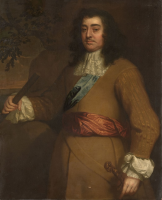
Samuel Pepys' Diary. 6th April 1665. Home and after a mouthfull of dinner to the office, where till 6 o'clock, and then to White Hall, and there with Sir G. Carteret [aged 55] and my Lord Brunckerd [aged 45] attended the Duke of Albemarle [aged 56] about the business of money. I also went to Jervas's, my barber, for my periwigg that was mending there, and there do hear that Jane is quite undone, taking the idle fellow for her husband yet not married, and lay with him several weeks that had another wife and child, and she is now going into Ireland.
John Evelyn's Diary. 6th April 1665. In the afternoon, I saw acted "Mustapha", a tragedy written by the Earl of Orrery [aged 43].
Samuel Pepys' Diary. 6th April 1666. Thence to Mr. Hales [aged 66] and there sat, and my picture almost finished, which by the word of Mr. and Mrs. Pierce (who come in accidentally) is mighty like, and I am sure I am mightily pleased both in the thing and the posture.

Samuel Pepys' Diary. 6th April 1668. Thence I to White Hall to attend the Council, and when the Council rose we find my order mightily enlarged by the Sollicitor Generall [aged 46], who was called thither, making it more safe for him and the Council, but their order is the same in the command of it that I drew, and will I think defend us well. So thence, meeting Creed, he and I to the new Cocke [aged 51]-pitt by the King's gate, and there saw the manner of it, and the mixed rabble of people that come thither; and saw two battles of cocks, wherein is no great sport, but only to consider how these creatures, without any provocation, do fight and kill one another, and aim only at one another's heads, and by their good will not leave till one of them be killed; and thence to the Park in a Hackney coach, so would not go into the tour, but round about the Park, and to the House, and there at the door eat and drank; whither come my Lady Kerneagy [aged 29], of whom Creed tells me more particulars; how her Lord, finding her and the Duke of York [aged 34] at the King's first coming in too kind, did get it out of her that he did dishonour him, and so bid her continue... [Note. Missing text ... to let him, and himself went to the foulest whore he could find, that he might get the pox; and did, and did give his wife it on purpose, that she (and he persuaded and threatened her that she should) might give it the Duke of York; which she did, and he did give it to the Duchesse; and since, all her children are thus sickly and infirm ], which is the most pernicious and full piece of revenge that ever I heard of; and he at this day owns it with great glory, and looks upon the Duke of York and the world with great content in the ampleness of his revenge.
Samuel Pepys' Diary. 6th April 1668. Betimes I to Alderman Backewell [aged 50], and with him to my Lord Ashly's [aged 46], where did a little business about Tangier, and to talk about the business of certificates, wherein, contrary to what could be believed, the King [aged 37] and Duke of York [aged 34] themselves, in my absence, did call for some of the Commissioners of the Treasury, and give them directions about the business [of the certificates], which I, despairing to do any thing on a Sunday, and not thinking that they would think of it themselves, did rest satisfied, and stayed at home all yesterday, leaving it to do something in this day; but I find that the King and Duke of York had been so pressing in it, that my Lord Ashly was more forward with the doing of it this day, than I could have been. And so I to White Hall with Alderman Backewell in his coach, with Mr. Blany; my Lord's Secretary: and there did draw up a rough draught of what order I would have, and did carry it in, and had it read twice and approved of, before my Lord Ashly and three more of the Commissioners of the Treasury, and then went up to the Council-chamber, where the Duke of York, and Prince Rupert [aged 48], and the rest of the Committee of the Navy were sitting: and I did get some of them to read it there: and they would have had it passed presently, but Sir John Nicholas desired they would first have it approved by a full Council: and, therefore, a Council Extraordinary was readily summoned against the afternoon, and the Duke of York run presently to the King, as if now they were really set to mind their business, which God grant! So I thence to Westminster, and walked in the Hall and up and down, the House being called over to-day, and little news, but some talk as if the agreement between France and Spain were like to be, which would be bad for us, and at noon with Sir Herbert Price [aged 63] to Mr. George Montagu's [aged 45] to dinner, being invited by him in the hall, and there mightily made of, even to great trouble to me to be so commended before my face, with that flattery and importunity, that I was quite troubled with it. Yet he is a fine gentleman, truly, and his lady a fine woman; and, among many sons that I saw there, there was a little daughter that is mighty pretty, of which he is infinite fond: and, after dinner, did make her play on the gittar and sing, which she did mighty prettily, and seems to have a mighty musical soul, keeping time with most excellent spirit. Here I met with Mr. Brownlow, my old schoolfellow, who come thither, I suppose, as a suitor to one of the young ladies that were there, and a sober man he seems to be. But here Mr. Montagu did tell me how Mr. Vaughan [aged 64], in that very room, did say that I was a great man, and had great understanding, and I know not what, which, I confess, I was a little proud of, if I may believe him. Here I do hear, as a great secret, that the King, and Duke of York and Duchesse, and my Baroness Castlemayne [aged 27], are now all agreed in a strict league, and all things like to go very current, and that it is not impossible to have my Lord Clarendon [aged 59], in time, here again. But I do hear that my Baroness Castlemayne is horribly vexed at the late libell1, the petition of the poor whores about the town, whose houses were pulled down the other day. I have got one of them, but it is not very witty, but devilish severe against her and the King and I wonder how it durst be printed and spread abroad, which shews that the times are loose, and come to a great disregard of the King, or Court, or Government.
Note 1. "The Poor Whores' Petition to the most splendid, illustrious, serene and eminent Lady of Pleasure the Countess of Castlemayne, &c., signed by us, Madam Cresswell and Damaris Page, this present 25th day of March, 1668". This sham petition occasioned a pretended answer, entitled, "The Gracious Answer of the Most Illustrious Lady of Pleasure, the Countess of Castlem.... to the Poor Whores' Petition". It is signed, "Given at our Closset, in King Street, Westminster, die Veneris, April 24, 1668. Castlem...". Compare Evelyn, April 2nd, 1668.
On 6th April 1676 Mary Cromwell [aged 45] died. Memorial at St Mary's Church, Tissington [Map]. Her husband's second's wife's memorial has been added at bottom.
Mary Cromwell: Around 1631 she was born to Thomas Cromwell 1st Earl Ardglass and Elizabeth Meverell Countess Ardglass. Before 6th April 1676 William Fitzherbert and she were married. She the daughter of Thomas Cromwell 1st Earl Ardglass and Elizabeth Meverell Countess Ardglass.


On 6th April 1678 Joshua Marshall [aged 49] died. He was buried in St Dunstan's in the West, Fleet Street [Map].

John Evelyn's Diary. 6th April 1683. Good Friday. There was in the afternoon, according to custom, a sermon before the King [aged 52], at Whitehall [Map]; Dr. Sprat [aged 48] preached for the Bishop of Rochester [aged 58].
On 6th April 1683 George Fitzroy 1st Duke Northumberland [aged 17] was created 1st Duke Northumberland by King Charles II of England Scotland and Ireland [aged 52].
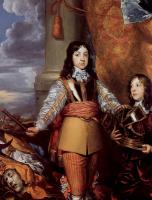


John Evelyn's Diary. 6th April 1692. A fast. King James [aged 58] sends a letter written and directed by his own hand to several of the Privy Council, and one to his daughter [aged 29], the Queen Regent, informing them of the Queen [aged 33] being ready to be brought to bed, and summoning them to be at the birth by the middle of May, promising as from the French King [aged 53], permission to come and return in safety.
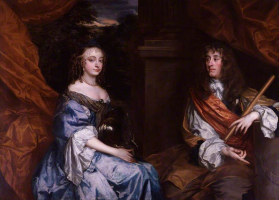


Chronicle of Geoffrey le Baker of Swinbroke
Baker was a secular clerk from Swinbroke, now Swinbrook, an Oxfordshire village two miles east of Burford. His Chronicle describes the events of the period 1303-1356: Gaveston, Bannockburn, Boroughbridge, the murder of King Edward II, the Scottish Wars, Sluys, Crécy, the Black Death, Winchelsea and Poitiers. To quote Herbert Bruce 'it possesses a vigorous and characteristic style, and its value for particular events between 1303 and 1356 has been recognised by its editor and by subsequent writers'. The book provides remarkable detail about the events it describes. Baker's text has been augmented with hundreds of notes, including extracts from other contemporary chronicles, such as the Annales Londonienses, Annales Paulini, Murimuth, Lanercost, Avesbury, Guisborough and Froissart to enrich the reader's understanding. The translation takes as its source the 'Chronicon Galfridi le Baker de Swynebroke' published in 1889, edited by Edward Maunde Thompson.
Available at Amazon in eBook and Paperback format.
On 6th April 1696 Charles Beauclerk 2nd Duke St Albans was born to Charles Beauclerk 1st Duke St Albans [aged 25] and Diana Vere Duchess St Albans [aged 17]. He a grandson of King Charles II of England Scotland and Ireland. He married 13th December 1722 Lucy Werden Duchess St Albans, daughter of John Werden 2nd Baronet, and had issue.


On 6th April 1721 Frederick Christian Oldenburg I Duke Schleswig Holstein Sonderburg Augustenburg was born to Christian August Oldenburg I Duke Schleswig Holstein Sonderburg Augustenburg [aged 24] and Frederikke Louise Unknown Duchess Schleswig Holstein Sonderburg Augustenburg. He married 26th May 1762 Charlotte Amalie Wilhelmine Unknown Duchess Schleswig Holstein Sonderburg Augustenburg, daughter of Frederick Charles Unknown Duke Schleswig Holstein Sonderburg Plön, and had issue.
On 6th April 1737 George Montagu 4th Duke Manchester was born to Robert Montagu 3rd Duke Manchester [aged 27] and Harriet Dunch Duchess Manchester. He married 22nd October 1762 Elizabeth Dashwood Duchess Manchester, daughter of James Dashwood 2nd Baronet and Elizabeth Spencer Lady Dashwood, and had issue.
On 6th April 1743 Michael Newton 4th Baronet [aged 48] died. Baronet Newton of Barrs Court extinct. He was buried at St Michael's Church, Heydour [Map]. Sculpted by Peter Scheemakers [aged 52].




Letters of Horace Walpole. 23rd March 1752. Arlington Street. To Horace Mann 1st Baronet [aged 45].
Mr. Conway [aged 31] has been arrived this fortnight, or a week sooner than we expected him: but my Lady Ailesbury [aged 31] forgives it! He is full of your praises, so you have not sowed your goodness in unthankful ground. By a letter I have just received from you he finds you have missed some from him with Commissions; but he will tell you about them himself I find him much leaner, and great cracks in his beauty. Your picture is arrived, which he says is extremely like you. Mr. Chute [aged 50] cannot bear it; says it wants your countenance and goodness; that it looks bonny and Irish. I am between both, and should know it; to be sure, there is none of your wet-brown-paperness in it, but it has a look with which I have known you come out of your little room, when Richcourt has raised your ministerial French, and you have writ to England about it till you were half fuddled. Au reste, it is gloriously coloured-will Astley promise to continue to do as well? or has he, like all other English painters, only laboured this to get reputation, and then intends to daub away to get money?
The year has not kept the promise of tranquillity that it made you at Christmas; there has been another parliamentary bustle. The Duke of Argyll [aged 69]299 has drawn the ministry into accommodating him with a notable job, under the notion of buying for the King from the mortgagees the forfeited estates in Scotland, which are to be colonized and civilized. It passed with some inconsiderable hitches through the Commons; but in the Lords last week the Duke of Bedford [aged 41] took it up warmly, and spoke like another Pitt.300 He attacked the Duke of Argyll on favouring Jacobites, and produced some flagrant instances, which the Scotch Duke neither answered nor endeavoured to excuse, but made a strange, hurt, mysterious, contemptuous, incoherent speech, neither in defence of the bill nor in reply to the Duke of Bedford, but to my Lord Bath [aged 68], who had fallen upon the ministry for assuming a dispensing power, in suffering Scotland to pay no taxes for the last five years. This speech, which formerly would have made the House of Commons take up arms, was strangely flat and unanimated, for want of his old chorus. Twelve lords divided against eighty that were for the bill. The Duke, who was present, would not vote; none of his people had attended the bill in the other House, and General Mordaunt [aged 55] (by his orders, as it is imagined) spoke against it. This concludes the session: the King goes to Hanover on Tuesday, he has been scattering ribands of all colours, blue ones [Note. Reference to being created a Knight of the Garter] on Prince Edward [aged 12], the young Stadtholder, and the Earls of Lincoln [aged 31], Winchilsea [aged 62], and Cardigan [aged 39];301 a green one [Note. Reference to being created a Knight of the Order of the Thistle] on Lord Dumfries;302 a red [Note. Order of the Bath] on Lord Onslow [aged 39].303
The world is still mad about the Gunnings; the Duchess of Hamilton [aged 18] was presented on Friday; the crowd was so great, that even the noble mob in the drawing-room clambered upon chairs and tables to look at her. There are mobs at their doors to see them get into their chairs; and people go early to get places at the theatres when it is known they will be there. Dr. Sacheverel never made more noise than these two beauties [Note. Elizabeth Gunning Duchess Hamilton and Argyll and Maria Gunning Countess Coventry [aged 19]].
There are two wretched women that just now are as much talked of, a Miss Jefferies1 and a Miss Blandy [aged 32]2; the one condemned for murdering her uncle, the other her father. Both their stories have horrid circumstances; the first, having been debauched by her uncle; the other had so tender a parent, that his whole concern while he was expiring, and knew her for his murderess, was to save her life. It is shocking to think what a shambles this country is grown! Seventeen were executed this morning, after having murdered the turnkey on Friday night, and almost forced open Newgate. One is forced to travel, even at noon, as if one was going to battle.
Mr. Chute is as much yours as ever, except in the article of pen and ink. Your brother transacts all he can for the Lucchi, as he has much more weight there304 than Mr. Chute. Adieu!
Note 299. Archibald Campbell, Duke of argyll, formerly Earl of Isla.
Note 300. For Lord Hardwicke's notes of this speech, see Parl. Hist. vol. xiv. P. 1235.-E.
Note 301. George Brudenell, fourth Earl of cardigan, created Duke of Montagu in 1776; died in 1790.-D.
Note 302. William Crichton Dalrymple [aged 53], fourth Earl [Note. Mistake. He was 5th Earl] of Dumfries in Scotland, in right of his mother. He also became, in 1760, fourth Earl of stair, and died in 1768.-D.
Note 303. George, third Lord Onslow; died in 1776.-D.
Note 304. With the late Mr. Whithed's brothers, who scrupled paying a small legacy and annuity to his mistress and child.
Note 1. Elizabeth Jeffries was to have received her uncle's estate but as a consequence of her bad behaviour he stated he would change his will. She, with accomplices, murdered her uncle. She was executed at a temporary gibbet at the Sixth Milestone Epping Forest on 28th March 1572.
Note 2. Mary Blandy who was found guilty of poisoning her father and executed on 6th April 1752.
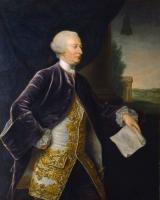


On 6th April 1752, Easter Monday, Mary Blandy [aged 32] was hanged outside Oxford Castle for having murdered her father Francis Blandy with arsenic.
Letters of Horace Walpole. 13th May 1752. Arlington Street. To Horace Mann 1st Baronet [aged 45].
By this time you know my way, how much my letters grow out of season, as it grows summer. I believe it is six weeks since I wrote to you last; but there is not only the usual deadness of summer to account for my silence; England itself is no longer England. News, madness, parties, whims, and twenty other causes, that used to produce perpetual events are at an end; Florence itself is not more inactive. Politics, "Like arts and sciences are travelled west."
They are cot into Ireland, where there is as much bustle to carry a question in the House of Commons, as ever it was here in any year forty-one. Not that there is any opposition to the King's measures; out of three hundred members, there has never yet been a division of above twenty-eight against the government: they are much the most zealous subjects the king has. The Duke of Dorset [aged 64] has had the art to make them distinguish between loyalty and aversion to the Lord Lieutenant.
I last night received yours of May 5th; but I cannot deliver your expressions to Mr. Conway [aged 31], for he and Lady Ailesbury [aged 31] are gone to his regiment in Ireland for four months, which is a little rigorous, not only after an exile in Minorca, but more especially unpleasant now as they have just bought one of the most charming places in England, Park-place, which belonged to Lady Archibald Hamilton [aged 48], and then to the Prince. You have seen enough of Mr. Conway to judge how patiently he submits to his duty. Their little girl [aged 3] is left with me.
The Gunnings [Maria Gunning Countess Coventry [aged 19] and Elizabeth Gunning Duchess Hamilton and Argyll [aged 18]]are gone to their several castles, and one hears no more of them, except that such crowds flock to see the Duchess Hamilton pass, that seven hundred people sat up all night in and about an inn in Yorkshire to see her get into her postchaise next morning.
I saw lately at Mr. Barret's a print of Valombrosa, which I should be glad to have, if you please; though I don't think it gives much idea of the beauty of the place: but you know what a passion there is for it in England, as Milton has mentioned it.
Miss Blandy [deceased] died with a coolness of courage that is astonishing, and denying the fact310, which has made a kind of party in her favour as if a woman who would not stick at parricide, would scruple a lie!
We have made a law for immediate execution on conviction of murder: it will appear extraordinary to me if it has any effect;311 for I can't help believing that the terrible part of death must be the preparation for it.
Note 310. Miss Blandy was executed at Oxford, on the 6th of April, "I am perfectly innocent," she exclaimed, "of any intention to destroy or even hurt my dear father; so help me God in these my last moments!"-E.
Note 311. Smollett, on the contrary, was of opinion that the expedient had been productive of very good effects.-E.


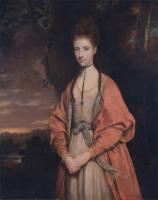

On 6th April 1771 Charles Howard 11th Duke of Norfolk [aged 25] and Frances Scudamore Duchess Norfolk [aged 21] were married. She by marriage Duchess Norfolk. Shortly after their marriage she exhibited signs of mental instability and spent the rest of her life confined to Holme Lacy House, Herefordshire [Map]. He the son of Charles Howard 10th Duke of Norfolk [aged 50] and Catherine Brockholes Duchess Norfolk [aged 52].
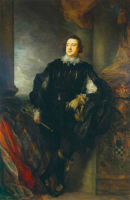


On 6th April 1778 Matthew Ridley [aged 66] died. Monument at the Cathedral Church St Nicholas, Newcastle upon Tyne [Map] sculpted by John "The Elder" Bacon [aged 37].

Archaeologia Volume 6 Section XIII. An account of some Druidical Remains on Stanton and Hartle Moor in the Peak, Derbyshire. By Hayman Rooke [aged 57], Esq. Read April 6, 1780.
On 6th April 1830 Francis George Osborne was born to George Godolphin Osborne 8th Duke Leeds [aged 27] and Harriet Emma Arundel Stewart [aged 29].
On 6th April 1830 Susan Georgina Osborne was born to George Godolphin Osborne 8th Duke Leeds [aged 27] and Harriet Emma Arundel Stewart [aged 29]. She married 22nd June 1864 Henry John Milbank.
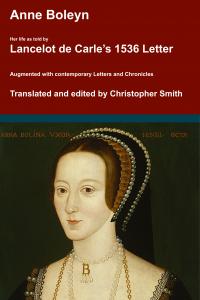
Anne Boleyn. Her Life as told by Lancelot de Carle's 1536 Letter.
In 1536, two weeks after the execution of Anne Boleyn, her brother George and four others, Lancelot du Carle, wrote an extraordinary letter that described Anne's life, and her trial and execution, to which he was a witness. This book presents a new translation of that letter, with additional material from other contemporary sources such as Letters, Hall's and Wriothesley's Chronicles, the pamphlets of Wynkyn the Worde, the Memorial of George Constantyne, the Portuguese Letter and the Baga de Secrets, all of which are provided in Appendices.
Available at Amazon in eBook and Paperback format.
On 6th April 1830 Louis I Grand Duke of Hesse [aged 76] died. His son Louis [aged 52] succeeded II Grand Duke of Hesse and by Rhine.
Greville Memoirs. 6th April 1832. I heard yesterday, however, from Keate, who is attending me (and who is the King's surgeon, and sees him when he is in town), that he saw his Majesty after the levee on Wednesday, and that he was ill, out of sorts, and in considerable agitation; that he enquired of him about his health, when the King said he had much to annoy him, and that 'many things passed there (pointing to the Cabinet, out of which he had just come) which were by no means agreeable, and that he had had more than usual to occupy him that morning.' Keate said he was very sure from his manner that something unpleasant had occurred. This was, I have since discovered, the question of a creation of Peers again brought forward, and to which the King's aversion has returned so much so that it is doubtful if he will after all consent to a large one. It seems that unless the Peers are made (in the event of the necessity arising) Brougham and Althorp will resign; at least so they threaten. I have seen enough of threats, and doubts, and scruples, to be satisfied that there is no certainty that any of them will produce the anticipated effects, but I am resolved I will try, out of these various elements, if I cannot work out something which may be serviceable to the cause itself, though the materials I have to work with are scanty. The Ministers were all day yesterday settling who the new Peers shall be, so seriously are they preparing for the coup. They had already fixed upon Lords Molyneux, Blandford, Kennedy, Ebrington [aged 79], Cavendish, Brabazon, and Charles Fox, Littleton, Portman, Frederick Lawley, Western, and many others, and this would be what Lord Holland calls assimilating the House of Lords to the spirit of the other House, and making it harmonise with the prevailing sense of the people.
On or before 6th April 1849 John William Waterhouse was born at Rome, Italy [Map]. He was baptised on 6th April 1949.
On 6th April 1871 Alexander John Windsor was born to King Edward VII of the United Kingdom [aged 29] and Alexandra of Denmark Queen Consort England [aged 26] at Sandringham House, Norfolk. She died aged less than one years old.


On 6th April 1873 William Quiller Orchardson [aged 41] and Helen Moxon were married.
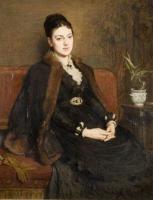
On 6th April 1876 Walter Stoneman was born.
On 6th April 1884 Hugh William Grosvenor was born to Hugh Lupus Grosvenor 1st Duke Westminster [aged 58] and Katherine Cavendish Duchess Westminster [aged 27]. He married Mabel Florence Mary Creighton, daughter of John Crichton 4th Earl Erne, and had issue.


On 6th April 1889 Princess Augusta Hesse-Kassel Duchess Cambridge [aged 91] died.


On 6th April 1914 Hugh Algernon Percy 10th Duke Northumberland was born to Alan Ian Percy 8th Duke Northumberland [aged 33] and Helen Gordon-Lennox Duchess Northumberland [aged 27]. He married 12th June 1946 his fourth cousin Elizabeth Diana Montagu-Douglas-Scott Duchess Northumberland, daughter of Walter Scott 8th Duke Buccleuch 10th Duke Queensberry and Vreda Lascelles Duchess Buccleuch and Queensbury, and had issue.


On 6th April 1935 James Graham 8th Duke of Montrose was born to James Angus Graham 7th Duke Montrose [aged 27] and Isabel Veronia Sellar Duchess Montrose.
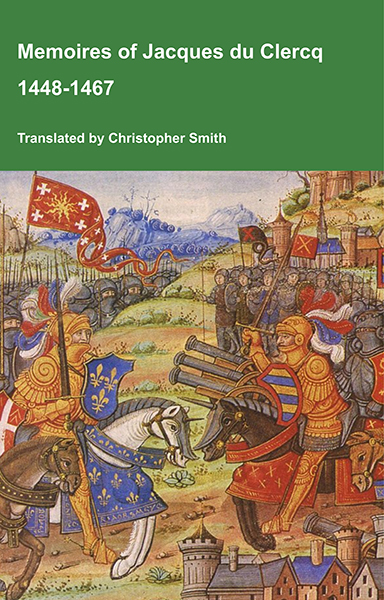
This is a translation of the 'Memoires of Jacques du Clercq', published in 1823 in two volumes, edited by Frederic, Baron de Reissenberg. In his introduction Reissenberg writes: 'Jacques du Clercq tells us that he was born in 1424, and that he was a licentiate in law and a counsellor to Philip the Good, Duke of Burgundy, in the castellany of Douai, Lille, and Orchies. It appears that he established his residence at Arras. In 1446, he married the daughter of Baldwin de la Lacherie, a gentleman who lived in Lille. We read in the fifth book of his Memoirs that his father, also named Jacques du Clercq, had married a lady of the Le Camelin family, from Compiègne. His ancestors, always attached to the counts of Flanders, had constantly served them, whether in their councils or in their armies.' The Memoires cover a period of nineteen years beginning in in 1448, ending in in 1467. It appears that the author had intended to extend the Memoirs beyond that date; no doubt illness or death prevented him from carrying out this plan. As Reissenberg writes the 'merit of this work lies in the simplicity of its narrative, in its tone of good faith, and in a certain air of frankness which naturally wins the reader’s confidence.' Du Clercq ranges from events of national and international importance, including events of the Wars of the Roses in England, to simple, everyday local events such as marriages, robberies, murders, trials and deaths, including that of his own father in Book 5; one of his last entries.
Available at Amazon in eBook and Paperback format.
On 6th April 1939 John Ian Robert Russell 13th Duke Bedford [aged 21] and Clare Bridgman [aged 36] were married. His father Hastings William Russell 12th Duke Bedford [aged 50] disinherited him as a consequence. He the son of Hastings William Russell 12th Duke Bedford and Louisa Crommelin Roberta Jowitt Whitwell Duchess Bedford.

On 6th April 1941 Commander Montague Wriothesley Noel [aged 48] was killed in action while on Convoy duty in the English channel. HMS Torrent, Surprise, Tornado and Radiant ran into a German minefield, with Torrent striking a German mine. Surprise and Tornado went to rescue Torrent's crew, but Torrent struck a second mine and quickly sank. In an attempt to rescue survivors, Surprise and Tornado also struck mines and sank. Only Radiant was undamaged and picked up the survivors from the three ships. In total, 12 officers and 240 other ranks were killed from the three ships. Only three of Torrent's crew survived, with 68 killed.
Memorial at the Church of St Peter and St Paul, Exton, Rutlandshire [Map].
On 6th April 1943 Brigadier Valentine Cecil Cavendish [aged 47] was killed in action by his own artillery fire at the Mayu Peninsula.
On 6th April 1960 Bruce Murray 12th Duke of Atholl was born to John Murray 11th Duke of Atholl [aged 31].
On 6th April 1978 Henry Fitzroy 12th Duke Grafton was born to James Oliver Charles Fitzroy [aged 30] and Claire Anabel Margaret Kerr [aged 26]. He married Olivia Staden Duchess Grafton.
On 6th April 1535 Infante Denis Aviz was born to John III King Portugal [aged 32] and Catherine of Austria Queen Consort Portugal [aged 28]. Coefficient of inbreeding 11.30%. He died aged one in 1537.

On 6th April 1584 Bridget Vere Baroness Norreys Rycote was born to Edward de Vere 17th Earl of Oxford [aged 33] and Anne Cecil Countess of Oxford [aged 27] at Theobalds House, Hertfordshire. She married (1) 28th April 1599 her fifth cousin once removed Francis Norreys 1st Earl Berkshire, son of William Norreys and Elizabeth Morrison Countess Lincoln, and had issue (2) before 1631 her second cousin twice removed Hugh Pollard 2nd Baronet, son of Lewis Pollard 1st Baronet and Margaret Berkeley, and had issue.
On 6th April 1595 Christian William Wettin was born to Johann Wettin II Duke Saxe Weimar [aged 24] and Dorothea Maria Anhalt at Altenburg. He died aged less than one years old.
On 6th April 1595 Henri Valois II Duke Longueville was born to Henri Valois I Duke Longueville [aged 27] and Catherine Gonzaga Duchess Longueville [aged 27]. He married (1) 10th April 1617 his second cousin Louise Bourbon Condé Duchess Longueville, daughter of Charles Bourbon Condé Count Soissons and Anne Montafié Countess Soissons, and had issue (2) 1642 his third cousin once removed Anne Geneviève Bourbon Condé Duchess Longueville.
On 6th April 1609 Walter Aston 2nd Baronet was born to Walter Aston 1st Baronet [aged 25]. He married 1629 Mary Weston, daughter of Richard Weston 1st Earl of Portland and Elizabeth Pinchon, and had issue.
On 6th April 1612 James Stewart 4th Duke Lennox 1st Duke Richmond was born to Esmé Stewart 3rd Duke Lennox [aged 33] and Katherine Clifton Duchess Lennox [aged 20]. He married 3rd August 1637 his half fifth cousin once removed Mary Villiers Duchess Lennox Duchess Richmond, daughter of George Villiers 1st Duke of Buckingham and Katherine Manners Duchess Buckingham, and had issue.
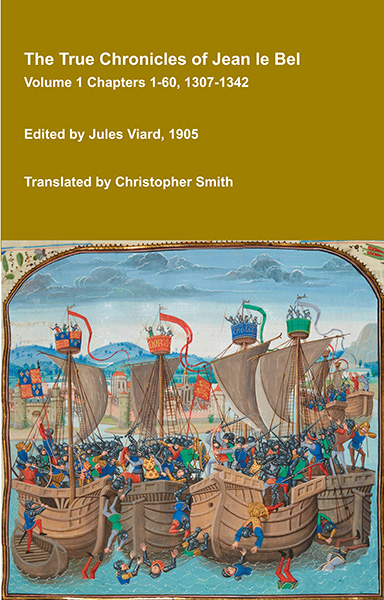
The True Chronicles of Jean le Bel Volume 1 Chapters 1-60 1307-1342
The True Chronicles of Jean le Bel offer one of the most vivid and immediate accounts of 14th-century Europe, written by a knight who lived through the events he describes, and experienced some of them first hand. Covering the early decades of the Hundred Years’ War, this remarkable chronicle follows the campaigns of Edward III of England, the politics of France and the Low Countries, and the shifting alliances that shaped medieval warfare. Unlike later historians, Jean le Bel writes with a strong sense of eyewitness authenticity, drawing on personal experience and the testimony of fellow soldiers. His narrative captures not only battles and sieges, but also the realities of military life, diplomacy, and the ideals of chivalry that governed noble society. A key source for Jean Froissart, Le Bel’s chronicle stands on its own as a compelling and insightful work, at once historical record and literary achievement. This translation builds on the 1905 edition published in French by Jules Viard, adding extensive translations from other sources Rymer's Fœdera, the Chronicles of Adam Murimuth, William Nangis, Walter of Guisborough, a Bourgeois of Valenciennes, Geoffrey le Baker of Swinbroke and Richard Lescot to enrich the original text and Viard's notes.
Available at Amazon in eBook and Paperback format.
On 6th April 1632 Maria Leopoldine Habsburg Spain Queen Consort Bohemia was born to Leopold Habsburg Spain V Archduke Austria [aged 45] and Claudia Medici [aged 27]. She married 2nd July 1648 her first cousin Ferdinand III Holy Roman Emperor, son of Ferdinand of Spain II Holy Roman Emperor and Maria Anna Wittelsbach Holy Roman Empress, and had issue.
On 6th April 1637 William Whitmore 2nd Baronet was born to Thomas Whitmore 1st Baronet [aged 24]. He married before 30th March 1699 Mary Harvey Lady Whitmore.
On 6th April 1653 Frederick Louis Oldenburg I Duke Schleswig-Holstein-Sonderburg-Beck was born to August Philipp Oldenburg I Duke Schleswig-Holstein-Sonderburg-Beck [aged 40] and Marie Sibylle Nassau Saarbrücken Duchess Schleswig-Holstein-Sonderburg-Beck. He married 1st January 1685 his first cousin Louise Charlotte Oldenburg Duchess Schleswig-Holstein-Sonderburg-Beck, daughter of Ernest Günther Oldenburg I Duke Schleswig Holstein Sonderburg Augustenburg and Auguste Oldenburg Duchess Schleswig Holstein Sonderburg Augustenburg, and had issue.
On 6th April 1689 Elizabeth Clifford Viscountess Dunbar was born to Hugh Clifford 2nd Baron Clifford Chudleigh [aged 26] and Anne Preston Baroness Clifford. She married (1) 1st August 1697 William Constable 4th Viscount Dunbar, son of John Constable 2nd Viscount Dunbar and Mary Brudenell Viscountess Dunbar (2) 17th November 1719 Charles Gregory Fairfax 9th Viscount Fairfax, son of William Fairfax 8th Viscount Fairfax.
On 6th April 1696 Charles Beauclerk 2nd Duke St Albans was born to Charles Beauclerk 1st Duke St Albans [aged 25] and Diana Vere Duchess St Albans [aged 17]. He a grandson of King Charles II of England Scotland and Ireland. He married 13th December 1722 Lucy Werden Duchess St Albans, daughter of John Werden 2nd Baronet, and had issue.

On 6th April 1718 Frances Carteret Marchioness Tweddale was born to John Carteret 2nd Earl Granville [aged 27] and Frances Worsley Countess Granville [aged 25]. She married 1748 her fifth cousin once removed John Hay 4th Marquess Tweedale, son of Charles Hay 3rd Marquess Tweeddale, and had issue.
On 6th April 1721 Frederick Christian Oldenburg I Duke Schleswig Holstein Sonderburg Augustenburg was born to Christian August Oldenburg I Duke Schleswig Holstein Sonderburg Augustenburg [aged 24] and Frederikke Louise Unknown Duchess Schleswig Holstein Sonderburg Augustenburg. He married 26th May 1762 Charlotte Amalie Wilhelmine Unknown Duchess Schleswig Holstein Sonderburg Augustenburg, daughter of Frederick Charles Unknown Duke Schleswig Holstein Sonderburg Plön, and had issue.
On 6th April 1728 Bartholomew Bouverie was born to Jacob Bouverie 1st Viscount Folkestone [aged 33] and Mary Clarke.
On 6th April 1737 George Montagu 4th Duke Manchester was born to Robert Montagu 3rd Duke Manchester [aged 27] and Harriet Dunch Duchess Manchester. He married 22nd October 1762 Elizabeth Dashwood Duchess Manchester, daughter of James Dashwood 2nd Baronet and Elizabeth Spencer Lady Dashwood, and had issue.
On 6th April 1756 Colonel Thomas Glyn was born to Richard Glyn 1st Baronet [aged 44].
Jean de Waurin's Chronicle of England Volume 6 Books 3-6: The Wars of the Roses
Jean de Waurin was a French Chronicler, from the Artois region, who was born around 1400, and died around 1474. Waurin’s Chronicle of England, Volume 6, covering the period 1450 to 1471, from which we have selected and translated Chapters relating to the Wars of the Roses, provides a vivid, original, contemporary description of key events some of which he witnessed first-hand, some of which he was told by the key people involved with whom Waurin had a personal relationship.
Available at Amazon in eBook and Paperback format.
On 6th April 1758 George Dallas 1st Baronet was born.
On 6th April 1771 Thomas John Clavering 8th Baronet was born to George Clavering of Greencroft [aged 51].
On 6th April 1795 Charles Young was born.
On 6th April 1823 Alexander Bannerman 9th Baronet was born to Charles Bannerman 8th Baronet [aged 40]. He married (1) 25th September 1860 Arabella Diana Sackville-West, daughter of George Sackville-West 5th Earl De La Warr and Elizabeth Sackville Countess De La Warr, and had issue (2) 20th January 1874 Katherine Ashburnham Lady Bannerman, daughter of Bertram Ashburnham 4th Earl Ashburnham and Katherine Charlotte Baillie Countess Ashburnham.
On 6th April 1828 Michael Fleming 7th Baronet was born to Reverend Richard le Fleming 6th Baronet [aged 36]. He married 10th November 1852 Elizabeth Boddie Lady Fleming and had issue.
On 6th April 1828 Charles Watson-Copley 3rd Baronet was born to Charles Wager Watson 2nd Baronet [aged 28] and Jemima Colleton Lady Watson [aged 20]. He married 12th May 1854 Georgiana Tredcroft Lady Watson-Copley and had issue.
On 6th April 1830 Susan Georgina Osborne was born to George Godolphin Osborne 8th Duke Leeds [aged 27] and Harriet Emma Arundel Stewart [aged 29]. She married 22nd June 1864 Henry John Milbank.
On 6th April 1830 Francis George Osborne was born to George Godolphin Osborne 8th Duke Leeds [aged 27] and Harriet Emma Arundel Stewart [aged 29].
On 6th April 1836 Thomas Southwell 4th Viscount Southwell was born to Lieutenant-Colonel Arthur Francis Southwell [aged 47]. He married 24th August 1871 Charlotte Mostyn Viscountess Southwell and had issue.
On 6th April 1838 Warren Hastings D'Oyly 10th Baronet was born to John Hadley D'Oyly 8th Baronet [aged 43] and Mary Fendall Lady D'Oyly. He married (1) 1st March 1859 Henrietta Mary Halliday Lady D'Oyly and had issue (2) 20th November 1909 Amy Agnes White Lady D'Oyly.
Chronicle of Geoffrey le Baker of Swinbroke
Baker was a secular clerk from Swinbroke, now Swinbrook, an Oxfordshire village two miles east of Burford. His Chronicle describes the events of the period 1303-1356: Gaveston, Bannockburn, Boroughbridge, the murder of King Edward II, the Scottish Wars, Sluys, Crécy, the Black Death, Winchelsea and Poitiers. To quote Herbert Bruce 'it possesses a vigorous and characteristic style, and its value for particular events between 1303 and 1356 has been recognised by its editor and by subsequent writers'. The book provides remarkable detail about the events it describes. Baker's text has been augmented with hundreds of notes, including extracts from other contemporary chronicles, such as the Annales Londonienses, Annales Paulini, Murimuth, Lanercost, Avesbury, Guisborough and Froissart to enrich the reader's understanding. The translation takes as its source the 'Chronicon Galfridi le Baker de Swynebroke' published in 1889, edited by Edward Maunde Thompson.
Available at Amazon in eBook and Paperback format.
On 6th April 1865 Verena Maud Lowther Viscountess Churchill Wychwood was born to Henry Lowther 3rd Earl Lonsdale [aged 47]. She married (1) 1st January 1887 Victor Albert Francis Spencer 1st Viscount Churchill, son of Francis George Spencer 2nd Baron Churchill and Jane Conyngham Baroness Churchill, and had issue.
On 6th April 1871 Alexander John Windsor was born to King Edward VII of the United Kingdom [aged 29] and Alexandra of Denmark Queen Consort England [aged 26] at Sandringham House, Norfolk. She died aged less than one years old.
On 6th April 1876 Walter Stoneman was born.
On 6th April 1882 Lieutenant Arthur George Coke was born to Thomas William Coke 3rd Earl of Leicester [aged 33] and Alice Emily White Countess Leicester [aged 26].
On 6th April 1884 Hugh William Grosvenor was born to Hugh Lupus Grosvenor 1st Duke Westminster [aged 58] and Katherine Cavendish Duchess Westminster [aged 27]. He married Mabel Florence Mary Creighton, daughter of John Crichton 4th Earl Erne, and had issue.
On 6th April 1885 Conyngham Denison 7th Baron Londesborough was born to Commander Conyngham Denison [aged 34].

On 6th April 1902 Major Bartholomew Pleydell-Bouverie was born to Jacob Pleydell-Bouverie 6th Earl Radnor [aged 33] and Julian Eleanor Adelaide Balfour.
On 6th April 1909 Basil Sheridan Hamilton-Temple-Blackwood 4th Marquess of Dufferin and Ava was born to Frederick Temple Hamilton-Temple-Blackwood 3rd Marquess of Dufferin and Ava [aged 34]. He married 3rd July 1930 Maureen Constance Guinness Marchioness of Dufferin and Ava and had issue.
On 6th April 1914 Hugh Algernon Percy 10th Duke Northumberland was born to Alan Ian Percy 8th Duke Northumberland [aged 33] and Helen Gordon-Lennox Duchess Northumberland [aged 27]. He married 12th June 1946 his fourth cousin Elizabeth Diana Montagu-Douglas-Scott Duchess Northumberland, daughter of Walter Scott 8th Duke Buccleuch 10th Duke Queensberry and Vreda Lascelles Duchess Buccleuch and Queensbury, and had issue.
On 6th April 1925 William Marcus Worsley 5th Baronet was born to William Arthington Worsley 4th Baronet [aged 35] and Joyce Morgan Brunner Lady Worsley [aged 30]. He married 10th December 1955 Bridget Assheton Lady Worsley, daughter of Ralph Assheton 1st Baron Clitheroe and Sylvia Benita Frances Hotham Baroness Clitheroe, and had issue.
On 6th April 1926 John Ogilvy Brocklehurst 3rd Baronet was born to Henry Courtney Brocklehurst [aged 37] and Helen Alice Wyllington Ogilvy [aged 35].
On 6th April 1935 James Graham 8th Duke of Montrose was born to James Angus Graham 7th Duke Montrose [aged 27] and Isabel Veronia Sellar Duchess Montrose.
This is a translation of the 'Memoires of Jacques du Clercq', published in 1823 in two volumes, edited by Frederic, Baron de Reissenberg. In his introduction Reissenberg writes: 'Jacques du Clercq tells us that he was born in 1424, and that he was a licentiate in law and a counsellor to Philip the Good, Duke of Burgundy, in the castellany of Douai, Lille, and Orchies. It appears that he established his residence at Arras. In 1446, he married the daughter of Baldwin de la Lacherie, a gentleman who lived in Lille. We read in the fifth book of his Memoirs that his father, also named Jacques du Clercq, had married a lady of the Le Camelin family, from Compiègne. His ancestors, always attached to the counts of Flanders, had constantly served them, whether in their councils or in their armies.' The Memoires cover a period of nineteen years beginning in in 1448, ending in in 1467. It appears that the author had intended to extend the Memoirs beyond that date; no doubt illness or death prevented him from carrying out this plan. As Reissenberg writes the 'merit of this work lies in the simplicity of its narrative, in its tone of good faith, and in a certain air of frankness which naturally wins the reader’s confidence.' Du Clercq ranges from events of national and international importance, including events of the Wars of the Roses in England, to simple, everyday local events such as marriages, robberies, murders, trials and deaths, including that of his own father in Book 5; one of his last entries.
Available at Amazon in eBook and Paperback format.
On 6th April 1949 Brooke Charles Boothby 15th Baronet was born to Hugo Robert Brooke Boothby 14th Baronet [aged 41].
On 6th April 1960 Bruce Murray 12th Duke of Atholl was born to John Murray 11th Duke of Atholl [aged 31].
On 6th April 1978 Henry Fitzroy 12th Duke Grafton was born to James Oliver Charles Fitzroy [aged 30] and Claire Anabel Margaret Kerr [aged 26]. He married Olivia Staden Duchess Grafton.
On 6th April 1255 Theobald "Young" II King Navarre [aged 15] and Isabella Capet [aged 14] were married. She the daughter of King Louis IX of France [aged 40] and Margaret Provence Queen Consort France [aged 34]. He the son of Theobald IV King Navarre and Margaret Bourbon Queen Consort Navarre [aged 38]. They were half third cousins. He a great x 4 grandson of King William "Conqueror" I of England. She a great x 2 granddaughter of King Henry "Curtmantle" II of England.
On 6th April 1580 William Wray 1st Baronet [aged 25] and Lucy Montagu were married.
On 6th April 1640 William Button 2nd Baronet [aged 18] and Anne Rolle [aged 24] were married at St Petroc's Church, Petrockstowe [Map].
On 6th April 1657 William Boothby 1st Baronet [aged 19] and Hill Brooke [aged 21] were married at Chiswick.
On 6th April 1703 John Erskine 23rd Earl of Mar [aged 28] and Margaret Hay Countess Mar [aged 16] were married. She by marriage Countess Mar. She the daughter of Thomas Hay 7th Earl Kinnoull [aged 43]. He the son of Charles Erskine 22nd Earl of Mar.
On 6th April 1734 Lucius Charles Carey 7th Viscount Falkland [aged 27] and Jane Butler were married.
On 6th April 1771 Charles Howard 11th Duke of Norfolk [aged 25] and Frances Scudamore Duchess Norfolk [aged 21] were married. She by marriage Duchess Norfolk. Shortly after their marriage she exhibited signs of mental instability and spent the rest of her life confined to Holme Lacy House, Herefordshire [Map]. He the son of Charles Howard 10th Duke of Norfolk [aged 50] and Catherine Brockholes Duchess Norfolk [aged 52].
On 6th April 1873 William Quiller Orchardson [aged 41] and Helen Moxon were married.
On 6th April 1938 Ronald Orr-Ewing 5th Baronet [aged 25] and Marion Hester Cameron Lady Orr-Ewing [aged 23] were married.
Chronicle of a Bourgeois of Valenciennes
Récits d’un bourgeois de Valenciennes aka The Chronicle of a Bourgeois of Valenciennes is a vivid 14th-century vernacular chronicle written by an anonymous urban chronicler from Valenciennes in the County of Hainaut. It survives in a manuscript that describes local and regional history from about 1253 to 1366, blending chronology, narrative episodes, and eyewitness-style accounts of political, military, and social events in medieval France, Flanders, and the Low Countries. The work begins with a chronological framework of events affecting Valenciennes and its region under rulers such as King Philip VI of France and the shifting allegiances of local nobility. It includes accounts of conflicts, sieges, diplomatic manoeuvres, and the impact of broader struggles like the Hundred Years’ War on urban life in Hainaut. Written from the perspective of a burgher (bourgeois) rather than a monastery or royal court, the chronicle offers a rare lay viewpoint on high politics and warfare, reflecting how merchants, townspeople, and civic institutions experienced the turbulence of the 13th and 14th centuries. Its narrative style combines straightforward reporting of events with moral and civic observations, making it a valuable source for readers interested in medieval urban society, regional politics, and the lived experience of war and governance in pre-modern Europe.
Available at Amazon in eBook and Paperback format.
On 6th April 1939 John Ian Robert Russell 13th Duke Bedford [aged 21] and Clare Bridgman [aged 36] were married. His father Hastings William Russell 12th Duke Bedford [aged 50] disinherited him as a consequence. He the son of Hastings William Russell 12th Duke Bedford and Louisa Crommelin Roberta Jowitt Whitwell Duchess Bedford.
On 6th April 1147 Frederick "One Eyed" Hohenstaufen I Holy Roman Emperor [aged 57] died.
On 26th March 1199 King Richard "Lionheart" I of England [aged 41] was besieging Châlus Chabrol Castle. During the course of the evening King Richard "Lionheart" I of England was shot by a crossbow. Richard died on 6th April 1199. His brother John [aged 32] succeeded I King of England.
There was a brother between Richard and John named Geoffrey Duke of Brittany who had a son Arthur [aged 11], who was around twelve, and a daughter Eleanor [aged 15], who was around fifteen, whose mother was Constance Penthièvre Duchess Brittany [aged 38].
King Philip II of France [aged 33] had planned for Eleanor to marry his son, probably to bring Brittany into the French Royal family, possibly to pursue a claim on England.
King Philip II of France supported Arthur's claim to the English throne. In the resulting war Arthur was captured, imprisoned and never seen again. Eleanor was captured, probably around the same time as Arthur, and imprisoned, more or less, for the remainder of her life, even after King John's death through the reign of King Henry III since she represented a threat to Henry's succession.
On 6th April 1231 William "The Younger" Marshal 2nd Earl Pembroke [aged 41] died. His brother Richard [aged 40] succeeded 3rd Earl Pembroke. Gervase Dinant Countess Pembroke by marriage Countess Pembroke.
On 6th April 1250 Hugh XI of Lusignan VI Count of La Marche II Count Angoulême [aged 29] died. His son Hugh [aged 15] succeeded XII Seigneur of Lusignan, VII Count La Marche, III Count Angoulême.
On 6th April 1284 Peter Capet Count Alençon [aged 33] was killed at Salerno by Aragonese mercenaries. He had no issue; Count Alençon extinct.
On 6th April 1317 Guy Chatillon IV Count Saint Pol [aged 63] died. His son Jean [aged 25] succeeded Count Saint Pol.
On 6th April 1362 Jacques Bourbon I Count La Marche and Ponthieu [aged 43] was killed at the Battle of Brignais. His son Jean [aged 18] succeeded I Count La Marche. His son Pierre Bourbon [aged 20] was also killed.
On 6th April 1387 John "Sans Terre" Artois 1st Count of Eu [aged 65] died. His son Robert [aged 31] succeeded Count Eu. Joanna Durazzo Countess Eu by marriage Countess Eu.
On 6th April 1395 William Stafford 4th Earl Stafford [aged 19] died at Pleshey Castle [Map]. He was buried at Tonbridge, Kent [Map]. His brother Edmund [aged 17] succeeded 5th Earl Stafford, 6th Baron Stafford.
On 6th April 1418 Ralph Greystoke 3rd Baron Greystoke [aged 64] died. He was buried at Newminster Abbey, Northumberland [Map]. His son John [aged 29] succeeded 4th Baron Greystoke.
On 6th April 1523 Henry Stafford 1st Earl Wiltshire [aged 44] died without issue. Earl Wiltshire extinct.
Chronicle of Abbot Ralph of Coggeshall
The Chronicle of Abbot Ralph of Coggeshall (Chronicon Anglicanum) is an indispensable medieval history that brings to life centuries of English and European affairs through the eyes of a learned Cistercian monk. Ralph of Coggeshall, abbot of the Abbey of Coggeshall in Essex in the early 13th century, continued and expanded his community’s chronicle, documenting events from the Norman Conquest of 1066 into the tumultuous reign of King Henry III. Blending eyewitness testimony, careful compilation, and the monastic commitment to record-keeping, this chronicle offers a rare narrative of political intrigue, royal power struggles, and social upheaval in England and beyond. Ralph’s work captures the reigns of pivotal figures such as Richard I and King John, providing invaluable insights into their characters, decisions, and the forces that shaped medieval rule. More than a simple annal, Chronicon Anglicanum conveys the texture of medieval life and governance, making it a rich source for scholars and readers fascinated by English history, monastic authorship, and the shaping of the medieval world.
Available at Amazon in eBook and Paperback format.
On 6th April 1605 Henry Windsor 5th Baron Windsor [aged 42] died. His son Thomas [aged 13] succeeded 6th Baron Windsor of Stanwell in Buckinghamshire.
On 6th April 1621 Edward Seymour 1st Earl Hertford [aged 81] died. He was buried at Salisbury Cathedral [Map].
On 6th April 1644 Henry Sandys 5th Baron Sandys of the Vyne [aged 39] died. His son William succeeded 6th Baron Sandys of The Vyne in Hampshire.

On 6th April 1664 Thomas Cullum 1st Baronet [aged 77] died. His son Thomas [aged 35] succeeded 2nd Baronet Cullum of Hastede in Suffolk.
On 6th April 1665 Lucy Dutton Countess Downe [aged 26] died.
On 6th April 1667 Richard Lucy 1st Baronet [aged 75] died. His son Kingsmill [aged 18] succeeded 2nd Baronet Lucy of Broxbourne in Hertfordshire.
On 6th April 1673 Dorothea Helena Kirkoven Countess Derby [aged 43] died.
On 6th April 1678 Joshua Marshall [aged 49] died. He was buried in St Dunstan's in the West, Fleet Street [Map].

On 6th April 1686 Arthur Annesley 1st Earl Annesley [aged 71] died. His son James [aged 41] succeeded 2nd Earl Anglesey, 3rd Viscount Valentia, 2nd Baron Annesley Newport Pagnell Buckinghamshire. Elizabeth Manners Countess Anglesey [aged 32] by marriage Countess Anglesey.
On 6th April 1716 Charles Cockayne 4th Viscount Cullen [aged 29] died. His son Charles [aged 5] succeeded 5th Viscount Cullen.
Jean de Waurin's Chronicle of England Volume 6 Books 3-6: The Wars of the Roses
Jean de Waurin was a French Chronicler, from the Artois region, who was born around 1400, and died around 1474. Waurin’s Chronicle of England, Volume 6, covering the period 1450 to 1471, from which we have selected and translated Chapters relating to the Wars of the Roses, provides a vivid, original, contemporary description of key events some of which he witnessed first-hand, some of which he was told by the key people involved with whom Waurin had a personal relationship.
Available at Amazon in eBook and Paperback format.
On 6th April 1718 Henry Monson 3rd Baronet [aged 64] died. His brother William [aged 64] succeeded 4th Baronet Monson of Carleton in Lincolnshire.
On 6th April 1725 Anne Coote Viscountess Blesington [aged 67] died.
On 6th April 1743 Michael Newton 4th Baronet [aged 48] died. Baronet Newton of Barrs Court extinct. He was buried at St Michael's Church, Heydour [Map]. Sculpted by Peter Scheemakers [aged 52].
On 6th April 1750 Edmund Bacon 6th Baronet [aged 25] died. His uncle Henry [aged 55] succeeded 7th Baronet Bacon of Mildenhall in Suffolk.
On 6th April 1778 Matthew Ridley [aged 66] died. Monument at the Cathedral Church St Nicholas, Newcastle upon Tyne [Map] sculpted by John "The Elder" Bacon [aged 37].
On 6th April 1783 William Guise 5th Baronet [aged 46] died unmarried. Baronet Guise of Elmore in Gloucestershire extinct.
On 6th April 1797 Henry Mainwaring 4th Baronet [aged 70] died unmarried. Baronet Mainwaring of Over Peover extinct. Thomas Wittenhall [aged 61] succeeded to the Over Peover, Cheshire estates and adopted the name and arms of Mainwaring, in compliance with the will of his half-brother Henry Mainwaring 4th Baronet.
On 6th April 1803 Admiral Thomas Rich 5th Baronet [aged 70] died. Baronet Rich of Sonning in Berkshire extinct.
On 6th April 1821 Robert Stewart 1st Marquess Londonderry [aged 81] died. His son Robert [aged 51] succeeded 2nd Marquess Londonderry. Amelia Hobart Marchioness Londonderry [aged 49] by marriage Marchioness Londonderry.


On 6th April 1827 Charles Talbot 15th Earl of Shrewsbury [aged 74] died. His nephew John [aged 36] succeeded 16th Earl of Shrewsbury, 16th Earl Waterford. Maria Theresa Talbot Countess Shrewsbury and Waterford by marriage Countess of Shrewsbury Countess Waterford.
The True Chronicles of Jean le Bel Volume 1 Chapters 1-60 1307-1342
The True Chronicles of Jean le Bel offer one of the most vivid and immediate accounts of 14th-century Europe, written by a knight who lived through the events he describes, and experienced some of them first hand. Covering the early decades of the Hundred Years’ War, this remarkable chronicle follows the campaigns of Edward III of England, the politics of France and the Low Countries, and the shifting alliances that shaped medieval warfare. Unlike later historians, Jean le Bel writes with a strong sense of eyewitness authenticity, drawing on personal experience and the testimony of fellow soldiers. His narrative captures not only battles and sieges, but also the realities of military life, diplomacy, and the ideals of chivalry that governed noble society. A key source for Jean Froissart, Le Bel’s chronicle stands on its own as a compelling and insightful work, at once historical record and literary achievement. This translation builds on the 1905 edition published in French by Jules Viard, adding extensive translations from other sources Rymer's Fœdera, the Chronicles of Adam Murimuth, William Nangis, Walter of Guisborough, a Bourgeois of Valenciennes, Geoffrey le Baker of Swinbroke and Richard Lescot to enrich the original text and Viard's notes.
Available at Amazon in eBook and Paperback format.
On 6th April 1830 Louis I Grand Duke of Hesse [aged 76] died. His son Louis [aged 52] succeeded II Grand Duke of Hesse and by Rhine.
On 6th April 1852 Frederick Thellusson 4th Baron Rendlesham [aged 54] died. His son Frederick [aged 12] succeeded 5th Baron Rendlesham of Rendlesham in Suffolk.
On 6th April 1863 Lydia Haggaer Lady Buckworth-Herne-Soame died. She was buried on 13th April 1863.
On 6th April 1888 Charles Watson-Copley 3rd Baronet [aged 60] died. His brother Wager [aged 51] succeeded 4th Baronet Watson of Fulmer in Buckinghamshire.
On 6th April 1889 Princess Augusta Hesse-Kassel Duchess Cambridge [aged 91] died.
On 6th April 1909 Mary Hood Marchioness Hertford [aged 62] died.
On 6th April 1910 William Francis Augustus Eliott 8th Baronet [aged 83] died.
On 6th April 1913 Somerset Lowry-Corry 4th Earl Belmore [aged 77] died.
On 6th April 1919 Charles Mills 2nd Baron Hillingdon [aged 64] died. His son Arthur [aged 27] succeeded 3rd Baron Hillingdon, 4th Baronet Mills of Hillingdon. Edith Mary Cadogan Baroness Hillingdon [aged 24] by marriage Baroness Hillingdon.
On 6th April 1939 Charles Thomas Keble Prévost 4th Baronet [aged 72] died. His son George [aged 29] succeeded 5th Baronet Prevost of Belmont in Hampshire.
The Deeds of the Dukes of Normandy
The Gesta Normannorum Ducum [The Deeds of the Dukes of Normandy] is a landmark medieval chronicle tracing the rise and fall of the Norman dynasty from its early roots through the pivotal events surrounding the Norman Conquest of England. Originally penned in Latin by the monk William of Jumièges shortly before 1060 and later expanded at the behest of William the Conqueror, the work chronicles the deeds, politics, battles, and leadership of the Norman dukes, especially William’s own claim to the English throne. The narrative combines earlier historical sources with firsthand information and oral testimony to present an authoritative account of Normandy’s transformation from a Viking settlement into one of medieval Europe’s most powerful realms. William’s history emphasizes the legitimacy, military prowess, and governance of the Norman line, framing their expansion, including the conquest of England, as both divinely sanctioned and noble in purpose. Later chroniclers such as Orderic Vitalis and Robert of Torigni continued the history, extending the coverage into the 12th century, providing broader context on ducal rule and its impact. Today this classic work remains a foundational source for understanding Norman identity, medieval statesmanship, and the historical forces that reshaped England and Western Europe between 800AD and 1100AD.
Available at Amazon in eBook and Paperback format.
On 6th April 1940 Evelyn Robert Pierrepont 5th Earl Manvers [aged 51] died. His first cousin Gervas [aged 58] succeeded 6th Earl Manvers, 6th Viscount Newark, 6th Baron Pierrepont of Holme Pierrepoint.
On 6th April 1946 Brigadier Eric FitzGerald Dillon 19th Viscount Dillon [aged 65] died. His son Michael [aged 34] succeeded 20th Viscount Dillon of Costello Gallen in Mayo.
On 6th April 2003 James Morrison 2nd Baron Margadale [aged 72] died. His son Alastair [aged 45] succeeded 2nd Baron Margadale of Islay in Argyll.