


10 Jun is in June.
Anglo-Saxon Chronicle. 729. This year appeared the comet-star, and St. Egbert (age 90) died in Iona. This year also died the etheling Oswald; and Osric was slain, who was eleven winters king of Northumberland; to which kingdom Ceolwulf succeeded, and held it eight years. The said Ceolwulf was the son of Cutha, Cutha of Cuthwin, Cuthwin of Leodwald, Leodwald of Egwald, Egwald of Ealdhelm, Ealdhelm of Occa, Occa of Ida, Ida of Eoppa. Archbishop Bertwald died this year on the ides of January. He was bishop thirty-seven winters, and six months, and fourteen days. The same year Tatwine (age 59), who was before a priest at Bredon in Mercia, was consecrated archbishop by Daniel Bishop of Winchester, Ingwald Bishop of London, Aldwin Bishop of Lichfield, and Aldulf Bishop of Rochester, on the tenth day of June. He enjoyed the archbishopric about three years.
On 10th June 729 Archbishop Tatwine (age 59) was consecrated Archbishop of Canterbury by Bishop Daniel of Winchester.
On 10th June 1128 Geoffrey Plantagenet Duke Normandy (age 14) was knighted by King Henry I "Beauclerc" England (age 60) in preparation for his wedding to Henry's daughter Empress Matilda (age 26).
On 10th June 1190 Frederick "Barbarossa" Hohenstaufen I Holy Roman Emperor (age 68) drowned in the Saleph River whilst on the journey of pilgrimage to Jerusalem. His son Henry (age 24) succeeded VI Holy Roman Emperor and King Italy.
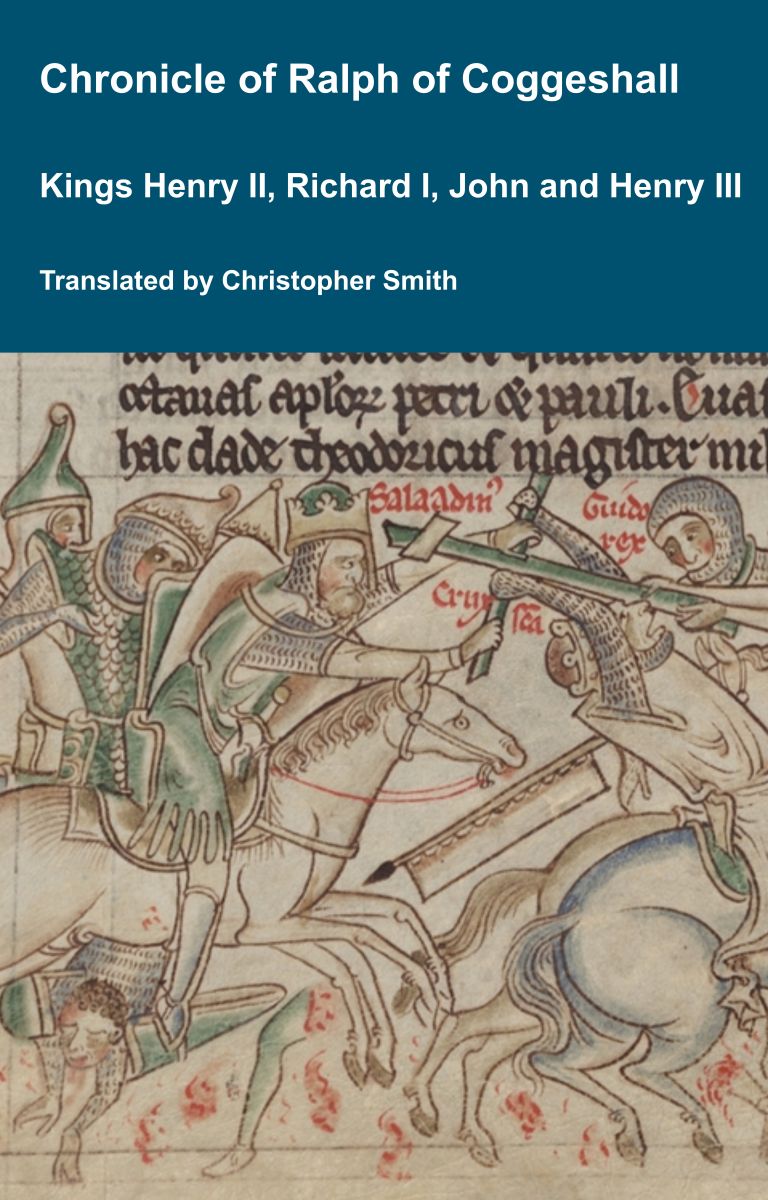 Chronicum Anglicanum by Ralph Coggeshall. In the same year, Frederick (age 68), emperor of the Romans, set out on the journey of pilgrimage to Jerusalem, leading in his company seven bishops with one archbishop, two dukes, nineteen counts, three marquises, three thousand knights, and of the rest about eighty thousand. Not wishing to entrust himself to winds and sea, he led his army overland through the territory of Béla, king of the Hungarians, and through the land of Isaac, emperor of Constantinople, then through the land of the sultan of Iconium, where he endured severe attacks with his army, before he captured Iconium and certain other cities of Asia by force of arms. When he came into Armenia, the land of Rupinus de la Montagne, at the river called the Salef, and the greater part of his army was crossing by a ford, he, not bearing the delay of the baggage animals any longer, urged his horse into the river beside the ford, and, falling from his horse, was drowned alone [10th June 1190]. His men drew him onto the bank, disembowelled him, and, after boiling the flesh in water and separating it from the bones, buried the flesh at Antioch. His bones, however, Conrad his son carried with him to Tyre, that the places which he could not visit while living, he might at least visit when dead. But his army was afterwards so scattered by various misfortunes that scarcely five hundred men were found with his son before Acre.
Eodem anno, Fredericus Romanorum imperator iter peregrinationis Hierosolymitana arripuit, ducens in comitatu suo septem antistites cum uno archipræsule, duos duces, comites decem et novem, tres marchiones, tria millia militum et reliquorum circiter octoginta millia; qui nolens se committere ventis et mari, duxit exercitum suum per terram Belis regis Hungariorum, et per terram Ysakii imperatoris Constantinopolitani, deinde per terram soltani de Yconia, ubi graves impugnationes cum exercitu suo pertulit, antequam Yconiam et quasdam alias Asiæ civitates armata manu caperet. Cumque perveniret in Armenia, terra Rupini de la Muntaine, ad fluvium qui dicitur Selef, et major pars exercitus sui per vadum transiret; ille moram summariorum diutius non ferens, misit se cum equo suo in flumine juxta vadum, et corruens de equo solus submersus est. Tractusque in terram sui evisceraverunt eum, carnemque aqua decoctam et ab ossibus separatam sepelierunt Antiochiæ; ossa autem illius Conradus filius ejus secum transtulit apud Tyrum, ut loca quæ vivus non poterat, saltem mortuus visitaret. Cujus exercitus ita variis eventibus postea dissipatus est, ut vix cum filio ante Achon quingenti viri reperirentur.
Chronicum Anglicanum by Ralph Coggeshall. On the appointed day [10th June 1215] of the conference, the barons gathered between Windsor and Staines, in the meadow called Runnymede, with a host of most noble knights, all well armed in every respect, and they remained there, having set up their tents. The king also, with his followers, stayed apart in the same meadow in pavilions. Then, with the archbishop of Canterbury intervening together with several bishops and certain barons, a kind of peace was made between the king and the barons, and, upon the touching of the holy things, it was sworn by all, even by the king himself, to be inviolably observed. Soon afterwards the form of peace was set down in a charter, so that each county of all England should have a single charter of one and the same tenor, sealed with the royal seal. There also the king restored to the barons and others their rights, of which it was without doubt certain that they were entitled. Another day having been appointed for the restoration of rights which were in dispute, the barons returned to London. From there the barons carried out military exercises in various parts of England. A general oath was taken by each individual, both knights and free men, throughout each county of the whole realm, by command of the king as set forth in open letters, that in faith and power they would uphold the aforesaid charter, and, if any should refuse to uphold it, they would, even the king himself, attack with all their strength.
Die igitur colloquii constituto barones inter Windlesore et Stanes, in prato qui vocatur Runemad, cum multitudine præclarissimæ militiæ et per omnia bene armatæ conveniunt, et in eodem loco fixis tentoriis remanserunt. Sed et rex cum suis seorsum in eodem prato in papillionibus mansit. Intervenientibus itaque archiepiscopo Cantuariensi cum pluribus coepiscopis et baronibus nonnullis, quasi pax inter regem et barones formata est, et tactis sacrosanctis, ab omnibus inviolabiliter tenenda juratur, etiam a rege. Mox igitur forma pacis in charta est comprehensa, ita quod singuli comitatus totius Angliæ singulas unius tenoris haberent chartas regio sigillo communitas. Ibi quoque jura sua baronibus, et aliis de quibus indubitanter constabat quod eis competebant, rex restituit. Præfixo igitur alio die ad jura restituenda de quibus controversia fuit, barones reversi sunt Londonias. Inde tirocinia diversis in locis Angliæ barones exercuerunt. Fit generalis juratio a singulis tam militibus quam liberis hominibus per singulos comitatus totius regni, ex præcepto regio in literis patentibus proposito, quod in fide et virtute prædictam chartam tenerent, et tenere nolentes, etiam regem ipsum, totis viribus infestarent.
On 10th June 1240 William Longespée (age 32) left England in the service of Richard of Cornwall 1st Earl Cornwall (age 31) with roughly a dozen English barons and several hundred knights.
Annals Londonienses. At last, when he (Piers Gaveston) was approaching Deddington with his men, on Saturday, the eve of Saint Barnabas the Apostle, namely the 10th of June [1312], after the sun had already risen, a cry was raised in the branches (or surrounding area) against the said Piers, louder than the voice of Rachel when she wept most bitterly. The house in which Piers was resting was surrounded. And when Piers, seeing such misfortune hastening upon him, looked around in all directions in hopes that some aid might appear, and when he saw that no help was coming, he surrendered himself to the aforementioned earl, barefoot, clothed only in a tunic, with his head uncovered. Then the earl (of Warwick) seized him and led him to Warwick, to his own castle, and handed him over to four guards to be safely held. Meanwhile, the Earls of Lancaster, Hereford, and Arundel, and many others, praised the Earl of Warwick for acting faithfully and consulted among themselves about what should be done with Piers. Their counsel and collective decision were soon clearly revealed in action.
Tandem cum apud Dadyngthone appropinquaret cum suis , die sabbati , vigilia Sancti Barnabæ apostoli , videlicet decimo die Junii , orto jam sole , levata est vox in Ramis super dictum Petrum , excelsior voce Rachelis quando asperius ploravit; et circumvallata est domus ubi ille Petrus requiescebat. Et cum Petrus tale infortunium super se accelerans vidisset, a longe et circumquaque prospiciens, si forte aliquod auxilium superveniret, ct cum auxilii non vidisset, reddidit se præfato comiti, nudis pedibus, tunica tantum indutus, capite nudo. Tunc cepit eum comes et duxit ipsum ad Warwyk in castello suo, et tradidit illum quatuor custodibus salvum custodiendum. Interim comites Lancastriæ, Herefordiæ, Arundeliæ, et multi alii, landaverunt comitem Warwiciæ, eo quod fideliter operabatur, et consulerunt adinvicem quid de ipso fieret. Quod quidem consilium et assensus eorum opere manifesto declarantur.
 Become a Member via our Buy Me a Coffee page to read more.
Anonimalle Chronicle. There, they made as their leader a man named Wat Tyler of Maidstone, to guide and advise them. And on the Monday [10th June 1381] following the feast of the Trinity, they came to Canterbury before the hour of None (around 3 p.m.), and three thousand of them entered the main church of Saint Thomas during high mass. Kneeling, they all cried out in one voice to the monks, demanding that they elect a new monk to be Archbishop of Canterbury, saying that the one who currently held the position was a traitor and would be beheaded for his treason — which indeed happened within five days afterward. When this was done, they returned to the town to join their companions, and by common agreement they summoned the mayor, bailiffs, and commons of the said town and questioned them whether they were willing, in good faith, to swear loyalty and fidelity to King Richard and to the loyal commons of England — or not. The mayor responded that they were willing to do so, and they took their oaths. Then the rebels asked whether there were any traitors among them, and it was said that there were three, who were named. The commons dragged those men out of their houses and beheaded them. Afterwards, they took some men from the town with them toward London and left the others behind to guard the town.
Kt illeoges firent lour chieftayne une Watt Teghler de Maydenstoun pur les mayntener et conseiller; et le lundy prochien apres le fest de la Trinytee viendrent a Caunterbury avaunt la houre de none et iii mille des eux entrerount en la meir esglise de seint Thomas en le temps del haut messe, et engenolauntz toutz a une voyce crierent a les moignes pur eslire une moigne destre ercevesqe de Kaunterbury, gar cestuy qor est, est traytour et serra decolle pur 8a Iniquitee; et si fuist il deinz le v iours apres; et quaunt ceo fuist fait ils alerount en la ville a lour compaignouns et par une assent manderount pur le meir, baillives et comunes del dite ville et les examinerount sils vodroient ovesqe bone voluntee iurere destre fele et leel al roy Richarde et a les loials comunes Dengleterre ou nemy; et le meir / respoundist qils vodroient volunters, et firent lour serementes et puis demanderent de eux sils furount ascunes traitours parentre eux; et dissoient qils furount trois et nomeront lour nounes; les queux les communes traiherount hors de lour measones et couperont lour testes et apres pristrent d gentz de la ville ovesqe eux devers Londres et les autres lesserount pur garder la ville.
Become a Member via our Buy Me a Coffee page to read more.
On 10th June 1414 Beatrix Hohenzollern Duchess Austria (age 52) died at Perchtoldsdorf.
Chronicle of Abbot Ralph of Coggeshall
The Chronicle of Abbot Ralph of Coggeshall (Chronicon Anglicanum) is an indispensable medieval history that brings to life centuries of English and European affairs through the eyes of a learned Cistercian monk. Ralph of Coggeshall, abbot of the Abbey of Coggeshall in Essex in the early 13th century, continued and expanded his community’s chronicle, documenting events from the Norman Conquest of 1066 into the tumultuous reign of King Henry III. Blending eyewitness testimony, careful compilation, and the monastic commitment to record-keeping, this chronicle offers a rare narrative of political intrigue, royal power struggles, and social upheaval in England and beyond. Ralph’s work captures the reigns of pivotal figures such as Richard I and King John, providing invaluable insights into their characters, decisions, and the forces that shaped medieval rule. More than a simple annal, Chronicon Anglicanum conveys the texture of medieval life and governance, making it a rich source for scholars and readers fascinated by English history, monastic authorship, and the shaping of the medieval world.
Available at Amazon in eBook and Paperback format.
On 10th June 1424 Ernest "The Iron" Habsburg I Duke Austria (age 47) died.
On 10th June 1437 Joanna of Navarre Queen Consort England (age 67) died at Havering atte Bower, Essex [Map].
On 10th June 1513 Louis Duke of Montpensier was born to Louis Bourbon Prince of La Roche sur Yon (age 40) and Louise Bourbon Duchess of Monpensier (age 31). He married 1538 his fifth cousin Jacqueline de Longwy and had issue.
Letters and Papers. 10th June 1536. Add MS. 8715, f. 256, b. B. M. 1115. Bishop of Faenza (age 36) to Mons. Ambrogio.
Yesterday a courier came from England with news that the King has taken to wife that lady [Queen Jane Seymour (age 27)] for whom he showed the greatest preference even during the life of the other ("quella Dama che vivendo anche l'altra mostrava che piu gli piacesse" i.e. "that Lady who, even while the other was alive, showed that she pleased him more.")
Ital., pp. 3. Modern copy. Headed: Al Signor Protonotario Ambrogio, Di Lione, 10 Giugno 1536.


Letters and Papers. 10th June 1536 Otho, C. x. 261. B. M. St. P. i. 455. Hearne's Sylloge, 124. 1109. Princess Mary (age 20) to [Henry VIII.]
Begs his daily blessing. Has already, she trusts, obtained forgiveness on her suit, with licence to write to him; but hopes for some token or message of reconciliation, and that she may obtain her fervent desire of access to his presence. Excuses her importunity. Begs him to accept his penitent child, who henceforth puts her state and living in his mercy, next to Almighty God, under whatever conditions. Prays God preserve him and the Queen (age 27), and send them a prince. Hownsdon [Map], 10 June. Hol. Mutilated.
Ib. f. 281. 2. Another copy, also holograph, dated like the preceding. Mutilated.
Ib. f. 264. 3. A third copy, also holograph, dated Hownsdon [Map], 13 June. Mutilated. [No verbal differences can be traced in what remains of the text of this and the other two copies; but the reservation "next to Almighty God" was doubtless omitted in this copy. See her letter to Cromwell of this later date, 13 June.]


Letters and Papers. 10th June 1536. Otho, C. x. 262 b. B. M. Hearne's Sylloge, 125. 1108. Princess Mary (age 20) to Cromwell.
I send by the bearer, my servant, "both the King's Highness' letter1, sealed, and the copy of the same, again to you." You will see I have followed your advice, and will do so in all things concerning my duty to the King, God and my conscience not offended; for I take you as one of my chief friends next his Grace and the Queen (age 27). I desire you, for Christ's passion, to find means that I be not moved to any further entry in this matter than I have done; for I assure you I have done the utmost my conscience will suffer me, and I neither desire nor intend to do less than I have done. "But if I be put to any more (I am plain with you as with my great friend) my said conscience will in no ways suffer me to consent thereunto." Except in this point, neither you nor any other shall be more desirous to have me obey the King than I shall be ready to do so. I had rather lose my life than displease him. I beg you to take this letter in good part. I would not have troubled you so much, but that the end of your letter caused me a little to fear I shall have more business hereafter. Hownsdon [Map], 10 June.
Hol. Mutilated. Add.: [To my go]od Master Secretary.
Note 1. Meaning her letter to the King's Highness.
On 10th June 1540 Thomas Cromwell 1st Earl Essex (age 55) attended a Meeting of the Privy Council where he was arrested. It isn't entirely clear why he was arrested but his role in the King's recent failed marriage to Anne of Cleves Queen Consort England (age 24) is likely to have played a part. Thomas Howard 3rd Duke of Norfolk (age 67) tore off Cromwell's St George of the Order of the Garter. He was imprisoned in the Tower of London [Map] and executed on the 28th of July 1540. See Spanish Chronicle and Marillac's letter to Montmorency.


Chronicle of Edward Hall [1496-1548]. The xix. day of July [Note. Cromwell was arrested on 10th June 1540 ], Thomas Lord Cromwell (age 55), late made Earl of Essex, as before you have hard, being in the counsel chamber, was suddenly apprehended, and committed to the Tower of London [Map], the which many lamented, but more rejoiced, and especially such, as ether had been religious men, or favoured religious persons, for they banqueted, and triumphed together that night, many wishing that that day had been seven years before, and some fearing least he should escape, although he were imprisoned, could not be merry. Other who knew nothing but truth by him, both lamented him, and heartily prayed for him. But this is true that of certain of the clergy, he was detestably hated, and specially of such as had borne swinge, and by his meanes was put from it, for in deed he was a man, that in all his doings, seemed not to favour any kind of Popery, nor could not abide the snoffing pride of some prelates, which undoubtedly whatsoever else was the cause of his death, did shorten his life, and procured the end that he was brought unto which was that the xix day of the said month, he was attainted by Parliament, and never came to his answer, which law many reported, he was the causer of the making thereof, but the truth thereof I know not. The Articles for which he died, appear in the Record, where his attainder is written, which are too long to be here rehearsed, but to conclude he was there attainted of heresy, and high treason.
Spanish Chronicle Chapter 45. [10th June 1540] As usual, they all went to the Parliament at Westminster, and when they came out and were going to the palace to dinner, the wind blew off the Secretary's bonnet, and it fell on the ground. The custom of the country is, when a gentleman loses his bonnet, for all those who are with him to doff theirs, but on this occasion, when Cromwell's bonnet blew off, all the other gentlemen kept theirs on their heads, which being noticed by him, he said, "A high wind indeed must it have been to blow my bonnet off and keep all yours on." They pretended not to hear what he said, and Cromwell took it for a bad omen. They went to the palace and dined, and all the while they were dining the gentlemen did not converse with the Secretary, as they were wont to do, and as soon as they had finished all the gentlemen went to the Council-chamber. It was the Secretary's habit always after dinner to go close up to a window to hear the petitioners; and when the gentlemen had gone to the Council-chamber, the Secretary remained at his window as usual for about an hour, and then joined the other gentlemen; and finding them all seated, he said, "You were in a great hurry, gentlemen, to get seated." The chair where he was in the habit of sitting was vacant, and the gentlemen made no answer to his remark; but just as he was going to sit down the Duke of Norfolk said, "Cromwell, do not sit there; that is no place for thee. Traitors do not sit amongst gentlemen." He answered, "I am not a traitor; "and with that the captain of the guard came in and took him by the arm, and said, "I arrest you." "What for?" said he. "That you will learn elsewhere" answered the captain. He then asked to see the King, as he wished to speak with him; and he was told that it was not the time now, and was reminded that it was he who passed the law. God's judgment! for he was the first to enact that the King should speak to no one who was accused of treason.
Then the Duke of Norfolk rose and said, "Stop, captain; traitors must not wear the Garter," and he took it off of him; and then six halberdiers took him by a back door to a boat which the captain had waiting, and he was carried to the Tower; and the Council sent a gentleman, who was said to be Knyvett, to go to his (Cromwell's) house, with fifty halberdiers, and take an inventory of everything they might find, and hold it for the King.
Become a Member via our Buy Me a Coffee page to read more.
Letters and Papers Foreign and Domestic Henry VIII 1540. After 10th June 1540. Burnet, iv. 415. 60. Not printed in the Statutes at Large. [c. 62]. Attainder of Thomas Crumwell, Earl of Essex (age 55), whom the King has raised from a very base and low degree to the state of an earl, and who nevertheless, as is proved by many "personages of great honor, worship, and discretion," has been the most detestable traitor that has been seen during the King's reign, and has of his own authority set at liberty divers persons convicted of misprision of treason and others apprehended upon suspicion of treason; and also has, for sums of money, granted licences for the export of money, corn, &c., contrary to the King's proclamations; and also has appointed commissioners in important affairs without the King's knowledge; and also "being a person of as poor and low degree as few be" within this realm, has said publicly, "That he was sure of you" (i.e. the King), and it is detestable that any subject should speak so of his sovereign; and also has give passports to divers persons to go over sea without search; and also, being a detestable heretic, has dispersed into all shires false and erroneous books, many of which were printed beyond seas, tending to the discredit of the blessed sacrament of the altar and other articles of religion declared by the King by the authority of Parliament, and has caused parts of the said books to be translated into English, and although the report made by the translator thereof has been that the matter was expressly against the sacrament of the altar, has, after reading the translation, affirmed the heresy so translated to be good; and also has obstinately maintained that every Christian may be a minister of the said sacrament as well as a priest; and also, being the King's vicegerent to reform errors and direct ecclesiastical causes, has, without the King's knowledge, licensed heretics to preach and teach, and has actually written to sheriffs in sundry shires, as if it were the King's pleasure, to set at large many false heretics; and also upon complaints being made to him of heretics, has defended the said heretics, and rebuked the credible persons, their accusers, &c.; and moreover, 31 March 30 Henry VIII., in the parish of St. Peter the Poor in London, upon information made to him against certain new preachers, as Robert Barnes and other, whereof part be now in the Tower for preaching against the King's proclamations, did arrogantly say in defence of their preaching, "That if the King would turn from it, yet I would not turn; and if the King did turn and all his people I would fight in the field in my own person with my sword in my hand against him and all other," and held up his dagger saying, "Or else this dagger thrust me to the heart if I would not die in that quarrel against them all; and I trust if I live one year or two it shall not lie in the King's power to resist or let it if he would," and affirming the words by a great oath, &c.; and moreover by bribery and extortion he obtained innumerable sums of money, and, being so enriched, has held the nobles of the Realm in great disdain, "and being put in remembrance of others of his estate which your Highness hath called him unto offending in like treasons," said, 31 Jan. 31 Henry VIII., in the parish of St. Martin in the Fields, Midd., "That if the lords would handle him so, that he would give them such a breakfast as never was made in England, and that the proudest of them should know." To suffer as a heretic or traitor, at the King's pleasure, and forfeit all property held since 31 March 30 Henry VIII. Saving clause excepting the deanery of Wells from forfeiture.
Become a Member via our Buy Me a Coffee page to read more.
Letters and Papers Foreign and Domestic Henry VIII 1541. 10th June 1541. 897. Chapuys (age 51) to the Queen of Hungary.
If the affair is mentioned, will follow her instructions in her letter of the 28th ult. Expects to be summoned before the King (age 49) two days hence. Is vexed at not having received the copy of her answer to the King, referred to in his despatch of 26 May. The news since that date is that on the 27th three of the chief conspirators in the North - an abbot and two gentlemen - were hung and quartered. About the same time took place the lamentable execution of the countess of Salisbury (age 67) at the Tower [Map] in presence of the Lord Mayor and about 150 persons. When informed of her sentence she found it very strange, not knowing her crime; but she walked to the space in front of the Tower, where there was no scaffold but only a small block. She there commended her soul to God, and desired those present to pray for the King, Queen, Prince, and Princess. The ordinary executioner being absent, a blundering "garçonneau" ["young man"] was chosen, who hacked her head and shoulders to pieces. A most virtuous lady nearly 90 years of age. When her death was resolved on her nephew (grandson) (age 21), the son of lord Montague, who had been allowed occasionally to go about within the Tower, was more strictly guarded. It is to be supposed he will soon follow his father and grandmother. London, 10 June 1541. Original at Vienna.


Diary of Edward VI. 10th June 1550. The bokis of my procedings4 was sent to the bishop of Winchester (age 67), to see whether he wold set his hand to it, or promes to set it forth to the peple.
Note 4. The book so designated by the King was the Book of Common Prayer. Gardiner was also required to give his opinion upon "another book, for the making of priests."
The Deeds of the Dukes of Normandy
The Gesta Normannorum Ducum [The Deeds of the Dukes of Normandy] is a landmark medieval chronicle tracing the rise and fall of the Norman dynasty from its early roots through the pivotal events surrounding the Norman Conquest of England. Originally penned in Latin by the monk William of Jumièges shortly before 1060 and later expanded at the behest of William the Conqueror, the work chronicles the deeds, politics, battles, and leadership of the Norman dukes, especially William’s own claim to the English throne. The narrative combines earlier historical sources with firsthand information and oral testimony to present an authoritative account of Normandy’s transformation from a Viking settlement into one of medieval Europe’s most powerful realms. William’s history emphasizes the legitimacy, military prowess, and governance of the Norman line, framing their expansion, including the conquest of England, as both divinely sanctioned and noble in purpose. Later chroniclers such as Orderic Vitalis and Robert of Torigni continued the history, extending the coverage into the 12th century, providing broader context on ducal rule and its impact. Today this classic work remains a foundational source for understanding Norman identity, medieval statesmanship, and the historical forces that reshaped England and Western Europe between 800AD and 1100AD.
Available at Amazon in eBook and Paperback format.
On 10th June 1554 Walter Hungerford (age 27) and Anne Bassett (age 34) were married. Queen Elizabeth I of England and Ireland (age 20) attended.
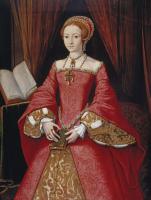


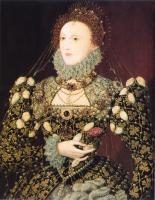
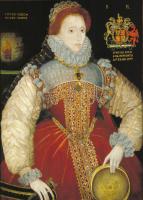


Henry Machyn's Diary. 10th June 1557. The x day of Junij the Kyng (age 30) and the Quen (age 41) toke ther jorney toward Hamtun [Map] courte for to hunt and to kyll a grett hartt, with serten of the consell; and so the howswold tared at the Whytthalle, tylle the Saterday folowhyng they cam a-gayne to Whytthalle.


Henry Machyn's Diary. 10th June 1560. The sam day was had to the Towre [Map] the (arch-)byshope of (York) docthur Heth (age 59), latt chanseler of Engeland by quen Mare('s) days, and part by quen Elesabeth('s) days.

Henry Machyn's Diary. 10th June 1561. [The x day of July the Queen (age 27) came by water] unto the Towre of London [Map] by x [of the clock, until] v at nyght, and whent and sa(w) all her my[nts; and they gave the] Quen serten pesses of gold, and gayff the [lord] of Hunsdon (age 35) had on, and my lord marques of [Northampton,] (age 49) and her grace whent owt of the yron gatt [over] Towre hyll [Map] unto Algatt chyrche, and so down Hondyche [Map] [to the] Spyttyll, and so downe Hoge lane, and so over the feldes to the Charter howse my lord North('s) (age 65) plase, with trumpetes and the penssyonars and the haroldes of armes and the servantes, and then cam gentyllmen rydyng, and after lordes, and then [the] lord of Hunsdon and bare the sword a-for the quen, and then cam [ladies] rydyng; and the feldes full of pepull, gret nombur [as ever was] sene; and ther tared tylle Monday.

Henry Machyn's Diary. 10th June 1563. The x day of June was a degre [decree] mayd a-for my lord [the duke] of Northfoke (age 27), and master Garter (age 53) and master Clarenshux (age 53) and master Norrey (age 65), that master Garter have the berehyng of all knyghtes of the Garter and all yerles and ther [wives] and all lordes and ther wyffes and vyconttes.

On 10th June 1584 Francis Valois Duke Anjou (age 29) died of malaria unmarried.
On 10th June 1595 Katharina Sofie Palatinate Simmern was born to Frederick IV Elector Palatine (age 21) and Electress Louise Juliana of the Palatine Rhine (age 19).
John Evelyn's Diary. 10th June 1640. London, and especially the Court, were at this period in frequent disorders, and great insolences were committed by the abused and too happy City: in particular, the Bishop of Canterbury's (age 66) Palace [Map] at Lambeth was assaulted by a rude rabble from Southwark, Surrey [Map], my Lord Chamberlain (age 55) imprisoned and many scandalous libels and invectives scattered about the streets, to the reproach of Government, and the fermentation of our since distractions: so that, upon the 25th of June, I was sent for to Wotton, Surrey [Map], and the 27th after, my father's (age 53) indisposition augmenting, by advice of the physicians he repaired to the Bath, Somerset [Map].


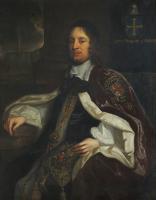
John Evelyn's Diary. 10th June 1647. We concluded about my marriage, in order to which I went to St. Germains, where his Majesty (age 17), then Prince of Wales, had his court, to desire of Dr. Earle (age 46), then one of his chaplains (since Dean of Westminster Abbey, Clerk of the Closet, and Bishop of Salisbury), that he would accompany me to Paris, which he did; and, on Thursday, 27th of June 1647, he married us in Sir Richard Browne's (age 42) chapel, between the hours of eleven and twelve, some few select friends being present. And this being Corpus Christi feast, was solemnly observed in this country; the streets were sumptuously hung with tapestry, and strewed with flowers.
Samuel Pepys' Diary. 10th June 1661. Early to my Lord's, who privately told me how the King had made him Embassador in the bringing over the Queen (age 22)1. That he is to go to Algier, &c., to settle the business, and to put the fleet in order there; and so to come back to Lisbone with three ships, and there to meet the fleet that is to follow him. He sent for me, to tell me that he do intrust me with the seeing of all things done in his absence as to this great preparation, as I shall receive orders from my Lord Chancellor (age 52) and Mr. Edward Montagu. At all which my heart is above measure glad; for my Lord's honour, and some profit to myself, I hope.
Note 1. Katherine of Braganza, daughter of John IV. of Portugal, born 1638, married to Charles II, May 21st, 1662. After the death of the king she lived for some time at Somerset House [Map], and then returned to Portugal, of which country she became Regent in 1704 on the retirement of her brother Don Pedro. She died December 31st, 1705.


Samuel Pepys' Diary. 10th June 1664. Up and by water to White Hall, and there to a Committee of Tangier, and had occasion to see how my Lord Ashworth (age 42)1 deports himself, which is very fine indeed, and it joys my heart to see that there is any body looks so near into the King's business as I perceive he do in this business of my Lord Peterborough's (age 42) accounts.
Note 1. Lord Ashworth is probably a miswriting for Lord Ashley (afterwards Earl of Shaftesbury).


John Evelyn's Diary. 8th June 1665. Came news of his highness's (age 35) victory, which indeed might have been a complete one, and at once ended the war, had it been pursued, but the cowardice of some, or treachery, or both, frustrated that. We had, however, bonfires, bells, and rejoicing in the city. Next day, the 9th, I had instant orders to repair to the Downs, so as I got to Rochester, Kent [Map] this evening. Next day I lay at Deal, Kent [Map], where I found all in readiness: but, the fleet being hindered by contrary winds, I came away on the 12th, and went to Dover, Kent [Map], and returned to Deal, Kent [Map]; and on the 13th, hearing the fleet was at Solbay, I went homeward, and lay at Chatham, Kent [Map], and on the 14th, I got home. On the 15th, came the eldest son of the present Secretary of State to the French King, with much other company, to dine with me. After dinner, I went with him to London, to speak to my Lord General for more guards, and gave his Majesty an account of my journey to the coasts under my inspection. I also waited on his Royal Highness (age 31), now come triumphant from the fleet, gotten into repair. See the whole history of this conflict in my "History of the Dutch War"..
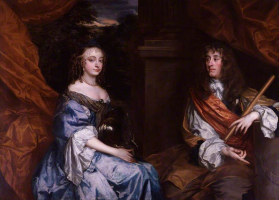


Samuel Pepys' Diary. 10th June 1665. In the evening home to supper; and there, to my great trouble, hear that the plague is come into the City (though it hath these three or four weeks since its beginning been wholly out of the City); but where should it begin but in my good friend and neighbour's, Dr. Burnett, in Fanchurch Street [Map]: which in both points troubles me mightily.

Before 10th June 1666 Vice-Admiral Christopher Myngs (age 40) died of wounds received at the Four Days' Battle. He was buried at St Mary's Church.
The Loyal London was built by Captain John Taylor. It was given to King Charles II of England Scotland and Ireland (age 36) by the City of London. Launched 10th June 1666.
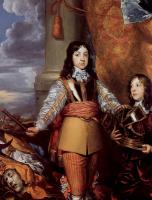


Chronicle of a Bourgeois of Valenciennes
Récits d’un bourgeois de Valenciennes aka The Chronicle of a Bourgeois of Valenciennes is a vivid 14th-century vernacular chronicle written by an anonymous urban chronicler from Valenciennes in the County of Hainaut. It survives in a manuscript that describes local and regional history from about 1253 to 1366, blending chronology, narrative episodes, and eyewitness-style accounts of political, military, and social events in medieval France, Flanders, and the Low Countries. The work begins with a chronological framework of events affecting Valenciennes and its region under rulers such as King Philip VI of France and the shifting allegiances of local nobility. It includes accounts of conflicts, sieges, diplomatic manoeuvres, and the impact of broader struggles like the Hundred Years’ War on urban life in Hainaut. Written from the perspective of a burgher (bourgeois) rather than a monastery or royal court, the chronicle offers a rare lay viewpoint on high politics and warfare, reflecting how merchants, townspeople, and civic institutions experienced the turbulence of the 13th and 14th centuries. Its narrative style combines straightforward reporting of events with moral and civic observations, making it a valuable source for readers interested in medieval urban society, regional politics, and the lived experience of war and governance in pre-modern Europe.
Available at Amazon in eBook and Paperback format.
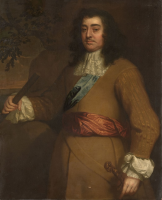
Samuel Pepys' Diary. 10th June 1666. He tells me further, how the Duke of Yorke (age 32) is wholly given up to his new mistresse, my Lady Denham (age 26), going at noon-day with all his gentlemen with him to visit her in Scotland Yard; she declaring she will not be his mistresse, as Mrs. Price (age 29), to go up and down the Privy-stairs, but will be owned publicly; and so she is. Mr. Bruncker (age 39), it seems, was the pimp to bring it about, and my Baroness Castlemaine's (age 25), who designs thereby to fortify herself by the Duke; there being a falling-out the other day between the King (age 36) and her: on this occasion, the Queene (age 56), in ordinary talke before the ladies in her drawing-room, did say to my Baroness Castlemaine's that she feared the King did take cold, by staying so late abroad at her house. She answered before them all, that he did not stay so late abroad with her, for he went betimes thence (though he do not before one, two, or three in the morning), but must stay somewhere else. The King then coming in and overhearing, did whisper in the eare aside, and told her she was a bold impertinent woman, and bid her to be gone out of the Court, and not come again till he sent for, her; which she did presently, and went to a lodging in the Pell Mell [Map], and kept there two or three days, and then sent to the King to know whether she might send for her things away out of her house. The King sent to her, she must first come and view them: and so she come, and the King went to her, and all friends again. He tells me she did, in her anger, say she would be even with the King, and print his letters to her. So putting all together, we are and are like to be in a sad condition. We are endeavouring to raise money by borrowing it of the City; but I do not think the City will lend a farthing.
Samuel Pepys' Diary. 10th June 1666. By and by the Council broke up, and I spoke with Sir W. Coventry (age 38) about business, with whom I doubt not in a little time to be mighty well, when I shall appear to mind my business again as I used to do, which by the grace of God I will do. Gone from him I endeavoured to find out Sir G. Carteret (age 56), and at last did at Mr. Ashburnham's (age 62), in the Old Palace Yarde, and thence he and I stepped out and walked an houre in the church-yarde, under Henry the Seventh's Chappell, he being lately come from the fleete; and tells me, as I hear from every body else, that the management in the late fight was bad from top to bottom. That several said this would not have been if my Lord Sandwich (age 40) had had the ordering of it. Nay, he tells me that certainly had my Lord Sandwich had the misfortune to have done as they have done, the King (age 36) could not have saved him. There is, too, nothing but discontent among the officers; and all the old experienced men are slighted. He tells me to my question (but as a great secret), that the dividing of the fleete did proceed first from a proposition from the fleete, though agreed to hence. But he confesses it arose from want of due intelligence, which he confesses we do want. He do, however, call the fleete's retreat on Sunday a very honourable retreat, and that the Duke of Albemarle (age 57) did do well in it, and would have been well if he had done it sooner, rather than venture the loss of the fleete and crown, as he must have done if the Prince had not come. He was surprised when I told him I heard that the King did intend to borrow some money of the City, and would know who had spoke of it to me; I told him Sir Ellis Layton this afternoon. He says it is a dangerous discourse; for that the City certainly will not be invited to do it, and then for the King to ask it and be denied, will be the beginning of our sorrow. He seems to fear we shall all fall to pieces among ourselves.


Become a Member via our Buy Me a Coffee page to read more.
Samuel Pepys' Diary. 10th June 1666. After dinner I took leave and by water to White Hall, and there spent all the afternoon in the Gallery, till the Council was up, to speake with Sir W. Coventry (age 38). Walking here I met with Pierce the surgeon, who is lately come from the fleete, and tells me that all the commanders, officers, and even the common seamen do condemn every part of the late conduct of the Duke of Albemarle (age 57): both in his fighting at all, in his manner of fighting, running among them in his retreat, and running the ships on ground; so as nothing can be worse spoken of. That Holmes, Spragg, and Smith do all the business, and the old and wiser commanders nothing. So as Sir Thomas Teddiman (whom the King (age 36) and all the world speak well of) is mightily discontented, as being wholly slighted. He says we lost more after the Prince (age 46) come, than before too. The Prince was so maimed, as to be forced to be towed home. He says all the fleete confess their being chased home by the Dutch; and yet the body of the Dutch that did it, was not above forty sayle at most. And yet this put us into the fright, as to bring all our ships on ground. He says, however, that the Duke of Albemarle is as high almost as ever, and pleases himself to think that he hath given the Dutch their bellies full, without sense of what he hath lost us; and talks how he knows now the way to beat them. But he says, that even Smith himself, one of his creatures, did himself condemn the late conduct from the beginning to the end.
Samuel Pepys' Diary. 10th June 1667. Up; and news brought us that, the Dutch are come up as high as the Nore; and more pressing orders for fireships. W. Batten (age 66), W. Pen (age 46), and I to St. James's; where the Duke of York (age 33) gone this morning betimes, to send away some men down to Chatham, Kent [Map].
Samuel Pepys' Diary. 10th June 1667. Yet partly ourselves, being used to be idle and in despair, and partly people that have been used to be deceived by us as to money, won't believe us; and we know not, though we have it, how almost to promise it; and our wants such, and men out of the way, that it is an admirable thing to consider how much the King (age 37) suffers, and how necessary it is in a State to keep the King's service always in a good posture and credit. Here I eat a bit, and then in the afternoon took boat and down to Greenwich, Kent [Map], where I find the stairs full of people, there being a great riding1 there to-day for a man, the constable of the town, whose wife beat him. Here I was with much ado fain to press two watermen to make me a galley, and so to Woolwich, Kent [Map] to give order for the dispatch of a ship I have taken under my care to see dispatched, and orders being so given, I, under pretence to fetch up the ship, which lay at Grays (the Golden Hand)2, did do that in my way, and went down to Gravesend, Kent [Map], where I find the Duke of Albemarle (age 58) just come, with a great many idle lords and gentlemen, with their pistols and fooleries; and the bulwarke not able to have stood half an hour had they come up; but the Dutch are fallen down from the Hope and Shell-haven as low as Sheernesse [Map], and we do plainly at this time hear the guns play. Yet I do not find the Duke of Albemarle intends to go thither, but stays here to-night, and hath, though the Dutch are gone, ordered our frigates to be brought to a line between the two blockhouses; which I took then to be a ridiculous thing.
Note 1. It was an ancient custom in Berkshire, when a man had beaten his wife, for the neighbours to parade in front of his house, for the purpose of serenading him with kettles, and horns and hand-bells, and every species of "rough music", by which name the ceremony was designated. Perhaps the riding mentioned by Pepys was a punishment somewhat similar. Malcolm ("Manners of London") quotes from the "Protestant Mercury", that a porter's lady, who resided near Strand Lane, beat her husband with so much violence and perseverance, that the poor man was compelled to leap out of the window to escape her fury. Exasperated at this virago, the neighbours made a "riding", i.e. a pedestrian procession, headed by a drum, and accompanied by a chemise, displayed for a banner. The manual musician sounded the tune of "You round-headed cuckolds, come dig, come dig!" and nearly seventy coalheavers, carmen, and porters, adorned with large horns fastened to their heads, followed. The public seemed highly pleased with the nature of the punishment, and gave liberally to the vindicators of injured manhood. B.
Note 2. The "Golden Hand" was to have been used for the conveyance of the Swedish Ambassadors' horses and goods to Holland. In August, 1667, Frances, widow of Captain Douglas and daughter of Lord Grey, petitioned the King "for a gift of the prize ship Golden Hand, now employed in weighing the ships sunk at Chatham, Kent [Map], where her husband lost his life in defence of the ships against the Dutch" (Calendar of State Papers, 1667, p. 430).
Become a Member via our Buy Me a Coffee page to read more.
John Evelyn's Diary. 10th June 1669. Came my Lord Cornbury, Sir William Pulteney (age 45), and others to visit me. I went this evening to London, to carry Mr. Pepys (age 36) to my brother Richard (age 46), now exceedingly afflicted with the stone, who had been successfully cut, and carried the stone as big as a tennis ball to show him, and encourage his resolution to go through the operation.
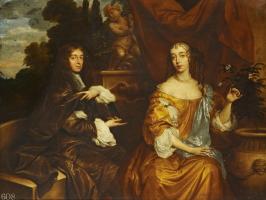


John Evelyn's Diary. 10th June 1673. Came to visit and dine with me my Lord Viscount Cornbury (age 11) and his Lady (age 10); Lady Frances Hyde, sister to the Duchess of York; and Mrs. Dorothy Howard (age 22), Maid of Honour [Note. Dorothy Howard and Colonel James Graham (age 24) were married in 1675 - may be an example of Evelyn writing his diary retrospectively she being referred to as 'Mrs' although possibly the term was used irrecspective of marriage - see John Evelyn's Diary 9th October 1671]. We went, after dinner, to see the formal and formidable camp on Blackheath, Greenwich [Map], raised to invade Holland; or, as others suspected for another design. Thence, to the Italian glass-house at Greenwich, Kent [Map], where glass was blown of finer metal than that of Murano [Map], at Venice.
On 10th June 1685 Charles Knollys 4th Earl Banbury (age 23) unsuccessfully petitioned the House of Lords to become Earl Banbury.
On 10th June 1688 James "Old Pretender" Stewart was born to King James II of England Scotland and Ireland (age 54) and Mary of Modena Queen Consort England Scotland and Ireland (age 29). Winifred Trentham (age 43) and Charles Middleton 2nd Earl Middleton (age 38) were present. He married 3rd September 1719 Maria Clementina Sobieska and had issue.


John Evelyn's Diary. 10th June 1690. Mr. Pepys (age 57) read to me his Remonstrance, showing with what malice and injustice he was suspected with Sir Anthony Deane (age 56) about the timber, of which the thirty ships were built by a late Act of Parliament, with the exceeding danger which the fleet would shortly be in, by reason of the tyranny and incompetency of those who now managed the Admiralty and affairs of the Navy, of which he gave an accurate state, and showed his great ability.
John Evelyn's Diary. 10th June 1691. I went to visit Lord Clarendon, still prisoner in the Tower [Map], though Lord Preston (age 41) being pardoned was released.
Chronicle of Geoffrey le Baker of Swinbroke
Baker was a secular clerk from Swinbroke, now Swinbrook, an Oxfordshire village two miles east of Burford. His Chronicle describes the events of the period 1303-1356: Gaveston, Bannockburn, Boroughbridge, the murder of King Edward II, the Scottish Wars, Sluys, Crécy, the Black Death, Winchelsea and Poitiers. To quote Herbert Bruce 'it possesses a vigorous and characteristic style, and its value for particular events between 1303 and 1356 has been recognised by its editor and by subsequent writers'. The book provides remarkable detail about the events it describes. Baker's text has been augmented with hundreds of notes, including extracts from other contemporary chronicles, such as the Annales Londonienses, Annales Paulini, Murimuth, Lanercost, Avesbury, Guisborough and Froissart to enrich the reader's understanding. The translation takes as its source the 'Chronicon Galfridi le Baker de Swynebroke' published in 1889, edited by Edward Maunde Thompson.
Available at Amazon in eBook and Paperback format.
On 10th June 1693 Philip William Oldenburg was born to Frederick Louis Oldenburg I Duke Schleswig-Holstein-Sonderburg-Beck (age 40) and Louise Charlotte Oldenburg Duchess Schleswig-Holstein-Sonderburg-Beck (age 35). Coefficient of inbreeding 7.82%.
On 10th June 1711 Princess Amelia Hanover was born to King George II of Great Britain and Ireland (age 27) and Caroline Hohenzollern Queen Consort England (age 28).
On 10th June 1713 Princess Caroline Hanover was born to King George II of Great Britain and Ireland (age 29) and Caroline Hohenzollern Queen Consort England (age 30).


After 10th June 1721. St Germans Priory [Map]. Memorial to Walter Moyle of Bake.
Derbyshire Archaeological Journal Volume 30 1908 Page 155. 10th June 1761 [Fol. 45.]
Copied from MS of John Mander, of Bakewell.
Arbourlows [Map] viewed by Mr Pegge and myself, 10 June 1761.
There are 2 in the enclosed commons adjoining One Ash ground, the great one is environed (a) by a great circular rampire, whose height sloping is about 7 yards, the foss four yards (b) over, the area (c) flat of 50 yards diameter; round which are 32 very large limestone slabs formerly erect, now flat. This Mr Pegge called a British temple. It has two entrances, one to the East, another to the West1. From that to the East runs a smail rampire, winding south westwardly to the 2nd low (D) at the distance of about 4 or 500 yards2. On the NE3 side of the temple near the last entrance upon the rampire stands a large low, or mount of earth supposed a great barrow and is properly the low.
The low D4 is about 18 feet diameter at top, with a large hollow in the middle of its area summitt after the form of a bason, on the S side is a small faint rampire5 of earth with several breaks in it running across the field (at the distance of about 70 feet from the low) from the wall on the W, and across under the wall on wall to the E. N.B., On the W side of the western wall we could find no traces of this rampire, nor any place where it turned. This rampire crossing the Eastern wall as was said before passes quite to the foot of the great rampire of the temple."
Note 1. Mr Manders evidently had the compass bearings on the plan referred to in this MS., wrong. The entrances of the circle are nearly due north and south, and the tumulus is on the south-east.
Note 2. Gib Hill [Map], but its actual distance from the circle is about 300 yds. It is constantly stated by the older writers that this tumulus was connected with the circle by a "rampire." This, however, upon leaving the latter, does not point to Gib Hill [Map], but has a southerly course for about 200 yards, after which it curves to the west, but with a bearing considerably south of the latter, and is then lost. The recent excavations proved that it consists of a small bank and ditch.
Note 3. This tumulus is on the sonth-east.
Note 5. From personal observations, this is very doubtful (J.W.).
Become a Member via our Buy Me a Coffee page to read more.
On 10th June 1787 George Henry Harlow was born.
On 10th June 1819 Gustave Courbet was born.
On 10th June 1823 James Archer was born at Edinburgh.
On 10th June 1830 Edward Adolphus Seymour 12th Duke of Somerset (age 25) and Jane Georgiana Sheridan Duchess Somerset (age 20) were married at Grosvenor Square, Belgravia. He the son of Edward Seymour 11th Duke of Somerset (age 55) and Charlotte Hamilton Duchess Somerset.
Vestiges of the Antiquities of Derbyshire. June the 10th, 1844, was opened a barrow [Map] upon Elton Moor, for which there is no distinctive name; it was on this occasion divided into four quarters by our sections, which left very little of the mound unexplored. In the usual central situation was found a previously-disturbed interment, accompanied by a large arrow- or spear-head of flint, a piece of a small urn neatly ornamented, and some animal teeth. On the southern side of the tumulus another interment was discovered, about eighteen inches below the natural surface of the land upon which the barrow was constructed; this skeleton was certainly that of an aged person, the teeth being much worn down; near the head was a piece of spherical iron pyrites, now for the first time noticed as being occasionally found with other relics in the British tumuli. Subsequent discoveries have proved that it was prized by the Britons, and not unfrequently deposited in the grave along with the weapons and ornaments which formed the most valued part of their store; even to the present day, the same mineral is used as a personal decoration by some tribes of the South American Indians. In the rear of the skeleton was a neatly-ornamented drinking-cup, which had been crushed by the weight of the soil, with which it had in a great degree become incorporated; within this cup the following odd assemblage of articles were placed: three quartz pebbles, one of which is red, the other two of a light colour; a flat piece of polished iron ore, a small celt of flint, with the peculiarity of having a round polished edge, instead of a cutting one as is usual; a beautifully-chipped cutting tool, twenty-one circular instruments almost all neatly chipped, and seventeen pieces, or rude instruments, all of flint, which had been turned to a delicate white or gray by calcination. Scattered about in the immediate neighbourhood of this interment were a good many pieces of burnt bones, not sufficient in quantity to compose a complete deposit, and a few rats' bones as usual.
Become a Member via our Buy Me a Coffee page to read more.
William of Worcester's Chronicle of England
William of Worcester, born around 1415, and died around 1482 was secretary to John Fastolf, the renowned soldier of the Hundred Years War, during which time he collected documents, letters, and wrote a record of events. Following their return to England in 1440 William was witness to major events. Twice in his chronicle he uses the first person: 1. when writing about the murder of Thomas, 7th Baron Scales, in 1460, he writes '… and I saw him lying naked in the cemetery near the porch of the church of St. Mary Overie in Southwark …' and 2. describing King Edward IV's entry into London in 1461 he writes '… proclaimed that all the people themselves were to recognize and acknowledge Edward as king. I was present and heard this, and immediately went down with them into the city'. William’s Chronicle is rich in detail. It is the source of much information about the Wars of the Roses, including the term 'Diabolical Marriage' to describe the marriage of Queen Elizabeth Woodville’s brother John’s marriage to Katherine, Dowager Duchess of Norfolk, he aged twenty, she sixty-five or more, and the story about a paper crown being placed in mockery on the severed head of Richard, 3rd Duke of York.
Available at Amazon in eBook and Paperback format.
On 10th June 1845 William Calder Marshall (age 32) and Margaret Calder (age 28) were married at St Cuthbert's Church, Edinburgh. The same church in which he had married his first wife three years previously.
On 10th June 1846 George Spencer-Churchill 6th Duke of Marlborough (age 52) and Charlotte Augusta Flower Duchess of Marlborough (age 28) were married. She by marriage Duchess Marlborough. The difference in their ages was 24 years. He the son of George Spencer-Churchill 5th Duke of Marlborough and Susan Stewart Duchess of Marlborough.
Ten Years' Digging. Waterfall Low, a large tumulus [Waterfall Low [Map]] on an eminence overlooking the village of Waterfall, was opened on the 10th of June. It is a very conspicuous object, being 20 yards diameter and 9 feet high. We began by cutting across the centre through a mixture of earth and stone; at the north end of the trench was a thick stratum of red earth, which had evidently been burnt, under it the barrow was composed of loose stone, intermingled with pieces of human bone, stags' horns, rats' bones, and in some places with dark coloured earth containing charcoal. Near the middle, about eight feet from the surface, was a cavity three feet long and eighteen inches wide, cut in the rock to a further depth of between one and two feet; although this was plainly the grave, it contained only a few fragments of bone, having evidently been examined by barrow diggers of a former age. A large part of the centre of the barrow was turned over, with no more successful result than the finding of horses' teeth and chippings of flint.
Ten Years' Digging. On the 10th of June, we examined the remnant of a barrow [Cotes Field Barrow [Map]] at Cotes Field, near Hartington, but were disappointed by finding the interior occupied by the ruins of a limekiln; a few fragments of human bone, and bones of rats, alone testifying to the sepulchral origin of the mound.
On 10th June 1851 John Manners (age 32) and Catherine Louise Georgina Marlay (age 20) were married at All Souls, Marylebone. He the son of John Henry Manners 5th Duke Rutland (age 73) and Elizabeth Howard Duchess Rutland.


On 10th June 1863 Prince Alfred Windsor (age 18) was appointed 736th Knight of the Garter by Queen Victoria of the United Kingdom (age 44).
On 10th June 1888 Helene Adelheid Viktoria Marie Glücksburg was born to Friedrich Ferdinand Glücksburg Duke Schleswig Holstein Sonderburg Glücksburg (age 32) and Victoria Friederike Oldenburg Duchess Schleswig Holstein Sonderburg Glücksburg (age 28). She married her second cousin Harald Glücksburg, son of Frederick VIII King of Denmark and Louise of Sweden Queen Consort Denmark, and had issue.
On 10th June 1894 Federico de Madrazo y Kuntz (age 79) died.
On 10th June 1912 Viola Maud Lyttelton Duchess Westminster was born to John Cavendish Lyttelton 9th Viscount Cobham (age 30) and Violet Leonard Viscountess Cobham. She married 3rd December 1946 her second cousin Robert George Grosvenor 5th Duke Westminster and had issue.
On 10th June 1917 Captain Edward James Kay-Shuttleworth (age 27) died in a motorcycle accident returning to duty at his Headquarters at Witham, Essex [Map] when returning to Duty. He was buried at St Bartholomew Churchyard, Barbon, Cumberland.
Jean de Waurin's Chronicle of England Volume 6 Books 3-6: The Wars of the Roses
Jean de Waurin was a French Chronicler, from the Artois region, who was born around 1400, and died around 1474. Waurin’s Chronicle of England, Volume 6, covering the period 1450 to 1471, from which we have selected and translated Chapters relating to the Wars of the Roses, provides a vivid, original, contemporary description of key events some of which he witnessed first-hand, some of which he was told by the key people involved with whom Waurin had a personal relationship.
Available at Amazon in eBook and Paperback format.

On 10th June 1921 Philip Mountbatten Duke Edinburgh was born to Andrew Glücksburg (age 39) and Princess Alice of Battenburg (age 36) at Mon Repos. He a great x 2 grandson of Queen Victoria of the United Kingdom. He married 20th November 1947 his second cousin once removed Queen Elizabeth II of the United Kingdom and had issue.

On 10th June 1940 Charles Howard 20th Earl of Suffolk, 13th Earl Berkshire (age 34) left Paris and travelled to Bordeaux [Map] where British Embassy representatives introduced them to the master of the British tramp ship SS Broompark. They embarked 33 eminent scientists, with their families. Two more scientists, Lew Kowarski and Hans Halban, arrived with the entire world stockpile of heavy water. Then the managing director of the Antwerp Diamond Bank, Paul Timbal, joined, with $10 million worth of gem diamonds. They discovered 600 tons of machine tools in wagons on the quay, which were also loaded. The Broompark carried them safely to Pendennis Castle, Falmouth [Map].
On 10th June 1974 Henry Windsor 1st Duke Gloucester (age 74) died. His son Richard (age 29) succeeded 2nd Duke Gloucester. Memorials at St Andrews Church, Barnwell [Map] to Henry Windsor 1st Duke Gloucester who lived nearby and worshipped at the church.
Richard Alexander Walter Windsor 2nd Duke Gloucester: On 26th August 1944 he was born to Henry Windsor 1st Duke Gloucester and Alice Christabel Montagu-Douglas-Scott Duchess Gloucester. He a grandson of King George V of the United Kingdom.


On 10th June 1513 Louis Duke of Montpensier was born to Louis Bourbon Prince of La Roche sur Yon (age 40) and Louise Bourbon Duchess of Monpensier (age 31). He married 1538 his fifth cousin Jacqueline de Longwy and had issue.
On 10th June 1549 Temperance Cavendish was born to William Cavendish (age 44) and Bess of Hardwick (age 22). She died a year later.


On 10th June 1595 Katharina Sofie Palatinate Simmern was born to Frederick IV Elector Palatine (age 21) and Electress Louise Juliana of the Palatine Rhine (age 19).
On 10th June 1604 John Manners 8th Earl of Rutland was born to George Manners (age 32) and Grace Pierrepont (age 29) at Haddon Hall, Derbyshire [Map]. He married before 2nd June 1629 Frances Montagu Countess Rutland, daughter of Edward Montagu 1st Baron Montagu and Frances Cotton, and had issue.
On 10th June 1630 Susan Crane was born to Robert Crane 1st Baronet (age 44) and Susan Alinton in Chilton, Suffolk. She married before 18th November 1650 Edward Walpole of Houghton and had issue.
On 9th June 1654 Catherine Herbert was born to Philip Herbert 5th Earl Pembroke 2nd Earl Montgomery (age 33) and Catherine Villiers Countess Pembroke and Montgomery (age 33). She was baptised on 10th June 1654 at St Benet's Church, Paul's Wharf [Map].
On 10th June 1685 Henry Grey 3rd Earl Stamford was born to John Grey (age 60) and Catherine Ward (age 22). He married 6th July 1704 Dorothy Wright Countess Stamford and had issue.
On 10th June 1688 James "Old Pretender" Stewart was born to King James II of England Scotland and Ireland (age 54) and Mary of Modena Queen Consort England Scotland and Ireland (age 29). Winifred Trentham (age 43) and Charles Middleton 2nd Earl Middleton (age 38) were present. He married 3rd September 1719 Maria Clementina Sobieska and had issue.
On 10th June 1693 Philip William Oldenburg was born to Frederick Louis Oldenburg I Duke Schleswig-Holstein-Sonderburg-Beck (age 40) and Louise Charlotte Oldenburg Duchess Schleswig-Holstein-Sonderburg-Beck (age 35). Coefficient of inbreeding 7.82%.
Abbot John Whethamstede’s Chronicle of the Abbey of St Albans
Abbot John Whethamstede's Register aka Chronicle of his second term at the Abbey of St Albans, 1451-1461, is a remarkable text that describes his first-hand experience of the beginning of the Wars of the Roses including the First and Second Battles of St Albans, 1455 and 1461, respectively, their cause, and their consequences, not least on the Abbey itself. His text also includes Loveday, Blore Heath, Northampton, the Act of Accord, Wakefield, and Towton, and ends with the Coronation of King Edward IV. In addition to the events of the Wars of the Roses, Abbot John, or his scribes who wrote the Chronicle, include details in the life of the Abbey such as charters, letters, land exchanges, visits by legates, and disputes, which provide a rich insight into the day-to-day life of the Abbey, and the challenges faced by its Abbot.
Available at Amazon in eBook and Paperback format.
On 10th June 1703 Walter Butler 16th Earl Ormonde 9th Earl Ossory was born to John Butler.
On 10th June 1711 Princess Amelia Hanover was born to King George II of Great Britain and Ireland (age 27) and Caroline Hohenzollern Queen Consort England (age 28).
On 10th June 1713 Princess Caroline Hanover was born to King George II of Great Britain and Ireland (age 29) and Caroline Hohenzollern Queen Consort England (age 30).

On 10th June 1755 Elizabeth Capell was born to William Anne Capell 4th Earl Essex (age 22) and Frances Hanbury Williams Countess Essex. She married John Monson 3rd Baron Monson, son of John Monson 2nd Baron Monson, and had issue.
On 10th June 1757 Field Marshal George Nugent 1st Baronet was born illegitimately to Lieutenant-Colonel Edmund Nugent (age 25). He married 16th November 1797 Maria Skinner and had issue.
On 10th June 1759 Isabella Anne Ingram Marchioness Hertford was born to Charles Ingram 9th Viscount Irvine (age 32) and Frances Shepheard. She became joint heir to her father's estate; 'one of the riches heiresses of high birth to be found in England'. She married 20th May 1776 her sixth cousin Francis Ingram Seymour-Conway 2nd Marquess Hertford, son of Francis Seymour-Conway 1st Marquess Hertford and Isabella Fitzroy Countess Hertford, and had issue.


On 10th June 1761 Frances Carpenter Baroness Calthorpe was born to Benjamin Carpenter. She married 1st May 1783 Henry Gough-Calthorpe 1st Baron Calthorpe, son of Henry Gough 1st Baronet and Barbara Calthorpe Lady Gough, and had issue.
On 10th June 1771 Sophia Southwell was born to Edward Southwell 20th Baron Clifford (age 33). She married 13th April 1790 John Townshend 2nd Viscount Sydney, son of Thomas Townshend 1st Viscount Sydney and Elizabeth Powys Viscountess Sydney, and had issue.

On 10th June 1785 Admiral Anthony Maitland 10th Earl of Lauderdale was born to James Maitland 8th Earl Lauderdale (age 26) and Eleanor Todd Countess Lauderdale (age 23).
On 10th June 1787 George Henry Harlow was born.
On 10th June 1789 Reynold Abel Alleyne 2nd Baronet was born to John Gay Alleyn 1st Baronet (age 65). He married 20th September 1810 Rebecca Alton Lady Alleyne and had issue.
On 10th June 1792 John Fitzgibbon 2nd Earl of de Clare was born to John Fitzgibbon 1st Earl of de Clare (age 44).
Chronicle of Walter of Guisborough
A canon regular of the Augustinian Guisborough Priory, Yorkshire, formerly known as The Chronicle of Walter of Hemingburgh, describes the period from 1066 to 1346. Before 1274 the Chronicle is based on other works. Thereafter, the Chronicle is original, and a remarkable source for the events of the time. This book provides a translation of the Chronicle from that date. The Latin source for our translation is the 1849 work edited by Hans Claude Hamilton. Hamilton, in his preface, says: 'In the present work we behold perhaps one of the finest samples of our early chronicles, both as regards the value of the events recorded, and the correctness with which they are detailed; Nor will the pleasing style of composition be lightly passed over by those capable of seeing reflected from it the tokens of a vigorous and cultivated mind, and a favourable specimen of the learning and taste of the age in which it was framed.'
Available at Amazon in eBook and Paperback format.
On 10th June 1802 Francis Charles Knowles 3rd Baronet was born to Charles Knowles 2nd Baronet (age 47). He married 26th May 1831 Emma Pocock, daughter of George Pocock 1st Baronet and Charlotte Mary Long Lady Pocock, and had issue.
On 10th June 1806 George Brodrick was born to George Brodrick 4th Viscount Midleton (age 51) and Maria Benyon Viscountess Midleton. He married 14th May 1833 Ellen Griffiths.
On 10th June 1810 Edmund Parker 2nd Earl Morley was born to John Parker 1st Earl Morley (age 38) and Frances Talbot Countess Morley (age 28). He married 1842 his second cousin Harriet Sophia Parker Countess Morley and had issue.


On 10th June 1814 Alfred Wodehouse was born to John Wodehouse 2nd Baron Wodehouse (age 43) and Charlotte Norris Baroness Woodhouse. He married 21st April 1840 Emma Hamilton Macdonald Macdonald.
On 10th June 1817 Robert Spencer was born to Francis Almeric Spencer 1st Baron Churchill (age 37) and Frances Fitzroy Baroness Churchill Wychwood (age 37). Coefficient of inbreeding 1.63%. He married before 17th June 1881 his first cousin once removed Louisa Spencer-Churchill, daughter of George Spencer-Churchill 6th Duke of Marlborough and Jane Stewart Duchess of Marlborough.
On 10th June 1819 Gustave Courbet was born.
On 10th June 1823 James Archer was born at Edinburgh.
On 10th June 1834 Henry Bligh was born to Edward Bligh 5th Earl Darnley (age 39) and Emma Jane Parnell Countess Darnley.
On 10th June 1844 Isabella Elizabeth Wynn Viscountess Hill was born to Spencer Bulkeley Wynn 3rd Baron Newborough (age 41) and Frances Maria De Winton Baroness Newborough. Coefficient of inbreeding 3.12%. She married 29th April 1875 Rowland Hill aka Clegg-Hill 3rd Viscount Hill, son of Rowland Hill 2nd Viscount Hill and Anne Clegg Viscoutess Hill, and had issue.
On 10th June 1864 Edward Sholto Douglas-Pennant 3rd Baron Penrhyn was born to George Sholto Douglas-Pennant 2nd Baron Penrhyn (age 27) and Pamela Blanche Rushout (age 25). He married 1887 his fourth cousin once removed Blanche Georgiana Fitzroy Baroness Penrhyn, daughter of Charles Fitzroy 3rd Baron Southampton and Ismania Katharine Nugent Baroness Southampton, and had issue.
Chronicle of Geoffrey le Baker of Swinbroke
Baker was a secular clerk from Swinbroke, now Swinbrook, an Oxfordshire village two miles east of Burford. His Chronicle describes the events of the period 1303-1356: Gaveston, Bannockburn, Boroughbridge, the murder of King Edward II, the Scottish Wars, Sluys, Crécy, the Black Death, Winchelsea and Poitiers. To quote Herbert Bruce 'it possesses a vigorous and characteristic style, and its value for particular events between 1303 and 1356 has been recognised by its editor and by subsequent writers'. The book provides remarkable detail about the events it describes. Baker's text has been augmented with hundreds of notes, including extracts from other contemporary chronicles, such as the Annales Londonienses, Annales Paulini, Murimuth, Lanercost, Avesbury, Guisborough and Froissart to enrich the reader's understanding. The translation takes as its source the 'Chronicon Galfridi le Baker de Swynebroke' published in 1889, edited by Edward Maunde Thompson.
Available at Amazon in eBook and Paperback format.
On 10th June 1866 Arthur Trollope 13th Baronet was born to Arthur Trollope (age 55).
On 10th June 1866 John Douglas-Scott-Montagu 2nd Baron Montagu of Beaulieu was born to Henry John Montagu-Douglas-Scott 1st Baron Montagu Beaulieu (age 30) and Cecily Susan Stuart-Wortley-Mackenzie Baroness Montagu. He married (1) 4th June 1889 his first cousin Cecil Victoria Kerr Baroness Montagu of Beaulieu, daughter of Schomberg Henry Kerr Kerr 9th Marquess Lothian and Victoria Alexandrina Montagu-Douglas-Scott Marchioness Lothian, and had issue (2) 10th August 1920 Alice Pearl Crake Baroness Montagu and had issue.
On 10th June 1885 Fitzroy Somerset 4th Baron Raglan was born to George Somerset 3rd Baron Raglan (age 27) and Ethel Jemima Ponsonby Baroness Raglan (age 28). Coefficient of inbreeding 1.58%. He married 9th April 1923 Julia Somerset Baroness Raglan and had issue.
On 10th June 1888 Helene Adelheid Viktoria Marie Glücksburg was born to Friedrich Ferdinand Glücksburg Duke Schleswig Holstein Sonderburg Glücksburg (age 32) and Victoria Friederike Oldenburg Duchess Schleswig Holstein Sonderburg Glücksburg (age 28). She married her second cousin Harald Glücksburg, son of Frederick VIII King of Denmark and Louise of Sweden Queen Consort Denmark, and had issue.
On 10th June 1888 Eric Fox Pitt Lubbock was born to John Lubbock 1st Baron Avebury (age 54) and Alice Lane Fox-Pitt Baroness Avebury (age 26).


On 10th June 1888 Captain Harold Fox-Pitt Lubbock was born to John Lubbock 1st Baron Avebury (age 54) and Alice Lane Fox-Pitt Baroness Avebury (age 26) at 39 Berkeley Square, Mayfair. He married 10th June 1914 Dorothy Charlotte Forster Baroness Wardington and had issue.
On 10th June 1907 Muriel Mary Swinstead aka Oriel Ross Countess Poulett was born. She married (1) 1935 George Poulett 8th Earl Poulett, son of William John Lydston Poulett 7th Earl Poulett and Sylvia Storey Countess Poulett.
On 10th June 1912 Viola Maud Lyttelton Duchess Westminster was born to John Cavendish Lyttelton 9th Viscount Cobham (age 30) and Violet Leonard Viscountess Cobham. She married 3rd December 1946 her second cousin Robert George Grosvenor 5th Duke Westminster and had issue.
On 10th June 1921 Philip Mountbatten Duke Edinburgh was born to Andrew Glücksburg (age 39) and Princess Alice of Battenburg (age 36) at Mon Repos. He a great x 2 grandson of Queen Victoria of the United Kingdom. He married 20th November 1947 his second cousin once removed Queen Elizabeth II of the United Kingdom and had issue.
On 10th June 1951 Charles Ponsonby 3rd Baronet was born to Ashley Ponsonby 2nd Baronet (age 30) and Martha Butler Lady Ponsonby (age 25).
On 10th June 1961 Jonathan Kemp 3rd Viscount Rochdale was born to St John Durival Kemp 2nd Viscount Rochdale (age 23).
On 10th June 1983 William Parker 13th Baronet was born to Richard William Hyde-Parker 12th Baronet (age 46).
William of Worcester's Chronicle of England
William of Worcester, born around 1415, and died around 1482 was secretary to John Fastolf, the renowned soldier of the Hundred Years War, during which time he collected documents, letters, and wrote a record of events. Following their return to England in 1440 William was witness to major events. Twice in his chronicle he uses the first person: 1. when writing about the murder of Thomas, 7th Baron Scales, in 1460, he writes '… and I saw him lying naked in the cemetery near the porch of the church of St. Mary Overie in Southwark …' and 2. describing King Edward IV's entry into London in 1461 he writes '… proclaimed that all the people themselves were to recognize and acknowledge Edward as king. I was present and heard this, and immediately went down with them into the city'. William’s Chronicle is rich in detail. It is the source of much information about the Wars of the Roses, including the term 'Diabolical Marriage' to describe the marriage of Queen Elizabeth Woodville’s brother John’s marriage to Katherine, Dowager Duchess of Norfolk, he aged twenty, she sixty-five or more, and the story about a paper crown being placed in mockery on the severed head of Richard, 3rd Duke of York.
Available at Amazon in eBook and Paperback format.
On 10th June 1330 Piers Grandison 2nd Baron Grandison (age 39) and Blanche Mortimer Baroness Grandison (age 18) were married. The difference in their ages was 21 years. She the daughter of Roger Mortimer 1st Earl March (age 43) and Joan Geneville Baroness Mortimer 2nd Baroness Geneville (age 44).
On 10th June 1554 Walter Hungerford (age 27) and Anne Bassett (age 34) were married. Queen Elizabeth I of England and Ireland (age 20) attended.
On 10th June 1632 Jerome Weston 2nd Earl of Portland (age 26) and Frances Stewart Countess Portland (age 15) were married. She the daughter of Esmé Stewart 3rd Duke Lennox and Katherine Clifton Duchess Lennox (age 40). He the son of Richard Weston 1st Earl of Portland (age 55) and Frances Waldegrave Countess Portland (age 55).
On 10th June 1766 Cornwallis Maude 1st Viscount Hawarden (age 36) and Mary Allen were married.
On 10th June 1830 Anthony Ashley-Cooper 7th Earl Shaftesbury (age 29) and Emily Caroline Catherine Frances Cowper Countess Shaftesbury were married. She the daughter of Peter Nassau Clavering-Cowper 5th Earl Cowper (age 52) and Emily Lamb Countess Cowper (age 43). He the son of Cropley Ashley-Cooper 6th Earl Shaftesbury (age 61) and Anne Spencer-Churchill Countess Shaftesbury (age 57).


On 10th June 1830 Edward Adolphus Seymour 12th Duke of Somerset (age 25) and Jane Georgiana Sheridan Duchess Somerset (age 20) were married at Grosvenor Square, Belgravia. He the son of Edward Seymour 11th Duke of Somerset (age 55) and Charlotte Hamilton Duchess Somerset.
On 10th June 1845 William Calder Marshall (age 32) and Margaret Calder (age 28) were married at St Cuthbert's Church, Edinburgh. The same church in which he had married his first wife three years previously.
On 10th June 1846 George Spencer-Churchill 6th Duke of Marlborough (age 52) and Charlotte Augusta Flower Duchess of Marlborough (age 28) were married. She by marriage Duchess Marlborough. The difference in their ages was 24 years. He the son of George Spencer-Churchill 5th Duke of Marlborough and Susan Stewart Duchess of Marlborough.
On 10th June 1847 Walter Burrell 5th Baronet (age 32) and Dorothea Jones Lady Burrell (age 19) were married at St James' Church, Piccadilly. They had four daughters and two sons.
On 10th June 1851 John Manners (age 32) and Catherine Louise Georgina Marlay (age 20) were married at All Souls, Marylebone. He the son of John Henry Manners 5th Duke Rutland (age 73) and Elizabeth Howard Duchess Rutland.
On 10th June 1856 John Weld-Forester 2nd Baron Forester (age 54) and Alexandrina Julia Gräfin von Maltzan were married at St John the Evangelist, Paddington.
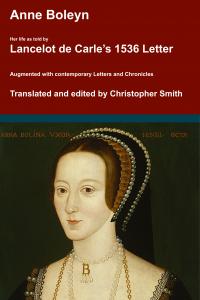
Anne Boleyn. Her Life as told by Lancelot de Carle's 1536 Letter.
In 1536, two weeks after the execution of Anne Boleyn, her brother George and four others, Lancelot du Carle, wrote an extraordinary letter that described Anne's life, and her trial and execution, to which he was a witness. This book presents a new translation of that letter, with additional material from other contemporary sources such as Letters, Hall's and Wriothesley's Chronicles, the pamphlets of Wynkyn the Worde, the Memorial of George Constantyne, the Portuguese Letter and the Baga de Secrets, all of which are provided in Appendices.
Available at Amazon in eBook and Paperback format.
On 10th June 1862 Lieutenant-General Arthur Cavendish Bentinck (age 43) and Augusta Mary Elizabeth Browne 1st Baroness Bolsover (age 27) were married.
On 10th June 1895 Charles Edward Cradock-Hartopp 5th Baronet (age 37) and Millicent Wilson (age 22) were married. She by marriage Lady Cradock-Hartopp.
On 10th June 1914 Captain Harold Fox-Pitt Lubbock (age 26) and Dorothy Charlotte Forster Baroness Wardington (age 23) were married.
On 10th June 1920 Denzil George Fortescue 6th Earl Fortescue (age 26) and Marjorie Ellinor Trotter Countess Fortescue (age 26) were married. They were divorced before 8th August 1941. He the son of Hugh Fortescue 4th Earl Fortescue (age 66) and Emily Ormsby-Gore Countess Fortescue (age 60).
On 10th June 1929 Robert Renwick 1st Baron Renwick (age 24) and Dorothy Mary Parkes were married.
On 10th June 1190 Frederick "Barbarossa" Hohenstaufen I Holy Roman Emperor (age 68) drowned in the Saleph River whilst on the journey of pilgrimage to Jerusalem. His son Henry (age 24) succeeded VI Holy Roman Emperor and King Italy.
On 7th June 1283 Bishop Robert of Holy Island died at Bishop Middleham,County Durham. He was buried in the CHapter House of Durham Cathedral [Map] on the 10th June 1283.
On 10th June 1414 Beatrix Hohenzollern Duchess Austria (age 52) died at Perchtoldsdorf.
On 10th June 1424 Ernest "The Iron" Habsburg I Duke Austria (age 47) died.
On 10th June 1437 Joanna of Navarre Queen Consort England (age 67) died at Havering atte Bower, Essex [Map].
Chronicle of Geoffrey le Baker of Swinbroke
Baker was a secular clerk from Swinbroke, now Swinbrook, an Oxfordshire village two miles east of Burford. His Chronicle describes the events of the period 1303-1356: Gaveston, Bannockburn, Boroughbridge, the murder of King Edward II, the Scottish Wars, Sluys, Crécy, the Black Death, Winchelsea and Poitiers. To quote Herbert Bruce 'it possesses a vigorous and characteristic style, and its value for particular events between 1303 and 1356 has been recognised by its editor and by subsequent writers'. The book provides remarkable detail about the events it describes. Baker's text has been augmented with hundreds of notes, including extracts from other contemporary chronicles, such as the Annales Londonienses, Annales Paulini, Murimuth, Lanercost, Avesbury, Guisborough and Froissart to enrich the reader's understanding. The translation takes as its source the 'Chronicon Galfridi le Baker de Swynebroke' published in 1889, edited by Edward Maunde Thompson.
Available at Amazon in eBook and Paperback format.

On 10th June 1563 William Paget 1st Baron Paget Beaudasert (age 57) died. His son Henry (age 24) succeeded 2nd Baron Paget Beaudasert.
On 10th June 1584 Francis Valois Duke Anjou (age 29) died of malaria unmarried.
On 10th June 1698 Mark Milbanke 2nd Baronet (age 38) died. His son Mark (age 16) succeeded 3rd Baronet Milbanke of Halnaby in Yorkshire.
On 10th June 1730 Thomas Allen 2nd Baronet (age 82) died without surviving issue. Baronet Allen of Totteridge in Middlesex extinct.
On 10th June 1741 Esther Kent Viscountess Chetwynd (age 41) died.
On 10th June 1749 George Downing 3rd Baronet (age 63) died without issue. His first cousin Jacob (age 32) succeeded 4th Baronet Downing of East Hatley in Cambridgeshire.
On 2nd June 1751 Oswald Mosley 1st Baronet (age 76) died. he was buried at St Mary's Church, Rolleston on Dove [Map] on 10th June 1751 His son Oswald (age 46) succeeded 2nd Baronet Mosley of Rolleston in Staffordshire.
On 10th June 1751 Matthew Deane 4th Baronet (age 45) died. His brother Robert (age 44) succeeded 5th Baronet Deane of Muskerry in Cork.
On 10th June 1757 Henry John Temple 1st Viscount Palmerston (age 84) died. His grandson Henry (age 17) succeeded 2nd Viscount Palmerston of Palmerston in County Dublin.
On 10th June 1760 Willoughby Bertie 3rd Earl of Abingdon (age 67) died. His son Willoughby (age 20) succeeded 4th Earl Abingdon, 8th Baron Norreys of Rycote.
William of Worcester's Chronicle of England
William of Worcester, born around 1415, and died around 1482 was secretary to John Fastolf, the renowned soldier of the Hundred Years War, during which time he collected documents, letters, and wrote a record of events. Following their return to England in 1440 William was witness to major events. Twice in his chronicle he uses the first person: 1. when writing about the murder of Thomas, 7th Baron Scales, in 1460, he writes '… and I saw him lying naked in the cemetery near the porch of the church of St. Mary Overie in Southwark …' and 2. describing King Edward IV's entry into London in 1461 he writes '… proclaimed that all the people themselves were to recognize and acknowledge Edward as king. I was present and heard this, and immediately went down with them into the city'. William’s Chronicle is rich in detail. It is the source of much information about the Wars of the Roses, including the term 'Diabolical Marriage' to describe the marriage of Queen Elizabeth Woodville’s brother John’s marriage to Katherine, Dowager Duchess of Norfolk, he aged twenty, she sixty-five or more, and the story about a paper crown being placed in mockery on the severed head of Richard, 3rd Duke of York.
Available at Amazon in eBook and Paperback format.

On 10th June 1770 George Cholmondeley 3rd Earl Cholmondeley (age 67) died. His grandson George (age 21) succeeded 4th Earl Cholmondeley in Cheshire, 5th Viscount Cholmondeley of Kells in County Meath, 4th Viscount Malpas in Cheshire, 4th Baron Cholmondeley Nampwich in Cheshire, 3rd Baron Newburgh of Newburgh in Anglesey, 3rd Baron Newborough of Newborough in County Wexford.
On 10th June 1772 Abraham Crichton 1st Baron Erne (age 68) died. His son John (age 41) succeeded 2nd Baron Erne of Crom Castle in Fermanagh.
On 10th June 1792 Harriet Bentinck Countess Clanbrassil (age 86) died.
On 10th June 1801 John Buckworth 4th Baronet (age 74) died unmarried. His brother Edward (age 68) succeeded 5th Baronet Buckworth-Herne of Sheen in Surrey. Anne Herne Lady Buckworth-Herne by marriage Lady Buckworth-Herne of Sheen in Surrey.

On 10th June 1828 Henry Watkin Dashwood 3rd Baronet (age 82) died. His son George (age 41) succeeded 4th Baronet Dashwood of Kirtlington Park in Oxfordshire.
On 10th June 1833 Edmund Cradock-Hartopp 1st Baronet (age 84) died. His son Edmund (age 44) succeeded 2nd Baronet Cradock-Hartopp.
On 10th June 1842 Abraham Crichton 2nd Earl Erne (age 77) died. His nephew John (age 39) succeeded 3rd Earl Erne of Crom Castle in County Fermanagh, 3rd Viscount Erne of Crom Castle in County Fermanagh, 4th Baron Erne of Crom Castle in Fermanagh. Selina Griselda Beresford Countess Erne (age 38) by marriage Countess Erne of Crom Castle in County Fermanagh.
On 10th June 1854 Robert Stewart 2nd Earl Castle Stewart (age 69) died.
On 10th June 1866 Charles Noel 1st Earl Gainsborough (age 84) died. His son Charles (age 47) succeeded 2nd Earl Gainsborough, 4th Baron Barham. Ida Harriet Augusta Hay Countess Gainsborough (age 44) by marriage Countess Gainsborough.
On 10th June 1894 Federico de Madrazo y Kuntz (age 79) died.
On 10 or 19th June 1901 Octavia Willoughby Lady Beaumont (age 67) died. She was buried at St Mary the Virgin Church, Coleorton [Map].
On 10th June 1901 Robert Loyd-Lindsay 1st Baron Wantage (age 69) died. Baron Wantage of Lockinge in Berkshire extinct.
On 10th June 1906 Harry Chichester 2nd Baron Templemore (age 84) died. His son Arthur (age 52) succeeded 3rd Baron Templemore of Templemore in Donegal. Alice Elizabeth Dawkins Baroness Templemore by marriage Baroness Templemore of Templemore in Donegal.
Henrici Quinti, Angliæ Regis, Gesta, is a first-hand account of the Agincourt Campaign, and subsequent events to his death in 1422. The author of the first part was a Chaplain in King Henry's retinue who was present from King Henry's departure at Southampton in 1415, at the siege of Harfleur, the battle of Agincourt, and the celebrations on King Henry's return to London. The second part, by another writer, relates the events that took place including the negotiations at Troye, Henry's marriage and his death in 1422.
Available at Amazon in eBook and Paperback format.
On 10th June 1933 Gervase Disney Alexander 15th Baron Cobham (age 53) died. Baron Cobham abeyant.
On 10th June 1934 Francis Patrick Fletcher-Vane 5th Baronet (age 72) died. Baronet Fletcher of Hutton in Cumberland extinct.
On 10th June 1947 Mary Louisa Cholmondeley Lady Massingham Parva (age 95) died.
On 10th June 1958 Margaret Helen Beaumont Countess Fortescue (age 65) died. Her husband Hugh William Fortescue 5th Earl Fortescue (age 69) died four days later.
On 10th June 1974 Henry Windsor 1st Duke Gloucester (age 74) died. His son Richard (age 29) succeeded 2nd Duke Gloucester. Memorials at St Andrews Church, Barnwell [Map] to Henry Windsor 1st Duke Gloucester who lived nearby and worshipped at the church.
Richard Alexander Walter Windsor 2nd Duke Gloucester: On 26th August 1944 he was born to Henry Windsor 1st Duke Gloucester and Alice Christabel Montagu-Douglas-Scott Duchess Gloucester. He a grandson of King George V of the United Kingdom.
On 10th June 1975 Frederick Smith 2nd Earl of Birkenhead (age 67) died. His son Frederick (age 39) succeeded 3rd Earl Birkenhead, 3rd Viscount Furneaux of Charlton in Northamptonshire, 3rd Viscount Birkenhead of Birkenhead in Cheshire, 3rd Baron Birkenhead of Birkenhead in Cheshire, 3rd Baronet Smith of Hillbrook.
On 10th June 1991 Jestyn Reginald Austin Plantagenet Philipps 2nd Viscount St Davids (age 74) died. His son Colwyn (age 52) succeeded 3rd Viscount St Davids of Lydstep Haven Pembrokeshire, 16th Baron Strange Knockin, 24th Baron Hungerford, 22nd Baron Moleyns, 15th Baronet Philips of Picton Castle, 12th Baron Mohun of Dunster.
On 10th June 2023 Harry Orde-Powlett 8th Baron Bolton (age 69) died. His son Thomas (age 43) succeeded 9th Baron Bolton of Bolton in Yorkshire.