


Text this colour links to Pages. Text this colour links to Family Trees. Text this colour are links that disabled for Guests.
Place the mouse over images to see a larger image. Click on paintings to see the painter's Biography Page.
Mouse over links for a preview. Move the mouse off the painting or link to close the popup.
13 Jan is in January.
888 Death of Charles V Holy Roman Emperor
1312 Gaveston Returns from Exile
1396 Marriage of John of Gaunt and Katherine Roet
On 13th January 47BC Ptolemy XIII Theos Philopator 61BC 47BC (age 14) drowned in the River Nile following, or during the course of, the Battle of the Nile.
On 13th January 731 Archbishop Berhtwald died.
On 13th January 858 King Æthelwulf of Wessex died. His son Æthelbald succeeded King Wessex.
On 13th January 888 Charles "Fat" King East Francia Holy Roman Emperor III King West Francia King Aquitaine (age 48) died.
On 13th January 1049 Dirk Gerulfing IV Count Holland (age 24) was murdered. His brother Floris (age 24) succeeded I Count Holland.
On 13th January 1200 Otto Hohenstaufen I Count Burgundy (age 29) was murdered.
Chronica Majora by Matthew Paris. 5th January 1237. In the year of our Lord 1237 which was the twentieth of the reign of King Henry the Third, he held his court at Christmas, at Winchester, whence he forthwith sent royal warrants throughout all the English territories, ordering all nobles belonging to the kingdom of England, namely, archbishops, bishops, abbats, installed priors, earls, and barons, all to assemble without fail in the octaves of the Epiphany at London, to arrange the royal business and matters concerning the whole kingdom. The nobles on hearing this immediately obeyed the king's summons, and accordingly on the day of St. Hilary [13th January 1237], a countless multitude of nobles, namely, the whole community of the kingdom, came to London, and proceeded to the royal palace at Westminster to hear the king's pleasure. When they had all taken their seats, there stood up in the midst of them, one William de Kaele, a clerk and familiar of the king's, a discreet man and well skilled in the laws of the land, who, acting as a sort of mediator between the king and the nobles, disclosed to them the king's pleasure and intentions. "My lord the king," he said, "informs you that, whatever he may have done heretofore, he now and henceforth will, without hesitation, submit himself to the advice of all of you, as his faithful and natural subjects. But those men who have till now, in the management of his affairs, been in charge of his treasury, have rendered him an incorrect account of the moneys received by them, and owing to this the king is now destitute of money, without which any king is indeed destitute; he therefore humbly demands assistance from you in money, on the understanding that the money which may be raised by your good will shall be kept to be expended for the necessary uses of the kingdom, at the discretion of any of you elected for the purpose. "When the assembled nobles heard this speech, they each and all, not expecting anything of this sort, murmured greatly, and "Alter in alterius jactantes lumina vultus". [Each hearer lost in dire amaze, Turned on his neighbour's face his gaze.]
And they said to one another, Fuderunt partum montes: en ridiculus mus. [The labouring mountains shook the earth, And to a paltry mouse gave birth. This is a quote from Aesop's Fable "The Mountain in Labour". It refers to speech acts which promise much but deliver little].
They then replied with indignation that they were oppressed on all sides, so often promising and paying now the twentieth, now the thirtieth, and now the fiftieth part of their property, and they declared that it would be unworthy of them, and injurious to them, to allow a king so easily led awav, who had never repelled or even frightened one of the enemies of the kingdom, even the least of them, and who had never increased his territories but rather lessened them, and placed them under foreign yoke, to extort so much money, so often, and by so many arguments, from his natural subjects, as if they were slaves of the lowest condition, to their injury and for the benefit of foreigners. "When the king heard this, he wished to calm the general discontent, and promised on oath that he would never again provoke or annoy the nobles of the kingdom by injuring them in that way, provided that the thirtieth part of all moveable property in England was granted and paid to him for his present use; because the large sum of money which he had a little while before sent to the emperor (age 42) (as he stated) for the marriage of his sister (age 23), and also what he had spent at his own marriage, had in a great degree exhausted his money. To this they openly replied that he, the king, had done all this without the advice of his liege subjects, and they ought not to share the punishment as they were innocent of the crime. They however withdrew to a private place to consult about obeying the king's demand, and supplying his necessities, and to discuss the kind and quantity of assistance which was demanded. As they were withdrawing for this purpose, Gilbert Bassett (age 49) said to the king in the hearing of all. and with less circimispection of speech than he ought, - "My lord king, send some one of your friends to be present at the conference of your barons." He was, when he said this, sitting on one side of the king, with only a few persons between them, and in reply to his speech, Richard Percy (age 67), who had been at the conference of the nobles, and was, not without cause, angry at it, said, "What is it, friend Gilbert, that you said? are we too foreigners, and are we not amongst the number of the king's friends? "And Gilbert felt himself rebuked by this unpleasant and sudden speech. And thus by a multipHcity of arguments the conference was protracted for four days.
 Become a Member via our Buy Me a Coffee page to read more.
Thomas Walsingham [~1422]. The King of England at that time issued a command to the earls and magnates of his realm, that they should assist the Earl of Warenne, the Warden of Scotland, in suppressing the rebellions of the Scots. He set them a deadline of the Octave of Saint Hilary [13th January 1298] by which they were to be ready at York, from which place they would proceed against the enemy.
Mandavit autem Rex Anglia; co tempore Comitibus et magnatibus æ suæ, ut assisterent Comiti de Warenna, Custodi Scotiæ, ad comprimendum rebelliones Scotorum; præfigens eis terminum Octabas Sancti Hillarii, in quo parati f'orcnt Eboraci, contra hostes altering progressuri; ad quem diem et locum mandavit majoribus Scotiæ, ut venirent; alioquin hostes publici haberentur.
On 13th January 1312 King Edward II of England (age 27) and Piers Gaveston 1st Earl Cornwall (age 28) were reunited at Knaresborough Castle [Map].
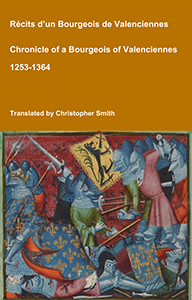
Chronicle of a Bourgeois of Valenciennes
Récits d’un bourgeois de Valenciennes aka The Chronicle of a Bourgeois of Valenciennes is a vivid 14th-century vernacular chronicle written by an anonymous urban chronicler from Valenciennes in the County of Hainaut. It survives in a manuscript that describes local and regional history from about 1253 to 1366, blending chronology, narrative episodes, and eyewitness-style accounts of political, military, and social events in medieval France, Flanders, and the Low Countries. The work begins with a chronological framework of events affecting Valenciennes and its region under rulers such as King Philip VI of France and the shifting allegiances of local nobility. It includes accounts of conflicts, sieges, diplomatic manoeuvres, and the impact of broader struggles like the Hundred Years’ War on urban life in Hainaut. Written from the perspective of a burgher (bourgeois) rather than a monastery or royal court, the chronicle offers a rare lay viewpoint on high politics and warfare, reflecting how merchants, townspeople, and civic institutions experienced the turbulence of the 13th and 14th centuries. Its narrative style combines straightforward reporting of events with moral and civic observations, making it a valuable source for readers interested in medieval urban society, regional politics, and the lived experience of war and governance in pre-modern Europe.
Available at Amazon in eBook and Paperback format.
Annales Paulini. [1st January 1322] In the same year, on the Feast of the Circumcision of the Lord [1st January], in the church of Saint Paul in London, it was publicly declared by the Lord Archbishop of Canterbury that Lord Hugh Despenser the son had not been lawfully exiled. And on the Feast of the Epiphany [6th January] immediately following, the lord king had it proclaimed throughout the city of London that peace was restored to the said Lord Hugh Despenser. On the morrow of the Epiphany [7th January], one hundred foot soldiers from the county of Kent, strong, able-bodied, and well-armed, were marching to the king, who was then at Shrewsbury. But when they came near Chipping Norton, they were struck with fear and dread, and fled quickly all the way back to Oxford, and from there returned individually to their own homes. In the same year, on the feast of Saint Hilary (13th of January), Lord Rigaud, Bishop of Winchester, set out toward the Roman Curia on various matters concerning the kingdom of England. Also in that same year, shortly after Christmas, the lord king departed from Chichester toward Wales, and arriving at Shrewsbury before the start of Lent, the Lords Roger de Mortimer, both uncle and nephew, at the urging and assurance of peace given by the Earls of Richmond and Arundel and other good men, surrendered themselves to the peace of the said lord king. But afterward they were captured and imprisoned, and both were led to London and committed to the Tower as prisoners. Later, the lord king, departing from Shrewsbury and advancing northward with an army of 3,000 armed men, lingered for some time near the River Humber.
Eodem anno, die Circumecisionis Domini, in ecclesia Sancti Pauli Londoniis, pronunciatum fuit per dominum archiepiscopum Cantuariensem, quod dominus Hugo Despenser filius non rite fuit exulatus; et in festo Epiphaniæ proximo sequente, dominus rex fecit proclamare pacem dicti domini Hugonis Despenser per medium civitatis Londoniarum. In crastino Epiphaniæ centum homines pedites de comitatu Kantiæ fortes et wvalidi et bene armati, euntes versus regem, qui fuit apud Salopiam, sicut venerunt versus Chepinge Northone et deprope, perterriti et pavidi usque ad villam Oxoniæ celeriter fugerunt, et sic redierunt in patriam suam particulariter. Eodem anno, die Sancti Hillarii, dominus Rigaldus episcopus Wintoniensis arripuit iter versus curiam Romanam pro diversis negotiis regnum Angliæ tangentibus. Eodem anno, cito post Natale Domini, dominus rex amovit se de Cicestria versus Walliam, et veniens Salopiam ante tempus Quadragesiæ, ubi domini Rogerus de Mortuomari, avunculus et nepos, ad predictionem et promotionem pacis per comites de Richemund et Arundel et alios bonam formam pacis regis promittentium, ad pacem dicti domini regis se reddiderunt; qui postea capti et incarcerati, deinde ambo ducti Londonias, in turrim carcere sunt mancipati. Et postea dominus rex, de Salopia movens versus Boream, cum exercitu IIIml virorum armatorum, prope Humber aliquantulum morabatur.
Become a Member via our Buy Me a Coffee page to read more.
On 13th January 1330 Frederick "Fair" Habsburg I Duke Austria (age 41) died. His brother Leopold succeeded I Duke Austria.
On 13th January 1334 Fadrique Alfonso Ivrea was born illegitimately to Alfonso "Avenger" XI King Castile (age 22) and Eleanor Guzman at Seville.
On 13th January 1334 Henry "Fratricide" II King Castile was born illegitimately to Alfonso "Avenger" XI King Castile (age 22) and Eleanor Guzman. He was one of twins. He married before 24th August 1358 his third cousin Juana Manuel Queen of Castile and had issue.
On 13th January 1349 Constanza Manuel Queen Consort Castile (age 33) died.
On 13th January 1393 Isabella of Castile Duchess York was buried at King's Langley Priory, Hertfordshire [Map].
On 13th January 1396 John of Gaunt 1st Duke Lancaster (age 55) and Katherine Swynford aka Roet Duchess Lancaster (age 45) were married at Lincoln Cathedral [Map]. She by marriage Duchess Lancaster. He the son of King Edward III of England and Philippa of Hainaut Queen Consort England.
Thomas Walsingham [~1422]. Accordingly dismissed by the King, he departed from the court and hastened to Lincoln, where Katherine de Swynford was then living; and after the Octave of Epiphany [13th January 1396], to the amazement of all at so extraordinary an event, he married her, since such a turn of fortune seemed scarcely fitting for a woman of such exalted station.
Licentiatus proinde a Rege, recessit a Curia et properavit Lincolniam, ubi Katerina do Swynford tunc morabatur; quam post Octabas Epiphaniæ, cunctis admirantibus facti miraculum, desponsavit, quia fortuna talis fœminaæ tantaæ sublimitatis error minime competebat.
Froissart Book 4 Chapter 73. [13th January 1396]. At this period, the duke of Lancaster (age 55) married his third wife [Katherine Swynford aka Roet Duchess Lancaster (age 45)], the daughter of a Hainault knight, called sir Paon de Ruet: he had formerly been one of the knights to the good and noble queen Philippa of England, who much loved the Hainaulters, as she was herself of that country.
This lady whom the duke of Lancaster married was called Catherine, and in her youth had been of the household of the duchess Blanche of Lancaster. Before the lady Blanche's death, and even when the duke was married to his second wife Constance, the daughter of don Pedro, he cohabited with the lady Catherine de Ruet, who was then married to an English knight [Hugh Swynford] now dead.
The duke of Lancaster had three children1 by her, previous to his marriage, two sons and a daughter: the eldest son was named John (age 23) lord Beaufort of Lancaster; the other Thomas [Henry] (age 21), whom the duke kept at the schools in Oxford, and made a great churchman and civihan. He was afterward bishop of Lincoln, which is the richest bishopric in the kingdom: from affection to these children, the duke married their mother, to the great astonishment of France and England, for Catherine Swynford was of base extraction in comparison to his two former duchesses Blanche and Constance. When this marriage was announced to the ladies of high rank in England, such as the duchess of Gloucester (age 30), the countess of Derby2, the countess of Arundel (age 20), and others connected with the royal family, they were greatly shocked, and thought the duke much to blame. They said, "he had sadly disgraced himself by thus marrying his concubine;" and added, that, "since it was so, she would be the second lady in the kingdom, and the queen (age 6) would be dishonourably accompanied by her; but that, for their parts, they would leave her to do the honours alone, for they would never enter any place where she was. They themselves would be disgraced if they suffered such a base-born duchess, who had been the duke's concubine a long time before and during his marriages, to take precedence, and their hearts would burst with grief were it to happen." Those who were the most outrageous on the subject were the duke (age 41) and duchess of Gloucester. They considered the duke of Lancaster as a doating fool for thus marrying his concubine, and declared they would never honour his lady by calling her sister. The duke of York (age 54) made light of the matter, for he lived chiefly with the king and his brother of Lancaster. The duke of Gloucester was of a different way of thinking: although the youngest of the three brothers, he yielded to no man's opinion, was naturally very proud and overbearing, and in opposition to the king's ministers, unless he could turn them as he willed. Catherine Ruet, however, remained duchess of Lancaster, and the second lady in England, as long as she lived. She was a lady accustomed to honours, for she had been brought up at court during her youth, and the duke fondly loved the children he had by her, as he showed during his life and at his death.
Note 1. Froissart mistakes in the number, and Thomas for Henry. According to Sandford, he had four children by Catherine Swynford: — John Beaufort, earl of Somerset, — Henry Beaufort, bishop of Winchester and cardinal of Beaufort, — Thomas Beaufort (age 19), duke of Exeter and earl of Dorset, — Joan Beaufort (age 17), countess of Westmoreland. For farther particulars, see Sandford and Dugdale.
Note 2. This reference to the Countess of Derby is confusing. In 1396 the Earl of Derby was Henry (age 28), future King Henry IV, who inherited the title from his mother Blanche when she died in 1368. Henry's first wife Mary Bohun had died in 1394, and he marired his second wife Joanna of Navarre Queen Consort England (age 26) in 1403?
Become a Member via our Buy Me a Coffee page to read more.
Abbot John Whethamstede’s Chronicle of the Abbey of St Albans
Abbot John Whethamstede's Register aka Chronicle of his second term at the Abbey of St Albans, 1451-1461, is a remarkable text that describes his first-hand experience of the beginning of the Wars of the Roses including the First and Second Battles of St Albans, 1455 and 1461, respectively, their cause, and their consequences, not least on the Abbey itself. His text also includes Loveday, Blore Heath, Northampton, the Act of Accord, Wakefield, and Towton, and ends with the Coronation of King Edward IV. In addition to the events of the Wars of the Roses, Abbot John, or his scribes who wrote the Chronicle, include details in the life of the Abbey such as charters, letters, land exchanges, visits by legates, and disputes, which provide a rich insight into the day-to-day life of the Abbey, and the challenges faced by its Abbot.
Available at Amazon in eBook and Paperback format.
Chronicle of Geoffrey le Baker of Swinbroke [-1360]. While the king was occupied with the aforementioned matters, the sailors of the Cinque Ports, having equipped themselves with pinnaces and boats well armed, shortly after the feast of Saint Hilary [13th January 1400] landed at Boulogne near the sea during a foggy time when they were scarcely noticed in the harbour. In the lower town, they burned nineteen galleys, four large ships, and twenty boats with all their armaments, together with the houses situated by the sea. Among these was one large house full of oars and sails, weapons, and crossbows needed for the sailors and defenders of the nineteen galleys. Eventually, a conflict arose between the townsfolk and the English, in which many of the locals were killed.
Rege circa negocia prescripta occupato, naute Quinque Portuum, assumptis spinaciis et scafis bene munitis, cito post festum sancti Hillarii applicuerunt Bononie iuxta mare in tempore nebuloso quo vix in portu fuerant percepti, et in villa inferiori XIX galiotas et IIIJ magnas naves et XX scafas cum omnibus suis armamentis combusserunt una cum domubus iuxta mare situatis, inter quas erat una domus magna plena remis et velis, armis et balistis necessariis pro nautis et defensoribus decem et novem galeotarum. Tandem, orto conflictu inter villanos et Anglicos, plures intranei ceciderunt occisi.
On 13th January 1400 Thomas Despencer 1st Earl Gloucester (age 26) was beheaded at Bristol, Gloucestershire [Map].
On 13th January 1400 Prince John Aviz Constable Portugal was born to King John I of Portugal (age 48) and Philippa of Lancaster Queen Consort Portugal (age 39). He a great grandson of King Edward III of England. He married 1424 his niece Isabella of Braganza and had issue.
On 13th January 1403 Joanna of Navarre Queen Consort England (age 33) with her two daughters Marguerite Montfort Viscountess Rohan (age 11) and Blanche Montfort Countess Armagnac (age 6) departed from Camaret to travel to England intending to land at Southampton. A storm caused them to land at Falmouth, Cornwall from where they travelled to Winchester.
Chronicle of Gregory [1400-1467]. 13th January 1450. Ande aftyr Synt Hyllary is day the Parlyment was remevyd unto Laycetter [Map]; ande yn the mene tyme was Caneyoldyn, ande alle the remenaunt of Normandy, savyng Chyrborowe [Map]. And the Duke of Sowthefolke (age 53) was a-pechide at that Parlyment, he beynge at London, of verry graunte tresou, and of many poyntys; among alle othyr, for that he schulde have solde Normandy, and also for the dethe of that nobylle prynce the Duke of Glouceter, and for many othyr poyntys of treson, for the whyche he was exylyd out of Ingelonde for certayne yerys.
On 13th January 1505 Joachim Hohenzollern Margrave of Brandenburg was born to Joachim "Nestor" Hohenzollern Elector Brandenburg (age 20).

13th January 1513. Sir Richard Wingfield (age 44) to Wolsey (age 39). A boat of Dover bringing the budget was "upon the 12th day" taken by the Barke of Boulogne; but the budget had been previously cast overboard. Five Easterlings and two merchantmen of London were taken in her and remain prisoners in Boulogne. Thinks that more strict commands should be given for the keeping of the Narrow Seas, as many inconveniences have arisen. Calais, 13 Jan.
P.S.-The Lord Walayn has been slain at Brussells. Hopes the safe conduct Wolsey promised to send him (Wingfield) has not been drowned with the budget. Signed.
13th January 1513. Maximilian (age 53) to Margaret of Savoy (age 33). Has received her letter of 23 Dec. and thinks that, by her answer to the King of England, she has gone too far and put the Emperor's countries in danger of open war with the French without any assurance of the King of England, who, if he thus obtain all he wants from the Emperor will not care about concluding any treaty. She must not permit him to levy men or boys as yet; for when the treaty is made he shall have lansknechts, Swiss and hoys enough. Landau, 13 Jan. 1512.
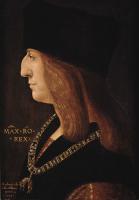

Letters and Papers Foreign and Domestic Henry VIII 1535. 13th January 1535. R. O. 45. John Husee to Lord Lisle (age 70).
Is glad to hear that Mr. Highefield is recovered. If he had died, I hoped that Whethill should not have enjoyed "it" (his place). Has delivered the piece of Orleans to Mr. Secretary. You may send him the mule as she is. The King's coming to Calais depends on the return of Mons. l'Admiral. Wishes to know what prices he must give for the 70 liveries. Asks what he shall do with the two horns he has received. Has advertised Mr. Secretary of your charges in Mr. Seymour's (age 35) matter. He will consult with the lord Chancellor. Has no answer yet touching Mr. Hacket's funeral and burial. Thinks Jenyne will bring orders for the same. Is promised the Commission of Sewers by Mr. Secretary. Has had no answer of the toll of Mark and Oye. Such suits are long, as Lacy knows. I send the Acts last passed. My lord William [Howard] is going to Scotland, with presents to the Scotch king, and William Polle to Ireland as provostmarshal. Gives an account of his fees. Would rather stay at home, for his wife's sake. Your servant Smyth is with Mr. Secretary. London, 13 Jan.
Hol., p. 1. Add. Endd.

On 13th January 1559 two new peerages were created...
Henry Carey 1st Baron Hunsdon (age 32) was created 1st Baron Hunsdon. Anne Morgan Baroness Hunsdon (age 30) by marriage Baroness Hunsdon.
Oliver St John 1st Baron St John (age 37) was created 1st Baron St John of Bletso. Agnes Fisher Baroness St John Bletso (age 33) by marriage Baroness St John of Bletso.
Henry Machyn's Diary. 13th January 1559. The xiij day of January with-in the Towre the Quen mad Knyghtes of the Baythe x.
Note. P. 186. The Knights of the Bath made at the Coronation of queen Elizabeth were in number eleven, viz.:—
John lord Darcy of the North (age 19),
John lord Sheffield (age 21),
John lord Darcy of Chiche (age 27),
Sir Robert Rich (age 22),
Sir Roger North (age 29),
Sir Nicholas Pointz (age 31),
Sir John Berkeley,
Sir Edward Unton (age 25),
Sir Henry Weston (age 24),
Sir George Speke (age 29),
See Anstis's History of the Order of the Bath, App. lxx.; and Nicolas, Appx. p. xiv.
Become a Member via our Buy Me a Coffee page to read more.
Henrici Quinti, Angliæ Regis, Gesta, is a first-hand account of the Agincourt Campaign, and subsequent events to his death in 1422. The author of the first part was a Chaplain in King Henry's retinue who was present from King Henry's departure at Southampton in 1415, at the siege of Harfleur, the battle of Agincourt, and the celebrations on King Henry's return to London. The second part, by another writer, relates the events that took place including the negotiations at Troye, Henry's marriage and his death in 1422.
Available at Amazon in eBook and Paperback format.

On 13th January 1601 Bridget Hussey Countess Bedford (age 75) died. She was originally interred at St Marys Church, Watford. The monument was probably moved when the Bedford Chapel, St Michael's Church, Chenies was extended in 1906.
Marble altar tomb chest with flat vertical pilaster strips; on sides and ends are shields with arms. Recumbent effigy of alabaster, coloured in robes of a peeress with ruff and close fitting cap. At the left and right of the tomb chest, on little stands, are two kneeling male figures in armour, carved in full relief, both facing West, thought to represent her grandsons Francis Norreys 1st Earl Berkshire (age 21) and - Francis, Lord Norreys and Sir Charles Morrison Bt.
On 13th January 1601 Guido Cagnacci was born.

On 13th January 1610 Maria Anna Habsburg Spain Duchess Bavaria was born to Ferdinand of Spain II Holy Roman Emperor (age 31) and Maria Anna Wittelsbach Holy Roman Empress (age 35). Coefficient of inbreeding 11.68%. She married 15th July 1635 her uncle Maximilian "The Great" Wittelsbach I Duke Bavaria I Elector Bavaria, son of William Wittelsbach V Duke Bavaria and Renata Lorraine Duchess Bavaria, and had issue.
On 13th January 1612 Jane Dormer Duchess Feria (age 74) died.
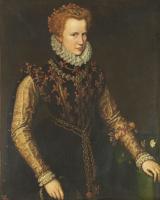
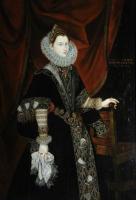
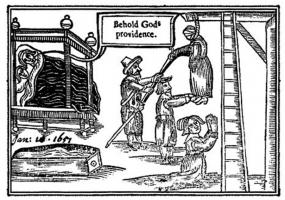
Wonder of Wonders. A Wonder of Wonders. BEING A faithful Narrative and true Relation, of one Anne Green (age 23), Servant to Sir Tho. Reed in Oxfordshire, who being got with Child by a Gentleman, her Child falling from her in the house or Office, being but a span long, and dead born, was condemned on the 14. of December last, and hanged in the Castle-yard in Oxford, for the space of half an hour, receiving many great and heavy blowes on the brests, by the but end of the Souldiers Muskets, and being pul'd down by the leggs, and was afterwards beg'd for an Anatomy, by the Physicians, and carried to Mr. Clarkes house, an Apothecary, where in the presence of many learned Chyrurgions, she breathed, and began to stir; insomuch, that Dr. Petty (age 27) caused a warm bed to be prepared for her, let her blood, and applyed Oyls to her, so that in 14 hours she recovered, and the first words she spake were these; Behold Gods Providence! Behold his miraculous and loving kindness! VVith the manner of her Tryal, her Speech and Confession at the Gallowes; and a Declaration of the Souldiery touching her recovery. Witnessed by Dr. Petty, and Licensed according to Order. 13th January 1651.
Samuel Pepys' Diary. 13th January 1660. Friday. Coming in the morning to my office, I met with Mr. Fage and took him to the Swan [Map]. He told me how high Haselrigge (age 59), and Morly (age 43), the last night began at my Lord Mayor's (age 27) to exclaim against the City of London, saying that they had forfeited their charter. And how the Chamberlain of the City did take them down, letting them know how much they were formerly beholding to the City, &c. He also told me that Monk's (age 51) letter that came to them by the sword-bearer was a cunning piece, and that which they did not much trust to; but they were resolved to make no more applications to the Parliament, nor to pay any money, unless the secluded members be brought in, or a free Parliament chosen. Thence to my office, where nothing to do. So to Will's with Mr. Pinkney, who invited me to their feast at his Hall the next Monday. Thence I went home and took my wife and dined at Mr. Wades, and after that we went and visited Catan. From thence home again, and my wife was very unwilling to let me go forth, but with some discontent would go out if I did, and I going forth towards Whitehall, I saw she followed me, and so I staid and took her round through Whitehall, and so carried her home angry. Thence I went to Mrs. Jem, and found her up and merry, and that it did not prove the smallpox, but only the swine-pox; so I played a game or two at cards with her. And so to Mr. Vines, where he and I and Mr. Hudson played half-a-dozen things, there being there Dick's wife and her sister. After that I went home and found my wife gone abroad to Mr. Hunt's, and came in a little after me. So to bed.

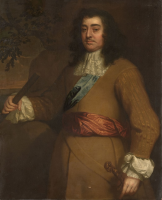
Samuel Pepys' Diary. 13th January 1664. So to the Coffee House where extraordinary good discourse of Dr. Whistler's' upon my question concerning the keeping of masts, he arguing against keeping them dry, by showing the nature of corruption in bodies and the several ways thereof.

Samuel Pepys' Diary. 13th January 1666. Home with his Lordship to Mrs. Williams's, in Covent-Garden [Map], to dinner (the first time I ever was there), and there met Captain Cocke (age 49); and pretty merry, though not perfectly so, because of the fear that there is of a great encrease again of the plague this week. And again my Lord Bruncker (age 46) do tell us, that he hath it from Sir John Baber; who is related to my Lord Craven (age 57), that my Lord Craven do look after Sir G. Carteret's (age 56) place, and do reckon himself sure of it.
Samuel Pepys' Diary. 13th January 1666. After dinner Cocke (age 49) and I together by coach to the Exchange [Map], in our way talking of our matters, and do conclude that every thing must breake in pieces, while no better counsels govern matters than there seem to do, and that it will become him and I and all men to get their reckonings even, as soon as they can, and expect all to breake. Besides, if the plague continues among us another yeare, the Lord knows what will become of us. I set him down at the 'Change [Map], and I home to my office, where late writing letters and doing business, and thence home to supper and to bed. My head full of cares, but pleased with my wife's minding her worke so well, and busying herself about her house, and I trust in God if I can but clear myself of my Lord Sandwich's (age 40) bond, wherein I am bound with him for £1000 to T. Pepys, I shall do pretty well, come what will come.


Henrici Quinti, Angliæ Regis, Gesta, is a first-hand account of the Agincourt Campaign, and subsequent events to his death in 1422. The author of the first part was a Chaplain in King Henry's retinue who was present from King Henry's departure at Southampton in 1415, at the siege of Harfleur, the battle of Agincourt, and the celebrations on King Henry's return to London. The second part, by another writer, relates the events that took place including the negotiations at Troye, Henry's marriage and his death in 1422.
Available at Amazon in eBook and Paperback format.
On 28th September 1667 Ferdinand Wenzel Habsburg Spain was born to Leopold Habsburg Spain I Holy Roman Emperor (age 27) and Margaret Theresa Habsburg Holy Roman Empress (age 16). On 13th January 1668 Ferdinand Wenzel Habsburg Spain died. Coefficient of inbreeding 30.98%.


Samuel Pepys' Diary. 13th January 1669. So up and by coach to Sir W. Coventry's (age 41), but he gone out, so I to White Hall, and thence walked out into the Park, all in the snow, with the Duke of York (age 35) and the rest, and so home, after visiting my Lady Peterborough (age 47), and there by invitation find Mr. Povy (age 55), and there was also Talbot Pepys (age 22), newly come from Impington, and dined with me; and after dinner and a little talk with Povy about publick matters, he gone, and I and my wife and Talbot towards the Temple [Map], and there to the King's playhouse, and there saw, I think, "The Maiden Queene", and so home and to supper and read, and to bed. This day come home the instrument I have so long longed for, the Parallelogram.


On 13th January 1684 Henry Howard 6th Duke of Norfolk (age 55) died. His son Henry (age 29) succeeded 7th Duke Norfolk, 18th or 25th Earl Arundel, 8th Earl Surrey, 5th Earl Norfolk, 2nd Earl Norwich, 18th Baron Mowbray, 19th Baron Segrave, 16th Baron Furnivall, 20th Baron Strange Blackmere, 17th Baron Talbot, 15th Baron Maltravers, 15th Baron Arundel, 2nd Baron Howard of Castle Rising, Earl Marshal. Mary Mordaunt Duchess Norfolk (age 25) by marriage Duchess Norfolk.


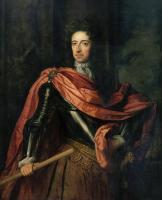
John Ashton Edmund Elliot Richard Graham 1691. On Fryday, the 2d day of this Sessions, my Lord Preston (age 41), John Ashton and Edmund Elliot, were all Arrained for High Treason, my Lord Preston was Tryed on Saturday by the name of Sir Richard Graham, Mr. Ashton on Monday. The Indictments against them consisted of Two Parts, the First of which set forth, That they had a Treasonable Design carrying on to Depose the King and Queen, and to Subvert and Alter the Government of the Kingdom of England, and to raise War and Rebellion in the same; which said Traiterous and Wicked Designs and Purposes to bring to pass, they did, on the 29th of December last, Meet and Conspire together, with several other Traitors not yet discovered, and did Compose several Treasonable Letters, Notes and Memorandums in writing, which set forth the most effectual way and means how they might Dethrone and Depose our Most Gracious Sovereign Lord and Lady the King (age 40) and Queen (age 28), and further describing therein how the Affairs of this Kingdom stood, and of what Strength and Force our Shipping was; as also the Fortifications of several Sea-Port-Towns within this Kingdom. The Second Part was their adhering to the Kings's Enemies: And to that end, that they might Acquaint Lewis the French King of the same, they did hire a Boat and Embarque themselves in order to Transport themselves and Pacquet of Treasonable Letters into France, agreeing to pay for their said Passages the Sum of One hundred Pound; and, in order to their Treasonable Voyage, they had made their Passage as far as below Gravesend [Map], but were then Taken by Captain Billop, who Cruised abroad to search for them.
After this the Evidence for the King being called, gave an Account particularly from Step to Step, how cunningly and subtilly they managed this horrid Conspiracy, by hiring the Smack called the Thomas and Elizabeth, to convey them secretly into France; in order to which they took Water in a Skuller at Surrey-Stairs, and went on Board the aforesaid Vessel, which lay in the River of Thames over against the Tower [Map]: From thence they set Sail down the River, till coming within the View of the George Frigate, lying in Long-reach, they desired the Master of the Smack to hide them under the Quarter-Hatches; which was done, they having some Fear of being discovered: There they remained till past that Danger, and then came up; but when they were within Sight of Gravesend [Map] they hid again, and a little below it Captain Billop came aboard them, under Pretence of Pressing the Masters two Men, who were assistants to him; but indeed his Design and real Intention was to find out those Traytors, which, upon Search, he found lying along under the Hatches; and after their being haled up he search'd them, and found a Pacquet of Treasonable Papers in Mr. Ashton's Bosom: which he with the Prisoners carried before my Lord Nottingham; who examined the Papers, and after being examined by the Cabinet Council they were committed to the Tower. The Evidence was very full and plain against them both, much to the same effect and purport: The Letters being also Read against them in Court, were adjudged to be of no less Import than High-Treason. Upon the whole they had nothing material to offer in their Defence; so after a very long hearing, they were both found Guilty of High Treason. Edmond Elliot was ordered to remain till further order.



Become a Member via our Buy Me a Coffee page to read more.
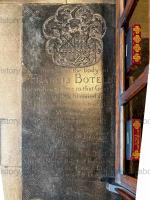
On 13th January 1694 Francis Boteler (age 18) died. He was buried at St Etheldreda's Church, Hatfield [Map].
Francis Boteler: Around 1676 he was born to Francis Shal of Digsworth, Hertfordshire and Julia Boteler. His father's surname incomplete as seen on the gravestone.
John Evelyn's Diary. 13th January 1695. The Thames was frozen over. The deaths by smallpox increased to five hundred more than in the preceding week. The King (age 44) and Princess Anne (age 29) reconciled, and she was invited to keep her Court at Whitehall, having hitherto lived privately at Berkeley House [Map]; she was desired to take into her family divers servants of the late Queen; to maintain them the King has assigned her £5,000 a quarter.


On 13th January 1696 Henry Fitzjames 1st Duke Albemarle (age 22) was created 1st Duke Albemarle Jacobite.
On 13th January 1724 or 23rd January 1724 Sophia Antonia Brunswick-Wolfenbüttel Duchess Saxe Coburg Saalfeld was born to Ferdinand Albert II Duke of Brunswick-Wolfenbüttel (age 43) and Princess Antoinette of Brunswick-Wolfenbüttel (age 27). She married 23rd April 1749 Ernest Frederick Saxe Coburg Saalfeld Duke Saxe Coburg Saalfeld, son of Francis Josias Saxe Coburg Saalfeld Duke Saxe Coburg Saalfeld and Duchess Anna Sophie Of Saxe-Coburg-Saalfeld, and had issue.
On 13th January 1735 Polyxena Hesse Rotenburg Queen Consort Sardinia (age 28) died.
Chronicle of a Bourgeois of Valenciennes
Récits d’un bourgeois de Valenciennes aka The Chronicle of a Bourgeois of Valenciennes is a vivid 14th-century vernacular chronicle written by an anonymous urban chronicler from Valenciennes in the County of Hainaut. It survives in a manuscript that describes local and regional history from about 1253 to 1366, blending chronology, narrative episodes, and eyewitness-style accounts of political, military, and social events in medieval France, Flanders, and the Low Countries. The work begins with a chronological framework of events affecting Valenciennes and its region under rulers such as King Philip VI of France and the shifting allegiances of local nobility. It includes accounts of conflicts, sieges, diplomatic manoeuvres, and the impact of broader struggles like the Hundred Years’ War on urban life in Hainaut. Written from the perspective of a burgher (bourgeois) rather than a monastery or royal court, the chronicle offers a rare lay viewpoint on high politics and warfare, reflecting how merchants, townspeople, and civic institutions experienced the turbulence of the 13th and 14th centuries. Its narrative style combines straightforward reporting of events with moral and civic observations, making it a valuable source for readers interested in medieval urban society, regional politics, and the lived experience of war and governance in pre-modern Europe.
Available at Amazon in eBook and Paperback format.
Archaeologia Volume 4 Section VIII. Observations on Kit's Cotty House [Map], in Kent. In a Letter to the Honourable Daines Barrington (age 47), from the Reverend Mr Pegge (age 69). Read at the Society of Antiquaries, Jan. 13, 1774.
On 13th January 1805 Maria wife of Robert Henson died. Monument in Church of St John the Baptist, Barnack [Map]. Sculpted by Richard Westmacott (age 29).


On 13th January 1808 Margaret Cunynghame (age 62) died. She was buried at the Church of St Leonard, Wortley [Map]. Memorial sculpted by John Flaxman (age 52).
Margaret Cunynghame: On 13th December 1745 she was born to David Cunynghame 3rd Baronet. On 8th June 1767 James Archibald Stuart-Wortley-Mackenzie and she were married. He the son of John Stuart 3rd Earl Bute and Mary Wortley-Montagu Countess Bute.


On 30th August 1810 Reverend Henry Spelman (age 82) died. On 13th January 1795 Ann Harwick died. They were buried at All Saints Church, Narborough [Map].
Reverend Henry Spelman: Around 1728 he was born to John Spelman. Before 13th January 1795 Reverend Henry Spelman and Ann Harwick were married.
Ann Harwick: she was born to Edmund Harwick and Amy Goodwin.
On 13th January 1819 George Spencer-Churchill 6th Duke of Marlborough (age 25) and Jane Stewart Duchess of Marlborough (age 21) were married. She the daughter of George Stewart 8th Earl Galloway (age 50) and Jane Paget Countess Galloway (age 44). He the son of George Spencer-Churchill 5th Duke of Marlborough (age 52) and Susan Stewart Duchess of Marlborough (age 51). They were first cousins.

Greville Memoirs. 13th January 1832. Last night Frederick Lamb (age 49) told me that Lord Grey had sent word to Melbourne of what Wharncliffe (age 55) had said to Sir Herbert Taylor, and Lord Grey assumed the tenour of Wharncliffe's language to have been merely an advice to the King not to make Peers, whereas all I suggested to him was to explain to the King that the creation was not necessary for the reasons which have been assigned to his Majesty by his Ministers, viz., the intention of all who voted against the second reading last year to vote against it this. In the meantime the dispute has been going on in the Cabinet, time has been gained, and several incidents have made a sort of cumulative impression. There is a petition to the King, got up by Lord Verulam (age 56) and Lord Salisbury, which is in fact a moderate Reform manifesto. It has been numerously signed, and Verulam is going to Brighton to present it. I have been labouring to persuade him to make up his mind to vote for the second reading, and to tell the King that such is his intention, which he has promised me he will. When I had obtained this promise from him I wrote word to Lady Cowper (age 44), telling her at the same time that Lord Harris (I had heard) would vote for the second reading, and this letter she imparted to Melbourne, who stated the fact in the Cabinet, where it made a considerable impression. All such circumstances serve to supply arms to the moderate party.
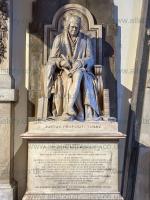
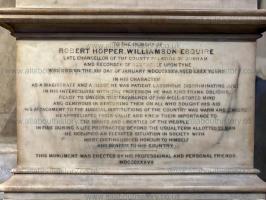
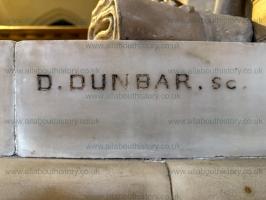
On 13th January 1835 Robert Hopper Williamson, Chancellor of the County Palatine of Durham and Recorder of Newwcastle, died. Monument at the Cathedral Church St Nicholas, Newcastle upon Tyne [Map] commissioned by "professional and personal" friends sculpted by D. Dunbar.
On 13th January 1843 Louise Auguste Oldenburg Duchess Schleswig Holstein Sonderburg Augustenburg (age 71) died.
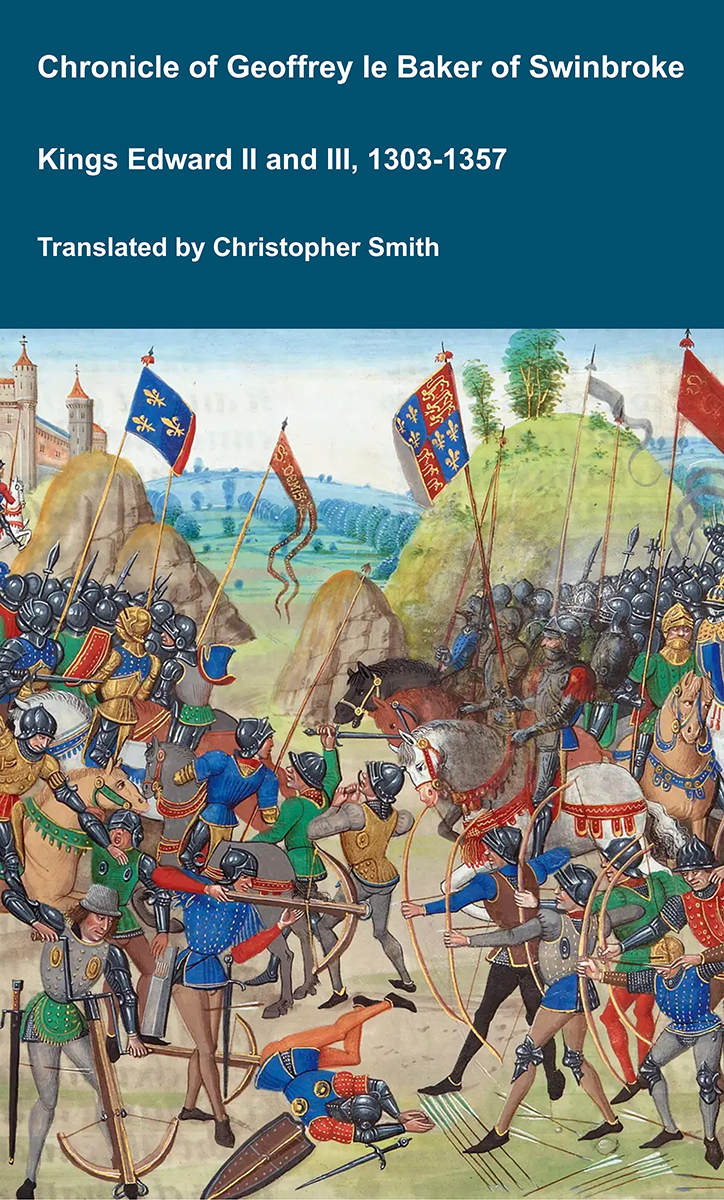
Chronicle of Geoffrey le Baker of Swinbroke
Baker was a secular clerk from Swinbroke, now Swinbrook, an Oxfordshire village two miles east of Burford. His Chronicle describes the events of the period 1303-1356: Gaveston, Bannockburn, Boroughbridge, the murder of King Edward II, the Scottish Wars, Sluys, Crécy, the Black Death, Winchelsea and Poitiers. To quote Herbert Bruce 'it possesses a vigorous and characteristic style, and its value for particular events between 1303 and 1356 has been recognised by its editor and by subsequent writers'. The book provides remarkable detail about the events it describes. Baker's text has been augmented with hundreds of notes, including extracts from other contemporary chronicles, such as the Annales Londonienses, Annales Paulini, Murimuth, Lanercost, Avesbury, Guisborough and Froissart to enrich the reader's understanding. The translation takes as its source the 'Chronicon Galfridi le Baker de Swynebroke' published in 1889, edited by Edward Maunde Thompson.
Available at Amazon in eBook and Paperback format.
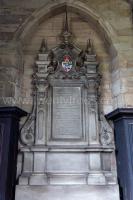
After 13th January 1844. Hasting's Chapel, St Helen's Church, Ashby-de-la-Zouch [Map]. Monument to George Augustus Francis Rawdon-Hastings 2nd Marquess Hastings (deceased).
Ten Years' Digging. January 13th [1848] was passed in deepening the trench, principally through the before-named clay, varied by layers of decomposed wood and charcoal. From the appearance of the bark still remaining on some of these fragments, they were decided to be hazel. Amongst them were found animal bones and flints as before, one of the latter being a fine instrument of semicircular shape.
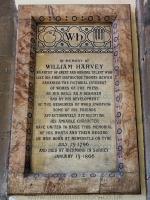
On 13th January 1866 artist William Harvey died at Richard, Surrey. Memorial at the Cathedral Church St Nicholas, Newcastle upon Tyne [Map].
On 13th January 1881 Nathaniel Jocelyn (age 84) died.
On 13th January 1883 Prince Arthur of Connaught was born to Prince Arthur Windsor 1st Duke Connaught and Strathearn (age 32) and Luise Margarete Hohenzollern Duchess Connaught (age 22). He a grandson of Queen Victoria of the United Kingdom. He married 15th October 1913 his first cousin once removed Princess Alexandra Duff Duchess Fife, daughter of Alexander Duff 1st Duke Fife and Louise Windsor Duchess Fife, and had issue.


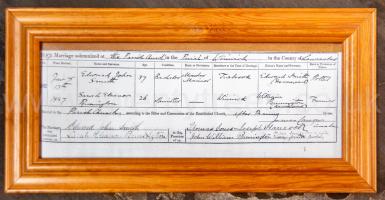
13th January 1887. Marriage Certificate of Edward John Smith and Sarah Eleanor Pennington who were married at St Oswald's Church, Winwick [Map]. He, twenty-five years later, was Captain of the Titanic who went down with his ship.
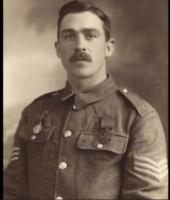
On 13th January 1915 William Charles Fuller (age 30) was invested with his Victoria Cross by King George V of the United Kingdom (age 49) at Buckingham Palace [Map].
On 13th January 1929 Emil Fuchs (age 62) committed suicide by shooting himself at the Hotel des Artistes in New York.
On 13th January 1945 Francis Pryor was born to Robert Matthew Marlborough Pryor. He was educated at Eton College [Map] before studying Archaeology at Trinity College, Cambridge University [Map].
On 13th January 1948 Peter Charles Beauclerk was born to Charles Beauclerk 13th Duke St Albans (age 32) and Suzanne Marie Fesq Duchess St Albans (age 26).
On 13th January 1312 Margaret Bardolf Baroness Welles was born to Thomas Bardolf 2nd Baron Bardolf (age 29) and Agnes Grandison Baroness Bardolf (age 23) at Tutbury Castle, Staffordshire [Map]. She married before 23rd August 1334 Adam Welles 3rd Baron Welles, son of Adam Welles 1st Baron Welles, and had issue.
Jean de Waurin's Chronicle of England Volume 6 Books 3-6: The Wars of the Roses
Jean de Waurin was a French Chronicler, from the Artois region, who was born around 1400, and died around 1474. Waurin’s Chronicle of England, Volume 6, covering the period 1450 to 1471, from which we have selected and translated Chapters relating to the Wars of the Roses, provides a vivid, original, contemporary description of key events some of which he witnessed first-hand, some of which he was told by the key people involved with whom Waurin had a personal relationship.
Available at Amazon in eBook and Paperback format.
On 13th January 1314 John Bardolf 3rd Baron Bardolf was born to Thomas Bardolf 2nd Baron Bardolf (age 31) and Agnes Grandison Baroness Bardolf (age 25). He married before 1349 Elizabeth Damory Baroness Bardolf and had issue.
On 13th January 1332 John Strange 4th Baron Strange Blackmere was born to John Strange 2nd Baron Strange Blackmere (age 25) and Ankaret Boteler Baroness Strange Blackmere (age 23) at Whitchurch, Shropshire. He married in or before 1353 his fourth cousin once removed Mary Fitzalan Baroness Strange Blackmere, daughter of Edmund Fitzalan 2nd or 9th Earl of Arundel and Alice Warenne Countess Arundel, and had issue.
On 13th January 1334 Henry "Fratricide" II King Castile was born illegitimately to Alfonso "Avenger" XI King Castile (age 22) and Eleanor Guzman. He was one of twins. He married before 24th August 1358 his third cousin Juana Manuel Queen of Castile and had issue.
On 13th January 1334 Fadrique Alfonso Ivrea was born illegitimately to Alfonso "Avenger" XI King Castile (age 22) and Eleanor Guzman at Seville.
On 13th January 1335 Thomas Ros 4th Baron Ros Helmsley was born to William Ros 2nd Baron Ros Helmsley (age 50) and Margery Badlesmere Baroness Ros of Helmsley (age 26). He married 12th April 1363 his third cousin Beatrice Stafford Countess Desmond, daughter of Ralph Stafford 1st Earl Stafford and Margaret Audley Countess Stafford, and had issue.
On 13th January 1400 Prince John Aviz Constable Portugal was born to King John I of Portugal (age 48) and Philippa of Lancaster Queen Consort Portugal (age 39). He a great grandson of King Edward III of England. He married 1424 his niece Isabella of Braganza and had issue.
On 13th January 1505 Joachim Hohenzollern Margrave of Brandenburg was born to Joachim "Nestor" Hohenzollern Elector Brandenburg (age 20).
On 13th January 1601 Guido Cagnacci was born.
Chronicle of Geoffrey le Baker of Swinbroke
Baker was a secular clerk from Swinbroke, now Swinbrook, an Oxfordshire village two miles east of Burford. His Chronicle describes the events of the period 1303-1356: Gaveston, Bannockburn, Boroughbridge, the murder of King Edward II, the Scottish Wars, Sluys, Crécy, the Black Death, Winchelsea and Poitiers. To quote Herbert Bruce 'it possesses a vigorous and characteristic style, and its value for particular events between 1303 and 1356 has been recognised by its editor and by subsequent writers'. The book provides remarkable detail about the events it describes. Baker's text has been augmented with hundreds of notes, including extracts from other contemporary chronicles, such as the Annales Londonienses, Annales Paulini, Murimuth, Lanercost, Avesbury, Guisborough and Froissart to enrich the reader's understanding. The translation takes as its source the 'Chronicon Galfridi le Baker de Swynebroke' published in 1889, edited by Edward Maunde Thompson.
Available at Amazon in eBook and Paperback format.
On 13th January 1610 Maria Anna Habsburg Spain Duchess Bavaria was born to Ferdinand of Spain II Holy Roman Emperor (age 31) and Maria Anna Wittelsbach Holy Roman Empress (age 35). Coefficient of inbreeding 11.68%. She married 15th July 1635 her uncle Maximilian "The Great" Wittelsbach I Duke Bavaria I Elector Bavaria, son of William Wittelsbach V Duke Bavaria and Renata Lorraine Duchess Bavaria, and had issue.
On 13th January 1622 Grey Skipwith 3rd Baronet was born to Henry Skipwith 1st Baronet (age 32) and Ann Kemp Lady Skipwith (age 30).
On 13th January 1652 Henry Booth 1st Earl Warrington was born to George Booth 1st Baron Delamer (age 29) and Elizabeth Grey Baroness Delamer (age 30). He married 7th July 1670 Mary Langham Countess Warrington, daughter of James Langham 2nd Baronet and Mary Alston, and had issue.


On 13th January 1663 Henry Paget 1st Earl Uxbridge was born to William Paget 6th Baron Paget Beaudasert (age 25) and Frances Pierrepont Baroness Geneville Beaudasert. He married (1) on or after 2nd January 1686 Mary Catesby Countess Uxbridge (2) 7th June 1739 his half fifth cousin once removed Elizabeth Bagot Countess Uxbridge, daughter of Walter Bagot 3rd Baronet and Jane Salusbury.
On 28th September 1667 Ferdinand Wenzel Habsburg Spain was born to Leopold Habsburg Spain I Holy Roman Emperor (age 27) and Margaret Theresa Habsburg Holy Roman Empress (age 16). On 13th January 1668 Ferdinand Wenzel Habsburg Spain died. Coefficient of inbreeding 30.98%.
On 13th January 1684 Edward Leigh 3rd Baron Leigh was born to Thomas Leigh 2nd Baron Leigh (age 31). He married 11th September 1705 Mary Holbech Baroness Leigh and had issue.
On 13th January 1707 Ludovic Grant 7th Baronet was born to James Grant 6th Baronet (age 27). He married 31st October 1735 Margaret Ogilvy, daughter of James Ogilvy 5th Earl Findlater 2nd Earl Seafield and Elizabeth Hay, and had issue.
On 13th January 1707 John Boyle 5th Earl Cork was born to Charles Boyle 4th Earl Cork 4th Earl Orrery (age 32) and Elizabeth Cecil Countess Cork (age 15). He married his second cousin once removed Henrietta Hamilton Countess Cork, daughter of George Hamilton 1st Earl Orkney and Elizabeth Villiers Countess Orkney, and had issue.
Chronicle of Geoffrey le Baker of Swinbroke
Baker was a secular clerk from Swinbroke, now Swinbrook, an Oxfordshire village two miles east of Burford. His Chronicle describes the events of the period 1303-1356: Gaveston, Bannockburn, Boroughbridge, the murder of King Edward II, the Scottish Wars, Sluys, Crécy, the Black Death, Winchelsea and Poitiers. To quote Herbert Bruce 'it possesses a vigorous and characteristic style, and its value for particular events between 1303 and 1356 has been recognised by its editor and by subsequent writers'. The book provides remarkable detail about the events it describes. Baker's text has been augmented with hundreds of notes, including extracts from other contemporary chronicles, such as the Annales Londonienses, Annales Paulini, Murimuth, Lanercost, Avesbury, Guisborough and Froissart to enrich the reader's understanding. The translation takes as its source the 'Chronicon Galfridi le Baker de Swynebroke' published in 1889, edited by Edward Maunde Thompson.
Available at Amazon in eBook and Paperback format.
On 7th January 1714 Bourchier Wrey 6th Baronet was born to Bourchier Wrey 5th Baronet (age 32) and Diana Rolle (age 31). He was baptised on 13th January 1714 in Westminster. Coefficient of inbreeding 6.37%. He married (1) 28th September 1749 Mary Edwards Lady Wrey (2) 1755 Ellen Thresher Lady Wrey and had issue.
On 13th January 1724 or 23rd January 1724 Sophia Antonia Brunswick-Wolfenbüttel Duchess Saxe Coburg Saalfeld was born to Ferdinand Albert II Duke of Brunswick-Wolfenbüttel (age 43) and Princess Antoinette of Brunswick-Wolfenbüttel (age 27). She married 23rd April 1749 Ernest Frederick Saxe Coburg Saalfeld Duke Saxe Coburg Saalfeld, son of Francis Josias Saxe Coburg Saalfeld Duke Saxe Coburg Saalfeld and Duchess Anna Sophie Of Saxe-Coburg-Saalfeld, and had issue.
On 13th January 1746 Thomas Howard 3rd Earl of Effingham was born to Thomas Howard 2nd Earl of Effingham (age 32) and Elizabeth Beckford Countess Effingham (age 21).
On 13th January 1753 Henry Tempest 4th Baronet was born to Henry Tempest 3rd Baronet (age 56).
On 13th January 1763 John Marjoribanks 1st Baronet was born to Edward Marjoribanks (age 28).

On 13th January 1777 Thomas Dalrymple Hesketh 3rd Baronet was born to Thomas Hesketh (age 28) and Jacintha Dalrymple at New York. He married 1st February 1798 Sophia Hinde Lady Hesketh and had issue.
On 13th January 1779 Sophia Curzon was born to Nathaniel Curzon 2nd Baron Scarsdale (age 26) and Sophia Susanna Noel. She married 5th September 1800 Robert Sewallis Shirley, son of Robert Shirley 7th Earl Ferrers and Elizabeth Prentiss Countess Ferrers.


On 13th January 1785 John Chandos Reade 7th Baronet was born to John Reade 6th Baronet (age 22) and Jane Hoskyns Lady Reade (age 30). He was baptised at St Marylebone Church. He married 6th January 1814 Louisa Murray Lady Reade.
On 13th January 1795 Edward Lloyd aka Lloyd-Mostyn 2nd Baron Mostyn was born to Edward Lloyd 1st Baron Mostyn (age 26).
On 13th January 1798 Astley Paston Cooper 2nd Baronet was born to Reverend Samuel Lovick Cooper (age 34) and Sarah Leman Rede (age 32). He married 29th November 1821 Elizabeth Harriet Rickford Lady Cooper and had issue.
The History of William Marshal was commissioned by his son shortly after William’s death in 1219 to celebrate the Marshal’s remarkable life; it is an authentic, contemporary voice. The manuscript was discovered in 1861 by French historian Paul Meyer. Meyer published the manuscript in its original Anglo-French in 1891 in two books. This book is a line by line translation of the first of Meyer’s books; lines 1-10152. Book 1 of the History begins in 1139 and ends in 1194. It describes the events of the Anarchy, the role of William’s father John, John’s marriages, William’s childhood, his role as a hostage at the siege of Newbury, his injury and imprisonment in Poitou where he met Eleanor of Aquitaine and his life as a knight errant. It continues with the accusation against him of an improper relationship with Margaret, wife of Henry the Young King, his exile, and return, the death of Henry the Young King, the rebellion of Richard, the future King Richard I, war with France, the death of King Henry II, and the capture of King Richard, and the rebellion of John, the future King John. It ends with the release of King Richard and the death of John Marshal.
Available at Amazon in eBook and Paperback format.

On 13th January 1801 Sophia Laura Wodehouse was born to John Wodehouse 2nd Baron Wodehouse (age 30) and Charlotte Norris Baroness Woodhouse.
On 13th January 1801 Laura Sophia Wodehouse was born to John Wodehouse 1st Baron Wodehouse (age 59) and Sophia Berkeley Baroness Wodehouse (age 54). She married 28th June 1825 Raikes Currie and had issue.
On 13th January 1820 William John Browne ffolkes was born to William Browne ffolkes 2nd Baronet (age 33) and Charlotte Philippa Browne (age 21).
On 13th January 1821 Paul William Molesworth 10th Baronet was born to Reverend William Molesworth (age 28) and Katherine Treby (age 32). He married 25th September 1849 Jane Frances Booker Lady Molesworth and had issue.
On 13th January 1830 Henry Ralph Fletcher-Vane 4th Baronet was born to Francis Fletcher-Vane 3rd Baronet (age 32) and Diana Elizabeth Beauclerk (age 23). He married 12th April 1871 Margaret Gladstone.
On 13th January 1834 Richard Trench 4th Earl of Clancarty was born to William Trench 3rd Earl of Clancarty (age 30) and Sarah Juliana Butler (age 21). He married 29th November 1866 Adeliza Georgiana Hervey Countess Clancarty, daughter of Frederick Hervey 2nd Marquess of Bristol and Katherine Isabella Manners, and had issue.
On 13th January 1843 William Purdie Treloar 1st Baronet was born. He married 1869 Annie Blake.
On 13th January 1850 Richard Mansel 12th Baronet was born to Major Courtenay Mansel (age 49) and Eliza Sidney.
Chronicle of a Bourgeois of Valenciennes
Récits d’un bourgeois de Valenciennes aka The Chronicle of a Bourgeois of Valenciennes is a vivid 14th-century vernacular chronicle written by an anonymous urban chronicler from Valenciennes in the County of Hainaut. It survives in a manuscript that describes local and regional history from about 1253 to 1366, blending chronology, narrative episodes, and eyewitness-style accounts of political, military, and social events in medieval France, Flanders, and the Low Countries. The work begins with a chronological framework of events affecting Valenciennes and its region under rulers such as King Philip VI of France and the shifting allegiances of local nobility. It includes accounts of conflicts, sieges, diplomatic manoeuvres, and the impact of broader struggles like the Hundred Years’ War on urban life in Hainaut. Written from the perspective of a burgher (bourgeois) rather than a monastery or royal court, the chronicle offers a rare lay viewpoint on high politics and warfare, reflecting how merchants, townspeople, and civic institutions experienced the turbulence of the 13th and 14th centuries. Its narrative style combines straightforward reporting of events with moral and civic observations, making it a valuable source for readers interested in medieval urban society, regional politics, and the lived experience of war and governance in pre-modern Europe.
Available at Amazon in eBook and Paperback format.
On 13th January 1856 Captain Walter Hill Chetwynd was born to George Chetwynd 3rd Baronet (age 46) and Charlotte Augusta Hill Lady Chetwynd. He married 14th June 1890 Edomé Eliza Theodosia Chetwynd, daughter of Debonnaire John Monson 8th Baron Monson.
On 13th January 1859 Dudley Stanhope 9th Earl of Harrington was born to Charles Stanhope 7th Earl of Harrington (age 49).
On 13th January 1861 Oliver Wallop 8th Earl of Portsmouth was born to Isaac Newton Wallop 5th Earl of Portsmouth (age 36) and Eveline Howard Herbert Countess Portsmouth (age 26).

On 13th January 1869 Richard Arthur Surtees Paget 2nd Baronet was born to Richard Horner Paget 1st Baronet (age 36) and Caroline Isabel Surtees (age 21). He was educated at Eton College [Map] and Magdalen College, Oxford University. He married (1) 31st May 1897 Muriel Finch-Hatton Lady Paget, daughter of Murray Finch-Hatton 7th Earl Nottingham 12th Earl Winchilsea and Edith Harcourt Countess Winchelsea and Nottingham, and had issue (2) 22nd July 1939 Hartley Glover Lady Paget.
On 13th January 1883 Prince Arthur of Connaught was born to Prince Arthur Windsor 1st Duke Connaught and Strathearn (age 32) and Luise Margarete Hohenzollern Duchess Connaught (age 22). He a grandson of Queen Victoria of the United Kingdom. He married 15th October 1913 his first cousin once removed Princess Alexandra Duff Duchess Fife, daughter of Alexander Duff 1st Duke Fife and Louise Windsor Duchess Fife, and had issue.
On 13th January 1888 Lilah Katherine Julia Wingfield was born to Mervyn Wingfield 7th Viscount Powerscourt (age 51) and Julia Coke Viscountess Powerscourt (age 44).
On 13th January 1897 John Henry Algernon Anson 5th Baronet was born to Rear-Admiral Algernon Horatio Anson (age 42) and Adela Venables-Vernon (age 26).
On 13th January 1897 Violet Lucy Emily Seely Viscountess Allendale was born to Charles Hilton Seely 2nd Baronet (age 37). She married 20th July 1921 Wentworth Henry Canning Beaumont 2nd Viscount Allendale, son of Wentworth Canning Blackett Beaumont 1st Viscount Allendale and Alexandrina Louise Maud Vane-Tempest Viscountess Allendale, and had issue.
On 13th January 1900 Mary Edith Gascoyne-Cecil Baroness Manners was born to Bishop Rupert Gascoyne-Cecil (age 36) and Florence Bootle Wibraham. She married 1921 Francis Henry Manners 4th Baron Manners, son of John Manners-Sutton 3rd Baron Manners and Constance Hamlyn-Fane Baroness Manners, and had issue.
Jean de Waurin's Chronicle of England Volume 6 Books 3-6: The Wars of the Roses
Jean de Waurin was a French Chronicler, from the Artois region, who was born around 1400, and died around 1474. Waurin’s Chronicle of England, Volume 6, covering the period 1450 to 1471, from which we have selected and translated Chapters relating to the Wars of the Roses, provides a vivid, original, contemporary description of key events some of which he witnessed first-hand, some of which he was told by the key people involved with whom Waurin had a personal relationship.
Available at Amazon in eBook and Paperback format.
On 13th January 1920 Robert Edward de Vere Capell 10th Earl of Essex was born to Arthur Algernon de Vere Capell (age 50).
On 13th January 1941 Michael John Assheton Eardley-Wilmot 6th Baronet was born to John Assheton Eardley-Wilmot 5th Baronet (age 24).
On 13th January 1945 Francis Pryor was born to Robert Matthew Marlborough Pryor. He was educated at Eton College [Map] before studying Archaeology at Trinity College, Cambridge University [Map].
On 13th January 1948 Peter Charles Beauclerk was born to Charles Beauclerk 13th Duke St Albans (age 32) and Suzanne Marie Fesq Duchess St Albans (age 26).
On 13th January 1396 John of Gaunt 1st Duke Lancaster (age 55) and Katherine Swynford aka Roet Duchess Lancaster (age 45) were married at Lincoln Cathedral [Map]. She by marriage Duchess Lancaster. He the son of King Edward III of England and Philippa of Hainaut Queen Consort England.
On 13th January 1585 John Fleming 1st Earl Wigtown (age 18) and Lilias Graham Countess Graham were married. She the daughter of John Graham 3rd Earl Montrose (age 37). They were first cousin once removed.
On 13th January 1651 John Fettiplace 1st Baronet (age 25) and Anne Wenman Lady Fettiplace (age 21) were married.
On 13th January 1653 David Wemyss 2nd Earl of Wemyss (age 42) and Margaret Leslie Countess Buccleuch and Wemyss (age 32) were married. She the daughter of John Leslie 6th Earl Rothes and Anne Erskine Countess of Rothes. He the son of John Wemyss 1st Earl of Wemyss and Jane Gray Countess Wemyss. They were fourth cousin once removed. He a great x 4 grandson of King Henry VII of England and Ireland.
On 13th January 1784 John Reade 6th Baronet (age 21) and Jane Hoskyns Lady Reade (age 29) were married at St Marylebone Church.
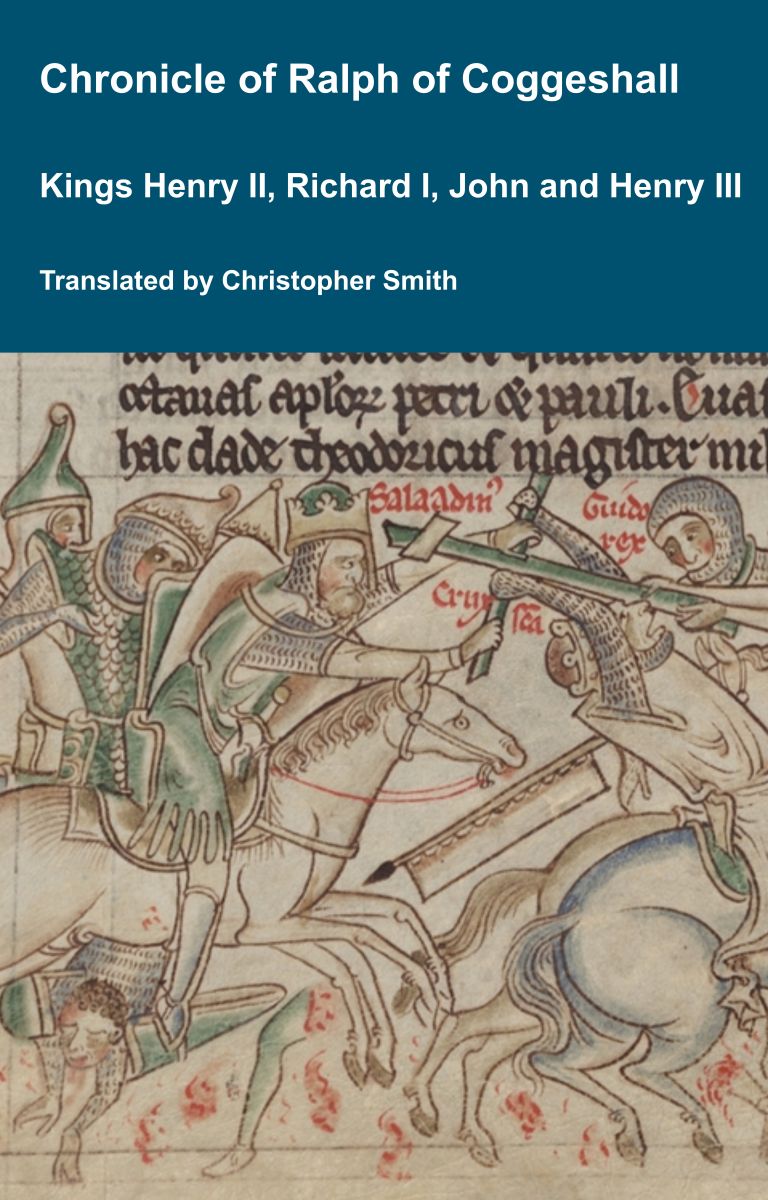
Chronicle of Abbot Ralph of Coggeshall
The Chronicle of Abbot Ralph of Coggeshall (Chronicon Anglicanum) is an indispensable medieval history that brings to life centuries of English and European affairs through the eyes of a learned Cistercian monk. Ralph of Coggeshall, abbot of the Abbey of Coggeshall in Essex in the early 13th century, continued and expanded his community’s chronicle, documenting events from the Norman Conquest of 1066 into the tumultuous reign of King Henry III. Blending eyewitness testimony, careful compilation, and the monastic commitment to record-keeping, this chronicle offers a rare narrative of political intrigue, royal power struggles, and social upheaval in England and beyond. Ralph’s work captures the reigns of pivotal figures such as Richard I and King John, providing invaluable insights into their characters, decisions, and the forces that shaped medieval rule. More than a simple annal, Chronicon Anglicanum conveys the texture of medieval life and governance, making it a rich source for scholars and readers fascinated by English history, monastic authorship, and the shaping of the medieval world.
Available at Amazon in eBook and Paperback format.
On 13th January 1802 Lowther Pennington 2nd Baron Muncaster (age 57) and Esther Barry were married.
On 13th January 1803 John Ponsonby 1st Viscount Ponsonby (age 33) and Frances Elizabeth Villiers Viscountess Ponsonby (age 17) were married. She the daughter of George Bussy Villiers 4th Earl Jersey (age 67) and Frances Twysden (age 49). He the son of William Ponsonby 1st Baron Ponsonby of Imokilly in County Cork (age 58) and Louisa Molesworth Countess Fitzwilliam (age 54).
On 13th January 1819 George Spencer-Churchill 6th Duke of Marlborough (age 25) and Jane Stewart Duchess of Marlborough (age 21) were married. She the daughter of George Stewart 8th Earl Galloway (age 50) and Jane Paget Countess Galloway (age 44). He the son of George Spencer-Churchill 5th Duke of Marlborough (age 52) and Susan Stewart Duchess of Marlborough (age 51). They were first cousins.
On 13th January 1823 Thomas Fermor 4th Earl Pomfret (age 52) and Amabel Borough (age 23) were married. The difference in their ages was 29 years. He the son of George Fermor 2nd Earl Pomfret and Anna Maria Delagard Countess Pomfret.
On 13th January 1863 Capel Molyneux 7th Baronet (age 21) and Mary Emily Fitzgerald Lady Molyneux (age 23) were married. She by marriage Lady Molyneux of Castle Dillon in Armagh.
On 13th January 1880 Charles Stuart Abbott 3rd Baron Tenterden (age 45) and Emma Mary Bailey Baroness Tenterden (age 37) were married at St George's Church, Hanover Square. She by marriage Baroness Tenterden of Hendon in Middlesex.

On 13th January 1881 Walter Grindlay Simpson 2nd Baronet (age 37) and Ann Fitzgerald Mackay Lady Simpson (age 24) were married at Banchory-Devenick.
On 13th January 731 Archbishop Berhtwald died.
On 13th January 858 King Æthelwulf of Wessex died. His son Æthelbald succeeded King Wessex.
On 13th January 888 Charles "Fat" King East Francia Holy Roman Emperor III King West Francia King Aquitaine (age 48) died.
On 13th January 1049 Dirk Gerulfing IV Count Holland (age 24) was murdered. His brother Floris (age 24) succeeded I Count Holland.
Chronicle of Abbot Ralph of Coggeshall
The Chronicle of Abbot Ralph of Coggeshall (Chronicon Anglicanum) is an indispensable medieval history that brings to life centuries of English and European affairs through the eyes of a learned Cistercian monk. Ralph of Coggeshall, abbot of the Abbey of Coggeshall in Essex in the early 13th century, continued and expanded his community’s chronicle, documenting events from the Norman Conquest of 1066 into the tumultuous reign of King Henry III. Blending eyewitness testimony, careful compilation, and the monastic commitment to record-keeping, this chronicle offers a rare narrative of political intrigue, royal power struggles, and social upheaval in England and beyond. Ralph’s work captures the reigns of pivotal figures such as Richard I and King John, providing invaluable insights into their characters, decisions, and the forces that shaped medieval rule. More than a simple annal, Chronicon Anglicanum conveys the texture of medieval life and governance, making it a rich source for scholars and readers fascinated by English history, monastic authorship, and the shaping of the medieval world.
Available at Amazon in eBook and Paperback format.
On 13th January 1151 Hawise Salisbury Countess Dreux (age 33) died.
On 13th January 1200 Otto Hohenstaufen I Count Burgundy (age 29) was murdered.
On 13th January 1330 Frederick "Fair" Habsburg I Duke Austria (age 41) died. His brother Leopold succeeded I Duke Austria.
On 13th January 1349 Constanza Manuel Queen Consort Castile (age 33) died.
On 13th January 1400 Thomas Despencer 1st Earl Gloucester (age 26) was beheaded at Bristol, Gloucestershire [Map].
On 13th January 1434 Joan Pole 4th Baroness Cobham died. She was buried at Church of St Mary Magdalene, Cobham. Her daughter Joan (age 31) succeeded 5th Baroness Cobham. Thomas Brooke Baron Cobham (age 43) by marriage Baron Cobham.
On 13th January 1450 Henry Grey 2nd Earl Tankerville (age 32) died. His son Richard (age 13) succeeded 3rd Earl Tankerville.
On 13th January 1483 Margrave Henry III of Upper Hesse (age 42) died.

On 13th January 1584 Thomas Wentworth 2nd Baron Wentworth (age 59) died. His son Henry (age 25) succeeded 3rd Baron Wentworth. His son Henry de jure 8th Baron Despencer.
Chronicle of a Bourgeois of Valenciennes
Récits d’un bourgeois de Valenciennes aka The Chronicle of a Bourgeois of Valenciennes is a vivid 14th-century vernacular chronicle written by an anonymous urban chronicler from Valenciennes in the County of Hainaut. It survives in a manuscript that describes local and regional history from about 1253 to 1366, blending chronology, narrative episodes, and eyewitness-style accounts of political, military, and social events in medieval France, Flanders, and the Low Countries. The work begins with a chronological framework of events affecting Valenciennes and its region under rulers such as King Philip VI of France and the shifting allegiances of local nobility. It includes accounts of conflicts, sieges, diplomatic manoeuvres, and the impact of broader struggles like the Hundred Years’ War on urban life in Hainaut. Written from the perspective of a burgher (bourgeois) rather than a monastery or royal court, the chronicle offers a rare lay viewpoint on high politics and warfare, reflecting how merchants, townspeople, and civic institutions experienced the turbulence of the 13th and 14th centuries. Its narrative style combines straightforward reporting of events with moral and civic observations, making it a valuable source for readers interested in medieval urban society, regional politics, and the lived experience of war and governance in pre-modern Europe.
Available at Amazon in eBook and Paperback format.
On 13th January 1595 James Plunkett 7th Baron Killeen (age 53) died. His son Christopher (age 31) succeeded 8th Baron Killeen. Genet Dillon Baroness Killeen by marriage Baroness Killeen.
On 13th January 1601 Bridget Hussey Countess Bedford (age 75) died. She was originally interred at St Marys Church, Watford. The monument was probably moved when the Bedford Chapel, St Michael's Church, Chenies was extended in 1906.
Marble altar tomb chest with flat vertical pilaster strips; on sides and ends are shields with arms. Recumbent effigy of alabaster, coloured in robes of a peeress with ruff and close fitting cap. At the left and right of the tomb chest, on little stands, are two kneeling male figures in armour, carved in full relief, both facing West, thought to represent her grandsons Francis Norreys 1st Earl Berkshire (age 21) and - Francis, Lord Norreys and Sir Charles Morrison Bt.
On 13th January 1612 Jane Dormer Duchess Feria (age 74) died.
On 13th January 1628 Anthony Ashley 1st Baronet (age 67) died. He was buried at Wimborne St Giles Church. Baronet Ashley of Wimborne St Giles in Dorset extinct.
On 13th January 1683 William Dalston 1st Baronet (age 73) died. His son John succeeded 2nd Baronet Dalston of Dalston.
On 13th January 1684 Henry Howard 6th Duke of Norfolk (age 55) died. His son Henry (age 29) succeeded 7th Duke Norfolk, 18th or 25th Earl Arundel, 8th Earl Surrey, 5th Earl Norfolk, 2nd Earl Norwich, 18th Baron Mowbray, 19th Baron Segrave, 16th Baron Furnivall, 20th Baron Strange Blackmere, 17th Baron Talbot, 15th Baron Maltravers, 15th Baron Arundel, 2nd Baron Howard of Castle Rising, Earl Marshal. Mary Mordaunt Duchess Norfolk (age 25) by marriage Duchess Norfolk.
On 13th January 1694 Mary Stafford Countess Stafford (age 74) died. She was buried at the Chapel of St Edmund, Westminster Abbey [Map]. Her son Henry (age 46) succeeded 2nd Baron Stafford.
On 13th January 1697 Elizabeth Cutler Countess Radnor died.
On 13th January 1701 John Garrard 3rd Baronet (age 63) died without male issue. He was buried at St Helen's Church, Wheathampstead. His brother Samuel (age 51) succeeded 4th Baronet Garrard of Lamer.
The Deeds of the Dukes of Normandy
The Gesta Normannorum Ducum [The Deeds of the Dukes of Normandy] is a landmark medieval chronicle tracing the rise and fall of the Norman dynasty from its early roots through the pivotal events surrounding the Norman Conquest of England. Originally penned in Latin by the monk William of Jumièges shortly before 1060 and later expanded at the behest of William the Conqueror, the work chronicles the deeds, politics, battles, and leadership of the Norman dukes, especially William’s own claim to the English throne. The narrative combines earlier historical sources with firsthand information and oral testimony to present an authoritative account of Normandy’s transformation from a Viking settlement into one of medieval Europe’s most powerful realms. William’s history emphasizes the legitimacy, military prowess, and governance of the Norman line, framing their expansion, including the conquest of England, as both divinely sanctioned and noble in purpose. Later chroniclers such as Orderic Vitalis and Robert of Torigni continued the history, extending the coverage into the 12th century, providing broader context on ducal rule and its impact. Today this classic work remains a foundational source for understanding Norman identity, medieval statesmanship, and the historical forces that reshaped England and Western Europe between 800AD and 1100AD.
Available at Amazon in eBook and Paperback format.
On 13th January 1709 Malet Wilmot Viscountess Lisburne (age 33) died.
On 13th January 1735 Polyxena Hesse Rotenburg Queen Consort Sardinia (age 28) died.
On 13th January 1781 Margaret Rolle Countess Orford (age 71) died. Her son George (age 50) succeeded 16th Baron Clinton.
On 13th January 1800 Paul Pechell 1st Baronet (age 75) died. His son Thomas (age 46) succeeded 2nd Baronet Pechell of Paglesham in Essex. Charlotte Clavering Lady Pechell (age 41) by marriage Lady Pechell of Paglesham in Essex.
On 13th January 1808 Margaret Cunynghame (age 62) died. She was buried at the Church of St Leonard, Wortley [Map]. Memorial sculpted by John Flaxman (age 52).
Margaret Cunynghame: On 13th December 1745 she was born to David Cunynghame 3rd Baronet. On 8th June 1767 James Archibald Stuart-Wortley-Mackenzie and she were married. He the son of John Stuart 3rd Earl Bute and Mary Wortley-Montagu Countess Bute.

On 13th January 1808 George Strickland 5th Baronet (age 78) died. His son William (age 54) succeeded 6th Baronet Strickland of Boynton in Yorkshire. Henrietta Cholmley Lady Strickland (age 47) by marriage Lady Strickland of Boynton in Yorkshire.
On 13th January 1821 Catherine Anderton Lady Gerard (age 79) died.
On 13th January 1828 Elizabeth Berkeley Margrave Brandenburg-Ansbach (age 77) died.
Jean de Waurin's Chronicle of England Volume 6 Books 3-6: The Wars of the Roses
Jean de Waurin was a French Chronicler, from the Artois region, who was born around 1400, and died around 1474. Waurin’s Chronicle of England, Volume 6, covering the period 1450 to 1471, from which we have selected and translated Chapters relating to the Wars of the Roses, provides a vivid, original, contemporary description of key events some of which he witnessed first-hand, some of which he was told by the key people involved with whom Waurin had a personal relationship.
Available at Amazon in eBook and Paperback format.

On 13th January 1838 John Scott 1st Earl Eldon (age 86) died. His grandson John (age 32) succeeded 2nd Earl Eldon, 2nd Viscount Encoumbe of Encombe in Dorest, 2nd Baron Eldon of Eldon in County Durham. Louisa Duncombe Countess Eldon (age 30) by marriage Countess Eldon.
On 13th January 1843 Louise Auguste Oldenburg Duchess Schleswig Holstein Sonderburg Augustenburg (age 71) died.
On 13th January 1844 George Augustus Francis Rawdon-Hastings 2nd Marquess Hastings (age 35) died. His son Paulyn (age 11) succeeded 3rd Marquess Hastings, 8th Earl Loudon, 4th Earl Moira, 19th Baron Botreaux, 18th Baron Hungerford, 16th Baron Moleyns and 16th Baron Hastings.
On 13th January 1855 Hester Browne Lady Astley (age 87) died.
On 13th January 1881 Nathaniel Jocelyn (age 84) died.
On 13th January 1900 Henry Gore-Booth 5th Baronet (age 56) died. His son Josslyn (age 30) succeeded 6th Baronet Gore-Booth of Artarman in County Sligo.
On 13th January 1906 Fanny Pottinger Lady Smith (age 73) died.
On 13th January 1915 William Duncombe 1st Earl Feversham (age 85) died. His grandson Charles (age 35) succeeded 2nd Earl Feversham, 4th Baron Feversham of Duncombe Park in Yorkshire. Marjorie Blanche Eva Greville Countess Feversham (age 30) by marriage Countess Feversham.
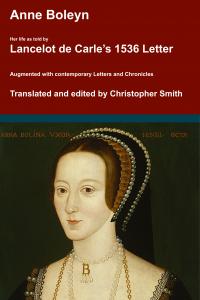
Anne Boleyn. Her Life as told by Lancelot de Carle's 1536 Letter.
In 1536, two weeks after the execution of Anne Boleyn, her brother George and four others, Lancelot du Carle, wrote an extraordinary letter that described Anne's life, and her trial and execution, to which he was a witness. This book presents a new translation of that letter, with additional material from other contemporary sources such as Letters, Hall's and Wriothesley's Chronicles, the pamphlets of Wynkyn the Worde, the Memorial of George Constantyne, the Portuguese Letter and the Baga de Secrets, all of which are provided in Appendices.
Available at Amazon in eBook and Paperback format.
On 13th January 1915 Joshua Charles Vanneck 4th Baron Huntingfield (age 72) died. His nephew William (age 32) succeeded 5th Baron Huntingfield of Heveningham Hall in Suffolk, 7th Baronet Vanneck of Putney.
On 13th January 1916 William Wallace Rhoderic Onslow 5th Baronet (age 70) died. His son Roger (age 35) succeeded 6th Baronet Onslow of Althain.
On 13th January 1929 Emil Fuchs (age 62) committed suicide by shooting himself at the Hotel des Artistes in New York.
On 13th January 1955 Bentley Tollemache 3rd Baron Tollemache (age 71) died. He was buried at the Church of St Mary, Helmingham [Map]. His second cousin John (age 44) succeeded 4th Baron Tollemache of Helmingham in Suffolk.
On 13th January 1960 Reginald Herbert 15th Earl Pembroke 12th Earl Montgomery (age 79) died. His son Sidney (age 54) succeeded 16th Earl Pembroke, 13th Earl Montgomery, 5th Baron Herbert Lea.
On 13th January 2017 Antony Armstrong-Jones 1st Earl of Snowdon (age 86) died. His son David (age 55) succeeded 2nd Earl Snowdon, 2nd Viscount Linley. Serena Stanhope (age 46) by marriage Countess Snowdon.