

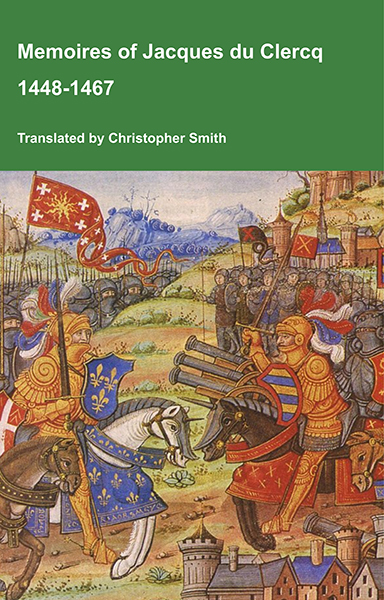
This is a translation of the 'Memoires of Jacques du Clercq', published in 1823 in two volumes, edited by Frederic, Baron de Reissenberg. In his introduction Reissenberg writes: 'Jacques du Clercq tells us that he was born in 1424, and that he was a licentiate in law and a counsellor to Philip the Good, Duke of Burgundy, in the castellany of Douai, Lille, and Orchies. It appears that he established his residence at Arras. In 1446, he married the daughter of Baldwin de la Lacherie, a gentleman who lived in Lille. We read in the fifth book of his Memoirs that his father, also named Jacques du Clercq, had married a lady of the Le Camelin family, from Compiègne. His ancestors, always attached to the counts of Flanders, had constantly served them, whether in their councils or in their armies.' The Memoires cover a period of nineteen years beginning in in 1448, ending in in 1467. It appears that the author had intended to extend the Memoirs beyond that date; no doubt illness or death prevented him from carrying out this plan. As Reissenberg writes the 'merit of this work lies in the simplicity of its narrative, in its tone of good faith, and in a certain air of frankness which naturally wins the reader’s confidence.' Du Clercq ranges from events of national and international importance, including events of the Wars of the Roses in England, to simple, everyday local events such as marriages, robberies, murders, trials and deaths, including that of his own father in Book 5; one of his last entries.
Available at Amazon in eBook and Paperback format.
21 Jun is in June.
Anglo-Saxon Chronicle. 693. This year was Bertwald consecrated archbishop by Godwin, bishop of the Gauls, on the fifth day before the nones of July; about which time died Gifmund, who was Bishop of Rochester; and Archbishop Bertwald consecrated Tobias in his stead. This year also Dryhtelm23 retired from the world.
Note 23. This brief notice of Dryhtelm, for so I find the name written in "Cotton Tiberius B iv." is totally unintelligible without a reference to Bede's "Ecclesiastical History", v. 12; where a curious account of him may be found, which is copied by Matthew of Westminster, anno. 699.
On 21st June 1040 Fulk "Black" Ingelger III Count Anjou (age 70) died. His son Geoffrey succeeded II Count Anjou. Agnes Ivrea Duchess Aquitaine by marriage Countess Anjou.
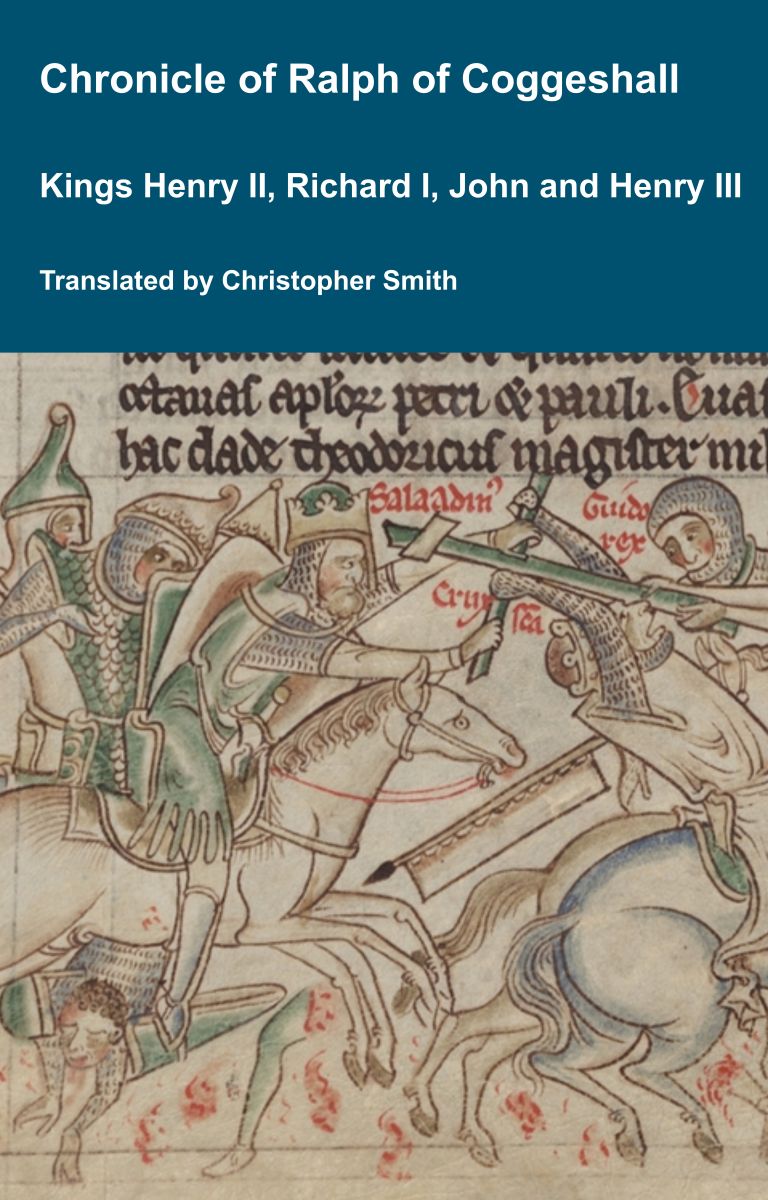 Chronicum Anglicanum by Ralph Coggeshall. 1125. In the territory called Gyssic, four days before the Nativity of Saint John [21st June 1125], blood began to flow from a certain spring, and in a miraculous manner, it did not cease throughout the entire summer. However, the blood would always stop flowing on Saturdays at the ninth hour and then resume again on Monday morning, continuing to flow for the rest of the week until the next Saturday.
MCXXV. In territorio quod Gyssic nominatur, quatuor dies ante Nativitatem beati Johannis de quodam fonte sanguis cepit emanare, et sic miro modo per totam eestatem non defecit, nisi quod semper in sabbato ad horam nonam sanguis ille cessavit, et iterum mane feria secunda fluere cepit per totam septimanam usque ad aliud sabbatum.
On 21st June 1208 Philip King Germany (age 30) was killed.
On 21st June 1221 King Alexander II of Scotland (age 22) and Joan Plantagenet Queen of Scotland (age 10) were married at York Minster [Map]. She by marriage Queen Consort Scotland. She the daughter of King John of England and Isabella of Angoulême Queen Consort England (age 33). He the son of King William I of Scotland and Ermengarde Beaumont Sarthe Queen Consort Scotland (age 51). They were half third cousins. He a great x 2 grandson of King Henry I "Beauclerc" England.
On 21st June 1221 Henry Luxemburg III Duke Limburg (age 81) died.
Annals of Dunstable. In the same year David (age 44), brother of Llywelyn, prince of Wales, was captured by the king's men, namely on the twenty-first day of June; and his legitimate son was taken with him. And he was imprisoned by order of the lord king. Many indeed of his supporters came to peace; and afterwards the lord king arranged all the province of Wales to his will, without any contradiction whatsoever. David's wife [Elizabeth Ferrers (age 43)] also, who was the daughter of the Earl of Ferrers, was likewise taken and imprisoned. Of this there is more on the other side of the leaf.
Eodem anno David, germanus Leulini, principis mention of Walliæ, captus est per gentem domini regis; videlicet vicesimo-primo die Junii; et filius suus legitimus captus est cum eo. Et, inprisonatus est de mandato domini regis. Multi vero ex fautoribus ejus venerunt ad pacem; et postea dominus rex de tota provincia Walliæ ad placitum suum ordinavit sine contradictione qualicunque. Uxor etiam ipsius David, quæ fuit filia comitis de Ferares, alias capta est et inprisonata. De hoc plus ex altera parte folii.
Annals of Dunstable. In the same year, on the eleventh day before the Kalends of July [21st June 1283], the long dispute between us and the abbot and convent of Darley, concerning certain tithes in Peak, which had been argued before various judges and at last devolved by appeal to the examination of the Dean of St Mary's of the Arches, London, after many altercations and windings of judgments, by the assent of our procurators and of the same religious men, with the said dean ordaining, defining, and pronouncing, came thus to an amicable settlement: namely, that the said tithes sought in the libel should remain with the said abbot and convent forever, peacefully and quietly. Provided, however, that the said abbot and convent shall pay for the said tithes, every year in perpetuity, to the said prior and convent or to their attorney, in their church of Bradbourne, sixteen shillings at two terms of the year, etc., under penalty of major excommunication, which the aforesaid dean of the Arches decreed and put into writing against the persons of the abbot, prior, subprior, precentor, cellarer, and sacrist of the same monastery of Darley, whenever they in any way should fail in full or in part to make payment of the said sixteen shillings. And a public instrument was made between us upon this, in which other coercions are also contained.
Eodem anno, undecimo kalendas Julii, longa controversia inter nos et abbatem et conventum de Derleya, super quibusdam decimis in Pecco, coram diversis judicibus ventilata, et demum ad examen decani Sanctæ Mariæ de Arcubus Londoniæ per appellationem devoluta, post varias altercationes et judiciorum anfractus, de assensu procuratorum nostrorum et eorundem religiosorum, dicto decano ordinante, diffiniente, pronuntiante, amicabiliter sic quievit, videlicet, quod dictæ decimæ in libello petitæ penes prædictos abbatem et conventum perpetuo remaneant pacifice et quiete. Ita quidem quod dicti abbas et conventus solvant pro decimis prænotatis, annis singulis in perpetuum, dictis priori et conventui vel eorum attornato, in ecclesia eorum de Bradeburne sedecim solidos, ad duos terminos anni, etc., sub pœna majoris excommunicationis, quas ex tunc in personas abbatis, prioris, subprioris, præcentoris, celerarii, et sacristæ, ejusdem monasterii de Derleya, prædictus decanus de Arcubus contulit et in scriptis, quoties in solutione dictorum sedecim solidorum in toto vel in parte cessaverint quoquomodo. Et factum est super hæc inter nos publicum instrumentum; in quo et coertiones aliæ continentur.
Abbot John Whethamstede’s Chronicle of the Abbey of St Albans
Abbot John Whethamstede's Register aka Chronicle of his second term at the Abbey of St Albans, 1451-1461, is a remarkable text that describes his first-hand experience of the beginning of the Wars of the Roses including the First and Second Battles of St Albans, 1455 and 1461, respectively, their cause, and their consequences, not least on the Abbey itself. His text also includes Loveday, Blore Heath, Northampton, the Act of Accord, Wakefield, and Towton, and ends with the Coronation of King Edward IV. In addition to the events of the Wars of the Roses, Abbot John, or his scribes who wrote the Chronicle, include details in the life of the Abbey such as charters, letters, land exchanges, visits by legates, and disputes, which provide a rich insight into the day-to-day life of the Abbey, and the challenges faced by its Abbot.
Available at Amazon in eBook and Paperback format.
Life Charles VI by a Monk of St Denis [~1420]. [21st June 1293]. As for the matters of the aforementioned, it has not been long since we wrote to your sublimity, admonishing and also beseeching you that you might promptly receive and pursue the cause of God, concerning which we are speaking, imitating the commendable footsteps of the holy progenitors, and conforming yourself entirely to the truth and unity of the holy Roman Church, our spouse, that you would wish to apply the powers and effective works of your mind to the removal of the pressing schism and division, and to the restoration of the Church, and not to delay further. However, having received our letters of this sort, since we had also sent two brothers of the Carthusian order to your presence, you transmitted two others of the same order, professors, along with the aforementioned other brothers to our presence. We, indeed, from the royal memorials reported by those professors, and from what those professors took care to explain more seriously, can hardly comprehend anything other than that those prudent men, who have a son, would that it were a blessing! Robert of Gebenna, formerly a cardinal priest of the basilica of the Twelve Apostles, either made an antipope, or followed the act through his own malignity or the wickedness of others, or both; they are holding you, whether young or just recently emerged, entangled in various ambiguities; so much so that your, as we might say, eyes cannot see the solid truth, dulled by their fascinations and evil snares. On this matter, we certainly grieve greatly. But nevertheless, since the Spirit of the Lord blows where He wills, and He does not know slow volumes or burdens, nor has such an error ever so violently invaded human minds, that God's goodness, when poured out, may not lead to the bright truth by dispersing their darkness (for even the prince of the apostles, Peter, even in the presence of truth, fell three times, yet rose most strongly and steadfastly), still good hope and almost certain expectation encourages us that God Himself will someday illuminate you, His noble creature, and you will see clearly that Urban, of happy memory, Pope VI, our predecessor, was canonically elected, enthroned, and crowned by those to whom the election of the Roman pontiff pertained, who had died, after our own immediate predecessor, Gregory XI; and that some of the aforementioned electors, we do not know by what evil passion of the mind impelled, but certainly by a miserable and sorrowful chance, tending to a ruinous side, made Robert an antipope, and placed such a great schism in the holy Church of God, which they never sufficiently lamented, and nourish it with all their might, and from the very beginnings of that schism, since they overflowed with no few earthly resources, aided by the power of seculars, they attempted to undermine, destroy, and utterly confuse the said Urban, not leaving anything undisputed. But their labors always fell in vain. For the truth and justice protected that poor and defenseless pontiff. But lest we prolong the speech, we again more earnestly request your sublimity, we exhort, advise, beg, and entreat you, and through those things which can be hoped for and which can be feared by Catholics and well-composed men, we beseech that for the mercy of God to be earned and for the restoration and amplification of your illustrious kingdom to be obtained and acquired from the Lord by true praise, henceforth, having dispelled the errors by which you are still held entangled by their malignity, you wish to recognize the truth in the premises, and having known it, to steadfastly follow and defend it, and as far as you can, to protect it, and to conform yourself to the unity of the same Church in all things, and to labor with all your might so that the same may do likewise, and to ensure that no one from your kingdom, or from Flanders, Vasconia, or Lorraine, or Brittany, or other parts, may be constrained to follow the said Robert by violence; the contrary, which is a matter of bad example, is often repeated. If you should accomplish this, as we wish and hope, God will establish you and your affairs as protector, and will render His Church and us propitious and gracious in all your honors and benefits. For we seek nothing else in this regard but your and your people's welfare, and also, if it could be done, that of the aforementioned Robert and his followers; and if you were to accomplish what is pressed above, the return of Robert and his followers would be made much easier. And if it be expedient and you require it, we will send a suitable messenger or messengers to inform you truthfully about all things. We will expect to be informed more certainly by you about your disposition. — Given in Pisa, on the twelfth kalends of June, in the fourth year of our pontificate.
"Prefati, non est diu, que ad materiam congruam videbantur, tue sublimitati scripsimus, illam paterne monentes et eciam obsecrantes ut Dei causam, de qua agitur, prompte suscipiens et constanti animo persequens, commendenda divorum progenitorum vestigia imitatus, ac te intemerate veritati et unitati sancte romane Ecclesie sponse nostre conformans, ad instantis reprobi scismatis ac divisionis remocionem et Ecclesie reintegracionem ingenii tui vires et efficaces operas adhibere velles, nec ulterius retardare. Tu autem hujusmodi nostris receptis litteris, cum preterea duos fratres cartusiensis ordinis ad tui presenciam misissemus, duos alios ejusdem ordinis professores cum dictis aliis fratribus ad nostram presenciam transmisisti. Nos vero ex memorialibus regiis per eosdem professores delatis, et ex hiis que dicti professores seriosius exponere curaverunt, vix aliud comprehendere possumus, quam quod illi preastuti viri, qui filium, utinam benedictionis! Robertum de Gebenna, olim basilice duodecim Apostolorum presbyterum cardinalem, antipapam aut fecerunt, aut factum malignitate propria seu aliorum versuciis vel utrisque sunt sequuti, te, adolescenciam vel nundum vel vix egressum, variis ambagibus detinent involutum; adeo quod tui, ut ita dixerimus, oculi illorum fascinacionibus et malis colliriis delibuti videre nequeant sollidam veritatem. De quo certe summe dolemus. Sed nilominus, cum spiritus Domini ubi vult spiret, nec tarda volumina vel molimina sciat, neque tantus error tam vehementer unquam mentes invaserit humanas, quin Dei bonitas, cum super effunditur, discussis eorum tenebris adducat lucidam veritatem (ipse namque princeps apostolorum Petrus, eciam in conspectu veritatis ter lapsus, fortissimus et constantissimus resurrexit), adhuc spes nosampla et pene certa fovet quod ipse Deus aliquando te suam nobilem creaturam illuminabit, et videbis aperte quod felicis recordacionis Urbanus papa sextus, predecessor noster, pie memorie Gregorio papa undecimo nostro et immediate suo predecessore vita. functo, per eos ad quos romani pontificis pertinebat electio canonice electus, intronizatus et coronatus fuit; cui nos legitime successimus in papatu; et quod nonnulli ex prediotis electoribus, nescimus qua.mala animi passione impulsi, sed casu certe miserabili atque dolendo, dampnosam se tendentes in partem, dictum Robertum antipapam fecerunt, et hujusmodi grande scisma nunquam satis defflendum in sancta Dei Ecclesia posuerunt, ac totis viribus nutriunt, et ab ipsis ejusdem scismatis primordiis, tam propterea cum non paucis terrenis opibus redundarent, secularium adjuti potencia, dictum Urbanum predecessorem subruere, exterminare, et in totum confundere conati fuerunt, nichil pretereuntes indiscussum. Sed semper incassum ceciderunt labores eorum. Protegebat enim illum utique inopem et inermem pontificem veritas et justicia. Sed ne sermonem in longum protrahamus, iterum celsitudinem tuam attencius requirimus, hortamur, monemus, rogamus ac depgecamur, ac per ea que optari et que timeri per catholicos et bene compositos viros possunt, obtestamur quatinus pro Dei misericordia promerenda ac restauracione et amplificacione incliti regni tui a Domino impetranda et acquirenda vera laude, amodo discussis erroribus quibus illorum malignitate adhuc implicitus detineris, velis in premissis agnoscere veritatem, et ea cognita, illam constanter sequi ac deffendere ac pro posse tueri, teque unitati ejusdem Ecclesie per omnia conformare, et ut tui idem faciant totis viribus laborare, ac dare ordinem cum effectu quod sive de tuo regno, sive de Flandrie, Vasconie, aut Lothoringie, vel Britanie, vel aliis partibus, nulli ad sequendum dictum Robertum per violenciam comprimantur; contrarium, que res est exempli mali, sepius iteratur. Que si efficeris, ut cupimus et speramus, Deum tibi tuisque rebus constitues protectorem, et ejus Ecclesiam et nos in cunctis honoribus et commodis tuis reddes propicios et benignos. Nichil enim aliud in hac parte querimus quam tuam tuorumque salutem, ac eciam, si fieri posset, prefati Roberti et sequacium ejus; et si tu perficeres que superius premituntur, Roberti et sequacium eorumdem reductio satis facilius redderetur. Et si fuerit expediens et requiras, nuncium vel nuncios ydoneum vel ydoneos te de omnibus veridice informaturum vel informaturos ad presenciam regiam transmittemus. Expectabimus a te de tua disposicione cercius informari. — Datum Pisis duodecimo kalendas junii, pontificatus nostri anno quarto."
On 21st June 1305 King Wenceslaus II of Bohemia and Poland (age 33) died.
On 21st June 1377 King Edward III of England (age 64) died of a stroke at Sheen Palace [Map]. He was buried in the Chapel of St Edward the Confessor, Westminster Abbey [Map]. His grandson Richard (age 10) succeeded II King of England.


Chronicle of Adam of Usk [~1352-1430]. Our gracious king Edward (age 64) departing this life on the eve A.D. 1377. of the Nativity of Saint John Baptist1, in the fifty-second year of his reign, Richard (age 10), son of Edward, prince of Wales, the eldest son of king Edward—a boy of eleven years, and fair among men as another Absalom—came to the throne, and was crowned at Westminster on Saint Kenelm's day2.
Note 1. This date is not correct. Edward III died on the Sunday next before the feast of the Nativity of St. John the Baptist, the 21st of June, 1877, not on the eve of the feast, the 23rd of the month; and in the fifty-first, not the fifty-second, year of his reign.
Note 2. More correctly, the eve of St. Kenelm, the 16th July.
Archaeologia Volume 22 Section XVI. Of Ales Peres, how she came about the Kynge in his sycknes, and toke his Rings.
The xi kalends of Jullii [21st June 1377], the vygell of our first martir Seint Albon, the renowned kynge Edward sodden as it were with the desease of the [annulir] which tyme we beleve was gyven hym of God to the use of penitence, and to redeme his synes, had almoaste sodaynly dyed, (I dare not say, dispisyng or neglectynge the benefite of tyme that God had gyven hym, lyke one that shuld lyve evar & not dye,) trusted still to the fond fables of the often named harlot [Alice Perrers (age 29)], when she affirmed he shuld well recover and not dye, so that at that tyme he talked rather of hawkynge & huntynge & suche tryfles, then of any thynge that purteyned to his salvation, only he graunted a certayne pardon of deathe and offences throughout his kyngdome, to the inhabitaunts of the same. Therefore as I have sayd, beinge sodeynly taken with the day of deathe, contrary to the opynion of hymselfe and othars about hym, besydes his voice faylyng, he began to have manyfest sygnes of deathe, by whiche bothe he and others that stode by knewe well he shuld dye. What Ales Perres did then, any man may judge that knoweth the conditions of a harlot, althoughe no man set them downe in writinge; for so sone as she saw the kynge had set fote within deathes dores, she bethought hir of flyght; yet before she went, that all men myght perceave that she loved not the kynge for him selfe, but for that whiche was his, she tooke the rings from his fingars, which for his royal majestie he was wont to weare, lest any should doubte of the truethe of the old proverbe, which saythe, no harlot wanteth any scruple of thefte; thus yelding hym suche thanks for his benefits, she bad him adwe, & so withdrew herselffe from him.
Note r. So in the margin.
Chronicle of Gregory [1400-1467]. 21st June 1460. Alle soo thes for said lordys come agayne unto Sondewyche [Map] the xxj [21] day of June nexte folowyng. And the comyns of Kente and there welle-wyllers brought them to Lundon, and so forthe to Northehampton.
Chronicle of Gregory [1400-1467]. 21st June 1463. Thys year, a-bute Mydsomyr, a the ryalle feste of the Sargantys of the Coyfe, the Mayre of London was desyryde to be at that feste. And at denyr tyme he come to the feste with his offecers, a-greyng and according unto his degre. For with yn London he is next unto the kyng in alle maner thynge. And in tyme of waschynge the Erle of Worseter (age 36) was take be-fore the mayre and sette downe in the myddys of the hy tabylle. And the mayre seynge that his place was occupyd hylde him contente, and went home a gayne with owt mete or drynke or any thonke, but rewarde him he dyd as his dignity requyryd of the cytte. And toke with him the substance of his bretheryn the aldyrmen to his place, and were sette and servyd also son as any man couthe devyse, bothe of sygnet and of othyr delycatys i-nowe, that alle the howse marvelled howe welle alle tynge was done in soo schorte a tyme, and prayde alle men to be mery and gladde, hit shulde be a mendyd a nothyr tyme.
Thenn the offesers of the feste, full evylle a schamyd, informyd the maysters of the feste of this mysse happe that is be-falle. And they consyderynge the grete dignity and costys and charge that longgyd unto the cytte, and a-non sende unto the mayre a present of mete, brede, wyne, and many dyvers sotelteys. But whenn they that come with the presentys say alle the gyftys, and the sarvyse that was at the borde, he was full sore a schamyd that shulde doo þe massage, for the present was not better then the servyse of metys was by fore the mayre, and thoroughe out the hyghe tabylle. But his demenynge was soo that he hadde love and thonke for his massage, and a grette rewarde with alle. And this the worschippe of the cytte was kepte, and not loste for hym. And I truste that nevyr it shalle, by the grace of God.
On 21st June 1483 Elizabeth Valois Duchess Cleves (age 44) died.
Ellis' Letters. [21st June 1484.] King Richard the Third (age 31) to his Chancellor, to prepare a Proclamation against Henry Tudor and other rebels his followers.
[MS. Donat. Mus. Brit. 4616. art. 98. ex bund, infra turr. LOND. temp. ric. hi. n. 28.]
R. R.
Right reverend fader in God, right trusty and right welbeloved, we grete yow wele, and wol and charge yow that under oure Greate Seale, being in your warde, ye do make in all haist our lettres of Proclamation, severally to be directed unto the shirrefs of everie Coun tie within this oure Royaume, according to the tenure hereafter ensueing.
"Forasmoche as the King oure Soverain Lorde hathe certaine knowledge that Piers Bisshop of Excestre, Jasper Tidder sone of Owen Tidder calling himself Erie of Pembroke, John late Erie of Oxon, and Sir Edward Widevile, with other diverse his rebells and traitours disabled and attayntedby authoritie of high Courte of Parliament, of whom many been knowon for open niiirtlrors, advowtcrs, and extortioners, contrarie to the pleasure of God and against all treuthe, honour, and nature, have forsaken thair naturall countrev, takin^j theim furst to be vuider the obeissaunce of the Due of Britaigne, and to him promised certain things which by hym and his Counseill were thought thinges to gretly unnaturall and abominable for theim to graunte, observe, kepe, and perfourme; and therfor the same utterly refused. The said Traitours seeing that the said Due and his Counseill would not aide and succour theim, nor folow their weyes, prively departed out of his countrey into Fraunce1, there taking theim to be undre th''obbeisance of the Kings auncient ennemie Charles, calling himself King of Fraunce; and to abuse and blynde the Commones of this said Koyaume, the said Rebeles and Traitours have chosen to be their Capitayne oon Henry Tidder son of Edmond Tidder son of Owen Tidder, whiche of his ambitious and insatiable covetise incrocheth and usurpeth hym the name and title of royal estate of this Roialme of Englande, wherunto he hath no maner interest, right, title, or colour, as every man wel knoweth; for he is descended of bastard blode both of the fader side and moder side; for the said Owen, the grandfader, was a bastard borne, and his moder was doughter unto John Duc of Somerset, sone unto John Erie of Somerset, son unto dame Kateryne Swynford, and of her in double advoutrow goten; wherby it evidently appereth that noo title can or may be in hym, whiche fulley entendeth to entre this Royaume purposing a conquest: and if he should atcheve this false entent and purpose, every mannys lif, livelood, and goods shuld be in his hands, libertie, and disposition: wherby shuld ensue the disheriting and distruction of all the noble and worshipfull blode of this Royalme for ever. And to the resistence and withstanding wherof, every true and naturall Englisheman born must lay to his handes for his own suertie, and well, and to the entent that the said Henry Tidder might the rather eschewe his said fals entent and pourpous by the aide, supporte, and assistence of the Kings said auncient ennemye of Fraunce, hath covenaunted and bargayned with hym and with all the Counseill of Fraunce to geve . and relesse in perpetuyte alle the right, title, and clayme that the Kings of England have had and mighte to have to the Corone and Royaume of Fraunce, togidder with the Duchies of Normandye, Angeoye and IVIaygne, Gascoygne and Guyenne, the Castelles and Townes of Caleys, Guisnes, Hammes, with the merches apperteignyng to the same, and to dessever and exclude the armes of Fraunce out of the armes of England for ever. And in more prove and sheweing of his said pourpose of conquest, the said Henry Tidder hath geven aswele to divers of the Kings said eiRMnycs as to Iiis said rebelles and traitoures, the Aichbisshoprekes, Bissliopriches, and other dignities spirituel, and also the Diiehies, Earledomes, Baronies, and otlu-e possessions and inheritaunces of Knights, Esquires, Gentlemen, and othre the Kings true subgets within this Roialnie; and entendeth also to chaunge and subvert the lawes of the same, and to enduce and establisshe newe lawes and ordinaunces amongs the Kings said subjiettes. And over this and besids the alienations of all the premisses into the possession of the Kings said ancient enemyes, to the gretest augeutisement, shame, and rebuke that ever might falle to this lande, the said Henry Tider and othre the Kings rebells and traietours aforesaid, have entended at thair cummyng, if theye can be of powair, to doo the moost cruell murdres, slaghters, robberies, and disherisons that ever wer seen in any Cristen Royaume. For the whiche and othre inestimable daungieres to be eschew'ed, and to the entent that the Kings said rebells, traitours, and enemyes may be utterly putt from their said malicious and fals pourpose, and soon disconfitcd of their enforce to lande, the King oure soverayn Lorde desireth, willeth, and commaundeth all and everych of the naturel and true subgiets of this his Royaume, to call the premisses into their myndes, and like good and true Enghsshemen to ... thaym self with all their powairs for the defence of theini, thair wifs, children, goocles, and hereditaments, agenst the said malicious purposes and conspirations whiche the said auncient ennemyes have made with the Kings said rebelles and traitours for the fynal destruction of this lande as is aforesaid. And oure sayde soverayn Lord, as awelewilled, diligent, and couragious Prince wol put his royal persone to all .... and payne necessarie in this behalve for the resistence and subdueing of his said ennemyes, rebelles and traitours to the moost comfort, wele, and suertie of all his true and feithfull liegemen and subgiettes; and over this cure said soverayn Lorde willeth and comaundeth all his said subgietts to be redy in their moost defensible arraye, to doo his Highnesse service of Werre, whan they by open proclamation or otherwise shall be commanded so to do for the resistence of the Kings said rebells, traitours, and enemyes" And thise oure Lettres shall be your sufficient warrant in that behalve.
Yeven under oure Signet, at oure Castell of Notyngham, the xxi day of Juyn the secund yere of our reigne.
To the right reverend fader in God our right trusty and right welbeloved the Bisshop of Lincoln our Chauncellour of England.
Note 1. For a comment upon this passage of the Letter, the reader may refer to Hall's Chronicle, edit. 1548. foll. xlv. b. xlvi.
Another Letter to the Bishop, directing a similar Proclamation to be prepared, dated December 3d m the same year, occurs in the Harleian Manuscript 433. fol. 273 b.
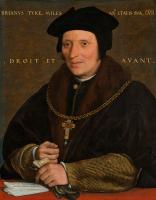
Letters and Papers Foreign and Domestic Henry VIII 1528. 21st June 1528. Vesp. C. IV. 237. B. M. St. P. I. 293. 4404. Brian Tuke to Cardinal Thomas Wolsey (age 55).
According to the purpose he expressed in his last letter to Wolsey, sent to Mr. Treasurer (age 38) to know if he should repair to the King. His messenger found Mr. Treasurer sick of the sweat at Waltham [Map], and the King (age 36) removed to Hunsdon [Map], whither he followed him, and delivered him Wolsey's letters to the Bishop of London and Tuke, Tuke's to the Bishop, his answer and Tuke's to the Treasurer. The King asked the messenger what disease Tuke had. The messenger told him wrong; and the King bade Tuke come, though he had to ride in a litter, offering to send him one. Rode thither on his mule at a foot pace, with marvellous pain; for on my faith I void blood per virgam. Arrived yesterday afternoon. The King seemed to be satisfied in the matter of the truce, for which he said he at first sent for him, but now he must put him to other business, saying secretly that it was to write his will, which he has lately reformed.
As to the truce, he said the Spaniards had a great advantage in the liberty to go to Flanders, but the English had not like liberty to repair to Spain; and he also complains that my Lady Margaret is not bound to make restitution for injuries done by Spaniards out of the property of other Spaniards in Flanders. Answered that the liberty to go to Flanders was beneficial to England, which would thus obtain oil and other Spanish merchandise; and, besides, English cloths, which would have been sent to Spain, can now be sent to Flanders. Showed him also the advantage that French or English men-of-war might have, in doing any exploits beyond the French havens; for directly they have returned to safety on this side the Spanish havens, the Spaniards are without remedy, as all hostilities must cease in the seas on this side.
Told him how glad the French ambassadors were when Wolsey, with marvellous policy, brought the secretaries to that point. Assured him "it was tikle medeling with them, seeing how little my Lady Margaret's council esteemed the truce," by which the French were enabled to strengthen themselves in Italy, and their cost in the Low Countries was lost. The King doubted whether the Spaniards would be bound by my Lady Margaret's treaty. Told him she had bound herself that the Emperor should ratify it, and that she would recompence goods taken by Spaniards; adding that if this order had not been taken by Wolsey, the King's subjects passing to Flanders, Iceland, Denmark, Bordeaux, &c. would have been in continual danger of capture. "His highness, not willing to make great replication, said, a little army might have served for keeping of the seas against the Spaniards; and I said, that his army royal, furnished as largely as ever it was, could not save his subjects from many great harms in the length between Spain and Iceland."
The King, being then about to sit down to supper, bid Tuke to rest that night at a gentleman's place near at hand, and return to him this day, when he would speak with him about the other secret matter of his will. "And so, willing to have rewarded me with a dish, if I had not said that I eat no fish," took his leave, and departed two miles to the lodging. On his return this morning, found the King going into the garden, who, after his return, heard three masses, and then called Tuke to the chamber in which he supped apart last night. After speaking of the advantages of this house, and its wholesome air at this time of sickness, the King delivered to him "the book of his said will in many points reformed, wherein his Grace riped me," and appointed Tuke a chamber here, under his privy chamber, bidding him send for his stuff, and go in hand with his business. Expects, therefore, to be here five or six days at least, though he has only a bed that he brought on horseback, ready to lay down anywhere. Must borrow stuff meanwhile, and is disappointed of the physic which he had ordered at his house in Essex, whither he sent a physician to stay with him for a time, promising him a mark a day, horse meat and man's meat. Must bid him return till he has leave to depart, when he begs Wolsey to let him attend on his physician for eight or ten days; "else I shall utterly, for lack of looking to at this begining, destroy myself for ever." The King is expected to remain here eight or ten days. Hunsdon [Map], Sunday, 21 June 1528.


On 21st June 1528 Maria of Spain Holy Roman Empress was born to Charles V Holy Roman Emperor (age 28) and Isabel Aviz Queen Consort Spain (age 24) at Madrid [Map]. Coefficient of inbreeding 10.98%. She married 13th September 1548 her first cousin Maximilian Habsburg Spain II Holy Roman Emperor, son of Ferdinand I Holy Roman Emperor and Anne Jagiellon, and had issue.


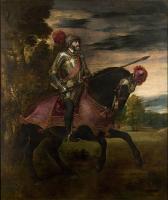

On 21st June 1547 Sebastiano del Piombo (age 62) died.
The History of William Marshal was commissioned by his son shortly after William’s death in 1219 to celebrate the Marshal’s remarkable life; it is an authentic, contemporary voice. The manuscript was discovered in 1861 by French historian Paul Meyer. Meyer published the manuscript in its original Anglo-French in 1891 in two books. This book is a line by line translation of the first of Meyer’s books; lines 1-10152. Book 1 of the History begins in 1139 and ends in 1194. It describes the events of the Anarchy, the role of William’s father John, John’s marriages, William’s childhood, his role as a hostage at the siege of Newbury, his injury and imprisonment in Poitou where he met Eleanor of Aquitaine and his life as a knight errant. It continues with the accusation against him of an improper relationship with Margaret, wife of Henry the Young King, his exile, and return, the death of Henry the Young King, the rebellion of Richard, the future King Richard I, war with France, the death of King Henry II, and the capture of King Richard, and the rebellion of John, the future King John. It ends with the release of King Richard and the death of John Marshal.
Available at Amazon in eBook and Paperback format.
Henry Machyn's Diary. 21st June 1559. The xxj day of June was v bysshopes deprevyd, the bysshope of Lychfeld and Coventre (age 55), and the bysshope of Carley (age 52), the bysshope of Westchester, the bysshope of Landaffh (age 87), and the bysshope of ( ).
On 21st June 1562 Frederick Habsburg Spain was born to Maximilian Habsburg Spain II Holy Roman Emperor (age 34) and Maria of Spain Holy Roman Empress (age 34). Coefficient of inbreeding 10.03%. He died aged less than one years old.


On 21st June 1585 Henry Percy 8th Earl of Northumberland (age 53) committed suicide at Tower of London [Map]. He was found dead in his bed in his cell, having been shot through the heart. A jury was at once summoned, and returned a verdict of suicide. He was buried in St Peter ad Vincula Church, Tower of London [Map]. His son Henry (age 21) succeeded 9th Earl of Northumberland, 12th Baron Percy of Alnwick, 20th Baron Percy of Topcliffe, 3rd Baron Percy of Alnwick, 11th Baron Poynings. Dorothy Devereux Countess Northumberland (age 21) by marriage Countess of Northumberland.

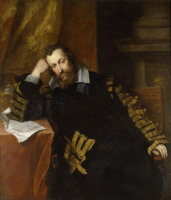

On 21st June 1646 Marie Françoise Élisabeth of Savoy Queen Consort of Portugal was born to Charles Amadeus Duke of Nemours (age 22) and Élisabeth Bourbon Vendôme (age 31). She married (1) 2nd August 1666 Alfonso VI King Portugal, son of John IV King Portugal and Luisa de Guzman Queen Consort Portugal (2) 2nd April 1668 Peter II King Portugal, son of John IV King Portugal and Luisa de Guzman Queen Consort Portugal, and had issue.
On 21st June 1650 Wilhelmina Ernestina Oldenburg was born to Frederick III King of Denmark (age 41) and Sophie Amalie Hanover Queen Consort Denmark (age 22).
Samuel Pepys' Diary. 21st June 1666. Up, and at the office all the morning; whereby several circumstances I find Sir W. Coventry (age 38) and the Duke of Albemarle (age 57) do not agree as they used to do; Sir W. Coventry commending Aylett (in some reproach to the Duke (age 32)), whom the Duke hath put out for want of courage; and found fault with Steward, whom the Duke keeps in, though as much in fault as any commander in the fleete.

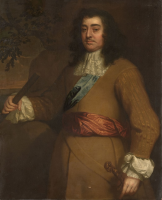

Samuel Pepys' Diary. 21st June 1666. So home and met Sir George Smith by the way, who tells me that this day my Chancellor (age 57) and some of the Court have been with the City, and the City have voted to lend the King (age 36) £100,000; which, if soon paid (as he says he believes it will), will be a greater service than I did ever expect at this time from the City.


Samuel Pepys' Diary. 21st June 1667. So I to my office, and there all the afternoon. This day comes news from Harwich, Essex [Map] that the Dutch fleete are all in sight, near 100 sail great and small, they think, coming towards them; where, they think, they shall be able to oppose them; but do cry out of the falling back of the seamen, few standing by them, and those with much faintness. The like they write from Portsmouth, Hampshire [Map], and their letters this post are worth reading. Sir H. Cholmly (age 34) come to me this day, and tells me the Court is as mad as ever; and that the night the Dutch burned our ships the King (age 37) did sup with my Baroness Castlemayne (age 26), at the Duchess of Monmouth's (age 16), and there were all mad in hunting of a poor moth. All the Court afraid of a Parliament; but he thinks nothing can save us but the King's giving up all to a Parliament. Busy at the office all the afternoon, and did much business to my great content.


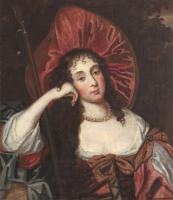


On 18th August 1680 Philip "Infamous Earl" Herbert 7th Earl Pembroke 4th Earl Montgomery (age 28) killed William Smeeth following a drunken evening in the tavern on Turnham Green Chiswick. On 21st June 1681 the grand jury of Middlesex charged him with murder. Pembroke could not invoke the privilege of peerage for a second time, leading him to briefly flee the country. A petition signed by twenty-four of his fellow peers was presented to the king, resulting in a royal pardon being granted to him.
On 21st June 1688 William Cavendish 2nd Duke Devonshire (age 16) and Rachel Russell Duchess Devonshire (age 14) were married. He the son of William Cavendish 1st Duke Devonshire (age 48) and Mary Butler Duchess Devonshire (age 42). They were third cousins.


Jean de Waurin's Chronicle of England Volume 6 Books 3-6: The Wars of the Roses
Jean de Waurin was a French Chronicler, from the Artois region, who was born around 1400, and died around 1474. Waurin’s Chronicle of England, Volume 6, covering the period 1450 to 1471, from which we have selected and translated Chapters relating to the Wars of the Roses, provides a vivid, original, contemporary description of key events some of which he witnessed first-hand, some of which he was told by the key people involved with whom Waurin had a personal relationship.
Available at Amazon in eBook and Paperback format.
On 21st June 1692 Frederick William I Duke Mecklenburg-Schwerin (age 17) succeeded I Duke Mecklenburg Schwerin.
John Evelyn's Diary. 21st June 1693. I saw a great auction of pictures in the Banqueting house, Whitehall [Map]. They had been my Lord Melford's (age 42), now Ambassador from King James (age 59) at Rome, and engaged to his creditors here. Lord Mulgrave (age 45) and Sir Edward Seymour (age 60) came to my house, and desired me to go with them to the sale. Divers more of the great lords, etc., were there, and bought pictures dear enough. There were some very excellent of Vandyke, Rubens, and Bassan. Lord Godolphin (age 48) bought the picture of the Boys, by Murillo the Spaniard, for 80 guineas, dear enough; my nephew Glanville, the old Earl of Arundel's head by Rubens, for £20. Growing late, I did not stay till all were sold.
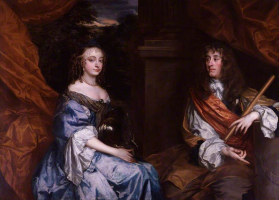


The Journal of the Reverend John Wesley 1745. 21st June 1745. We rode to Marazion. (Vulgarly called Market jew.) Finding the Justices were not met, we walked up St. Michael’s Mount. The house at the top is surprisingly large and pleasant. Sir John St. Aubyn had taken much pains, and been at a considerable expense, in repairing and beautifying the apartments ; and when the seat was finished, the owner died ! About two Mr. Thompson and I went into the room, where the Justices and Commissioners were. After a few minutes, Dr. Borlase (age 49) stood up and asked, whether we had any business. I told him, "We have." We desired tobe heard, concerning: one whowas lately apprehended at Crowan. He said, "Gentlemen, the business of Crowan does not come on yet. You shall. be sent for, when it does." So we retired, and waited in: another room, till after nine o’clock. They delayed the affair of Mr. Maxfield (as we imagined they would) to thevery last. About nine he was called. I would have gone in then; but. Mr. Thompson advised to wait a little longer. The next information we received was, that they had sentenced him to go for a soldier. Hearing this, we went straight to the Commission-chamber. But the honourable gentlemen were gone.
They had ordered Mr. Maxfield to be immediately put on board a boat, and carried for Penzance. We were informed, they had first offered him to a Captain of a man-of-war, that was just come into the harbour. But he answered, "I have no authority to take such men as these, unless you would have me give him so much a week, to preach and pray to my people."
Archaeologia Volume 2 Section XXXV. 21st June 1770. A Description of the Sepulchral Monument at New Grange [Map], near Drogheda, in the County of Meath, in Ireland. by Thomas Pownall, Esq; in a Letter to the Rev. Gregory Sharpe, D. D. Master of The Temple. Read at the Society of Antiquaries, June 21, 28, 1770.
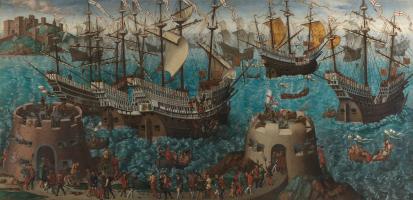
Archaeologia Volume 6 Section XXIV. A Description of an antient Picture in Windsor Castle, representing the Embarkation of King Henry VIII at Dover, May 31, 1520; preparatory to his Interview with the French King Francis I. By John Topham, Esq. F.R.S. F.S.A. Read June 21, 1781.

On 21st June 1806 King Christian I of Norway and VIII of Denmark (age 19) and Duchess Charlotte Frederica of Mecklenburg-Schwerin (age 21) were married. They were first cousins.
On 21st June 1809 Sophia Georgiana Lennox was born to Charles Lennox 4th Duke Richmond (age 44) and Charlotte Gordon Duchess Richmond (age 40). She a great x 3 granddaughter of King Charles II of England Scotland and Ireland. She married 8th August 1838 Thomas Cecil, son of Henry Cecil 1st Marquess Exeter and Sarah Hoggins Countess Exeter.
On 21st June 1813 the Battle of Vitoria was fought between a British, Portuguese and Spanish army under the Marquess of Wellington (age 44) and the French army under King Joseph Bonaparte and Marshal Jean-Baptiste Jourdan.
Brothers General Thomas Bradford (age 35) and Lieutenant-Colonel Henry Hollis Bradford (age 31) fought.
Hugh Gough 1st Viscount Gough (age 33) fought.
General Henry Fane (age 34) commanded.
General Mildmay Fane (age 18) fought.


On 21st June 1813 Lieutenant-Colonel Charles Fane (age 32) was killed in action at the Battle of Vitoria.
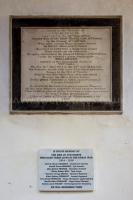
After 21st June 1813. Memorial to Lieutenant-Colonel Charles Fane (deceased) at the Church of St Leonard, Apethorpe [Map].
Lieutenant-Colonel Charles Fane: On 14th May 1781 he was born to Henry Fane of Fulbeck and Anne Buckley Batson. On 21st June 1813 Lieutenant-Colonel Charles Fane was killed in action at the Battle of Vitoria.
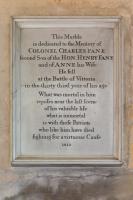
After 21st June 1813. Memorial to Lieutenant-Colonel Charles Fane (deceased) at St Nicholas' Church, Fulbeck.
Abbot John Whethamstede’s Chronicle of the Abbey of St Albans
Abbot John Whethamstede's Register aka Chronicle of his second term at the Abbey of St Albans, 1451-1461, is a remarkable text that describes his first-hand experience of the beginning of the Wars of the Roses including the First and Second Battles of St Albans, 1455 and 1461, respectively, their cause, and their consequences, not least on the Abbey itself. His text also includes Loveday, Blore Heath, Northampton, the Act of Accord, Wakefield, and Towton, and ends with the Coronation of King Edward IV. In addition to the events of the Wars of the Roses, Abbot John, or his scribes who wrote the Chronicle, include details in the life of the Abbey such as charters, letters, land exchanges, visits by legates, and disputes, which provide a rich insight into the day-to-day life of the Abbey, and the challenges faced by its Abbot.
Available at Amazon in eBook and Paperback format.
On 21st June 1818 Ernest Saxe Coburg Gotha II Duke Saxe Coburg Gotha was born to Ernest Saxe Coburg Gotha I Duke Saxe Coburg Gotha (age 34) and Duchess Louise Dorothea of Saxe Coburg Altenburg (age 17). He married 3rd June 1842 his fifth cousin once removed Princess Alexandrine of Baden, daughter of Leopold Grand Duke of Baden and Princess Sophie of Sweden.
On 21st June 1832 Louise Ingram Rayner was born to Samuel Rayner (age 26) and Anne Manser at Matlock Bath, Derbyshire [Map].

Thomas Bateman 1845. On the 21st of June, 1845, an attempt was made to open a large barrow near Alstonefield, Staffordshire, called Steep Lowe [Map], measuring about fifty yards in diameter, and about fifteen feet in central elevation which is constructed almost entirely of loose stones. It was found, on reaching the place, that some of the neighbouring villagers had already, in a vain search after imaginary treasure, found near the apex of the mound, the body of a Romanized Briton, extended on its back, accompanied by an iron spear-head, a lance-head and knife of the same, placed near the head, and three Roman coins, in third brass, namely; one of Constantine the Greats one of Tetricos, the other illegible firom the friction of sand-paper applied by the finder, in the delusive hope of making evident its golden character. They also found some pieces of a highly-ornamented drinking-cup, a curious piece of iron ore, and various animal bones, amongst others, horses' teeth, and rats' bones. All the antiquities discovered by these enterprising individuals were ceded to the writer, on their being reimbursed for their labour and loss of time. On continuing the excavation, there was discovered close to where the spears were found a small stud or circular ornament of copal amber, perforated with a double hole at the back for attachment, in a similar manner to the two ornaments found on Alsop Moor on the 4th of June. In the opposite direction was found a large plain urn of globular form, with four holes through the upper edge, containing a deposit of burnt human bones, two quartz pebbles, and a piece of flint; it was not more than one foot six inches beneath the surface. An attempt was made to penetrate to the floor of the barrow, but owing to the great depth, and the loose nature of the stones, of which the mound is composed, it was found advisable to desist, on account of the hazardous nature of the undertaking, when the excavation had reached the depth of about six feet. It is evident that there yet remains the original interment, and it is by no means unlikely that there may be many more in the interior of the tumulus, which could not be thoroughly examined without a great deal of time and labour being expended.
Thomas Bateman 1845. On the same day, another small barrow [Note. Either Gratton Hill Barrow [Map] or Gratton Low Barrow [Map]] was opened which is situate upon a mountain called Gratton Hill, about half a mile from the preceding cairn. In the centre was found a cist cut in the rock, which contained a skeleton, accompanied by some fragments of a rudely-ornamented urn; on a rather higher level was a deposit of calcined human bones, amongst which were two arrow-heads of flint. Incidentally upon the floor of the cist were horses' teeth, the skull of a polecat, and an infinity of rats' bones. Near the surface of the barrow the remains of another human skeleton were found, which had been previously disturbed, and a small piece of brass, probably of much later date.
Ten Years' Digging. June 21st [1848], opened a barrow between Deepdale and the village of Grindon, called Mouse Low [Map], fourteen yards diameter and not more than two feet high; the lower part composed of stiff clayey soil, plentifully interspersed with small pebbles; in the centre was a cist constructed of three large flat stones, the fourth side being left open; it was paved with very thin slabs of blue limestone, and contained the skeleton of a very large and strongly built man resting on his left side in the usual contracted posture, near whose head was a peculiarly elegant and well finished drinking cup, 8¼ inches high, inside of which were two implements cut from the ribs of a large animal (compare with those found with a similar interment at Green Low [Possibly Green Low Barrow [Map] but may be a different Green Low], in April, 1845, Vestiges page 60), a spear head, and two beautiful barbed arrows of white flint; outside the cup were two more arrows of the same kind. The skull is very large, and is remarkable from the presence of a frontal suture, although by no means that of a young man; the teeth are in fine preservation; and the skull is of the platy-cephalic variety, occasionally found amongst Celtic crania. In other parts of the mound numerous pieces of human bone, stag's horn, and a neat circular ended flint, were found. And as far as our trench extended, which would be about five yards, it exposed a row of large boulders of hard red grit, laid on the surface of the natural soil in a direction coincident with the longest side of the cist; the smaller limestones near these were almost turned to lime from the effect of heat, and were mixed with burnt bones and charcoal.
Vestiges of the Antiquities of Derbyshire. June 21, 1848. A large barrow about eight feet in height, denominated End Lowe [Map], which forms a conspicuous object, being placed on an elevated ridge of land near Heathcote, was subjected to an examination, which proved anything but satisfactory; from the south side, where the turf was first removed, to the centre of the barrow, nothing but large stones presented themselves, which when unmixed with soil, as in this case, are the material worst calculated to afford success to the labours of the antiquarian excavator: however, at the very commencement large quantities of rats' bones, and pieces of the antlers of deer were abundantly scattered about through the more open parts of the mound. About six feet from the southern verge of the circle, was found a human skeleton, apparently of a very young individual, not more than twelve years of age, near which lay a deposit of calcined human bones, without urn or other means of protection from the weight of the overriding mass of stones, by which the skeleton had been much injured. Near the centre of the tumulus a very few human bones of adult size were observed, all of which had the appearance of being gnawed by rats. The natural surface of the ground immediately beneath the middle of the mound was formed to sink to a considerable depth lower than the surrounding levels and it is much to be regretted that owing to the loose nature of the barrow before alluded to it was formed impossible to penetrate to the undisturbed ground upon which in all probability the earliest interment would be formed to lie.
On 21st June 1851 Florence Gordon-Lennox was born to Charles Gordon-Lennox 6th Duke Richmond (age 33) and Frances Harriett Greville Duchess Richmond (age 27).
Ten Years' Digging. On the 21st of June we made an excavation in the centre of a large tumulus, at the Brund [Brund Low [Map]], near Sheen, measuring 38 yards diameter and nine feet high, composed of earth. About half way down we found a deposit of calcined bones, much decayed, the teeth being most conspicuous amongst the fragments. Near them was a triangular sandstone, in which a circular cavity had been artificially worked, like that found at Elkstone on the 31st of August, 1850. By filling up the cutting, we found a flint that had been chipped to a circular form.
On the 16th of July we made another parallel trench, near four yards long, which at the north end was two yards deep, and gradually increased to three at the other extremity, before reaching the undisturbed surface. We found no interment, but observed a little charcoal, and picked up two chippings of flint, and another of the sandstones, with a cup-shaped cavity worked in it. The stone in this case was too large for carriage, so we cut out the part with the cup. Capsular stones of this kind are not uncom* monly found in tumuli on the Yorkshire moors, especially in the neighbourhood of Pickering, as will be seen further on in this volume. I was also told by Mr. Rhind that he had found the same inside the primitive structures called "Picts' Houses," in Caithness. We were told that the apex of this barrow had been much lowered some time since, when a bronze weapon, half a yard in length, was found.
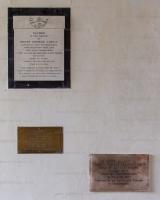
On 21st June 1851 George Ralph Payne Jarvis (age 77) died. Memorial at St Peter's Church, Doddington [Map].
George Ralph Payne Jarvis: On 13th May 1774 he was born. Before 18th February 1809 he and Sarah Delaval were married.
Lady Marian Alford Memorial, Little Gaddesden [Map]. Lady Marian, mother of the 2nd and 3rd Earls Brownlow, died in 1888 and a collection was taken for a memorial. The donors ranged from Victorian nobility to her estate workers. The cross and seat at the entrance to Ashridge Park were erected in her memory and were unveiled three years later in 1891 on her birthday, Sunday 21st June. Inscription on larger trough 'Whosoever drinketh of the water that I shall give him shall never thirst: but the water that I shall give him shall be in him a well of water springing up into Everlasting Life'.


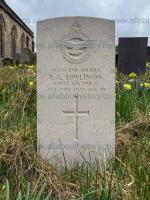
193110 2nd Airman P. G. Rowlinson. Royal Air Force. 21st June 1920. Aged 19. Born in Ashbourne. Died of tuberculosis. Buried at St Peter's Church, Ellastone.

On 21st June 1926 Philip Burne-Jones 2nd Baronet (age 64) died. Baronet Burne-Jones of Rottingdean in Sussex and The Grange in Fulham in London extinct.
Henrici Quinti, Angliæ Regis, Gesta, is a first-hand account of the Agincourt Campaign, and subsequent events to his death in 1422. The author of the first part was a Chaplain in King Henry's retinue who was present from King Henry's departure at Southampton in 1415, at the siege of Harfleur, the battle of Agincourt, and the celebrations on King Henry's return to London. The second part, by another writer, relates the events that took place including the negotiations at Troye, Henry's marriage and his death in 1422.
Available at Amazon in eBook and Paperback format.
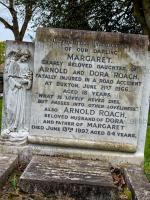
St Mary's Church, Sutton Scarsdale [Map]. Grave of Margaret Roach, killed in a road accident, 21st June 1966.
On 21st June 1982 William Prince of Wales was born to King Charles III (age 33) and Diana Spencer Princess Wales (age 20). He a grandson of Queen Elizabeth II of the United Kingdom. He married 29th April 2011 Catherine Middleton Princess of Wales.
On 21st June 1528 Maria of Spain Holy Roman Empress was born to Charles V Holy Roman Emperor (age 28) and Isabel Aviz Queen Consort Spain (age 24) at Madrid [Map]. Coefficient of inbreeding 10.98%. She married 13th September 1548 her first cousin Maximilian Habsburg Spain II Holy Roman Emperor, son of Ferdinand I Holy Roman Emperor and Anne Jagiellon, and had issue.
On 21st June 1562 Frederick Habsburg Spain was born to Maximilian Habsburg Spain II Holy Roman Emperor (age 34) and Maria of Spain Holy Roman Empress (age 34). Coefficient of inbreeding 10.03%. He died aged less than one years old.
On 21st June 1581 Edward Barrett 1st Baron Barrett was born to Charles Barrett of Belhouse and Christian Mildmay (age 23). He married (1) 20th February 1609 his half first cousin once removed Jane Carey, daughter of Edward Carey and Catherine Knyvet Baroness Geneville Beaudasert (2) before 2nd January 1645 Catherine Fenn Baroness Barrett.
On 21st June 1646 Marie Françoise Élisabeth of Savoy Queen Consort of Portugal was born to Charles Amadeus Duke of Nemours (age 22) and Élisabeth Bourbon Vendôme (age 31). She married (1) 2nd August 1666 Alfonso VI King Portugal, son of John IV King Portugal and Luisa de Guzman Queen Consort Portugal (2) 2nd April 1668 Peter II King Portugal, son of John IV King Portugal and Luisa de Guzman Queen Consort Portugal, and had issue.
On 21st June 1650 Wilhelmina Ernestina Oldenburg was born to Frederick III King of Denmark (age 41) and Sophie Amalie Hanover Queen Consort Denmark (age 22).
On 21st June 1684 Charles Shirley was born to Robert Shirley 1st Earl Ferrers (age 33) and Elizabeth Washington Baroness Ferrers Chartley. He died aged one in 1685.


On 21st June 1701 Charles Berkeley of Bruton Abbey was born to William Berkeley 4th Baron Berkeley (age 38) and Frances Temple Baroness Berkeley. He married before 6th August 1777 Frances West and had issue.
On 21st June 1721 John Reade 5th Baronet was born to Thomas Reade 4th Baronet (age 38) and Jane Mary Dutton Lady Reade at Golden Square Soho. He was baptised 27th June 1721 at St James' Church, Piccadilly. He married 18th October 1759 Harriet Barker and had issue.
On 21st June 1731 Bysshe Shelley 1st Baronet was born to Timothy Shelley (age 31) and Johanna Plume (age 27) in Newark, New Jersey. He married (1) 30th June 1752 Mary Catherine Michell and had issue (2) 17th August 1769 Elizabeth Jane Perry and had issue.
On 21st June 1733 John Cullum 6th Baronet was born to John Cullum 5th Baronet (age 34) and Susanna Gery Lady Cullum.
On 21st June 1746 William Heathcote 3rd Baronet was born to Thomas Heathcote 2nd Baronet (age 24) and Elizabeth Hinton (age 22). He married 21st May 1768 Frances Thorpe Lady Heathcote and had issue.
On 21st June 1779 Paul Methuen 1st Baron Methuen was born to Paul Cobb Methuen of Corsham in Wiltshire. He married 1810 Jane Dorothea Mildmay, daughter of Henry Paulet St John-Mildmay 3rd Baronet and Jane Mildmay Lady St-John Mildmay, and had issue.
The Deeds of the Dukes of Normandy
The Gesta Normannorum Ducum [The Deeds of the Dukes of Normandy] is a landmark medieval chronicle tracing the rise and fall of the Norman dynasty from its early roots through the pivotal events surrounding the Norman Conquest of England. Originally penned in Latin by the monk William of Jumièges shortly before 1060 and later expanded at the behest of William the Conqueror, the work chronicles the deeds, politics, battles, and leadership of the Norman dukes, especially William’s own claim to the English throne. The narrative combines earlier historical sources with firsthand information and oral testimony to present an authoritative account of Normandy’s transformation from a Viking settlement into one of medieval Europe’s most powerful realms. William’s history emphasizes the legitimacy, military prowess, and governance of the Norman line, framing their expansion, including the conquest of England, as both divinely sanctioned and noble in purpose. Later chroniclers such as Orderic Vitalis and Robert of Torigni continued the history, extending the coverage into the 12th century, providing broader context on ducal rule and its impact. Today this classic work remains a foundational source for understanding Norman identity, medieval statesmanship, and the historical forces that reshaped England and Western Europe between 800AD and 1100AD.
Available at Amazon in eBook and Paperback format.
On 21st June 1780 Thomas Haddington 9th Earl Haddington was born to Charles Hamilton 8th Earl Haddington (age 26) and Sophia Hope (age 21). He married 1802 Maria Parker, daughter of George Parker 4th Earl Macclesfield and Mary Frances Drake Countess Macclesfield.
On 21st June 1788 Sarah Hay-Drummond was born to Robert Hay-Drummond 10th Earl Kinnoul (age 37) and Sarah Harley Countess Kinnoul. She married 5th May 1811 Bishop George Murray, son of Bishop George Murray, and had issue.
On 21st June 1794 John Buckworth-Herne-Soame 8th Baronet was born to Buckworth Buckworth-Herne-Soame 6th Baronet (age 32) and Susan Semperingham Lady Buckworth-Herne-Soame. He married 17th January 1833 Lydia Haggaer Lady Buckworth-Herne-Soame.
On 21st June 1799 Jane Sherard was born to Philip Sherard 5th Earl Harborough (age 32).

On 21st June 1805 Edward Anson was born to Thomas Anson 1st Viscount Anson (age 38) and Anne Margaret Coke Viscountess Anson (age 26).
On 21st June 1809 Sophia Georgiana Lennox was born to Charles Lennox 4th Duke Richmond (age 44) and Charlotte Gordon Duchess Richmond (age 40). She a great x 3 granddaughter of King Charles II of England Scotland and Ireland. She married 8th August 1838 Thomas Cecil, son of Henry Cecil 1st Marquess Exeter and Sarah Hoggins Countess Exeter.
On 21st June 1811 John Thomas Pelham was born to Thomas Pelham 2nd Earl Chichester (age 55) and Mary Henrietta Juliana Osborne Countess Chichester (age 34). He married 6th November 1845 Henrietta Tatton and had issue.
On 21st June 1817 Robert Collier 1st Baron Monkswell was born to John Collier (age 48). He married 1844 Isabella Rose Baroness Monkswell and had issue.
On 21st June 1817 Marianne Margaret Compton was born to Spencer Compton 2nd Marquess Northampton (age 27) and Margaret Douglas-Maclean-Clephane Marchioness Northampton (age 25). She married 1841 John Hume Egerton, son of John Cust 1st Earl Brownlow and Amelia Sophia Hume, and had issue.
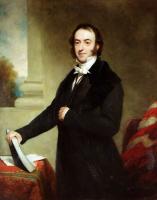

On 21st June 1818 Ernest Saxe Coburg Gotha II Duke Saxe Coburg Gotha was born to Ernest Saxe Coburg Gotha I Duke Saxe Coburg Gotha (age 34) and Duchess Louise Dorothea of Saxe Coburg Altenburg (age 17). He married 3rd June 1842 his fifth cousin once removed Princess Alexandrine of Baden, daughter of Leopold Grand Duke of Baden and Princess Sophie of Sweden.
This is a translation of the 'Memoires of Jacques du Clercq', published in 1823 in two volumes, edited by Frederic, Baron de Reissenberg. In his introduction Reissenberg writes: 'Jacques du Clercq tells us that he was born in 1424, and that he was a licentiate in law and a counsellor to Philip the Good, Duke of Burgundy, in the castellany of Douai, Lille, and Orchies. It appears that he established his residence at Arras. In 1446, he married the daughter of Baldwin de la Lacherie, a gentleman who lived in Lille. We read in the fifth book of his Memoirs that his father, also named Jacques du Clercq, had married a lady of the Le Camelin family, from Compiègne. His ancestors, always attached to the counts of Flanders, had constantly served them, whether in their councils or in their armies.' The Memoires cover a period of nineteen years beginning in in 1448, ending in in 1467. It appears that the author had intended to extend the Memoirs beyond that date; no doubt illness or death prevented him from carrying out this plan. As Reissenberg writes the 'merit of this work lies in the simplicity of its narrative, in its tone of good faith, and in a certain air of frankness which naturally wins the reader’s confidence.' Du Clercq ranges from events of national and international importance, including events of the Wars of the Roses in England, to simple, everyday local events such as marriages, robberies, murders, trials and deaths, including that of his own father in Book 5; one of his last entries.
Available at Amazon in eBook and Paperback format.
On 21st June 1830 Henry George Paston-Bedingfeld 7th Baronet was born to Henry Richard Paston-Bedingfeld 6th Baronet (age 30) and Margaret Paston Lady Paston-Bedingfield (age 23). He married 27th October 1859 Augusta Lucy Clavering Lady Paston-Bedingfield and had issue.
On 21st June 1832 Louise Ingram Rayner was born to Samuel Rayner (age 26) and Anne Manser at Matlock Bath, Derbyshire [Map].
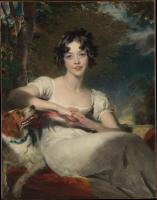
On 21st June 1834 Elizabeth Jane Somerville Countess Charlemont was born to William Meredyth Somerville 1st Baron Meredyth and Athlumney (age 32) and Maria Harriet Conyngham. She married 18th December 1856 James Molyneux Caulfeild 3rd Earl Charlemont.
On 21st June 1840 Frederick Charles Howard was born to Henry Howard 2nd Earl of Effingham (age 33) and Eliza Drummond Baroness Howard (age 29). He married 3rd June 1871 his fourth cousin once removed Constance Eleanora Caroline Finch-Hatton, daughter of George Finch-Hatton 6th Earl Nottingham 11th Earl Winchilsea and Constance Henrietta Paget Countess Nottingham Winchilsea, and had issue.

On 21st June 1846 Julia Charlotte Sophia Stewart-Mackenzie Marchoness Tweedale was born to Keith William Stewart-Mackenzie (age 28). She married 8th October 1873 Arthur Hay 9th Marquess Tweedale, son of George Hay 8th Marquess Tweedale and Susan Montagu Marchioness Tweddale.
On 21st June 1848 Ada Maria Tollemache Baroness Sudeley was born to Frederick James Tollemache (age 44) and Isabella Anne Forbes. She married 1868 Charles Hanbury Tracy 4th Baron Sudeley, son of Thomas Charles Hanbury-Tracy 2nd Baron Sudeley and Emma Elizabeth Alicia Dawkins-Pennant Baroness Sudeley, and had issue.
On 21st June 1851 William Cansfield Gerard 2nd Baron Gerard was born to Robert Tolver Gerard 1st Baron Gerard (age 43).
On 21st June 1851 Florence Gordon-Lennox was born to Charles Gordon-Lennox 6th Duke Richmond (age 33) and Frances Harriett Greville Duchess Richmond (age 27).
On 21st June 1868 Charles Rushout 4th Baronet was born to Charles Rushout 3rd Baronet (age 27).
On 21st June 1872 William Henry Charles Wemyss Cooke 10th Baronet was born to William Ridley Charles Cooke 9th Baronet (age 44). He married (1) 1902 Mildred Adelaide Cecilia Denison, daughter of William Henry Forester Denison 1st Earl Londesborough and Edith Somerset Countess Londesborough, and had issue.
Abbot John Whethamstede’s Chronicle of the Abbey of St Albans
Abbot John Whethamstede's Register aka Chronicle of his second term at the Abbey of St Albans, 1451-1461, is a remarkable text that describes his first-hand experience of the beginning of the Wars of the Roses including the First and Second Battles of St Albans, 1455 and 1461, respectively, their cause, and their consequences, not least on the Abbey itself. His text also includes Loveday, Blore Heath, Northampton, the Act of Accord, Wakefield, and Towton, and ends with the Coronation of King Edward IV. In addition to the events of the Wars of the Roses, Abbot John, or his scribes who wrote the Chronicle, include details in the life of the Abbey such as charters, letters, land exchanges, visits by legates, and disputes, which provide a rich insight into the day-to-day life of the Abbey, and the challenges faced by its Abbot.
Available at Amazon in eBook and Paperback format.
On 21st June 1879 Auckland Geddes 1st Baron Geddes was born.
On 21st June 1883 Maurice Anthony Wingfield was born to Mervyn Wingfield 7th Viscount Powerscourt (age 46) and Julia Coke Viscountess Powerscourt (age 39).
On 21st June 1933 William Burton Nigel Goring 13th Baronet was born to Major Frederick Yelverton Goring (age 39). He married (1) 24th September 1960 Caroline Elizabeth Thellusson Lady Goring, daughter of Charles Anthony Hugh Thellusson 8th Baron Rendlesham.
On 21st June 1982 William Prince of Wales was born to King Charles III (age 33) and Diana Spencer Princess Wales (age 20). He a grandson of Queen Elizabeth II of the United Kingdom. He married 29th April 2011 Catherine Middleton Princess of Wales.
On 21st June 1221 King Alexander II of Scotland (age 22) and Joan Plantagenet Queen of Scotland (age 10) were married at York Minster [Map]. She by marriage Queen Consort Scotland. She the daughter of King John of England and Isabella of Angoulême Queen Consort England (age 33). He the son of King William I of Scotland and Ermengarde Beaumont Sarthe Queen Consort Scotland (age 51). They were half third cousins. He a great x 2 grandson of King Henry I "Beauclerc" England.
On 21st June 1638 Mildmay Fane 2nd Earl of Westmoreland (age 36) and Mary Vere Countess of Westmoreland (age 30) were married at Hackney. She by marriage Countess of Westmoreland. He the son of Francis Fane 1st Earl of Westmoreland and Mary Mildmay Countess of Westmoreland (age 56).
On 21st June 1688 William Cavendish 2nd Duke Devonshire (age 16) and Rachel Russell Duchess Devonshire (age 14) were married. He the son of William Cavendish 1st Duke Devonshire (age 48) and Mary Butler Duchess Devonshire (age 42). They were third cousins.
On 21st June 1806 King Christian I of Norway and VIII of Denmark (age 19) and Duchess Charlotte Frederica of Mecklenburg-Schwerin (age 21) were married. They were first cousins.
On 21st June 1813 George Sackville-West 5th Earl De La Warr (age 21) and Elizabeth Sackville Countess De La Warr (age 17) were married. She by marriage Countess De La Warr. She the daughter of John Frederick Sackville 3rd Duke Dorset and Arabella Diana Cope 3rd Duchess Dorset (age 44). He the son of John West 4th Earl De La Warr. They were fourth cousin once removed.
On 21st June 1845 George Floyd Duckett 3rd Baronet (age 34) and Isabella Smith were married. They had no children.
On 21st June 1852 Trevor Wheler 11th Baronet (age 24) and Cordelia Mary Jane Scott Lady Wheler were married at Simla.
Chronicle of Walter of Guisborough
A canon regular of the Augustinian Guisborough Priory, Yorkshire, formerly known as The Chronicle of Walter of Hemingburgh, describes the period from 1066 to 1346. Before 1274 the Chronicle is based on other works. Thereafter, the Chronicle is original, and a remarkable source for the events of the time. This book provides a translation of the Chronicle from that date. The Latin source for our translation is the 1849 work edited by Hans Claude Hamilton. Hamilton, in his preface, says: 'In the present work we behold perhaps one of the finest samples of our early chronicles, both as regards the value of the events recorded, and the correctness with which they are detailed; Nor will the pleasing style of composition be lightly passed over by those capable of seeing reflected from it the tokens of a vigorous and cultivated mind, and a favourable specimen of the learning and taste of the age in which it was framed.'
Available at Amazon in eBook and Paperback format.
On 21st June 1853 Fitzpatrick Vernon 2nd Baron Lyveden (age 29) and Albreda Elizabeth Wentworth-Fitzwilliam Baroness Lyveden (age 23) were married. She the daughter of Charles Wentworth-Fitzwilliam 5th and 3rd Earl Fitzwilliam (age 67) and Mary Dundas.
On 21st June 1855 William Henry Portman 2nd Viscount Portman (age 25) and Mary Selina Wentworth-Fitzwilliam Viscountess Portman (age 19) were married.
On 21st June 1862 Thomas Fowell Buxton 3rd Baronet (age 25) and Victoria Noel Lady Buxton (age 22) were married. She by marriage Lady Buxton of Belfield in Dorset. She the daughter of Charles Noel 1st Earl Gainsborough (age 80) and Frances Jocelyn Countess Gainsborough (age 47).
On 21st June 1949 Robert Walter Sigismund Grimston 2nd Baron Grimston (age 24) and June Mary Ponsonby Baroness Grimston (age 25) were married.
On 21st June 1040 Fulk "Black" Ingelger III Count Anjou (age 70) died. His son Geoffrey succeeded II Count Anjou. Agnes Ivrea Duchess Aquitaine by marriage Countess Anjou.
On 21st June 1208 Philip King Germany (age 30) was killed.
On 21st June 1213 Eleanor Capet Countess Vermandois (age 64) died.
On 21st June 1221 Henry Luxemburg III Duke Limburg (age 81) died.
On 21st June 1305 King Wenceslaus II of Bohemia and Poland (age 33) died.
On 21st June 1377 King Edward III of England (age 64) died of a stroke at Sheen Palace [Map]. He was buried in the Chapel of St Edward the Confessor, Westminster Abbey [Map]. His grandson Richard (age 10) succeeded II King of England.
On 21st June 1483 Elizabeth Valois Duchess Cleves (age 44) died.
On 21st June 1547 Sebastiano del Piombo (age 62) died.
Chronicle of Abbot Ralph of Coggeshall
The Chronicle of Abbot Ralph of Coggeshall (Chronicon Anglicanum) is an indispensable medieval history that brings to life centuries of English and European affairs through the eyes of a learned Cistercian monk. Ralph of Coggeshall, abbot of the Abbey of Coggeshall in Essex in the early 13th century, continued and expanded his community’s chronicle, documenting events from the Norman Conquest of 1066 into the tumultuous reign of King Henry III. Blending eyewitness testimony, careful compilation, and the monastic commitment to record-keeping, this chronicle offers a rare narrative of political intrigue, royal power struggles, and social upheaval in England and beyond. Ralph’s work captures the reigns of pivotal figures such as Richard I and King John, providing invaluable insights into their characters, decisions, and the forces that shaped medieval rule. More than a simple annal, Chronicon Anglicanum conveys the texture of medieval life and governance, making it a rich source for scholars and readers fascinated by English history, monastic authorship, and the shaping of the medieval world.
Available at Amazon in eBook and Paperback format.
On 21st June 1585 Henry Percy 8th Earl of Northumberland (age 53) committed suicide at Tower of London [Map]. He was found dead in his bed in his cell, having been shot through the heart. A jury was at once summoned, and returned a verdict of suicide. He was buried in St Peter ad Vincula Church, Tower of London [Map]. His son Henry (age 21) succeeded 9th Earl of Northumberland, 12th Baron Percy of Alnwick, 20th Baron Percy of Topcliffe, 3rd Baron Percy of Alnwick, 11th Baron Poynings. Dorothy Devereux Countess Northumberland (age 21) by marriage Countess of Northumberland.
On 21st June 1698 John Arundell 2nd Baron Arundel of Trerice (age 49) died. His son John (age 20) succeeded 3rd Baron Arundel Trerice in Cornwall.
On 21st June 1702 Arthur Ingram 3rd Viscount Irvine (age 36) died. In 1714 His son Edward (age 16) succeeded 4th Viscount Irvine.
On 21st June 1729 John Tyrrell 3rd Baronet (age 44) died. His son Charles (age 4) succeeded 4th Baronet Tyrrell of Springfield.

On 21st June 1738 Charles Townshend 2nd Viscount Townsend (age 64) died. His son Charles (age 37) succeeded 3rd Viscount Townsend, 3rd Baron Townshend of Lynn Regis in Norfolk, 5th Baronet Townshend.
On 21st June 1767 John Chetwynd 2nd Viscount Chetwynd (age 85) died. His brother William (age 83) succeeded 3rd Viscount Chetwynd of Bearhaven in Kerry. Catherine Chetwynd (age 44) inherited Ingestre Hall, Staffordshire.
On 21st June 1797 Frederick Rogers 5th Baronet (age 50) died. His son John (age 17) succeeded 6th Baronet Rogers of Wisdome in Devon.
On 21st June 1797 Robert Jocelyn 1st Earl Roden (age 65) died at York Street, Dublin. His son Robert (age 40) succeeded 2nd Earl Roden.
On 21st June 1798 James Sanderson 1st Baronet (age 56) died. He ws buried at St Magnus the Martyr Church [Map]. Baronet Sanderson of London extinct.
On 21st June 1806, whilst visiting Buxton, Derbyshire [Map], Wilfrid Lawson 10th Baronet (age 42) developed an illness and died unexpectedly. Baronet Lawson of Isel Hall in Cumbria extinct. His estates, including Brayton Hall, Aspatria, were inherited by a Thomas Wybergh aka Lawson (age 12), nephew of his wife Anne Hartley (age 42). He died six years later and the estates were inherited by his brother Wilfrid Wybergh aka Lawson 1st Baronet (age 10) who was subsequently created Baronet Lawson.
On 21st June 1814 Gilbert Elliot 1st Earl Minto (age 63) died at his home 4 Prince's Terrace, Kensington. He was buried in Westminster Abbey [Map]. His son Gilbert (age 31) succeeded 2nd Earl Minto of Minto in Roxburghshire, 5th Baronet Elliot of Minto.
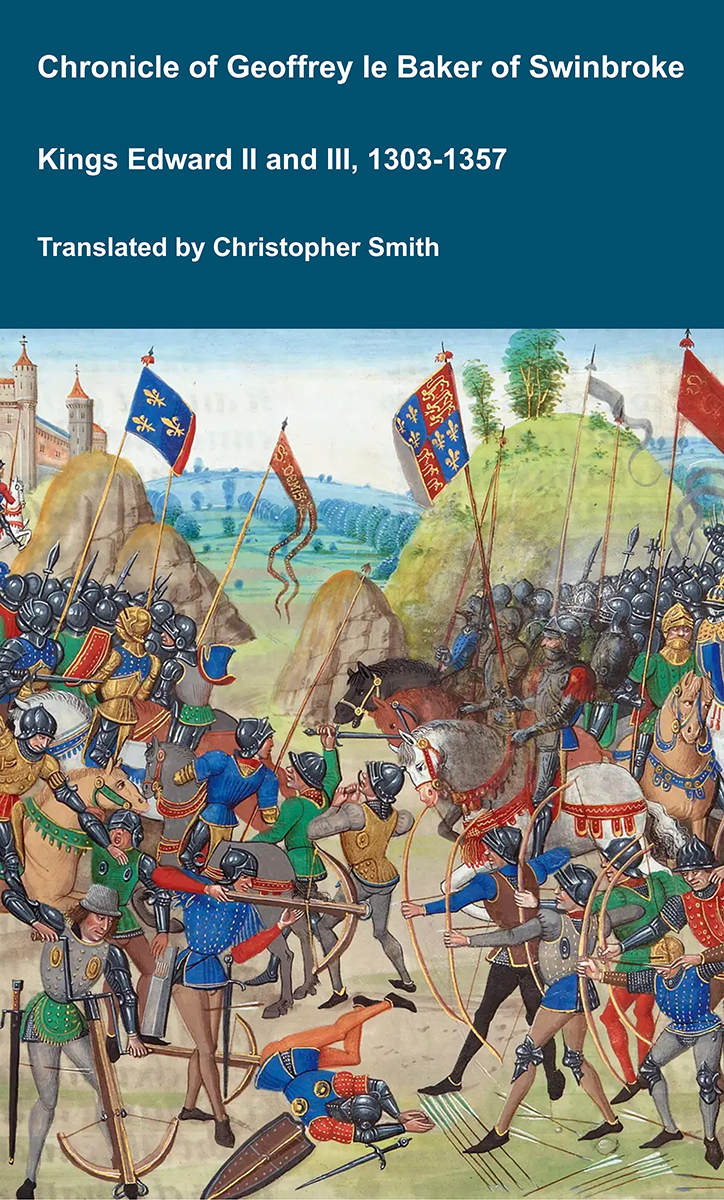
Chronicle of Geoffrey le Baker of Swinbroke
Baker was a secular clerk from Swinbroke, now Swinbrook, an Oxfordshire village two miles east of Burford. His Chronicle describes the events of the period 1303-1356: Gaveston, Bannockburn, Boroughbridge, the murder of King Edward II, the Scottish Wars, Sluys, Crécy, the Black Death, Winchelsea and Poitiers. To quote Herbert Bruce 'it possesses a vigorous and characteristic style, and its value for particular events between 1303 and 1356 has been recognised by its editor and by subsequent writers'. The book provides remarkable detail about the events it describes. Baker's text has been augmented with hundreds of notes, including extracts from other contemporary chronicles, such as the Annales Londonienses, Annales Paulini, Murimuth, Lanercost, Avesbury, Guisborough and Froissart to enrich the reader's understanding. The translation takes as its source the 'Chronicon Galfridi le Baker de Swynebroke' published in 1889, edited by Edward Maunde Thompson.
Available at Amazon in eBook and Paperback format.
On 21st June 1830 John Duntze 2nd Baronet (age 68) died. His son John (age 20) succeeded 3rd Baronet Duntze of Tiverton in Devon.
On 21st June 1834 James Everard Arundell 10th Baron Arundel (age 48) died in Rome, Italy [Map]. His brother Henry (age 29) succeeded 11th Baron Arundel of Wardour in Wiltshire. Frances Catherine Tichborne Baroness Arundel by marriage Baroness Arundel of Wardour in Wiltshire.
On 21st June 1837 Peter Nassau Clavering-Cowper 5th Earl Cowper (age 59) died. His son George (age 30) succeeded 6th Earl Cowper, 5th Baron Cowper of Wingham in Kent, 7th Baronet Cowper of Ratling Court in Kent.
On 21st June 1842 George Rodney 3rd Baron Rodney (age 60) died. His brother Thomas (age 58) succeeded 4th Baron Rodney of Rodney Stoke in Somerset.
On 21st June 1865 John Lubbock 3rd Baronet (age 62) died. His son John (age 31) succeeded 4th Baronet Lubbock of Lammas in Norfolk. Ellen Frances Horden Lady Lubbock by marriage Lady Lubbock of Lammas in Norfolk.


On 21st June 1914 George Howland William Beaumont 10th Baronet (age 63) died. His son George (age 33) succeeded 11th Baronet Beaumont of Stoughton Grange in Leicestershire.
On 21st June 1924 Robert Pollock Somerville Head 4th Baronet (age 40) died. His son Francis (age 7) succeeded 5th Baronet Head of Rochester in Kent.
On 21st June 1926 Philip Burne-Jones 2nd Baronet (age 64) died. Baronet Burne-Jones of Rottingdean in Sussex and The Grange in Fulham in London extinct.
On 21st June 1955 Geoffrey Morton Eden 7th Baron Auckland (age 64) died. His brother Terence (age 62) succeeded 8th Baron Auckland of West Auckland. Evelyn Vane Drummond of Cromlix Baroness Auckland (age 50) by marriage Baroness Auckland of West Auckland.
On 21st June 1971 John Lubbock 3rd Baron Avebury (age 56) died. His first cousin Eric (age 42) succeeded 4th Baron Avebury of Avebury in Wiltshire, 7th Baronet Lubbock of Lammas in Norfolk. Kina-Maria O'Kelly de Gallagh Baroness Avebury by marriage Baroness Avebury of Avebury in Wiltshire.
On 21st June 1975 Anthony Methuen 5th Baron Methuen (age 83) died. His son John (age 49) succeeded 6th Baron Methuen of Corsham in Wiltshire.
