

Anne Boleyn. Her Life as told by Lancelot de Carle's 1536 Letter.
In 1536, two weeks after the execution of Anne Boleyn, her brother George and four others, Lancelot du Carle, wrote an extraordinary letter that described Anne's life, and her trial and execution, to which he was a witness. This book presents a new translation of that letter, with additional material from other contemporary sources such as Letters, Hall's and Wriothesley's Chronicles, the pamphlets of Wynkyn the Worde, the Memorial of George Constantyne, the Portuguese Letter and the Baga de Secrets, all of which are provided in Appendices.
Available at Amazon in eBook and Paperback format.
27 Jan is in January.
1476 Marriage of Richard Duke of York and Anne Mowbray
1552 Trial and Execution of Edward Seymour Duke of Somerset and his Supporters
1645 King Charles I Rewards his Supporters
On 27th January 672 Pope Vitalian died.
On 27th January 992 Mathilde Carolingian Queen Consort Burgundy (age 49) died.
Annales Paulini. On Sunday, on the feast of Saint Vincent the Martyr [22nd January 1329], the archbishop [Simon Mepeham] was enthroned at Canterbury; and on the following Friday [27th January 1329], he summoned the entire clergy of the whole province to hold a council in London at the Church of Saint Paul. Early in the morning, a Mass of the Holy Spirit was celebrated by the Bishop of Chichester, with the archbishop and the other bishops, abbots, and prelates standing apart, all vested in their pontificals. After the Mass, the hymn Veni Creator was sung, and the archbishop delivered a long sermon to the clergy. Then a certificate from the Bishop of London was read aloud, confirming the citation of the clergy; and thus the provincial council began. Nothing else was done on the first day, but the council continued for several days, and each day they gathered there to discuss the statutes of the English Church.
Die Dominica in festo Sancti Vincentii martyris intronizatus est archiepiscopus apud Cantuariam; et die Veneris proxima sequente fecit convocari omnem clerum totius provincie ad concilium faciendum Londoniis in ecclesia Sancti Pauli; et primo mane fuit Missa de Sancto Spiritu celebrata ab episcopo Cicestrensi, archiepiscopo et ceteris episcopis cum abbatibus et prelatis seorsum astantibus indutis pontificalibus; et post Missam cantato hympno "Veni Creator," fecit archiepiscopus longum sermonem ad clerum. Deinde lecta fuit litera certificatoria episcopi Londoniensis de citatione cleri; et hoc modo incepit concilium provinciale: et nihil aliud est actum primo die, sed continuatur per plures dies, et qualibet die convenerunt ibi tractantes de statutis ecclesim Anglican.
On 27th January 1364 Edward Plantagenet was born to Edward "Black Prince" (age 33) and Joan "Fair Maid of Kent" Princess Wales (age 35) at Château d'Angoulême, Angoulême. He a grandson of King Edward III of England. Coefficient of inbreeding 3.42%. He died aged six in 1370.
On 27th January 1393 Philip Artois Count of Eu (age 36) and Marie Valois I Duchess Auverge (age 18) were married. She by marriage Countess Eu. She the daughter of John Valois 1st Duke Berry (age 52) and Joanne Armagnac Duchess Berry. He the son of John "Sans Terre" Artois 1st Count of Eu and Isabeau Melun Countess Eu. They were second cousin once removed. He a great x 3 grandson of King Henry III of England.
Paston Letters Volume 5 884. Item, as ffor Bowen I shall ffele hym, and sholde have doon, thowghe ye hadde nott sente.
Item, ther is offryd me a goode marriage for my suster Anne Skypwithys sone and heyr off Lynkolneshyre, a man v. or vj. mrke by year. No mor.
Wretyn at London, the xxvij. daye off Janyver [1476], anno E. iiijti xvo .
Item, my Lady off Excester (deceased) is ded, and it was seyde that bothe the olde Dywchesse off Norffolk, and the Cowntesse off Oxenfforde weer ded, but it is nott soo yitt.
Item, I shall remembr Caleyse bothe for horse and alJe, &c.
Paston Letters Volume 5 884. [27th January 1476] Item, I praye yow recomande me to my moodr, and lat us aIle prey God sende my Lady off Norffolk a soone, for uppon that restythe moche Inater; ffor if the Kyngys soone mary my lords dowghtr, the Kynge wolde that hys so one sholde have a flayr place in Norffolk, thowhe he sholde gyffe me ij. tymes the valywe in other londe, as I am doon to weete. I praye yow sende me worde off my ladyes spede as soone as ye kan.
On 27th January 1501 Bishop Thomas Langton died of plague. He was buried in a marble tomb within 'a very fair chapel' which he had built south of the lady-chapel in Winchester Cathedral [Map].

Letters and Papers Foreign and Domestic Henry VIII 1533. 27th January 1533. Vienna Archives. 89. Chapuys (age 43) to Charles V.
Three days ago received the Emperor's letters of the 27th ult., concerning the visit of the Emperor and the Pope to Bologna, and the exploit of the prince of Melphi. Communicated part of it to the duke of Norfolk (age 60), to be reported to the King, who was in the country. The Duke was pleased with the news, and thanked me for my good offices, saying they would be as agreeable to the King as to himself. I told him your Majesty was very desirous to preserve friendship, and had such confidence in the King that you would not conceal any of your affairs; you were pleased to hear that the two Cardinals were coming to Italy at the King's instance, and had put off treating with the Pope until their arrival. Said this partly on account of their refusal to allow ambassadors at the interview at Calais, but chiefly because the French ambassador had said that your Majesty wished to settle everything before the Cardinals arrived, but the Pope refused. Norfolk praised your intention, and said the Cardinals had already arrived at Bologna, and were honourably received. He spoke of the sumptuousness of their train, and wondered how they could assemble so great a company in so short a time, as it was agreed by the Kings that they should only take 24 horses between them. When I tried to find out the cause of their mission, he excused himself as before by his illness, which prevented him from attending to business. He said he wished the Emperor had been at St. Omer at the same time, for then the interview would not have been without his presence. I replied, that I thought they did not want many witnesses, as they prevented ambassadors from coming. He said the reason of this was that the object was not to make treaties, but only enjoyment, and it was not worth while to give ambassadors the trouble of coming, but that the presence of your Majesty's would have been the cause of proposing many important matters. I suggested that, perhaps, the Cardinals had orders to put forward what the Kings had wished to treat with your Majesty, and, if it was feasible, they might remedy your Majesty's absence at the inverview. The Duke hoped this would happen, and said that though the Cardinals were good men, and privy councillors of the French king, they only knew the outside of affairs, and everything was in the hands of the Chancellor, Grand Master, and Admiral, all of whom he praised, but especially the Admiral. The Grand Master he liked least of the three.
On 27th January 1550 Humphrey Arundell of Helland (age 37) was executed.
Annales of England by John Stow. 27th January 1550. the 27 of January, Humfrey Arundell (age 37) esquire, Thomas Holmes, Winslowe and Bery, captaines of the rebels in Devonshire, were hanged and quartered at Tyboure [Map].
Henry Machyn's Diary. 27th January 1552. The xxvijth day of January was reynyd at Westmynster Hall ser Raff a Vane knyght of tresun, and qwyt of hytt, and cast of felony to be hangyd,-the v yer K. E. vjth.
Wriothesley's Chronicle [1508-1562]. 27th January 1552. The 27 of January Sir Raphe Vane, knight, was arraigned at Westminster, and condempned for felony, and had judgment to be hanged.
Henry Machyn's Diary. 27th January 1554. [The xxvij day of January the city sent into Kent a great number of men in white coats. The captains to command them, and the rest of their forces, were the duke of Norfolk (age 17), earl of Ormond (age 22), sir George Howard (age 29), [Possibly Hayward] and divers others. But many of the guards, and of the white-coats, deserted] them, and captaynes cam hom a-gayn. Wyatt (age 33) had gotten some of the late king's ordenanse; and so, after their removyng, cam towards Dartford [Map] with ys army towards London.
Note. P. 52. Sir George Howard was son of lord Edmund Howard, and one of the brothers of queen Katharine Howard. He was knighted by the duke of Somerset in Scotland in 1547; and in March 1550–1 had a warrant for office of Master of the Henchmen for one whole year. He was appointed to attend upon the young lords sent over the sea as hostages, whereof the earl of Hertford was one. Strype, Mem. ii. 539.


The Deeds of the Dukes of Normandy
The Gesta Normannorum Ducum [The Deeds of the Dukes of Normandy] is a landmark medieval chronicle tracing the rise and fall of the Norman dynasty from its early roots through the pivotal events surrounding the Norman Conquest of England. Originally penned in Latin by the monk William of Jumièges shortly before 1060 and later expanded at the behest of William the Conqueror, the work chronicles the deeds, politics, battles, and leadership of the Norman dukes, especially William’s own claim to the English throne. The narrative combines earlier historical sources with firsthand information and oral testimony to present an authoritative account of Normandy’s transformation from a Viking settlement into one of medieval Europe’s most powerful realms. William’s history emphasizes the legitimacy, military prowess, and governance of the Norman line, framing their expansion, including the conquest of England, as both divinely sanctioned and noble in purpose. Later chroniclers such as Orderic Vitalis and Robert of Torigni continued the history, extending the coverage into the 12th century, providing broader context on ducal rule and its impact. Today this classic work remains a foundational source for understanding Norman identity, medieval statesmanship, and the historical forces that reshaped England and Western Europe between 800AD and 1100AD.
Available at Amazon in eBook and Paperback format.
Henry Machyn's Diary. 27th January 1560. The sam day cam rydyng to London, and so [entered] at Ludgatt, the good yerle of Shreusbery (age 32), with a C [100] [men] rydyng, and so to Cold Harber to ys owne plasse.


On 27th January 1561 Archbishop Thomas Young (age 54) was elected Archbishop of York.
Henry Machyn's Diary. 27th January 1562. The xxvij day of January was bered master Charlys Wrys[seley] (age 52) alyas Wyndsore, with all the haroldes of armes, master Garter (age 52), master Clarenshux, master Chaster alleas Norrey, master Somersett, [master York,] master Rychmond, master Lankester, Rugecrosse, Ruge-dragon, [Portcullis,] and Blumantylle, with vj skochyons of armes, in sant P[ulcher's] parryche, bered in the body of the chyrche; and they [ie the heralds] payd the ch[arges].
Note. P. 275. Funeral of Charles Wryothesley, Windsor herald. He died "at Camden's howsse, in the parish of St. Pulcres in London." (MS. Harl. 897, f. 27b.) "Item. On Sounday the 25th of January, An°. 1561, departed out of this world about sixe of the cloacke, Charles Wryotheley al's Windsour herauld, who was buryed at Saint Sepulcres churche w'hout Newgate, on Tuesday in the morning, at the which buriall the sayd corsse was covered with a pall of blacke velvett, and on the same was laid a rich coate of armes, and of each corner of the sayd corpes went a pursivant of armes in a mourning gowne and hood, and in their coates of armes. And after the corsse went Somersett herauld in his gowne and hood, and after him Mr. Garter and Mr. Clarencieux, and after them the rest of the office of armes not in blacke." From the Papers of Sir Edward Walker, Garter, "Heralds, vol. I. p. 120, Coll. Arm." See also the MS. I. 13, f. 34.
Ellis' Letters. Anne Duchess of Somerset to Sir William Cecil: upon the same.
[ms. lansdowne 9. art 32. Orig.]
This Letter is endorsed as having been received April 18th, 1566.
Good Mr. Secretary, yf I have let you alone all thys whyle I pray you thynke yt was to tary for my L.
Leycesters assystans, to whom as I have now wryten to take some occasyon to do good in my Sonne's cause, so are thyese to pray you to provoke hym, and jqyne with hym to further the same; trusting the occasyon of thyse Holy Weke and charytable tyme of forgevenes ernestly sett forth by hys Lordship and you, wyll bryng forth some comfortable frute of rely ve to the long afflycted partyes: wherin my Lord and you cannot go so farre but God's cause and the Quene's honor bedd you go farther. Thus moch I thowght good to wret as gevyng occasyon for my Lord and you to move the Quenes Maty to mercy, and not styll to suffre this cause alone to rest withowt all favour and forgevenes I can nomore but ons agayn pray yowre emest dealyng herein; and lykwyse that myne humble duty of thanks for Mr. Mychells passport may be donne to her Hyghnes, and so do leave you to God.
Yo asured lovyng frynd,
ANNE SOMERSET.
To my lovyng frynd Mr. Secretary.
Note. Within a year from the receipt of this Letter death released the Lady Catherine (age 26) from her sufferings. The Harleian MS. N°. 39. folio 380. contains what is called "The Manner of her departing." The Reader will peruse it with a feeling of pity.
"All the night she continued in prayer, saying of psalms and hearing them read of others, sometimes saying them after others, and as soon as one Psalm was done she would call for another to be said; divers times she would rehearse the prayers appointed for the Visitation of the Sick, and five or six times the same night she said the prayers appointed to be said at the hours of death, and when she was comforted by those that were about her, saying 'Madam be of good comfort, with God's help you shall live and do well many years,' she would answer 'No, no, no life in this worlde, but in the world to come I hope to live ever; for here is nothing but care and misery, and there is life everlasting:' and then seeing herself faint, she said ' Lord be merciful unto me, for now I begin to faint,' and all the time of her fainting, when any about her would chafe or rub her to comfort her, she would lift up her hands and eyes unto heaven and say 'Father of Heaven, for thy son Christ's sake, have mercy upon me.' Then said the Lady Hopton unto her, 'Madam be of good comfort, for with God his favour you shall live and escape this; for Mrs. Cousen saith you have escaped many dangers, when you were as like to die as you be nowe.' 'No, no my Ladie my time is come, and it is not God's will that I should live any longer, and his will be done, and not mine;' then, looking upon those that were about her, 'As I am, so shall you be, behold the picture of yourselves.' And about vi. or vij. of the clocke in the morning she desired those that were about her to cause Sir Owen Hoptone (age 48) to come unto her, and when he came he said unto her, 'Good Madam how do you,' and she said, 'Even now going to God, Sir Owen, even as fast as I can; and I pray you and the rest that be about me to bear witness with me that I die a true Christian, and that I believe to be saved by the death of Christ, and that I am one that he hath shed his most precious blood for; and I ask God and all the world forgiveness, and I forgive all the world.' Then she said unto Sir Owen Hoptone 'I beseech you promise me one thing, that you yourself with your own mouth will make this request unto the Queen's Majesty, which shall be the last suit and request that ever I shall make unto her Highness, even from the mouth of a dead woman; that she would forgive her displeasure towards me as my hope is she hath done; I must needs confess I have greatly offended her, in that I made my choice without her knowledge, otherwise I take God to witness I had never the heart to think any^vil against her Majesty; and that she would be good unto my children, and not to impute my fault unto them, whom I give wholly unto Her Majesty: for in my life they have had few friends, and fewer shall they have when I am dead, except Her Majesty be gracious unto them: and I desire her Highness to be good unto my Lord, for I know this my death will be heavy news unto him, that her Grace will be so good as to send liberty to glad his sorrow, ful heart withall'a Then she said unto Sir Owen, 'I shall further desire you to deliver from me certain commendations and Tokens unto my Lord,' and calling unto her woman, she said, 'Give me the box wherein my wedding Ring is,' and when she had it she opened it, and took out a Ring with a pointed diamond in it, and said, 'Here Sir Owen, deliver this unto my Lordb, this is the Ring that I received of him when I gave myself unto him and gave him my faith.' 'What say you, Madam,' said Sir Owen, 'was this your Wedding Ring?' 'No, Sir Owen,' she said, 'this was the Ring of my assurance unto my Lord, and there is my Wedding Ring,' taking another Ring all of gold out of the box, saying, 'Deliver this also unto my Lord, a and pray him even as I have been to him, as I take God to witness I have been, a true and a faithful Wife, that he would be a loving and a natural Father unto my children, unto whom I give the same blessing that God gave unto Abraham, Isaac, and Jacob.' And then took she out another Ring with a Death's head, and said 'This shall be the last Token unto my Lord that ever I shall send him; it is the picture of myself.' The words about the Death's head were these 'While I lyve yourtf and so, looking down upon her hands, and perceiving the nails to look purple, said, 'Lo here he is come,' and then as it were with a joyful countenance she said 'welcome Death,' and embracing herself with her arms, and lifting up her eyes and hands unto heaven, knocking her hands upon her breast, she brake forth and said 'O Lord! for thy manyfold mercies, blot out of thy Book all mine offenses!' Whereby Sir Owen perceiving her to draw towards her end, said to Mr. Bockeham were it not best to send to the Church that the bellc may be rung, and she herself hearing him, 'Good Sir Owen let it be so.' Then immediately perceiving her end to be near, she entered into Prayer, and said, 'O Lord! into thy hands I commend my soul, Lord Jesus receive my spirit' and so putting down her eyes with her own hands she yielded unto God her meek spirit at nine of the clock in the Morning the 27th of January, 1567."
The marriage between Lady Catherine Gray and the Earl of Hertford was not established till 1606; when the priest who had joined them being produced, and other circumstances agreeing, a jury at common law found it a good marriaged. Several papers relating to Lord Beauchamp's Appeal against the Sentence of the Commission, in 1604, occur in the Cottonian MS. Vitellius C. xvi. folL 412, 458, 516, 522: and Sir Julius Caesar's Notes from the Jurisconsults when the sentence was reversed, in the Lansdowne MS. 732.
Note a. The Lord Hertford remained in prison nine years.
Note b. This Ring had been exhibited by Lady Catherine to the Commission of Inquiry. It consisted of five links, the four inner ones containing the following posie of the Earl's making:
"As circles five by art compact shewe but one Ring in sight,
So trust uniteth faithfull mindes with knott of secret might;
Whose force to breake but greedie Death noe wight possesseth power,
As time and sequels well shall prove. My Ringe can say no more."
Note c. The Passing Bell. It was rung at the passing from Life to Death, with the intention that those who heard it should pray for the person dying.
Note d. Brydges's Edit of Collins's Peerage, vol. i. p. ITS.


On 27th January 1606 Everard Digby (age 28), Robert Wintour (age 38), John Grant (age 36), Thomas Bates (age 39), Ambrose Rookwood (age 28), Thomas Wintour (age 35), Robert Keyes (age 41) and Guy Fawkes (age 35) were tried at Westminster Hall [Map]. Only Everard Digby pleaded guilty. All were found guilty
80 Gunpowder Plot. The Trials of ROBERT WINTER, THOMAS WINTER, GUY FAWKES, JOHN GRANT, AMBROSE ROOKWOOD, ROB. KEY ES, THOMAS BATES, and Sir EVERARD DIGBY, at Westminster, for High Treason, being Conspirators in the Gunpowder-Plot: 3 Jac. I. 27th Jan. A. D. 1606.
On 27th January 1606 the trial of the conspirators took place at Westminster Hall [Map].
The Commissioners were: Earl of Nottingham (age 70), Suffolk (age 44), Worcester (age 56), Devonshire (age 43), Northampton (age 65), Salisbury (age 42), John Popham (age 75), the Lord Chief Baron of the Exchequer, Thomas Fleming (age 61), Peter Warburton (age 66), knight, one of the Justices of the Common Pleas.
The Effect of the Indictment.
THAT whereas our Sovereign Lord the King (age 39) had, by the Advice and Assent of his Council, for divers weighty and urgent Occasions concerning, his Majesty, the State, and Defence of the Church and Kingdom of England, appointed a Parliament to be holden at his City of Westminster; That Henry Garnet (age 50), Superior of the Jesuits within the Realm of England, (called also by the several names of Wally, Darcy, Roberts, Farmer, and Henry Philips), Oswald Tesmond Jesuit (age 43), otherwise called Oswald Greenwell, John Gerrard Jesuit (age 41), (called also by the several names of Lee and Brooke), Robert Winter (age 38), Thomas Winter (age 35), Gentlemen, Guy Fawkes (age 35) Gent. otherwise called Guy Johnson, Robert Keyes (age 41) Gent. and Thomas Bates Yeoman, late Servant to Robert Catesby Esquire; together with the said Robert Catesby and Thomas Percy Esquires, John Wright and Christopher Wright Gentlemen, in open Rebellion and Insurrection against his Majesty, lately slain, and Francis Tresham Esq; lately dead; as false Traitors against our said Sovereign Lord the King, did traitorously meet and assemble themselves together; and being so met, the said Henry Garnet, Oswald Tesmond, John Gerrard, and other Jesuits, did maliciously, falsly, and traitorously move and persuade as well the said Thomas Winter, Guy Fawkes, Robert Keyes, and Thomas Bates, as the said Robert Catesby, Thomas Percy, John Wright, Christopher Wright, and Francis Tresham, That our said Sovereign Lord the King, the Nobility, Clergy, and whole Commonalty of the Realm of England, (Papists excepted) were Hereticks; and that all Hereticks were accursed and excommunicate; and that none Heretick could be a King; but that it was lawful and meritorious to kill our said Sovereign Lord the King, and all other Hereticks within this Realm of England, for the Advancing and Enlargement of the pretended and usurped Authority and Jurisdiction of the Bishop of Rome, and for the restoring of the superstitious Romish Religion within this Realm of England.
On 27th January 1645 John Belasyse 1st Baron Belasyse (age 30) was created 1st Baron Belasyse of Worlaby in Lincolnshire by King Charles I of England, Scotland and Ireland (age 44). Anne Paulett Baroness Belasyse by marriage Baroness Belasyse of Worlaby in Lincolnshire.


From 27th January 1659 the Third Protectorate Parliament sat for one session until 22 Apr 1659.
Samuel Pepys' Diary. 27th January 1661. Lord's Day. Before I rose, letters come to me from Portsmouth, Hampshire [Map], telling me that the Princess (age 16) is now well, and my Lord Sandwich (age 35) set sail with the Queen (age 51) and her yesterday from thence for France.


Samuel Pepys' Diary. 27th January 1661. To church again, a good sermon of Mr. Mills, and after sermon Sir W. Pen (age 39) and I an hour in the garden talking, and he did answer me to many things, I asked Mr. Coventry's (age 33) opinion of me, and Sir W. Batten's (age 60) of my Lord Sandwich (age 35), which do both please me. Then to Sir W. Batten's, where very merry, and here I met the Comptroller (age 50) and his lady and daughter (the first time I ever saw them) and Mrs. Turner (age 38), who and her husband supped with us here (I having fetched my wife thither), and after supper we fell to oysters, and then Mr. Turner went and fetched some strong waters, and so being very merry we parted, and home to bed. This day the parson read a proclamation at church, for the keeping of Wednesday next, the 30th of January, a fast for the murther of the late King.

Samuel Pepys' Diary. 27th January 1663. Up and to the office, where sat till two o'clock, and then home to dinner, whither by and by comes Mr. Creed, and he and I talked of our Tangier [Map] business, and do find that there is nothing in the world done with true integrity, but there is design along with it, as in my Lord Rutherford, who designs to have the profit of victualling of the garrison himself, and others to have the benefit of making the Mole, so that I am almost discouraged from coming any more to the Committee, were it not that it will possibly hereafter bring me to some acquaintance of great men.
Samuel Pepys' Diary. 27th January 1664. Thence to the 'Change [Map], and after doing much business, home, taking Commissioner Pett (age 53) with me, and all alone dined together. He told me many stories of the yard, but I do know him so well, and had his character given me this morning by Hempson, as well as my own too of him before, that I shall know how to value any thing he says either of friendship or other business. He was mighty serious with me in discourse about the consequence of Sir W. Petty's (age 40) boat, as the most dangerous thing in the world, if it should be practised by endangering our losse of the command of the seas and our trade, while the Turkes and others shall get the use of them, which, without doubt, by bearing more sayle will go faster than any other ships, and, not being of burden, our merchants cannot have the use of them and so will be at the mercy of their enemies. So that I perceive he is afeard that the honour of his trade will down, though (which is a truth) he pretends this consideration to hinder the growth of this invention.
Samuel Pepys' Diary. 27th January 1664. Up and to the office, and at noon to the Coffeehouse, where I sat with Sir G. Ascue (age 48)1 and Sir William Petty (age 40), who in discourse is, methinks, one of the most rational men that ever I heard speak with a tongue, having all his notions the most distinct and clear, and, among other things (saying, that in all his life these three books were the most esteemed and generally cried up for wit in the world "Religio Medici", "Osborne's Advice to a Son2", and "Hudibras"), did say that in these-in the two first principally-the wit lies, and confirming some pretty sayings, which are generally like paradoxes, by some argument smartly and pleasantly urged, which takes with people who do not trouble themselves to examine the force of an argument, which pleases them in the delivery, upon a subject which they like; whereas, as by many particular instances of mine, and others, out of Osborne, he did really find fault and weaken the strength of many of Osborne's arguments, so as that in downright disputation they would not bear weight; at least, so far, but that they might be weakened, and better found in their rooms to confirm what is there said. He shewed finely whence it happens that good writers are not admired by the present age; because there are but few in any age that do mind anything that is abstruse and curious; and so longer before any body do put the true praise, and set it on foot in the world, the generality of mankind pleasing themselves in the easy delights of the world, as eating, drinking, dancing, hunting, fencing, which we see the meanest men do the best, those that profess it. A gentleman never dances so well as the dancing master, and an ordinary fiddler makes better musique for a shilling than a gentleman will do after spending forty, and so in all the delights of the world almost.
Note 1. Sir George Ayscue or Askew. After his return from his imprisonment he declined to go to sea again, although he was twice afterwards formally appointed. He sat on the court-martial on the loss of the "Defiance" in 1668.
Note 2. Francis Osborne, an English writer of considerable abilities and popularity, was the author of "Advice to a Son", in two parts, Oxford, 1656-8, 8vo. He died in 1659. He is the same person mentioned as "My Father Osborne", October 19th, 1661. B.
John Evelyn's Diary. 27th January 1665. Dined at the Lord Chancellor's (age 55), who caused me after dinner to sit two or three hours alone with him in his bedchamber.


William of Worcester's Chronicle of England
William of Worcester, born around 1415, and died around 1482 was secretary to John Fastolf, the renowned soldier of the Hundred Years War, during which time he collected documents, letters, and wrote a record of events. Following their return to England in 1440 William was witness to major events. Twice in his chronicle he uses the first person: 1. when writing about the murder of Thomas, 7th Baron Scales, in 1460, he writes '… and I saw him lying naked in the cemetery near the porch of the church of St. Mary Overie in Southwark …' and 2. describing King Edward IV's entry into London in 1461 he writes '… proclaimed that all the people themselves were to recognize and acknowledge Edward as king. I was present and heard this, and immediately went down with them into the city'. William’s Chronicle is rich in detail. It is the source of much information about the Wars of the Roses, including the term 'Diabolical Marriage' to describe the marriage of Queen Elizabeth Woodville’s brother John’s marriage to Katherine, Dowager Duchess of Norfolk, he aged twenty, she sixty-five or more, and the story about a paper crown being placed in mockery on the severed head of Richard, 3rd Duke of York.
Available at Amazon in eBook and Paperback format.
Samuel Pepys' Diary. 27th January 1665. Thence away to boat again and landed her at the Three Cranes again, and I to the Bridge [Map], and so home, and after shifting myself, being dirty, I to the 'Change [Map], and thence to Mr. Povy's (age 51) and there dined, and thence with him and Creed to my Lord Bellasses' (age 50), and there debated a great while how to put things in order against his going, and so with my Lord in his coach to White Hall, and with him to my Lord Duke of Albemarle (age 56), finding him at cards. After a few dull words or two, I away to White Hall again, and there delivered a letter to the Duke of Yorke (age 31) about our Navy business, and thence walked up and down in the gallery, talking with Mr. Slingsby (age 44), who is a very ingenious person, about the Mint and coynage of money. Among other things, he argues that there being £700,000 coined in the Rump time, and by all the Treasurers of that time, it being their opinion that the Rump money was in all payments, one with another, about a tenth part of all their money. Then, says he, to my question, the nearest guess we can make is, that the money passing up and down in business is £7,000,000. To another question of mine he made me fully understand that the old law of prohibiting bullion to be exported, is, and ever was a folly and an injury, rather than good. Arguing thus, that if the exportations exceed importations, then the balance must be brought home in money, which, when our merchants know cannot be carried out again, they will forbear to bring home in money, but let it lie abroad for trade, or keepe in foreign banks: or if our importations exceed our exportations, then, to keepe credit, the merchants will and must find ways of carrying out money by stealth, which is a most easy thing to do, and is every where done; and therefore the law against it signifies nothing in the world. Besides, that it is seen, that where money is free, there is great plenty; where it is restrained, as here, there is a great want, as in Spayne. These and many other fine discourses I had from him.


Samuel Pepys' Diary. 27th January 1667. Thence I through the garden into the Park, and there met with Roger Pepys (age 49), and he and I to walk in the Pell Mell [Map]. I find by him that the House of Parliament continues full of ill humours, and he seems to dislike those that are troublesome more than needs, and do say how, in their late Poll Bill, which cost so much time, the yeomanry, and indeed two-thirds of the nation, are left out to be taxed, that there is not effectual provision enough made for collecting of the money; and then, that after a man his goods are distrained and sold, and the overplus returned, I am to have ten days to make my complaints of being over-rated if there be cause, when my goods are sold, and that is too late. These things they are resolved to look into again, and mend them before they rise, which they expect at furthest on Thursday next.
Samuel Pepys' Diary. 27th January 1667. Here we met with Mr. May (age 45), and he and we to talk of several things, of building, and such like matters; and so walked to White Hall, and there I skewed my cozen Roger (age 49) the Duchesse of York (age 29) sitting in state, while her own mother (age 49) stands by her; he had a desire, and I shewed him my Baroness Castlemayne (age 26), whom he approves to be very handsome, and wonders that she cannot be as good within as she is fair without. Her little black boy came by him; and, a dog being in his way, the little boy called to the dog: "Pox of this dog!"-"Now", says he, blessing himself, "would I whip this child till the blood come, if it were my child!" and I believe he would. But he do by no means like the liberty of the Court, and did come with expectation of finding them playing at cards to-night, though Sunday; for such stories he is told, but how true I know not1.
Note 1. There is little reason to doubt that it was such as Evelyn describes it at a later time. "I can never forget the inexpressible luxury and prophaneness, gaming, and all dissoluteness, and, as it were, total forgetfulness of God (it being Sunday evening) which this day se'nnight I was witness of; the King (age 36) sitting and toying with his concubines, Portsmouth (age 17), Cleveland, Mazarin (age 20), &c. A French boy singing love songs in that glorious gallery, whilst about twenty of the great courtiers and other dissolute persons were at basset round a large table, a bank of at least £2,000 in gold before them; upon which two gentlemen who were with me made reflexions with astonishment. Six days after was all in the dust". B.
Samuel Pepys' Diary. 27th January 1668. So to White Hall, and there a Committee of Tangier, but little done there, only I did get two or three little jobs done to the perfecting two or three papers about my Tangier accounts. Here Mr. Povy (age 54) do tell me how he is like to lose his £400 a-year pension of the Duke of York (age 34), which he took in consideration of his place which was taken from him. He tells me the Duchesse (age 30) is a devil against him, and do now come like Queen Elizabeth, and sits with the Duke of York's Council, and sees what they do; and she crosses out this man's wages and prices, as she sees fit, for saving money; but yet, he tells me, she reserves £5000 a-year for her own spending; and my Lady Peterborough (age 46), by and by, tells me that the Duchesse do lay up, mightily, jewells.


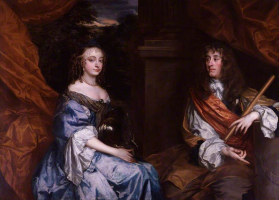
Samuel Pepys' Diary. 27th January 1668. Thence to my Lady Peterborough's (age 46), she desiring to speak with me. She loves to be taken dressing herself, as I always find her; and there, after a little talk, to please her, about her husband's (age 46) pension, which I do not think he will ever get again, I away thence home, and all the afternoon mighty busy at the office, and late, preparing a letter to the Commissioners of Accounts, our first letter to them, and so home to supper, where Betty Turner (age 15) was (whose brother Frank did set out toward the East Indies this day, his father (age 55) and mother (age 45) gone down with him to Gravesend, Kent [Map]), and there was her little brother Moses, whom I examined, and he is a pretty good scholar for a child, and so after supper to talk and laugh, and to bed.

On 27th January 1669 Gaspar de Crayer (age 84) died.
Samuel Pepys' Diary. 27th January 1669. Up, and with Sir John Minnes (age 69) in his coach to White Hall, where first we waited on the Lords of the Treasury about finishing the Victualling Contract; and there also I was put to it to make good our letter complaining against my Lord Anglesey's (age 54) failing us in the payment of the moneys assigned us upon the Customs, where Mr. Fenn was, and I know will tell my Lord; but it is no matter, I am over shy already, and therefore must not fear. Then we up to a Committee of the Council for the Navy, about a business of Sir D. Gawden's relating to the Victualling, and thence I by Hackney to the Temple [Map] to the Auditor's man, and with him to a tavern to meet with another under-auditor to advise about the clearing of my Lord Bellasses' (age 54) accounts without injuring myself and perplexing my accounts, and so thence away to my cozen Turner's, where I find Roger Pepys (age 51) come last night to town, and here is his mistress, Mrs. Dickenson, and by and by comes in Mr. Turner, a worthy, sober, serious man-I honour him mightily. And there we dined, having but an ordinary dinner; and so, after dinner, she, and I, and Roger, and his mistress, to the Duke of York's playhouse, and there saw "The Five Hours' Adventure", which hath not been acted a good while before, but once, and is a most excellent play, I must confess. My wife and The. (age 17) come after us, after they had been to buy some things abroad, and so after the play done we to see them home, and then home ourselves, and my wife to read to me, and so to supper and to bed.


On 27th January 1670 Anne Clarges Duchess Albermarle (age 50) died.
John Evelyn's Diary. 27th January 1685. I din'd at Lord Sunderland's (age 43), being invited to heare that celebrated voice of Mr. Pordage, newly come from Rome; his singing was after the Venetian recitative, as masterly as could be, and with an excellent voice both treble and basse; Dr. Walgrave accompanied it with his theorba lute, on which he perform'd beyond imagination, and is doubtlesse orie of the greatest masters in Europe on that charming in strument. Pordage is a priest, as Mr. Bernard Howard (age 44) told me in private. There was in the roome where we din'd, and in his bed-chamber, those incomparable pieces of Columbus, a Flagellation, the Grammar-schoole, the Venus and Adonis of Titian; and of Vandyke's that picture of the late E. of Digby (father of the Countess of Sunderland (age 39)), and Earle of Bedford (age 68), Sr Kenelm Digby, and two Ladys of incomparable performance; besides that of Moses and the burning bush of Bassano, and several other pieces of ye best masters. A marble head of M. Brutus, &c.


Calendar of State Papers Charles II 27 Jan 1668. 27th January 1688. Whitehall. Warrant for a pardon to George, Duke of Buckingham, of all treason, misprision of treason, felony, &c., especially concerning the killing of William Jenkins, and assaults on Francis Earl of Shrewsbury, - or Sir John Talbot (age 57), whether or not they have died or shall die of the same; with non-obstante of the statutes requiring security for good behaviour. [Ibid. No. 90.]


Calendar of State Papers Charles II 27 Jan 1668. 27th January 1688. Petition of John Bennett, high bailiff of the city and liberties of Westminster, to the King. By the accidental killing of William Jenkins, in a late duel between the Duke of Buckingham and Earl of Shrewsbury, the Duke forfeits all his goods, chattels, and personal estate to the King, a considerable part of which, being in Westminster, would come to the petitioner; but as he loses it by his Majesty's pardon to the Duke, he begs to be recommended to his Grace for some compensation. [Ibid. No. 93.]

Calendar of State Papers Charles II 27 Jan 1668. 27th January 1688? Petition of John Bennett, high bailiff of Westminster, to the King, for similar recommendation to Bernard Howard (age 47), Sir John Talbot (age 57), and Sir Robert Holmes (age 66), who were engaged in the encounter in which William Jenkins was slain, but his Majesty is inclined to pardon them before conviction. [Ibid. No. 94.]
John Evelyn's Diary. 27th January 1689. I dined at the Admiralty, where was brought in a child not twelve years old, the son of one Dr. Clench, of the most prodigious maturity of knowledge, for I cannot call it altogether memory, but something more extraordinary. Mr. Pepys (age 55) and myself examined him, not in any method, but with promiscuous questions, which required judgment and discernment to answer so readily and pertinently. There was not anything in chronology, history, geography, the several systems of astronomy, courses of the stars, longitude, latitude, doctrine of the spheres, courses and sources of rivers, creeks, harbors, eminent cities, boundaries and bearings of countries, not only in Europe, but in any other part of the earth, which he did not readily resolve and demonstrate his knowledge of, readily drawing out with a pen anything he would describe. He was able not only to repeat the most famous things which are left us in any of the Greek or Roman histories, monarchies, republics, wars, colonies, exploits by sea and land, but all the sacred stories of the Old and New Testament; the succession of all the monarchies, Babylonian, Persian, Greek, Roman, with all the lower Emperors, Popes, Heresiarchs, and Councils, what they were called about, what they determined, or in the controversy about Easter, the tenets of the Gnostics, Sabellians, Arians, Nestorians; the difference between St. Cyprian and Stephen about re-baptism, the schisms. We leaped from that to other things totally different, to Olympic years, and synchronisms; we asked him questions which could not be resolved without considerable meditation and judgment, nay of some particulars of the Civil Laws, of the Digest and Code. He gave a stupendous account of both natural and moral philosophy, and even in metaphysics.
Having thus exhausted ourselves rather than this wonderful child, or angel rather, for he was as beautiful and lovely in countenance as in knowledge, we concluded with asking him if, in all he had read or heard of, he had ever met with anything which was like this expedition of the Prince of Orange (age 38), with so small a force to obtain three great kingdoms without any contest. After a little thought, he told us that he knew of nothing which did more resemble it than the coming of Constantine the Great out of Britain, through France and Italy, so tedious a march, to meet Maxentius, whom he overthrew at Pons Milvius with very little conflict, and at the very gates of Rome, which he entered and was received with triumph, and obtained the empire, not of three kingdoms only, but of all the then known world. He was perfect in the Latin authors, spoke French naturally, and gave us a description of France, Italy, Savoy, Spain, ancient and modernly divided; as also of ancient Greece, Scythia, and northern countries and tracts: we left questioning further. He did this without any set or formal repetitions, as one who had learned things without book, but as if he minded other things, going about the room, and toying with a parrot there, and as he was at dinner (tanquam aliua agens, as it were) seeming to be full of play, of a lively, sprightly temper, always smiling, and exceedingly pleasant, without the least levity, rudeness, or childishness.


Chronicle of Walter of Guisborough
A canon regular of the Augustinian Guisborough Priory, Yorkshire, formerly known as The Chronicle of Walter of Hemingburgh, describes the period from 1066 to 1346. Before 1274 the Chronicle is based on other works. Thereafter, the Chronicle is original, and a remarkable source for the events of the time. This book provides a translation of the Chronicle from that date. The Latin source for our translation is the 1849 work edited by Hans Claude Hamilton. Hamilton, in his preface, says: 'In the present work we behold perhaps one of the finest samples of our early chronicles, both as regards the value of the events recorded, and the correctness with which they are detailed; Nor will the pleasing style of composition be lightly passed over by those capable of seeing reflected from it the tokens of a vigorous and cultivated mind, and a favourable specimen of the learning and taste of the age in which it was framed.'
Available at Amazon in eBook and Paperback format.

On 27th January 1735 Reverend Robert Dymoke of Grebby Hall in Lincolnshire (age 35) drowned in the Chequer Well, Lincoln. He was buried at Lincoln Cathedral [Map].
Reverend Robert Dymoke of Grebby Hall in Lincolnshire: On or before 17th October 1699, the date he was baptised, he was born to Robert Dymoke of Scremby in Lincolnshire.
On 27th January 1738 John Thomas (age 26) became Rector of Bletchingley in Surrey, a living in the gift of William Clayton of Hambledon in Buckinghamshire whose daughter Anne Clayton Lady Blackwell he would subsequently marry.
On 27th January 1740 Louis Henri Bourbon Condé Duke Bourbon (age 47) died.
On 27th January 1768 Augusta Murray Duchess Sussex was born to John Murray 4th Earl Dunmore (age 38) and Charlotte Stewart Countess Dunmore (age 38). She married (1) 4th April 1793 Prince Augustus Frederick Hanover 1st Duke Sussex, son of King George III of Great Britain and Ireland and Charlotte Mecklenburg Strelitz Queen Consort England, and had issue.
On 27th January 1773 Prince Augustus Frederick Hanover 1st Duke Sussex was born to King George III of Great Britain and Ireland (age 34) and Charlotte Mecklenburg Strelitz Queen Consort England (age 28) at Buckingham House [Map]. He married (1) 4th April 1793 Augusta Murray Duchess Sussex, daughter of John Murray 4th Earl Dunmore and Charlotte Stewart Countess Dunmore, and had issue (2) 2nd May 1831 Cecilia Gore aka Underwood Duchess of Inverness, daughter of Arthur Saunders Gore 2nd Earl Arran and Elizabeth Underwood Countess of Arran.
On 27th January 1784 Amelia Darcy 12th Baroness Darcy 9th Baroness Conyers (age 29) died. Her son George (age 8) succeeded 13th Baron Darcy of Knayth, 10th Baron Conyers.
On 27th January 1818 John Hamilton 1st Marquess Abercorn (age 61) died. His grandson James (age 7) succeeded 2nd Marquess Abercorn, 10th Earl Abercorn.
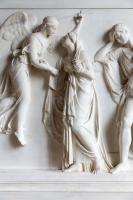
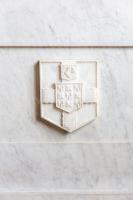
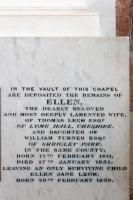
On 27th January 1831 Ellen Turner (deceased) was buried at St Oswald's Church, Winwick [Map]. The service was performed by Reverend Thomas Hinde. Monument sculpted by Richard James Wyatt (age 35).
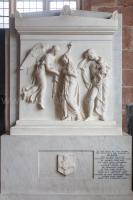
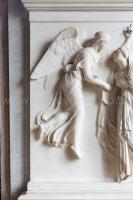
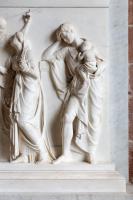

On 27th January 1832 Arthur Hughes was born to Edward Hughes (age 45). He married October 1855 Tryphena Foord and had issue.
On 27th January 1836 Princess Wilhelmine Baden (age 47) died.
Chronicle of a Bourgeois of Valenciennes
Récits d’un bourgeois de Valenciennes aka The Chronicle of a Bourgeois of Valenciennes is a vivid 14th-century vernacular chronicle written by an anonymous urban chronicler from Valenciennes in the County of Hainaut. It survives in a manuscript that describes local and regional history from about 1253 to 1366, blending chronology, narrative episodes, and eyewitness-style accounts of political, military, and social events in medieval France, Flanders, and the Low Countries. The work begins with a chronological framework of events affecting Valenciennes and its region under rulers such as King Philip VI of France and the shifting allegiances of local nobility. It includes accounts of conflicts, sieges, diplomatic manoeuvres, and the impact of broader struggles like the Hundred Years’ War on urban life in Hainaut. Written from the perspective of a burgher (bourgeois) rather than a monastery or royal court, the chronicle offers a rare lay viewpoint on high politics and warfare, reflecting how merchants, townspeople, and civic institutions experienced the turbulence of the 13th and 14th centuries. Its narrative style combines straightforward reporting of events with moral and civic observations, making it a valuable source for readers interested in medieval urban society, regional politics, and the lived experience of war and governance in pre-modern Europe.
Available at Amazon in eBook and Paperback format.
On 27th January 1850 John Collier was born to Robert Collier 1st Baron Monkswell (age 32) and Isabella Rose Baroness Monkswell (age 35). He married (1) 30th June 1879 Marian "Mady" Huxley and had issue (2) 1889 Emma aka Ethel Huxley.
Diary of Ford Madox Brown. 27th January 1856. For want of a book I have omitted entries since the 6th inst. During this blank I worked two whole weeks (sundays included) at the reduction of King Lear, besides one even, also one eve at the present drawing of do. — also one good day at the "Hay Field" (100 hours). On Monday last White called but did not like the latter, said the hay was pink & he had never seen such. He seemed doubtful about the "Lear", said he would call again in a few days if I would make Kent's head & one of the officers & cordelia's hands less red. He did not seem to have his wonted élan but ended by taking the pencil K Lear for £6.6/ minus 25 per cent discount which I now always allow him on the price. I succeeded in taking him to see Tom Seddons (age 34) pictures which he seemed to like very much but did not buy. After this he had not time to go to Woolners as he promised me, moreover he did not pay for the Chaucer picture, £45 of which still owing. He was to have paid on receiving it from Paris. Tuesday I did what he wished to the King Lear & after called on the Rossettis having a mind to try if Maria would undertake Lucy's Education inlieu of sending her to school. The room was too full to talk however & Bill with a man named Clayton4 jawed to nasiously about Ruskin & Art that I felt quite disgusted & said nothing.
Note 4. Owing to Emma Brown's (age 26) intemperance Brown wished Lucy to live away from home (Private Information). John Clayton (1827-1913) helped to found Clayton and Bell, glass painters, and was himself a painter on glass.


On 27th January 1859 Wilhelm Hohenzollern was born to Frederick III King Prussia (age 27) and Victoria Empress Germany Queen Consort Prussia (age 18) at Crown Prince's Palace, Berlin. He a grandson of Queen Victoria of the United Kingdom. He married (1) 27th February 1881 his fourth cousin Empress Auguste Viktoria Oldenburg, daughter of Frederick Christian Oldenburg II Duke Schleswig Holstein Sonderburg Augustenburg and Adelheid Hohenlohe Langenburg Duchess Schleswig Holstein Sonderburg Augustenburg, and had issue (2) 9th November 1922 Hermine Reuss.


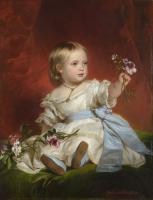


On 27th January 1862 Florence Louisa Miles (age 22) died in childbirth.
On 7th January 1866 or 27th January 1866 John Gibson (age 75) died at Rome, Italy [Map]. He bequeathed the contents of his studio, a large selection of his works and a large sum of money to the Royal Academy.
On 27th January 1870 George Hamilton-Gordon 6th Earl Aberdeen (age 28) drowned. Travelling from Boston to Melbourne on the Hera, Lord Aberdeen was washed overboard during a violent storm and drowned. His brother John (age 22) succeeded 7th Earl Aberdeen.

After 27th January 1877. Church of St Mary, East Raynham [Map]. Memorial to Elizabeth Jane Stuart (deceased), John Villiers Stuart Townshend 5th Marquess Townshend (age 45) and Nicholas Townshend Durham.
Elizabeth Jane Stuart: On 18th July 1803 she was born to George Stuart. On 18th August 1825 John Townshend 4th Marquess Townshend and she were married. On 27th January 1877 Elizabeth Jane Stuart died.
Nicholas Townshend Durham: he was born to James Cunninghame Durham and Agnes Elizabeth Audrey Townshend. He a great x 3 grandson of King William IV of the United Kingdom. On 17th March 1943 Nicholas Townshend Durham was killed in action at the Battle of the Mareth Line.
On 25 or 27th January 1916 Major Rupert Chabbert Meyricke (age 38) committed suicide in Malta. His body was found in the grounds of the hospital. Suicide by shooting himself with a small automatic pistol he had smuggled into the hospital a few hours before he was due to be evacuated back to the UK - he had wanted to stay on Malta so as to be able to rejoin his battery. Maj Meyricke had himself carried on a wheeled chair to the terrace at the front of the hospital over-looking the harbour, sat on a wooden garden seat and after a few minutes produced a Colt automatic pistol he had hidden about himself and committed suicide. He was buried in Pietà Military Cemetery, TTriq id-Duluri, Malta.
The Times. 27th January 1916. The death of Lady Ulrica Thynne (deceased) took place on Wednesday at 30, Grosvenor-gardens. She was the second daughter of the 12th Duke of Somerset and was born in 1833. She married, in 1858, Lord Henry Frederick Thynne, second son of the third Marquess of Bath, who was Treasurer of the Household to Queen Victoria and for over 25 years M.P. for South Wilts. There were four sons and two daughters of the marriage. The funeral will be at Findon, near Worthing, on Monday, at 1 o'clock.
On 27th January 1916 John Henry Montagu Manners 9th Duke Rutland (age 29) and Kathleen Tennant Duchess Rutland (age 21) were married. He the son of Henry John Brinsley Manners 8th Duke Rutland (age 63) and Violet Lindsay Duchess Rutland (age 59).
Chronicle of a Bourgeois of Valenciennes
Récits d’un bourgeois de Valenciennes aka The Chronicle of a Bourgeois of Valenciennes is a vivid 14th-century vernacular chronicle written by an anonymous urban chronicler from Valenciennes in the County of Hainaut. It survives in a manuscript that describes local and regional history from about 1253 to 1366, blending chronology, narrative episodes, and eyewitness-style accounts of political, military, and social events in medieval France, Flanders, and the Low Countries. The work begins with a chronological framework of events affecting Valenciennes and its region under rulers such as King Philip VI of France and the shifting allegiances of local nobility. It includes accounts of conflicts, sieges, diplomatic manoeuvres, and the impact of broader struggles like the Hundred Years’ War on urban life in Hainaut. Written from the perspective of a burgher (bourgeois) rather than a monastery or royal court, the chronicle offers a rare lay viewpoint on high politics and warfare, reflecting how merchants, townspeople, and civic institutions experienced the turbulence of the 13th and 14th centuries. Its narrative style combines straightforward reporting of events with moral and civic observations, making it a valuable source for readers interested in medieval urban society, regional politics, and the lived experience of war and governance in pre-modern Europe.
Available at Amazon in eBook and Paperback format.
On 27th January 1918 Reverend William Greenwell (age 97) died unmarried at his home 27 South Bailey, Durham.


On 27th January 1932 Charles Frederick Cavendish 5th Baron Waterpark (age 48) died unmarried. Memorial at St Cuthbert's Church, Doveridge [Map]. His second cousin Henry (age 55) succeeded 6th Baron Waterpark, 7th Baronet Cavendish of Doveridge Hall.
Charles Frederick Cavendish 5th Baron Waterpark: On 11th May 1883 he was born to Henry Anson Cavendish 4th Baron Waterpark and Emily Stenning Baroness Waterpark.
Henry Sheppard Hart Cavendish 6th Baron Waterpark: On 18th May 1876 he was born to Captain William Thomas Cavendish. On 26th November 1948 Henry Sheppard Hart Cavendish 6th Baron Waterpark died. His nephew Frederick succeeded 7th Baron Waterpark, 8th Baronet Cavendish of Doveridge Hall.

On 27th January 1937 Bernard Fitzalan 16th Duke of Norfolk (age 28) and Lavinia Mary Strutt Duchess Norfolk (age 20) were married. She by marriage Duchess Norfolk. She the daughter of Algernon Strutt 3rd Baron Belper (age 53) and Eva Isabel Countess Rosebery (age 44). He the son of Henry Fitzalan Howard 15th Duke of Norfolk and Gwendolen Constable-Maxwell Duchess Norfolk (age 60).
The Times. 28th January 1937. The Duke Of Norfolk And Miss Strutt.
Princess Alice Countess of Athlone (age 53) and Major-General the Earl of Athlone (age 63), and Prince Arthur of Connaught (age 54) were present yesterday afternoon at the marriage at Brompton Oratory of the Duke of Norfolk, Premier Peer and Hereditary Earl Marshal of England, and the Hon. Lavinia Mary Strutt (age 20), only daughter of Lord Belper (age 53) and the Countess of Rosebery (age 44).
Princess Alice wore a mink coat over a dress of burgundy-red crepe, with a small red hat to match.
The Oratory was decorated with four large stands of flowers, placed at the chancel steps. They were in mixed shades of red and included amaryllis lilies, poinsettia, anthuriums, roses, carnations, and red leaves. While the guests were arriving the organist played Mendelssohn's Allegretto from the Fourth Sonata, Elgar's Allegro Maestoso from the First Sonata, and the prelude and fugue in E flat, and the organ choral "Mortify us by Thy Goodness" by J. S. Bach.
The bride arrived with her father, Lord Belper, and was loudly cheered by the crowd outside the Oratory, who broke through the police cordon. She walked up the nave to Handel's March from the Occasional Oratorio, and was met by Father Talbot and Father John Cuddon. Miss Strutt wore a classically simple dress of silver lame, cut on straight sheath lines with long tight sleeves and a high round roll collar. The skirt just touched the ground and was continued at the back to form a long square train. She wore a girdle of silver cord knotted in front. Her long veil of white tulle fell from a simple coronet of orange-blossom and green leaves, and she carried a sheaf of arum lilies. She was followed by six little pages-Robin Herbert, Timothy Hunloke, Bob McCreery, John Scrope, George Vivian-Smith, and Michael Watt; and by six bridesmaids-Lady Katharine (age 25) and Lady Winefride Howard (age 23) (sisters of the bridegroom), Lady Anne Bridgeman (age 23), the Hon. Pamela Digby (age 16), Miss Gillian Drummond, and Miss Nancy Malcolmnson. The bridegroom's (age 28) racing colours, pale blue and scarlet, were introduced into the dresses and suits of the attendants. The pages were in pale blue satin suits piped with scarlet, and the bridesmaids wore dresses of sky-blue corded crepe, with touches of scarlet at the waistline. They had high rounded necklines with long bell sleeves and their headdresses of red bavardia were massed in front. They carried bouquets of red flowers, including tulips, amaryllis lilies, carnations, and euphorbia. The bridegroom gave them brooches showing his and his bride's initials in rubies and diamonds. The Earl of Eldon (age 37) was best man.
The marriage service was very short and non-choral, as the bride is not a Roman Catholic. After they had plighted their troth Father Ronald Knox gave an address from the centre of the transept. The bride and bridegroom remained kneeling at the chancel steps, facing the altar. They then went in procession to the vestry, where the registrar, Mr. J. P. Bond, conducted the civil ceremony.
Afterwards the bride and bridegroom left for 38, Mayfair (the residence of the Earl of Rosebery (age 55)), where the Countess of Rosebery held a reception. The bride went away for the honeymoon in a dress of black and red shot silk taffeta, under a broadtail coat with a fur cap to match.
Among those present at the Oratory were:
The Earl and Countess of Rosebery.
The Duchess of Norfolk (age 60).
Lady Rachel Howard (age 32).
Lady Belper.
the Hon. Alexander (age 24) and the Hon. Michael Strutt (age 23), the Hon. Mrs. Parry-Evans. Mr. and the Hon. Mrs. Vernon Malcolmsonson, Lord and Lady Aberdare, the Hon. Margaret Strutt, the Hon. Mrs. Frank Hormsby, etc.
On 27th January 1952 Fanny Ward aka Buchanan (age 79) died.
On 27th January 1364 Edward Plantagenet was born to Edward "Black Prince" (age 33) and Joan "Fair Maid of Kent" Princess Wales (age 35) at Château d'Angoulême, Angoulême. He a grandson of King Edward III of England. Coefficient of inbreeding 3.42%. He died aged six in 1370.
On 27th January 1531 Anthony Gresham was born to John Gresham (age 36) and Mary Ipswell (age 36).

On 27th January 1533 George Brooke was born to George Brooke 9th Baron Cobham (age 36) and Anne Braye Baroness Cobham (age 31).
On 27th January 1603 Harbottle Grimston 2nd Baronet was born to Harbottle Grimston 1st Baronet (age 34). He married before 7th January 1643 Mary Croke and had issue.


On 27th January 1663 George Byng 1st Viscount Torrington was born.


Anne Boleyn. Her Life as told by Lancelot de Carle's 1536 Letter.
In 1536, two weeks after the execution of Anne Boleyn, her brother George and four others, Lancelot du Carle, wrote an extraordinary letter that described Anne's life, and her trial and execution, to which he was a witness. This book presents a new translation of that letter, with additional material from other contemporary sources such as Letters, Hall's and Wriothesley's Chronicles, the pamphlets of Wynkyn the Worde, the Memorial of George Constantyne, the Portuguese Letter and the Baga de Secrets, all of which are provided in Appendices.
Available at Amazon in eBook and Paperback format.
On 27th January 1673 John Carnegie 2nd Baronet was born to David Carnegie 1st Baronet (age 32) and Catherine Primrose Lady Carnegie.
On 27th January 1678 Sarah Margetson was born to John Margetson (age 22) and Alice Caulfeild Baroness Carpenter (age 17). She married before 1704 her second cousin Brabazon Ponsonby 1st Earl Bessborough, son of William Ponsonby 1st Viscount Duncannon and Mary Moore, and had issue.
On 27th January 1722 Benedict Swingate Calvert was born illegitimately to Charles Calvert 5th Baron Baltimore (age 22) and Petronilla Melusine Schulenburg Countess Chesterfield (age 28). He a great x 2 grandson of King Charles II of England Scotland and Ireland.

On 27th January 1725 Mary Stawell 1st Baroness Stawell was born to Edward Stawell 4th Baron Stawell. She married (1) in or before 1757 Henry Bilson Legge, son of William Legge 1st Earl Dartmouth and Anne Finch Countess Dartmouth, and had issue (2) 1766 Wills Hill 1st Marquess Downshire, son of Trevor Hill 1st Viscount Hillsborough.
On 27th January 1755 Manasseh Masseh Lopes 1st Baronet was born to Mordecai Lopes (age 26).
On 27th January 1764 Charles Burroughs-Paulet 13th Marquess Winchester was born to George Paulett 12th Marquess Winchester (age 41) and Martha Ingoldsby Marchioness Winchester. He married 31st July 1800 Anne Andrews Marchioness of Winchester and had issue.
On 27th January 1768 Augusta Murray Duchess Sussex was born to John Murray 4th Earl Dunmore (age 38) and Charlotte Stewart Countess Dunmore (age 38). She married (1) 4th April 1793 Prince Augustus Frederick Hanover 1st Duke Sussex, son of King George III of Great Britain and Ireland and Charlotte Mecklenburg Strelitz Queen Consort England, and had issue.
On 27th January 1773 Prince Augustus Frederick Hanover 1st Duke Sussex was born to King George III of Great Britain and Ireland (age 34) and Charlotte Mecklenburg Strelitz Queen Consort England (age 28) at Buckingham House [Map]. He married (1) 4th April 1793 Augusta Murray Duchess Sussex, daughter of John Murray 4th Earl Dunmore and Charlotte Stewart Countess Dunmore, and had issue (2) 2nd May 1831 Cecilia Gore aka Underwood Duchess of Inverness, daughter of Arthur Saunders Gore 2nd Earl Arran and Elizabeth Underwood Countess of Arran.


On 27th January 1795 Richard Grosvenor 2nd Marquess Westminster was born to Robert Grosvenor 1st Marquess Westminster (age 27) and Eleanor Egerton Marchioness Westminster (age 24). He married before October 1820 Elizabeth Mary Leveson-Gower Marchioness Westminster, daughter of George Granville Leveson-Gower 1st Duke Sutherland and Elizabeth Sutherland Duchess Sutherland 19th Countess Sutherland, and had issue.
On 27th January 1800 Evelyn Denison 1st Viscount Ossington was born to John Denison (age 42). He married 1827 Charlotte Cavendish-Scott-Bentinck Viscountess Ossington, daughter of William Henry Cavendish-Scott-Bentinck 4th Duke Portland and Henrietta Scott Duchess Portland.
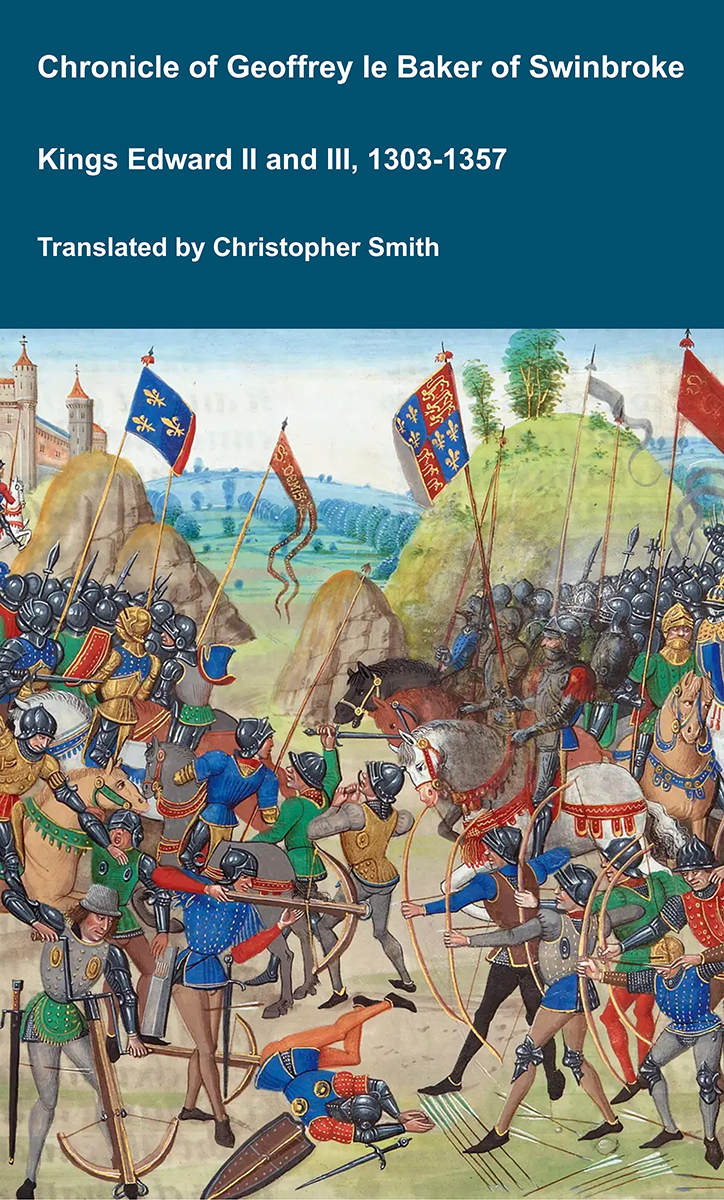
Chronicle of Geoffrey le Baker of Swinbroke
Baker was a secular clerk from Swinbroke, now Swinbrook, an Oxfordshire village two miles east of Burford. His Chronicle describes the events of the period 1303-1356: Gaveston, Bannockburn, Boroughbridge, the murder of King Edward II, the Scottish Wars, Sluys, Crécy, the Black Death, Winchelsea and Poitiers. To quote Herbert Bruce 'it possesses a vigorous and characteristic style, and its value for particular events between 1303 and 1356 has been recognised by its editor and by subsequent writers'. The book provides remarkable detail about the events it describes. Baker's text has been augmented with hundreds of notes, including extracts from other contemporary chronicles, such as the Annales Londonienses, Annales Paulini, Murimuth, Lanercost, Avesbury, Guisborough and Froissart to enrich the reader's understanding. The translation takes as its source the 'Chronicon Galfridi le Baker de Swynebroke' published in 1889, edited by Edward Maunde Thompson.
Available at Amazon in eBook and Paperback format.
On 27th January 1803 Anne Wood was born to Francis Lindley Wood 2nd Baronet (age 31) and Anne Buck Lady Wood. She married 29th March 1824 John Walbanke-Childers and had issue.

On 27th January 1803 Arthur Algernon Capell 6th Earl Essex was born to John Thomas Capell (age 34) and Caroline Paget (age 29). He married (1) 14th July 1825 his fourth cousin once removed Caroline Janetta Beauclerk Countess Essex, daughter of William Beauclerk 8th Duke St Albans and Maria Janetta Nelthorpe Duchess St Albans, and had issue (2) 3rd June 1863 his first cousin once removed Louisa Elizabeth Heneage Countess Essex (3) 3rd June 1863 his fifth cousin Louisa Caroline Elizabeth Boyle Countess Essex.
On 27th January 1809 Margaret Bruce Wentworth-Fitzwilliam was born to Charles Wentworth-Fitzwilliam 5th and 3rd Earl Fitzwilliam (age 22) and Mary Dundas (age 21). Coefficient of inbreeding 6.25%. She died aged less than one years old.
On 27th January 1825 Adelaide Horatia Seymour-Conway Countess Spencer was born to Horace Beauchamp Seymour-Conway (age 33) and Elizabeth Malet Palk (age 28). She married 1851 Frederick Spencer 4th Earl Spencer, son of George John Spencer 2nd Earl Spencer and Lavinia Bingham Countess Spencer, and had issue.
On 27th January 1832 Arthur Hughes was born to Edward Hughes (age 45). He married October 1855 Tryphena Foord and had issue.
On 27th January 1837 Reverend John Cæsar Hawkins 4th Baronet was born to John Cæsar Hawkins (age 31) and Louisa Georgiana Letitia Ricketts.
On 27th January 1839 George Alexander Duntze 4th Baronet was born to Reverend Samuel Henry Duntze (age 38).
On 27th January 1850 John Collier was born to Robert Collier 1st Baron Monkswell (age 32) and Isabella Rose Baroness Monkswell (age 35). He married (1) 30th June 1879 Marian "Mady" Huxley and had issue (2) 1889 Emma aka Ethel Huxley.
On 27th January 1859 Wilhelm Hohenzollern was born to Frederick III King Prussia (age 27) and Victoria Empress Germany Queen Consort Prussia (age 18) at Crown Prince's Palace, Berlin. He a grandson of Queen Victoria of the United Kingdom. He married (1) 27th February 1881 his fourth cousin Empress Auguste Viktoria Oldenburg, daughter of Frederick Christian Oldenburg II Duke Schleswig Holstein Sonderburg Augustenburg and Adelheid Hohenlohe Langenburg Duchess Schleswig Holstein Sonderburg Augustenburg, and had issue (2) 9th November 1922 Hermine Reuss.
On 27th January 1860 George Reresby Sitwell 4th Baronet was born to Sitwell Reresby Sitwell 3rd Baronet (age 40). He married 1886 Ida Emily Augusta Denison Lady Sitwell, daughter of William Henry Forester Denison 1st Earl Londesborough and Edith Somerset Countess Londesborough, and had issue.
On 27th January 1862 Edmund Byng 6th Earl Strafford was born to Francis Edmund Cecil Byng 5th Earl Strafford (age 27) and Florence Louisa Miles (age 22). He married 17th December 1894 Mary Elizabeth Colebrooke Countess Strafford, daughter of Thomas Edward Colebrooke 4th Baronet, and had issue.
On 27th January 1870 Florence Hamilton Davis Countess Howe was born to John Hagy Davis and Florence Chapman. She married 1919 Richard George Penn Curzon 4th Earl Howe, son of Richard William Penn Curzon Howe 3rd Earl Howe and Isabella Maria Katherine Anson Countess Howe.
On 27th January 1877 James Ernest Thorold 14th Baronet was born to John Henry Thorold 12th Baronet (age 34) and Alexandrina Henrietta Matilda Willoughby (age 32).
On 27th January 1884 Osbert Mordaunt 11th Baronet was born to Charles Mordaunt 10th Baronet (age 47) and Mary Louisa Cholmondeley Lady Massingham Parva (age 32).
On 27th January 1921 Maurice Victor Macmillan was born to Harold Macmillan 1st Earl Stockton (age 26) and Dorothy Evelyn Cavendish (age 20). He married 22nd August 1942 his half sixth cousin Katharine Margaret Alice Ormsby-Gore, daughter of George Arthur Ormsby-Gore 4th Baron Harlech and Beatrice Edith Mildred Gascoyne-Cecil Baroness Harlech, and had issue.
Henrici Quinti, Angliæ Regis, Gesta, is a first-hand account of the Agincourt Campaign, and subsequent events to his death in 1422. The author of the first part was a Chaplain in King Henry's retinue who was present from King Henry's departure at Southampton in 1415, at the siege of Harfleur, the battle of Agincourt, and the celebrations on King Henry's return to London. The second part, by another writer, relates the events that took place including the negotiations at Troye, Henry's marriage and his death in 1422.
Available at Amazon in eBook and Paperback format.
On 27th January 1949 Juliana Noel Countess Liverpool was born to Anthony Gerard Edward Noel 5th Earl of Gainsborough (age 25) and Mary Stourton Countess Gainsborough (age 23). She married 29th January 1970 her sixth cousin Edward Foljambe 5th Earl of Liverpool.
On 27th January 1393 Philip Artois Count of Eu (age 36) and Marie Valois I Duchess Auverge (age 18) were married. She by marriage Countess Eu. She the daughter of John Valois 1st Duke Berry (age 52) and Joanne Armagnac Duchess Berry. He the son of John "Sans Terre" Artois 1st Count of Eu and Isabeau Melun Countess Eu. They were second cousin once removed. He a great x 3 grandson of King Henry III of England.
On 27th January 1447 Richard Beauchamp 2nd Baron Beauchamp Powick (age 12) and Elizabeth Stafford (age 12) were married at Beauchamp's Court, Alcester. They were half fourth cousins.
On 27th January 1678 John Margetson (age 22) and Alice Caulfeild Baroness Carpenter (age 17) were married. His sister Anne Margetson (age 21) married her brother William Caulfeild 2nd Viscount Charlemont (age 23) six months later.
On 27th January 1721 Thomas Samwell 2nd Baronet (age 33) and Mary Clarke were married. They had a son and a daughter.
On 27th January 1729 Abel Walter Baron Abergavenny (age 28) and Jane Neville 4th Baroness Abergavenny (age 26) were married.
On 27th January 1776 Nigel Bowyer Gresley 7th Baronet (age 23) and Wilmot Gresley were married by which he acquired Drakelow Hall, Derbyshire. They were first cousins.
On 27th January 1812 Francis Hartwell 1st Baronet (age 54) and Louisa Aldridge (age 35) were married. They had a daughter.
On 27th January 1916 John Henry Montagu Manners 9th Duke Rutland (age 29) and Kathleen Tennant Duchess Rutland (age 21) were married. He the son of Henry John Brinsley Manners 8th Duke Rutland (age 63) and Violet Lindsay Duchess Rutland (age 59).
On 27th January 1937 Bernard Fitzalan 16th Duke of Norfolk (age 28) and Lavinia Mary Strutt Duchess Norfolk (age 20) were married. She by marriage Duchess Norfolk. She the daughter of Algernon Strutt 3rd Baron Belper (age 53) and Eva Isabel Countess Rosebery (age 44). He the son of Henry Fitzalan Howard 15th Duke of Norfolk and Gwendolen Constable-Maxwell Duchess Norfolk (age 60).
The Deeds of the Dukes of Normandy
The Gesta Normannorum Ducum [The Deeds of the Dukes of Normandy] is a landmark medieval chronicle tracing the rise and fall of the Norman dynasty from its early roots through the pivotal events surrounding the Norman Conquest of England. Originally penned in Latin by the monk William of Jumièges shortly before 1060 and later expanded at the behest of William the Conqueror, the work chronicles the deeds, politics, battles, and leadership of the Norman dukes, especially William’s own claim to the English throne. The narrative combines earlier historical sources with firsthand information and oral testimony to present an authoritative account of Normandy’s transformation from a Viking settlement into one of medieval Europe’s most powerful realms. William’s history emphasizes the legitimacy, military prowess, and governance of the Norman line, framing their expansion, including the conquest of England, as both divinely sanctioned and noble in purpose. Later chroniclers such as Orderic Vitalis and Robert of Torigni continued the history, extending the coverage into the 12th century, providing broader context on ducal rule and its impact. Today this classic work remains a foundational source for understanding Norman identity, medieval statesmanship, and the historical forces that reshaped England and Western Europe between 800AD and 1100AD.
Available at Amazon in eBook and Paperback format.
On 27th January 672 Pope Vitalian died.
On 27th January 992 Mathilde Carolingian Queen Consort Burgundy (age 49) died.
On 27th January 1443 John Tiptoft 1st Baron Tiptoft died. He was buried at St Andrew's Church, Enfield. His son John (age 15) succeeded 2nd Baron Tiptoft.
On 27th January 1471 John de Lisle 7th Baron Lisle (age 64) died. His half brother Nicholas succeeded 8th Baron Lisle.
On 27th January 1501 Bishop Thomas Langton died of plague. He was buried in a marble tomb within 'a very fair chapel' which he had built south of the lady-chapel in Winchester Cathedral [Map].
On 27th January 1665 William Cunningham 9th Earl Glencairn (age 55) died.
On 27th January 1665 Margaret Montgomerie Countess Glencairn (age 47) died.
On 27th January 1669 Gaspar de Crayer (age 84) died.
On 27th January 1670 Anne Clarges Duchess Albermarle (age 50) died.
On 27th January 1681 Nicholas Leke 2nd Earl Scarsdale (age 69) died. His son Robert (age 26) succeeded 3rd Earl Scarsdale, 3rd Baron Deincourt of Sutton, 3rd Baronet Leke of Sutton in Derbyshire. Mary Lewis Countess Scarsdale (age 23) by marriage Countess Scarsdale.
Chronicle of a Bourgeois of Valenciennes
Récits d’un bourgeois de Valenciennes aka The Chronicle of a Bourgeois of Valenciennes is a vivid 14th-century vernacular chronicle written by an anonymous urban chronicler from Valenciennes in the County of Hainaut. It survives in a manuscript that describes local and regional history from about 1253 to 1366, blending chronology, narrative episodes, and eyewitness-style accounts of political, military, and social events in medieval France, Flanders, and the Low Countries. The work begins with a chronological framework of events affecting Valenciennes and its region under rulers such as King Philip VI of France and the shifting allegiances of local nobility. It includes accounts of conflicts, sieges, diplomatic manoeuvres, and the impact of broader struggles like the Hundred Years’ War on urban life in Hainaut. Written from the perspective of a burgher (bourgeois) rather than a monastery or royal court, the chronicle offers a rare lay viewpoint on high politics and warfare, reflecting how merchants, townspeople, and civic institutions experienced the turbulence of the 13th and 14th centuries. Its narrative style combines straightforward reporting of events with moral and civic observations, making it a valuable source for readers interested in medieval urban society, regional politics, and the lived experience of war and governance in pre-modern Europe.
Available at Amazon in eBook and Paperback format.
On 27th January 1689 Thomas Culpepper 2nd Baron Culpepper (age 53) died. His brother John (age 49) succeeded 3rd Baron Culpeper of Thoresway in Lincolnshire.
On 27th January 1689 Henry Beaumont 2nd Baronet (age 50) died. His son Thomas (age 25) succeeded 3rd Baronet Beaumont of Stoughton Grange in Leicestershire.
On 27th January 1697 Thomas Blount 1st Baronet (age 47) died. His son Thomas (age 27) succeeded 2nd Baronet Blount of Tittenhanger.
On 27th January 1726 Nicholas Morice 2nd Baronet (age 45) died. He was buried at Werrington, Devon on 7th February 1726 . His son William (age 19) succeeded 3rd Baronet Morice of Werrington in Devon.
On 27th January 1726 Philip Stanhope 3rd Earl Chesterfield (age 52) died. His son Philip (age 31) succeeded 4th Earl Chesterfield, 4th Baron Stanhope of Shelford in Nottinghamshire and inherited Boughton aka Bocton Place, Kent [Map].


On 27th January 1740 Louis Henri Bourbon Condé Duke Bourbon (age 47) died.
On 27th January 1753 William Napier 4th Baronet (age 53) died. His brother Gerard (age 52) succeeded 5th Baronet Napier of Middle Marsh in Dorset.
On 27th January 1765 Dean Edward Townshend (age 45) died in Bath, Somerset [Map].
On 27th January 1781 Kenneth Mackenzie 1st Earl Seaforth (age 37) died at sea whilst travelling with his regiment the 78th Seaforth (Highland) Regiment, serving as its Lieutenant Colonel Commandant. He was buried at sea. Earl Seaforth extinct.
On 27th January 1784 Amelia Darcy 12th Baroness Darcy 9th Baroness Conyers (age 29) died. Her son George (age 8) succeeded 13th Baron Darcy of Knayth, 10th Baron Conyers.
On 27th January 1794 Elizabeth Cuffe 1st Countess Longford (age 74) died. Her grandson Thomas (age 19) succeeded 2nd Earl Longford.
William of Worcester's Chronicle of England
William of Worcester, born around 1415, and died around 1482 was secretary to John Fastolf, the renowned soldier of the Hundred Years War, during which time he collected documents, letters, and wrote a record of events. Following their return to England in 1440 William was witness to major events. Twice in his chronicle he uses the first person: 1. when writing about the murder of Thomas, 7th Baron Scales, in 1460, he writes '… and I saw him lying naked in the cemetery near the porch of the church of St. Mary Overie in Southwark …' and 2. describing King Edward IV's entry into London in 1461 he writes '… proclaimed that all the people themselves were to recognize and acknowledge Edward as king. I was present and heard this, and immediately went down with them into the city'. William’s Chronicle is rich in detail. It is the source of much information about the Wars of the Roses, including the term 'Diabolical Marriage' to describe the marriage of Queen Elizabeth Woodville’s brother John’s marriage to Katherine, Dowager Duchess of Norfolk, he aged twenty, she sixty-five or more, and the story about a paper crown being placed in mockery on the severed head of Richard, 3rd Duke of York.
Available at Amazon in eBook and Paperback format.

On 27th January 1816 Admiral Samuel Hood 1st Viscount Hood (age 91) died. His son Henry (age 62) succeeded 2nd Viscount Hood of Whitley in Warwickshire, 2nd Baronet Hood of Catherington. Jane Wheler Viscountess Hood (age 61) by marriage Viscountess Hood of Whitley in Warwickshire.
On 27th January 1818 John Hamilton 1st Marquess Abercorn (age 61) died. His grandson James (age 7) succeeded 2nd Marquess Abercorn, 10th Earl Abercorn.
On 27th January 1822 Lucy Courtenay Countess Lisburne (age 51) died.
On 27th January 1824 Margaret Caroline Leveson-Gower Countess Carlisle died.
On 27th January 1827 Bishop Edward Legge (age 71) died.
On 27th January 1828 Jacob Pleydell-Bouverie 2nd Earl Radnor (age 77) died. His son William (age 48) succeeded 3rd Earl Radnor, 4th Viscount Folkestone, 4th Baron Longford, 6th Baronet Bouverie of St Catherine Cree Church in London. Judith St John-Mildmay Countess Radnor (age 37) by marriage Countess Radnor.


On 27th January 1836 Princess Wilhelmine Baden (age 47) died.

On 27th January 1837 Nathaniel Curzon 2nd Baron Scarsdale (age 84) died. His son Nathaniel (age 56) succeeded 3rd Baron Scarsdale, 7th Baronet Curzon of Kedleston in Derbyshire, 7th Baronet Curzon of Nova Scotia.
On 27th January 1852 Robert Graham 8th Baronet (age 82) died. His son Edward (age 32) succeeded 9th Baronet Graham of Esk in Cumberland

On 27th January 1857 Elizabeth Egerton Lady Broughton died at Hoole Hall, Cheshire.
Henrici Quinti, Angliæ Regis, Gesta, is a first-hand account of the Agincourt Campaign, and subsequent events to his death in 1422. The author of the first part was a Chaplain in King Henry's retinue who was present from King Henry's departure at Southampton in 1415, at the siege of Harfleur, the battle of Agincourt, and the celebrations on King Henry's return to London. The second part, by another writer, relates the events that took place including the negotiations at Troye, Henry's marriage and his death in 1422.
Available at Amazon in eBook and Paperback format.
On 7th January 1866 or 27th January 1866 John Gibson (age 75) died at Rome, Italy [Map]. He bequeathed the contents of his studio, a large selection of his works and a large sum of money to the Royal Academy.
On 27th January 1867 Elizabeth Fortescue Countess Devon (age 65) died.
On 27th January 1870 Captain Edward Cecil Bishopp 12th Baronet (age 43) died. Baronet Bishopp of Parham in Sussex extinct.
On 27th January 1870 George Hamilton-Gordon 6th Earl Aberdeen (age 28) drowned. Travelling from Boston to Melbourne on the Hera, Lord Aberdeen was washed overboard during a violent storm and drowned. His brother John (age 22) succeeded 7th Earl Aberdeen.
On 27th January 1874 Andrew St John 15th Baron St John (age 62) died. His son St Andrew (age 33) succeeded 16th Baron St John of Bletso, 13th Baronet St John of Woodford in Northamptonshire.
On 27th January 1886 John Rous 2nd Earl Stradbroke (age 91) died. His son George (age 23) succeeded 3rd Earl Stradbroke, 3rd Viscount Dunwich, 8th Baronet Stradbrooke of Henham in Suffolk.
On 27th January 1892 Georgiana Tredcroft Lady Watson-Copley (age 65) died.
On 27th January 1899 Montague Peregrine Bertie 11th Earl Lindsey (age 83) died. His son Montague (age 37) succeeded 12th Earl Lindsey. Millicent Cox Countess Lindsey (age 36) by marriage Countess Lindsey.
On 27th January 1918 Reverend William Greenwell (age 97) died unmarried at his home 27 South Bailey, Durham.
On 27th January 1922 Arthur John Fludyer 5th Baronet (age 77) died. Baronet Fludyer extinct.
This is a translation of the 'Memoires of Jacques du Clercq', published in 1823 in two volumes, edited by Frederic, Baron de Reissenberg. In his introduction Reissenberg writes: 'Jacques du Clercq tells us that he was born in 1424, and that he was a licentiate in law and a counsellor to Philip the Good, Duke of Burgundy, in the castellany of Douai, Lille, and Orchies. It appears that he established his residence at Arras. In 1446, he married the daughter of Baldwin de la Lacherie, a gentleman who lived in Lille. We read in the fifth book of his Memoirs that his father, also named Jacques du Clercq, had married a lady of the Le Camelin family, from Compiègne. His ancestors, always attached to the counts of Flanders, had constantly served them, whether in their councils or in their armies.' The Memoires cover a period of nineteen years beginning in in 1448, ending in in 1467. It appears that the author had intended to extend the Memoirs beyond that date; no doubt illness or death prevented him from carrying out this plan. As Reissenberg writes the 'merit of this work lies in the simplicity of its narrative, in its tone of good faith, and in a certain air of frankness which naturally wins the reader’s confidence.' Du Clercq ranges from events of national and international importance, including events of the Wars of the Roses in England, to simple, everyday local events such as marriages, robberies, murders, trials and deaths, including that of his own father in Book 5; one of his last entries.
Available at Amazon in eBook and Paperback format.
On 27th January 1923 Walter Henry James 2nd Baron Northbourne (age 76) died. His son Walter (age 53) succeeded 3rd Baron Northbourne of Betteshanger in Kent and Jarrow Grange in County Durham, 4th Baronet James of Langley Hall and Denford Court in Berkshire.
On 27th January 1925 Francis Grenfell 1st Baron Grenfell (age 83) died. His son Pascoe (age 19) succeeded 2nd Baron Grenfell of Kilvey in Glamorganshire.
On 27th January 1931 Cecil Lister-Kaye 4th Baronet (age 77) died. His son Kenelm (age 38) succeeded 5th Baronet Lister-Kaye of Grange in Yorkshire.
On 27th January 1932 Charles Frederick Cavendish 5th Baron Waterpark (age 48) died unmarried. Memorial at St Cuthbert's Church, Doveridge [Map]. His second cousin Henry (age 55) succeeded 6th Baron Waterpark, 7th Baronet Cavendish of Doveridge Hall.
Charles Frederick Cavendish 5th Baron Waterpark: On 11th May 1883 he was born to Henry Anson Cavendish 4th Baron Waterpark and Emily Stenning Baroness Waterpark.
Henry Sheppard Hart Cavendish 6th Baron Waterpark: On 18th May 1876 he was born to Captain William Thomas Cavendish. On 26th November 1948 Henry Sheppard Hart Cavendish 6th Baron Waterpark died. His nephew Frederick succeeded 7th Baron Waterpark, 8th Baronet Cavendish of Doveridge Hall.
On 27th January 1952 Fanny Ward aka Buchanan (age 79) died.
On 27th January 1953 Charles Michael Wentworth Noel-Hill 9th Baron Berwick (age 55) died. Baron Berwick of Attingham in Shropshire extinct.
On 27th January 1965 William Craven 6th Earl Craven (age 47) died. His son Thomas (age 7) succeeded 7th Earl Craven in Yorkshire, 7th Viscount Uffington, 13th Baron Craven of Hamstead Marshall in Berkshire.
On 27th January 1974 Edward Louis Spears 1st Baronet (age 87) died at the Heatherwood Hospital, Ascot. He was buried in the churchyard of St Michael the Archangel Church, Warfield. Baronet Spears of Warfield in Berkshire extinct.