


Text this colour is a link for Members only. Support us by becoming a Member for only £3 a month by joining our 'Buy Me A Coffee page'; Membership gives you access to all content and removes ads.
Text this colour links to Pages. Text this colour links to Family Trees. Place the mouse over images to see a larger image. Click on paintings to see the painter's Biography Page. Mouse over links for a preview. Move the mouse off the painting or link to close the popup.
27 Jun is in June.
1497 Battle of Blackheath aka Deptford Bridge
1503 Margaret Tudor's Journey to Scotland
1630 Baptism of future Charles II
Events on the 27th June
On 27th June 678 Pope Agatho was appointed Pope.
On 27th June 1194 Sancho "Wise" King Navarre (age 62) died at Pamplona [Map]. His son Sancho (age 40) succeeded VII King Navarre.
On 27th June 1241 Gilbert Marshal 4th Earl Pembroke (age 44) was killed in a tournament at Ware, Hertfordshire [Map]. He was buried at Temple Church, London [Map] next to his father. His brother Walter (age 42) succeeded 5th Earl Pembroke; he had also attended the tournament. The King King Henry III of England (age 33) had expressly forbidden the tournament leading to anger at his disobeying the King's orders.
Chronica Majora. "Whilst the mutability of time was thus sporting with and deluding the world with its variable occurrences, Earl Gilbert, marshal (age 44), had, with some other nobles, arranged a sort of tilting-match, called by some adventure," but wliich might rather be called a "misadventure;" they tried their strength about a crossbow-shot from Hertford [Map]; where he by his skill in knightly tactics, gained for himself the praise of military science, and was declared by all, considering his small size of body, to have justly distinguished himself for his valour. This was what the said earl chiefly aimed at; for he was, in the first place, destined to clerical orders, and was reported to be weak and unskilful in warlike exercises. He was, at this tournament, mounted on a noble horse, an Italian charger, to which he was not accustomed, accoutred in handsome armour, and surrounded by a dense body of soldiers, who soon afterwards, however, left him, and dispersed, intent on gain. Whilst the earl, then, was amusing himself by checking his horse at full speed, and anon goring his sides with his sharp spurs, to urge him to greater speed, and, as the case required, suddenly drew rein, both the reins suddenly broke off at the junction with the bit. By this accident the horse became unmanageable, and tossing up his head, struck his rider a violent blow on the breast. Some there were who imhesitatingly asserted that the bridle had been treacherously cut by some jealous person, in order that, being thus left at the mercy of his horse, he might be dashed to pieces and killed; or, at least, that he might be taken by his adversaries at will. Moreover, he had dined, and was nearly blinded by the heat, dust, and sweat, and his head was oppressed by the weight of his heavy helmet. His horse, too, could not be restrained by him, or any one else; but he, at the same time, fainted away, began to totter in his saddle, and soon after fell, half-dead, from his horse-with one foot, however, fixed in the stirrup; and in this manner he was dragged some distance over the field, by which he suffered some internal injuries, which caused his death. He expired in the evening of the 27th of June, amidst the deep and loudly-expressed sorrow of those who beheld him, at a house [Map] of the monks of Hertford. When he was about to breathe his last, having just received the viaticum, he made a bequest to the church of the blessed Virgin at Hertford, for the redemption of his soul. His body was afterwards opened, when his liver was discovered to be black and broken, from the force of the blows he had received. His entrails were buried in the said church, before the altar of St. Mary, to whom he had committed his spirit when dying. On the following day, his body-preceded by his brother (age 42), and accompanied by the whole of his family - was carried to London, to be buried [Map] near his father. At this same tournament, also, was killed one of the earl's retinue, named Robert de Saye, and his bowels were buried with those of the earl. Many other knights and men-at-arms were also wounded and seriously injured with maces, at this same tournament, because the jealousy of many of the parties concerned had converted the sport into a battle. The affairs of the cross and the interests of the Holy Land suffered great loss by the death of the said earl, for he had intended to set out for Jerusalem in the next month, without fail, having collected money from all in the country who had assumed the cross; for permission to do which, he had paid two hundred marks to the pope; following the prudent example of Earl Richard (age 32).
 Become a Member via our 'Buy Me a Coffee' page to read complete text.
On 27th June 1296 Floris Gerulfing V Count Holland (age 42) was killed. His son John (age 12) succeeded I Count Holland.
Floris has transferred his allegiance to France inviting the enmity of King Edward I of England (age 57) who relied on him to support the valuable English wool trade. Edward conspired with Guy of Flanders to kidnap Floris. Floris was captured during a hunting party and taken to Muiderslot castle. Concerned about their safety the kidnappers attempted to take Floris to a safer location during which jounrney they were attacked by an angry mob of local peasants. Floris was killed.
On 27th June 1301 King Edward I (age 62) visited Horton Castle, Northumberland [Map].
From 27th June 1369 to 1371 Bishop Thomas de Brantingham was appointed Lord Treasurer to King Edward III of England (age 56).
On 27th June 1374 Rupert King Germany (age 22) and Elisabeth Hohenzollern (age 16) were married at Amberg. She the daughter of Frederick Hohenzollern V Burgrave Nuremburg (age 41).
On 27th June 1458 Alfonso V King Aragon (age 62) died. His son Ferdinand (age 35) succeeded I King Naples. Isabella Clermont Queen Consort Naples (age 34) by marriage Queen Consort Naples. His brother John (age 59) succeeded II King Aragon.
On 27th June 1461 Thomas Fitzalan 10th or 17th Earl of Arundel (age 11) was appointed Knight of the Bath.
After 27th June 1461, the time of his coronation, King Edward IV of England (age 19) created his brother George (age 11) 1st Duke Clarence.
Chronicle of Robert Fabyan. 27th June 1461. And upon the morne, beynge Sunday & seynt Peters daye, he was with great tryumphe, of the archebysshop of Cautorbury, crowned and enoyntyd before ye hygh aulter of seynt Peters churche of Westmynster. And after this solempnyzacion of the crownynge of the kynge, with also the sumptuous & honorable feest holden in Westmynster all1 was fynysshed, the kynge soone after creatyd George (age 11) his brother duke of Clarence. And in the moneth of luly folowynge, at ye stadarde in Chepe, the hande of a seruaunt of the kynges, callyd lohn Dauy, was stryken of, for that he hadde stryken a man within the palays of Westmynster.
Note 1. Westminster hall. edit. 1542. 1559.
Warkworth's Chronicle. 27th June 1461.... at the coronacyone1 of the forseyde Edwarde, he create and made dukes his two brythir, the eldere George (age 11) Duke of Clarence, and his yongere brothir Richard (age 8) Duke of Gloucetre; and the Lord Montagu (age 30)2, the Earl of Warwick (age 32)'s brothere, the Earl of Northumberlonde; and one William Stafford squiere, Lord Stafforde of Southwyke; and Sere Herbard (age 38), Lorde Herbard, and after Lorde Earl of Penbroke3; and so the seide Lorde Stafforde (age 22) was made Earl of Devynschire4; the Lorde Gray Ryffyne (age 44), Earl of Kent6; the Lorde Bourchyer (age 57), Earl of Essex; the Lorde Jhon of Bokyngham (age 33), the Earl of Wyltschyre5; Sere Thomas [Walter] Blount (age 45)7, knyghte, Lord Mont[joy]; Sere Jhon Hawarde, Lorde Hawarde (age 36)8; William Hastynges (age 30) he made Lorde Hastynges and grete Chamberlayne; and the Lorde Ryvers; Denham squyere, Lorde Dynham; and worthy as is afore schewed; and othere of gentylmen and yomenne he made knyghtes and squyres, as they hade desserved.
Note 1. At the coronacyone. King Edward was crowned in Westminster Abbey, on the 29th of June 1461. Warkworth's first passage is both imperfect and incorrect, and would form a very bad specimen of the value of the subsequent portions of his narrative; yet we find it transferred to the Chronicle of Stowe. It must, however, be regarded rather as a memorandum of the various creations to the peerage made during Edward's reign, than as a part of the chronicle. Not even the third peerage mentioned, the Earldom of Northumberland, was conferred at the Coronation, but by patent dated 27 May 1464: and the only two Earldoms bestowed in Edward's first year (and probably at the Coronation) were, the Earldom of Essex, conferred on Henry Viscount Bourchier, Earl of Eu in Normandy, who had married the King's aunt, the Princess Isabel of York; and the Earldom of Kent, conferred on William Neville, Lord Fauconberg, one of King Edward's generals at Towton. The former creation is mentioned by Warkworth lower down in his list; the latter is omitted altogether. - J.G.N.
Note 2. The Lord Montagu. And then Kyng Edward, concidering the greate feate doon by the said Lord Montagu, made hym Earl of Northumberlond; and in July next folowyng th'Earl of Warwyk, with th'ayde of the said Earl of Northumberland, gate agayn the castell of Bamborugh, wheryn was taken Sir Raaf Gray (age 29), which said Ser Raaf was after behedid and quartred at York. Also, in this yere, the first day of May, the Kyng wedded Dame Elizabeth Gray (age 24), late wif unto the lord Gray of Groby, and doughter to the Lord Ryvers." - The London Chronicle, MS. Cotton. Vitell. A. xvi. fol. 126, ro. The MS. of the London Chronicle, from which Sir Harris Nicolas printed his edition, does not contain this passage. It is almost unnecessary to remark the chronological incorrectness of the above, but it serves to show how carelessly these slight Chronicles were compiled. Cf. MS. Add. Mus. Brit. 6113, fol. 192, rº. and MS. Cotton. Otho, B. XIV. fol. 221, ro.
Note 3. Lord Earl of Pembroke. William Lord Herbert of Chepstow, the first of the long line of Herbert Earls of Pembroke, was so created the 27th May 1468. His decapitation by the Duke of Clarence at Northampton in 1469, is noticed by Warkworth in p. 7.-J.G.N.
Note 4. Earl of Devynschire. Humphery Stafford, created Baron Stafford of Southwick by patent 24th April 1464, was advanced to the Earldom of Devon 7th May 1469; but beheaded by the commons at Bridgwater before the close of the same year, as related by Warkworth, ubi supra. - J.G.N.
Note 5. Earl of Wyltschyre. John Stafford, created Earl of Wiltshire, 5th Jan. 1470; he died in 1473.—J.G.N.
Note 6."The Lorde Gray Ryffyne, Earl of Kent". The Earl of Kent, of the family of Neville, died without male issue, a few months after his elevation to that dignity; and it was conferred on the 30th May 1465, on Edmund Lord Grey de Ruthyn, on occasion of the Queen's coronation. He was cousin-german to Sir John Grey, of Groby, the Queen's first husband. On the same occasion the Queen's son Sir Thomas Grey (age 6) was created Marquess of Dorset; her father Richard Wydevile (age 56) lord Ryvers was advanced to the dignity of Earl Ryvers; and her brother Anthony (age 21) married to the heiress of Scales, in whose right he was summoned to Parliament as a Baron. - J.G.N.
Note 7.Sere Thomas Blount. This should be Walter, created Lord Montjoy 20th June 1465; he died in 1474.-J.G.N.
Note 8. Sere Jhon Hawarde, Lord Hawarde. John Howard 1st Duke of Norfolk. This peerage dates its origin, by writ of summons to Parliament, during the short restoration of Henry VI. in 1470, a circumstance more remarkable as "evidence exists that he did not attach himself to the interest of that Prince, being constitued by Edward, in the same year, commander of his fleet." See Sir Harris Nicolas's memoir of this distinguished person (afterwards the first Duke of Norfolk) in Cartwright's History of the Rape of Bramber, p. 189.-J.G.N.
Become a Member via our 'Buy Me a Coffee' page to read complete text.

On 27th June 1462 Louis XII King France was born to Charles Valois Duke Orléans (age 67) and Mary La Marck Duchess Orléans. Coefficient of inbreeding 2.19%.
Chronicles of London Vitellius A XVI. And the same day [27th June 1497] was the lord Awdley (age 34) had from the Tower to Westm'. the Axe of the Tower borne byfore hym. And there in the White hall a-Reyned and adiuged; and that after none drawen from Westm' vnto Newgate, and there Remayned all nyght. And vpon Weddensday in the mornyng, aboute IX of the Clok, drawen from the said Gaole of Newgate [Map] vnto the Tower hill wt a cote armour vpon hym of papir, all to torne; and there his hede stryken off: vpon whos Soule, and all christen god haue mercy! amen! And after his hede set vpon the Brigge. The cause of Rysyng of those Comons was after the Comon ffame for the graunt of swich money as was graunted at the last parliament, for the which the said Comons put in blame the Archbisshop of Caunterbury, my lord Cardynall, also the Archebisshop of Durham, the Bisshop of Bathe, Sir Reynold Bray and Sir Thomas Lovell, knyghtes, wt other ; which persones their myendes was to have distroyed; this was their owteward Colour, what their Inward intent was God knoweth, but what hath ensued of like besynesse is euydent, as by Jak Straw, Jak Cade, and other.
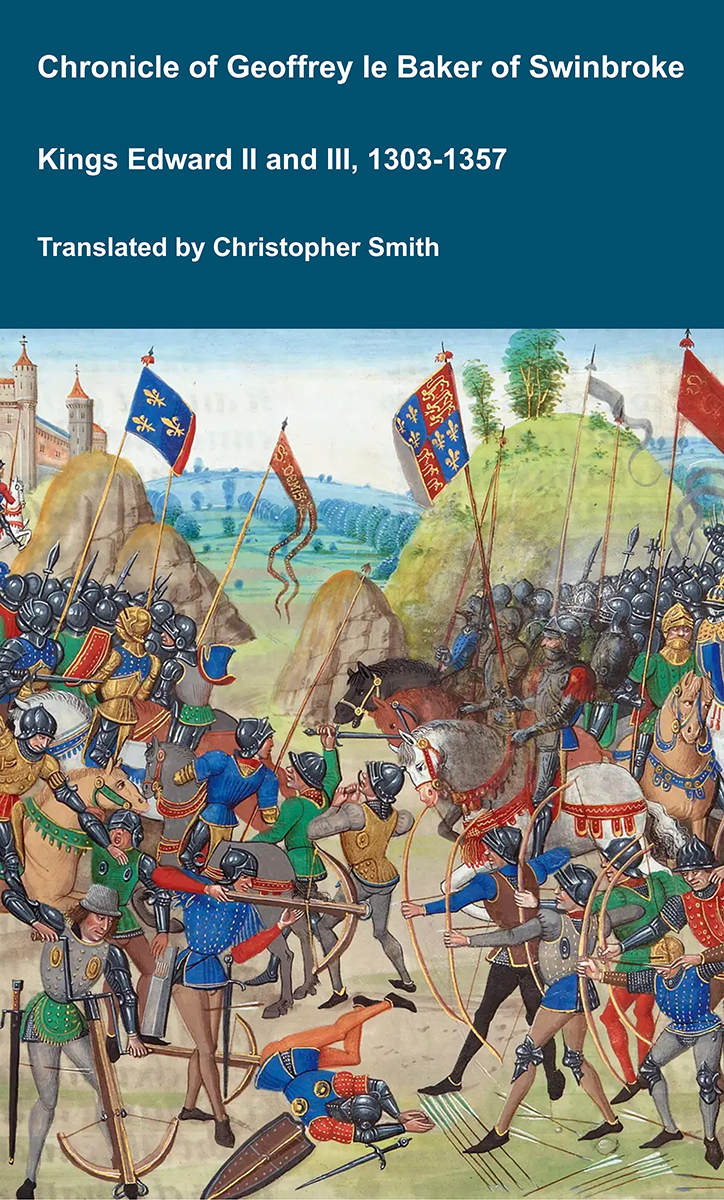
All About History Books
The Chronicle of Geoffrey le Baker of Swinbroke. Baker was a secular clerk from Swinbroke, now Swinbrook, an Oxfordshire village two miles east of Burford. His Chronicle describes the events of the period 1303-1356: Gaveston, Bannockburn, Boroughbridge, the murder of King Edward II, the Scottish Wars, Sluys, Crécy, the Black Death, Winchelsea and Poitiers. To quote Herbert Bruce 'it possesses a vigorous and characteristic style, and its value for particular events between 1303 and 1356 has been recognised by its editor and by subsequent writers'. The book provides remarkable detail about the events it describes. Baker's text has been augmented with hundreds of notes, including extracts from other contemporary chronicles, such as the Annales Londonienses, Annales Paulini, Murimuth, Lanercost, Avesbury, Guisborough and Froissart to enrich the reader's understanding. The translation takes as its source the 'Chronicon Galfridi le Baker de Swynebroke' published in 1889, edited by Edward Maunde Thompson. Available at Amazon in eBook and Paperback.
Chronicles of London Vitellius A XVI. Ye haue hard before how that the Smyth, Capitayn of the forsaid Comons of Cornewaill, wer taken at the blak heth wt many moo, as the lord Awdley, flammok, and many other; which said Smyth and fflammok wer vpon the Monday, beyng the XXVJ day of Juyn, Arayned in the White Hall at Westmynster, and there adiuged; and vpon the morow, Tuesday [27th June 1497] folowyng, the said Smyth and fflammok wer drawen from the Tower through the Citie vnto Tiborn; and ther hanged till they wer dede, and after stryken downe, and heded and after quarterid.
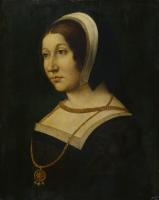
On 27th June 1503 Margaret Tudor Queen Scotland (age 13) left Richmond Palace [Map] for Scotland accompanied by Thomas Boleyn 1st Earl Wiltshire and Ormonde (age 26), Edward Howard (age 27), Richard Neville 2nd Baron Latimer of Snape (age 35) and Ralph Ogle 3rd Baron Ogle (age 34). During her journey she stayed at Collyweston, Northamptonshire [Map] and York [Map].

On 27th June 1515 Cardinal Reginald Pole (age 15) graduated Magdalene College aka Buckingham.
On 14th August 1539 Ralph Sacheverell (age 33) died at Ratcliffe on Soar, Nottinghamshire [Map]. He was buried at Holy Trinity Church Ratcliffe on Soar [Map].
On 27th June 1538 Cecilia Durance (age 30) died. She was buried at Holy Trinity Church Ratcliffe on Soar [Map].
Decorated Gabled Headress. Lancastrian Esses Collar with Big Esses with Tudor Rose Pendant. Possibly second hand monuments. Gabled Headress.


Ralph Sacheverell: Ralph Sacheverell and Anna Unknown were married. Ralph Sacheverell and Cecilia Durance were married. In 1506 he was born to Richard Sacheverell Baron Hungerford, Botreaux and Moleyns and Mary Hungerford Baroness Hastings, 4th Baroness Hungerford, 5th Baroness Botreaux and 2nd Baroness Moleyns at Ratcliffe on Soar, Nottinghamshire [Map].
Cecilia Durance: In 1508 she was born to John Durance at Isham, Northamptonshire.
On 27th June 1550 Charles IX King France was born to King Henry II of France (age 31) and Catherine Medici Queen Consort France (age 31).


Chronicle of Greyfriars. 27th June 1551. And the xxvij. day of the same monyth the byshoppe of Wynchester (age 37) that was than (John Ponetc ) was devorsyd from hys wyffe in Powlles, the whyche was a bucheres wyff of Nottynggam, and gave hare husbande a sartyne mony a yere dureynge hys lyffe as it was jugydde by the lawe.
Note c. The name is left blank in the manuscript. This passage is remarkable as a fuller statement of the same matter of which a brief notice occurs in Machyn's Diary, p. 8, and which was only assigned by strong presumption to bishop Ponet. See the note, ibid, p. 320.
Henry Machyn's Diary. 27th June 1552. The xxvij day of Juin the Kyng's (age 14) mageste removed from Grenwyche [Map] by water unto Pottney [Map], and ther [he] toke ys horsse unto Hamtun [Map] cowrte one ys progres, and ther lyvyng ther x days, and so to Ottland [Map], and to Gy[lford] [Map].
Note. The king took horse on his progress. King Edward's Diary, (May 23, 1551) gives the following enumeration of the bands of men of arms appointed at this time to accompany him on his progress:
Lord Treasure 30 Earl of Rutland 15 Lord Cobham 20
Lord Great Master 25 Earl of Huntingdon 25 Lord Warden 20
Lord Privy Seal 30 Earl of Pembroke 50 Mr. Vice-chamberlain 15
Duke of Suffolk 25 Lord Admiral 15 Mr. Sadler 15
Earl of Warwick 25 Lord Darcy 30 Mr. Sydney 15
Afterwards, on the 22d of June, it was agreed that the bands appointed to Mr. Sidney, Mr. Vice-chamberlain, Mr. Hobby, and Mr. Sadler, should not be furnished, but left off. Again, when the king was in Sussex, on the 24th July, "because the number of bands that went with me this progress made the train great, it was thought good they should be sent home, save only 150 which were picked out of all the bands. This was because the train was thought to be near 4000 horse, which were enough to eat up the country, for there was little meadow or hay all the way as I went."
Become a Member via our 'Buy Me a Coffee' page to read complete text.


Henry Machyn's Diary. 27th June 1560. The xxvij day of June the penters [painters] whent in hand with the yerle of Huntyngtun('s) (deceased) berehyng.
On 27th June 1596 William Hervey 1st Baron Hervey (age 31) was knighted at Cádiz by Robert Devereux 2nd Earl Essex (age 30) at the Sack of Cádiz.


On 27th June 1598 Bridget Paston died. Monument in Church of St Mary the Virgin, Tittleshall [Map]. Arched niche with kneeling effigy at prie-dieu which carries the inscription. Flanking pilasters with partly painted carved trophies surrounded by ribbon-work. Carved achievement in strapwork surround above and eight kneeling weepers below.
Armorials top left  Coke Arms and top right
  Paston Arms.
Above the monument an amorial Quarterly: Coke Arms, Crispin, Folkard and Pawe impaling Quarterly of Seventeen with 1 Paston Arms, 2 Peche 3 Leach 4 Somerton 5 Peyver 6 Walcot 7 Berry 8 Craven 9 Kerdeston 10 Wachesam or Sotherton 11 Hethersett 12 Charles 13 Tatshall 14 Hengrave 15 Gerbridge 16 Mautby 17 Basinges?.


Bridget Paston: she was born to John Paston. On 13th August 1582 Edward Coke and she were married.
On 27th June 1630 the future Charles II was baptised by Archbishop William Laud (age 56) at Chapel Royal, St James's Palace. Louis XIII King France (age 28) and Marie de Medici Queen Consort France (age 55) were godparents.
Robert Kerr 1st Earl Ancram (age 52) was created 1st Earl Ancram.
John Evelyn's Diary. 10th June 1640. London, and especially the Court, were at this period in frequent disorders, and great insolences were committed by the abused and too happy City: in particular, the Bishop of Canterbury's (age 66) Palace [Map] at Lambeth was assaulted by a rude rabble from Southwark, Surrey [Map], my Lord Chamberlain (age 55) imprisoned and many scandalous libels and invectives scattered about the streets, to the reproach of Government, and the fermentation of our since distractions: so that, upon the 25th of June, I was sent for to Wotton, Surrey [Map], and the 27th after, my father's (age 53) indisposition augmenting, by advice of the physicians he repaired to the Bath, Somerset [Map].


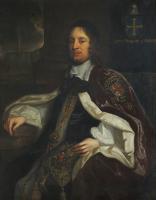
John Evelyn's Diary. 10th June 1647. We concluded about my marriage, in order to which I went to St. Germains, where his Majesty (age 17), then Prince of Wales, had his court, to desire of Dr. Earle (age 46), then one of his chaplains (since Dean of Westminster Abbey, Clerk of the Closet, and Bishop of Salisbury), that he would accompany me to Paris, which he did; and, on Thursday, 27th of June 1647, he married us in Sir Richard Browne's (age 42) chapel, between the hours of eleven and twelve, some few select friends being present. And this being Corpus Christi feast, was solemnly observed in this country; the streets were sumptuously hung with tapestry, and strewed with flowers.
In June 1660 King Charles II of England Scotland and Ireland (age 30) rewarded those who supported his Restoration ...
6th William Wray 1st Baronet (age 35) and John Talbot of Lacock (age 29) were knighted.
7th Geoffrey Palmer 1st Baronet (age 62) was created 1st Baronet Palmer of Carlton in Northampton
7th Orlando Bridgeman 1st Baronet (age 54) was created 1st Baronet Bridgeman of Great Lever in Lancashire.
7th John Langham 1st Baronet (age 76) was created 1st Baronet Langham of Cottesbrooke in Northamptonshire.
11th Henry Wright 1st Baronet (age 23) was created 1st Baronet Wright of Dagenham. Ann Crew Lady Wright by marriage Lady Wright of Dagenham.
13th Nicholas Gould 1st Baronet was created 1st Baronet Gould of the City of London.
14th Thomas Allen 1st Baronet (age 27) was created 1st Baronet Allen of Totteridge in Middlesex.
18th Thomas Cullum 1st Baronet (age 73) was created 1st Baronet Cullum of Hastede in Suffolk.
19th Thomas Darcy 1st Baronet (age 28) was created 1st Baronet Darcy of St Osith's.
22nd Robert Cordell 1st Baronet was created 1st Baronet Cordell of Long Melford.
22nd John Robinson 1st Baronet (age 45) was created 1st Baronet Robinson of London. Anne Whitmore Lady Robinson (age 48) by marriage Lady Robinson of London.
25th William Bowyer 1st Baronet (age 47) was created 1st Baronet Bowyer of Denham Court. Margaret Weld Lady Bowyer (age 43) by marriage Lady Bowyer of Denham Court.
25th Thomas Stanley 1st Baronet (age 63) was created 1st Baronet Stanley of Alderley in Cheshire.
26th Jacob Astley 1st Baronet (age 21) was created 1st Baronet Astley of Hill Morton.
27th William Wray 1st Baronet was created 1st Baronet Wray of Ashby in Lincolnshire. Olympia Tufton Lady Ashby (age 36) by marriage Lady Wray of Ashby in Lincolnshire.
28th Oliver St John 1st Baronet (age 36) was created 1st Baronet St John of Woodford in Northamptonshire.
29th Ralph Delaval 1st Baronet (age 37) was created 1st Baronet Delaval of Seaton in Northumberland. Anne Leslie Lady Delaval by marriage Lady Delaval of Seaton in Northumberland.
30th Andrew Henley 1st Baronet (age 38) was created 1st Baronet Henley of Henley in Somerset.
Become a Member via our 'Buy Me a Coffee' page to read complete text.
Samuel Pepys' Diary. 27th June 1661. This day Mr. Holden sent me a bever, which cost me £4 5s1.
Note 1. Whilst a hat (see January 28th, 1660-61, ante) cost only 35s. See also Lord Sandwich's (age 35) vexation at his beaver being stolen, and a hat only left in lieu of it, April 30th, 1661, ante; and April 19th and 26th, 1662, Post. B.


Samuel Pepys' Diary. 27th June 1662. After dinner comes Sir J. Minnes (age 63) and some captains with him, who had been at a Councill of Warr to-day, who tell us they have acquitted Captain Hall, who was accused of cowardice in letting of old Winter, the Argier pyrate, go away from him with a prize or two; and also Captain Diamond of the murder laid to him of a man that he had struck, but he lived many months after, till being drunk, he fell into the hold, and there broke his jaw and died, but they say there are such bawdy articles against him as never were heard of .... To the pay again, where I left them, and walked to Redriffe [Map], and so home, and there came Mr. Creed and Shepley to me, and staid till night about my Lord's accounts, our proceeding to set them in order, and so parted and I to bed. Mr. Holliard (age 53) had been with my wife to-day, and cured her of her pain in her ear by taking out a most prodigious quantity of hard wax that had hardened itself in the bottom of the ear, of which I am very glad.
Samuel Pepys' Diary. 27th June 1666. Up, and to my office awhile, and then down the river a little way to see vessels ready for the carrying down of 400 land soldiers to the fleete. Then back to the office for my papers, and so to St. James's, where we did our usual attendance on the Duke (age 32). Having done with him, we all of us down to Sir W. Coventry's (age 38) chamber (where I saw his father my Lord Coventry's picture hung up, done by Stone, who then brought it home. It is a good picture, drawn in his judge's robes, and the great seale by him. And while it was hanging up, "This", says Sir W. Coventry, merrily, "is the use we make of our fathers",) to discourse about the proposition of serving us with hempe, delivered in by my Lord Brouncker (age 46) as from an unknown person, though I know it to be Captain Cocke's (age 49). My Lord and Sir William Coventry had some earnest words about it, the one promoting it for his private ends, being, as Cocke tells me himself, to have £500 if the bargain goes on, and I am to have as much, and the other opposing it for the unseasonableness of it, not knowing at all whose the proposition is, which seems the more ingenious of the two. I sat by and said nothing, being no great friend to the proposition, though Cocke intends me a convenience by it. But what I observed most from the discourse was this of Sir W. Coventry, that he do look upon ourselves in a desperate condition. The issue of all standing upon this one point, that by the next fight, if we beat, the Dutch will certainly be content to take eggs for their money (that was his expression); or if we be beaten, we must be contented to make peace, and glad if we can have it without paying too dear for it. And withall we do rely wholly upon the Parliament's giving us more money the next sitting, or else we are undone.


Samuel Pepys' Diary. 27th June 1666. Thence home to dinner, and after dinner carried my wife to her sister's and I to Mr. Hales's (age 66), to pay for my father's picture, which cost me £10 the head and 25s. The frame.
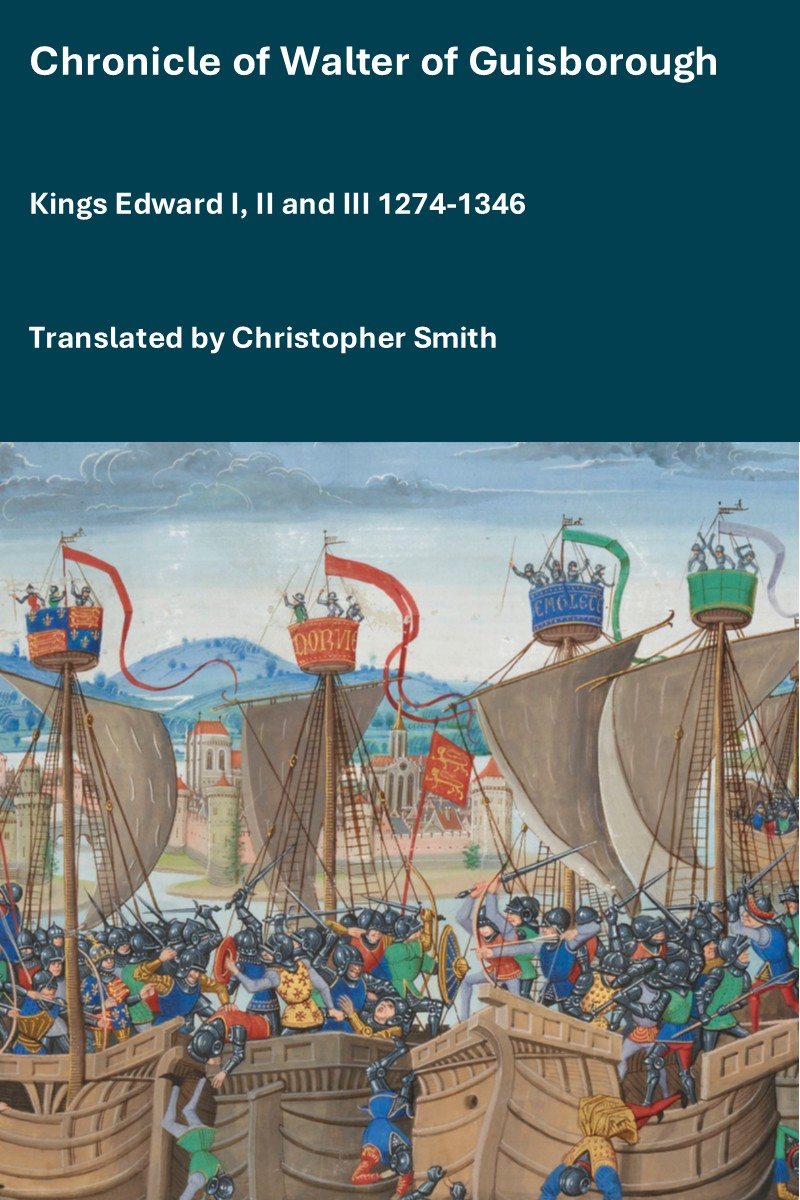
All About History Books
The Chronicle of Walter of Guisborough, a canon regular of the Augustinian Guisborough Priory, Yorkshire, formerly known as The Chronicle of Walter of Hemingburgh, describes the period from 1066 to 1346. Before 1274 the Chronicle is based on other works. Thereafter, the Chronicle is original, and a remarkable source for the events of the time. This book provides a translation of the Chronicle from that date. The Latin source for our translation is the 1849 work edited by Hans Claude Hamilton. Hamilton, in his preface, says: "In the present work we behold perhaps one of the finest samples of our early chronicles, both as regards the value of the events recorded, and the correctness with which they are detailed; Nor will the pleasing style of composition be lightly passed over by those capable of seeing reflected from it the tokens of a vigorous and cultivated mind, and a favourable specimen of the learning and taste of the age in which it was framed." Available at Amazon in eBook and Paperback.
John Evelyn's Diary. 27th June 1674. Mr. Dryden (age 42), the famous poet and now laureate, came to give me a visit. It was the anniversary of my marriage, and the first day I went into my new little cell and cabinet, which I built below toward the south court, at the east end of the parlor.


John Evelyn's Diary. 27th June 1675. At Ely House, I went to the consecration of my worthy friend, the learned Dr. Barlow (age 51), Warden of Queen's College, Oxford, now made Bishop of Lincoln. After it succeeded a magnificent feast, where were the Duke of Ormond (age 64), Earl of Lauderdale (age 59), the Lord Treasurer (age 43), Lord Keeper, etc.
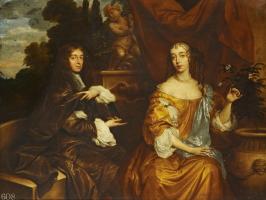
John Evelyn's Diary. 27th June 1690. I went to visit some friends in the Tower [Map], when asking for Lord Clarendon, they by mistake directed me to the Earl of Torrington (age 42), who about three days before had been sent for from the fleet [Map], and put into the Tower [Map] for cowardice and not fighting the French fleet, which having beaten a squadron of the Hollanders, while Torrington did nothing, did now ride masters of the sea, threatening a descent.
John Evelyn's Diary. 27th June 1702. I went to Wotton, Surrey [Map] with my family for the rest of the summer, and my son-in-law, Draper, with his family, came to stay with us, his house at Addiscombe being new-building, so that my family was above thirty. Most of the new Parliament were chosen of Church of England principles, against the peevish party. The Queen (age 37) was magnificently entertained at Oxford and all the towns she passed through on her way to Bath, Somerset [Map].


On 27th June 1743 the Battle of Dettingen was fought between an Allied army of England, Hanover and Austria against a French army during the War of the Austrian Succession.
The French army was commanded by Adrien Maurice 3rd Duke de Noailles (age 64).
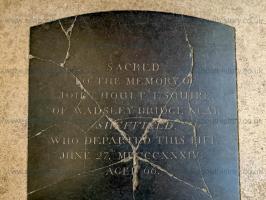
27th June 1834. St Giles' Church, Great Longstone [Map]. Sacred to the memory of John Hoult Esquire of Wadsley Bridge near Sheffield.
On 5th July 1839 Flora Elizabeth Rawdon-Hastings (age 33) died. She had suffered a swelling in her abdomen. She refused an examination. Rumours were spread, by among others the future Queen Victoria (age 20), that she was pregnant. When Lady Flora did finally consent to an examination she was found to an advanced cancerous liver tumour, and had only months left to live. The future Queen Victoria visited Lady Flora on 27th June 1839 eight days before her death.
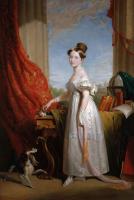


The Diary of George Price Boyce 1855-1857. 27th June 1857. To P.R.B. Exhibition in Russell Place .... I found my little "Sunset" sketch in North Wales mounted in a preposterously wide gilt flat, whereas I had left it in my room mounted on white paper. A lot of the foreground is covered by the mount which completely spoils the sketch and looks ridiculously pretentious besides. Saw (at Hogarth's) a rather clever caricature-etching founded on Millais' "Dream of the Past" picture, to which the outlines were pretty strictly kept to. Millais (age 28) himself is the old Knight, Rossetti (age 29) the girl in front, Holman Hunt (age 30) the child behind. Ruskin (age 38) the ass on which they are riding and which is by far the best thing in the etching in every respect.
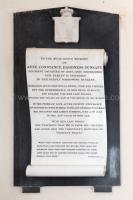
On 27th June 1858 Anne Constance Dutton Baroness Dunsany (age 41) died. She was buried in the Saint Mary Magdalene's Church, Sherborne [Map]. Monument sculpted by Thomas Gaffin.
Anne Constance Dutton Baroness Dunsany: On 12th September 1816 she was born to John Dutton 2nd Baron Sherborne. On 22nd September 1846 Edward Plunkett 16th Baron Dunsany and she were married. On 7th April 1852 Randall Edward Plunkett 15th Baron Dunsany died. His brother Edward succeeded 16th Baron Dunsany. She by marriage Baroness Dunsany.

On 27th June 1872 William Gray (age 75) died. Memorial at the Chapel of St John the Evangelist, Bolton [Map].
William Gray: On 14th November 1796 he was born to Bishop Robert Gray. In or before 1834 he and Eleanor Ker were married.
The London Gazette 25485. Master of thee Horse's Office, Royal Mews, Pimlico, June 27, 1885. Her Majesty has been graciously pleased to appoint the Right Honourable John Henry Delapoer (age 41), Marquis of Waterford, K.P., to be Master of Her Majesty's Buckhounds, in the room of the Right Honourable Richard Edmund St. Lawrance (age 56), Earl of Cork and Orrery, K.P., resigned.
The London Gazette 25485. At the Court at Windsor, the 27th day of June, 1885. Present, The Queen's Most Excellent Majesty in Council. This day the Most Honourable John Henry (age 41), Marquess of Waterford, K.P., was, by Her Majesty's command, sworn of Her Majesty's Most Honourable Privy Council, and took his place at the Board accordingly.

The London Gazette 25486. St. James's Palace, June 27, 1885.
The Queen (age 66) has been pleased to appoint George William (age 61), Viscount Barrington, to be Captain of Her Majesty's Body Guard of Yeomen of the Guard, in the room of!William John (age 56), Lord Monson, resigned.
W6GBhi0WThe Queen has been pleased to appoint the following to be Lords in Waiting in Ordinary to Her Majesty, viz.:—
Dudley Charles, Lord de Ros, in the room of Frederick Henry Paul, Lord Methuen, resigned.
Algernon Hawkins Thomoud, Earl of Kintore, in the room of John William, Earl of Dalhousie, resigned.
Cornwallis, Viscount Hawarden, in the room of William, Lord Sandhurst, resigned.
John Major, Lord Henniker, in the room of Thomas, Lord Ribblesdale, resigned.
John Adrian Louis (age 24), Earl of Hopetoun, in the room of Thomas John, Lord Thurlow, resigned.
William, Lord Elphinstone (age 56), in the room of Arthur, Lord Wrottesley, resigned.
Become a Member via our 'Buy Me a Coffee' page to read complete text.
The London Gazette 25486. St. James's Palace, June 27, 1885. The Queen (age 66) has been pleased to appoint the Duchess of Buccleuch (age 48) to be Mistress of the Robes, in the room of the Duchess of Roxburghe (age 30), resigned
All About History Books
The Chronicle of Geoffrey le Baker of Swinbroke. Baker was a secular clerk from Swinbroke, now Swinbrook, an Oxfordshire village two miles east of Burford. His Chronicle describes the events of the period 1303-1356: Gaveston, Bannockburn, Boroughbridge, the murder of King Edward II, the Scottish Wars, Sluys, Crécy, the Black Death, Winchelsea and Poitiers. To quote Herbert Bruce 'it possesses a vigorous and characteristic style, and its value for particular events between 1303 and 1356 has been recognised by its editor and by subsequent writers'. The book provides remarkable detail about the events it describes. Baker's text has been augmented with hundreds of notes, including extracts from other contemporary chronicles, such as the Annales Londonienses, Annales Paulini, Murimuth, Lanercost, Avesbury, Guisborough and Froissart to enrich the reader's understanding. The translation takes as its source the 'Chronicon Galfridi le Baker de Swynebroke' published in 1889, edited by Edward Maunde Thompson. Available at Amazon in eBook and Paperback.

Black Watch Boer War Memorial, Edinburgh [Map]. Unveiled 27th June 1910. Bronze figure of a Black Watch Serviceman in the uniform of 1899. The sculptor was Mr William Birnie Rhind. There are 211 names listed. The words 'Am Freiceadan Dubh' being Gaelic for 'The Black Watch'.
Births on the 27th June
On 27th June 1430 Henry Holland 3rd Duke Exeter was born to John Holland 2nd Duke Exeter (age 35) and Anne Stafford Duchess Exeter. He a great x 2 grandson of King Edward III of England. Coefficient of inbreeding 2.71%.
On 27th June 1462 Louis XII King France was born to Charles Valois Duke Orléans (age 67) and Mary La Marck Duchess Orléans. Coefficient of inbreeding 2.19%.
On 27th June 1550 Charles IX King France was born to King Henry II of France (age 31) and Catherine Medici Queen Consort France (age 31).
On 27th June 1633 Auguste Oldenburg Duchess Schleswig Holstein Sonderburg Augustenburg was born to Philip Oldenburg (age 49).

On 27th June 1703 Elizabeth Adriana Bentinck was born to William Bentinck 1st Earl of Portland (age 53) and Jane Martha Temple Countess Portland (age 31).

On 27th June 1716 Louise Diane Bourbon was born to Philippe Bourbon II Duke Orléans (age 41) and Françoise Marie Bourbon Duchess Orléans (age 39). She a great x 3 granddaughter of King James I of England and Ireland and VI of Scotland. Coefficient of inbreeding 7.39%.
On 21st June 1721 John Reade 5th Baronet was born to Thomas Reade 4th Baronet (age 38) and Jane Mary Dutton Lady Reade at Golden Square Soho. He was baptised 27th June 1721 at St James' Church, Piccadilly.
On 27th June 1735 Elizabeth Bentinck Marchioness Bath was born to William Bentinck 2nd Duke Portland (age 26) and Margaret Cavendish Harley 2nd Duchess Portland (age 20) at Welbeck Abbey, Nottinghamshire [Map].

On 27th June 1775 Thomas Harvie Farquhar 2nd Baronet was born to Walter Farquhar 1st Baronet (age 36).
All About History Books
The Chronicle of Geoffrey le Baker of Swinbroke. Baker was a secular clerk from Swinbroke, now Swinbrook, an Oxfordshire village two miles east of Burford. His Chronicle describes the events of the period 1303-1356: Gaveston, Bannockburn, Boroughbridge, the murder of King Edward II, the Scottish Wars, Sluys, Crécy, the Black Death, Winchelsea and Poitiers. To quote Herbert Bruce 'it possesses a vigorous and characteristic style, and its value for particular events between 1303 and 1356 has been recognised by its editor and by subsequent writers'. The book provides remarkable detail about the events it describes. Baker's text has been augmented with hundreds of notes, including extracts from other contemporary chronicles, such as the Annales Londonienses, Annales Paulini, Murimuth, Lanercost, Avesbury, Guisborough and Froissart to enrich the reader's understanding. The translation takes as its source the 'Chronicon Galfridi le Baker de Swynebroke' published in 1889, edited by Edward Maunde Thompson. Available at Amazon in eBook and Paperback.
On 27th June 1778 John Dugdale Astley 1st Baronet was born.

On 27th June 1778 John Murray 5th Duke Atholl was born to John Murray 4th Duke Atholl (age 22).

On 27th June 1785 Louisa Emma Fox-Strangways Marchioness of Lansdowne was born to Henry Thomas Fox-Strangways 2nd Earl of Ilchester (age 37) and Mary Theresa O'Grady Countess of Ilchester (age 30).
On 27th June 1786 John Hobhouse 1st Baron Broughton was born to Benjamin Hobhouse 1st Baronet (age 29) and Charlotte Cam.
On 27th June 1791 Chandos Leigh 1st Baron Leigh was born to James Henry Leigh of Adlestrop (age 26) and Julia Judith Twisleton (age 19). Coefficient of inbreeding 1.76%.
On 27th June 1818 Adolphus Frederick Octavious Liddell was born to Thomas Liddell 1st Baron Ravensworth (age 43) and Maria Susannah Simpson Baroness Calthorpe (age 45).
On 27th June 1820 Alfred Phillipps Ryder was born to Bishop Henry Dudley Ryder (age 42) and Sophia March Phillips.
On 27th June 1822 George Augustus Hamilton Chichester 5th Marquess Donegal was born to Edward Chichester 4th Marquess Donegal (age 23) and Amelia Ogrady Marchioness County Donegal.
On 27th June 1829 Henry Bourchier Toke Wrey 10th Baronet was born to Henry Bourchier Wrey 9th Baronet (age 32) and Ellen Maria Toke (age 28). Coefficient of inbreeding 6.45%.

All About History Books
The Deeds of King Henry V, or in Latin Henrici Quinti, Angliæ Regis, Gesta, is a first-hand account of the Agincourt Campaign, and subsequent events to his death in 1422. The author of the first part was a Chaplain in King Henry's retinue who was present from King Henry's departure at Southampton in 1415, at the siege of Harfleur, the battle of Agincourt, and the celebrations on King Henry's return to London. The second part, by another writer, relates the events that took place including the negotiations at Troye, Henry's marriage and his death in 1422.
Available at Amazon as eBook or Paperback.
On 27th June 1831 Anthony Ashley-Cooper 8th Earl Shaftesbury was born to Anthony Ashley-Cooper 7th Earl Shaftesbury (age 30) and Emily Caroline Catherine Frances Cowper Countess Shaftesbury.


On 27th June 1836 Wager Joseph Watson 4th Baronet was born to Charles Wager Watson 2nd Baronet (age 36).
On 27th June 1837 Andrew Marshall Porter 1st Baronet was born.
On 27th June 1874 Victor Alexander Frederick Villiers Russell and Alexander Victor Frederick Villiers Russell were born to Odo Russell 1st Baron Ampthill (age 45) and Emily Theresa Villiers Baroness Ampthill (age 31).
On 27th June 1876 Alice Heathcote-Willoughby-Drummond was born to Gilbert Henry Heathcote Drummond Willoughby 1st Earl Ancaster (age 45) and Evelyn Elizabeth Gordon Countess Ancaster (age 30).

On 27th June 1897 Elizabeth Pleydell-Bouverie was born to Jacob Pleydell-Bouverie 6th Earl Radnor (age 28) and Julian Eleanor Adelaide Balfour.
On 27th June 1903 John Charles Dundas Harington was born to Richard Harington 12th Baronet (age 42) and Selina Louise Grace Dundas Lady Harington (age 28).
On 27th June 1949 Quentin John le Fleming 12th Baronet was born to William Kelland le Fleming (age 27).
On 27th June 1960 David Cholmondeley 7th Marquess of Cholmondeley was born to Hugh Cholmondeley 6th Marquess of Cholmondeley (age 41) and Lavinia Margaret Leslie Marchioness Cholmondeley (age 38).
On 27th June 1990 Sophie Alice Augusta Neville was born to Christopher Neville 6th Marquess Abergavenny (age 35) and Venetia Maynard Marchioness Abergavenny (age 32).
On 27th June 1990 George Rupert Gerrard Neville was born to Christopher Neville 6th Marquess Abergavenny (age 35) and Venetia Maynard Marchioness Abergavenny (age 32).
Marriages on the 27th June
On 27th June 1316 Edmund Mortimer (age 13) and Elizabeth Badlesmere Countess Northampton (age 3) were married at Kinlet, Cleobury Mortimer [Map]. He the son of Roger Mortimer 1st Earl March (age 29) and Joan Geneville Baroness Mortimer 2nd Baroness Geneville (age 30). They were fourth cousins. He a great x 4 grandson of King John of England. She a great x 4 granddaughter of King Henry "Curtmantle" II of England.
On 27th June 1328 Stephen Wittelsbach II Duke Bavaria (age 9) and Elisabeth Barcelona Duchess Bavaria (age 18) were married. He the son of Louis Wittelsbach IV Holy Roman Emperor (age 46) and Beatrix Świdnica Holy Roman Empress. They were fifth cousins. He a great x 4 grandson of King Henry "Curtmantle" II of England. She a great x 4 granddaughter of King Henry "Curtmantle" II of England.
On 27th June 1374 Rupert King Germany (age 22) and Elisabeth Hohenzollern (age 16) were married at Amberg. She the daughter of Frederick Hohenzollern V Burgrave Nuremburg (age 41).
On 27th June 1481 George Talbot 4th Earl of Shrewsbury (age 13) and Anne Hastings Countess Shrewsbury and Waterford (age 10) were married. She by marriage Countess of Shrewsbury, Countess Waterford. He the son of John Talbot 3rd Earl of Shrewsbury and Catherine Stafford Countess Shrewsbury and Waterford. They were second cousins. He a great x 3 grandson of King Edward III of England. She a great x 3 granddaughter of King Edward III of England.
On 27th June 1584 Francis Hay 9th Earl Erroll (age 20) and Margaret Stewart Countess Erroll (age 15) were married. She by marriage Countess Erroll. She the daughter of James Stewart 1st Earl of Moray Regent and Agnes Keith Countess Moray and Mar (age 53). He the son of Andrew Hay 8th Earl Erroll (age 53) and Jean Hay (age 44). They were fourth cousins. She a great x 2 granddaughter of King Henry VII of England and Ireland.
All About History Books
The Chronicle of Geoffrey le Baker of Swinbroke. Baker was a secular clerk from Swinbroke, now Swinbrook, an Oxfordshire village two miles east of Burford. His Chronicle describes the events of the period 1303-1356: Gaveston, Bannockburn, Boroughbridge, the murder of King Edward II, the Scottish Wars, Sluys, Crécy, the Black Death, Winchelsea and Poitiers. To quote Herbert Bruce 'it possesses a vigorous and characteristic style, and its value for particular events between 1303 and 1356 has been recognised by its editor and by subsequent writers'. The book provides remarkable detail about the events it describes. Baker's text has been augmented with hundreds of notes, including extracts from other contemporary chronicles, such as the Annales Londonienses, Annales Paulini, Murimuth, Lanercost, Avesbury, Guisborough and Froissart to enrich the reader's understanding. The translation takes as its source the 'Chronicon Galfridi le Baker de Swynebroke' published in 1889, edited by Edward Maunde Thompson. Available at Amazon in eBook and Paperback.
On 27th June 1602 John Egerton 1st Earl Bridgewater (age 23) and Frances Stanley Countess Bridgewater (age 19) were married. She the daughter of Ferdinando Stanley 5th Earl of Derby and Alice Spencer Countess Derby (age 53).
On 27th June 1655 Robert Montagu 3rd Earl Manchester (age 21) and Anne Yelverton Countess Manchester (age 25) were married at St Giles' in the Fields Church [Map]. He the son of Edward Montagu 2nd Earl Manchester (age 53) and Anne Rich Viscountess Mandeville.
On 27th June 1723 Robert Clifton 5th Baronet (age 33) and Frances Coote Lady Clifton were married. She the daughter of Nanfan Coote 2nd Earl Bellomont and Lucia Anna van Nassau (age 39).
On 27th June 1724 Thomas Lumley-Saunderson 3rd Earl Scarborough (age 33) and Frances Hamilton Countess Scarborough were married. She the daughter of George Hamilton 1st Earl Orkney (age 58) and Elizabeth Villiers Countess Orkney (age 67). He the son of Richard Lumley 1st Earl Scarborough and Frances Jones Countess Scarborough. They were fourth cousins.
On 27th June 1731 William Maxwell 6th Earl Nithsdale and Catherine Stewart (age 26) were married. She the daughter of Charles Stewart 4th Earl Traquair (age 72) and Mary Maxwell Countess Traquair (age 60). He the son of William Maxwell 5th Earl Nithsale and Winifred Herbert Countess Nithsdale (age 51). They were first cousins.
On 27th June 1748 Bennet Sherard 3rd Earl Harborough (age 38) and Elizabeth Verney (age 28) were married at St James' Church, Piccadilly. She the daughter of Ralph Verney 1st Earl Verney (age 65). He the son of Philip Sherard 2nd Earl Harborough (age 68) and Anne Pedley Countess Harborough (age 73).
On 27th June 1848 Arthur Edwin Hill aka Hill-Trevor 1st Baron Trevor (age 28) and Emily Mary Sutton were married. He the son of Arthur Blundell Sandys Trumbull Hill 3rd Marquess Downshire and Maria Windsor Marchioness Downshire (age 58). They were fourth cousins.

On 27th June 1849 George Leveson-Gower 3rd Duke Sutherland (age 20) and Anne Hay Mackenzie Duchess Sutherland (age 20) were married. He the son of George Sutherland Leveson-Gower 2nd Duke Sutherland (age 62) and Harriet Elizabeth Georgiana Howard Duchess Sutherland (age 43).
On 27th June 1926 Marmaduke Furness 1st Viscount Furness (age 42) and Thelma Morgan Viscountess Furness (age 21) were married. She by marriage Viscountess Furness of Grantley in the West Riding of Yorkshire. The difference in their ages was 20 years.
On 27th June 1987 Edward Fitzalan-Howard 18th Duke of Norfolk (age 30) and Georgina Susan Gore Duchess of Norfolk (age 25) were married at Arundel Cathedral, Sussex [Map]. He the son of Miles Stapleton Fitzalan Howard 17th Duke of Norfolk (age 71) and Anne Constable-Maxwell Duchess Norfolk (age 59).
Deaths on the 27th June
On 27th June 992 Conan "Crooked" Penthièvre III Duke Brittany died. His son Geoffrey (age 12) succeeded I Duke Brittany.
On 27th June 1194 Sancho "Wise" King Navarre (age 62) died at Pamplona [Map]. His son Sancho (age 40) succeeded VII King Navarre.
All About History Books
The Chronicle of Geoffrey le Baker of Swinbroke. Baker was a secular clerk from Swinbroke, now Swinbrook, an Oxfordshire village two miles east of Burford. His Chronicle describes the events of the period 1303-1356: Gaveston, Bannockburn, Boroughbridge, the murder of King Edward II, the Scottish Wars, Sluys, Crécy, the Black Death, Winchelsea and Poitiers. To quote Herbert Bruce 'it possesses a vigorous and characteristic style, and its value for particular events between 1303 and 1356 has been recognised by its editor and by subsequent writers'. The book provides remarkable detail about the events it describes. Baker's text has been augmented with hundreds of notes, including extracts from other contemporary chronicles, such as the Annales Londonienses, Annales Paulini, Murimuth, Lanercost, Avesbury, Guisborough and Froissart to enrich the reader's understanding. The translation takes as its source the 'Chronicon Galfridi le Baker de Swynebroke' published in 1889, edited by Edward Maunde Thompson. Available at Amazon in eBook and Paperback.
On 27th June 1241 Gilbert Marshal 4th Earl Pembroke (age 44) was killed in a tournament at Ware, Hertfordshire [Map]. He was buried at Temple Church, London [Map] next to his father. His brother Walter (age 42) succeeded 5th Earl Pembroke; he had also attended the tournament. The King King Henry III of England (age 33) had expressly forbidden the tournament leading to anger at his disobeying the King's orders.
On 27th June 1296 Floris Gerulfing V Count Holland (age 42) was killed. His son John (age 12) succeeded I Count Holland.
Floris has transferred his allegiance to France inviting the enmity of King Edward I of England (age 57) who relied on him to support the valuable English wool trade. Edward conspired with Guy of Flanders to kidnap Floris. Floris was captured during a hunting party and taken to Muiderslot castle. Concerned about their safety the kidnappers attempted to take Floris to a safer location during which jounrney they were attacked by an angry mob of local peasants. Floris was killed.
On 27th June 1335 William Grandison 1st Baron Grandison (age 73) died at Lambourne, Berkshire [Map]. His son Piers (age 44) succeeded 2nd Baron Grandison. Blanche Mortimer Baroness Grandison (age 23) by marriage Baroness Grandison.
On 27th June 1376 Joan Montagu Countess Suffolk (age 27) died. Her half sister Audrey succeeded 2nd Baroness Montagu.
On 27th June 1458 Alfonso V King Aragon (age 62) died. His son Ferdinand (age 35) succeeded I King Naples. Isabella Clermont Queen Consort Naples (age 34) by marriage Queen Consort Naples. His brother John (age 59) succeeded II King Aragon.
On 27th June 1477 Adolf Egmont 2nd Duke Guelders (age 39) died at Tournai [Map]. He was buried at Tournai Cathedral [Map]. His son Charles (age 10) succeeded 3rd Duke Guelders.
On 27th June 1509 Elizabeth Hay Countess Huntley (age 59) died.
On 27th June 1601 Henry Norreys 1st Baron Norreys of Rycote (age 76) died at Rycote, Oxfordshire [Map]. His grandson Francis (age 21) succeeded 2nd Baron Norreys of Rycote. Bridget Vere Baroness Norreys Rycote (age 17) by marriage Baroness Norreys of Rycote.
On 27th June 1618 William Cecil 16th Baron Ros Helmsley (age 28) died. His first cousin once removed Francis (age 40) succeeded 17th Baron Ros Helmsley. Cecily Tufton Countess Rutland by marriage Baroness Ros Helmsley.
On 27th June 1621 Richard Worsley 1st Baronet (age 32) died. His son Henry (age 8) succeeded 2nd Baronet Worsley of Appuldurcombe.
On 27th June 1641 Michiel Janszoon van Mierevelt (age 75) died.
All About History Books
The Chronicle of Geoffrey le Baker of Swinbroke. Baker was a secular clerk from Swinbroke, now Swinbrook, an Oxfordshire village two miles east of Burford. His Chronicle describes the events of the period 1303-1356: Gaveston, Bannockburn, Boroughbridge, the murder of King Edward II, the Scottish Wars, Sluys, Crécy, the Black Death, Winchelsea and Poitiers. To quote Herbert Bruce 'it possesses a vigorous and characteristic style, and its value for particular events between 1303 and 1356 has been recognised by its editor and by subsequent writers'. The book provides remarkable detail about the events it describes. Baker's text has been augmented with hundreds of notes, including extracts from other contemporary chronicles, such as the Annales Londonienses, Annales Paulini, Murimuth, Lanercost, Avesbury, Guisborough and Froissart to enrich the reader's understanding. The translation takes as its source the 'Chronicon Galfridi le Baker de Swynebroke' published in 1889, edited by Edward Maunde Thompson. Available at Amazon in eBook and Paperback.
On 27th June 1672 Roger Twysden 2nd Baronet (age 74) died. His son William (age 36) succeeded 3rd Baronet Twysden of Roydon in Kent.
On 27th June 1721 Denzil Onslow of Pyrford (age 79) died without issue. His estate was inherited by the children of his nephew Richard Onslow 1st Baron Onslow.


On 27th June 1752 Henry Flower 1st Viscount Ashbrook (age 32) died. His son William (age 8) succeeded 2nd Viscount Ashbrook.
On 27th June 1778 Charles Ingram 9th Viscount Irvine (age 51) died without male issue. Viscount Irvine extinct.
On 27th June 1787 Thomas Heathcote 2nd Baronet (age 65) died. His son William (age 41) succeeded 3rd Baronet Heathcote of Hursley in Hampshire. Frances Thorpe Lady Heathcote (age 45) by marriage Lady Heathcote of Hursley in Hampshire.
On 27th June 1792 John Morgan (age 50) died. His sister Jane Morgan (age 61) and her husband Charles Gould aka Morgan 1st Baronet (age 66) and inherited Tredegar House, Monmouthshire on condition he changed his name from Gould to Morgan which he did by royal licence on 20th November 1792. His children including Charles Gould aka Morgan 2nd Baronet (age 32) also changed their surname.


On 27th June 1816 John Peachey 2nd Baron Selsey (age 67) died. His son Henry (age 29) succeeded 3rd Baron Selsey of Selsey in Sussex.
On 27th June 1823 John Fletcher aka Boughey 2nd Baronet (age 39) died. His son Thomas (age 14) succeeded 3rd Baronet Boughey of Newcastle under Lyme in Staffordshire.
On 27th June 1831 Sophie Germain (age 55) died from breast cancer at 13 rue de Savoie, Paris. She was buried at Père Lachaise Cemetery in Paris.
On 5th July 1839 Flora Elizabeth Rawdon-Hastings (age 33) died. She had suffered a swelling in her abdomen. She refused an examination. Rumours were spread, by among others the future Queen Victoria (age 20), that she was pregnant. When Lady Flora did finally consent to an examination she was found to an advanced cancerous liver tumour, and had only months left to live. The future Queen Victoria visited Lady Flora on 27th June 1839 eight days before her death.
On 27th June 1858 Anne Constance Dutton Baroness Dunsany (age 41) died. She was buried in the Saint Mary Magdalene's Church, Sherborne [Map]. Monument sculpted by Thomas Gaffin.
Anne Constance Dutton Baroness Dunsany: On 12th September 1816 she was born to John Dutton 2nd Baron Sherborne. On 22nd September 1846 Edward Plunkett 16th Baron Dunsany and she were married. On 7th April 1852 Randall Edward Plunkett 15th Baron Dunsany died. His brother Edward succeeded 16th Baron Dunsany. She by marriage Baroness Dunsany.
On 27th June 1860 Henry Allen Johnson 2nd Baronet (age 74) died. His son Henry (age 41) succeeded 3rd Baronet Johnson of Bath in Somerset.
On 27th June 1870 George William Villiers 4th Earl Clarendon (age 70) died. His son Edward (age 24) succeeded 5th Earl Clarendon, 5th Baron Hyde of Hindon in Wiltshire 1756.
On 27th June 1871 Henry Wilson 11th Baron Berners (age 74) died. His niece Emma (age 35) succeeded 12th Baroness Berners. Henry Thomas Tyrwhitt-Jones 3rd Baronet (age 47) by marriage Baron Berners.
All About History Books
The Chronicle of Walter of Guisborough, a canon regular of the Augustinian Guisborough Priory, Yorkshire, formerly known as The Chronicle of Walter of Hemingburgh, describes the period from 1066 to 1346. Before 1274 the Chronicle is based on other works. Thereafter, the Chronicle is original, and a remarkable source for the events of the time. This book provides a translation of the Chronicle from that date. The Latin source for our translation is the 1849 work edited by Hans Claude Hamilton. Hamilton, in his preface, says: "In the present work we behold perhaps one of the finest samples of our early chronicles, both as regards the value of the events recorded, and the correctness with which they are detailed; Nor will the pleasing style of composition be lightly passed over by those capable of seeing reflected from it the tokens of a vigorous and cultivated mind, and a favourable specimen of the learning and taste of the age in which it was framed." Available at Amazon in eBook and Paperback.
On 27th June 1890 James McGarel-Hogg 1st Baron Magheramorne (age 67) died. He was buried at Brompton Cemetery, Kensington. His son James (age 29) succeeded 2nd Baron Magheramorne of Magheramorne in Antrim, 3rd Baronet Hogg of Upper Grosvenor Street in London. Evelyn Ashley-Cooper Baroness Magheramorne (age 25) by marriage Baroness Magheramorne of Magheramorne in Antrim.

On 27th June 1897 William Molyneux 4th Earl Sefton (age 61) died. On 27th June 1897 His son Charles succeeded 5th Earl Sefton, 12th Viscount Molyneux, 13th Baronet Molyneux of Sefton.
On 27th June 1902 John Major Henniker-Major 5th Baron Henniker (age 59) died. His son Charles (age 30) succeeded 6th Baron Henniker of Stratford upon Slaney in County Wicklow, 7th Baronet Major of Worlingsworth Hall in Suffolk.
On 27th June 1913 Cromartie Sutherland-Leveson-Gower 4th Duke of Sutherland (age 61) died. His son George (age 24) succeeded 5th Duke Sutherland, 23rd Earl Sutherland, 7th Earl Gower, 8th Baron Gower, 12th Baronet Gower of Stittenham in Yorkshire.
On 27th June 1934 Feodorowna Yorke Baroness Alington (age 70) died.
On 27th June 1939 Constance Evelyn Primrose Baroness Leconfield (age 93) died.
On 27th June 1943 William Frederick Style 11th Baronet (age 55) died. His son William (age 26) succeeded 12th Baronet Style of Wateringbury in Kent.
On 27th June 1961 Richard Morland Tollemache Bethell 4th Baron Westbury (age 46) died. His brother David (age 39) succeeded 5th Baron Westbury of Westbury in Wiltshire.
On 27th June 1973 John Littleton 6th Baron Hatherton (age 66) died. His brother Thomas (age 65) succeeded 7th Baron Hatherton.
On 27th June 1974 Synolda Emily Thursby-Pelham Lady Walker and Jaffray died.
On 27th June 1975 Cuthbert Patrick Blake 6th Baronet (age 90) died. Baronet Blake of Langham in Suffolk extinct.
On 27th June 2012 Valentine Abdy 6th Baronet (age 74) died. His son Robert (age 34) de jure 7th Baronet Abdy of Albyns in Essex. He has yet to prove his claim the title so the Baronetcy is regard as vacant.