


Henrici Quinti, Angliæ Regis, Gesta, is a first-hand account of the Agincourt Campaign, and subsequent events to his death in 1422. The author of the first part was a Chaplain in King Henry's retinue who was present from King Henry's departure at Southampton in 1415, at the siege of Harfleur, the battle of Agincourt, and the celebrations on King Henry's return to London. The second part, by another writer, relates the events that took place including the negotiations at Troye, Henry's marriage and his death in 1422.
Available at Amazon in eBook and Paperback format.
28 Mar is in March.
Anglo-Saxon Chronicle. 795. This year was the moon eclipsed, between cock-crowing and dawn31, on the fifth day before the calends of April; and Erdulf succeeded to the Northumbrian kingdom on the second before the ides of May. He was afterwards consecrated and raised to his throne, at York, on the seventh day before the calends of June, by Archbishop Eanbald, and Bishops Ethelbert, Hibbald, and Baldulf.
Note 31. This is the Grecian method of computation; between the hours of three and six in the morning. It must be recollected, that before the distribution of time into hours, minutes, and seconds, the day and night were divided into eight equal portions, containing three hours each; and this method was continued long afterwards by historians.
On 28th March 1072 Ordulf Duke of Saxony (age 50) died. His son Magnus (age 27) succeeded Duke Saxony.
On 28th March 1193 King Richard "Lionheart" I of England (age 35) was handed over to Henry Hohenstaufen VI Holy Roman Emperor (age 27) who imprisoned him in Trifels Castle [Map].
On 28th March 1241 King Valdemar II of Denmark (age 70) died.
Rymer's Fœdera Volume 1. The King to the Archbishop of Canterbury concerning the excommunication of malefactors or disturbers of the peace in Wales.
The King to the Archbishop of Canterbury, Primate of all England, greeting. Whereas certain Welsh malefactors, and others their accomplices and abettors, envying the tranquility and peace of our realm, have stirred up and raised a certain disturbance in our land of Wales, and there have committed depredations, homicides, arsons, and very many other enormities against our peace, and from day to day, by cunning devices, strive with all their power to inflict greater losses and dangers upon us and upon the men adhering to our faith: We, wishing that the malice and rebellion of such malefactors, whom we intend to have incurred, ipso facto, the sentence of greater excommunication, may be repressed, as we are bound, earnestly require and beg your fatherhood, whom we know to be most circumspect in punishing such malefactors by the keys of the Church, that for the speedy repression of their malice and rebellion, you would, if it please you, apply your care and diligence, favorably as all your predecessors have done in times past. And that you give commands to all and each of your suffragans, on our behalf, in such wise as your discretion shall deem most expedient for the tranquility and peace of the inhabitants of our realm, that they cause all such disturbers of the peace, and their conspirators, accomplices, and abettors, and all who give them assent, consent, counsel, or aid, secretly or openly, in these matters, to be publicly and solemnly denounced as excommunicated in each of their dioceses. For we trust that their rebellion and malice, by the aid of the spiritual sword, which in such a case is known to assist the secular arm, will the more easily be repressed. Witness the King, at Devizes, on the 28th day of March, in the tenth year [of our reign]. Similar letters are directed to the Archbishops of York and Dublin. Witness as above.
Rex archiepiscopo Cantuar' de malefactoribus, seu pacis perturbatoribus in Wallia, excommunicandis.
Rex archiepiscopo Cantuariensi, totius Angliæ primati, salutem. Cum nonnulli malefactores Wallenses, & alii complice & fautores sui, tranquillitati & paci regni nostri invidentes, turbacionem quandam in terrâ nostrâ Walliæ suscitantes, pariter & moventes, ibidem deprædationes, homicidia, incendia, & alia enormia quamplurima perpetrârint, contra pacem nostram, & de die in diem callidis machinationibus studeant nobis & hominibus, fidei nostræ adhærentibus, majora damna & pericula pro viribus perpetrare; Nos, maliciam & rebellionem hujusmodi malefactorum, quos in canonem latæ sentenciæ ipso facto intendimus incidisse, volentes reprimi, ut tenemur, paternitatem vestram, quam in punitione hujusmodi malefactorum, per claves ecclesiasticas faciendâ, esse novimus plurimum circumspectam, affectuosè requirimus & rogamus, ad maliciam & rebellionem ipsorum celeriter reprimendam, si placet, curam & solicitudinem, prout omnes prædecessores vestri fecerunt retrolapsis temporibus, favorabiliter adhibentes; Universis & singulis suffraganeis vestris detis, nostri intuitu, secundum quod vestra discretio tranquilitati & paci incolarum regni nostri magis expedire viderit, in mandatis, ut ipsi omnes hujusmodi perturbatores pacis, & eorum conspiratores, complices & fautores, ac omnes assensum, consensum, consilium vel auxilium, clam vel palam, eisdem præbentes in præmissis, per singulas dioceses suas publicè & solemniter denunciari faciant excommunicatos. Speramus enim quod rebellio & malicia ipsorum, mediante juvamine gladii spiritualis, qui in hujusmodi casu juvare dinoscitur brachium seculare, facilius reprimentur. Teste Rege, apud Devises, xxviii. die Martii anno, &c. decimo. Consimiles litteræ diriguntur archiepiscopis Ebor' & Dublin'. Teste ut supra.
 Become a Member via our Buy Me a Coffee page to read more.
Annals of Dunstable. In the same year died Brother John de Derlington, archbishop of Dublin, who had been appointed collector of all the money granted for the aid of the Holy Land in the Council of Lyons. And it is said that he died suddenly1, and almost intestate.
Eodem anno obiit frater Johannes de Derlingtone, archiepiscopus de Duvelyn; qui totius pecuniæ, in subsidium Terræ Sanctæ concessæ in concilio Lugdunensi, collector fuerat deputatus. Et dicitur quod subito obiit, et quasi intestatus.
Note 1. Archbishop John Derlington died on the 28th March 1284.
Chronicle of Walter of Guisborough. In the same year, by the king's command, Lord Edmund, his brother, crossed over to Gascony with the Earl of Lincoln, accompanied by twenty-six bannerets, seven hundred armed men, and a large number of commoners. They landed around mid-Lent at Bourg and Blaye, and remained there until Easter with our forces, who greeted their arrival with rejoicing. Many Gascons and others from various nations gathered to them, so that their number quickly grew to over two thousand armed men. In Easter Week, on Wednesday [28th March 1296], they set out and pitched camp opposite Bordeaux, about a league from the city. When the townspeople saw this, they came out with the French to confront them. Both sides could see each other and were eager for battle. However, our forces held back and even pretended to retreat, to draw the enemy farther from the city. When they had lured them a significant distance, they turned around and drove them back toward the city, killing nearly two thousand and pursuing the rest to the gates. Some of our men entered the city with them but were trapped when the gate was shut. Among them were two brothers, Lords Robert and John de Manley, who were later ransomed at a price. In the morning, fearing a continued siege, the townspeople set fire to the houses in the suburbs that were attached to the city walls. Meanwhile, our sailors went out and burned the rest of the suburban buildings. Thus, on that Thursday, nearly the entire suburb was consumed by raging flames. On Friday, since our forces were unable to storm the heavily fortified city, because they lacked wooden siege engines, they marched to Langon, beyond Rions about three leagues away. The lord of that town, upon their arrival and after driving out the French, surrendered the town freely. They stayed there for three days and in the meantime sent word to Saint-Macaire, demanding the surrender of the town. The townspeople there requested and were granted a three-day truce and sent to Bordeaux for help. Upon receiving a reply that no aid could be given, they surrendered themselves and the town. However, the garrison held the castle and was besieged by our men for three weeks, though it was not taken.
Eodem anno transfretavit in Vasconiam, ex præcepto regis, dominus Edmundus frater ejus, cum comite Lincolniæ, associatis eis XXVI banerettis, et septingentis armatis cum plebe multa, applicueruntque circa medium Quadragesimæ apud Burgum et Blaynes, manseruntque ibidem cum nostris, quos in eorum adventu congratulantes invenerant, usque Pascha, et congregati sunt ad eos Vasconienses multi et cæteræ nationes, ita quod in brevi creverunt in numerum plusquam duo millia armatorum. In ebdomada vero Paschæ, die Mercurii, moverunt se, et ex opposito de Burdews fixerunt castra sua, a civitate quasi per unam leucam. Quod videntes cives, exierunt cum Francis, ut eis occurrerent. Mutuo enim videbant se, et ad congrediendum festinabant. Nostri tamen expectabant, et in parte retraxerunt se, quasi fugam simulantes, quousque seperarentur ab urbe spatio magno, et tunc versis vultibus eos in urbem retrocedere compulerunt, cæsisque quasi duobus millibus, alios insecuti sunt usque ad portas civitatis. Quidam etiam ex nostris ingressi sunt cum eis, et demum, demissa porta, præclusi sunt et retenti. Inter quos erant illi duo fratres de Manley, domini Robertus et Johannes, qui postea redempti sunt dato pretio. Mane autem facto, timentes cives obsidionem continuari, apposuerunt ignem in domibus suburbanis quæ muro adhærebant: et interim egressi marinarii nostri, cæteras domos suburbanas accendebant; ita quod in ipso die Jovis totum quasi suburbium vorax flamma consumpsit. Die autem Veneris, cum urbem fortissimam nostri expugnare non possent, eo quod ligneas machinas non haberent, profecti sunt usque Langon ultra Ryons per tres leucas, ubi dominus villæ ejusdem in eorum adventu, Francis effugatis, tradidit eis villam liberam, et morati sunt ibidem per tres dies, miseruntque interim ad Sanctum Macharium, ut villam redderent. At illi, petitis et obtentis tridualibus induciis, miserunt Burdegalim, ut auxilium mitterent, et, accepto responso quod non possent, tradiderunt se nostris et villam reddiderunt. Castrenses tamen tenuerunt castrum, et obsessi sunt a nostris tribus ebdomadis, non tamen expugnati.
Become a Member via our Buy Me a Coffee page to read more.
On 28th March 1424 King James I of Scotland (age 29) signed his release agreement, in which he promised to pay a ransom of 60,000 marks, at Durham, County Durham [Map]. He and his wife Joan Beaufort Queen Consort Scotland (age 20), married for seven weeks, travelled to Melrose Abbey [Map] arriving on 5th April 1424
On 28th March 1461 one or more battles were fought at Ferrybridge and Dintingdale. Richard "Kingmaker" Neville Earl Warwick, 6th Earl Salisbury (age 32) fought. John Radclyffe Baron Fitzwalter (age 35) was killed.
John "Butcher" Clifford 9th Baron Clifford (age 25) was killed. His son Henry (age 7) succeeded 10th Baron de Clifford, 10th Lord Skipton.
William Neville 1st Earl Kent (age 56) fought for York.
Chronicle of Jean de Waurin Books 3-5 [1400-1474]. 28th March 1461. When they had carefully considered the terms of the enemy, the Earl of March, as a worthy and bold knight, confidently declared that it was necessary to gain the crossing, and that otherwise they could accomplish nothing profitably. Therefore it was decided to assault the bridge which the adversaries had fortified; and thus the skirmish was begun, which lasted from noon until six in the evening, during which, on both sides, more than three thousand men were killed. The bridge was then taken by those of the party of Edward Earl of March, and the whole army crossed over that same night. And it was exceedingly cold, with snow and sleet, so that it was pitiful to see men-at-arms and horses; and, what afflicted them most, they were poorly supplied with provisions. Nevertheless, they lodged there all that night until the next morning, when they received news that King Henry had come out of the city of York and had set his standard among his men, and was advancing in great order to give battle. The king’s vanguard was led by the duke of Somerset together with the duke of Exeter, the lord Rivers, and his son Anthony; the earl of Northumberland led the main battle; and altogether they were reckoned at sixty thousand men.
Quant ilz eurent tout bien advise le convenant des annemis, le comte de La Marche, comme preu et hardy chevallier bien asseure, dist quil estoit expedient de guaignier le passage et que autrement ilz ne povoient prouflitablement besongnier; si fut ordonne dassaillir le pont que les adversaires avoient fortiffe, et par ainsi fut eslevee lescarmuche quy dura depuis douze heures a midy jusques a six heures du vespre, et y morurent, tant dun coste comme daultre, mieulz de trois mille hommes. Lequel pont guaignerent ceulz de la partie du comte Edouard de La Marche et passerent toute larmee oultre celle mesmes nuit: si faisoit moult froit de nesges et gresilz tant que pitie estoit a veoir gens darmes et chevaulz, et, qui le pis leur faisoit, estoient mal avitaillies; mais toutes fois se logerent illec toute celle nuit jusques a lendemain au matin quilz eurent nouvelles que le roy Henry estoit issu hors de la cite d Yorc et avoit son estandart boutte auz gens, et venoit en grant ordonnance pour combatre, si menoit lavantgarde du roy le duc de Sombresset avec le duc dExcestre, le seigneur de Riviere, Anthonie son filz; le comte de Northumbelland menoit In bataille; si estoient tons nombrez a soixante mille hommes.
Become a Member via our Buy Me a Coffee page to read more.
Henrici Quinti, Angliæ Regis, Gesta, is a first-hand account of the Agincourt Campaign, and subsequent events to his death in 1422. The author of the first part was a Chaplain in King Henry's retinue who was present from King Henry's departure at Southampton in 1415, at the siege of Harfleur, the battle of Agincourt, and the celebrations on King Henry's return to London. The second part, by another writer, relates the events that took place including the negotiations at Troye, Henry's marriage and his death in 1422.
Available at Amazon in eBook and Paperback format.
Chronicle of Gregory. 28th March 1461. And the xxviij day of Marche, that was Palme Sunday evyn, the Lord Fewater (age 35) was slayne at Ferybryge, and many with him was slayne and drownyd. And the Erle of Warwycke (age 32) was hurte yn his legge with an arowe at the same jornaye.
Chronicle of William of Worcester. 28th March 1461 ... and around Palm Sunday, first at Ferrybridge, Lord Fitzwalter (age 35) was slain.
et circa dominicam Palmarum in primis apud Ferybrygge occisus est dominus Fewater,
Chronicle of Edward Hall [1496-1548]. 28th March 1461. The lusty king Edward, perceiving the courage of his trusty friend the earl of Warwick, made proclamation that all men, which were already to fight, should incontinent [ie quickly] depart, and to all me that tarried the battle, he promised great rewards with this addition, that if any soldier, which voluntarily would abide, and in, or before the conflict fly, or turn his back, that then he that could kill him should have a great remuneration and double wages. After this proclamation ended the lord Fauconberg, sir Water Blount, Robert Home with the forward, passed the river at Castleford three miles from Ferrybridge, intending to have environed and enclosed the lord Clifford and his company, but they being thereof advertised, departed in great haste toward king Henry's army, but they meet with some that they looked not for, and were trapped or they were ware [?]. For the lord Clifford, either bridge for heat or pain, putting of his gorget, suddenly with an arrow (as some say) without an head, was struck into the throat, and incontinent rendered his spirit, and the earl of Westmorland's brother and all his company almost were there slain, at a place called Dintingdale, not far from Towton. This end had he, which slew the young earl of Rutland, kneeling on his knees: whose young son Thomas Clifford was brought up with a shepherd, in poor habit, and dissimuled behaviour ever in fear, to publish his lineage or degree, till king Henry the vii obtained the crown, and got the diadem: by whom he was restored to his name and possessions.
Hearne's Fragment. [28th March 1461] Then the Friday ensuing the King Edward issued out of the city in goodly order at Bishopsgate, then being the 12th day of March, and held on his journey following those others, and when the fore prickers came to Ferrybridge, there was a great skirmish whereat John Ratcliff, then Lord Fitzwalter, was slain, and thereupon they ever advanced themselves till they came to Touton, 8 miles out of York,
Letters and Papers. 28th March 1536. R. O. 573. T. Warley to Lady Lisle (age 42).
Received her letter today from Buck, Lord Edmund's servant, bidding him send the kirtle and sleeves given by the Queen (age 35), by Goodale. Had already given it to Hussey, with three yards of black satin for Lord Lisle's (age 71) doublet. As to her desiring him to take 20s. from Hussey to reward those in the Queen's wardrobe, Hussey says Mr. Taylour wishes no reward to be given. Has delivered the casket of steel and "flower" to Mrs. Margery Horsman. She was right glad of it, and said it would serve to keep her jewels in. Encloses a gold cramp ring, which she gave him for Lady Lisle. Has not seen Mr. Receiver since her letter. Since coming to London has received a letter of Lady Lisle from Hussey, dated 17 March; another, dated 25 March, by Bucke; and one from Lord Lisle, dated 18 March. No news but that the abbeys shall down. The King's solicitor, Mr. Riche, is made general surveyor, and Mr. Pope, the Lord Chancellor's servant, the general receiver. Great fees are allowed them. There will be eight other receivers, who will have during their lives, £20 a year, £10 for the carriage of every £1,000, their costs and charges borne. Edward Waters, Mr. Gunston's brother-in-law, is one, and Freman, the King's goldsmith, another. Does not know the rest, nor who will be auditors. It is said the King will ride North to meet the king of Scots. Received from Bucke a packet of letters from Lord Lisle. Delivered them to Mr. Secretary, who incontinently read them. It is an evil time for suitors, as the King and his Council have so many matters in hand daily. Begs her to ask Lord Lisle to write in his behalf to the Lord Chancellor, that he may have expedition in his suit. London, 28 March. Hol., p. 1. Add.: At Calais.


Letters and Papers. 28th March 1536. In this three things are to be considered:—(1.) That in that case nothing more can be done for her advantage during her father's life, and she can take no action with good conscience against her father even for redress of the injuries done to her late mother, even if her life was "advancée sinestrement1," as is suspected; and if the sentence of the divorce were pursued, to make the King give up his concubine (age 35), he might marry another, whereas it is certain he could have no issue from the concubine to hinder the succession of the Princess. And as one of the principal points which the King will think of with regard to our said cousin, and also the concubine and her adherents, will be to whom they will marry her, and it is important also to treat of it as a principal point in order to with draw our said cousin even for her surety, as well as for the security of further negociations, you will endeavour discreetly to discover to what match the king of England leans; and, as of yourself, and in such wise that no one can presume it is part of your charge, you may suggest Don Loys of Portugal, our brother-in-law, who was lately with us in the Tunis expedition, and do your best to recommend it either to the King or Cromwell. He is, in truth, the person who, among all others, seems best suited both for the Princess herself and for the King and his realm, and the concubine and her adherents ought to be less suspicious of him as the Portuguese are good neighbours and not quarrelsome, as you may suggest; but it must be with a suitable dowry. (2.) By this means the Princess might be drawn out of the kingdom, rescued from continual danger of her life, and allied with a person of suitable quality; and, when the time came, might be assisted by her allies in obtaining her right; and if issue came of the marriage, especially male issue, it would be a great occasion to her father to recall her and her children into the kingdom, if he is satisfied with the treaty we shall make together, and the good offices we shall continue to do him. And (3), although it be a good thing to bring back the King to his allegiance to the Church, even though the Church forbear some of her rights and profits, and also to withdraw our cousin out of the realm, yet we cannot do prejudice in the future either to the one or to the other, and means may be found hereafter of putting the said Church in full possession of her rights, especially if our said cousin succeed to the Crown; and she also, before leaving England, cannot make any treaty which can prejudice her, since everyone knows in what fear and danger she is kept. Moreover, although the concubine might not agree to either the one or the other of the above means (the declaration or suspension),—which she and all her adherents ought to think a great advantage, to be relieved from the fear and danger they are continually in,—and though she put forth further claims in behalf of her daughter and other children that she might have, yet you should not break off negotiations on this account, but ascertain in this also to what she will agree, and, after making such representations to her as you think fit, say you will refer to us. If you find her demands too exorbitant you may use Cromwell's help, if he can and will do what he has promised, and use all possible dexterity to make the most advantageous terms for her that you can; and if there be anything that requires to be kept secret from the said concubine or her adherents "il s'en usera selon ce2."
Note 1. "advanced dishonourably" or "promoted by wrongful means".
Note 2. "he will make use of it accordingly" or "He will make use of it according to that [thing or situation]".
Become a Member via our Buy Me a Coffee page to read more.
On 28th March 1551 Ferdinand Habsburg Spain was born to Maximilian Habsburg Spain II Holy Roman Emperor (age 23) and Maria of Spain Holy Roman Empress (age 22). Coefficient of inbreeding 10.03%. He died aged one in 1552.


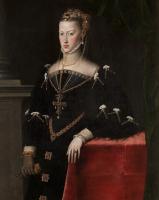

Henry Machyn's Diary. 28th March 1559. The xxviij day of Marche, the wyche was Ester-tuwysday, doctur Cokes (age 66) sum-tyme dene of Westmynster dyd pryche.


In March 1586 a virulent outbreak of gaol fever occurred during the Assizes in Exeter, Devon [Map]. The cause according to modern medical opinion was typhus transmitted by the human body-louse. Among the dead victims were eight judges, eleven of the twelve jurors, several constables, and the surrounding population which was ravaged by the disease for several months.
Edward Flowerdew died of gaol fever.
On 28th March 1586 Thomas Carew of Haccombe (age 70) died of gaol fever.
On 31st March 1586 John Chichester died of gaol fever.
On 1st April 1586 Robert Carey (age 71) died of gaol fever.
On 2nd April 1586 Arthur Bassett (age 45) died of gaol fever.
On 10th April 1586 Bernard Drake (age 58) died of gaol fever.
Become a Member via our Buy Me a Coffee page to read more.

Diary of Anne Clifford. 28th March 1617. The 28th I walk'd abroad with my Lord (age 28) in the Park and the garden, where he spake to me much of this business with my uncle. I wrought much within doors and strived to sit as merry a face as I could upon a discontented heart, for I might easily perceive that Matthew and Lindsay had got a great hand of my Lord and were both against me. Yet by this means they put Lord William clean out of all grace and trust with my Lord, which I hope may be the better hereafter for me and my Child, knowing that Gop often brings things to pass by contrary means.
Diary of Anne Clifford. 28th March 1619. The 28th Easter Day Mr Rand preached in the Chapel but there was no Communion in the house but at the Church. In the afternoon I began to repent that I had caused the Communion to be put off till Whit Sunday, my Lord (age 30) protesting to me that he would be a very good husband to me and that I should receive no prejudice by releasing my thirds.
Chronicle of Walter of Guisborough
A canon regular of the Augustinian Guisborough Priory, Yorkshire, formerly known as The Chronicle of Walter of Hemingburgh, describes the period from 1066 to 1346. Before 1274 the Chronicle is based on other works. Thereafter, the Chronicle is original, and a remarkable source for the events of the time. This book provides a translation of the Chronicle from that date. The Latin source for our translation is the 1849 work edited by Hans Claude Hamilton. Hamilton, in his preface, says: 'In the present work we behold perhaps one of the finest samples of our early chronicles, both as regards the value of the events recorded, and the correctness with which they are detailed; Nor will the pleasing style of composition be lightly passed over by those capable of seeing reflected from it the tokens of a vigorous and cultivated mind, and a favourable specimen of the learning and taste of the age in which it was framed.'
Available at Amazon in eBook and Paperback format.
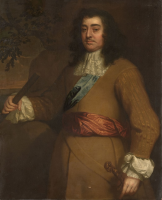
On 28th March 1663 James Scott 1st Duke Monmouth 1st Duke Buccleuch (age 13) was appointed 467th Knight of the Garter by King Charles II of England Scotland and Ireland (age 32).


On 28th March 1664 Archbishop Accepted Frewen (age 75) died.
Samuel Pepys' Diary. 28th March 1666. Thence set them down at Pierces, and we home, where busy and at my chamber till 12 at night, and so to bed. This night, I am told, the Queene of Portugall (deceased), the mother to our Queene (age 27), is lately dead, and newes brought of it hither this day1. 29th. All the morning hard at the office.
Note 1. Donna Luiza, the Queen Regent of Portugal. She was daughter of the Duke de Medina Sidonia and widow of Juan IV. The Court wore the deepest mourning on this occasion. The ladies were directed to wear their hair plain, and to appear without spots on their faces, the disfiguring fashion of patching having just been introduced.- Strickland's Queens of England, vol. viii., p. 362.
Samuel Pepys' Diary. 28th March 1666. So by coach to Hales's (age 66), and there sat again, and it is become mighty like. Hither come my wife and Mercer brought by Mrs. Pierce and Knipp, we were mighty merry and the picture goes on the better for it.
Samuel Pepys' Diary. 28th March 1666. Thence to the Cockpitt [Map], and dined with a great deal of company at the Duke of Albemarle's (age 57), and a bad and dirty, nasty dinner.

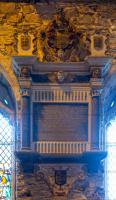
Before 28th March 1671 Sarah Hungerford (age 29) died. She was buried at St James' Church, Antony [Map].
Sarah Hungerford: Before 30th March 1641 she was born to Anthony Hungerford and Rachel Jones. Before 8th August 1664 John Carew 3rd Baronet and she were married.
On 28th March 1675 Frederick William I Duke Mecklenburg-Schwerin was born to Frederick I Duke of Mecklenburg Grabow (age 37). He married 2nd January 1704 his fourth cousin Sophie Charlotte Hesse-Kassel Duchess Mecklenburg-Schwerin, daughter of Charles I Landgrave Hesse-Kassel and Maria Amalia of Courland Landgravine Hesse-Kassel.
John Evelyn's Diary. 28th March 1686. Dr White, Bp. of Peterboro' (age 58), preach'd in a very eloquent style, on 26 Matthew 29, submission to the will of God on all accidents and at all times.
Jean de Waurin's Chronicle of England Volume 6 Books 3-6: The Wars of the Roses
Jean de Waurin was a French Chronicler, from the Artois region, who was born around 1400, and died around 1474. Waurin’s Chronicle of England, Volume 6, covering the period 1450 to 1471, from which we have selected and translated Chapters relating to the Wars of the Roses, provides a vivid, original, contemporary description of key events some of which he witnessed first-hand, some of which he was told by the key people involved with whom Waurin had a personal relationship.
Available at Amazon in eBook and Paperback format.
On 28th March 1697 Grace Fitzroy Countess Darlington was born to Charles Fitzroy 1st Duke Southampton 2nd Duke Cleveland (age 34) and Anne Pulteney Duchess Southampton Duchess of Cleveland (age 33). She a granddaughter of King Charles II of England Scotland and Ireland. She married 2nd September 1725 Henry Vane 1st Earl Darlington, son of Gilbert Vane 2nd Baron Barnard and Mary Randyll Baroness Barnard, and had issue.
John Evelyn's Diary. 18th March 1701. I let Sayes Court, Deptford [Map] to Lord Carmarthen (age 42), son to the Duke of Leeds (age 69). 28th. I went to the funeral of my sister Draper, who was buried at Edmonton in great state. Dr. Davenant displeased the clergy now met in Convocation by a passage in his book, p. 40.
On 28th March 1704 Edward Ward 8th Baron Dudley 3rd Baron Ward (age 20) died of smallpox. His son Edward succeeded 4th Baron Ward of Birmingham, 9th Baron Dudley posthumously.
On 28th March 1717 Roger Gale (age 44) was elected Fellow of the Royal Society.
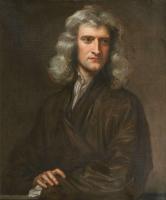
On 28th March 1727 Isaac Newton (deceased) was buried in Scientist's Corner, Westminster Abbey [Map]; the first scientist to be buried there. The service was performed by the Bishop of Rochester (age 74).
Before the funeral his body lay in state in the Jerusalem Chamber, Cheyneygates, Westminster Abbey [Map]. His coffin was followed by most of the Fellows of the Royal Society.
The Pall Bearers were the Lord Chancellor Peter King 1st Baron King (age 58), James Graham 1st Duke Montrose (age 44), Robert Ker 2nd Duke Roxburghe (age 18), Thomas Herbert 8th Earl Pembroke 5th Earl Montgomery (age 71), Talbot Yelverton 1st Earl of Sussex (age 36) and Thomas Parker 1st Earl Macclesfield (age 60).
The Chief Mourner was Michael Newton 4th Baronet (age 32); his third cousin.
Voltaire observed, "He was buried like a king who had done well by his subjects.".
The inscription on his John Michael Rysbrack (age 32) monument reads "Here is buried Isaac Newton, Knight, who by a strength of mind almost divine, and mathematical principles peculiarly his own, explored the course and figures of the planets, the paths of comets, the tides of the sea, the dissimilarities in rays of light, and, what no other scholar has previously imagined, the properties of the colours thus produced. Diligent, sagacious and faithful, in his expositions of nature, antiquity and the holy Scriptures, he vindicated by his philosophy the majesty of God mighty and good, and expressed the simplicity of the Gospel in his manners. Mortals rejoice that there has existed such and so great an ornament of the human race! He was born on 25th December 1642, and died on 20th March 1726."


Cansisk's Monumental Inscriptions Volume 1 Old St Pancras Churchyard. Churchyard St Pancras Old Church [Map]. Here lyeth deposited in this vault the remains of the late Honble Lady Barbara Webb, Wife of Sr John Webb (age 85), of Great Canford, in the county of Dorset, Baronet Who departed this life on the 28th day of March, in the year of our Lord 1740. This pious lady was the surviving daughter and sole Heiress of the late Right Honble John, Lord Belasyse, by his third wife the Lady Ann Powlett, Daughter of the Right Noble John, Marquiss of Winchester, who to avoid the expense and vanity of a pompous funeral in her family vault made it her death bed request in compassion to the poor to be privately interred in this churchyard & that the repose of her soul may be remembered by all good Christians. This tomb was erected by her disconsolate husband. Requiescat in pace. Amen.
Letters of Horace Walpole. 23rd March 1752. Arlington Street. To Horace Mann 1st Baronet (age 45).
Mr. Conway (age 31) has been arrived this fortnight, or a week sooner than we expected him: but my Lady Ailesbury (age 31) forgives it! He is full of your praises, so you have not sowed your goodness in unthankful ground. By a letter I have just received from you he finds you have missed some from him with Commissions; but he will tell you about them himself I find him much leaner, and great cracks in his beauty. Your picture is arrived, which he says is extremely like you. Mr. Chute (age 50) cannot bear it; says it wants your countenance and goodness; that it looks bonny and Irish. I am between both, and should know it; to be sure, there is none of your wet-brown-paperness in it, but it has a look with which I have known you come out of your little room, when Richcourt has raised your ministerial French, and you have writ to England about it till you were half fuddled. Au reste, it is gloriously coloured-will Astley promise to continue to do as well? or has he, like all other English painters, only laboured this to get reputation, and then intends to daub away to get money?
The year has not kept the promise of tranquillity that it made you at Christmas; there has been another parliamentary bustle. The Duke of Argyll (age 69)299 has drawn the ministry into accommodating him with a notable job, under the notion of buying for the King from the mortgagees the forfeited estates in Scotland, which are to be colonized and civilized. It passed with some inconsiderable hitches through the Commons; but in the Lords last week the Duke of Bedford (age 41) took it up warmly, and spoke like another Pitt.300 He attacked the Duke of Argyll on favouring Jacobites, and produced some flagrant instances, which the Scotch Duke neither answered nor endeavoured to excuse, but made a strange, hurt, mysterious, contemptuous, incoherent speech, neither in defence of the bill nor in reply to the Duke of Bedford, but to my Lord Bath (age 68), who had fallen upon the ministry for assuming a dispensing power, in suffering Scotland to pay no taxes for the last five years. This speech, which formerly would have made the House of Commons take up arms, was strangely flat and unanimated, for want of his old chorus. Twelve lords divided against eighty that were for the bill. The Duke, who was present, would not vote; none of his people had attended the bill in the other House, and General Mordaunt (age 55) (by his orders, as it is imagined) spoke against it. This concludes the session: the King goes to Hanover on Tuesday, he has been scattering ribands of all colours, blue ones [Note. Reference to being created a Knight of the Garter] on Prince Edward (age 12), the young Stadtholder, and the Earls of Lincoln (age 31), Winchilsea (age 62), and Cardigan (age 39);301 a green one [Note. Reference to being created a Knight of the Order of the Thistle] on Lord Dumfries;302 a red [Note. Order of the Bath] on Lord Onslow (age 39).303
The world is still mad about the Gunnings; the Duchess of Hamilton (age 18) was presented on Friday; the crowd was so great, that even the noble mob in the drawing-room clambered upon chairs and tables to look at her. There are mobs at their doors to see them get into their chairs; and people go early to get places at the theatres when it is known they will be there. Dr. Sacheverel never made more noise than these two beauties [Note. Elizabeth Gunning Duchess Hamilton and Argyll and Maria Gunning Countess Coventry (age 19)].
There are two wretched women that just now are as much talked of, a Miss Jefferies1 and a Miss Blandy (age 32)2; the one condemned for murdering her uncle, the other her father. Both their stories have horrid circumstances; the first, having been debauched by her uncle; the other had so tender a parent, that his whole concern while he was expiring, and knew her for his murderess, was to save her life. It is shocking to think what a shambles this country is grown! Seventeen were executed this morning, after having murdered the turnkey on Friday night, and almost forced open Newgate. One is forced to travel, even at noon, as if one was going to battle.
Mr. Chute is as much yours as ever, except in the article of pen and ink. Your brother transacts all he can for the Lucchi, as he has much more weight there304 than Mr. Chute. Adieu!
Note 299. Archibald Campbell, Duke of argyll, formerly Earl of Isla.
Note 300. For Lord Hardwicke's notes of this speech, see Parl. Hist. vol. xiv. P. 1235.-E.
Note 301. George Brudenell, fourth Earl of cardigan, created Duke of Montagu in 1776; died in 1790.-D.
Note 302. William Crichton Dalrymple (age 53), fourth Earl [Note. Mistake. He was 5th Earl] of Dumfries in Scotland, in right of his mother. He also became, in 1760, fourth Earl of stair, and died in 1768.-D.
Note 303. George, third Lord Onslow; died in 1776.-D.
Note 304. With the late Mr. Whithed's brothers, who scrupled paying a small legacy and annuity to his mistress and child.
Note 1. Elizabeth Jeffries was to have received her uncle's estate but as a consequence of her bad behaviour he stated he would change his will. She, with accomplices, murdered her uncle. She was executed at a temporary gibbet at the Sixth Milestone Epping Forest on 28th March 1572.
Note 2. Mary Blandy who was found guilty of poisoning her father and executed on 6th April 1752.
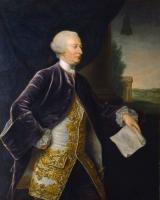


Become a Member via our Buy Me a Coffee page to read more.
On 28th March 1766 Diana Beauclerk (age 20) died in childbirth. The child was stillborn.
On 28th March 1785 Ferdinand Georg August Saxe Coburg Gotha was born to Francis Saxe Coburg Gotha I Duke Saxe Coburg Gotha (age 34) and Augusta Reuss Duchess Saxe Coburg Gotha (age 28). He married 30th November 1815 Maria Antonia Koháry Csábrág and had issue.


On 28th March 1793 Harry Bewes (age 52) died. He was buried at St Cuby's Church, Duloe [Map]. Monument by William Adran, 1793, signed 'Adran Fect London'.
Harry Bewes: Around 1741 he was born.


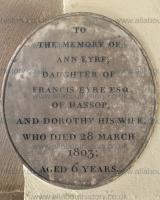
St Giles' Church, Great Longstone [Map]. To the memory of Anne Eyre Daughter of Francis Eyre, Esq. of Hassop, And Dorothy his wife, Who died 28 March 1803, aged 6 years.
The London Gazette 15905. Dublin Castle, March 28, 1806.
The Duke of Bedford (age 39), who embarked at Holyhead on Tuesday Night the 25th Instant, on board His Majesty's Yacht the Dorset, arrived in this Harbour early this Morning. His Grace on his Arrival in Dublin, was received by the Lord Mayor, Aldermen, Sheriffs, and Commons of the City of Dublin.
His Grace, attended by a Squadron of Dragoons, proceeded to the Castle, and the Council having assembled at Three o'Clock, His Grace was introduced in form to His Excellency the Earl, of Hardwicke (age 48), who received him sitting under the Canopy of State in the Presence Chamber, from whence a Procession was made in the usual State to the Council Chamber: The Council sitting, His Grace's Commission was tead, and the Oath being administered to him, His Grace was invested with the Collar of the most illustrious Order of Saint Patrick, and received the Sword of State from the Earl of Hardwicke.
His Grace afterwards repaired to the Presence Chamber, and received the Compliments of the Nobility and other Persons of Distinction upon his safe Arrival, and taKing upon him the Government of Ireland.


On 28th March 1809 George Richmond was born in Brompton, Kensington.

Archaeologia Volume 22 Appendix. March 28, 1822. James Logan, Esq. communicated to the Society two Drawings of Druidical Circles in Aberdeenshire, accompanied by some Remarks.
On 28th March 1831 Anne-Elizabeth Hodgson (age 28) died from childbirth eleven days after giving birth to a daughter.
On 28th March 1853 Edward Spencer-Churchill was born to George Spencer-Churchill 6th Duke of Marlborough (age 59) and Jane Francis Stewart Duchess Marlborough. Coefficient of inbreeding 6.28%. He married 15th September 1874 Augusta Warburton and had issue.
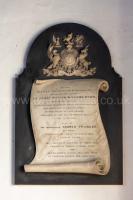
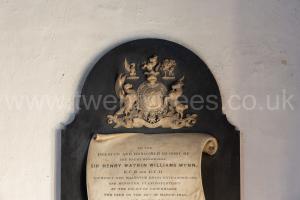
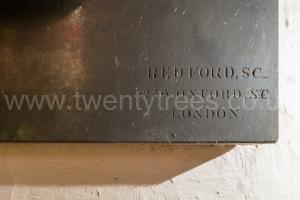
After 28th March 1856. Memorial to Henry Watkin Williams-Wynn (deceased) and Hester Frances Smith. Sculpted by Bedford of Oxford Street.
Hester Frances Smith: Around 1790 she was born to Robert Smith 1st Baron Carrington. On 30th September 1813 Henry Watkin Williams-Wynn and she were married. On 5th March 1854 Hester Frances Smith died.
Adeline Horsey Recollections. One fine March morning he told me that he was going to ride and see a gamekeeper who had accidentally shot himself.
He asked me and Sir Henry Edwards (age 55) to accompany him, but when we reached the keeper's cottage he told us to return to Deene [Map], saying that as he intended to sit an hour with the man he would come on later. We declared our willingness to wait, but Cardigan would not hear of it, and so we somewhat reluctantly rode home without him.
The luncheon hour arrived, but Lord Cardigan did not come; the afternoon dragged on, and still there were no signs of him. I had a horrible presentment that something must have happened, and at once ordered some of the servants to go in search of his Lordship.
My fears were only too well grounded; my husband was found lying insensible on the roadside, nearly lifeless. A roadmender told us afterwards that Lord Cardigan had passed him and spoken a few words and seemed apparently quite well; the horse he was riding shied at a heap of stones and commenced to rear and plunge rather wildly, but my husband kept the animal well under control, for the roadmender saw him ride quietly away. The effort must, however, have afterwards brought on a seizure, for Cardigan fell from his horse, and lay helpless until he was found and brought back to Deene [Map].
For three dreadful days and nights he lay quite unconscious, gasping for breath, and the knowledge that he could not speak to me and did not recognise me intensified my grief a thousandfold. But mercifully his suffering was not prolonged, and on March 28, 1868, my beloved husband passed away.
There are some griefs that are too deep to speak of, even after Time's soothing touch has taken away the first deadly pain of a great sorrow. When I look back and remember the kindness and love which my husband lavished on me, I feel proud to think he often said that the happiest period of his life was after he married me, and that his great possessions and military fame were as nothing compared to the wife he adored.
Lord Cardigan's body lay in state in the ballroom at Deene [Map] for twelve days, during which time six thousand people came to look their last at the remains of the leader of the Charge of the Light Brigade. On April 9 he was buried in Deene Church [Map]; the whole regiment of the 11th Hussars attended the funeral, and he was carried to his last resting-place by eight of his old officers.
When the will was read, it was found that he had left everything to me.
Become a Member via our Buy Me a Coffee page to read more.
Chronicle of Abbot Ralph of Coggeshall
The Chronicle of Abbot Ralph of Coggeshall (Chronicon Anglicanum) is an indispensable medieval history that brings to life centuries of English and European affairs through the eyes of a learned Cistercian monk. Ralph of Coggeshall, abbot of the Abbey of Coggeshall in Essex in the early 13th century, continued and expanded his community’s chronicle, documenting events from the Norman Conquest of 1066 into the tumultuous reign of King Henry III. Blending eyewitness testimony, careful compilation, and the monastic commitment to record-keeping, this chronicle offers a rare narrative of political intrigue, royal power struggles, and social upheaval in England and beyond. Ralph’s work captures the reigns of pivotal figures such as Richard I and King John, providing invaluable insights into their characters, decisions, and the forces that shaped medieval rule. More than a simple annal, Chronicon Anglicanum conveys the texture of medieval life and governance, making it a rich source for scholars and readers fascinated by English history, monastic authorship, and the shaping of the medieval world.
Available at Amazon in eBook and Paperback format.
On 28th March 1868 James Brudenell 7th Earl Cardigan (age 70) died from a fall from a horse. His second cousin George (age 63) succeeded 8th Earl Cardigan, 8th Baron Brudenell of Stonton in Leicestershire. Baron Brudenell Deene in Northamptonshire extinct.
On 25th May 1915 Adeline Horsey Countess Cardigan (age 90) died.
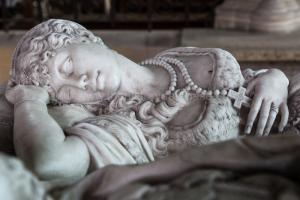
Both were buried in St Peter's Church, Deene [Map]; he on 9th April 1868. Monument to James Brudenell 7th Earl Cardigan 1797 1868 sculpted by Joseph Boehm (age 33). Recumbent effigies on Sarcophagus, bronze sea horses (Brudenell Crest) at the bottom corners.




On 28th March 1871 Archibald Keightley Nicholson was born.
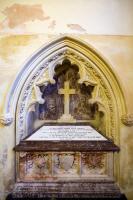
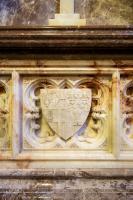
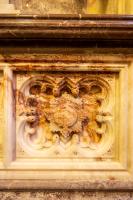
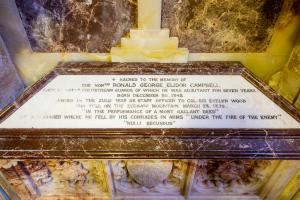
On 28th March 1879 Captain Ronald George Elidor Campbell (age 30) was killed in action in the Zulu Wars at Zlobani Mountain. Monument in St Elidor's Church Stackpole [Map]. His two colleagues took the Zulu position and were both awarded VCs. Colonel Evelyn Wood stated that if he had survived Campbell would also have been recommended for the VC. He died "in the performance of a most gallant act. He was buried where he fell by his comrades under the fire of the enemy" according to the citation. His wife later visited his gravestone which is on the battlefield.
Captain Ronald George Elidor Campbell: In 1867 Ronald Campbell was commissioned in the Coldstream Guards in 1867, promoted Captain in 1871, becoming Adjutant 1st Battalion 1871-78. Before 28th March 1879 Captain Ronald George Elidor Campbell applied for special service in South Africa he served in the Anglo-Zulu Wars (1879-96) as Staff Officer to Col. Sir Evelyn Wood.

Detail from 'Letter from Florence' in Roman News: A Weekly Review of Politics, Archaeology, Fine Arts, Literature and Society, 28th March 1883.
The lady referred to, is a Bostonian, Miss Alexander (age 46), for many years a resident, and who for well nigh four years has been at work on what, we verily believe, will carry her name down to a distant posterity. It consists of an album, of large size, containing all the Stornelli and the Rispetti, or love ditties, which Miss Alexander has with great and patient perseverance, gathered both from old song books, and from the contadini themselves, they singing the melodies and repeating the words of songs fast being forgotten even by the old, and she rapidly noting them down. These are all most feelingly illustrated, and in an entirely original manner such lovely Madonnas and Bambinis, such sweet interiors of the paesani, countenances expressing such stern rebuke and sweet approvals and all surrounded by the many Tuscan wild flowers only noticed and gathered by a true lover of nature. The entire work is done in pen and ink, and though not yet completed, Mr. Ruskin bas already bought it, at the price of six hundred Guineas for his Sheflield Museum.

On 28th March 1884 Leopold Saxe Coburg Gotha 1st Duke Albany (age 30) died at the Villa Nevada, Cannes.
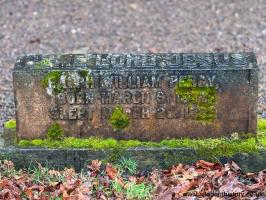
On 28th March 1889 Ralph William Percy (age 12) died.He was buried at the Church of St Mary the Virgin, Lesbury [Map].
Ralph William Percy: On 9th March 1877 he was born to Henry George Percy 7th Duke Northumberland and Edith Campbell Duchess Northumberland.
On 24th March 1908 Spencer Cavendish 8th Duke Devonshire (age 74) died of pneumonia at Hotel Metropol. His nephew Victor (age 39) succeeded 9th Duke Devonshire, 12th Earl Devonshire, 4th Earl Burlington, 12th Baron Cavendish Hardwick. On 28th March 1908 he was buried in the Cavendish Plot, St Peter's Church, Edensor [Map].


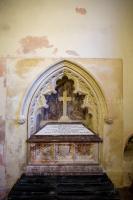
After 28th March 1908. St Peter's Church, Edensor [Map]. Reredos in memory of Spencer Cavendish 8th Duke Devonshire (deceased).


On 28th March 1910 Ingrid Bernadotte Queen Consort Denmark was born to Gustaf Adolph VI King Sweden (age 27) and Margaret "Daisy" Windsor (age 28). He a great grandson of Queen Victoria of the United Kingdom.
On 28th March 1918 Richard Gerard Wellesley Williams-Bulkeley (age 36) died from wounds received in action at his home following a long illness.

On 28th March 1918 Lieutenant-Colonel Oliver Cyril Spencer Watson (age 41) was killed in action. He was awarded the Victoria Cross - see The Gazette.
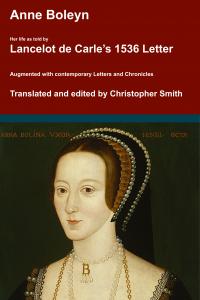
Anne Boleyn. Her Life as told by Lancelot de Carle's 1536 Letter.
In 1536, two weeks after the execution of Anne Boleyn, her brother George and four others, Lancelot du Carle, wrote an extraordinary letter that described Anne's life, and her trial and execution, to which he was a witness. This book presents a new translation of that letter, with additional material from other contemporary sources such as Letters, Hall's and Wriothesley's Chronicles, the pamphlets of Wynkyn the Worde, the Memorial of George Constantyne, the Portuguese Letter and the Baga de Secrets, all of which are provided in Appendices.
Available at Amazon in eBook and Paperback format.
On 28th March 1926 María del Rosario Cayetana Fitz-James Stuart 18th Duchess of Alba 11th Duke of Berwick was born to Jacobo Fitz-James Stuart 17th Duke of Alba 10th Duke of Berwick (age 47) and María del Rosario de Silva Duchess of Alba (age 25). She married 12th October 1947 Luis Martínez de Irujo y Artázcoz and had issue.

On 28th March 1941 Adeline Virginia Stephen aka Virginia Woolf (age 59) committed suicide. She walked into the fast-flowing River Ouse near her home having placed a large stone in her pocket. Her body was not found until 18 April. In her suicide note, addressed to her husband Leonard Woolf (age 60), she wrote: "Dearest, I feel certain that I am going mad again. I feel we can't go through another of those terrible times. And I shan't recover this time. I begin to hear voices, and I can't concentrate. So I am doing what seems the best thing to do. You have given me the greatest possible happiness. You have been in every way all that anyone could be. I don't think two people could have been happier till this terrible disease came. I can't fight it any longer. I know that I am spoiling your life, that without me you could work. And you will I know. You see I can't even write this properly. I can't read. What I want to say is I owe all the happiness of my life to you. You have been entirely patient with me and incredibly good. I want to say that—everybody knows it. If anybody could have saved me, it would have been you. Everything has gone from me but the certainty of your goodness. I can't go on spoiling your life any longer. I don't think two people could have been happier than we have been. V."
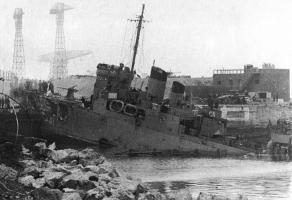
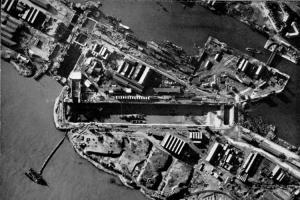
On 28th March 1942 a British amphibious attack on the heavily defended 'Normandie' dry dock at St Nazaire, Western France, resulted in putting out of action the only dry-dock in the Atlantic that was large enough to accomodate the Tirpitz. The obsolete destroyer HMS Campbeltown, accompanied by eighteen smaller craft, crossed the English Channel to the Atlantic coast of France and rammed into the dry dock south gate. The ship had been packed with delayed-action explosives, well hidden within a steel and concrete case, that detonated later that day, putting the dock out of service until 1948. Of the 612 men who undertook the raid, 228 returned to Britain, 169 were killed and 215 became prisoners of war. German casualties included over 360 dead, some of whom were killed after the raid when Campbeltown exploded. Eighty-nine members of the raiding party were awarded decorations, including five Victoria Crosses.
Photos. 1. HMS Campbeltown wedged in the dock gates. 2. Normandie Dock months after the raid. The wreck of HMS Campbeltown is visible inside the dry dock.
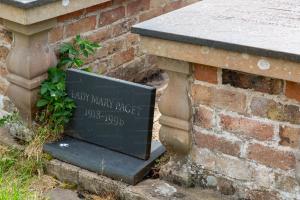
On 28th March 1996 Mary Patricia Beatrice Rose Paget (age 78) died. She was buried at St Edwen's Church, Llanedwen [Map].
Mary Patricia Beatrice Rose Paget: On 19th January 1918 she was born to Charles Henry Alexander Paget 6th Marquess Anglesey and Victoria Marjorie Harriet Manners Marchioness Anglesey.
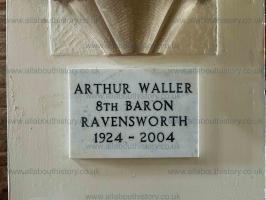
On 28th March 2004 Arthur Waller Liddell 8th Baron Ravensworth (age 79) died. Memorial at St Bartholomew's Church, Whittingham [Map]. His son Thomas (age 49) succeeded 9th Baron Ravensworth of Ravensworth Castle in County Durham, 14th Baronet Liddell of Ravensworth Castle.
Arthur Waller Liddell 8th Baron Ravensworth: On 25th July 1924 he was born to Cyril Arthur Liddell. On 4th August 1950 Robert Arthur Liddell 7th Baron Ravensworth died. His first cousin Arthur succeeded 8th Baron Ravensworth of Ravensworth Castle in County Durham, 13th Baronet Liddell of Ravensworth Castle.
Thomas Arthur Hamish Liddell 9th Baron Ravensworth: On 27th October 1954 he was born to Arthur Waller Liddell 8th Baron Ravensworth.
On 28th March 1551 Ferdinand Habsburg Spain was born to Maximilian Habsburg Spain II Holy Roman Emperor (age 23) and Maria of Spain Holy Roman Empress (age 22). Coefficient of inbreeding 10.03%. He died aged one in 1552.
On 28th March 1591 William Cecil 2nd Earl Salisbury was born to Robert Cecil 1st Earl Salisbury (age 27) and Elizabeth Brooke (age 28). He married 1st December 1608 his fifth cousin Catherine Howard Countess Salisbury, daughter of Thomas Howard 1st Earl Suffolk and Catherine Knyvet Countess Suffolk, and had issue.


On 28th March 1634 Richard Temple 3rd Baronet was born to Peter Temple 2nd Baronet (age 42) and Christian Leveson (age 22). He married before 24th October 1675 Mary Knapp Lady Temple and had issue.
On 28th March 1675 Frederick William I Duke Mecklenburg-Schwerin was born to Frederick I Duke of Mecklenburg Grabow (age 37). He married 2nd January 1704 his fourth cousin Sophie Charlotte Hesse-Kassel Duchess Mecklenburg-Schwerin, daughter of Charles I Landgrave Hesse-Kassel and Maria Amalia of Courland Landgravine Hesse-Kassel.
On 28th March 1697 Grace Fitzroy Countess Darlington was born to Charles Fitzroy 1st Duke Southampton 2nd Duke Cleveland (age 34) and Anne Pulteney Duchess Southampton Duchess of Cleveland (age 33). She a granddaughter of King Charles II of England Scotland and Ireland. She married 2nd September 1725 Henry Vane 1st Earl Darlington, son of Gilbert Vane 2nd Baron Barnard and Mary Randyll Baroness Barnard, and had issue.
On 28th March 1739 Francis Reynolds-Moreton 3rd Baron Ducie was born to Francis Reynolds and Elizabeth Moreton.
Chronicle of Walter of Guisborough
A canon regular of the Augustinian Guisborough Priory, Yorkshire, formerly known as The Chronicle of Walter of Hemingburgh, describes the period from 1066 to 1346. Before 1274 the Chronicle is based on other works. Thereafter, the Chronicle is original, and a remarkable source for the events of the time. This book provides a translation of the Chronicle from that date. The Latin source for our translation is the 1849 work edited by Hans Claude Hamilton. Hamilton, in his preface, says: 'In the present work we behold perhaps one of the finest samples of our early chronicles, both as regards the value of the events recorded, and the correctness with which they are detailed; Nor will the pleasing style of composition be lightly passed over by those capable of seeing reflected from it the tokens of a vigorous and cultivated mind, and a favourable specimen of the learning and taste of the age in which it was framed.'
Available at Amazon in eBook and Paperback format.
On 28th March 1746 George Damer 2nd Earl Dorchester was born to Joseph Damer 1st Earl Dorchester (age 28) and Caroline Sackville Lady Milton.
On 28th March 1757 Theophilus Biddulph 5th Baronet was born to Theophilus Biddulph 4th Baronet (age 37) and Jane Biddulph Lady Biddulph (age 30). Coefficient of inbreeding 3.12%. He married in or before 1784 Hannah Prestridge Lady Biddulph and had issue.

On 28th March 1785 Georgiana Maria Fitzroy was born to George Fitzroy 2nd Baron Southampton (age 23) and Laura Keppel Baroness Southampton (age 20). She a great x 3 granddaughter of King Charles II of England Scotland and Ireland. She married 2nd June 1814 her first cousin Lieutentnant-Colonel John Horace Thomas Stapleton.
On 28th March 1785 Ferdinand Georg August Saxe Coburg Gotha was born to Francis Saxe Coburg Gotha I Duke Saxe Coburg Gotha (age 34) and Augusta Reuss Duchess Saxe Coburg Gotha (age 28). He married 30th November 1815 Maria Antonia Koháry Csábrág and had issue.
On 28th March 1785 Theophilus Biddulph 6th Baronet was born to Theophilus Biddulph 5th Baronet (age 28) and Hannah Prestridge Lady Biddulph (age 30). He married 12th April 1825 Jane Rebecca Vyner Lady Biddulph and had issue.
On 28th March 1798 John Townshend 4th Marquess Townshend was born to John Townshend (age 41) and Georgiana Anne Poyntz (age 34) at Balls Park, Hertford. He married 18th August 1825 Elizabeth Jane Stuart and had issue.

On 28th March 1808 Chartlotte Catherine Hamilton-Gordon was born to George Hamilton-Gordon 4th Earl Aberdeen (age 24) and Catherine Elizabeth Hamilton Countess Aberdeen (age 24). She died aged ten in 1818.
On 28th March 1809 George Richmond was born in Brompton, Kensington.
On 28th March 1814 Louisa Harriet Jenkinson was born to Charles Jenkinson 3rd Earl Liverpool (age 29) and Julia Evelyn Medley Shuckburgh-Evelyn. She married 5th September 1839 John Cotes.
Chronicle of Geoffrey le Baker of Swinbroke
Baker was a secular clerk from Swinbroke, now Swinbrook, an Oxfordshire village two miles east of Burford. His Chronicle describes the events of the period 1303-1356: Gaveston, Bannockburn, Boroughbridge, the murder of King Edward II, the Scottish Wars, Sluys, Crécy, the Black Death, Winchelsea and Poitiers. To quote Herbert Bruce 'it possesses a vigorous and characteristic style, and its value for particular events between 1303 and 1356 has been recognised by its editor and by subsequent writers'. The book provides remarkable detail about the events it describes. Baker's text has been augmented with hundreds of notes, including extracts from other contemporary chronicles, such as the Annales Londonienses, Annales Paulini, Murimuth, Lanercost, Avesbury, Guisborough and Froissart to enrich the reader's understanding. The translation takes as its source the 'Chronicon Galfridi le Baker de Swynebroke' published in 1889, edited by Edward Maunde Thompson.
Available at Amazon in eBook and Paperback format.
On 28th March 1818 George Greville 4th Earl Warwick 4th Earl Brooke was born to Henry Greville 3rd Earl Warwick 3rd Earl Brooke Warwick Castle (age 38) and Sarah Elizabeth Savile Countess Warwick (age 32) at Charles Street, Berkeley Square. He married before 9th February 1853 Anne Charteris Countess Warwick, daughter of Francis Charles Charteris 9th Earl of Wemyss and Louisa Bingham Countess Wemyss, and had issue.
On 28th March 1837 George William Lowther was born to Charles Lowther 3rd Baronet (age 33).
On 28th March 1842 John William Spencer Brownlow Egerton-Cust 2nd Earl Brownlow was born to John Hume Egerton (age 29) and Marianne Margaret Compton (age 24) at Carlton Gardens.


On 28th March 1851 Murray Finch-Hatton 7th Earl Nottingham 12th Earl Winchilsea was born to George Finch-Hatton 5th Earl Nottingham 10th Earl Winchilsea (age 59) and Fanny Margaretta Rice Countess Nottingham Winchilsea. He married 27th October 1865 Edith Harcourt Countess Winchelsea and Nottingham and had issue.
On 28th March 1853 Edward Spencer-Churchill was born to George Spencer-Churchill 6th Duke of Marlborough (age 59) and Jane Francis Stewart Duchess Marlborough. Coefficient of inbreeding 6.28%. He married 15th September 1874 Augusta Warburton and had issue.
On 28th March 1871 Archibald Keightley Nicholson was born.
On 28th March 1876 Sybil Mary McDonnell Baroness Bicester was born to William Randall McDonnell 6th Earl of Antrim (age 25) and Louisa Grey Countess of Antrim (age 21). She married 6th March 1897 Vivian Hugh Smith 1st Baron Bicester and had issue.
On 28th March 1879 George Menteth Boughey 9th Baronet was born to George Fletcher Ottley Boughey (age 35).

On 28th March 1893 Maud Kathleen Cairnes Plantagenet Hastings was born to Warner Hastings 15th Earl Huntingdon (age 24) and Maud Margaret Wilson Countess Huntingdon (age 25). She married 28th July 1916 William Curzon.

On 28th March 1896 Nadejda Mikhailovna Torby Marchioness Milford Haven was born to Grand Duke Michael Mikhailovich of Russia (age 34). She married 1916 George Mountbatten 2nd Marquess Milford Haven, son of Prince Louis of Battenburg 1st Marquess Milford Haven and Victoria Hesse Darmstadt Marchioness Milford Haven, and had issue.
On 28th March 1908 Richard Anstruther-Gough-Calthorpe 2nd Baronet was born to Fitzroy Anstruther-Gough-Calthorpe 1st Baronet (age 35) and Rachel Gough-Calthorpe Lady Anstruther-Gough-Calthorpe (age 36).
On 28th March 1910 Ingrid Bernadotte Queen Consort Denmark was born to Gustaf Adolph VI King Sweden (age 27) and Margaret "Daisy" Windsor (age 28). He a great grandson of Queen Victoria of the United Kingdom.
On 28th March 1920 Mark Tennyson 5th Baron Tennyson was born to Major Lionel Hallam Tennyson 3rd Baron Tennyson (age 30) and Clarissa Madeline Tennant Baroness Tennyson (age 23). He married 1964 Deline Celeste Budler Baroness Tennyson.
The History of William Marshal was commissioned by his son shortly after William’s death in 1219 to celebrate the Marshal’s remarkable life; it is an authentic, contemporary voice. The manuscript was discovered in 1861 by French historian Paul Meyer. Meyer published the manuscript in its original Anglo-French in 1891 in two books. This book is a line by line translation of the first of Meyer’s books; lines 1-10152. Book 1 of the History begins in 1139 and ends in 1194. It describes the events of the Anarchy, the role of William’s father John, John’s marriages, William’s childhood, his role as a hostage at the siege of Newbury, his injury and imprisonment in Poitou where he met Eleanor of Aquitaine and his life as a knight errant. It continues with the accusation against him of an improper relationship with Margaret, wife of Henry the Young King, his exile, and return, the death of Henry the Young King, the rebellion of Richard, the future King Richard I, war with France, the death of King Henry II, and the capture of King Richard, and the rebellion of John, the future King John. It ends with the release of King Richard and the death of John Marshal.
Available at Amazon in eBook and Paperback format.
On 28th March 1924 Diana Evelyn Legh Countess Kimberley was born to Lieutenant-Colonel Piers Walter Legh (age 33). She married 27th October 1945 her fifth cousin once removed John Wodehouse 4th Earl Kimberley, son of John Wodehouse 3rd Earl Kimberley and Frances Margaret Irby Countess Kimberley.
On 28th March 1926 María del Rosario Cayetana Fitz-James Stuart 18th Duchess of Alba 11th Duke of Berwick was born to Jacobo Fitz-James Stuart 17th Duke of Alba 10th Duke of Berwick (age 47) and María del Rosario de Silva Duchess of Alba (age 25). She married 12th October 1947 Luis Martínez de Irujo y Artázcoz and had issue.
On 28th March 1948 Julian Charles Marsham 8th Earl of Romney was born to Lieutenant-Colonel Peter William Marsham (age 34) and Hersey Coke (age 33).
On 28th March 1672 James Wemyss 1st Lord Burntisland (age 15) and Margaret Wemyss Countess Cromartie 3rd Countess Wemyss (age 13) were married. She the daughter of David Wemyss 2nd Earl of Wemyss (age 61) and Margaret Leslie Countess Buccleuch and Wemyss (age 51).
On 28th March 1740 Thomas Foley 1st Baron Foley (age 23) and Grace Granville were married.
On 28th March 1769 Frederick Campbell (age 39) and Mary Meredith Countess Ferrers were married. He the son of John Campbell 4th Duke Argyll (age 76) and Mary Drummond Bellenden.
On 28th March 1837 Edward Strutt 1st Baron Belper (age 35) and Amelia Harriet Otter Baroness Belper (age 20) were married. She the daughter of Bishop William Otter (age 68).
On 28th March 1921 John James Kenward Shaw aka Best-Shaw 9th Baronet (age 25) and Elizabeth Mary Theodora Hughes Lady Shaw (age 24) were married.
Henrici Quinti, Angliæ Regis, Gesta, is a first-hand account of the Agincourt Campaign, and subsequent events to his death in 1422. The author of the first part was a Chaplain in King Henry's retinue who was present from King Henry's departure at Southampton in 1415, at the siege of Harfleur, the battle of Agincourt, and the celebrations on King Henry's return to London. The second part, by another writer, relates the events that took place including the negotiations at Troye, Henry's marriage and his death in 1422.
Available at Amazon in eBook and Paperback format.
On 28th March 965 Arnulf "Great" I Count Flanders (age 75) died.
On 28th March 1072 Ordulf Duke of Saxony (age 50) died. His son Magnus (age 27) succeeded Duke Saxony.
On 28th March 1241 King Valdemar II of Denmark (age 70) died.
On 28th March 1254 William Ferrers 5th Earl of Derby (age 61) died. He was buried at Merevale Abbey, Warwickshire [Map]. His son Robert (age 15) succeeded 6th Earl Derby. Mary or Marie Lusignan Countess Derby (age 12) by marriage Countess Derby.
On 28th March 1317 Bishop Walter of Maidstone died.
On 28th March 1353 Roger St John 4th Baron St John of Lageham died. Baron St John of Lagenhamdormant or extinct.
On 28th March 1421 Thomas Camoys 1st Baron Camoys (age 70) died. He was buried at St George's Church Trotton. His grandson Hugh (age 8) succeeded 2nd Baron Camoys.
On 28th March 1461 one or more battles were fought at Ferrybridge and Dintingdale. Richard "Kingmaker" Neville Earl Warwick, 6th Earl Salisbury (age 32) fought. John Radclyffe Baron Fitzwalter (age 35) was killed.
John "Butcher" Clifford 9th Baron Clifford (age 25) was killed. His son Henry (age 7) succeeded 10th Baron de Clifford, 10th Lord Skipton.
William Neville 1st Earl Kent (age 56) fought for York.
On 28th March 1489 Bishop Thomas Kempe (age 99) died.
Chronicle of Geoffrey le Baker of Swinbroke
Baker was a secular clerk from Swinbroke, now Swinbrook, an Oxfordshire village two miles east of Burford. His Chronicle describes the events of the period 1303-1356: Gaveston, Bannockburn, Boroughbridge, the murder of King Edward II, the Scottish Wars, Sluys, Crécy, the Black Death, Winchelsea and Poitiers. To quote Herbert Bruce 'it possesses a vigorous and characteristic style, and its value for particular events between 1303 and 1356 has been recognised by its editor and by subsequent writers'. The book provides remarkable detail about the events it describes. Baker's text has been augmented with hundreds of notes, including extracts from other contemporary chronicles, such as the Annales Londonienses, Annales Paulini, Murimuth, Lanercost, Avesbury, Guisborough and Froissart to enrich the reader's understanding. The translation takes as its source the 'Chronicon Galfridi le Baker de Swynebroke' published in 1889, edited by Edward Maunde Thompson.
Available at Amazon in eBook and Paperback format.
On 28th March 1501 Jean IV Count Auvergne (age 34) died.
On 28th March 1624 Richard Sackville 3rd Earl Dorset (age 35) died at Dorset House. He was buried in the Sackville Chapel St Michael's Church Withyham East Sussex. His brother Edward (age 33) succeeded 4th Earl Dorset, 4th Baron Buckhurst. Mary Curzon Countess Dorset (age 34) by marriage Countess Dorset.


On 28th March 1628 Edmund Prideaux 1st Baronet (age 74) died. His son Peter (age 32) succeeded 2nd Baronet Prideaux of Netherton in Devon. Susan Poulet Lady Prideaux (age 28) by marriage Lady Prideaux of Netherton in Devon.
On 28th March 1641 John Mohun 1st Baron Mohun Okehampton (age 46) died. His son Warwick (age 20) succeeded 2nd Baron Mohun Okehampton, 3rd Baronet Mohun of Boconnoc in Cornwall.
On 28th March 1664 Archbishop Accepted Frewen (age 75) died.
On 28th March 1677 William Hay 4th Earl Kinnoull (age 55) died. His son George succeeded 5th Earl Kinnoull.
On 28th March 1691 Dean Thomas Pierce (age 69) died at North Tidworth, Wiltshire where he had an estate.
On 28th March 1704 Edward Ward 8th Baron Dudley 3rd Baron Ward (age 20) died of smallpox. His son Edward succeeded 4th Baron Ward of Birmingham, 9th Baron Dudley posthumously.
Chronicle of a Bourgeois of Valenciennes
Récits d’un bourgeois de Valenciennes aka The Chronicle of a Bourgeois of Valenciennes is a vivid 14th-century vernacular chronicle written by an anonymous urban chronicler from Valenciennes in the County of Hainaut. It survives in a manuscript that describes local and regional history from about 1253 to 1366, blending chronology, narrative episodes, and eyewitness-style accounts of political, military, and social events in medieval France, Flanders, and the Low Countries. The work begins with a chronological framework of events affecting Valenciennes and its region under rulers such as King Philip VI of France and the shifting allegiances of local nobility. It includes accounts of conflicts, sieges, diplomatic manoeuvres, and the impact of broader struggles like the Hundred Years’ War on urban life in Hainaut. Written from the perspective of a burgher (bourgeois) rather than a monastery or royal court, the chronicle offers a rare lay viewpoint on high politics and warfare, reflecting how merchants, townspeople, and civic institutions experienced the turbulence of the 13th and 14th centuries. Its narrative style combines straightforward reporting of events with moral and civic observations, making it a valuable source for readers interested in medieval urban society, regional politics, and the lived experience of war and governance in pre-modern Europe.
Available at Amazon in eBook and Paperback format.
On 28th March 1740 Barbara Belasyse Lady Webb died.
On 28th March 1765 Johnathan Cope 1st Baronet (age 74) died at Orton Longueville predeceasing his father. His grandson Charles (age 22) succeeded 2nd Baronet Cope of Bruern in Oxfordshire.
On 28th March 1779 John Stewart 6th Earl Traquair (age 80) died. His son Charles (age 34) succeeded 7th Earl Traquair, 13th Lord Traquair.
On 28th March 1793 Harry Bewes (age 52) died. He was buried at St Cuby's Church, Duloe [Map]. Monument by William Adran, 1793, signed 'Adran Fect London'.
Harry Bewes: Around 1741 he was born.
On 28th March 1803 Joseph Blake 1st Baron Wallscourt (age 37) died. His nephew Joseph (age 7) succeeded 2nd Baron Wallscourt of Ardfry in County Galway although he may not have succeeded until his grandfather Joseph Blake (age 63) died in 1806.
On 28th March 1852 John Shelley 6th Baronet (age 80) died. His son John (age 44) succeeded 7th Baronet Shelley of Mitchelgrove in Sussex.
On 28th March 1868 James Brudenell 7th Earl Cardigan (age 70) died from a fall from a horse. His second cousin George (age 63) succeeded 8th Earl Cardigan, 8th Baron Brudenell of Stonton in Leicestershire. Baron Brudenell Deene in Northamptonshire extinct.
On 25th May 1915 Adeline Horsey Countess Cardigan (age 90) died.
Both were buried in St Peter's Church, Deene [Map]; he on 9th April 1868. Monument to James Brudenell 7th Earl Cardigan 1797 1868 sculpted by Joseph Boehm (age 33). Recumbent effigies on Sarcophagus, bronze sea horses (Brudenell Crest) at the bottom corners.
On 28th March 1884 Leopold Saxe Coburg Gotha 1st Duke Albany (age 30) died at the Villa Nevada, Cannes.
On 28th March 1895 Henry George Agar-Ellis 4th Viscount Clifden (age 31) died. His uncle Leopold (age 65) succeeded 5th Viscount Clifden of Gowran in County Kilkenny, 5th Baron Mendip of Mendip in Somerset, 4th Baron Dover. Harriet Stonor Viscountess Clifden (age 58) by marriage Viscountess Clifden of Gowran in County Kilkenny.
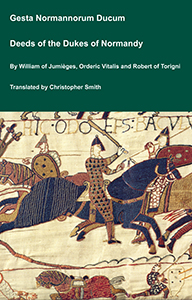
The Deeds of the Dukes of Normandy
The Gesta Normannorum Ducum [The Deeds of the Dukes of Normandy] is a landmark medieval chronicle tracing the rise and fall of the Norman dynasty from its early roots through the pivotal events surrounding the Norman Conquest of England. Originally penned in Latin by the monk William of Jumièges shortly before 1060 and later expanded at the behest of William the Conqueror, the work chronicles the deeds, politics, battles, and leadership of the Norman dukes, especially William’s own claim to the English throne. The narrative combines earlier historical sources with firsthand information and oral testimony to present an authoritative account of Normandy’s transformation from a Viking settlement into one of medieval Europe’s most powerful realms. William’s history emphasizes the legitimacy, military prowess, and governance of the Norman line, framing their expansion, including the conquest of England, as both divinely sanctioned and noble in purpose. Later chroniclers such as Orderic Vitalis and Robert of Torigni continued the history, extending the coverage into the 12th century, providing broader context on ducal rule and its impact. Today this classic work remains a foundational source for understanding Norman identity, medieval statesmanship, and the historical forces that reshaped England and Western Europe between 800AD and 1100AD.
Available at Amazon in eBook and Paperback format.
On 28th March 1898 George Byng 3rd Earl Strafford (age 68) died at St James' Square. His brother Henry (age 66) succeeded 4th Earl Strafford, 4th Viscount Enfield of Enfield in Middlesex, 4th Baron Strafford of Harmondsworth in Middlesex.
On 28th March 1902 William Stephen Temple Gore-Langton 4th Earl Temple (age 54) died at Cairo, Egypt to where he had travelled with his wife Helen for his health. His son Algernon (age 30) succeeded 5th Earl Temple of Stowe.
On 24th March 1908 Spencer Cavendish 8th Duke Devonshire (age 74) died of pneumonia at Hotel Metropol. His nephew Victor (age 39) succeeded 9th Duke Devonshire, 12th Earl Devonshire, 4th Earl Burlington, 12th Baron Cavendish Hardwick. On 28th March 1908 he was buried in the Cavendish Plot, St Peter's Church, Edensor [Map].
On 28th March 1910 Violet Neville Countess Cowley (age 43) died.
On 28th March 1931 Edith Eden Baroness Auckland (age 71) died.
On 28th March 1938 John Wynford Philipps 1st Viscount St Davids (age 77) died. His son Jestyn (age 21) succeeded 2nd Viscount St Davids of Lydstep Haven Pembrokeshire, 14th Baronet Philips of Picton Castle.
On 28th March 1941 Adeline Virginia Stephen aka Virginia Woolf (age 59) committed suicide. She walked into the fast-flowing River Ouse near her home having placed a large stone in her pocket. Her body was not found until 18 April. In her suicide note, addressed to her husband Leonard Woolf (age 60), she wrote: "Dearest, I feel certain that I am going mad again. I feel we can't go through another of those terrible times. And I shan't recover this time. I begin to hear voices, and I can't concentrate. So I am doing what seems the best thing to do. You have given me the greatest possible happiness. You have been in every way all that anyone could be. I don't think two people could have been happier till this terrible disease came. I can't fight it any longer. I know that I am spoiling your life, that without me you could work. And you will I know. You see I can't even write this properly. I can't read. What I want to say is I owe all the happiness of my life to you. You have been entirely patient with me and incredibly good. I want to say that—everybody knows it. If anybody could have saved me, it would have been you. Everything has gone from me but the certainty of your goodness. I can't go on spoiling your life any longer. I don't think two people could have been happier than we have been. V."
On 28th March 1942 Elizabeth Bulwer-Lytton Countess Balfour (age 74) died.
On 28th March 1965 Princess Mary Windsor Countess Harewood (age 67) died.


Jean de Waurin's Chronicle of England Volume 6 Books 3-6: The Wars of the Roses
Jean de Waurin was a French Chronicler, from the Artois region, who was born around 1400, and died around 1474. Waurin’s Chronicle of England, Volume 6, covering the period 1450 to 1471, from which we have selected and translated Chapters relating to the Wars of the Roses, provides a vivid, original, contemporary description of key events some of which he witnessed first-hand, some of which he was told by the key people involved with whom Waurin had a personal relationship.
Available at Amazon in eBook and Paperback format.
On 28th March 2004 Arthur Waller Liddell 8th Baron Ravensworth (age 79) died. Memorial at St Bartholomew's Church, Whittingham [Map]. His son Thomas (age 49) succeeded 9th Baron Ravensworth of Ravensworth Castle in County Durham, 14th Baronet Liddell of Ravensworth Castle.
Arthur Waller Liddell 8th Baron Ravensworth: On 25th July 1924 he was born to Cyril Arthur Liddell. On 4th August 1950 Robert Arthur Liddell 7th Baron Ravensworth died. His first cousin Arthur succeeded 8th Baron Ravensworth of Ravensworth Castle in County Durham, 13th Baronet Liddell of Ravensworth Castle.
Thomas Arthur Hamish Liddell 9th Baron Ravensworth: On 27th October 1954 he was born to Arthur Waller Liddell 8th Baron Ravensworth.
On 28th March 2009 Peter Nelson 9th Earl Nelson (age 67) died. His son Simon (age 37) succeeded 10th Earl Nelson of Trafalgar and Merson in Surrey, 10th Viscount Merton, 11th Baron Nelson of the Nile and Hillborough in Norfolk.