

William of Worcester's Chronicle of England
William of Worcester, born around 1415, and died around 1482 was secretary to John Fastolf, the renowned soldier of the Hundred Years War, during which time he collected documents, letters, and wrote a record of events. Following their return to England in 1440 William was witness to major events. Twice in his chronicle he uses the first person: 1. when writing about the murder of Thomas, 7th Baron Scales, in 1460, he writes '… and I saw him lying naked in the cemetery near the porch of the church of St. Mary Overie in Southwark …' and 2. describing King Edward IV's entry into London in 1461 he writes '… proclaimed that all the people themselves were to recognize and acknowledge Edward as king. I was present and heard this, and immediately went down with them into the city'. William’s Chronicle is rich in detail. It is the source of much information about the Wars of the Roses, including the term 'Diabolical Marriage' to describe the marriage of Queen Elizabeth Woodville’s brother John’s marriage to Katherine, Dowager Duchess of Norfolk, he aged twenty, she sixty-five or more, and the story about a paper crown being placed in mockery on the severed head of Richard, 3rd Duke of York.
Available at Amazon in eBook and Paperback format.
29 Jun is in June.
1283 Execution of David Prince of Wales
1509 Death of Margaret Beaufort
1540 Execution of Thomas Cromwell
29 Jun 1541 Execution of Thomas Fiennes
1611 June Creation of Baronets
1644 Battle of Cropredy Bridge
On 29th June 430 Fergus Mór aka Great mac Eirc King of Dál Riata was born to Erc King of Dál Riata.
Bede. Bertwald succeeded Theodore in the archbishopric, being abbot of the monastery called Racuulfe [Map], which stands at the northern mouth of the river Genlade. He was a man learned in the Scriptures, and perfectly instructed in ecclesiastical and monastic teaching, yet in no wise to be compared to his predecessor. He was chosen bishop in the year of our Lord 692, on the first day of July, when Wictred (age 22) and Suaebhard were kings in Kent; but he was ordained the next year, on Sunday the 29th of June, by Godwin, metropolitan bishop of Gaul, and was enthroned on Sunday the 31st of August. Among the many bishops whom he ordained was Tobias, a man instructed in the Latin, Greek, and Saxon tongues, and otherwise of manifold learning, whom he consecrated in the stead of Gedmund, bishop of the Church of Rochester, who had died.
On 29th June 693 Archbishop Berhtwald was ordained by Archbishop Godwin.
History of the Dukes of Normandy by William of Jumieges. Charles the Simple, the son of Louis named "Do Nothing," was Rollo's father-in-law. At one time he sent two knights to his daughter Gisela. She kept them with her secretly for a long while, not wishing to reveal them to Rollo. When he learned of this, he became angry, and thinking them to be spies, ordered them to be brought out, and when they were brought out, had them executed in the public marketplace, he had them executed. When Robert, duke of the Franks and Rollo's godfather, heard that the bonds of peace made between the king and the Robert [Rollo], duke of the Northmen, had been destroyed and broken because of the killing of the two knights, he rose against him, and invading the kingdom of the Franks, he was anointed king on the third day before the Kalends of July [29th June 922].
Carolus Simplex, filius Ludovici cognomento Nihil-fecit erat socer Rollonis; quodam tempore misit duos milites Gislæ filiæ suæ. Quos illa apud se occulte diu morari fecit, nolens eos manifestare Rolloni. Quod cum ille cognovisset, iratus et reputans eos exploratores, jussit illos educi, et eductos in foro rerum venalium jugulari. Audiens autem Robertus dux Francorum, patrinus Rollonis, quod pro nece duorum militum, colligatæ pacis inter regem et Robertum ducem Northmannorum vincula soluta diruptaque essent, contra eum rebellavit, et regnum Franciæ invadens, in regem III Kalendas Julii unctus est.
On 29th June 1059 Bernard II Duke of Saxony (age 64) died. His son Ordulf (age 37) succeeded Duke Saxony.
 Chronicum Anglicanum by Ralph Coggeshall. Then, after negotiations had taken place on both sides, a long discussion was held concerning the ransom of the king. At last it was agreed that, for his ransom, he should pay one hundred and fifty thousand marks of silver, according to the weight of Cologne. And when the emperor and the king had reached this agreement, an oath was sworn by the bishops, dukes, and counts, on the feast day of the Apostles Peter and Paul [29th June 1193], that as soon as the aforesaid sum had been paid by the king, he would immediately be set free to return to his own kingdom.
Deinde, mediantibus hinc inde utrisque partibus, pro redemptione regis diutius tractatum est. Tandem ad hoc perventum est, ut pro redemptione sua daret centum quinquaginta millia marcas argenti ad pondus Coloniensium. Cumque super hoc imperatori et regi conveniret, præstitum est ab episcopis et ducibus et comitibus juramentum, die apostolorum Petri et Pauli,' ut quamcitius prænominatam pecuniam rex persolvisset, illico liber ad regnum proprium regrederetur.
Chronica Majora by Matthew Paris. 29th June 1236. In the same year the inhabitants of Genoa, assisted by the Pisans and Marseillese, and the king of Arragon, suddenly attacked a noble city of Spain, called Cepta, on which the pagan citizens, who had for a long while inflicted much harm and injury to the said invaders, in alarm at the great numbers of their enemies, and at their sudden attack, surrendered to their authority, making a truce for a time on the condition, that if their lord, the king of Africa, who was commonly called the Emir of the World, should not send them effectual assistance within three years, they would willingly, and without any difficulty, surrender themselves and the whole city to them; that in the mean time the king of Arragon and his allies might, at any time during three years, peaceably build a tower and fortify it at their pleasure, on a bridge which they had gained possession of before the arrangement of this truce. The city of Cordova, then being taken, and Cepta being ready for capture, the hopes of the Christians were raised, and alarm seized on the Saracens, and especially on the king of Africa.
Chronica Majora by Matthew Paris. 29th June 1237. In the same year, too, about the feast of St. Peter and St. Paul, it was not known for what purpose. Master Otto, a cardinal deacon of St. Nicholas in the Tullian prison, came as legate to England on a summons from the king, unknown to the nobles; at which a great many of them conceived great anger against the king, and said, "The king perverts all laws, breaks his faith and promises, and transgresses in everything he does: he a little while ago united himself in marriage to a foreigner, without consulting his friends and natural subjects; and now he has secretly summoned a legate to make alterations throughout the whole kingdom: at one time he gives away his own, and then endeavours to recall what he has given." In this way from day to day, according to the words of the Gospel, the kingdom, divided in itself, and in disorder, was dreadfully desolate. It was said that Edmund, archbishop of Canterbury, reproached the king for acting in the way he did, and especially for summoning the legate, knowing that it would ere long be the cause of great loss to the kingdom, and to the prejudice of his dignity; but the king rejected his advice, as well as that of others of his counsellors, and would on no account abandon the purpose he had conceived in his mind. The aforesaid legate, therefore, came in grand pomp and in great power, and the bishops and clerks of distinction went as far as the coast to meet him; and some went off to him in boats, receiving him with acclamations, and offering him costly presents. Even at Paris, the messengers of several bishops met him, and offered him cloth of scarlet and valuable cups. For doing this they deserved general censure, both for the gift and the manner of giving it; for by the cloth and its colour it was made to appear that the office of the legateship and his arrival were accepted of On his arrival, he did not receive all the presents offered to him, but only some; and what he did not take, he ordered to be kept for him; he then liberally distributed the vacant benefices amongst his followers, whom he had brought with him, whether deserving or undeserving. The king himself met him at the seaside, and bowed his head to his knees; after which he officiously conducted him to the interior of the country. The bishops also came, as well as abbats, and the other prelates of the churches, and received him with all honour and reverence, with processions and the music of bells, and with costly presents, as became them, and more than became them...
On 29th June 1252 King Abel of Denmark (age 34)was killed by a wheelwright named Henner on Husum Bridge near Eiderstedt. His brother Christopher (age 33) succeeded King of Denmark.
Annals of Dunstable. And on the feast of Saint Alban [22nd June 1283] next following, the aforesaid David (age 44), hiding on a certain mountain with a few men, was captured through the treachery of one of his own, and bound in irons was kept in the safest custody until the following feast of Saint Michael [29th June 1283]. His wife [Elizabeth Ferrers (age 43)] also was likewise taken and kept safely. On the said feast of Saint Michael, the said David, by the judgment of all the baronage of England, received four sentences in this manner:
1. Because he had been a traitor to his lord the king, who had made him a knight, he was drawn by horses at a slow pace to the place of execution.
2. Because he had committed the homicide of Fulk Trigald and of other English nobles, he was hanged alive.
3. Because he did this in the time of the Lord's Passion, for that blasphemy his entrails were burned with fire.
4. Because in many places of England he had plotted the death of his lord the king, he was cut limb from limb [on 3rd October 1283], and his members sent through the regions of England for the terror of evil-doers.
But his head was fixed upon the Tower of London on a very high stake, facing the sea. And this likewise was done in the eleventh year of the aforesaid lord King Edward's reign.
Et die Sancti Albani proximo subsequenti, prædictus David in quodam monte latitans cum paucis, captus est per proditionem cujusdam ex suis, et ferro vinctus tutissime servabatur usque ad sequens festum Sancti Michaelis. Uxor etiam sua similiter capta est et salvo custodita. In predicto festo Sancti Michaelis, dictus David per totum barnagium Angliæ quatuor judicia suscepit in hune modum.
1. Quia proditor fuit domini regis, qui eum militem fecerat; tractus est equis lento passu ad locum suspendii.
2. Quia homicidium fecerat Fulconis Trigald, et aliorum nobilium Angliæ; suspensus est vivus.
3. Quia illud fecit tempore Dominicæ Passionis; propter blasphemiam viscera ejus incendio sunt cremata.
4. Quia in pluribus locis Angliæ mortem domini regis fuerat machinatus; membratim est partitus, et per climata Angliæ ad terrorem malignantium destinatus.
Caput autem ejus in Turri Londoniæ super palum altissimam est affixum, versus mare; et hoc similiter factum est anno undecimo prædicti domini regis Edwardi durante.
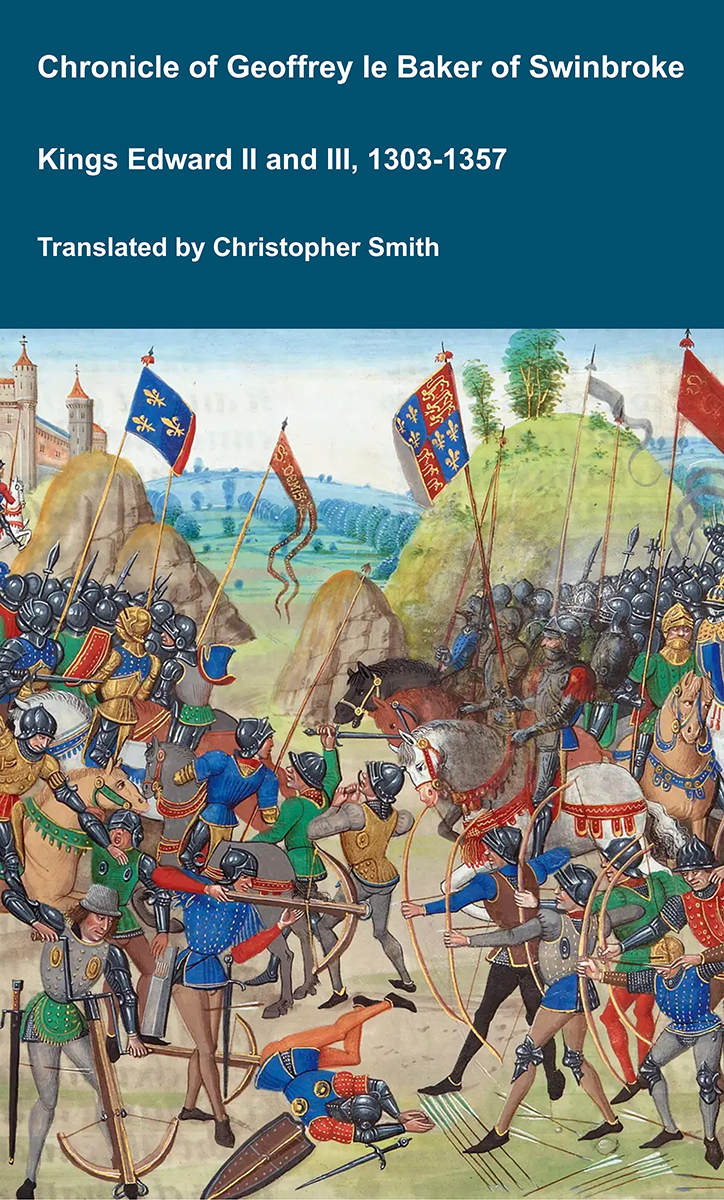
Chronicle of Geoffrey le Baker of Swinbroke
Baker was a secular clerk from Swinbroke, now Swinbrook, an Oxfordshire village two miles east of Burford. His Chronicle describes the events of the period 1303-1356: Gaveston, Bannockburn, Boroughbridge, the murder of King Edward II, the Scottish Wars, Sluys, Crécy, the Black Death, Winchelsea and Poitiers. To quote Herbert Bruce 'it possesses a vigorous and characteristic style, and its value for particular events between 1303 and 1356 has been recognised by its editor and by subsequent writers'. The book provides remarkable detail about the events it describes. Baker's text has been augmented with hundreds of notes, including extracts from other contemporary chronicles, such as the Annales Londonienses, Annales Paulini, Murimuth, Lanercost, Avesbury, Guisborough and Froissart to enrich the reader's understanding. The translation takes as its source the 'Chronicon Galfridi le Baker de Swynebroke' published in 1889, edited by Edward Maunde Thompson.
Available at Amazon in eBook and Paperback format.
Annals of Dunstable. At the fifth county court, held at Bedford on Monday next after the feast of Saint John the Baptist [29th June 1284] in the aforesaid year, the said Christiana came into full county court, and pursued her appeal against John and others for the death [of Simon], etc. They were called and did not come, but a writ of the lord king on their behalf was presented in full county court, as follows."
Ad quintum comitatum, tentum apud Bedefordiam die Lunæ proxima post festum Sancti Johannis Baptistæ anno prædicto, dicta Cristiana etc. venit in pleno comitatu, et prosecuta est appellum suum versus Johannem et alios pro morte etc. Qui fuerunt vocati; non venerunt, sed breve domini regis pro ipsis in pleno comitatu fuit porrectum, sic.
On 29th June 1398 John II King Aragon was born to Ferdinand I King Aragon (age 17) and Eleanor of Alberquerque Queen Consort Aragon (age 24). Coefficient of inbreeding 4.41%. He married (1) before 29th May 1421 his first cousin once removed Blanche Évreux Queen Consort Aragon, daughter of Charles III King Navarre and Eleanor of Castile Queen Consort Navarre, and had issue (2) after 1441 his second cousin once removed Juana Enríquez Queen Consort Aragon, daughter of Fadrique Enríquez Count Melgar Count Rueda and Mariana Fernández Countess Melgar, and had issue.
Chronicle of Gregory [1400-1467]. 29th June 1417. Ande the same year, on Syn Petrys eve and Poule, the Erle of Huntyngdon (age 22) whythe o[th]yr certayne lordys faughtyn whithe carykys of Gene, and dyscomfyte hem, and toke iiij of [th]e grettyste of them and her patronys. And the amerelle [admiral] of them was the Duke of Burbone (age 36), and he was take whithe them whythe alle the tresoure that sholde have wagyd them for halfe a year.
On 29th June 1450 Bishop William Ayscough (age 55) was murdered at Edington, Wiltshire by an angry mob.
Chronicle of Gregory [1400-1467]. 29th June 1450. And the same year was the Byschoppe of Sawlysbury (age 55) slayne at Edyngton, a myle out of the towne, a-pon a hyghe hylle; it was the xiiij day of June, and alle his goode mevabylle was departyde to every man dwellynge there that any of his lyflode laye; for bothe oxsyn, sheppe, hors, swyne, carte, plowe, corne, hay, tymbyr, strawe, harnys in castellys of hys, clothynge for his owne body, bokys, chalys, and alle that longyd to any manyr of hys, and the very ledde that coveryd the howsys and wodys wer fylde downe in some placys, but not in every place, but in som, as at Shyrbone in Dorsette schyre. And the men that toke a-pon them alle this mys rewle, whenne they undyrstode that it was wronge that they hadde done bothe to hym, and in specyalle unto the King, they a-non wente thoroughe out alle the towne of Shyrborne an toke to every man, woman, and chylde that was above xij year age and iij chore, every che of them hadde vj d; and they madde them to swere to be trewe ande holde to gedyr, by cause yf the King wolde have take any execucyon a-pon it he moste have take it a-pon e alle the hoole schyre and contrays there that his lyflode was. And for cause here of the King gaffe a generalle pardon to alle maner men.
On 29th June 1475 Beatrice Este was born to Ercole Este I Duke Ferrara (age 43). She married Ludovico Sforza Duke Milan, son of Francesco Sforza I Duke Milan and Bianca Maria Visconti.

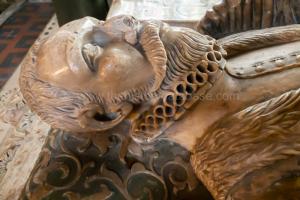
On 29th June 1509 Margaret Beaufort Countess Richmond (age 66) died in the Deanery, Westminster Abbey [Map]. She had lived to see the Coronation of her son King Henry VII of England and Ireland and her grandson King Henry VIII of England and Ireland (age 18).
She was buried at the King Henry VII Chapel, Westminster Abbey [Map]. Her tomb was created by Pietro Torrigiano (age 36). The gilded bronze sculpture on the tomb depicts Margaret with her head resting on pillows and her hands raised in prayer, wearing garments characteristic of widowhood; the face was probably sculpted from a death mask. The black marble tomb is embellished with heraldic bronze insignia, including a Yale, her heraldic badge, at her feet.
The inscription written by the humanist scholar Erasmus reads "Margaret, Countess of Richmond, mother of Henry VII, grandmother of Henry VIII, who donated funds for three monks of this abbey, a grammar school in Wimborne, a preacher in the whole of England, two lecturers in Scripture, one at Oxford, the other at Cambridge, where she also founded two colleges, one dedicated to Christ [Map], and the other to St John, the evangelist [Map]".
Image Source: .
Letters and Papers. 29th June 1536. R. O. 1219. John Smyth to Cromwell.
We have been in the west parts, and surveyed all the Queen's (age 27) lands in Hampshire. Dorsetshire, Devonshire, Somersetshire, and Wiltshire. We have found all the Queen's farmers and tenants as glad of her Grace as heart can think, and have been well entertained. On our return to the Court, which will be within 10 or 12 days, I trust you will see we have done her good service, and that the King will be pleased. To ascertain you of the plentifulness of the "newing" of this one year in these parts, it has not been seen that any such yering hath been of late within this realm, as Mr. Richard, your nephew, can inform you. "So that the people doth note this same year to be the year of grace here in England, which men were wont to seek in Rome." Bromeham, Wilts, at Mr. Baynton's house, 29 June.
Hol., pp. 2. Add.: Mr. Secretary. Endd.


On 29th June 1537 John Hussey 1st Baron Hussey of Sleaford (age 72) was beheaded at Lincoln, Lincolnshire [Map]. Baron Hussey of Sleaford forfeit.
On 29th June 1539 Thomas Howard 3rd Duke of Norfolk (age 66) attended dinner with King Henry VIII of England and Ireland (age 48), Cromwell (age 54) and others as guests of Archbishop Thomas Cranmer (age 49).


Chronicle of Edward Hall [1496-1548]. 29th June 1540. The morrow after Midsomer day, the king caused the Queen (age 24) to remove to Richmond, purposing it to be more for her health, open air and pleasure: but the sixth day of July, certain Lordes came down into the neither house, which expressly declared causes, that the marriage was not lawful, and in conclusion, the matter was by the Convocation clearly determined, that the king might lawfully marry where he would, and so might she: and so were they clearly divorced and separated, and by the Parliament enacted and concluded, that she should be taken no more as Queen, but called the Lady Anne of Cleve.
Item: The Bill of Attainder of Thomas Cromwell (age 55), Earl of Essex, for the crime of heresy and treason, newly drafted by the Commons; and assented to, together with a provision annexed to the same.
Item Billa Attincture Thome Cromwell, Comitis Essex, de Crimine Heresis et Lese Majestatis, per Communes de novo concepta; et assens. et simul cum provisione eidem annexa.
Note. For the text of the attainder see Burnet History of the Reformation Book 1 Part 2 Collection of Records 16
The History of the Reformation Volume 1 Book II. Collection of Records 16: The Attainder of Thomas Cromwell
(Parliament Rolls, Act 60, Anno Regni tricesimo secundo.)
Also, a certain other petition, containing the form of a certain act of attainder, was presented to His Royal Majesty in the aforementioned Parliament, the tenor of which follows in these words.
[29th June 1540] Item quedam alia petitio, formam cujusdam actus attincture in se continens, exhibita est suz Regie Majestati in Parliamento pradicto, cujus tenor sequitur in hc verba.
In their most humble-wise shewing to your most Royal Majesty, the Lords Spiritual and Temporal, and all your most loving and obedient Subjects, the Commons in this your high Court of Parliament assembled; That where your most. Royal Majesty, our Natural Sovereign Lord, is justly and lawfully, really entituled to be our sole Supreme Head and Governor? of this your Realm of England, and of the Dominions of the same; to whom, and to none other under God, the Kingly .Direction., Order, and Governance of your most loving and obedient Subjects, and People of this your Realm, only appertained and belongeth And the which your most loving and obedient Subjects your Highness prudently and quietly, without any manner of disturbance by a long time most graciously hath preserved sustained and defended.
And your Highness, for the Quietness, Wealth, and Tranquillity of your said humble and obedient Subjects, hath made, and ordained, divers and many most godly, virtuous and wholesome Laws; and for due execution of the same, hath not desisted to travel in your own most Royal Person, to support and maintain, as well the Laws or Almighty God, as the Laws by your Highness made and ordained, by due and condign Execution of the same Laws upon the Transgressors offending contrary to the same: And your Majesty hath always most virtuously -studied and laboured, by all ways, and alt means, to and for the setting forth thereof, in such wise as might be most to the Honour, Glory, and Pleasure of Almighty God and for the common accord and wealth of this your Realm, and other your Dominions
And for the true execution of the same, hath elected, chosen and made divers, as well of your Nobles as others, to be of your most Honourable Council, as to the Honour of a Noble Prince appertained. And where your Majesty hath had a special Trust and Confidence in your said most trusty Counsellors, that the same your Counsellors, and every of them, had minded and intended, and 'finally purposed to hare followed and pursued your most Godly and Princely Purpose, as of truth the more number hath most faithfully done; Yet nevertheless Thomas Cromwell, now Earl of Essex, whom your Majesty took and received into your trusty Service, the same Thomas then being a Man of very base and low degree, and far singular Favour Trust and Confidence, which your Majesty bore and had in him, did not only erect and advance the same Thomas unto the state of an Earl, and enriched him with manifold Gifts, as well of Goods, as of Lands and Offices, but also him, the said Thomas Cromwell, Earl of Essex, did erect and make one of your most trusty Counsellors, as well concerning your Grace's Supreme Jurisdictions Ecclesiastical, as your most high secret Affairs Temporal Nevertheless your Majesty now of late hath found, and tried, by a large number of Witnesses, being your faithful Subjects, and Personages of great Honour, Worship, and Discretion, the said Thomas Cromwell, Earl of Essex, contrary to the singular trust and confidence which your Majesty had in him, to be the most false and corrupt Traitor, Deceiver, and Circumventor against your most Royal Person, and the Imperial Crown of this your Realm, that hath been known, seen, or heard of in all the time of your most noble Reign.
Insomuch that it is manifestly proved and declared, by the Depositions of the Witnesses aforesaid. That the same Thomas Cromwell, Earl of Essex, usurping upon your Kingly Estate, Power, Authority, and Office; without your Grace's„ Commandment or Assent, hath taken upon him to set at liberty divers Persons being convicted and attainted of Misprision of High Treason; and divers other being apprehended, and in Prison, for Suspicion of High Treason; and over that, many and divers Times, at sundry Places in this your Realm, for manifold Sums of Money to him given, most traitorously hath taken upon him, by several Writings, to give and grant, as well unto Aliens, as to your Subjects, a great Number of Licenses for conveying and carrying of Money, Corn, Grain, Beans, Beer, Leather, Tallow, Belli;, Metals, Horses, and other Commodities of this your Realm, contrary to your Highness's most Godly and Gracious Proclamations made for the Commonwealth of your People of this your Realm in that behalf, and in Derogation of your Crown and Dignity, And the same Thomas Cromwell, elated and full of Pride, contrary to his most bounden Duty, of his own Authority and Power, not regarding your Majesty Royal.
And further, taking upon him your Power, Sovereign Lord, in that behalf, divers and many times most. traitorously hath constituted, deputed and assigned, many singular Persons of your Subjects to be Commissioners in many your great, urgent and weighty Causes and Affairs, executed and done in this your Realm, without the Assent,Knowledge, or Consent of your Highness, And further also, being a Person of as poor and low Degree, as few be within this your Realm; pretending to have so great a Stroke about you, our, and his natural Sovereign Liege Lord, that he letted and Falsehoods, the said Thomas Cromwell, Earl of Essex, being detestable Heretic, and being In himself utterly disposed to set and sow common Sedition and Variance among your true and loving Subjects, hath secretly set forth and dispersed into all Shires, and other Territories of this your Realm, and other your Dominions, great Numbers of false erroneous Books, whereof many were printed and made beyond the Seas, and divers other within this Realm, comprising and declaring, among many other Evils and Errors, manifest Matters to induce and lead your Subjects to diffidence, and refusal of the true and sincere Faith and Belief, which Christian Religion bindeth all Christian People to have, in the most Holy and Blessed Sacrament of the Altar, and other Articles of Christian Religion, most graciously declared by your Majesty, by Authority of Parliament:
And certain Matters comprised in some of the said Books, hath caused to be translated into our Maternal and English Tongue; And upon report made unto him by the Translator thereof, that the Matter so translated hath expressly been against the said most Blessed and Holy Sacrament; Yet the same Thomas Cromwell, Earl of Essex, after he had read the same Translation, most heretically hath affirmed the same material Heresies so translated, to be good; and further hath said, that he found no fault therein; and over that, hath openly and obstinately holden Opinion, and said, That it was as lawful for every Christian Man to be a Minister of the said Sacrament, as well as a Priest.
And where also your most Royal Majesty, being a Prince of Virtue, Learning, and Justice, of singular Confidence and Trust, did constitute and make the same Thomas Cromwell, Earl of Essex, your Highness's Vicegerent within this your Realm of England; and by the same, gave unto him Authority and Power, not only to redress and reform all, and all manner of Errors, and erroneous Opinions, insuring and growing among your loving and obe-dient Subject of this your Realm, and of the Dominions of the same, but also to order and direct all Ecclesiastical and Spiritual Causes within your said Realm, and Dominions; the said Thomas Cromwell, Earl of Essex, not regarding his Duty to Almighty God, and to your Highness, under the Seal of your Vicegerent, bath without your Grace's Assent or Knowledge, licensed and authorized divers Persons, detected and suspected of Heresies, openly to teach and preach amongst your most loving and obedient Subjects within this your Realm of England.
And under the Pretence and Colour of the said great Authorities and Cures, which your Majesty hath committed unto him in the Premises, hath not only, of his corrupt and damnable Will and Mind, actually, at some time, by his own Deed and Commandment, and at many other Times by his Letters expressly written to divers worshipful Persons, being Sheriffs, in sundry Shires of this your Realm, falsely suggesting thereby your Grace's Pleasure so to have been, caused to be set at large many false Here ticks, some being there indicted, and some other being thereof apprehended, and in Ward: and commonly, upon Complaint* made by credible Persons unto the said Thomas Cromwell, Earl of Essex, of great and most detestable Heresies committed and sprung in many places of this your Realm, with Declaration of the Specialities of the same Heresies, and the Names of the Offenders therein, the same Thomas Cromwell, Earl of Essex, by his crafty and subtle Means and Inventions, bath not only defended the same Heretics from Punishment and Reformation; but being a Fautor, Maintainer, and Supporter of Heretics, divers times bath terribly rebuked divers of the said credible Persons being their Accusers, and some others of them hath persecuted and vexed by Imprisonment and otherwise. So that thereby many of your Grace's true and loving Subjects have been in much Dread and Fear, to detect or accuse such detestable known He re ticks; the Particularities and Specialties of which said abominable Heroics, Errors, and Offences, committed and done by the said Thomas Cromwell, being over-tedious, long, and of too great Number here to be expressed, declared, or written.
And to the Intent to have those damnable Errors and Heresies, to be inculcated impressed, and infixed in the Hearts of your Subjects, as well contrary to God's Laws, as to your Law* and Ordinances. Most Gracious Sovereign Lord, the same Thomas Cromwell, Earl of Essex, hath allured and drawn unto him by Retainours, many of your Subjects sunderly inhabiting in every of your said Shires and Territories, as well erroneously persuading and daring to them the Contents of the false erroneous Books, above written to be good, true, and best standing with the most Holy Word and Picture of God; as other his false and heretical Opinions and Errors; whereby, and by his Confederacies there-in, he hath caused many of your faithful Subjects to be greatly infected with Heresies, and other Errors, contrary to the right Laws and Pleasure of Almighty God. And the same Thomas Cromwell, Earl of Essex, by the false and traitorous Means above-written, supposing himself to be fully able, by Force and Strength, to maintain and defend his said abominable Treasons, Heresies, and Errors, not regarding his most bounden Duty to Almighty God, and his Laws, nor the natural Duty of Allegiance to your Majesty, in the last Day of March, in the 30 Year of your most gracious Reign, in the Parish of St, Peter the Poor, within your City of London, upon Demonstration and Declaration then and there made unto him, that there were certain new Preachers, as Robert Barnes Clerk, and other, whereof part were committed to the Tower of London, for preaching nod teaching of loud learning against your Highness's Proclamations the same Thomas affirming the same preaching to be good most detestably, arrogantly, erroneously, wilfully, maliciously, and traitorously expressly against your Laws and Statutes, then and there did not let to declare, and say, these most traitorous and detestable Words ensuing, amongst other Words of like Matter and Effect.
That is to say, That if the King would turn from it, yet would not turn; dud if the King did turn, and all his People, I would fight in the Field in mine own Person, with my Sword hi my Hand against him and all others; and then, and there, most traitorously milled out his Dagger, and held it on high, saying these Words, Or else this Dagger thrust me to the Heart, if I would not die in that Quarrel against them all: And I trust if I live one Year or two, it shall not lie in the King's Power to resist or lett if if he would. And further, then and there swearing by a great Oath, traitorously affirmed the same his traitorous Saying and Pronunciation of Words, saying, I will do so indeed extending up his Arm, a$ tho he had had a Sword in his Hand; to the most perilous,grievous, and wicked Example of all oilier your loving, faithful and obedient Subjects in this your Realm, and to the Peril of your most Royal Person.
And moreover, our most gracious Sovereign Lord, the said Thomas Cromwell, Earl of Essex, hath acquired and obtained into his Possession, by Oppression, Bribery, Extort, Power and false Promises made by him to your Subjects of your Realm, innumerable Sums of Money and Treasure; and being so enriched, hath had your Nobles of your Realm in great Disdain, Derision, and Detestation, as by express words by him most opprobriously spoken hath appeared. And being put in remembrance of others, of his Estate, which your Highness hath called him unto, offending in like Treasons, the last Day of January, in the 31 Year of your most noble Reign, at the Parish of St. Martins in the Field, in the County of Middlesex, most arrogantly, willingly, maliciously, and traitorously, said, published, and declared, That if the Lords would handle hint $of that he would give them such a Breakfast as never was made in England, and that the proudest of them should know to the great Peril and Danger, as well of your Majesty, as of your Heirs and Successors: For the which his most detestable and abominable Heresies and Treasons, and many other his like Offences and Treasons over-long here to be rehearsed and declared.
Be it Enacted, Ordain fed, and Established by your Majesty, with the Assent of the Lords Spiritual and Temporal, and the Commons in this present Parliament assembled, and by the Authority of the same, 'Hint the said Thomas Cromwell, Earl of Essex, for his abominable and detestable Heresies and Treasons, by him most abominably, hectically, and traitorously practised, committed, and done, as well against Almighty God, as against your Majesty, and this your said Realm, shall be, and stand, by Authority of this present Parliament, convicted and attainted of Heresies and High-Treason, and be adjudged an abominable and detestable Heretick and Traitor; and shall have and suffer such Pains of Death, Losses, and Forfeitures of Goods, Debts, and Chattels, as in eases of Heresies and High-Treason, or as in cases of either of them, at the Pleasure of your most Royal Majesty. And that the same Thomas Cromwell, Earl of Essex, shall, by Authority above said, lose,end forfeit to your Highness, and to your Heirs and Successor all such his Castles, Lordships, Manors, Messuages, Lands, Tenements, Rents, Reversions, Remainders, Services, Possessions, Offices, Rights, Conditions, and all other his Hereditaments, of what Names, Natures, or Qualities so ever they be, which he the said Thomas Cromwell, Earl of Essex, or any other to his Use had, or ought to have had, of any Estate of Inheritance, in Fee-Simple or Fee-Tail, in Reversion or Possession, at the said last Day of March, in the said thirtieth Year of your most Gracious Reign, or any time sith or after, as in Cases of High-Treason.
And that all the said Castles, Lordships, Manors, Lands, Messuages Tenements, Rents, Reversions, Remainders, Services, Possessions, Offices, and all other the Premises forfeited, as is above said, shall he deemed, in-vested, and adjudged, in the lawful, real, and actual Possession of your Highness, your Heirs and Successors for ever in the same, and in such Estate, Manner and Form, as if the said Castles, Lordships, Man dots, Messuages, Lands, Tenements, Re tits, Reversions, Remainders, Services, Possessions, Offices, and other the Premises, with their Appurtenances, and every of them, were especially or particularly founden, by Office or Offices, Inquisition or Inquisitions, to be taken by any Eschceator or Escheators, or any other Commissioner or Commissioners, by Virtue of any Commission or Commissions to them or any of them, to he directed in any County or Counties, Shire or Shires, within this your Realm of England, where the said Castles, and other the Premises, or any of them, been, or do lye, and returned Into any of your Majesty's Courts.
Saving to all and singular, Person and Persons, Bodies politick and corporate, their Heirs and Successors and their Successors and Assignees of every of them, other than the said Thomas Cromwell, Earl of Essex, and his Heirs, and all and every other Person and Persons, claiming by the same Thomas Cromwell, and to his Use, all such Right, Title, Entry, Possessions, Interest, Reversions, Remainders, .Lease, Leases, Conditions, Fees, Offices, Rents, Annuities, Commons, and all other Commodities, Profits, and Hereditaments whatsoever they or any of them might, should or ought to have had, if this Act had never been had or made. Provided always, and be it enacted by the Authority aforesaid, that this Act of Attainder, ne any Offence, ne other thing therein contained, extend not unto the Deanery of Wells in the County of Somerset; nor to any Manors, Lands, Tenements, or Hereditaments thereunto belonging; nor be in any wise prejudicial or hurtful unto the Bishop of Bath and Wells.
Nor to the Dean and Chapter of the Cathedral Church of St, Andrew of Wells, nor to any of them, nor to any of their Successors; but that the said Bishop, Dean, and Chapters, and their Successors, and every of them, shall and may have, hold, use, occupy, and enjoy, all and singular their Titles, Rights, Manors, Lands, Tenements, Rents, Reversions, and Services, and all and singular other their Hereditaments, Commodities, and Profits, of what nature, kind, or quality, or condition so ever they be, in as ample and large manner and form, as tho' this Act of Attainder, or any Offence therein mentioned, had never been had, committed, nor made; and that from henceforth the Dean, and his Successors, Deans of the said Cathedral Church that hereafter shall be perfected, elected, and admitted to the same, Shall, by the Authority aforesaid, be Dean of the said Cathedral Church, fully and wholly incorporated with the Chapter of the same, in as ample, large, and like manner and form, to all intents and purposes, as the Deans before this time hath been and used to be, with the said Chapter of the said Cathedral Church of Wells. And that the same Dean and Chapter, and their Successors, shall have, occupy, and enjoy, all and singular their such Possessions, Manors, Lands. Tenements Rents, Reversions, and Services, and all and singular their Hereditaments, of what nature, kind, name or names they be called or known. And shall be adjudged and deemed in actual and real Possession and Seizin of, and in the same Premise to all intents and purposes, according to their old Corporation, as tho' this Act of Attainder, or anything, clause, or matter therein contained had never been had, committed, nor made. This said Act of Attainder, or any other Act, Provision, or anything heretofore had or made to the contrary notwithstanding.
Chronicle of Edward Hall [1496-1548]. [28th June 1541]. In this season was arraigned and condemned three gentlemen, called Mantell, Roydon, and Frowdes, and were hanged at Saint Thomas of Wateringes [Map]. Likewise was Thomas Fiennes (age 26) Lord Dacres of the South, arraigned before the Lord Audley of Walden (age 53), then Chancellor of England, and that day High Steward of the same at Westminster, and there before the said Lord Chancellor and his Peers, he confessed the inditement, and so had judgement to be hanged.
And so the twenty and nine day of June , being Saint Peter's day at afternoon, he was led on foot, between the two Sheriffs of London, from the Tower through the city to Tyburn [Map], where he was strangled, as common murderers are, and his body buried in the Church of Saint Sepulchres. The cause of the death of this noble man, and the other gentlemen, was a murder of a simple man and an unlawful assembly made in Sussex. Great moan was made for them all, but most especially for Mantell, who was as witty, and toward a gentleman, as any was in the realm, and a man able to have done good service.


On 29th June 1541 Thomas Fiennes 9th Baron Dacre Gilsland (age 26) was hanged at Tyburn [Map]. He was buried at St Sepulchre without Newgate Church. Baron Dacre Gilsland, Baron Multon of Gilsland forfeit. His son Gregory (age 2) would be restored to the title in 1558.
Note. Hall's Chronicle says strangled.
Letters and Papers Foreign and Domestic Henry VIII 1541. That afternoon [Chapus appears here to have the wrong day; other sources say 29th June 1541 i.e. St Peter's Day] two gentlemen were hung [the other being either John Mantell, John Frowds, George Roidon, Thomas Isleie, and two yeomen Richard Middleton and John Goldwell], one of whom had an income of over 12,000 ducats a year, and was the handsomest and best bred man in England, only 25 years old and married to a niece of the Duke of Norfolk (age 68). He was sentenced for having belonged to a set of eight rakish youths, one of whom had killed a poor old man in an unpremeditated fray. For the same cause lord Dacres (age 26) also, son1 of the Duke of Norfolk's sister, and cousin of this Queen (age 18), 23 years old and possessing a property of about 5,000 ducats a year, was hung from the most ignominious gibbet, and for greater shame dragged through the streets to the place of execution, to the great pity of many people, and even of his very judges, who wept when they sentenced him, and in a body asked his pardon of the King. But the thing which astonished people most was, that, the same day lord Dacres was hung, another young man (age 28), son of the Treasurer of the Royal household (age 56), who was one of those present at the old man's death, was freely pardoned, though he had been already tried for some like misdemeanour.
At the same time in the North, Sir John Neville (deceased) and about 60 more, among whom at least 25 were ecclesiastics, were executed for the conspiracy of which Chapuys wrote some time ago. Has just heard of the arrival of a Polish gentleman with eight or ten servants. Will endeavour to discover who he is and what he comes for. London, 2 July 1541. Original at Vienna.
Note 1. Thomas Fiennes 9th Baron Dacre Gilsland, Lord Dacre, was the grandson of Anne Bourchier Baroness Dacre of Gilsland who was the maternal half-sister of Thomas Howard 3rd Duke of Norfolk; Anne and Thomas' mother was Elizabeth Tilney Countess of Surrey.
Chronicle of Greyfriars. 29th June 1541. And the 29th of the same monyth was Lord Dacres of the South (age 26) led with the sheriffs of London unto Tyborne at after-none, and there hanged for the new acte that was made, and browte home agayne in the carte unto St Sepulchres and ther buried.
Note. Lord Dacre was hung for a murder committed in Sussex, as were his three companions named in the next paragraph.
The Deeds of the Dukes of Normandy
The Gesta Normannorum Ducum [The Deeds of the Dukes of Normandy] is a landmark medieval chronicle tracing the rise and fall of the Norman dynasty from its early roots through the pivotal events surrounding the Norman Conquest of England. Originally penned in Latin by the monk William of Jumièges shortly before 1060 and later expanded at the behest of William the Conqueror, the work chronicles the deeds, politics, battles, and leadership of the Norman dukes, especially William’s own claim to the English throne. The narrative combines earlier historical sources with firsthand information and oral testimony to present an authoritative account of Normandy’s transformation from a Viking settlement into one of medieval Europe’s most powerful realms. William’s history emphasizes the legitimacy, military prowess, and governance of the Norman line, framing their expansion, including the conquest of England, as both divinely sanctioned and noble in purpose. Later chroniclers such as Orderic Vitalis and Robert of Torigni continued the history, extending the coverage into the 12th century, providing broader context on ducal rule and its impact. Today this classic work remains a foundational source for understanding Norman identity, medieval statesmanship, and the historical forces that reshaped England and Western Europe between 800AD and 1100AD.
Available at Amazon in eBook and Paperback format.
Wriothesley's Chronicle [1508-1562]. 29th June 1541. The 29th daie of June, being Sainct Peeters daie, at 11 of the clocke in the afternoune, the sherives were at the Towre of London to have had the Lord Dacres (age 26) to execution on the gallowes at Towre Hill, and, as the prisonner should have come out of the Tower, the Controwler of my Lord Chauncelors howse, called Mr. Heyre, came and commanded, in the Kinges name, to stay the execution till tow of the clocke in the afternoune, which caused the people to hope that the King would pardon him; nevertheles at three of the clocke in the afternoune the said Lord Dacres was had from the Tower to Tiburne [Map], led betwene the sherives of London on foote till he came to the place of execution, where he was hanged till he was dead, and then ymediatlie he was cutt downe and laid in the cart, and had from thence to Sainct Sepulchers church by Newgate, and their buried.
On 29th June 1546 Dorothea Oldenburg Duchess Brunswick-Lüneburg was born to Christian III King of Denmark (age 42) and Dorothea of Saxe Lauenburg Queen Consort Denmark and Norway (age 35) at Kolding. She married 12th October 1561 her half sixth cousin William "Younger" Welf Duke Brunswick-Lüneburg.
Wriothesley's Chronicle [1508-1562]. The 29th daie of June [1547] there was a solempne obsequie kept in Poules [Map] [for] the French Kinge Frances latelie departed, where was a sumptuous herse made, and the quire and the bodie of the church hanged with blacke and sett with schuchions of the armes of France, and tow hundreth torch bearers having new blacke gownes and hoodes with badges of the armes of France on their sholders, the Archbishop of Canterbery (age 57) begining the derige in his pontificalibus, the Archbishop of Yorke (age 65) and other 8 bishopps and suffragans being also in their pontificalibus, six erles and lordes of the Kinges Majestie being the cheife mourners, the Emperours Embassadour, and the French Kinges Embassadoure, and the Secretarie of Venice in their blacke mourning gownes being also there present at the same, the major and aldermen with tow hundred citizens in their best lyveries with their hoodes on their sholders present at the same also; and on the morrow also at the requiem masse, which the Archbishopp of Canterberie songe in his pontificalibus, with the other bishopps in their pontificalibus also; and there preached at the said masse the Bishop of Rochester (age 70) [Note. Possibly Bishop Nicholas Ridley (age 47) who became Bishop of Rochester in 1547], who greatlie commended in his sermon the said French King departed, for setting fourth of the Bible and New Testament in the French tonge to be reade of all his subjectes; also all the parish churches in London kept a solempne obett with knill, the bells ringing, and a herse with tow great tapers, in everie parish church.
Diary of Edward VI. 29th June 1548. Upon S. Peter's day the bishop of Winchester (age 65) was committed to the Toure.Inserted.
Note 1. Bishop Gardiner preached the sermon which was made the test of his religious faith and policy on St. Peter's day (June 29), as already noticed in p. 59. He was sent to the Tower two days after.
Henry Machyn's Diary. 29th June 1554. The xxix day of Juin, the wyche was sant Peter and Powlles day, was a fayre at Westmynster abbay; and ther was a goodly pressessyon, and after masse; and ther the prynse of Pymon (age 25) and dyvers Spaneards, and hard messe [heard mass] in kyng Henry the vij chapelle [Map].
On 29th June 1583 Anthony Gell (age 61) died. He was buried in St Mary's Church, Wirksworth [Map]. Elizabethan Period.
Anthony Gell: In 1522 he was born to Ralph Gell and Godeth Ashby.



On 29th June 1596 the fleet arrived in Cádiz Spain. In the Bay of Cádiz some 40 Spanish ships, ranging from galleys to galleons, as well as 16 other vessels from the Spanish convoy, which were disarmed and ready to depart for the West Indies. These unarmed vessels immediately fled to Puerto Real for refuge.
On 29th June 1611 another tranche of Baronets were created by King James I of England and Ireland and VI of Scotland (age 45)...
Francis Barrington 1st Baronet (age 51) was created 1st Baronet Barrington of Barrington Hall.
Thomas Bendish 1st Baronet (age 43) was created 1st Baronet Bendish of Steeple Bumstead in Essex.
Robert Cholmondeley 1st Earl Leinster (age 27) was created 1st Baronet Cholmondley of Cholmondeley. Catherine Stanhope Countess Leinster by marriage Lady Cholmondley of Cholmondeley.
Anthony Cope 1st Baronet (age 63) was created 1st Baronet Cope of Hanwell in Oxfordshire. Anne Paston Lady Hanwell (age 58) by marriage Lady Cope of Hanwell in Oxfordshire.
William Constable 1st Baronet (age 31) was created 1st Baronet Constable of Flamborough in Yorkshire.
Robert Bruce Cotton 1st Baronet (age 40) was created 1st Baronet Cotton of Conington in Huntingdonshire.
George Gresley 1st Baronet (age 31) was created 1st Baronet Gresley of Drakelow in Derbyshire. Susan Ferrers Lady Gresley by marriage Lady Gresley of Drakelow in Derbyshire.
Edward Hales 1st Baronet (age 35) was created 1st Baronet Hales of Woodchurch and Tunstall.
James Harrington 1st Baronet (age 69) was created 1st Baronet Harington of Ridlington in Rutlandshire.
Edward Hussey 1st Baronet (age 25) was created 1st Baronet Hussey of Honington in Lincolnshire.
William Kniveton 1st Baronet (age 51) was created 1st Baronet Kniveton of Mercaston in Derbyshire.
Henry Lee 1st Baronet (age 40) was created 1st Baronet Lee of Quarrendon in Buckinghamshire.
Thomas Mildmay 1st Baronet (age 38) was created 1st Baronet Mildmay of Moulsham.
John Molyneux 1st Baronet (age 30) was created 1st Baronet Molyneux of Teversall in Nottinghamshire.
Richard Molyneux 1st Baronet (age 51) was created 1st Baronet Molyneux of Sefton. Frances Gerard Lady Molyneux (age 42) by marriage Lady Molyneux of Sefton.
Thomas Monson 1st Baronet (age 46) was created 1st Baronet Monson of Carleton in Lincolnshire.
Estrange Mordaunt 1st Baronet (age 39) was created 1st Baronet Mordaunt of Massingham Parva.
Charles Morrison 1st Baronet (age 24) was created 1st Baronet Morrison of Cashiobury. Mary Hicks Lady Cooper and Morrison by marriage Lady Morrison of Cashiobury.
Richard Musgrave 1st Baronet (age 26) was created 1st Baronet Musgrave of Hartley Castle in Westmoreland.
Samuel Peyton 1st Baronet (age 20) was created 1st Baronet Peyton of Knowlton in Kent.
John Savage 1st Baronet (age 61) was created 1st Baronet Savage of Rocksavage in Cheshire.
Henry Savile 1st Baronet (age 32) was created 1st Baronet Savile of Methley.
William Sedley 1st Baronet (age 53) was created 1st Baronet Sedley of Ailesford in Kent.
Edward Seymour 1st Baronet (age 48) was created 1st Baronet Seymour of Berry Pomeroy. Elizabeth Champernowne Baroness Seymour by marriage Lady Seymour of Berry Pomeroy.
Thomas Spencer 1st Baronet (age 26) was created 1st Baronet Spencer of Yarnton in Oxfordshire.
George St Paul 1st Baronet (age 49) was created 1st Baronet St Paul in Snarford in Lincolnshire. Frances Wray Countess Warwick by marriage Lady St Paul in Snarford in Lincolnshire.
Lewis Tresham 1st Baronet (age 36) was created 1st Baronet Tresham of Rushton in Northamptonshire.
John Tufton 1st Baronet (age 67) was created 1st Baronet Tufton of Hothfield.
William Twysden 1st Baronet (age 45) was created 1st Baronet Twysden of Roydon in Kent. Anne Finch Lady Twysden (age 37) by marriage Lady Twysden of Roydon in Kent.
John Wentworth 1st Baronet (age 28) was created 1st Baronet Wentworth of Gosfield. Catherine Finch Lady Wentworth (age 23) by marriage Lady Wentworth of Gosfield.
William Wentworth 1st Baronet (age 49) was created 1st Baronet Wentworth of Wentworth Woodhouse in Yorkshire.
Henry Willoughby 1st Baronet (age 31) was created 1st Baronet Willoughby of Risley in Derbyshire.
Philip Wodehouse 1st Baronet was created 1st Baronet Woodhouse of Wilberhall. Note. Date uncertain.
Richard Worsley 1st Baronet (age 22) was created 1st Baronet Worsley of Appuldurcombe.
John Wynn 1st Baronet (age 58) was created 1st Baronet Wynn of Gwydir.


On 29th June 1612 Robert Crichton 8th Lord Sanquhar was hanged in Westminster Palace Yard for having arranged the murder of his fencing Master John Painter Turner who had previously disfigured him during practice. At his trial Francis Bacon 1st Viscount St Alban (age 51) read the charges.


On 29th June 1621...
Edward Montagu 1st Baron Montagu (age 58) was created 1st Baron Montagu of Boughton in Northamptonshire.
Thomas Palmer 1st Baronet (age 81) was created 1st Baronet Palmer of Wingham in Kent. Margaret Poley Lady Palmer (age 79) by marriage Lady Palmer of Wingham in Kent.
On 29th June 1640 Elizabeth Butler Countess Chesterfield was born to James Butler 1st Duke Ormonde (age 29) and Elizabeth Preston Duchess Ormonde (age 24). She married after 1654 Philip Stanhope 2nd Earl Chesterfield, son of Henry Stanhope and Katherine Wotton Countess Chesterfield, and had issue.


On 29th June 1644 the Battle of Cropredy Bridge was fought near Banbury, Oxfordshire [Map].
Robert Howard (age 18) fought.
James Harington 3rd Baronet (age 36) led out a brigade of suburban Trained Bands, the Tower Hamlets Regiment and the Southwark White Auxiliaries and the Westminster Yellow Auxiliaries, to join William Waller (age 47) in the campaign that culminated at the Battle of Cropredy Bridge.
John Evelyn's Diary. 29th June 1652. We went to see the house of my Lord Clanrickarde (age 48) at Summer hill, near Tunbridge (now given to that villain, Bradshawe (age 49), who condemned the King (age 22)). 'Tis situated on an eminent hill, with a park; but has nothing else extraordinary.
In June 1660 King Charles II of England Scotland and Ireland (age 30) rewarded those who supported his Restoration...
6th William Wray 1st Baronet (age 35) and John Talbot of Lacock (age 29) were knighted.
7th Geoffrey Palmer 1st Baronet (age 62) was created 1st Baronet Palmer of Carlton in Northampton
7th Orlando Bridgeman 1st Baronet (age 54) was created 1st Baronet Bridgeman of Great Lever in Lancashire.
7th John Langham 1st Baronet (age 76) was created 1st Baronet Langham of Cottesbrooke in Northamptonshire.
11th Henry Wright 1st Baronet (age 23) was created 1st Baronet Wright of Dagenham. Ann Crew Lady Wright by marriage Lady Wright of Dagenham.
13th Nicholas Gould 1st Baronet was created 1st Baronet Gould of the City of London.
14th Thomas Allen 1st Baronet (age 27) was created 1st Baronet Allen of Totteridge in Middlesex.
18th Thomas Cullum 1st Baronet (age 73) was created 1st Baronet Cullum of Hastede in Suffolk.
19th Thomas Darcy 1st Baronet (age 28) was created 1st Baronet Darcy of St Osith's.
22nd Robert Cordell 1st Baronet was created 1st Baronet Cordell of Long Melford.
22nd John Robinson 1st Baronet (age 45) was created 1st Baronet Robinson of London. Anne Whitmore Lady Robinson (age 48) by marriage Lady Robinson of London.
25th William Bowyer 1st Baronet (age 47) was created 1st Baronet Bowyer of Denham Court. Margaret Weld Lady Bowyer (age 43) by marriage Lady Bowyer of Denham Court.
25th Thomas Stanley 1st Baronet (age 63) was created 1st Baronet Stanley of Alderley in Cheshire.
26th Jacob Astley 1st Baronet (age 21) was created 1st Baronet Astley of Hill Morton.
27th William Wray 1st Baronet was created 1st Baronet Wray of Ashby in Lincolnshire. Olympia Tufton Lady Ashby (age 36) by marriage Lady Wray of Ashby in Lincolnshire.
28th Oliver St John 1st Baronet (age 36) was created 1st Baronet St John of Woodford in Northamptonshire.
29th Ralph Delaval 1st Baronet (age 37) was created 1st Baronet Delaval of Seaton in Northumberland. Anne Leslie Lady Delaval by marriage Lady Delaval of Seaton in Northumberland.
30th Andrew Henley 1st Baronet (age 38) was created 1st Baronet Henley of Henley in Somerset.
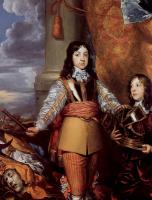


Samuel Pepys' Diary. 29th June 1660. This day or two my maid Jane [Jane Wayneman] has been lame, that we cannot tell what to do for want of her. Up and to White Hall, where I got my warrant from the Duke to be Clerk of the Acts. Also I got my Lord's warrant from the Secretary for his honour of Earle of Portsmouth, and Viscount Montagu of Hinchingbroke. So to my Lord, to give him an account of what I had done. Then to Sir Geffery Palmer (age 62), to give them to him to have bills drawn upon them, who told me that my Lord must have some good Latinist to make the preamble to his Patent, which must express his late service in the best terms that he can, and he told me in what high flaunting terms Sir J. Greenville (age 31) had caused his to be done, which he do not like; but that Sir Richard Fanshawe (age 52) had done General Monk's (age 51) very well. Back to Westminster, and meeting Mr. Townsend in the Palace, he and I and another or two went and dined at the Leg there. Then to White Hall, where I was told by Mr. Hutchinson at the Admiralty, that Mr. Barlow, my predecessor, Clerk of the Acts, is yet alive, and coming up to town to look after his place, which made my heart sad a little. At night told my Lord thereof, and he bade me get possession of my Patent; and he would do all that could be done to keep him out. This night my Lord and I looked over the list of the Captains,. and marked some that my Lord had a mind to have put out. Home and to bed. Our wench very lame, abed these two days.


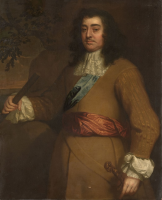
Samuel Pepys' Diary. 29th June 1663. Up betimes and to my office, and by and by to the Temple [Map], and there appointed to meet in the evening about my business, and thence I walked home, and up and down the streets is cried mightily the great victory got by the Portugalls against the Spaniards, where 10,000 slain, 3 or 4,000 taken prisoners, with all the artillery, baggage, money, &c., and Don John of Austria (age 34)1 forced to flee with a man or two with him, which is very great news.
Note 1. He was natural son of Philip IV., King of Spain (age 58), who, after his father's death in 1665, exerted his whole influence to overthrow the Regency appointed during the young king's minority. B.


Samuel Pepys' Diary. 29th June 1664. Thence walked to my Lord Sandwich's (age 38), and there dined, my Lord there. He was pleasant enough at table with me, but yet without any discourse of business, or any regard to me when dinner was over, but fell to cards, and my Lady and I sat two hours alone, talking of the condition of her family's being greatly in debt, and many children now coming up to provide for. I did give her my sense very plain of it, which she took well and carried further than myself, to the bemoaning their condition, and remembering how finely things were ordered about six years ago, when I lived there and my Lord at sea every year.


Calendar of State Papers Charles II 1665 29 Jun 1665. 29th June 1665. 82. Comr. Thomas Middleton to Sam. Pepys (age 32). Progress and dispatch of ships; 45 carpenters are to be discharged; the ropemakers have discharged themselves for want of money, and gone into the country to make hay. Asks how many sorts of sails shall be made. [Adm. Paper, 1 pages.]


Samuel Pepys' Diary. 29th June 1665. Up and by water to White Hall, where the Court full of waggons and people ready to go out of towne. To the Harp and Ball, and there drank and talked with Mary, she telling me in discourse that she lived lately at my neighbour's, Mr. Knightly, which made me forbear further discourse. This end of the towne every day grows very bad of the plague. The Mortality Bill is come to 2671 which is about ninety more than the last: and of these but four in the City, which is a great blessing to us.
Samuel Pepys' Diary. 29th June 1665. So home, calling at Somersett House [Map], where all are packing up too: the Queene-Mother (age 55) setting out for France this day to drink Bourbon waters this year, she being in a consumption; and intends not to come till winter come twelvemonths2. So by coach home, where at the office all the morning, and at noon Mrs. Hunt dined with us. Very merry, and she a very good woman. To the office, where busy a while putting some things in my office in order, and then to letters till night. About 10 a'clock home, the days being sensibly shorter before I have once kept a summer's day by shutting up office by daylight; but my life hath been still as it was in winter almost. But I will for a month try what I can do by daylight. So home to supper and to bed.
Note 1. According to the Bills of Mortality, the total number of deaths in London for the week ending June 27th was 684, of which number 267 were deaths from the plague. The number of deaths rose week by week until September 19th, when the total was 8,297, and the deaths from the plague 7,165. On September 26th the total had fallen to 6,460, and deaths from the plague to 5,533 The number fell gradually, week by week, till October 31st, when the total was 1,388, and deaths from the plague 1,031. On November 7th there was a rise to 1,787 and 1,414 respectively. On November 14th the numbers had gone down to 1,359 and 1,050 respectively. On December 12th the total had fallen to 442, and deaths from the plague to 243. On December 19th there was a rise to 525 and 281 respectively. The total of burials in 1665 was 97,506, of which number the plague claimed 68,596 victims.
Note 2. The Queen-Mother never came to England again. She retired to her chateau at Colombes, near Paris, where she died in August, 1669, after a long illness; the immediate cause of her death being an opiate ordered by her physicians. She was buried, September 12th, in the church of St. Denis. Her funeral sermon was preached by Bossuet. Sir John Reresby speaks of Queen Henrietta Maria (age 26) in high terms. He says that in the winter, 1659-60, although the Court of France was very splendid, there was a greater resort to the Palais Royal, "the good humour and wit of our Queen Mother, and the beauty of the Princess Henrietta (age 21) her daughter, giving greater invitation than the more particular humour of the French Queen, being a Spaniard". In another place he says: "Her majesty had a great affection for England, notwithstanding the severe usage she and hers had received from it. Her discourse was much with the great men and ladies of France in praise of the people and of the country; of their courage, generosity, good nature; and would excuse all their miscarriages in relation to unfortunate effects of the late war, as if it were a convulsion of some desperate and infatuated persons, rather than from the genius and temper of the Kingdom" ("Memoirs of Sir John Reresby", ed. Cartwright, pp. 43, 45).


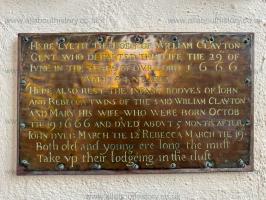
Memorial at the Church of St Lawrence, Whitwell [Map] to William Clayton, died 29th June 1666.
Samuel Pepys' Diary. 29th June 1666. After dinner to White Hall to a Committee of Tangier, but I come a little too late, they were up, so I to several places about business, among others to Westminster Hall [Map], and there did meet with Betty Michell at her own mother's shop. I would fain have carried her home by water, but she was to sup at that end of the town. So I away to White Hall, and thence, the Council being up, walked to St. James's, and there had much discourse with Sir W. Coventry (age 38) at his chamber, who I find quite weary of the warr, decries our having any warr at all, or himself to have been any occasion of it, that he hopes this will make us shy of any warr hereafter, or to prepare better for it, believes that one overthrow on the Dutch side would make them desire peace, and that one on ours will make us willing to accept of one: tells me that Commissioner Pett (age 55) is fallen infinitely under the displeasure of the Prince and Duke of Albemarle (age 57), not giving them satisfaction in the getting out of the fleete, and that the complaint he believes is come to the King (age 36), and by Sir W. Coventry's discourse I find he do concur in it, and speaks of his having of no authority in the place where he is, and I do believe at least it will end in his being removed to some other yarde, and I am not sorry for it, but do fear that though he deserves as bad, yet at this time the blame may not be so well deserved.

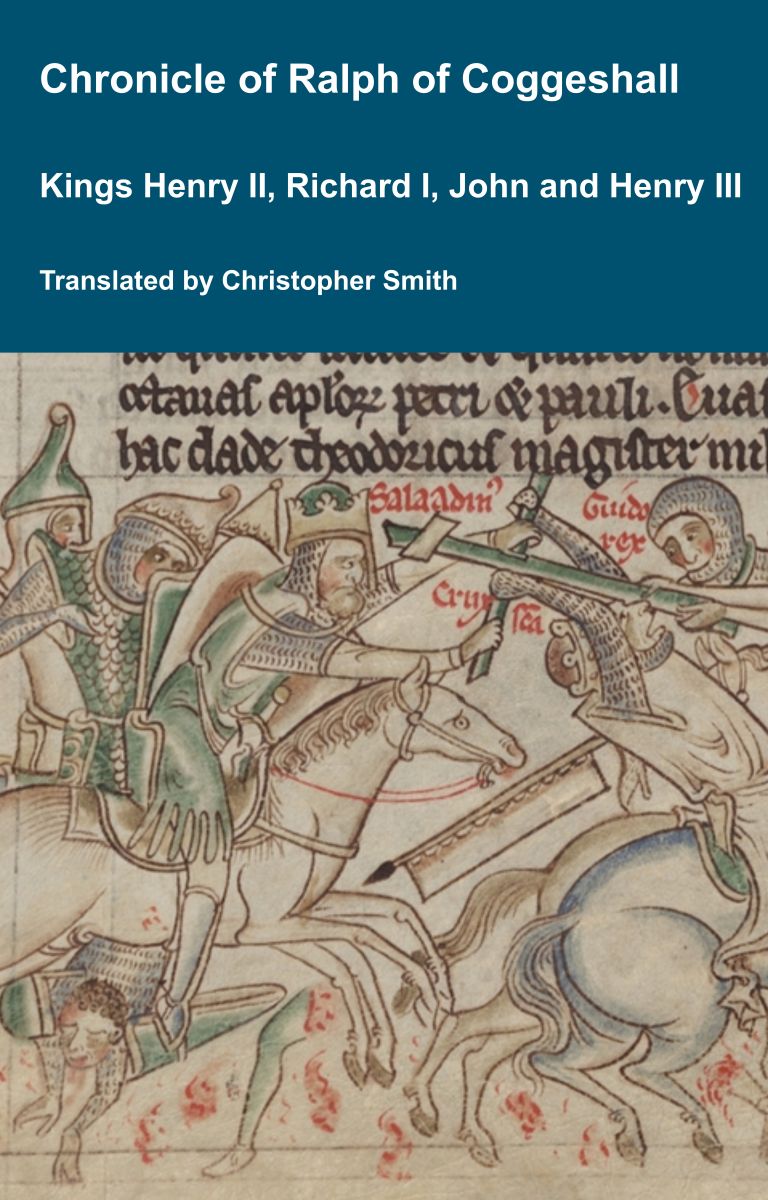
Chronicle of Abbot Ralph of Coggeshall
The Chronicle of Abbot Ralph of Coggeshall (Chronicon Anglicanum) is an indispensable medieval history that brings to life centuries of English and European affairs through the eyes of a learned Cistercian monk. Ralph of Coggeshall, abbot of the Abbey of Coggeshall in Essex in the early 13th century, continued and expanded his community’s chronicle, documenting events from the Norman Conquest of 1066 into the tumultuous reign of King Henry III. Blending eyewitness testimony, careful compilation, and the monastic commitment to record-keeping, this chronicle offers a rare narrative of political intrigue, royal power struggles, and social upheaval in England and beyond. Ralph’s work captures the reigns of pivotal figures such as Richard I and King John, providing invaluable insights into their characters, decisions, and the forces that shaped medieval rule. More than a simple annal, Chronicon Anglicanum conveys the texture of medieval life and governance, making it a rich source for scholars and readers fascinated by English history, monastic authorship, and the shaping of the medieval world.
Available at Amazon in eBook and Paperback format.
Samuel Pepys' Diary. 29th June 1667. Up, and by coach to St. James's, and there find Sir W. Coventry (age 39) and Sir W. Pen (age 46) above stairs, and then we to discourse about making up our accounts against the Parliament; and Sir W. Coventry did give us the best advice he could for us to provide for our own justification, believing, as everybody do, that they will fall heavily upon us all, though he lay all upon want of money, only a little, he says (if the Parliament be in any temper), may be laid upon themselves for not providing money sooner, they being expressly and industriously warned thereof by him, he says, even to the troubling them, that some of them did afterwards tell him that he had frighted them. He says he do prepare to justify himself, and that he hears that my Chancellor (age 58), my Lord Arlington (age 49), the Vice Chamberlain and himself are reported all up and down the Coffee houses to be the four sacrifices that must be made to atone the people.


Samuel Pepys' Diary. 29th June 1668. Called up by my Lady Peterborough's (age 46) servant about some business of hers, and so to the office.
John Evelyn's Diary. 29th June 1678. Returned with my Lord (age 60) by Hounslow Heath [Map], where we saw the newly raised army encamped, designed against France, in pretense, at least; but which gave umbrage to the Parliament. His Majesty (age 48) and a world of company were in the field, and the whole army in battalia; a very glorious sight. Now were brought into service a new sort of soldiers, called Grenadiers, who were dexterous in flinging hand grenades, everyone having a pouch full; they had furred caps with coped crowns like Janizaries, which made them look very fierce, and some had long hoods hanging down behind, as we picture fools. Their clothing being likewise piebald, yellow and red.
On 29th June 1688 the seven bishops were tried at the King's Bench. Robert Sawyer (age 55) acted for the defence. They were found not guilty. Their acquittal resulted in wild celebrations throughout London
John Evelyn's Diary. 29th June 1688. They appeared; the trial lasted from nine in the morning to past six in the evening, when the jury retired to consider of their verdict, and the Court adjourned to nine the next morning. The jury were locked up till that time, eleven of them being for an acquittal; but one (Arnold, a brewer) would not consent. At length he agreed with the others. The Chief Justice, Wright (age 54), behaved with great moderation and civility to the Bishops. Alibone, a Papist, was strongly against them; but Holloway and Powell (age 56) being of opinion in their favor, they were acquitted. When this was heard, there was great rejoicing; and there was a lane of people from the King's Bench [Map] to the water side, on their knees, as the Bishops passed and repassed, to beg their blessing. Bonfires were made that night, and bells rung, which was taken very ill at Court, and an appearance of nearly sixty Earls and Lords, etc., on the bench, did not a little comfort them; but indeed they were all along full of comfort and cheerful.
On 29th June 1716 Ernest Augustus Hanover 1st Duke of York and Albany (age 41) was created 1st Duke York and Albany.

On 29th June 1724 William Manners was born to John Manners 3rd Duke Rutland (age 27) and Bridget Sutton Duchess Rutland (age 24). He died aged five in 1730.
On 29th June 1743 Horace Walpole 4th Earl Orford (age 25) wrote to Horace Mann 1st Baronet (age 36):
[Charles Fitzroy 2nd Duke Grafton (age 59)]... is so unhappy in his heir apparent, that he checks his hand in almost everything he undertakes. Last week he heard a new exploit of his barbarity. A tenant of Lord Euston (age 27) in Northamptonshire brought him his rent, and the Lord said it wanted three and sixpence: the tenant begged he would examine the account, that it would prove exact - however, to content him, he would willingly pay him the three and sixpence. Lord E. flew into a rage and vowed he would write to the Duke to have him turned out of a little place he has in the post office of thirty pounds a year. The poor man, who has six children, and knew nothing of my Lord's being on no terms of power with his father, went home and shot himself.


On 29th June 1770 Robert Jenkinson 2nd Earl Liverpool was baptised at St Margaret's Church, Westminster [Map].
On 29th June 1779 Anton Raphael Mengs (age 51) died.
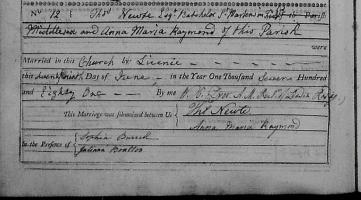
On 29th June 1781 Thomas Newte and Anna Maria Raymond (age 25) were married at Church of St Margaret of Antioch, Barking [Map].
Anna Maria Raymond: Around 1756 she was born to Charles Raymond 1st Baronet and Sarah Webster Lady Raymond. On 19th August 1783 she died. She was buried at the Church of St Margaret of Antioch, Barking [Map] where her mural monuments has the inscription "Near this place are deposited the remains of Anna Maria Newte, Daughter of Sir Charles Raymond Baronet Of Valentine House. Who died at Bristol Wells August the 19th 1783 Aged 27 years."
Chronicle of Geoffrey le Baker of Swinbroke
Baker was a secular clerk from Swinbroke, now Swinbrook, an Oxfordshire village two miles east of Burford. His Chronicle describes the events of the period 1303-1356: Gaveston, Bannockburn, Boroughbridge, the murder of King Edward II, the Scottish Wars, Sluys, Crécy, the Black Death, Winchelsea and Poitiers. To quote Herbert Bruce 'it possesses a vigorous and characteristic style, and its value for particular events between 1303 and 1356 has been recognised by its editor and by subsequent writers'. The book provides remarkable detail about the events it describes. Baker's text has been augmented with hundreds of notes, including extracts from other contemporary chronicles, such as the Annales Londonienses, Annales Paulini, Murimuth, Lanercost, Avesbury, Guisborough and Froissart to enrich the reader's understanding. The translation takes as its source the 'Chronicon Galfridi le Baker de Swynebroke' published in 1889, edited by Edward Maunde Thompson.
Available at Amazon in eBook and Paperback format.
Derbyshire Archaeological Journal Volume 30 1908 Page 155. 29th June 1782. Arber low [Map] 29: June 1782.
Qy of its addition Rink? Mr. Rook thinks this to be the most ancient and capital monument of antiquity in the Kingdom, and upon a plan full as large as Stonehenge, but vastly more ancient. That in every such place each stone had its name, before which stones the respective chiefs stood in their general assemblies, and every one knew his own stone, which bore his name of office, as King stone, &c. Rinch, Ringh, Ring from Winshew Curium rotendum. The temple here is certainly round, and if no circumstance of a barrow appears in the Mount now (June 29th 1782) opening, it should seem to be more like a court, when the assemblies of the ancient Britons with their chiefs were used to be held. Compare it with Vernometum in Leicestershire.
The London Gazette 13541. Whitehall, June 29 [1793]. The King has been. pleased, to grant the Dignity of an Earl and Marquess of the Kingdom of Great Britain to the Right Honorable Francis Seymour Conway (age 74), Earl of Hertford, Knight of the Most Noble Order of the Garter, and the Heirs Male of his Body lawfully, begotten, by the Names, Stiles, and Titles of Earl of Yarmouth in the County of Norfolk, and Marquess of Hertford.
The King has also been, pleased to grant the Dignity of an Earl of the Kingdom of Great Britain to the Right Honorable Henry Lord Porchester (age 51), and the Heirs Male of his Body lawfully, begotten by the Name, Stile and Title of Earl of the Town And County of Carnarvon, in the Principality of Wales. [Elizabeth Alicia Maria Wyndham Countess Carnarvon (age 40) by marriage Countess Carnarvon]
The King has been pleased to appoint George Poyntz Ricketts, Esq; to be Captain-General and Governor in Chief of the Island of Tobago.
The King has been pleased to approve of the Appointment of Lawrence Hansen, Esq; to be His Danish Majesty's Consul in the Town and Port of Liverpool, and in all other Ports in die County Palatine of Lancaster.


On 29th June 1794 George Waldegrave 5th Earl Waldegrave (age 9) drowned whilst swimming in the River Thames near Eton [Map]. His brother John (age 8) succeeded 6th Earl Waldegrave, 7th Baron Waldegrave Chewton Somerset, 10th Baronet Waldegrave of Hever Castle.

On 29th June 1801 Charles Hohenzollern was born to Frederick William III King Prussia (age 30) and Queen Louise of Prussia (age 25). He married 26th May 1827 Marie Saxe Weimar Eisenach and had issue.

Archaeologia Volume 15 Section XI Page 126. Heytesbury, June 29, 1803.
Sir
On my return from Stonehenge last Wednesday, (where I had been to open some barrows with Mr. Coxe) I was surprised to find a large string of beads, which had been taken out of the large barrow on Upton-Lovell Downs near you. This barrow is bell-shaped, surrounded with a deep ditch, and small vallum, the diameter at the base is 105 feet, its elevation 11 feet, and from its large size is called Upton Great Barrow [Map]. [e] On enquiry I found it had been opened in my absence by a labouring man, who is often employed, in digging flints on those Downs for the turnpike roads; his views were the hopes of finding treasure, but on finding nothing but burnt bones and the beads, he sent for me; but being absent, my brother and one of my daughters went, and having persuaded him to defist from further pursuits till my return, they brought away the beads. When I saw the barrow, I found he had made a large trench near the centre, when, at the depth of nearly eleven feet, he found a circular cist in the native chalk; this contained burnt human bones, with which were deposited 48 beads; of these 16 were of green and blue glass [f] "in long pieces notched between, so as to resemble a string of beads," 5 were of canal-coal or jet, and the remaining 57 of red amber; among the latter was one of a large size; the very small ones fell to pieces soon after their exposure to the air, but the large ones are in good preservation. Mr. Crocker has drawn a sample of each very accurately, as you will see on comparing. A neighbouring farmer, Mr. Baker of Chiltern, having brought two labourers to assist; these with the same man worked all day in making further researches, but we were not able to discover any thing else, except a variety of animal bones; and abundance of black ashes and charred wood. I am therefore of opinion that this large tumulus was erected over the remains of some illustrious female, for such the beads indicate; had there been more than one interment, I think we should certainly have discovered them, as we made some very large sections in those parts of the barrow where they are generally found.
I am very respectfully.
Sir,
Your faithful Servant,
William Cunnington.
Note e. I have accompanied this with a drawing of the barrow, and part of the beads, by Mr. Crocker, and request your acceptance of them.
Note f. Theese are finely coated with the Armatura acquired by lying a length of time in the earth.
Wiltshire Archaeological Magazine 1885 V22 Pages 234-238. June 29 [1814]. Examined the British village near Glory ann. In the first trial the pickaxe struck upon a quern with the hole in it— pottery of various sorts - stags' horns— animals bones, &e,"
After 29th June 1820. Church of St Michael and All Angels, Edenham [Map]. Monument to Peter Burrell Baron Willoughby, 1st Baron Gwydyr (deceased) sculpted by Joseph Nollekens (age 82). Freestanding square marble shaft bears a bust.


On 29th June 1822 Henry Somerset 7th Duke Beaufort (age 30) and Emily Frances Smith Duchess Beaufort (age 22) were married. She being the younger half-sister of his first wife Georgiana Frederica Fitzroy both of whom's mother was Anne Wellesley (age 54) sister of Arthur Wellesley 1st Duke Wellington (age 53). An example of a man marrying two sisters, albeit in this case half-sisters. He the son of Henry Charles Somerset 6th Duke Beaufort (age 55) and Charlotte Sophia Leveson-Gower Duchess Beaufort (age 51).


On 29th June 1837 Charles Eamer Kempe was born to Nathaniel Kemp (age 78).

On 29th June 1841 Frederica Mecklenburg Strelitz Queen Consort Hanover (age 63) died.
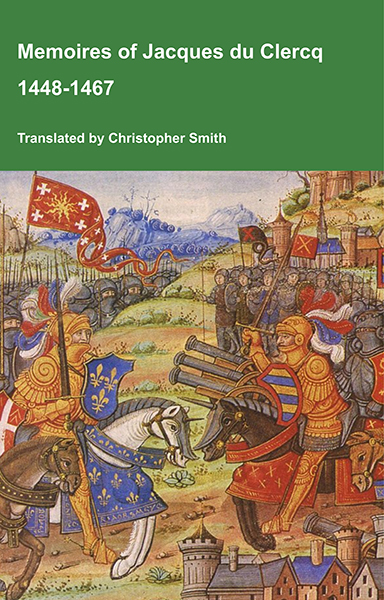
This is a translation of the 'Memoires of Jacques du Clercq', published in 1823 in two volumes, edited by Frederic, Baron de Reissenberg. In his introduction Reissenberg writes: 'Jacques du Clercq tells us that he was born in 1424, and that he was a licentiate in law and a counsellor to Philip the Good, Duke of Burgundy, in the castellany of Douai, Lille, and Orchies. It appears that he established his residence at Arras. In 1446, he married the daughter of Baldwin de la Lacherie, a gentleman who lived in Lille. We read in the fifth book of his Memoirs that his father, also named Jacques du Clercq, had married a lady of the Le Camelin family, from Compiègne. His ancestors, always attached to the counts of Flanders, had constantly served them, whether in their councils or in their armies.' The Memoires cover a period of nineteen years beginning in in 1448, ending in in 1467. It appears that the author had intended to extend the Memoirs beyond that date; no doubt illness or death prevented him from carrying out this plan. As Reissenberg writes the 'merit of this work lies in the simplicity of its narrative, in its tone of good faith, and in a certain air of frankness which naturally wins the reader’s confidence.' Du Clercq ranges from events of national and international importance, including events of the Wars of the Roses in England, to simple, everyday local events such as marriages, robberies, murders, trials and deaths, including that of his own father in Book 5; one of his last entries.
Available at Amazon in eBook and Paperback format.
The London Gazette 20118. Commission signed by the Lord Lieutenant of the County of Southampton. North Hants Militia.
The Earl of Wiltshire (age 41) to be Colonel. Dated 29th June 1842
Ten Years' Digging. June 29th [1848], a barrow was discovered at Bincliff, near Wetton, that had escaped previous observation from having been nearly levelled by agricultural operations, although it still retained its circular form and regular curvature. On examination, human remains, mixed with bones of the water rat, were found about a foot from the surface. The ground in the midst of the barrow appeared to have been dug out to the depth of four feet and filled in again, with the addition of stones and charcoal; but no interment was found.
The Diary of George Price Boyce 1855-1857. 29th June 1857. Rossetti (age 29) and his friend Morris (age 23) (of 17 Red Lion Square), called on me in Buckingham St. and had tea. R. told me he was sure it was a man of the name of Sandys (age 28) who had done the caricature.
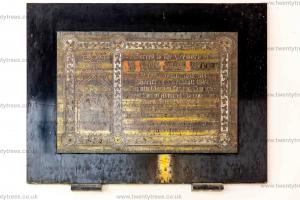
On 29th June 1868 Samuel Thomas Spry (age 63) died. Memorial at St Anthony's Church, St Anthony in Roseland [Map] to him and his wife Harriet Hill (age 47).
Harriet Hill: In 1821 she was born. In or before 1857 Samuel Thomas Spry and she were married. On 1st November 1900 she died.
On 29th June 1879 Charles Bennet (age 28) died of cholera at India.
On 29th June 1885 Camilla "Camille" Clifford was born. She married 1906 Henry Lyndhurst Bruce, son of Henry Bruce 2nd Baron Aberdare and Constance Mary Beckett Baroness Aberdare.


On 29th June 1902 Simon Elwes was born to Gervase Elwes (age 35) and Winefride Mary Elizabeth Feilding (age 33) at Hothorpe Hall, Northamptonshire. He married 25th November 1926 Gloria Rodd, daughter of Rennell Rodd 1st Baron Rodd and Lilias Georgina Guthrie Baroness Rennell.
Grave of Flight Lieutenant Geoffrey Richard Henry Talbot, died 29th June 1916, at St Peter and St Paul Church, Little Gaddesden. Nieuport Type 10 No. 3968, military two-seat reconnaissance aircraft, RNAS Dover. Written off (destroyed) when crashed on take-off, H.M.S. "President II", Dover, Kent [a land based ship]. The pilot Flt Lt Geoffrey Richard Henry Talbot was killed immediately. The passenger, Air Mechanic 1st Class Abraham Alf Hampson (Service Number F/10086, aged 24), the next day, 30th June 1916, of injuries sustained.
According to an eyewitness report: "There is one particularly poignant letter in the Kiplin collection from Mr A.R. George of Aylsham, Norfolk, to a Major Talbot (who may perhaps be Humphrey, Geoffrey's brother, though we have no other evidence that he attained this rank since his Great War medals are inscribed Lieutenant). The letter is dated 4th February 1921, and describes the heroic circumstances of Geoffrey's death. The full text reads as follows: 'I consider it a privilege to be able to give you particulars of the aeroplane accident I witnessed at Dover in June 1916, which I afterwards learnt resulted in the death of Mr Geoffrey Talbot. Between five and six thousand of us (R.G.A recruits) were drilling on the parade ground at Fort Burgoyne, and you can imagine we were closely packed in, when an aeroplane rose from behind the Fort and suddenly swooped down directly over the heads of the men drilling, so closely in fact that many fell on their faces to avoid being hit by the propellers, but the pilot in order to avoid what would have been a terrible catastrophe swerved sharply to the left, and the machine fell into a sunken road near the Fort. here is no doubt that the machine would have landed in the thick of the men with terrible results but with safety to the two men in it, and it was freely admitted by all who witnessed it that the pilot lost his life in a most gallant attempt to avoid crashing amongst the dense mass of men. I heard it said by the airmen there that air currents around Fort Burgoyne were very bad and this was probably the cause of the accident. From what I can remember, the two men were pinned under the machine and were picked up quite dead. It may be some consolation to his relatives to know that Mr Geoffrey Talbot gave his life in this heroic manner, and I consider it an honour to be able to give this testimony as an eyewitness of the sad affair. I remain, sincerely yours, A.R.George.'"
According to a contemporary report in Flight magazine, 6th July 1916, page 576: "Fatal Accidents. Flight-Lieutenant GEoffrey Richard Henry Talbot, R.N.A.S., whose death is officially announced, was killed instantaneously at Dover on June 29th when starting on a flight to France. The aeroplane was caught by a gust of wind and sideslipped, and was wrecked. The mechanic accompanying him was also killed. Flight-Lieutenant Talbot, who was born in 1888, was the younger son of the Hon. Alfred Talbot, of Little Gaddesden, and grandson of the 18th Earl of Shrewsbury and Talbot. He was educated at Eton, and having a great taste for mechanics entered the service of the East Indian Railway Company. His services were given to the public for the war, and he joined the Naval Air Service, rapidly becoming an expert and steady pilot. He obtained his "Wings" in 1915, and received promotion shortly before his death. He made many flights to and from France, whence he had only returned the previous day to his death."
According to the Imperial War Museum's website: "The Coroner's Inquest. Known At: July 1916. A note in the margin of Geoffrey's entry in the Burial Register at St Peter and St Paul's Church, Little Gaddesden reads "after Coroner's Inquest". At the inquest it was said that Geoffrey had only arrived at the Dover station on Thursday 29th June and was killed that afternoon, having taken off in a Nieuport biplane with Air Mechanic Hampson, aged 23, who was also killed. Both men were unconscious when help reached them and Geoffrey died from multiple injuries while being lifted into an ambulance. The inquest was told that nothing was wrong with the aircraft and, while it was also said that the accident was no one's fault, there was no suggestion that Geoffrey was taking evasive action to avoid hitting something on the ground. The verdict could be read as suggesting that pilot error, in difficult circumstances, contributed to the crash. As to the other crew member, who also died, Abraham Alfred Hampson was born on 31 May 1892 in Silksworth, near Sunderland. He was the youngest son of James Hampson (born 1866), a coal miner from Bolton, Lancashire, and Martha Ann Hampson (born 1867) from Lancaster, Lancashire. Abraham was the only child of three girls and three boys to be born in County Durham. The other children were born in Lancashire. In 1901 the family lived at 44 Victoria Street, Manchester, and, by the time of the 1911 census, had moved to 88 Stuart Street, Clayton, Manchester. Abraham was working as a motor fitter on the census date. Abraham joined the Royal Naval Air Service on 7 December 1915. He was given the service number F10086 and the rank of Air Mechanic 1st Class. Little is known of his service until 29 June 1916 when, starting on a flight for France from Dover Air Station, the aeroplane in which he was travelling was caught by a gust of wind, side-slipped and was wrecked. Abraham died on 30 June 1916 in the Military Hospital, Western Heights, Dover, Kent from multiple injuries sustained in the crash. The pilot of the aeroplane was Flight Lieutenant Geoffrey Richard Henry Talbot who was killed instantly. Abraham Hampson is buried in Philips Park Cemetery, Miles Platting, Manchester, Lancashire.
On 29th June 1920 Nicole Schnedier Duchess Bedford was born to Captain Paul Schneider. She married 4th September 1960 John Ian Robert Russell 13th Duke Bedford, son of Hastings William Russell 12th Duke Bedford and Louisa Crommelin Roberta Jowitt Whitwell Duchess Bedford.
After 13th May 1948 Kathleen "Kick" Kennedy (deceased) was buried at Cavendish Plot, St Peter's Church, Edensor [Map]. Joseph Patrick Kennedy (age 59), her father, was the only Kennedy family member to attend.
On Saturday 29th June 1963, around four in the afternoon, her grave was visited by her elder brother President John Fitzgerald Kennedy (age 46), some five months before his assassination. He was travelling from to London for a meeting with the British Prime Minister when he made a detour landing at and then travelling by helicopter to St Peter's Church, Edensor [Map]. He laid a wreath which he had brought from Ireland. Present at the wreath laying was his sisters Eunice Mary Kennedy (age 41) and Jean Ann Kennedy (age 35), and the Duke and Duchess (age 67) of Devonshire.


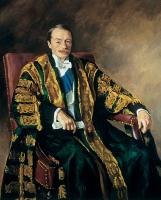
William of Worcester's Chronicle of England
William of Worcester, born around 1415, and died around 1482 was secretary to John Fastolf, the renowned soldier of the Hundred Years War, during which time he collected documents, letters, and wrote a record of events. Following their return to England in 1440 William was witness to major events. Twice in his chronicle he uses the first person: 1. when writing about the murder of Thomas, 7th Baron Scales, in 1460, he writes '… and I saw him lying naked in the cemetery near the porch of the church of St. Mary Overie in Southwark …' and 2. describing King Edward IV's entry into London in 1461 he writes '… proclaimed that all the people themselves were to recognize and acknowledge Edward as king. I was present and heard this, and immediately went down with them into the city'. William’s Chronicle is rich in detail. It is the source of much information about the Wars of the Roses, including the term 'Diabolical Marriage' to describe the marriage of Queen Elizabeth Woodville’s brother John’s marriage to Katherine, Dowager Duchess of Norfolk, he aged twenty, she sixty-five or more, and the story about a paper crown being placed in mockery on the severed head of Richard, 3rd Duke of York.
Available at Amazon in eBook and Paperback format.
On 29th June 430 Fergus Mór aka Great mac Eirc King of Dál Riata was born to Erc King of Dál Riata.
On 29th June 1333 Isabel St John 4th Baroness St John of Basing was born to Hugh St John 2nd Baron St John of Basing (age 23) and Isabel Wake Baroness St John Basing at Basing, Hampshire. She married (1) Henry Burghesh, son of Bartholomew "The Elder" Burghesh 1st Baron Burghesh and Elizabeth Verdun Baroness Burghesh (2) in or before 1351 Luke Poynings 4th Baron St John of Basing and had issue.
On 29th June 1398 John II King Aragon was born to Ferdinand I King Aragon (age 17) and Eleanor of Alberquerque Queen Consort Aragon (age 24). Coefficient of inbreeding 4.41%. He married (1) before 29th May 1421 his first cousin once removed Blanche Évreux Queen Consort Aragon, daughter of Charles III King Navarre and Eleanor of Castile Queen Consort Navarre, and had issue (2) after 1441 his second cousin once removed Juana Enríquez Queen Consort Aragon, daughter of Fadrique Enríquez Count Melgar Count Rueda and Mariana Fernández Countess Melgar, and had issue.
On 29th June 1475 Beatrice Este was born to Ercole Este I Duke Ferrara (age 43). She married Ludovico Sforza Duke Milan, son of Francesco Sforza I Duke Milan and Bianca Maria Visconti.
On 29th June 1543 Christine Hesse was born to Landgrave Philip I of Hesse (age 38) and Christine of Saxony (age 37). She married 17th December 1564 her half fourth cousin once removed Duke Adolph Oldenburg of Holstein-Gotorp and had issue.
On 29th June 1546 Dorothea Oldenburg Duchess Brunswick-Lüneburg was born to Christian III King of Denmark (age 42) and Dorothea of Saxe Lauenburg Queen Consort Denmark and Norway (age 35) at Kolding. She married 12th October 1561 her half sixth cousin William "Younger" Welf Duke Brunswick-Lüneburg.
On 29th June 1552 Elizabeth Spencer Baroness Hunsdon and Eure was born to John Spencer (age 28) and Katherine Kitson (age 28) at Althorp House, Northamptonshire [Map]. She married (1) 29th December 1574 George Carey 2nd Baron Hunsdon, son of Henry Carey 1st Baron Hunsdon and Anne Morgan Baroness Hunsdon, and had issue (2) after 1612 Ralph Eure 3rd Baron Eure, son of William Eure 2nd Baron Eure and Margaret Dymoke.
On 29th June 1612 William Bowyer 1st Baronet was born to Henry Bowyer and Anne Salter. He was baptised at St Olave's Church [Map]. He married 29th May 1634 Margaret Weld Lady Bowyer and had issue.
On 29th June 1640 Elizabeth Butler Countess Chesterfield was born to James Butler 1st Duke Ormonde (age 29) and Elizabeth Preston Duchess Ormonde (age 24). She married after 1654 Philip Stanhope 2nd Earl Chesterfield, son of Henry Stanhope and Katherine Wotton Countess Chesterfield, and had issue.
On 29th June 1684 Amy Cox was born to Richard Cox 1st Baronet (age 34) and Mary Bourne (age 26). She married 18th October 1700 William Mansel 7th Baronet, son of Richard Mansel 5th Baronet, and had issue.

On 29th June 1686 Anne Lee was born to Edward Lee 1st Earl Lichfield (age 23) and Charlotte Fitzroy Countess Lichfield (age 21). She a granddaughter of King Charles II of England Scotland and Ireland.
William of Worcester's Chronicle of England
William of Worcester, born around 1415, and died around 1482 was secretary to John Fastolf, the renowned soldier of the Hundred Years War, during which time he collected documents, letters, and wrote a record of events. Following their return to England in 1440 William was witness to major events. Twice in his chronicle he uses the first person: 1. when writing about the murder of Thomas, 7th Baron Scales, in 1460, he writes '… and I saw him lying naked in the cemetery near the porch of the church of St. Mary Overie in Southwark …' and 2. describing King Edward IV's entry into London in 1461 he writes '… proclaimed that all the people themselves were to recognize and acknowledge Edward as king. I was present and heard this, and immediately went down with them into the city'. William’s Chronicle is rich in detail. It is the source of much information about the Wars of the Roses, including the term 'Diabolical Marriage' to describe the marriage of Queen Elizabeth Woodville’s brother John’s marriage to Katherine, Dowager Duchess of Norfolk, he aged twenty, she sixty-five or more, and the story about a paper crown being placed in mockery on the severed head of Richard, 3rd Duke of York.
Available at Amazon in eBook and Paperback format.
On 29th June 1724 William Manners was born to John Manners 3rd Duke Rutland (age 27) and Bridget Sutton Duchess Rutland (age 24). He died aged five in 1730.
On 29th June 1725 Charles Cocks 1st Baron Somers was born to John Cocks of Castleditch in Eastnor in Herefordshire and Mary Cocks. Coefficient of inbreeding 12.50%. He married (1) 8th August 1759 Elizabeth Eliot and had issue (2) 20th May 1772 Anne Pole and had issue.
On 29th June 1730 Charles Moore 1st Marquess Drogheda was born to Edward Moore 5th Earl Drogheda (age 29) and Sarah Ponsonby. He married 15th February 1766 Anne Seymour-Conway Countess Drogheda, daughter of Francis Seymour-Conway 1st Marquess Hertford and Isabella Fitzroy Countess Hertford, and had issue.
On 29th June 1742 John Wallop 2nd Earl Portsmouth was born to John Wallop Viscount Lymington (age 23) and Catherine Conduit. He married 27th August 1763 Urania Fellowes and had issue.
On 29th June 1751 Elizabeth Parker was born to Thomas Parker 3rd Earl Macclesfield (age 27) and Mary Heathcote Countess Macclesfield. Coefficient of inbreeding 6.25%. She married 1773 John Fane and had issue.

On 29th June 1788 Sophia Ashburnham was born to George Ashburnham 3rd Earl Ashburnham (age 27) and Sophia Thynne (age 24).
On 29th June 1801 Charles Hohenzollern was born to Frederick William III King Prussia (age 30) and Queen Louise of Prussia (age 25). He married 26th May 1827 Marie Saxe Weimar Eisenach and had issue.
On 29th June 1809 Anne Brudenell Countess Lucan was born to Robert Brudenell 6th Earl Cardigan (age 40) and Penelope Cooke Countess Cardigan (age 39). She married 29th June 1829 George Charles Bingham 3rd Earl Lucan, son of Richard Bingham 2nd Earl Lucan and Elizabeth Belasyse Duchess Norfolk, and had issue.
On 29th June 1812 Algernon Charles Heber-Percy was born to Bishop Hugh Percy (age 28) and Mary Manners Sutton.
On 29th June 1812 James Graham Domville 3rd Baronet was born to William Domville 2nd Baronet (age 38).
On 29th June 1816 Alfred Paget was born to Henry William Paget 1st Marquess Anglesey (age 48) and Charlotte Cadogan Marchioness Anglesey (age 34). He married 1847 Cecilia Wyndham, daughter of George Thomas Wyndham of Cromer Hall Norfolk and Maria Augusta Windham Countess Listowel, and had issue.


On 29th June 1816 William Frederick Waldegrave was born to William Waldegrave 8th Earl Waldegrave (age 27) and Elizabeth Whitbread (age 24) in Cardington, Bedfordshire. He married 2nd July 1850 Frances Bastard and had issue.
William of Worcester's Chronicle of England
William of Worcester, born around 1415, and died around 1482 was secretary to John Fastolf, the renowned soldier of the Hundred Years War, during which time he collected documents, letters, and wrote a record of events. Following their return to England in 1440 William was witness to major events. Twice in his chronicle he uses the first person: 1. when writing about the murder of Thomas, 7th Baron Scales, in 1460, he writes '… and I saw him lying naked in the cemetery near the porch of the church of St. Mary Overie in Southwark …' and 2. describing King Edward IV's entry into London in 1461 he writes '… proclaimed that all the people themselves were to recognize and acknowledge Edward as king. I was present and heard this, and immediately went down with them into the city'. William’s Chronicle is rich in detail. It is the source of much information about the Wars of the Roses, including the term 'Diabolical Marriage' to describe the marriage of Queen Elizabeth Woodville’s brother John’s marriage to Katherine, Dowager Duchess of Norfolk, he aged twenty, she sixty-five or more, and the story about a paper crown being placed in mockery on the severed head of Richard, 3rd Duke of York.
Available at Amazon in eBook and Paperback format.
On 29th June 1837 Charles Eamer Kempe was born to Nathaniel Kemp (age 78).
On 29th June 1872 Gavin Hamilton 2nd Baron Hamilton of Dalzell was born to John Hamilton 1st Baron Hamilton of Dalzell (age 42) and Emily Eleanor Leslie-Melville (age 32).
On 29th June 1885 Camilla "Camille" Clifford was born. She married 1906 Henry Lyndhurst Bruce, son of Henry Bruce 2nd Baron Aberdare and Constance Mary Beckett Baroness Aberdare.
On 29th June 1887 Francis Stapleton-Cotton 4th Viscount Combermere was born to Robert Wellington Stapleton-Cotton 3rd Viscount Combermere (age 42) and Isabel Marion Chetwynd Viscountess Combermere. He married (1) 30th October 1917 Louisa Hazel Agnew Viscountess Combermere (2) 1st January 1927 Constance Marie Katherine Williams-Drummond and had issue.
On 29th June 1902 Simon Elwes was born to Gervase Elwes (age 35) and Winefride Mary Elizabeth Feilding (age 33) at Hothorpe Hall, Northamptonshire. He married 25th November 1926 Gloria Rodd, daughter of Rennell Rodd 1st Baron Rodd and Lilias Georgina Guthrie Baroness Rennell.
On 29th June 1902 Henry Tate 4th Baronet was born to Ernest William Tate 3rd Baronet (age 35).
On 29th June 1914 Anthony Joseph Henry Doughty-Tichborne 14th Baronet was born to Joseph Henry Bernard Doughty-Tichborne 13th Baronet (age 24).
On 29th June 1920 Nicole Schnedier Duchess Bedford was born to Captain Paul Schneider. She married 4th September 1960 John Ian Robert Russell 13th Duke Bedford, son of Hastings William Russell 12th Duke Bedford and Louisa Crommelin Roberta Jowitt Whitwell Duchess Bedford.
On 29th June 1921 Desmond Leslie was born to John Randolph Leslie 3rd Baronet (age 35).
On 29th June 1921 Fiennes Cornwallis 3rd Baron Cornwallis was born to Wykeham Cornwallis 2nd Baron Cornwallis (age 29) and Cecily Etha Mary Walker (age 27).
Abbot John Whethamstede’s Chronicle of the Abbey of St Albans
Abbot John Whethamstede's Register aka Chronicle of his second term at the Abbey of St Albans, 1451-1461, is a remarkable text that describes his first-hand experience of the beginning of the Wars of the Roses including the First and Second Battles of St Albans, 1455 and 1461, respectively, their cause, and their consequences, not least on the Abbey itself. His text also includes Loveday, Blore Heath, Northampton, the Act of Accord, Wakefield, and Towton, and ends with the Coronation of King Edward IV. In addition to the events of the Wars of the Roses, Abbot John, or his scribes who wrote the Chronicle, include details in the life of the Abbey such as charters, letters, land exchanges, visits by legates, and disputes, which provide a rich insight into the day-to-day life of the Abbey, and the challenges faced by its Abbot.
Available at Amazon in eBook and Paperback format.
On 29th June 1931 Davina Mary Cecil Baroness Barnard was born to David George Brownlow-Cecil 6th Marquess Exeter (age 26) and Mary Theresa Montagu-Douglas-Scott (age 27). Coefficient of inbreeding 1.62%. She married (1) 8th October 1952 her half second cousin once removed Harry John Neville Vane 11th Baron Barnard, son of Christopher Vane 10th Baron Barnard and Sylvia Mary Straker Baroness Barnard, and had issue.
On 29th June 1938 Michael Fitzroy Farquhar 7th Baronet was born to Peter Farquhar 6th Baronet (age 33).
On 29th June 1533 William Howard 1st Baron Howard (age 23) and Margaret Gamage Baroness Howard (age 18) were married. He the son of Thomas Howard 2nd Duke of Norfolk and Agnes Tilney Duchess Norfolk (age 56).
On 29th June 1589 Francis Vincent 1st Baronet (age 21) and Sarah Paulett (age 32) were married.
On 29th June 1744 John Fitzpatrick 1st Earl Upper Ossory (age 25) and Evelyn Leveson-Gower Countess Upper Ossory (age 19) were married. She by marriage Baroness Gowran of Bowran in County Kilkenny. She the daughter of John Leveson-Gower 1st Earl Gower (age 49) and Evelyn Pierrepont Baroness Gower.
On 29th June 1786 Arthur Hill 2nd Marquess Downshire (age 33) and Mary Sandys Marchioness Downshire (age 22) were married. He the son of Wills Hill 1st Marquess Downshire (age 68) and Margaretta Fitzgerald.
On 29th June 1813 Lucas Pepys 1st Baronet (age 71) and Deborah Askew (age 49) were married at St George's Church, Hanover Square. The difference in their ages was 21 years.
On 29th June 1814 John James and Emily Jane Stewart Viscountess Hardinge (age 25) were married. She the daughter of Robert Stewart 1st Marquess Londonderry (age 74) and Frances Pratt Marchioness Londonderry (age 63). They were first cousins.
On 29th June 1822 Henry Somerset 7th Duke Beaufort (age 30) and Emily Frances Smith Duchess Beaufort (age 22) were married. She being the younger half-sister of his first wife Georgiana Frederica Fitzroy both of whom's mother was Anne Wellesley (age 54) sister of Arthur Wellesley 1st Duke Wellington (age 53). An example of a man marrying two sisters, albeit in this case half-sisters. He the son of Henry Charles Somerset 6th Duke Beaufort (age 55) and Charlotte Sophia Leveson-Gower Duchess Beaufort (age 51).
On 29th June 1826 Henry Reynolds-Moreton 2nd Earl Ducie (age 24) and Elizabeth Dutton Countess Ducie (age 19) were married. He the son of Thomas Reynolds-Moreton 1st Earl Ducie (age 49) and Frances Herbert Baroness Ducie Tortworth (age 44).
Abbot John Whethamstede’s Chronicle of the Abbey of St Albans
Abbot John Whethamstede's Register aka Chronicle of his second term at the Abbey of St Albans, 1451-1461, is a remarkable text that describes his first-hand experience of the beginning of the Wars of the Roses including the First and Second Battles of St Albans, 1455 and 1461, respectively, their cause, and their consequences, not least on the Abbey itself. His text also includes Loveday, Blore Heath, Northampton, the Act of Accord, Wakefield, and Towton, and ends with the Coronation of King Edward IV. In addition to the events of the Wars of the Roses, Abbot John, or his scribes who wrote the Chronicle, include details in the life of the Abbey such as charters, letters, land exchanges, visits by legates, and disputes, which provide a rich insight into the day-to-day life of the Abbey, and the challenges faced by its Abbot.
Available at Amazon in eBook and Paperback format.
On 29th June 1829 George Charles Bingham 3rd Earl Lucan (age 29) and Anne Brudenell Countess Lucan (age 20) were married. She the daughter of Robert Brudenell 6th Earl Cardigan (age 60) and Penelope Cooke Countess Cardigan. He the son of Richard Bingham 2nd Earl Lucan (age 64) and Elizabeth Belasyse Duchess Norfolk.
On 29th June 1870 Bishop Edward Stuart Talbot (age 26) and Lavinia Lyttelton (age 20) were married.


On 29th June 1889 John Vinton Dahlgren (age 21) and Elizabeth Wharton Drexel Baroness Decies (age 21) were married at St Patrick's Cathedral, Manhattan.


On 29th June 1933 Herbert Paul Latham 2nd Baronet (age 28) and Patricia Doreen Moore Lady Latham (age 21) were married. She by marriage Lady Latham of Crow Clump in Surrey. She the daughter of Henry Moore 10th Earl of Drogheda (age 49) and Kathleen Pelham Burn Countess Drogheda (age 46).
On 29th June 1059 Bernard II Duke of Saxony (age 64) died. His son Ordulf (age 37) succeeded Duke Saxony.
On 29th June 1252 King Abel of Denmark (age 34)was killed by a wheelwright named Henner on Husum Bridge near Eiderstedt. His brother Christopher (age 33) succeeded King of Denmark.
On 29th June 1450 Bishop William Ayscough (age 55) was murdered at Edington, Wiltshire by an angry mob.
On 29th June 1502 Elizabeth Mortimer Baroness De La Warr and West (age 42) died.
On 29th June 1509 Margaret Beaufort Countess Richmond (age 66) died in the Deanery, Westminster Abbey [Map]. She had lived to see the Coronation of her son King Henry VII of England and Ireland and her grandson King Henry VIII of England and Ireland (age 18).
She was buried at the King Henry VII Chapel, Westminster Abbey [Map]. Her tomb was created by Pietro Torrigiano (age 36). The gilded bronze sculpture on the tomb depicts Margaret with her head resting on pillows and her hands raised in prayer, wearing garments characteristic of widowhood; the face was probably sculpted from a death mask. The black marble tomb is embellished with heraldic bronze insignia, including a Yale, her heraldic badge, at her feet.
The inscription written by the humanist scholar Erasmus reads "Margaret, Countess of Richmond, mother of Henry VII, grandmother of Henry VIII, who donated funds for three monks of this abbey, a grammar school in Wimborne, a preacher in the whole of England, two lecturers in Scripture, one at Oxford, the other at Cambridge, where she also founded two colleges, one dedicated to Christ [Map], and the other to St John, the evangelist [Map]".
Image Source: .
On 29th June 1537 John Hussey 1st Baron Hussey of Sleaford (age 72) was beheaded at Lincoln, Lincolnshire [Map]. Baron Hussey of Sleaford forfeit.
On 29th June 1612 Robert Crichton 8th Lord Sanquhar was hanged in Westminster Palace Yard for having arranged the murder of his fencing Master John Painter Turner who had previously disfigured him during practice. At his trial Francis Bacon 1st Viscount St Alban (age 51) read the charges.
On 29th June 1636 Grace Thornhurst Countess of Westmoreland (age 32) died.
On 29th June 1650 Alice Barnham Viscountess St Alban (age 58) died.
On 29th June 1695 Edward Wyndham 2nd Baronet (age 28) died. His son William (age 7) succeeded 3rd Baronet Wyndham of Orchard in Somerset.
On 29th June 1700 John Webb 2nd Baronet died. His son John (age 45) succeeded 3rd Baronet Webb of Odstock in Wiltshire. Barbara Belasyse Lady Webb by marriage Lady Webb of Odstock in Wiltshire.
This is a translation of the 'Memoires of Jacques du Clercq', published in 1823 in two volumes, edited by Frederic, Baron de Reissenberg. In his introduction Reissenberg writes: 'Jacques du Clercq tells us that he was born in 1424, and that he was a licentiate in law and a counsellor to Philip the Good, Duke of Burgundy, in the castellany of Douai, Lille, and Orchies. It appears that he established his residence at Arras. In 1446, he married the daughter of Baldwin de la Lacherie, a gentleman who lived in Lille. We read in the fifth book of his Memoirs that his father, also named Jacques du Clercq, had married a lady of the Le Camelin family, from Compiègne. His ancestors, always attached to the counts of Flanders, had constantly served them, whether in their councils or in their armies.' The Memoires cover a period of nineteen years beginning in in 1448, ending in in 1467. It appears that the author had intended to extend the Memoirs beyond that date; no doubt illness or death prevented him from carrying out this plan. As Reissenberg writes the 'merit of this work lies in the simplicity of its narrative, in its tone of good faith, and in a certain air of frankness which naturally wins the reader’s confidence.' Du Clercq ranges from events of national and international importance, including events of the Wars of the Roses in England, to simple, everyday local events such as marriages, robberies, murders, trials and deaths, including that of his own father in Book 5; one of his last entries.
Available at Amazon in eBook and Paperback format.

On 29th June 1757 Heneage Finch 2nd Earl Aylesford (age 74) died. His son Heneage (age 41) succeeded 3rd Earl Aylesford. Charlotte Seymour Countess Aylesford (age 26) by marriage Countess Aylesford.
On 29th June 1763 Monoux Cope 7th Baronet (age 67) died. His son John (age 32) succeeded 8th Baronet Cope of Hanwell in Oxfordshire.
On 29th June 1763 Thomas Webb 4th Baronet (age 58) died. His son John (age 20) succeeded 5th Baronet Webb of Odstock in Wiltshire. Mary Salvin Lady Webb by marriage Lady Webb of Odstock in Wiltshire.
On 29th June 1769 Richard Wrottesley 7th Baronet (age 48) died. His son John (age 24) succeeded 8th Baronet Wrottesley of Wrottesley in Staffordshire.
On 29th June 1779 John Every 7th Baronet (age 69) died. His second cousin twice removed Edward (age 25) succeeded 8th Baronet Every of Egginton in Derbyshire.
On 29th June 1779 Anton Raphael Mengs (age 51) died.

On 29th June 1792 Elizabeth Drax Countess Berkeley and Nugent (age 72) died.
On 29th June 1794 George Waldegrave 5th Earl Waldegrave (age 9) drowned whilst swimming in the River Thames near Eton [Map]. His brother John (age 8) succeeded 6th Earl Waldegrave, 7th Baron Waldegrave Chewton Somerset, 10th Baronet Waldegrave of Hever Castle.

On 29th June 1798 Laura Keppel Baroness Southampton (age 33) died in Dawlish, Devon.
On 29th June 1818 George Osborn 4th Baronet (age 76) died. His son John (age 45) succeeded 5th Baronet Osborn of Chicksands in Bedfordshire.
On 29th June 1820 Robert Jocelyn 2nd Earl Roden (age 63) died. His son Robert (age 31) succeeded 3rd Earl Roden. Maria Frances Catherine Stapleton Countess Roden by marriage Countess Roden.
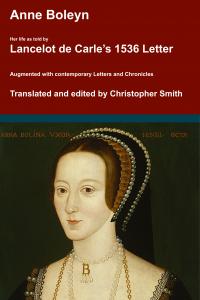
Anne Boleyn. Her Life as told by Lancelot de Carle's 1536 Letter.
In 1536, two weeks after the execution of Anne Boleyn, her brother George and four others, Lancelot du Carle, wrote an extraordinary letter that described Anne's life, and her trial and execution, to which he was a witness. This book presents a new translation of that letter, with additional material from other contemporary sources such as Letters, Hall's and Wriothesley's Chronicles, the pamphlets of Wynkyn the Worde, the Memorial of George Constantyne, the Portuguese Letter and the Baga de Secrets, all of which are provided in Appendices.
Available at Amazon in eBook and Paperback format.
On 29th June 1820 Peter Burrell Baron Willoughby, 1st Baron Gwydyr (age 66) died. His son Peter (age 38) succeeded 2nd Baron Gwydyr of Cwydyr in Carnarfonshire. Clementina Sarah Drummond Baroness Gwydyr and Willoughby (age 34) by marriage Baroness Gwydyr of Cwydyr in Carnarfonshire.
On 29th June 1827 Thomas Beauchamp-Proctor 2nd Baronet (age 71) died. His son William (age 45) succeeded 3rd Baronet Beauchamp-Proctor of Langley Park in Norfolk. Anne Gregory Lady Beauchamp-Proctor (age 35) by marriage Lady Beauchamp-Proctor of Langley Park in Norfolk.
On 29th June 1832 John Hely-Hutchinson 2nd Earl of Donoughmore (age 75) died unmarried. His nephew John (age 45) succeeded 3rd Earl of Donoughmore, 3rd Viscount Hutchinson of Knocklofty in Tipperary, 3rd Viscount Donoughmore of Knocklofty in Tipperary, 4th Baron Donoughmore of Knocklofty in Tipperary. Barbara Reynell Countess Donoughmore by marriage Countess of Donoughmore.
On 29th June 1833 Thomas Fermor 4th Earl Pomfret (age 62) died. His son George (age 8) succeeded 5th Earl Pomfret aka Pontefract, 5th Baron Leominster, 6th Baronet Fermor of Easton Neston in Northamptonshire.
On 29th June 1837 Elizabeth Scott Countess Home died.
On 29th June 1841 Frederica Mecklenburg Strelitz Queen Consort Hanover (age 63) died.
On 29th June 1856 Edmund Boyle 8th Earl Cork (age 88) died. His grandson Richard (age 27) succeeded 9th Earl Cork. Emily Charlotte Burgh Countess Cork (age 27) by marriage Countess Cork.
On 29th June 1860 George Brooke-Pechell 4th Baronet (age 70) died without surviving male issue at 27 Hill Street, Berkeley Square. His first cousin once removed George (age 41) succeeded 5th Baronet Brooke-Pechell of Paglesham in Essex.
On 29th June 1863 Thomas Stanley-Massey-Stanley 10th Baronet (age 56) died. His brother Rowland (age 54) succeeded 11th Baronet Errington of Hooton in Cheshire.
On 29th June 1864 Reverend Thomas Combe Miller 6th Baronet (age 84) died. His son Charles (age 35) succeeded 7th Baronet Miller of Chichester in Sussex.

On 29th June 1890 Henry Howard Molyneux Herbert 4th Earl Carnarvon (age 59) died. His son George (age 24) succeeded 5th Earl Carnarvon, 5th Baron Porchester of Highclere in Hampshire.
On 29th June 1892 Henry Seymour Moore 3rd Marquess Drogheda (age 66) died. Marquess Drogheda extinct. His second cousin once removed Ponsonby (age 46) succeeded 9th Earl Drogheda, 11th Viscount Moore of Drogheda, 11th Baron Moore of Mellefont in Louth.
On 29th June 1908 Edward Baldwin Malet 4th Baronet (age 70) died. His first cousin once removed Edward (age 35) succeeded 5th Baronet Malet of Wilbury in Wiltshire.
On 29th June 1931 Thomas Hugh Bell 2nd Baronet (age 87) died. His son Maurice (age 60) succeeded 3rd Baronet Bell of Rounton Range and Washington Hall in County Durham.

On 29th June 1932 William Humble Ward 2nd Earl of Dudley (age 65) died. He was buried at the Earl of Dudley's Memory Garden, St Michael's Church, Himley [Map]. His son William (age 38) succeeded 3rd Earl of Dudley of Dudley Castle in Staffordshire, 13th Baron Ward of Birmingham.
Henrici Quinti, Angliæ Regis, Gesta, is a first-hand account of the Agincourt Campaign, and subsequent events to his death in 1422. The author of the first part was a Chaplain in King Henry's retinue who was present from King Henry's departure at Southampton in 1415, at the siege of Harfleur, the battle of Agincourt, and the celebrations on King Henry's return to London. The second part, by another writer, relates the events that took place including the negotiations at Troye, Henry's marriage and his death in 1422.
Available at Amazon in eBook and Paperback format.
On 29th June 1939 Cosmo Gordon Antrobus 5th Baronet (age 79) died. His first cousin Philip (age 62) succeeded 6th Baronet Antrobus of Antrobus in Cheshire.
On 29th June 1957 Beresford Annesley 8th Earl Annesley (age 63) died. His third cousin once removed Robert (age 57) succeeded 9th Earl Annesley of Castlewellan in County Down, 10th Viscount Glerawly of County Fermanagh, 10th Baron Annesley of Castle Wellan in County Down.
On 29th June 1958 Grace Elvina Hinds Marchioness Curzon Kedleston (age 73) died.


On 29th June 1969 Roger Lumley 11th Earl of Scarbrough (age 72) died. His son Richard (age 36) succeeded 12th Earl of Scarborough, 13th Viscount Lumley, 12th Baron Lumley.
On 29th June 1977 Sylvia Hawkes Baroness Stanley (age 73) died.
On 29th June 1978 Hector Wroth Lethbridge 6th Baronet (age 79) died. His son Thomas (age 27) succeeded 7th Baronet Lethbridge of Westaway House in Devon and Winkley Court in Somerset.
On 29th June 1983 Almeric Frederic Conness Rich 6th Baronet (age 86) died. Baronet Rich of Shirley House in Hampshire extinct or possibly dormant.
On 29th June 2022 John Stephen Gyles Dryden 11th and 8th Baronet (age 78) died. His son John (age 46) succeeded 12th Baronet Dryden of Ambrosden in Oxfordshire, 9th Baronet Dryden of Canons Ashby in Northamptonshire.