

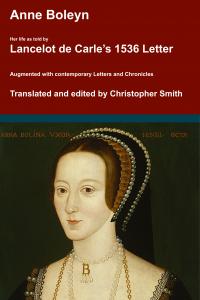
Anne Boleyn. Her Life as told by Lancelot de Carle's 1536 Letter.
In 1536, two weeks after the execution of Anne Boleyn, her brother George and four others, Lancelot du Carle, wrote an extraordinary letter that described Anne's life, and her trial and execution, to which he was a witness. This book presents a new translation of that letter, with additional material from other contemporary sources such as Letters, Hall's and Wriothesley's Chronicles, the pamphlets of Wynkyn the Worde, the Memorial of George Constantyne, the Portuguese Letter and the Baga de Secrets, all of which are provided in Appendices.
Available at Amazon in eBook and Paperback format.
30 Nov is in November.
1016 Death of King Edmund Ironside
1292 Coronation of King John Balliol of Scotland
1535 Sweating Sickness Outbreak
1680 Trial and Execution of William Howard 1st Viscount Stafford
On 30th November 912 Henry "Fowler" I King East Francia (age 36) succeeded I Duke Saxony.
On 30th November 1016 King Edmund "Ironside" I of England (age 26) died. He was buried near his grandfather King Edgar I of England in Glastonbury Abbey [Map].
On 30th November 1219 Ferdinand III King Castile III King Leon (age 20) and Elisabeth Hohenstaufen Queen Consort Castile Queen Consort Leon (age 14) were married in Burgos [Map]. She by marriage Queen Consort Castile, Queen Consort Leon. She the daughter of Philip King Germany. He the son of Alfonso IX King Leon (age 48) and Berengaria Ivrea I Queen Castile (age 40). They were fourth cousins. He a great grandson of King Henry "Curtmantle" II of England.
Liber de Antiquis Legibus 1255. 30th November 1255. In the same year, Sir Edward (age 16), the King's eldest son, came to London from Gascoigne, on the Vigil of Saint Andrew [30 November], the City being handsomely hung with tapestry for the occasion.
On 30th November 1292 King John Balliol I of Scotland (age 43) was crowned I King Scotland at Scone Abbey [Map].
 Chronicle of Walter of Guisborough. These things having been done and the kingdom settled, and guardians placed in the castles and towns, the king returned to the southern parts, appointing a date for his return on the [1st November 1292] in the following year. On that date, when he returned, he arranged that fifty judges should be chosen from the kingdom of Scotland, men of discretion and learned in the law. To these he added thirty elected men from England, commanding all, in the faith of their sworn oaths, to weigh the claims of the petitioners with God before their eyes, and to bring the matter of the succession to a proper conclusion. These men, withdrawing as they had been instructed, heard the claims and petitions of all who asserted a right or claim in the kingdom of Scotland. When nearly all the petitioners had been heard and completed their cases, the matter came down to John de Balliol and Robert de Bruce, whose claims are summarized briefly as follows: Since no nearer royal bloodline appeared, attention was turned to David, formerly Earl of Huntingdon and brother of William, formerly King of Scotland, who had reigned in Scotland in the time of Henry II. This David had three daughters. The eldest he gave in marriage to John de Balliol, the middle one to the Lord Bruce, and the youngest to the Lord Hastings. From these daughters descended John de Balliol, Robert de Bruce, and John de Hastings, each of whom claimed the succession to the kingdom. But since a kingdom should never be divided and, as some argued, should belong to the nearest of royal blood, Robert de Bruce, although descended from the second daughter, petitioned that he, as the closer in blood by one degree, should be admitted to the succession. However, the appointed judges did not accept this reasoning. They adjudged the succession of the kingdom of Scotland to John de Balliol, as he was descended from the eldest daughter. Our king, approving their decision, restored to John the kingdom of Scotland with all its integrity, reserving for himself the homage and fealty to be rendered in due time. On the feast of Saint Andrew the Apostle [30th November 1292], John de Balliol (age 43) was made King of Scotland in the Scottish manner, which was as follows. At the monastery of Scone [Map], there was placed a very large stone in the church of God beside the high altar, hollowed out and shaped like a round chair, in which future kings were customarily seated in a kind of coronation rite. The placing of a new king in this stone was the hereditary duty of the Earl of Fife, after the king had sworn an oath to rule the holy mother Church and the people subject to him justly, to establish good laws, and to maintain established and newly enacted laws until death. With the new king seated upon the stone, the solemn celebration of the Mass began, and apart from the elevation of the sacred body of the Lord, the king remained seated on the stone. On the feast of Saint Stephen the Protomartyr [26th December 1292], the same King of Scots performed homage1 to our king at Newcastle upon Tyne in the year of our Lord 1292. Our king restored to him all his rights entire and unharmed along with all his castles. And thus he returned to the southern parts.
Hiis itaque gestis et ordinato regno positisque custodibus suis in castris et villis, reversus est ad partes australes rex, statuens eis suæ reversionis terminum in festo Omnium Sanctorum anni sequentis; in quo quidem termino reversus, apordinavit ut de regno Scotia eligerentur L arbitri, viri discreti et legem scientes, quibus electis associavit eis ex Anglia XXX viros electos, præcipiens universis, in fide præstiti sacramenti, ut Deum habentes præ oculis vota petentium ponderarent, et debito fine clauderent negotium successionis prædictum; qui secedentes, ut in mandatis habuerant, omnium, qui in regno Scotia jus vel clamium vendicabant, audiebant vota, et petitiones singulorum, et, absolutis petentibus quasi universis, in fine perventum est ad Johannem de Balliolo et Robertum de Bruys, quorum petitio sic brevibus declaratur. Cum enim sanguis regius proximior non appareret, tandem habitus est recursus ad David quondam comitem Huntingdoniæ et fratrem Willelmi quondam regis Scotiæ, qui temporibus Henrici secundi regnavit in Scotia: hic David, cum tres haberet filias, primogenitam dedit Johanni de Balliolo, mediam domino de Brus, et ultimam domino de Hastinges, ex quarum sanguine prædicti Johannes et Robertus cum Johanne de Hastinges successionem regni vendicabant; verum quia regnum debet nunquam dividi et, ut a quibusdam dicebatur, proximiori regio sanguini debeatur; prædictus Robertus de Bruys, licet de secunda sorore exisset, tamen in eo quod sanguini proximior in uno erat gradu, petiit se, tanquam sanguini proximiorem, ad regni successionem admitti. Prædicti tamen arbitri rationem non admittentes, prædicto Johanni de Balliolo, tanquam e primogenita exeunti, successionem regni Scotia adjudicarunt: rex vero noster, eorum approbando arbitrium, eidem Johanni regnum Scotiæ cum omni integritate restituit, salvo sibi homagio suo et fidelitate pro tempore faciendis. Die vero Sancti Andreæ Apostoli idem Johannes de Balliolo effectus est rex Scotia more Scotorum, qui sequitur. Apud monasterium de Scone positus erat lapis pergrandis in ecclesia Dei juxta majus altare, concavus quidem ets ad modum rotundæ cathedræ confectus, in quo futuri reges loco quasi coronationis ponebantur ex more; et hujusmodi novi regis depositio ad comitem de Fyf jure hæreditario pertinebat, facto tamen juramento quod sanctam matrem ecclesiam Scotland. populumque sibi subjectum juste regendo defenderet, legesque bonas conderet, usitatasque et inventas usque ad mortem continuaret: rege itaque novo in lapide posito missarum solemnia incepta peraguntur, et præterquam in elevatione sacri Dominici corporis semper lapidatus mansit. Die autem beati protomartyris Stephani idem and does rex Scotorum homagium fecit regi nostro apud Novum Castrum super Tynam anno Domini MCCXCII restituitque ei rex noster omnia sua jura integra et illæsa cum omnibus castris suis; et sic reversus est ad partes australes.
Note 1. The oath of fealty is printed in Rymer, Fœdera, 1.782.
On 30th November 1335 David III Strathbogie 11th Earl Atholl (age 26) was killed during the Battle of Culblean. His son David (age 8) succeeded 12th Earl Atholl, 3rd Baron Strabolgi.
Whilst small the battle had a significant impact insofar as it brought an end to the campaign of King Edward III of England (age 23) also ending the aspirations to the Scottish throne of King Edward I of Scotland (age 52).
On 30th November 1340 John Valois 1st Duke Berry was born to King John "The Good" II of France (age 21) and Bonne Luxemburg Queen Consort France (age 25) at Château de Vincennes. He married (1) before 1362 his third cousin Joanne Armagnac Duchess Berry, daughter of John I Count Armagnac and Beatrice Clermont Countess Armagnac, and had issue (2) 1389 Joan II Countess of Auvergne Duchess Berry, daughter of John II Count Auvergne and Aliénor de Comminges.
Chronicle of Walter of Guisborough. King Edward, having crossed the sea, entered England1, removed his ministers, namely the chancellor2, treasurer3, and others4, and in their place appointed, at his own pleasure, not clerics but laymen. He also began certain undertakings, as will appear in what follows, led by the counsel of certain supporters; and for this reason John, Archbishop of Canterbury, wrote to him in French a letter5 containing the following.
Rex Edwardus, mari transito, Angliam intravit, ministros suos, videlicet cancellarium, thesaurarium, et alios, amovit, non clericos immo seculares ad placitum suum substituit, nonnulla, ut in sequentibus patebit, fautorum ductus consilio inchoavit, unde et Johannes Cantuariensis archiepiscopus ei literam in Gallico scripsit, talia continentem.
Note 1. Edward arrived at the Tower of London on Thursday, the 30th of November [1340], about midnight. Claus. 14 Edward III p.2, m.12, d.; Rymer, Fœdera, 2.1141.
Note 2. Robert Stratford (age 48), Bishop of Chichester.
Note 3. Roger de Northburgh, Bishop of Litchfield Coventry.
Note 4. Among these were Lord Nicholas de la Beche, Constable of the Tower; Andrew Aubrey, Mayor of London; Lord Thomas Wake; Sir John Stonore, Lord Chief Justice of the King's Bench; Michael Wath, Henry Stratford, and Robert Chickwel, Clerks of the Chancery; and Philip Thorp, Clerk of the Exchequer.
Note 5. A copy of this letter in the original French form will be found in Rymer, 2.1143.
On 30th November 1347 Ivo Fitzwarin was born to William Fitzwarin (age 31). He was baptised at St Leonards Church, Blunsdon [Map]. His wardship was originally granted to Philippa of Hainaut Queen Consort England (age 33) but she sold it in the following year for 1100 marks. He married 20th January 1372 Maud Argentine and had issue.
 Chronicle of Geoffrey le Baker of Swinbroke [-1360]. On Monday, namely on the feast day of the Apostle, after a long journey through a vast wilderness, they arrived at the town of Gelous [Castel-Jaloux], where there are three castles, one of which is situated in a marsh.
Feria secunda, die videlicet sancti apostoli, itinere longo per vastam solitudinem devenerunt ad villam de Gelous, ubi sunt tria castra, uno illorum in marisco situato.
On 30th November 1417 Louis Wittelsbach III Elector Palatine (age 39) and Matilda of Savoy (age 27) were married. He the son of Rupert King Germany.
On 30th November 1424 Philip "Good" Valois III Duke Burgundy (age 28) and Bonne Artois Duchess Burgundy (age 28) were married. She by marriage Duchess Burgundy. She the daughter of Philip Artois Count of Eu and Marie Valois I Duchess Auverge (age 49). He the son of John "Fearless" Valois Duke Burgundy and Margaret Wittelsbach Duchess Burgundy. They were second cousins. He a great x 4 grandson of King Edward I of England. She a great x 4 granddaughter of King Henry III of England.
Annals of the six Kings of England by Nicholas Trivet
Translation of the Annals of the Six Kings of England by that traces the rise and rule of the Angevin aka Plantagenet dynasty from the mid-12th to early 14th century. Written by the Dominican scholar Nicholas Trivet, the work offers a vivid account of English history from the reign of King Stephen through to the death of King Edward I, blending political narrative with moral reflection. Covering the reigns of six monarchs—from Stephen to Edward I—the chronicle explores royal authority, rebellion, war, and the shifting balance between crown, church, and nobility. Trivet provides detailed insight into defining moments such as baronial conflicts, Anglo-French rivalry, and the consolidation of royal power under Edward I, whose reign he describes with particular immediacy. The Annals combines careful year-by-year reporting with thoughtful interpretation, presenting history not merely as a sequence of events but as a moral and political lesson. Ideal for readers interested in medieval history, kingship, and the origins of the English state, this chronicle remains a valuable and accessible window into the turbulent world of the Plantagenet kings.
Available at Amazon in eBook and Paperback format.
On 30th November 1497 Anne Sforza (age 21) died in childbirth. Some sources reported that her child, a son, died immediately after being baptised; others, say that he survived and was named Alessandro, dying in 1514 aged 17. She was buried in the monastery of San Vito.
Letters and Papers Foreign and Domestic Henry VIII 1535. Nov 1535. R. O. 913. Richard Gylham to Mr. Porter.1
I have buried four persons of pestilence since Saturday, and I have one more to bury today. Yesterday I was in the house where the plague is very sore, and therefore dare not come to Mr. Auditor. I send a copy of my patent from the prior and convent of Moche Malverne for him to see. Whatever way he takes with the lease I will stand to it.
The charges which the prior and convent should pay out of the vicarage of Moche Malverne are as follows:—To the vicar of Malverne, all manner of charges discharged to the King and the ordinary, £8 To the archdeacon, for proxy at Easter, 9s. 5½d., and for synnage money, 12d. To the bishop of Worcester:—for the Communion at Easter, six gallons of wine 6s., bread 5d.; for the Communion through the whole year, 8s. 2d. These are all the charges which I as yet pay, except the archdeacon, for he is unpaid for five years.
Some years the vicarage is not worth £6 13s. 4d. The prior should pay me £8 yearly, and discharge me of 16s. to the King for my tenths. "I was not very well since I was in the house where the plague was." Moch Malverne, this present day of November.
The whole sum that goeth out with the vicar's wages is £9 14s. 6d. There is 16s. more which the King should pay for the prior to me.
Hol., pp. 2.
Note 1. There is no clear indication of the date of this document except that it was written in a plague year. From the reference to the bishop of Worcester, however, it was probably not during the time Ghinucci held that bishopric. Gylham was "curate" (i.e., vicar of Much Malvern,) in 1585. SeeValor Eccl. iii. 246.
Henry Machyn's Diary. 30th November 1551. The xxx day of November ther was a grett skaffold mad in Westmynster halle agaynst the next day, that was [the] ffurst day of Desember, for the duke of Somersett (age 51), the [which] was raynyd of tresun and qwyt of ytt, and cast of fe[lony], and ther was shyth a shutt of men and women, for they thowght that he had byne qwytt, for [they] thruw a C. caps on he for gladnes, for ther was mony lost ther .... and the stret hangyd with blake ... mantyll frysse gowne boyth ... meny blake gownes, and then cam the cors with ... of armes borne a-bowt her, and a gret ... and ther was the compeny of the Clarkes, and a gret ...
Note. Funeral of lady Locke. The imperfect funeral in this page probably belongs to the widow of sir William Locke, who has been noticed in p. 313. She was buried by his side on the 5th Dec. 1551. (Malcolm, ii. 156.) "Lady Elyzabeth Locke, latte wyf of sir William Locke knyght, decesyd on saynt Androwes daye at iij. of the cloke at afternone in good memory, the v. yere of the rayne of kyng Edward the vj. executors Rycharde Spreyngham and Thomas Nycolles the elder: and buryed in the churche of our laydy of Bowe [Map] within the quyre. Cheffe morner, Mary Spryngened (sic); [other mourners,] Elyzabeth Nycolles, Elyzabeth Fyld, Ellen Meredyth, Jone Rawlyns." (MS. I. 3. in Coll. Arm. f. 846.)
Henry Machyn's Diary. 30th November 1554. The xxx day of November the Kyng('s) (age 27) grace and ys [lords] rod to Westmynster abbay to masse, for the Spaneards [sung], and ther mett ym at the cort gate a C. He-Alman [High Almains] in hosse and dobeletes of whyt and red, and yelow welvet cotes [trimmed], with yelow sarsenet, and yelow velvet capes and fethers ... coler, and drumes and flutes in the sam coler, and with gylt [halbards], and C. in yolow hosse, dobelets of welvett, and jerkens of [leather] gardyd with cremesun velvett and whyt, fether yelow and red; and thos be Spaneards; and a C. in yelow gownes of velvett with (blank) And the sam nyght my lord cardenall (age 54) cam to the courte, and whent to the chapell with the Kyng, and ther Te Deum songe.


Henry Machyn's Diary. 30th November 1557. The sam day at after dener my lord cardenall (age 57) mad a godly sermon in the chapell, and ther wher all juges and bysshopes, and my lord mayre and all the althermen, and mony lordes and knyghtes, and lades and gentyllmen. .... assyon by the mare.
Henry Machyn's Diary. 30th November 1557. The sam day the Quen('s) (age 41) grace and my lord cardenell (age 57) cam from Sant James unto Whytt-halle, and ther they hard masse; and after masse done, and ther wher all the byshopes and the juges and sergantes of the lawe, and ther wer creatyd ser Thomas Tressam (age 57) lord of sant John's of England, and iiij knyghtes of the Rodes made; and the sam tyme my lord abbot whent a prossessyon in ys myter, and all the monkes and clarkes syngyng Salve festa dies; and rond abowt the abbay, and my lord abbott (age 42) sange the masse.


Henry Machyn's Diary. 30th November 1558. The xxx day of November, was sant Andrewes day, the bysshope of Rochestur (deceased) was cared from the plasse in Sowthwarke unto sant Mangnus [Map] in London; for he was parsun ther; and he had a herse of wax, and a v dosen pensels, and the qwyre hangyd with blake and armes; and he had ij whyt branchys and ij dosen torchys; and he had ij haroldes of armes, ser Wylliam Peter (age 53) cheyff morner, and ser Wylliam Garrett (age 51), master Low, master Catter, and dyvers odur, and mony morners; and xij pore men had blake gownes, and xij of ys men bare torchys; and after my lord of Wynchester dyd pryche; and after he was bered they whent to ys plasse to dener, for ther was a grett dener, and he had a gret baner of armes and iiij baners of santes and viij dosen of skochyons.
Henry Machyn's Diary. 30th November 1560. The last day of November, that was sant Andrews day, was a grett fray at the cowrt be-twyn my lord Robart [Dudley's] (age 28) men and (blank) Harbard('s) [Herbert's] men; and that day was no water in [any] condyth [conduit] in London but in Lothbere.


Diary of Anne Clifford. 30th November 1617. The 30th I do not remember whether my Lord (age 28) went to Church.

On 30th November 1651 George Rodney (age 22) died. Monument in the Church of St Leonard, Rodney Stoke [Map].
George Rodney: On 21st July 1629 he was born to Edward Rodney and Frances Southwell.
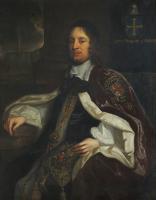
John Evelyn's Diary. 30th November 1662. St. Andrew's day. Invited by the Dean of Westminster (age 61) to his consecration dinner and ceremony, on his being made Bishop of Worcester. Dr. Bolton preached in the Abbey Church [Map]; then followed the consecration by the Bishops of London (age 64), Chichester (age 70), Winchester (age 64), Salisbury (age 70), etc. After this, was one of the most plentiful and magnificent dinners that in my life I ever saw; it cost near £600 as I was informed. Here were the judges, nobility, clergy, and gentlemen innumerable, this Bishop being universally beloved for his sweet and gentle disposition. He was author of those Characters which go under the name of Blount. He translated his late Majesty's (age 32) "Icon" into Latin, was Clerk of his Closet, Chaplain, Dean of Westminster, and yet a most humble, meek, and cheerful man, an excellent scholar, and rare preacher. I had the honor to be loved by him. He married me at Paris, during his Majesty's and the Church's exile. When I took leave of him, he brought me to the cloisters in his episcopal habit. I then went to prayers at Whitehall [Map], where I passed that evening.
Samuel Pepys' Diary. 30th November 1663. Anon he and I to the Temple [Map] and there parted, and I to my cozen Roger Pepys (age 46), whom I met going to his chamber; he was in haste, and to go out of town tomorrow. He tells me of a letter from my father which he will keep to read to me at his coming to town again. I perceive it is about my father's jealousys concerning my wife's doing ill offices with me against him only from the differences they had when she was there, which he very unwisely continues to have and troubles himself and friends about to speak to me in, as my Lord Sandwich (age 38), Mr. Moore, and my cozen Roger, which vexes me, but I must impute it to his age and care for my mother and Pall and so let it go.


Samuel Pepys' Diary. 30th November 1663. At White Hall we met the Duke (age 30) in the Matted Gallery, and there he discoursed with us; and by and by my Lord Sandwich (age 38) came and stood by, and talked; but it being St. Andrew's, and a collar-day, he went to the Chappell, and we parted.
Samuel Pepys' Diary. 30th November 1665. In the afternoon to the office, and there very late writing letters and then home, my wife and people sitting up for me, and after supper to bed. Great joy we have this week in the weekly Bill, it being come to 544 in all, and but 333 of the plague; so that we are encouraged to get to London soon as we can. And my father writes as great news of joy to them, that he saw Yorke's waggon go again this week to London, and was full of passengers; and tells me that my aunt Bell hath been dead of the plague these seven weeks.
William of Worcester's Chronicle of England
William of Worcester, born around 1415, and died around 1482 was secretary to John Fastolf, the renowned soldier of the Hundred Years War, during which time he collected documents, letters, and wrote a record of events. Following their return to England in 1440 William was witness to major events. Twice in his chronicle he uses the first person: 1. when writing about the murder of Thomas, 7th Baron Scales, in 1460, he writes '… and I saw him lying naked in the cemetery near the porch of the church of St. Mary Overie in Southwark …' and 2. describing King Edward IV's entry into London in 1461 he writes '… proclaimed that all the people themselves were to recognize and acknowledge Edward as king. I was present and heard this, and immediately went down with them into the city'. William’s Chronicle is rich in detail. It is the source of much information about the Wars of the Roses, including the term 'Diabolical Marriage' to describe the marriage of Queen Elizabeth Woodville’s brother John’s marriage to Katherine, Dowager Duchess of Norfolk, he aged twenty, she sixty-five or more, and the story about a paper crown being placed in mockery on the severed head of Richard, 3rd Duke of York.
Available at Amazon in eBook and Paperback format.
Samuel Pepys' Diary. 30th November 1667. Thence, paying our shot, 6s. apiece, I home, and there to the office and wrote my letters, and then home, my eyes very sore with yesterday's work, and so home and tried to make a piece by my eare and viall to "I wonder what the grave", &c., and so to supper and to bed, where frighted a good while and my wife again with noises, and my wife did rise twice, but I think it was Sir John Minnes's (age 68) people again late cleaning their house, for it was past I o'clock in the morning before we could fall to sleep, and so slept. But I perceive well what the care of money and treasure in a man's house is to a man that fears to lose it. My Lord Anglesey (age 53) told me this day that he did believe the House of Commons would, the next week, yield to the Lords; but, speaking with others this day, they conclude they will not, but that rather the King (age 37) will accommodate it by committing my Lord Clarendon (age 58) himself. I remember what Mr. Evelyn (age 47) said, that he did believe we should soon see ourselves fall into a Commonwealth again. Joseph Williamson I find mighty kind still, but close, not daring to say anything almost that touches upon news or state of affairs.


Samuel Pepys' Diary. 30th November 1667. Up, and to the office, where all the morning, and then by coach to Arundel House [Map], to the election of Officers for the next year; where I was near being chosen of the Council, but am glad I was not, for I could not have attended, though, above all things, I could wish it; and do take it as a mighty respect to have been named there. The company great, and the elections long, and then to Cary House, a house now of entertainment, next my Lord Ashly's (age 46); and there, where I have heretofore heard Common Prayer in the time of Dr. Mossum, we after two hours' stay, sitting at the table with our napkins open, had our dinners brought, but badly done. But here was good company. I choosing to sit next Dr. Wilkins (age 53), Sir George Ent, and others whom I value, there talked of several things. Among others Dr. Wilkins, talking of the universal speech, of which he hath a book coming out, did first inform me how man was certainly made for society, he being of all creatures the least armed for defence, and of all creatures in the world the young ones are not able to do anything to help themselves, nor can find the dug without being put to it, but would die if the mother did not help it; and, he says, were it not for speech man would be a very mean creature. Much of this good discourse we had. But here, above all, I was pleased to see the person who had his blood taken out. He speaks well, and did this day give the Society a relation thereof in Latin, saying that he finds himself much better since, and as a new man, but he is cracked a little in his head, though he speaks very reasonably, and very well. He had but 20s. for his suffering it, and is to have the same again tried upon him: the first sound man that ever had it tried on him in England, and but one that we hear of in France, which was a porter hired by the virtuosos. Here all the afternoon till within night. Then I took coach and to the Exchange [Map], where I was to meet my wife, but she was gone home, and so I to Westminster Hall [Map], and there took a turn or two, but meeting with nobody to discourse with, returned to Cary House, and there stayed and saw a pretty deception of the sight by a glass with water poured into it, with a stick standing up with three balls of wax upon it, one distant from the other. How these balls did seem double and disappear one after another, mighty pretty! Here Mr. Carcasse did come to me, and brought first Mr. Colwall, our Treasurer, and then Dr. Wilkins to engage me to be his friend, and himself asking forgiveness and desiring my friendship, saying that the Council have now ordered him to be free to return to the Office to be employed. I promised him my friendship, and am glad of this occasion, having desired it; for there is nobody's ill tongue that I fear like his, being a malicious and cunning bold fellow.


John Evelyn's Diary. 30th November 1673. On St. Andrew's day I first saw the new Duchess of York (age 15), and the Duchess of Modena, her mother (age 34).


John Evelyn's Diary. 30th November 1680. The signal day begun the trial (at which I was present) of my Lord Viscount Stafford (age 66), (for conspiring the death of the King (age 50), second son to my Lord Thomas Howard, Earl of Arundel and Surrey, Earl Marshal of England, and grandfather to the present Duke of Norfolk (age 52), whom I so well knew, and from which excellent person I received so many favors. It was likewise his birthday, The trial was in Westminster Hall [Map], before the King, Lords, and Commons, just in the same manner as, forty years past, the great and wise Earl of Strafford (there being but one letter differing their names) received his trial for pretended ill government in Ireland, in the very same place, this Lord Stafford's father being then High Steward. The place of sitting was now exalted some considerable height from the paved floor of the hall, with a stage of boards. The throne, woolsacks for the Judges, long forms for the Peers, chair for the Lord Steward, exactly ranged, as in the House of Lords. The sides on both hands scaffolded to the very roof for the members of the House of Commons. At the upper end, and on the right side of the King's state, was a box for his Majesty, and on the left others for the great ladies, and over head a gallery for ambassadors and public ministers. At the lower end, or entrance, was a bar, and place for the prisoner, the Lieutenant of the Tower of London, the ax-bearer and guards, my Lord Stafford's two daughters, the Marchioness of Winchester being one; there was likewise a box for my Lord to retire into. At the right hand, in another box, somewhat higher, stood the witnesses; at the left, the managers, in the name of the Commons of England, namely, Serjeant Maynard (age 76) (the great lawyer, the same who prosecuted the cause against the Earl of Strafford forty years before, being now near eighty years of age), Sir William Jones (age 49), late Attorney-General, Sir Francis Winnington (age 46), a famous pleader, and Mr. Treby, now Recorder of London, not appearing in their gowns as lawyers, but in their cloaks and swords, as representing the Commons of England: to these were joined Mr. Hampden, Dr. Sacheverell, Mr. Poule, Colonel Titus (age 57), Sir Thomas Lee (age 45), all gentlemen of quality, and noted parliamentary men. The first two days, in which were read the commission and impeachment, were but a tedious entrance into matter of fact, at which I was but little present. But, on Thursday, I was commodiously seated among the Commons, when the witnesses were sworn and examined. The principal witnesses were Mr. Oates (age 31) (who called himself Dr.), Mr. Dugdale (age 40), and Turberville (age 32). Oates swore that he delivered a commission to Viscount Stafford from the Pope, to be Paymaster-General to an army intended to be raised; Dugdale, that being at Lord Aston's, the prisoner dealt with him plainly to murder his Majesty; and Turberville, that at Paris he also proposed the same to him.

John Evelyn's Diary. 30th November 1681. Sir Christopher Wren (age 58) chosen President [of the Royal Society], Mr. Austine, Secretary, with Dr. Plot, the ingenious author of the "History of Oxfordshire". There was a most illustrious appearance.
On 30th November 1699 Bridget Sutton Duchess Rutland was born to Robert Sutton 2nd Baron Lexinton (age 37) and Margaret Hungerford Baroness Lexington. She married before 1718 John Manners 3rd Duke Rutland, son of John Manners 2nd Duke Rutland and Catherine Russell Duchess Rutland, and had issue.
On 30th November 1716 Stillborn Saxe Coburg Altenburg was born to Frederick Saxe Coburg Altenburg II Duke Saxe Gotha Altenburg (age 40) and Magdalena Augusta Anhalt-Zerbst Duchess Saxe Gotha Altenburg at Gotha.

On 30th November 1719 Augusta Saxe Coburg Altenburg was born to Frederick Saxe Coburg Altenburg II Duke Saxe Gotha Altenburg (age 43) and Magdalena Augusta Anhalt-Zerbst Duchess Saxe Gotha Altenburg at Gotha. She married 8th May 1736 her half fourth cousin once removed Frederick Louis Hanover Prince of Wales, son of King George II of Great Britain and Ireland and Caroline Hohenzollern Queen Consort England, and had issue.
On 30th November 1745 Henry Frederick Hanover 1st Duke Cumberland and Strathearn was christened at Leicester House.


On 30th November 1770 John Buckler was born at Calbourne, Isle of Wight.
On 30th November 1797 William Henry Lambton (age 33) died of consumption. He was buried at Old English Cemetery.
On 30th November 1804 Frederick Richard Say was born.
William of Worcester's Chronicle of England
William of Worcester, born around 1415, and died around 1482 was secretary to John Fastolf, the renowned soldier of the Hundred Years War, during which time he collected documents, letters, and wrote a record of events. Following their return to England in 1440 William was witness to major events. Twice in his chronicle he uses the first person: 1. when writing about the murder of Thomas, 7th Baron Scales, in 1460, he writes '… and I saw him lying naked in the cemetery near the porch of the church of St. Mary Overie in Southwark …' and 2. describing King Edward IV's entry into London in 1461 he writes '… proclaimed that all the people themselves were to recognize and acknowledge Edward as king. I was present and heard this, and immediately went down with them into the city'. William’s Chronicle is rich in detail. It is the source of much information about the Wars of the Roses, including the term 'Diabolical Marriage' to describe the marriage of Queen Elizabeth Woodville’s brother John’s marriage to Katherine, Dowager Duchess of Norfolk, he aged twenty, she sixty-five or more, and the story about a paper crown being placed in mockery on the severed head of Richard, 3rd Duke of York.
Available at Amazon in eBook and Paperback format.

On 22nd July 1824 Philip Hamond of High House in West Acre in Norfolk (age 42) died. On 30th November 1847 Anne Packe (age 47) died. Memorial in All Saints Church, West Acre [Map].
Philip Hamond of High House in West Acre in Norfolk: Around 1782 he was born to Anthony Hamond of High House in West Acre. On 1st March 1803 Philip Hamond of High House in West Acre in Norfolk and Anne Packe were married.
Anne Packe: Around 1777 she was born to Charles James Packe of Prestwold in Leicestershire.
On 30th November 1834 William Frederick Hanover 2nd Duke Gloucester and Edinburgh (age 58) died at Yattendon Castle [Map]. He was buried at St George's Chapel, Windsor Castle [Map]. Duke Gloucester and Edinburgh, Earl Connaught extinct.
On 30th November 1836 Frederick Charles Cavendish was born to William Cavendish 7th Duke Devonshire (age 28) and Blanche Georgiana Howard (age 24) at Compton Place Eastbourne. Coefficient of inbreeding 1.65%. He married 7th June 1864 his third cousin Lucy Caroline Lyttelton, daughter of George William Lyttelton 4th Baron Lyttelton and Mary Glynne Lady Lyttelton.


On 30th November 1846 Jean-André Rixens was born.
Thomas Bateman 1846. On November 30th, 1846, were opened two barrows near Middleton, upon the Calling Lowe Farm, which probably has acquired the denomination of "Lowe" from the presence of these two tumuli, doubtless once well known and venerated. The first barrow [Map] [Note. Calling Low Barrow 1 [Map]] is situate near the edge of the Lowe Dale, at the termination of a stony ridge, which has been taken advantage of in forming the shape of the tumulus, without the expenditure of much labour. The skeleton, with the knees drawn up lay on its right side, in an oblong cist, the extremities of which were respectively north-east and south-west, and which was constructed of flat limestones, arranged in a depression in the rock, about eighteen inches in depth, near the centre of the barrow; near the pelvis were two instruments of calcined flint, namely, a spear-head and a circular-ended instrument, and above the body lay the bones of a dog's hind leg, and a round ball of sandstone about two inches and a half in diameter. Many rats' bones accompanied this interment which, owing to its proximity to the surface, was very much decayed.
Thomas Bateman 1846. The other barrow [Map] [Note. Calling Low Barrow 2 [Map]] is a lowly sepulchre, not rising more than a foot above the surrounding field, and situated nearer the Yolgrave and Buxton road than the preceding one is. About two feet from the surface, in the centre, and consequently beneath the natural level, was a skeleton inclosed in a mass of stiff earth, which had almost effected the destruction of the bones; near the pelvis of this body a rude instrument of calcined flint was found; it was the only relic deposited with this interment, which had, undoubtedly, supplanted the rightful occupants of the tomb: this circumstance was proved by the discovery of the remains of two previous interments, which had been thrown on one side to make room for the intruder. These I relics comprised many pieces of two unbumt skeletons, parts of two highly-ornamented drinking-cups, and many bones of animals, amongst which the remains of rats were as usual most numerous.
On 30th November 1869 James Albert Edward Hamilton 3rd Duke of Abercorn was born to James Hamilton 2nd Duke of Abercorn (age 31) and Mary Anna Curzon Howe Duchess Abercorn (age 21) at Hamilton Place. He married 1st November 1894 his third cousin Rosalind Cecilia Caroline Bingham Duchess Abercorn, daughter of Charles George Bingham 4th Earl Lucan and Cecilia Catherine Gordon-Lennox Countess Lucan, and had issue.

On 30th November 1872 Herbert Andrew Montagu-Douglas-Scott was born to William Scott 6th Duke Buccleuch 8th Duke Queensberry (age 41) and Louisa Jane Hamilton Duchess Buccleuch and Queensbury (age 36). He married Marie Josephine Edwards.

30th November 1910. Bassano Ltd. Photograph of Victoria Marjorie Harriet Manners Marchioness Anglesey (age 26)

30th November 1910. Bassano Ltd. Photograph of Victoria Marjorie Harriet Manners Marchioness Anglesey (age 26)
On 8th February 1911 Frederick Archibald Vaughan Campbell 3rd Earl Cawdor (age 63) died. His son Hugh (age 41) succeeded 4th Earl Cawdor of Castlemartin in Pembrokeshire, 5th Baron Cawdor of Castlemartin in Pembrokeshire. Joan Emily Thynne Countess Cawdor (age 38) by marriage Countess Cawdor of Castlemartin in Pembrokeshire.
9th February 1911. Times Newspaper Obituaries. DEATH OF LORD CAWDOR. We record with much regret that Lord Cawdor died peacefully in his sleep at 5:45 yesterday morning, a few days before his 64th birthday. Baroness Cadogan (age 67) and the members of their family were present. He had keen ill for some time. We announced on November 30 that he was suffering from an attack of tonsilitis. Just before Christmns be caught a chill while recoveing from this attack, and had to enter a nursing home. Early in January his illness began to take a serious turn and since then, though he rallied wonderfully from time to time, he steadily lost strength. Royal Sympathy. The King and Queen Alexandra (age 66) have sent telegms expressing deep sympathy with the family.


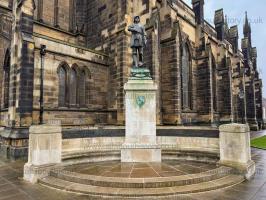
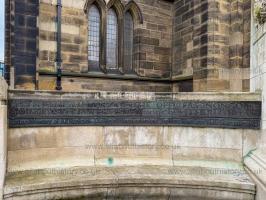
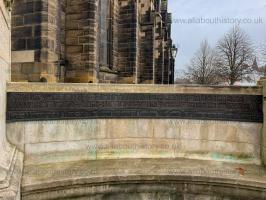
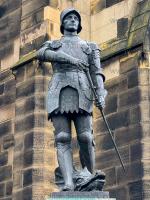
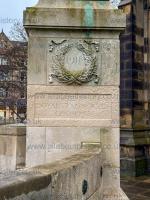
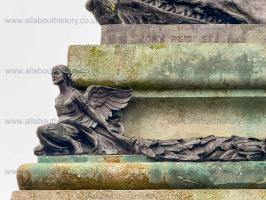
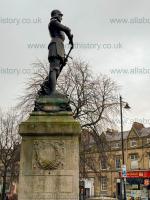
On 30th November 1924 the Northumberland Fusiliers and Royal Tank Regiment War Memorial, Newcastle upon Tyne [Map] was unveiled by the commanding officer of the Northumberland Fusiliers, Major General Sir Percival S. Wilson, and dedicated by the Rev Canon T E Crawhall, the memorial had been raised by public subscription at a cost of £3,000. The figure which represents St George slaying the dragon was designed by John W M Reid who at the time was Master of Sculpture at the nearby University of Durham's Armstrong College (now Newcastle University). The intricate detail found in the representation of St George's armour was researched by Reid during a visit to see examples of the period in the Tower of London. The sculptor of the figure was William Currie and the architects were Newcastle-based Cackett and Burns Dick. The memorial's figure is made from bronze, supported by a pedestal and screen of Portland Stone. The memorial commemorates the service of both the 6th (Territorial/City) Northumberland Fusiliers and the 43rd and 49th battalions of the Royal Tank Regiment. The latter was added after World War Two to mark an amalgamation in 1938 of the Northumberland Fusiliers with the Royal Tank Regiment. In 1938 the Fusiliers had changed from an infantry to an armoured role.
On 30th November 1935 Adrian Scott Stokes (age 80) died.
On 30th November 1991 Charles Gordon-Lennox 11th Duke of Richmond and Lennox 6th Duke of Gordon (age 36) and Janet Elizabeth Astor Duchess of Richmond and Gordon (age 29) were married. He the son of Charles Gordon-Lennox 10th Duke of Richmond and Lennox 5th Duke of Gordon (age 62).
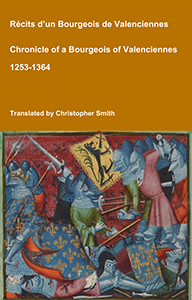
Chronicle of a Bourgeois of Valenciennes
Récits d’un bourgeois de Valenciennes aka The Chronicle of a Bourgeois of Valenciennes is a vivid 14th-century vernacular chronicle written by an anonymous urban chronicler from Valenciennes in the County of Hainaut. It survives in a manuscript that describes local and regional history from about 1253 to 1366, blending chronology, narrative episodes, and eyewitness-style accounts of political, military, and social events in medieval France, Flanders, and the Low Countries. The work begins with a chronological framework of events affecting Valenciennes and its region under rulers such as King Philip VI of France and the shifting allegiances of local nobility. It includes accounts of conflicts, sieges, diplomatic manoeuvres, and the impact of broader struggles like the Hundred Years’ War on urban life in Hainaut. Written from the perspective of a burgher (bourgeois) rather than a monastery or royal court, the chronicle offers a rare lay viewpoint on high politics and warfare, reflecting how merchants, townspeople, and civic institutions experienced the turbulence of the 13th and 14th centuries. Its narrative style combines straightforward reporting of events with moral and civic observations, making it a valuable source for readers interested in medieval urban society, regional politics, and the lived experience of war and governance in pre-modern Europe.
Available at Amazon in eBook and Paperback format.
On 30th November 1340 John Valois 1st Duke Berry was born to King John "The Good" II of France (age 21) and Bonne Luxemburg Queen Consort France (age 25) at Château de Vincennes. He married (1) before 1362 his third cousin Joanne Armagnac Duchess Berry, daughter of John I Count Armagnac and Beatrice Clermont Countess Armagnac, and had issue (2) 1389 Joan II Countess of Auvergne Duchess Berry, daughter of John II Count Auvergne and Aliénor de Comminges.
On 30th November 1347 Ivo Fitzwarin was born to William Fitzwarin (age 31). He was baptised at St Leonards Church, Blunsdon [Map]. His wardship was originally granted to Philippa of Hainaut Queen Consort England (age 33) but she sold it in the following year for 1100 marks. He married 20th January 1372 Maud Argentine and had issue.
On 30th November 1396 Richard Despencer 4th Baron Burghesh was born to Thomas Despencer 1st Earl Gloucester (age 23) and Constance York Countess Gloucester (age 22). He a great grandson of King Edward III of England. He married before 1414 his second cousin Eleanor Neville Countess Northumberland, daughter of Ralph Neville 1st Earl of Westmoreland and Joan Beaufort Countess of Westmoreland.
On 30th November 1569 John Dudley was born to Edward Sutton 4th Baron Dudley (age 44) and Katherine Brydges Baroness Dudley. He married before 1590 Elizabeth Whorwood.
On 30th November 1571 Thomas Delves 1st Baronet was born to Henry Delves.

On 30th November 1593 Isabel Seton was born to Robert Seton 1st Earl Winton (age 40) and Margaret Montgomerie Countess Winton. Coefficient of inbreeding 1.89%.
On 30th November 1594 Bishop John Cosins was born at Norwich, Norfolk [Map]. He married 15th August 1626 Frances Blakiston and had issue.
On 30th November 1614 William Howard 1st Viscount Stafford was born to Thomas Howard 14th or 21st Earl of Arundel 4th Earl of Surrey 1st Earl Norfolk (age 29) and Alethea Talbot Countess Arundel, Surrey and Norfolk (age 29). He married 11th October 1637 his half fourth cousin once removed Mary Stafford Countess Stafford and had issue.


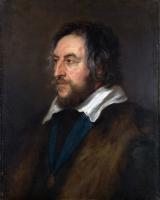

On 30th November 1638 Mary Calvert was born to Cecil Calvert 2nd Baron Baltimore (age 33) and Ann Arundell Baroness Baltimore (age 22).
On 30th November 1686 Richard Lumley 2nd Earl Scarborough was born to Richard, Baron Lumley, (age 36) and Frances Jones (age 19).


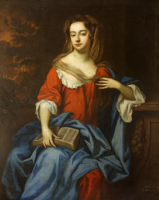
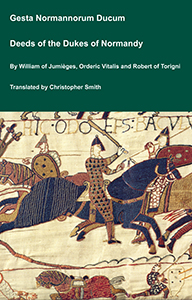
The Deeds of the Dukes of Normandy
The Gesta Normannorum Ducum [The Deeds of the Dukes of Normandy] is a landmark medieval chronicle tracing the rise and fall of the Norman dynasty from its early roots through the pivotal events surrounding the Norman Conquest of England. Originally penned in Latin by the monk William of Jumièges shortly before 1060 and later expanded at the behest of William the Conqueror, the work chronicles the deeds, politics, battles, and leadership of the Norman dukes, especially William’s own claim to the English throne. The narrative combines earlier historical sources with firsthand information and oral testimony to present an authoritative account of Normandy’s transformation from a Viking settlement into one of medieval Europe’s most powerful realms. William’s history emphasizes the legitimacy, military prowess, and governance of the Norman line, framing their expansion, including the conquest of England, as both divinely sanctioned and noble in purpose. Later chroniclers such as Orderic Vitalis and Robert of Torigni continued the history, extending the coverage into the 12th century, providing broader context on ducal rule and its impact. Today this classic work remains a foundational source for understanding Norman identity, medieval statesmanship, and the historical forces that reshaped England and Western Europe between 800AD and 1100AD.
Available at Amazon in eBook and Paperback format.
On 30th November 1697 Patrick Lindsay-Crawford 2nd Viscount Garnock was born to John Lindsay-Crawford 1st Viscount Garnock (age 28) and Margaret Stuart Viscountess Garnock (age 16).
On 30th November 1699 Bridget Sutton Duchess Rutland was born to Robert Sutton 2nd Baron Lexinton (age 37) and Margaret Hungerford Baroness Lexington. She married before 1718 John Manners 3rd Duke Rutland, son of John Manners 2nd Duke Rutland and Catherine Russell Duchess Rutland, and had issue.
On 30th November 1716 Stillborn Saxe Coburg Altenburg was born to Frederick Saxe Coburg Altenburg II Duke Saxe Gotha Altenburg (age 40) and Magdalena Augusta Anhalt-Zerbst Duchess Saxe Gotha Altenburg at Gotha.
On 30th November 1719 Augusta Saxe Coburg Altenburg was born to Frederick Saxe Coburg Altenburg II Duke Saxe Gotha Altenburg (age 43) and Magdalena Augusta Anhalt-Zerbst Duchess Saxe Gotha Altenburg at Gotha. She married 8th May 1736 her half fourth cousin once removed Frederick Louis Hanover Prince of Wales, son of King George II of Great Britain and Ireland and Caroline Hohenzollern Queen Consort England, and had issue.
On 30th November 1721 Bishop John Egerton was born to Bishop Henry Egerton (age 32) and Elizabeth Adriana Bentinck (age 18). He married 21st November 1748 his first cousin Anne Sophia Grey, daughter of Henry Grey 1st Duke Kent and Sophia Bentinck Duchess Kent, and had issue.
On 30th November 1738 Thomas Robinson 2nd Baron Grantham was born to Thomas Robinson 1st Baron Grantham (age 43) at Vienna [Map]. He married 1780 Mary Jemima Yorke Baroness Grantham, daughter of Philip Yorke 2nd Earl of Hardwicke and Jemima Campbell 2nd Marchioness Grey, and had issue.
On 30th November 1741 Thomas Gery Cullum 7th Baronet was born to John Cullum 5th Baronet (age 42) and Susanna Gery Lady Cullum.

On 30th November 1768 Louisa Kerr was born to William John Kerr 5th Marquess Lothian (age 31) and Elizabeth Fortescue 5th Marchioness Lothian (age 23).
On 30th November 1770 John Buckler was born at Calbourne, Isle of Wight.
On 30th November 1777 Harriett Peyton was born to Henry Dashwood aka Peyton 1st Baronet (age 41) and Frances Rous Lady Peyton. She married 8th October 1794 Thomas Kingscote and had issue.
Annals of the six Kings of England by Nicholas Trivet
Translation of the Annals of the Six Kings of England by that traces the rise and rule of the Angevin aka Plantagenet dynasty from the mid-12th to early 14th century. Written by the Dominican scholar Nicholas Trivet, the work offers a vivid account of English history from the reign of King Stephen through to the death of King Edward I, blending political narrative with moral reflection. Covering the reigns of six monarchs—from Stephen to Edward I—the chronicle explores royal authority, rebellion, war, and the shifting balance between crown, church, and nobility. Trivet provides detailed insight into defining moments such as baronial conflicts, Anglo-French rivalry, and the consolidation of royal power under Edward I, whose reign he describes with particular immediacy. The Annals combines careful year-by-year reporting with thoughtful interpretation, presenting history not merely as a sequence of events but as a moral and political lesson. Ideal for readers interested in medieval history, kingship, and the origins of the English state, this chronicle remains a valuable and accessible window into the turbulent world of the Plantagenet kings.
Available at Amazon in eBook and Paperback format.
On 30th November 1785 Arthur Annesley 10th Viscount Valentia was born to Arthur Annesley (age 25) and Catherine Hardy. He married 12th August 1808 Eleanor O'Brien.
On 30th November 1804 Frederick Richard Say was born.
On 30th November 1812 John Skeffington 10th Viscount Massereene, 3rd Viscount Ferrard was born to Thomas Henry Foster aka Skeffington 2nd Viscount Ferrard (age 40) and Harriet Skeffington 9th Viscountess Massereene (age 23). He married 1st August 1835 Olivia Grady Viscountess Massereene and had issue.
On 30th November 1816 Robert Barlow Palmer Byng was born to George Byng 6th Viscount Torrington (age 48) and Francis Harriet Barlow Viscountess Torrington (age 30).
On 30th November 1832 Hubert George Burgh 2nd Marquess Clanricarde was born to Ulick Burgh 1st Marquess Clanricarde (age 29) and Harriet Canning Marchioness Clanricarde (age 28).
On 30th November 1836 Frederick Charles Cavendish was born to William Cavendish 7th Duke Devonshire (age 28) and Blanche Georgiana Howard (age 24) at Compton Place Eastbourne. Coefficient of inbreeding 1.65%. He married 7th June 1864 his third cousin Lucy Caroline Lyttelton, daughter of George William Lyttelton 4th Baron Lyttelton and Mary Glynne Lady Lyttelton.
On 30th November 1846 Jean-André Rixens was born.
On 30th November 1869 James Albert Edward Hamilton 3rd Duke of Abercorn was born to James Hamilton 2nd Duke of Abercorn (age 31) and Mary Anna Curzon Howe Duchess Abercorn (age 21) at Hamilton Place. He married 1st November 1894 his third cousin Rosalind Cecilia Caroline Bingham Duchess Abercorn, daughter of Charles George Bingham 4th Earl Lucan and Cecilia Catherine Gordon-Lennox Countess Lucan, and had issue.
On 30th November 1872 Herbert Andrew Montagu-Douglas-Scott was born to William Scott 6th Duke Buccleuch 8th Duke Queensberry (age 41) and Louisa Jane Hamilton Duchess Buccleuch and Queensbury (age 36). He married Marie Josephine Edwards.
On 30th November 1873 William Henry Dudley Boyle 12th Earl Cork was born to Gerald Edmund Boyle (age 33). He married 24th June 1902 his fifth cousin Florence Cecilia Keppel Countess Cork, daughter of William Keppel 7th Earl Albermarle and Sophia Mary MacNab of Dundurn Castle.
The Deeds of the Dukes of Normandy
The Gesta Normannorum Ducum [The Deeds of the Dukes of Normandy] is a landmark medieval chronicle tracing the rise and fall of the Norman dynasty from its early roots through the pivotal events surrounding the Norman Conquest of England. Originally penned in Latin by the monk William of Jumièges shortly before 1060 and later expanded at the behest of William the Conqueror, the work chronicles the deeds, politics, battles, and leadership of the Norman dukes, especially William’s own claim to the English throne. The narrative combines earlier historical sources with firsthand information and oral testimony to present an authoritative account of Normandy’s transformation from a Viking settlement into one of medieval Europe’s most powerful realms. William’s history emphasizes the legitimacy, military prowess, and governance of the Norman line, framing their expansion, including the conquest of England, as both divinely sanctioned and noble in purpose. Later chroniclers such as Orderic Vitalis and Robert of Torigni continued the history, extending the coverage into the 12th century, providing broader context on ducal rule and its impact. Today this classic work remains a foundational source for understanding Norman identity, medieval statesmanship, and the historical forces that reshaped England and Western Europe between 800AD and 1100AD.
Available at Amazon in eBook and Paperback format.
On 30th November 1878 Arthur Russell 6th Baronet was born to George Russell 4th Baronet (age 50) and Constance Charlotte Lennox.
On 30th November 1891 Humphrey Edmund de Trafford 4th Baronet was born to Humphrey Francis de Trafford 3rd Baronet (age 29) and Violet Franklin Lady de Trafford. He married 2nd October 1917 Cynthia Hilda Evelyn Cadogan.
On 30th November 1904 Owen Watkin Williams-Wynn 10th Baronet was born to Watkin Williams-Wynn 9th Baronet (age 42) and Elizabeth Ida Lowther (age 29).
On 30th November 1938 John Simon Stracey 9th Baronet was born to Algernon Augustus Henry Stracey (age 65).
On 30th November 1950 William Parker 5th Baronet was born to William Parker 4th Baronet (age 34).
On 30th November 1219 Ferdinand III King Castile III King Leon (age 20) and Elisabeth Hohenstaufen Queen Consort Castile Queen Consort Leon (age 14) were married in Burgos [Map]. She by marriage Queen Consort Castile, Queen Consort Leon. She the daughter of Philip King Germany. He the son of Alfonso IX King Leon (age 48) and Berengaria Ivrea I Queen Castile (age 40). They were fourth cousins. He a great grandson of King Henry "Curtmantle" II of England.
On 30th November 1350 Miles Stapleton (age 30) and Joan Ightham Baroness Strange Knockin were married.
On 30th November 1417 Louis Wittelsbach III Elector Palatine (age 39) and Matilda of Savoy (age 27) were married. He the son of Rupert King Germany.
On 30th November 1424 Philip "Good" Valois III Duke Burgundy (age 28) and Bonne Artois Duchess Burgundy (age 28) were married. She by marriage Duchess Burgundy. She the daughter of Philip Artois Count of Eu and Marie Valois I Duchess Auverge (age 49). He the son of John "Fearless" Valois Duke Burgundy and Margaret Wittelsbach Duchess Burgundy. They were second cousins. He a great x 4 grandson of King Edward I of England. She a great x 4 granddaughter of King Henry III of England.
On 30th November 1523 Francis Talbot 5th Earl of Shrewsbury (age 23) and Mary Dacre (age 21) were married. He the son of George Talbot 4th Earl of Shrewsbury (age 55) and Anne Hastings Countess Shrewsbury and Waterford. They were half third cousins. He a great x 4 grandson of King Edward III of England. She a great x 5 granddaughter of King Edward III of England.
Jean de Waurin's Chronicle of England Volume 6 Books 3-6: The Wars of the Roses
Jean de Waurin was a French Chronicler, from the Artois region, who was born around 1400, and died around 1474. Waurin’s Chronicle of England, Volume 6, covering the period 1450 to 1471, from which we have selected and translated Chapters relating to the Wars of the Roses, provides a vivid, original, contemporary description of key events some of which he witnessed first-hand, some of which he was told by the key people involved with whom Waurin had a personal relationship.
Available at Amazon in eBook and Paperback format.
On 30th November 1587 Thomas Erskine 1st Earl Kellie (age 21) and Ann Ogilvy were married.

On 30th November 1639 George Booth 1st Baron Delamer (age 16) and Catherine Clinton were married. She the daughter of Theophilus Clinton 4th Earl Lincoln (age 39) and Bridget Fiennes Countess Lincoln.
On 30th November 1694 Gilbert Coventry 4th Earl Coventry (age 26) and Dorothy Keyt (age 23) were married. He the son of Thomas Coventry 1st Earl Coventry (age 65) and Winifred Edgecumbe.
On 30th November 1721 Cecil Wray 11th Baronet (age 43) and Joanna Taylor Lady Wray were married at St Martin in the Fields Church [Map]. She by marriage Lady Wray of Glentworth in Lincolnshire.
On 30th November 1769 Admiral Richard King 1st Baronet (age 39) and Susanna Margaretta Coker (age 24) were married at Wimborne Minster, Dorset [Map].
On 30th November 1803 Richard King 2nd Baronet (age 29) and Sarah Anne Duckworth Lady King (age 19) were married. They had four sons and a daughter.
On 30th November 1811 Thomas Maynard Haselrigge 10th Baronet (age 83) and Letitia Wodehouse Lady Haselrigge (age 37) were married at Wymondham, Norfolk [Map]. The difference in their ages was 45 years.
On 30th November 1901 Dudley Marjoribanks 3rd Baron Tweedmouth (age 27) and Muriel Brodrick (age 20) were married at St George's Church, Hanover Square. She the daughter of William St John Brodrick 1st Earl of Midleton (age 44) and Hilda Charteris.
On 30th November 1940 Richard Hanbury-Tracy 6th Baron Sudeley (age 29) and Elizabeth Mary Bromley (age 21) were married.
On 30th November 1940 Esme Ivo Bligh 9th Earl of Darnley (age 54) and Rosemary Potter Countess Darnley (age 24) were married. She by marriage Countess Darnley. The difference in their ages was 29 years. He the son of Ivo Bligh 8th Earl Darnley and Florence Bligh Countess of Darnley (age 80).
On 30th November 1991 Charles Gordon-Lennox 11th Duke of Richmond and Lennox 6th Duke of Gordon (age 36) and Janet Elizabeth Astor Duchess of Richmond and Gordon (age 29) were married. He the son of Charles Gordon-Lennox 10th Duke of Richmond and Lennox 5th Duke of Gordon (age 62).
On 30th November 1016 King Edmund "Ironside" I of England (age 26) died. He was buried near his grandfather King Edgar I of England in Glastonbury Abbey [Map].
On 30th November 1335 David III Strathbogie 11th Earl Atholl (age 26) was killed during the Battle of Culblean. His son David (age 8) succeeded 12th Earl Atholl, 3rd Baron Strabolgi.
Whilst small the battle had a significant impact insofar as it brought an end to the campaign of King Edward III of England (age 23) also ending the aspirations to the Scottish throne of King Edward I of Scotland (age 52).
On 30th November 1447 Christopher Fleming 3rd Baron Slane (age 63) died. His grandson Christopher (age 13) succeeded 4th Baron Slane.
On 30th November 1654 Elizabeth Montagu Countess Lindsey died.
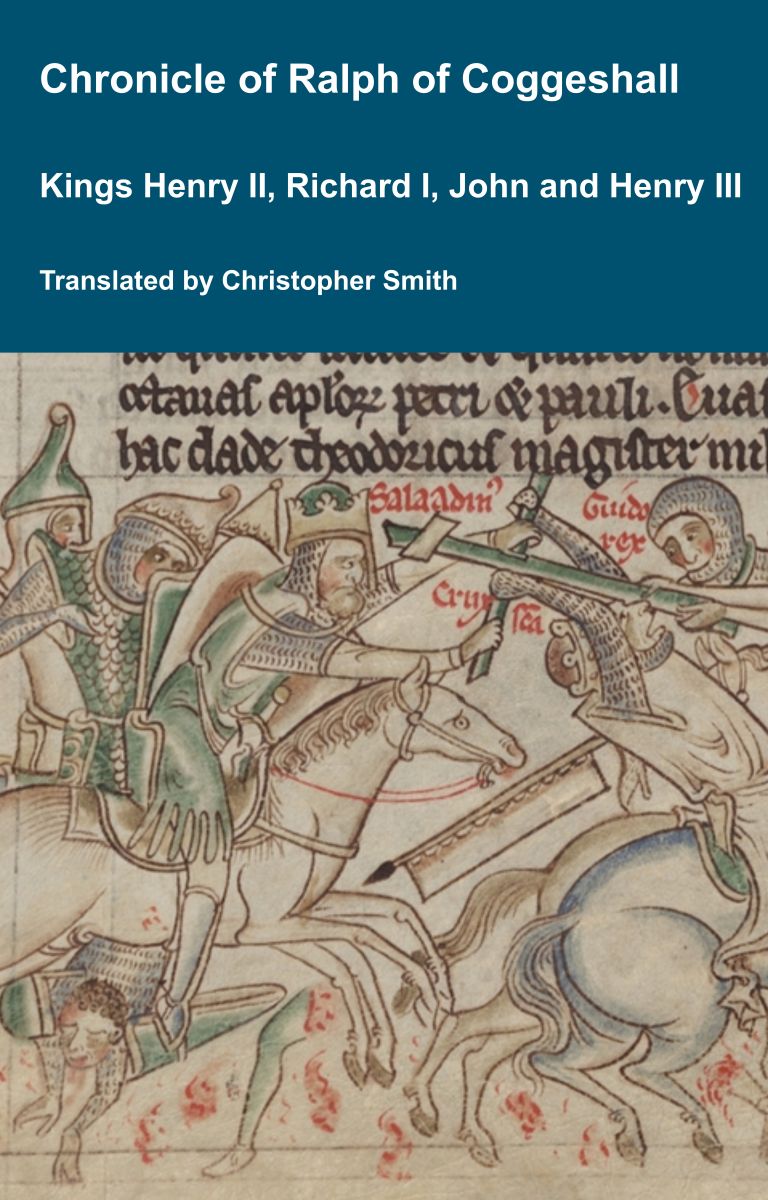
Chronicle of Abbot Ralph of Coggeshall
The Chronicle of Abbot Ralph of Coggeshall (Chronicon Anglicanum) is an indispensable medieval history that brings to life centuries of English and European affairs through the eyes of a learned Cistercian monk. Ralph of Coggeshall, abbot of the Abbey of Coggeshall in Essex in the early 13th century, continued and expanded his community’s chronicle, documenting events from the Norman Conquest of 1066 into the tumultuous reign of King Henry III. Blending eyewitness testimony, careful compilation, and the monastic commitment to record-keeping, this chronicle offers a rare narrative of political intrigue, royal power struggles, and social upheaval in England and beyond. Ralph’s work captures the reigns of pivotal figures such as Richard I and King John, providing invaluable insights into their characters, decisions, and the forces that shaped medieval rule. More than a simple annal, Chronicon Anglicanum conveys the texture of medieval life and governance, making it a rich source for scholars and readers fascinated by English history, monastic authorship, and the shaping of the medieval world.
Available at Amazon in eBook and Paperback format.
On 30th November 1657 Hugh Cholmley 1st Baronet (age 57) died. His son William (age 31) succeeded 2nd Baronet Cholmley of Whitby in Yorkshire. Katherine Savile Lady Cholmley by marriage Lady Cholmley of Whitby in Yorkshire.
On 30th November 1669 William Russell 1st Baronet (age 71) died. His son Francis (age 32) succeeded 2nd Baronet Russell of Wytley in Worcestershire. Francis Russell 2nd Baronet by marriage Baronet Russell of Wytley in Worcestershire.
On 30th November 1675 Cecil Calvert 2nd Baron Baltimore (age 70) died. His son Charles (age 38) succeeded 3rd Baron Baltimore of Longford in Leinster. Jane Lowe Baroness Baltimore (age 31) by marriage Baroness Baltimore of Longford in Leinster.

On 30th November 1692 John Stawell 2nd Baron Stawell (age 23) died. His half brother William (age 10) succeeded 3rd Baron Stawell of Somerton in Somerset.
On 30th November 1697 Thomas Crew 2nd Baron Crew (age 73) died. His brother Nathaniel (age 64) succeeded 3rd Baron Crew of Stene in Northamptonshire. Penelope Frowde Baroness Crewe by marriage Baroness Crew of Stene in Northamptonshire.


On 30th November 1702 William Keyt 2nd Baronet (age 63) died. His grandson William (age 14) succeeded 3rd Baronet Keyt of Ebrington in Gloucestershire.
On 30th November 1712 Henry Furnese 1st Baronet (age 54) died. His son Robert (age 25) succeeded 2nd Baronet Furnese of Waldershare in Kent.

On 30th November 1716 Dorothy Ferrers Countess Arran (age 61) died.
On 30th November 1749 Thomas Leigh 4th Baron Leigh (age 36) died. He was buried at the Church of the Virgin Mary, Stoneleigh [Map]. His son Edward (age 7) succeeded 5th Baron Leigh of Stoneleigh in Warwickshire, 6th Baronet Leigh of Stoneleigh in Warwickshire
On 30th November 1751 Anne Finch Countess Dartmouth died.
On 30th November 1755 Anna Maria Barnardiston Lady Shaw (age 58) died. She was buried at Church of Holy Trinity, Eltham on 10th December 1755.
On 30th November 1757 Edward Digby 6th Baron Digby (age 27) died. His brother Henry (age 26) succeeded 7th Baron Digby of Geashill in County Offaly.
On 30th November 1762 John Pakington 6th Baronet died. His brother Herbert succeeded 7th Baronet Pakington.

On 30th November 1767 John Cole 1st Baron Mountflorence (age 58) died. His son William (age 31) succeeded 2nd Baron Mountflorence of Florence Court in County Fermanagh.
Abbot John Whethamstede’s Chronicle of the Abbey of St Albans
Abbot John Whethamstede's Register aka Chronicle of his second term at the Abbey of St Albans, 1451-1461, is a remarkable text that describes his first-hand experience of the beginning of the Wars of the Roses including the First and Second Battles of St Albans, 1455 and 1461, respectively, their cause, and their consequences, not least on the Abbey itself. His text also includes Loveday, Blore Heath, Northampton, the Act of Accord, Wakefield, and Towton, and ends with the Coronation of King Edward IV. In addition to the events of the Wars of the Roses, Abbot John, or his scribes who wrote the Chronicle, include details in the life of the Abbey such as charters, letters, land exchanges, visits by legates, and disputes, which provide a rich insight into the day-to-day life of the Abbey, and the challenges faced by its Abbot.
Available at Amazon in eBook and Paperback format.
On 30th November 1775 Thomas Kennedy 9th Earl Cassilis died without male issue. His brother David (age 41) succeeded 10th Earl Cassilis, 5th Baronet Kennedy of Culzean in Ayrshire.
On 22nd November 1777 John West 2nd Earl De La Warr (age 48) died at Audley Square. On 30th November 1777 he was buried at St Margaret's Church, Westminster [Map]. His son William (age 20) succeeded 3rd Earl De La Warr, 3rd Viscount Cantalupe, 9th Baron De La Warr.
On 30th November 1799 John de la Pole 6th Baronet (age 42) died. His son William (age 17) succeeded 7th Baronet Pole of Shute House in Devon.
On 30th November 1800 Matthew Robinson 2nd Baron Rokeby (age 87) died. His nephew Morris (age 43) succeeded 3rd Baron Rokeby.
On 30th November 1834 William Frederick Hanover 2nd Duke Gloucester and Edinburgh (age 58) died at Yattendon Castle [Map]. He was buried at St George's Chapel, Windsor Castle [Map]. Duke Gloucester and Edinburgh, Earl Connaught extinct.
On 30th November 1855 Elizabeth Burdett Lady Langham died.
On 30th November 1872 Edward St Aubyn 1st Baronet (age 73) died. His son John (age 43) succeeded 2nd Baronet St Aubyn of St Michael's Mount in Cornwall. Elizabeth Clementina Townshend Baroness St Levan by marriage Lady St Aubyn of St Michael's Mount in Cornwall.
On 30th November 1879 Theobald Dominick Dillon 15th Viscount Dillon (age 68) died. His brother Arthur (age 67) succeeded 16th Viscount Dillon of Costello Gallen in Mayo.
On 18th or 30th November 1897 Dudley Wilmot Carleton 4th Baron Dorchester (age 75) died. Baron Dorchester of Dorchester in Oxfordshire extinct.
On 30th November 1899 Peniston Milbanke 9th Baronet (age 52) died. His son John (age 27) succeeded 10th Baronet Milbanke of Halnaby in Yorkshire.
On 30th November 1901 William Bateman-Hanbury 2nd Baron Bateman (age 75) died. His son William (age 45) succeeded 3rd Baron Bateman of Shobdon.
Jean de Waurin's Chronicle of England Volume 6 Books 3-6: The Wars of the Roses
Jean de Waurin was a French Chronicler, from the Artois region, who was born around 1400, and died around 1474. Waurin’s Chronicle of England, Volume 6, covering the period 1450 to 1471, from which we have selected and translated Chapters relating to the Wars of the Roses, provides a vivid, original, contemporary description of key events some of which he witnessed first-hand, some of which he was told by the key people involved with whom Waurin had a personal relationship.
Available at Amazon in eBook and Paperback format.
On 8th February 1911 Frederick Archibald Vaughan Campbell 3rd Earl Cawdor (age 63) died. His son Hugh (age 41) succeeded 4th Earl Cawdor of Castlemartin in Pembrokeshire, 5th Baron Cawdor of Castlemartin in Pembrokeshire. Joan Emily Thynne Countess Cawdor (age 38) by marriage Countess Cawdor of Castlemartin in Pembrokeshire.
9th February 1911. Times Newspaper Obituaries. DEATH OF LORD CAWDOR. We record with much regret that Lord Cawdor died peacefully in his sleep at 5:45 yesterday morning, a few days before his 64th birthday. Baroness Cadogan (age 67) and the members of their family were present. He had keen ill for some time. We announced on November 30 that he was suffering from an attack of tonsilitis. Just before Christmns be caught a chill while recoveing from this attack, and had to enter a nursing home. Early in January his illness began to take a serious turn and since then, though he rallied wonderfully from time to time, he steadily lost strength. Royal Sympathy. The King and Queen Alexandra (age 66) have sent telegms expressing deep sympathy with the family.
On 30th November 1917 William Lewis Salusbury-Trelawny 10th Baronet (age 73) died. His son John (age 48) succeeded 11th Baronet Salusbury-Trelawny of Trelawny in Cornwall. Catherine Penelope Cave-Browne-Cave Lady Salusbury-Trelawny by marriage Lady Salusbury-Trelawny of Trelawny in Cornwall.
On 30th November 1924 William Smith-Marriott 5th Baronet (age 89) died. His son William (age 54) succeeded 6th Baronet Smith of Sydling St Nicholas.
On 30th November 1935 Adrian Scott Stokes (age 80) died.

On 30th November 1945 Alice Mankiewicz Baroness Ludlow died.
On 30th November 1948 George Bowyer 1st Baron Denham (age 62) died. His son Bertram (age 21) succeeded 2nd Baron Denham of Weston Underwood in Buckinghamshire.
On 30th November 1957 Enid Edith Wilson Countess Chesterfield (age 79) died.


On 30th November 1966 Katharine Agnes Parr Lady Croft (age 88) died.
On 30th November 1979 Lieutenant-Colonel Michael Eric Dillon 20th Viscount Dillon (age 68) died. His son Charles (age 34) succeeded 21st Viscount Dillon of Costello Gallen in Mayo.
On 30th November 1991 Major Robert Jocelyn Palmer Baron Lucas (age 72) died.
Chronicle of Walter of Guisborough
A canon regular of the Augustinian Guisborough Priory, Yorkshire, formerly known as The Chronicle of Walter of Hemingburgh, describes the period from 1066 to 1346. Before 1274 the Chronicle is based on other works. Thereafter, the Chronicle is original, and a remarkable source for the events of the time. This book provides a translation of the Chronicle from that date. The Latin source for our translation is the 1849 work edited by Hans Claude Hamilton. Hamilton, in his preface, says: 'In the present work we behold perhaps one of the finest samples of our early chronicles, both as regards the value of the events recorded, and the correctness with which they are detailed; Nor will the pleasing style of composition be lightly passed over by those capable of seeing reflected from it the tokens of a vigorous and cultivated mind, and a favourable specimen of the learning and taste of the age in which it was framed.'
Available at Amazon in eBook and Paperback format.
On 30th November 1993 Wogan Philips 2nd Baron Milford (age 91) died. His son Hugo succeeded 3rd Baron Milford, 3rd Baronet Philips of Llanstephan Radnorshire.
On 30th November 1999 Hugo Philipps 3rd Baron Milford died. His son Guy (age 38) succeeded 4th Baron Milford, 4th Baronet Philips of Llanstephan Radnorshire.