


Anne Boleyn. Her Life as told by Lancelot de Carle's 1536 Letter.
In 1536, two weeks after the execution of Anne Boleyn, her brother George and four others, Lancelot du Carle, wrote an extraordinary letter that described Anne's life, and her trial and execution, to which he was a witness. This book presents a new translation of that letter, with additional material from other contemporary sources such as Letters, Hall's and Wriothesley's Chronicles, the pamphlets of Wynkyn the Worde, the Memorial of George Constantyne, the Portuguese Letter and the Baga de Secrets, all of which are provided in Appendices.
Available at Amazon in eBook and Paperback format.
Chevron is in Charges.
See: Chevron Argent, Chevron Engrailed, Chevron Ermine, Chevron Gules, Chevron Or, Chevron Sable, Chevrons.
Chevron. A v-shape, pointing upwards unless specified inverted.
 Monck Arms. Gules, a chevron between three lion's heads erased argent. Source.
 Berkeley Arms. Gules a chevron between ten crosses pattee six in chief and four in base argent.
 Mordaunt Arms. Argent, a chevron between three estoiles sable. Source.
 Chicheley Arms. Or, a chevron between three cinquefoils gules. Source.
 Mosley Arms. Sable a chevron between three pickaxes argent. Source.
 Finch Arms. Argent, a chevron between three griffins passant sable. Source.
 Ponsonby Arms. Gules, a chevron between three combs argent. Source.
Chronicle of Walter of Guisborough
A canon regular of the Augustinian Guisborough Priory, Yorkshire, formerly known as The Chronicle of Walter of Hemingburgh, describes the period from 1066 to 1346. Before 1274 the Chronicle is based on other works. Thereafter, the Chronicle is original, and a remarkable source for the events of the time. This book provides a translation of the Chronicle from that date. The Latin source for our translation is the 1849 work edited by Hans Claude Hamilton. Hamilton, in his preface, says: 'In the present work we behold perhaps one of the finest samples of our early chronicles, both as regards the value of the events recorded, and the correctness with which they are detailed; Nor will the pleasing style of composition be lightly passed over by those capable of seeing reflected from it the tokens of a vigorous and cultivated mind, and a favourable specimen of the learning and taste of the age in which it was framed.'
Available at Amazon in eBook and Paperback format.
 Rich Arms. Gules, a chevron between three crosses botonée or. Source.
 Lyttleton Arms. Argent, a chevron between three escallops sable. Source.
 Robinson Arms. Vert, a chevron between three bucks at gaze or. Source.
 Braye Arms. Argent, a chevron between three eagle's legs erased sable. Source.
 Tilney Arms. Azure, a chevron between three griffin's heads erased or. Source.
 Mansel Arms. Argent, a chevron between three maunches. Source.
 Fanshawe Arms. Or a chevron between three fleur de lys sable. Source.
 Littleton Arms. Argent, a chevron between three escallops sable. Source.
 Trefusis Arms. Argent, a chevron between three spindles sable. Source.
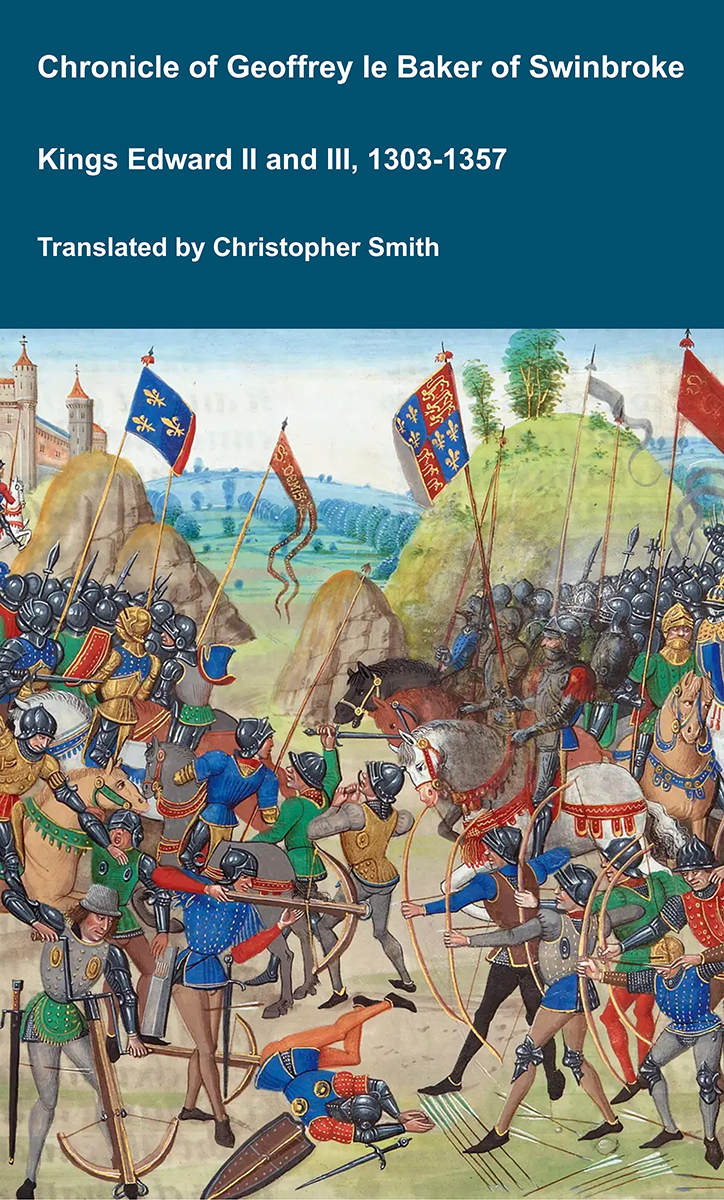
Chronicle of Geoffrey le Baker of Swinbroke
Baker was a secular clerk from Swinbroke, now Swinbrook, an Oxfordshire village two miles east of Burford. His Chronicle describes the events of the period 1303-1356: Gaveston, Bannockburn, Boroughbridge, the murder of King Edward II, the Scottish Wars, Sluys, Crécy, the Black Death, Winchelsea and Poitiers. To quote Herbert Bruce 'it possesses a vigorous and characteristic style, and its value for particular events between 1303 and 1356 has been recognised by its editor and by subsequent writers'. The book provides remarkable detail about the events it describes. Baker's text has been augmented with hundreds of notes, including extracts from other contemporary chronicles, such as the Annales Londonienses, Annales Paulini, Murimuth, Lanercost, Avesbury, Guisborough and Froissart to enrich the reader's understanding. The translation takes as its source the 'Chronicon Galfridi le Baker de Swynebroke' published in 1889, edited by Edward Maunde Thompson.
Available at Amazon in eBook and Paperback format.
 Wyndham Arms. Azure, a chevron between three lion's heads erased or.
 Fox Arms. Ermine, on a chevron azure three fox's heads and necks erased or on a canton of the second a fleur de lys of the third. The canton is an augmentation of honour to his paternal arms, granted out of the Royal Arms as a mark of esteem to him and his heirs forever, by King Charles II following the Restoration of the Monarchy. Source.



 Brooke Arms. Gules, on a chevron argent a lion rampant sable crowned or. Source.
 Carr Arms. Gules, on a chevron argent, three mullets, of the field.
 Knollys Arms. Gules, on a chevron argent, three roses gules, barbed and seeded proper. Source.
 Loftus Arms. Sable, a chevron engrailed ermine, between three trefoils slipped argent. Source.
 Child Villiers Arms. Quarterly 1&4
  Villiers Arms and 2&3 Child Arms gules a chevron engrailed ermine between three eaglets argent gorged or. Source.
 Watson Arms. Argent, on a chevron engrailed azure between three martlets sable as many crescents or. Source.
 Baron Annaly Arms. Argent, on a chevron engrailed gules, between three roses of the last, a cross crosslet or. Source.
 Beaumont Arms. Chequy or and azure a chevron ermine. Source.
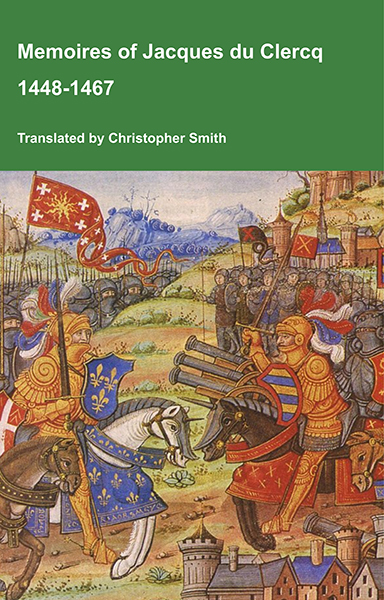
This is a translation of the 'Memoires of Jacques du Clercq', published in 1823 in two volumes, edited by Frederic, Baron de Reissenberg. In his introduction Reissenberg writes: 'Jacques du Clercq tells us that he was born in 1424, and that he was a licentiate in law and a counsellor to Philip the Good, Duke of Burgundy, in the castellany of Douai, Lille, and Orchies. It appears that he established his residence at Arras. In 1446, he married the daughter of Baldwin de la Lacherie, a gentleman who lived in Lille. We read in the fifth book of his Memoirs that his father, also named Jacques du Clercq, had married a lady of the Le Camelin family, from Compiègne. His ancestors, always attached to the counts of Flanders, had constantly served them, whether in their councils or in their armies.' The Memoires cover a period of nineteen years beginning in in 1448, ending in in 1467. It appears that the author had intended to extend the Memoirs beyond that date; no doubt illness or death prevented him from carrying out this plan. As Reissenberg writes the 'merit of this work lies in the simplicity of its narrative, in its tone of good faith, and in a certain air of frankness which naturally wins the reader’s confidence.' Du Clercq ranges from events of national and international importance, including events of the Wars of the Roses in England, to simple, everyday local events such as marriages, robberies, murders, trials and deaths, including that of his own father in Book 5; one of his last entries.
Available at Amazon in eBook and Paperback format.
 Blennerhassett Arms. Gules, a chevron ermine, between three dolphins naiant embowed argent. Source.
 Clotworthy Arms. Azure, a chevron ermine between three chaplets or. Source.
 Gresham Arms. Argent, a chevron ermine between three mullets pierced sable.
 Townshend Arms. Azure, a chevron ermine between three escallops argent. Source.
 Turner Baronets Arms. Sable, a chevron ermine between three fers de moline or on a chief argent a lion passant gules. Source.
 Tuchet Arms. Ermine, a chevron gules. Source.
 Brudenell Arms. Argent, a chevron gules between three morion caps azure pointed to the sinister. Source.
 Boleyn Arms. Argent, a chevron gules between three bull's heads afrontée. Source.
 Gorges Arms. Lozengy or and azure, a chevron gules. Source.
Chronicle of Walter of Guisborough
A canon regular of the Augustinian Guisborough Priory, Yorkshire, formerly known as The Chronicle of Walter of Hemingburgh, describes the period from 1066 to 1346. Before 1274 the Chronicle is based on other works. Thereafter, the Chronicle is original, and a remarkable source for the events of the time. This book provides a translation of the Chronicle from that date. The Latin source for our translation is the 1849 work edited by Hans Claude Hamilton. Hamilton, in his preface, says: 'In the present work we behold perhaps one of the finest samples of our early chronicles, both as regards the value of the events recorded, and the correctness with which they are detailed; Nor will the pleasing style of composition be lightly passed over by those capable of seeing reflected from it the tokens of a vigorous and cultivated mind, and a favourable specimen of the learning and taste of the age in which it was framed.'
Available at Amazon in eBook and Paperback format.
 Newport Arms. Argent, a chevron gules between three leopard's faces sable. Source.
 Stafford Arms. Or, a chevron gules.
 Belasyse Arms. Argent a chevron gules between three fleur de lys azure. Source.
 Barkham Arms. Paly argent and gules a chevron or.
 Cobham Arms. Gules a chevron or three lions rampant sable. Source.
 Danvers Arms. Gules a chevron or three estoiles. Source.
 Wentworth Arms. Sable, a chevron or three leopard's faces or. Source.
 Wodehouse Arms. Sable a chevron or between three cinquefoils. Source.
 Wodehouse Augmented Arms. Wodehouse Arms augmented with a chevron or guttée de sang. The Wodehouse arms were augmented after the Battle of Agincourt. Source.
 Clare Arms. Or three chevrons gules. Source.
 Fitzhugh Arms. Azure, three chevrons interlaced in base or a chief of the last. Source.
Chronicle of Walter of Guisborough
A canon regular of the Augustinian Guisborough Priory, Yorkshire, formerly known as The Chronicle of Walter of Hemingburgh, describes the period from 1066 to 1346. Before 1274 the Chronicle is based on other works. Thereafter, the Chronicle is original, and a remarkable source for the events of the time. This book provides a translation of the Chronicle from that date. The Latin source for our translation is the 1849 work edited by Hans Claude Hamilton. Hamilton, in his preface, says: 'In the present work we behold perhaps one of the finest samples of our early chronicles, both as regards the value of the events recorded, and the correctness with which they are detailed; Nor will the pleasing style of composition be lightly passed over by those capable of seeing reflected from it the tokens of a vigorous and cultivated mind, and a favourable specimen of the learning and taste of the age in which it was framed.'
Available at Amazon in eBook and Paperback format.
 Hainault Arms. Or, three chevrons sable. Source.

Around 1577 George Gower (age 37). Portrait of Richard Drake (age 42). The heraldic escutcheon shows seven quarters as follows:
1:  Drake of Ash Arms. Drake of Ash in the parish of Musbury, Devon.
2: Argent, on a chief gules three cinquefoils of the first; Billet of Ash.
3: Gules, on a fess argent two mullets sable; Hamton of Rockbere and Ash.
4: Ermine, on a chief indented sable three crosslets fitchee or; Orwey of Orwey and Ash.
5: Barry of seven argent and sable.
6: Azure, six lions rampant argent crowned Gules, 3, 2, 1; Forde of Forde.
7: Argent, two chevrons sable (Esse/Ash of Ash); Esse or Ash of Ash.
 Daubeney Arms. Or, two chevrons gules three griffin's heads. Source.
 Fitzwalter Arms. Or, a fess gules between two chevrons of the last. Source.
 Lisle Arms. Or a fess between two chevrons sable. Source.
 Walpole Arms. Or a fess between two chevrons sable three cross crosslets of the field. Source.


_Arms.png)


.svg)


.png)


#/media/File:Blason_Louise_d'Abos.svg)


.svg)

.svg)
