


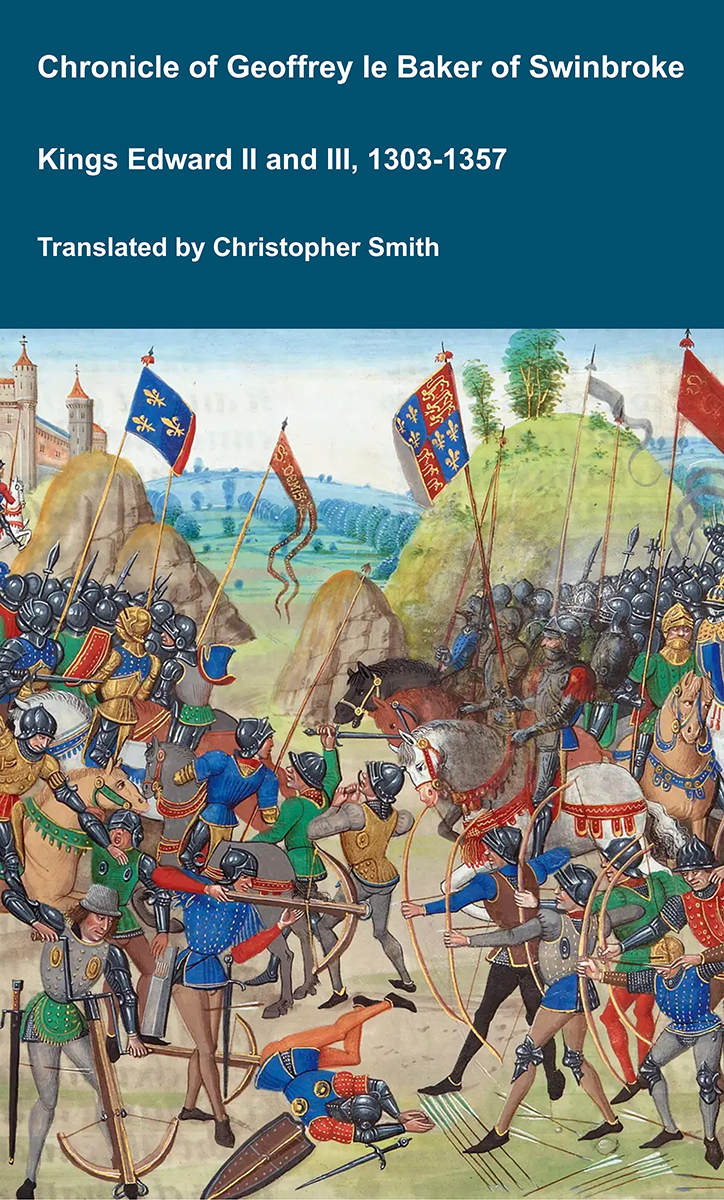
Chronicle of Geoffrey le Baker of Swinbroke
Baker was a secular clerk from Swinbroke, now Swinbrook, an Oxfordshire village two miles east of Burford. His Chronicle describes the events of the period 1303-1356: Gaveston, Bannockburn, Boroughbridge, the murder of King Edward II, the Scottish Wars, Sluys, Crécy, the Black Death, Winchelsea and Poitiers. To quote Herbert Bruce 'it possesses a vigorous and characteristic style, and its value for particular events between 1303 and 1356 has been recognised by its editor and by subsequent writers'. The book provides remarkable detail about the events it describes. Baker's text has been augmented with hundreds of notes, including extracts from other contemporary chronicles, such as the Annales Londonienses, Annales Paulini, Murimuth, Lanercost, Avesbury, Guisborough and Froissart to enrich the reader's understanding. The translation takes as its source the 'Chronicon Galfridi le Baker de Swynebroke' published in 1889, edited by Edward Maunde Thompson.
Available at Amazon in eBook and Paperback format.
Anglo-Saxon Chronicle. 1009. This year were the ships ready, that we before spoke about; and there were so many of them as never were in England before, in any king (age 43) days, as books tell us. And they were all transported together to Sandwich, Kent [Map]; that they should lie there, and defend this land against any out-force. But we have not yet had the prosperity and the honour, that the naval armament should be useful to this land, any more than it often before was. It was at this same time, or a little earlier, that Brihtric, brother of Earldorman Eadric Streona, betrayed Wulnoth, the South-Saxon knight, father of Earl Godwin (age 8), to the king; and he went into exile, and enticed the navy, till he had with him twenty ships; with which he plundered everywhere by the south coast, and wrought every kind of mischief. When it was told the navy that they might easily seize him, if they would look about them, then took Brihtric with him eighty ships; and thought that he should acquire for himself much reputation, by getting Wulnoth into his hands alive or dead. But, whilst they were proceeding thitherward, there came such a wind against them, as no man remembered before; which beat and tossed the ships, and drove them aground; whereupon Wulnoth soon came, and burned them. When this was known to the remaining ships, where the king was, how the others fared, it was then as if all were lost. The king went home, with the aldermen and the nobility; and thus lightly did they forsake the ships; whilst the men that were in them rowed them back to London. Thus lightly did they suffer the labour of all the people to be in vain; nor was the terror lessened, as all England hoped. When this naval expedition was thus ended, then came, soon after Lammas, the formidable army of the enemy, called Thurkill's army, to Sandwich, Kent [Map]; and soon they bent their march to Canterbury, Kent [Map]; which city they would quickly have stormed, had they not rather desired peace; and all the men of East-Kent made peace with the army, and gave them 3,000 pounds for security. The army soon after that went about till they came to the Isle of Wight; and everywhere in Sussex, and in Hampshire, and also in Berkshire, they plundered and burned, as THEIR CUSTOM IS.54 Then ordered the king to summon out all the population, that men might hold firm against them on every side; but nevertheless they marched as they pleased. On one occasion the king had begun his march before them, as they proceeded to their ships, and all the people were ready to fall upon them; but the plan was then frustrated through Earldorman Eadric Streona, AS IT EVER IS STILL. Then after Martinmas they went back again to Kent, and chose their winter-quarters on the Thames; obtaining their provisions from Essex, and from the shires that were next, on both sides of the Thames. And oft they fought against the city of London; but glory be to God, that it yet standeth firm: and they ever there met with ill fare. Then after midwinter took they an excursion up through Chiltern55, and so to Oxford, Oxfordshire [Map]; which city they burned, and plundered on both sides of the Thames to their ships. Being fore-warned that there was an army gathered against them at London, they went over at Staines; and thus were they in motion all the winter, and in spring, appeared again in Kent, and repaired their ships.
Note 54. These expressions in the present tense afford a strong proof that the original records of these transactions are nearly coeval with the transactions themselves. Later MSS. use the past tense.
Note 55. i.e. the Chiltern Hills; from which the south-eastern part of Oxfordshire is called the Chiltern district.
 Become a Member via our Buy Me a Coffee page to read more.
Anglo-Saxon Chronicle. 1013. The year after that Archbishop Elfeah was martyred, the king (age 47) appointed Lifing to the archiepiscopal see of Canterbury. And in the same year, before the month August, came King Sweyne (age 53) with his fleet to Sandwich, Kent [Map]; and very soon went about East-Anglia into the Humber-mouth, and so upward along the Trent, until he came to Gainsborough [Map]. Then soon submitted to him Earl Utred, and all the Northumbrians, and all the people of Lindsey, and afterwards the people of the Five Boroughs, and soon after all the army to the north of Watling-street; and hostages were given him from each shire. When he understood that all the people were subject to him, then ordered he that his army should have provision and horses; and he then went southward with his main army, committing his ships and the hostages to his son Knute (age 18). And after he came over Watling-street, they wrought the greatest mischief that any army could do. Then he went to Oxford, Oxfordshire [Map]; and the population soon submitted, and gave hostages; thence to Winchester, where they did the same. Thence went they eastward to London; and many of the party sunk in the Thames, because they kept not to any bridge. When he came to the city, the population would not submit; but held their ground in full fight against him, because therein was King Ethelred, and Thurkill with him. Then went King Sweyne thence to Wallingford; and so over Thames westward to Bath, where he abode with his army. Thither came Alderman Ethelmar, and all the western thanes with him, and all submitted to Sweyne, and gave hostages. When he had thus settled all, then went he northward to his ships; and all the population fully received him, and considered him full king. The population of London also after this submitted to him, and gave hostages; because they dreaded that he would undo them. Then bade Sweyne full tribute and forage for his army during the winter; and Thurkill bade the same for the army that lay at Greenwich, Kent [Map]: besides this, they plundered as oft as they would. And when this nation could neither resist in the south nor in the north, King Ethelred abode some while with the fleet that lay in the Thames; and the lady (age 28)57 went afterwards over sea to her brother Richard (age 49), accompanied by Elfsy, Abbot of Peterborough. The king sent Bishop Elfun with the ethelings, Edward (age 10) and Alfred (age 8), over sea; that he might instruct them. Then went the king from the fleet, about midwinter, to the Isle of Wight [Map]; and there abode for the season; after which he went over sea to Richard, with whom he abode till the time when Sweyne died. Whilst the lady was with her brother beyond sea, Elfsy, Abbot of Peterborough, who was there with her, went to the abbey called Boneval, where St. Florentine's body lay; and there found a miserable place, a miserable abbot, and miserable monks: because they had been plundered. There he bought of the abbot, and of the monks, the body of St. Florentine, all but the head, for 500 pounds; which, on his return home, he offered to Christ and St. Peter.
Note 57. This was a title bestowed on the queen.
Become a Member via our Buy Me a Coffee page to read more.
Economium Emmae Reginae. The Translation of the Body of Sweyn (deceased) into Denmark. Meanwhile, one of the noble women of England had a ship made ready for herself; and taking with her the body of King Sweyn, which had been buried in that land, she had it embalmed with spices and wrapped in rich cloths, and set out upon the sea. With a favorable voyage she reached the harbours of the Danes, and sent messengers to both brothers, announcing that the body of their father was come, and bidding them hasten to receive it and place it in the tomb he had prepared for himself. They came joyfully, received the body with honour, and with even greater honour laid it in the monastery built by the same king in honour of the Holy Trinity, in the sepulchre which he had made ready for his own burial. When this was accomplished, and now with the summer sun drawing near, Cnut, having restored his army, made haste to return and avenge the wrongs done to him. As he was walking along the shore, suddenly he saw a few sails appearing in the midst of the sea. For Thorkell, mindful of what he had done for Sweyn, and that he had then remained in that land without the leave of his lord, Cnut, came with nine ships and their crews to seek out his lord, to make it plain to him that he had stayed behind not to his hurt. When Thorkell arrived, he did not presume to land without permission; but, having cast anchor and sent messengers ahead, he asked leave to come into the harbour. When leave was granted, he came ashore and sought the mercy of his lord; and, having been reconciled with great effort, he gave an oath of fealty, that he would thenceforth serve him faithfully. With him Cnut remained more than a full month, and Thorkell urged him to return to England, saying that he could easily overcome those people, whose lands were known far and wide to them both. He added, moreover, that he had left thirty ships in the land of the English, with a most loyal force, who would receive him with honour when he came, and lead him through all the borders of the country.
Translatio corporis Sueini in Danomarchiam. Interea quaedam matronarum Anglicarum navim sibi fecit parari, et assumpto corpore Sueini regis sua in patria sepulti, illoque aromatibus condito palliisque velato, mare adiit, et prospero cursu appulsa ad portus Danorum pervenit. Mittens ergo utrisque fratribus nuntium, mandat corpus adesse paternum, ut hoc maturent suscipere, tumuloque quod sibi paraverat locare. Illi hilares adsunt, honorifice corpus suscipiunt, honorificentiusque illud in monasterio in honore sanctae Trinitatis ab eodem rege constructo, in sepulchro quod sibi paraverat, recondunt. Quo perfecto iamque appropiante sole aestivo, accelerat Cnuto redintegrato exercitu redire suasque iniurias vindicare. At illi circa litora deambulanti subito apparescunt carbasa non multa in medio mari. Nam Thurkil memor quod Sueino fecerat, et quod tunc in terra absque licentia domini sui Cnutonis inconsulte remanserat, cum novem navibus earumque exercitu dominum suum requisivit, ut ei patefaceret, quia non contra eius salutem se recedente remanserit. Qui veniens, non presumpsit litora iniussus subire, sed eiectis anchoris premissisque nunciis, poscit se portus subintrare licere. Quod ubi concessum est, ascendit misericordiamque domini sui quesivit, et illi multo labore conciliatus, dat fidei sacramentum, se illi deinceps fideliter serviturum. Cum quo mense plus integro moratur, et ut ad Anglos redeat hortatur, dicens eum leviter illos posse superare, quorum fines longe lateque notificarentur utrisque. Presertim, aiebat, se triginta naves in Anglorum patria cum exercitu fidissimo reliquisse, qui venientes sussciperent honorifice, ducerentque per fines totius patriae.
Become a Member via our Buy Me a Coffee page to read more.
Economium Emmae Reginae. [25th June 1016] Then Thorkell, seeing that the time had come when he could prove his faithfulness to his lord, said: "I myself will take charge of this battle for my lord with my own men. Shall I allow my king, young and fiery as he is, to be drawn into this fight? For if I am victorious, I shall triumph for my king; but if I fall, or should I turn my back in flight, the English will gain no great glory from it, since the king will still survive, he who will renew the battle and, perhaps as victor, avenge my injuries." Since this seemed the counsel of sound judgment to all, and the king gave his consent, Thorkell disembarked with his men, drawing up his forces against the attack of the English, who had gathered in a place called Scorastan [Sherston, Wiltshire [Map]]. A host of more than forty ships of Danes went ashore; yet even this number was not equal to half that of the enemy. But their leader, trusting more in valour than in numbers, wasted no time: he sounded the trumpets, advanced at the forefront, and ever in his heart implored the help of God, cutting down with his sword's edge all who opposed him. At first the English, being stronger, slaughtered the Danes with terrible carnage, so that they had almost won the victory and were forcing their foes to flee, had not the general's exhortation restrained them, and, reminding them of their courage, made them ashamed to flee. For he reminded them that flight was impossible: the enemy held the land, and their ships lay far from the shore; therefore, if they did not conquer, they must all perish together. At this, their spirits rose; and in the battle they soon showed how dangerous desperation can be. Indeed, having despaired of flight, they raged so furiously against the enemy that one might see not only the bodies of the dead falling, but even the living staggering under blows they could scarcely parry. At length, therefore, they won the longed-for victory, and buried the bodies of their comrades as best they could find them. Then, stripping the spoils from the slain, they returned, and began preparing to invade the surrounding region.
Tunc Turkil tempus intuens instare, quo fidelitatem suam domino suo valebat patefacere: Ego inquit hoc certamen domino meo accurabo cum meis evincere, nec regem meum ad bellandum, utpote iuvenem ferventissimum, huic misceri patiar pugnae? Nam si victor fuero, regi ipsi triumphabo; si autem cecidero sive tergum dedero, non Anglis glorias erit adeo, quia rex supererit, qui et proelium restaurabit et fortasse victor meas iniurias vindicabit. Hoc dictum cum sanae mentis esse videretur omnibus, annuente rege ascendit cum suis e navibus, dirigens aciem contra Anglorum inpetum, qui tunc in loco Scorastan dicto fuerat congregatus. Quadraginta denique navium et eo amplius Danorum exercitus ascenderat, sed adhuc hic numerus medietati hostium minime par fuerat. At dux eorum, magis fisus virtute quam multitudine, omnes rumpens morulas classica insonuit, gradiens in prima fronte, et mente semper Dei auxilium exorans, queque obvia metebat mucronis acie. Angli vero in primis fortiores, dira cede Danos obtruncarunt, in tantum ut paene victoriam adepti adversarios fugere cogerent, si non ducis alloquio retenti memoresque virtutis fugam erubescerent. Namque memorabat ille abesse diffugium, in terra scilicet hostes, et a litore longe remotas pupes, ideoque si non vincerent, quod pariter occumbere deberent. Unde illi animosiores effecti, in praelio ilico manifestant, quam periculosa sit desperatio. Enimvero de refugio fugae desperati, tanta in hostes debachati sunt insania, ut non tantum mortuorum aspiceres corpora cadentia, verum etiam vivorum ictus declinantia. Tandem ergo potiti optata victoria, suorum quae reperire poterant tumulabant membra. Ab adversariis quoque diripientes spolia revertuntur, et adiacentem regionem invadendam accinguntur.
Become a Member via our Buy Me a Coffee page to read more.
Economium Emmae Reginae. [18th October 1016] When the winter season had passed, Edmund (age 26) once more gathered his army during the whole of Lent, and soon after Easter prepared to drive the king and the Danes out of the land of the English. Coming, therefore, with an innumerable multitude, he planned suddenly to attack them. But the report did not escape the Danes, who, leaving their ships behind, took to the land, and made ready to receive whatever might come against them. For they had a banner of wondrous portent, which, though I may believe it to seem incredible to the reader, yet, because it is true, I will insert into this true account. Indeed, though it was woven of the simplest and purest silk, and bore no image or figure embroidered upon it, yet at the time of battle there was always seen upon it a raven, as if woven within the fabric, when their side was to be victorious, the raven appeared with open beak, beating its wings, and standing unsteady upon its feet; but when their side was defeated, it was seen motionless and drooping in every part. When Thorkell, the leader of their first battle, saw this, he cried out: "Let us fight manfully, comrades! There shall be no danger for us, the restless raven of our prophetic standard bears witness to our victory!" Hearing this, the Danes became more daring, and, hardened in their iron armor, they advanced to meet the English in a place called Aescenedun, which we Latins may interpret as "the Hill of the Ash Trees." And there, even before the armies joined battle, Eadric, whom we said was the chief of Edmund's earls, spoke these words to his men: "Let us flee, comrades, and withdraw our lives from the death that threatens; otherwise we shall perish at once, for I know well the hardness of the Danes." And, veiling the standard which he carried in his right hand, he turned his back on the enemy, and by his flight defrauded the army of a great part of its strength. And, as some say, he did this not from fear, but from treachery, as later became clear; for, as many assert, he had secretly promised the Danes to do so, in return for some unknown reward. Then Edmund, seeing this and pressed on every side, cried out: "O Englishmen! Either you will fight today, or all together you will go into bondage. Fight therefore for freedom and for your country, brave men! As for those who flee, being cowardly, if they had not departed, they would only have hindered our army." Saying this, he charged into the midst of the enemy, cutting down the Danes on every side, and by his example made his own men, the nobles, more eager to fight.
Then was joined a fierce battle on foot, for the Danes, though fewer in number, chose annihilation rather than the peril of flight. They stood firm like men and fought bravely, and the combat, begun at the ninth hour of the day, lasted into the evening, not that they unwillingly met the swords of others, but rather that they pressed upon others with the points of their own. On both sides armed men fell, yet more from that host which had the greater numbers. And when the time of evening drew near and the shadows of night approached, their love of victory overcame the perils of darkness; for neither did they fear the coming of night, being consumed by a greater care, nor would they yield even to the darkness, while they still burned to prevail over the enemy. And unless the bright moon had shown them where the foe was, each man might have struck down his own comrade, thinking him an enemy resisting, and none of either side would have survived except those whom flight had saved. Meanwhile, the English began to grow weary and little by little to think of flight, when they saw that the Danes were resolved either to conquer or to perish to the last man together. For the Danes now seemed to them more numerous and, in that long-continued struggle, the stronger; they truly deemed them stronger, and with good reason, for now, stung by the goads of steel and angered by the fall of their comrades, they seemed rather to rage than to fight. Then the English, turning their backs, fled here and there without delay, falling before their adversaries, and so added glory to the honour of Cnut and his victory, while Edmund their prince fled in shame. Yet though overcome, he withdrew yielding only to the stronger, still not wholly despairing, and entrusted himself to safe places, intending, when he should gather a stronger host, to try again whether by chance fortune might favour him. But the Danes pursued the fugitives not far, for being unfamiliar with the country, they were hindered by the darkness of night. The English, however, knowing the ground well, quickly escaped from their hands, leaving the enemy to the spoils of the slain, and betaking themselves to ignoble refuges.
Recedente vero brumali tempore, tota quadragesima rursus militiam adunavit, et mox post pascales dies regem et Danos a finibus Anglorum deturbare paravit, et veniens cum innumerabili multitudine, eos subito cogitavit invadere. At sermo non latuit Danos, qui puppibus postpositis petunt arida, aptantes se excipere quaeque obvia. Erat namque eis vexillum miri portenti, quod licet credam posse esse incredibile lectori, tamen, quia verum est, verae inseram lectioni. Enimvero dum esset simplissimo candidissimoque intextum serico, nulliusque figurae in eo inserta esset imago, tempore belli semper in eo videbatur corvus ac siintextus, in victoria suorum quasi hians ore excutiensque alas, instabilisque pedibus; et suis devictis quietissimus totoque corpore demissus. Quod requirens Turchil, auctor primi prelii: Pugnemus inquit viriliter, sotii, nihil nobis erit periculi; hoc denique testatur instabilis corvus presagientis vexilli. Quo audito Dani audentiores effecti, ferratisque induviis indurati, occurrunt Anglis in Aesceneduno loco, quod nos Latini montem fraxinorum possumus interpretari. Ibique nondum congressione facta, Edric, quem primum comitum Aedmundi diximus, hec suis intulit affamina: Fugiamus, o sotii, vitamque subtrahamus morti imminenti, alioquin occumbemus ilico; Danorum enim duritiam nosco. Et velato vexillo quod dextra gestabat, dans tergum hostibus magnam partem militum bello fraudabat. Et ut quidam aiunt, hoc non causa egit timoris sed dolositatis, ut postea claruit; quia hoc eum clam Danis promisisse, nescio quo pro beneficio, assertio multorum dicit. Tunc Aedmund hoc intuitus et undique angustiatus: O Angli, inquit, aut hodie bellabitis, aut omnes una in deditionem ibitis. Pugnate ergo pro libertate et patria, viri cordati; hi quippe qui fugiunt, utpote formidolosi, si non abirent, essent impedimento exercitui. Et haec dicens in medios ingreditur hostes, circumquaque caedens Danos, nobiles hoc exemplo suos reddens ad bellandum proniores.
Commissum est ergo prelium pedestre gravissimum, dum Dani, licet pauciores, nescii cedere magis eligerent internetionem quam fugae periculum. Resistunt itaque viriliter, et prelium hora diei nona ceptum ducunt in vesperam, se gladiis haud sponte opponentes, sed gladiorum aculeis voluntarius alios urgentes. Cadunt utriusque partis armati, plus tamen eius quae erat numero eminentiori. At ubi iam advesperante noctis adessent tempora, vincit amor victoriae tenebrarum incommoda, quia neque horrebant tenebras instante cura maiore, neque etiam nocti dignabantur cedere, in hostem tantum dum ardebant prevalere. Et nisi luna clarescens ipsum monstraret hostem, cederet quisque suum commilitonem, ut inimicum resistentem, nullusque utriusque partis superviveret nisi quem fuga salvasset. Interea ceperunt Angli fatigari paulatimque fugam meditari, dum intuentur Danos in hoc conspiratos, quatenus aut vincerent aut usque ad unum omnes una perirent. Videbantur enim eis tunc numerosiores et in tam diutina conflictatione fortiores. Fortiores namque eos estimabant vera suspitione, quia iam stimulis ferri commoniti casuque suorum turbati, magis videbantur sevire quam bellare. Unde Angli terga vertentes, hac et illac fugitant absque mora, semper ante adversarios cadentes, adduntque decus honori Cnutonis et victoriae, decorato Aedmundo fugiente principe. Qui licet devictus valentioribus cedens recederet, tamen adhuc non penitus desperans, tutis se commisit locis, ut demum fortiori multitudine collecta iterum experiretur, si quid forte sibi boni succedere posset. At Dani fugientes non longe sunt persecuti, quia incogniti locorum noctis obscuritate sunt retenti. Angli vero loci non inscii, cito a manibus hostium sunt elapsi, eos relinquentes ad spolia, seseque dantes ad inhonesta refugia.
Become a Member via our Buy Me a Coffee page to read more.
Before 1021 Thorkell the Tall and Edgitha were married.
Chronicon ex Chronicis by Florence and John of Worcester. 1021. Before the feast of St. Martin [11th Nov], Canute, king of England and Denmark (age 26), banished from England Thurkill, the earl often mentioned, and his wife [his wife] Edgitha. Algar, bishop of the East-Angles (of Ehnham) died, and was succeeded by Alwin.
In or after 1039 Thorkell the Tall died.
Anglo-Saxon Chronicle. 5th March 1039. The Welsh slew Edwin, brother of Earl Leofric, and Thurkil, and Elfget, and many good men with them.
Economium Emmae Reginae. This first triumph Thorkell won by his arms greatly increased the glory of Cnut, and for this he afterwards deserved high favour throughout the land. Then, returning to his lord, he reported to him and to his companions the outcome of his deeds; and by displaying the spoils he had taken, he made them all the more eager for battle, rejoicing in the booty and in the success of victory. By this example, a certain Eric, duke and prince of the province called Norway, was stirred to action, for he too held office under King Cnut, being long subject to him, a man valiant in arms and worthy of all honour. Having received permission, he set out with his men, and, attacking part of the land, seized plunder, ravaged the villages, subdued the enemies who met him, and took many captives; and at last, victorious, he returned to his comrades with the spoils. When he had returned, the king, sparing the country, forbade that it should be plundered any further, but commanded that the city of London, the metropolis of the land, should be besieged; for into it had fled the nobles, a portion of the army, and the greater part of the people, since it is the most populous of cities. And because neither the foot soldiers nor the horsemen could effect this, for the place is in a way surrounded on every side by a river like the sea, he caused it to be hemmed in by ships with towers, and held it with a most secure blockade.
Hoc primum decus Turchil armis Cnutonis auxit, et magnam partem patriae pro hoc postmodum promeruit. At tunc ad dominum regressus, ei et sotiis suos indicat eventus, facitque eos spoliis quae attulit ardentiores ad pugnam, manubiis letus et palmae successibus. Quo exemplo Eric quidam, dux et princeps provintiae quae Nordwega dicitur, incitatus – nam et his Cnutonis regis intererat officialibus, iam diu illi subditus, vir armis strenuus, omni honorificentia dignus, – accepta licentia cum suis est egressus, et partem terrae aggressus spolia diripuit, vicos invadendo destruxit, occurrentes sibi hostes domuit, et multos ex eis captivavit, tandemque victoriosus ad socios cum spoliis redit. Quo reverso, rex parcens patriae prohibuit ultra eam predari; sed iussit civitatem Londoniam, metropolim terrae, obsidione teneri, quia in ea confugerant optimates et pars exercitus, et maximum, ut est populosissima, vulgus. Et quia hoc pedites equitesque nequibant explere, undique enim mari quodammodo non pari vallatur flumine, turritis pupibus eam coangustare fecit, et firmissima vallatione tenuit.
Become a Member via our Buy Me a Coffee page to read more.
Economium Emmae Reginae. With a favorable voyage, the king reached the land of his birth. And when all those who had once been loyal to his father marveled at his solitary return, sudden rumor swiftly filled the palace of King Harold, proclaiming that his elder brother, Cnut, had come to the Danish shore. The king and all his army were astonished, and, as yet knowing nothing, began to forebode the hard fortunes that awaited him. Then from the king's side certain chosen soldiers were sent forth, and horses were made ready to ride out and meet him, for brotherly love urged the king to act with due honour toward his brother. When at last Cnut entered his brother's threshold with all honour, as was fitting for a king, the brothers met at the very entrance; and with mutual embrace, their bodies pressed together, they often imprinted upon one another affectionate kisses. The necks of both were wet with tears, shed partly for love, and partly for the death of their father; and when these tears were hardly dried, they cheered each other again with loving words. While each inquired after the other's fortune and revealed his own, Cnut, who was the elder by birth, thus addressed his brother Harold: "I have come, brother, partly for love of you, and partly to escape the unlooked-for rashness of barbarian rage, not, however, from any fear of war, since I will return to seek the glory that is mine, but that, instructed by your counsel and supported by your protection, I may return sure of victory. The first thing, therefore, that you must do for me, if you are not envious of my renown, is to divide with me the kingdom of the Danes, that is, my inheritance which you now alone possess. Then, if by our united effort we can add the kingdom of the English to our heritage, let one of us, whichever you choose, hold one realm happily, and I will hold the other in like manner. For this purpose I will winter with you, that there may be time for your counsel, and that ships and an army may be refitted as need requires, lest when the time of battle comes, we be lacking in what is necessary. Our Thorkell, remaining behind as he did with our father, has stayed in that land and kept a great part of our ships; and, as I think, he will prove our adversary, yet he will not prevail."
Prospero itaque cursu rex natales ad fines delatus, cum mirarentur omnes solitarium reditum eius, quantum ad regem, patri antea fideles, Haroldi regis subito complevit volitans fama palatia, fratrem eius maiorem, Cnutonem scilicet, sua advenisse litora. Miratur rex omnisque pariter exercitus, atque adhuc nescii duros ipsius presagibant casus. Igitur a latere regis milites diriguntur delecti, paratique in occursum transmittuntur equi. Fraternus siquidem amor fratris eum monebat inservire decori. Cumque tandem honorifice, utpote regem decet, fraterna subintraret limina, frater ipse in primo aditu occurrit, mutuoque brachiorum conexione pressis corporibus, sibi invicem pia quam saepe defigunt oscula. Collum utriusque partim pro amore partimque pro patris morte fusae madefecere lacrimae; quibus vix extinctis, mutuo refocillantur affamine. Ubi dum quisque fortunam fratris inquireret, propriam quoque patefaceret, Cnuto, qui natu maior fuerat, sic Haroldum fratrem alloquitur: Adveni, frater, partim causa tui amoris, partim vero ut declinarem inprovisam temeritatem barbarici furoris, non tamen metuens bellorum quae meae repetam gloriae, sed ut tuo consultu edoctus presidioque suffultus redeum certus victoriae. Est autem primum quod mihi facies, si non gloriae meae invides, ut dividas mecum regnum Danorum, meam scilicet hereditatem quam solus tenes, deinde regnum Anglorum si communi opera poterimus nostrae hereditati adicere: unum horum, quodcumque elegeris, feliciter teneto, et ego aliud similiter tenebo. Huius rei gratia tecum hiemabo, ut tempus tuo sufficiat consilio, et ut expedit reparentur naves et exercitus, ne deficiant necessaria, dum pugnae ingruerit tempus. Thurkil noster nos relinquendo, ut patrem,in terra resedit, et magnam partem navium nostrarum retinuit, et ut reor nobis adversarius erit, sed tamen non prevalebit.
Become a Member via our Buy Me a Coffee page to read more.
Chronicle of Geoffrey le Baker of Swinbroke
Baker was a secular clerk from Swinbroke, now Swinbrook, an Oxfordshire village two miles east of Burford. His Chronicle describes the events of the period 1303-1356: Gaveston, Bannockburn, Boroughbridge, the murder of King Edward II, the Scottish Wars, Sluys, Crécy, the Black Death, Winchelsea and Poitiers. To quote Herbert Bruce 'it possesses a vigorous and characteristic style, and its value for particular events between 1303 and 1356 has been recognised by its editor and by subsequent writers'. The book provides remarkable detail about the events it describes. Baker's text has been augmented with hundreds of notes, including extracts from other contemporary chronicles, such as the Annales Londonienses, Annales Paulini, Murimuth, Lanercost, Avesbury, Guisborough and Froissart to enrich the reader's understanding. The translation takes as its source the 'Chronicon Galfridi le Baker de Swynebroke' published in 1889, edited by Edward Maunde Thompson.
Available at Amazon in eBook and Paperback format.
Economium Emmae Reginae. When his father was dead, Cnut prepared to keep hold of the sceptre of the kingdom; but for this he was in no way sufficient, since he lacked the support of loyal followers. For the English, remembering that his father had unjustly invaded their lands, gathered together with one accord all the forces of the realm to expel him, as being yet but a youth. When the king learned this, he secretly took counsel for his honour through his faithful friends, and commanded that a fleet be prepared for him, not that he fled from the harsh fortunes of war out of fear, but that he might consult his brother Harold, the King of the Danes, concerning this affair. Therefore, taking again his father's fleet and replenishing the crews, he entrusted his royal sails to the wind and sea. Yet he did not bring back all the army which, with his father and himself, had entered the land; for Thorkell, whom we mentioned before as commander of the host, after examining the excellence of the country, preferred to remain in so fertile a land, having made peace with the natives, rather than return home as one who had been driven out. And, as some say, he did this not out of disloyalty to his lord, but in order that, when Cnut should return with renewed strength and the help of his brother, he might either persuade the chief men of the realm to make submission by his counsel, or, if that should not succeed, might fall upon the king's enemies from behind, when they fought against their rightful lord. The truth of this appears from the fact that he kept with him the greater part of the soldiers, and that the king allowed no more than sixty ships to depart with him.
Mortuo patre Cnuto regni parat retinere sceptrum; sed ad hoc minime sufficere potuit deficiente copia fidelium. Angli siquidem memores quod pater eius iniuste suos invasisset fines, ad expellendum eum, utpote qui iuvenis erat, omnes regni pariter collegerunt vires. Quo comperto, rex clam per fideles amicos reperto honoris sui consilio, classim sibi preparari iubet, non quod asperos eventus belli metuendo fugeret, sed ut fratrem suum Haroldum, regem scilicet Danorum, super tali negotio consuleret. Paterna itaque classe repetita instauratoque remige, ventis marique regalia commisit carbasa, sed tamen non omnem militiam secum reduxit, quae cum patre suo secumque patriam introivit. Nam Thurkil, quem principem militie prediximus, terra quod esset optima inspecta, maluit conversari in tam fertili patria, cum patriensibus pace confecta, quam velut expulsus demum redire ad propria. Et ut quidam aiunt, hoc non fecit despiciendo dominum, sed uti, cum resumptis viribus fratrisque auxilio repedaret ad debellandum regnum, is aut optimates regni consilio suo ad deditionem flecteret, aut si id parum processisset, dimicantes contra dominum suum hostes incautos a tergo cederet. Cuius rei patet veritas ex eo, quod secum maximam partem militum retinuit, quodque rex non amplius quam sexaginta naves secum abire permisit.
Become a Member via our Buy Me a Coffee page to read more.