All About History Books on Amazon
The Deeds of the Dukes of Normandy
The Gesta Normannorum Ducum [The Deeds of the Dukes of Normandy] is a landmark medieval chronicle tracing the rise and fall of the Norman dynasty from its early roots through the pivotal events surrounding the Norman Conquest of England. Originally penned in Latin by the monk William of Jumièges shortly before 1060 and later expanded at the behest of William the Conqueror, the work chronicles the deeds, politics, battles, and leadership of the Norman dukes, especially William’s own claim to the English throne. The narrative combines earlier historical sources with firsthand information and oral testimony to present an authoritative account of Normandy’s transformation from a Viking settlement into one of medieval Europe’s most powerful realms. William’s history emphasizes the legitimacy, military prowess, and governance of the Norman line, framing their expansion, including the conquest of England, as both divinely sanctioned and noble in purpose. Later chroniclers such as Orderic Vitalis and Robert of Torigni continued the history, extending the coverage into the 12th century, providing broader context on ducal rule and its impact. Today this classic work remains a foundational source for understanding Norman identity, medieval statesmanship, and the historical forces that reshaped England and Western Europe between 800AD and 1100AD.
Available at Amazon in eBook and Paperback format.
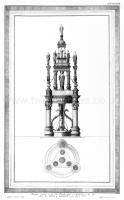
Vesta Monumenta. Plate 1.7: Engraving of Waltham Cross [Map]
Plate 1.7 of Vetusta Monumenta depicts the Waltham Cross, one of the twelve monuments that Edward I ordered to be built between 1291 and 1294 to commemorate the funeral procession of Queen Eleanor. The print documents the early preservation efforts of the Society of Antiquaries of London. The cross was re-engraved by James Basire Sr. after Jacob Schnebbelie for the third volume of Vetusta Monumenta (Plate 3.16), where it appears with two more of the Eleanor Crosses. Engraving by George Vertue [aged 37] after William Stukeley [aged 33]. 490 x 301 mm. Published by the Society of Antiquaries of London in 1721. Current location: Waltham Cross, Hertfordshire, UK.
In 1730 James Basire was born to Isaac Basire [aged 25].
Vesta Monumenta. 1753. Plate 2.23. Richmond Palace [Map]. Engraved by James Basire Sr. [aged 23].
Vesta Monumenta. 1753. Plate 2.25. Palace of Placentia, Greenwich [Map]. Engraving by James Basire [aged 23] after George Vertue [aged 69].
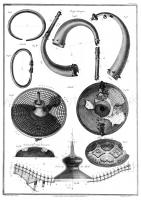
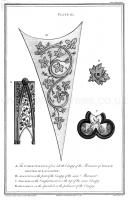
Vesta Monumenta. 1763. Plate 2.20. Two silver arm rings and three bronze horns from Ireland, a fifteenth-century buckler from Wales, and a Viking Age brooch from the Western Isles of Scotland. Engraving by James Basire Sr. [aged 33] after his own drawings.
Vesta Monumenta. 1765. Plate 2.26. East Window of St Margaret's Church, Westminster [Map]. A sixteenth-century Flemish-inspired stained-glass window produced in Holland and shipped to England around 1526. Known now as the "Great East Window at St Margaret's Church, Westminster," its three central lights show the Crucifixion, and its two outer lights feature portraits of King Henry VIII and Catherine of Aragon. The window was first installed in the Church of Waltham Abbey, and then moved to New Hall, Essex during the Dissolution of the Monasteries. The window was installed in St. Margaret's in 1758. Engraving by James Basire [aged 35] after George Vertue.
Vesta Monumenta. 1765. Plate 2.24. Nonsuch Palace [Map]. Engraved by James Basire Sr. [aged 35].
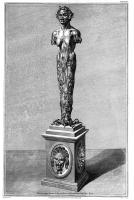
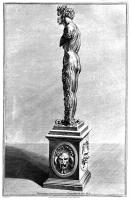
Vesta Monumenta. 1765. Plate 2.21. Bronze statuette, 22 1/4 inches high, believed in the eighteenth century to be of ancient origin. It was acquired by Thomas Hollis [aged 44] in Italy in 1753 and exhibited at a meeting of the Society of Antiquaries of London in 1758, after which Hollis donated the drawings here reproduced. Engravings by James Basire Sr. [aged 35] after drawings by Giovanni Battista Cipriani.
Thomas Hollis: On 14th April 1720 he was born. In 1757 Thomas Hollis was elected Fellow of the Royal Society. On 1st January 1774 he died.

On 24th August 1768 [his father] Isaac Basire [aged 63] died.
All About History Books on Amazon
Chronicle of Walter of Guisborough
A canon regular of the Augustinian Guisborough Priory, Yorkshire, formerly known as The Chronicle of Walter of Hemingburgh, describes the period from 1066 to 1346. Before 1274 the Chronicle is based on other works. Thereafter, the Chronicle is original, and a remarkable source for the events of the time. This book provides a translation of the Chronicle from that date. The Latin source for our translation is the 1849 work edited by Hans Claude Hamilton. Hamilton, in his preface, says: 'In the present work we behold perhaps one of the finest samples of our early chronicles, both as regards the value of the events recorded, and the correctness with which they are detailed; Nor will the pleasing style of composition be lightly passed over by those capable of seeing reflected from it the tokens of a vigorous and cultivated mind, and a favourable specimen of the learning and taste of the age in which it was framed.'
Available at Amazon in eBook and Paperback format.
On 4th August 1772 William Blake was apprenticed to James Basire [aged 42] for seven years.
Vesta Monumenta. 1780. Plate 2.38. Fountain dedicated to the memory of Joan of Arc in Rouen, France [Map], Normandy. The fountain was erected in 1525 at what was believed to be the site of Joan's execution in 1431. Engraving by James Basire Sr. [aged 50] after a drawing made in France, possibly by Louis-Jean Allais, under the direction of Jean-Baptiste Descamps.
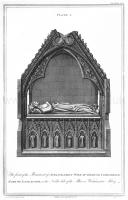
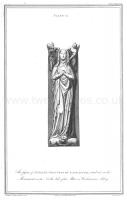
Vesta Monumenta. 1780. Plates 2.29, 2.30 and 2.31. Effigy of Aveline Forz 6th Countess Albemarle and Lancaster. Engravings by James Basire, Sr. [aged 50] after his own drawings, or possibly those of his apprentice, William Blake.


Vesta Monumenta. 1786. Plates 2.39 and 2.40. Twelfth-century baptismal font in Winchester Cathedral [Map]. Carved of a blue-black limestone commonly known as "Tournai marble," the north and east sides of this font depict eight birds and a mammal, and the south and west sides present hagiographical scenes from the life of St. Nicholas of Myra (also known as "Saint Nick" or Santa Claus). Engravings by James Basire Sr. [aged 56] after John Carter.

Around 1795 George Cooke [aged 14] was apprenticed to James Basire [aged 65].
In 1802 James Basire [aged 72] died.
Grandfather: Jacques or James Basire
Father: Isaac Basire
Grandmother: Magdelaine Lair