


Text this colour links to Pages. Text this colour links to Family Trees. Text this colour are links that are disabled for Guests.
Place the mouse over images to see a larger image. Click on paintings to see the painter's Biography Page. Mouse over links for a preview. Move the mouse off the painting or link to close the popup.
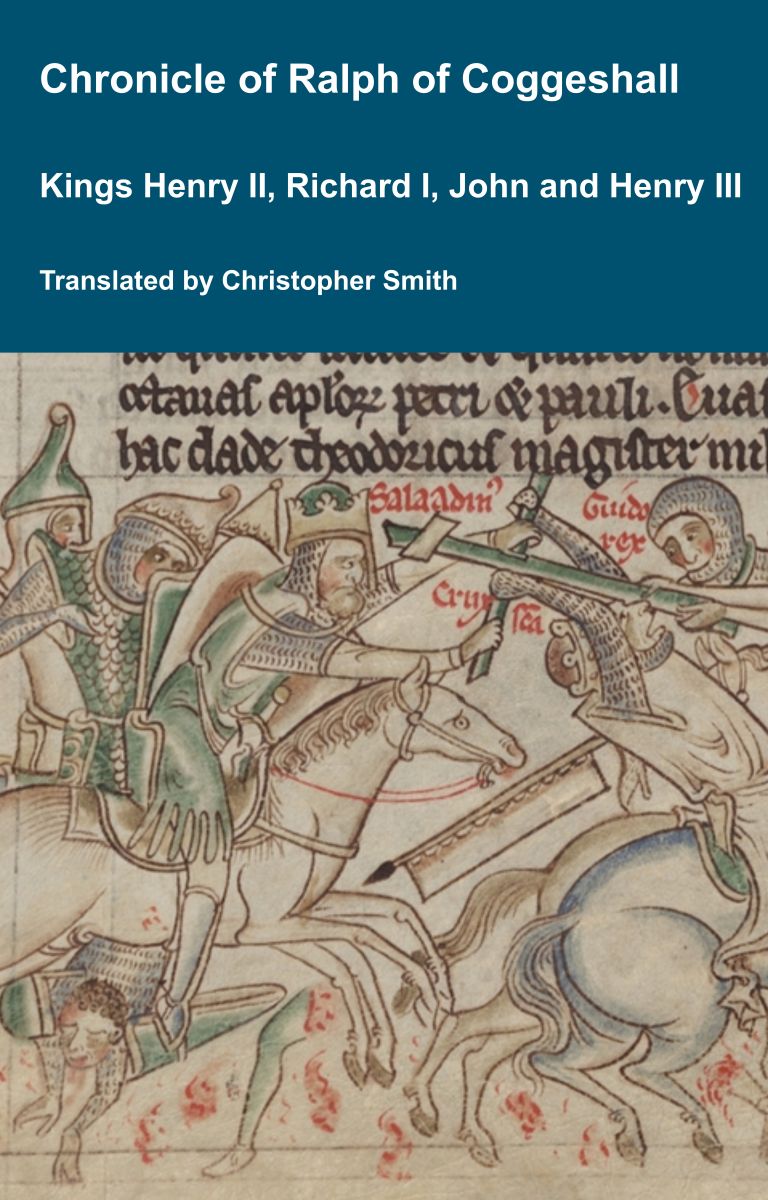
All About History Books
The Chronicle of Abbot Ralph of Coggeshall describes the reigns of Kings Henry II, Richard I, John and Henry III, providing a wealth of information about their lives and the events of the time. Ralph's work is detailed, comprehensive and objective. We have augmented Ralph's text with extracts from other contemporary chroniclers to enrich the reader's experience. Available at Amazon in eBook and Paperback.
Paternal Family Tree: Anjou aka Plantagenet
Maternal Family Tree: Elizabeth Cuman
Descendants Family Tree: John of Gaunt 1st Duke Lancaster 1340-1399
On 24th January 1328 [his father] King Edward III of England (age 15) and [his mother] Philippa of Hainault (age 13) were married at York Minster [Map]. She by marriage Queen Consort England. She was crowned the same day. She the daughter of [his grandfather] William Hainault I Count Hainault III Count Avesnes III Count Holland II Count Zeeland (age 42) and [his grandmother] Joan Valois Countess Zeeland Holland Avesnes and Hainault (age 34). He the son of [his grandfather] King Edward II of England and [his grandmother] Isabella of France Queen Consort England (age 33). They were second cousins. She a great x 5 granddaughter of King Stephen I England.
The marriage was the quid pro quo for her father William Hainault I Count Hainault III Count Avesnes III Count Holland II Count Zeeland having supported his mother Isabella of France Queen Consort England and Roger Mortimer 1st Earl March (age 40) returning to England to usurp the throne of Edward's father King Edward II of England.
On 6th March 1340 John of Gaunt 1st Duke Lancaster was born to [his father] King Edward III of England (age 27) and [his mother] Philippa of Hainault Queen Consort England (age 25) at the Prinsenhof Palace [Map] in Ghent aka Gaunt. Coefficient of inbreeding 3.00%.
On 24th June 1340 [his father] King Edward III of England (age 27) attacked the French fleet at anchor during the Battle of Sluys capturing more than 200 ships, killing around 18000 French. The English force included John Beauchamp 1st Baron Beauchamp Warwick (age 24), William Bohun 1st Earl of Northampton (age 30), Henry Scrope 1st Baron Scrope of Masham (age 27), William Latimer 4th Baron Latimer of Corby (age 10), John Lisle 2nd Baron Lisle (age 22), Ralph Stafford 1st Earl Stafford (age 38), [his future father-in-law] Henry of Grosmont 1st Duke Lancaster (age 30), Walter Manny 1st Baron Manny (age 30), Hugh Despencer 1st Baron Despencer (age 32) and Richard Pembridge (age 20).
Thomas Monthermer 2nd Baron Monthermer (age 38) died from wounds. His daughter Margaret succeeded 3rd Baroness Monthermer.
On 12th May 1343 [his brother] Edward "Black Prince" (age 12) was created Prince of Wales.
On 26th August 1346 the army of [his father] King Edward III of England (age 33) defeated the French army at the Battle of Crécy. The English army was commanded by King Edward III of England, his son [his brother] Edward "Black Prince" (age 16), Thomas Beauchamp 11th Earl Warwick (age 33), William Bohun 1st Earl of Northampton (age 36) and John Beauchamp 1st Baron Beauchamp Warwick (age 30).
The English army was included: Bishop Thomas of Hatfield (age 36), Hugh Despencer 1st Baron Despencer (age 38), Bernard Brocas (age 16), Thomas Felton (age 16), James Audley (age 28), Robert Bourchier 1st Baron Bourchier, Bartholomew "The Elder" Burghesh 1st Baron Burghesh (age 59), Bartholomew "The Younger" Burghesh 2nd Baron Burghesh (age 18), Reginald Cobham 1st Baron Cobham (age 51), John Darcy 1st Baron Darcy of Knayth (age 66), Robert Ferrers 3rd Baron Ferrers of Chartley (age 37), Richard Scrope 1st Baron Scrope of Bolton (age 19), William Scrope (age 21), Stephen Scrope (age 21), William Latimer 4th Baron Latimer of Corby (age 16), John Lisle 2nd Baron Lisle (age 28), Gerard Lisle 1st Baron Lisle (age 42), Nicholas Longford (age 61), Edward Montagu 1st Baron Montagu, Walter Paveley 4th Baron Burghesh (age 27), Michael Poynings 1st Baron Poynings (age 28), Robert Ufford 1st Earl Suffolk (age 48), John de Vere 7th Earl of Oxford (age 34), Thomas West (age 34), John Willoughby 2nd Baron Willoughby (age 43), John Wingfield (age 26), Henry Percy 11th and 3rd Baron Percy (age 25), Hugh Courtenay 2nd or 10th Earl Devon (age 43) (possibly), Walter "Elder" Devereux (age 37), John Devereux (age 44), Enion Sais Brecon, John Chandos (age 26), Richard Pembridge (age 26) and John Sully (age 63).
The French army suffered significant casualties. King Philip "Fortunate" VI of France (age 52) was wounded. William de Coucy (age 60) and his son Enguerrand 6th Lord de Coucy (age 33) and were killed.
Charles Valois Count Alençon (age 49) was killed. His son Charles (age 9) succeeded Count Alençon.
Louis Chatillon II Count Blois I Count Chatillon was killed. His son Louis succeeded III Count Blois.
Louis Dampierre II Count Nevers I Count Flanders (age 42) was killed. His son Louis (age 15) succeeded III Count Nevers, II Count Flanders.
King John I of Bohemia (age 50) was killed. His son Charles (age 30) succeeded IV King Bohemia.
Rudolph "Valiant" Metz I Duke Lorraine (age 26) was killed. His son John succeeded I Duke Lorraine.
Jean IV de Harcourt (age 39) was killed.
On 22nd February 1347 John Graham Earl Menteith (age 57) was condemned to be executed as a traitor. The sentence was carried out on the 28th February 1347 when John Graham Earl Menteith was hanged, drawn and quartered by direct orders of [his father] King Edward I (age 34) to whom he had previously sworn fealty.
In 1351 [his future father-in-law] Henry of Grosmont 1st Duke Lancaster (age 41) was created 1st Duke Lancaster by [his father] King Edward III of England (age 38). [his future mother-in-law] Isabel Beaumont Duchess Lancaster (age 31) by marriage Duchess Lancaster.
[his brother] Lionel of Antwerp 1st Duke of Clarence (age 12) was created 1st Earl of Ulster.
John of Gaunt 1st Duke Lancaster (age 10) was created 1st Earl Richmond.
Ralph Stafford 1st Earl Stafford (age 49) was created 1st Earl Stafford.
Chronicle of Geoffrey le Baker of Swinbroke [-1360]. In the year of Christ 1351, and the 25th year of the king's reign, after the octave of the Purification of the Glorious Virgin [2nd February 1351], at the parliament held in London at Westminster, Lord [his future father-in-law] Henry (age 41), son of Henry, Earl of Lancaster, himself Earl of Lincoln, Leicester, Derby, Grismond, and Ferrers, was made Duke of Lancaster, receiving liberties and privileges from the royal bounty such as no other earl had ever held. Also Lord [his brother] Lionel of Antwerp (age 12), the king's son, was made Earl of Ulster in Ireland, Lord John of Gaunt (age 10), his brother, was made Earl of Richmond and Lord Ralph of Stafford (age 49), formerly a baron, was created Earl of the same name.
Anno Christi MCCCLJ et regis XXV post octabas Purificacionis Virginis gloriose, in parliamento Londoniis apud Westmonasterium celebrato, dominus Henricus filius Henrici comitis Lancastrie, ipse comes Lincolnie, Leicestrie, Derbie et Grossimontis atque de Ferrariis, factus est dux Lancastrie, datis sibi libertatibus atque privilegiis munificencia regali qualia nullus comitum habebat. Item, dominus Leunecius de Andewerpe, regis filius, fit comes de Holvestria in Hybernia, et dominus Tohannes de Gandavo, germanus eius, fit comes Richemundie, et dominus Radulfus de Staffordia, pridem baro, comes eiusdem tituli creabatur.
In 1352 [his brother] Lionel of Antwerp 1st Duke of Clarence (age 13) and [his sister-in-law] Elizabeth Burgh Duchess of Clarence (age 19) were married. He by marriage Earl of Ulster. She was the sole heir of her father and brought the de Burgh inheritance of the lands of Ulster to the marriage. As a consequence of their earlier betrothal he had been called Earl Ulster since 1347. She the daughter of William Donn Burgh 3rd Earl of Ulster and Maud Plantagenet Countess Ulster (age 42). He the son of [his father] King Edward III of England (age 39) and [his mother] Philippa of Hainault Queen Consort England (age 37). They were half second cousin once removed. She a great x 2 granddaughter of King Henry III of England.
On 19th September 1356 the army of [his brother] Edward "Black Prince" (age 26) defeated the French and Scottish army led by King John "The Good" II of France (age 37) at the Battle of Poitiers
King John "The Good" II of France was captured by three captains including Ivon aka John Fane.
The the English army included: Bernard Brocas (age 26), Thomas Felton (age 26), James Audley (age 38), Thomas Beauchamp 11th Earl Warwick (age 43), Bartholomew "The Younger" Burghesh 2nd Baron Burghesh (age 28), Reginald Cobham 1st Baron Cobham (age 61), Edward Despencer 1st Baron Despencer, Baron Burghesh (age 21), Ralph Ferrers (age 27), William Scrope (age 31), William Montagu 2nd Earl Salisbury (age 28), Walter Paveley 4th Baron Burghesh (age 37), Robert Ufford 1st Earl Suffolk (age 58), William Ufford 2nd Earl Suffolk (age 18), John de Vere 7th Earl of Oxford (age 44), John Willoughby 3rd Baron Willoughby (age 33), Thomas Arderne (age 19), Enion Sais Brecon, John Chandos (age 36), Richard Pembridge (age 36), Jean Grailly (age 25), Robert de Fouleshurst (age 26) and John Sully (age 73)
John Savile of Shelley and Golcar (age 31) probably fought having received letters of protection to travel overseas.
Hugh Courtenay 2nd or 10th Earl Devon (age 53) protected the baggage train.
The French and Scottish army included: King John "The Good" II of France, Philip "Bold" Valois II Duke Burgundy (age 14), Jean Bourbon I Count La Marche (age 12), Archibald "Grim" Douglas 3rd Earl Douglas (age 26), [his uncle] John "Sans Terre" Artois 1st Count of Eu (age 35); all captured.
Guichard d'Angle 1st Earl Huntingdon and William Douglas 1st Earl Douglas (age 33) fought.
Peter Bourbon Duke Bourbon (age 45) was killed. His son Louis (age 19) succeeded II Duke Bourbon.
Gauthier VI Comte de Brienne (age 54) was killed.
 Become a Member via our Buy Me a Coffee page to read complete text.
Archaeologia Volume 35 1853 XXXIII. From the 30th of January to the 2nd of February, the Comte de Tancarville continues again a visitor at the Castle; and on the 1st of February, the Earl of Richmond, John (age 17), son of Edward III., dined with the [his grandmother] Queen (age 63), his grandmother.
Archaeologia Volume 35 1853 XXXIII. On the 21st [Mar 1358], William, Archbishop of Sens, now in England to negotiate a treaty of peace for his Sovereign with the English Monarch, the Maréchal D'Audenham, and the Countess of Pembroke (age 41), spend the entire day with [his grandmother] Isabella (age 63); and her grandson, the Earl of Richmond (age 18), arrives to supper.
In May 1359 [his father] King Edward III of England (age 46) and his son [his brother] Edward "Black Prince" (age 28) took part in a tournament in London. For the amusement of the citizens both Edwards and their friends dressed as the mayor and aldermen of London. The tournament possibly in celebration of the two Royal marriages of his children John of Gaunt 1st Duke Lancaster (age 19) and [his sister] Margaret Plantagenet Countess of Pembroke (age 12) on 19th May 1359.
On 19th May 1359, or thereabouts, a double-royal wedding celebration took place at Reading Abbey, Berkshire [Map] whereby two children of King Edward III of England (age 46) were married:
John of Gaunt 1st Duke Lancaster (age 19) and Blanche Duchess of Lancaster (age 17) were married. She by marriage Countess Richmond. She the daughter of Henry of Grosmont 1st Duke Lancaster (age 49) and Isabel Beaumont Duchess Lancaster (age 39). He the son of King Edward III of England and Philippa of Hainault Queen Consort England (age 44). They were half second cousin once removed. She a great x 2 granddaughter of King Henry III of England.
John Hastings 2nd Earl Pembroke (age 11) and Margaret Plantagenet Countess of Pembroke (age 12) were married. At the time John Hastings 2nd Earl Pembroke was a ward of King Edward III of England who would enjoy the benefit of the substantial revenue of the Earldom of Pembroke until John came of age nine years later in 1368. She died two or so years later probably of plague. She the daughter of King Edward III of England and Philippa of Hainault Queen Consort England. He the son of Laurence Hastings 1st Earl Pembroke and Agnes Mortimer Countess of Pembroke (age 42). They were half fourth cousins. He a great x 5 grandson of King John of England.
On 31st March 1360 [his daughter] Philippa of Lancaster Queen Consort Portugal was born to John of Gaunt 1st Duke Lancaster (age 20) and [his wife] Blanche Duchess of Lancaster (age 18) at Leicester Castle [Map]. She a granddaughter of King Edward III of England. She married 2nd February 1387 her half fourth cousin King John I of Portugal, son of Peter I King Portugal and Inês Castro, and had issue.
On 13th April 1360 a freak weather event known as Black Monday Hailstorm occurred as the army of [his father] King Edward III of England (age 47) were camped outside Chartres [Map]. Thomas Beauchamp 11th Earl Warwick (age 47), William Bohun 1st Earl of Northampton (age 50), [his father-in-law] Henry of Grosmont 1st Duke Lancaster (age 50), [his brother] Edward "Black Prince" (age 29) and Walter Mauny were present. Around one thousand English were killed, with up to six thousand horses. King Edward III of England believed the event to be an Act of God and proceeded to negotiate with the French resulting in the Treaty of Brétigny.
On 28th April 1360 Guy Beauchamp died from injuries received during the Black Monday Hailstorm.
In 1361 [his father] King Edward III of England (age 48) created three of his sons as Garter Knights...
35th [his brother] Lionel of Antwerp 1st Duke of Clarence (age 22).
36th John of Gaunt 1st Duke Lancaster (age 20).
37th [his brother] Edmund of Langley 1st Duke of York (age 19).
38th Edward Despencer 1st Baron Despencer, Baron Burghesh (age 25).
On 23rd March 1361 [his father-in-law] Henry of Grosmont 1st Duke Lancaster (age 51) died at Leicester Castle [Map]. He was buried at Church of the Annunciation of our Lady of the Newark [Map]. Duke Lancaster, Earl Lincoln extinct.
[his wife] Blanche Duchess of Lancaster (age 18) succeeded 5th Countess Lancaster and 2nd Countess Derby. John of Gaunt 1st Duke Lancaster (age 21) by marriage Earl Lancaster, Earl Derby.
[his sister-in-law] Maud Plantagenet Duchess Lower Bavaria (age 20) succeeded 5th Countess of Leicester.
On 10th October 1361 [his brother] Edward "Black Prince" (age 31) and [his sister-in-law] Joan "Fair Maid of Kent" Princess Wales (age 33) were married at Windsor Castle [Map]. She by marriage Princess of Wales. His first wife, her second (or third depending on how you count them) husband. She had four children already. They had known each other since childhood. Thirty-one and thirty-three respectively. A curious choice for the heir to the throne; foreign princesses were usual. They were married nearly fifteen years and had two children. She the daughter of Edmund of Woodstock 1st Earl Kent and Margaret Wake Countess Kent. He the son of [his father] King Edward III of England (age 48) and [his mother] Philippa of Hainault Queen Consort England (age 47). They were half first cousin once removed. She a granddaughter of King Edward I of England.
In 1362 [his brother] Edmund of Langley 1st Duke of York (age 20) was created 1st Earl Cambridge.
In 1362 [his son] John Lancaster was born to John of Gaunt 1st Duke Lancaster (age 21) and [his wife] Blanche Duchess of Lancaster (age 19). He a grandson of King Edward III of England. He died aged three in 1365.
On 10th April 1362 [his sister-in-law] Maud Plantagenet Duchess Lower Bavaria (age 22) died. Her sister [his wife] Blanche (age 20) succeeded 6th Countess of Leicester. John of Gaunt 1st Duke Lancaster (age 22) by marriage Earl of Leicester adding a fourth Earldom to the ones he already held: Earl Richmond, Earl Lancaster and Earl Derby.
On 13th November 1362, his fiftieth birthday, [his father] King Edward III of England (age 50) created two sons as Dukes...
[his brother] Lionel of Antwerp 1st Duke of Clarence (age 23) was created 1st Duke Clarence. [his sister-in-law] Elizabeth Burgh Duchess of Clarence (age 30) by marriage Duchess Clarence.
John of Gaunt 1st Duke Lancaster (age 22) was created 1st Duke Lancaster. [his wife] Blanche Duchess of Lancaster (age 20) by marriage Duchess Lancaster.
Before 21st February 1363 [his daughter] Elizabeth Lancaster Duchess Exeter was born to John of Gaunt 1st Duke Lancaster (age 22) and [his wife] Blanche Duchess of Lancaster (age 20) at Burford, Shropshire [Map]. She a granddaughter of King Edward III of England. She married (1) 24th June 1380 her half third cousin John Hastings 3rd Earl Pembroke, son of John Hastings 2nd Earl Pembroke and Anne Manny Countess Pembroke (2) 24th June 1386 her half second cousin once removed John Holland 1st Duke Exeter, son of Thomas Holland 1st Earl Kent and Joan "Fair Maid of Kent" Princess Wales, and had issue (3) 1400 her fourth cousin once removed John Cornwall 1st Baron Fanhope 1st Baron Milbroke and had issue.
On 28th May 1363 John Harrington 2nd Baron Harington (age 35) died at Gleaston Castle [Map]. His son Robert (age 7) succeeded 3rd Baron Harington. Given his young age Robert Harrington 3rd Baron Harington became a ward of [his father] King Edward III of England (age 50) who granted his wardship to his daughter [his sister] Isabella Countess Bedford and Soissons (age 30) and her husband [his future brother-in-law] Enguerrand de Coucy 1st Earl Bedford 1st Count Soissons (age 23).
In 1365 [his son] John Lancaster (age 3) died. He was buried at Church of the Annunciation of our Lady of the Newark [Map].
In 1365 [his son] Edward Lancaster was born to John of Gaunt 1st Duke Lancaster (age 24) and [his wife] Blanche Duchess of Lancaster (age 22). In 1365 Edward Lancaster died. He was buried at Church of the Annunciation of our Lady of the Newark [Map]. He a grandson of King Edward III of England.
On 27th July 1365 [his brother-in-law] Enguerrand de Coucy 1st Earl Bedford 1st Count Soissons (age 25) and [his sister] Isabella Countess Bedford and Soissons (age 33) were married at Windsor Castle [Map]. She the daughter of [his father] King Edward III of England (age 52) and [his mother] Philippa of Hainault Queen Consort England (age 51). They were fourth cousin once removed.
In 1366 [his brother-in-law] Enguerrand de Coucy 1st Earl Bedford 1st Count Soissons (age 26) was created 1st Earl Bedford. [his sister] Isabella Countess Bedford and Soissons (age 33) by marriage Countess Bedford.
In 1366 [his son] John Lancaster was born to John of Gaunt 1st Duke Lancaster (age 25) and [his wife] Blanche Duchess of Lancaster (age 23). In 1367 John Lancaster died. He was buried at Church of the Annunciation of our Lady of the Newark [Map]. He a grandson of King Edward III of England.
In or before 1367 Hugh Swynford and [his future wife] Katherine Swynford aka Roet Duchess Lancaster (age 16) were married.
In 1367 [his brother-in-law] Enguerrand de Coucy 1st Earl Bedford 1st Count Soissons (age 27) was created 1st Count Soissons. [his sister] Isabella Countess Bedford and Soissons (age 34) by marriage Countess Soissons.
After 1367 John Savile of Shelley and Golcar (age 42) transferred his allegiance to the new duke, John of Gaunt (age 26), becoming a member of the latter's affinity, at a fee of £20 a year during this period. In return for his annuity he took part in at least three expeditions to France.
On 3rd April 1367 the forces of Peter "Cruel" I King Castile (age 32) commanded by [his brother] Edward "Black Prince" (age 36) defeated the army of Henry "Fratricide" II King Castile (age 33) at the Battle of Nájera at Nájera [Map]. The English forces included John of Gaunt 1st Duke Lancaster (age 27), William Scrope, Peter Courtenay (age 21), John Devereux 1st Baron Devereux (age 30), John Savile of Shelley and Golcar (age 42), Bernard Brocas (age 37) and Thomas Banastre (age 33).
The forces of Henry "Fratricide" II King Castile included Bertrand Geusclin (age 47). The battle achieved little since Bertrand Geusclin escaped.
John Ferrers 4th Baron Ferrers of Chartley (age 36) was killed. His son Robert (age 9) succeeded 5th Baron Ferrers of Chartley. Margaret Despencer Baroness Ferrers of Chartley by marriage Baroness Ferrers of Chartley.
Edward "Black Prince" thereafter returned home, taking Peter's daughters [his future wife] Constance (age 13) and [his future sister-in-law] Isabella (age 12) as hostages to ensure Peter would pay the money owed to Edward. Constance married John of Gaunt 1st Duke Lancaster, Isabella married [his brother] Edmund of Langley 1st Duke of York (age 25).

On 15th April 1367 [his son] King Henry IV of England was born to John of Gaunt 1st Duke Lancaster (age 27) and [his wife] Blanche Duchess of Lancaster (age 25) at Bolingbroke Castle, Lincolnshire [Map]. He a grandson of King Edward III of England. He married (1) 5th February 1381 his second cousin Mary Bohun, daughter of Humphrey Bohun 7th Earl Hereford 6th Earl Essex 2nd Earl of Northampton and Joan Fitzalan Countess Essex, Hereford and Northampton, and had issue (2) 7th February 1403 his third cousin Joanna of Navarre Queen Consort England, daughter of Charles "Bad" II King Navarre and Joan Valois Queen Consort Navarre.

All About History Books
The Deeds of King Henry V, or in Latin Henrici Quinti, Angliæ Regis, Gesta, is a first-hand account of the Agincourt Campaign, and subsequent events to his death in 1422. The author of the first part was a Chaplain in King Henry's retinue who was present from King Henry's departure at Southampton in 1415, at the siege of Harfleur, the battle of Agincourt, and the celebrations on King Henry's return to London. The second part, by another writer, relates the events that took place including the negotiations at Troye, Henry's marriage and his death in 1422.
Available at Amazon as eBook or Paperback.
In 1368 [his daughter] Isabel Lancaster was born to John of Gaunt 1st Duke Lancaster (age 27) and [his wife] Blanche Duchess of Lancaster (age 25). She a granddaughter of King Edward III of England. She died aged less than one years old.
In 1368 [his daughter] Isabel Lancaster died. She was buried at Church of the Annunciation of our Lady of the Newark [Map].
In June 1368 [his brother] Lionel of Antwerp 1st Duke of Clarence (age 29) and [his sister-in-law] Violante Visconti (age 14) were married in the Church of Santa Maria Maggiore, Milan [Map]. The wedding festivities were lavish and ostentatious. The banquet, held outside, included 30 courses of meat and fish presented fully gilded. Between the courses the guests were given gifts such as suits of armour, bolts of cloth, war horses, arms, and hunting dogs. Among the guests were Geoffrey Chaucer (age 25), Petrarch, Jean Froissart and John Hawkwood. He the son of [his father] King Edward III of England (age 55) and [his mother] Philippa of Hainault Queen Consort England (age 53). They were fourth cousin once removed.
On 12th September 1368 [his wife] Blanche Duchess of Lancaster (age 26) died at Tutbury Castle, Staffordshire [Map]. Her last words were said to be "Souveyne vous de moi" ("Don't forget me") the 'S' of which was possibly subsequently represented on the Lancastrian Esses Collar. She was buried at St Paul's Cathedral [Map]. Her son [his son] Henry of Grosmont (age 1) succeeded 3rd Earl Derby, 6th Earl Lancaster.
On 7th October 1368 [his brother] Lionel of Antwerp 1st Duke of Clarence (age 29) died from poisoning at Alba [Map]. Duke Clarence extinct. His daughter [his niece] Philippa (age 13) succeeded 2nd Countess of Ulster. He was buried at the St Pietro Ciel d'Oro Church, Pavia [Map].
There was strong speculation he had been poisoned by his [his sister-in-law] wife's (age 14) father (age 48).
From 27th June 1369 to 1371 Bishop Thomas de Brantingham was appointed Lord Treasurer to [his father] King Edward III of England (age 56).
On 15th August 1369 [his mother] Philippa of Hainault Queen Consort England (age 55) died at Windsor Castle [Map]. Her husband [his father] King Edward III of England (age 56) and youngest son [his brother] Thomas of Woodstock 1st Duke of Gloucester (age 14) were present. She was given a state funeral six months later on 9th January 1370 at which she was interred at on the northeast side of the Chapel of St Edward the Confessor, Westminster Abbey [Map]. Her alabaster effigy was executed by sculptor Jean de Liège.
In 1370 Sir Godfrey Foljambe (age 26) the younger (son of the eminent lawyer and retainer of John of Gaunt (age 29)) confirmed him in possession of part of the manors of Over Haddon [Map], Rowsley, Derbyshire [Map], Wardlow, Derbyshire [Map], Monyash, Derbyshire [Map] and Chelmorton [Map] in Derbyshire, which were to Gaunt himself.
On 21st September 1371 John of Gaunt 1st Duke Lancaster (age 31) and Constance of Castile Duchess of Lancaster (age 17) were married at Roquefort, Landes. She by marriage Duchess Lancaster. His younger brother Edmund of Langley 1st Duke of York (age 30) married Constance's sister in July 1372. An example of Marriage of Two Sets of Siblings. She the illegitmate daughter of Peter "Cruel" I King Castile and Maria Padilla. He the son of King Edward III of England (age 58) and Philippa of Hainault Queen Consort England. They were half third cousin twice removed.
All About History Books
The Chronicle of Abbot Ralph of Coggeshall describes the reigns of Kings Henry II, Richard I, John and Henry III, providing a wealth of information about their lives and the events of the time. Ralph's work is detailed, comprehensive and objective. We have augmented Ralph's text with extracts from other contemporary chroniclers to enrich the reader's experience. Available at Amazon in eBook and Paperback.
After 21st September 1371 [his future sister-in-law] Isabella of Castile Duchess York (age 16) accompanied her sister [his wife] Constance of Castile Duchess of Lancaster (age 17) to England after her marriage to John of Gaunt 1st Duke Lancaster (age 31).
In 1372 [his brother] Thomas of Woodstock 1st Duke of Gloucester (age 16) was appointed Constable of England.
On 9th February 1372 [his wife] Constance of Castile Duchess of Lancaster (age 18), the wife of John of Gaunt 1st Duke Lancaster (age 31) made a ceremonial entry in London.
On 11th July 1372 [his brother] Edmund of Langley 1st Duke of York (age 31) and [his sister-in-law] Isabella of Castile Duchess York (age 17) were married at Wallingford, Oxfordshire [Map]. She by marriage Countess Cambridge. She being the younger sister of [his wife] Constance (age 18) who had married Edmund's older brother John of Gaunt 1st Duke Lancaster (age 32) a year before. An example of Marriage of Two Sets of Siblings. She the illegitmate daughter of Peter "Cruel" I King Castile and Maria Padilla. He the son of [his father] King Edward III of England (age 59) and [his mother] Philippa of Hainault Queen Consort England. They were half third cousin twice removed.
In September 1372 John of Gaunt 1st Duke Lancaster (age 32) surrendered the Earldom of Richmond to his father [his father] King Edward III (age 59).
In 1373 [his illegitimate son] John Beaufort 1st Marquess Somerset and Dorset was born illegitimately to John of Gaunt 1st Duke Lancaster (age 32) and [his future wife] Katherine Swynford aka Roet Duchess Lancaster (age 22). He a grandson of King Edward III of England. He married 27th November 1397 his half third cousin Margaret Holland Duchess Clarence, daughter of Thomas Holland 2nd Earl Kent and Alice Fitzalan Countess Kent, and had issue.
On 16th January 1373 Humphrey Bohun 7th Earl Hereford 6th Earl Essex 2nd Earl of Northampton (age 31) died. He was buried at Waldon Priory and Abbey [Map]. Earl Hereford, Earl Essex, Earl of Northampton extinct. His estates were divided between his two daughters [his future sister-in-law] Eleanor Bohun Duchess Gloucester (age 7), wife of [his brother] Thomas of Woodstock 1st Duke of Gloucester (age 18) and [his future daughter-in-law] Mary Bohun (age 5), wife of [his son] Henry of Bolingbroke (age 5), the future Henry IV, although the title and estates should have been inherited Gilbert Bohun who was a grandson of Humphrey Bohun 2nd Earl Hereford 1st Earl Essex.
On 31st March 1373 [his daughter] Catherine of Lancaster Queen Consort Castile was born to John of Gaunt 1st Duke Lancaster (age 33) and [his wife] Constance of Castile Duchess of Lancaster (age 19) at Hertford Castle [Map]. She a granddaughter of King Edward III of England. She married before 17th September 1388 her half second cousin Henry III King Castile, son of John I King Castile and Eleanor Barcelona Queen Consort Castile, and had issue.
In April 1373 Gaunt's (age 33) receiver was ordered to pay the 30 archers whom Saville (age 48) and Sir Robert Rockley had commanded on one of these recent operations. Sir John probably had the duke to thank for the knighthood which was bestowed upon him in the late 1360s; and he also acquired the marriage of Elizabeth Thornton (age 16), one of his patron's wards, albeit for 'un grant somme'.
In 1374 [his brother] Thomas of Woodstock 1st Duke of Gloucester (age 18) and [his sister-in-law] Eleanor Bohun Duchess Gloucester (age 8) were married. She the daughter of Humphrey Bohun 7th Earl Hereford 6th Earl Essex 2nd Earl of Northampton and Joan Fitzalan Countess Essex, Hereford and Northampton (age 27). He the son of [his father] King Edward III of England (age 61) and [his mother] Philippa of Hainault Queen Consort England. They were second cousin once removed. She a great x 2 granddaughter of King Edward I of England.
In 1374 [his son] John Lancaster was born to John of Gaunt 1st Duke Lancaster (age 33) and [his wife] Constance of Castile Duchess of Lancaster (age 20). He a grandson of King Edward III of England. He died aged one in 1375.
In 1375 [his illegitimate son] Cardinal Henry Beaufort was born illegitimately to John of Gaunt 1st Duke Lancaster (age 34) and [his future wife] Katherine Swynford aka Roet Duchess Lancaster (age 24). He a grandson of King Edward III of England.
In 1375 [his daughter] Catherine of Lancster (age 1), daughter of John of Gaunt 1st Duke Lancaster (age 34), was given her own room at Melbourne Castle [Map], and a Castilin attendant.
In 1375 [his son] John Lancaster (age 1) died.
In 1376 [his brother] Thomas of Woodstock 1st Duke of Gloucester (age 20) was created 1st Earl Essex. [his sister-in-law] Eleanor Bohun Duchess Gloucester (age 10) by marriage Countess Essex.
Archaeologia Volume 22 Section XVI. [1376] Of the Duke of Lancaster (age 35) his wordes & his condicions.
The nighte followynge, the Duke consulted wyth his private men how he might putt of that that redounded to his infamye & many fest dyshonor. After dyvers mens opynions dyversly tolde, he, lykyng of none of ther wayes, is reported to have sayde: What sayeth he, doo theis base & unnoble knightes attempt? Do they thynke they be the kynges or princes of this lande? Or els, whence is thys hautynes and pride? I thynke they know not what power I am of. I will therfore erely in the morenynge appear unto them so glorious, & will shew suche power amonge them, & wyth such vigoure I will terryfie them, that neither they nor theire like shall dare henceforth to provoke me to wrathe. Boastyng in this sorte, and vaynely assurynge himself, one of his gentellmen is sayed to have geven him this answer. My Lorde, saieth he, it is not unknown to your honor what helpes thes knyghtes, not of the common sorte, as you affirme, but mightie in armes & valiant, have to undershore them; for they have the favour & love of the lordes, & specially of the Lorde Edward Prince, your brother, who gyveth them his counsayle and aide effectuallye.
The Londoners allso, all & everychone, and common peopell be so well affected towards them that they will not suffer them to be overlayde wyth reprochefull language or to be molested with the least injurye in the world. Yea, & the knyghtes themselves abused in any reprochefull maner shal be enforced to attempt all extremitie against your person & your frendes, which, happly, otherwyse they wolde never dooe. Wyth this admonition the duke's guyltie conscience was very much troubled. He was afrayde in deede that it wolde so come to passe, as the gentellman had sayde unto hyme, and that so his honor should ever mor be disteyned. Whereas, he knew that if mencyon were openly made of his wicked actes, he could not satisfye the peopell by any purgation, nor for trouble of mynde and guyltines of conscience durst, though he were willynge thereto, wage battayle agaynst hys envyers. Being couragless, and with synne and uncleannes divers wayes made foule and evel favored for leavyng his lawful wedlock bedd, being an infamous leacher and adulterer, deceved as well hys fyrst wyfe, the daughter of the most noble Lord Henry, the first Duke of Lancaster, as the daughter of Peter Kynge of Spayne, and this did he, not only secretly and in hugger mugger, but even in their bedds wolde he laye his lewde harlotts, to the great sorrowe of hys wyfes not daryng to gaynesay hit. O infortunate duke & myserable, O that destroyest them with thy treason and lack of sense and reason, whom thow guydest to battayle, and whom in peace thow shouldst guyde through examples of goodworkes, thow leadest them through buy wayes and bryngest them to destruction, for thow whereas ether God, or, that I may so saye, Nature, the mother of all thynges, hath geven thee a soule and dyscrecion, than the which no thyng is more excellent, so dost abject & abase thyself, that a man may thynke you to dyffer no thynge from a brute beast. Behold, O most myserable man, which thynkest thy self to floury she which accountest thy self happye, in what sorte thy owne myseries do overbeare thee, thy lustes do torment thee; to whom that which thow hast is not sufficient, & yet fearest lest it will not long contynue thyne.a
Note a. This passage, in which allusion is made to John of Gaunt's amour with [his future wife] Katherine Swynford (age 25), whom he afterwards married, may be noticed as furnishing a strong proof that the original Chronicle was written during that prince's lifetime. [Further proof is given by the words 'hys wyfes' referring to Constance of Castile who John of Gaunt married in 1371; she died in 1394.]
Become a Member via our Buy Me a Coffee page to read complete text.
In 1376 John Savile of Shelley and Golcar (age 51) was elected MP Yorkshire in the Good Parliament. During the Good Parliament, he was sufficiently trusted to conduct Thomas Caterton from Queenborough Castle [Map] for interrogation before Parliament. Caterton had been appealed for treason by Sir John Annesley, and the court party, including Gaunt (age 35), was anxious to protect him from attack. In the event, they were able to hold off the opposition, despite some damning revelations about their conduct of the war-effort. The duke himself was singled out for particular criticism, and during the Peasants' Revolt of 1381 he fled into Scotland, leaving his Savoy Palace [Map] to be destroyed by the London mob. Gaunt was, understandably, reluctant to cross the border again without the protection of a sizeable bodyguard. In late June 1376, therefore, his leading retainers in the north were instructed to provide an escort for his journey to Knaresborough [Map]. Not only did John Savile of Shelley and Golcar mobilize a personal retinue of ten men-at-arms and 40 archers; he also helped to suppress the rebellion in the north by serving on two commissions for the punishment of insurgents.
On 8th June 1376 [his brother] Edward "Black Prince" (age 45) died of dysentery at Westminster Palace [Map]. He was buried in Canterbury Cathedral [Map]. His son [his nephew] Richard (age 9) succeeded as heir to his grandfather [his father] King Edward III of England (age 63) who died a year later.


Around 1377 [his brother] Lionel of Antwerp 1st Duke of Clarence was reburied at Clare Priory, Suffolk [Map]. [his niece] Philippa Plantagenet Countess March 2nd Countess Ulster (age 21) succeeded 5th Countess of Ulster.
In 1377 [his brother] Thomas of Woodstock 1st Duke of Gloucester (age 21) was created 1st Earl Buckingham. [his sister-in-law] Eleanor Bohun Duchess Gloucester (age 11) by marriage Countess Buckingham.
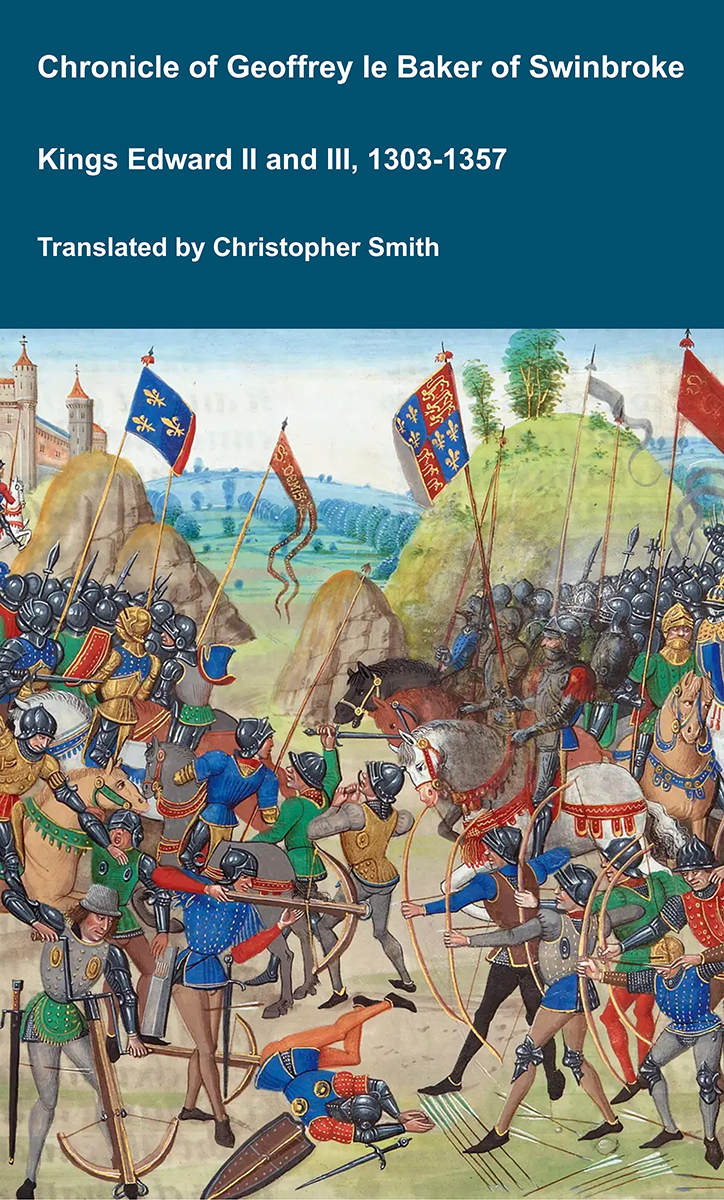
All About History Books
The Chronicle of Geoffrey le Baker of Swinbroke. Baker was a secular clerk from Swinbroke, now Swinbrook, an Oxfordshire village two miles east of Burford. His Chronicle describes the events of the period 1303-1356: Gaveston, Bannockburn, Boroughbridge, the murder of King Edward II, the Scottish Wars, Sluys, Crécy, the Black Death, Winchelsea and Poitiers. To quote Herbert Bruce 'it possesses a vigorous and characteristic style, and its value for particular events between 1303 and 1356 has been recognised by its editor and by subsequent writers'. The book provides remarkable detail about the events it describes. Baker's text has been augmented with hundreds of notes, including extracts from other contemporary chronicles, such as the Annales Londonienses, Annales Paulini, Murimuth, Lanercost, Avesbury, Guisborough and Froissart to enrich the reader's understanding. The translation takes as its source the 'Chronicon Galfridi le Baker de Swynebroke' published in 1889, edited by Edward Maunde Thompson. Available at Amazon in eBook and Paperback.
Around January 1377 [his illegitimate son] Thomas Beaufort 1st Duke Exeter was born illegitimately to John of Gaunt 1st Duke Lancaster (age 36) and [his future wife] Katherine Swynford aka Roet Duchess Lancaster (age 26). He a grandson of King Edward III of England. He married before 15th February 1404 his half fifth cousin once removed Margaret Neville Countess Dorest, daughter of Thomas Neville Baron Furnivall and Joan Furnival 5th Baroness Furnivall, and had issue.
Archaeologia Volume 22 Section XVI. The convocation at London agaynst the Duke (age 36) and Henry Percy, and of there flyght.
[March 1377] The morrow after the Londoners collyng the cytezyns together, tooke counsell uppon such demande as the day before the Lord Thomas Woodstoke and the Lord Henry Percye affyrmed did procede ofthe kyngs will and pleasure concernyng the creation of a captayn in the cyty, & of the use of the Marshalls offyce in the same, as is before declared. Besydes, of the injury that was offered to his byshop and other matters, and whilst there was longe and great ado and talke about these thyngs, there entered in the Lord Ffyzwalter,z and the Lord Wydo de Bryon,a whether to know there mynde, or for what other cause it is uncertayne. The commons at there fyrst comyng scarcely held there hands from beatyng them that came, and were not called for; but at last, after they had sworne that there comyng to there counsell was not for any hurt unto them or the cytye, they were suffered of the cytezyns, as well for that they themselves were cytezyns, as also had many possessions in the cytye. The Lords tooke an othe of fydelyty to be observed to the cyty & cytezyns, or els sel or let there goods to others, because now it was agreed that none of there enemyes should enjoye any tenement or rent in the cytye, therfore these lords put there hands to the booke in a hye place of the hall, the cytezyns & commons requestyng that so it myght be. The Lord Fyzwalter having gotten favor thus at the cytezyns hands, began his oration on this wyse :-Worthy Cytezyns, synce by the othe that I have presently taken, I am bound to love and obeye you, & that by my auncyent inherytance, as may appere, I ought to be your standard bearer, & one of your specyall favorers, there is none that doubt but that your losse redoundeth to myne, & the injuryes that be offered to you are in lyke sort to mee, I thought good, for that it concerns mee as well as you, to forewarn you that your lybertyes are in great daunger, & it were good that you looked more watchfully unto your selves, and whether it be with your knowledg or not, yt is for your discredyt that one should be kept in the inn of the Marshall, namely, of the Lord Henry Percye, where it is well known that the pryson ought not to be any such custodye, which if you neglygently at this tyme suffer, it may come to passe that when you wold you shall not be able to repulse or withstand the lyke chaunce with all your forces. Now therefore you ought to take counsell what is to be done in it, and see whether the remyssyon of this dede be not hereafter a thorne in your eyes, & this present presumption unpunyshed bring over you new customs to your manyfest losse & hynderance. The cytezyns, whome the comon people for the auncyent nobility of London call proceres, state they all with a shout consent, and every man cryes out that by manyfest judgement they wold condemme such injurye; nether made they any delay, but presently tooke armor, & ran with great rage to the marshall his inn; they break up the doores, brought out the prysoner, & cary away the gyves wherein his feete were bounde, entendyng to burne them in the mydst of the cytye. The Lord Percy is sought for doubtles to receyve punyshment for the injury, if he could have been founde. The armed men wander up & downe the chambers, thrustyng thorowe the bedds with there launces. The privy houses are searched, but all in vayne; ffor that daye he and the duke were to dyne with one John de Ipres, who before had bydden them; but the Londoners knew it not, for they thought that he & the duke had bene at the Savoye, & therfore with all hast, they posted thyther, but whylst these thyngs were doynge, one of the duke's soldyers seeing this, in great hast came to the place where the duke was,b & after he had knocked rudelye, and could not get in as he wold, with great feare he sayed to Haverland, the porter, if thou love, sayth he, my lord & hys lyfe, open me the gate quycklye, with which words he gat entrye, and with great feare, scarce able to speake, he tells the duke, that without the doores were infynyte numbers of armed men, & unles he tooke heede, this day should be his last; and with his words he made the Lord Percy no less afrayd, for he opened unto hym how for his cause this comotion was made, and what they had done at his inn. They were, when [this man] he came in, standyng about there oysters, & some had eaten some of them, and others none at all. The duke, when he hard this message, thought it nothyng safe to tary any longer there, lept so hastely from his oysters, that he hurt both his leggs aganst the forme, whereby being greved, his offycers offered hym wyne, but he wold not drynke, and sayinge as it were it is fynyshed, the ungodly man fled with his felow the Lord Percy, no man following them, and, entryng the Thames, never stynted rowynge untyll they came to a house nere the maner of Kenygton, where at that tyme the prynces with the young prynce aboade, before whome (with great feare, as appeared by hys sweatynge and tremblynge) he made his complaynt of all those thyngs that had happened. The prynces hearyng there talke comforted them with such wordes as she thought best for the tyme, promysyng that she wold make a fynall end of all those matters which should be profytable to them, as they should well perceyve.
Note z. Of Walter Lord Fitzwalter (age 32) a particular account will be found in Dugdale's Baronage, vol. i. p. 220. As hereditary Constable of Castle Baynard, and Banner Bearer of London, he enjoyed very important rights and privileges in the City, which are set forth in Stow's Survey of London, Strype's edition, vol. i. p. 60.
Note . a Guy de Bryan (age 58) was, as Dugdale observes, a person of very great note in his time. He had been Standard Bearer to the King at Calais, and was afterwards employed in many important military and civil services. Baronage, vol. ii. p. 151.
Note b. This was at Ipres Inn, in St. Thomas Apostle, west of the church. William of Ipres, a Fleming, who came over to the aid of King Stephen against the Empress Maud in 1138, built this "great messuage" (as Stow calls it) near the Tower Royal, where the king "was then lodged, as in the heart of the city, for his more safety." Stow's London by Strype, b. iii. p. 8. William was created Earl of Kent by Stephen, but in the subsequent reign was forced to leave England, and died a Monk at Laon, according to Dugd. Bar. i. p. 612. But Stow says he was recalled and restored to his possessions, which remained to his descendants. John of Ipres, named in the text, was a person of sufficient importance to be appointed one of King Edward's executors. See Nichols's Royal Wills, p. 63.
Become a Member via our Buy Me a Coffee page to read complete text.
On 23rd April 1377 [his father] King Edward III of England (age 64)1 created three new Garter Knights:
61st [his nephew] Richard of Gloucester (age 10) (the future Richard III).
62nd [his son] Henry Bolingbroke (age 10) (the future Henry IV).
63rd John Burley (age 52).
Note 1. We should note that King Edward III at this time was gravely ill dying two months later. His son John of Gaunt 1st Duke Lancaster (age 37) was effectively in power.
On 21st June 1377 [his father] King Edward III of England (age 64) died of a stroke at Sheen Palace [Map]. He was buried in the Chapel of St Edward the Confessor, Westminster Abbey [Map]. His grandson [his nephew] Richard (age 10) succeeded II King of England.
In 1379 [his illegitimate daughter] Joan Beaufort Countess of Westmoreland was born illegitimately to John of Gaunt 1st Duke Lancaster (age 38) and [his future wife] Katherine Swynford aka Roet Duchess Lancaster (age 28). She a granddaughter of King Edward III of England. She married (1) 1391 Robert Ferrers, son of Robert Ferrers Baron Wem and Oversley and Elizabeth Boteler Baroness Ferrers Wem, and had issue (2) before 29th November 1396 her half fifth cousin Ralph Neville 1st Earl of Westmoreland, son of John Neville 3rd Baron Neville of Raby and Maud Percy Baroness Neville Raby, and had issue.
In 1380 Thomas Erpingham (age 25) joined John of Gaunt's (age 39) service as an Esquire.
Around 1380 Thomas Erpingham (age 25) was knighted by John of Gaunt 1st Duke Lancaster (age 39).
On 24th June 1380 [his son-in-law] John Hastings 3rd Earl Pembroke (age 7) and [his daughter] Elizabeth Lancaster Duchess Exeter (age 17) were married at Kenilworth Castle [Map]. She by marriage Countess Pembroke. She the daughter of John of Gaunt 1st Duke Lancaster (age 40) and [his former wife] Blanche Duchess of Lancaster. He the son of John Hastings 2nd Earl Pembroke and Anne Manny Countess Pembroke. They were half third cousins. He a great x 2 grandson of King Edward I of England. She a granddaughter of King Edward III of England.
After 24th June 1380 [his son-in-law] John Hastings 3rd Earl Pembroke (age 7) and [his daughter] Elizabeth Lancaster Duchess Exeter (age 17) marriage annulled since she had become pregnant by [his future son-in-law] John Holland 1st Duke Exeter (age 28) whom she subsequently married. It isn't clear whether John Holland was punished; he was half-brother to [his nephew] King Richard II of England (age 13) through their mother [his former sister-in-law] Joan "Fair Maid of Kent" Princess Wales (age 51).
In 1381 [his brother] Thomas of Woodstock 1st Duke of Gloucester (age 25) was appointed 66th Knight of the Garter by [his nephew] King Richard II of England (age 13).
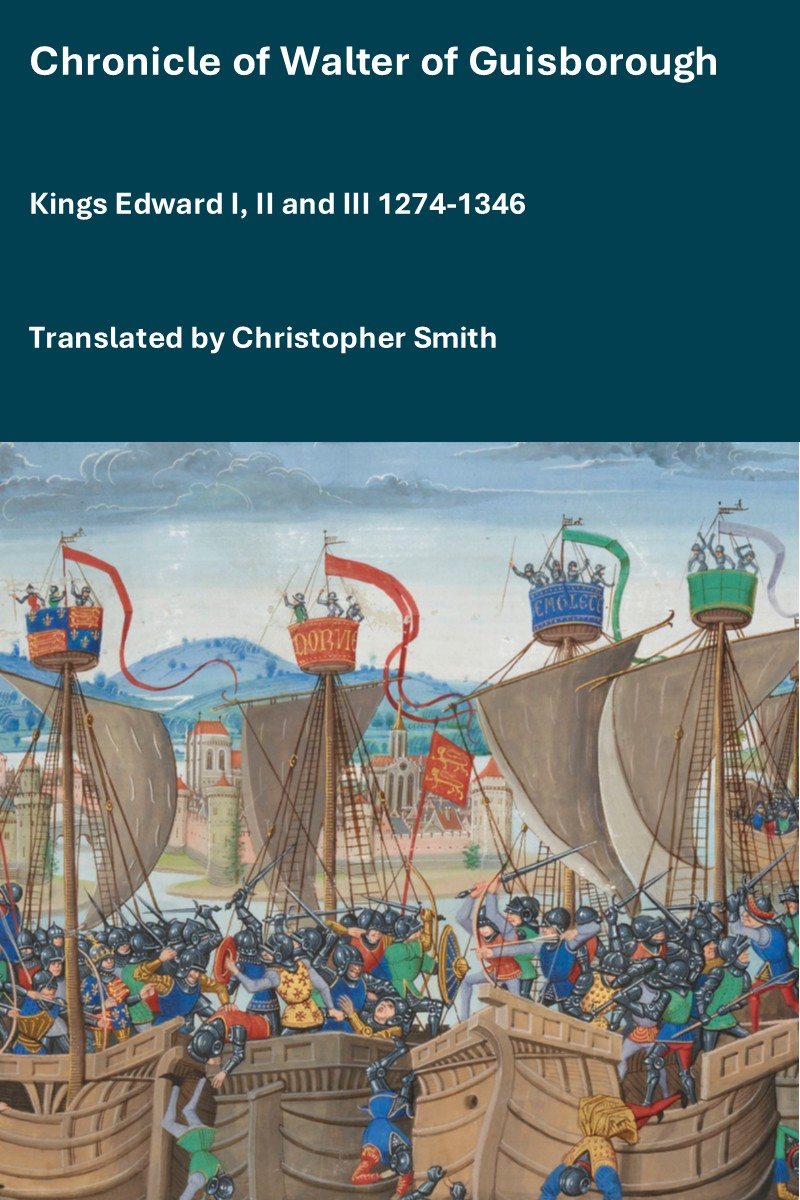
All About History Books
The Chronicle of Walter of Guisborough, a canon regular of the Augustinian Guisborough Priory, Yorkshire, formerly known as The Chronicle of Walter of Hemingburgh, describes the period from 1066 to 1346. Before 1274 the Chronicle is based on other works. Thereafter, the Chronicle is original, and a remarkable source for the events of the time. This book provides a translation of the Chronicle from that date. The Latin source for our translation is the 1849 work edited by Hans Claude Hamilton. Hamilton, in his preface, says: "In the present work we behold perhaps one of the finest samples of our early chronicles, both as regards the value of the events recorded, and the correctness with which they are detailed; Nor will the pleasing style of composition be lightly passed over by those capable of seeing reflected from it the tokens of a vigorous and cultivated mind, and a favourable specimen of the learning and taste of the age in which it was framed." Available at Amazon in eBook and Paperback.
On 5th February 1381 [his son] Henry Bolingbroke (age 13) and [his daughter-in-law] Mary Bohun (age 13) were married at Arundel Castle [Map]. She the daughter of Humphrey Bohun 7th Earl Hereford 6th Earl Essex 2nd Earl of Northampton and Joan Fitzalan Countess Essex, Hereford and Northampton (age 34). He the son of John of Gaunt 1st Duke Lancaster (age 40) and [his former wife] Blanche Duchess of Lancaster. They were second cousins. He a grandson of King Edward III of England. She a great x 2 granddaughter of King Edward I of England.
Chronicle of Adam of Usk [~1352-1430]. 15th June 1381. In this rising of the commons were many great men of the land in many places beheaded. The Savoy [Map], the palace of the duke of Lancaster (age 41) and the fairest in the kingdom, standing near London on the bank of Thames, was, from the commons' hatred of the duke, utterly destroyed by them with fire; and the duke himself, for fear of them, fled into Scotland1. To appease them and to quiet their fury, the [his nephew] king (age 14) granted that the state of villeinage, as well in their persons as in their labour, should be henceforth done away, freedom fully given, and all prisoners set at large. And this he commanded and made to be openly proclaimed throughout the counties of the kingdom. And then what a throe of grief passed through the desolated land! For they boasted that they would slay all those of higher birth, would raise up king and lords from among themselves, would stablish new laws, and, in a word, would make new, or rather - disfigure, the face and estate of the whole island. Then every man struck off the head of his enemy, and despoiled his richer neighbour. But, by the mercy of God, when their leader, being in Smithfield near London, doffed not his hood before the king nor in anything did reverence to the king's majesty, his head was deftly struck off, in the very midst of his flock of kites, by sir William Walworth, knight and citizen of London; and straightway, being raised on the point of a sword, it was shown before them. Then the commons in sore dread sought flight by stealth, and there and then casting away their rebellious weapons, as though unguilty of such riot and wickedness, like foxes into their holes, they pitifully crept home. But the king and the lords pursued them, and some they made to be dragged behind horses, some they slew with the sword, some they hanged on the gallows, some they quartered; and they destroyed thousands2.
Note 1. John of Gaunt was at this time in the north, negotiating a truce with Scotland. Knighton (ij. 143-7) tells us that so unpopular was his name that his duchess was refused admission into his own castle at Pontefract [Map], and that he himself was denied hospitality by the earl of Northumberland; and that it was reported that a large force of the insurgents was sent north in pursuit of him. He retired to Edinburgh on a safe-conduct from the Scots, by whom he was well entertained.
Note 2. The severity of the punishments inflicted after the suppression of the outbreak is fully set forth in the pages of Walsingham's History. Richard, however, interfered to prevent indiscriminate slaughter of the insurgents when first beaten in the field.— Wals. Hist. Angl. (Rolls series), i. 466.
Become a Member via our Buy Me a Coffee page to read complete text.
Patent Rolls. 15th June 1381. Commission of oyer and terminer to William Walleworth, mayor of London, Robert Bealknapp, Robert Knolles, Nicholas Brembre, John Philipot, Robert Launde, and William Cheyne, on information that great crowds of labourers and others have collected together, especially in the counties of Essex, Kent, Surrey, Sussex, and Middlesex, compelled their betters to go with them, killed many of the king's lieges, and burned many houses, entered the city of London, and burned the house of the king's uncle John, duke of Lancaster (age 41), called the 'Sauveye [Map],' and the priory in Clerkenwelle of the Hospital of St. John of Jerusalem in England, and killed Simon, archbishop of Canterbury (deceased) and chancellor, and Robert de Hales (deceased), prior of the said Hospital. By К. June 15. London.
On 5th October 1382 [his sister] Isabella Countess Bedford and Soissons (age 50) died.
In December 1384 Thomas Wendesley (age 40) was retained for life by John of Gaunt 1st Duke Lancaster (age 44) in peace and war at an annual fee of 20 marks, charged upon the township of Bensall in Derbyshire [Note. Possibly Bonsall, Derbyshire [Map]]. The benefits were certainly not all one-sided, for Wensley was expected to use his own influence as a member of the local bench and crown commissioner on the duke's behalf when the occasion demanded.
On 6th August 1385 [his brother] Edmund of Langley 1st Duke of York (age 44) was created 1st Duke York by [his nephew] King Richard II of England (age 18). [his sister-in-law] Isabella of Castile Duchess York (age 30) by marriage Duchess York.
[his brother] Thomas of Woodstock 1st Duke of Gloucester (age 30) was created 1st Duke Albemarle, and around the same time, 1st Duke Gloucester. [his sister-in-law] Eleanor Bohun Duchess Gloucester (age 19) by marriage Duchess Albemarle and Duchess Gloucester.
On 24th June 1386 [his son-in-law] John Holland 1st Duke Exeter (age 34) and [his daughter] Elizabeth Lancaster Duchess Exeter (age 23) were married at Plymouth, Devon [Map]. She the daughter of John of Gaunt 1st Duke Lancaster (age 46) and [his former wife] Blanche Duchess of Lancaster. He the son of Thomas Holland 1st Earl Kent and [his former sister-in-law] Joan "Fair Maid of Kent" Princess Wales. They were half second cousin once removed. He a great grandson of King Edward I of England. She a granddaughter of King Edward III of England.
On 2nd February 1387 [his son-in-law] King John I of Portugal (age 35) and [his daughter] Philippa of Lancaster Queen Consort Portugal (age 26) were married. She by marriage Queen Consort Portugal. She the daughter of John of Gaunt 1st Duke Lancaster (age 46) and [his former wife] Blanche Duchess of Lancaster. He the son of Peter I King Portugal and Inês Castro. They were half fourth cousins. He a great x 5 grandson of King Henry "Curtmantle" II of England. She a granddaughter of King Edward III of England.
On 19th December 1387 an army of the Lords Appellant led by the future [his son] King Henry IV of England (age 20) prevented the forces of [his nephew] King Richard II of England (age 20) commanded by Robert de Vere 1st Duke Ireland (age 25) from crossing the bridge [Map] over the River Thames at Radcot in Oxfordshire. When [his brother] Thomas of Woodstock 1st Duke of Gloucester (age 32) arrived with further Lord Appellant's men the King's men were encircled. The King's men attempted to force the crossing of the bridge at which time the only casualties occurred including Thomas Molyneux (age 49) who was killed by Thomas Mortimer (age 37). Around 800 men drowned in the marshes whilst trying to escape. Robert de Vere 1st Duke Ireland narrowly escaped to France.
In February 1388 Thomas Wendesley (age 44) was commissioned to arrest persons charged with damaging John of Gaunt's (age 47) property.
Before 17th September 1388 [his son-in-law] Henry III King Castile (age 8) and [his daughter] Catherine of Lancaster Queen Consort Castile (age 15) were married at Palencia Cathedral [Map]. She by marriage Queen Consort Castile. She the daughter of John of Gaunt 1st Duke Lancaster (age 48) and [his wife] Constance of Castile Duchess of Lancaster (age 34). He the son of John I King Castile (age 30) and Eleanor Barcelona Queen Consort Castile. They were half second cousins. She a granddaughter of King Edward III of England.
In September 1389 the Scrope vs Grosvenor Case was brought to the Court of Chivalry. Up to that time two families, Scrope and Grosvenor, had been using the armorial  Scrope Arms: Azure, a bend or.
Several hundred witnesses were called including John of Gaunt 1st Duke Lancaster (age 49), Geoffrey Chaucer (age 46) and John Savile of Shelley and Golcar (age 64).
On 3rd September 1386 Owain ap Gruffudd "Glyndŵr" Mathrafal Prince Powys (age 27) gave evidence at the Church of John the Baptist, Chester [Map].
The Court decided in favour of Scrope.
Neither party was happy with the decision so [his nephew] King Richard II (age 22) was called upon to give his personal verdict.
On 27th May 1390 he confirmed that Grosvenor could not bear the undifferenced arms.
As a consequence of the case the Grosvenor has for many years used the name Bendor for horses and nicknames.
Become a Member via our Buy Me a Coffee page to read complete text.
In 1391 [his son-in-law] Robert Ferrers (age 18) and [his illegitimate daughter] Joan Beaufort Countess of Westmoreland (age 12) were married at Beaufort en Vallée [Map]. She the illegitmate daughter of John of Gaunt 1st Duke Lancaster (age 50) and [his future wife] Katherine Swynford aka Roet Duchess Lancaster (age 40).
On 23rd December 1392 [his sister-in-law] Isabella of Castile Duchess York (age 37) died. She was buried at King's Langley Priory, Hertfordshire [Map]. She the wife of [his brother] Edmund of Langley 1st Duke of York (age 51). Isabella had travelled to England with her sister [his wife] Constance of Castile Duchess of Lancaster (age 38) who had married Edmund's elder brother John of Gaunt 1st Duke Lancaster (age 52). Isabella and Edmund's marriage was not, apparently, a happy one. She is known to have had an affair with [his son-in-law] John Holland 1st Duke Exeter (age 40) who may have been the father of [his nephew] Richard of Conisbrough 1st Earl Cambridge (age 7) progenitor of the House of York.
On 4th November 1393 [his brother] Edmund of Langley 1st Duke of York (age 52) and [his sister-in-law] Joan Holland Duchess York (age 13) were married. She by marriage Duchess York. The difference in their ages was 38 years. She the daughter of Thomas Holland 2nd Earl Kent (age 43) and Alice Fitzalan Countess Kent (age 43). He the son of [his father] King Edward III of England and [his mother] Philippa of Hainault Queen Consort England. They were half second cousin once removed. She a great x 2 granddaughter of King Edward I of England.
On 24th March 1394 [his wife] Constance of Castile Duchess of Lancaster (age 40) died at Leicester Castle [Map]. She was buried at Church of the Annunciation of our Lady of the Newark [Map].
On 13th January 1396 John of Gaunt 1st Duke Lancaster (age 55) and Katherine Swynford aka Roet Duchess Lancaster (age 45) were married at Lincoln Cathedral [Map]. She by marriage Duchess Lancaster. He the son of King Edward III of England and Philippa of Hainault Queen Consort England.
Froissart Book 4 Chapter 73. [13th January 1396]. At this period, the duke of Lancaster (age 55) married his third wife [[his wife] Katherine Swynford aka Roet Duchess Lancaster (age 45)], the daughter of a Hainault knight, called sir Paon de Ruet: he had formerly been one of the knights to the good and noble queen [his mother] Philippa of England, who much loved the Hainaulters, as she was herself of that country.
This lady whom the duke of Lancaster married was called Catherine, and in her youth had been of the household of the duchess [his former wife] Blanche of Lancaster. Before the lady Blanche's death, and even when the duke was married to his second wife [his former wife] Constance, the daughter of don Pedro, he cohabited with the lady Catherine de Ruet, who was then married to an English knight [Hugh Swynford] now dead.
The duke of Lancaster had three children1 by her, previous to his marriage, two sons and a daughter: the eldest son was named [his illegitimate son] John (age 23) lord Beaufort of Lancaster; the other [his illegitimate son] Thomas [Henry] (age 21), whom the duke kept at the schools in Oxford, and made a great churchman and civihan. He was afterward bishop of Lincoln, which is the richest bishopric in the kingdom: from affection to these children, the duke married their mother, to the great astonishment of France and England, for Catherine Swynford was of base extraction in comparison to his two former duchesses Blanche and Constance. When this marriage was announced to the ladies of high rank in England, such as the [his sister-in-law] duchess of Gloucester (age 30), the countess of Derby2, the countess of Arundel (age 20), and others connected with the royal family, they were greatly shocked, and thought the duke much to blame. They said, "he had sadly disgraced himself by thus marrying his concubine;" and added, that, "since it was so, she would be the second lady in the kingdom, and the queen (age 6) would be dishonourably accompanied by her; but that, for their parts, they would leave her to do the honours alone, for they would never enter any place where she was. They themselves would be disgraced if they suffered such a base-born duchess, who had been the duke's concubine a long time before and during his marriages, to take precedence, and their hearts would burst with grief were it to happen." Those who were the most outrageous on the subject were the [his brother] duke (age 41) and duchess of Gloucester. They considered the duke of Lancaster as a doating fool for thus marrying his concubine, and declared they would never honour his lady by calling her sister. The [his brother] duke of York (age 54) made light of the matter, for he lived chiefly with the king and his brother of Lancaster. The duke of Gloucester was of a different way of thinking: although the youngest of the three brothers, he yielded to no man's opinion, was naturally very proud and overbearing, and in opposition to the king's ministers, unless he could turn them as he willed. Catherine Ruet, however, remained duchess of Lancaster, and the second lady in England, as long as she lived. She was a lady accustomed to honours, for she had been brought up at court during her youth, and the duke fondly loved the children he had by her, as he showed during his life and at his death.
Note 1. Froissart mistakes in the number, and Thomas for Henry. According to Sandford, he had four children by Catherine Swynford: — John Beaufort, earl of Somerset, — Henry Beaufort, bishop of Winchester and cardinal of Beaufort, — [his illegitimate son] Thomas Beaufort (age 19), duke of Exeter and earl of Dorset, — [his illegitimate daughter] Joan Beaufort (age 17), countess of Westmoreland. For farther particulars, see Sandford and Dugdale.
Note 2. This reference to the Countess of Derby is confusing. In 1396 the Earl of Derby was [his son] Henry (age 28), future King Henry IV, who inherited the title from fhis mother Blanche when she died in 1368. Henry's first wife [his former daughter-in-law] Mary Bohun had died in 1394, and he marired his second wife [his future daughter-in-law] Joanna of Navarre Queen Consort England (age 26) in 1403?
Become a Member via our Buy Me a Coffee page to read complete text.
Life Charles VI by a Monk of St Denis [~1420]. Among all that was to be done, the king, with utmost diligence, intended to make the marriage of his firstborn daughter Lady Isabella (age 6) and the King of England conspicuous and in his presence; having been prevailed upon by the king with strong prayers, he sent to him the Duke of Burgundy, his uncle, to inquire how this could be accomplished more advantageously and honourably. He, according to the custom of the firstborn, recommending his departure to blessed Denis, when he had reached Guînes, a town in Picardy, on the vigil of the Assumption of the Blessed Virgin Mary [15th August 1396], met the Counts of the Marshal and of [his nephew] Rutland (age 23); thence he encountered the prelates of the kingdom of England, and subsequently the Dukes of Lancaster (age 56) and [his brother] Gloucester (age 41), the king's uncles, accompanied by five hundred knights and squires, who escorted him with musical instruments all the way to Calais.
Inter omnia gerenda, rex, summa sollicitudine intendens connubium filie sue primogenite domine Ysabellis et regis Anglie reddere conspicuum et in ejus presencia, ipsius regis victus vallidis precibus, ad eum ducem Burgundie patruum suum misit, ad querendum qualiter id commodius et honorificencius agi posset. Qui, primogenitorum more, recessum suum beato Dyonisio recommendans, cum Guinnas, Picardie villam, attigisset, vigilia Assumpcionis beate Marie, comites Marescalli ac Rotlandi obvios habuit, inde regni Anglie prelatos, ac successive Lencastrie et Glocestrie duces, patruos regis, quingentis militibus et armigeris stipatos, qui eum cum instrumentis musicis usque Calesium conduxerunt.
Life Charles VI by a Monk of St Denis [~1420]. [30th October 1396] Thus far awaited by the kings, Lady Isabelle, with a retinue of distinguished ladies adorned with golden and gem-studded garlands, also mounted on horses adorned with royal trappings, then arrived. If you had attended to their appearance, you would have undoubtedly said that it was the assembly of goddesses and a ritual long imagined renewed. To recount each detail that made the royal virgin conspicuous at that time would be long; but using brevity, it is hardly recalled in the memory of men to have seen in the annals of history any authority with such a rich flow of horses, chariots, and litters, and such a noble retinue of barons and knights soliciting the marriage of a foreign prince. Therefore, in royal attire, adorned with golden embroidered lilies and a golden diadem, while the kings, as previously mentioned, were exiting from their tents to celebrate mutual conversation near the aforementioned pallium; with trumpets and sweetly resonating musical instruments, she was led to her father's place. And no sooner had they arrived to honour her properly than the [his wife] Duchess of Lancaster (age 45) and the [his sister-in-law] Duchess of Gloucester (age 30) soon approached her. With them, also, the Dukes of Orléans, Bitturiae, and Burgundy were present, who, receiving her in their arms, honourably presented her to King Richard of England. When he had greeted her twice on bent knee, satisfied with this reverence, and leaving his seat, he gently embraced her with the kiss of peace in the presence of her father, who then directed a word to him: "Behold," he said, "my son, the daughter whom I had promised you; I leave her to you, asking that you henceforth love her as your own wife."
When he had willingly pledged this, having given a kiss to his father and parents with tears, he made her be led to Calais. Then, celebrating a solemn banquet for the King of France, he honoured him more courteously than usual; for he not only granted him the right-hand seat, but also had dishes brought in successively served during the meal, with counts of royal lineage being present, who, serving him honourably, offered bread and cups in royal fashion. Then the kings reclined alone; to whom, during the meal, the dukes of both parties were obedient, proceeding with all kinds of dishes. When this was completed, when the King of England had taken cups from the hand of the Duke of Lancaster (age 56), and the King of France from the hand of the Duke of Orléans, they offered each other the following gifts. A solid gold vessel, suitable for offering dishes, with a sumptuous necklace was granted by the father to the son; who, not being ungrateful to his father, presented another necklace. Following his example, the Duke of Lancaster gave one other to himself, exceeding in value what he had recently received as a gift from King John of France. When these matters were completed, when the kings had proceeded on horseback up to the pallium, and the King of England, receiving a diamond and a sapphire of immense value, had compensated for the gifts of his father with the two best right-hand men, then with mutual farewell spoken, they mixed kisses of peace, and thus each joyfully returned to their own.
Hucusque ab ipsis regibus expectata domina Ysabellis cum comitiva insignium dominarum in sertis aureis et gemmatis, equis eciam cultu regio faleratis insedencium, tunc advenit. Quarum si apparatum attendisses, olim fictum dearum contubernium et ritum dixisses procul dubio renovatum. Referre singula, que regiam virginem tunc reddiderunt conspicuam, longum esset; sed breviloquio utens, memoria hominum minime recolebat in annalibus vidisse hujus auctoritatis aliquam cum tanto divite fluxu equorum, curruum et lecticarum, tamque nobili comitiva baronum et militum extranei principis peciisse connubium. Cultu itaque regio, aureis contexto liliis, aureoque dyademate insignita, interim dum reges, modo quo superius dictum est, de tentoriis exeuntes, ad sepedictum pallum colloquium mutuum celebrarent; cum lituis et instrumentis musicis dulciter resonantibus ad locum paternum perducitur. Nec mora, ut eam honore debito prevenirent, Lencastrie et Glocestrie ducisse mox ad eam accesserunt. Cum duce eciam Aurelianensi Biturie et Burgundie duces affuerunt, qui eam in ulnis suscipientes ipsam regi Anglie Richardo honorifice obtulerunt. Quem cum bis flexis genibus salutasset, hac reverencia contentus, et sedem suam relinquens, eam cum pacis osculo dulciter amplexatus est in patris presencia, qui tunc ad eum verbum dirigens: "Ecce, inquit, filiam, fili mi, quam vobis promiseram, relinquo, rogans ut eam deinceps ut uxorem propriam diligatis."
Quod cum libenti animo spopondisset, cum patri et parentibus osculum cum lacrimis prebuisset, eam ad Calesium duci fecit. Tunc regi Francie celebrans solemne convivium, eum solito curialius honoravit; nam non solum sibi dexteram sedem concessit, sed et fercula allata successive ministrari durante prandio fecit, de genere regali adhibitis comitibus, qui sibi honorifice servientes, panem et pocula regio more offerrent. Soli tunc discubuerunt reges; quibus, durante prandio, duces utriusque partis obsequiosi fuerunt, omnia ferculorum genera precedendo. Quo peracto, cum rex Anglie de manu ducis Lencastrie, et rex Francie de manu ducis Aurelianensis pocula cum speciebus sumpsissent, hec sequencia munera sibi invicem obtulerunt. Vas quidem auri solidum, speciebus porrigendis aptum, cum sumptuoso monili pater filio concessit; qui nec ingratus existens patri monile aliud presentavit. Cujus exemplum dux Lencastrie sequutus, unum aliud sibi dedit in valore excedens quod a Johanne rege Francie dono nuper acceperat. Hiis peractis, cum reges equestres usque ad pallum processissent, et rex Anglie adamantem et saphirum ingentis valoris recipiens, et patris munera duobus dextrariis optimis compensasset, tunc cum mutuo vale dicto pacis oscula miscuerunt, et sic quisque letus ad propria remeavit.
Become a Member via our Buy Me a Coffee page to read complete text.
Before 29th November 1396 [his son-in-law] Ralph Neville 1st Earl of Westmoreland (age 32) and [his illegitimate daughter] Joan Beaufort Countess of Westmoreland (age 17) were married. She by marriage Baroness Neville Raby. She the illegitmate daughter of John of Gaunt 1st Duke Lancaster (age 56) and [his wife] Katherine Swynford aka Roet Duchess Lancaster (age 46). They were half fifth cousins. He a great x 5 grandson of King Henry "Curtmantle" II of England. She a granddaughter of King Edward III of England.
Parliament Rolls Richard II. 4th February 1397. 28. Be it remembered that on Tuesday, the fifteenth day of the parliament [4 February 1397], the chancellor (age 53), by order of the [his nephew] king (age 30), declared that our holy father the pope, in reverence of the most excellent person of the king and his honourable uncle the duke of Guyenne and of Lancaster (age 56), and of his blood, has enabled and legitimized my lord [his illegitimate son] John Beaufort (age 24), his brothers [Note. [his illegitimate son] Cardinal Henry Beaufort (age 22) and [his illegitimate son] Thomas Beaufort 1st Duke Exeter (age 20)], and his [his illegitimate daughter] sister (age 18). And therefore our lord the king, as sole ruler of his kingdom of England, for the honour of his blood, willed and enabled of his abundant royal power, and legitimized, of his own authority, the said John, his said brothers, and sister. And he also pronounced and published the ability and legitimation, according to the form of the charter of the king made thereon.
29. Which charter was read in full parliament, and delivered to the said duke, father of the said John, and his said brothers and sister; the tenor of which charter follows:
Richard, by the grace of God, king of England and France and lord of Ireland, to our most beloved kinsmen the noble John, knight, Henry, cleric, Thomas, donzel, and our beloved noblewoman Joan Beaufort, lady-in-waiting, our most beloved cousins born of our uncle that noble man John duke of Lancaster, our lieges, greeting and the goodwill of our royal majesty. While inwardly considering how endlessly and with how many honours of parental and sincere affection of our aforementioned uncle and of his mature counsel we are on all sides blessed, we have judged it appropriate and worthy that in consideration of his merits, and in contemplation of the grace of persons, we should endow you, who are resplendent with probity and virtuous life and conduct, and are born of royal stock and divinely marked with many virtues and gifts, with the protection of grace and favour by special prerogative. Thus it is that, yielding to the prayers of our said uncle, your father, we grant to you who, so it is claimed, have suffered such defect of birth, that, notwithstanding this defect, which, together with its various consequences, we wish to be fully included in these presents, you may nevertheless receive all honours, dignities, preferments, estates, degrees, and public and private offices, both perpetual and temporal, and feudal and noble rights, by whatsoever name they are called, such as duchies, lordships, earldoms, baronies, or whatsoever other fiefs they be, whether they be dependent upon or held of us mediately or intermediately, which may be preferred, promoted, elected, taken up and allowed, and received, retained, performed and exercised prudently, freely and lawfully, as if you were born in wedlock, notwithstanding any statutes or customs of our kingdom of England decreed or observed to the contrary; and we dispense you [from this defect] by the tenor of these presents, by the plenitude of our royal power and with the assent of our parliament; and we restore you and each of you to legitimacy.
Become a Member via our Buy Me a Coffee page to read complete text.
Parliament Rolls Richard II. 30. Also, on the Saturday [10 February 1397], the chancellor (age 53) announced by the [his nephew] king's (age 30) command that reason willed that one should honour and enhance the estate of worthy and virtuous persons. Wherefore the king considering the nobility and virtue of his cousin [his illegitimate son] Sir John Beaufort (age 24), son of his uncle of Guyenne and Lancaster (age 56), and the great honour he had done his person on various expeditions and labours in many kingdoms and lands overseas, to the great honour of the king and kingdom; and also to encourage him and others to do such honour; and also to strengthen the royal sceptre which could best be supported in honour by worthy and valiant persons had, of his royal dignity and special grace, made and created the said John an earl, and given him the name and honour of the Earl of Somerset, to have to him and his male heirs lawfully engendered of his body, with twenty pounds a year to be taken from the issues and profits of the county of Somerset for his title and the name of earl.
Note. On 10th February 1397 John Beaufort 1st Marquess Somerset and Dorset was created 1st Earl Somerset
All About History Books
The Chronicle of Walter of Guisborough, a canon regular of the Augustinian Guisborough Priory, Yorkshire, formerly known as The Chronicle of Walter of Hemingburgh, describes the period from 1066 to 1346. Before 1274 the Chronicle is based on other works. Thereafter, the Chronicle is original, and a remarkable source for the events of the time. This book provides a translation of the Chronicle from that date. The Latin source for our translation is the 1849 work edited by Hans Claude Hamilton. Hamilton, in his preface, says: "In the present work we behold perhaps one of the finest samples of our early chronicles, both as regards the value of the events recorded, and the correctness with which they are detailed; Nor will the pleasing style of composition be lightly passed over by those capable of seeing reflected from it the tokens of a vigorous and cultivated mind, and a favourable specimen of the learning and taste of the age in which it was framed." Available at Amazon in eBook and Paperback.
Parliament Rolls Richard II. 32. The [his nephew] king (age 30) to his archbishops, bishops, abbots, priors, dukes, earls, barons, justices, sheriffs, reeves, ministers, and other his bailiffs and faithful men, greeting. Know that we, considering the strenuous probity and prudent mind, distinguished conduct and nobility of birth of our beloved and faithful kinsman [his illegitimate son] John Beaufort (age 24), knight, son of our beloved uncle John duke of Aquitaine and Lancaster (age 56), and willing therefore deservedly to exalt the same John Beaufort with the prerogative of honour, we do appoint and create John Beaufort earl of Somerset in our present parliament, and invest him with the style and name and honour of the aforesaid earl by girding him with the sword, to have to him and his male heirs issuing from his body in perpetuity. And that the same earl and his aforesaid heirs, given such name and honour, may the better and more honourably support the burdens incumbent upon the same, of our special grace in our present parliament we have given and granted, and by this our charter confirmed, to the same earl and his aforesaid heirs twenty pounds to be received each year from the issues of the aforesaid county by the hand of the sheriff of that county for the time being, at the terms of Easter and Michaelmas [29 September] in equal portions, in perpetuity. Witnessed by these, the venerable father Thomas archbishop of Canterbury (age 44) primate of all England, John of Aquitaine and Lancaster, and [his brother] Edmund of York (age 55), dukes; Robert of London, William of Winchester (age 77), John of Ely, Edmund of Exeter, our chancellor (age 53), bishops; [his son] Henry of Derby (age 29), [his nephew] Edward of Rutland (age 24), Thomas of Nottingham and marshal of England (age 28), earls; Reginald Grey (age 35), [his son-in-law] Ralph Neville (age 33), John Lovell, knights; Roger Walden dean of York, our treasurer, Thomas Percy (age 54), steward of our household, Guy Mone, keeper of our privy seal, and others. Given by our hand at Westminster on 10 February in the twentieth year of our reign [10th February 1397].
Become a Member via our Buy Me a Coffee page to read complete text.
Around 8th September 1397 [his brother] Thomas of Woodstock 1st Duke of Gloucester (age 42) was murdered in Calais [Map] for his role as leader of the Lords Appellant. Duke Albemarle, Duke Gloucester, Earl Essex forfeit. His son [his nephew] Humphrey (age 16) succeeded 2nd Earl Buckingham.
Walter Clopton was part of the inquiry into his death the outcome of which is not known. A John Hall was executed for the murder.
On 27th November 1397 [his illegitimate son] John Beaufort 1st Marquess Somerset and Dorset (age 24) and [his granddaughter-in-law] Margaret Holland Duchess Clarence (age 12) were married. She by marriage Countess Somerset. She the daughter of Thomas Holland 2nd Earl Kent and Alice Fitzalan Countess Kent (age 47). He the illegitmate son of John of Gaunt 1st Duke Lancaster (age 57) and [his wife] Katherine Swynford aka Roet Duchess Lancaster (age 47). They were half third cousins. He a grandson of King Edward III of England. She a great x 2 granddaughter of King Edward I of England.
Froissart Book 4 Chapter 94. Before 16th September 1398. The two earls, in the mean time, were making every preparation for their combat. The duke of Lancaster (age 58) never went near the king, and as seldom saw his [his son] son (age 31), acting throughout with great good sense. He knew the earl of Derby was very popular with all ranks in England, but more particularly with the Londoners, who waited on him, and addressed him, - "Earl of Derby, make your mind easy: whatever may be the event of this combat it will turn out to your honour, in spite of the king and all his minions. We know well how things are managed, and what will be the result of them: this accusation has been invented by envy, to cause your banishment out of the kingdom, where they are aware you are so greatly beloved by all ranks and sexes; and should you be forced to quit us in sorrow, you shall return in joy, for you are more worthy to rule than [his nephew] Richard of Bordeaux (age 31). Whoever may choose to search the matter to the bottom, to discover the real origin of you both, will soon see that you have a greater right to the crown of England than he who wears it, although we have paid him homage, and acknowledged him for king these twenty years; but that was obtained by the entreaties of your grandfather, king Edward of happy memory, who was suspicious of what we hint, and feared the consequences. There was once a serious dispute on this subject between king Edward and your grandfather by your mother's side, duke Henry of Lancaster, but the great lords interfered and made up matters between them. King Edward was valiant and successful in all his enterprises, and had gained the love of his subjects high and low. Your grandfather of Lancaster only required from the king what was just, and served him and his kingdom so loyally, that his conduct deserved the commendation of all. Every one who knew him called him their old father. These things are worthy of king Richard's consideration, and may make him repent, if anything can, at his leisure, that he has not more prudently governed." Such conversations did many of the nobles and citizens of London hold with the earl of Derby, who was pleased with their affection, and received them kindly. He did not, however, neglect any preparations for his combat, but sent to every one of his friends throughout England, to entreat their company at the appointed day and place.
Become a Member via our Buy Me a Coffee page to read complete text.
Froissart Book 4 Chapter 95. 16th September 1398. Not long after this, the [his nephew] king of England (age 31) summoned a large council of the great nobles and prelates at Eltham [Map]. On their arrival, he placed his two uncles of Lancaster (age 58) and [his brother] York (age 57) beside him, with the earls of Northumberland (age 56), Salisbury (age 48) and [his son-in-law] Huntingdon (age 46). The [his son] earl of Derby (age 31) and the earl marshal (age 30) were sent for, and put into separate chambers, for it had been ordered they were not to meet. The king showed he wished to mediate between them, notwithstanding their words had been very displeasing to him, and ought not to be lightly pardoned. He required therefore that they should submit themselves to his decision; and to this end sent the constable of England, with four great barons, to oblige them to promise punctually to obey it. The constable and the lords waited on the two earls, and explained the king's intentions They both bound themselves, in their presence, to abide by whatever sentence the king should give. They having reported this, the king said, "Well then, I order that the earl marshal, for having caused trouble in this kingdom, by uttering words which he could not prove otherwise than by common report, be banished the realm: he may seek any other land he pleases to dwell in, but he must give over all hope of returning hither, as I banish him for life. I also order, that the earl of Derby, our cousin, for having angered us, and because he has been, in some measure, the cause of the earl marshal's crime and punishment, prepare to leave the kingdom within fifteen days, and be banished hence for the term of ten years, without daring to return unless recalled by us; but we shall reserve to ourself the power of abridging this term in part or altogether." The sentence was satisfactory to the lords present, who said: "The earl of Derby may readily go two or three years and amuse himself in foreign parts, for he is young enough; and, although he has already travelled to Prussia, the Holy Sepulchre, Cairo and Saint Catherine's1, he will find other places to visit. He has two sisters, queens of [his daughter] Castillo (age 25) and of [his daughter] Portugal (age 38), and may cheerfully pass his time with them. The lords, knights and squires of those countries, will make him welcome, for at this moment all warfare is at an end. On his arrival in Castille, as he is very active, he may put them in motion, and lead them against the infidels of Granada, which will employ his time better than remaining idle in England. Or he may go to Hainault, where his cousin, and brother in arms, the count d'Ostrevant, will be happily to see him, and gladly entertain him, that he may assist him in his war against the Frieslanders. If he go to Hainault, lie can have frequent intelligence from his own country and children. He therefore cannot fail of doing well, whithersoever he goes; and the king may speedily recall him, through means of the good friends he will leave behind, for he is the finest feather in his cap; and he must not therefore suffer him to be too long absent, if he wish to gain the love of his subjects. The earl marshal has had hard treatment, for he is banished without hope of ever being recalled; but, to say the truth, he has deserved it, for all this mischief has been caused by him and his foolish talking: he must therefore pay for it." Thus conversed many English knights with each other, the day the king passed sentence on the earl of Derby and the earl marshal.
Note 1. The monastery on Mount Sinai. - Ed.
Become a Member via our Buy Me a Coffee page to read complete text.
Froissart Book 4 Chapter 96. After 19th October 1398. When the day of his exile drew near, he went to Eltham where the [his nephew] king (age 31) resided. [his son] He found there his father (age 58), the [his brother] duke of York (age 57) his uncle, and with them the earl of Northumberland (age 56), sir Henry Percy (age 34) his son, and a great many barons and knights of England, vexed that his ill fortune should force him out of England. The greater part of them accompanied him to the presence of the king, to learn his ultimate pleasure as to this banishment. The king pretended that he was very happy to see these lords: he entertained them well, and there was a full court on the occasion. The earl of Salisbury (age 48), and the [his son-in-law] earl of Huntingdon (age 46), who had married the duke of Lancaster's [his daughter] daughter (age 35), were present, and kept near to the earl of Derby (age 31), whether through dissimulation or not I am ignorant. When the time for the earl of Derby's taking leave arrived, the king addressed his cousin with great apparent humility, and said, "that as God might help him, the words which had passed between him and the lord marshal had much vexed him; and that he had judged the matter between them to the best of his understanding, and to satisfy the people, who had murmured greatly at this quarrel. Wherefore, cousin," he added, "to relieve you somewhat of your pain, I now remit four years of the term of your banishment, and reduce it to six years instead often. Make your preparations, and provide accordingly." "My lord," replied the earl, "I humbly thank you; and, when it shall be your good pleasure, you will extend your mercy." The lords present were satisfied with the answer, and for this time were well pleased with the king's behaviour, for he received them kindly. Some of them returned with the earl of Derby to London. The earl's baggage had been sent forward to Dover, and he was advised by his father, on his arrival at Calais, to go straight to Paris, and wait on the king of France (age 29) and his cousins the princes of France, for by their means he would be the sooner enabled to shorten his exile than by any other. Had not the duke of Lancaster earnestly pressed this matter, like a father anxious to console his son, he would have taken the direct road to the count d'Ostrevant in Hainault.
Become a Member via our Buy Me a Coffee page to read complete text.
Thomas Walsingham [~1422]. After whose death [John of Gaunt's (age 58)], the King decreed that Lord Henry, his son—whom he had previously banished for ten years—should now be exiled in perpetuity; revoking his general letters patent, which had earlier been granted to him, allowing his attorneys during his absence (while he was banished) to prosecute claims for the release to him of any inheritances or successions that might fall to him, and that his homage might be deferred upon payment of a reasonable fine. By this action, it became clearer that the King did not sincerely love the Duke of Hereford, nor had he banished him merely because of the quarrels that had arisen between his family and that of the Duke of Norfolk, as had been alleged; but rather, as many said, for the purpose of seizing the goods of both Dukes.
Post cujus mortem, Rex Dominum Henricum, filium ejus, quem relegaverat ad decennium, exulare decrevit in perpetuum; revocans suas patentes litteras generales, quas sibi prius concesserat, quod in absentia ipsius, dum fuerat relegatus, geneles attornati sui possent prosequi pro liberatione sibi facienda petual de quibuscunque hæsreditatibus sive successionibus ipsum extunc contingentibus, et quod homagium suum respectaari posset pro fine rationabili faciendo. Quo facto, constabat manifestius Regem [non] sincere diligere Ducem Herfordia, nec eum relegasse nisi pro dissensionibus quæ potuissent oriri inter familias suas et Ducis Northfolchiæ, ut prætensum fuerat, sed occasione bona Ducubus occupandi, ut multi dicebant.
Thomas Walsingham [~1422]. [3rd February 1399] At this time, John, Duke of Lancaster (age 58), died; whose body was buried in the Church of St. Paul in London.
Hoc tempore obiit Johannes Dux Lankastriæ; cujus corpus in Ecclesia Sancti Pauli Londoniis est humatum.
On 3rd February 1399 John of Gaunt 1st Duke Lancaster (age 58) died at Leicester Castle [Map]. [his wife] Katherine Swynford aka Roet Duchess Lancaster (age 48) was by his side. His son Henry (age 31) succeeded 2nd Duke Lancaster, 7th Earl of Leicester. He was buried in the Choir of St Paul's Cathedral [Map] with his first wife [his former wife] Blanche Duchess of Lancaster.
[his nephew] King Richard II of England (age 32) witheld the future Henry IV's inheritance from him giving Henry reason to return to England to claim his lands and titles.
Close Rolls Richard II 1396 1399 V6. 7th June 1399. Westminster Palace [Map]. To the keepers, occupiers, receivers or farmers of the lordship of Kyngeston in Dorsete for the time being. Order so long as the same shall remain in the king's hand to pay to John Swelle esquire 20 marks a year, which by a writing indented, confirmed by the king, John late duke of Lancastre granted him for life, to be taken of the issues of the said lordship.
On 10th May 1403 [his former wife] Katherine Swynford aka Roet Duchess Lancaster (age 52) died. She was buried in Lincoln Cathedral [Map]. The monument is thought to be the work of Henry Yevele.
"Katherine's fine tomb chest of Purbeck marble, with its moulded plinth and lid, had armorial shields encircled by garters along each side; it was surmounted by a canopied brass depicting Katherine in her widow's weeds, and bearing her arms impaled with those of John of Gaunt, while above it was raised a vaulted canopy with trefoiled arches, cusped lozenges and miniature rose bosses. The canopy and associated stonework would have been painted in bright colours."
When John Leland visited the Cathedral in about 1540, he recorded that: "In the southe parte of the presbytery lyithe in 2. severalle highe marble tumbes in a chapell Catarine Swineforde, the 3. wife to John of Gaunt Duke of Lancaster, and Jane her dougtar Countes of Westmerland".
In 1654 John Evelyn's Diary: "The soldiers had lately knocked off most of the brasses from the gravestones".
At some point after this the position of the two monuments was changed and they now stand end to end.


On 31st July 1415, when [his grandson] King Henry V of England (age 28) was in Portchester Castle, Hampshire [Map] preparing to invade France, Edmund Mortimer 5th Earl March 7th Earl of Ulster (age 23) revealed the Southampton Plot to him. Henry Scrope 3rd Baron Scrope of Masham (age 42), Thomas Grey of Werke and Heaton (age 30), and [his nephew] Richard of Conisbrough 1st Earl Cambridge (age 30) were intending to replace King Henry V of England with Edmund Mortimer 5th Earl March 7th Earl of Ulster as King of England based on Edmund Mortimer 5th Earl March 7th Earl of Ulster having a better claim to the throne being descended from Edward III's second son [his brother] Lionel of Antwerp 1st Duke of Clarence whereas King Henry V of England was descended from the third son John of Gaunt 1st Duke Lancaster.
Robert Willoughby 6th Baron Willoughby (age 30), [his grandson-in-law] Richard de Vere 11th Earl of Oxford (age 29), Thomas Montagu 1st Count Perche 4th Earl Salisbury (age 27) and Thomas Camoys 1st Baron Camoys (age 64) sat in judgement.
On 16th December 1485 Catherine of Aragon was born to Ferdinand II King Aragon (age 33) and [his great granddaughter] Isabella Queen Castile (age 34) at the Palace of Alcalá de Henares, Madrid [Map]. She was possibly named after her Great Grandmother [his daughter] Catherine of Lancaster Queen Consort Castile daughter of John of Gaunt 1st Duke Lancaster and [his former wife] Constance of Castile Duchess of Lancaster. She a great x 3 granddaughter of King Edward III of England. Coefficient of inbreeding 3.23%. She married (1) 14th November 1501 her half third cousin once removed Prince Arthur Tudor, son of King Henry VII of England and Ireland and Elizabeth York Queen Consort England (2) 11th June 1509 her half third cousin once removed King Henry VIII of England and Ireland, son of King Henry VII of England and Ireland and Elizabeth York Queen Consort England, and had issue.


Henry Machyn's Diary. 28th February 1552. The xxviij day of Feybruarii was bered the nobull [lady the] contes of Penbroke (deceased), and syster to the late qwyne and wyffe [to the] nobull Kyng Henry the viij. late kyng, and the good lade [the] contes of Penbroke the wyche she ded at Benard Castle [Map], and so cared unto Powlls. Ther was a C. [Note. 100] powre men and women had mantylle fryse gownes, then cam the haroldes, [then] the corse, and a-bowt her viij baners rolls of armes, and then cam the mornars boyth lordes and knyghts and gentyll men, and then cam the lades mornars and gentyll women mornars ij C. [then the] gentyll men and gentyll women, and after cam in cotts ij C. servandes and odur servandes, and she was bered by the tombe of [the duke] of Lankaster [Note. At St Paul's Cathedral [Map]], and after her banars wher sett up over her [and her] armes sett on dyvers pelers,-the vj King Edward vjth.
Note. Funeral of the countess of Pembroke. King Edward in his Diary records the death of the countess of Pembroke on the 20th Feb. 1551–2. As sister to queen Katharine Parr, she was a person of high consideration. A magnificent canopied monument to William Herbert, earl of Pembroke, and his countess Anne, with their recumbent effigies, and kneeling effigies of their three children, Henry earl of Pembroke, sir Edward Herbert knt. and Anne lady Talbot, was erected in St. Paul's cathedral, next the monument of John of Ghent, duke of Lancaster, and is represented in a plate of Dugdale's History of St. Paul's.


All About History Books
The Chronicle of Abbot Ralph of Coggeshall describes the reigns of Kings Henry II, Richard I, John and Henry III, providing a wealth of information about their lives and the events of the time. Ralph's work is detailed, comprehensive and objective. We have augmented Ralph's text with extracts from other contemporary chroniclers to enrich the reader's experience. Available at Amazon in eBook and Paperback.
John Evelyn's Diary. 8th October 1641. Here I beheld the Palace [Map] wherein John of Gaunt and Charles V were born; whose statue stands in the market-place, upon a high pillar, with his sword drawn, to which (as I was told) the magistrates and burghers were wont to repair upon a certain day every year with ropes about their necks, in token of submission and penance for an old rebellion of theirs; but now the hemp is changed into a blue ribbon. Here is planted the basilisco, or great gun, so much talked of. The Lys and the Scheldt meeting in this vast city, divide it into twenty-six islands, which are united by many bridges, somewhat resembling Venice. This night I supped with the Abbot of Andoyne, a pleasant and courteous priest.

[his illegitimate daughter] Blanche Beaufort was born illegitimately to John of Gaunt 1st Duke Lancaster and Marie St Hilaire Hainault. She a granddaughter of King Edward III of England.
Parliament Rolls Richard II. 27. Be it remembered that the venerable father Thomas, archbishop of Canterbury, primate of all England, earnestly prayed to the lord king in the present parliament that whereas his church of Canterbury, by the gift and grant of his noble and holy progenitors, which the same king graciously confirmed, had such prerogative over the other churches of England that whatsoever archbishop of Canterbury for the time being had custody of all lordships, manors, tenements, and rents with appurtenances which were held of the same church in chief during the minority of the heirs of their tenants, even though the same tenants elsewhere held in chief of the lord king; and now concerning the castle and manor of Tonbridge, Kent [Map], which by virtue of this prerogative were in the custody of William de Courtenay, late archbishop of Canterbury now deceased, predecessor of the present archbishop, on the day on which he died, by reason of the minority of the heir of the earl of Stafford deceased, who held the aforesaid castle and manor from the aforesaid former archbishop in chief, dispute and controversy between the present archbishop and the executors of the will of the aforesaid late archbishop are pending at present. And whereas a certain composition was drawn up a short while ago between the archbishop of Canterbury and the prior and chapter of the church of Canterbury on the matter, it pleased the lord king, having inspected and examined that composition, to order a view and settlement of the matter for the peace and right of his said church of Canterbury, as should seem best to his royal majesty, to whose ordinance and decree on the foregoing the same archbishop proclaimed himself to be firmly obedient in all things, whereupon the same lord king immediately appointed the venerable fathers Robert archbishop of York, Robert Bishop of London and John Bishop of Ely, and John duke of Aquitaine and Lancaster, and John Earl of Huntingdon, and Thomas the earl marshal, to inspect and examine that composition, and further to discuss and settle the matter at their discretion, and fully to inform the lord king of what their deed and action should be. And later on Monday, the last day of the aforesaid parliament [10 February 1397], the archbishop of York, and the bishops, and the aforesaid duke and earls thus appointed by order of the lord king in the same parliament returned their decree and ordinance on the aforesaid matter by Walter Clopton, the lord king's justice, in this form - namely, that the third part of all manors, lands, and tenements of the inheritance of the aforesaid heir, and the issues, profits, and revenues of the same from the time of the death of the aforesaid late archbishop, should, according to the form of the aforesaid composition, remain and be in the hands of the aforesaid prior and chapter, to be used for their own purposes; and that two parts of the aforesaid lands and tenements, with the issues, profits, and revenues of the same two parts, should remain likewise in the hands of that prior and chapter, safely and securely to keep until the lord king shall have ordained to whom those said two parts of the issues, profits, and revenues shall be delivered and has declared his will thereon. And the castle of Tonbridge [Map] will be delivered to the aforesaid present archbishop of Canterbury without delay, to remain in his hands and keeping until the the coming of age of the aforesaid heir. The which ordinance and decree thus rendered by the archbishop of York, bishops, duke and earls, the aforesaid lord king, approving thereof, ordered to be placed on record on the roll of parliament at the request of the aforesaid present archbishop of Canterbury.
Become a Member via our Buy Me a Coffee page to read complete text.
Parliament Rolls Richard II. 33. Also, on the same Saturday [10 February 1397], a charter of the [his nephew] king made to the earl marshal touching his office of marshal of England, and the gold staff adorned with the emblem of the king's arms which he will carry in his office, was read and delivered to the said earl. The tenor of which charter follows:
The king to the same, greeting. Know that whereas recently by our letters patent of our special grace we granted to our beloved kinsman Thomas, Earl of Nottingham, the office of marshal of England, together with the name and honour of earl marshal, to have to him and his male heirs issuing from his body, with all the fees, profits, and appurtenances whatsoever pertaining in any way to the said office, in perpetuity; as is fully contained in the same letters. We, mindful of the gracious and laudable services often performed by the aforementioned earl, on either side of the sea, for the benefit and honour of us and our kingdom, at no small effort, cost, and charge to him; and wishing therefore to provide for the estate and honour of that earl, of our special grace have granted in our present parliament for us and our heirs to the same earl the said office, and the name, title, and honour of earl marshal of England, to have to him and his male heirs issuing from his body, together with all offices, commodities, profits and other appurtenances whatsoever, both in our courts and elsewhere, relating or pertaining in any way to the same office, in the same manner and as fully, freely, wholly, and peacefully as Thomas Brotherton, lately Earl of Norfolk and marshal of England, father of our beloved kinswoman Margaret Countess of Norfolk, [widow] of the aforesaid late earl, or Roger Bigod sometime Earl of Norfolk and marshal of England, or any other after the death of the same former earl, or the same present earl, had or held the said office of marshal of England in their time.
Willing further and granting for us and our heirs, that the office of marshal of our Bench before us, which John Wicks holds for the term of his life by our grant, and the office of marshal in our treasury which Richard Gascoigne holds for his life by grant of our beloved brother Thomas Earl of Kent, lately marshal of England, by our confirmation; and also the office of herald of the marshal before the steward and marshal of our household, which Guy Allesley holds for his life by grant of the lord Edward [III], late king of England, our grandfather, and by our confirmation; which offices after the death of the aforesaid John, Richard and Guy should revert to us and our heirs, after the death of the same John, Richard, and Guy shall remain to the aforementioned earl marshal, to have to him and his male heirs in perpetuity. And that the same offices, and all other offices in any of our courts and elsewhere, which pertained, and used to pertain to the said office of marshal of England in times past, shall be fully restored, annexed, and reunited to the said office of marshal of England in perpetuity. And that the same earl and his male heirs may give, grant, or confer those offices on any suitable persons freely and without hindrance as soon as they shall have fallen vacant by death, demise, resignation, surrender, or in any other way, notwithstanding any of our letters patent made to the contrary.
Considering also the vigour and nobility of that earl, and that he may in future the more fittingly and honourably perform and exercise the aforesaid office, we have granted for us and our heirs to the same present earl that he and his said male heirs, marshals of England, by virtue of their aforesaid office should have, carry, and bear, as well in the presence as in the absence of us and our heirs, a certain gold staff, with both ends enamelled in black, and with the emblem of our arms decorating the top of the said staff, and with the emblem of the arms of that earl decorating the bottom of the said staff; notwithstanding that the same present earl in his time, or the aforementioned former earls, or any other who had the said office of marshal of England before this time, used to carry or bear a wooden staff. Witnessed by these, the venerable fathers Thomas archbishop of Canterbury, primate of all England, Robert of London, William of Winchester, John of Ely, Edmund of Exeter, our chancellor, bishops; John of Aquitaine and Lancaster, [his brother] Edmund of York, dukes, our beloved uncles; [his son] Henry of Derby, [his nephew] Edward of Rutland, Henry of Northumberland, earls; Reginald Grey of Ruthin, Ralph Neville, John Lovell, knights; Roger Walden, dean of York, our treasurer, Thomas Percy, steward of our household, and others. Given by our hand at Westminster on 10 February 1397.
Become a Member via our Buy Me a Coffee page to read complete text.
Matthew Redman served in France and Spain under John of Gaunt 1st Duke Lancaster.
Parliament Rolls Richard II. 15. Also, as to the fourth article, touching the expenses of the [his nephew] king's household and the presence of bishops and ladies in his company, the king took great offence and affront in that the commons who were his lieges should wrongly take upon themselves or presume any ordinance or governance of the kingking's person, or his household, or other persons of standing whom it should please him to have in his company. And it seemed to the king that the commons committed a great offence therein against his regality and his royal majesty, and the liberty of himself and his honourable progenitors, which he was bound and willed to maintain and sustain by the aid of God. Wherefor the king ordered the said lords spiritual and temporal that on the following Saturday morning [3 February 1397] they should explain and declare in full to the said commons the king's will in the matter. And further, the king understanding that the said commons had been influenced and informed by a bill delivered to them to present and explain the said last article, so he ordered the duke of Guyenne and of Lancaster to charge Sir John Bushy, speaker for the commons, on his allegiance to recount and tell him the name of whomsoever submitted the said bill to the said commons.
Parliament Rolls Richard II. 5. The following are assigned to be triers of petitions from England, Ireland, Wales, and Scotland:
The duke of Guyenne and duke of Lancaster.
[his brother] The duke of Gloucester.
[his son] The Earl of Derby.
William Thirning.
William Rickhill.
John Wadham.
to act all together, or at least six of the aforesaid prelates and lords; consulting with the chancellor, treasurer, steward, and chamberlain, and also the king's serjeants when necessary. And they shall hold their session in the chamberlain's room near the Painted Chamber [Map].
Become a Member via our Buy Me a Coffee page to read complete text.
Parliament Rolls Richard II. 7. Also, the following Tuesday [23 January 1397], the commons presented Sir John Bushy as their common speaker, with whom the [his nephew] king was well pleased. And then the said Sir John prayed of the king that he might make a protestation that if he should say anything through ignorance or otherwise which had not been agreed by his companions, etc., that he might be corrected by his said companions; to which the king agreed, as he should by right and reason. And on the same day the duke of Lancaster asked the king to do justice to Sir Thomas Talbot, etc.. And then the chancellor explained to the commons that although he had explained in general the reason for summoning the parliament, on the morrow following, at eight o'clock [24 January 1397], the officers would explain it more particularly, that the commons might be better informed; and they were ordered to make haste in the business of parliament. And later the chancellor, at the king's command, charged all the lords spiritual and temporal to be at parliament each day at nine o'clock at the latest, and that no lord should absent himself in any way without the special permission of the king himself.
Parliament Rolls Richard II. 11. And further, on the other hand, the [his nephew] king, recalling that on the second day of parliament [23 January 1397], his uncle of Lancaster made him a request regarding certain grievances inflicted on him by Sir Thomas Talbot, whereof it was his wish that justice be done as an example to such lawlessness, and saying that had he been greater or lesser, of whatever condition he had been within his realm, who committed wrong, excess, or oppression against any of his lieges contrary to the law, of which he had knowledge of the truth, that he would deliver full justice and punishment thereon according to the law, whether he be of his blood of otherwise, showing no favour to anyone.
Kings Wessex: Great x 9 Grand Son of King Edmund "Ironside" I of England
Kings England: Son of King Edward III of England
Kings Scotland: Great x 8 Grand Son of King Duncan I of Scotland
Kings Franks: Great x 5 Grand Son of Louis VII King Franks
Kings France: Great x 9 Grand Son of Robert "Pious" II King France
Kings Duke Aquitaine: Great x 13 Grand Son of Ranulf I Duke Aquitaine
Philippa of Lancaster Queen Consort Portugal [1]
Catherine of Lancaster Queen Consort Castile [1]
Joan Beaufort Queen Consort Scotland [1]
King Richard III of England [1]
Anne Neville Queen Consort England [1]
King Henry VII of England and Ireland [1]
Catherine Parr Queen Consort England [1]
Jane Grey I Queen England and Ireland [1]
George Wharton [10]
Brigadier-General Charles Fitz-Clarence [28]
Queen Elizabeth II of the United Kingdom [133]
Queen Consort Camilla Shand [44]
Great x 4 Grandfather: King Henry "Curtmantle" II of England Grand Son of King Henry I "Beauclerc" England
Great x 3 Grandfather: King John of England Son of King Henry "Curtmantle" II of England
Great x 4 Grandmother: Eleanor of Aquitaine Queen Consort Franks and England
Great x 2 Grandfather: King Henry III of England Son of King John of England
Great x 4 Grandfather: Aymer Angoulême I Count Angoulême
Great x 3 Grandmother: Isabella of Angoulême Queen Consort England
Great x 4 Grandmother: Alice Courtenay Countess Angoulême
Great x 1 Grandfather: King Edward I of England Son of King Henry III of England
Great x 4 Grandfather: Alfonso Barcelona II Count Provence
Great x 3 Grandfather: Raymond Berenguer Provence IV Count Provence
Great x 4 Grandmother: Gersenda II Sabran Countess Provence
Great x 2 Grandmother: Eleanor of Provence Queen Consort England
Great x 4 Grandfather: Thomas Savoy I Count Savoy
Great x 3 Grandmother: Beatrice Savoy Countess Provence
Great x 4 Grandmother: Margaret Geneva Countess Savoy
GrandFather: King Edward II of England Son of King Edward I of England
Great x 4 Grandfather: Ferdinand II King Leon
Great x 3 Grandfather: Alfonso IX King Leon
Great x 4 Grandmother: Urraca Burgundy Queen Consort Leon
Great x 2 Grandfather: Ferdinand III King Castile III King Leon Great Grand Son of King Henry "Curtmantle" II of England
Great x 4 Grandfather: Alfonso VIII King Castile
Great x 3 Grandmother: Berengaria Ivrea I Queen Castile Grand Daughter of King Henry "Curtmantle" II of England
Great x 4 Grandmother: Eleanor Plantagenet Queen Consort Castile Daughter of King Henry "Curtmantle" II of England
Great x 1 Grandmother: Eleanor of Castile Queen Consort England 2 x Great Grand Daughter of King Henry "Curtmantle" II of England
Great x 4 Grandfather: Alberic Dammartin
Great x 3 Grandfather: Simon Dammartin
Great x 4 Grandmother: Mathilde Clermont
Great x 2 Grandmother: Joan Dammartin Queen Consort Castile and Leon
Great x 4 Grandfather: William Montgomery IV Count Ponthieu
Great x 3 Grandmother: Marie Montgomery Countess Ponthieu
Great x 4 Grandmother: Alys Capet Countess Ponthieu
Father: King Edward III of England Son of King Edward II of England
Great x 4 Grandfather: King Louis VIII of France 3 x Great Grand Son of King William "Conqueror" I of England
Great x 3 Grandfather: King Louis IX of France Great Grand Son of King Henry "Curtmantle" II of England
Great x 4 Grandmother: Blanche Ivrea Queen Consort France Grand Daughter of King Henry "Curtmantle" II of England
Great x 2 Grandfather: King Philip III of France 2 x Great Grand Son of King Henry "Curtmantle" II of England
Great x 4 Grandfather: Raymond Berenguer Provence IV Count Provence
Great x 3 Grandmother: Margaret Provence Queen Consort France
Great x 4 Grandmother: Beatrice Savoy Countess Provence
Great x 1 Grandfather: King Philip IV of France 3 x Great Grand Son of King Henry "Curtmantle" II of England
Great x 4 Grandfather: Peter II King Aragon
Great x 3 Grandfather: James I King Aragon
Great x 4 Grandmother: Marie Montpellier Queen Consort Aragon
Great x 2 Grandmother: Isabella Barcelona Queen Consort France
Great x 4 Grandfather: King Andrew II of Hungary
Great x 3 Grandmother: Violant Árpád Queen Consort Aragon
GrandMother: Isabella of France Queen Consort England 4 x Great Grand Daughter of King Henry "Curtmantle" II of England
Great x 4 Grandfather: Theobald Blois III Count Champagne 2 x Great Grand Son of King William "Conqueror" I of England
Great x 3 Grandfather: Theobald IV King Navarre 3 x Great Grand Son of King William "Conqueror" I of England
Great x 4 Grandmother: Blanche Ramirez
Great x 2 Grandfather: Henry I King Navarre 4 x Great Grand Son of King William "Conqueror" I of England
Great x 4 Grandfather: Archambaud "Great" Dampierre
Great x 3 Grandmother: Margaret Bourbon Queen Consort Navarre
Great x 4 Grandmother: Alix Forez
Great x 1 Grandmother: Joan Blois I Queen Navarre 3 x Great Grand Daughter of King Henry "Curtmantle" II of England
Great x 4 Grandfather: King Louis VIII of France 3 x Great Grand Son of King William "Conqueror" I of England
Great x 3 Grandfather: Robert Capet Count of Artois Great Grand Son of King Henry "Curtmantle" II of England
Great x 4 Grandmother: Blanche Ivrea Queen Consort France Grand Daughter of King Henry "Curtmantle" II of England
Great x 2 Grandmother: Blanche Capet Queen Navarre 2 x Great Grand Daughter of King Henry "Curtmantle" II of England
Great x 4 Grandfather: Henry Reginar II Duke Brabant Great Grand Son of King Stephen I England
Great x 3 Grandmother: Matilda Reginar Countess Saint Pol 2 x Great Grand Daughter of King Stephen I England
Great x 4 Grandmother: Marie Swabia Duchess Brabant
John of Gaunt 1st Duke Lancaster Son of King Edward III of England
Great x 4 Grandfather: James Avesnes
Great x 3 Grandfather: Bouchard Avesnes
Great x 4 Grandmother: Adela Guise
Great x 2 Grandfather: John Hainault I Count Hainault 4 x Great Grand Son of King William "Conqueror" I of England
Great x 4 Grandfather: Baldwin IX Count Flanders VI Count Hainault
Great x 3 Grandmother: Margaret II Countess Flanders 3 x Great Grand Daughter of King William "Conqueror" I of England
Great x 4 Grandmother: Marie Blois Countess Flanders 2 x Great Grand Daughter of King William "Conqueror" I of England
Great x 1 Grandfather: John Hainault II Count Hainault II Count Holland 3 x Great Grand Son of King Stephen I England
Great x 4 Grandfather: William Gerulfing I Count Holland
Great x 3 Grandfather: Floris Gerulfing IV Count Holland
Great x 4 Grandmother: Adelaide Guelders Countess Holland
Great x 2 Grandmother: Adelaide Gerulfing Countess Hainault 2 x Great Grand Daughter of King Stephen I England
Great x 4 Grandfather: Henry Reginar VIII Duke Lower Lorraine I Duke Brabant
Great x 3 Grandmother: Mathilde Reginar Countess Holland and Palatine Great Grand Daughter of King Stephen I England
Great x 4 Grandmother: Maud Metz Grand Daughter of King Stephen I England
GrandFather: William Hainault I Count Hainault III Count Avesnes III Count Holland II Count Zeeland 4 x Great Grand Son of King Stephen I England
Great x 4 Grandfather: Henry Luxemburg III Duke Limburg
Great x 3 Grandfather: Waleran Luxemburg III Duke Limburg
Great x 4 Grandmother: Sophia Saarbrücken Duchess Limburg
Great x 2 Grandfather: Henry "Great" Luxemburg V Count Luxemburg III Count Namur
Great x 4 Grandfather: Henry "Blind" Namur IV Count Luxemburg I Count Namur
Great x 3 Grandmother: Erminsende Namur Countess of Bar
Great x 4 Grandmother: Agnes Guelders Countess Namur and Luxemburg
Great x 1 Grandmother: Philippa Luxemburg Countess Hainault and Holland 5 x Great Grand Daughter of King William "Conqueror" I of England
Great x 4 Grandfather: Theobald of Bar I Count of Bar 2 x Great Grand Son of King William "Conqueror" I of England
Great x 3 Grandfather: Henry of Bar II Count of Bar 3 x Great Grand Son of King William "Conqueror" I of England
Great x 4 Grandmother: Erminsende of Bar Sur Seine Countess Bar
Great x 2 Grandmother: Margaret of Bar Countess Luxemburg and Namur 4 x Great Grand Daughter of King William "Conqueror" I of England
Great x 4 Grandfather: Robert Capet II Count Dreux
Great x 3 Grandmother: Philippa Capet Countess of Bar
Great x 4 Grandmother: Yolande Coucy Countess Dreux
Mother: Philippa of Hainault Queen Consort England 5 x Great Grand Daughter of King Stephen I England
Great x 4 Grandfather: King Louis VIII of France 3 x Great Grand Son of King William "Conqueror" I of England
Great x 3 Grandfather: King Louis IX of France Great Grand Son of King Henry "Curtmantle" II of England
Great x 4 Grandmother: Blanche Ivrea Queen Consort France Grand Daughter of King Henry "Curtmantle" II of England
Great x 2 Grandfather: King Philip III of France 2 x Great Grand Son of King Henry "Curtmantle" II of England
Great x 4 Grandfather: Raymond Berenguer Provence IV Count Provence
Great x 3 Grandmother: Margaret Provence Queen Consort France
Great x 4 Grandmother: Beatrice Savoy Countess Provence
Great x 1 Grandfather: Charles Valois I Count Valois 3 x Great Grand Son of King Henry "Curtmantle" II of England
Great x 4 Grandfather: Peter II King Aragon
Great x 3 Grandfather: James I King Aragon
Great x 4 Grandmother: Marie Montpellier Queen Consort Aragon
Great x 2 Grandmother: Isabella Barcelona Queen Consort France
Great x 4 Grandfather: King Andrew II of Hungary
Great x 3 Grandmother: Violant Árpád Queen Consort Aragon
GrandMother: Joan Valois Countess Zeeland Holland Avesnes and Hainault 4 x Great Grand Daughter of King Henry "Curtmantle" II of England
Great x 4 Grandfather: King Louis VIII of France 3 x Great Grand Son of King William "Conqueror" I of England
Great x 3 Grandfather: King Charles Capet of Sicily Great Grand Son of King Henry "Curtmantle" II of England
Great x 4 Grandmother: Blanche Ivrea Queen Consort France Grand Daughter of King Henry "Curtmantle" II of England
Great x 2 Grandfather: Charles II King Naples 2 x Great Grand Son of King Henry "Curtmantle" II of England
Great x 4 Grandfather: Raymond Berenguer Provence IV Count Provence
Great x 3 Grandmother: Beatrice Provence Queen Consort Sicily
Great x 4 Grandmother: Beatrice Savoy Countess Provence
Great x 1 Grandmother: Margaret Capet Countess Valois 3 x Great Grand Daughter of King Henry "Curtmantle" II of England
Great x 4 Grandfather: Béla IV King of Hungary
Great x 3 Grandfather: Stephen V of Hungary
Great x 2 Grandmother: Mary of Hungary Queen Consort Naples
Great x 3 Grandmother: Elizabeth Cuman