

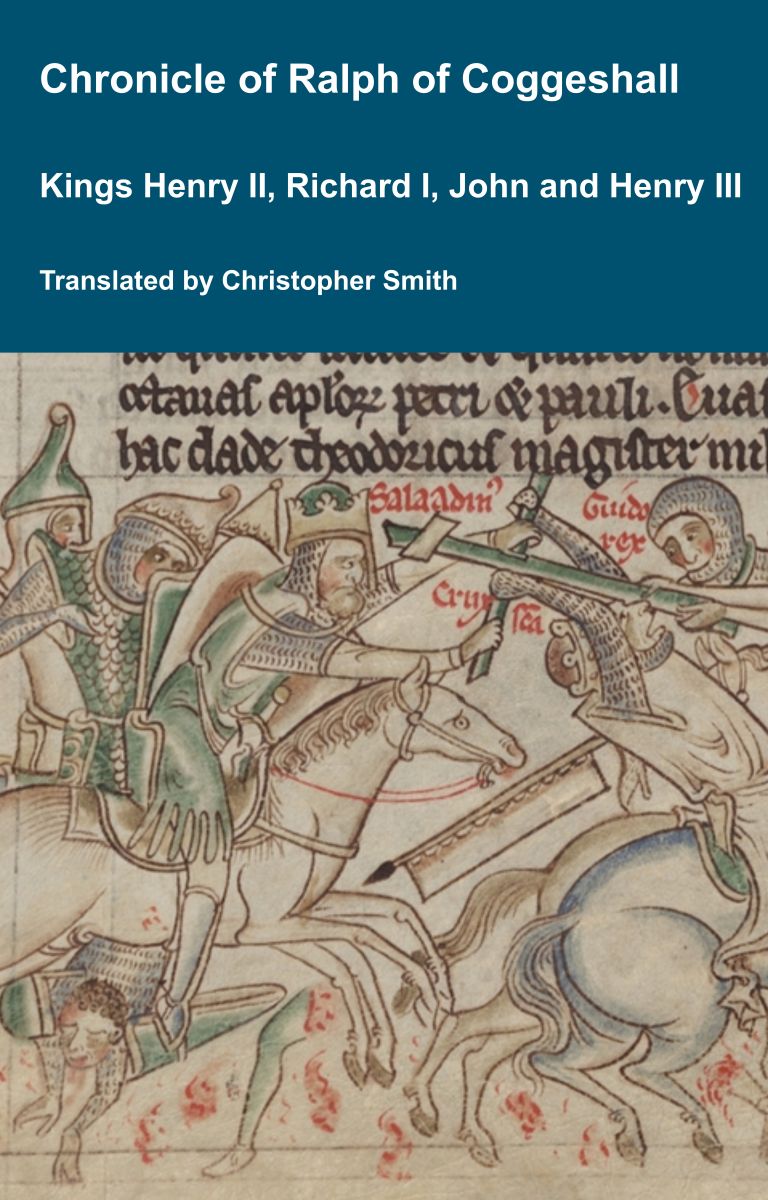
Chronicle of Abbot Ralph of Coggeshall
The Chronicle of Abbot Ralph of Coggeshall (Chronicon Anglicanum) is an indispensable medieval history that brings to life centuries of English and European affairs through the eyes of a learned Cistercian monk. Ralph of Coggeshall, abbot of the Abbey of Coggeshall in Essex in the early 13th century, continued and expanded his community’s chronicle, documenting events from the Norman Conquest of 1066 into the tumultuous reign of King Henry III. Blending eyewitness testimony, careful compilation, and the monastic commitment to record-keeping, this chronicle offers a rare narrative of political intrigue, royal power struggles, and social upheaval in England and beyond. Ralph’s work captures the reigns of pivotal figures such as Richard I and King John, providing invaluable insights into their characters, decisions, and the forces that shaped medieval rule. More than a simple annal, Chronicon Anglicanum conveys the texture of medieval life and governance, making it a rich source for scholars and readers fascinated by English history, monastic authorship, and the shaping of the medieval world.
Available at Amazon in eBook and Paperback format.
03 Jun is in June.
1162 Thomas Becket appointed Archbishop of Canterbury
1420 Marriage of Henry V and Catherine of Valois
1449 Warwick "Kingmaker" Becomes Earl of Warwick
1535 Execution of Bishop Fisher and Thomas More
1603 Arrival of Anne of Denmark
1610 Prince Henry invested as Prince of Wales and Earl Chester
Chronicon ex Chronicis by Florence and John of Worcester. 3rd June 1123. Henry, king of England, went over sea after the feast of Whitsuntide [3rd June]. William (age 53), archbishop of Canterbury, having received the pallium from pope Calixtus, and Thurstan (age 53), archbishop of York, with their companions, on their return from Rome, paid a visit to the king, who was still in Normandy: after a short stay, archbishop William came back to England, and, on the eleventh of the calends of August [22nd July], at Canterbury, consecrated Alexander as bishop of Lincoln; and, on the seventh of the calends of September [26th August], in the church of St. Paul the Apostle, at London, consecrated Godfrey, the queen's chancellor, to the bishopric of Bath.
On 3rd June 1162 Archbishop Thomas Becket (age 42) was consecrated Archibishop Canterbury by Bishop Henry of Blois (age 64).
On 3rd June 1173 Archbishop Richard de Dover was elected Archibishop Canterbury against the wishes of the clergy.Archbishop Richard de Dover when trvaelled to Rome to rebut the charges against him.
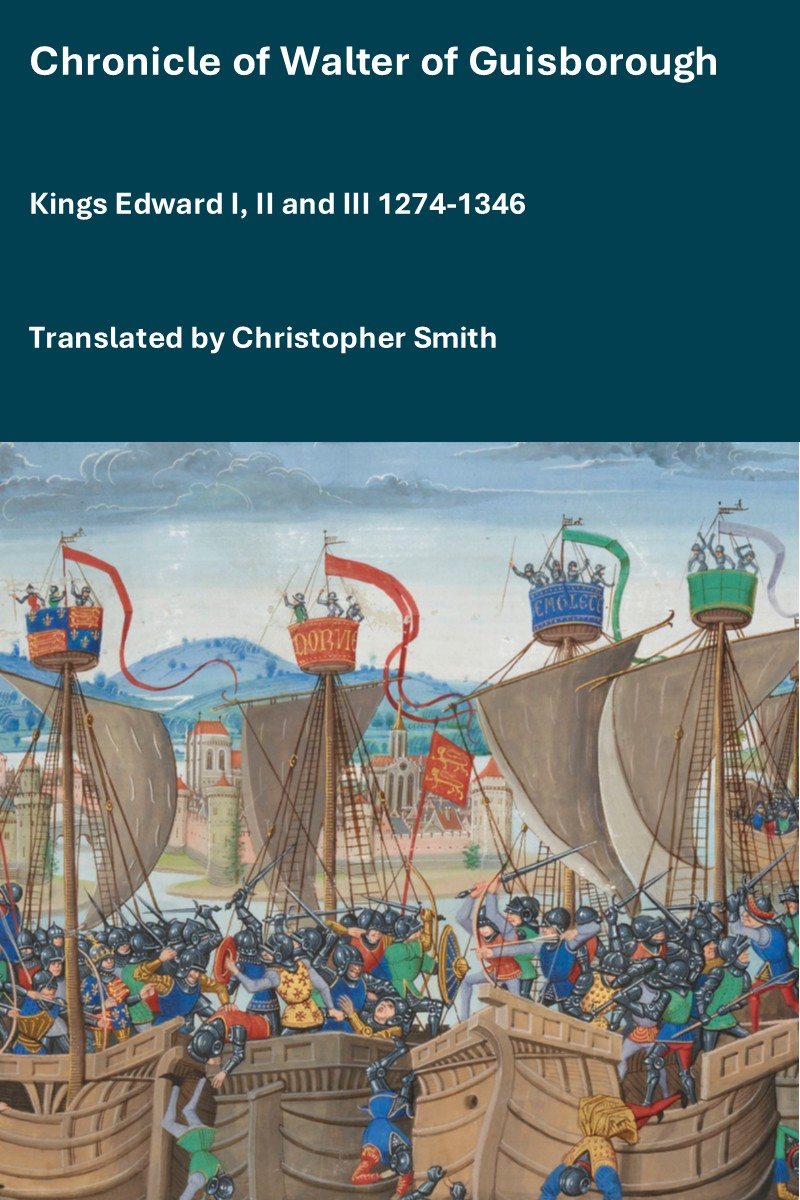 Chronicle of Walter of Guisborough. In the meantime, Lord Robert de Brus returned from the islands, and being fully cured of a long illness from which he had suffered after taking poison, began to carry out many raids in Northumbria. On account of this, on the Feast of Saint Hilary1 [3rd June 1308], the lord king sent to him distinguished envoys, namely, the Earl of Gloucester and two other earls, along with certain of the pope's envoys, who had come especially for this purpose, so that they might negotiate either for peace or a truce; and they entered into a truce with him until the Feast of All Saints in the following year.
Interim reversus est dominus Robertus de Brus ex insulis, et a longa infirmitate sua, qua venenum sumpserat, plene curatus, cœpit exercere multas strages in Northumbria; propter quod dominus rex in festo Sancti Hilarii misit ad eum solemnes nuncios, comitem scilicet Gloucestriæ et alios duos comites, et quosdam cum nunciis domini papæ, qui ad hoc specialiter venerant, ut de pace tractarent vel treuga; et inierunt cum eo treugas usque in festum Omnium Sanctorum anni sequentis.
Note 1. St Hilary of Carcassone, whose feast day is the 3rd of June, rather than St Hilary of Poitiers, whose feast day is the 13th of January.
Anonimalle Chronicle. Afterwards, on the Monday [3rd Jun 1381]1 following the feast of Pentecost, a knight of our lord the king's household, Sir Simon de Burley (age 41) by name, had with him two of the king's men-at-arms, and came that Monday to Gravesend and there claimed a man to be his serf. The good people of the town came to him to try to make a settlement, out of respect for the king. But Sir Simon would accept nothing less than 300 pounds in silver for the man's release, which was a grave injustice to the said man. The good townspeople begged for mercy, but they could not succeed in getting a reduction in the amount, telling Sir Simon that the man was a Christian and of good standing, and therefore should not be condemned to a life of bondage. At this, Sir Simon became very angry and wrathful, and he greatly scorned the good people. In his fury, he had the man bound by the sergeants and taken to Rochester Castle to be securely held, which led to great harm and misfortune thereafter. And after his departure, the commons began to rise up, welcoming to their cause people from many towns in Kent.
Denapres le lundy prochien apres le fest de Pentecost, une chivaler del measoun nostre seignur le roy, monsire Symond de Burley nome, avoit en sa companye deux seriauntes darmes del dit roy, et vient le lundy susdit a Gravesende et chalanga illeoges une homme destre soun nayff; et les bones gentz de la ville viendrent a luy pur acorde fair en ease maner al reverence le roy. Mes le dit sire Symond ne vodroit meyns prendre qe ccc li. dargent a graunde defesance del dit homme; et a ceo les bones gentz prierent de mitigacione, mes ils ne purrount esplayter ne avoir lour purpos de meyndre somme, dissauntz al dit sire Symonde ge le homme fuist Cristien et de bone part et pur ceo il ne deveroit estre defait pur toutz iours; par qay le dit sire Symond fuist moult curuce et irrous et despisa graundement les bones gentz, et pur grossour de coer fist les sergeantz lier le dit homme et amener al chastelle de Rouchestre pur estre salvement garde, par qay graunde male et meschief vient apres; et apres soun aler, les comunes comenserount a lever, accoillauntz as eux les gentz des plusours villes en Kent.
Note 1. There is a problem with this narrative insofar as Accounts, etc., Exchequer 318/26, shows that Burley was in 'Bohemia' from the spring to the autumn of 1381 and could not have been at Gravesend on Whit Monday.
On 3rd June 1405 Thomas Beaufort 1st Duke Exeter (age 28) arrived at York [Map]. The King denied the accused trial by their peers. Thomas Fitzalan 10th Earl of Surrey 5th or 12th Earl of Arundel (age 23) and Thomas Beaufort 1st Duke Exeter sat in judgement of Archbishop Richard Scrope (age 55) and Thomas Mowbray 4th Earl Norfolk 2nd Earl Nottingham (age 19). William Gascoigne (age 55) refused to pronounce sentence on Archbishop Richard Scrope and Thomas Mowbray 4th Earl Norfolk 2nd Earl Nottingham asserting their right to be tried by their peers.
On 3rd June 1411 Leopold "The Fat" Habsburg IV Duke Austria (age 40) died. His brother Ernest (age 34) succeeded I Duke Austria.
Chronicle of Gregory [1400-1467]. 3rd June 1420. And thenne was the kyng (age 33) and Dame Katerynne (age 18) swryde to-gedyr. And on the morne aftyr was Trenyte Sonday, that was the iij day of June, the year of our lord M CCCC xx, in the chyrche of Troys [Map], the kyng spowsyd Dame Kateryne, Kyng Charlys daughter of Fraunce (age 51); and thenne he was made Regent of Fraunce, and the convencyons of the whiche acordyd folowynge here aftyr, that is for to saye:
Harry, by the grace of God, Kyng of Inglond, heyre and Regent of Fraunce, and lord of Yrlonde, to perpetualle mynde to alle Crystyn pepylle, ande to alle that ben undyr owre obeysaunce, we notefy and declare that thoughe a here before dyvers tretes have ben be twyne the moste excellente Prynce Charlis, owre fadyr of Fraunce, and his progenytours, for the pes to ben hadde be twyne ij realmys of Fraunce and of Inglonde, the whiche here by forne have borne no1 frwte, we, consyderynge the grette harmys that have ben, not oonly by twyne ij realmys for the grette devysyon that hathe ben be-twyne hem, but to alle hooly Chyrche, we have take a trete whythe our said fadyr and us, that for as moche as be the bonde of matrymonye, i-made for the goode of the pes be-twyne us and our moste dyre modyr Isabelle (age 50) his wife, the same Charlis and Isabelle ben made fadyr and modyr, and there fore take them as for owre fadyr and modyr, we shalle have and worschippe as it syttythe and semythe so worthy a prynce and a pryncesse too ben i-worschippyde, pryncypally before alle othyr temporalle personys of the worlde.
Alle so we shalle nought dystroble, nor dyssesyn, nor lette our said fadyr, but that he holde and procede2 as long as he levythe, and holdythe, ande he possedythe at this tyme, the crowne and dignity of the ryalte of Fraunce, and rentys and profytys of the same, to the sustenaunce of his estate and chargys of the realme of Fraunce, and owr modir al so holdyng as long as she levy the estate and dignity of the quene, aftyr the maner of the same realme, whythe convenable and convenyante parte of the said rentys and profytys.
Alle so that the fore said Kateryne shalle take and have dwer in our realme of Inglond, as [quenes of England]3 here a-forne were wonte to have and take, that is for to saye, to the summa of xl M [40000] scwtys yearly, of the whyche4 ij [2] shalle be worthe a nobylle Englysche. Alle so the maners, weyis, and menys that we may, whythe out transgressyon or ofFensys ofte5 i-made by us for to kepe the lawys, customys, usagys, and ryghtys of owre said realme6 of Inglonde, [we]7 shalle done owre labur and pursewe that the said Katerynne, alsone as it may be done and be made sure, for to take and for to have in owre said realme of Inglonde fro tyme of our dethe, the said xl M [40000] scutys yerly, of the whyche twyne shalle alle way be worthe8 a nobylle of Englysche mony.
Note 1. borne no. These words are taken from J., and are a true rendering of the text of the original treaty (see Kymer, ix. 895). Our MS. reads, "have ben frwte/' following perhaps some other translation in which the word "without" has been omitted. Vit. reads, still more absurdly, "have ben frendes."
Note 2. procede. A transcriber's error for "possede," i.e. possess,
Note 3. Omitted in MS.; supplied from J.
Note 4. of the whiche repeated, MS.
Note 5. ofte. We should certainly read, "of the oath;" but the words do not occur even in J.
Note 6. of owre said realme repeated in MS.
Note 7. Omitted in MS.
Note 8. worthe. with, MS.; corrected from J.
On 3rd June 1449 Anne Beauchamp 15th Countess Warwick (age 5) died at Ewelme, Oxfordshire aged four whilst in the care of Alice Chaucer Duchess Suffolk (age 45). She was buried at Reading Abbey, Berkshire [Map]. Baron Burghesh abeyant between her three-half aunts and her full aunt Anne Beauchamp 16th Countess Warwick (age 22). It isn't clear why the barony was not subject to the same legal dispute that the Earldom of Warwick was subject to - see following.
After a prolonged legal dispute between her three half-aunts, Margaret Beauchamp Countess Shrewsbury and Waterford (age 45), Eleanor Beauchamp Duchess Somerset (age 40), Elizabeth Beauchamp Baroness Latimer (age 32) and her full aunt Anne Beauchamp 16th Countess Warwick, the courts decided her full aunt Anne Beauchamp should succeed. Anne Beauchamp succeeded 16th Countess Warwick. Her husband Richard Neville (age 20) by marriage Earl Warwick; the first step on his journey to becoming Kingmaker.
The decision of the court was not subscribed to by Edmund Beaufort Earl Somerset (age 43) who was married to Anne's half-sister Eleanor; he wanted his share of the considerable Beauchamp inheritance.
Chronicle of Edward Hall [1496-1548]. 3rd June 1522. The Wednesday, the more to do the Emperor pleasure, was prepared a Jousts Royal. On the one part was the King, the Earl of Devonshire (age 26) and ten more companions, all mounted on horseback, their apparel and bards, were of rich Cloth of gold, embroidered with silver letters, very rich, with great plumes on their heads. This company took the field, and rode about the tilt: then entered the Duke of Suffolk (age 38), and the Marquess of Dorset (age 44), and ten with them barded, and their apparel was russet velvet, embroidered with sundry knots, and culpins [?] of gold. The Emperor and the Queen (age 36), with all the nobles stood in the gallery, to behold the doing. The King (age 30) ran at the Duke of Suffolk eight courses, and at every course brake his spere. Then every man ran his courses and that done, all ran together violent, as fast as they could discharge, and when the spears appointed were broken, then they disarmed and went to supper. After supper, the Emperor beheld the ladies dances, and suddenly came to the chamber, six noble men, apparelled in crimson velvet and cloth of gold, and a mantel of taffeta, rolled about their bodies, and hoods and bonnets of cloth of gold, on their heads, and velvet buskins on their legs. These maskers entered and danced a great while with the ladies, and suddenly entered six other maskers with drumslades [drums], apparelled in long gowns, and hoods of cloth of gold, of which number was the King, the Duke of Suffolk, the Prince of Orange, the Count of Nassau, the Count of Naveray, and Monsieur Egmont. When these maskers were entered, the other avoided, and then they took ladies and danced, so that the strangers much praised them and when the time came, every person departed to their lodging.


On or after 3rd June 1530, the date his will was made [proved on 30th August 1530], Randle Brereton of Malpas (age 50) died. He was buried in St Oswald's Church, Malpas [Map]. Monument to Randle Brereton of Malpas and Eleanor Dutton. Alabaster. Fluted Period. Lancastrian Esses Collar with Big Esses. Dogs Head Crest. Dogs chewing at her dress. Chest with Angels with Rounded Wings. Dogs chewing at her dress with Studded Collar. Possibly Harpur and Moorecock of Burton on Trent. Gabled Headress with Lappets. Angels Supporting Pillow. Swirling Tail. Chest with Weepers.
Around the edge of the tomb is the following inscription in Latin - "Here lie Randal Brereton Knight Banneret and Chamberlain of the County of Chester and the Lady Eleanor his wife, which said Randal and Eleanor, while yet living, had this tomb made, to wit at the feast of St Michael the Archangel AD 1522 on whose souls may God have mercy, Amen."
Hic jacent Randulfus Brereton, miles Baronit 'ac Camerar' Cest', et D'na Elynora uxor ejus, qui quidem Randulfus et Elynora dn' i' humanis vixerunt, hanc tumbam fieri fecerunt, scilicet in festo Sc'i Michaelis Archangeli, anno d'ni millesimo quingentesimo, vicesimo secundo quorum 'a 'a 'abus p'pitietur Deus. Amen.
Randle Brereton of Malpas: Around 1480 he was born to Randle Brereton of Malpas. There is some confusion here with so many Randle Breretons. Some sources insert another generation between Randle Brereton 1480-1530 and his father although doing so makes the dates inconsistent. In or before 1499 Randle Brereton of Malpas and Eleanor Dutton were married.
Eleanor Dutton: In 1484 she was born to Peter Dutton. In 1522 Eleanor Dutton died at Malpas, Cheshire [Map].


Letters and Papers Foreign and Domestic Henry VIII 1535. 3rd June 1535. 814. Sir Thomas More (age 57)
His answers to questions put by Thomas Audeley (age 47), Lord Chancellor, and others, 3 June 27 Hen. VIII.
1. Whether he knew the statute making the King supreme head, &ec. Replied that he did.
2. When asked whether the King was, as by statute decreed, head of the Church [in England] or not, he answered that "the [stutute made in the Parliameut] whereby the Kynges Highnes was made supreme hedd as ys aforsayd [was like unto a sword] with too edges, for yf he seyd that the same lawe werre [not] good then a was daungerous to the soule. And yf he seyd contrary to the seyd estatute [then] yt was deth to the body ; wherfor he wold make therto none other aunswer by cafuse] ... oldnot.. f ... of the shortyng of his lif."
ii. The effect of the conversation between Richard R[iche] and the seyd Sir Thomas More, in presence of Edward Walsyngham, Richard Southwell, Palmer and ———t Derleght (?). ('The conversation described seems to have been that which took place on the 12 June. See the record of More's trial, 1 July.) Pp.2.: Much mutilated. Large paper. On two separate leaves found apart.


Letters and Papers Foreign and Domestic Henry VIII 1535. 3rd June 1535. 815. Sir Thomas More (age 57) to Margaret Roper (age 30).
Writes, as it is likely she has heard that he was before the Council this day. Perceives little difference between this time and the last. As far as he can see, the whole purpose is to drive him to say precisely one way or the other. My lord of Canterbury (age 45), my Lord Chancellor (age 47), lords Suffolk (age 51) and Wiltshire (age 58), and Mr. Secretary (age 50), were here. Mr. Secretary said he had told the King about More's answer, and he was not content, but thought More had been the occasion of much grudge in the realm, and had an obstinate mind and an evil towards him, and he had sent them to command him to make a determinate answer whether he thought the statute lawful or no, and that he should either confess it lawful that the King should be Supreme Head of the Church of England, or else utter plainly his malignity. Answered that he had no malignity, and therefore could none utter, aud could make no answer but what he had made before. Is sorry that the King had such an opinion of him, but comforts himself, knowing that the time shall come when God shall declare his truth towards the King. His case is such that he can have no harm, though he may have pain, "for a man may in such a case lose his head, and have no harm." Has always truly used himself, looking first upon God and next upon the King, according to the lesson his Highness taught him at first coming to his service. Can go no further and make no other answer. To this the Lord Chancellor and Secretary said that the King might by his laws compel him to give an answer. Said this scemed hard, if his conscience were against it, to compel him to speak either to the loss of his soul or the destruction of his body. Mr. Secretary referred to More's having compelled heretics to answer whether they believed the Pope to be Head of the Church or not, and asked why the King should not similarly compel him? Replied that there was a difference between what was taken for an undoubted thing throughout Christendom, and a thing that was merely agreed in this realm, and the contrary taken for truth elsewhere. Mr. Secretary answered that they were as well burned for denying that, as they were beheaded for denying this, and therefore as good reason to compel men to answer one us the other. Answered that a man is not so bound in conscience by a law of one realm as by a law of Christendom; the reasonableness or unreasonableness of binding a man to answer stands not in the difference between heading and burning, but in the difference between heading and hell. In conclusion they offered him an oath to answer truly what wus asked him on the King's behalf concerning his person. Said he never purposed to swear any book oath while he lived. They said he was very obstinate to refuse that, for every man does it in the Star Chamber and elsewhere. Replied that he could well conjecture what would be part of his interrogatories, and it was as well to refuse them at first as afterward. The interrogatories were then shown him, and they were two:—whether he had seen the statute, and whether he thought it a lawful made statute or not. Refused the oath, and said he had already confessed the first and would not answer the second. Was thereupon sent away. In the communication before, it was said that it was marvel that he stuck so much in his conscience while he was not sure therein. Said he was sure that his own conscience might very well stand with his own salvation. It was also said to him that if he had as soon be out of the world as in it, why did he not speak plain out against the statute; it was clear that he was not content to die, though he said so. Answered that he has not been a man of such holy living that he might be bold to offer himself for death, lest God, for his presumption, might suffer him to fall. In conclusion, Mr. Secretary said he liked him worse than the last time, for then he pitied him, but now he thought he meant not well. God knows he means well. Wishes his friends to be of good cheer and pray for him.
Headed: Another letter written and sent by Sir Thos. More to his daughter Mistress Rooper, written A.D. 1535, 27 Hen. VIII.


Letters and Papers. [3 Jun 1536]. R. O. 1047. Sir John Russell (age 51) to Lord Lisle (age 72).
I presented the King with the cherries in my lady's name, and he thanks both you and her. I also delivered your letter to the King, who commanded Mr. Secretary to read it. Mr. Secretary said he would do anything for your Lordship that he could, and I think you are much bound to him. I cannot tell what will be the effect of your letter. I told the King the news of what was between the French and the Flemings, and how the captain of Gralyng took two Gascon merchants. Word came by Rokewood to Robert Semer that war was proclaimed between Flanders and France, but I informed the King that it was not true, as I was sure you would write me that with other news. On Friday last the Queen (age 27) sat abroad as Queen, and was served by her own servants, who were sworn that same day. The King came in his great boat to Greenwich that day with his privy chamber, and the Queen and the ladies in the great barge. I assure you she is as gentle a lady as ever I knew, and as fair a Queen as any in Christendom. "The King hath come out of hell into heaven for the gentleness in this and the cursedness and the unhappiness in the other." You would do well to write to the King again that you rejoice he is so well matched with so gracious a woman as is reported. This will please the King. I thank you for your present. Greenwich, Whitsun even. Signed.
Pp. 2. Add.: Deputy of Calais. Endd.

On 3rd June 1537 John Manuel Aviz Prince Portugal was born to John III King Portugal (age 34) and Catherine of Austria Queen Consort Portugal (age 30). Coefficient of inbreeding 11.30%. He married 1552 his double first cousin Joanna of Austria Princess Portugal, daughter of Charles V Holy Roman Emperor and Isabel Aviz Queen Consort Spain, and had issue.

On 3rd June 1540 Charles Habsburg Spain II Archduke Austria was born to Ferdinand I Holy Roman Emperor (age 37) and Anne Jagiellon (age 36) at Vienna [Map]. He married 26th August 1571 his niece Maria Anna Wittelsbach, daughter of Albert V Wittelsbach V Duke Bavaria and Anna Habsburg Spain Duchess Bavaria, and had issue.


Diary of Edward VI. 3rd June 1550. The King came to Schein, wher was a mariag mad(e) betwen the lord Lisle (age 23), th'erle of Warwic's (age 46) sone, and the ladi Anne (age 12), daughter to the duke of Somerset (age 50)3, wich don and a faire diner made, and daunsing finished, the King and the ladies went into tow chamhers mad of bowis, wher first he saw six gentlemen of on(e) side and six of another rune the course of the field, twis over, Ther names hiere do folow:
The lord Edward (age 21).1a
Sir Jhon Aplebey.
(The rest omitted.)
And afterward cam three mascers of one side and tow of another, wich rane fowre courses apece. Ther names be (left blank).
Last of al came the count of Ragonne,2a with 3 Italians, who ran with al the gentlemen fowre courses, and afterward fought at tornay. And so, after souper, he (the King) retorned to Whestmuster.
Note 3. On this occasion Dudley must have held out a brother's hand to Seymour, and hopes must have been entertained that the alliance would cement their future friendship, and secure the position of both parties. The result, as is well known, was otherwise. Little is on record of the history, and less of the character, of the bridegroom. When earl of Warwick, he was condemned with his father the duke of Northumberland in 1553, and he died without children in 1554, within ten days after his release from the Tower. The bride — one of the "trois belles chanteresses "(as they were styled by the poet Ronsard) who under the guidance of their tutor Denisot celebrated in French verse the death and virtues of Marguerite de Valois, queen of Navarre — suffered severely from the miseries to which her high birth subjected her. After losing her father by decapitation in 1552, and having her husband condemned to the like fate in the following year, — after attending him in the Tower, and losing him (probably from the effects of his confinement), — the countess was remarried on the 29th April, 1555, to Edward Unton (age 16), a Berkshire squire, afterwards a knight of the Bath. By an inquisition taken many years after, it was found that she had been a lunatic from the year 1566. She was however the mother of seven children by sir Edward Unton, and the younger surviving son was the celebrated sir Henry Unton, ambassador in France, whose dispatches have been edited for the Roxburghe Club by Mr. Stevenson. For more minute particulars relative to the countess see the memoir of the Unton Family, by the present Editor, prefixed to the Unton Inventories, printed for the Berkshire Ashmolean Society in 1841.
Note 1a. Lord Edward Seymour, the duke of Somerset's eldest son. [Note. In 1550 the Duke's eldest son John Seymour (age 23) was alive; he would die in 1552.]
Note 2a. On the 20th April, in the year before us, the council had issued a "warrant to (blank) to pay cxxvli. to the young conte Rangone for the half-yeres pension of one thousand crownes by the yere assigned to him during his abode in the King's majesties service, as well in respect of the young gentleman's good will and towardnesse, as for the love of his father, being a nobleman of Italie, and one that hath alwaies borne unto the King's majestic and his most noble father a singuler afiection: for a token whereof he sent this his eldest sonne hither to serve his highnesse." (Council Book.) This annuity of 250l. to Pallavicino Eangoni, during pleasure, was confirmed by letters patent dated the 20th Jan. 4 Edw. VI. 1550-1, printed in Rymer, xv. 252.
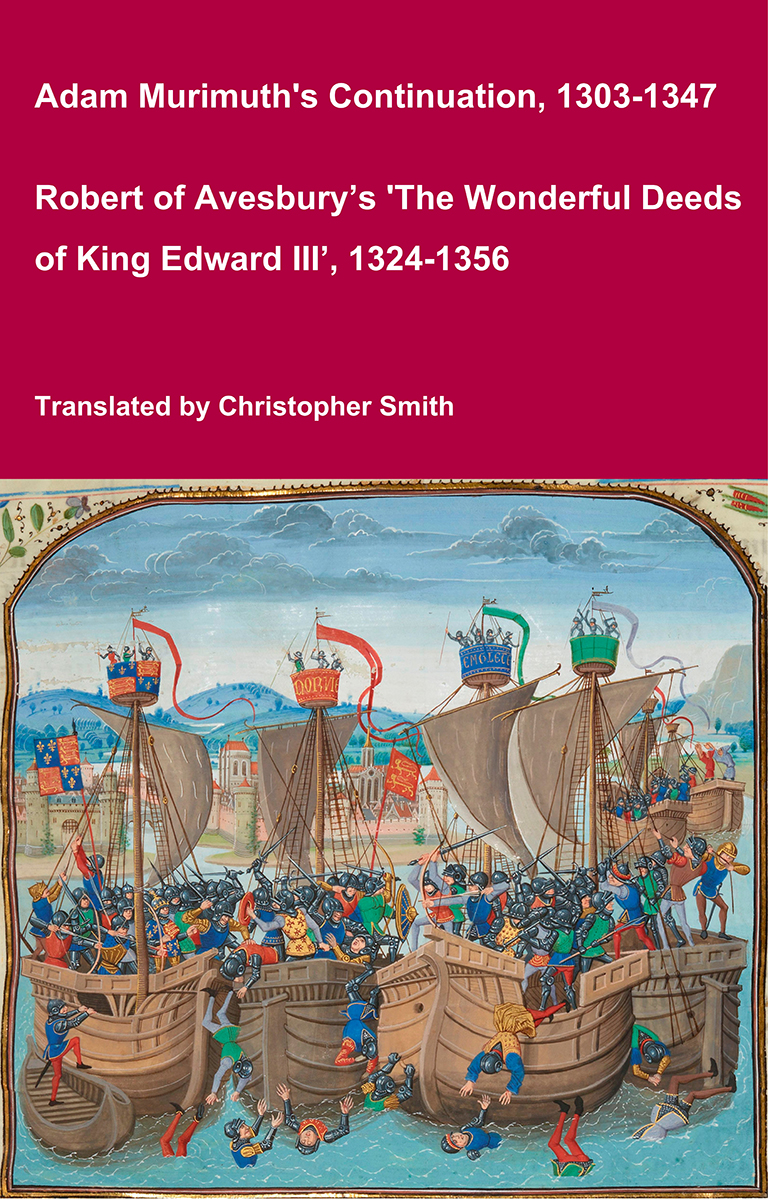
Adam Murimuth's Continuation and Robert of Avesbury’s 'The Wonderful Deeds of King Edward III'
This volume brings together two of the most important contemporary chronicles for the reign of Edward III and the opening phases of the Hundred Years’ War. Written in Latin by English clerical observers, these texts provide a vivid and authoritative window into the political, diplomatic, and military history of fourteenth-century England and its continental ambitions. Adam Murimuth Continuatio's Chronicarum continues an earlier chronicle into the mid-fourteenth century, offering concise but valuable notices on royal policy, foreign relations, and ecclesiastical affairs. Its annalistic structure makes it especially useful for establishing chronology and tracing the development of events year by year. Complementing it, Robert of Avesbury’s De gestis mirabilibus regis Edwardi tertii is a rich documentary chronicle preserving letters, treaties, and official records alongside narrative passages. It is an indispensable source for understanding Edward III’s claim to the French crown, the conduct of war, and the mechanisms of medieval diplomacy. Together, these works offer scholars, students, and enthusiasts a reliable and unembellished account of a transformative period in English and European history. Essential for anyone interested in medieval chronicles, the Hundred Years’ War, or the reign of Edward III.
Available at Amazon in eBook and Paperback format.
Henry Machyn's Diary. 3rd June 1560. The iij day of June at nyght whent to the Towre [Map] my old lord the byshope of Ely, doctur Thurlbe (age 54).

On 3rd June 1594 César Bourbon Vendôme 1st Duke Vendôme was born illegitimately to Henry IV King France (age 40) and Gabrielle d'Estrées (age 21). He married 16th July 1608 his half third cousin once removed Françoise Lorraine Duchess Vendôme and had issue.
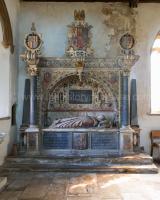
On 3rd June 1602 Elizabeth Seymour (age 52) died. She was buried at All Saints Church, Norton [Map] on 6th June 1603. Painted alabaster Elizabethan Period monument with recumbent praying effigy in coffered arch flanked by black marble Corinthian Columns and outer obelisks and topped by armorial panels. The monument also to Dudley Knightley (deceased).
Here Lieth ye bodie of ye Right Honorable ye ladie Elizabeth Seymour ye 4 daughter to ye High and Mightie Prince Edward Duke of Somerset Protector of England unckle to King Edward the 6. Who was also ye second wife of Sr Richard Knightley of Norton Kni. By whom he had issue 7 sons & 2 daughters (vis) Seymour, Ferdinand, Dudley, John, Nathaniel, Robert, & Francis; Ann deceased & Ann Knightley ye yonger married to Sr Euseby Andrew of Winick Knight. Wch Ladie Elizabeth died ye 3 June and dni 1602
Elizabeth Seymour: Around 1550 she was born to Edward Seymour 1st Duke of Somerset and Anne Stanhope Duchess Somerset in the year in which her father was executed. Around 1578 Richard Knightley and she were married. They had seven sons and seven daughters. She the daughter of Edward Seymour 1st Duke of Somerset and Anne Stanhope Duchess Somerset. They were fifth cousin once removed. She a great x 5 granddaughter of King Edward III of England.
Dudley Knightley: Around 1583 he was born to Richard Knightley and Elizabeth Seymour. In June 1602 Dudley Knightley died in Norton, Northamptonshire [Map]. He had been shot in the neck whilst in the defence of Ostend. Having returned home he "fell down wherwith a fever took him whereof he died".


On 3rd June 1603 a number of English noble ladies selected by the Privy Council greeted Anne of Denmark Queen Consort Scotland England and Ireland (age 28) at Berwick-upon-Tweed, Northumberland [Map] with two-hundred horse including...
Frances Howard Countess Kildare
Elizabeth Hastings Countess of Worcester (age 57)
Philadelphia Carey Baroness Scrope Bolton
Penelope Devereux Countess Devonshire (age 40).
Anne Lady Herbert (age 20)
Audrey Shelton Lady Walsingham (age 34).


On 3rd June 1610 Oliver St John 1st Earl Bolingbroke (age 30) was created Knight of the Bath.

On 3rd June 1643 Anne Sophia Herbert Countess Carnarvon died of smallpox.
On 3rd June 1654 Alethea Talbot Countess Arundel, Surrey and Norfolk (age 69) died. Her grandson Thomas (age 27) succeeded 14th Baron Furnivall, 18th Baron Strange Blackmere, 15th Baron Talbot.
On 3rd June 1665 Charles Maynard (age 30) died. Memorial at St Albans Cathedral [Map]: Near to this place lies the Body of Charles Maynard, Esq; with the Body of Mrs. Mary Maynard his dear Sister; he died the 3d of June 1665. in the 31th. Year of his Age. She died the 20th of Jan. 1663. in the 20th Year of her Age; who were Son and Daughter to Auditor Charles Maynard (age 67) of Waltham-stow in the County of Essex, Esq; who died the 19th of November, 1665, in the 67th Year of his Age, who lies interred at Euston with his Brother the Right Honourable William Lord Maynard Baron of Euston in Essex
Charles Maynard: On or after 11th February 1635 he was born to Charles Maynard and Mary Corsellis. In 1649 Charles Maynard was sued by the attorney-general, Edmund Prideaux, for retaining paperwork belonging to the defunct Court of Wards, allegedly with a view to personal gain. On 12th May 1665 Charles Maynard made his will on 12 May 1665, bequeathing sums totalling £2,100 to two of his younger children, the other having already been provided for.
Mary Maynard: Around 1643 she was born to Charles Maynard and Mary Corsellis. On 20th January 1663 Mary Maynard died.
Charles Maynard: In 1598 he was born to Henry Maynard of Estaines Parva and Susan Pearson. On or after 16th July 1633, the date of the license, Charles Maynard and Mary Corsellis were married. She the daughter of a wealthy Flemish immigrant and brought £800 to the marriage. On 19th November 1665 Charles Maynard died. He was buried at St Mary's Church, Little Easton [Map].


On 3rd June 1665 at the Battle of Lowestoft an English fleet commanded by King James II of England Scotland and Ireland (age 31), Prince Rupert Palatinate Simmern 1st Duke Cumberland (age 45) and Edward Montagu 1st Earl Sandwich (age 39) defeated a Dutch Fleet.
Richard Boyle was killed.
Charles Maccarthy Viscount Muskerry was killed.
Charles Berkeley 1st Earl Falmouth (age 35) was killed by a cannonball aboard the Royal Charles. Earl Falmouth extinct, Baron Botetourt Langport in Somerset extinct. His father Charles (age 65) succeeded 2nd Viscount Fitzhardinge of Berehaven in Kerry. Penelope Godolphin Viscountess Fitzhardinge by marriage Viscountess Fitzhardinge of Berehaven in Kerry. Possibly the only occasion when a father has succeeded his son.
Charles Weston 3rd Earl of Portland (deceased) was killed by a cannon shot. On 13th June 1665 His uncle Thomas (age 55) succeeded 4th Earl of Portland, 4th Baron Weston of Nayland in Suffolk.
Thomas Allin 1st Baronet (age 53) was present.
Admiral Jeremy Smith commanded the Mary.
Captain George Batts fought. He was assigned to Sir George Ayscue's (age 49) division in the Blue Squadron.
James Ley 3rd Earl Marlborough (age 47) was killed at the Battle of Lowestoft commanding Old James attempting to recover a captured ship. His half brother William (age 53) succeeded 4th Earl Marlborough.

Samuel Pepys' Diary. 3rd June 1665. At home to dinner, and all the afternoon at the office, where late at night, and much business done, then home to supper and to bed. All this day by all people upon the River, and almost every where else hereabout were heard the guns, our two fleets for certain being engaged; which was confirmed by letters from Harwich, Essex [Map], but nothing particular: and all our hearts full of concernment for the Duke (age 31), and I particularly for my Lord Sandwich (age 39) and Mr. Coventry (age 37) after his Royall Highnesse.
Samuel Pepys' Diary. 3rd June 1666. So home after church time to dinner, and after dinner my father, wife, sister, and Mercer by water to Woolwich, Kent [Map], while I walked by land, and saw the Exchange [Map] as full of people, and hath been all this noon as of any other day, only for newes. I to St. Margaret's, Westminster [Map], and there saw at church my pretty Betty Michell, and thence to the Abbey [Map], and so to Mrs. Martin, and there did what 'je voudrais avec her [I wanted with her].... So by and by he come in, and after some discourse with him I away to White Hall, and there met with this bad newes farther, that the Prince (age 46) come to Dover, Kent [Map] but at ten o'clock last night, and there heard nothing of a fight; so that we are defeated of all our hopes of his helpe to the fleete. It is also reported by some Victuallers that the Duke of Albemarle (age 57) and Holmes their flags were shot down, and both fain to come to anchor to renew their rigging and sails.
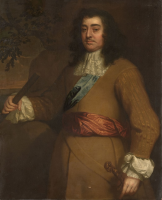

Samuel Pepys' Diary. 3rd June 1666. So meeting Creed, he and I by coach to Hide Parke alone to talke of these things, and do blesse God that my Lord Sandwich (age 40) was not here at this time to be concerned in a business like to be so misfortunate. It was a pleasant thing to consider how fearfull I was of being seen with Creed all this afternoon, for fear of people's thinking that by our relation to my Lord Sandwich we should be making ill construction of the Prince's (age 46) failure. But, God knows, I am heartily sorry for the sake of the whole nation, though, if it were not for that, it would not be amisse to have these high blades find some checke to their presumption and their disparaging of as good men.
John Evelyn's Diary. 3rd June 1666. Whitsunday. After sermon came news that the Duke of Albemarle (age 57) was still in fight, and had been all Saturday, and that Captain Harman's (age 41) ship (the Henry) was like to be burnt. Then a letter from Mr. Bertie that Prince Rupert (age 46) was come up with his squadron (according to my former advice of his being loose and in the way), and put new courage into our fleet, now in a manner yielding ground; so that now we were chasing the chasers; that the Duke of Albemarle was slightly wounded, and the rest still in great danger. So, having been much wearied with my journey, I slipped home, the guns still roaring very fiercely.
Samuel Pepys' Diary. 3rd June 1666. Lord's-day; Whit-sunday. Up, and by water to White Hall, and there met with Mr. Coventry (age 38), who tells me the only news from the fleete is brought by Captain Elliott, of The Portland, which, by being run on board by The Guernsey, was disabled from staying abroad; so is come in to Aldbrough [Map]. That he saw one of the Dutch great ships blown up, and three on fire. That they begun to fight on Friday; and at his coming into port, he could make another ship of the King's coming in, which he judged to be the Rupert: that he knows of no other hurt to our ships. With this good newes I home by water again, and to church in the sermon-time, and with great joy told it my fellows in the pew.
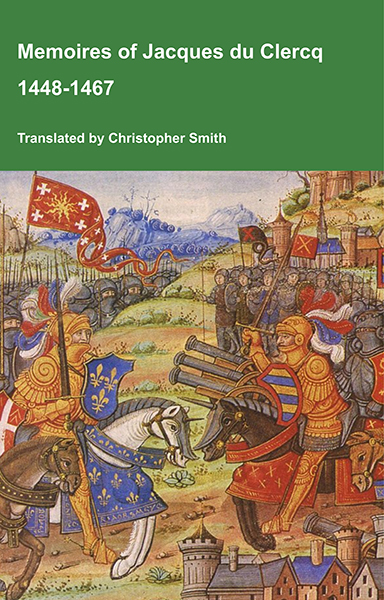
This is a translation of the 'Memoires of Jacques du Clercq', published in 1823 in two volumes, edited by Frederic, Baron de Reissenberg. In his introduction Reissenberg writes: 'Jacques du Clercq tells us that he was born in 1424, and that he was a licentiate in law and a counsellor to Philip the Good, Duke of Burgundy, in the castellany of Douai, Lille, and Orchies. It appears that he established his residence at Arras. In 1446, he married the daughter of Baldwin de la Lacherie, a gentleman who lived in Lille. We read in the fifth book of his Memoirs that his father, also named Jacques du Clercq, had married a lady of the Le Camelin family, from Compiègne. His ancestors, always attached to the counts of Flanders, had constantly served them, whether in their councils or in their armies.' The Memoires cover a period of nineteen years beginning in in 1448, ending in in 1467. It appears that the author had intended to extend the Memoirs beyond that date; no doubt illness or death prevented him from carrying out this plan. As Reissenberg writes the 'merit of this work lies in the simplicity of its narrative, in its tone of good faith, and in a certain air of frankness which naturally wins the reader’s confidence.' Du Clercq ranges from events of national and international importance, including events of the Wars of the Roses in England, to simple, everyday local events such as marriages, robberies, murders, trials and deaths, including that of his own father in Book 5; one of his last entries.
Available at Amazon in eBook and Paperback format.
Samuel Pepys' Diary. 3rd June 1667. By and by, I, upon desire, was called in, and delivered in my report of my Accounts. Present, Lord Ashly (age 45), Clifford (age 36), and Duncomb (age 44), who, being busy, did not read it; but committed it to Sir George Downing (age 42), and so I was dismissed; but, Lord! to see how Duncomb do take upon him is an eyesore, though I think he deserves great honour, but only the suddenness of his rise, and his pride. But I do like the way of these lords, that they admit nobody to use many words, nor do they spend many words themselves, but in great state do hear what they see necessary, and say little themselves, but bid withdraw.


Samuel Pepys' Diary. 3rd June 1667. Thence down by water to Deptford, Kent [Map], it being Trinity Monday, when the Master is chosen, and there, finding them all at church, and thinking they dined, as usual, at Stepny [Map], I turned back, having a good book in my hand, the Life of Cardinal Wolsey, wrote by his own servant, and to Ratcliffe; and so walked to Stepny [Map], and spent, my time in the churchyard, looking over the gravestones, expecting when the company would come by. Finding no company stirring, I sent to the house to see; and, it seems, they dine not there, but at Deptford, Kent [Map]: so I back again to Deptford, Kent [Map], and there find them just sat down. And so I down with them; and we had a good dinner of plain meat, and good company at our table: among others, my good Mr. Evelyn (age 46), with whom, after dinner, I stepped aside, and talked upon the present posture of our affairs; which is, that the Dutch are known to be abroad with eighty sail of ships of war, and twenty fire-ships; and the French come into the Channell with twenty sail of men-of-war, and five fireships, while we have not a ship at sea to do them any hurt with; but are calling in all we can, while our Embassadors are treating at Bredah; and the Dutch look upon them as come to beg peace, and use them accordingly; and all this through the negligence of our Prince, who hath power, if he would, to master all these with the money and men that he hath had the command of, and may now have, if he would mind his business. But, for aught we see, the Kingdom is likely to be lost, as well as the reputation of it is, for ever; notwithstanding so much reputation got and preserved by a rebel that went before him.


Samuel Pepys' Diary. 3rd June 1668. Thence with him home, and there to the office till noon, and then with Lord Brouncker (age 48), Sir J. Minnes (age 69), and Sir G. Carteret (age 58), upon whose accounts they have been this day to the Three Tuns [Map] to dinner, and thence back again home, and after doing a little business I by coach to the King's house, and there saw good, part of "The Scornful Lady", and that done, would have takn out Knepp, but she was engaged, and so to my Lord Crew's (age 70) to visit him; from whom I learn nothing but that there hath been some controversy at the Council-table, about my Lord Sandwich's (age 42) signing, where some would not have had him, in the treaty with Portugall; but all, I think, is over in it.
John Evelyn's Diary. 3rd June 1669. Went to take leave of Lord Howard, going Ambassador to Morocco. Dined at Lord Arlington's (age 51), where were the Earl of Berkshire (age 49), Lord Saint John, Sir Robert Howard, and Sir R. Holmes.


On 3rd June 1672 John Maitland 1st Duke Lauderdale (age 56) was appointed 472nd Knight of the Garter by King Charles II of England Scotland and Ireland (age 42).


On 3rd June 1696 Percy Seymour was born to Charles Seymour 6th Duke of Somerset (age 33) and Elizabeth Percy Duchess Somerset (age 29).
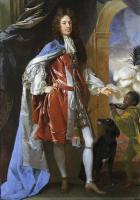


On 3rd June 1705 or 18th September 1721 Charles Butler 3rd Duke Ormond (age 33) and Elizabeth Crew Countess Arran (age 26) were married. She by marriage Countess Arran. He the son of Thomas Butler 6th Earl Ossory and Emilia Nassau Beverweert Countess Ossory.
On 3rd June 1714 Frederick William Oldenburg I Duke Schleswig Holstein Sonderburg Augustenburg (age 45) died. His son Christian (age 17) succeeded I Duke Schleswig Holstein Sonderburg Augustenburg. Frederikke Louise Unknown Duchess Schleswig Holstein Sonderburg Augustenburg by marriage Duchess Schleswig Holstein Sonderburg Augustenburg.
On 3rd June 1740 Aubrey Beauclerk 5th Duke St Albans was born to Vere Beauclerk 1st Baron de Vere (age 40) and Mary Chambers Baroness Spencer (age 26). He a great grandson of King Charles II of England Scotland and Ireland. He married 4th May 1763 Catherine Ponsonby Duchess St Albans, daughter of William Ponsonby 2nd Earl Bessborough and Caroline Cavendish Countess Bessborough, and had issue.
On 3rd June 1743 William Elector of Hesse was born to Frederick Hesse-Kassel (age 22) and Mary Hanover (age 20). He a grandson of King George II of Great Britain and Ireland. He married 1st September 1764 his first cousin Electress Wilhelmina Caroline Oldenburg, daughter of Frederick V King of Denmark and Norway and Louise Hanover Queen Consort Denmark and Norway, and had issue.


William of Worcester's Chronicle of England
William of Worcester, born around 1415, and died around 1482 was secretary to John Fastolf, the renowned soldier of the Hundred Years War, during which time he collected documents, letters, and wrote a record of events. Following their return to England in 1440 William was witness to major events. Twice in his chronicle he uses the first person: 1. when writing about the murder of Thomas, 7th Baron Scales, in 1460, he writes '… and I saw him lying naked in the cemetery near the porch of the church of St. Mary Overie in Southwark …' and 2. describing King Edward IV's entry into London in 1461 he writes '… proclaimed that all the people themselves were to recognize and acknowledge Edward as king. I was present and heard this, and immediately went down with them into the city'. William’s Chronicle is rich in detail. It is the source of much information about the Wars of the Roses, including the term 'Diabolical Marriage' to describe the marriage of Queen Elizabeth Woodville’s brother John’s marriage to Katherine, Dowager Duchess of Norfolk, he aged twenty, she sixty-five or more, and the story about a paper crown being placed in mockery on the severed head of Richard, 3rd Duke of York.
Available at Amazon in eBook and Paperback format.

On 3rd June 1786 William Hilton was born to William Hilton (age 34) at Vicar's Court, Lincoln Cathedral Close. He was baptised at St Mary le Wigford Church, Lincoln. He married 26th February 1828 Justinia Kent.

On 3rd June 1794 Dorothy Cavendish 3rd Duchess Portland (age 43) died. She was buried at St Marylebone Church.
On 3rd June 1796 George Wright 2nd Baronet (age 26) and Rebecca Maclane were married. His uncle-in-law Archbishop John Moore (age 66) officiated.
On 3rd June 1821 Jacopo Fitz James Stuart 15th Duke Alba 13th Duke Veragua 8th Duke Berwick was born to Carlos Miguel Fitz James Stuart 12th Duke Veragua 7th Duke Berwick 14th Duke Alba (age 27) and Rosalía Ventimiglia Duchess Veragua Duchess Berwick Duchess Alba (age 23) at Palermo [Map]. He married 14th February 1838 María Francisca "Paca" Palafox Duchess Veragua Duchess Berwick Duchess Alba.
On 3rd June 1822 Thomas Warren-Bulkeley 7th Viscount Bulkeley (age 69) died without issue. Viscount Bulkeley of Cashel in Tipperary, Baron Bulkeley Beaumaris Anglesey extinct. Monument in St Marys and St Nicholas Church Beaumaris [Map] sculpted by Richard Westmacott (age 46).


Derbyshire Archaeological Journal Volume 30 1908 Page 155. Account of the opening of some sepulchral tumuli in the neighbourhood of Arbow-low Co. Derby - read before the Literary and Philosophical Society of Sheffield, June 3rd 18251.
May 18th 1825. On opening a tumulus on the hill called Kenslow2, we met with a few remnants of the skull and other bones of a human skeleton deposited in a cist cut out of the solid rock, accompanied by a spear-head of Iron, and another small instrument of iron whose use we could not ascertain. The metal of which these were composed, was very much corroded. In the socket of the spear head the remains of wood were still visible; from the oxidation of the iron, it had become petrified, and as hard as the metal itself.
On the same ridge3 of hill, and not far distant, a very fine barrow was opened in 1825, an account of which I havealready presented to the Society in my essay on Arborlow.
A second barrow opened on this same day and situate close to the Roman Road which crosses this part of the country from Buxton to Little Chester, presented nothing on being opened but a mass of burnt bones, ashes, and charcoal, without either urn or interments of any description4.
Note 1. The portion of the paper "On Druidism", p. 157, relating to Derbyshire.
Note 2. Vestiges, p. 33
Note 3. lbid., p. 28.
Note 4. lbid., p. 33. Subsequently re-excavated by Mr. T. Bateman, 1844.
On 3rd June 1842 Ernest Saxe Coburg Gotha II Duke Saxe Coburg Gotha (age 23) and Princess Alexandrine of Baden (age 21) were married. He the son of Ernest Saxe Coburg Gotha I Duke Saxe Coburg Gotha (age 58) and Duchess Louise Dorothea of Saxe Coburg Altenburg. They were fifth cousin once removed. She a great x 3 granddaughter of King George II of Great Britain and Ireland.
On 3rd June 1843 Frederick VIII King of Denmark was born to King Christian IX of Denmark (age 25) and Queen Louise Hesse-Kassel of Denmark (age 25). He a great x 3 grandson of King George II of Great Britain and Ireland. Coefficient of inbreeding 2.84%. He married 28th July 1869 Louise of Sweden Queen Consort Denmark and had issue.
Ten Years' Digging. On the 3rd of June we examined a mutilated barrow in a plantation upon Parwich Moor, called Shuttlestone [Map], which had originally been about four feet in height; it consisted of a compact mass of tempered earth down to the natural surface of the land, below which point, in the centre of the barrow there appeared a large collection of immense limestones, the two uppermost being placed on edge and all below being laid flat, though without any other order or design than was sufficient to prevent the lowest course resting upon the floor of the grave, inside which they were piled up, and which was cut out to the depth of at least eight feet below the natural surface; thus rendering the total depth from the top of the mound to the floor of the grave not less than twelve feet. Underneath the large stones lay the the skeleton of a man in the prime of life and of fine proportions, apparently the sole occupant of the mound, who had been interred whilst enveloped in a skin, of dark red colour, the hairy surface of which had left many traces both upon the surrounding earth and upon the verdigris or patina coating a bronze axe-shaped celt and dagger, deposited with the skeleton. On the former weapon there are also beautifully distinct impressions of fern leaves, handsful of which, in a compressed and half-decayed state, surrounded the bones from head to foot. From these leaves being discernible on one side of the celt only, "whilst the other side presents traces of leather alone, it is certain that the leaves were placed first as a couch for the reception of the corpse with its accompaniments, and after these had been deposited, were then further added in quantity sufficient to protect the body from the earth. The position of the weapons with respect to the body was well ascertained; and is further evidenced by the bronze having imparted a vivid tinge of green to the bones where in contact with them. Close to the head were one small black bead of jet and a circular flint; in contact with the left upper arm lay a bronze dagger with a very sharp edge, having two rivets for the attachment of the handle, which was of horn, the impression of the grain of that substance being quite distinct around the studs. About the middle of the left thigh bone was placed the bronze celt, which is of the plainest axe-shaped type. The cutting edge was turned towards the upper part of the person, and the instrument itself has been inserted vertically into a wooden handle by being driven in for about two inches at the narrow end - at least the grain of the wood runs in the same direction as the longest dimension of the celt, a fact not unworthy of the notice of any inclined to explain the precise manner of mounting these curious implements. The skull, which is decayed on the left side, from the body having lain with that side down, is of the platy-cephalic form, with prominent parietal tubers - the femur measures 18½ inches.
Ten Years' Digging. On the 3rd of June, we opened a barrow at Hasling Houses [Map], near Buxton, measuring about twelve yards across and three feet in height, chiefly composed of tempered earth, except in the centre, where were a good many stones, covering a grave cut from east to west, about eighteen inches deep. Within it lay at length the skeleton of a powerful man of middle age, with the head to the west, who had been buried either within a coffin, or upon a thick plank with another above him, in order to keep off the pressure of the stones. In the earth, about a foot from the skull, we, found a rude instrument of flint, probably unconnected with the interment, and brought with earth from the neighbouring field as material for the mound. The femur measures 19½ inches; and both bones of the left leg had been fractured just below the knee, and strongly re-united by the formation of osseous substance many years before death. The body was most probably that of a Saxon.
Ten Years' Digging. In the afternoon we examined the remains on Foxlow Hill [Map], near Buxton, where, in addition to some inconsiderable earthworks, there is the base of a large tumulus, the upper part of which had been removed to within a few inches of the rock. We found many traces of its former contents in the shape of human teeth and rats' bones, but all in the utmost confusion.
Ten Years' Digging. On the 3rd of June, another skeleton was found between the cist and the eastern verge of the mound, which lay in the contracted position on its left side, with the head to the south. It had been slightly protected by four stones, not very carefully arranged round it, and was quite destitute of accompaniment. On the same day, a large trench was made parallel to the first, without any interment of consequence being found. The decayed skeletons of two infants were noticed, and we casually picked up a barbed arrow-head of grey flint, and a piece of hard sandstone that had been used to triturate grain. In the accompanying plan the principal interments only are marked, the later ones being omitted to prevent confusion. While we were re-filling the excavation, Mrs. Bateman had the misfortune to drop in, unobserved, a gold ring set with an onyx cameo, representing a classical subject, an occurrence which may some day lead to the conclusion that the Romans buried in these ancient grave-hills. Many theories are based upon foundations equally fallacious.
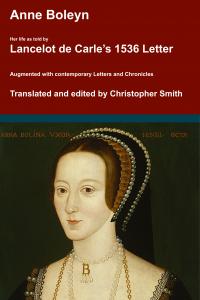
Anne Boleyn. Her Life as told by Lancelot de Carle's 1536 Letter.
In 1536, two weeks after the execution of Anne Boleyn, her brother George and four others, Lancelot du Carle, wrote an extraordinary letter that described Anne's life, and her trial and execution, to which he was a witness. This book presents a new translation of that letter, with additional material from other contemporary sources such as Letters, Hall's and Wriothesley's Chronicles, the pamphlets of Wynkyn the Worde, the Memorial of George Constantyne, the Portuguese Letter and the Baga de Secrets, all of which are provided in Appendices.
Available at Amazon in eBook and Paperback format.
Ten Years' Digging. On the 3rd of June, we went to a conspicuous mound on the heathery uninclosed, and most elevated part of Baslow Moor, called Hob Hurst's House [Map], and found it to be a circular tumulus, composed of sand and gritstones, about eleven yards diameter, and four feet high; though, from its being surrounded by an embankment, inside of which the earth had been cut in the form of a ditch, the height appeared fully six feet, and it was only by digging down to the natural surface, that we were able to ascertain the actual elevation. The diameter at the outside of the embankment waa 22 yards, it was formed, like the mound, of stones and sand, and was fourteen feet thick at the base and about four feet high. A trench cut from the south side of the central mound, disclosed some large upright slabs of gritstone, set on the natural level, which we at once perceived to be part of a cist or sepulchral chamber, which was soon cleared out and sketched.
It was rectangular, measuring from north to south ten feet three inches, and nine feet from east to west, and was chiefly constructed of slabs of stone each nearly a yard broad. There were traces of fire throughout the whole enclosure; the undisturbed sand having been burnt to a dirty white, or cream colour, and covered with a layer of charcoal, which was thickest towards the east side, where in the comer formed by the junction of the south boundary of the chamber, we discovered the original deposit, consisting of calcined human bones, lying in the very spot where they had been drawn together while the embers of the funeral pyre were glowing. They were in a small heap along with some thick pieces of charcoal and two lumps of burnt lead ore; and were separated or marked oiF from the floor of the chamber by a semicircular row of small sandstone boulders, all of which exhibited marks of fire. A few more burnt bones were found embedded in the sand near the north end of the cist, but no instrument or pottery of any kind was seen, although one of the pieces of charred wood exhibits a cleanly cut oblique surface, which must have been effected by a sharp instrument. The popular name given to the barrow, we have an indirect testimony to its great antiquity, as Hobhurst's House signifies the abode of an unearthly or supernatural being, accustomed to haunt woods and other solitary places, respecting whom many traditions yet linger in remote-villages. Such an idea could only arise in a superstitious age long ago, yet sufficiently modem to have effaced all traditionary recollection of the original intention of the mound; it likewise affords a curious instance of the inherent tendency of the mind to assign a reason for everything uncommon or unaccountable, which no extent of ignorance or apathy seems able totally to eradicate.
Many of the remaining pre-historic monuments of our land are similarly connected with names well know in popular mythology, now so rapidly vanishing, that it is probable the legends will be forgotten, while the names alone will be perpetuated as long as the structures with which they are identified exist. We may here observe, that the practice of separating the deposits within the cist by pebbles, as in this barrow, is most unusual in the Midland Counties, but is described as prevalent in the Channel Islands, by Mr. Lukis, in the Journal of the British Archaeological Institute, Vol I., page 142.


Ten Years' Digging. On the 3rd of June, we opened the first [Smerrill Barrow 2 [Map]] of three barrows upon Smerrill Moor, near Middleton-by-Youlgrave, situated on the edge of the hill forming one side of a rocky but waterless valley. It measured about 11 yards across by 3 feet in height, was composed of earth and stones, and exhibited signs of former disturbance in the external appearance of a large stone in the centre, that had been removed from the side of a cist, which we afterwards found to consist of two compartments. The first had been plundered, and its contents were re-interred in confusion: they comprised bones from no fewer than twelve skeletons, of ages varying from infancy to senility, intermixed with a few pieces of calcined bone, charred wood, rats' bones, potsherds, &c., including jaws of two foxes or dogs, and a good spear head of white flint.
The second compartment was made by three large limestones placed on edge, their upper part appearing above the surface of the mound. It contained the skeleton of a female of rather low stature, who had been placed on her left side with the knees drawn up, and the head towards the north-east; a plain flake and a knife of flint lay at the head, and the bones were embedded in earth that had acquired a dark colour, apparently from the decomposition of wood; particles of charcoal, rats' bones, and fragments of earthenware of two sorts, were also present. The skull is remarkably small, and elevated in its contour, the occipital bone being much flattened, possibly by artificial compression in youth; the teeth indicate an age not exceeding 18 or 20 years, and the long bones are slender in proportion to the length; the femur measures 16½ inches.
On 3rd June 1862 Albert Toft was born.
On 3rd June 1865 King George V of the United Kingdom was born to King Edward VII of the United Kingdom (age 23) and Alexandra of Denmark Queen Consort England (age 20) at Marlborough House. He married 6th July 1893 his second cousin once removed Victoria Mary Teck Queen Consort England and had issue.
On 3rd June 1895 John Hayter (age 94) died.

On 3rd June 1903 John Ellingham Brooks (age 40) and Romaine Brooks aka Goddard (age 29) were married in Capri, Italy [Map].
On 3rd June 1927 Catherine Emily Brown (age 76) died.


On 3rd June 1937 King Edward VIII of the United Kingdom (age 42) and Wallis Warfield aka Simpson Duchess of Windsor (age 40) were married at the Château de Candé. No member of his family attended. He the son of King George V of the United Kingdom and Victoria Mary Teck Queen Consort England (age 70).


3rd June 1940. The Times.
Roll Of Honour — Death Of Duke Of Northumberland (deceased)
Alnwick, June 2 The flying of the Duke of Northumberland's flag, the blue lion rampant, at half-mast on the keep of Alnwick Castle this morning was the first intimation to the people of Alnwick that the Duke had been killed in action. The news had been conveyed, in a message from the Duchess of Northumberland, by Mr. T. W. Haward (the Duke's commissioner) and Archdeacon Mangin (his chaplain). People streaming from the churches glanced up at the flag and wondered. The news soon spread over the town and countryside, where the Duke was known as a benefactor of the people and a generous landlord to those on his large estates.
The Sunderland Echo 03/06/1940 reports:
Duke Killed In Action Loss To Famous Percy Family Large Landowner
The Duke of Northumberland, Henry George Alan Percy (deceased), has been killed action. This was learned yesterday when his flag, the blue lion rampant, floated at half mast on the keep of Alnwick Castle, a message having been received from the Duchess of Northumberland by the Duke's Commissioner and the Duke's Chaplain. The Duke was 27.
People streaming from the churches glanced at the flag and wondered. They were awestruck as the news passed round that the head of the historic House of Percy had passed away so young. The battlefield had claimed him like many of his ancestors.
Ninth Duke
He was the ninth Duke of Northumberland, son of the late Duke Alan and the present Duchess of Northumberland. He was 18 years of age when his father died. He succeeded to the title and dukedom and the extensive Percy estates. He celebrated his majority in 1933, when 3,000 tenants on the estate and other people were entertained at Alnwick Castle. In 1935 he was Parliamentary Private Secretary to the Lord Privy Seal and a year later he was appointed Parliamentary Private Secretary to the Secretary of State for Air, a post he held until Lord Swinton's resignation.
The Duke was joint Master with his mother of the Percy Foxhounds and he hunted a few days with them in the late winter when home on leave from his regiment. He was one of the largest landowners in England. When his father died in 1930 the estate was valued at £2,500,000 and death duties totalled more than £1,000,000. A year ago he closed down Alnwick Castle owing to these duties, income-tax. surtax, and depreciation of income. The castle, an historic fortress on the border, is almost the last stronghold of feudal tradition. When he left Alnwick Castle and moved to Lesbury House, some three miles away, last year he told the farmers and cottagers attending the annual rent audit: "No one is more alive to the value of tradition than I, but when it comes to choosing between the tradition of living in a castle and the tradition of doing one's best to maintain this estate there can be no hesitation."

On 3rd June 1973 John Russell 3rd Baron Ampthill (age 76) died. He was buried at St Michael's Church, Chenies [Map]. His son Geoffrey (age 51) succeeded 4th Baron Ampthill of Ampthill in Bedfordshire. The succession was unsuccessfully contested by his younger half-brother John Hugo Trenchard Russell (age 22). The Committee for Privileges ruled in favour of Geoffrey in 1976.
Geoffrey Russell 4th Baron Ampthill: On 15th October 1921 he was born to John Russell 3rd Baron Ampthill and Christabel Hulme Hart Baroness Ampthill. The biological father remains a mystery since his mother and father had never, apparently, consummated their marriage. His father apparently never spoke to the child. On 23rd April 2011 Geoffrey Russell 4th Baron Ampthill died. His son David succeeded 5th Baron Ampthill of Ampthill in Bedfordshire.
John Hugo Trenchard Russell: On 13th October 1950 he was born to John Russell 3rd Baron Ampthill and Adeline Mary Constance Hone Baroness Ampthill
On 3rd June 1985 Sidney Montagu 11th Duke of Manchester (age 56) died at Robin Hood Ranch, Tennessee. He was buried at St Andrew's Church, Kimbolton [Map]. His brother Angus (age 46) succeeded 12th Duke Manchester, 15th Earl Manchester, 15th Viscount Mandeville, 15th Baron Montagu of Kimbolton.
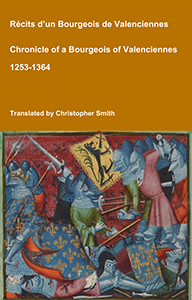
Chronicle of a Bourgeois of Valenciennes
Récits d’un bourgeois de Valenciennes aka The Chronicle of a Bourgeois of Valenciennes is a vivid 14th-century vernacular chronicle written by an anonymous urban chronicler from Valenciennes in the County of Hainaut. It survives in a manuscript that describes local and regional history from about 1253 to 1366, blending chronology, narrative episodes, and eyewitness-style accounts of political, military, and social events in medieval France, Flanders, and the Low Countries. The work begins with a chronological framework of events affecting Valenciennes and its region under rulers such as King Philip VI of France and the shifting allegiances of local nobility. It includes accounts of conflicts, sieges, diplomatic manoeuvres, and the impact of broader struggles like the Hundred Years’ War on urban life in Hainaut. Written from the perspective of a burgher (bourgeois) rather than a monastery or royal court, the chronicle offers a rare lay viewpoint on high politics and warfare, reflecting how merchants, townspeople, and civic institutions experienced the turbulence of the 13th and 14th centuries. Its narrative style combines straightforward reporting of events with moral and civic observations, making it a valuable source for readers interested in medieval urban society, regional politics, and the lived experience of war and governance in pre-modern Europe.
Available at Amazon in eBook and Paperback format.
On 3rd June 1537 John Manuel Aviz Prince Portugal was born to John III King Portugal (age 34) and Catherine of Austria Queen Consort Portugal (age 30). Coefficient of inbreeding 11.30%. He married 1552 his double first cousin Joanna of Austria Princess Portugal, daughter of Charles V Holy Roman Emperor and Isabel Aviz Queen Consort Spain, and had issue.
On 3rd June 1540 Charles Habsburg Spain II Archduke Austria was born to Ferdinand I Holy Roman Emperor (age 37) and Anne Jagiellon (age 36) at Vienna [Map]. He married 26th August 1571 his niece Maria Anna Wittelsbach, daughter of Albert V Wittelsbach V Duke Bavaria and Anna Habsburg Spain Duchess Bavaria, and had issue.
On 3rd June 1594 César Bourbon Vendôme 1st Duke Vendôme was born illegitimately to Henry IV King France (age 40) and Gabrielle d'Estrées (age 21). He married 16th July 1608 his half third cousin once removed Françoise Lorraine Duchess Vendôme and had issue.
On 3rd June 1678 Walter Chetwynd 1st Viscount Chetwynd was born to John Chetwynd of Boughton (age 35) and Lucy Roane. He married 27th May 1703 Mary Berkeley Viscountess Chetwynd, daughter of John Berkeley 4th Viscount Fitzhardinge and Barbara Villiers Viscountess Fitzhardinge.
On 3rd June 1696 Percy Seymour was born to Charles Seymour 6th Duke of Somerset (age 33) and Elizabeth Percy Duchess Somerset (age 29).
On 3rd June 1708 Humphrey Hervey was born to John Hervey 1st Earl Bristol (age 42) and Elizabeth Felton Countess Bristol (age 31).


On 3rd June 1713 Robert Petre 8th Baron Petre was born to Robert Petre 7th Baron Petre three months after his father's death. He married 2nd May 1732 his third cousin once removed Mary Radclyffe, daughter of James Radclyffe 3rd Earl Derwentwater and Anna Maria Webb Countess Derwentwater, and had issue.
On 3rd June 1720 Borlace Wallop was born to John Wallop 1st Earl Portsmouth (age 30) and Bridget Bennet Viscountess Lymington (age 23).
On 3rd June 1736 John Acton 6th Baronet was born to Edward Acton (age 26). He married before 1800 his niece Mary-Ann Acton Lady Acton and had issue.
On 3rd June 1740 Aubrey Beauclerk 5th Duke St Albans was born to Vere Beauclerk 1st Baron de Vere (age 40) and Mary Chambers Baroness Spencer (age 26). He a great grandson of King Charles II of England Scotland and Ireland. He married 4th May 1763 Catherine Ponsonby Duchess St Albans, daughter of William Ponsonby 2nd Earl Bessborough and Caroline Cavendish Countess Bessborough, and had issue.
On 3rd June 1743 William Elector of Hesse was born to Frederick Hesse-Kassel (age 22) and Mary Hanover (age 20). He a grandson of King George II of Great Britain and Ireland. He married 1st September 1764 his first cousin Electress Wilhelmina Caroline Oldenburg, daughter of Frederick V King of Denmark and Norway and Louise Hanover Queen Consort Denmark and Norway, and had issue.
On 3rd June 1744 Brooke Boothby 6th Baronet was born to Brooke Boothby 5th Baronet (age 33) and Phoebe Hollins Lady Boothby (age 27). He was baptised at St Oswald's Church, Ashbourne [Map].
Henrici Quinti, Angliæ Regis, Gesta, is a first-hand account of the Agincourt Campaign, and subsequent events to his death in 1422. The author of the first part was a Chaplain in King Henry's retinue who was present from King Henry's departure at Southampton in 1415, at the siege of Harfleur, the battle of Agincourt, and the celebrations on King Henry's return to London. The second part, by another writer, relates the events that took place including the negotiations at Troye, Henry's marriage and his death in 1422.
Available at Amazon in eBook and Paperback format.
On 3rd June 1768 Jacquetta Baring Lady Northcote was born to Charles Baring (age 25) and Margaret Gould (age 25). She married 6th May 1791 Stafford Henry Northcote 7th Baronet, son of Stafford Northcote 6th Baronet, and had issue.
On 3rd June 1769 Henrietta Constantia Finch was born to Heneage Finch 3rd Earl Aylesford (age 53) and Charlotte Seymour Countess Aylesford (age 38).

On 3rd June 1772 Henry George Herbert 2nd Earl Carnarvon was born to Henry Herbert 1st Earl Carnarvon (age 30) and Elizabeth Alicia Maria Wyndham Countess Carnarvon (age 19). He married 26th April 1796 Elizabeth Kitty Acland Countess Carnarvon and had issue.
On 3rd June 1785 Charles Banks Stanhope was born to Charles Stanhope 3rd Earl Stanhope (age 31) and Louisa Granville Countess Stanhope (age 27).
On 3rd June 1786 William Hilton was born to William Hilton (age 34) at Vicar's Court, Lincoln Cathedral Close. He was baptised at St Mary le Wigford Church, Lincoln. He married 26th February 1828 Justinia Kent.

On 3rd June 1789 John Ashburnham was born to George Ashburnham 3rd Earl Ashburnham (age 28) and Sophia Thynne (age 25).
On 3rd June 1796 Mary Legge was born to George Legge 3rd Earl Dartmouth (age 40) and Frances Finch Countess Dartmouth (age 35).

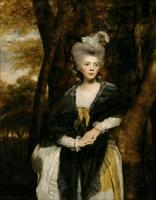

On 3rd June 1801 John Paulet 14th Marquess Winchester was born to Charles Burroughs-Paulet 13th Marquess Winchester (age 37) and Anne Andrews Marchioness of Winchester (age 28) at Amport House. He married (1) 18th August 1831 Caroline Ramsden (2) 10th August 1850 Joan Granville (3) 29th November 1855 Mary Robinson Montagu Marchioness Winchester, daughter of Henry Robinson Montagu 6th Baron Rokeby, and had issue.
On 3rd June 1802 Charles James Stuart-Wortley-Mackenzie was born to James Archibald Stuart-Wortley-Mackenzie 1st Baron Wharncliffe (age 25) and Elizabeth Caroline Mary Crichton Baroness Wharncliffe (age 24). He married 17th February 1831 his fourth cousin Emmeline Charlotte Elizabeth Manners, daughter of John Henry Manners 5th Duke Rutland and Elizabeth Howard Duchess Rutland, and had issue.
On 3rd June 1816 John Ormsby-Gore 1st Baron Harlech was born to William Ormsby-Gore (age 37).
On 3rd June 1816 Walter Charles James 1st Baron Northbourne was born to John James and Emily Jane Stewart Viscountess Hardinge (age 27). Coefficient of inbreeding 6.25%. He married 1841 Sarah Caroline Ellison and had issue.
On 3rd June 1819 Jane Maria Baker Lady Simeon was born to Frederick Baker 2nd Baronet (age 47) and Harriet Simeon Lady Baker. She married 26th November 1840 her first cousin John Simeon 3rd Baronet, son of Richard Godin Simeon 2nd Baronet and Louisa Edith Barrington, and had issue.
On 3rd June 1821 Jacopo Fitz James Stuart 15th Duke Alba 13th Duke Veragua 8th Duke Berwick was born to Carlos Miguel Fitz James Stuart 12th Duke Veragua 7th Duke Berwick 14th Duke Alba (age 27) and Rosalía Ventimiglia Duchess Veragua Duchess Berwick Duchess Alba (age 23) at Palermo [Map]. He married 14th February 1838 María Francisca "Paca" Palafox Duchess Veragua Duchess Berwick Duchess Alba.
On 3rd June 1823 Henrietta Charlotte Cholmondeley Baroness Berners was born to Thomas Cholmondeley 1st Baron Delamere (age 55) and Henrietta Elizabeth Williams-Wynn Baroness Delamere (age 52). She married 21st July 1857 Henry Wilson 11th Baron Berners, son of Reverend Henry Wilson 10th Baron Berners.
On 3rd June 1825 Juliana Whitbread Countess Leicester was born to Samuel Charles Whitbread (age 29) and Julia Brand. She married 20th April 1843 her half fifth cousin once removed Thomas Coke 2nd Earl of Leicester, son of Thomas Coke 1st Earl of Leicester and Anne Amelia Keppel Countess Leicester, and had issue.
On 3rd June 1830 Edward Joseph Bellew 2nd Baron Bellew was born to Patrick Bellew 1st Baron Bellew (age 32) and Anna Fermina de Mendoza Baroness bellew. He was baptised on 7th June 1830 at the Roman Catholic Cathedral, Dublin. He married 7th February 1853 Augusta Mary Bryan and had issue.
On 3rd June 1840 Henry Coster Lea Edwards 2nd Baronet was born to Henry Edwards 1st Baronet (age 27). He married (1) 22nd June 1872 Agnes Harcourt Clark (2) 29th September 1887 Laura Selina Clark Lady Edwards and had issue.
On 3rd June 1843 Frederick VIII King of Denmark was born to King Christian IX of Denmark (age 25) and Queen Louise Hesse-Kassel of Denmark (age 25). He a great x 3 grandson of King George II of Great Britain and Ireland. Coefficient of inbreeding 2.84%. He married 28th July 1869 Louise of Sweden Queen Consort Denmark and had issue.
On 3rd June 1852 Charles Bernard Talbot Fitzalan Howard was born to Edward George Fitzalan Howard 1st Baron Howard (age 33) and Augusta Talbot (age 20). He died aged nine in 1861.
Henrici Quinti, Angliæ Regis, Gesta, is a first-hand account of the Agincourt Campaign, and subsequent events to his death in 1422. The author of the first part was a Chaplain in King Henry's retinue who was present from King Henry's departure at Southampton in 1415, at the siege of Harfleur, the battle of Agincourt, and the celebrations on King Henry's return to London. The second part, by another writer, relates the events that took place including the negotiations at Troye, Henry's marriage and his death in 1422.
Available at Amazon in eBook and Paperback format.
On 3rd June 1859 Robert John Dashwood 9th Baronet was born to Edwin Hare Dashwood 7th Baronet (age 33) and Roberta Henrietta Abercromby.
On 3rd June 1862 Watkin Williams-Wynn 9th Baronet was born to Colonel Herbert Watkin Williams-Wynn (age 40) and Anna Lloyd (age 28). He married 1904 Elizabeth Ida Lowther and had issue.
On 3rd June 1862 Albert Toft was born.
On 3rd June 1865 King George V of the United Kingdom was born to King Edward VII of the United Kingdom (age 23) and Alexandra of Denmark Queen Consort England (age 20) at Marlborough House. He married 6th July 1893 his second cousin once removed Victoria Mary Teck Queen Consort England and had issue.
On 3rd June 1866 D'Arcy Lambton Lambton was born to George Frederick D'Arcy Lambton 2nd Earl Durham (age 37) and Beatrix Frances Hamilton Countess Durham (age 31).
On 3rd June 1912 William Douglas-Home Baron Dacre was born to Charles Cospatrick Douglas-Home 13th Earl of Home (age 38) and Lilian Lambton Countess of Home (age 30). He married 26th July 1951 his third cousin Rachel Leila Brand 27th Baroness Dacre, daughter of Thomas Brand 4th Viscount Hampden and Leila Seely Viscountess Hampden, and had issue.
On 3rd June 1940 John Skeffington 14th Viscount Massereene, 7th Viscount Ferrard was born to John Skeffington 13th Viscount Massereene, 6th Viscount Ferrard (age 25).
On 3rd June 1946 Evelyn Baring 4th Earl of Cromer was born to Rowland Baring 3rd Earl of Cromer (age 27).
On 3rd June 1979 Nicholas Ashley-Cooper 12th Earl of Shaftesbury was born to Anthony Ashley-Cooper 10th Earl of Shaftesbury (age 41) and Christina Eva Montan Countess of Shaftesbury (age 39).
On 3rd June 1550 John Dudley 2nd Earl Warwick (age 23) and Anne Seymour Countess of Warwick (age 12) were married at Sheen Palace [Map]. She the daughter of Edward Seymour 1st Duke of Somerset (age 50) and Anne Stanhope Duchess Somerset (age 53). He the son of John Dudley 1st Duke Northumberland (age 46) and Jane Guildford Duchess Northumberland (age 41). They were fifth cousin once removed. She a great x 5 granddaughter of King Edward III of England.
On 3rd June 1640 Thomas Pelham 2nd Baronet (age 42) and Margaret Vane Lady Pelham (age 17) were married. She by marriage Lady Pelham of Laughton. The difference in their ages was 25 years. They were fourth cousin once removed.
On 3rd June 1643 James Murray 2nd Earl Tullibardine (age 25) and Lilias Drummond Countess Tullibardine (age 22) were married. She the daughter of John Drummond 2nd Earl Perth (age 55) and Jean Ker Countess Perth. He the son of Patrick Murray 1st Earl Tullibardine (age 64). They were second cousins.
Anne Boleyn. Her Life as told by Lancelot de Carle's 1536 Letter.
In 1536, two weeks after the execution of Anne Boleyn, her brother George and four others, Lancelot du Carle, wrote an extraordinary letter that described Anne's life, and her trial and execution, to which he was a witness. This book presents a new translation of that letter, with additional material from other contemporary sources such as Letters, Hall's and Wriothesley's Chronicles, the pamphlets of Wynkyn the Worde, the Memorial of George Constantyne, the Portuguese Letter and the Baga de Secrets, all of which are provided in Appendices.
Available at Amazon in eBook and Paperback format.
On 3rd June 1683 Martin Lumley 3rd Baronet (age 21) and Elizabeth Dawes were married at St Dionis Backchurch.
On 3rd June 1705 or 18th September 1721 Charles Butler 3rd Duke Ormond (age 33) and Elizabeth Crew Countess Arran (age 26) were married. She by marriage Countess Arran. He the son of Thomas Butler 6th Earl Ossory and Emilia Nassau Beverweert Countess Ossory.
On 3rd June 1728 Theophilus Hastings 9th Earl Huntingdon (age 31) and Selina Shirley Countess Huntingdon (age 21) were married. She by marriage Countess Huntingdon. The marriage was arranged by his half-sister Elizabeth "Lady Betty" Hastings (age 46). She the daughter of Washington Shirley 2nd Earl Ferrers (age 50) and Mary Levinge Countess Ferrers. He the son of Theophilus Hastings 7th Earl Huntingdon and Mary Frances Fowler Countess Huntingdon.


On 3rd June 1777 Cornwallis Maude 1st Viscount Hawarden (age 47) and Anne Isabella Monck Viscountess Hawarden (age 18) were married. The difference in their ages was 29 years.
On 3rd June 1780 George Carpenter 2nd Earl Tyrconnel (age 30) and Sarah Hussey Delaval Countess Tyrconnel (age 17) were married. She by marriage Countess Tyrconnel. He the son of George Carpenter 1st Earl Tyrconnel and Frances Clifton Countess Tyrconnel.


On 3rd June 1781 Robert Hay-Drummond 10th Earl Kinnoul (age 30) and Sarah Harley Countess Kinnoul were married. He the son of Archbishop Robert Hay-Drummond and Henrietta d'Auriol. They were half third cousins.
On 3rd June 1791 Thomas Cave 7th Baronet (age 24) and Lucy Sherard Lady Cave (age 21) were married. She by marriage Lady Cave of Stanford in Northamptonshire. She the daughter of Robert Sherard 4th Earl Harborough (age 78).
On 3rd June 1796 George Wright 2nd Baronet (age 26) and Rebecca Maclane were married. His uncle-in-law Archbishop John Moore (age 66) officiated.
On 3rd June 1842 Ernest Saxe Coburg Gotha II Duke Saxe Coburg Gotha (age 23) and Princess Alexandrine of Baden (age 21) were married. He the son of Ernest Saxe Coburg Gotha I Duke Saxe Coburg Gotha (age 58) and Duchess Louise Dorothea of Saxe Coburg Altenburg. They were fifth cousin once removed. She a great x 3 granddaughter of King George II of Great Britain and Ireland.
On 3rd June 1846 George Gough 2nd Viscount Gough (age 31) and Jane Arbuthnot Viscountess Gough (age 29) were married.
On 3rd June 1863 Arthur Algernon Capell 6th Earl Essex (age 60) and Louisa Elizabeth Heneage Countess Essex were married. She by marriage Countess Essex. They were first cousin once removed. She a great x 5 granddaughter of King Charles II of England Scotland and Ireland.
On 3rd June 1863 Arthur Algernon Capell 6th Earl Essex (age 60) and Louisa Caroline Elizabeth Boyle Countess Essex were married. She by marriage Countess Essex. They were fifth cousins.
On 3rd June 1880 Robert Offley Ashburton Crewe Milnes 1st Marquess of Crewe (age 22) and Sibyl Marcia Graham Baroness Houghton (age 22) were married.
Jean de Waurin's Chronicle of England Volume 6 Books 3-6: The Wars of the Roses
Jean de Waurin was a French Chronicler, from the Artois region, who was born around 1400, and died around 1474. Waurin’s Chronicle of England, Volume 6, covering the period 1450 to 1471, from which we have selected and translated Chapters relating to the Wars of the Roses, provides a vivid, original, contemporary description of key events some of which he witnessed first-hand, some of which he was told by the key people involved with whom Waurin had a personal relationship.
Available at Amazon in eBook and Paperback format.
On 3rd June 1884 Edward Pellew 4th Viscount Exmouth (age 22) and Edith Hargreaves Viscountess Exmouth (age 24) were married. She by marriage Viscountess Exmouth.
On 3rd June 1903 John Ellingham Brooks (age 40) and Romaine Brooks aka Goddard (age 29) were married in Capri, Italy [Map].
On 3rd June 1937 King Edward VIII of the United Kingdom (age 42) and Wallis Warfield aka Simpson Duchess of Windsor (age 40) were married at the Château de Candé. No member of his family attended. He the son of King George V of the United Kingdom and Victoria Mary Teck Queen Consort England (age 70).
On 3rd June 1953 Matthew White Ridley 4th Viscount Ridley (age 27) and Anne Katharine Gabrielle Lumley Viscountess Ridley (age 24) were married. She the daughter of Roger Lumley 11th Earl of Scarbrough (age 56) and Katherine Isobel McEwen Countess Scarborough (age 53).
On 3rd June 1960 William Waldorf Astor 3rd Viscount Astor (age 52) and Phillipa Victoria Hunloke Viscountess Astor (age 29) were divorced.
On 3rd June 1253 Margaret Beaumont 7th Countess Warwick died. Her half first cousin William (age 33) succeeded 8th Earl Warwick. Alice Segrave Countess Warwick (age 21) by marriage Countess Warwick.
On 3rd June 1397 William Montagu 2nd Earl Salisbury (age 68) died. His nephew John (age 47) succeeded 3rd Earl Salisbury, 5th Baron Montagu. Maud Francis Countess of Salisbury (age 33) by marriage Countess Salisbury.
On 3rd June 1411 Leopold "The Fat" Habsburg IV Duke Austria (age 40) died. His brother Ernest (age 34) succeeded I Duke Austria.
On 3rd June 1449 Anne Beauchamp 15th Countess Warwick (age 5) died at Ewelme, Oxfordshire aged four whilst in the care of Alice Chaucer Duchess Suffolk (age 45). She was buried at Reading Abbey, Berkshire [Map]. Baron Burghesh abeyant between her three-half aunts and her full aunt Anne Beauchamp 16th Countess Warwick (age 22). It isn't clear why the barony was not subject to the same legal dispute that the Earldom of Warwick was subject to - see following.
After a prolonged legal dispute between her three half-aunts, Margaret Beauchamp Countess Shrewsbury and Waterford (age 45), Eleanor Beauchamp Duchess Somerset (age 40), Elizabeth Beauchamp Baroness Latimer (age 32) and her full aunt Anne Beauchamp 16th Countess Warwick, the courts decided her full aunt Anne Beauchamp should succeed. Anne Beauchamp succeeded 16th Countess Warwick. Her husband Richard Neville (age 20) by marriage Earl Warwick; the first step on his journey to becoming Kingmaker.
The decision of the court was not subscribed to by Edmund Beaufort Earl Somerset (age 43) who was married to Anne's half-sister Eleanor; he wanted his share of the considerable Beauchamp inheritance.
On 3rd June 1457 Avice Stafford Countess Ormonde (age 33) died.
On 3rd June 1514 William Browne (age 46) died. He was buried at Church of St Mary Magdalen Milk Street.
Henrici Quinti, Angliæ Regis, Gesta, is a first-hand account of the Agincourt Campaign, and subsequent events to his death in 1422. The author of the first part was a Chaplain in King Henry's retinue who was present from King Henry's departure at Southampton in 1415, at the siege of Harfleur, the battle of Agincourt, and the celebrations on King Henry's return to London. The second part, by another writer, relates the events that took place including the negotiations at Troye, Henry's marriage and his death in 1422.
Available at Amazon in eBook and Paperback format.
On 3rd June 1624 Thomas Bamburgh 2nd Baronet (age 17) died. His brother John (age 11) succeeded 3rd Baronet Bamburgh of Howsham in Yorkshire.
On 3rd June 1638 Francis Courtenay 4th Earl Devon (age 62) died at Berry Pomeroy, Devon. His son William (age 9) de jure 5th Earl Devon. Margaret Waller Countess Devon by marriage Countess Devon.

On 3rd June 1640 Theophilus Howard 2nd Earl Suffolk (age 57) died at Suffolk House, Suffolk Street. He was buried at Waldon Priory and Abbey [Map]. His son James (age 21) succeeded 3rd Earl Suffolk, 3rd Baron Howard de Walden.
On 3rd June 1643 Anne Sophia Herbert Countess Carnarvon died of smallpox.
On 3rd June 1654 Mary Colley Viscountess Moore and Wilmot died.
On 3rd June 1654 Alethea Talbot Countess Arundel, Surrey and Norfolk (age 69) died. Her grandson Thomas (age 27) succeeded 14th Baron Furnivall, 18th Baron Strange Blackmere, 15th Baron Talbot.
On 3rd June 1665 at the Battle of Lowestoft an English fleet commanded by King James II of England Scotland and Ireland (age 31), Prince Rupert Palatinate Simmern 1st Duke Cumberland (age 45) and Edward Montagu 1st Earl Sandwich (age 39) defeated a Dutch Fleet.
Richard Boyle was killed.
Charles Maccarthy Viscount Muskerry was killed.
Charles Berkeley 1st Earl Falmouth (age 35) was killed by a cannonball aboard the Royal Charles. Earl Falmouth extinct, Baron Botetourt Langport in Somerset extinct. His father Charles (age 65) succeeded 2nd Viscount Fitzhardinge of Berehaven in Kerry. Penelope Godolphin Viscountess Fitzhardinge by marriage Viscountess Fitzhardinge of Berehaven in Kerry. Possibly the only occasion when a father has succeeded his son.
Charles Weston 3rd Earl of Portland (deceased) was killed by a cannon shot. On 13th June 1665 His uncle Thomas (age 55) succeeded 4th Earl of Portland, 4th Baron Weston of Nayland in Suffolk.
Thomas Allin 1st Baronet (age 53) was present.
Admiral Jeremy Smith commanded the Mary.
Captain George Batts fought. He was assigned to Sir George Ayscue's (age 49) division in the Blue Squadron.
James Ley 3rd Earl Marlborough (age 47) was killed at the Battle of Lowestoft commanding Old James attempting to recover a captured ship. His half brother William (age 53) succeeded 4th Earl Marlborough.
On 3rd June 1692 Marie Bourbon Condé Countess Soissons (age 86) died.
On 3rd June 1705 Cecil Bishopp 4th Baronet (age 80) died. His son Cecil succeeded 5th Baronet Bishopp of Parham in Sussex.
On 3rd June 1714 Frederick William Oldenburg I Duke Schleswig Holstein Sonderburg Augustenburg (age 45) died. His son Christian (age 17) succeeded I Duke Schleswig Holstein Sonderburg Augustenburg. Frederikke Louise Unknown Duchess Schleswig Holstein Sonderburg Augustenburg by marriage Duchess Schleswig Holstein Sonderburg Augustenburg.
On 3rd June 1717 Bishop Thomas Watson (age 80) died.
On 3rd June 1741 Mary Berkeley Viscountess Chetwynd (age 70) died.
William of Worcester's Chronicle of England
William of Worcester, born around 1415, and died around 1482 was secretary to John Fastolf, the renowned soldier of the Hundred Years War, during which time he collected documents, letters, and wrote a record of events. Following their return to England in 1440 William was witness to major events. Twice in his chronicle he uses the first person: 1. when writing about the murder of Thomas, 7th Baron Scales, in 1460, he writes '… and I saw him lying naked in the cemetery near the porch of the church of St. Mary Overie in Southwark …' and 2. describing King Edward IV's entry into London in 1461 he writes '… proclaimed that all the people themselves were to recognize and acknowledge Edward as king. I was present and heard this, and immediately went down with them into the city'. William’s Chronicle is rich in detail. It is the source of much information about the Wars of the Roses, including the term 'Diabolical Marriage' to describe the marriage of Queen Elizabeth Woodville’s brother John’s marriage to Katherine, Dowager Duchess of Norfolk, he aged twenty, she sixty-five or more, and the story about a paper crown being placed in mockery on the severed head of Richard, 3rd Duke of York.
Available at Amazon in eBook and Paperback format.
On 3rd June 1792 Edward Pakenham 2nd Baron Longford (age 49) died. His son Thomas (age 18) succeeded 3rd Baron Longford.
On 3rd June 1794 Mary Leeson Countess Mayo (age 59) died.
On 3rd June 1794 Dorothy Cavendish 3rd Duchess Portland (age 43) died. She was buried at St Marylebone Church.
On 3rd June 1803 Bishop George Murray (age 42) died in Cavendish Square Marylebone after having caught a chill leaving the House of Lords.
On 3rd June 1811 Henry Herbert 1st Earl Carnarvon (age 69) died. His son Henry (age 39) succeeded 2nd Earl Carnarvon, 2nd Baron Porchester of Highclere in Hampshire. Elizabeth Kitty Acland Countess Carnarvon (age 38) by marriage Countess Carnarvon.
On 3rd June 1822 Thomas Warren-Bulkeley 7th Viscount Bulkeley (age 69) died without issue. Viscount Bulkeley of Cashel in Tipperary, Baron Bulkeley Beaumaris Anglesey extinct. Monument in St Marys and St Nicholas Church Beaumaris [Map] sculpted by Richard Westmacott (age 46).

On 3rd June 1830 Henrietta Antonia Herbert 3rd Countess Powis (age 71) died.
On 3rd June 1839 Hercules Rowley 2nd Baron Langford (age 44) died.
On 3rd June 1845 Henry Joseph Tichborne 8th Baronet (age 66) died. His brother Edward (age 63) succeeded 9th Baronet Tichborne of Tichborne in Hampshire.
On 3rd June 1860 John Byng 1st Earl Strafford (age 88) died. His son George (age 53) succeeded 2nd Earl Strafford, 2nd Viscount Enfield of Enfield in Middlesex, 2nd Baron Strafford of Harmondsworth in Middlesex. Harriet Cavendish Countess Strafford (age 39) by marriage Countess Strafford.
On 3rd June 1869 John Hobhouse 1st Baron Broughton (age 82) died. Baron Broughton of Broughton de Gyfford in Wiltshire extinct. His nephew Charles (age 44) succeeded 3rd Baronet Hobhouse of Chantry House Wiltshire and Westbury College in Gloucestershire.
Chronicle of Abbot Ralph of Coggeshall
The Chronicle of Abbot Ralph of Coggeshall (Chronicon Anglicanum) is an indispensable medieval history that brings to life centuries of English and European affairs through the eyes of a learned Cistercian monk. Ralph of Coggeshall, abbot of the Abbey of Coggeshall in Essex in the early 13th century, continued and expanded his community’s chronicle, documenting events from the Norman Conquest of 1066 into the tumultuous reign of King Henry III. Blending eyewitness testimony, careful compilation, and the monastic commitment to record-keeping, this chronicle offers a rare narrative of political intrigue, royal power struggles, and social upheaval in England and beyond. Ralph’s work captures the reigns of pivotal figures such as Richard I and King John, providing invaluable insights into their characters, decisions, and the forces that shaped medieval rule. More than a simple annal, Chronicon Anglicanum conveys the texture of medieval life and governance, making it a rich source for scholars and readers fascinated by English history, monastic authorship, and the shaping of the medieval world.
Available at Amazon in eBook and Paperback format.
On 3rd June 1895 John Hayter (age 94) died.
On 3rd June 1900 William Pleydell-Bouverie 5th Earl Radnor (age 58) died. His son Jacob (age 31) succeeded 6th Earl Radnor, 7th Viscount Folkestone, 7th Baron Longford, 9th Baronet Bouverie of St Catherine Cree Church in London.
On 3rd June 1922 Wyndham Charles Hanmer 6th Baronet (age 54) died. His son Griffin (age 28) succeeded 7th Baronet Hamner of Hamner in Flintshire.
On 3rd June 1923 Sophia Georgiana Robertina Wellesley Countess Hardwicke (age 83) died.
On 3rd June 1927 Henry Petty-Fitzmaurice 5th Marquess Lansdowne (age 82) died. His son Henry (age 55) succeeded 6th Marquess Lansdowne, 7th Earl Shelburne in County Wexford, 7th Earl Kerry.


On 3rd June 1927 Catherine Emily Brown (age 76) died.

On 3rd June 1939 Philip Albert Gustave David Sassoon 3rd Baronet (age 50) died. Baronet Sassoon of Kensington-gore in London extinct.
On 3rd June 1940 Denzil Cope 14th Baronet (age 66) died. His son Anthony (age 12) succeeded 15th Baronet Cope of Hanwell in Oxfordshire.
On 3rd June 1971 William Onslow 6th Earl of Onslow (age 57) died. His son Michael (age 33) succeeded 7th Earl Onslow, 7th Viscount Cranley, 10th Baron Onslow, 11th Baronet Onslow of West Clandon in Surrey, 12th Baronet Foote of London.
On 3rd June 1973 John Russell 3rd Baron Ampthill (age 76) died. He was buried at St Michael's Church, Chenies [Map]. His son Geoffrey (age 51) succeeded 4th Baron Ampthill of Ampthill in Bedfordshire. The succession was unsuccessfully contested by his younger half-brother John Hugo Trenchard Russell (age 22). The Committee for Privileges ruled in favour of Geoffrey in 1976.
Geoffrey Russell 4th Baron Ampthill: On 15th October 1921 he was born to John Russell 3rd Baron Ampthill and Christabel Hulme Hart Baroness Ampthill. The biological father remains a mystery since his mother and father had never, apparently, consummated their marriage. His father apparently never spoke to the child. On 23rd April 2011 Geoffrey Russell 4th Baron Ampthill died. His son David succeeded 5th Baron Ampthill of Ampthill in Bedfordshire.
John Hugo Trenchard Russell: On 13th October 1950 he was born to John Russell 3rd Baron Ampthill and Adeline Mary Constance Hone Baroness Ampthill
On 3rd June 1985 Sidney Montagu 11th Duke of Manchester (age 56) died at Robin Hood Ranch, Tennessee. He was buried at St Andrew's Church, Kimbolton [Map]. His brother Angus (age 46) succeeded 12th Duke Manchester, 15th Earl Manchester, 15th Viscount Mandeville, 15th Baron Montagu of Kimbolton.
On 3rd June 1987 Alan Montagu Stuart-Wortley-Mackenzie 4th Earl of Wharncliffe (age 52) died at Wharncliffe House, Wortley. He was buried at the Church of St Leonard, Wortley [Map]. His second cousin once removed Richard (age 34) succeeded 5th Earl Wharncliffe, 7th Baron Wharncliffe of Wortley in Yorkshire.
Chronicle of a Bourgeois of Valenciennes
Récits d’un bourgeois de Valenciennes aka The Chronicle of a Bourgeois of Valenciennes is a vivid 14th-century vernacular chronicle written by an anonymous urban chronicler from Valenciennes in the County of Hainaut. It survives in a manuscript that describes local and regional history from about 1253 to 1366, blending chronology, narrative episodes, and eyewitness-style accounts of political, military, and social events in medieval France, Flanders, and the Low Countries. The work begins with a chronological framework of events affecting Valenciennes and its region under rulers such as King Philip VI of France and the shifting allegiances of local nobility. It includes accounts of conflicts, sieges, diplomatic manoeuvres, and the impact of broader struggles like the Hundred Years’ War on urban life in Hainaut. Written from the perspective of a burgher (bourgeois) rather than a monastery or royal court, the chronicle offers a rare lay viewpoint on high politics and warfare, reflecting how merchants, townspeople, and civic institutions experienced the turbulence of the 13th and 14th centuries. Its narrative style combines straightforward reporting of events with moral and civic observations, making it a valuable source for readers interested in medieval urban society, regional politics, and the lived experience of war and governance in pre-modern Europe.
Available at Amazon in eBook and Paperback format.
On 3rd June 2004 Frances Ruth Roche Countess Spencer (age 68) died.