

Abbot John Whethamstede’s Chronicle of the Abbey of St Albans
Abbot John Whethamstede's Register aka Chronicle of his second term at the Abbey of St Albans, 1451-1461, is a remarkable text that describes his first-hand experience of the beginning of the Wars of the Roses including the First and Second Battles of St Albans, 1455 and 1461, respectively, their cause, and their consequences, not least on the Abbey itself. His text also includes Loveday, Blore Heath, Northampton, the Act of Accord, Wakefield, and Towton, and ends with the Coronation of King Edward IV. In addition to the events of the Wars of the Roses, Abbot John, or his scribes who wrote the Chronicle, include details in the life of the Abbey such as charters, letters, land exchanges, visits by legates, and disputes, which provide a rich insight into the day-to-day life of the Abbey, and the challenges faced by its Abbot.
Available at Amazon in eBook and Paperback format.
12 Oct is in October.
1338 French Raid on Southampton
12th October 1459 Battle of Ludford Bridge
On 12th October 501 Fergus Mór aka Great mac Eirc King of Dál Riata (age 71) died.
On 12th October 633 King Penda's alliance of Gwynedd and Mercia defeated the Northumbrians at the Battle of Hatfield Chase.
Eadfrith Deira was captured.
King Edwin of Northumbria (age 47) was killed. He was buried at Whitby Abbey [Map] - see Bede. His first cousin Osric succeeded King Deira. His nephew Eanfrith (age 43) succeeded King Bernicia.
Edwin's son Osfrith Deira was killed.
Anglo-Saxon Chronicle. 633. This year King Edwin (age 47) was slain by Cadwalla and Penda, on Hatfield moor, on the fourteenth of October [Note. Some sources say 12th October 633]. He reigned seventeen years. His son Osfrid was also slain with him. After this Cadwalla and Penda went and ravaged all the land of the Northumbrians; which when Paulinus saw, he took Ethelburga (age 28), the relict of Edwin, and went by ship to Kent. Eadbald and Honorius received him very honourably, and gave him the bishopric of Rochester, where he continued to his death.
On 12th October 638 Pope Honorius I died.
Rotuli Litterarum Clausarum. The King to Savaric de Mauléon, greetings. Know that Hugh de Foresta, the bearer of these presents, has lost his land in our service. And therefore we order you to provide him with some land from the confiscations of our enemies, from which he may be able to maintain himself. Witness T. at Wisbech [Map], on the 12th day of October [1216].
Rex Sauar̃ de Maɫ Leone saɫt. Sciatis qd Hugo de Foresta psenc lator amisit tram suā ₽ svico nr̃o. Et io vob mandam qd tram un sustentari posset alicubi ei ₽videa[tis de Pris inimicoz nr̃oz. T.] apd Wisebech. xij. die Oct.
On 12th October 1328 Clementia Hungary Queen Consort France (age 35) died.
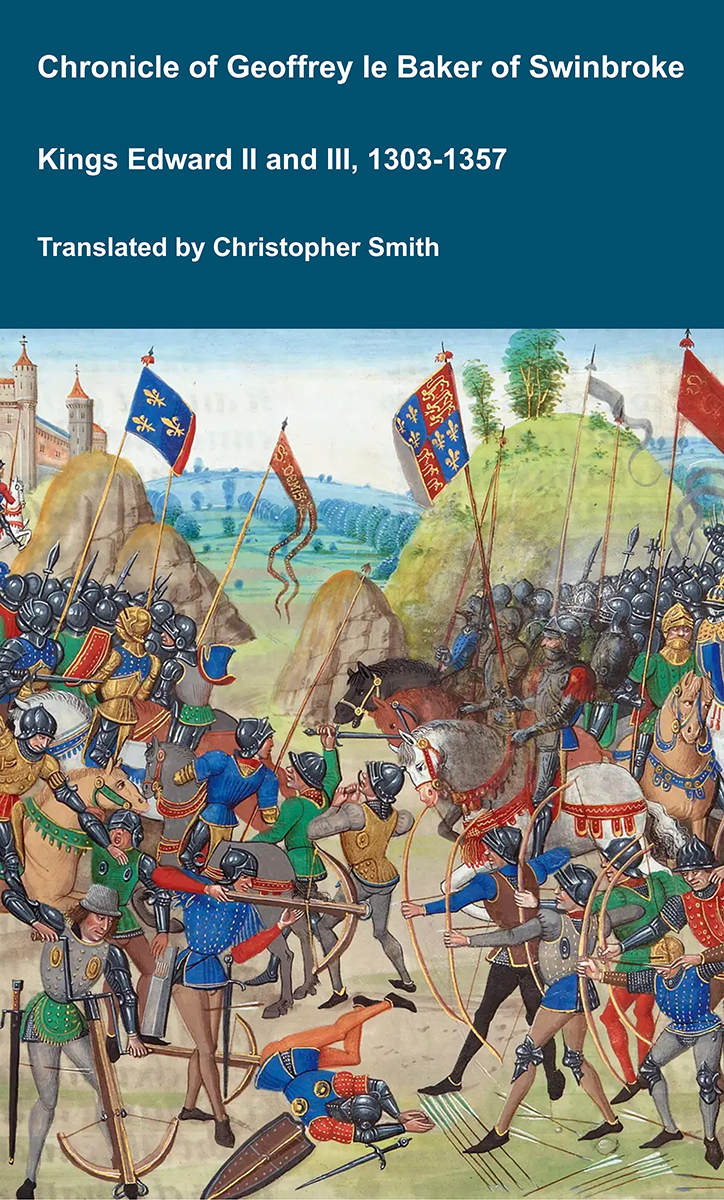 Chronicle of Geoffrey le Baker of Swinbroke [-1360]. In the same year, around the feast of Saint Callixtus the Pope, the Church of Canterbury became vacant upon the death of Master Simon Mepeham.1 At the request of the king, the pope provided as his successor Master John of Stretford, Bishop of Winchester.
Eodem anno, circa festum sancti Kalixti pape, vacavit ecclesia Cantuariensis per mortem magistri Simonis Mepham; cui, ad peticionem regis, papa providit de magistro Iohanne de Stretford episcopo Wintoniensi.
Note 1. Archbishop Simon Mepeham died on the 12th October 1333. He is buried in a tomb made of black marble located beneath the entrance arch to the Chapel of St. Anselm in Canterbury Cathedral.
On 12th October 1333 Archbishop Simon Mepeham died.
Calendar Fine Rolls 1337-1347. 12th October 1338. Kennington. Commission to John de Scures and Thomas Coudray to keep during pleasure the town of Southampton, which the king has resumed into his hand, against invasions and for the good government thereof, so that answer be made to the king for the issues and all other profits of the town and the liberty thereof which in this case are acknowledged to belong to the king; and order to all arrayers and keepers of the seacoast in those parts and to the sheriff of the county, knights and other men of those parts and the men of Southampton to be intendant to them; and power to the said John and Thomas to take and commit to prison all whom they find rebellious, to be detained until further order; the mayor, bailiffs and men of that town, holding it at fee farm to be kept safely to the king's use, having abandoned it on the coming. of certain aliens in galleys, so that the latter invaded the town, plundered and occupied the same, to the dishonour of the king and realm and to the great peril of the realm, as such enemies will be rendered the bolder for lack of resistance, invading the realm and committing worse or like evils. By K. and the guardian and council.
On 12th October 1343 Reginald "Black" I Duke Guelders (age 48) died from a fall from a horse at Arnhem [Map]. His son Reginald (age 10) succeeded II Duke Guelders, III Count Guelders. His wife acted as Regent to her nine year old son until 1344. His brother Edward Duke Guelders (age 7), however, also claimed the title and a war of succession commenced.
Chronicle of Geoffrey le Baker of Swinbroke [-1360]. While the aforementioned events were underway, two knights1 in the service of the King of Armenia came to England and into the presence of the king, presenting letters from the said Greek king, in which it was written that one of the knights, John of Visconti, a native of Cyprus, had accused the other, Thomas de la Marche (age 32), a Frenchman and illegitimate son of the late King Philip of France, of having received a sum of gold from the Turks in order to betray the Christian army into the hands of the Turkish tyrants. To prove this accusation, John challenged Thomas to single combat, to be judged under the authority of King Edward of England, as the most fortunate and noble prince. For this cause, the two knights fought a judicial duel within the enclosed lists at Westminster Palace, on the Monday immediately after the Feast of Saint Michael. In that combat, Thomas, in defence of his innocence, defeated his opponent, though he did not kill him, because he was unable to pierce his armour effectively with any weapon, except at the face, which alone was left unprotected. After the tilting with lances and hand-to-hand combat on foot, they fell wrestling together onto the ground. Then Thomas, using certain short and sharp spikes, which were embedded in the knuckle joints of his gauntleted right hand, and which are nowadays called "gadelinges", wounded John's exposed face. John, however, had no such short weapon with which he could harm Thomas's face, and so, with horrible cries, the duel was halted by royal order, and victory was adjudged to Thomas. Thomas delivered his vanquished opponent as a captive to the Prince of Wales, and offered his armour devoutly to Saint George at the Church of Saint Paul.
Prefatis in fieri se habentibus, duo milites stipendiarii domini regis Armenie venerunt ad Angliam et regis presenciam, ostendentes literas prefati regis Greci, in quibus continebatur quod alter istorum militum, scilicet Iohannes de Viscomite, nacione Ciprius, alterum, scilicet Thomam de la Marche, nacione Gallicum et filium Philippi nuper regis Francie, set illegitimum, calumniavit de eo quod predictus Thomas debuisset a Turcis quamdam auri summam recepisse ad hoc, quod exercitum Christianorum tirannidi Turcorum prodidisset, et quod ad calumnie probacionem Iohannes Thomam ad monomachiam provocasset, iudicio Edwardi regis Anglie, tamquam principis fortunatissimi, dirimendam. Pro ista causa prefati milites dimicarunt infra ligaticia pallacii regalis Westmonasterii, die Lune proxima post festum sancti Michaelis; ubi Thomas, in declaracionem sue iusticie, eius adversarium superavit, non tamen occidit, quia nec potuit sufficienter armatum penetrare alico tormento invasivo, preterquam in facie quam habuit nudam. Post nempe hastiludia et pedestres congressus, luctando simul in aream profusi, Thomas quibusdam stimulis curtis et acutis quos manum dextram comprimendo digitorum nodi radicales e cirotecis laminatis expresserunt, et eos moderni vocant 'gadelinges,' nudam Iohannis faciem wlneravit. E contra Iohannes nullum tormentum habuit ita curtum quo posset ledere faciem Thome; et hinc, orribiliter ipso exclamante, regio precepto duellum cessavit, et Thome victoria adiudicatur; qui victum Iohannem principi Wallie dederat captivum, atque suam armaturam sancto Georgio in ecclesia sancti Pauli optulit devote.
Note 1. Stow Annales 392.
On the 24th June 1350, Edward issued a safe conduct for Thomas, bastard of France, to come to England with thirty followers, to fight the duel. On the 12th October he publicly announced the result of the combat. Rymer's Fœdera 3.199, 205. From the latter document we are able to correct Baker's wild mistake about the Turks. Thomas de la Marche and Giovanni Visconti, both soldiers of fortune, were in the service of the king of Sicily, who was besieging Catania. Visconti brought a charge against de la Marche of conspiring to betray the king into the hands of the enemy; and challenged him to combat. The 'gadelinges,' which de la Marche used to such good effect, were apparently the sharp-pointed edges of the steel plates which protected the knuckles. The larger sharp spikes which were affixed to different parts of defensive armour were called 'gads' [goads].
Thomas de la Marche was not put to death in the manner described. He is heard of as late as 1358. See Froissart ed. Lettenhove, 22.157.
Froissart Book 4 Chapter 116. 12th October 1399. On the Saturday before the coronation, the new king went from Westminster to the Tower of London, attended by great numbers, and those squires who were to be knighted watched their arms that night: they amounted to forty-six: each squire had his chamber and bath, in which he bathed.
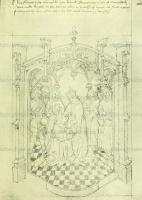
Beauchamp Pageant. [12th October 1399] 3. Here sheweth how this noble lorde [Richard Beauchamp (age 17)] Erle of Warrewik was made Knyghte to the whiche ordre in processe of tyme as shall appere folowyng by his noble actes: he did greet honour & worship.
Note. The scene here depicted is shown as taking place within a groined and canopied recess with tiled floor, flanked by buttresses surmounted by images of St. John Baptist and St. James the Greater within housings. Young Richard, now a boy of 17, is vested in a long gown with jewelled belt, and kneels before King Henry IV. on the eve of whose coronation (12th October 1399) he was made a Knight of the Bath. The King is standing crowned and in his parliament robes, and is placing about the boy's neck his own livery collar of SS. Behind the King, in long robes and wearing jewelled collars, stand several nobles, one of whom has a round cap on his head, while another holds his cap in his hand and has a large purse hanging from his belt. On the King's right hand is the swordbearer, in long gown with jewelled belt and neck-band. Next him is a noble in short girded tunic lined with fur, a jewelled baudric across the body, and long jack boots over his hose, holding in his left hand a round fur cap with rolled rim in which is set an upright jewelled feather. This figure probably represents Richard's father, Thomas Beauchamp, Earl of Warwick.
On 12th October 1428 the Siege of Orléans commenced at Orléans. During the course of the siege Thomas Montagu 1st Count Perche 4th Earl Salisbury (age 40) and Jean Poton Xaintrailles (age 38) were wounded. William "Jackanapes" de la Pole 1st Duke of Suffolk (age 31) commanded the English forces during some of the siege.
On 12th October 1459 the Battle of Ludford Bridge nearly took place at Ludlow [Map]. In the event a large number of the Calais garrison led by Andrew Trollope refused to fight against King Henry VI of England and II of France (age 37) who was present.
The Yorkist Richard Plantagenet 3rd Duke of York (age 48), the future King Edward IV of England (age 17), Edmund York 1st Earl of Rutland (age 16), Richard "Kingmaker" Neville Earl Warwick, 6th Earl Salisbury (age 30), Richard Neville Earl Salisbury (age 59) left overnight before the battle.
John Dynham 1st Baron Dynham (age 26) and Thomas Parr (age 52) were present.
The Lancastrian army included Humphrey Stafford 1st Duke of Buckingham (age 57) and William Fitzalan 9th or 16th Earl of Arundel (age 41).
Richard Grey 3rd Earl Tankerville (age 22) was present on the Yorkist side for which he was subsequently attainted. Earl Tankerville forfeit.
Pakington's Chronicle [-1390]. [12th October 1459] Anno D. 1459 & reg. Henr. 38. the Duke of York, the Erle of Warwike, and Salisbyri, seyng all thinges to be rulid by the Queene, and the Noble Men despisid, and standing yn Jeopardy of Life, gatherid an Hoste, and cam to Ludlo, to the whlch the Erle of Warwick resortid from Calays, and One Andrew Trollope, a stoute Warrior, with hym, yn whom he much trustid.
Andrew Trollop and the old Soldiours of Calais left the Duke of York, and the Erle of Warwik, and went to the Kinges Campe.
Then fledde the Duke of York with his second Sunne by Wales into Ireland, and the Erles of Salisbyri, and the Erle of March, in to Devonshire, and ther one Deneham, an Esquier, gat them a Ship for a 220 Nobles, and thens he sailid into Garnesey, and after was receivid in to the Castel of Calays.
Then the King entered Ludlo Toune and Castelle, and dispoilid them. And taking the Duches of York with her Childerne sent her to my Lady of Bokingham her Sister, where she was kept many dayes.
Chronicle of Jean de Waurin Books 3-5 [1400-1474]. 12th October 1459 Battle of Ludford Bridge
Andrew had received news through a secret message from the Duke of Somerset, very eloquently worded, which explained to him that he was coming to wage war against the King, his sovereign lord. It was also mentioned that the King had proclaimed among his army that all those who were adherents to his opposing party and wished to return to serve the King would be pardoned for everything, given great rewards, and treated well. Upon hearing this, Andrew Trollope secretly went to all those in the garrison of Calais and so convincingly persuaded them that they joined his side. Together, they went to the Earl of Warwick and informed him that they did not want to fight against their sovereign lord. Immediately, they switched sides, and no one could stop them.
Chronicle of Robert Fabyan [-1512]. 12th October 1459. Where of hearing the said Duke (age 48), then being with his people near unto the town of Ludlow, picked there a sure and strong field, that none of his foes might upon any part enter. Where he so lying, came to him from Calais, the Earl of Warwick (age 30) with a strong band of men, among the which was Andrew Trollope, and many other of the best soldiers of Calais. The Duke thus keeping his field upon that one party, and the king with his people upon that other, upon the night preceding the day that both houses should have met, the forenamed Andrewe Trollope, with all the chief soldiers of Calais, secretly departed from the Duke's host and went unto the kings, where they were joyously received. When this thing to the Duke and the other lords was ascertained, they were therewith sore dismayed, and especially, for the said lordes had to the said Andrew showed the whole of their entities, which then they knew well should be clearly discovered unto their enemies: wherefore, after counsel for a remedie taken, they concluded to flee, and to leave the field standing as they had been present and still abidyng. And so incontently the saide Duke with his two sons, and a few other persons, fled towarde Wales, and from thence passed safely into Irelande. And the earls of Salesbury (age 59), of Marche, and of Warwick, and other, with a secret company also departed and took the way into Devonshire, where a squire named John Dynham (age 26), which after was a lorde and High Treasurer of England, and so lastly in Henry the VII's days and sixteenth year of his reign died, [which John Dynham foresaid]1 bought a ship for aa hundredn and ten markys, or eleven score nobles; and in the same ship the said lords went, and so sailed into Gernesey. And when they had a season there sojourned and refreshed themselves, they departed thence, as in the beginning of the next mayor's year shall be clearly shown. Upon the morrow, when all this couyne was known to the kyng and the lords upon his party, there was sending and running with all speed toward every coast to take these lords, but none might be found. And forthwith the King rode unto Ludlow and despoiled the town and castle, and sent the Duchess of York, with her children, unto the Duchesse of Buckingham her sister, where she rested long after.
 Become a Member via our Buy Me a Coffee page to read more.
Abbot John Whethamstede’s Chronicle of the Abbey of St Albans
Abbot John Whethamstede's Register aka Chronicle of his second term at the Abbey of St Albans, 1451-1461, is a remarkable text that describes his first-hand experience of the beginning of the Wars of the Roses including the First and Second Battles of St Albans, 1455 and 1461, respectively, their cause, and their consequences, not least on the Abbey itself. His text also includes Loveday, Blore Heath, Northampton, the Act of Accord, Wakefield, and Towton, and ends with the Coronation of King Edward IV. In addition to the events of the Wars of the Roses, Abbot John, or his scribes who wrote the Chronicle, include details in the life of the Abbey such as charters, letters, land exchanges, visits by legates, and disputes, which provide a rich insight into the day-to-day life of the Abbey, and the challenges faced by its Abbot.
Available at Amazon in eBook and Paperback format.
Chronicle of St Albans by Abbot John Whethamstede [-1465]. Having been informed by their faithful followers about this matter and the conclusion reached among them, the Lords immediately raised their voices and exclaimed against the treacherous and seditious people using these words: "O deceitful nation! O impious people! O people full of treachery! You sacrifice more to Bacchus and Venus than to Bellona or brother Mars, as if they were more worthy gods. O fickle nation! O changeable people! O guilty people of deceit! You do not hesitate to be accused of falsehood, as long as you can hide in the clamour of war or find refuge in some place. O people! O genuine offspring of vipers! You deserve comparison on two counts: first, because you do not hesitate to corrode the entrails of your own lords, as long as you can escape the outcome of battle and return to your own without harm. Second, because you now strive with all your might to pierce those who have never harmed you, attempting to inflict wounds with your venomous swords. O people! O viperous breed, rather than vicarious! More venomous than truthful, known by every nation. For they had promised to stand with us unto death, and now, breaking their promise and with their spirit poisoned, they hasten to take our lives and thus save their own. O people! O generation similar to those who are wicked, perverse, and reputed to have faithless children! Therefore, let them be treated according to the imprecation of the Psalmist:— Let their children, that is, their orphans, and their wives, that is, their widows, be cast out from all their dwellings, which are known to exist somewhere within the kingdom."
Certiorati Domini per suos fideles de hujusmodi quæstionationis, et de conclusione sumpta inter eos, exaltaverunt protinus in altum voces, exclamaveruntque in populum perfidum et seditiosum, sub hiis verbis:— "O gens subdola! O gens impia! O gens perfidiæ plena! quæ Baccho et Veneri sæpius immolat, quam Bellonæ, aut fratri Marti, aut hiis, tanquam Diis dignioribus, immolare festinat. O gens instabilis! O gens mutabilis! O gens fallaciæ rea! quæ non veretur falsitatis argui, dummodo in strepitu bellico latere posset sub umbraculo, aut in loco refugii aliquo se tueri. O gens! O genus genuinum viperarum! gemina ratione merito comparandum: primo, quia nec verentur, nec verecundantur, propriorum dominorum viscera corrodere, dummodo possent illi evadere eventum belli, et iterum ad propria sine vulnere redire. Secundo vero, quia jam laborant totis viribus illos suorum aculeorum gladiis compungere, qui nunquam eos pupugerunt, give puncturam conabantur inferre. O gens! O genus vipereum, potius quam vicarium! virulentumque magis quam veridicum, ab omni natione nuncupandum. Nobiscum etenim usque ad mortem stare promiserant, et jam, promiss fracto, animoque potionato, vitam nobis adimere, et sic eis suam salvare, festinant. O gens O genus generationi illi multum persimile, quæ prava est, et perversa, et infideles filios fertur habere! Fiat igitur illis juxta imprecatum Psalmistæ:— filii, hoc est, eorum orphani, uxores vero viduæ, ejicianturque ulterius ipsi de omnibus et singulis suis habitaculis, quæ alicubi infra regnum noscuntur habere."
Become a Member via our Buy Me a Coffee page to read more.
Chronicle of Gregory [1400-1467]. 12th October 1459. Ande this same year there was a grete afray at Lodlowe by twyne the King (age 37) and the Duke of Yorke (age 48), the Erle of Salusbury (age 59), the Erle of Warwyke (age 30), the Erle of Marche (age 17). The Duke of Yorke lete make a grete depe dyche and fortefyde it with gonnys, cartys, and stakys, but his party was ovyr weke, for the kyng was mo then xxxM [Note. 3000] of harneysyd men, by-syde nakyd men that were compellyd for to come with the King. And thenne the duke fledde fro place to place in Walys, and breke downe the bryggys aftyr him that the kyngys mayny schulde not come aftyr hym. And he wente unto Monde. And there he taryd tylle the jornay was endyd at Northehampton. And he made newe grotys of a newe kune in Irlonde; in on syde of the grote was a crowne and in that othyr syde a crosse. And there he made many newe statutys, and his yong sonys [George York 1st Duke of Clarence (age 9) and King Richard III of England (age 7)] were sende by yende the see unto the Duke of Burgayne (age 63).
Chronicle of Gregory [1400-1467]. 12th October 1459. The Erle of Saulysbury (age 59), the Erle of Warwycke (age 30), the Erle of Marche (age 17), Syr John Wenlocke (age 59), alle thes come unto Devynschyre to Syr John Denham (age 26), and alle thes by the conveynge of Syr John Denham; and they bought a smalle vesselle in that contray, an they were conveyde unto Garnesey [Map], ande from Garnesaye unto Calys [Map], for fere of dethe that they said was ymagenyde by the kyng and his lordys, and of her owne housolde mayny for her dystruccyon, the counselle and consent of King Harry the VI. Thes lordys departyd out of Ingelonde on Synt Edward is evyn, Synt Edward bothe King and confessoure, the xij day of Octobera, and they taryd at Calys xxxvj wekys.
Note a. This is really the date of the breaking up of their camp at Ludlow, not of their leaving England.
A Chronicle of London. 12th October 1459 ... the seid erle holdyng his wey to Ludlowe, where he mette with the duke of Yorke and his sones therles of the Marche and Ruthland, and therle of Warwik aforseid; and toward them came kyng Henry with Lm1 [50,000] men. And in the nyght the duke of Yorke and his sones, and therle of Salisbury with his sone, voidid into Walis; and there departid the duke of Yorke with his seconde sone therle of Ruthland into Irland; and therles of Marche, Warwik and Salisbury, bought a ship, and so gete to Caleise and there were received.
A Brief Latin Chronicle. 12th October 1459. For in the year of our Lord 1459, the aforementioned lords, namely Richard, Duke of York, the Earl of March, son of the same duke, the Earl of Salisbury, and the Earl of Warwick, with a large retinue, near Ludlow around the feast of Saint Edward the Confessor, were preparing for open battle. Whether they had gathered to reform the ills of the kingdom, or for their own safekeeping, or for any other reason, God knows. Against them, the king himself with the nobles of the kingdom and a large army hastened to battle; however, after a delay there, many left the duke and the earls and, submitting themselves to the king, were received into his grace. The Duke of York fled. Indeed, the Duke of York went to Ireland with a few; the three remaining earls with very few reached Calais by ship. In the meantime, their estates were confiscated, and other properties were plundered. Meanwhile, occasional conflicts occurred between the Duke of Somerset, the captain of the castle of Guines, with his men, and the people of Calais, and many fell.
Nam anno Domini millesimo cccc°.lix°, insurrexerunt iterum predicti domini, scilicet Ricardus, dux Eboracensis, comes Merchie, filius ejusdem ducis, comes Sarum, comes Warwyc, cim grandi comitatu, et juxta Ludlaw circiter festum Sancti Edwardi Confessoris, ad bellum campestre se parabant. An sic convenerant ad reformandum mala regni, aut sui ipsorum salvam custodiam, vel quavis alia causa, novit Deus. Contra quos rex ipse cum proceribus regni et copioso exercitu in bellum properavit; mora autem ibi facta, recesserunt multi a duce et comitibus et regi se submittentes ad graciam ejus recepti sunt. Dux autem Eboracensis fugam inierunt. Dux namque Eboracensis cum paucis Hyberniam adiit; tres reliqui comites cum paucissimis usque Calisiam navigio pervenerunt. Confiscantur interim eorum predia, diripiuntur alia bona. Interim inter ducem Somersetie, capitaneum castri de Geynes, cum suis, et Calisienses, facti sunt interdum conflictus, et multi corruerunt.
Become a Member via our Buy Me a Coffee page to read more.
An English Chronicle. [12th October 1459] After theyre excusacionne conteyned in thys letter sent to the kyng, thay withdrowe thayme, and went in to dyuers parties of beyonde the see, for the more sewrte of theyre personnes: the duke of York wente into Yrelond, where he was worshypfully resceued. The erles of March, of Salesbury, and Warrewyk, nat wythoute grete geopardy and perylle, as welle in the londe as in the see, wente vnto Caleys and abood there.
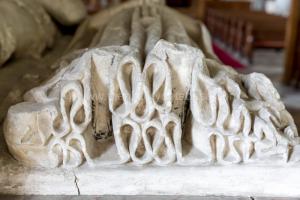
After 12th October 1477. Church of St John The Baptist, Kinlet [Map]. Monument to Humphrey Blount (deceased) and Elizabeth Winnington (age 49). Fluted Period. He wearing a Suns and Roses Collar. She wearing a fine Horned Headdress with large flap as also detailed in the weepers. Dress Folds at Feet. Dogs chewing at her dress with Studded Collar. Chest with Weepers holding Shields.
Humphrey Blount: In 1421 he was born to John Blount and Alice Bere at Rock, Worcestershire. In 1446 William Lichfield died. The estates at Kinlet, Cleobury Mortimer [Map] were inherited by Humphrey Blount who was the grandson of John Blount of Sodington who had married Isabella Cornwall who was the aunt of William's wife Elizabeth Cornwall. In or before 1447 Humphrey Blount and Elizabeth Winnington were married. On 12th October 1477 Humphrey Blount died at Kinlet, Cleobury Mortimer [Map].
Elizabeth Winnington: Around 1428 she was born to Robert Winnington. After 20th April 1478 she died.




Ellis' Letters. 12th October 1514. Mary Queen of France (age 18) to Thomas Wolsey (age 41), then Archbishop of York.
[MS. COTTON. CALIG. D. vi. fol. 143. Orig.]
... I recomaund me un to you as hertly as I can, and as schoth .... intreated as the kynge (age 23) and you thought I schuld have ben, for .... the morn next after the maryage, all my servants, both men and women . . a dyscharged. Insomoch that my mother Guldeford (age 51) was also dischargyd, whom as ze knowe the kynge and zou willed me in eny wyse to be cowncelled. But for eny thynge I myght do, yn no wyse myght I have any graunt for her abode here, which I assure you my lord is moch to my discomffort; besyd meny other discomffortis that ze wold full lyttyll have thought. I have not zet seen yn Fraunce eny lady or jentill woman so necessary for me as sche ys nor zet so mete to do the kynge my brother service as sche ys. And for my part my lord, as ze love the kynge my broder and me, fynd the meanes that sche may yn all hast com hither agayn, for I had as lefe lose the wynnynge I schall have yn France as to lose her counsell when I schall lacke it, which is not like long to be required, as I am sure the nobill men and jentillmen can schew you more then becometh me to wryte yn this matter. I pray you my Lord gyf credens forther to my moder Guldeford yn every thyng concernynge thys matter. And albehit my Lord of Northfollke (age 41) h .. b nethyr deled best with me nor zet with her at thys tyme: zet I pray you allwayes to be good lord unto her. And wold to God my had ben so good o have had zou with me hither when I ha . . rd c of Northfolke. And thus fare ze weale
My Lord. Wryt ile a the xij the . daye of Octobr.
My Lord I pray you gyve credens to my .... ord yn my sorows she have delyve ... Yowr on whyl I lefe
MARY
To my lovynge frend Th'archebischop of Zorke.
Become a Member via our Buy Me a Coffee page to read more.
Letters and Papers Foreign and Domestic. 12th October 1514. Vitell. C. XI., 155. B.M. Lett, de Rois, II., 547. (Documents Inédits.) 3357. [5484.] Mary Queen of France.
Names of the gentlemen and ladies retained by the King (Louis XII.) to do service to the Queen, viz.:—
"Le conte de Nonshere," Dr. Denton, almoner, Mr. Richard Blounte, "escuyer descuyerie," the sons of Lord Roos, Lord Cobham, and Mr. Seymour, "enfans d'honneur"; Evrard, brother of the Marquis, Arthur Polle (age 12), brother of Lord Montague, Le Poulayn, "pannetiers échansons et valetz trenchans"; Francis Buddis, usher of the chamber, Maistre Guillaume, physician, Henry Calays, "varlet des robes," Rob. Wast. Mesdemoiselles Grey (age 17) (sister of the Marquis), Mary Finis (age 19) (daughter of Lord Dacres (age 42)), Elizabeth (sister of Lord Grey), Madamoyselle Boleyne, Maistres Anne Jenyngham (age 10), "femme de chambre," and Jeanne Barnesse, "chamberiere." Signed by Louis XII.
Fr., pp. 2.
Note. The "Madamoyselle Boleyne" may be a reference to either Mary Boleyn (age 15) or Queen Anne Boleyn of England (age 13).


Ellis' Letters. 12th October 1514. Mary Queen of France (age 18) to King Henry the Eighth (age 23).
[MS. COTTON. CALIG. D. vi. fol. 253. Orig.]
MY good Brother as hertly as I can I recomaund me unto your Grace, mervelynge moch that I never herd from you syns ... re depertynge, so often as I have sent and wrytten to you. And now am I left post a lone in effect; for on the morn next after . . e maryage my chambirlayn with all other men servants wer dischargd and in lyke wyse my mother Guldeford (age 51) with other my women and maydyns, except such as never had experiens nor knowlech how to advertyse or gyfe me counsell yn any tyme of nede, which is to be fered more schortly then your Grace thought at the tyme of my depertynge, as my mother Guldeford can more playnly schew your Grace then I cann wryt; to whom I beseche you to gyve credens. And yf hit may be by eny meane possible, I humbly requyr you to cause my seyd mother Guldeford to repayr hither once agayn. For ells if any chauns happe other then weale I schall not knowe wher nor of whom to aske any good counsell to your pleasur, nor yet to myn own proffit. I merveill moche that my Lord of Northfolke (age 41) wold at all tymes so lyghtly graunt every thynge at ther reqwests here. I am weale assured that when ze know the trouth of every thyng as my mother Guideford can schew you, ze wold full lyttyll have thowght I schold have ben thus intreated: that wold God my Lord of Zorke (age 41) had com with me yn the rome of Northfolke: for then am I sure I schuld have bene left moch more at my herti .... then I am now.
And thus I byd your Grace fare weale with .... as ever had Prince; and more herds ease then I have now ... a Abvile [Map] the xijth . day of October.
.... gef gredens to my mowder Geldeford.
your lowyng syster MARY QUENE OF FRANCE.
Note a. From Henry the Eighth and his Court accompanied the young Queen to Dover, whence on the second of October she sailed to Boulogne. She reached Abbeville on the 8th and was married on the 9th of that month. The original List of the persons who went in her retinue, signed by Louis himself, is still preserved among the Cottonian Manuscriptsb; though strange as it may seem, almost the whole were dismissed the morning after her marriage. "The Tewesdaye, being the x. daye of October," says Hall, "all th'Englishmen except a fewe that were officers with the sayde Quene, were discharged; whiche was a great sorowe for theim, for some had served her long in hope of prefermente, and some, that had honest romes, lefte them to serve her; and now they were with out service; which caused them to take thought, in so much that some dyed by the way returning, and some fell mad; but ther was no remedy." The Queen's own account of this Transaction will be found in this, and the following Letter. Mother Guldeford who is so particularly mentioned in these Letters, was apparently the Governess, or, as she was sometimes called, the Mother to the Maids of Honor.
Note b. It was as follows:
"Premierement
Mons. le Conte de Nrushere.
Maistre docteur Denton aumosmer.
Messe. Richard Blounte escuyer de scuierie.
Enffans d'onneur: Le filz de Mons. Roos, Le filz de Mons. Cobham, Le filz de Messe. Seymor,
Evrard frere du Marquis.
Arthus Polle (age 12), frere de Monsr. de Montagu.
Le Poulayn.
Francoye Buddis, huissier de Chambre.
Maistre Guille, Medicin.
Henry Calays varler des robes.
Robert Wast.
Madamoyselle Grey, seur du Marquis. [Note. Possibly Elizabeth Grey Countess Kildare (age 17)]
Madamoyselle Marie finis fille de Monsr. Dacres. [Note. Possibly Mary Dacre (age 12)]
Madamoyselle Elizabet seur de Monsr. Grey.
Madamoyselle BOLEYNE. [Note. A reference to Mary Boleyn (age 15) rather than Queen Anne Boleyn of England (age 13) since her father Thomas wrote to Margaret of Austria on the 14th of October 1514 requesting the return of Anne see Manuscripts of J Eliot Hodgkin].
Maistres Anne Jenyngham (age 10). femme de Chambre.
Johanue Daruossc, chamberiere."
Become a Member via our Buy Me a Coffee page to read more.
On 12th October 1531 Jacques of Savoy 2nd Duke of Nemours was born to Philip of Savoy Duke Nemours (age 41) and Charlotte Valois (age 19). He married 29th April 1566 his half third cousin once removed Anna d'Este, daughter of Ercole Este II Duke Ferrara and Renée of France Duchess of Ferrara, and had issue.
On 12th October 1537 King Edward VI of England and Ireland was born to Henry VIII (age 46) and Queen Jane Seymour (age 28) after two day of labour at either four or ten in the morning at Hampton Court Palace, Richmond [Map]. George Owen (age 38) assisted as Physician. See Register of the Order of the Garter.


This is a translation of the 'Memoires of Jacques du Clercq', published in 1823 in two volumes, edited by Frederic, Baron de Reissenberg. In his introduction Reissenberg writes: 'Jacques du Clercq tells us that he was born in 1424, and that he was a licentiate in law and a counsellor to Philip the Good, Duke of Burgundy, in the castellany of Douai, Lille, and Orchies. It appears that he established his residence at Arras. In 1446, he married the daughter of Baldwin de la Lacherie, a gentleman who lived in Lille. We read in the fifth book of his Memoirs that his father, also named Jacques du Clercq, had married a lady of the Le Camelin family, from Compiègne. His ancestors, always attached to the counts of Flanders, had constantly served them, whether in their councils or in their armies.' The Memoires cover a period of nineteen years beginning in in 1448, ending in in 1467. It appears that the author had intended to extend the Memoirs beyond that date; no doubt illness or death prevented him from carrying out this plan. As Reissenberg writes the 'merit of this work lies in the simplicity of its narrative, in its tone of good faith, and in a certain air of frankness which naturally wins the reader’s confidence.' Du Clercq ranges from events of national and international importance, including events of the Wars of the Roses in England, to simple, everyday local events such as marriages, robberies, murders, trials and deaths, including that of his own father in Book 5; one of his last entries.
Available at Amazon in eBook and Paperback format.
Chronicle of Edward Hall [1496-1548]. 12th October 1537. In October on Saint Edward's eve was borne at Hampton court [Map] the noble Impe Prince Edward, whose Godfathers at the Christening were the Archbishop of Canterbury (age 48), and the Duke of Norfolk (age 64) and his Godmother the Lady Mary (age 21) the King's daughter, and at the bishoping was Godfather the Duke of Suffolk (age 53). At the birth of this noble Prince was great fires made through the whole realm and great joy made with thanks giving to almighty God, which had sent so noble a prince to succeed in the crown of this realm.


Wriothesley's Chronicle [1508-1562]. 12th October 1537. And the morrowe after, being Fridaie and the eaven of Sainct Edwarda, sometime King of Englande, at tow of the clocke in the mominge the Quecne [was] delivered of a man chieldeb at Hampton Court beside Kingston. And the same daie, at eight of the clocke in the morning, Te Deum was songe in everie parish church throughout Londonc, with all the bells ringing in everie church, and great fiars made in everie streete; and at 9 of the clocke their was assembled at Ponies all the orders of friars, monkes, channons, priestes, and clarkes about London, standing all about Paules in rich copes, with the best crosses and candlestickes of everie parrishe church in London; the Bishopp of London, the Bishopp of Chichestre, Deane of Poules, and the Abbott of West- minster being mitred, the said Bishopp and Deane of Paules making a collation to the people at the quire dore of Poules, the French Kinges embassadour being present, the Lord Chauncelor of Englande, the Lord Privie Scale, the Lorde Marques Dorsett, with all the judges and serjeantes of the lawe; the Major of London, with the orderman [aldermen] and sherives, with all the craftes of London, standing in their liveries: and after the said collation Poules quire song an attempncd of the Trinitie, with Te Deum, and the 9th responde of the Trinitie, with the colect of the same. Then the Kinges waites and the waites of London plaied with the shalmes; and after that a great peale of gonnea were shott at the Tower of London, all which solempnitie was donne to give laude and prayse to God for joy of our prince.
October 12th. Circular letters, in the Queen's name and under her signet, were prepared, announcing the birth of Prince Edward. One of them, addressed to the Lord Privy Seal, and dated on that day at Hampton Court, is now in the British Museum, Nero, C. x. leaf 7.
Note b. The story of Edward's being brought into the world by surgical art, and at the sacrifice jof his mother's life, seems to haye been invented by Nicolas Sanders, the Jesuit, from whom it was borrowed by Sir John Hayward, and adopted in his life of Edward VI. - See Kennett's Hist. Engl. vol. ii. p. 273. From this source it found its way into various historical books. The error apparently originated through the Queen's death having been assigned to the 14th, only two days after her deliyery, instead of to the 24th. - See p. 69 of this Chronicle.
Note c. As the King had caused his two daughters by his former marriages to be declared illegitimate, nothing could be more acceptable than the birth of a son which put the succession of the Crown out of all dispute.
Note d. Anthem.
Become a Member via our Buy Me a Coffee page to read more.
Register of the Order of the Garter Volume 1. [12th October 1537] In the same Year thef thirteenth Day of October, being St Edward's Day, about four a-Clock1, the most gracious Queen Jane was freed from her very hard Labour, which she had bore with exceeding Pain for about two whole Days before; when; by God's Assistance, the most renowned Prince Edward came into the World. Whole Birth caused all over the Kingdom of England, far greater Joy and Transport, than can be told or express'd; and if a Damp had not, by the Mother's dying a fewg Days after in that Child-bed; been put upons that Joy, it would, above all others which ever arose on the like or not much different Occasion; have doubtless (as it begun so) continued the most abundant as well as immoveable. But this one Misfortune so allayed the Fulness of the Joy conceived, or rather annnihilated it, That some might doubt, whether (as we were indeed bound) we ought to rejoice more for the Birth of the Child, or mourn for the Death of the Mother. Either of them indeed affected in an uncommon Degree, whether you confider the Occasion of Joy or Sadness. May the Mother rejoice in Heaven, and enjoy her Deires there! May the Son triumph on Earth, and fill up the Years of Life?h
Ejusdem anni mensis Octobris, circiter horam quartam diei tertii decimi, qui et Edoardo Divo sacer erat, soluta est gratiosissima Regina Joanna partu illo diffieillimo, quem duos totos, plus minus, ante dies ægerrime pertulerat. Quo felicissime, Deo præstante, prodiit in hanc lucem inclytissimus Princeps Edoardus, cujus nativitas passim Anglorum regno gaudium atque exultationem invexit, quam dici aut exprimi potest longe majorem. Et nisi vel hoc unum refricuisset, quod eo puerperio non ita multos post dies mater obiisset, ea Iætitia præter alias qu£e sunt uspiam in pari vel non longe dissimili causa prius exortæ, non dubium quin uberrima (quod et cœperat) utique permansisset, atque inooncussa : sed hæc una infoelicitas occepti gaudii plenitudinem ita exinanivit, aut elevavit potius, ut quisque dubitaret, an ortu prolis abunde (quod revera oportuit) gaudere deberet, an matris obitu flere. Utrumvis sane haud mediocriter aifecit, seu Iætitiæ causam sive mæroris attendas : Mater in cælo gaudeat, et fruatur optatis ; proles in terra triumphet, atque annos impleat ætatis.
Note f. Tis strange the contemporary Writers shuld differ so much in the Day of the Birth of this Princem, wherein this Regifter is with several other Authors mistaken, for he was born without Doubt, as 'tis entred in the Heralds Office "on the xii of Oct. the Feast of St. Wilfrid, the Vigil of St. Edw, which was on the Fryday in the Year of our Lord 1527, the Dominical Letter G. in the 29 Year of the Reign of Hen. VIII" All these various Methods of Computations correspond with each other, and as that Ceremonial informs us, he was not echristened till the Monday next following, when (it is there said) he was after the Rites of Baptism "borne" to the King, and to the Queens and bad the Blessing of Almighty God and his Fathers and Mothers, J. 14 in Off. Arm. p. 135. E. 10 penes me p. 26. & G. xi p. 450.
Note g. The Writers are no more agreed on the Day of this Queen's Death, their various Accounts may be seen in the Margin of Burn. 2 vol. Refor. p. 1. who in his Text saith that she died the Day after this Prince was born. But we find from the Christenining of the Prince, that she was living on the Monday following, the Letter of the Physicians published by My. Hearne was wrote upon a Wednes. which though it hath not the Addition of the Day of the Month, proves her to be living longer than that learned Historian imagined, The Colections of Antony Antony Surveyor of the Ordinance in Mus. Ashmol n. 861, p. 333, place the Birth of this Prince on 12 of Oct, and the Death of his Mother on the 24 of Oct. between x and xi at Night. The Ceremonial of her Funeral in the Heralds Office hath a farther Addition that her Death was on Wednesday 12 of the Clock at Night, 12 Days after the Prince's Birth, M. 6. p. 1. J. 14. p. 119. E. 14. penes me. p. 28.
Note h. Here is no Entry of the Transactions in the 30th Year, though it appears from the Partition of Fees among the Heralds, that there was a Feast of this Order held at Windfor on 26 Day of May, and from B. 3. penes me p. 32, that the Duke of Norfolk was then Lieutenant as Windsor, Dr. Aldrydge on 18 July in this 29 Year, being nominated to the Bishoprick of, this Omission might be occasiioned by that Means; for upon Inspection of this Book, it appears, that the Entry of the next Year is wrote with a very different Ink, and that the Initial Letters are painted in a different Manner from the former Part of this Book. And the Variation in the Style during the Remainder a this Reign is very obvious. Mr. Ashm. p. 198; hath observed that in the Register. Chart. the Hand altered after the end of the 29th Year of Hen. VIII.
Note 1. "circiter horam quartam diei tertii decimi" may mean "about four a-Clock". However, it may refer to the fourth hour of the day meaning ten in the morning.
Become a Member via our Buy Me a Coffee page to read more.
On 12th October 1537 Edward Seymour was born to Edward Seymour 1st Duke of Somerset (age 37) and Anne Stanhope Duchess Somerset (age 40). He died aged one in 1539.
Chronicle of Greyfriars. 12th October 1537. Also this yere the 12th day of October was born the Prince Edward at Hampton Court [Map], the 29th year of King Henry the VIII.
On 12th October 1555 Peregrine Bertie 13th Baron Willoughby was born to Richard Bertie Baron Willoughby (age 38) and Catherine Willoughby Duchess Suffolk (age 36) at Wesel in Germany. He was named for his parents peregrinations through Germany avoiding religious persecution. He married 25th December 1577 Mary Vere Baroness Willoughby of Eresby, daughter of John de Vere 16th Earl of Oxford and Margery Golding Countess of Oxford, and had issue.


On 12th October 1558 Maximilian King Poland was born to Maximilian Habsburg Spain II Holy Roman Emperor (age 31) and Maria of Spain Holy Roman Empress (age 30). Coefficient of inbreeding 10.03%.


Henry Machyn's Diary. 12th October 1559. The xij day of October whent by water unto the court the kyng of Sweythen('s) (age 63) sune (age 25), and ys gard, and ther he was honorabull reseyvyd with mony honorabull men at the hall-dore, wher the gard stod in ther ryche cottes, unto the quen('s) chambur, and ther he was reseyvyd of the Quen('s) (age 26) grace, and after he had grett chere as cold be had.
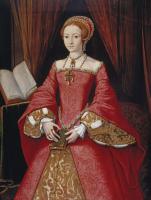


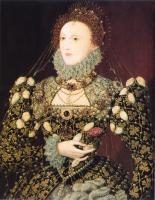
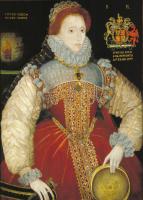


On 12th October 1561 William "Younger" Welf Duke Brunswick-Lüneburg (age 26) and Dorothea Oldenburg Duchess Brunswick-Lüneburg (age 15) were married. She by marriage Duchess Brunswick Lüneburg. She the daughter of Christian III King of Denmark and Dorothea of Saxe Lauenburg Queen Consort Denmark and Norway (age 50). They were half sixth cousins.

On 12th October 1576 Maximilian Habsburg Spain II Holy Roman Emperor (age 49) died. His son Rudolf (age 24) succeeded II Holy Roman Emperor.
Abbot John Whethamstede’s Chronicle of the Abbey of St Albans
Abbot John Whethamstede's Register aka Chronicle of his second term at the Abbey of St Albans, 1451-1461, is a remarkable text that describes his first-hand experience of the beginning of the Wars of the Roses including the First and Second Battles of St Albans, 1455 and 1461, respectively, their cause, and their consequences, not least on the Abbey itself. His text also includes Loveday, Blore Heath, Northampton, the Act of Accord, Wakefield, and Towton, and ends with the Coronation of King Edward IV. In addition to the events of the Wars of the Roses, Abbot John, or his scribes who wrote the Chronicle, include details in the life of the Abbey such as charters, letters, land exchanges, visits by legates, and disputes, which provide a rich insight into the day-to-day life of the Abbey, and the challenges faced by its Abbot.
Available at Amazon in eBook and Paperback format.
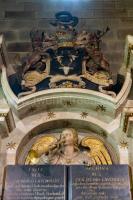
On 3rd March 1626 William Cavendish 1st Earl Devonshire (age 73) died. His son William (age 36) succeeded 2nd Earl Devonshire, 2nd Baron Cavendish Hardwick. Christian Bruce Countess Devonshire by marriage Countess Devonshire. On 12th October 1616 Henry Cavendish died. Both were buried at St Peter's Church, Edensor [Map].
The monument was behind the altar in the original church but moved to a separate chapel in the new church.
Monument formed two bodies under a low four-poster with black Ionic columns and black covering slab. The monument has been attributed to Maximilian Colt (age 51).


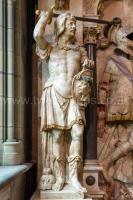




John Evelyn's Diary. 12th October 1641. From Dover, I that night rode post to Canterbury, Kent [Map]. Here I visited the cathedral [Map], then in great splendour, those famous windows being entire, since demolished by the fanatics. The next morning, by Sittingboume [Map], I came to Rochester [Map], and thence to Gravesend [Map], where a light-horseman (as they call it) taking us in, we spent our tide as far as Greenwich [Map]. From hence, after we had a little refreshed ourselves at the College, (for by reason of the contagion then in London we balked the inns,) we came to London landing at Arundel-stairs [Map]. Here I took leave of his Lordship (age 56), and retired to my lodgings in the Middle Temple, being about two in the morning, the 14th of October.


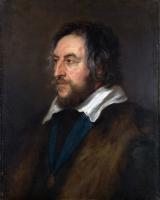

On 12th October 1654 John Savage 2nd Earl Rivers (deceased) was buried at Macclesfield, Cheshire [Map].

Samuel Pepys' Diary. 12th October 1660. Office day all the morning, and from thence with Sir W. Batten (age 59) and the rest of the officers to a venison pasty of his at the Dolphin, where dined withal Col. Washington, Sir Edward Brett, and Major Norwood, very noble company. After dinner I went home, where I found Mr. Cooke, who told me that my Lady Sandwich (age 35) is come to town to-day, whereupon I went to Westminster to see her, and found her at super, so she made me sit down all alone with her, and after supper staid and talked with her, she showing me most extraordinary love and kindness, and do give me good assurance of my uncle's resolution to make me his heir. From thence home and to bed.
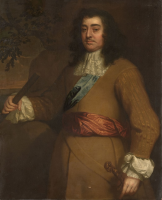
Samuel Pepys' Diary. 12th October 1663. Up (though slept well) and made some water in the morning [as] I used to do, and a little pain returned to me, and some fears, but being forced to go to the Duke (age 29) at St. James's, I took coach and in my way called upon Mr. Hollyard (age 54) and had his advice to take a glyster. At St. James's we attended the Duke all of us. And there, after my discourse, Mr. Coventry (age 35) of his own accord begun to tell the Duke how he found that discourse abroad did run to his prejudice about the fees that he took, and how he sold places and other things; wherein he desired to appeal to his Highness, whether he did any thing more than what his predecessors did, and appealed to us all. So Sir G. Carteret (age 53) did answer that some fees were heretofore taken, but what he knows not; only that selling of places never was nor ought to be countenanced. So Mr. Coventry very hotly answered to Sir G. Carteret, and appealed to himself whether he was not one of the first that put him upon looking after this taking of fees, and that he told him that Mr. Smith should say that he made £5000 the first year, and he believed he made £7000. This Sir G. Carteret denied, and said, that if he did say so he told a lie, for he could not, nor did know, that ever he did make that profit of his place; but that he believes he might say £2500 the first year. Mr. Coventry instanced in another thing, particularly wherein Sir G. Carteret did advise with him about the selling of the Auditor's place of the stores, when in the beginning there was an intention of creating such an office. This he confessed, but with some lessening of the tale Mr. Coventry told, it being only for a respect to my Lord Fitz-Harding (age 33). In fine, Mr. Coventry did put into the Duke's hand a list of above 250 places that he did give without receiving one farthing, so much as his ordinary fees for them, upon his life and oath; and that since the Duke's establishment of fees he had never received one token more of any man; and that in his whole life he never conditioned or discoursed of any consideration from any commanders since he came to the Navy. And afterwards, my Lord Barkeley merrily discoursing that he wished his profit greater than it was, and that he did believe that he had got £50,000 since he came in, Mr. Coventry did openly declare that his Lordship, or any of us, should have not only all he had got, but all that he had in the world (and yet he did not come a beggar into the Navy, nor would yet be thought to speak in any contempt of his Royall Highness's bounty), and should have a year to consider of it too, for £25,000. The Duke's answer was, that he wished we all had made more profit than he had of our places, and that we had all of us got as much as one man below stayres in the Court, which he presently named, and it was Sir George Lane (age 43)! This being ended, and the list left in the Duke's hand, we parted, and I with Sir G. Carteret, Sir J. Minnes (age 64), and Sir W. Batten (age 62) by coach to the Exchange [Map], and there a while, and so home, and whether it be the jogging, or by having my mind more employed (which I believe is a great matter) I know not, but.... I begin to be suddenly well, at least better than I was.


Become a Member via our Buy Me a Coffee page to read more.
Samuel Pepys' Diary. 12th October 1663. So home and to dinner, and thence by coach to the Old Exchange [Map], and there cheapened some laces for my wife, and then to Mr.---the great laceman in Cheapside, and bought one cost me £4. more by 20s. than I intended, but when I came to see them I was resolved to buy one worth wearing with credit, and so to the New Exchange, and there put it to making, and so to my Lord's lodgings and left my wife, and so I to the Committee of Tangier, and then late home with my wife again by coach, beginning to be very well, and yet when I came home.... The little straining which I thought was no strain at all at the present did by and by bring me some pain for a good while. Anon, about 8 o'clock, my wife did give me a clyster which Mr. Hollyard (age 54) directed, viz., a pint of strong ale, 4 oz. of sugar, and 2 oz. of butter. It lay while I lay upon the bed above an hour, if not two, and then thinking it quite lost I rose, and by and by it began with my walking to work, and gave me three or four most excellent stools and carried away wind, put me in excellent ease, and taking my usual walnut quantity of electuary at my going into bed I had about two stools in the night....
Samuel Pepys' Diary. 12th October 1665. Called up before day, and so I dressed myself and down, it being horrid cold, by water to my Lord Bruncker's (age 45) ship, who advised me to do so, and it was civilly to show me what the King (age 35) had commanded about the prize-goods, to examine most severely all that had been done in the taking out any with or without order, without respect to my Lord Sandwich (age 40) at all, and that he had been doing of it, and find him examining one man, and I do find that extreme ill use was made of my Lord's order. For they did toss and tumble and spoil, and breake things in hold to a great losse and shame to come at the fine goods, and did take a man that knows where the fine goods were, and did this over and over again for many days, Sir W. Berkeley (age 26) being the chief hand that did it, but others did the like at other times, and they did say in doing it that my Lord Sandwich's back was broad enough to bear it.


Samuel Pepys' Diary. 12th October 1665. Being overjoyed at this I to write my letters, and at it very late. Good newes this week that there are about 600 less dead of the plague than the last. So home to bed.
Samuel Pepys' Diary. 12th October 1667. And so it rested; but this do shew that they are and will be very high; and Mr. Pierce do tell me that he fears, and do hear, that it hath been said among them, that they will move for the calling my Lord Sandwich (age 42) home, to bring him to account; which do trouble me mightily; but I trust it will not be so. Anon comes home Sir W. Pen (age 46) from the burial, and he and I to walk in the garden, where he did confirm the most of this news, and so to talk of our particular concernments, and among the rest he says that Lady Batten and her children-in-law are all broke in pieces, and that there is but £800 found in the world, of money; and is in great doubt what we shall do towards the doing ourselves right with them, about the prize-money. This troubles me, but we will fall to work upon that next week close. Then he tells me he did deliver my petition into the hands of Sir W. Coventry (age 39), who did take it with great kindness and promised to present it to the Duke of York (age 33), and that himself has since seen the Duke of York, but it was in haste, and thinks the Duke of York did tell him that the thing was done, but he is confident that it either is or will be done. This do please me mightily. So after a little talk more I away home to supper with John Bowles and brother and wife (who, I perceive, is already a little jealous of my being fond of Willet, but I will avoid giving her any cause to continue in that mind, as much as possible), and before that did go with Sir W. Pen to my Lady Batten, whom I had not seen since she was a widow, which she took unkindly, but I did excuse it; and the house being full of company, and of several factions, she against the children, and they against one another and her, I away, and home to supper, and after supper to bed.
Samuel Pepys' Diary. 12th October 1667. At home we find that Sir W. Batten's (deceased) burial was to-day carried from hence, with a hundred or two of coaches, to Walthamstow, Essex [Map], and there buried. Here I hear by Mr. Pierce the surgeon; and then by Mr. Lewes, and also by Mr. Hater, that the Parliament hath met on Thursday last, and adjourned to Monday next. The King (age 37) did make them a very kind speech, promising them to leave all to them to do, and call to account what and whom they pleased; and declared by my Lord Keeper (age 61) how many, thirty-six, actes he had done since he saw them; among others, disbanding the army, and putting all Papists out of employment, and displacing persons that had managed their business ill, that the Parliament is mightily pleased with the King's speech, and voted giving him thanks for what he said and hath done; and, among things, would by name thank him for displacing my Chancellor (age 58), for which a great many did speak in the House, but it was opposed by some, and particularly Harry Coventry (age 48), who got that it should be put to a Committee to consider what particulars to mention in their thanks to the King, saying that it was too soon to give thanks for the displacing of a man, before they knew or had examined what was the cause of his displacing.


Samuel Pepys' Diary. 12th October 1668. So to supper, and after supper to read a ridiculous nonsensical book set out by Will. Pen (age 23), for the Quakers; but so full of nothing but nonsense, that I was ashamed to read in it. So they gone, we to bed1. 13th. Up, and to the office, and before the office did speak with my Lord Brouncker (age 48), and there did get his ready assent to T. Hater's having of Mr. Turner's place, and so Sir J. Minnes's (age 69) also: but when we come to sit down at the Board, comes to us Mr. Wren (age 39) this day to town, and tells me that James Southern do petition the Duke of York (age 34) for the Storekeeper's place of Deptford, Kent [Map], which did trouble me much, and also the Board, though, upon discourse, after he was gone, we did resolve to move hard for our Clerks, and that places of preferment may go according to seniority and merit. So, the Board up, I home with my people to dinner, and so to the office again, and there, after doing some business, I with Mr. Turner to the Duke of Albemarle's (age 59) at night; and there did speak to him about his appearing to Mr. Wren a friend to Mr. Turner, which he did take kindly from me; and so away thence, well pleased with what we had now done, and so I with him home, stopping at my Lord Brouncker's, and getting his hand to a letter I wrote to the Duke of York for T. Hater, and also at my Lord Middleton's (age 60), to give him an account of what I had done this day, with his man, at Alderman Backewell's (age 50), about the getting of his £1000 paid2 and here he did take occasion to discourse about the business of the Dutch war, which, he says, he was always an enemy to; and did discourse very well of it, I saying little, but pleased to hear him talk; and to see how some men may by age come to know much, and yet by their drinking and other pleasures render themselves not very considerable. I did this day find by discourse with somebody, that this nobleman was the great Major-General Middleton; that was of the Scots army, in the beginning of the late war against the King (age 38). Thence home and to the office to finish my letters, and so home and did get my wife to read to me, and then Deb to comb my head....
Note 1. Penn's first work, entitled, "Truth exalted, in a short but sure testimony against all those religions, faiths, and worships, that have been formed and followed, in the darkness of apostacy; and for that glorious light which is now risen, and shines forth, in the life and doctrine of the despised Quakers.... by W. Penn, whom divine love constrains, in holy contempt, to trample on Egypt's glory, not fearing the King's wrath, having beheld the Majesty of Him who is invisible:" London, 1668. B.
Note 2. It was probably for this payment that the tally was obtained, the loss of which caused Pepys so much anxiety. See November 26th, 1668.


Become a Member via our Buy Me a Coffee page to read more.
Samuel Pepys' Diary. 12th October 1668. Up, and with Mr. Turner by water to White Hall, there to think to enquire when the Duke of York (age 34) will be in town, in order to Mr. Turner's going down to Audley Ends [Map] about his place; and here I met in St. James's Park with one that told us that the Duke of York would be in town to-morrow, and so Turner parted and went home, and I also did stop my intentions of going to the Court, also this day, about securing Mr. Turner's place of Petty-purveyor to Mr. Hater. So I to my Lord Brouncker's (age 48), thinking to have gone and spoke to him about it, but he is gone out to town till night, and so, meeting a gentleman of my Lord Middleton's (age 60) looking for me about the payment of the £1000 lately ordered to his Lord, in advance of his pay, which shall arise upon his going Governor to Tangier, I did go to his Lord's lodgings, and there spoke the first time with him, and find him a shrewd man, but a drinking man, I think, as the world says; but a man that hath seen much of the world, and is a Scot. I offered him my service, though I can do him little; but he sends his man home with me, where I made him stay, till I had gone to Sir W. Pen (age 47), to bespeak him about Mr. Hater, who, contrary to my fears, did appear very friendly, to my great content; for I was afraid of his appearing for his man Burroughs. But he did not; but did declare to me afterwards his intentions to desire an excuse in his own business, to be eased of the business of the Comptroller, his health not giving him power to stay always in town, but he must go into the country. I did say little to him but compliment, having no leisure to think of his business, or any man's but my own, and so away and home, where I find Sir H. Cholmly (age 36) come to town; and is come hither to see me: and he is a man that I love mightily, as being, of a gentleman, the most industrious that ever I saw. He staid with me awhile talking, and telling me his obligations to my Lord Sandwich (age 43), which I was glad of; and that the Duke of Buckingham (age 40) is now chief of all men in this kingdom, which I knew before; and that he do think the Parliament will hardly ever meet again; which is a great many men's thoughts, and I shall not be sorry for it. He being gone, I with my Lord Middleton's servant to Mr. Colvill's, but he was not in town, and so he parted, and I home, and there to dinner, and Mr. Pelling with us; and thence my wife and Mercer, and W. Hewer (age 26) and Deb., to the King's playhouse, and I afterwards by water with them, and there we did hear the Eunuch (who, it seems, is a Frenchman, but long bred in Italy) sing, which I seemed to take as new to me, though I saw him on Saturday last, but said nothing of it; but such action and singing I could never have imagined to have heard, and do make good whatever Tom Hill used to tell me. Here we met with Mr. Batelier and his sister, and so they home with us in two coaches, and there at my house staid and supped, and this night my bookseller Shrewsbury comes, and brings my books of Martyrs, and I did pay him for them, and did this night make the young women before supper to open all the volumes for me.


Become a Member via our Buy Me a Coffee page to read more.
On 12th October 1679 Edmund Berry Godfrey (age 57) was murdered. He was found dead in a ditch at Primrose Hill lying face down on his own sword. The investigation concluded he had been strangled and subsequently moved.

John Evelyn's Diary. 12th October 1690. The French General, with Tyrconnel (age 60) and their forces, gone back to France, beaten out by King William. Cork [Map] delivered on discretion. The Duke of Grafton (deceased) was there mortally wounded and dies. Very great storms of wind. The 8th of this month Lord Spencer (age 49) wrote me word from Althorpe [Map], that there happened an earthquake the day before in the morning, which, though short, sensibly shook the house. The "Gazette" acquainted us that the like happened at the same time, half-past seven, at Barnstaple, Devon, Holyhead, Anglesey, and Dublin [Map]. We were not sensible of it here.
On 12th October 1709 Anne Hamilton was born to James Hamilton Duke Hamilton, 1st Duke Brandon (age 51) and Elizabeth Gerard Duchess Brandon (age 29) in St James' Square. He was named after his godmother Queen Anne of England Scotland and Ireland (age 44). His other godparents were John Churchill 1st Duke of Marlborough (age 59) and Charles Spencer 3rd Earl of Sunderland (age 34). He married October 1742 Anna Charlotta Maria Powell and had issue.


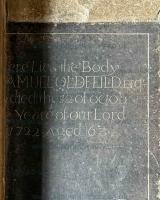
St Cuthbert's Church, Doveridge [Map]. Grave of Samuelk Olfdeild died 12th October 1722.
On 12th October 1730 Frederick IV King of Denmark and Norway (age 59) died. His son Christian (age 30) succeeded VI King of Denmark and Norway.
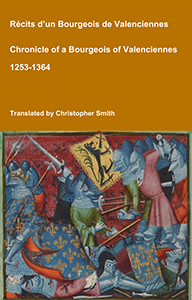
Chronicle of a Bourgeois of Valenciennes
Récits d’un bourgeois de Valenciennes aka The Chronicle of a Bourgeois of Valenciennes is a vivid 14th-century vernacular chronicle written by an anonymous urban chronicler from Valenciennes in the County of Hainaut. It survives in a manuscript that describes local and regional history from about 1253 to 1366, blending chronology, narrative episodes, and eyewitness-style accounts of political, military, and social events in medieval France, Flanders, and the Low Countries. The work begins with a chronological framework of events affecting Valenciennes and its region under rulers such as King Philip VI of France and the shifting allegiances of local nobility. It includes accounts of conflicts, sieges, diplomatic manoeuvres, and the impact of broader struggles like the Hundred Years’ War on urban life in Hainaut. Written from the perspective of a burgher (bourgeois) rather than a monastery or royal court, the chronicle offers a rare lay viewpoint on high politics and warfare, reflecting how merchants, townspeople, and civic institutions experienced the turbulence of the 13th and 14th centuries. Its narrative style combines straightforward reporting of events with moral and civic observations, making it a valuable source for readers interested in medieval urban society, regional politics, and the lived experience of war and governance in pre-modern Europe.
Available at Amazon in eBook and Paperback format.
On 12th October 1753 Danvers Osborn 3rd Baronet (age 37) committed suicide at New York. His body was found in the garden of the house in which he was lodged, which belonged to a local councilman. The body presented evidence of strangulation. His son George (age 11) succeeded 4th Baronet Osborn of Chicksands in Bedfordshire.


On 12th October 1772 Samuel Scott (age 70) died.
On 12th October 1817 Georgiana Ellice was born to Robert Charles Ellice (age 32) and Eliza Courtenay (age 25). Named after her maternal grandmother Georgiana Spencer Duchess Devonshire. She married 4th November 1846 Hugh Horatio Seymour-Conway.


Greville Memoirs. 12th October 1831. The Reformers appear to have rallied their spirits. Lord Grey went to Windsor, was graciously received by the King, and obtained the dismissal of Lord Howe, which will serve to show the King's entire good-will to his present Ministers. Ebrington's (age 78) resolution of confidence was carried by a great majority in the House of Commons after some violent speeches from Macaulay, Sheil, and O'Connell, and very moderate ones and in a low tone on the other side. Macaulay's speech was as usual very eloquent, but as inflammatory as possible. Such men as these three can care nothing into what state of confusion the country is thrown, for all they want is a market to which they may bring their talents;2 but how the Miltons, Tavistocks, Althorps, and all who have a great stake in the country can run the same course is more than I can conceive or comprehend. Party is indeed, as Swift says, 'the madness of many,' when carried to its present pitch. In the meantime the Conservative party are as usual committing blunders, which will be fatal to them. Lord Harrowby was to have moved yesterday or the day before, in the House of Lords, a resolution pledging the House to take into consideration early in the next session the acknowledged defects in the representation, with a view to make such ameliorations in it as might be consistent with the Constitution, or something to this effect. This has not been done because the Duke of Wellington objects. He will not concur because he thinks the proposition should come from Government; as if this was a time to stand upon such punctilios, and that it was not of paramount importance to show the country that the Peers are not obstinately bent upon opposing all Reform. I had hoped that he had profited by experience, and that at least his past errors in politics might have taught him a little modesty, and that he would not have thwarted measures which were proposed by the wisest and most disinterested of his own party. I can conceive no greater misfortune at this moment than such a disunion of that party, and to have its deliberations ruled by the obstinacy and prejudices of the Duke. He is a great man in little things, but a little man in great matters—I mean in civil affairs; in those mighty questions which embrace enormous and various interests and considerations, and to comprehend which great knowledge of human nature, great sagacity, coolness, and impartiality are required, he is not fit to govern and direct. His mind has not been sufficiently disciplined, nor saturated with knowledge and matured by reflection and communication with other minds, to enable him to be a safe and efficient leader in such times as these.
Note 2. This was very unjust to Macaulay, and not true as to Sheil; to O'Connell alone applicable.
[In reading over these remarks upon the Duke of Wellington, and comparing them with the opinions I now entertain of his present conduct, and of the nature and quality of his mind, I am compelled to ask myself whether I did not then do him injustice. On the whole I think not. He is not, nor ever was, a little man in anything, great or small; but I am satisfied that he has made great political blunders, though with the best and most patriotic intentions, and that his conduct throughout the Reform contest was one of the greatest and most unfortunate of them.—July 1838.]
Become a Member via our Buy Me a Coffee page to read more.
On 12th October 1837 James Murray 1st Baron Glenlyon (age 55) died at Fenton's Hotel, St James' Street. His son George (age 23) succeeded 2nd Baron Glenlyon of Glenlyon in Perthshire.
On 12th October 1844 Caroline Gordon-Lennox was born to Charles Gordon-Lennox 6th Duke Richmond (age 26) and Frances Harriett Greville Duchess Richmond (age 20).
On 12th October 1847 Charles William Fitzgerald Fitzgerald 4th Duke Leinster (age 28) and Caroline Leveson-Gower Duchess Leinster (age 20) were married at Trentham, Staffordshire. She the daughter of George Sutherland Leveson-Gower 2nd Duke Sutherland (age 61) and Harriet Elizabeth Georgiana Howard Duchess Sutherland (age 41). He the son of Augustus Fitzgerald 3rd Duke Leinster (age 56) and Charlotte Augusta Stanhope Duchess Leinster (age 54). They were half fifth cousin once removed. He a great x 4 grandson of King Charles II of England Scotland and Ireland.
Journals of Caroline Fox Chapter XIII 1847. 12th October 1847. Burnard tells amusing stories of his brother sculptors, and their devices to hide their ignorance on certain questions. Chantrey, after sustaining a learned conversation with Lord Melbourne (age 68) to his extremest limits, saved his credit by, "Would your Lordship kindly turn your head on the other side and shut your mouth." Spoke of Bacon (age 70), the sculptor, after having given up his craft for twenty-five years, resuming it, at the request of his dying daughter, to make her monument, and finding himself as much at home with his tools as ever.
On 12th October 1855 Friedrich Ferdinand Glücksburg Duke Schleswig Holstein Sonderburg Glücksburg was born to Friedrich Glücksburg Duke Schleswig Holstein Sonderburg Glücksburg (age 40) and Adelheid Schasumburg Lippe Duchess Schleswig Holstein Sonderburg Glücksburg at Kiel. He a great x 3 grandson of King George II of Great Britain and Ireland. He married 19th March 1885 his third cousin once removed Victoria Friederike Oldenburg Duchess Schleswig Holstein Sonderburg Glücksburg, daughter of Frederick Christian Oldenburg II Duke Schleswig Holstein Sonderburg Augustenburg and Adelheid Hohenlohe Langenburg Duchess Schleswig Holstein Sonderburg Augustenburg, and had issue.
On 12th October 1861 Prince Friedrich of Saxe Meiningen was born to Georg II Duke of Saxe Meiningen (age 35).
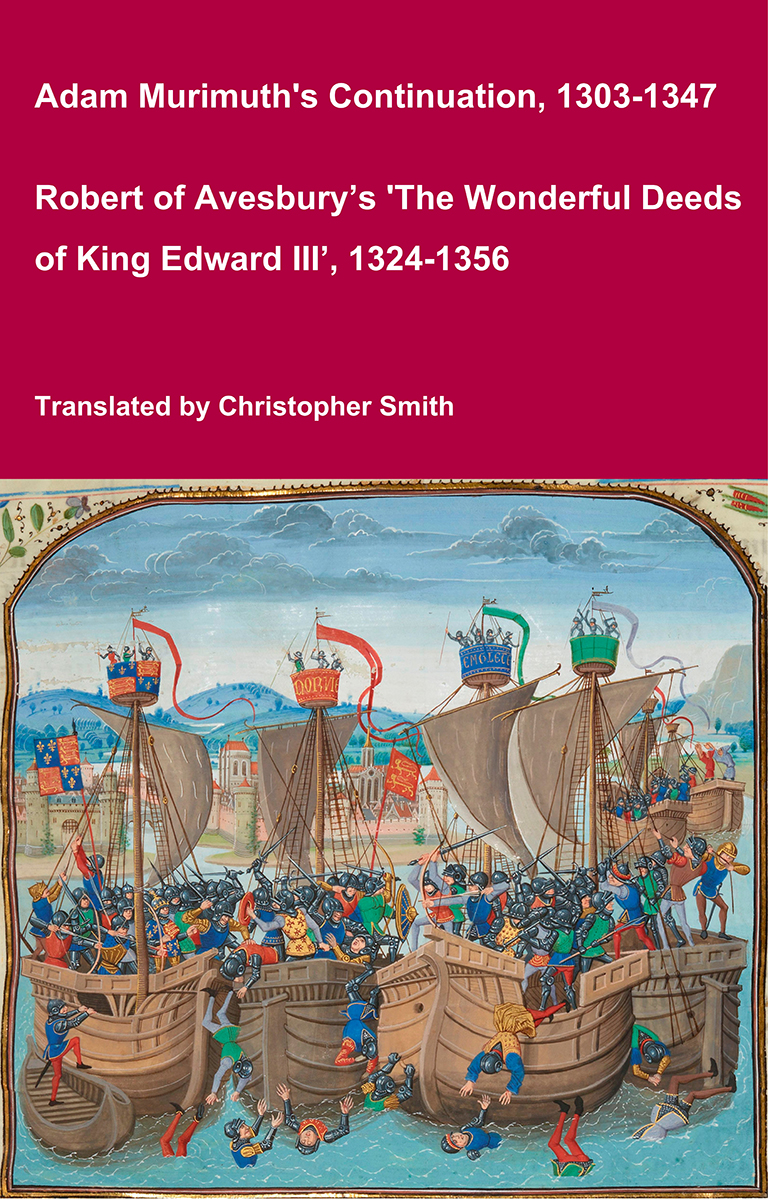
Adam Murimuth's Continuation and Robert of Avesbury’s 'The Wonderful Deeds of King Edward III'
This volume brings together two of the most important contemporary chronicles for the reign of Edward III and the opening phases of the Hundred Years’ War. Written in Latin by English clerical observers, these texts provide a vivid and authoritative window into the political, diplomatic, and military history of fourteenth-century England and its continental ambitions. Adam Murimuth Continuatio's Chronicarum continues an earlier chronicle into the mid-fourteenth century, offering concise but valuable notices on royal policy, foreign relations, and ecclesiastical affairs. Its annalistic structure makes it especially useful for establishing chronology and tracing the development of events year by year. Complementing it, Robert of Avesbury’s De gestis mirabilibus regis Edwardi tertii is a rich documentary chronicle preserving letters, treaties, and official records alongside narrative passages. It is an indispensable source for understanding Edward III’s claim to the French crown, the conduct of war, and the mechanisms of medieval diplomacy. Together, these works offer scholars, students, and enthusiasts a reliable and unembellished account of a transformative period in English and European history. Essential for anyone interested in medieval chronicles, the Hundred Years’ War, or the reign of Edward III.
Available at Amazon in eBook and Paperback format.
After 12th October 1901. All Saints Church, West Acre [Map]. Memorials to Edward Lewis Birkbeck (deceased) and Gillian Mary Birkbeck (age 18).
Edward Lewis Birkbeck: On 16th June 1860 he was born to Henry Birkbeck of Stoke Holy Cross and Mary Anne Hamond. On 21st April 1891 Edward Lewis Birkbeck and Emily Augusta Seymour were married. They were sixth cousins. She a great x 5 granddaughter of King James II of England Scotland and Ireland. On 12th October 1901 Edward Lewis Birkbeck died.
Gillian Mary Birkbeck: On 25th October 1882 she was born to Henry Birkbeck. On 15th May 1909 Gillian Mary Birkbeck died at Kobe Japan whilst working as a Missionary.
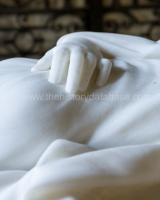
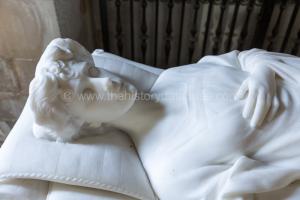
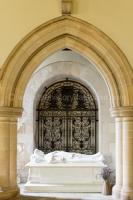
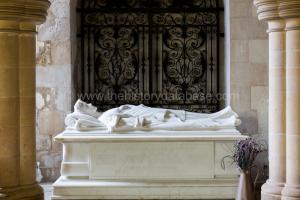
On 12th October 1905 Isabel Innes-Kerr (age 26) died in childbirth. Monument at St James' Church Warter [Map] sculpted by George Frampton (age 45). She died in childbirth aged 26.
Isabel Innes-Kerr: In 1879 she was born to James Henry Robert Innes-Kerr 7th Duke Roxburghe and Anne Emily Spencer-Churchill Duchess Roxburghe. On 23rd June 1904 Guy Greville Wilson and she were married. She the daughter of James Henry Robert Innes-Kerr 7th Duke Roxburghe and Anne Emily Spencer-Churchill Duchess Roxburghe.
On 12th October 1915 Edith Cavell Nurse (age 49) was shot by firing squad for having helped two-hundred allied soldiers escape from German-occupied Belgium during the First World War.
On 12th October 1917 Henry Quentin Ridley (age 35) was killed in action near Zonnebeke in Flanders. He was buried at the Passchendaele New British Cemetery, Passchendaele, Flanders, Belgium.
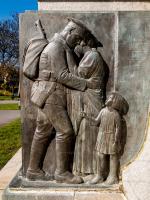
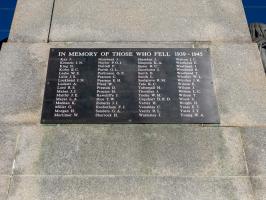
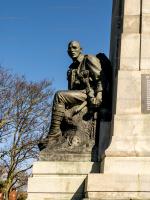
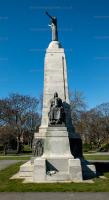
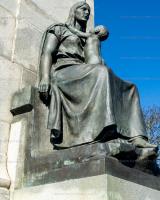
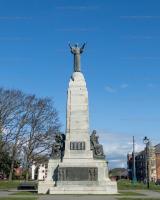
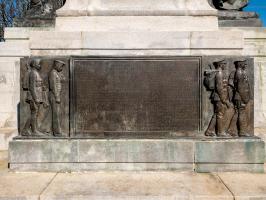
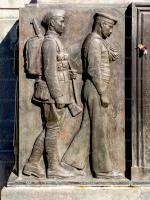
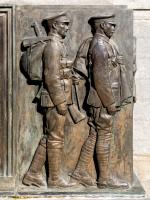
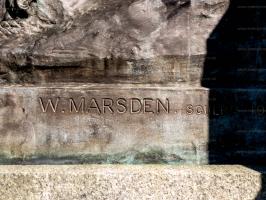
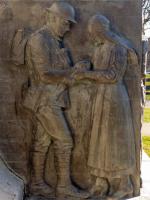
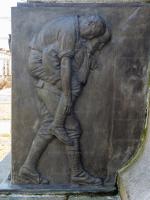
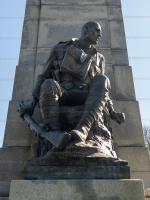
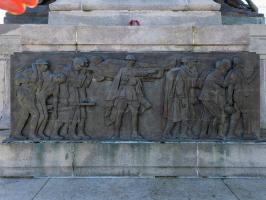
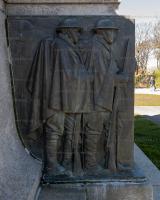
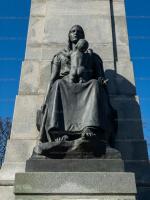
The erecting of Lytham St Anne's War memorial [Map] in 1924 was made possible by a gift of £10000, donated by Lord Ashton. The memorial commemorates the fallen of the Municipal Borough of Lytham St Anne's, formed in 1922 by the merger of Lytham and St Anne's urban district councils. It was unveiled on 12 October 1924 by Alderman Charles Critchley, whose son Burton 'Plum' Critchley was killed in 1918 while serving in the RAF. The ceremony was attended by the Rt Hon Stephen Walsh (Minister for War), Maj Gen Sir Cecil Lothian Nicholson KCB CMG (whose son was killed at Arras), Lt Gen Sir Richard Butler KCB KCMG and 1000 ex-servicemen. The unveiling was also attended by nine children of fallen servicemen, who were later presented with gold medals inscribed with the coat of arms of the borough. Sculpted by Walter Marsden (age 41).
On 12th October 1946 Hugh Denis Charles Fitzroy 11th Duke Grafton (age 27) and Ann Fortune Smith Duchess Grafton (age 26) were married. He the son of Charles Alfred Euston Fitzroy 10th Duke Grafton (age 54) and Doreen Buxton Duchess Grafton.
On 12th October 1947 Luis Martínez de Irujo y Artázcoz (age 28) and María del Rosario Cayetana Fitz-James Stuart 18th Duchess of Alba 11th Duke of Berwick (age 21) were married. She the daughter of Jacobo Fitz-James Stuart 17th Duke of Alba 10th Duke of Berwick (age 68) and María del Rosario de Silva Duchess of Alba.
On 12th October 1992 Viola Grosvenor was born to Gerald Cavendish Grosvenor 6th Duke Westminster (age 40) and Natalia Phillips Duchess of Westminster (age 33).
On 12th October 1531 Jacques of Savoy 2nd Duke of Nemours was born to Philip of Savoy Duke Nemours (age 41) and Charlotte Valois (age 19). He married 29th April 1566 his half third cousin once removed Anna d'Este, daughter of Ercole Este II Duke Ferrara and Renée of France Duchess of Ferrara, and had issue.
On 12th October 1537 Edward Seymour was born to Edward Seymour 1st Duke of Somerset (age 37) and Anne Stanhope Duchess Somerset (age 40). He died aged one in 1539.
On 12th October 1537 King Edward VI of England and Ireland was born to Henry VIII (age 46) and Queen Jane Seymour (age 28) after two day of labour at either four or ten in the morning at Hampton Court Palace, Richmond [Map]. George Owen (age 38) assisted as Physician. See Register of the Order of the Garter.
Chronicle of Geoffrey le Baker of Swinbroke
Baker was a secular clerk from Swinbroke, now Swinbrook, an Oxfordshire village two miles east of Burford. His Chronicle describes the events of the period 1303-1356: Gaveston, Bannockburn, Boroughbridge, the murder of King Edward II, the Scottish Wars, Sluys, Crécy, the Black Death, Winchelsea and Poitiers. To quote Herbert Bruce 'it possesses a vigorous and characteristic style, and its value for particular events between 1303 and 1356 has been recognised by its editor and by subsequent writers'. The book provides remarkable detail about the events it describes. Baker's text has been augmented with hundreds of notes, including extracts from other contemporary chronicles, such as the Annales Londonienses, Annales Paulini, Murimuth, Lanercost, Avesbury, Guisborough and Froissart to enrich the reader's understanding. The translation takes as its source the 'Chronicon Galfridi le Baker de Swynebroke' published in 1889, edited by Edward Maunde Thompson.
Available at Amazon in eBook and Paperback format.
On 12th October 1555 Peregrine Bertie 13th Baron Willoughby was born to Richard Bertie Baron Willoughby (age 38) and Catherine Willoughby Duchess Suffolk (age 36) at Wesel in Germany. He was named for his parents peregrinations through Germany avoiding religious persecution. He married 25th December 1577 Mary Vere Baroness Willoughby of Eresby, daughter of John de Vere 16th Earl of Oxford and Margery Golding Countess of Oxford, and had issue.
On 12th October 1558 Maximilian King Poland was born to Maximilian Habsburg Spain II Holy Roman Emperor (age 31) and Maria of Spain Holy Roman Empress (age 30). Coefficient of inbreeding 10.03%.
On 12th October 1617 Francis Gerard 2nd Baronet was born to Gilbert Gerard 1st Baronet (age 29) and Mary Barrington. He married in or before 1653 his fifth cousin once removed Isabel Cheeke and had issue.
On 12th October 1631 George Saunderson 5th Viscount Castleton was born to Nicholas Saundeson 2nd Viscount Castleton and Frances Manners (age 31) in Fillingham Linconsolshire. He married (1) before 1667 his fourth cousin once removed Grace Belasyse and had issue (2) after 1674 Sarah Evelyn Viscountess Fanshawe and Castleton.
On 12th October 1649 Thomas Felton 4th Baronet was born to Henry Felton 2nd Baronet (age 30) and Susanna Tollemache Lady Felton. He married before 18th December 1676 his fifth cousin Elizabeth Howard Lady Felton, daughter of James Howard 3rd Earl Suffolk and Barbara Villiers Countess Suffolk, and had issue.
On 12th October 1709 Anne Hamilton was born to James Hamilton Duke Hamilton, 1st Duke Brandon (age 51) and Elizabeth Gerard Duchess Brandon (age 29) in St James' Square. He was named after his godmother Queen Anne of England Scotland and Ireland (age 44). His other godparents were John Churchill 1st Duke of Marlborough (age 59) and Charles Spencer 3rd Earl of Sunderland (age 34). He married October 1742 Anna Charlotta Maria Powell and had issue.

On 12th October 1723 Thomas Parker 3rd Earl Macclesfield was born to George Parker 2nd Earl Macclesfield (age 27). He married 1749 his first cousin Mary Heathcote Countess Macclesfield, daughter of William Heathcote 1st Baronet and Elizabeth Parker Lady Heathcote, and had issue.
On 12th October 1738 George Rochfort 2nd Earl Belvedere was born to Robert Rochfort 1st Earl of Belvedere (age 30) and Mary Molesworth.

On 12th October 1754 Amelia Darcy 12th Baroness Darcy 9th Baroness Conyers was born to Robert Darcy 4th Earl Holderness (age 36). She married (1) 29th November 1773 Francis Osborne 5th Duke Leeds, son of Thomas Osborne 4th Duke Leeds and Mary Godolphin Duchess Leeds, and had issue (2) 1779 her sixth cousin John "Mad Jack" Byron and had issue.

On 12th October 1770 Harriet Kerr was born to William John Kerr 5th Marquess Lothian (age 33) and Elizabeth Fortescue 5th Marchioness Lothian (age 25).
Chronicle of Geoffrey le Baker of Swinbroke
Baker was a secular clerk from Swinbroke, now Swinbrook, an Oxfordshire village two miles east of Burford. His Chronicle describes the events of the period 1303-1356: Gaveston, Bannockburn, Boroughbridge, the murder of King Edward II, the Scottish Wars, Sluys, Crécy, the Black Death, Winchelsea and Poitiers. To quote Herbert Bruce 'it possesses a vigorous and characteristic style, and its value for particular events between 1303 and 1356 has been recognised by its editor and by subsequent writers'. The book provides remarkable detail about the events it describes. Baker's text has been augmented with hundreds of notes, including extracts from other contemporary chronicles, such as the Annales Londonienses, Annales Paulini, Murimuth, Lanercost, Avesbury, Guisborough and Froissart to enrich the reader's understanding. The translation takes as its source the 'Chronicon Galfridi le Baker de Swynebroke' published in 1889, edited by Edward Maunde Thompson.
Available at Amazon in eBook and Paperback format.
On 12th October 1770 Thomas Fermor 4th Earl Pomfret was born to George Fermor 2nd Earl Pomfret (age 48) and Anna Maria Delagard Countess Pomfret (age 34). He married 13th January 1823 Amabel Elizabeth Borough Countess of Pomfret, daughter of Richard Borough 1st Baronet and Anna Maria Lake, and had issue.
On 12th October 1773 Granville Leveson-Gower 1st Earl Granville was born to Granville Leveson-Gower 1st Marquess Stafford (age 52) and Susanna Stewart Marchioness Stafford. He married 24th December 1809 his half fourth cousin once removed Harriet Cavendish Countess Granville, daughter of William Cavendish 5th Duke Devonshire and Georgiana Spencer Duchess Devonshire, and had issue.


On 12th October 1775 Thomas Lawrence Dundas was born to Thomas Dundas 1st Baron Dundas (age 34) and Charlotte Fitzwilliam Baroness Dundas (age 29).
On 12th October 1798 Reverend Walter St John Milmay was born to Henry Paulet St John-Mildmay 3rd Baronet (age 34) and Jane Mildmay Lady St-John Mildmay (age 33).
On 12th October 1802 George Nugent 2nd Baronet was born to Field Marshal George Nugent 1st Baronet (age 45) and Maria Skinner (age 31). He married 13th July 1831 Maria Charlotte Ridley-Colborne Lady Nugent, daughter of Nicholas William Ridley-Colborne 1st Baron Colborne, and had issue.
On 12th October 1802 Reverend Brook George Bridges 6th Baronet was born to Brook William Bridges 4th Baronet (age 35) and Eleanor Foote (age 31). He married 15th November 1832 Louisa Chaplin.
On 12th October 1814 Frances Margaret Hughes Baroness Gardner was born. She married 1835 Alan Legge Gardner 3rd Baron Gardner, son of Alan Hyde Gardner 2nd Baron Gardner and Charlotte Elizabeth Smith Baroness Gardner.
On 12th October 1815 William Thomas Wentworth-Fitzwilliam 6th and 4th Earl Fitzwilliam was born to Charles Wentworth-Fitzwilliam 5th and 3rd Earl Fitzwilliam (age 29) and Mary Dundas (age 28). Coefficient of inbreeding 6.25%. He married 10th September 1838 Frances Harriet Douglas Countess Fitzwilliam, daughter of George Sholto Douglas 17th Earl Morton, and had issue.
On 12th October 1817 Georgiana Ellice was born to Robert Charles Ellice (age 32) and Eliza Courtenay (age 25). Named after her maternal grandmother Georgiana Spencer Duchess Devonshire. She married 4th November 1846 Hugh Horatio Seymour-Conway.
On 12th October 1827 Philip Lancaster Brocklehurst 1st Baronet was born to John Brocklehurst (age 38) and Mary Coare.
Adam Murimuth's Continuation and Robert of Avesbury’s 'The Wonderful Deeds of King Edward III'
This volume brings together two of the most important contemporary chronicles for the reign of Edward III and the opening phases of the Hundred Years’ War. Written in Latin by English clerical observers, these texts provide a vivid and authoritative window into the political, diplomatic, and military history of fourteenth-century England and its continental ambitions. Adam Murimuth Continuatio's Chronicarum continues an earlier chronicle into the mid-fourteenth century, offering concise but valuable notices on royal policy, foreign relations, and ecclesiastical affairs. Its annalistic structure makes it especially useful for establishing chronology and tracing the development of events year by year. Complementing it, Robert of Avesbury’s De gestis mirabilibus regis Edwardi tertii is a rich documentary chronicle preserving letters, treaties, and official records alongside narrative passages. It is an indispensable source for understanding Edward III’s claim to the French crown, the conduct of war, and the mechanisms of medieval diplomacy. Together, these works offer scholars, students, and enthusiasts a reliable and unembellished account of a transformative period in English and European history. Essential for anyone interested in medieval chronicles, the Hundred Years’ War, or the reign of Edward III.
Available at Amazon in eBook and Paperback format.
On 12th October 1844 Arthur John Fludyer 5th Baronet was born to John Henry Fludyer 4th Baronet (age 41) and Augusta Borough (age 35). He married before 27th January 1922 his first cousin Augusta Borough Lady Fludyer, daughter of Edward Richard Borough 2nd Baronet and Elizabeth St Lawrence Lady Borough.
On 12th October 1844 Caroline Gordon-Lennox was born to Charles Gordon-Lennox 6th Duke Richmond (age 26) and Frances Harriett Greville Duchess Richmond (age 20).
On 12th October 1855 Friedrich Ferdinand Glücksburg Duke Schleswig Holstein Sonderburg Glücksburg was born to Friedrich Glücksburg Duke Schleswig Holstein Sonderburg Glücksburg (age 40) and Adelheid Schasumburg Lippe Duchess Schleswig Holstein Sonderburg Glücksburg at Kiel. He a great x 3 grandson of King George II of Great Britain and Ireland. He married 19th March 1885 his third cousin once removed Victoria Friederike Oldenburg Duchess Schleswig Holstein Sonderburg Glücksburg, daughter of Frederick Christian Oldenburg II Duke Schleswig Holstein Sonderburg Augustenburg and Adelheid Hohenlohe Langenburg Duchess Schleswig Holstein Sonderburg Augustenburg, and had issue.
On 12th October 1861 Edward Arthur Colebrooke 1st Baron Colebrooke was born to Thomas Edward Colebrooke 4th Baronet (age 48). He married before 28th February 1939 Alexandra Harriet Paget.
On 12th October 1861 Prince Friedrich of Saxe Meiningen was born to Georg II Duke of Saxe Meiningen (age 35).

On 12th October 1870 Adela Venables-Vernon was born to Augustus Henry Vernon 6th Baron Vernon (age 41) and Harriet Frances Maria Anson Baroness Vernon (age 42). She married before 13th January 1897 her second cousin once removed Rear-Admiral Algernon Horatio Anson, son of John William Hamilton Anson 2nd Baronet and Elizabeth Catherine Pack Lady Anson, and had issue.
On 12th October 1880 Beatrice Child-Villiers Baroness Dunsany was born to Victor Albert George Child-Villiers 7th Earl Jersey (age 35) and Margaret Elizabeth Leigh Countess Jersey (age 30). She married 15th September 1904 Edward John Moreton Drax Plunkett 18th Baron Dunsany, son of John William Plunkett 17th Baron Dunsany.

On 12th October 1881 Mary "Molly" Katherine Bell Lady Trevelyan was born to Thomas Hugh Bell 2nd Baronet (age 37) and Florence Eveleen Eleanore Olliffe Lady Bell (age 30). She married 1904 Charles Trevelyan 3rd Baronet, son of George Trevelyan 2nd Baronet and Caroline Philips Lady Trevelyan, and had issue.
On 12th October 1885 Rudolph Feilding Viscount Feilding was born to Rudolph Feilding 9th Earl of Denbigh (age 26) and Cecilia Mary Clifford Countess Denbigh (age 25).
On 12th October 1907 Colonel Richard Hamilton Glyn 9th and 5th Baronet was born to Richard FitzGerald Glyn 8th and 4th Baronet (age 32).
Chronicle of Geoffrey le Baker of Swinbroke
Baker was a secular clerk from Swinbroke, now Swinbrook, an Oxfordshire village two miles east of Burford. His Chronicle describes the events of the period 1303-1356: Gaveston, Bannockburn, Boroughbridge, the murder of King Edward II, the Scottish Wars, Sluys, Crécy, the Black Death, Winchelsea and Poitiers. To quote Herbert Bruce 'it possesses a vigorous and characteristic style, and its value for particular events between 1303 and 1356 has been recognised by its editor and by subsequent writers'. The book provides remarkable detail about the events it describes. Baker's text has been augmented with hundreds of notes, including extracts from other contemporary chronicles, such as the Annales Londonienses, Annales Paulini, Murimuth, Lanercost, Avesbury, Guisborough and Froissart to enrich the reader's understanding. The translation takes as its source the 'Chronicon Galfridi le Baker de Swynebroke' published in 1889, edited by Edward Maunde Thompson.
Available at Amazon in eBook and Paperback format.
On 12th October 1992 Viola Grosvenor was born to Gerald Cavendish Grosvenor 6th Duke Westminster (age 40) and Natalia Phillips Duchess of Westminster (age 33).
On 12th October 1561 William "Younger" Welf Duke Brunswick-Lüneburg (age 26) and Dorothea Oldenburg Duchess Brunswick-Lüneburg (age 15) were married. She by marriage Duchess Brunswick Lüneburg. She the daughter of Christian III King of Denmark and Dorothea of Saxe Lauenburg Queen Consort Denmark and Norway (age 50). They were half sixth cousins.
On 12th October 1609 William Keith 6th Earl Marischal (age 24) and Mary Erskine were married. She the daughter of John Erskine 19th Earl of Mar (age 47) and Mary Stewart Countess Mar (age 27). He the son of George Keith 5th Earl Marischal (age 56) and Margaret Home Countess Marischal. They were half fifth cousin once removed.
On 12th October 1697 William Craven 2nd Baron Craven (age 28) and Elizabeth Skipwith Baroness Craven (age 20) were married. She by marriage Baroness Craven of Hamstead Marshall in Berkshire.
On 12th October 1752 Lewis Watson 1st Baron Sondes (age 23) and Grace Pelham Baroness Sondes (age 17) were married. They were half third cousins.
On 12th October 1771 John Lubbock 1st Baronet (age 27) and Elizabeth Christiana Commerell were married at St Dunstan's in the East Parish.
On 12th October 1807 James Wandesford Butler 1st Marquess Ormonde (age 30) and Grace Louisa Staples Marchioness Ormonde were married. He the son of John Butler 17th Earl Ormonde 11th Earl Ossory and Frances Wandesford Countess Ormonde and Ossory (age 53).
On 12th October 1833 William Edwardes 3rd Baron Kensington (age 32) and Laura Jane Ellison (age 22) were married.
On 12th October 1847 Charles William Fitzgerald Fitzgerald 4th Duke Leinster (age 28) and Caroline Leveson-Gower Duchess Leinster (age 20) were married at Trentham, Staffordshire. She the daughter of George Sutherland Leveson-Gower 2nd Duke Sutherland (age 61) and Harriet Elizabeth Georgiana Howard Duchess Sutherland (age 41). He the son of Augustus Fitzgerald 3rd Duke Leinster (age 56) and Charlotte Augusta Stanhope Duchess Leinster (age 54). They were half fifth cousin once removed. He a great x 4 grandson of King Charles II of England Scotland and Ireland.
On 12th October 1853 Dudley Fitzgerald De Ros 23rd Baron Ros Helmsley (age 26) and Elizabeth Egerton Baroness Ros of Helmsley (age 21) were married at Heaton, Lancashire. She the daughter of Thomas Grosvenor 2nd Earl Wilton (age 53) and Mary Smith-Stanley Countess Wilton (age 52).
On 12th October 1859 Henry Flower Every 10th Baronet (age 28) and Mary Isabella Hollond Lady Every (age 19) were married. She by marriage Lady Every of Egginton in Derbyshire.

On 12th October 1898 Walter FitzUryan Rice 7th Baron Dynevor (age 25) and Margaret Child-Villiers Baroness Dynevor (age 23) were married. She the daughter of Victor Albert George Child-Villiers 7th Earl Jersey (age 53) and Margaret Elizabeth Leigh Countess Jersey (age 48).
On 12th October 1908 Captain James Harold Cuthbert (age 32) and Kathleen Alice Coppin-Straker Baroness Rayleigh were married.
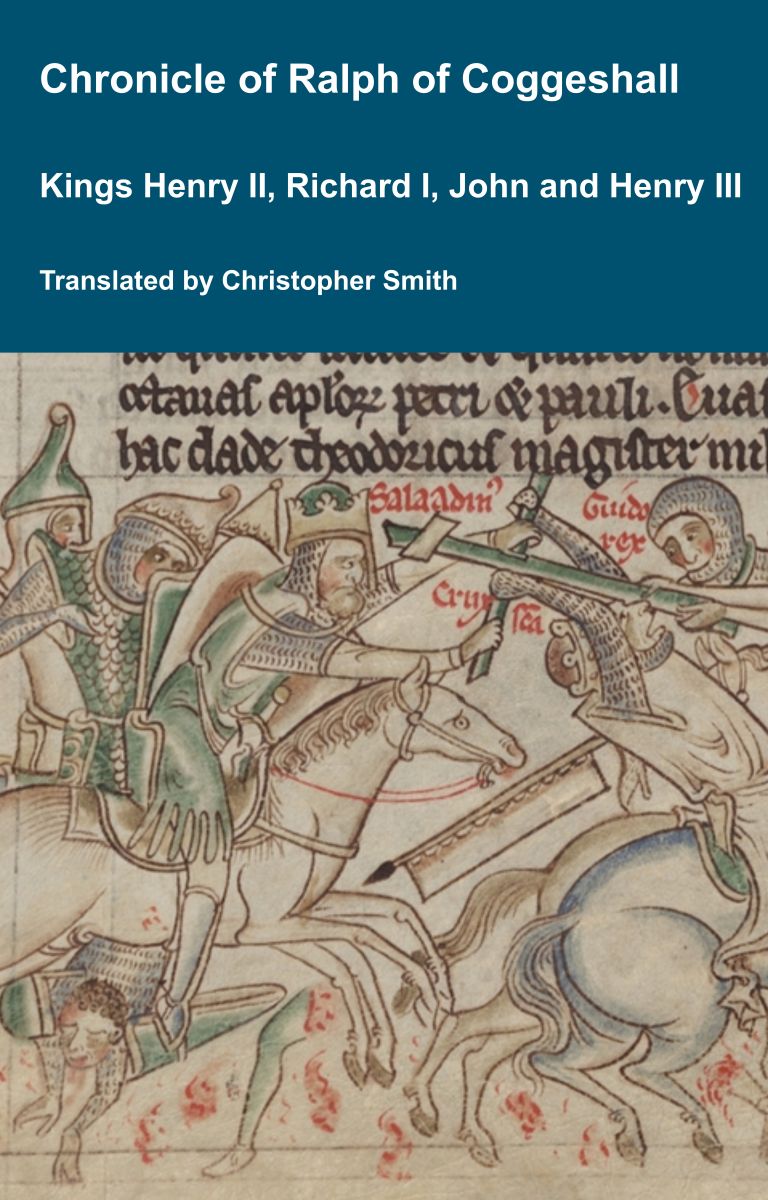
Chronicle of Abbot Ralph of Coggeshall
The Chronicle of Abbot Ralph of Coggeshall (Chronicon Anglicanum) is an indispensable medieval history that brings to life centuries of English and European affairs through the eyes of a learned Cistercian monk. Ralph of Coggeshall, abbot of the Abbey of Coggeshall in Essex in the early 13th century, continued and expanded his community’s chronicle, documenting events from the Norman Conquest of 1066 into the tumultuous reign of King Henry III. Blending eyewitness testimony, careful compilation, and the monastic commitment to record-keeping, this chronicle offers a rare narrative of political intrigue, royal power struggles, and social upheaval in England and beyond. Ralph’s work captures the reigns of pivotal figures such as Richard I and King John, providing invaluable insights into their characters, decisions, and the forces that shaped medieval rule. More than a simple annal, Chronicon Anglicanum conveys the texture of medieval life and governance, making it a rich source for scholars and readers fascinated by English history, monastic authorship, and the shaping of the medieval world.
Available at Amazon in eBook and Paperback format.
On 12th October 1925 Sacheverell Reresby Sitwell 6th Baronet (age 27) and Georgia Doble (age 20) were married.



On 12th October 1946 Hugh Denis Charles Fitzroy 11th Duke Grafton (age 27) and Ann Fortune Smith Duchess Grafton (age 26) were married. He the son of Charles Alfred Euston Fitzroy 10th Duke Grafton (age 54) and Doreen Buxton Duchess Grafton.
On 12th October 1947 Luis Martínez de Irujo y Artázcoz (age 28) and María del Rosario Cayetana Fitz-James Stuart 18th Duchess of Alba 11th Duke of Berwick (age 21) were married. She the daughter of Jacobo Fitz-James Stuart 17th Duke of Alba 10th Duke of Berwick (age 68) and María del Rosario de Silva Duchess of Alba.
On 12th October 501 Fergus Mór aka Great mac Eirc King of Dál Riata (age 71) died.
On 12th October 633 King Penda's alliance of Gwynedd and Mercia defeated the Northumbrians at the Battle of Hatfield Chase.
Eadfrith Deira was captured.
King Edwin of Northumbria (age 47) was killed. He was buried at Whitby Abbey [Map] - see Bede. His first cousin Osric succeeded King Deira. His nephew Eanfrith (age 43) succeeded King Bernicia.
Edwin's son Osfrith Deira was killed.
On 12th October 638 Pope Honorius I died.
On 12th October 1176 William D'Aubigny 1st Earl Lincoln 1st Earl of Arundel (age 67) died. His son William (age 38) succeeded 2nd Earl Lincoln, 2nd Earl Arundel and inherited Castle Rising Castle [Map].
On 12th October 1328 Clementia Hungary Queen Consort France (age 35) died.
On 12th October 1333 Archbishop Simon Mepeham died.
On 12th October 1343 Reginald "Black" I Duke Guelders (age 48) died from a fall from a horse at Arnhem [Map]. His son Reginald (age 10) succeeded II Duke Guelders, III Count Guelders. His wife acted as Regent to her nine year old son until 1344. His brother Edward Duke Guelders (age 7), however, also claimed the title and a war of succession commenced.
On 12th October 1363 Margaret Verdun Baroness Hussey (age 53) died at Newbold Verdon, Leicestershire.
On 12th October 1475 Edward Blount 2nd Baron Mountjoy (age 11) died. His uncle John (age 25) succeeded 3rd Baron Mountjoy.
On 12th October 1485 John Blount 3rd Baron Mountjoy (age 35) died. His son William (age 7) succeeded 4th Baron Mountjoy.
Chronicle of Walter of Guisborough
A canon regular of the Augustinian Guisborough Priory, Yorkshire, formerly known as The Chronicle of Walter of Hemingburgh, describes the period from 1066 to 1346. Before 1274 the Chronicle is based on other works. Thereafter, the Chronicle is original, and a remarkable source for the events of the time. This book provides a translation of the Chronicle from that date. The Latin source for our translation is the 1849 work edited by Hans Claude Hamilton. Hamilton, in his preface, says: 'In the present work we behold perhaps one of the finest samples of our early chronicles, both as regards the value of the events recorded, and the correctness with which they are detailed; Nor will the pleasing style of composition be lightly passed over by those capable of seeing reflected from it the tokens of a vigorous and cultivated mind, and a favourable specimen of the learning and taste of the age in which it was framed.'
Available at Amazon in eBook and Paperback format.
On 12th October 1576 Maximilian Habsburg Spain II Holy Roman Emperor (age 49) died. His son Rudolf (age 24) succeeded II Holy Roman Emperor.
On 3rd March 1626 William Cavendish 1st Earl Devonshire (age 73) died. His son William (age 36) succeeded 2nd Earl Devonshire, 2nd Baron Cavendish Hardwick. Christian Bruce Countess Devonshire by marriage Countess Devonshire. On 12th October 1616 Henry Cavendish died. Both were buried at St Peter's Church, Edensor [Map].
The monument was behind the altar in the original church but moved to a separate chapel in the new church.
Monument formed two bodies under a low four-poster with black Ionic columns and black covering slab. The monument has been attributed to Maximilian Colt (age 51).
On 12th October 1674 Francis Molyneux 2nd Baronet (age 72) died. His son John (age 51) succeeded 3rd Baronet Molyneux of Teversall in Nottinghamshire. Lucy Rigby Lady Molyneux (age 49) by marriage Lady Molyneux of Teversall in Nottinghamshire.
On 12th October 1687 Thomas Foote 1st Baronet (age 89) died. He was buried at All Saints Church, West Ham. His son-in-law Arthur Onslow 1st and 2nd Baronet (age 63) succeeded 2nd Baronet Foote of London according to the special remainder added to the creation.
On 12th October 1693 Christopher Conyers 2nd Baronet (age 72) died. His son John (age 49) succeeded 3rd Baronet Conyers of Horden in County Durham.
On 12th October 1694 Charles Boyle 3rd Baron Clifford (age 54) died. His son Charles (age 26) succeeded 4th Baron Clifford.


On 12th October 1714 Edward Smythe 1st Baronet (age 94) died. His son Richard (age 5) succeeded 2nd Baronet Smythe.
On 12th October 1729 Elizabeth Herne Lady Blackwell (age 51) died.
On 12th October 1730 Frederick IV King of Denmark and Norway (age 59) died. His son Christian (age 30) succeeded VI King of Denmark and Norway.
On 12th October 1731 Mary Eure (age 80) died. Baron Scrope of Bolton abeyant.
On 12th October 1738 Bridget Bennet Viscountess Lymington (age 42) died. She was buried at St John's Church, Farleigh Wallop.
Henrici Quinti, Angliæ Regis, Gesta, is a first-hand account of the Agincourt Campaign, and subsequent events to his death in 1422. The author of the first part was a Chaplain in King Henry's retinue who was present from King Henry's departure at Southampton in 1415, at the siege of Harfleur, the battle of Agincourt, and the celebrations on King Henry's return to London. The second part, by another writer, relates the events that took place including the negotiations at Troye, Henry's marriage and his death in 1422.
Available at Amazon in eBook and Paperback format.
On 12th October 1740 James Tuchet 6th Earl Castlehaven died. His son James (age 17) succeeded 7th Earl Castlehaven, 17th Baron Audley of Heighley in Staffordshire, 14th Baron Tuchet, 7th Baron Audley of Orier in England, 5th Baron Audley of Hely in Ireland.
On 12th October 1753 Danvers Osborn 3rd Baronet (age 37) committed suicide at New York. His body was found in the garden of the house in which he was lodged, which belonged to a local councilman. The body presented evidence of strangulation. His son George (age 11) succeeded 4th Baronet Osborn of Chicksands in Bedfordshire.
On 12th October 1758 Richard Molesworth 3rd Viscount Molesworth (age 78) died.

On 12th October 1768 James Douglas 14th Earl Morton (age 66) died. His son Sholto (age 37) succeeded 15th Earl Morton.
On 12th October 1772 Samuel Scott (age 70) died.
On 12th October 1772 John St Aubyn 4th Baronet (age 45) died. His son John (age 14) succeeded 5th Baronet St Aubyn of Clowance in Cornwall.
On 12th October 1807 Thomas Wynn 1st Baron Newborough (age 71) died. His son Thomas (age 5) succeeded 2nd Baron Newborough of Newborough in County Wexford.
On 12th October 1819 William East 1st Baronet (age 81) died. He was buried at St Nicholas Church, Witham. His son Gilbert (age 55) succeeded 2nd Baronet East of Hall Place in Maidenhead in Berkshire.
On 12th October 1837 Roger Gresley 8th Baronet (age 37) died. He was buried at St George and St Mary's Church, Church Gresley on 28th October 1837. His first cousin William (age 31) succeeded 9th Baronet Gresley of Drakelow in Derbyshire.
On 12th October 1837 James Murray 1st Baron Glenlyon (age 55) died at Fenton's Hotel, St James' Street. His son George (age 23) succeeded 2nd Baron Glenlyon of Glenlyon in Perthshire.
Henrici Quinti, Angliæ Regis, Gesta, is a first-hand account of the Agincourt Campaign, and subsequent events to his death in 1422. The author of the first part was a Chaplain in King Henry's retinue who was present from King Henry's departure at Southampton in 1415, at the siege of Harfleur, the battle of Agincourt, and the celebrations on King Henry's return to London. The second part, by another writer, relates the events that took place including the negotiations at Troye, Henry's marriage and his death in 1422.
Available at Amazon in eBook and Paperback format.
On 12th October 1838 Andrew Snape Hamond 1st Baronet (age 99) died. His son Graham (age 58) succeeded 2nd Baronet Hamond of Holly Grove in Berkshire. Elizabeth Kimber Lady Hamond by marriage Lady Hamond of Holly Grove in Berkshire.
On 12th October 1842 Georgina Elizabeth Moncrieffe Countess Bradford (age 52) died.
On 12th October 1856 Cornwallis Maude 3rd Viscount Hawarden (age 76) died. His son Cornwallis (age 39) succeeded 4th Viscount Hawarden, 4th Baron Montalt of Hawarden in Tipperary, 6th Baronet of Dundrum in Tipperary.
On 12th October 1863 John Singleton Copley 1st Baron Lyndhurst (age 91) died. Baron Lyndhurst of Lyndhurst in Hampshire extinct.
On 12th October 1895 Amy Henrietta Nelson-Smith Lady Burgoyne (age 64) died.
On 12th October 1896 William Fitzherbert 4th Baronet (age 88) died. His son Richard (age 50) succeeded 5th Baronet Fitzherbert of Tissington in Derbyshire. Mary Anne Arkwright Lady Fitzherbert (age 46) by marriage Lady Fitzherbert of Tissington in Derbyshire.
On 12th October 1905 Isabel Innes-Kerr (age 26) died in childbirth. Monument at St James' Church Warter [Map] sculpted by George Frampton (age 45). She died in childbirth aged 26.
Isabel Innes-Kerr: In 1879 she was born to James Henry Robert Innes-Kerr 7th Duke Roxburghe and Anne Emily Spencer-Churchill Duchess Roxburghe. On 23rd June 1904 Guy Greville Wilson and she were married. She the daughter of James Henry Robert Innes-Kerr 7th Duke Roxburghe and Anne Emily Spencer-Churchill Duchess Roxburghe.
On 12th October 1927 Seymour Egerton 6th Earl Wilton (age 31) died. His son Seymour (age 6) succeeded 7th Earl Wilton, 7th Viscount Grey de Wilton.
On 12th October 1934 Mary Caroline L'Estrange Countess of Erroll died.
On 12th October 1967 William Jared Parnell 7th Baron Congleton (age 42) died. His brother Christopher (age 37) succeeded 8th Baron Congleton of Congleton in Cheshire, 11th Baronet Parnell of Rathleague Queen's County.
Adam Murimuth's Continuation and Robert of Avesbury’s 'The Wonderful Deeds of King Edward III'
This volume brings together two of the most important contemporary chronicles for the reign of Edward III and the opening phases of the Hundred Years’ War. Written in Latin by English clerical observers, these texts provide a vivid and authoritative window into the political, diplomatic, and military history of fourteenth-century England and its continental ambitions. Adam Murimuth Continuatio's Chronicarum continues an earlier chronicle into the mid-fourteenth century, offering concise but valuable notices on royal policy, foreign relations, and ecclesiastical affairs. Its annalistic structure makes it especially useful for establishing chronology and tracing the development of events year by year. Complementing it, Robert of Avesbury’s De gestis mirabilibus regis Edwardi tertii is a rich documentary chronicle preserving letters, treaties, and official records alongside narrative passages. It is an indispensable source for understanding Edward III’s claim to the French crown, the conduct of war, and the mechanisms of medieval diplomacy. Together, these works offer scholars, students, and enthusiasts a reliable and unembellished account of a transformative period in English and European history. Essential for anyone interested in medieval chronicles, the Hundred Years’ War, or the reign of Edward III.
Available at Amazon in eBook and Paperback format.
On 12th October 1972 Cecil Eustace Irby 8th Baron Boston (age 75) died unmarried. His third cousin once removed Gerald (age 75) succeeded 9th Baron Boston, 10th Baronet Irby of Whaplode and Boston.
On 12th October 2014 Elizabeth Anne Cary Lady Nelson (age 87) died.