


William of Worcester's Chronicle of England
William of Worcester, born around 1415, and died around 1482 was secretary to John Fastolf, the renowned soldier of the Hundred Years War, during which time he collected documents, letters, and wrote a record of events. Following their return to England in 1440 William was witness to major events. Twice in his chronicle he uses the first person: 1. when writing about the murder of Thomas, 7th Baron Scales, in 1460, he writes '… and I saw him lying naked in the cemetery near the porch of the church of St. Mary Overie in Southwark …' and 2. describing King Edward IV's entry into London in 1461 he writes '… proclaimed that all the people themselves were to recognize and acknowledge Edward as king. I was present and heard this, and immediately went down with them into the city'. William’s Chronicle is rich in detail. It is the source of much information about the Wars of the Roses, including the term 'Diabolical Marriage' to describe the marriage of Queen Elizabeth Woodville’s brother John’s marriage to Katherine, Dowager Duchess of Norfolk, he aged twenty, she sixty-five or more, and the story about a paper crown being placed in mockery on the severed head of Richard, 3rd Duke of York.
Available at Amazon in eBook and Paperback format.
24 Nov is in November.
1326 Execution of the Despencers
24th November 1400-Douglas Black Dinner
On 24th November 1192 Bishop Albert Reginar (age 26) was assassinated at Reims.
On 24th November 1273 Alfonso Plantagenet was born to King Edward I of England (age 34) and Eleanor of Castile Queen Consort England (age 32) in Bayonne [Map]. Their ninth child. He was named after Eleanor's half-brother Alfonso X King Castile X King Leon (age 52) who was also the child's godfather and attended his christening. He died aged ten in 1284.
Chronicle of Henry Knighton. And thus he was immediately beheaded by death, namely on the eighth of the calendar of December [24th November 1326]. His head was fixed aloft on London Bridge.
Hugh contraytour estez trove, par quoy vous agardent touz lez bonez gentz de realme, meyndrez et greyndres, ryches et pourez par commune assent, que vous come larone estes trove par quey vous serrez pendue. Et contreytour estez trove par quey vous serrez treynez et quarterecez, et envoye par my le realme. Et pur ceo que vous fuistez utlage par nostre seignour le Roy et par commune assent, et estez revenue en courte sanz garraunt, vous serrez decollez. Et pur ceo que vous abbestatez ct procurastez discorde entre nostre seignour le Roy et la Royne et lez altrez del realme, si serret enbouellecz, et puis ils serront ars. Retrayez vous traytour, tyrant reneyee, si alez vostre Juyse prendre. Traytour malveys et attaynte.
Et sic statim morte plexus est scilicet viij. kalendarum Decembris. Cujus caput in altum fixum est super pontem Londoniemsem.
On 24th November 1326 Hugh "Younger" Despencer 1st Baron Despencer (age 40) was hanged, drawn and quartered in Hereford [Map]. Baron Despencer forfeit.
Simon of Reading was also hanged, drawn and quartered the same day.
Isabella of France Queen Consort England (age 31) and Roger Mortimer 1st Earl March (age 39) were present - see 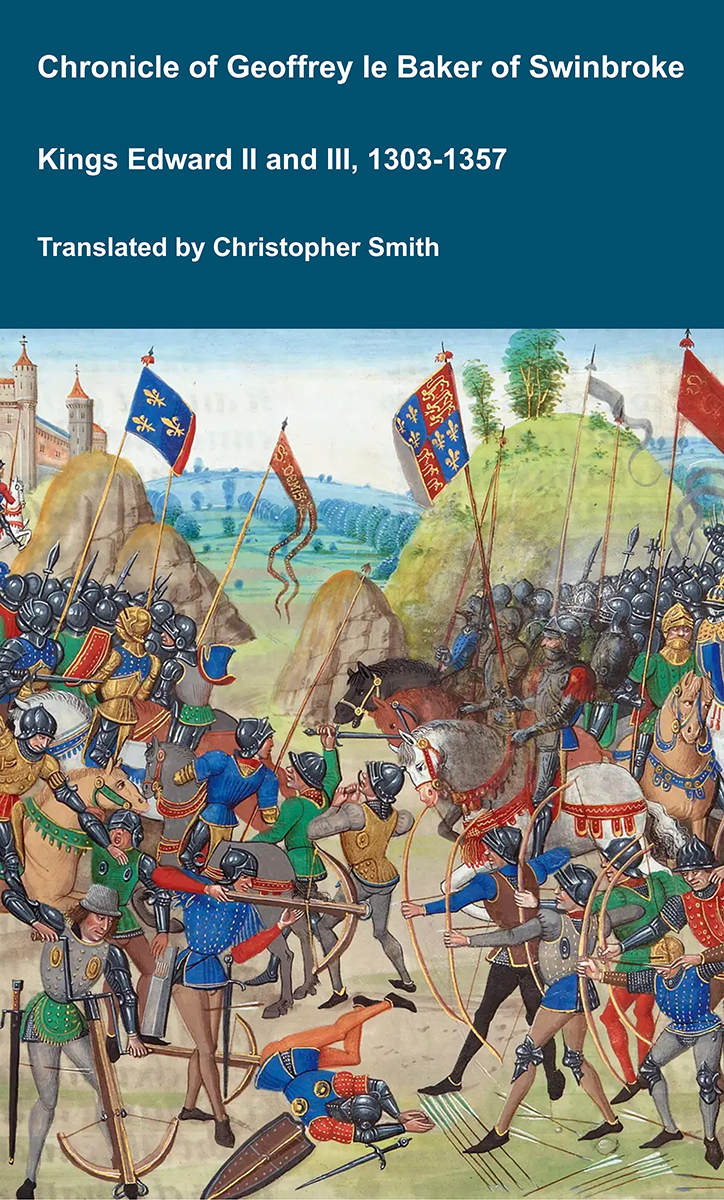 Chronicle of Geoffrey le Baker.
Chronicle of Geoffrey le Baker of Swinbroke [-1360]. Afterwards, the Earl of Gloucester,1 Hugh Despenser the Younger (age 40), was brought forth in chains to the fierce and wrathful gaze of the queen. Without waiting for the reasoning of any judge, he was dragged [24th November 1326] from the city, namely, Hereford, hanged, beheaded, and quartered. His head was sent to London Bridge, and his four quarters were distributed to the four corners of the realm. Simon of Reading2 was likewise drawn and hanged there.
Postea comes Gloucestrie, Hugo de Spenser filius, in vinculis oblatus oculis terribilibus indignate, non expectata raciocinacione cuiuscumque iudicis, fuit ab eadem civitate, scilicet Herefordie, tractus, suspensus, decollatus, et in quarterias divisus; cuius capud fuit missum ad pontem Londoniarum, et quatuor quarteria ad quatuor regni partes fuerunt distributa. Simon eciam de Redynge fuit ibidem tractus et suspensus.
Note 1. Knighton 2546.
A passage from the Brute chronicle [Harley MS. 2279] may be here quoted: "But sir Hugh the Spencer, after the tyme that he was take, wolde ete no manor mete nother drink no maner drink, for he wiste to have no mercie, but oneliche he wiste he shulde bene dede. And the quene and her councel tho had ordeynede that he shulde have bene don to deth atte London; but he was so febil for his mychel fastyng that he was dede almoste for fastyng, and therfor hit was ordeynede that he shulde have his iugement atte Herforde. And atte a place of the toune his hood was take fro his heed, and also from Robert of Baldok, that was a fals piled clerk also and the kynges chaunceler. And men sette uppon hire heedes chaplettis of sharpe nettelis, and ij squyers blewe in hire eeres ij grete bugle homes uppon tho ij prisoners, fat men myjte hure there blowyng oute with homes mo than a thousand. And on Symounde of Redyng, the kyngis marshal, bifore hem bare her armes uppon a spere reversid, in tokene that thei shulde bene undone for evermore. And uppon the morue was sir Hugh the Spencer, the sone, dampnede to the dethe, and was drawe and hongede, biheveded, and his bowellis taken oute of his bodie and his bowellis brente; and, after, he was quarterede and his quarteres sente to iiij tounes of Engelonde, and his heed sente to London brigge. And this Symounde, for inchesone he despisede the quene Isabella, he was drawe and hongede in a stage made amydde the forsaid sir Hughes galwes. And the same day, a litel fro thennes, was sir John of Arundel bihedede, for he was one of sir Hugh the Spencers councellers. And anone after was sir Hugh the Spencer drawe and hongede and bihedede atte Bristowe, and, after, hongede ayein by the armes with ij strong ropis; and, fe iiij day after, he was hewe al to peces, and houndes eten him. And, for that inchesone that the kyng had geven the erle of Wynchestre his heed, hit was lad thider and putte uppon a spere. And the fals Baldok was sente to London, and ther he deide in prison emong theves; for men dede him no more reverence fan men wolde done unto an hounde. And so deyden the treytours of Engelonde, blessid be almyjti God; and hit was no wonder, for thurgh hire councele the good erle Thomas of Lancastre was done unto deth."
Thomas Walsingham [~1422]. [24th November 1326] After this, the said Lord Hugh was sentenced to death at Hereford without being allowed any answer; where he was drawn and hanged on a gallows fifty feet high; and afterwards beheaded and quartered, and the parts sent to the four quarters of the kingdom. His head was set upon London Bridge. He was drawn in a tunic embroidered with his own arms, on which was plainly written in good letters the Psalm, 'Why do you glory in malice?' up to the verse, 'But I am like a green olive tree'. Concerning this someone writes thus:—
The rope with the beams, wretched man, and the sword and the fire,
Hugh, the axe, the horse, have taken away all your honour.
Post hæc, Dominus Hugo prædictus apud Herefordiam fuit morti adjudicatus sine responsione; ubi tractus et suspensus est in furca habente quinquaginta pedes in altitudine; et posteæ decapitatus est et quarterizatus, et partes ad quatuor plagas regni missæ. Caput vero super pontem Londoniarum fixum fuit. Tractus autem fuit in collobio armis 'intexto propriis, in quo legibiliter fuit seriptus bonis litteris Psalmus, "Quid gloriaris in malitia?" usque ad versum, "Ego autem sicut oliva:" de quo quidam sic scribit;—
"Funis cum lignis, à te, miser, ensis et ignis,
Hugo, securis, equus, abstulit omne decus,"
"Funis," quia tractus fuit; "ligna," quiæ suspensus; "ensis, quia decollatus; "ignis," quia exentratus, et viscera concremata; "securis," quia in quartas divisus; "equus" quidern eum traxit.
 Become a Member via our Buy Me a Coffee page to read more.
The Brut. [24th November 1326]. And oppon þe morwe was Sir Hugh þe Spenser (age 40) þe sone dampnede to deþ; and was draw and hongede, biheuedet, & his boweiles taken out of his body, and his bowelles brent. And after he was quarterede, & his quarteres sent to iiij tounes of Engeland, and his heuede sent to London Brigge.
Froissart Book 1: 1307-1340. [24th November 1326] 18. After the feast had ended, the said Sir Hugh (age 40), who was thoroughly hated, was brought before the queen and all the assembled barons and knights. There, all his deeds were recited to him from a written record, and he said nothing in his defence. As a result, he was judged then and there, unanimously by all the barons and knights, to die and to be executed in the manner you shall now hear. First, he was drawn through the streets of Hereford on a hurdle, accompanied by trumpets and horns, from one street to another. Then he was brought to a large square in the town, where all the people were assembled. There, he was placed high upon a scaffold, so that everyone, both great and small, could see him. A large fire had been built in that same square. When he was thus displayed, his genitals were first cut off, because he was accused of being a heretic and a sodomite — as was also said of the king himself. It was claimed that it was through his urging that the king had driven the queen away. When his genitals were cut off, they were thrown into the fire and burned. Next, his belly was slit open, and his heart and entrails were taken out and thrown into the fire to burn — because he was judged to be false of heart and a traitor, and because, by his treacherous counsel and persuasion, the king had brought shame and misfortune upon the realm and had caused the execution of the greatest barons of England, who should have upheld and defended the kingdom. Furthermore, he had so manipulated the king that he would neither see nor acknowledge his queen nor his eldest son, who ought to have been their lord; rather, he had driven them from the kingdom, endangering their lives. After Sir Hugh had been thus dealt with, as described, his head was cut off and sent to the city of London. His body was then cut into four quarters, which were sent to the four greatest cities in England after London.
18. Quant li feste fu passée, li dis messires Hues qui point n'estoit amés, là endroit fu amenés par devant le royne et tous les barons et chevaliers, qui là estoient assamblet. Là li furent recordet tout si fet par escript, que onques ne dist riens à l'encontre: si ques là endroit il fu jugiés, par plainne sieute, de tous les barons et chevaliers, à mort, et à justicier, en tel manière com vous orés. Premierement, il fu traynés sour un bahut, à trompes et à trompètes, par toute la ville de Harfort, de rue en rue. Et puis fu amenés en une grant place, en le ville, là où tous li peuples estoit assamblés. Là endroit fu il loiiés haut sus une eschielle, si ques çascuns, petis et grans, le pooient veoir. Et avoit on fait en le ditte place un grant feu. Quant il fut ensi loiiés, on li copa tout premiers le vit et les coulles, par tant qu'il estoit herites et sodomites, ensi que on disoit meismement del roy. Et pour ce avoit decaciet li rois la royne ensus de lui et par son enhort. Quant li vis et les coulles li furent coppées, on les getta ou feu, et furent arses. Apriès, on li fendi le ventre, et li osta on tout le coer et le coraille, et le getta on ou feu pour ardoir, par tant qu'il estoit faulz de coer et traittes, et que, par son traitte conseil et enhort, li rois avoit honni son royaume et mis à meschief, et avoit fait decoler les plus grans barons d'Engleterre, par les quels li royaumes devoit estre soustenus et deffendus. Et avoech ce il avoit si enhortet le roy qu'il ne pooit ou ne voloit veoir la royne sa femme, ne son ainsnet fil, qui devoit estre leurs sires; ains les avoit decaciés, par doubtance de leurs corps, hors dou royaume. Apriès, quant li dis messires Hues fu ensi atournés, comme dit est, on li coppa le teste, et fu envoiie en le chité de Londres; et puis fu il decopés en quatre quartiers. Et furent tantost envoiiet as quatre milleurs cités d'Engleterre apriès Londres.
Become a Member via our Buy Me a Coffee page to read more.
On 24th November 1331 King David II of Scotland (age 7) was crowned II King Scotland at Scone Abbey [Map].
Jean de Waurin's Chronicle of England Volume 6 Books 3-6: The Wars of the Roses
Jean de Waurin was a French Chronicler, from the Artois region, who was born around 1400, and died around 1474. Waurin’s Chronicle of England, Volume 6, covering the period 1450 to 1471, from which we have selected and translated Chapters relating to the Wars of the Roses, provides a vivid, original, contemporary description of key events some of which he witnessed first-hand, some of which he was told by the key people involved with whom Waurin had a personal relationship.
Available at Amazon in eBook and Paperback format.
Chronicle of Geoffrey le Baker of Swinbroke [-1360]. On Tuesday, after a long march, they were lodged in the open fields, where, due to a lack of water, they gave their horses wine to drink; as a result, on the following day, the horses, being intoxicated, were unable to walk properly, and many of them perished.
Die Martis post longum iter, in campis ospitati, quo defectu aquarum, potarunt equos vino; unde in crastino debriati non poterant recto passu incedere et multi ex eiis perierunt.
On 24th November 1394 Charles Valois Duke Orléans was born to Louis Valois I Duke Orléans (age 22) and Valentina Visconti Duchess of Orleans (age 23). Coefficient of inbreeding 7.39%. He married (1) 1406 his first cousin Isabella Valois Queen Consort England, daughter of Charles "Beloved Mad" VI King France and Isabeau Wittelsbach Queen Consort France, and had issue (2) 1410 his second cousin Bonne Armagnac Duchess Orléans, daughter of Bernard VII Count Armagnac and Bonne Valois Countess Armagnac and Savoy (3) 1440 his second cousin once removed Mary La Marck Duchess Orléans, daughter of Adolph La Marck I Duke Cleves and Marie Valois Duchess Cleves, and had issue.
On 24th November 1406 Sibia Fortia Queen Consort Aragon died at Barcelona [Map]. She had a state funeral. She was buried in the convent of San Francisco (Framenors) in Barcelona.
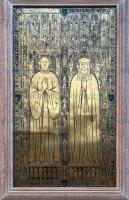
On 24th November 1411 Agnes Wauton died. Monumental brass at the Cathedral Church St Nicholas, Newcastle upon Tyne [Map].
Agnes Wauton: In or before 1397 Roger Thornton and she were married. They had seven sons and seven daughters.
On 24th November 1413 John Lancaster 1st Duke Bedford (age 24) was created 1st Earl Richmond.
On 24th November 1426 Elizabeth Lancaster Duchess Exeter (age 63) died. She was buried at St Mary's Church, Burford [Map].


On 24th November 1427 John Stafford 1st Earl Wiltshire was born to Humphrey Stafford 1st Duke of Buckingham (age 25) and Anne Neville Duchess Buckingham (age 19). He a great x 2 grandson of King Edward III of England. Coefficient of inbreeding 2.35%. He married before 7th April 1470 Constance Green Countess Wiltshire and had issue.
On 25th November 1431 Walter Fitzwalter 7th Baron Fitzwalter (age 31) drowned at sea in a storm whilst returning from France.
Elizabeth Fitzwalter Baroness Dinham 8th Baroness Fitzwalter (age 2) succeeded 8th Baroness Fitzwalter. Note. Chronicle of Gregory 1432 states 24th November 1432 or, more specifically, "on Syn Kateryn ys eve" - St Katherine's feast day is 25 Nov.
On 24th November 1440 William Crichton 1st Lord Crichton arranged a dinner of reconciliation at the Great Hall, Edinburgh Castle. During the course of the dinner the young brothers William Douglas 3rd Duke Touraine (age 16) and David Douglas (age 10) was beheaded in front of the young King James II of Scotland (age 10).
The Auchinleck Chronicle. [24th November 1440] Item Jm iiijc Erll William of douglas archebalde's son beand than xviij years of age & his brother Dauid Douglas was put to deid at Edinburgh and malcome flemyng of beggar was put to deid in that samyn place within three days eft.
The History of the Houses of Douglas and Angus. [24th November 1440] This fpeech thus uttered, teftifying both an acknowledging of the evill paft, and a refolution to amend, was it not fufficient to have purged whatfoever errour had been, or might have been thought to have escaped him before? And certainly it would, if these men had regarded Juftice, or the good of the Common-wealth, and had defired to reclaim him from his errours, and winne him to his Countrey. But his fo full confidence thus repofing on their credit, was it not enough to have tied them to have kept their credit? If there had been any spark of humanity or nature of man left in them: and if they had not beene worse then favage beafts. Truft deferveth that we should prove worthy of that trust, and credit procures keeping of credit; where all humane nature is not extinct, and even fimplicity deferveth favour and pitie. Neither can a man that is not altogether given over, and hath not fold himfelfe to wickednes choose but favour it, and have compaffion of it; yea though he had been otherwife difpofed in the beginning, it would even move any mans heart (that were indeed a man, and not changed into a beaft) to favour and commiferate, and would have tamed and calmed any former difcontentment, and have wrung from them any evill intention which they might (perhaps) have conceived before. However, this noble youth goeth on in the innocency of his heart, and that the more quickely, to cut off all occafion of fuch speeches, and with his brother, and with a few other principall friends goeth directly to the Castle, (being led as it were and drawne by a fatall destiny) and both enter, and fo come in the power of thofe their deadly enemies and fained friends. At the very inftant comes the Governour (as was before appointed betwixt them) to play his part of the Tragedy, that both might bee alike embarked in the action, and beare the envie of fo ugly a fact, that the weight thereof might not lie on one alone: yet to play out their treacherous parts, they welcome him moft courteoufly, fet him to dinner with the King at the fame table, feaft him royally, intertain him chearfully, and that for a long time. At laft about the end of dinner, they compaffe him about with armed men, and cause present a bulls head before him on the boord the bulls head was in thofe dayes a token of death (fay our Hiftories) but how it hath come in ufe fo to bee taken, and fignifie, neither doe they, nor any elfe tell us, neither is it to be found (that I remember) any where in any History, fave in this one place: neither can wee conjecture what affinity it can have therewith, unleffe to exprobrate groffeneffe, according to the French, and Our owne reproaching dull, and groffe wits, by calling him Calves-head (tefte de Vean) but not Bulls head. So that by this they did infult over that innocencie which they had fnared, and applaud their owne wifedome that had fo circumvented him: a brave commendation indeed, and an honeft! yet I wonder what they meant by entertaining him fo well at that time, there was fome reason for it why they fhould have done it by the way, that they might worke out their treafon, untill he were within their thongs: but being now within the Caftle, and fully in their power, I wonder what it fhould mean to make him to faire a welcome, to feaft him fo liberally and folemnely at the Kings table, and from thence to bring him tothe fhambles: what could have beene their intention? might they not have conveyed him to fome private chamber? might they not have carried him to the place of execution? what needed all this proceffe? what needed they to have let him fee the King at all? It would feem as if they had not been fully refolved upon the bulinelle before; and that their intentions and purpofes were not treafonable, but that they tooke occafion to be treasonable from the facility to atchieve it: but our Writers are cleare against that, and fay onely it was pre-concluded, when he was written for. It might feeme alfo that they did this to communicate the matter, or to transferre it altogether upon the King: but he was too young, and purges himselfe by difproving of it. So that I can see no other reafon of it, but as the Lion with his prey, or(to ufe a more bafe, yet a more familiarexample, and the bafer the fitter for them) as the cat with the mouse, which he might devoure immediately, yet it pleaseth her to play a little with it: So they for their greater fatisfaction, and contentment, delight to play out their Steane; fo ftrangely notwithstanding that fuch proceffe and uncouth formes of doing might feem to import fome myfteand deeper reach then ordinary: which I confeffe is fo profound and deep a folly, and mifchantneffe, that I can no wife found it, unleffe it were that the Noblemans place, and his worth forced their wicked hearts to acknowledge it notwithstanding their wickedneffe: And although the acknowledging could not prevaile fo farre, as to make them leave off the enterprise, yet did it in fome fort brangle their refolution, and wrung out this confeffion of his worth: as all the actions of wickedneffe, and all wickedneffe in the acting, are full of contradictions, as this fame is most clearly for if this Nobleman was guilty of death, why is he brought into the Kings prefence why is he fet at his table? If he was not guilty, why was he put to death? So difficult a thing it is in a lie to keep conformity, either in a lie of actions (fo to fpeake) or in a lie of words! In words it is difficult fo to fpeake that the attentive hearer fhall not perceive contrariety: In actions it is impoffible that they can be diffembled. This action is a lie, for it faith he is guilty of death, but their welcomming of him, their fetting of him at the table with the King, and their feafting, fayes, he is an innocent, Noble, worthy man; Indeed onely truth in word and action can accord with it felfe: as it is uniforme, it floweth from unitie, tendeth to it, and endeth in it, and keepeth the tafte of the fountain from which it cometh. So they having given this confeffion of his worth, and again, (by that ominous figne) contradicted their confeffion, muft needs be falfe witneffes however it go. The young Nobleman either understanding the figne as an ordinary thing, or aftonished with it as an uncouth thing, upon the fight of the Buls head offering to rife, was laid hold of by their armed men in the Kings prefence at the Kings table, which should have beene a Sanctuary to him. And fo without regard of King, or any duty, and without any further proceffe, without order, affife (or jurie) without law, no crime objected, he not being convicted at all; a young man of that age that was not liable to the law in regard of his youth, a Nobleman of that place, a worthy young Gentleman of fuch expectation, a guest of that acceptation, one who had repofed upon their credit, who had committed himselfe to them, a friend in mind, who looked for friendship, to whom all friendship was promifed; against dutie, law, friendship, faith, honefty, humanitie, hofpitalitie; against nature, against humane fociety, against Gods Law, against mans law, and the law of nature, is cruelly executed, and put to death: They, (in defpight as it were) fpitting in the face of all duty and honefty, proclaiming (as farre as lay in them) there was no dutie to God nor man to bee regarded. And that the measure of their wickedneffe thus heaped and fhaken, and preft downe might also runne over; all this was done (as it fhould feem) without the confent, nay, against the will of their King and Soveraigne, who wept at their execution, and forbad them to meddle with his Coufin: the shameleffe men chid him for weeping at the death of his enemy (as they call him) during whofe life (fay they) hee needed never to looke for peace, whereas they themselves were his chiefeft enemies, and greatest traitours to him, and befides him to God and nature, and to the office of Juftice which they bore; bringing a blot on the and the other, and bloud-guiltineffe upon his Crowne, fo farre as lay in them.
Become a Member via our Buy Me a Coffee page to read more.
Tales of a Grandfather by Walter Scott. But when this powerful nobleman died, in 1439, and was succeeded by his son William, a youth of only sixteen years old, the wily Crichton began to spy an occasion to crush the Douglasses, as he hoped, for ever, by the destruction of the youthful earl and his brother, and for abating, by this cruel and unmerited punishment, the power and pride of this great family. Crichton proposed to Livingstone to join him in this meditated treachery; and, though enemies to each other, the guardian of the King and the chancellor of the kingdom united in the vile project of cutting off two boys, whose age alone showed their innocence of the guilt charged upon them. For this purpose flattery and fair words were used to induce the young earl, and his brother David, with some of their nearest friends, to come to court, where it was pretended that they would be suitable companions and intimates for the young King. An old adherent of the family greatly dissuaded the earl from accepting this invitation, and exhorted him, if he went to Edinburgh in person, to leave at least his brother David behind him. But the unhappy youth, thinking that no treachery was intended, could not be diverted from the fatal journey.
The Chancellor Crichton received the Earl of Douglas and his brother on their journey, at his own castle of Crichton, and with the utmost appearance of hospitality and kindness. After remaining a day or two at this place, the two brothers were inveigled to Edinburgh Castle, and introduced to the young King, who, not knowing the further purpose of his guardians, received them with affability, and seemed delighted with the prospect of enjoying their society.
On a sudden the scene began to change. At an entertainment [24th November 1440] which was served up to the earl and his brother, the head of a black bull was placed on the table. The Douglasses knew this, according to a custom which prevailed in Scotland, to be the sign of death, and leaped from the table in great dismay. But they were seized by armed men who entered the apartment. They underwent a mock trial, in which all the insolencies of their ancestors were charged against them, and were condemnea to immediate execution. The young King wept, and implored Livingstone and Crichton to show mercy to the young noblemen, but in vain. These cruel men only reproved him for weeping at the death of those whom they called his enemies. The brethren were led out to the court of the castle, and beheaded without delay.. Malcolm Fleming of Cumbernauld, a faithful adherent of their house, shared the same fate with the two brothers.
This barbarous proceeding was as unwise as it was unjust. It did not reduce the power of the Douglasses, but only raised general detestation against those who managed the affairs of James II1. A fat, quiet, peaceable person, called James the Gross, indolent from habit of body and temper of mind, next became Earl of Douglas, which was probably the reason that no public commotion immediately attended on the murder of the hapless brothers. But this corpulent dignitary lived only two years, and was in his turn succeeded by his son William, who was as active and turbulent as any of his ambitious predecessors, and engaged in various civil broils for the purpose of revenging the death of his kinsmen2.
Note 1. Godscroft and Abercromby record the following traditionary rhyme, expressive of popular indignation at the deed:
"Edinburgh castle, toun and tour,
God grant you sink for sin;
And that even for the black dinnour
Earl Douglas got therein."
Note 2. Wood's Peerage, vol. i., p. 429, 430.
Become a Member via our Buy Me a Coffee page to read more.
On 24th November 1468 François Valois Duke Longueville (age 21) succeeded Count Dunois, Count Longueville.
The Deeds of the Dukes of Normandy
The Gesta Normannorum Ducum [The Deeds of the Dukes of Normandy] is a landmark medieval chronicle tracing the rise and fall of the Norman dynasty from its early roots through the pivotal events surrounding the Norman Conquest of England. Originally penned in Latin by the monk William of Jumièges shortly before 1060 and later expanded at the behest of William the Conqueror, the work chronicles the deeds, politics, battles, and leadership of the Norman dukes, especially William’s own claim to the English throne. The narrative combines earlier historical sources with firsthand information and oral testimony to present an authoritative account of Normandy’s transformation from a Viking settlement into one of medieval Europe’s most powerful realms. William’s history emphasizes the legitimacy, military prowess, and governance of the Norman line, framing their expansion, including the conquest of England, as both divinely sanctioned and noble in purpose. Later chroniclers such as Orderic Vitalis and Robert of Torigni continued the history, extending the coverage into the 12th century, providing broader context on ducal rule and its impact. Today this classic work remains a foundational source for understanding Norman identity, medieval statesmanship, and the historical forces that reshaped England and Western Europe between 800AD and 1100AD.
Available at Amazon in eBook and Paperback format.
On 24th November 1472 Pietro Torrigiano was born.

On 24th November 1496 John Radclyffe 9th Baron Fitzwalter (age 44) was beheaded at Calais [Map] for trying to bribe his jailers. His son Robert (age 13) succeeded 10th Baron Fitzwalter.
On 24th November 1502 Claude Lorraine was born to René Lorraine II Duke Lorraine Duke of Bar (age 51) and Philippa Egmont Duchess of Bar Duchess Lorraine (age 35) at Bar le Duc.
On 24th November 1502 Catherine Lorraine was born to René Lorraine II Duke Lorraine Duke of Bar (age 51) and Philippa Egmont Duchess of Bar Duchess Lorraine (age 35) at Bar le Duc.
Archives of Venice. Nov. 24. [1531] Sanuto Diaries, v. lv. p. 168. 701. Advices from France, received by the French Ambassador in Venice.
On the day of All Saints the King gave most gracious greeting at Compiegne to the Vice-Chancellor (Vice gran Canzelier) of England, who was accompanied by Sir Francis Bryan (age 41). On the morrow of All Souls the King went out of mourning for his mother, as did the princes, lords, and gentlemen. The Queen and the King's children did not put themselves into mourning. The Queen of Navarre and the children of the King [of Navarre] wore it from beginning to end, spontaneously. The King chose to have an exact list of all the lords, gentlemen, officials, and servants of his mother, and has provided for all of them, from the highest to the lowest, giving them the same amount of salary as they received from the deceased; placing some in his own household, others with the Dauphin and his brothers, the rest in the household of the Princesses, his daughters. The ladies of his mother's household are placed in that of the Queen, and the maids of honour with his daughters. The act was that of a magnanimous prince, such as he is.
On the 5th instant the Bishop of Bayonne returned to the Court from England, and says that the King, on hearing of the death of the late most illustrious "Madame," made all the English princes and great lords go into mourning; and when the Bishop told this to the Legate, there was present the Emperor's ambassador, who declared that his master had done the like, which is a demonstration of great friendship.
It is said that more than seven weeks ago a mob of from seven to eight thousand women of London went out of the town to seize Boleyn's daughter (age 30), the sweetheart of the King of England, who was supping at a villa (in una easa di piacere) on a river, the King not being with her; and having received notice of this, she escaped by crossing the river in a boat. The women had intended to kill her; and amongst the mob were many men, disguised as women; nor has any great demonstration been made about this, because it was a thing done by women.
To prevent the exportation of grain from France a proclamation has been issued forbidding all millers, bakers, and usurious wheat merchants, any longer to raise the price of corn. No corn may be sold save at market, and no baker, miller, or corn merchant can purchase it two hours after the close of the market, so that the people may be enabled to buy their supply; and the granaries of Paris are to be inspected by competent and worthy men, who are to acquaint themselves with the number of persons forming the household of each proprietor, whether noblemen, councillors, citizens, or merchants, and the annual amount of grain required for their consumption; which being set apart, they will be bound to take all the rest to market and sell it to the people, by reason of the King's just fear lest the people of Paris lack the means of subsistence.
La Fère, 24th November 1531. Registered by Sanuto 18th Dec.
[Italian.]


Become a Member via our Buy Me a Coffee page to read more.
On 24th November 1534 Thomas Wriothesley (age 46) died.
On 24th November 1538 Bishop John Hilsey preached at St Paul's Cross [Map] and showed the blood of the abbey of Hales [Map], affirming it to be clarified honey and saffron (Holinshed, pp. 275, 946). He similarly denounced the Rood of Grace of Boxley, exhibiting its machinery and breaking it to pieces (Stow, Annales, p. 574; Burnet, Hist. of the Reformation, ed. Pocock, i. 385, vi. 194).
On 24th November 1542 Thomas Wharton 1st Baron Wharton (age 47) commanded the English forces at Battle of Solway Moss at Solway Moss, Cumberland [Map]. John Thynne (age 27) fought. Of the Scottish army Malcolm Fleming 3rd Lord Fleming (age 48), Gilbert Kennedy 3rd Earl Cassilis (age 27) and Laurence Oliphant 3rd Lord Oliphant fought.
William Graham 3rd Earl Menteith (age 42) was captured. He was ransomed in 1453.
William Cunningham 4th Earl Glencairn (age 49) was captured and committed to the custody of Thomas Howard 3rd Duke of Norfolk (age 69). He was released on payment of a ransom of a thousand pounds and subscribing by his own hand to support Henry VIII's (age 51) project of a marriage between the young King Edward VI of England and Ireland (age 5) and the Mary Queen of Scots.
Malcolm Fleming 3rd Lord Fleming was captured.


Henry Machyn's Diary. 24th November 1554. [The same day cardinal Pole (age 54) came from Gravesend [Map] by water, with the earl of Shrewsbury (age 54), the lord Montagu (age 25), the bishops of Durham (age 80) and Ely (age 48), the lord Paget (age 48), sir Edward Hastings (age 33), the lord Cobham (age 57), and diverse] knyghts and gentyllmen, in barges, and thay all [did shoot the] bryge be-twyn xij and on of the cloke, and a-g[ainst] the steleard [Map] of Temes my lord chanseler (age 71) mett [them in his] barge, and my lord of Shrousbury [had his] barge with the [talbot, all] ys men in bluw cotes, red-hosse, skarlett capes, [and white] fethers; and so to the cort gatt, and ther the Kyng('s) (age 27) grace [met him] and inbrasyd hym, and so lad ym thrughe the kyng('s) hall;] and he had borne a-for hym a sylver crosse, and [he was arrayed in] a skarlet gowne and a sqware skarlett cape; and my lord [North] bare the swarde a-for the Kyng; and so they whent up unto the Quens chambur, and ther her grace (age 38) salutyd hym; and after he toke ys leyffe, and toke ys barge to ys plase at Lambeth [Map], that was the bysshope of Cantorberys, Crenmer (age 65), and so to dener.
On 24th November 1655 Charles XI King Sweden was born to Charles Gustav X King Sweden (age 33). He married 6th May 1680 Ulrika Eleonora Oldenburg, daughter of Frederick III King of Denmark and Sophie Amalie Hanover Queen Consort Denmark, and had issue.
Samuel Pepys' Diary. 23rd February 1661. This my birthday, 28 years. This morning Sir W. Batten (age 60), Pen, and I did some business, and then I by water to Whitehall, having met Mr. Hartlibb (age 61) by the way at Alderman Backwell's (age 43). So he did give me a glass of Rhenish wine at the Steeleyard, and so to Whitehall by water. He continues of the same bold impertinent humour that he was always of and will ever be. He told me how my Lord Chancellor (age 52) had lately got the Duke of York (age 27) and Duchess, and her woman, my Lord Ossory's and a Doctor, to make oath before most of the judges of the kingdom, concerning all the circumstances of their marriage. And in fine, it is confessed that they were not fully married till about a month or two before she was brought to bed; but that they were contracted long before, and time enough for the child to be legitimate1. But I do not hear that it was put to the judges to determine whether it was so or no.
Note 1. The Duke of York's marriage took place September 3rd, 1660. Anne Hyde was contracted to the Duke at Breda, November 24th, 1659.


Samuel Pepys' Diary. 24th November 1662. Thence the King (age 32) to Woolwich, Kent [Map], though a very cold day; and the Duke (age 29) to White Hall, commanding us to come after him, which we did by coach; and in his closett, my Lord Sandwich (age 37) being there, did discourse with us about getting some of this money to pay off the Fleets, and other matters; and then away hence, and, it being almost dinner time, I to my Lord Crew's, and dined with him, and had very good discourse, and he seemed to be much pleased with my visits.


Samuel Pepys' Diary. 24th November 1664. After the House had received the King's speech, and what more he had to say, delivered in writing, the Chancellor (age 55) being sicke, it rose, and I with Sir Philip Warwicke (age 54) home and conferred our matters about the charge of the Navy, and have more to give him in the excessive charge of this year's expense. I dined with him, and Mr. Povy (age 50) with us and Sir Edmund Pooly (age 45), a fine gentleman, and Mr. Chichly (age 50), and fine discourse we had and fine talke, being proud to see myself accepted in such company and thought better than I am.

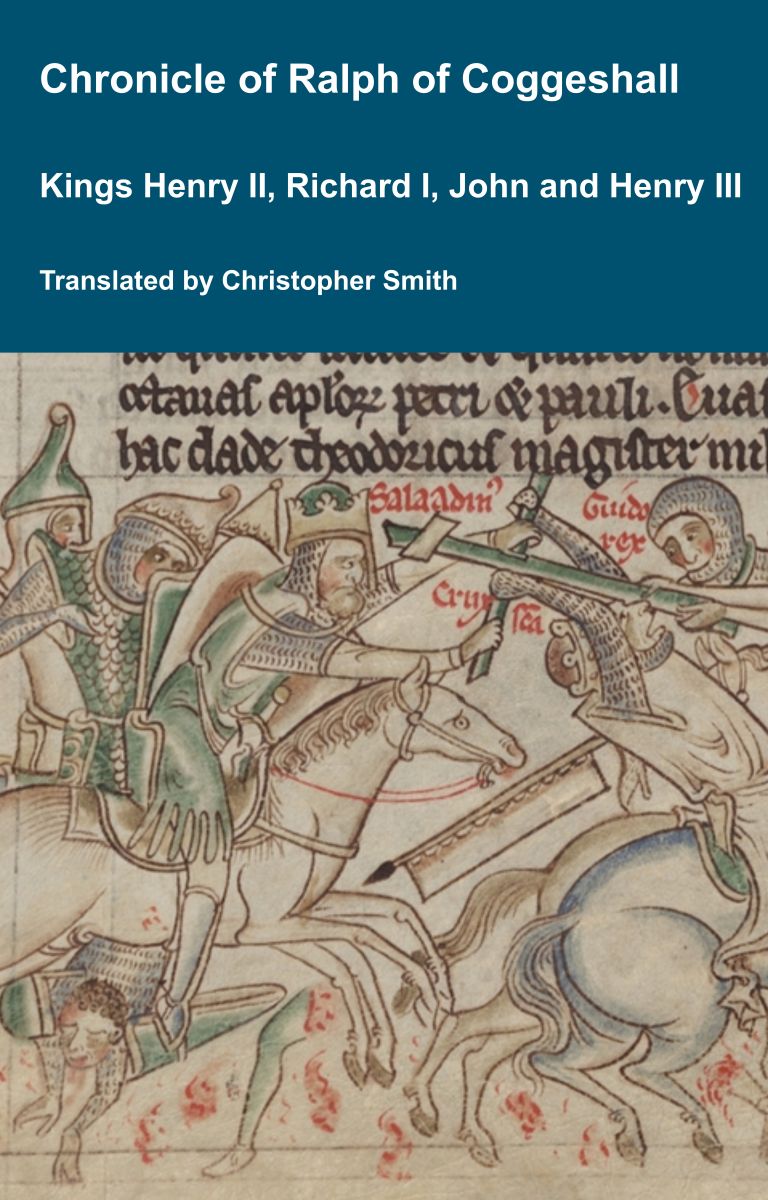
Chronicle of Abbot Ralph of Coggeshall
The Chronicle of Abbot Ralph of Coggeshall (Chronicon Anglicanum) is an indispensable medieval history that brings to life centuries of English and European affairs through the eyes of a learned Cistercian monk. Ralph of Coggeshall, abbot of the Abbey of Coggeshall in Essex in the early 13th century, continued and expanded his community’s chronicle, documenting events from the Norman Conquest of 1066 into the tumultuous reign of King Henry III. Blending eyewitness testimony, careful compilation, and the monastic commitment to record-keeping, this chronicle offers a rare narrative of political intrigue, royal power struggles, and social upheaval in England and beyond. Ralph’s work captures the reigns of pivotal figures such as Richard I and King John, providing invaluable insights into their characters, decisions, and the forces that shaped medieval rule. More than a simple annal, Chronicon Anglicanum conveys the texture of medieval life and governance, making it a rich source for scholars and readers fascinated by English history, monastic authorship, and the shaping of the medieval world.
Available at Amazon in eBook and Paperback format.
Samuel Pepys' Diary. 24th November 1665. After dinner Captain Cocke (age 48) and I about some business, and then with my other barrel of oysters home to Greenwich, Kent [Map], sent them by water to Mrs. Penington, while he and I landed, and visited Mr. Evelyn (age 45), where most excellent discourse with him; among other things he showed me a ledger of a Treasurer of the Navy, his great grandfather, just 100 years old; which I seemed mighty fond of, and he did present me with it, which I take as a great rarity; and he hopes to find me more, older than it. He also shewed us several letters of the old Lord of Leicester's, in Queen Elizabeth's time, under the very hand-writing of Queen Elizabeth, and Queen Mary, Queen of Scotts; and others, very venerable names.


Samuel Pepys' Diary. 24th November 1666. Up, and to the office, where we sat all the morning. At noon rose and to my closet, and finished my report to my Lord Treasurer (age 59) of our Tangier wants, and then with Sir J. Minnes (age 67) by coach to Stepney [Map] to the Trinity House, Deptford [Map], where it is kept again now since the burning of their other house in London. And here a great many met at Sir Thomas Allen's (age 33) feast, of his being made an Elder Brother; but he is sick, and so could not be there. Here was much good company, and very merry; but the discourse of Scotland, it seems, is confirmed, and that they are 4000 of them in armes, and do declare for King and Covenant, which is very ill news. I pray God deliver us from the ill consequences we may justly fear from it. Here was a good venison pasty or two and other good victuals; but towards the latter end of the dinner I rose, and without taking leave went away from the table, and got Sir J. Minnes' coach and away home, and thence with my report to my Lord Treasurer's, where I did deliver it to Sir Philip Warwicke (age 56) for my Lord, who was busy, my report for him to consider against to-morrow's council.
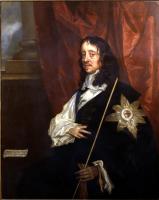

John Evelyn's Diary. 24th November 1670. I dined with the Treasurer (age 40), where was the Earl of Rochester (age 23), a very profane wit.


After 24th November 1679. St Peter and St Paul Church, Belton [Map]. Monument to John "Old Sir John" Brownlow 1st Baronet (deceased) sculpted by William Stanton (age 40).


On 24th November 1685 Dorothea Oldenburg was born to Frederick Louis Oldenburg I Duke Schleswig-Holstein-Sonderburg-Beck (age 32) and Louise Charlotte Oldenburg Duchess Schleswig-Holstein-Sonderburg-Beck (age 27). Coefficient of inbreeding 7.82%.
On 24th November 1693 Archbishop William Sancroft (age 76) died.
On 24th November 1698 Charles Douglas 3rd Duke Queensberry was born to James Douglas 2nd Duke Queensberry (age 35) and Mary Boyle Duchess Queensbury (age 34) in Queensberry House. He married 10th March 1720 his second cousin Catherine Hyde Duchess Queensbury, daughter of Henry Hyde 2nd Earl Rochester 4th Earl Clarendon and Jane Leveson-Gower Countess Rochester and Clarendon.
On 24th November 1722 Elizabeth Percy Duchess Somerset (age 55) died.


On 24th November 1740 John "The Elder" Bacon was born to Thomas Bacon in Southwark, Surrey [Map]. He married (1) 2nd March 1767 Elizabeth Wade and had issue (2) October 1782 Marthe Holland.

On 24th November 1741 Ulrika Eleonora Palatinate Zweibrücken Queen Consort Sweden (age 53) died.
Chronicle of Geoffrey le Baker of Swinbroke
Baker was a secular clerk from Swinbroke, now Swinbrook, an Oxfordshire village two miles east of Burford. His Chronicle describes the events of the period 1303-1356: Gaveston, Bannockburn, Boroughbridge, the murder of King Edward II, the Scottish Wars, Sluys, Crécy, the Black Death, Winchelsea and Poitiers. To quote Herbert Bruce 'it possesses a vigorous and characteristic style, and its value for particular events between 1303 and 1356 has been recognised by its editor and by subsequent writers'. The book provides remarkable detail about the events it describes. Baker's text has been augmented with hundreds of notes, including extracts from other contemporary chronicles, such as the Annales Londonienses, Annales Paulini, Murimuth, Lanercost, Avesbury, Guisborough and Froissart to enrich the reader's understanding. The translation takes as its source the 'Chronicon Galfridi le Baker de Swynebroke' published in 1889, edited by Edward Maunde Thompson.
Available at Amazon in eBook and Paperback format.
On 24th November 1745 Infanta Maria Luisa of Spain was born to Charles III King Spain (age 29) and Maria Amalia of Saxony Queen Consort Spain (age 21). She married 5th August 1765 her second cousin once removed Leopold II Holy Roman Emperor, son of Francis I Holy Roman Emperor and Maria Theresa Habsburg Spain Holy Roman Empress, and had issue.


On 24th November 1745 Thomas Wyndham 1st Baron Wyndham (age 63) died unmarried. Baron Wyndham of Finglass extinct. Monument at Salisbury Cathedral [Map] sculpted by John Michael Rysbrack (age 51).
Against a broad obelisk, Hibernia weeps, holding a rod and draped harp. By an urn, the purse for the Great Seal of Ireland.
Thomas Wyndham 1st Baron Wyndham: On 27th December 1681 he was born to Colonel John Wyndham and Alice Fownes. In 1724 he was appointed Chief Justice of the Common Pleas. In 1726 he was appointed Lord Chancellor of Ireland. In 1731 Thomas Wyndham 1st Baron Wyndham was created 1st Baron Wyndham of Finglass.


On 24th November 1784 Catherine Brockholes Duchess Norfolk (age 66) died.
On 24th November 1801 Prince Augustus Frederick Hanover 1st Duke Sussex (age 28) was created 1st Duke Sussex. Augusta Murray Duchess Sussex (age 33) by marriage Duchess Sussex.


On 24th November 1805 Wilhelm Bottner (age 53) died.
On 24th November 1807 Lieutenant Nevile Fane (age 19) died of yellow fever at Bridgetown, Barbados where he was buried.
On 24th November 1816 Llewellynn Jewitt was born to Arthur Jewitt (age 44) and Martha Sheldon of Crooke's Moor in Sheffield at Kimberworth, Rotherham. The youngest of seventeen children. He married Elizabeth Sage.
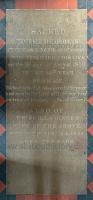
St Mary the Virgin Church, Edelsborough [Map]. Memorial to Thomas Ginger, died 8th August 1819, aged 49 years and his wife, Priscilla, died 24th November 1853, aged 75.
The London Gazette 17654. War-Office, 24th November 1820
3d Regiment of Dragoon Guards, Lieutenant Daniel Carrol, from the half-pay of the 22d Light Dragoons, to be Lieutenant, vice Lawford Burne, who exchanges, receiving the difference. Dated 16th November 1820.
10th Regiment of Light Dragoons, Lieutenant William Cartwright to be Captain, by purchase, vice Sir Henry Floyd, promoted in the 11th Light Dragoons. Dated 16th November 1820.
Cornet John Earl of Wiltshire (age 19) to be Lieutenant, by purchase, vice Cartwright. Dated 16th November 1820.
Thomas Wood, Gent, to be Cornet, by purchase, vice Lord Wiltshire, promoted. Dated 16th November 1820.
On 31st March 1880 Frederick Lambton (age 24) was elected MP South Durham which seat he held until 24th November 1885 when the constituency was abolished.
The History of William Marshal was commissioned by his son shortly after William’s death in 1219 to celebrate the Marshal’s remarkable life; it is an authentic, contemporary voice. The manuscript was discovered in 1861 by French historian Paul Meyer. Meyer published the manuscript in its original Anglo-French in 1891 in two books. This book is a line by line translation of the first of Meyer’s books; lines 1-10152. Book 1 of the History begins in 1139 and ends in 1194. It describes the events of the Anarchy, the role of William’s father John, John’s marriages, William’s childhood, his role as a hostage at the siege of Newbury, his injury and imprisonment in Poitou where he met Eleanor of Aquitaine and his life as a knight errant. It continues with the accusation against him of an improper relationship with Margaret, wife of Henry the Young King, his exile, and return, the death of Henry the Young King, the rebellion of Richard, the future King Richard I, war with France, the death of King Henry II, and the capture of King Richard, and the rebellion of John, the future King John. It ends with the release of King Richard and the death of John Marshal.
Available at Amazon in eBook and Paperback format.
On 24th November 1924 Henry Adelbert Wellington Fitzroy 9th Duke Beaufort (age 77) died at Badminton House. He was buried at St Michael and all Angels Church, Badminton. His son Henry (age 24) succeeded 10th Duke Beaufort, 12th Marquess Worcester, 16th Earl Worcester, 18th Baron Herbert of Raglan, 10th Baron Botetort.
On 24th November 1935 Herbert Gustav Schmalz aka Carmichael (age 79) died.
On 24th November 1940 Major George Allen (age 49) died in a motorcycle accident.
On 24th November 1955 James Spencer-Churchill 12th Duke of Marlborough was born to John Spencer-Churchill 11th Duke of Marlborough (age 29).
On 24th November 1273 Alfonso Plantagenet was born to King Edward I of England (age 34) and Eleanor of Castile Queen Consort England (age 32) in Bayonne [Map]. Their ninth child. He was named after Eleanor's half-brother Alfonso X King Castile X King Leon (age 52) who was also the child's godfather and attended his christening. He died aged ten in 1284.
On 24th November 1394 Charles Valois Duke Orléans was born to Louis Valois I Duke Orléans (age 22) and Valentina Visconti Duchess of Orleans (age 23). Coefficient of inbreeding 7.39%. He married (1) 1406 his first cousin Isabella Valois Queen Consort England, daughter of Charles "Beloved Mad" VI King France and Isabeau Wittelsbach Queen Consort France, and had issue (2) 1410 his second cousin Bonne Armagnac Duchess Orléans, daughter of Bernard VII Count Armagnac and Bonne Valois Countess Armagnac and Savoy (3) 1440 his second cousin once removed Mary La Marck Duchess Orléans, daughter of Adolph La Marck I Duke Cleves and Marie Valois Duchess Cleves, and had issue.
On 24th November 1420 James Butler 1st Earl Wiltshire 5th Earl Ormonde was born to James "White Earl" Butler 4th Earl Ormonde (age 27) and Joan Beauchamp Countess Ormonde at Kilkenny, County Kilkenny. He married (1) before 3rd June 1457 Avice Stafford Countess Ormonde (2) April 1458 his second cousin once removed Eleanor Beaufort Countess Ormonde, daughter of Edmund Beaufort 1st or 2nd Duke of Somerset and Eleanor Beauchamp Duchess Somerset.
On 24th November 1427 John Stafford 1st Earl Wiltshire was born to Humphrey Stafford 1st Duke of Buckingham (age 25) and Anne Neville Duchess Buckingham (age 19). He a great x 2 grandson of King Edward III of England. Coefficient of inbreeding 2.35%. He married before 7th April 1470 Constance Green Countess Wiltshire and had issue.
On 24th November 1472 Pietro Torrigiano was born.
On 24th November 1502 Claude Lorraine was born to René Lorraine II Duke Lorraine Duke of Bar (age 51) and Philippa Egmont Duchess of Bar Duchess Lorraine (age 35) at Bar le Duc.
On 24th November 1502 Catherine Lorraine was born to René Lorraine II Duke Lorraine Duke of Bar (age 51) and Philippa Egmont Duchess of Bar Duchess Lorraine (age 35) at Bar le Duc.

On 24th November 1589 Lettice West was born to Thomas West 2nd Baron De La Warr (age 33) and Anne Knollys Baroness De La Warr (age 34). She married her fifth cousin Henry Ludlow.
Jean de Waurin's Chronicle of England Volume 6 Books 3-6: The Wars of the Roses
Jean de Waurin was a French Chronicler, from the Artois region, who was born around 1400, and died around 1474. Waurin’s Chronicle of England, Volume 6, covering the period 1450 to 1471, from which we have selected and translated Chapters relating to the Wars of the Roses, provides a vivid, original, contemporary description of key events some of which he witnessed first-hand, some of which he was told by the key people involved with whom Waurin had a personal relationship.
Available at Amazon in eBook and Paperback format.
On 24th November 1594 Henry Grey 10th Earl Kent was born to Anthony Grey 9th Earl Kent (age 37) and Magdelane Purefoy Countess Kent (age 22). He married (1) 14th October 1641 Mary Courtine Countess Kent (2) 1st August 1644 Amabel Benn Countess Kent and had issue.
On 24th November 1655 Charles XI King Sweden was born to Charles Gustav X King Sweden (age 33). He married 6th May 1680 Ulrika Eleonora Oldenburg, daughter of Frederick III King of Denmark and Sophie Amalie Hanover Queen Consort Denmark, and had issue.

On 24th November 1681 Robert Darcy 3rd Earl Holderness was born to John Darcy (age 22) and Bridget Sutton (age 16). He married 26th May 1715 Frederica Schomberg Countess Holderness and Fitzwalter, daughter of Meinhart Schomberg 3rd Duke Schomberg and Karoline von der Pfalz, and had issue.
On 24th November 1685 Dorothea Oldenburg was born to Frederick Louis Oldenburg I Duke Schleswig-Holstein-Sonderburg-Beck (age 32) and Louise Charlotte Oldenburg Duchess Schleswig-Holstein-Sonderburg-Beck (age 27). Coefficient of inbreeding 7.82%.
On 24th November 1698 Charles Douglas 3rd Duke Queensberry was born to James Douglas 2nd Duke Queensberry (age 35) and Mary Boyle Duchess Queensbury (age 34) in Queensberry House. He married 10th March 1720 his second cousin Catherine Hyde Duchess Queensbury, daughter of Henry Hyde 2nd Earl Rochester 4th Earl Clarendon and Jane Leveson-Gower Countess Rochester and Clarendon.
On 24th November 1740 John "The Elder" Bacon was born to Thomas Bacon in Southwark, Surrey [Map]. He married (1) 2nd March 1767 Elizabeth Wade and had issue (2) October 1782 Marthe Holland.
On 24th November 1745 Infanta Maria Luisa of Spain was born to Charles III King Spain (age 29) and Maria Amalia of Saxony Queen Consort Spain (age 21). She married 5th August 1765 her second cousin once removed Leopold II Holy Roman Emperor, son of Francis I Holy Roman Emperor and Maria Theresa Habsburg Spain Holy Roman Empress, and had issue.
On 24th November 1804 Charles Henry John Anderson 9th Baronet was born to Charles John Anderson 8th Baronet (age 37). He married before 8th August 1870 Emma Foljambe Lady Anderson and had issue.
On 24th November 1816 Llewellynn Jewitt was born to Arthur Jewitt (age 44) and Martha Sheldon of Crooke's Moor in Sheffield at Kimberworth, Rotherham. The youngest of seventeen children. He married Elizabeth Sage.
On 24th November 1818 Wellington Stapleton-Cotton 2nd Viscount Combermere was born to Stapleton Cotton 1st Viscount Combermere (age 45) and Caroline Greville Viscountess Comberemere (age 29) at Duncombe House, St Thomas. He married 1844 Susan Alice Sitwell, daughter of George Sitwell 2nd Baronet, and had issue.
On 24th November 1818 William Henry Wellington Brydges Nugent was born to George Nugent 1st Marquess Westmeath (age 33) and Emily Anne Bennet Elizabeth Cecil Marchioness Westmeath (age 29). He died aged less than one years old.

On 24th November 1821 Emily Anne Frankland-Russell Lady Frankland was born to Robert Frankland-Russell 7th Baronet (age 37) and Louisa Anne Murray Lady Thirkleby (age 31). She married 10th November 1847 William Payne-Gallwey 2nd Baronet, son of General William Payne-Gallwey 1st Baronet and Harriett Quin Lady Payne-Galway, and had issue.
On 24th November 1831 Lucius Cary Master of Falkland was born to Lucius Cary 10th Viscount Falkland (age 28) and Amelia Fitz-Clarence Viscountess Falkland (age 24). He a grandson of King William IV of the United Kingdom.
On 24th November 1855 Algernon Francis Peyton 6th Baronet was born to Thomas Peyton 5th Baronet (age 38).
Henrici Quinti, Angliæ Regis, Gesta, is a first-hand account of the Agincourt Campaign, and subsequent events to his death in 1422. The author of the first part was a Chaplain in King Henry's retinue who was present from King Henry's departure at Southampton in 1415, at the siege of Harfleur, the battle of Agincourt, and the celebrations on King Henry's return to London. The second part, by another writer, relates the events that took place including the negotiations at Troye, Henry's marriage and his death in 1422.
Available at Amazon in eBook and Paperback format.
On 24th November 1860 Charles John Monson Shaw 8th Baronet was born to Reverend Charles John Kenward Shaw (age 31).
On 24th November 1861 Charles Spencer Boyle 10th Earl Cork was born to Richard Boyle 9th Earl Cork (age 32) and Emily Charlotte Burgh Countess Cork (age 33).
On 24th November 1862 Roland Dormer 13th Baron Dormer was born to James Charlemagne Dormer (age 28). He married 16th August 1897 Marie Hanem Eywaz Baroness Dormer.
On 24th November 1867 Henry Milles was born to George Milles 1st Earl Sondes (age 43) and Charlote Stracey.

On 24th November 1869 Reginald Brabazon 13th Earl of Meath was born to Reginald Brabazon 12th Earl of Meath (age 28) and Mary Jane Maitland Countess Meath (age 22). He married 12th February 1908 Aileen Wyndham-Quin, daughter of Windham Wyndham-Quin 4th Earl of Dunraven and Mount Earl and Florence Kerr Countess of Dunraven and Mount Earl, and had issue.
On 24th November 1872 Hilda Mary Dundas Baroness Southampton was born to Lawrence Dundas 1st Marquess Zetland (age 28) and Lilian Selina Elizabeth Lumley Marchioness Zetland (age 21). She married 9th July 1892 Charles Fitzroy 4th Baron Southampton, son of Charles Fitzroy 3rd Baron Southampton and Ismania Katharine Nugent Baroness Southampton, and had issue.
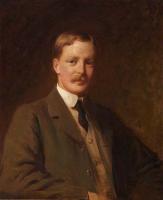
On 24th November 1883 Arthur George Child-Villiers was born to Victor Albert George Child-Villiers 7th Earl Jersey (age 38) and Margaret Elizabeth Leigh Countess Jersey (age 34).
On 24th November 1894 Robert Godfrey de Bohun Devereux was born to Robert Charles Devereux 17th Viscount Hereford (age 29).
On 24th November 1904 Geoffrey Slingsby Nightingale 15th Baronet was born to Thomas Slingsby Nightingale (age 38).
On 24th November 1932 Victor Brooke 3rd Viscount Alanbrooke was born to Field-Marshal Alan Brooke 1st Viscount Alanbrooke (age 49).
On 24th November 1933 Hugh Ivor Edwardes 8th and 5th Baron Edwardes was born to Hugh Edwardes (age 28).
Chronicle of a Bourgeois of Valenciennes
Récits d’un bourgeois de Valenciennes aka The Chronicle of a Bourgeois of Valenciennes is a vivid 14th-century vernacular chronicle written by an anonymous urban chronicler from Valenciennes in the County of Hainaut. It survives in a manuscript that describes local and regional history from about 1253 to 1366, blending chronology, narrative episodes, and eyewitness-style accounts of political, military, and social events in medieval France, Flanders, and the Low Countries. The work begins with a chronological framework of events affecting Valenciennes and its region under rulers such as King Philip VI of France and the shifting allegiances of local nobility. It includes accounts of conflicts, sieges, diplomatic manoeuvres, and the impact of broader struggles like the Hundred Years’ War on urban life in Hainaut. Written from the perspective of a burgher (bourgeois) rather than a monastery or royal court, the chronicle offers a rare lay viewpoint on high politics and warfare, reflecting how merchants, townspeople, and civic institutions experienced the turbulence of the 13th and 14th centuries. Its narrative style combines straightforward reporting of events with moral and civic observations, making it a valuable source for readers interested in medieval urban society, regional politics, and the lived experience of war and governance in pre-modern Europe.
Available at Amazon in eBook and Paperback format.
On 24th November 1955 James Spencer-Churchill 12th Duke of Marlborough was born to John Spencer-Churchill 11th Duke of Marlborough (age 29).
On 24th November 1435 John Valois II Count of Nevers, Etampes, Rethel and Eu (age 20) and Jacqueline Ailly Countess Nevers were married. He the son of Philip Valois II Count Nevers and Bonne Artois Duchess Burgundy.
On 24th November 1654 Oliver St John 2nd Earl Bolingbroke (age 21) and Frances Cavendish Countess Bolingbroke were married. She the daughter of William Cavendish 1st Duke Newcastle upon Tyne (age 61) and Elizabeth Bassett Countess Newcastle upon Tyne.

On 24th November 1673 Horatio Townshend 1st Viscount Townsend (age 42) and Mary Ashe Viscountess Townshend (age 21) were married. The difference in their ages was 21 years.
On 24th November 1687 William Savile 2nd Marquess Halifax (age 22) and Elizabeth Grimston were married. He the son of George Savile 1st Marquess Halifax (age 54) and Dorothy Spencer Lady Savile.
On 24th November 1687 Henry Carew 2nd Baronet (age 33) and Gratiana Darrell were married.
On 24th November 1824 Thomas Fremantle 1st Baron Cottesloe (age 26) and Louisa Elizabeth Nugent Baroness Cottesloe (age 21) were married. She by marriage Lady Fremantle of Swanborne in Buckinghamshire.
On 24th November 1837 William Brabazon 11th Earl of Meath (age 34) and Harriot Brooke Countess Meath were married. He the son of John Brabazon 10th Earl Meath (age 65).
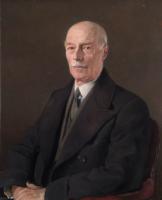
On 24th November 1909 Charles Beresford Fulke 3rd Baron Greville (age 38) and Olive Agnes Grace Baroness Greville (age 33) were married at St Paul's Church, Knightsbridge. She, a widow, brought $1million to the marriage that she had inherited from her first husband; Dollar Princess. Further, she was the neice of the millionaire brothers Michael P. Grace and William R. Grace. She was, apparently, twenty minutes late as a consequence of her car breaking down; possibly the first such bride to be so affected given the earliness of the year.
The reception was held at Carlton Terrace. Guests included Alexander Teck 1st Earl Athlone (age 35).
Their honeymoon was cut short by the serious illness of his father Algernon Greville-Nugent 2nd Baron Greville (age 68) who died nine days after the wedding.

On 24th November 1927 Charles John Wilson 3rd Baron Nunburnholme (age 23) and Mary Beatrice Thynne Baroness Nunburnholme (age 24) were married. She by marriage Baroness Nunburnholme. She the daughter of Thomas Henry Thynne 5th Marquess of Bath (age 65) and Violet Caroline Mordaunt Marchioness Bath (age 58). They were fourth cousins.
On 24th November 1192 Bishop Albert Reginar (age 26) was assassinated at Reims.
Henrici Quinti, Angliæ Regis, Gesta, is a first-hand account of the Agincourt Campaign, and subsequent events to his death in 1422. The author of the first part was a Chaplain in King Henry's retinue who was present from King Henry's departure at Southampton in 1415, at the siege of Harfleur, the battle of Agincourt, and the celebrations on King Henry's return to London. The second part, by another writer, relates the events that took place including the negotiations at Troye, Henry's marriage and his death in 1422.
Available at Amazon in eBook and Paperback format.
On 24th November 1315 Fulk Fitzwarin 1st Baron Fitzwarin (age 64) died. His son Fulk (age 30) succeeded 2nd Baron Fitzwarin. Eleanor Beauchamp Baroness Fitzwarin (age 37) by marriage Baroness Fitzwarin.
On 24th November 1326 Hugh "Younger" Despencer 1st Baron Despencer (age 40) was hanged, drawn and quartered in Hereford [Map]. Baron Despencer forfeit.
Simon of Reading was also hanged, drawn and quartered the same day.
Isabella of France Queen Consort England (age 31) and Roger Mortimer 1st Earl March (age 39) were present - see
Chronicle of Geoffrey le Baker.
On 24th November 1370 John de Lisle 4th Baron Lisle (age 34) died. His son John (age 4) succeeded 5th Baron Lisle.
On 24th November 1406 Sibia Fortia Queen Consort Aragon died at Barcelona [Map]. She had a state funeral. She was buried in the convent of San Francisco (Framenors) in Barcelona.
On 24th November 1426 Elizabeth Lancaster Duchess Exeter (age 63) died. She was buried at St Mary's Church, Burford [Map].
On 25th November 1431 Walter Fitzwalter 7th Baron Fitzwalter (age 31) drowned at sea in a storm whilst returning from France.
Elizabeth Fitzwalter Baroness Dinham 8th Baroness Fitzwalter (age 2) succeeded 8th Baroness Fitzwalter. Note. Chronicle of Gregory 1432 states 24th November 1432 or, more specifically, "on Syn Kateryn ys eve" - St Katherine's feast day is 25 Nov.
On 24th November 1440 William Crichton 1st Lord Crichton arranged a dinner of reconciliation at the Great Hall, Edinburgh Castle. During the course of the dinner the young brothers William Douglas 3rd Duke Touraine (age 16) and David Douglas (age 10) was beheaded in front of the young King James II of Scotland (age 10).
On 24th November 1442 Joan Braybrooke 5th Baroness Cobham (age 39) died at Cooling Castle [Map]. Her son Edward (age 27) succeeded 6th Baron Cobham. Elizabeth Tuchet Baroness Cobham (age 22) by marriage Baroness Cobham.
On 24th November 1468 Jean "Bastard of Orléans" Valois Count Dunois Count Longueville (age 66) died.
On 24th November 1492 Louis de Bruges 1st Earl of Winchester (age 65) died. His son John (age 34) succeeded 2nd Earl Winchester.
On 24th November 1496 John Radclyffe 9th Baron Fitzwalter (age 44) was beheaded at Calais [Map] for trying to bribe his jailers. His son Robert (age 13) succeeded 10th Baron Fitzwalter.
On 24th November 1534 Thomas Wriothesley (age 46) died.
On 24th November 1558 George Leslie 4th Earl Rothes (age 74) died. His son Andrew (age 28) succeeded 5th Earl Rothes.
Chronicle of a Bourgeois of Valenciennes
Récits d’un bourgeois de Valenciennes aka The Chronicle of a Bourgeois of Valenciennes is a vivid 14th-century vernacular chronicle written by an anonymous urban chronicler from Valenciennes in the County of Hainaut. It survives in a manuscript that describes local and regional history from about 1253 to 1366, blending chronology, narrative episodes, and eyewitness-style accounts of political, military, and social events in medieval France, Flanders, and the Low Countries. The work begins with a chronological framework of events affecting Valenciennes and its region under rulers such as King Philip VI of France and the shifting allegiances of local nobility. It includes accounts of conflicts, sieges, diplomatic manoeuvres, and the impact of broader struggles like the Hundred Years’ War on urban life in Hainaut. Written from the perspective of a burgher (bourgeois) rather than a monastery or royal court, the chronicle offers a rare lay viewpoint on high politics and warfare, reflecting how merchants, townspeople, and civic institutions experienced the turbulence of the 13th and 14th centuries. Its narrative style combines straightforward reporting of events with moral and civic observations, making it a valuable source for readers interested in medieval urban society, regional politics, and the lived experience of war and governance in pre-modern Europe.
Available at Amazon in eBook and Paperback format.
On 24th November 1598 William Paulet 3rd Marquess Winchester (age 66) died. His son William (age 39) succeeded 4th Marquess Winchester, 4th Earl Wiltshire, 4th Baron St John. Lucy Cecil Marchioness Winchester by marriage Marchioness Winchester.
On 24th November 1676 Anne Cecil Countess Stamford (age 80) died.
On 24th November 1679 Nicholas Tufton 3rd Earl of Thanet (age 48) died. His brother John (age 41) succeeded 4th Earl of Thanet, 4th Baron Tufton, 16th Baron de Clifford, 5th Baronet Tufton of Hothfield.
On 24th November 1679 John "Old Sir John" Brownlow 1st Baronet (age 89) died without issue. Baronet Brownlow of Belton in Lincolnshire extinct. He left Belton House [Map] to his great-nephew John Brownlow 3rd Baronet (age 20) (grand-son of his brother William Brownlow 1st Baronet) and niece Alice Sherard Baroness Brownlow (age 20) (grand-daughter of his sister Elizabeth Brownlow ) who had married three years before in 1676. He also left them an income of £9,000 per annum and £20,000 in cash. They immediately bought a townhouse in Southampton Square.


On 24th November 1693 Archbishop William Sancroft (age 76) died.
On 24th November 1714 Walter Aston 3rd Baronet (age 81) died. His son Walter (age 54) succeeded 4th Baronet Aston of Tixall and 4th Baronet Aston of Forfar.
On 24th November 1722 Elizabeth Percy Duchess Somerset (age 55) died.
On 24th November 1738 Charles Turner 1st Baronet (age 72) died without surviving male issue. His brother John (age 68) succeeded 2nd Baronet Turner of Warham in Norfolk.
On 24th November 1741 Ulrika Eleonora Palatinate Zweibrücken Queen Consort Sweden (age 53) died.
On 24th November 1744 Catherine Gounter Lady Maynard (age 42) died.
Chronicle of Abbot Ralph of Coggeshall
The Chronicle of Abbot Ralph of Coggeshall (Chronicon Anglicanum) is an indispensable medieval history that brings to life centuries of English and European affairs through the eyes of a learned Cistercian monk. Ralph of Coggeshall, abbot of the Abbey of Coggeshall in Essex in the early 13th century, continued and expanded his community’s chronicle, documenting events from the Norman Conquest of 1066 into the tumultuous reign of King Henry III. Blending eyewitness testimony, careful compilation, and the monastic commitment to record-keeping, this chronicle offers a rare narrative of political intrigue, royal power struggles, and social upheaval in England and beyond. Ralph’s work captures the reigns of pivotal figures such as Richard I and King John, providing invaluable insights into their characters, decisions, and the forces that shaped medieval rule. More than a simple annal, Chronicon Anglicanum conveys the texture of medieval life and governance, making it a rich source for scholars and readers fascinated by English history, monastic authorship, and the shaping of the medieval world.
Available at Amazon in eBook and Paperback format.
On 24th November 1744 Anne Robinson Baroness Gowran died.
On 24th November 1745 Thomas Wyndham 1st Baron Wyndham (age 63) died unmarried. Baron Wyndham of Finglass extinct. Monument at Salisbury Cathedral [Map] sculpted by John Michael Rysbrack (age 51).
Against a broad obelisk, Hibernia weeps, holding a rod and draped harp. By an urn, the purse for the Great Seal of Ireland.
Thomas Wyndham 1st Baron Wyndham: On 27th December 1681 he was born to Colonel John Wyndham and Alice Fownes. In 1724 he was appointed Chief Justice of the Common Pleas. In 1726 he was appointed Lord Chancellor of Ireland. In 1731 Thomas Wyndham 1st Baron Wyndham was created 1st Baron Wyndham of Finglass.
On 24th November 1762 Euphemia Lockhart Countess Wigtown (age 59) died.
On 24th November 1772 Edward Brabazon 7th Earl Meath (age 81) died. His son Anthony (age 51) succeeded 8th Earl Meath, 9th Baron Ardee.
On 24th November 1773 Bishop Edward Willes (age 80) died. He was buried at Westminster Abbey [Map].
On 24th November 1776 Alice Clavering Viscountess Windsor died.
On 24th November 1784 Catherine Brockholes Duchess Norfolk (age 66) died.
On 24th November 1794 John Stanley-Massey-Stanley 6th Baronet (age 83) died. His son Thomas (age 39) succeeded 7th Baronet Stanley of Hooton in Cheshire.
On 24th November 1805 Wilhelm Bottner (age 53) died.

On 10th November 1810 George Legge 3rd Earl Dartmouth (age 55) died in Cornwall. He was buried at Holy Trinity Church, Minories [Map] on 24th November 1810. His son William (age 25) succeeded 4th Earl Dartmouth, 5th Baron Dartmouth.
On 24th November 1835 Eleanor Mary Arundell Baroness Clifford Chudleigh (age 69) died.
Henrici Quinti, Angliæ Regis, Gesta, is a first-hand account of the Agincourt Campaign, and subsequent events to his death in 1422. The author of the first part was a Chaplain in King Henry's retinue who was present from King Henry's departure at Southampton in 1415, at the siege of Harfleur, the battle of Agincourt, and the celebrations on King Henry's return to London. The second part, by another writer, relates the events that took place including the negotiations at Troye, Henry's marriage and his death in 1422.
Available at Amazon in eBook and Paperback format.
On 24th November 1837 Richard Le Poer Trench 2nd Earl Clancarty (age 70) died. His son William (age 34) succeeded 3rd Earl Clancarty.
On 24th November 1841 Henry Lascelles 2nd Earl Harewood (age 73) died. His son Henry (age 44) succeeded 3rd Earl Harewood in Yorkshire, 3rd Viscount Lascelles, 3rd Baron Harewood of Harewood in Yorkshire. Louisa Thynne Countess Harewood (age 40) by marriage Countess Harewood in Yorkshire.
On 24th November 1848 William Lamb 2nd Viscount Melbourne (age 69) died. His brother Frederick (age 66) succeeded 3rd Viscount Melbourne of Kilmore in County Cavan, 4th Baronet Lamb of Brocket Hall in Hertfordshire.
On 24th November 1861 Charlotte Augusta Hill Lady Chetwynd died.
On 24th November 1887 Ida Louise Bennet Countess Dalhousie (age 30) died.

On 24th November 1891 Edward Robert Bulwer-Lytton 1st Earl (age 60) died. His son Victor (age 15) succeeded 2nd Earl of Lytton in Derbyshire, 3rd Baron Lytton of Knebworth in Hertfordshire, 3rd Baronet Bulwer of Knebworth in Hertfordshire.
On 24th November 1916 Ralph Frankland-Payne-Gallwey 3rd Baronet (age 68) died. His nephew John (age 26) succeeded 4th Baronet Payne-Gallwey of Hampton Hill.
On 24th November 1924 Henry Adelbert Wellington Fitzroy 9th Duke Beaufort (age 77) died at Badminton House. He was buried at St Michael and all Angels Church, Badminton. His son Henry (age 24) succeeded 10th Duke Beaufort, 12th Marquess Worcester, 16th Earl Worcester, 18th Baron Herbert of Raglan, 10th Baron Botetort.
On 24th November 1935 Herbert Gustav Schmalz aka Carmichael (age 79) died.
On 24th November 1948 Brodrick Hartwell 4th Baronet (age 72) died. His son Brodrick (age 39) succeeded 5th Baronet Hartwell of Dale Hall in Essex.
Chronicle of Walter of Guisborough
A canon regular of the Augustinian Guisborough Priory, Yorkshire, formerly known as The Chronicle of Walter of Hemingburgh, describes the period from 1066 to 1346. Before 1274 the Chronicle is based on other works. Thereafter, the Chronicle is original, and a remarkable source for the events of the time. This book provides a translation of the Chronicle from that date. The Latin source for our translation is the 1849 work edited by Hans Claude Hamilton. Hamilton, in his preface, says: 'In the present work we behold perhaps one of the finest samples of our early chronicles, both as regards the value of the events recorded, and the correctness with which they are detailed; Nor will the pleasing style of composition be lightly passed over by those capable of seeing reflected from it the tokens of a vigorous and cultivated mind, and a favourable specimen of the learning and taste of the age in which it was framed.'
Available at Amazon in eBook and Paperback format.
On 24th November 1949 Ralph Milbanke 12th Baronet (age 42) died. Baronet Milbanke of Halnaby in Yorkshire extinct.
On 24th November 1957 Godfrey Baring 1st Baronet (age 86) died. His son Charles (age 58) succeeded 2nd Baronet Baring of Nubia House in Northwood, Isle of Wight.
On 24th November 1958 Edgar Gascoyne-Cecil 1st Viscount Cecil (age 94) died. Viscount Cecil of Chelwood of East Grinstead in Sussex extinct.


On 24th November 1990 Richard Acland 15th Baronet (age 83) died. His son John (age 51) succeeded 16th Baronet Acland of Columb John in Devon.