

Chronicle of Walter of Guisborough
A canon regular of the Augustinian Guisborough Priory, Yorkshire, formerly known as The Chronicle of Walter of Hemingburgh, describes the period from 1066 to 1346. Before 1274 the Chronicle is based on other works. Thereafter, the Chronicle is original, and a remarkable source for the events of the time. This book provides a translation of the Chronicle from that date. The Latin source for our translation is the 1849 work edited by Hans Claude Hamilton. Hamilton, in his preface, says: 'In the present work we behold perhaps one of the finest samples of our early chronicles, both as regards the value of the events recorded, and the correctness with which they are detailed; Nor will the pleasing style of composition be lightly passed over by those capable of seeing reflected from it the tokens of a vigorous and cultivated mind, and a favourable specimen of the learning and taste of the age in which it was framed.'
Available at Amazon in eBook and Paperback format.
31 Oct is in October.
1454 Battle of Stamford Bridge
1528 Sweating Sickness Outbreak
1532 Henry VIII and Francis I meet at Calais
31 Oct is known as Halloween, a contraction of All Hallow's Eve. It corresponds the pre-Christian festival of Samhain
On 31st October 1214 Eleanor Plantagenet Queen Consort Castile (age 53) died at Burgos [Map]. She was buried at Abbey of Santa Maria la Real de Huelgas [Map].
On 31st October 1266 the Dictum of Kenilworth was issued. The Dictum was a peace agreement between King Henry III of England (age 59) and the rebels who were besieged in the impregnable Kenilworth Castle [Map]. The committee included: Bishop Walter Branscombe (age 46), Archbishop Walter Giffard (age 41), Bishop Nicholas Ely, Gilbert de Clare 8th Earl Gloucester 7th Earl Hertford, Humphrey Bohun 2nd Earl Hereford 1st Earl Essex (age 62), Philip Basset (age 82), John Balliol (age 58), Robert Walerand, Alan Zouche (age 63), Roger Somery 2nd Baron Dudley (age 76), and Warin Bassingbourne.
Robert Ferrers 6th Earl of Derby (age 27) and Henry Hastings (age 31) were fined seven times their annual income. The Dictum, however, required the rebels to pay their fines before being restored to their lands; something of a Catch-22 since if they weren't restored to their lands, they would have no income to pay the fine.
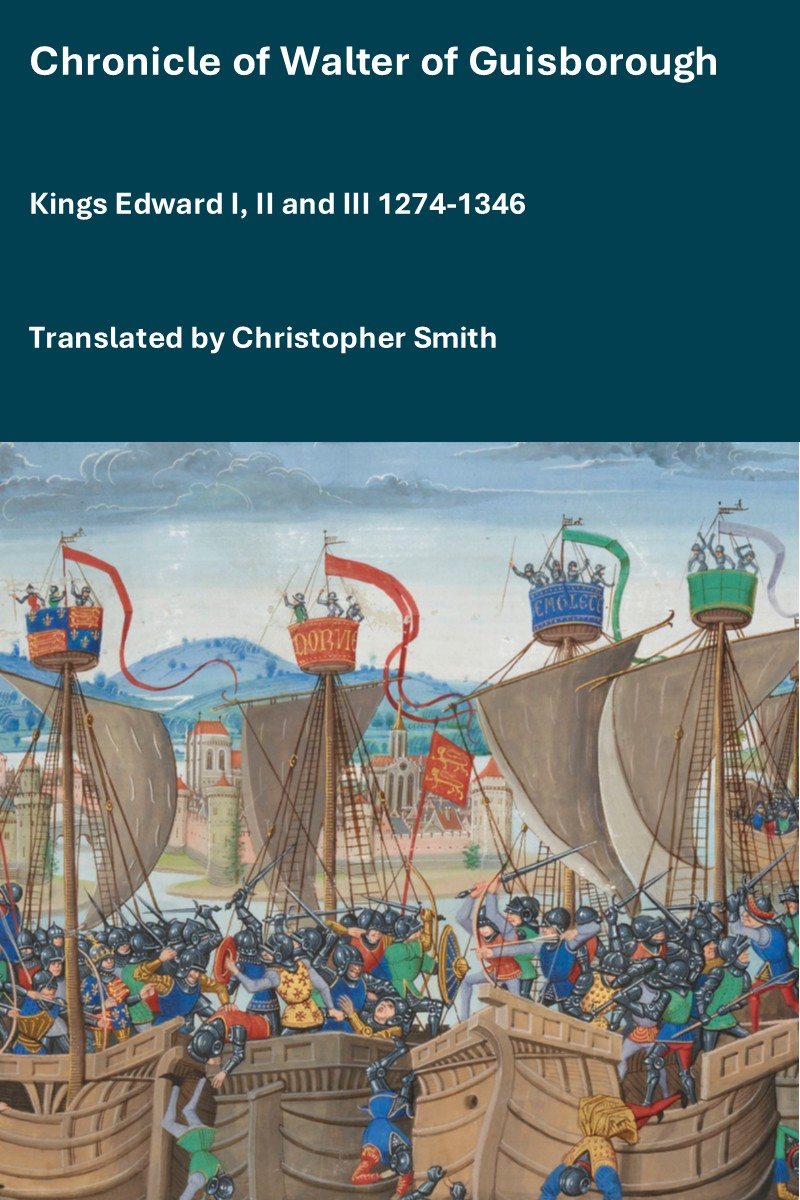 Chronicle of Walter of Guisborough. Upon hearing these things, the king immediately sent five hundred armed knights and twenty thousand foot soldiers into Gascony, under the command of Lord John de St. John, who had formerly served as seneschal of that land, along with Lord John of Brittany and the most valiant knight William Latimer. After all preparations necessary for such an expedition had been completed at Portsmouth, they set out to sea around the Feast of St. Peter in Chains [1st August 1294]. However, due to contrary winds, the fleet was scattered along the coasts of Cornwall. They regrouped again at Plymouth around the Feast of St. Denis [9th October 1294], hoisted sail once more, and after enduring many and various perils of storms, finally landed in Gascony near the Feast of Saints Simon and Jude [28th October 1294], at Castillon, which lies on the banks of the River Garonne. The lord of that town submitted himself to them and to the King of England, received them with great joy, and treated them kindly. From there they marched to Macau, and the citizens surrendered on the Eve of All Saints [31st October 1294]. On the following day, the whole fleet anchored before Bourg-sur-Gironde [Mons Albani]. The townspeople wished to surrender, but they feared the Picards who were stationed in the town's garrison. When the Picards saw that the townspeople intended to surrender, they sallied out from the castle and slew many. The citizens sent messengers to the English reporting what had happened and begging for help. The English quickly came to their aid and drove the royal [French] troops back into the castle. The townspeople then surrendered. In the morning, when our men prepared to storm the castle, the Picards asked for a three-day truce so that they could send a messenger to Bordeaux. They promised to surrender without delay if no help arrived. So a boy was sent, and the Constable of Bordeaux and the Marshal of France replied that they could not come so quickly, but ordered the Picards to defend themselves and resist manfully, especially as they had supplies and all necessities to last six months. Upon hearing this, the Picards surrendered immediately, on condition that their lives, limbs, horses, and arms be spared, and they departed in peace. Eight days later, our forces returned to the town of Blaye, which lies two leagues from Bourg. The garrison there sought a similar truce and obtained it; but as no help came, they surrendered and left. Our troops found a large amount of provisions in both the town and the castle, including around 2,500 barrels of wine.
Hiis auditis mox ipse rex quingentos armatos et viginti millia peditum misit in Vasconiam cum domino Johanne de Sancto Johanne, qui ejusdem terræ olim senescallus extiterat, et cum domino Johanne de Britannia, et illo milite strenuissimo Willelmo Latymer; qui apud Portesmew omnibus ad expeditionem tantam necessariis præparatis, posuerunt se in mari circa festum beati Petri ad Vincula, et irruente vento contrario dispersæ sunt naves per partes Cornubiæ; iterumque recollectæ apud Plumeuthe circa festum beati Dionysii ventis vela iterato laxabant, et post multa variaque tempestatum discrimina tandem circa festum Apostolorum Symonis et Judæ, applicuerunt in Vasconiam apud Chastellon, quæ situatur in littore fluminis Gerundæ; deditque se eis et regi Angliæ dominus urbis illius, et eos cum lætitia magna suscepit, et benigne tractavit. Profectique sunt inde usque ad Makant et dederunt se cives in vigilia Omnium Sanctorum, et in crastino anchoraverunt cum tota classe ante Burgum super mare qui antiquitus dicebatur Mons Albani; cives autem se dare volebant, sed timebant Picardos qui erant in præsidio civitatis; cumque vidissent Picardi quod se dare vellent, exierunt a castro et plurimos peremerunt. Miseruntque cives ad Anglos nunciantes hæc et eorum auxilium exposcentes, qui confestim in eorum auxilium ascenderunt, et retraxerunt se regales in castrum, et cives se dederunt; mane autem facto cum nostri in castrum irruere voluissent, petierunt Picardi inducias triduales, ut misso nuncio Burdegalim si in eorum non venirent auxilium se statim redderent absque dubio. Misso igitur puero remandavit eis constabularius de Burdews et marescallus Franciæ quod ita festinanter venire non poterant, immo se defenderent et viriliter resisterent, præcipue cum haberent victualia et cætera quæque necessaria, pro tempore semestri; quo audito statim dederunt se, salvis sibi vita et membris, equis et armis, et abierunt in pace. Post dies octo reversi sunt nostri ad urbem de Blaynes, quæ distat a Burgo per duas leucas, et similes quasi treugas petierunt castrenses et habuerunt, sed nullo veniente auxilio dederunt se et abierunt, inveneruntque nostri victualia multa in urbe et in castro et dolia vini circiter MMD.
Annales Paulini. Meanwhile, on the feast of Saint Luke the Evangelist (18th October), the king caused it to be proclaimed in London, by his writ, that no one should be afraid just because he was marching against the said castle, and that all should keep the peace of the realm of England. Nevertheless, on the same day, it was also proclaimed that: Crossbowmen coming to the siege would be paid 8 pence per day, Archers 6 pence, Knights 2 shillings, Men-at-arms 12 pence. And the mayor of London granted the king, in his aid, 500 armed foot soldiers. From the county of Essex, a thousand men came. Such a multitude from many parts gathered and increased day by day, that, as was said, more than 30,000 were counted. This siege lasted until the eve of All Saints (31st October). At length, those who were holding the castle, namely, Sir Bartholomew de Burghersh, the wife of Lord Bartholomew de Badlesmere, Walter Culpepper, and many others, surrendered themselves to the king under the hope of peace, their lives and limbs being spared.
Interim, die Sancti Luca evangelist, dominus rex proclamare fecit Londoniis, per breve suum, quod nullus esset perterritus eo quod ipse esset iturus versus dictum castellum, et quod unusquisque observaret pacem regni Angliæ; tamen eodem die proclamatum fuit quod, si balistarii venirent ad dictum obsidium, haberent viii. denarios, sagittarii vi. denarios, miles ii solidos, armiger xii. denarios. Et concessum fuit per majorem Londoniensem domino regi in suo subsidio v.c. hominum peditum armatorum, ex comitatu de Essex Mm. hominum. Tanta multitndo de pluribus partibus ibidem conveniebat et crescebat de die in diem, quod plus quam xxx. millia numerabantur ut dicebatur. Et durabat hujusmodi obsidium usque ad vigiliam Omnium Sanctorum. Itaque illi qui illud castellum custodiebant, videlicet dominus Bartholommus de Burhasse miles, uxor domini Bartholommi de Badelesmere, Walterus Colpepir, et plures alii, sub spe pacis domino regi se reddiderunt salvis eis tamen vita et membris.
On 31st October 1345 Ferdinand I King Portugal was born to Peter I King Portugal (age 25) and Constanza Manuel Queen Consort Castile (age 29). Coefficient of inbreeding 3.84%. He married 1371 Leonor Teles Meneses Queen Consort Portugal and had issue.
On 31st October 1391 Edward "The Philosopher" I King Portugal was born to King John I of Portugal (age 39) and Philippa of Lancaster Queen Consort Portugal (age 31). He a great grandson of King Edward III of England. He married 22nd September 1428 his first cousin once removed Eleanor Trastámara Queen Consort Portugal, daughter of Ferdinand I King Aragon and Eleanor of Alberquerque Queen Consort Aragon, and had issue.
Chronicle of Walter of Guisborough. On the feast day of Saint Luke the Evangelist [31st October 1399], the King of England remained in the same place, waiting to see if perhaps the French would come. On the following day, the army moved about three miles towards the country of Tyrais; on Wednesday, it advanced two miles; on Thursday, it entered three miles further into the same country of Tyrais and burned the surrounding area for six miles. On Friday, in the same place, he waited the whole day for the French, for it was the final day appointed in the letters, as mentioned above. In the evening, when the magnates of the English army had agreed to return to their own territories on the morrow, a certain messenger arrived on behalf of the King of France, requesting the King of England to choose a place to his liking on the next day, and assuring him without doubt that the King of France would meet him there for battle. Hearing this, the King of England was filled with great joy; and that night the English hurried to select a position well-suited to themselves. And behold, that same night the Earl of Salisbury and Sir Walter de Mauny, riding with their men towards the French army, came as far as the sentries, and, shouting loudly, so terrified and alarmed the whole camp that they kept armed and in battle array throughout the night, as if prepared to fight; and having captured a certain knight with his squire, they returned to their own side. When morning came, the English dismounted from their horses, and the king ordered the archers to be placed next to the men-at-arms, and set the Welsh with their lances beside them, and arranged his battle lines in the best manner he could. The Germans and the Brabançons came to see the English lines drawn up and the manner of their disposition; and seeing the arrangement of the army, they were astonished. And when they saw the king and his men prepared to live or die, with steady countenance and resolute spirit, they returned to their own lines much encouraged. The king sent some of his men to scout the country and the French army; and these, returning around the first hour of the same day, brought with them a certain Frenchman they had captured, who declared firmly that the French were hastening to arrive and preparing themselves for battle. Then several men approached the king and were made knights by his own hand. After this, the King of England and the Earls of Northampton and Salisbury ordered wine to be brought, and drinking with great joy, the knight captured that same day was granted his life and limbs under the following condition: he was sent to the King of France to say that neither the King of France nor his people were showing themselves as courteous and worthy men, nor acting as they ought, in thus delaying and exhausting men already weary from their labours day after day in such fashion, especially after, by their letters, they had seemed to implore battle with ardent desire on the appointed day. When the aforesaid knight returned to his own side, the King of England went to inspect and review his battle array, which was divided into three wings or divisions1. In the first division were the following lords: the Bishop of Lincoln, Henry de Burghersh, Henry of Flanders, John Darcy, Henry de Ferrers, Edward de Montagu, John de Beaumont, the Lord de Segrave, William FitzWarin, Reginald de Cobham, Walter de Mauny, Robert de Ferrers, Geoffrey de Scrope, John of Norwich, Nicholas de Cantilupe, John Molyns, Maurice de Berkeley, John de Stirling, and John de Montgomery. In the second, the right wing, were the Earls of Derby and Suffolk, the Lord de Say, and many other nobles. In the third, the left wing, were the Earls of Northampton, Salisbury, and Pembroke, together with many other nobles. In the central guard or main battle were the Margrave of Brandenburg, the Duke of Guelders, the Margrave of Jülich, the Count of Mons, Lord John of Hainault, the Lord of Fauquemont, the Constable of Zeeland and Holland, and Lord William de Ufford. In the third [division] was alone the Duke of Brabant with his own troops. And the Duke of Brabant, after he had seen the English formation and their arrangement in battle, as well as their steadfast expression and spirit, and that they were most fully prepared to fight, returned joyfully to his own men and ordered it to be proclaimed that whoever from his force would bring him the width of a palm from the banner of the King of France would receive from him a thousand florins for his trouble. Around the ninth hour, the aforesaid knight came to the King of France and reported how he had been captured and brought before the King of England, who had granted him life and limb under the stated condition, and told him plainly in order all that had happened, exactly as has been described above. And when the French had heard everything in detail, and had considered that the English were spirited and ready for battle, they said among themselves, as if struck with consternation, "The King of England is full of madness, he has dared to enter our land, to kill our people, to burn our towns, to raze our castles, and still to resist in the field against the power and strength of France." Then the King of France swore an oath by Saint Denis that, although the King of England might wish to expose his own people to ruin, he himself, since he would have to answer before God for such folly, would by no means do this. "Rather," he said, "let us turn back, and at another time we shall meet him to better advantage according to our will." And when it came to the ears of the King of England that the French army had thus withdrawn, he was utterly astonished that a people so renowned from of old had not kept the agreements confirmed by their own letters. The King of France, having returned as far as Saint-Quentin, the King of England soon afterwards crossed back to England2.
In die Sancti Lucæ Evangelista rex Angliæ in eodem loco Gallicos, si forte venire vellent, expectando moram fecit. In crastino versus patriam de Tyrais per tria milliaria motus est exercitus, die Mercurii per duo milliaria, die Jovis infra patriam de Tyrais per tria milliaria intravit, et circumcirca per sex milliaria igne concremavit. Die Veneris in eodem loco per totum diem Gallicos expectavit; fuit enim dies ultimus, per literas, ut præmittitur, assignatus. In vespera enim, cum magnates exercitus Anglorum concordati fuissent in crastino ad sua redire, supervenit nuncius quidam ex parte regis Franciæ, Anglorum regem interpellans quatinus in crastino locum sibi placitum eligeret, et sine dubio ad pugnam rex Franciæ sibi obviaret. Quibus auditis, rex Angliæ ingenti lætitia repletus est; et Anglici nocte illa locum suum illis aptum eligere festinarunt. Et ecce, eadem nocte comes de Salesbiri et dominus Walterus de Manney cum suis versus exercitum Franciæ equitantes, usque ad vigiles pervenerunt, et, fortiter exclamantes, totum exercitum terrore et timore perterritum, quasi ad pugnam paratum per totam noctem armatum stare fecerunt; et capto milite quodam cum suo scutifero ad suos redierunt. Facto autem mane Anglici de equis descenderunt, et rex arcitenentes juxta armatos collocari fecit, et Wallenses cum suis lanceis juxta eos constituit, aciesque suas meliori modo quo potuit ordinavit. Veneruntque Alamanni et Brabantini, ut aciem Anglorum dispositam modumque viderent; et videntes dispositionem exercitus admirati sunt. Considerantesque regem et suos ad vivendum et moriendum paratos, vultuque et animo constantes, multum animati ad acies suas redierunt. Et misit rex quosdam de suis qui patriam exercitumque Francorum explorarent: qui circa primam ejusdem diei revertentes, quendam Gallicum captum secum adducunt coram rege, qui Gallicos festinanter advenire et ad pugnam se parare firmiter asseruit. Et accesserunt statim plures ad regem, et milites de manu ejus facti sunt. Post hæc rex Angliæ et comites de Northampton et Salisbiri afferri vina jusserunt, et etiam magna potantes lætitia, miles eodem die captus sub conditione sequente vitam et membra consecutus est. Mittitur ergo ad regem Franciæ, cui et diceret quod curiales et probos se non ostenderent rex Franciæ et gens sua, nec sicut deberent fecissent, homines laboribus fessos indies modo tali procrastinando, ex quo per literas suas die assignata ardenti, ut videbatur, desiderio bellum implorassent. Regresso ad suos milite prædicto, processit rex Angliæ ad videndum et considerandum aciem suam, quæ in tres alas seu acies divisa fuit. In quarum prima fuerunt domini episcopus Lincolniensis, Henricus de Burghasse, Henricus de Flandria, Johannes Darci, Henricus de Ferrariis, Edwardus de Monte-Hermeri, Johannes de Bellomonte, dominus de Segrave, Willelmus Filius-Warini, Reginaldus de Cobham, Walterus de Mannay, Robertus de Ferrariis, Galfridus de Scrop, Johannes de Norwic, Nicholaus de Cantilupo, Johannes Molyns, Mauricius de Berkle, Johannes de Strivelyn, Johannes de Mongomery. In secunda vero ala dextera, comites de Derby et Sothfolk, dominus de Saye, et alii plures nobiles. In tertia ala sinistra, comites Northampton, Salesbiriæ, et Pembrochiæ, et cæteri nobiles multi. In media vero custodia sive acie fuerunt marchio de Brendesburghe, dux Gelrensis, marchio de Julers, comes Moncium, dominus Johannes de Hannonia, dominus de Faucomond, constabularius Selandia et Holandiæ, dominus Willelmus de Ufford. In tertia vero solus dux Brabantiæ cum gente sua dux quoque Brabantiæ, postquam modum Anglorum et ordinationem" eorum in acie sua vidisset, necnon vultum eorum animique constantiam, et quod ad pugnandum paratissimi erant, lætus ad suos regressus, fecit proclamari quod quicunque de suis amplitudinem unius palmæ de vexillo regis Franciæ sibi deferret, mille florenos pro suo labore sibi conferret. Circa horam IX cum miles prædictus ad regem Franciæ venisset, retulit ei quomodo captus ad regem Angliæ ductus fuerat, et sibi vitam et membra contulerat sub conditione, et cuncta per ordinem, sicut prædicta sunt, eidem patenter enarravit. Cumque seriatim Gallici omnia audissent, et quod Anglici animosi et parati ad pugnam forent, perpendissent, quasi mente consternati dixerunt inter se, "Dementia plenus est rex Angliæ, qui terram nostram ausus est intrare, gentem nostram interficere, villas incendere, castra prosternere, et contra vires Franciæ et ejus potentiam in campo ad pugnandum adhuc resistere." Tunc rex Franciæ per Sanctum Dionisium juramento firmavit, quod licet rex Angliæ gentem suam confusioni exponere vellet, ipse tamen, cum coram Deo pro tanta stultitia responderet, nullatenus hoc faceret. "Sed redeamus," inquit, "et pro voluntate nostra alias ei melius obviare debemus." Cumque ad aures regis Angliæ pervenisset, militiam Gallicorum sic regressam, mirabatur in immensum quod gens ab antiquo tam famosa, conventiones literis suis affirmatas non servasset. Regresso itaque usque ad Sanctum Quintinum rege Franciæ, Angliæ cito post in Angliam transfretavit.
Note 1. Mezeray [writing in the 17th Century] estimates the English army at forty thousand cavalry and sixty thousand foot, while the French force was equally brilliant; for though in infantry inferior by about one-fifth, their cavalry was double, two hundred and twenty banners of the most noble seigneurs of France floated in the air; the Kings of France, Navarre, Bohemia, and Scotland commanded in person, accompanied by the Dukes of Normandy, Berry, Bourbon, Bretagne, Lorraine, and d'Athenes, with thirty-six counts, and above 4000 knights. Mezeray, Hist, 2.398.
Note 2. Edward returned to England on the 21st of February, 1340, Rymer, Fœdera, 2.1115.
On 31st October 1454 or 1st November 1454 John Neville 1st Marquess Montagu (age 23) and Thomas Neville (age 24) captured Thomas Percy 1st Baron Egremont (age 31) and Richard Percy (age 28) in a skirmish known as the Battle of Stamford Bridge. [Note. The second battle at Stamford Bridge [Map] with the first being in 1066]. The brothers were taken to Middleham Castle [Map]. Thomas Percy 1st Baron Egremont was subsequently fined £11,200 in damages which, with an income of £100, he was unlikely to ever pay. He was, therefore, taken to Newgate Prison, London [Map] in which he stayed until he escaped in 1456.
On 25th October 1460 Parliament enacted the Act of Accord by which Richard Plantagenet 3rd Duke of York (age 49) was declared heir to King Henry VI of England and II of France (age 38) disinheriting Edward of Westminster (age 7). At the same Parliament on 31st October 1460 Richard Plantagenet 3rd Duke of York was created Prince of Wales, 1st Duke of Cornwall. He was also appointed Lord Protector.
On 31st October 1461 King Edward IV of England (age 19) created his brother Richard (age 9) 1st Duke Gloucester. Henry Bourchier (age 57) was created 1st Earl Essex. Isabel of York (age 52) by marriage Countess Essex. William Neville (age 56) was created 1st Earl Kent. Joan Fauconberg (age 55) by marriage Countess Kent.
Chronicle of Robert Fabyan [-1512]. 31st October 1461. And upon Alhaloen daye before passyd, ye kynge creatyd Richarde (age 9) his yonger brother, duke of Glowcetyr, ye lorde Bowchyer (age 57), erle of Essex, & the lord Fawcumbrydge (age 56)1, erle of Kent.
Note 1. Fabyan is her referring to William Neville, Baron Fauconberg jure uxoris, sometimes known as the Bastard of Fauconberg being an illegitmate son of Ralph Neville 1st Earl of Westmoreland.
The History of William Marshal was commissioned by his son shortly after William’s death in 1219 to celebrate the Marshal’s remarkable life; it is an authentic, contemporary voice. The manuscript was discovered in 1861 by French historian Paul Meyer. Meyer published the manuscript in its original Anglo-French in 1891 in two books. This book is a line by line translation of the first of Meyer’s books; lines 1-10152. Book 1 of the History begins in 1139 and ends in 1194. It describes the events of the Anarchy, the role of William’s father John, John’s marriages, William’s childhood, his role as a hostage at the siege of Newbury, his injury and imprisonment in Poitou where he met Eleanor of Aquitaine and his life as a knight errant. It continues with the accusation against him of an improper relationship with Margaret, wife of Henry the Young King, his exile, and return, the death of Henry the Young King, the rebellion of Richard, the future King Richard I, war with France, the death of King Henry II, and the capture of King Richard, and the rebellion of John, the future King John. It ends with the release of King Richard and the death of John Marshal.
Available at Amazon in eBook and Paperback format.

On 31st October 1479 Anna Boleyn (age 3) died. Brass in St Andrew's Church, Blickling [Map]. Her incription reads "Hic iacet Anna Boleyn, filia Willi; Boleyn, Armigeri, Etatis trium Annorum undecem Mensum et tredecem Dierum, que obiit ultimo Die Mensis Octobr' Anno Domini Mcccclrrir cuius anime propicietur Deus Amen." i.e. "Here lies Anne Boleyn, daughter of Will; Boleyn, Squire, of the Age of Three Years, Eleven Months and Thirteen Days, who died on the last Day of the Month of October, in the Year of the Lord Mccclxxix, whose soul may God have mercy on him, Amen." The amorial shows her father's (age 28) and mother's (age 25) quartered.
Anna Boleyn: In 1476 she was born to William Boleyn and Margaret Butler.

Engravings of Sepulchral Brasses Volume 1. Plate XXXII. Ann Boleyn (deceased), at Blickling [Map], 1479.
Blomefield's Norf. vi. 388. Gough's Sepulch. Monum. ii. 184.
This brass is to the memory of Ann, infant daughter of Sir William Boleyn and his lady Margaret, daughter and coheir of Thomas Butler, Earl of Ormond, and aunt of the unfortunate queen who afterwards bore her name.
This brass gives us the first example of the necklace, which nevertheless had been for many years a conspicuous feature in female attire.
[The arms are Boleyn, Argent, a chevron gules, between three bulls' heads couped Sable, quarterly with Azure, three mullets, a chief dauncette or, Bracton, the heiress of Bracton having been wife of Geoffery, grandfather of Sir William Boleyn. The mullets, which were probably enamelled, do not appear. There was in the chancel at Blickling another brass of this family, representing Cecily, sister of Geoffrey Boleyn, lord of Blickling: she died 26 June, 1458, aged 50. The most interesting memorial of the family, which, from the connexion with Queen Elizabeth, possesses an additional interest, is the brass in Hever church, Kent, of Sir Thomas Boleyn, the eldest brother of Cecily, who was created Earl of Wiltshire by Henry VI. It is engraved in Thorpe's Custumale Roff. p. 115. Impressions of both are preserved in the British Museum.—A. W.]
Letters and Papers Foreign and Domestic Henry VIII 1528. 31st October 1528. R. O. 4891. Henry Duke Of Richmond (age 9) To Henry VIII.
Has passed this last summer without any peril of the rageous sweat that hath reigned in these parts. Thanks the King for the preservatives he sent. There are now with him my lord of Westmoreland (age 30) and his wife (age 29), and their son lord Nevell. Sheriff Hutton [Map].
Hol., p. 1. Add.
Archives of Venice. Oct. 31 [1532]. Sanuto Diaries v. lvii. p. 266. 822. Zuam Antonio Venier to the Signory.
All the ambassadors being here [at Abbeville] on the 18th, I wrote from Montreuil, that on the 17th the Papal Nuncio and the Imperial Ambassador caused us to remain here at Abbeville an insult to the powers we represent, we being put to cost and in confinement whilst the former ambassadors are sent for to Montreuil and Boulogne, and while others are allowed to attend the congress, which shows they are treating against our princes.1
On the 11th instant the English King crossed the Channel, and landed at Calais with from 1,500 to 2,000 horse. He brought with him the Marchioness Boleyn (age 31), his favourite, with some twenty maids of honour (damigelle). The most Christian King remained hunting in the neighbourhood of Boulogne until the 19th, when he entered the town. On the 20th he went to Marquise, and on the afternoon of the 21st proceeded towards Calais, and midway met the English King, and both their Majesties, with mutual goodwill and respect, embraced, calling each other "brother;" and coming to Boulogne, the most Christian King placed the King of England on his right hand; and passing through Marquise they refreshed themselves, the reception being as pompous and costly as possible, there being great plenty of everything requisite.
Proceeding on their way, they met the Dauphin and the Dukes of Orleans and Angouleme, and the most Christian King said to the English King, "Sire, those are the Dauphin and my other sons, who wish, and are bound, to pay their respects to your Majesty;" and he then drew a little aside, not choosing to take part in the reception. Whereupon the English King not only embraced but kissed them all three on the mouth; and the Dauphin and Orleans thanked him for what he had done, and for having released their father from captivity, declaring that their lives and their entire substance would at all times be at the disposal of his Majesty and his kingdom. Angouleme, who had not the same subject of discourse, addressed him in another form, but so sweetly and sagely, according to report, that he spoke like an angel; so that the English King again embraced him alone, kissing him several times; after which the most Christian King resumed his place beside King Henry, thanking him for his gracious reception of his sons. They were then met in succession by five cardinals, namely, the Legate [Chancellor Duprat (age 69)], Bourbon, Lorraine, Tournon, and Grammont, and by a great number of archbishops, bishops, and prelates, and by many princes and barons, all of whom were embraced by the English King, which being a tedious and fatiguing ceremony, was considered a mark of great gracious-ness on the part of his Majesty; there being, in addition to these, the 200 gentlemen of his most Christian Majesty's household, in rich and noble array, and the 400 archers, and the 100 Switzers, all in very costly liveries of silk and gold, so that the abundance of silk, gold, pearls, and jewels on the part of France was considered inestimable, most especially on account of the embroideries and brocades (brocature) now in fashion there; but on the side of England there were many cloths of silk, and gold chains without number, but not such boundless expense.
On entering Boulogne, although the English King remonstrated against it, his most Christian Majesty accompanied him to his chamber; and on the following day sent him, as a present, a coat (iuppone) a doublet (soio) and a gown (roba) such as he himself purposed wearing on that day, which apparel was embroidered with pearls and precious stones, so that it is said to be marvellous. And the various games, entertainments, and pageants were most splendid and endless; and the extreme graciousness of both the Kings was remarkable, for the most Christian King always banqueted the Englishmen, King Henry doing the like by the Frenchmen. On the 13th the most Christian King gave the English King a suit of bed furniture, wrought throughout with pearls on crimson velvet, which he purchased lately in Paris of an Italian merchant for 10,000 golden crowns; and the other day he gave him six coursers of his own breed, the handsomest he had in his stable.
It is said that on the evening of the 23rd the two Kings held a long secret conference, there being present on the part of France the Lord Chancellor Legate, the Lord Steward, and the Admiral2, and on the part of England the Dukes of Norfolk and Suffolk, and the Bishop of Winchester.
The result of this conference is understood to be that the most Christian King sends the Cardinals Tournon and Grammont to the Pope about the Emperor entering Italy, and will send a personage to said Emperor (a esso Cesare) and he has despatched an ambassador to Scotland to offer his daughter to the King there, according to the request made by the Scottish ambassador, who had returned to his King without any decision. But his most Christian Majesty will give him his daughter on condition that he do forthwith form a league and understanding with his Majesty and the English King, which will be difficult.
It is said that the English King having made the Marchioness cross the Channel with him for the purpose of marrying her, with the intervention of King Francis, (per sposarla con intervento dil Re Xmo.) his most Christian Majesty apparently modified this project at the consultation held between them; and such is the belief of the French and English.
The Reverend (sic) Casal3 arrived lately, having ridden post from Rome, where he was negotiating for the English King. No farther change was caused by his coming.
On the morning of the 25th the most Christian King gave the collar of his order of St. Michael to the Dukes of Norfolk and Suffolk, and went to Calais with the English King; and on the road, and on entering that town, the same compliments were paid as on entering Boulogne, every loving and honourable demonstration being made towards the French; nor was there less magnificence; games and pageants being exchanged for wild fowl and venison, and, moreover, for English ladies.4 Then the English King gave his most Christian Majesty a vesture (uno vestido) and six coursers, and six hobbies (chinee); and it is said, though this I do not know for certain, that he remitted and gave to the three French princes the entire debt due from their father, amounting to about 300,000 crowns. He also gave his Order of St. George to the Lord Steward and to the Admiral5; and finally gave, as servant to the most Christian King, his natural son, who is about 13 years old.
On the 29th the English King, accompanied by the most Christian King, went a distance of three leagues beyond Calais; there they took leave of each other with many mutual embraces and caresses.
It is reported that these two nations, which are by nature hostile to each other, exchanged greater marks of honour and goodwill than were expected.
Two days hence the most Christian King will go to Amiens, there to consult about the mission of these two Cardinals. It is said that these two Kings have agreed for the Cardinals to insist on the Pope's not leaguing with the Emperor, and should he make a fresh agreement with him, they will no longer allow the collation of the benefices of France and England to be referred to Rome, but will separate their clergy from the Roman See. (Si dice questi Rè kanno convenuto che li Cardinali insista ch'el Papa non conseguisca il vincolo con Cesare; et facendo nova, intelligentia non voter più che la erpeditione di Franca et Anglia vadino a Roma, ma divider il suo clero dalla Sede Romana). But this interview (vista) and conference have been a superfluous expenditure,—entertainments and pageants, and nothing else.
Abbeville6, 31st October. Registered by Sanuto, 29th November.
[Italian.]
Note 1. "Ritrovandosi tutti li Oratori quì alli 18, scrissi da Montreuil che adi 17 il Nontio Pontificio et Orator Cesareo concluseno questo atto di fame star quì apartati, e via (eon pocha consideration, et per far grande iniuria a li Principi de chi semo Oratori, li quali è sta fati venir a Montarol e Bologna), e spender, confiuandone, e a cadaun altro è sta leeito andar a vedcr i congressi."
Note 2. Philippe Chabot, Seigneur de Brion.
Note 3. Query Sir Gregory Casal. (See State Papers, vol. vii. part 5, p. 380.)
Note 4. "e non furono inferiori di splendidezza, suplendo nelli jochi spetaculi, de animali silvestri e di più dille dame Englese." See also Hall, p. 795. "I assure you he [Francis I] and his trayne, were requited at Caleis for [by?] the plentie of wylde foule, venison," etc., etc.
Note 5. Montmorency and Chabot.
Note 6. In the original "Bovilla," but see letter dated Montreuil, 17th October.


Archives of Venice. Oct. 31 [1532]. Sanuto Diaries, v. lvii. p. 279.. 824. Summary of the Interview between the Kings of England and France.
Madam Anne (age 31) is not one of the handsomest women in the world; she is of middling stature, swarthy complexion, long neck, wide mouth, bosom not much raised, and in fact has nothing but the English King's great appetite, and her eyes, which are black and beautiful, and take great effect on those who served the Queen when she was on the throne—(et li ochj, che sono neri et belli, el che ha grande modo de l'iutertenimento di servitori avesse la Regina quando era in salute).
The most Christian King will go to a distance of two leagues from Calais to meet the King of England, and then return to dine at Marquise, and sleep at Boulogne, where they will remain Monday, Tuesday, Wednesday, and Thursday, and then on Friday go to Calais, remaining there Saturday and Sunday.
These two Kings have a bitter feeling against the Pope and the Emperor. The English King purposes destroying the castle of Gravelines, which the Emperor built opposite Calais.
Madam Anne lives like a Queen at Calais, and the King accompanies her to mass and everywhere as if she was such.
The King's son is very handsome and accomplished.
On the 20th October the most Christian King, accompanied by the gentlemen of his household, went to mass at Notre Dame de Boulogne.
200 Imperial horse and 500 infantry have entered Gravelines; so the Emperor has shifted his quarters.
In the afternoon the King, accompanied by the princes, went to sleep at Marquise, between Boulogne and Calais; his three sons, the Legate, the Lord Chancellor, and the other Cardinals and Bishops remaining at Boulogne, he having solely Lorraine and Bayonne with him; and tomorrow the two kings will meet at the "Hospice" of St. Gilbert.
On the 21st October 1532, at the ninth hour, the most Christian King dined; at the 10th he mounted on horseback with all the princes and gentlemen who were at Marquise, and they went towards Calais, without servants: and all the gentlemen, who were in great number, were clad in velvet.
On arriving at St. Gilbert's, two leagues from Calais, the King of England came in sight, very well accompanied by princes and gentlemen. And when the two Kings met they embraced each other twice, and after exchanging a few words, again embraced closely, shedding a few tears of joy, and then reciprocally embraced the princes.
The Dauphin with his two brothers and the Legate, Bourbon, Tournon, and Grammont, were at a distance of half a league from Boulogne with the young Princes Nevers, the sons of Vendome, de Guise, and many other gentlemen, and the King's archer-guard and the Switzers. When the Kings met them, his English Majesty embraced them, and Angoulême's speech to him was graceful.
They then entered the town in a body; and in the evening the two Kings remained together before supper in pleasing discourse, after which all went to supper in their own apartments. And after supper the most Christian King went to visit the English King, and they discussed light topics (e parlono di cose piacevole) and then withdrew to their chambers. The chambers were richly furnished, and the halls also.
This morning, the 22nd, the most Christian King sent to give the English King a gown, a coat, and a doublet (una vesta, uno zamavo, e uno giupono) and the King also clad himself in like manner, and they went to a church. One went to one chapel, the other to another, both of which were very richly furnished; and the mass being ended, they joined company, and a "mottetto" was sung in his (sic) chapel, commencing with the words "Da pacem, Domine, in diebus nostris." All the Cardinals who were at the mass went together, after church, to the apartment (scalla) of the English King, where they remained half an hour in conversation, and then went to the apartment of the most Christian King, and the English King kept the Cardinal of Lorraine to dine with him; and after dinner they had a game at ball, and then gambled. The most Christian King dragged the King of England1 to Council, where he remained about an hour, and then went to see the English King joust. They are intent on making good cheer; the Dauphin and the Lord Steward invite some of these grandees to banquet with them. The negotiations are conducted very secretly. On coming from the game of ball in the middle of the court, compliments were exchanged about accompanying each other. Having entered their chambers, the most Christian King before supper went to visit King Henry, whom he took to sup with him, and a very handsome banquet was served, after which they gambled, and the Cardinal of Lorraine lost 1,500 crowns to the Duke of Suffolk; everyone then withdrew. The Lord Steward placed the first service before the the King, and then retired to his lodging in the Castle, taking with him all the English princes and lords, to whom he gave a very grand banquet in great state.
On the 23rd, the two Kings on quitting their chambers met in the centre of the court, and after talking together awhile, proceeded to the mass, which being ended, they returned to their apartments. The most Christian King took the Dukes of Norfolk and Suffolk to dine with him, and the English King did the like by the Cardinal of Bourbon, Lorraine, Vendôme, St. Pol, and Guise. Even the King talked licentiously2; and they gambled for the space of two hours. After dinner the most Christian King sat in Council with the Bishop of Winchester, the Dukes of Suffolk and Norfolk, the Cardinal Legate, the Lord Steward, and the Admiral; the Cardinals Grammont, Tournon, and Bayonne were in the hall but did not enter, and departed3. They remained together for an hour, and then the most Christian King came to the English King to the joust. The aforesaid again sat in Council, remaining thus for about two hours, the only persons present besides themselves being Vilander (sic) and an English secretary. The joust being ended, the two Kings went into his most Christian Majesty's chamber and had a long conversation at a window, and it was known to be of importance.
This evening the Cardinal of Lorraine gave a banquet to the English Princes. The English King gave his most Christian Majesty 13 very handsome horses of his country, and received others from King Francis.
A roll is being made of the persons who are to go to Calais.
The affairs here are conducted very secretly, nor can one hear anything.
It is understood that the Queen of France demands her share in the government of Flanders4.
It is said that the marriage of Madam Anne will be solemnized on Sunday, and that Bayonne will sing the mass.
During the last two days the most Christian King has been in a great passion, owing to letters received from Rome, purporting that he has been the cause of the Turkish invasion, and the Pope allows sermons to be preached in Rome publicly to this effect.
On the 25th the Legate went to the King, as did also the other Cardinals. Afterwards, the two Kings being in riding gear, and with the order [of St. Michael] round their necks, [the most Christian King] gave it with very great ceremony to Suffolk and Norfolk.
After dinner the two Kings mounted on horseback on their way to Calais, accompanied by his most Christian Majesty's three sons; and the Cardinals Tournon and Grammont are being sent to Rome, for the purpose, it is said, of obtaining the tenths and annats of benefices in the same manner as conceded to the Emperor.
The marriage of Madam Anne is announced by balls5, banquets, and masquings, but the people of England will not allow it to take place.
The King's sons remained [at Boulogne?]; the Lord Steward went to . . .
I write nothing about the doings at Calais, but nothing was thought of but good cheer, balls, and masquings; and very great honour was paid to the most Christian King; and some Frenchmen were made Knights of the Garter.
The son of the English King is very handsome and accomplished; he came to France, and the son of the Duke of Norfolk is also coming.
The King of England has arranged to fortify Guisnes and other places distant 2½ leagues from Calais.
Boulogne? 31st October. Registered by Sanuto 7th December.
[Italian.]
Note 1. "Il Rè Xmo il tiro in consilio dove stetey" etc.
Note 2. "Fino il Rè intrò in ragionamento di lussã" (sic) (lussuria?).
Note 3. "II Re Xmo poi disnar intrò in consilio con Monsignor di Vicestre, duca di Sopholch e di Norpholch, il Legato Cardinal Gran Metre et Admirante, li Cardinali Agrarnonte et Tornon et Bajona, erano in la salla e non introrono e se partirono."
Note 4. "La Regina di Franz a se intende dimanda il suo partagio delle coae di Fiandra." Eleanor of Austria, Queen of France, sister of Charles V., probably claimed part of the property left by her aunt Margaret, Governess of the Low Countries, who died at Mechlin on the 1st of December 1530; or it may mean "her share in the government of Flanders."
Note 5. S'è messo in balli etc.
On 31st October 1534 Alfonso Este I Duke Ferrara, Modena and Reggio (age 58) died. His son Ercole (age 26) succeeded II Duke Ferrara. Renée of France Duchess of Ferrara (age 24) by marriage Duchess Ferrara.
Wriothesley's Chronicle [1508-1562]. 31st October 1537. This yeare, on All Hallowe Even, the Lord Thomas Howarde (age 26), brother to the Duke of Northfolke (age 64), died in prison in the Tower of London, and his bodie was caried to Thetforde, and there buried.
Allso the Ladie Margarett Duglas (age 22), that had lyen in prison in the Tower of London for love betwene him and her, was pardoned by the King and sett agayne at her libertie; howbeit, she tooke his death very heavilie.1
Note 1. In 1644 she married Matthew fourth Earl of Lennox (age 21), and became Conntess of Lennox, and mother of Darnley.
On 31st October 1537 Thomas Howard (age 26) died at the Tower of London [Map]. His body was released to his mother Agnes Tilney Duchess Norfolk (age 60). He was buried at Thetford Priory, Norfolk [Map].
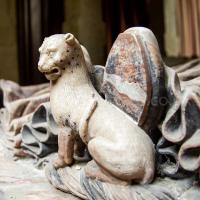
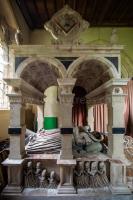
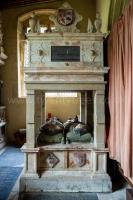
After 31st October 1612. Church of St Peter and St Paul, Easton Maudit [Map]. Monument to Christopher Yelverton (deceased) and Margaret Catesby was buried at Church of St Peter and St Paul, Easton Maudit [Map]. Early canopied Stuart Hooded Monument with eight daughters shown on one side, four sons on the other. The posts support a canopy of two semicircular arches with coffered soffits, urn ornaments at the angles, and shields of arms.
Christopher Yelverton: In 1536 he was born to William Yelverton and Amy Fermor. Before 29th June 1566 Christopher Yelverton and Margaret Catesby were married. On 24th November 1597 he was appointed Speaker of the House of Commons. On 31st October 1612 Christopher Yelverton died at his seventy room house in Easton Maudit.
Margaret Catesby: In 1543 she was born to Thomas Catesby of Whiston. In 1611 Margaret Catesby died.
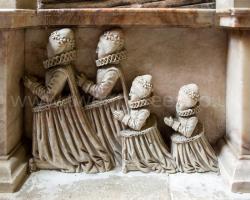
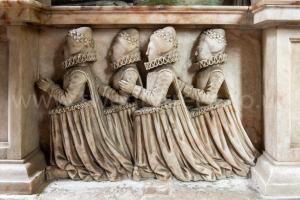
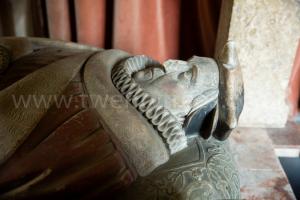
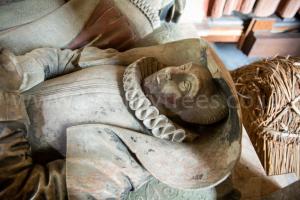
Letters of the Court of James I 1618. 31st October 1618. London. John Chamberlain (age 65), Esq., to Sir Dudley Carleton (age 45).
I remember, that in my last letter, I said that Sir Walter Raleigh (age 64) was not secure. But now he is past all peradventure; for, upon Thursday morning [29th October 1618], he was be-headed, in the old Palace at Westminster, 'twixt the Parliament House and the church. On Wednesday, he was brought from the Tower to the King's Bench bar, as they say, the manner is when a man lives above a year and a day after he is condemned; and there demanded what he could say for himself, why the sentence pronounced against him at Winchester should not be put in execution. The sum of his answer was, that the king had employed him in his service, and given him a commission, wherein he styled him "his loyal subject;" and withal given him potestatem vitæ et mortis [the power of life and death]; which did amount to a pardon. For in all reason he must be master of his own life, that hath power over other men's. The judges replied, that there is no pardon for treason by implication. Wherefore, he must find a better plea, or undergo the sentence. Thus he spoke of his trial at Winchester, and avowed that all, or the far greater part of those that were present, did acquit him in their consciences; and that the king's gracious forbearing him so long, and, but for this late accident, longer would have done, even to a hundred years, if nature could have drawn out his life so long, did show that his majesty approved his innocence. But, in conclusion, he was willed to prepare himself, and so was delivered to the sheriffs of London, and conveyed to the Gatehouse, where he spent the rest of that day in writing letters to the king, and others, and in prayer with the Dean of Westminster, who came the next morning at five o'clock, and ministered to him the communion; and, when he had broken his fast, about eight o'clock, came to the scaffold, where he found the Earls of Arundel, Oxford, Northampton, the Lord of Doncaster, and divers others. He made a speech of more than half an hour, wherein he cleared himself of having any intelligence with France, which had been objected to him, more than to save his life, and hide himself from the king's indignation. Then, that he never said any ill intent words towards his majesty, not so much as in thought. That he had no other pretence, nor end in his last voyage, than the enriching of the king, the realm, himself, and his followers. That he never had any undutiful speech concerning his majesty with the runagate French physician, nor ever offered to Sir Lewis Stukely £10,000 to go with him into France, nor told him that the Lord Arran had given him advice to be gone; and that he and the Lord of Doncaster would maintain him in France, of which points he had been accused by them. And, though he protested not only to forgive them, but to pray God to forgive them, yet he thought fit to give men warning of such persons. To all this, and much more, he took God, so often, and so solemnly to witness, that he was believed of all that heard him.
He spake somewhat of the death of the Earl of Essex, and how sorry he was for him; for though he was of a contrary faction, yet he foresaw that those who esteemed him then in that respect, yet would cast him off, as they did afterwards. He confessed himself the greatest sinner that he knew; and no marvel, as having been a soldier, a seaman, and a courtier. He excused the disfiguring of himself, by the example of David, who feigned himself mad, to avoid danger, and never heard it imputed to him for a sin. In conclusion, he spake and behaved himself so, without any show of fear or affectation, that he moved much commiseration; and all that saw him confessed that his end was, as far as man can discern, every way perfect.
It will not be amiss to set down some few passages, of divers that I have heard. The morning that he went to execution, there was a cup of excellent sack brought him, and, being asked how he liked it, "As the fellow,"said he, " that, drinking of St. Giles's bowl, as he went to Tyburn, said, that was good drink if a man might tarry by it." As he went from Westminster Hall to the Gatehouse, he spied Sir Hugh Beeston in the throng, and, calling to him, prayed he would see him die to-morrow. Sir Hugh, to make sure work, got a letter from Secretary Lake to the sheriffs, to see him placed conveniently; and meeting them, as they came near to the scaffold, delivered his letter, but the latter, by mishap, had left his spectacles at home, and put the letter in his pocket. In the mean time, Sir Hugh being thrust by, Sir Walter bade him farewell, and said, "I know not what shift you will make, but I am sure to have a place." When the hangman asked his forgiveness, he desired to see the axe; and, feeling the edge, he said, that was a sharp medicine, to cure him of all his diseases and miseries. When he was laid down, some found fault that his face was westward, and would have him turned. Whereupon, rising, he said, "It was no great matter which way a man's head stood, so his heart lay right." He had given order to the executioner, that, after some short meditation, when he stretched forth his hands, he should despatch him; ´after once or twice putting forth his hands, the fellow, out of timorousness (or what other cause), forbearing, he was fain to bid him strike, and so, at two blows, he took off his head, though he stirred not a whit after the first. The people were much affected at the sight, insomuch that one was heard to say, that we had not such another head to cut off. Another wished the head and brains to be upon S. N.'s shoulders.
There was great means made for his life; and I hear the queen (age 43) wrote very earnestly to the king, as he tendered her health, to spare him, for that she had received great good by his receipts. I hear not so much of her recovery of late, as when I wrote last, but rather that she goes peggiorando1, insomuch that it is doubted whether the king will come hither to-day from Theobalds, or go direct to Hampton Court, where she lies.
peggiorando i.e. getting worse.


On 31st October 1620 John Evelyn was born to Richard Evelyn of Wotton (age 33) and Eleanor Stansfield (age 21). He married before 10th September 1647 Mary Browne, daughter of Richard Browne 1st Baronet and Elizabeth Prettyman, and had issue.


On 31st October 1627 Isabella Maria Theresa Habsburg Spain was born to Philip IV King Spain (age 22) and Elisabeth Bourbon Queen Consort Spain (age 24). Coefficient of inbreeding 4.39%. He died aged less than one years old.


On 31st October 1640 Archbishop Richard Neale (age 78) died.
Abbot John Whethamstede’s Chronicle of the Abbey of St Albans
Abbot John Whethamstede's Register aka Chronicle of his second term at the Abbey of St Albans, 1451-1461, is a remarkable text that describes his first-hand experience of the beginning of the Wars of the Roses including the First and Second Battles of St Albans, 1455 and 1461, respectively, their cause, and their consequences, not least on the Abbey itself. His text also includes Loveday, Blore Heath, Northampton, the Act of Accord, Wakefield, and Towton, and ends with the Coronation of King Edward IV. In addition to the events of the Wars of the Roses, Abbot John, or his scribes who wrote the Chronicle, include details in the life of the Abbey such as charters, letters, land exchanges, visits by legates, and disputes, which provide a rich insight into the day-to-day life of the Abbey, and the challenges faced by its Abbot.
Available at Amazon in eBook and Paperback format.
Samuel Pepys' Diary. 31st October 1660. Office day. Much troubled all this morning in my mind about the business of my walk on the leads. I spoke of it to the Comptroller and the rest of the principal officers, who are all unwilling to meddle in anything that may anger my Lady Davis. And so I am fain to give over for the time that she do continue therein. Dined at home, and after dinner to Westminster Hall [Map], where I met with Billing (age 37) the quaker at Mrs. Michell's shop, who is still of the former opinion he was of against the clergymen of all sorts, and a cunning fellow I find him to be. Home, and there I had news that Sir W. Pen (age 39) is resolved to ride to Sir W. Batten's (age 59) country house to-morrow, and would have me go with him, so I sat up late, getting together my things to ride in, and was fain to cut an old pair of boots to make leathers for those I was to wear. This month I conclude with my mind very heavy for the loss of the leads, as also for the greatness of my late expenses, insomuch that I do not think that I have above £150 clear money in the world, but I have, I believe, got a great deal of good household stuff: I hear to-day that the Queen (age 50) is landed at Dover, and will be here on Friday next, November 2nd. my wife has been so ill of late of her old pain that I have not known her this fortnight almost, which is a pain to me.


Samuel Pepys' Diary. 31st October 1662. I am now also busy in a discovery for my Lord Sandwich (age 37) and Sir H. Bennett (age 44) by Mr. Wade's means of some of Baxter's [Barkstead] money hid in one of his cellars in the Tower. If we get it it may be I may be 10 or £20 the better for it. I thank God I have no crosses, but only much business to trouble my mind with. In all other things as happy a man as any in the world, for the whole world seems to smile upon me, and if my house were done that I could diligently follow my business, I would not doubt to do God, and the King (age 32), and myself good service.


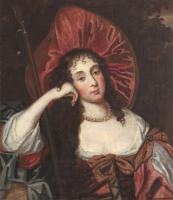
Samuel Pepys' Diary. 31st October 1662. And all I do impute almost wholly to my late temperance, since my making of my vowes against wine and plays, which keeps me most happily and contentfully to my business; which God continue! Public matters are full of discontent, what with the sale of Dunkirk, and my Baroness Castlemaine's (age 21), and her faction at Court; though I know not what they would have more than to debauch the King (age 32), whom God preserve from it! And then great plots are talked to be discovered, and all the prisons in town full of ordinary people, taken from their meeting-places last. Sunday. But for certain some plots there hath been, though not brought to a head.




Samuel Pepys' Diary. 31st October 1663. The Queene (age 53) continues lightheaded, but in hopes to recover. The plague is much in Amsterdam, and we in fears of it here, which God defend1. The Turke goes on mightily in the Emperor's dominions, and the Princes cannot agree among themselves how to go against him. Myself in pretty good health now, after being ill this month for a week together, but cannot yet come to.... well, being so costive, but for this month almost I have not had a good natural stool, but to this hour am forced to take physic every night, which brings me neither but one stool, and that in the morning as soon as I am up, all the rest of the day very costive. My father has been very ill in the country, but I hope better again now. I am lately come to a conclusion with Tom Trice to pay him £100, which is a great deale of money, but I hope it will save a great deale more. But thus everything lessens, which I have and am like to have, and therefore I must look about me to get something more than just my salary, or else I may resolve to live well and die a beggar.
Note 1. Defend is used in the sense of forbid. It is a Gallicism from the French "defendre"..
Samuel Pepys' Diary. 31st October 1665. Thus we end the month merrily; and the more for that, after some fears that the plague would have increased again this week, I hear for certain that there is above 400 [less], the whole number being 1,388, and of them of the plague, 1,031. Want of money in the Navy puts everything out of order. Men grow mutinous; and nobody here to mind the business of the Navy but myself. At least Sir W. Batten (age 64) for the few days he has been here do nothing. I in great hopes of my place of Surveyor-Generall of the Victualling, which will bring me £300 per annum.
Samuel Pepys' Diary. 31st October 1664. Very busy all the morning, at noon Creed to me and dined with me, and then he and I to White Hall, there to a Committee of Tangier, where it is worth remembering when Mr. Coventry (age 36) proposed the retrenching some of the charge of the horse, the first word asked by the Duke of Albemarle (age 55) was, "Let us see who commands them", there being three troops. One of them he calls to mind was by Sir Toby Bridges. "Oh!" says he, "there is a very good man. If you must reform1 two of them, be sure let him command the troop that is left".
Note 1. Reform, i.e. disband. See "Memoirs of Sir John Reresby", September 2nd, 1651. "A great many younger brothers and reformed officers of the King's army depended upon him for their meat and drink". So reformado, a discharged or disbanded officer.-M. B.


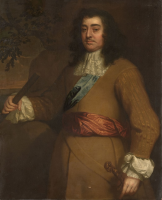
Samuel Pepys' Diary. 31st October 1666. The Prince and Duke of Albemarle (age 57) have got no great credit by this year's service. Our losses both of reputation and ships having been greater than is thought have ever been suffered in all ages put together before; being beat home, and fleeing home the first fight, and then losing so many ships then and since upon the sands, and some falling into the enemy's hands, and not one taken this yeare, but the Ruby, French prize, now at the end of the yeare, by the Frenchmen's mistake in running upon us. Great folly in both Houses of Parliament, several persons falling together by the eares, among others in the House of Lords, the Duke of Buckingham (age 38) and my Lord Ossory (age 32). Such is our case, that every body fears an invasion the next yeare; and for my part, I do methinks foresee great unhappiness coming upon us, and do provide for it by laying by something against a rainy day, dividing what I have, and laying it in several places, but with all faithfulness to the King (age 36) in all respects; my grief only being that the King do not look after his business himself, and thereby will be undone both himself and his nation, it being not yet, I believe, too late if he would apply himself to it, to save all, and conquer the Dutch; but while he and the Duke of York (age 33) mind their pleasure, as they do and nothing else, we must be beaten. So late with my mind in good condition of quiet after the settling all my accounts, and to bed.


John Evelyn's Diary. 31st October 1666. I heard the signal cause of my Lord Cleveland (age 75) pleaded before the House of Lords; and was this day forty-six years of age, wonderfully protected by the mercies of God, for which I render him immortal thanks.
Samuel Pepys' Diary. 31st October 1667. Up, and all the morning at the office, and at noon Mr. Creed and Yeabsly dined with me (my wife gone to dine with Mrs. Pierce and see a play with her), and after dinner in comes Mr. Turner, of Eynsbury, lately come to town, and also after him Captain Hill of the "Coventry", who lost her at Barbadoes, and is come out of France, where he hath been long prisoner. After a great deal of mixed discourse, and then Mr. Turner and I alone a little in my closet, talking about my Lord Sandwich (age 42) (who I hear is now ordered by the King (age 37) to come home again), we all parted, and I by water, calling at Michell's, and saw and once kissed su wife, but I do think that he is jealous of her, and so she dares not stand out of his sight; so could not do more, but away by water to the Temple [Map], and there, after spending a little time in my bookseller's shop, I to Westminster; and there at the lobby do hear by Commissioner Pett (age 57), to my great amazement, that he is in worse condition than before, by the coming in of the Duke of Albemarle's (age 58) and Prince Rupert's (age 47) Narratives' this day; wherein the former do most severely lay matters upon him, so as the House this day have, I think, ordered him to the Tower again, or something like it; so that the poor man is likely to be overthrown, I doubt, right or wrong, so infinite fond they are of any thing the Duke of Albemarle says or writes to them! I did then go down, and there met with Colonel Reames and cozen Roger Pepys (age 50); and there they do tell me how the Duke of Albemarle and the Prince have laid blame on a great many, and particularly on our Office in general; and particularly for want of provision, wherein I shall come to be questioned again in that business myself; which do trouble me. But my cozen Pepys and I had much discourse alone: and he do bewail the constitution of this House, and says there is a direct caball and faction, as much as is possible between those for and those against the Chancellor (age 58), and so in other factions, that there is nothing almost done honestly and with integrity; only some few, he says, there are, that do keep out of all plots and combinations, and when their time comes will speak and see right done, if possible; and that he himself is looked upon to be a man that will be of no faction, and so they do shun to make him; and I am glad of it. He tells me that he thanks God he never knew what it was to be tempted to be a knave in his life; till he did come into the House of Commons, where there is nothing done but by passion, and faction, and private interest. Reames did tell me of a fellow last night (one Kelsy, a commander of a fire-ship, who complained for want of his money paid him) did say that he did see one of the Commissioners of the Navy bring in three waggon-loads of prize-goods into Greenwich, Kent [Map] one night; but that the House did take no notice of it, nor enquire; but this is me, and I must expect to be called to account, and answer what I did as well as I can. So thence away home, and in Holborne, going round, it being dark, I espied Sir D. Gawden's coach, and so went out of mine into his; and there had opportunity to talk of the business of victuals, which the Duke of Albemarle and Prince did complain that they were in want of the last year: but we do conclude we shall be able to show quite the contrary of that; only it troubles me that we must come to contend with these great persons, which will overrun us. So with some disquiet in my mind on this account I home, and there comes Mr. Yeabsly, and he and I to even some accounts, wherein I shall be a gainer about £200, which is a seasonable profit, for I have got nothing a great while; and he being gone, I to bed.


Samuel Pepys' Diary. 31st October 1668. Up, and at the office all the morning. At noon home to dinner with my people, and afternoon to the office again, and then to my chamber with Gibson to do more about my great answer for the Duke of York (age 35), and so at night after supper to bed well pleased with my advance thereon. This day my Lord Anglesey (age 54) was at the Office, and do seem to make nothing of this business of his suspension, resolving to bring it into the Council, where he seems not to doubt to have right, he standing upon his defence and patent, and hath put in his caveats to the several Offices: so, as soon as the King (age 38) comes back again, which will be on Tuesday next, he will bring it into the Council. So ends this month with some quiet to my mind, though not perfect, after the greatest falling out with my poor wife, and through my folly with the girl, that ever I had, and I have reason to be sorry and ashamed of it, and more to be troubled for the poor girl's sake, whom I fear I shall by this means prove the ruin of, though I shall think myself concerned both to love and be a friend to her. This day Roger Pepys (age 51) and his son Talbot (age 22), newly come to town, come and dined with me, and mighty glad I am to see them.
John Evelyn's Diary. 31st October 1675. Dined at my Lord Chamberlain's (age 57), with my son (age 20). There were the learned Isaac Vossius (age 57), and Spanhemius, son of the famous man of Heidelberg; nor was this gentleman less learned, being a general scholar. Among other pieces, he was author of an excellent treatise on Medals.
John Evelyn's Diary. 31st October 1680. I spent this whole day in exercises. A stranger preached at Whitehall [Map] on Luke xvi. 30, 31. I then went to St. Martin's [Map], where the Bishop of St. Asaph (age 53) [Note. The next post refers to Bishop William Lloyd being made Bishop of St Asaph. The previous incumbent Isaac Barrow had died 24th June 1680] preached on 1 Peter iii. 15; the Holy Communion followed, at which I participated, humbly imploring God's assistance in the great work I was entering into. In the afternoon, I heard Dr. Sprat (age 45), at St. Margaret's [Map], on Acts xvii. 11.
John Evelyn's Diary. 31st October 1680. I began and spent the whole week in examining my life, begging pardon for my faults, assistance and blessing for the future, that I might, in some sort, be prepared for the time that now drew near, and not have the great work to begin, when one can work no longer. The Lord Jesus help and assist me! I therefore stirred little abroad till the 5th of November, when I heard Dr. Tenison (age 44), the now vicar of St. Martin's [Map]; Dr. Lloyd (age 53), the former incumbent, being made Bishop of St. Asaph.
William of Worcester's Chronicle of England
William of Worcester, born around 1415, and died around 1482 was secretary to John Fastolf, the renowned soldier of the Hundred Years War, during which time he collected documents, letters, and wrote a record of events. Following their return to England in 1440 William was witness to major events. Twice in his chronicle he uses the first person: 1. when writing about the murder of Thomas, 7th Baron Scales, in 1460, he writes '… and I saw him lying naked in the cemetery near the porch of the church of St. Mary Overie in Southwark …' and 2. describing King Edward IV's entry into London in 1461 he writes '… proclaimed that all the people themselves were to recognize and acknowledge Edward as king. I was present and heard this, and immediately went down with them into the city'. William’s Chronicle is rich in detail. It is the source of much information about the Wars of the Roses, including the term 'Diabolical Marriage' to describe the marriage of Queen Elizabeth Woodville’s brother John’s marriage to Katherine, Dowager Duchess of Norfolk, he aged twenty, she sixty-five or more, and the story about a paper crown being placed in mockery on the severed head of Richard, 3rd Duke of York.
Available at Amazon in eBook and Paperback format.
John Evelyn's Diary. 31st October 1685. I din'd at our greate Lord Chancellor Jefferies (age 40), who us'd me with much respect. This was the late Chief Justice who had newly ben the Western Circuit to try the Monmouth conspirators, and had formerly don such severe justice amongst the obnoxious in Westmr Hall [Map], for which his Ma* (age 52) dignified him by creating him first a Baron, and now Lord Chancellor. He had some years past ben conversant at Deptford; is of an assur'd and undaunted spirit, and has serv'd the Court interest on all the hardiest occasions; is of nature cruel and a slave of the Court.


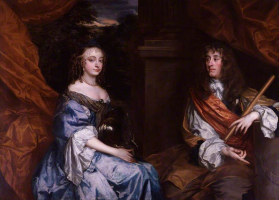


John Evelyn's Diary. 31st October 1688. My birthday, being the 68th year of my age. O blessed Lord, grant that as I grow in years, so may I improve in grace! Be thou my protector this following year, and preserve me and mine from those dangers and great confusions that threaten a sad revolution to this sinful nation! Defend thy church, our holy religion, and just laws, disposing his Majesty (age 55) to listen to sober and healing counsels, that if it be thy blessed will, we may still enjoy that happy tranquility which hitherto thou hast continued to us! Amen, Amen!
On 31st October 1732 Victor Amadeus King Sardinia (age 66) died. His son Charles (age 31) succeeded Duke Savoy, III King Sardinia. His grandson Victor (age 6) succeeded III King Sardinia.
On 31st October 1765 William Augustus Hanover 1st Duke Cumberland (age 44) died unmarried. Duke Cumberland extinct. He was buried at King Henry VII Chapel, Westminster Abbey [Map].

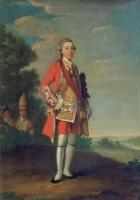
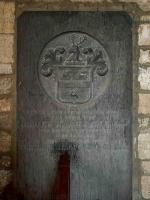
St Bartholomew's Church, Whittingham [Map]. Memorial to James Hargrave, died 31st October 1777.
On 31st October 1785 Frederick Hesse-Kassel (age 65) died. His son William (age 42) succeeded IX Landgrave Hesse Kassel. Electress Wilhelmina Caroline Oldenburg (age 38) by marriage Landgravine Hesse Kassel.


On 31st October 1795 John Keats was born.


On 31st October 1826 Eleanor Henrietta Robinson (age 11) died. She has a monument at All Saints' Church, Nocton [Map] sculpted by Richard Westmacott (age 51).
Eleanor Henrietta Robinson: On 22nd May 1815 she was born to Frederick John Robinson 1st Earl Ripon and Sarah Albinia Louisa Hobart.

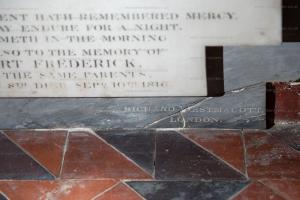
On 31st October 1838 Luis I King Portugal was born to Ferdinand Saxe Coburg Gotha King Consort Portugal (age 22) and Maria II Queen Portugal (age 41). He married 6th October 1862 Maria Pia of Savoy Queen Consort of Portugal.
On 31st October 1851 Louise of Sweden Queen Consort Denmark was born to Charles XV King Sweden IV King Norway (age 25). She married 28th July 1869 Frederick VIII King of Denmark, son of King Christian IX of Denmark and Queen Louise Hesse-Kassel of Denmark, and had issue.
On 31st October 1864 Archbishop Cosmo Gordon Lang was born.

On 31st October 1869 Richard Grosvenor 2nd Marquess Westminster (age 74) died. His son Hugh (age 44) succeeded 3rd Marquess Westminster, 4th Earl Grosvenor, 10th Baronet Grosvenor of Eaton in Cheshire. Constance Leveson-Gower Duchess Westminster (age 35) by marriage Marchioness Westminster.
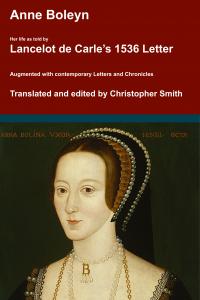
Anne Boleyn. Her Life as told by Lancelot de Carle's 1536 Letter.
In 1536, two weeks after the execution of Anne Boleyn, her brother George and four others, Lancelot du Carle, wrote an extraordinary letter that described Anne's life, and her trial and execution, to which he was a witness. This book presents a new translation of that letter, with additional material from other contemporary sources such as Letters, Hall's and Wriothesley's Chronicles, the pamphlets of Wynkyn the Worde, the Memorial of George Constantyne, the Portuguese Letter and the Baga de Secrets, all of which are provided in Appendices.
Available at Amazon in eBook and Paperback format.
On 31st October 1885 James Hamilton 1st Duke of Abercorn (age 74) died. His son James (age 47) succeeded 2nd Duke Abercorn, 3rd Marquess Abercorn, 11th Earl Abercorn.
On 31st October 1886 Unamed Hamilton was born to James Hamilton 2nd Duke of Abercorn (age 48) and Mary Anna Curzon Howe Duchess Abercorn (age 38). He died aged less than one years old.
On 31st October 1890 Gerald Leslie Brockhurst was born to Arthur Brockhurst (age 31) and Amelia Ward (age 29) at 106 Summer Road, Edgbaston. Their fourth son. He was baptised at St Thomas' Church, Birmingham on 8th February 1891. His father's trade is given as Coal Merchant. He married (1) October 1914 Anaïs Melisande Folin and had issue (2) 1947 Kathleen Woodward.

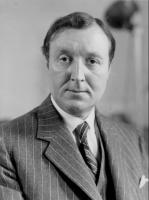
On 31st October 1899 Douglas Henry Marsham (age 28) was killed.
On 31st October 1914 Francis Lambton (age 43) was killed in action at Zandvorde.

On 31st October 1916 Carl Johan Bernadotte was born to Gustaf Adolph VI King Sweden (age 33) and Margaret "Daisy" Windsor (age 34). He a great grandson of Queen Victoria of the United Kingdom.
On 31st October 1928 Theodor Wilhelm "Tito" Wessel (age 39) and Jessie Smither aka Denise Orme Duchess Leinster (age 43) were married.
On 5th October 1936 the Jarrow March left Jarrow Town Hall, County Durham cheered on by most of the town and bearing banners announcing themselves as the "Jarrow Crusade". The marchers arrived at Marble Arch [Map], London on the 31st October 1936.
On 31st October 1945 Ignacio Zuloaga (age 75) died.

On 31st October 1961 Augustus John (age 83) died.
On 31st October 1995 Henry Percy 11th Duke of Northumberland (age 42) died from an overdose of amphetamines. He was unmarried. His brother Ralph (age 38) succeeded 12th Duke Northumberland, 9th Earl Beverley, 11th Baron Percy, 15th Baronet Smithson of Stanwick in Yorkshire.
On 31st October 1345 Ferdinand I King Portugal was born to Peter I King Portugal (age 25) and Constanza Manuel Queen Consort Castile (age 29). Coefficient of inbreeding 3.84%. He married 1371 Leonor Teles Meneses Queen Consort Portugal and had issue.
William of Worcester's Chronicle of England
William of Worcester, born around 1415, and died around 1482 was secretary to John Fastolf, the renowned soldier of the Hundred Years War, during which time he collected documents, letters, and wrote a record of events. Following their return to England in 1440 William was witness to major events. Twice in his chronicle he uses the first person: 1. when writing about the murder of Thomas, 7th Baron Scales, in 1460, he writes '… and I saw him lying naked in the cemetery near the porch of the church of St. Mary Overie in Southwark …' and 2. describing King Edward IV's entry into London in 1461 he writes '… proclaimed that all the people themselves were to recognize and acknowledge Edward as king. I was present and heard this, and immediately went down with them into the city'. William’s Chronicle is rich in detail. It is the source of much information about the Wars of the Roses, including the term 'Diabolical Marriage' to describe the marriage of Queen Elizabeth Woodville’s brother John’s marriage to Katherine, Dowager Duchess of Norfolk, he aged twenty, she sixty-five or more, and the story about a paper crown being placed in mockery on the severed head of Richard, 3rd Duke of York.
Available at Amazon in eBook and Paperback format.
On 31st October 1391 Edward "The Philosopher" I King Portugal was born to King John I of Portugal (age 39) and Philippa of Lancaster Queen Consort Portugal (age 31). He a great grandson of King Edward III of England. He married 22nd September 1428 his first cousin once removed Eleanor Trastámara Queen Consort Portugal, daughter of Ferdinand I King Aragon and Eleanor of Alberquerque Queen Consort Aragon, and had issue.
On 31st October 1596 Henry Portman 2nd Baronet was born to John Portman 1st Baronet (age 21). He married 20th July 1615 Anne Stanley, daughter of William Stanley 6th Earl of Derby and Elizabeth Vere Countess Derby.
On 31st October 1599 Denzil Holles 1st Baron Holles was born to John Holles 1st Earl de Clare (age 35) and Anne Stanhope Countess de Clare (age 23). He married (1) 1628 Dorothy Ashley and had issue (2) 1642 his sixth cousin Jane Shirley Baroness Holles (3) 1666 Esther Le Lou Baroness Holles.
On 31st October 1620 John Evelyn was born to Richard Evelyn of Wotton (age 33) and Eleanor Stansfield (age 21). He married before 10th September 1647 Mary Browne, daughter of Richard Browne 1st Baronet and Elizabeth Prettyman, and had issue.
On 31st October 1627 Isabella Maria Theresa Habsburg Spain was born to Philip IV King Spain (age 22) and Elisabeth Bourbon Queen Consort Spain (age 24). Coefficient of inbreeding 4.39%. He died aged less than one years old.
On 31st October 1664 Wilfrid Lawson 2nd Baronet was born to William Lawson and Milcah Strickland. He married in or before 1697 Elizabeth Preston and had issue.
On 31st October 1673 Frances Thynne was born to Thomas Thynne 1st Viscount Weymouth (age 33) and Frances Finch Viscountess Weymouth (age 23). She married her fifth cousin once removed Robert Worsley 4th Baronet, son of Robert Worsley 3rd Baronet and Mary Herbert Countess Gainsborough, and had issue.


On 31st October 1685 John Murray 2nd Earl Dunmore was born to Charles Murray 1st Earl Dunmore (age 24).
On 31st October 1741 John John Russell 8th Baronet was born to Charles Russell (age 40) and Mary Joanna Cutts Revett (age 34).
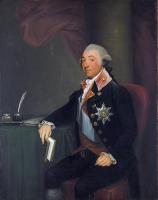
On 31st October 1763 Clotworthy Taylour aka Rowley 1st Baron Langford was born to Thomas Taylour 1st Earl of Bective (age 39) and Jane Rowley (age 29). He married January 1794 his first cousin Frances Rowley Baroness Langford and had issue.
On 31st October 1765 George Grey 6th Earl Stamford 2nd Earl Warrington was born to George Grey 5th Earl Stamford 1st Earl Warrington (age 28) and Henrietta Bentinck Countess Stamford and Warrington (age 28). He married 23rd December 1797 Henrietta Charteris Countess Stamford and Warrington and had issue.


On 31st October 1782 William Orde-Powlett 2nd Baron Bolton was born to Thomas Orde-Powlett 1st Baron Bolton (age 42) and Jean Mary Browne Powlett Baroness Bolton (age 31). He married 8th May 1810 Maria Carleton Baroness Bolton, daughter of Guy Carleton 1st Baron Dorchester and Maria Howard Baroness Dorchester.
Chronicle of Geoffrey le Baker of Swinbroke
Baker was a secular clerk from Swinbroke, now Swinbrook, an Oxfordshire village two miles east of Burford. His Chronicle describes the events of the period 1303-1356: Gaveston, Bannockburn, Boroughbridge, the murder of King Edward II, the Scottish Wars, Sluys, Crécy, the Black Death, Winchelsea and Poitiers. To quote Herbert Bruce 'it possesses a vigorous and characteristic style, and its value for particular events between 1303 and 1356 has been recognised by its editor and by subsequent writers'. The book provides remarkable detail about the events it describes. Baker's text has been augmented with hundreds of notes, including extracts from other contemporary chronicles, such as the Annales Londonienses, Annales Paulini, Murimuth, Lanercost, Avesbury, Guisborough and Froissart to enrich the reader's understanding. The translation takes as its source the 'Chronicon Galfridi le Baker de Swynebroke' published in 1889, edited by Edward Maunde Thompson.
Available at Amazon in eBook and Paperback format.
On 31st October 1785 Anastasia Blake was born to Joseph Blake 1st Baron Wallscourt (age 20) and Louisa Bermingham (age 21). She married 6th January 1803 Luke Dillon 2nd Baron Clonbrook, son of Robert Dillon 1st Baron Clonbrook, and had issue.
On 31st October 1795 John Keats was born.
On 31st October 1814 Catherine Herbert Countess Dunmore was born to George Augustus Herbert 11th Earl Pembroke 8th Earl Montgomery (age 55) and Yekaterina Semyonovna Vorontsova Countess Pembroke and Montgomery (age 30). She married 27th September 1836 Alexander Murray 6th Earl Dunmore, son of George Murray 5th Earl Dunmore and Susan Hamilton Countess Dunmore, and had issue.
On 31st October 1838 Luis I King Portugal was born to Ferdinand Saxe Coburg Gotha King Consort Portugal (age 22) and Maria II Queen Portugal (age 41). He married 6th October 1862 Maria Pia of Savoy Queen Consort of Portugal.
On 31st October 1851 Louise of Sweden Queen Consort Denmark was born to Charles XV King Sweden IV King Norway (age 25). She married 28th July 1869 Frederick VIII King of Denmark, son of King Christian IX of Denmark and Queen Louise Hesse-Kassel of Denmark, and had issue.
On 31st October 1853 Lewis William Molesworth 11th Baronet was born to Paul William Molesworth 10th Baronet (age 32) and Jane Frances Booker Lady Molesworth.
On 31st October 1854 Kathleen Susan Emma Bligh was born to John Stuart Bligh 6th Earl Darnley (age 27) and Harriet Mary Pelham Countess Darnley (age 25).
On 31st October 1859 Charles Gunning 7th Baronet was born to George Gunning 5th Baronet (age 31). He married 17th October 1888 Ethel Finch-Hatton Lady Gunning.
On 31st October 1864 Archbishop Cosmo Gordon Lang was born.
On 31st October 1871 Douglas Henry Marsham was born to Charles Marsham 4th Earl Romney (age 30) and Frances Augusta Constance Muir Rawdon-Hastings Countess Romney (age 27).
On 31st October 1877 Lilian Strutt was born to Henry Strutt 2nd Baron Belper (age 37) and Margaret Coke Baroness Belper (age 25). She married 10th January 1901 Vernon Austen Malcolmson.
On 31st October 1886 Unamed Hamilton was born to James Hamilton 2nd Duke of Abercorn (age 48) and Mary Anna Curzon Howe Duchess Abercorn (age 38). He died aged less than one years old.
On 31st October 1890 Gerald Leslie Brockhurst was born to Arthur Brockhurst (age 31) and Amelia Ward (age 29) at 106 Summer Road, Edgbaston. Their fourth son. He was baptised at St Thomas' Church, Birmingham on 8th February 1891. His father's trade is given as Coal Merchant. He married (1) October 1914 Anaïs Melisande Folin and had issue (2) 1947 Kathleen Woodward.
On 31st October 1903 Gyles Isham 12th Baronet was born to Vere Isham 11th Baronet (age 41) at Lamport, Northamptonshire.
Abbot John Whethamstede’s Chronicle of the Abbey of St Albans
Abbot John Whethamstede's Register aka Chronicle of his second term at the Abbey of St Albans, 1451-1461, is a remarkable text that describes his first-hand experience of the beginning of the Wars of the Roses including the First and Second Battles of St Albans, 1455 and 1461, respectively, their cause, and their consequences, not least on the Abbey itself. His text also includes Loveday, Blore Heath, Northampton, the Act of Accord, Wakefield, and Towton, and ends with the Coronation of King Edward IV. In addition to the events of the Wars of the Roses, Abbot John, or his scribes who wrote the Chronicle, include details in the life of the Abbey such as charters, letters, land exchanges, visits by legates, and disputes, which provide a rich insight into the day-to-day life of the Abbey, and the challenges faced by its Abbot.
Available at Amazon in eBook and Paperback format.
On 31st October 1908 Captain Heneage Michael Charles Finch 9th Earl of Aylesford was born to Heneage Greville Finch (age 25) and Gladys Cecil Georgina Fellowes (age 23). He married 18th April 1940 Pamela Elizabeth Coventry Countess of Aylesford.
On 31st October 1910 Nathaniel Mayer Victor Rothschild 3rd Baron Rothschild was born to Nathaniel Charles Rothschild (age 33).
On 31st October 1916 Carl Johan Bernadotte was born to Gustaf Adolph VI King Sweden (age 33) and Margaret "Daisy" Windsor (age 34). He a great grandson of Queen Victoria of the United Kingdom.
On 31st October 1917 Walter Edward Alpin Blount 12th Baronet was born to Edward Robert Blount 11th Baronet (age 32).
On 31st October 1919 George Hugh Boscawen 9th Viscount Falmouth was born to Evelyn Hugh Boscawen 8th Viscount Falmouth (age 32) and Mary Margaret Desiree Meynell Viscountess Falmouth (age 25).
On 31st October 1921 George Hardinge 3rd Baron Hardinge was born to Alec Hardinge 2nd Baron Hardinge (age 27) and Helen Mary (age 20). He married 1944 his third cousin Janet Balfour Baroness Hardinge and had issue.
On 31st October 1597 John Wallace 13th of Craigie (age 44) and Elizabeth Douglas Countess Morton were married. The date being only some twenty-five days after the death of her previous husband Alexander Stewart 6th of Garlies (deceased)? She the daughter of David Douglas 7th Earl Angus and Margaret Hamilton Countess Angus.
On 31st October 1732 Hercules Langford Rowley Viscount Langford (age 18) and Elizabeth Rowley 1st Viscountess Langford (age 19) were married. He by marriage Viscount Langford of Longford Lodge.
On 31st October 1733 John Leveson-Gower 1st Earl Gower (age 39) and Penelope Stonhouse Baroness Gower (age 28) were married. She by marriage Baroness Gower.
On 31st October 1735 Ludovic Grant 7th Baronet (age 28) and Margaret Ogilvy were married. She the daughter of James Ogilvy 5th Earl Findlater 2nd Earl Seafield (age 46) and Elizabeth Hay.
Annals of the six Kings of England by Nicholas Trivet
Translation of the Annals of the Six Kings of England by that traces the rise and rule of the Angevin aka Plantagenet dynasty from the mid-12th to early 14th century. Written by the Dominican scholar Nicholas Trivet, the work offers a vivid account of English history from the reign of King Stephen through to the death of King Edward I, blending political narrative with moral reflection. Covering the reigns of six monarchs—from Stephen to Edward I—the chronicle explores royal authority, rebellion, war, and the shifting balance between crown, church, and nobility. Trivet provides detailed insight into defining moments such as baronial conflicts, Anglo-French rivalry, and the consolidation of royal power under Edward I, whose reign he describes with particular immediacy. The Annals combines careful year-by-year reporting with thoughtful interpretation, presenting history not merely as a sequence of events but as a moral and political lesson. Ideal for readers interested in medieval history, kingship, and the origins of the English state, this chronicle remains a valuable and accessible window into the turbulent world of the Plantagenet kings.
Available at Amazon in eBook and Paperback format.
On 31st October 1772 Lucas Pepys 1st Baronet (age 30) and Jane Elizabeth Leslie 12th Countess of Rothes (age 22) were married. She the daughter of John Leslie 10th Earl Rothes and Hannah Cole Countess Rothes.
On 31st October 1787 George Shiffner 1st Baronet (age 24) and Mary Bridger were married. They had four sons and four daughters.
On 31st October 1928 Theodor Wilhelm "Tito" Wessel (age 39) and Jessie Smither aka Denise Orme Duchess Leinster (age 43) were married.
On 31st October 1931 Edward Vane-Tempest-Stewart 8th Marquess of Londonderry (age 28) and Romaine Combe were married at St Martin in the Fields Church [Map]. He the son of Charles Vane-Tempest-Stewart 7th Marquess of Londonderry (age 53) and Edith Chaplin Marchioness Londonderry (age 52).
On 31st October 1948 Michael Henry Croft 2nd Baron Croft (age 32) and Antoinette Fredericka Conyngham Baroness Croft (age 25) were married. She by marriage Baroness Croft of Bournemouth in Hampshire. She the daughter of Frederick William Conyngham 6th Marquess Conyngham (age 58).
On 31st October 1952 Sacheverell Reresby Sitwell 7th Baronet (age 25) and Penelope Forbes (age 29) were married.
On 31st October 1953 Charles John Wilson 3rd Baron Nunburnholme (age 49) and Alex Hockley Baroness Nunburnholme were married. She by marriage Baroness Nunburnholme.
On 31st October 1147 Robert Normandy 1st Earl Gloucester (age 48) died. His son William succeeded 2nd Earl Gloucester.
On 31st October 1214 Eleanor Plantagenet Queen Consort Castile (age 53) died at Burgos [Map]. She was buried at Abbey of Santa Maria la Real de Huelgas [Map].
On 31st October 1354 William Clinton 1st Earl Huntingdon (age 50) died. Earl Huntingdon extinct.
On 31st October 1534 Alfonso Este I Duke Ferrara, Modena and Reggio (age 58) died. His son Ercole (age 26) succeeded II Duke Ferrara. Renée of France Duchess of Ferrara (age 24) by marriage Duchess Ferrara.
On 31st October 1537 Thomas Howard (age 26) died at the Tower of London [Map]. His body was released to his mother Agnes Tilney Duchess Norfolk (age 60). He was buried at Thetford Priory, Norfolk [Map].
Henrici Quinti, Angliæ Regis, Gesta, is a first-hand account of the Agincourt Campaign, and subsequent events to his death in 1422. The author of the first part was a Chaplain in King Henry's retinue who was present from King Henry's departure at Southampton in 1415, at the siege of Harfleur, the battle of Agincourt, and the celebrations on King Henry's return to London. The second part, by another writer, relates the events that took place including the negotiations at Troye, Henry's marriage and his death in 1422.
Available at Amazon in eBook and Paperback format.
On 31st October 1563 Bishop Anthony Kitchin (age 92) died.
On 31st October 1605 Dorothy Braye Baroness Chandos and Knollys (age 81) died.
On 31st October 1640 Archbishop Richard Neale (age 78) died.

On 31st October 1660 Thomas Wilbraham 2nd Baronet (age 59) died. See monument at Action, Cheshire [Map]. His son Thomas (age 30) succeeded 3rd Baronet Wilbraham of Woodhey in Cheshire. Elizabeth Mytton Lady Wilbrahim (age 29) by marriage Lady Wilbraham of Woodhey in Cheshire.
On 31st October 1700 Robert Napier 1st Baronet (age 58) died. His son Charles (age 27) succeeded 2nd Baronet Napier of Punknoll.
On 31st October 1706 Thomas Dyke 1st Baronet (age 56) died. His son Thomas (age 10) succeeded 2nd Baronet Dyke of Horeham in Sussex.
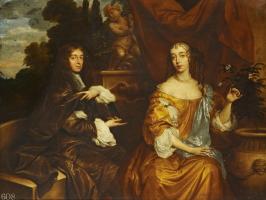
On 31st October 1709 Henry Hyde 2nd Earl Clarendon died. His son Edward (age 47) succeeded 3rd Earl Clarendon, 3rd Baron Hyde of Hindon in Wiltshire 1660.
On 31st October 1732 Victor Amadeus King Sardinia (age 66) died. His son Charles (age 31) succeeded Duke Savoy, III King Sardinia. His grandson Victor (age 6) succeeded III King Sardinia.

On 31st October 1734 William North 6th Baron North (age 55) died in Madrid [Map]. His first cousin once removed Francis (age 30) succeeded 7th Baron North.
On 31st October 1765 William Augustus Hanover 1st Duke Cumberland (age 44) died unmarried. Duke Cumberland extinct. He was buried at King Henry VII Chapel, Westminster Abbey [Map].
The Deeds of the Dukes of Normandy
The Gesta Normannorum Ducum [The Deeds of the Dukes of Normandy] is a landmark medieval chronicle tracing the rise and fall of the Norman dynasty from its early roots through the pivotal events surrounding the Norman Conquest of England. Originally penned in Latin by the monk William of Jumièges shortly before 1060 and later expanded at the behest of William the Conqueror, the work chronicles the deeds, politics, battles, and leadership of the Norman dukes, especially William’s own claim to the English throne. The narrative combines earlier historical sources with firsthand information and oral testimony to present an authoritative account of Normandy’s transformation from a Viking settlement into one of medieval Europe’s most powerful realms. William’s history emphasizes the legitimacy, military prowess, and governance of the Norman line, framing their expansion, including the conquest of England, as both divinely sanctioned and noble in purpose. Later chroniclers such as Orderic Vitalis and Robert of Torigni continued the history, extending the coverage into the 12th century, providing broader context on ducal rule and its impact. Today this classic work remains a foundational source for understanding Norman identity, medieval statesmanship, and the historical forces that reshaped England and Western Europe between 800AD and 1100AD.
Available at Amazon in eBook and Paperback format.

On 31st October 1766 Edward Turner 2nd Baronet (age 47) died. His son Gregory (age 18) succeeded 3rd Baronet Turner of Ambrosden in Oxfordshire.
On 31st October 1766 Nicholas Hume-Loftus 1st Earl of Ely (age 58) died. His son Nicholas (age 28) succeeded 2nd Earl of Ely in Wicklow, 3rd Viscount Loftus of Ely, 3rd Baron Loftus of Loftus Hall in Wexford.
On 31st October 1771 John Rous 5th Baronet (age 44) died. His son John (age 21) succeeded 6th Baronet Stradbrooke of Henham in Suffolk.

On 31st October 1774 Edward Noel 1st Viscount Wentworth (age 59) died. His son Thomas (age 28) succeeded 2nd Viscount Wentworth, 10th Baron Wentworth. His son Thomas de jure 14th Baron Despencer, 7th Baronet Noel.
On 31st October 1778 Thomas Cochrane 8th Earl of Dundonald (age 87) died. His son Archibald (age 30) succeeded 9th Earl Dundonald.
On 31st October 1783 John Spencer 1st Earl Spencer (age 48) died at Bath, Somerset [Map]. He was buried at St Mary the Virgin Church, Great Brington, Northamptonshire. His son George (age 25) succeeded 2nd Earl Spencer, 2nd Viscount Althorp, 2nd Viscount Spencer, 2nd Baron Spencer Althorp. Lavinia Bingham Countess Spencer (age 21) by marriage Countess Spencer.


On 31st October 1785 Frederick Hesse-Kassel (age 65) died. His son William (age 42) succeeded IX Landgrave Hesse Kassel. Electress Wilhelmina Caroline Oldenburg (age 38) by marriage Landgravine Hesse Kassel.
On 31st October 1803 Walter Blount 7th Baronet (age 35) died. His son Edward (age 8) succeeded 8th Baronet Blount of Sodington.
On 31st October 1826 Eleanor Henrietta Robinson (age 11) died. She has a monument at All Saints' Church, Nocton [Map] sculpted by Richard Westmacott (age 51).
Eleanor Henrietta Robinson: On 22nd May 1815 she was born to Frederick John Robinson 1st Earl Ripon and Sarah Albinia Louisa Hobart.
On 31st October 1830 Henry Darrell Carew 7th Baronet (age 51) died. His son Walter (age 23) succeeded 8th Baronet Carew of Haccombe in Devon. He was buried at St Blaise's Church, Haccombe where there is a monument with the inscription: "Hic jacet in crypta aborum sepultus Henricus Carew Baronettus qui obiit XXXI die Octobris anno d(omi)ni MDCCCXXX (a)etatis su(a)e LI. Hic etiam cum marito jacet Domina Elizabetha Carew Gualteri Palk de Marley armigeri filia haeresque quae obiit VII die Martis (sic) anno d(omi)ni MDCCCLXII aetatis suae LXXVI" translated as "Here lies buried in the crypt..... Henry Carew, Baronet, who died on the 31st day of October in the year of our Lord 1830 (in the year) of his age 51. Here also with her husband lies Lady Elizabeth Carew, daughter and heiress of Walter Palk of Marley, Esquire, who died on the 7th day of March in the year of our Lord 1862 (in the year) of her age 76".
Annals of the six Kings of England by Nicholas Trivet
Translation of the Annals of the Six Kings of England by that traces the rise and rule of the Angevin aka Plantagenet dynasty from the mid-12th to early 14th century. Written by the Dominican scholar Nicholas Trivet, the work offers a vivid account of English history from the reign of King Stephen through to the death of King Edward I, blending political narrative with moral reflection. Covering the reigns of six monarchs—from Stephen to Edward I—the chronicle explores royal authority, rebellion, war, and the shifting balance between crown, church, and nobility. Trivet provides detailed insight into defining moments such as baronial conflicts, Anglo-French rivalry, and the consolidation of royal power under Edward I, whose reign he describes with particular immediacy. The Annals combines careful year-by-year reporting with thoughtful interpretation, presenting history not merely as a sequence of events but as a moral and political lesson. Ideal for readers interested in medieval history, kingship, and the origins of the English state, this chronicle remains a valuable and accessible window into the turbulent world of the Plantagenet kings.
Available at Amazon in eBook and Paperback format.
On 31st October 1853 Valentine Browne 2nd Earl of Kenmare (age 65) died. His brother Thomas (age 64) succeeded 3rd Earl Kenmare, 3rd Viscount Kenmare.
On 31st October 1860 Thomas Cochrane 10th Earl Dundonald (age 84) died.
On 31st October 1869 Richard Grosvenor 2nd Marquess Westminster (age 74) died. His son Hugh (age 44) succeeded 3rd Marquess Westminster, 4th Earl Grosvenor, 10th Baronet Grosvenor of Eaton in Cheshire. Constance Leveson-Gower Duchess Westminster (age 35) by marriage Marchioness Westminster.
On 31st October 1871 Maria Augusta Windham Countess Listowel (age 66) died.
On 31st October 1885 James Hamilton 1st Duke of Abercorn (age 74) died. His son James (age 47) succeeded 2nd Duke Abercorn, 3rd Marquess Abercorn, 11th Earl Abercorn.
On 31st October 1891 Anne Clegg Viscoutess Hill (age 76) died.
On 31st October 1899 Edward Pellew 4th Viscount Exmouth (age 38) died. His son Edward (age 8) succeeded 5th Viscount Exmouth, 5th Baron Exmouth of Canonteign, 5th Baronet Pellew of Treverry in Cornwall.
On 31st October 1899 Hedworth Jolliffe 2nd Baron Hylton (age 70) died. His son Hylton (age 36) succeeded 3rd Baron Hylton of Hylton in County Durham. Alice Adeliza Hervey Baroness Hylton (age 25) by marriage Baroness Hylton of Hylton in County Durham.
On 31st October 1900 Edward Bligh 7th Earl Darnley (age 49) died. His brother Ivo (age 41) succeeded 8th Earl Darnley. Florence Bligh Countess of Darnley (age 40) by marriage Countess Darnley. His daughter Elizabeth succeeded 17th Baroness Clifton of Leighton Bromswold in Huntingdonshire.
On 31st October 1928 Mary Eleanor Coventry Countess Suffolk and Berkshire (age 81) died.
On 31st October 1929 Elizabeth Margaret Denman Lady Milbanke died.
Annals of the six Kings of England by Nicholas Trivet
Translation of the Annals of the Six Kings of England by that traces the rise and rule of the Angevin aka Plantagenet dynasty from the mid-12th to early 14th century. Written by the Dominican scholar Nicholas Trivet, the work offers a vivid account of English history from the reign of King Stephen through to the death of King Edward I, blending political narrative with moral reflection. Covering the reigns of six monarchs—from Stephen to Edward I—the chronicle explores royal authority, rebellion, war, and the shifting balance between crown, church, and nobility. Trivet provides detailed insight into defining moments such as baronial conflicts, Anglo-French rivalry, and the consolidation of royal power under Edward I, whose reign he describes with particular immediacy. The Annals combines careful year-by-year reporting with thoughtful interpretation, presenting history not merely as a sequence of events but as a moral and political lesson. Ideal for readers interested in medieval history, kingship, and the origins of the English state, this chronicle remains a valuable and accessible window into the turbulent world of the Plantagenet kings.
Available at Amazon in eBook and Paperback format.
On 31st October 1945 Ignacio Zuloaga (age 75) died.
On 31st October 1945 William Hudleston le Fleming 9th Baronet (age 84) died. His son Frank (age 56) succeeded 10th Baronet Fleming of Rydal in Cumbria.
On 31st October 1954 David John Colville 1st Baron Clydesmuir (age 60) died. His son Ronald (age 37) succeeded 2nd Baron CLydesmuir of Braidwood in Lanarkshire.
On 31st October 1954 Mary Frances Neville Marchioness Abergavenny (age 85) died.
On 31st October 1961 Augustus John (age 83) died.
On 31st October 1967 Conyngham Denison 7th Baron Londesborough (age 82) died. His first cousin John (age 66) succeeded 8th Baron Londesborough of Londesborough in the East Riding of Yorkshire.
On 31st October 1995 Henry Percy 11th Duke of Northumberland (age 42) died from an overdose of amphetamines. He was unmarried. His brother Ralph (age 38) succeeded 12th Duke Northumberland, 9th Earl Beverley, 11th Baron Percy, 15th Baronet Smithson of Stanwick in Yorkshire.
On 31st October 1995 Arthur Ramsey Hogg 7th Baronet (age 99) died. His son Michael (age 70) succeeded 8th Baronet Hogg of Upper Grosvenor Street in London. Elizabeth Anne Thérèse Falkiner Lady Hogg (age 65) by marriage Lady Hogg of Upper Grosvenor Street in London.
On 31st October 1996 Granville James Leveson-Gower 5th Earl Granville (age 77) died. His son Fergus (age 37) succeeded 6th Earl Granville, 6th Viscount Granville.