


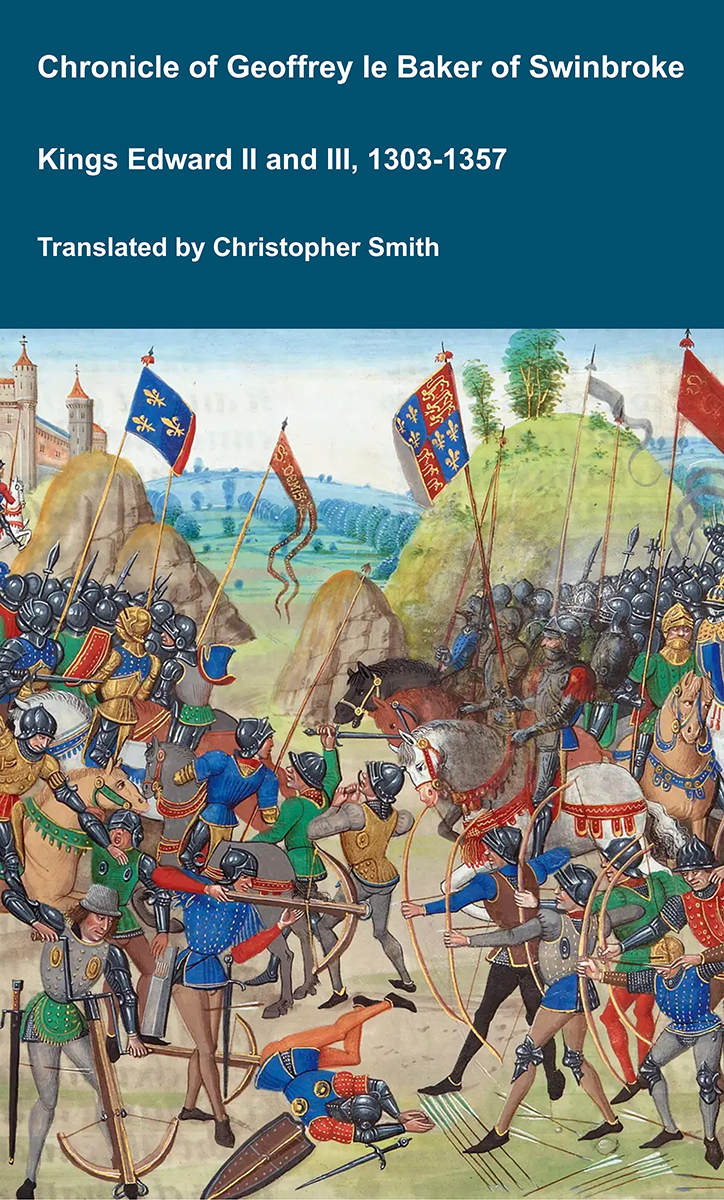
Chronicle of Geoffrey le Baker of Swinbroke
Baker was a secular clerk from Swinbroke, now Swinbrook, an Oxfordshire village two miles east of Burford. His Chronicle describes the events of the period 1303-1356: Gaveston, Bannockburn, Boroughbridge, the murder of King Edward II, the Scottish Wars, Sluys, Crécy, the Black Death, Winchelsea and Poitiers. To quote Herbert Bruce 'it possesses a vigorous and characteristic style, and its value for particular events between 1303 and 1356 has been recognised by its editor and by subsequent writers'. The book provides remarkable detail about the events it describes. Baker's text has been augmented with hundreds of notes, including extracts from other contemporary chronicles, such as the Annales Londonienses, Annales Paulini, Murimuth, Lanercost, Avesbury, Guisborough and Froissart to enrich the reader's understanding. The translation takes as its source the 'Chronicon Galfridi le Baker de Swynebroke' published in 1889, edited by Edward Maunde Thompson.
Available at Amazon in eBook and Paperback format.
02 May is in May.
1485 Execution of Roger Clifford
1502 Trial and Execution of James Tyrrell
1526 Arrest of Norris and Weston
1536 Sweating Sickness Outbreak
1550 Execution of Joan Bourchier
1557 Scarborough Castle Rebellion
1568 Mary Queen of Scots escapes from Lochleven Castle, Kinross
Anglo-Saxon Chronicle. 980. In this year was Ethelgar consecrated bishop, on the sixth day before the nones of May, to the bishopric of Selsey; and in the same year was Southampton, Hampshire [Map] plundered by a pirate-army, and most of the population slain or imprisoned. And the same year was the Isle of Thanet [Map] overrun, and the county of Chester was plundered by the pirate-army of the North. In this year Alderman Alfere fetched the body of the holy King Edward at Wareham, Dorset [Map], and carried him with great solemnity to Shaftsbury [Map]
Chronicle of Roger de Hoveden. 2nd May 1194. On the second day of May, the king, overcome with impatience, ordered that his entire fleet be loaded with men, horses, and arms. On that Monday, against the advice of his sailors, he boarded one of his longships, hoping to cross the sea by sailing. Although the wind was against him, he refused to turn back. Meanwhile, the rest of the fleet remained in port. However, the king and those with him were tossed by the waves, for there was a violent storm, and their hearts were filled with fear.
Secunda die mensis Maii rex, tædio affectus, fecit totam classem suam carcari hominibus et equis et armis, feria secunda: et contra consilium nautarum suorum intravit quandam navem suam longam, sperans transfretare navigando; et quamvis ventus esset ei contrarius noluit reverti. Cæteræ autem naves remanserunt in portu; rex vero, et qui cum eo erant, jactabantur fluctibus. Erat enim tempestas valida, et erat cor eorum pavens.
Sometime before 2nd May 1230 William de Braose 9th Baron Abergavenny 7th Baron Bramber (age 26) was captured by Llewellyn "The Great" Aberffraw (age 58) in the bedchamber of his wife Joan Plantagenet (age 39).
On 2nd May 1230 William de Braose 9th Baron Abergavenny 7th Baron Bramber (age 26) was hanged by Llewellyn "The Great" Aberffraw (age 58) for having been found in the bedchamber of his wife Joan Plantagenet (age 39). His daughter Eva (age 3) succeeded 10th Baroness Abergavenny Feudal Creation. William Cantilupe by marriage Baron Abergavenny Feudal Creation. His first cousin John (age 33) succeeded 8th Baron Bramber Feudal.
Chronicle of the Princes of Wales. 1230. That year, William Bruse (age 26) was hanged by Llywelyn (age 58), son of Iorwerth, having been caught in the chamber of the prince, with the princess Jannet (age 39), daughter of king John, and wife of the prince.
On 2nd May 1302 Blanche Capet Queen Navarre (age 54) died.
Chronicle of Geoffrey le Baker of Swinbroke [-1360]. In this year, the lord king, together with the Bishop of Winchester, Lord William de Montagu (age 30), and a very few others, crossed the sea1 disguised as a merchant, carrying saddlebags and without armour, having with him scarcely fifteen knights. He claimed he was going abroad on pilgrimage, leaving Lord John of Eltham, his brother, as guardian of the realm. Before the end of April, he returned, and a grand tournament was held at Dartford.2 Shortly before the feast of Saint Michael, there were splendid jousts in Cheapside,3 London, where Queen Philippa, with a great company of ladies, watched from newly built pavilions. But the pavilions collapsed, though the ladies were unharmed.4 The most gracious queen did not allow the carpenters to be punished for this, but with prayers and kneeling, so calmed the king and his friends from anger that, reflecting on her compassion, all were moved to greater love for the merciful queen.
Hoc anno dominus rex, cum episcopo Wyntoniensi et domino Willelmo de Monte acuto et aliis admodum paucis, transfretavit, sicut mercator, cum manticis absque hernesiis, vix secum habens xv equites, pretendens se peregre profecturum, domino Ioanne Deltham, germano suo, custode regni relicto; et ante finem mensis Aprilis rediit, et fuit apud Derteford solempne torneamentum. Et parum ante festum sancti Michaelis Londoniis in Chepe pulcherrima hastiludia fuerunt, ubi domina regina Philippa cum magna dominarum comitiva de tentoriis, unde militares actus specularentur, noviter edificatis, ceciderunt, set illese. Carpentarios proinde puniri non permisit illa piissima regina, set ab iracundia regem et amicos regis precibus et genuflexionibus ita revocavit, quod in sui amorem omnes eius pictatem considerantes regina misericors concitavit.
Note 1. Edward sailed from Dover on the 4th April 1331, leaving John of Eltham guardian of the realm during his absence. He returned on the 20th April. Rymer's Fœdera 2.815, 818. The ostensible reason of his journey was the discharge of a vow; the real reason was the adjustment of certain points in dispute with France.
Note 2. This took place on the 2nd May 1331. See the account, in the Annales Paulini 352.
Note 3. On the 22nd September there was a masquerade wherein appeared the king and his companions, Annales Paulini 354.
Note 4. The Annales Paulini 355.
On 2nd May 1340 Archbishop William Zouche was appointed Archbishop of York.

After 2nd May 1377. Exeter Cathedral [Map]. Monument to Hugh Courtenay 2nd or 10th Earl Devon (deceased) and Margaret Bohun Countess Devon (age 66). Note the de Bohun Swans Effigies on which her feet rest.
Margaret Bohun Countess Devon: On 3rd April 1311 she was born to Humphrey Bohun 4th Earl Hereford 3rd Earl Essex and Princess Elizabeth of Rhuddlan Countess Essex, Hereford and Holland. She a granddaughter of King Edward I of England. On 11th August 1325 Hugh Courtenay 2nd or 10th Earl Devon and she were married. She the daughter of Humphrey Bohun 4th Earl Hereford 3rd Earl Essex and Princess Elizabeth of Rhuddlan Countess Essex, Hereford and Holland. He the son of Hugh Courtenay 1st or 9th Earl Devon and Agnes St John Countess Devon. They were fifth cousin once removed. She a granddaughter of King Edward I of England. On 23rd December 1340 Hugh Courtenay 1st or 9th Earl Devon died. His son Hugh succeeded 2nd Earl Devon, 5th Baron Okehampton, 2nd Baron Courtenay. She by marriage Countess Devon. On 16th December 1391 Margaret Bohun Countess Devon died.
Henrici Quinti, Angliæ Regis, Gesta, is a first-hand account of the Agincourt Campaign, and subsequent events to his death in 1422. The author of the first part was a Chaplain in King Henry's retinue who was present from King Henry's departure at Southampton in 1415, at the siege of Harfleur, the battle of Agincourt, and the celebrations on King Henry's return to London. The second part, by another writer, relates the events that took place including the negotiations at Troye, Henry's marriage and his death in 1422.
Available at Amazon in eBook and Paperback format.
On 2nd May 1451 René Lorraine II Duke Lorraine Duke of Bar was born to Frederick Lorraine Count Vaudémont (age 23) and Yolande Valois Anjou (age 22) at Angers [Map]. Coefficient of inbreeding 1.75%. He married 1485 his fourth cousin Philippa Egmont Duchess of Bar Duchess Lorraine, daughter of Adolf Egmont 2nd Duke Guelders and Catherine Bourbon Duchess Guelders, and had issue.
On 2nd May 1458 Eleanor Viseu Queen Consort Portugal was born to Ferdinand Aviz 2nd Duke Viseu (age 24) and Beatrice Aviz Duchess Viseu (age 27). She a great x 3 granddaughter of King Edward III of England. Coefficient of inbreeding 9.54%. She married 1470 her first cousin John II King Portugal, son of Alfonso "The African" V King Portugal and Isabella Aviz Queen Consort Portugal, and had issue.
Patent Rolls. 2nd May 1459. Westminster. Grant for life to the king's uterine brother, Jasper, earl of Pembroke (age 27), of a tower in the lower end of the great hall within Westminster palace adjacent to the entry to the Receipt by "Le Steirehed," which tower the earl has before occupied by the king's licence, for the safe-guard and keeping of the earls evidences and for the communication and easement of the earl and his council, to hold as the queen holds the other tower at the end of the hall at the entry of the Exchequer for her and her council. By K. ete.
Patent Rolls. 2nd May 1461. Westminster Palace [Map]. The like (Grant for life) to the king's (age 19) kinsman John Neville of Montagu (age 30), knight, from Easter last, of the king's mines in Decon and Cornwall in which gold and silver can be found or worked for, at a rent of 110l yearly, as the king's father used to pay, with power of demise the same for 10, 15 or 20 years, provided that after his death the holders pay a tithe of the pure silver or lead to the king or his farmer. By p.s.
On 2nd May 1485 Roger Clifford (age 48) was beheaded at Tower Hill [Map] for supporting King Henry VII of England and Ireland (age 28).
On 2nd May 1502 James Tyrrell (age 47) confessed to the murder of the Princes in the Tower at Guildhall [Map] during the Trial and Execution of James Tyrrell attended by King Henry VII of England and Ireland (age 45) and Elizabeth York Queen Consort England (age 36).


Memorial of George Constantyne. 2nd May 1526 ... where upon he was committed to the towre in the mornynge. And by the waye as his chapleyn tolde me he confessed, but he sayed at his arrayning, when his owne confession was layed afore hym, that he was deceaved to do the same by the Erie of Hampton (age 36) that now ys1. But what so ever he sayed, he was cast.
Note 1. Sir William Fitzwilliam, Treasurer of the Household, who was created Earl of Southampton in 1537, the year after Anne's execution. In the absence of all documentary evidence relating to the examinations, the Letters of Sir William Kyngston and Edward Baynton (all of them unfortunately mutilated), will not fail to be interesting. See Ellis's Original Letters, first series, vol. ii. p. 52, et seq.
Letters and Papers. 2nd May 1536. R. O. 791. Richard Staverton to Cromwell (age 51).
It pleased you to write to me of your good will to my preferment. Various offenders have been committed to the Tower, among others Master Henry Norris (age 54), who has various rooms in the parts about me near Windsor, for which I hope you will have me in remembrance. He has the Little Park, the Park of Holy John (Foly John), Perlam (Perlaunt) Park, and the room of the Black Rod, in Windsor Castle, which I shall be glad to have, as I have 14 children.
Hol., p. 1. Add.: Mr. Secretary. Endd.
Letters and Papers Foreign and Domestic Henry VIII 1528. 2nd May 1528. R. O. 4236. Warham (age 78) To Lord Rochford (age 25) And Sir Henry Guildford (age 39).
Has received their letter, dated Greenwich, 1 May, saying that the King wishes him to send up the writer of the copy of the bill of supplication, the man who instructed the writer, and the supplication interlined, of which they have the copy. Sends Richard Sisely, in whose hands he found the original bill, scribbled and interlined, which he encloses; and Thomas Colhurst, the writer, who did nothing but copy the bill which was brought to him. Sisely will tell Rochford from whom he had the original bill in Tunbridge, but he does not know who gave the instructions or wrote the original bill. Would have sent to Tunbridge for those Siseley named, but thought Lord Rochford could do that better, as he has the rule there, and, besides that, it might cause a bruit. Otford, 2 May. Signed.


Letters and Papers. 2nd May 1536. R. O. 789. Thomas Warley to Lady Lisle (age 42).
I was at Lincoln's Inn on Saturday last with my master, your son (age 16), who is in good health and desires your blessing, which he is worthy to have, as he is a towardly gentleman and a wise. As I knew that two gentlemen of the Inner Temple, named Nedam, died last week of the sickness, I advised Mr. Basset to go to Mr. Danaster's in the country; but he said he was not afraid, and was far enough from the contagious air, and would wait till your Ladyship sends him a gelding. Bremelcome, who waits on him, is an honest man and gives diligent attendance. Mr. Danastre thanks you for the wine and other pleasures, and says if he sees any danger he will remove Mr. Bassett.
Water Skynner, who was post to the Lord Chancellor, came over in good season, for on Sunday before mass the King made him post for the abbeys which are to be put down, with fees and wages as other posts, which he had not before. I send by Burdoke, of Calais, a letter from Mr. Wait, of the Temple. I did not know of Mr. Huggan's death till Mr. Vice-treasurer was departed. If I had, I would have proved him for the room, and given him a satin gown. I wrote by Collins that the King would have been at Rochester tonight, but he has changed his mind, which was not known till Sunday at 11 o'clock, and will go to Dover next week. The Council sit daily, so that suitors must abide their good hour. I delivered an abridgement and particulars of my bill of supplication to the King. I live in hope, fed with sweet words, and make all the means I can to be despatched. I trust my Lord and you will take no displeasure at my long absence, which is sore against my will. The arbitrators between Hastyngs and me find that he is indebted to me, but they stay to make their award, as he says he cannot pay. "Robert Whettell brags freshly in the court in a coat of crimson taffata, cut and lined with yellow sarcenet, a shirt wrought with gold, his hosen scarlet, the breeches crimson velvet, cut and edged and lined with yellow sarcenet, his shoes crimson velvet, and likewise his sword, girdle, and scabbard, a cloak of red frisado, a scarlet cap, with feathers red and yellow; he hath many lookers on." Lovell's room, for which I labored to my Lord and you, has been given since my being here. I am sorry to hear of the sickness in Calais. London, 2 May 1536.
Here is a priest named Sir Richard Chicheley, B.D., well seen in physic, astronomy, and surgery, and can sing his plain song well, and is well apparelled. He would fain serve my Lord and you in Calais, if you would help him to a chantry and meat and drink. He demands no more. If he were there, I think Philbert and he would reason of physic. Also, he says, he is cunning in stilling of waters.
Hol., pp. 4. Add.: In Calais.
 Become a Member via our Buy Me a Coffee page to read more.
On 2nd May 1536 Queen Anne Boleyn (age 35) was charged with treason and accused of 'despising her marriage and entertaining malice against the King, and following daily her frail and carnal lust'. She was imprisoned in the Tower of London [Map]. Five ladies were appointed to serve Anne whilst in prison:
Margaret Dymoke (age 36),
her aunt Anne Boleyn (age 60),
Mary Scrope (age 60), wife of the Lieutenant of the Tower of London William Kingston (age 60),
her aunt by marriage Elizabeth Wood aka Wode, wife of her uncle James Boleyn (age 43), and
Elizabeth Chamber Baroness St John Bletso, wife of Serjeant-at-Arms Walter Stonor (age 59).


Chronicle of Edward Hall [1496-1548]. 2nd May 1536... who the next day was apprehended and brought from Greenwich to the Tower of London [Map], where after she [Queen Anne Boleyn of England (age 35)] was arraigned of high treason, and condemned. Also at the same time was likewise apprehended, the Lord Rochford (age 33) brother to the said Queen, and Henry Norrys (age 54), Marke Smeaton (age 24), William Brereton and Sir Francis Weston (age 25), all of the King's Privy Chamber. All these were likewise committed to the Tower [Map] and after arraigned and condemned of high treason.
Wriothesley's Chronicle [1508-1562]. 2nd May 1536. ... and the same daie, about five of the clocke at nighta, Anne Bolleine (age 35) was brought to the Towre of London by my Lord Chauncelor (age 48)b, the Duke of Norfolke (age 63), Mr. Secretarie (age 51),c and Sir William Kingston (age 60), Constable of the Tower; and when she came to the court gate,d entring in, she fell downe on her knees before the said lordes, beseeching God to helpe her as she was not giltie of her accusement,e and also desired the said lordes to beseech the Kinges grace to be good unto her, and so they left her their prisoner.f
Note a. "In the afternoon." — Stow.
Note b. Sir Thomas Audley.
Note c. Sir Thomas Cromwell, afterwards Earl of Essex.
Note d. "Towergate" in Stow.
Note e. On her arrest she was informed of the accusation of adultery.
Note f. Anne's prison-chamber was that in which she had slept the night before her coronation.


Become a Member via our Buy Me a Coffee page to read more.
Letters and Papers. 2nd May 1536. Vienna Archives. 782. Chapuys (age 46) to Charles V (age 36).
Your Majesty will remember what I wrote about the beginning of last month, of the conversation I had with Cromwell (age 51) about the divorce of this King from the Concubine (age 35). I have since heard the will of the Princess (age 20), by which, as I wrote, I meant to be guided, and which was that I should promote the matter, especially for the discharge of the conscience of the King (age 44) her father, and that she did not care in the least if he had lawful heirs who would deprive her of the succession, nor for all the injuries done either to herself or to the Queen her mother, which, for the honor of God, she pardoned everyone most heartily. I accordingly used several means to promote the matter, both with Cromwell and with others, of which I have not hitherto written, awaiting some certain issue of the affair, which, in my opinion, has come to pass much better than anybody could have believed, to the great disgrace [of the Concubine], who by the judgment of God has been brought in full daylight from Greenwich to the Tower of London, conducted by the Duke of Norfolk (age 63), the two Chamberlains, of the realm and of the chamber, and only four women have been left to her. The report is that it is for adultery, in which she has long continued, with a player [Mark Smeaton (age 24)] on the spinnet of her chamber, who has been this morning lodged in the Tower [Map], and Mr. Norris (age 54), the most private and familiar "somelier de corps" of the King, for not having revealed the matter.

Letters and Papers. 2nd May 1536. Add. MS. 28,588, f. 260. B. M. 784. Anne Boleyn. "Las nuevas de Ynglaterra de la presion de la Manceba del Rey."
The Emperor (age 36) has letters from England of 2 May, stating that the mistress [Queen Anne Boleyn of England (age 35)] of the king of England, who is called Queen, had been put in the Tower [Map] for adultery with an organist of her chamber [Mark Smeaton (age 24)], and the King's most private "sommelier de corps (age 54)." Her brother (age 33) is imprisoned for not giving information of her crime. It is said that, even if it had not been discovered, the King had determined to leave her, as he had been informed that she had consummated a marriage with the earl of Nortemberlano (age 34) (Northumberland) nine years ago.
Sp., p. 1, modern copy.
Letters and Papers. 2nd May 1536. R. O. 785. Roland Bulkeley to Sir Ric. Bulkeley (age 35), Chamberlain of North Wales.
Commendations to Sir Richard (his brother) and his lady. The Queen (age 35) is in the Tower, with the Earl of Wiltshire, Lord Rochford (age 33)1, Mr. Norres (age 54), one master Markes (age 24), one of the King's privy chamber, and sundry ladies. The cause is high treason, that is to say, "that maister Norres shulde have a do wythe the Queyne, and Markes and the other acsesari to the sayme. The arre lyke to suffyre, all ther morre is the pitte."
Begs him to come to the King as soon as he can, for he can do more than 20 in his absence, and to make haste, and be there before any word be of their death. "When it is ones knone that ye shall dede all wylbe to latte." Asks him to keep this letter close. Grays Inn, 2 May.
Hol., p. 1. Add. Endd.
Note. A mistake? George, Viscount Rochford, brother of Anne Boleyn, children of Thomas Bolyen, Earl of Wiltshire, was in the Tower.
The Deeds of the Dukes of Normandy
The Gesta Normannorum Ducum [The Deeds of the Dukes of Normandy] is a landmark medieval chronicle tracing the rise and fall of the Norman dynasty from its early roots through the pivotal events surrounding the Norman Conquest of England. Originally penned in Latin by the monk William of Jumièges shortly before 1060 and later expanded at the behest of William the Conqueror, the work chronicles the deeds, politics, battles, and leadership of the Norman dukes, especially William’s own claim to the English throne. The narrative combines earlier historical sources with firsthand information and oral testimony to present an authoritative account of Normandy’s transformation from a Viking settlement into one of medieval Europe’s most powerful realms. William’s history emphasizes the legitimacy, military prowess, and governance of the Norman line, framing their expansion, including the conquest of England, as both divinely sanctioned and noble in purpose. Later chroniclers such as Orderic Vitalis and Robert of Torigni continued the history, extending the coverage into the 12th century, providing broader context on ducal rule and its impact. Today this classic work remains a foundational source for understanding Norman identity, medieval statesmanship, and the historical forces that reshaped England and Western Europe between 800AD and 1100AD.
Available at Amazon in eBook and Paperback format.
Spanish Chronicle Chapter 29. 2nd May 1536. The King then wished the Queen to be examined, and he sent Secretary Cromwell, the Archbishop of Canterbury (age 46), the Duke of Norfolk (age 63), and the Chancellor (age 48), who were expressly ordered by the King to treat her with no respect or consideration. They desired the Archbishop to be spokesman, and he said these words to her, "Madam, there is no one in the realm, after my lord the King, who is so distressed at your bad conduct as I am, for all these gentlemen well know I owe my dignity to your good-will;" and Anne, before he could say any more, interrupted him with, "My lord Bishop, I know what is your errand; waste no more time; I have never wronged the King, but I know well that he is tired of me, as he was before of the good lady Katharine." Then the Bishop continued, "Say no such thing, Madam, for your evil courses have been clearly seen; and if you desire to read the confession which Mark has made, it will be shown to you." Anne, in a great rage, replied, "Go to! It has all been done as I say, because the King has fallen in love, as I know, with Jane Seymour (age 27), and does not know how to get rid of me. Well, let him do as he likes, he will get nothing more out of me; and any confession that has been made is false."
With that, as they saw they should extract nothing from her, they determined to leave; but before doing so the Duke of Norfolk said to her, "Madam, if it be true that the Duke1 your brother has shared your guilt, a great punishment indeed should be yours and his as well." To which she answered, "Duke, say no such thing; my brother is blameless; and if he has been in my chamber to speak with me, surely he might do so without suspicion, being my brother, and they cannot accuse him for that. I know that the King has had him arrested, so that there should be none left to take my part. You need not trouble to stop talking with me, for you will find out no more. "So they went away; and when they told the King how she had answered, he said, "She has a stout heart, but she shall pay for it;"...
Note 1. The chronicler is in error in calling the Queen's brother Duke. He was, of course, Viscount Rochford.


Become a Member via our Buy Me a Coffee page to read more.
Letters and Papers. 14 May 1536. Add. MS. 25,114, f. 160. B. M. 873. Cromwell to Gardiner and Wallop.
The King has deferred answering their letters sent by Salisbury till the arrival of the bailly of Troyes. Has to inform them, however, of a most detestable scheme, happily discovered and notoriously known to all men. They may have heard the rumour of it. Will express to them, however, some part of the coming out, and of the King's proceeding. The Queen's (age 35) incontinent living was so rank and common that the ladies of her privy chamber could not conceal it. It came to the ears of some of the Council, who told his Majesty, although with great fear, as the case enforced. Certain persons of the privy chamber and others of her side were examined, and the matter appeared so evident that, besides that crime, "there brake out a certain conspiracy of the King's death, which extended so far that all we that had the examination of it quaked at the danger his Grace was in, and on our knees gave him (God?) laud and praise that he had preserved him so long from it." Certain men were committed to the Tower, viz., Marks (age 24) and Norris (age 54) and the Queen's brother (age 33); then she herself was apprehended and committed to the same place; after her Sir Francis Weston (age 25) and Thomas Brereton [A mistake for William?].
Calendar of State Papers Foreign Series Elizabeth I 1558-1559 Volume 1. [2nd May 1536] 19. Those who were present (of whom, by God's mercy, many are still alive, and have now returned into England from banishment) well know how deep was the grief of all the godly, how loud the joy of the hypocrites, the enemies of the Gospel, when the report spread in the morning that the Queen had been thrown in the Tower. They will remember the tears and lamentations of the faithful who were lamenting over the snare laid for the Queen, and the boastful triumphing of the foes of the true doctrine. I remained a sorrowful man at home, waiting for the result; for it was easy to perceive that in the event of the Queen's death, a change of religion was inevitable.
Spanish Chronicle Chapter 29. 2nd May 1536... and he sent them to the Duke (age 33) [Note. a mistake for Viscount] to see how he would answer. To explain why the Duke had been arrested, it should be told that the King was informed that he had been seen on several occasions going in and out of the Queen's room dressed only in his night-clothes. When the gentlemen went to him, he said, "I do not know why the King has had me arrested, for I never wronged him in word or deed. If my sister has done so, let her bear the penalty." Then the Chancellor replied, "Duke, it was ground for suspicion that you should go so often to her chamber at night, and tell the ladies to leave you. It was a very bold thing to do, and you deserve great punishment." "But look you, Chancellor," answered the Duke, "even if I did go to speak with her sometimes when she was unwell, surely that is no proof that I was so wicked as to do so great crime and treason to the King." Then the Duke of Norfolk said, "Hold thy peace, Duke, the King's will must be done after all." So they left him, and presently put old Margaret to the torture, who told the whole story of how she had arranged that Mark and Master Norris and Brereton should all have access to the Queen unknown to each other. She was asked about Master Wyatt, but she said she had never even seen him speak to the Queen privately, but always openly, whereupon Secretary Cromwell was glad, for he was very fond of Master Wyatt.
So the gentlemen ordered the old woman1 to be burnt that night within the Tower, and they took her confession to the King; and the King ordered all the prisoners to be beheaded, and the Duke as well, so the next day the Duke, Master Norris, Brereton, and Mark were executed.
Note 1. Lady Wingfield; I can find no record, however, of her having been burnt in Tower, although her dying confession, of which a part only now remains, has always been considered the strongest proof of Anne's guilt.
Become a Member via our Buy Me a Coffee page to read more.
Spanish Chronicle Chapter 29. 2nd May 1536... As soon as the King learnt that she was in the Tower, he ordered the Duke (age 33) [Note. a mistake for Viscount] her brother to be arrested, and taken thither, the old woman having already been taken.
Wriothesley's Chronicle [1508-1562]. And the secondo dale of Maie, Mr. Noris (age 54) and my Lorde of Rochforde (age 33) were brought to the Towre of London [Map] as prisoners;
Letters and Papers. 2nd May 1536. 782. The Concubine's brother (age 33), named Rochefort, has also been lodged in the Tower [Map], but more than six hours after the others, and three or four before his sister; and even if the said crime of adultery had not been discovered, this King, as I have been for some days informed by good authority, had determined to abandon her; for there were witnesses testifying that a marriage passed nine years before had been made and fully consummated between her and the earl of Northumberland (age 34), and the King would have declared himself earlier, but that some one of his Council gave him to understand that he could not separate from the Concubine without tacitly confirming, not only the first marriage, but also, what he most fears, the authority of the Pope. These news are indeed new, but it is still more wonderful to think of the sudden' change from yesterday to today, and the manner of the departure from Greenwich to come hither; but I forbear particulars, not to delay the bearer, by whom you will be amply informed.
Spanish Chronicle Chapter 29. 2nd May 1536. How the Queen (age 35) and her brother the Duke (age 33) were arrested.
Diary of Edward VI. 2nd May 1550. Jhon (Joan) Bocher, otherwis Jhon (Joan) of Kent1, was burnt for holding that Christ was not incarnat of the Virgin Mary, being condemned the yere befor, but kept in hope of conversion; and the 30 of April the bishop of London (age 50) and the bishop of Elie2 were to perswad her. But she withstode them, and reviled the preacher (age 40) that preached at her death.3
The first paiment was paied at Cales [Map], and received by sir Thomas (Maurice) Dennis (age 42) and mr. Sharington (age 55).
Note 1. Joan Bocher, alias Knell, was a martyr for religious opinions, whose story is not related by John Foxe: but that historian mentions her incidentally in his account of the King's character, illustrating his meek nature by the following anecdote: "Hee alwaies spared and favoured the life of man: as in a certain dissertation of his once appeared, had with master Cheeke in favoring the life of heretickes: in so much that when Joane Butcher should have been burned, all the counsel could not moove him to put-to his hand, but were faine to get doctour Cranmer to perswade with him, and yet neither coulde hee with much labour induce the King so to doe, saying, What, my lord, will yee have me send her quick to the devill in her error? So that doctour Cranmer himselfe confessed that hee had never so much to doe in all his life, as to cause the King to put-to his hand, saying that he would laie aU the charge thereof upon Cranmer before God." This story, apocryphal at the best, has been considered so far to the discredit of Cranmer (age 60) that his friends have been anxious to vindicate him. Mr. Bruce, in the Works of Roger Hutchinson, edited for the Parker Society, 1842, Preface, p. iv., has shewn that the King would not be required to sign any document on the occasion, the warrant of the council being sufficient. For the particulars of Joan Bocher and her heresy see Wilkins, Concilia, iv. 43; the General Index to the Works of the Parker Society, 1855, p. 124; also the General Index to the Works of Strype, Oxford edition. The religious insurrection in Kent, which the King has just mentioned under the date of the 26th April, was perhaps the proximate cause of her suffering; for it was on the 27th that the council issued their warrant to the lord chancellor (age 53) to make out a writ to the sheriffs of London for her execution. (Council Book.)
Note 3. "There preached before her, or she dyed, Scory; and she said to hym he lyed lyke a knave, &c." Chronicle of the Grey Friars of London, p. 66. The preacher was John Scory, afterwards bishop of Hereford in the reign of Elizabeth.


Become a Member via our Buy Me a Coffee page to read more.
Henry Machyn's Diary. 2nd May 1557. The ij day of May dyd pryche at Powlles crosse [Map] dyd pryche docthur Chadsay, and mad a godly sermon, and ther he declaryd that serten trayturs that was taken at Skarborow castyll [Map], the wyche they fled over the see a-for ....
On 2nd May 1568 Mary Queen of Scots (age 25) escaped from Lochleven Castle, Kinross with the help of George Douglas of Helenhill (brother of William Douglas 6th Earl Morton (age 28), the castle's owner) and Claud Hamilton 1st Lord Paisley (age 21).


Letters of John Chamberlain Volume 1.199. [2nd May 1610] The Lord Treasurer (age 46) hath sent over his secretarie Kirkham to take order to furnish the Lord Cranbourne (age 19) with all necessaries to follow the French king in this journy, and more of our court gallants talke of taking the same course yf the viage hold. Indeed yt were fitter they had some place abrode to vent theyre superfluous valour then to brabble so much as they do here at home: for in one weeke we had three or fowre great quarrells, the first twixt the earles of Southampton (age 36) and Mongomerie (age 25) that fell out at tennis, where the racketts flew about theyre cares, but the matter was taken up and compounded by the King without further bloudshed, but the matter was not so easilie ended twixt younge Egerton eldest1 sonne to Sir John (age 59), and one Morgan (age 34) a lawiers sonne of goode state: the first beeing left dead in the feild, and the other sort hurt, and yet cannot be bailed nor dispensed withall but that he lies still by yt in Newgate. The Lord Norris (age 30) likewise went into the feild with Peregrin Willoughby (age 26) upon an old reckening, and hurt him daungerously in the shoulder.
Note 1. McClure has this as 'James' rather than 'John'. He was a younger son.


Letters of John Chamberlain Volume 1.199. [2nd May 1610] The last widow Lady Dorset found the way to the Fleet [Map] again, where she lay sixe or seven dayes for pressing into the privie chamber and importuning the King contrary to commaundment.

Diary of Anne Clifford. 2nd May 1616. Upon the 2nd came Mr Legg1 and told divers of the servants that my Lord (age 27) would come down and see me once more which would be the last time that I should see him again.
Note 1. Mr. Edward Legg, Steward.
The Deeds of the Dukes of Normandy
The Gesta Normannorum Ducum [The Deeds of the Dukes of Normandy] is a landmark medieval chronicle tracing the rise and fall of the Norman dynasty from its early roots through the pivotal events surrounding the Norman Conquest of England. Originally penned in Latin by the monk William of Jumièges shortly before 1060 and later expanded at the behest of William the Conqueror, the work chronicles the deeds, politics, battles, and leadership of the Norman dukes, especially William’s own claim to the English throne. The narrative combines earlier historical sources with firsthand information and oral testimony to present an authoritative account of Normandy’s transformation from a Viking settlement into one of medieval Europe’s most powerful realms. William’s history emphasizes the legitimacy, military prowess, and governance of the Norman line, framing their expansion, including the conquest of England, as both divinely sanctioned and noble in purpose. Later chroniclers such as Orderic Vitalis and Robert of Torigni continued the history, extending the coverage into the 12th century, providing broader context on ducal rule and its impact. Today this classic work remains a foundational source for understanding Norman identity, medieval statesmanship, and the historical forces that reshaped England and Western Europe between 800AD and 1100AD.
Available at Amazon in eBook and Paperback format.
Samuel Pepys' Diary. 2nd May 1660. In the morning at a breakfast of radishes at the Purser's cabin. After that to writing till dinner. At which time comes Dunne from London, with letters that tell us the welcome news of the Parliament's votes yesterday, which will be remembered for the happiest May-day that bath been many a year to England. The King's (age 29) letter was read in the House, wherein he submits himself and all things to them, as to an Act of Oblivion1 to all, unless they shall please to except any, as to the confirming of the sales of the King's and Church lands, if they see good. The House upon reading the letter, ordered £50,000 to be forthwith provided to send to His Majesty for his present supply; and a committee chosen to return an answer of thanks to His Majesty for his gracious letter; and that the letter be kept among the records of the Parliament; and in all this not so much as one No. So that Luke Robinson himself stood up and made a recantation for what he had done, and promises to be a loyal subject to his Prince for the time to come. The City of London have put a Declaration, wherein they do disclaim their owing any other government but that of a King, Lords, and Commons. Thanks was given by the House to Sir John Greenville2, one of the bedchamber to the King, who brought the letter, and they continued bare all the time it was reading. Upon notice made from the Lords to the Commons, of their desire that the Commons would join with them in their vote for King, Lords, and Commons; the Commons did concur and voted that all books whatever that are out against the Government of King, Lords, and Commons, should be brought into the House and burned. Great joy all yesterday at London, and at night more bonfires than ever, and ringing of bells, and drinking of the King's health upon their knees in the streets, which methinks is a little too much. But every body seems to be very joyfull in the business, insomuch that our sea-commanders now begin to say so too, which a week ago they would not do3. And our seamen, as many as had money or credit for drink, did do nothing else this evening. This day came Mr. North (Sir Dudley North's (age 77) son) on board, to spend a little time here, which my Lord was a little troubled at, but he seems to be a fine gentleman, and at night did play his part exceeding well at first sight. After musique I went up to the Captain's Cabin with him and Lieutenant Ferrers, who came hither to-day from London to bring this news to my Lord, and after a bottle of wine we all to bed.
Note 1. His Majesty added thereunto an excellent Declaration for the safety and repose of those, who tortured in their consciences, for having partaken in the rebellion, might fear the punishment of it, and in that fear might oppose the tranquillity of the Estate, and the calling in of their lawful Prince. It is printed and published as well as the letter, but that shall not hinder me to say, that there was never seen a more perfect assemblage of all the most excellent natural qualities, and of all the venues, as well Royal as Christian, wherewith a great Prince may be endowed, than was found in those two wonderful productions. Sir William Lowers 'Relation ... of the voiage and Residence Which... Charles the II Hath made in Holland,' Hague, 1660, folio, p. 3.
Note 2. Created Earl of Bath, 1661; son of Sir Bevil Grenville, killed at the battle of Lansdowne; he was, when a boy, left for dead on the field at the second battle of Newbury, and said to have been the only person entrusted by Charles II and Monk (age 51) in bringing about the Restoration.
Note 3. The picture of King Charles II was often set up in houses, without the least molestation, whereas a while ago, it was almost a hanging matter so to do; but now the Rump Parliament was so hated and jeered at, that the butchers' boys would say, 'Will you buy any Parliament rumps and kidneys?' And it was a very ordinary thing to see little children make a fire in the streets, and burn rumps. Rugge's Diurnal. B.

Become a Member via our Buy Me a Coffee page to read more.
John Evelyn's Diary. 2nd May 1661. I had audience of my Lord Chancellor (age 52) about my title to Sayes Court [Map].


Samuel Pepys' Diary. 2nd May 1661. Up, and Mr. Creed and I to walk round the town upon the walls. Then to our inn, and there all the officers of the Yard to see me with great respect, and I walked with them to the Dock and saw all the stores, and much pleased with the sight of the place. Back and brought them all to dinner with me, and treated them handsomely; and so after dinner by water to the Yard, and there we made the sale of the old provisions. Then we and our wives all to see the Montagu, which is a fine ship, and so to the town again by water, and then to see the room where the Duke of Buckingham was killed by Felton 1628. So to our lodging, and to supper and to bed. To-night came Mr. Stevens to town to help us to pay off the Fox.
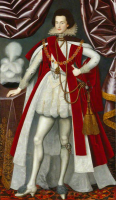


Samuel Pepys' Diary. 2nd May 1663. So to the Exchange [Map] and then home to dinner, and very merry and well pleased with my wife, and so to the office again, where we met extraordinary upon drawing up the debts of the Navy to my Lord Treasurer (age 56). So rose and up to Sir W. Pen (age 42) to drink a glass of bad syder in his new far low dining room, which is very noble, and so home, where Captain Ferrers and his lady are come to see my wife, he being to go the beginning of next week to France to sea and I think to fetch over my young Lord Hinchinbroke. They being gone I to my office to write letters by the post, and so home to supper and to bed.
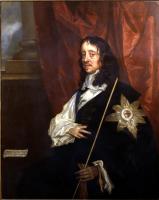

Samuel Pepys' Diary. 2nd May 1664. There by Captain Ferrers meeting with an opportunity of my Lord's coach, to carry us to the Parke anon, we directed it to come to the play-house door; and so we walked, my wife and I and Madamoiselle. I paid for her going in, and there saw "The Labyrinth", the poorest play, methinks, that ever I saw, there being nothing in it but the odd accidents that fell out, by a lady's being bred up in man's apparel, and a man in a woman's. Here was Mrs. Stewart (age 16), who is indeed very pretty, but not like my Baroness Castlemayne (age 23), for all that.


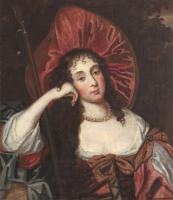


Samuel Pepys' Diary. 2nd May 1667. To the office, where all the morning. At noon home to dinner, and then abroad to my Lord Treasurer's (age 60), who continues so ill as not to be troubled with business. So Mr. Gawden and I to my Lord Ashly's (age 45) and spoke with him, and then straight home, and there I did much business at the office, and then to my own chamber and did the like there, to my great content, but to the pain of my eyes, and then to supper and to bed, having a song with my wife with great pleasure, she doing it well.


On 2nd May 1669 Erasmus Henry Dryden 5th Baronet was born to John Dryden (age 37) and Elizabeth Howard (age 31).


Samuel Pepys' Diary. 2nd May 1669. Lord's Day. Up, and by water to White Hall, and there visit my Lord Sandwich (age 43), who, after about two months' absence at Hinchingbroke [Map], come to town last night. I saw him, and very kind; and I am glad he is so, I having not wrote to him all the time, my eyes indeed not letting me. Here with Sir Charles Herbert [Harbord] (age 29), and my Lord Hinchingbrooke (age 21), and Sidney (age 18), we looked upon the picture of Tangier, designed: by Charles Herbert [Harbord], and drawn by Dancre (age 44), which my Lord Sandwich admires, as being the truest picture that ever he's saw in his life: and it is indeed very pretty, and I will be at the cost of having one of them.

John Evelyn's Diary. 2nd May 1671. The French King (age 32), being now with a great army of 28,000 men about Dunkirk, divers of the grandees of that Court, and a vast number of gentlemen and cadets, in fantastical habits, came flocking over to see our Court and compliment his Majesty (age 40). I was present, when they first were conducted into the Queen's (age 32) withdrawing-room, where saluted their Majesties the Dukes of Guise [Note. Possibly Henri Jules Bourbon Condé Prince Condé (age 27) who ], Longueville, and many others of the first rank.
On 2nd May 1672 John Maitland 1st Duke Lauderdale (age 55) was created 1st Duke Lauderdale, 1st Earl March Unknown Creation. Elizabeth Murray Duchess Lauderdale (age 45) by marriage Duchess Lauderdale.


John Evelyn's Diary. 2nd May 1687. I dined with Mynheer Diskvelts, the Holland Ambassador, a prudent and worthy person. There dined Lord Middleton (age 37), principal Secretary of State, Lord Pembroke (age 31), Lord Lumley (age 37), Lord Preston, Colonel Fitzpatrick, and Sir John Chardin (age 43). After dinner, the Ambassador discoursed of and deplored the stupid folly of our politics, in suffering the French to take Luxemburg, it being a place of the most concern to have been defended, for the interest not only of the Netherlands, but of England.


Chronicle of Abbot Ralph of Coggeshall
The Chronicle of Abbot Ralph of Coggeshall (Chronicon Anglicanum) is an indispensable medieval history that brings to life centuries of English and European affairs through the eyes of a learned Cistercian monk. Ralph of Coggeshall, abbot of the Abbey of Coggeshall in Essex in the early 13th century, continued and expanded his community’s chronicle, documenting events from the Norman Conquest of 1066 into the tumultuous reign of King Henry III. Blending eyewitness testimony, careful compilation, and the monastic commitment to record-keeping, this chronicle offers a rare narrative of political intrigue, royal power struggles, and social upheaval in England and beyond. Ralph’s work captures the reigns of pivotal figures such as Richard I and King John, providing invaluable insights into their characters, decisions, and the forces that shaped medieval rule. More than a simple annal, Chronicon Anglicanum conveys the texture of medieval life and governance, making it a rich source for scholars and readers fascinated by English history, monastic authorship, and the shaping of the medieval world.
Available at Amazon in eBook and Paperback format.
John Evelyn's Diary. 2nd May 1696. I dined at Lambeth [Map], being summoned to meet my co-trustees, the Archbishop (age 59), Sir Henry Ashurst, and Mr. Serjeant Rotheram, to consult about settling Mr. Boyle's lecture for a perpetuity; which we concluded upon, by buying a rent charge of £50 per annum, with the stock in our hands.

On 2nd May 1717 Louis Charles William Hohenzollern was born to Frederick William "Soldier King" I King Prussia (age 28) and Sophia Dorothea Hanover Queen Consort Prussia (age 30). He a great x 3 grandson of King James I of England and Ireland and VI of Scotland. Coefficient of inbreeding 8.31%. He died aged two in 1719.
On 2nd May 1718 James Hamilton 5th Duke Hamilton 2nd Duke Brandon (age 15) was educated at Christ Church College, Oxford University.
On 2nd May 1740 Louise Charlotte Oldenburg Duchess Schleswig-Holstein-Sonderburg-Beck (age 82) died.
On 2nd May 1767 Henry Scott 3rd Duke Buccleuch (age 20) and Elizabeth Montagu Duchess Buccleuch (age 23) were married at Montagu House Whitehall Palace. She by marriage Duchess Buccleuch. She the daughter of George Brudenell aka Montagu 1st Duke Montagu (age 54) and Mary Montagu Duchess of Montagu (age 56). He the son of Francis Scott and Caroline Campbell 1st Baroness Greenwich (age 49). They were fourth cousins. He a great x 3 grandson of King Charles II of England Scotland and Ireland.
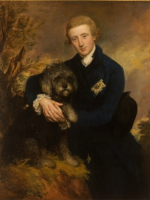

On 2nd May 1782 Thomas Pelham-Clinton 3rd Duke Newcastle-under-Lyne (age 29) and Anna Maria Stanhope Countess Lincoln were married. She the daughter of William Stanhope 2nd Earl of Harrington and Caroline Fitzroy Countess Harrington (age 60). He the son of Henry Fiennes Pelham-Clinton 2nd Duke Newcastle-under-Lyne (age 62) and Catherine Pelham Countess of Lincoln. They were sixth cousins. She a great x 2 granddaughter of King Charles II of England Scotland and Ireland.

On 2nd May 1806 Emmeline Charlotte Elizabeth Manners was born to John Henry Manners 5th Duke Rutland (age 28) and Elizabeth Howard Duchess Rutland (age 25). She married 17th February 1831 her fourth cousin Charles James Stuart-Wortley-Mackenzie, son of James Archibald Stuart-Wortley-Mackenzie 1st Baron Wharncliffe and Elizabeth Caroline Mary Crichton Baroness Wharncliffe, and had issue.

2nd May 1816. Stonehenge by Francis Etheridge. Inscribed on reverse: 'South west view of the Druidical. Temple of Stonehenge on Stonehenge Plain, from the Great Stone called the Friar's Heel [Map]. Francis Etheridge (2 May) 1816'. Painting depicts two figures next to the heel stone.
On 2nd May 1831 Prince Augustus Frederick Hanover 1st Duke Sussex (age 58) and Cecilia Gore aka Underwood Duchess of Inverness (age 46) were married contrary to the Royal Marriages Act. On the same day she assumed the surname Underwood by Royal Licence. She did not assume the title Duchess of Sussex. She the daughter of Arthur Saunders Gore 2nd Earl Arran and Elizabeth Underwood Countess of Arran. He the son of King George III of Great Britain and Ireland and Charlotte Mecklenburg Strelitz Queen Consort England.


Ten Years' Digging. The next [Probably Calton Barrow 2 [Map]], near "The Beech Plantation," had been a conical mound, covering an area fourteen yards in diameter, but was much mutilated by the centre being removed. It had originally been constructed as the last, with a central cist surrounded by stones and sand, and had contained a deposit of calcined bones, accompanied by a small vase, neatly ornamented, of which we found some fragments.
Ten Years' Digging. On the 2nd of May, we examined some of the tumuli on Calton Pasture, near Chatsworth, of which there are at least seven, all more or less mutilated.
The first [Probably Calton Barrow 1 [Map]] of those opened by us was a large flat barrow, about seventj feet diameter, and four high, situated in a field adjoining "The Hospital Field," consequently not in the large open Calton Pasture, though close to it. It was composed of sand and small stones, increasing in size towards the centre, where was a large cist vaen constructed of sandstones, which we found had been broken up very recently before our visit; we found only a few scattered burnt bones, and pieces of lead ore, which had undergone the action of fire.
Jean de Waurin's Chronicle of England Volume 6 Books 3-6: The Wars of the Roses
Jean de Waurin was a French Chronicler, from the Artois region, who was born around 1400, and died around 1474. Waurin’s Chronicle of England, Volume 6, covering the period 1450 to 1471, from which we have selected and translated Chapters relating to the Wars of the Roses, provides a vivid, original, contemporary description of key events some of which he witnessed first-hand, some of which he was told by the key people involved with whom Waurin had a personal relationship.
Available at Amazon in eBook and Paperback format.
Ten Years' Digging. On the 25th of May, we opened two stone cists on the site of the ruined tumulus at Bole Hill [Map], Bakewell Moor, where some remarkably elongated crania were found in 1843.
The first we examined did not appear to have been disturbed, although the skull therein discovered lay in one comer, apart from the skeleton to which it belonged. The body had been deposited in the usual contracted position upon its left side, and was surrounded by small stones, having above an artless covering of large flat slabs. The shortness and slenderness of the bones indicate the female sex, the femur being but 16½, and the tibia 13, inches long. The skull is decidedly long in the fronto-occipital diameter, but from the fulness of the parietal prominences this peculiarity is not so obvious at a first glance as in other crania from the same mound. The obliteration of the sutures, taken in connection with the general smoothness of the calvarium, and the abraded state of the teeth, show that the age at death would not be less than 60 years.
The second cist-vaen had been so thoroughly dug over at a former period, as to yield nothing more than detached bones of two or three skeletons, one of them that of a young person. No instruments or pottery were found in either enclosure. The cists consisted of rectangular compartments, made by placing massive blocks of limestone on edge upon the natural surface of the land, the unoccupied space between them being levelled up with stone collected in the neighbourhood.
On 2nd May 1868 James aka John Wilson Carmichael (age 67) died.
On 2nd May 1891 Arthur Foljambe 2nd Earl of Liverpool (age 20) was commissioned a second lieutenant in the Rifle Brigade. was promoted to lieutenant on 14 February 1893 and to captain on 1 December 1897.

On 2nd May 1896 Helen Glücksburg was born to Constantine I King Greece (age 27) and Sophia Hohenzollern Queen Consort Greece (age 25). She a great granddaughter of Queen Victoria of the United Kingdom. She married (1) 10th March 1921 her second cousin King Carol II Hohenzollern Sigmaringen and had issue.

Archaeologia Volume 84 1935 Section VI. 2nd May 1912. Plate XXX. The wooded part of the NNW. Fosse and Vallum of Avebury, looking WSW.
On 2nd May 1914 John Campbell 9th Duke Argyll (age 68) died at Cowes, Isle of Wight. His nephew Niall (age 42) succeeded 10th Duke Argyll, 7th Baron Hamilton of Hameldon in Leicestershire.

On 2nd May 1915 John Samuel Spry (age 58) died. Memorial at St Anthony's Church, St Anthony in Roseland [Map] to him and his wife Harriet (age 49).
John Samuel Spry: Around 1857 he was born to Samuel Thomas Spry and Harriet Hill. Before 2nd May 1915 he and Harriet were married.
Harriet: Around 1866 she was born. On 25th September 1922 she died.
On 2nd May 1919 Evelyn de Morgan aka Mary Evelyn Pickering (age 63) died.
Tottington War Memorial [Map] was unveiled by Lord Walsingham (age 71) at the Tottington Reading Room on 2nd May 1920 during a United Service of the Established and Free Churches of Tottington. Out of a population of around 250 people, 60 had joined up to serve in the First World War, and the memorial commemorates the 15 servicemen from Tottington and neighbouring Sturston who fell and the 45 men who returned safely. It was organised by a local War Memorial Committee and funded by public subscription.
The roundels were sculpted by Walter Marsden (age 37).
John Augustus Grey 7th Baron Walsingham: On 21st March 1849 he was born to Thomas Grey 5th Baron Walsingham and Emily Julia Thellusson Baroness Walsingham. On 3rd December 1919 Thomas Grey 6th Baron Walsingham died. His half brother John succeeded 7th Baron Walsingham of Walsingham in Norfolk. On 21st March 1929 John Augustus Grey 7th Baron Walsingham died. His son George succeeded 8th Baron Walsingham of Walsingham in Norfolk.


On 2nd May 1451 René Lorraine II Duke Lorraine Duke of Bar was born to Frederick Lorraine Count Vaudémont (age 23) and Yolande Valois Anjou (age 22) at Angers [Map]. Coefficient of inbreeding 1.75%. He married 1485 his fourth cousin Philippa Egmont Duchess of Bar Duchess Lorraine, daughter of Adolf Egmont 2nd Duke Guelders and Catherine Bourbon Duchess Guelders, and had issue.
Chronicle of Geoffrey le Baker of Swinbroke
Baker was a secular clerk from Swinbroke, now Swinbrook, an Oxfordshire village two miles east of Burford. His Chronicle describes the events of the period 1303-1356: Gaveston, Bannockburn, Boroughbridge, the murder of King Edward II, the Scottish Wars, Sluys, Crécy, the Black Death, Winchelsea and Poitiers. To quote Herbert Bruce 'it possesses a vigorous and characteristic style, and its value for particular events between 1303 and 1356 has been recognised by its editor and by subsequent writers'. The book provides remarkable detail about the events it describes. Baker's text has been augmented with hundreds of notes, including extracts from other contemporary chronicles, such as the Annales Londonienses, Annales Paulini, Murimuth, Lanercost, Avesbury, Guisborough and Froissart to enrich the reader's understanding. The translation takes as its source the 'Chronicon Galfridi le Baker de Swynebroke' published in 1889, edited by Edward Maunde Thompson.
Available at Amazon in eBook and Paperback format.
On 2nd May 1458 Eleanor Viseu Queen Consort Portugal was born to Ferdinand Aviz 2nd Duke Viseu (age 24) and Beatrice Aviz Duchess Viseu (age 27). She a great x 3 granddaughter of King Edward III of England. Coefficient of inbreeding 9.54%. She married 1470 her first cousin John II King Portugal, son of Alfonso "The African" V King Portugal and Isabella Aviz Queen Consort Portugal, and had issue.
On 2nd May 1631 John Murray 1st Marquess Atholl was born to John Murray 1st Earl Atholl and Jean Campbell Countess Atholl. Coefficient of inbreeding 1.83%. He married 5th May 1659 Amelia Stanley Marchioness Atholl, daughter of James Stanley 7th Earl of Derby and Charlotte Thouars Countess Derby, and had issue.

On 2nd May 1644 Robert Cotton was born to Thomas Cotton 2nd Baronet (age 50) and Alice Constable Lady Cotton (age 31).
On 2nd May 1657 Frances Archer Lady Rouse was born to Thomas Archer (age 38) and Anne Leigh (age 24). She married (1) before 31st July 1687 Francis Rouse 3rd Baronet, son of Thomas Rouse 1st Baronet and Frances Murray (2) 3rd February 1692 John Chaplin.
On 1st May 1662 Francis Brereton 5th Baron Brereton was born to William Brereton 3rd Baron Brereton (age 30) and Frances Willoughby Baroness Brereton (age 37). He was baptised at St Paul's Church, Covent Garden on 2nd May 1662.
On 2nd May 1669 Erasmus Henry Dryden 5th Baronet was born to John Dryden (age 37) and Elizabeth Howard (age 31).
On 2nd May 1675 George Booth 2nd Earl Warrington was born to Henry Booth 1st Earl Warrington (age 23) and Mary Langham Countess Warrington (age 23) at Mere Hall, Cheshire. He married 1702 Mary Oldbury Countess Warrington and had issue.


On 2nd May 1687 James Compton 5th Earl of Northampton was born to George Compton 4th Earl of Northampton (age 22) and Jane Fox Countess Northampton (age 18). He married 1716 Elizabeth Shirley Countess Northampton and had issue.

On 2nd May 1690 Talbot Yelverton 1st Earl of Sussex was born to Henry Yelverton 1st Viscount Longueville and Barbara Talbot Viscountess Longueville (age 25). He married before 27th July 1727 his fifth cousin Lucy Pelham Countess Sussex and had issue.
On 2nd May 1717 Louis Charles William Hohenzollern was born to Frederick William "Soldier King" I King Prussia (age 28) and Sophia Dorothea Hanover Queen Consort Prussia (age 30). He a great x 3 grandson of King James I of England and Ireland and VI of Scotland. Coefficient of inbreeding 8.31%. He died aged two in 1719.
On 2nd May 1737 William Petty 1st Marquess Lansdowne was born to John Petty-Fitzmaurice 1st Earl Shelburne (age 31) and Mary Fitzmaurice Countess Shelburne at Dublin [Map]. He married (1) 3rd February 1765 Sophia Carteret Countess Shelburne, daughter of John Carteret 2nd Earl Granville and Sophia Fermor Countess Granville, and had issue (2) after 5th January 1771 Louisa Fitzpatrick Marchioness Lansdowne, daughter of John Fitzpatrick 1st Earl Upper Ossory and Evelyn Leveson-Gower Countess Upper Ossory, and had issue.
On 2nd May 1745 John Fitzpatrick 2nd Earl Upper Ossory was born to John Fitzpatrick 1st Earl Upper Ossory (age 26) and Evelyn Leveson-Gower Countess Upper Ossory (age 20). He married after 23rd March 1769 Anne Liddell Duchess Grafton, daughter of Henry Liddell 1st Baron Ravensworth, and had issue.
The Deeds of the Dukes of Normandy
The Gesta Normannorum Ducum [The Deeds of the Dukes of Normandy] is a landmark medieval chronicle tracing the rise and fall of the Norman dynasty from its early roots through the pivotal events surrounding the Norman Conquest of England. Originally penned in Latin by the monk William of Jumièges shortly before 1060 and later expanded at the behest of William the Conqueror, the work chronicles the deeds, politics, battles, and leadership of the Norman dukes, especially William’s own claim to the English throne. The narrative combines earlier historical sources with firsthand information and oral testimony to present an authoritative account of Normandy’s transformation from a Viking settlement into one of medieval Europe’s most powerful realms. William’s history emphasizes the legitimacy, military prowess, and governance of the Norman line, framing their expansion, including the conquest of England, as both divinely sanctioned and noble in purpose. Later chroniclers such as Orderic Vitalis and Robert of Torigni continued the history, extending the coverage into the 12th century, providing broader context on ducal rule and its impact. Today this classic work remains a foundational source for understanding Norman identity, medieval statesmanship, and the historical forces that reshaped England and Western Europe between 800AD and 1100AD.
Available at Amazon in eBook and Paperback format.
On 2nd May 1765 John Petty 2nd Marquess Lansdowne was born to William Petty 1st Marquess Lansdowne (age 28) and Sophia Carteret Countess Shelburne (age 19).
On 2nd May 1773 Montagu Roger Burgoyne 8th Baronet was born to John Burgoyne 7th Baronet (age 34).
On 2nd May 1799 George Pratt 2nd Marquess Camden was born to John Jeffreys Pratt 1st Marquess Camden (age 40) and Frances Molesworth Marchioness Camden (age 43). He married 27th August 1835 Harriet Murray Marchioness Camden, daughter of Bishop George Murray and Sarah Hay-Drummond, and had issue.


On 2nd May 1804 Stilborn Pleydell-Bouverie was born to William Pleydell-Bouverie 3rd Earl Radnor (age 24) and Catherine Pelham-Clinton (age 28).
On 2nd May 1806 Emmeline Charlotte Elizabeth Manners was born to John Henry Manners 5th Duke Rutland (age 28) and Elizabeth Howard Duchess Rutland (age 25). She married 17th February 1831 her fourth cousin Charles James Stuart-Wortley-Mackenzie, son of James Archibald Stuart-Wortley-Mackenzie 1st Baron Wharncliffe and Elizabeth Caroline Mary Crichton Baroness Wharncliffe, and had issue.
On 2nd May 1807 Henry Fitzroy was born to George Fitzroy 2nd Baron Southampton (age 45) and Frances Isabella Seymour Baroness Southampton. Coefficient of inbreeding 1.56%. He married 29th April 1869 Hannah Meyer Rothschild.
On 2nd May 1808 Fanny Elizabeth Hopkins-Northey Baroness Boston was born. She married 1830 George Ives Irby 4th Baron Boston, son of George Irby 3rd Baron Boston and Rachel Ives Drake Baroness Boston, and had issue.
On 2nd May 1810 Mary Wentworth-Fitzwilliam was born to Charles Wentworth-Fitzwilliam 5th and 3rd Earl Fitzwilliam (age 23) and Mary Dundas (age 22). Coefficient of inbreeding 6.25%.
On 2nd May 1810 Alexander Baring was born to Alexander Baring 1st Baron Ashburton (age 35) and Ann Louisa Bingham Baroness Ashburton (age 28).
On 2nd May 1837 Reverend George Boughey 5th Baronet was born to Thomas Fletcher Fenton Boughey 3rd Baronet (age 28). He married 20th April 1875 his second cousin Theodosia Mary Royds.
The History of William Marshal was commissioned by his son shortly after William’s death in 1219 to celebrate the Marshal’s remarkable life; it is an authentic, contemporary voice. The manuscript was discovered in 1861 by French historian Paul Meyer. Meyer published the manuscript in its original Anglo-French in 1891 in two books. This book is a line by line translation of the first of Meyer’s books; lines 1-10152. Book 1 of the History begins in 1139 and ends in 1194. It describes the events of the Anarchy, the role of William’s father John, John’s marriages, William’s childhood, his role as a hostage at the siege of Newbury, his injury and imprisonment in Poitou where he met Eleanor of Aquitaine and his life as a knight errant. It continues with the accusation against him of an improper relationship with Margaret, wife of Henry the Young King, his exile, and return, the death of Henry the Young King, the rebellion of Richard, the future King Richard I, war with France, the death of King Henry II, and the capture of King Richard, and the rebellion of John, the future King John. It ends with the release of King Richard and the death of John Marshal.
Available at Amazon in eBook and Paperback format.

On 2nd May 1841 Henry Brand 2nd Viscount Hampden was born to Henry Brand 1st Viscount Hampden (age 26) and Eliza Ellice (age 23). He married 14th April 1868 Susan Henrietta Cavendish Viscountess Hampden and had issue.
On 2nd May 1850 George Aubrey Vere Bertie was born to Montagu Bertie 6th Earl of Abingdon (age 41) and Elizabeth Lavinia Harcourt Countess Abingdon. He married 13th October 1885 his half second cousin once removed Harriet Blanche Farquhar, daughter of Walter Rockliffe Farquhar 3rd Baronet and Mary Octavia Somerset Lady Farquhar.
On 2nd May 1893 Helen Vivien Gould Baroness Decies was born to George Jay Gould I (age 29). She married 7th February 1911 John Beresford 5th Baron Decies, son of William Horsley-Beresford 3rd Baron Decies and Catherine Anne Dent Baroness Decies, and had issue.
On 2nd May 1896 Helen Glücksburg was born to Constantine I King Greece (age 27) and Sophia Hohenzollern Queen Consort Greece (age 25). She a great granddaughter of Queen Victoria of the United Kingdom. She married (1) 10th March 1921 her second cousin King Carol II Hohenzollern Sigmaringen and had issue.
On 2nd May 1902 David Bowes-Lyon was born to Claude Bowes-Lyon 14th Earl Strathmore and Kinghorne (age 47) and Cecilia Nina Cavendish-Bentinck Countess of Strathmore and Kinghorne (age 39).


On 2nd May 1933 Georgiana Ross 26th Baroness de Ros of Helmsley was born to Peter Ross (age 26). She married 24th July 1954 Commander John David Maxwell and had issue.
On 2nd May 1947 Alastair Bruce 5th Baron Aberdare was born to Morys George Lyndhurst Bruce 4th Baron Aberdare (age 27) and Maud Helen Sarah Dashwood.
On 2nd May 1290 Gilbert "Red Earl" Clare 7th Earl Gloucester 6th Earl Hertford (age 46) and Joan of Acre Countess Gloucester and Hertford (age 18) were married at Clerkenwell [Map]. She by marriage Countess Gloucester, Countess Hertford. The difference in their ages was 28 years. She the daughter of King Edward I of England (age 50) and Eleanor of Castile Queen Consort England (age 49). He the son of Richard de Clare 6th Earl Gloucester 5th Earl Hertford and Maud Lacy Countess Gloucester and Hertford. They were half fifth cousins. He a great x 4 grandson of King Henry I "Beauclerc" England.

On 2nd May 1594 Thomas Heneage (age 62) and Mary Browne Countess Southampton (age 41) were married. Her second husband. The difference in their ages was 20 years.
On 2nd May 1655 William Ker 2nd Earl Roxburghe (age 32) and Jane Ker Countess Roxburgh were married. She by marriage Countess Roxburghe. She the daughter of Henry Ker and Margaret Hay Countess Cassilis. He the son of John Drummond 2nd Earl Perth (age 67) and Jean Ker Countess Perth. They were half first cousins.
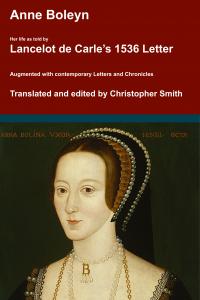
Anne Boleyn. Her Life as told by Lancelot de Carle's 1536 Letter.
In 1536, two weeks after the execution of Anne Boleyn, her brother George and four others, Lancelot du Carle, wrote an extraordinary letter that described Anne's life, and her trial and execution, to which he was a witness. This book presents a new translation of that letter, with additional material from other contemporary sources such as Letters, Hall's and Wriothesley's Chronicles, the pamphlets of Wynkyn the Worde, the Memorial of George Constantyne, the Portuguese Letter and the Baga de Secrets, all of which are provided in Appendices.
Available at Amazon in eBook and Paperback format.
On 2nd May 1670 John Cecil 5th Earl Exeter (age 22) and Anne Cavendish Countess Exeter (age 21) were married. She the daughter of William Cavendish 3rd Earl Devonshire (age 52) and Elizabeth Cecil Countess Devonshire (age 51). He the son of John Cecil 4th Earl Exeter (age 42) and Frances Manners Countess Exeter. They were half third cousin once removed.
On 2nd May 1710 John Miller 2nd Baronet and Elizabeth Meux were married.
On 2nd May 1732 Robert Petre 8th Baron Petre (age 18) and Mary Radclyffe (age 18) were married in St Paul's Cathedral [Map]. She the daughter of James Radclyffe 3rd Earl Derwentwater and Anna Maria Webb Countess Derwentwater. They were third cousin once removed. She a great granddaughter of King Charles II of England Scotland and Ireland.
On 2nd May 1763 James Townsend (age 26) and Henrietta Rosa Peregrina (age 17) were married. A grant of her father's estates was granted to her husband.
On 2nd May 1767 Henry Scott 3rd Duke Buccleuch (age 20) and Elizabeth Montagu Duchess Buccleuch (age 23) were married at Montagu House Whitehall Palace. She by marriage Duchess Buccleuch. She the daughter of George Brudenell aka Montagu 1st Duke Montagu (age 54) and Mary Montagu Duchess of Montagu (age 56). He the son of Francis Scott and Caroline Campbell 1st Baroness Greenwich (age 49). They were fourth cousins. He a great x 3 grandson of King Charles II of England Scotland and Ireland.
On 2nd May 1780 Hugh Edward Henry Clifford 5th Baron Clifford Chudleigh (age 24) and Apollonia Langdale Baroness Clifford (age 25) were married.

On 2nd May 1780 Richard Brooke 5th Baronet (age 27) and Mary Cunliffe Lady Brooke were married.
On 2nd May 1782 Thomas Pelham-Clinton 3rd Duke Newcastle-under-Lyne (age 29) and Anna Maria Stanhope Countess Lincoln were married. She the daughter of William Stanhope 2nd Earl of Harrington and Caroline Fitzroy Countess Harrington (age 60). He the son of Henry Fiennes Pelham-Clinton 2nd Duke Newcastle-under-Lyne (age 62) and Catherine Pelham Countess of Lincoln. They were sixth cousins. She a great x 2 granddaughter of King Charles II of England Scotland and Ireland.
On 2nd May 1792 George Thicknesse 19th Baron Audley 16th Baron Tuchet (age 35) and Augusta Henrietta Catherina Boisdaune Baroness Audley were married. She by marriage Baroness Audley of Heighley in Staffordshire.

On 2nd May 1799 Philip Stanhope 5th Earl Chesterfield (age 43) and Henrietta Thynne (age 36) were married at Grosvenor Street. She the daughter of Thomas Thynne 1st Marquess of Bath and Elizabeth Bentinck Marchioness Bath (age 63).
The History of William Marshal was commissioned by his son shortly after William’s death in 1219 to celebrate the Marshal’s remarkable life; it is an authentic, contemporary voice. The manuscript was discovered in 1861 by French historian Paul Meyer. Meyer published the manuscript in its original Anglo-French in 1891 in two books. This book is a line by line translation of the first of Meyer’s books; lines 1-10152. Book 1 of the History begins in 1139 and ends in 1194. It describes the events of the Anarchy, the role of William’s father John, John’s marriages, William’s childhood, his role as a hostage at the siege of Newbury, his injury and imprisonment in Poitou where he met Eleanor of Aquitaine and his life as a knight errant. It continues with the accusation against him of an improper relationship with Margaret, wife of Henry the Young King, his exile, and return, the death of Henry the Young King, the rebellion of Richard, the future King Richard I, war with France, the death of King Henry II, and the capture of King Richard, and the rebellion of John, the future King John. It ends with the release of King Richard and the death of John Marshal.
Available at Amazon in eBook and Paperback format.
On 2nd May 1831 Prince Augustus Frederick Hanover 1st Duke Sussex (age 58) and Cecilia Gore aka Underwood Duchess of Inverness (age 46) were married contrary to the Royal Marriages Act. On the same day she assumed the surname Underwood by Royal Licence. She did not assume the title Duchess of Sussex. She the daughter of Arthur Saunders Gore 2nd Earl Arran and Elizabeth Underwood Countess of Arran. He the son of King George III of Great Britain and Ireland and Charlotte Mecklenburg Strelitz Queen Consort England.
On 2nd May 1843 Thomas Moncrieffe 7th Baronet (age 21) and Louisa Hay-Drummond Lady Moncrieffe were married. She by marriage Lady Moncreiffe 1685. She the daughter of Thomas Hay-Drummond 11th Earl Kinnoull (age 58) and Louisa Burton Rowley Countess Kinnoul. He the son of David Moncrieffe 6th Baronet and Helen Mackay Countess Bradford (age 42).
On 2nd May 1848 William Neville 1st Marquess Abergavenny (age 21) and Caroline Vanden Bempte Johnston Marchioness Abergavenny were married. He the son of William Neville 4th Earl Abergavenny (age 55) and Caroline Leeke Countess Abergavenny.
On 2nd May 1874 Henry Strutt 2nd Baron Belper (age 33) and Margaret Coke Baroness Belper (age 22) were married at Holkham, Norfolk. She the daughter of Thomas Coke 2nd Earl of Leicester (age 51) and Juliana Whitbread Countess Leicester.
On 2nd May 1230 William de Braose 9th Baron Abergavenny 7th Baron Bramber (age 26) was hanged by Llewellyn "The Great" Aberffraw (age 58) for having been found in the bedchamber of his wife Joan Plantagenet (age 39). His daughter Eva (age 3) succeeded 10th Baroness Abergavenny Feudal Creation. William Cantilupe by marriage Baron Abergavenny Feudal Creation. His first cousin John (age 33) succeeded 8th Baron Bramber Feudal.
On 2nd May 1302 Blanche Capet Queen Navarre (age 54) died.
On 2nd May 1320 Joan Fitzgerald Countess Carrick (age 39) died.
On 2nd May 1377 Hugh Courtenay 2nd or 10th Earl Devon (age 73) died at Exeter, Devon [Map]. His grandson Edward (age 20) succeeded 3rd Earl Devon, 6th Baron Okehampton.
On 2nd May 1417 Ralph Cromwell 2nd Baron Cromwell (age 49) died at Tattershall [Map]. His son Ralph (age 14) succeeded 3rd Baron Cromwell.
On 2nd May 1473 Ralph Boteler 6th and 1st Baron Sudeley (age 84) died. Baron Sudeley extinct. Baron Sudeley abeyant.
Anne Boleyn. Her Life as told by Lancelot de Carle's 1536 Letter.
In 1536, two weeks after the execution of Anne Boleyn, her brother George and four others, Lancelot du Carle, wrote an extraordinary letter that described Anne's life, and her trial and execution, to which he was a witness. This book presents a new translation of that letter, with additional material from other contemporary sources such as Letters, Hall's and Wriothesley's Chronicles, the pamphlets of Wynkyn the Worde, the Memorial of George Constantyne, the Portuguese Letter and the Baga de Secrets, all of which are provided in Appendices.
Available at Amazon in eBook and Paperback format.

On 2nd May 1635 Horace de Vere 1st Baron Vere (age 70) died. Baron Vere of Tilbury extinct.
On 2nd May 1640 Anne Erskine Countess of Rothes (age 43) died.
On 2nd May 1691 Henry O'Brien 7th Earl Thomond (age 71) died. His grandson Henry (age 2) succeeded 8th Earl Thomond.
On 2nd May 1692 Edward Evelyn 1st Baronet (age 66) died. Baronet Evelyn of Long Ditton in Surrey extinct.
On 2nd May 1711 Lawrence Hyde 1st Earl Rochester (age 69) died. His son Henry (age 38) succeeded 2nd Earl Rochester. Jane Leveson-Gower Countess Rochester and Clarendon by marriage Countess Rochester.


On 2nd May 1716 Charles Lyttelton 3rd Baronet (age 88) died. His son Thomas (age 30) succeeded 4th Baronet Lyttelton of Frankley. Christian Temple Lady Lyttelton (age 37) by marriage Lady Lyttelton of Frankley.
On 2nd May 1728 John Eden 2nd Baronet (age 50) died at Bath, Somerset [Map]. His son Robert (age 10) succeeded 3rd Baronet Eden of West Auckland.
On 2nd May 1740 Louise Charlotte Oldenburg Duchess Schleswig-Holstein-Sonderburg-Beck (age 82) died.
On 2nd May 1795 Herbert Perrott Pakington 7th Baronet died. His son John (age 35) succeeded 8th Baronet Pakington.
On 2nd May 1823 Sylvester Douglas 1st Baron Benverbie (age 79) died.
On 2nd May 1827 Robert Shirley 7th Earl Ferrers (age 70) died. He was buried at Church of St Mary and St Hardulph, Breedon on the Hill [Map]. His brother Washington (age 66) succeeded 8th Earl Ferrers, 14th Baronet Shirley of Staunton Harold in Leicestershire.
On 2nd May 1851 Richard White 1st Earl Bantry (age 83) died. His son Richard (age 50) succeeded 2nd Earl Bantry. Mary O'Brien Countess Bantry by marriage Countess Bantry.
Anne Boleyn. Her Life as told by Lancelot de Carle's 1536 Letter.
In 1536, two weeks after the execution of Anne Boleyn, her brother George and four others, Lancelot du Carle, wrote an extraordinary letter that described Anne's life, and her trial and execution, to which he was a witness. This book presents a new translation of that letter, with additional material from other contemporary sources such as Letters, Hall's and Wriothesley's Chronicles, the pamphlets of Wynkyn the Worde, the Memorial of George Constantyne, the Portuguese Letter and the Baga de Secrets, all of which are provided in Appendices.
Available at Amazon in eBook and Paperback format.
On 2nd May 1860 William Fowle Middleton 2nd Baronet (age 75) died. Baronet Middleton of Crowfield in Suffolk extinct.
On 2nd May 1868 James aka John Wilson Carmichael (age 67) died.
On 2nd May 1868 Frederick Gough 4th Baron Calthorpe (age 77) died. His son Frederick (age 41) succeeded 5th Baron Calthorpe of Calthorpe in Norfolk, 6th Gough-Calthorpe of Edgbaston in Warwickshire.
On 2nd May 1874 Theresa Anna Maria Fox-Strangways Baroness Digby (age 60) died.
On 2nd May 1886 John Freeman-Mitford 1st Earl Redesdale (age 80) died unmarried. Earl Redesdale in Northumberland and Baron Redesdale of Redesdale in Northumberland extinct.
On 2nd May 1913 Rose Neville Countess Cottentham (age 46) died.
On 2nd May 1914 John Campbell 9th Duke Argyll (age 68) died at Cowes, Isle of Wight. His nephew Niall (age 42) succeeded 10th Duke Argyll, 7th Baron Hamilton of Hameldon in Leicestershire.
On 2nd May 1915 Cecily Susan Stuart-Wortley-Mackenzie Baroness Montagu died.
On 2nd May 1919 Evelyn de Morgan aka Mary Evelyn Pickering (age 63) died.
On 2nd May 1922 George Alexander Duntze 4th Baronet (age 83) died. His son George (age 48) succeeded 5th Baronet Duntze of Tiverton in Devon.
On 2nd May 1926 Constance Mary Barrington Baroness Haldon (age 79) died.
Chronicle of Walter of Guisborough
A canon regular of the Augustinian Guisborough Priory, Yorkshire, formerly known as The Chronicle of Walter of Hemingburgh, describes the period from 1066 to 1346. Before 1274 the Chronicle is based on other works. Thereafter, the Chronicle is original, and a remarkable source for the events of the time. This book provides a translation of the Chronicle from that date. The Latin source for our translation is the 1849 work edited by Hans Claude Hamilton. Hamilton, in his preface, says: 'In the present work we behold perhaps one of the finest samples of our early chronicles, both as regards the value of the events recorded, and the correctness with which they are detailed; Nor will the pleasing style of composition be lightly passed over by those capable of seeing reflected from it the tokens of a vigorous and cultivated mind, and a favourable specimen of the learning and taste of the age in which it was framed.'
Available at Amazon in eBook and Paperback format.
On 2nd May 1965 Edward Llewelyn Roger Lloyd-Mostyn 4th Baron Mostyn (age 80) died. His son Roger (age 45) succeeded 5th Baron Mostyn of Mostyn in Flintshire, 6th Baronet Lloyd of Pengwerra in Flintshire.
On 2nd May 1999 Edward Portman 9th Viscount Portman (age 65) died. His son Christopher (age 40) succeeded 10th Viscount Portman, 10th Baron Portman.