

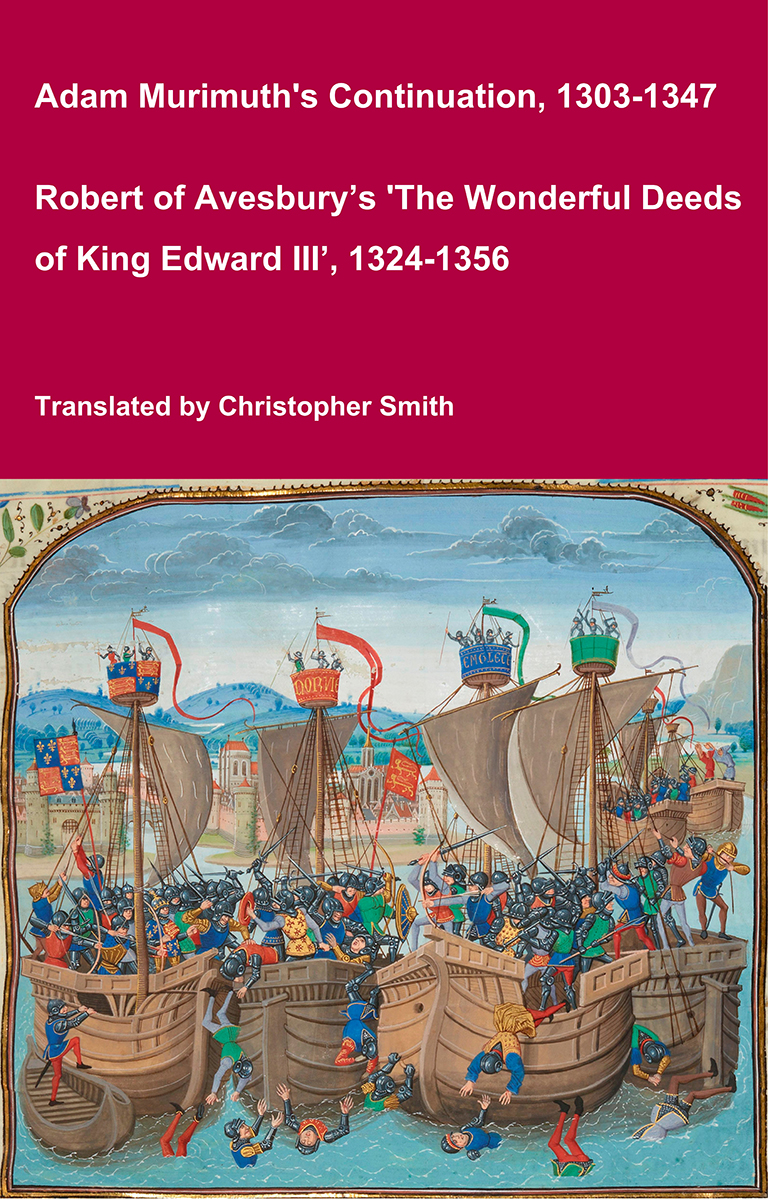
Adam Murimuth's Continuation and Robert of Avesbury’s 'The Wonderful Deeds of King Edward III'
This volume brings together two of the most important contemporary chronicles for the reign of Edward III and the opening phases of the Hundred Years’ War. Written in Latin by English clerical observers, these texts provide a vivid and authoritative window into the political, diplomatic, and military history of fourteenth-century England and its continental ambitions. Adam Murimuth Continuatio's Chronicarum continues an earlier chronicle into the mid-fourteenth century, offering concise but valuable notices on royal policy, foreign relations, and ecclesiastical affairs. Its annalistic structure makes it especially useful for establishing chronology and tracing the development of events year by year. Complementing it, Robert of Avesbury’s De gestis mirabilibus regis Edwardi tertii is a rich documentary chronicle preserving letters, treaties, and official records alongside narrative passages. It is an indispensable source for understanding Edward III’s claim to the French crown, the conduct of war, and the mechanisms of medieval diplomacy. Together, these works offer scholars, students, and enthusiasts a reliable and unembellished account of a transformative period in English and European history. Essential for anyone interested in medieval chronicles, the Hundred Years’ War, or the reign of Edward III.
Available at Amazon in eBook and Paperback format.
17 Apr is in April.
On 17th April 1080 King Harald III of Denmark [aged 40] died. King Canute "The Holy" IV of Denmark [aged 38] was appointed IV King of Denmark.
On 17th April 1154 Sancho "Strong" VII King Navarre was born to Sancho "Wise" King Navarre [aged 21] and Sancha Ivrea [aged 15]. He married 1195 his half third cousin once removed Constance Rouerge Queen Consort Navarre, daughter of Raymond Count of Toulouse and Beatrice Beziers.
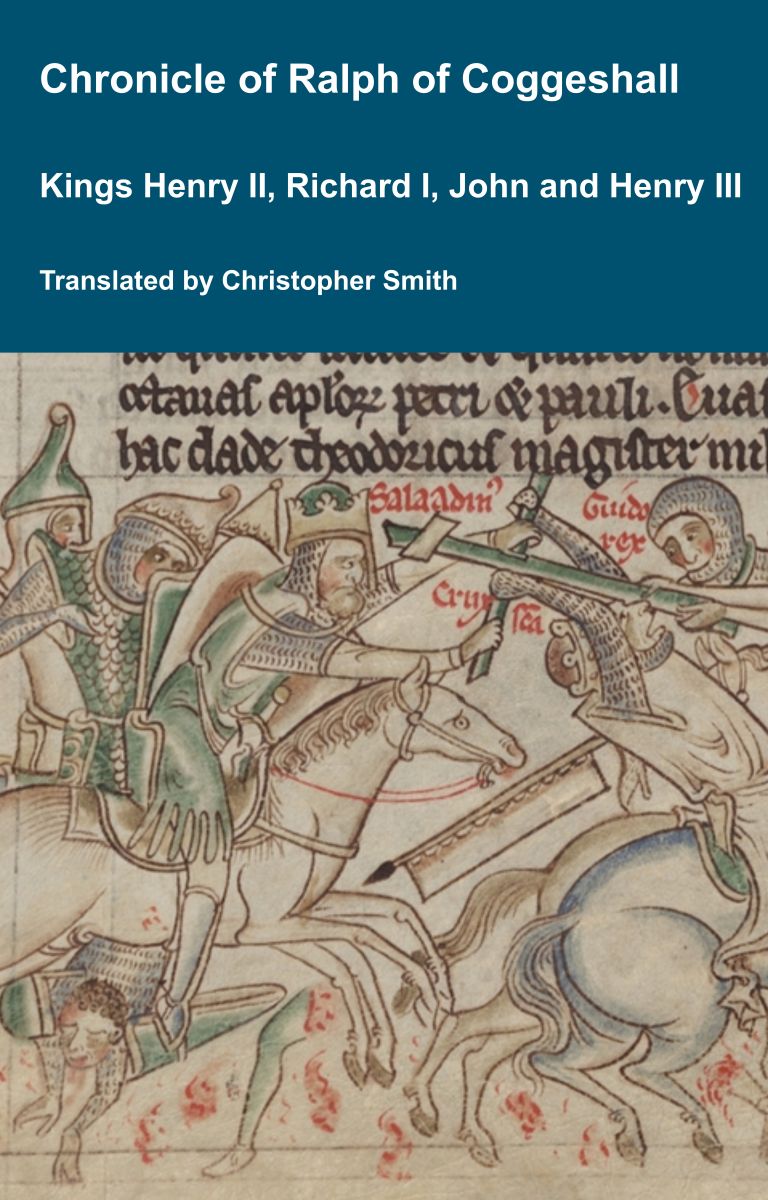 Chronicum Anglicanum by Ralph Coggeshall. Accordingly, after all his adversaries in England had been subdued in a short time, King Richard, on the octave of Easter [1194]1, was crowned at Winchester by the counsel of his nobles, though somewhat unwillingly, the Mass being celebrated by Hubert Walter, archbishop of Canterbury, who the previous year, returning from Jerusalem, had been consecrated archbishop. Immediately after this, the king crossed over into Normandy.
Subactis igitur in Anglia omnibus in brevi adversariis, rex Ricardus in octavis Paschae apud Winto niam consilio procerum suorum, licet aliquantulum renitens, coronatus est, archiepiscopo Cantuariensi Huberto Waltero missam celebrante, qui anno præterito a Hierosolyma regrediens in archiepiscopum est consecratus. Statim post hæc, rex in Normanniam transfretavit.
Note 1. Roger of Hoveden: "On the seventeenth day of April 1194, a Sunday within the Octave of Easter, a great assembly gathered in the Church of St. Swithun. Present were: Hubert, Archbishop of Canterbury, John, Archbishop of Dublin, Hugh, Bishop of Durham, Hugh of Lincoln, Richard of London, Gilbert of Rochester, William of Ely, Seffrid of Chichester, Henry of Exeter, William of Hereford, the Bishop of Worcester, the Bishop of St. David's, and the Bishop of Bangor, together with many abbots, clergy, and laypeople. Richard, King of England, clothed in royal garments and wearing a golden crown on his head, came forth from his chamber already crowned. He held in his right hand the royal sceptre, topped with the sign of the cross, and in his left hand a golden rod, topped with the figure of a dove. On his right walked William, Bishop of Ely, his chancellor, and on his left, Richard, Bishop of London. Preceding them in ordered procession were the archbishops, bishops, abbots, monks, and clerics. Following the king were earls, barons, knights, and a great multitude of common people."
Shortly after 17th April 1280 Richard de Swinfield was appointed Archdeacon of London.
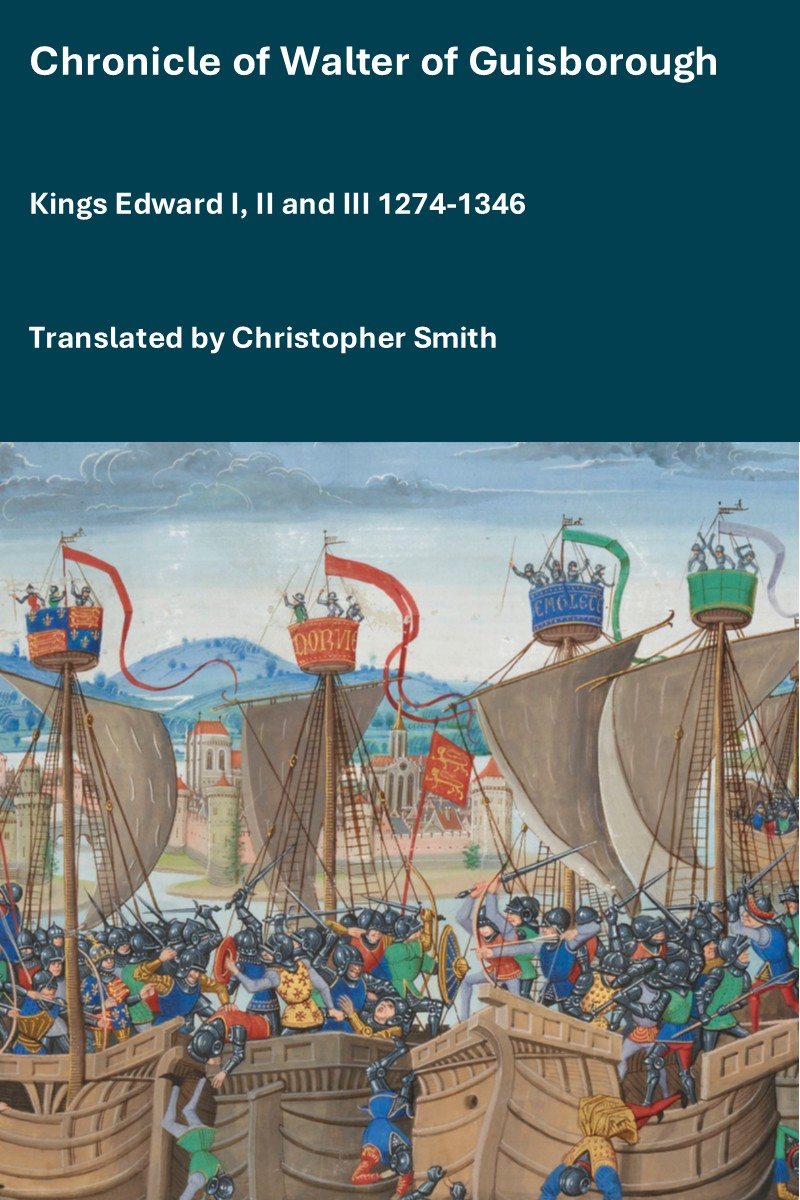 Chronicle of Walter of Guisborough. In the same year, in his own land of Annandale, at Lochmaben, that noble man Lord Robert de Brus the Fourth [aged 80] died, on Maundy Thursday [31st March 1295]. As previously mentioned, he had disputed with John Balliol before the king of England over the succession to the Scottish throne. And, as he had ordered while alive, he was buried in our house at Guisborough [Map], beside his father, on the second Sunday after Easter, the fifteenth day before the Kalends of May [17th April 1295], with the highest honour and great reverence, as was fitting. Throughout his life, he was glorious, gracious, wealthy, and generous, and he abounded in all things both in life and in death.
Eodem anno in terra sua Vallis Anandiæ apud Loghmaban obiit nobilis ille vir dominus Robertus de Bruys quartus, in Cœna Domini, qui, ut superius tactum est, circa successionem regni Scotiæ cum Johanne de Balliolo coram rege Anglorum disceptavit; et, ut vivens ipse jusserat, sepultus est in domo nostra Gisseburne juxta patrem suum, Dominica secunda post Pascha, XV kalendas Maii, cum summo honore, ut decuit, et reverentia magna. Hic toto tempore vitæ suæ gloriosus extitit, facetus, dives, et largus, et abundavit in omnibus in vita et in morte.
On 17th April 1320 Bishop Thomas Cantilupe was canonised by Pope John XII [aged 76].
Archaeologia Volume 35 1853 XXXIII. Reverting to the notices of visitors from the time of the Queen's leaving Hertford, we find that on the 17th of April [1358], in London, the Maréchal D'Audenham passed the entire day with her; the Countess of Pembroke [aged 41] and Sir John de Wynewyk coming to supper.
Archaeologia Volume 22 Section XVI. Of the death of the Countesse of Pembrooke, & of her godly deedes.
[17th April 1377] The sevententh day of Aprill, dyed the Lady Mary of St. Paule [deceased], Countesse of Pembrooke, a woman of singular example, for yet lyvynge, so to the honour of God & glorye of her howse, so in releavynge poore men's necessytyes she spent her goods, that unto the dukes themselves, she showered examples of good workes, & dyeynge, she gave all her substance ether to her servaunts that wayted on her, or to dyvers churches, or to poore folcke; for unto the churche of St. Albans she gave a certein image of silver and gilded with golde of St. Vincent, which holdeth in yts handes a certein showe, where in ys conteined one bone of the same blessed martyr, & singuler reliques of all the martyrs & confessours (to whose honour they were mayde) where she had obteyned the benyfyte of her prayer.
On 17th April 1427 John Valois IV Duke Brabant [aged 23] died. His brother Philip [aged 22] succeeded I Duke Brabant.
Abbot John Whethamstede’s Chronicle of the Abbey of St Albans
Abbot John Whethamstede's Register aka Chronicle of his second term at the Abbey of St Albans, 1451-1461, is a remarkable text that describes his first-hand experience of the beginning of the Wars of the Roses including the First and Second Battles of St Albans, 1455 and 1461, respectively, their cause, and their consequences, not least on the Abbey itself. His text also includes Loveday, Blore Heath, Northampton, the Act of Accord, Wakefield, and Towton, and ends with the Coronation of King Edward IV. In addition to the events of the Wars of the Roses, Abbot John, or his scribes who wrote the Chronicle, include details in the life of the Abbey such as charters, letters, land exchanges, visits by legates, and disputes, which provide a rich insight into the day-to-day life of the Abbey, and the challenges faced by its Abbot.
Available at Amazon in eBook and Paperback format.
On 17th April 1457 Wartislaw Griffins 9th Duke Pomerania died.
On 17th April 1483 the coffin of Edward IV [deceased] was carried to Westminster Abbey [Map] by Edward Stanley 1st Baron Monteagle [aged 21], John Savage [aged 39], Thomas Wortley [aged 50], Thomas Molyneux [aged 38], probably John Welles 1st Viscount Welles [aged 33] who had married Edward's daughter Cecily), John Cheney 1st Baron Cheyne [aged 41], Walter Hungerford [aged 19], Guy Wolston [aged 50], John Sapcote [aged 35], Thomas Tyrrell [aged 30], John Risley, Thomas Dacre 2nd Baron Dacre Gilsland [aged 15], John Norreys, Louis de Bretelles and John Comyn 4th Lord Baddenoch.
Those in the procession included:
Thomas St Leger [aged 43], widow of Edward's sister Anne.
William Parr [aged 49].
William Stonor [aged 33].
Henry Ferrers [aged 40].
James Radclyffe [aged 43].
George Browne [aged 43].
Gilbert Debenham [aged 51].
John Howard 1st Duke of Norfolk [aged 58] walked in front of the coffin with Edward's personal arms.
John Marlow Abbot Bermondsey followed by:
Bishop Thomas Kempe [aged 93].
Bishop John Hales [aged 83] (Bishop of Chester?).
Bishop Robert Stillington [aged 63].
Bishop William Dudley [aged 58].
Cardinal John Morton [aged 63] (as Bishop of Ely).
Bishop Edmund Tuchet [aged 40] (as Bishop of Rochester).
Bishop Peter Courtenay, and.
Bishop Lionel Woodville [aged 36].
Archbishop Thomas Rotherham [aged 59] brought up the rear.
Cardinal Thomas Bourchier [aged 65], then Archbishop of Canterbury, took no part due to infirmity.
John de la Pole Earl Lincoln 1st [aged 21]; the King's nephew,.
William Hastings 1st Baron Hastings [aged 52].
Thomas Grey 1st Marquess Dorset [aged 28].
William Herbert 2nd Earl Pembroke 1st Earl Huntingdon [aged 32] (some sources say Earl of Huntingindon?).
William Berkeley 1st Marquess Berkeley [aged 57].
Thomas Stanley 1st Earl of Derby [aged 48].
Richard Fiennes Baron Dacre Gilsland [aged 68].
John Sutton 1st Baron Dudley [aged 82].
George Neville 4th and 2nd Baron Abergavenny [aged 43].
John Tuchet 6th Baron Audley, 3rd Baron Tuchet [aged 57].
Walter Devereux Baron Ferrers of Chartley [aged 51].
Edward Grey 1st Viscount Lisle [aged 51].
Henry Lovell 9th Baron Marshal 8th Baron Morley [aged 7].
Richard Woodville 3rd Earl Rivers [aged 30].
John Brooke 7th Baron Cobham [aged 35].
Richard Hastings Baron Willoughby [aged 50].
John Bourchier 6th Baron Ferrers of Groby [aged 45].
Henry Machyn's Diary. 17th April 1555. The xvij day of Aprell was a commandment [from the bishop of London [aged 55] that every] parryche in London should have the sam day, and the morowe, durge and masse and ryngyng for pope Jully [the third] of that name, and for all crystyn solles.
Henry Machyn's Diary. 17th April 1560. The xvij day of Aprell dyd pryche at sant Mare spytyll master Juelle [aged 37].

On 17th April 1573 Maximilian "The Great" Wittelsbach I Duke Bavaria I Elector Bavaria was born to William Wittelsbach V Duke Bavaria [aged 24] and Renata Lorraine Duchess Bavaria [aged 28] at Munich. Coefficient of inbreeding 2.86%. He married (1) 6th February 1595 his first cousin Elisabeth Renata Lorraine Duchess Bavaria, daughter of Charles "The Great" Lorraine III Duke Lorraine and Claude Valois Duchess Lorraine (2) 15th July 1635 his niece Maria Anna Habsburg Spain Duchess Bavaria, daughter of Ferdinand of Spain II Holy Roman Emperor and Maria Anna Wittelsbach Holy Roman Empress, and had issue.
On 17th April 1581 Humphrey Bradbourne [aged 57] died. Monument in St Oswald's Church, Ashbourne [Map]. Around the sides of the tomb their six sons and four daughters. The tomb sculpted by Richard and Gabriel Royley of Burton-upon-Trent. Chest with Weepers holding Shields. Dress Folds at Feet. Ruffs.
Humphrey Bradbourne: Around 1524 he was born to John Bradbourne and Isabel Cotton. Date adjusted from 1537 to be consistent with father's death.


Diary of Anne Clifford. 17th April 1617. Upon ye 17th in the morning my Lord [aged 28] told me he was resolved never to move me more in these businesses, because he saw how fully I was bent.
On 17th April 1652 Henry Howard 15th or 22nd Earl of Arundel 5th Earl of Surrey 2nd Earl Norfolk [aged 43] died. His son Thomas [aged 25] succeeded 16th or 23rd Earl Arundel, 6th Earl Surrey, 3rd Earl Norfolk, 13th Baron Maltravers, 13th Baron Arundel, 16th Baron Mowbray, 17th Baron Segrave.
Samuel Pepys' Diary. 17th April 1662. To Mr. Holliard's [aged 53] in the morning, thinking to be let blood, but he was gone out.
John Evelyn's Diary. 17th April 1662. The young Marquis of Argyle [aged 33] [Note. Evelyn makes a mistake here insofar as Archibald Campbell 9th Earl Argyll was only restored to the Earldom.], whose turbulent father was executed in Scotland, came to see my garden. He seemed a man of parts.
Samuel Pepys' Diary. 17th April 1664. Thence to the Hall again, and after meeting with several persons, and talking there, I to Mrs. Hunt's (where I knew my wife and my aunt Wight [aged 45] were about business), and they being gone to walk in the parke I went after them with Mrs. Hunt, who staid at home for me, and finding them did by coach, which I had agreed to wait for me, go with them all and Mrs. Hunt and a kinswoman of theirs, Mrs. Steward, to Hide Parke, where I have not been since last year; where I saw the King [aged 33] with his periwigg, but not altered at all; and my Baroness Castlemayne [aged 23] in a coach by herself, in yellow satin and a pinner on; and many brave persons. And myself being in a hackney and full of people, was ashamed to be seen by the world, many of them knowing me.




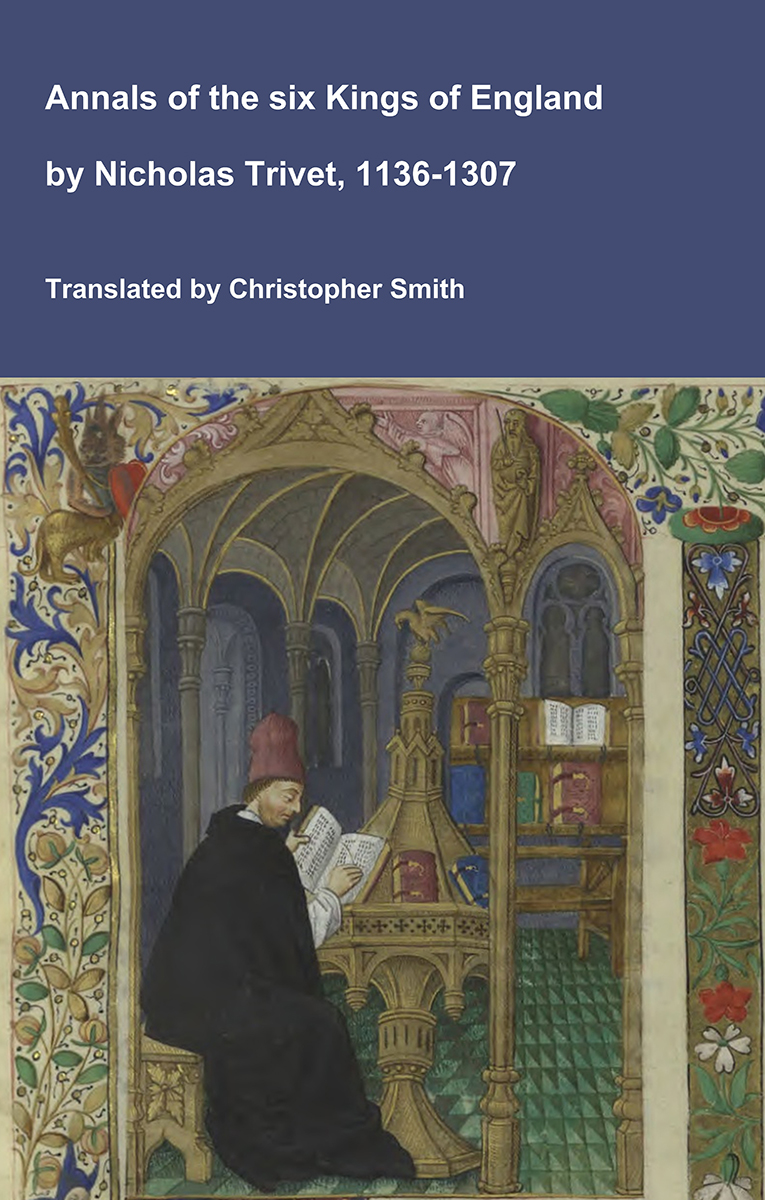
Annals of the six Kings of England by Nicholas Trivet
Translation of the Annals of the Six Kings of England by that traces the rise and rule of the Angevin aka Plantagenet dynasty from the mid-12th to early 14th century. Written by the Dominican scholar Nicholas Trivet, the work offers a vivid account of English history from the reign of King Stephen through to the death of King Edward I, blending political narrative with moral reflection. Covering the reigns of six monarchs—from Stephen to Edward I—the chronicle explores royal authority, rebellion, war, and the shifting balance between crown, church, and nobility. Trivet provides detailed insight into defining moments such as baronial conflicts, Anglo-French rivalry, and the consolidation of royal power under Edward I, whose reign he describes with particular immediacy. The Annals combines careful year-by-year reporting with thoughtful interpretation, presenting history not merely as a sequence of events but as a moral and political lesson. Ideal for readers interested in medieval history, kingship, and the origins of the English state, this chronicle remains a valuable and accessible window into the turbulent world of the Plantagenet kings.
Available at Amazon in eBook and Paperback format.
Samuel Pepys' Diary. 17th April 1665. Up and to the Duke of Albemarle's [aged 56], where he shewed me Mr. Coventry's [aged 37] letters, how three Dutch privateers are taken, in one whereof Everson's' son is captaine. But they have killed poor Captaine Golding in The Diamond. Two of them, one of 32 and the other of 20 odd guns, did stand stoutly up against her, which hath 46, and the Yarmouth that hath 52 guns, and as many more men as they. So that they did more than we could expect, not yielding till many of their men were killed. And Everson, when he was brought before the Duke of Yorke [aged 31], and was observed to be shot through the hat, answered, that he wished it had gone through his head, rather than been taken. One thing more is written: that two of our ships the other day appearing upon the coast of Holland, they presently fired their beacons round the country to give notice. And newes is brought the King [aged 34], that the Dutch Smyrna fleete is seen upon the back of Scotland; and thereupon the King hath wrote to the Duke, that he do appoint a fleete to go to the Northward to try to meet them coming home round: which God send!


Samuel Pepys' Diary. 17th April 1669. Thence with my wife in Hackney to Sir W. Coventry's [aged 41], who being gone to the Park we drove after him, and there met him coming out, and followed him home, and there sent my wife to Unthanke's while I spent on hour with him reading over first my draught of the Administration of the Navy, which he do like very well; and so fell to talk of other things, and among the rest of the story of his late disgrace, and how basely and in what a mean manner the Duke of Buckingham [aged 41] hath proceeded against him-not like a man of honour. He tells me that the King [aged 38] will not give other answer about his coming to kiss his hands, than "Not yet". But he says that this that he desires, of kissing the King's hand, is only to show to the world that he is not discontented, and not in any desire to come again into play, though I do perceive that he speaks this with less earnestness than heretofore: and this, it may be, is, from what he told me lately, that the King is offended at what is talked, that he hath declared himself desirous not to have to do with any employment more. But he do tell me that the leisure he hath yet had do not at all begin to be burdensome to him, he knowing how to spend his time with content to himself; and that he hopes shortly to contract his expence, so as that he shall not be under any straits in that respect neither; and so seems to be in very good condition of content.


On 17th April 1672 Henry Somerset 1st Duke Beaufort [aged 43] was appointed Privy Council.
John Evelyn's Diary. 17th April 1673. Dr. Compton [aged 41], brother to the Earl of Northampton [aged 50], preached on 1 Corinth. v. 11-16 [Note. This reference is ambiguous?], showing the Church's power in ordaining things indifferent; this worthy person's talent is not preaching, but he is likely to make a grave and serious good man.


John Evelyn's Diary. 17th April 1673. I carried Lady Tuke to thank the Countess of Arlington [aged 39] for speaking to his Majesty [aged 42] in her behalf, for being one of the Queen Consort's [aged 34] women. She carried us up into her new dressing room at Goring House [Map], where was a bed, two glasses, silver jars, and vases, cabinets, and other so rich furniture as I had seldom seen; to this excess of superfluity were we now arrived and that not only at Court, but almost universally, even to wantonness and profusion.

John Evelyn's Diary. 17th April 1685. Good Friday. Dr. Tenison [aged 48] preached at the new church at St. James's, on 1 Cor. 16, 22, upon the infinite love of God to us, which he illustrated in many instances. The holy Sacrament followed, at which I participated. The Lord make me thankfull. In the after noone Dr. Sprat, Bp. of Rochester [aged 50], preached in Whitehall Chapell, the auditory very full of Lords, the two Archbishops, and many others, now drawne to towne upon the occasion of the Coronation and ensuing Parliament. I supp'd with the Countesse of Sunderland [aged 39] and Lord Godolphin [aged 39], and return'd home.
On 17th April 1694 Charles Beauclerk 1st Duke St Albans [aged 23] and Diana Vere Duchess St Albans [aged 15] were married. She by marriage Duchess St Albans. She the daughter of Aubrey de Vere 20th Earl of Oxford [aged 67] and Diana Kirke Countess of Oxford. He the illegitmate son of King Charles II of England Scotland and Ireland and Nell Gwyn.


On 17th April 1714 Baptist Noel 3rd Earl Gainsborough [aged 30] died of smallpox. His son Baptist [aged 6] succeeded 4th Earl Gainsborough, 7th Viscount Campden, 7th Baron Hicks of Ilmington in Warwickshire.
On 17th April 1714 Karl Saxe Coburg Altenburg was born to Frederick Saxe Coburg Altenburg II Duke Saxe Gotha Altenburg [aged 37] and Magdalena Augusta Anhalt-Zerbst Duchess Saxe Gotha Altenburg at Gotha. He died aged one in 1715.
On 17th April 1720 James Drummond 2nd Duke Perth [aged 46] died. His son James [aged 6] succeeded 3rd Duke Perth.
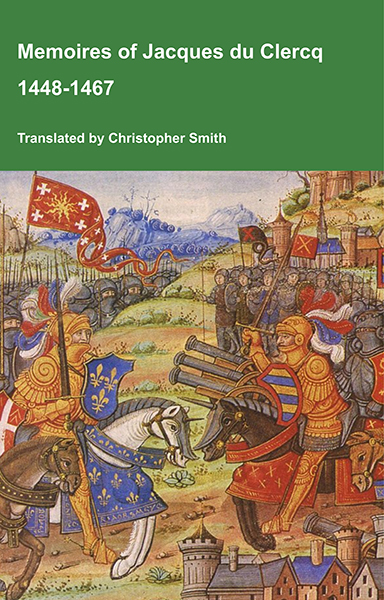
This is a translation of the 'Memoires of Jacques du Clercq', published in 1823 in two volumes, edited by Frederic, Baron de Reissenberg. In his introduction Reissenberg writes: 'Jacques du Clercq tells us that he was born in 1424, and that he was a licentiate in law and a counsellor to Philip the Good, Duke of Burgundy, in the castellany of Douai, Lille, and Orchies. It appears that he established his residence at Arras. In 1446, he married the daughter of Baldwin de la Lacherie, a gentleman who lived in Lille. We read in the fifth book of his Memoirs that his father, also named Jacques du Clercq, had married a lady of the Le Camelin family, from Compiègne. His ancestors, always attached to the counts of Flanders, had constantly served them, whether in their councils or in their armies.' The Memoires cover a period of nineteen years beginning in in 1448, ending in in 1467. It appears that the author had intended to extend the Memoirs beyond that date; no doubt illness or death prevented him from carrying out this plan. As Reissenberg writes the 'merit of this work lies in the simplicity of its narrative, in its tone of good faith, and in a certain air of frankness which naturally wins the reader’s confidence.' Du Clercq ranges from events of national and international importance, including events of the Wars of the Roses in England, to simple, everyday local events such as marriages, robberies, murders, trials and deaths, including that of his own father in Book 5; one of his last entries.
Available at Amazon in eBook and Paperback format.
On 17th April 1771 Peter Rouw was born to Peter Rouw.
On 10th February 1780 Samuel Egerton [aged 68] died. On 19th February 1780 he was buried at St Mary's Church, Rostherne, Tatton [Map]. Monument sculpted by John "The Elder" Bacon [aged 39]. Figures representing Hope and Patience.
The monument inscription describes those also buried in the vault: John Egerton, his wife Elizabeth Barbour buried 10th February 1743, her mother Elizabeth Hill [aged 85] buried 17th April 1713 and John and Elizabeth's daughter-in-law Beatrix Copley [aged 22] buried 1st May 1755.


On 14th April 1803 Mary Leach [aged 66] died. On 17th April 1803 Mary Leach was buried at Church of St Barlok, Norbury [Map].
Mary Leach: In 1737 she was born. On 16th June 1763 George Evans and she were married at the Church of St Barlok, Norbury [Map].
On 17th April 1825 Henry Fuseli [aged 84] died at the house of the Countess of Guildford [aged 55], on Putney Hill


Cansick's Monumental Inscriptions Volume 2 St Giles' Cemetery, Kings Road. Here rest the mortal remains of Ann Flaxman, The virtuous and beloved wife of John Flaxman, R.A.P.S., Whose soul returned to the Almighty Creator and Blessed Redeemer On the 7th of February, In the year of Our Lord, 1820, And the 60th year of her age. Under the same stone Is interred her husband, John Flaxman, R.A.P.S.1, Whose mortal life Was a constant preparation For a blessed immortality. His angelic spirit returned to the Divine Giver On the 7th of December, 1826, In the 72nd year of his age.
Also in the same vault Are deposited the mortal remains of Mary Ann Flaxman [deceased], Sister of the above John Flaxman, Whose gentle spirit returned to the Divine Giver On the 17th of April, 1833, in the 65th year of her age.
Note 1. Mr. John Flaxman, was born at York, 1755. From boyhood lie displayed a remarkable genius for modelling in clay.
In 1787 he visited Rome, where, during a residence of seven years, he executed his celebrated designs in outline from Homer, Æschylus and Danté.
These were engraved and published, as were some which he made from Hesiod.
Whilst at Rome he also executed the splendid group from Ovid's Metamorphoses entitled "The Fury of Athamas;" consisting of four figures larger than life. For this work he received only £6oo; an amount very much below the cost. It was executed for the Earl of Bristol. In 1794 he returned to England and executed the monument for Lord Mansfield, now in Westminster Abbey. For this he received £2,500. After this he produced a large number of fine works, and was considered the greatest of modem sculptors. His collections of drawings and models he bequeathed to the University of London, to form a Flaxman Gallery.
Ten Years' Digging. On the 17th of April we re-opened the barrow at Little Lea, Castern, which was first examined on the 20th July, 1848, when our excavation was confined to the centre. We now began to dig at the south side, and continued to do so in a direction concentric with the former cutting till we reached the eastern quarter of the barrow, where at the depth of half a yard we found a deposit of calcined human bones, which were partly contained in a funnel-shaped hole, near two feet deep and a foot wide at the top, into which the bones and the heated embers of the funeral pyre had been thrust, without any separation having been made. The deposit being mixed with a great deal of charcoal, both in masses and in powder, and with small stones reduced to lime, was so much increased in quantity as not merely to fill the hole made for its reception, but also to form a heap above and around it. The following article had accompanied the corpse through its fiery preparation for the grave, and were deposited with its remains — a few shreds or broken pieces of an urn; a neat bone pin, upwards of four inches long; and about a do^en instruments of flint, mostly of neat manufacture, but nearly all destroyed by the fierceness of the fire to which they had been exposed: one, however, is perfect, and is a fine circular-ended implement, three inches long. We have here our attention arrested by the fact that portions of earthen vessels were sometimes burnt along with human bodies, as it is to be observed that the fragments found with this deposit have evidently been submitted to a great heat since thdr fracture, and also that, had anything like an entire vessel been interred, its fragments would doubtless have been discovered among the ashes. I have long surmised that this was a custom observed in some particular and perhaps exceptional cases, but have not paid suflScient attention to the state of fragments of pottery when newly discovered until of late. I fibad, however, a few well-marked examples of burnt fragments in the collection at Lomberdale, derived from deposits of calcined bone, as at Arbor Low in 1845, and in one instance from an incinerated interment within an urn (see barrow on Ballidon Moor, 30th July, 1849).
In illustration of this, we reprint the following from a letter communicated in 1845, by the Rev. Ferdinand Keller, President of the Society of Antiquaries of Zurich, to Sir Henry Ellis, explanatory of an obscure passage in Shakspere, Hamlet Act V., Scene 1, wherein it is said that — "In almost all the accounts of the opening of Pagan sepulchres and tumuli, mention is made of the discovery of fragments of pottery strewn in the soil, which appear to be portions of vessels similar to such as are often found by the side of the human remains interred in these tombs, and consist of earthenware, not baked in a kihi, but imperfectly hardened by a fire. These potsherds are found in sepulchres where there are no urns, and are almost always fragments of different vessels. Archaeologists have considered them to be the relics of the Lyke-wake held at the funeral. Kleeman observes that it was customary to bring the corpse to the place of interment dad in festive garments, and show it to the friends; a banquet then commenced, and a share was offered to the deceased. The revelry must have been of a very lively character (?) from the quantity of broken pottery found in these tombs. (See the "Handbook of German Antiquities," Dresden, 1836, p. 94.) Another remarkable circumstance in connection with Pagan places of burial is the discovery of flints, which are found in all parts of the tumulus, but chiefly over the skeleton, varying considerably in size. This fact has been noticed by antiquarians, who do not appear to have recognised the observance of a heathen custom, and have not ascertained whether it may be regarded as characteristic of the customs of Celtic or Germanic tribes. These traces of ancient usages appear to throw light on a passage in Hamlet hitherto unexplained. At the burial of Ophelia, Hamlet remarking that the usual rites were not observed, supposes that the deceased had perished by her own hand. Upon this, Laertes enquires with what rites the corpse is to be interred, and the priest replies that her death had been doubtful; that, but for the command that her obsequies should be otherwise ordered, the corpse should have rested in unconsecrated soil; and for charitable prayers shards, flints and pebbles should be thrown on her.' Mr. Keller supposes that Shakspere had in view some ancient usage, retained possibly in some part of England, in accordance with which those who, like Pagans, had laid violent hands upon themselyes, were buried with ceremonies peculiar to the heathens. Amongst such sepulchral usages that of scattering flints and potsherds over the corpse, as shown by the examination of tumuli in Switzerland and Southern Germany, appears to have been observed. Mr. Keller remarked, that if English archasologists succeed in determining to which of the two ancient races of their island the customs recorded in this passage of Shakspere may be ascribed, some light may thereby be thrown on the origin of those sepulchral remains on the Continent which had given rise to so much dispute".

On 17th April 1861 Emily Maud Dent died. Wall memorial at St Andrew's Church, Bolam [Map].
Emily Maud Dent: On 7th September 1860 he was born to Commander William Dent Hedley aka Dent and Ellen Mary Kerr.
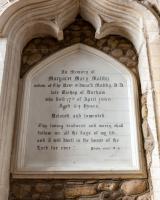
In 17th April 1868 Margaret Green [aged 84] died. Monument at St Mary's Church, Buckden [Map].
Margaret Green: Around 1784 she was born. In 1826 Bishop Edward Maltby and she were married.
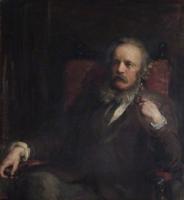
On 17th April 1877 Henry Merritt [aged 55] and Anne Lea aka Merritt [aged 32] were married. He died three months later. She did not marry again. The difference in their ages was 22 years.
On 17th April 1880 Alan Ian Percy 8th Duke Northumberland was born to Henry George Percy 7th Duke Northumberland [aged 33] and Edith Campbell Duchess Northumberland [aged 30]. He married 18th November 1911 his fifth cousin Helen Gordon-Lennox Duchess Northumberland, daughter of Charles Gordon-Lennox 7th Duke Richmond and Isabel Sophie Craven, and had issue.
On 17th April 1888 at a meeting at the since demolished Royal Hotel, Market Street, Liverpool, the 'Football League' was formed. The first season of the Football League began on the 8th September with twelve member clubs: Accrington, Aston Villa, Blackburn Rovers, Bolton Wanderers, Burnley, Derby County, Everton, Notts County, Preston North End, Stoke, West Bromwich Albion and Wolverhampton Wanderers.
On 17th April 1937 Hugo Denison 4th Earl of Londesborough [aged 42] died. He was buried at St Oswald's Church, Blankney. The Earl had become ill and it was decided to move him to London for treatment; he died on the journey. Earl Londesborough in Yorkshire extinct. His first cousin once removed Ernest [aged 60] succeeded 6th Baron Londesborough of Londesborough in the East Riding of Yorkshire.
The impact of death duties necessitated the sale of Blankney, Lincolnshire to Mr William Parker of Norfolk. The Countess, Marigold Lubbock Countess Londesborough [aged 33], and her daughter Zinnia Rosemary Denison, continued to live on the estate.


At midnight on the night of the 17th and 18th April 1949 the Republic of Ireland Act 1948 came into force by which Ireland became a Republic.
Adam Murimuth's Continuation and Robert of Avesbury’s 'The Wonderful Deeds of King Edward III'
This volume brings together two of the most important contemporary chronicles for the reign of Edward III and the opening phases of the Hundred Years’ War. Written in Latin by English clerical observers, these texts provide a vivid and authoritative window into the political, diplomatic, and military history of fourteenth-century England and its continental ambitions. Adam Murimuth Continuatio's Chronicarum continues an earlier chronicle into the mid-fourteenth century, offering concise but valuable notices on royal policy, foreign relations, and ecclesiastical affairs. Its annalistic structure makes it especially useful for establishing chronology and tracing the development of events year by year. Complementing it, Robert of Avesbury’s De gestis mirabilibus regis Edwardi tertii is a rich documentary chronicle preserving letters, treaties, and official records alongside narrative passages. It is an indispensable source for understanding Edward III’s claim to the French crown, the conduct of war, and the mechanisms of medieval diplomacy. Together, these works offer scholars, students, and enthusiasts a reliable and unembellished account of a transformative period in English and European history. Essential for anyone interested in medieval chronicles, the Hundred Years’ War, or the reign of Edward III.
Available at Amazon in eBook and Paperback format.
On 17th April 1154 Sancho "Strong" VII King Navarre was born to Sancho "Wise" King Navarre [aged 21] and Sancha Ivrea [aged 15]. He married 1195 his half third cousin once removed Constance Rouerge Queen Consort Navarre, daughter of Raymond Count of Toulouse and Beatrice Beziers.
On 17th April 1199 Marie Montgomery Countess Ponthieu was born to William Montgomery IV Count Ponthieu [aged 20] and Alys Capet Countess Ponthieu [aged 38]. She married before 1208 Simon Dammartin and had issue.
On 17th April 1568 George Brooke was born to William Brooke 10th Baron Cobham [aged 40] and Frances Newton Baroness Cobham [aged 29]. He married after 17th January 1598 his fifth cousin Elizabeth Burgh, daughter of Thomas Burgh 9th Baron Cobham 7th Baron Strabolgi 3rd Baron Burgh and Frances Vaughan, and had issue.
On 17th April 1573 Maximilian "The Great" Wittelsbach I Duke Bavaria I Elector Bavaria was born to William Wittelsbach V Duke Bavaria [aged 24] and Renata Lorraine Duchess Bavaria [aged 28] at Munich. Coefficient of inbreeding 2.86%. He married (1) 6th February 1595 his first cousin Elisabeth Renata Lorraine Duchess Bavaria, daughter of Charles "The Great" Lorraine III Duke Lorraine and Claude Valois Duchess Lorraine (2) 15th July 1635 his niece Maria Anna Habsburg Spain Duchess Bavaria, daughter of Ferdinand of Spain II Holy Roman Emperor and Maria Anna Wittelsbach Holy Roman Empress, and had issue.
On 17th April 1635 Bishop Edward Stillingfleet was born.


On 17th April 1648 William Booth was born to George Booth 1st Baron Delamer [aged 25] and Elizabeth Grey Baroness Delamer [aged 26].


On 17th April 1664 Aubrey de Vere was born to Aubrey de Vere 20th Earl of Oxford [aged 37] and Hester Davenport Countess of Oxford [aged 22]. He was baptised on 15th May 1664 at St Paul's Church, Covent Garden.
On 17th April 1699 Francis Edwardes 4th Baronet was born to Francis Edwardes 3rd Baronet. He married 10th June 1726 Hester Lacon Lady Edwardes and had issue.
On 17th April 1710 Henry Erskine 10th Earl of Buchan was born to David Erskine 9th Earl Buchan [aged 38] and Frances Fairfax Countess Buchan [aged 47]. He married 31st January 1739 Agnes Steuart and had issue.
On 17th April 1714 Karl Saxe Coburg Altenburg was born to Frederick Saxe Coburg Altenburg II Duke Saxe Gotha Altenburg [aged 37] and Magdalena Augusta Anhalt-Zerbst Duchess Saxe Gotha Altenburg at Gotha. He died aged one in 1715.

On 17th April 1755 Mary Anne Caldwell Countess Belmore was born to John Caldwell 4th Baronet. She married 1st March 1794 Armar Lowry-Corry 1st Earl Belmore.
On 17th April 1762 Buckworth Buckworth-Herne-Soame 6th Baronet was born to Edward Buckworth aka Buckworth-Herne 5th Baronet [aged 29] and Anne Herne Lady Buckworth-Herne. He a great x 3 grandson of King Charles II of England Scotland and Ireland. He married before 24th April 1793 Susan Semperingham Lady Buckworth-Herne-Soame and had issue.
On 17th April 1762 Harriet Hobart Viscountess Belmore was born to John Hobart 2nd Earl Buckinghamshire [aged 38] and Mary Anne Drury Countess Buckinghamshire [aged 22]. She married (1) 2nd March 1780 Armar Lowry-Corry 1st Earl Belmore and had issue (2) 4th April 1793 William Kerr 6th Marquess Lothian, son of William John Kerr 5th Marquess Lothian and Elizabeth Fortescue 5th Marchioness Lothian, and had issue.


William of Worcester's Chronicle of England
William of Worcester, born around 1415, and died around 1482 was secretary to John Fastolf, the renowned soldier of the Hundred Years War, during which time he collected documents, letters, and wrote a record of events. Following their return to England in 1440 William was witness to major events. Twice in his chronicle he uses the first person: 1. when writing about the murder of Thomas, 7th Baron Scales, in 1460, he writes '… and I saw him lying naked in the cemetery near the porch of the church of St. Mary Overie in Southwark …' and 2. describing King Edward IV's entry into London in 1461 he writes '… proclaimed that all the people themselves were to recognize and acknowledge Edward as king. I was present and heard this, and immediately went down with them into the city'. William’s Chronicle is rich in detail. It is the source of much information about the Wars of the Roses, including the term 'Diabolical Marriage' to describe the marriage of Queen Elizabeth Woodville’s brother John’s marriage to Katherine, Dowager Duchess of Norfolk, he aged twenty, she sixty-five or more, and the story about a paper crown being placed in mockery on the severed head of Richard, 3rd Duke of York.
Available at Amazon in eBook and Paperback format.
On 17th April 1771 Peter Rouw was born to Peter Rouw.
On 17th April 1782 Frederick Lamb 3rd Viscount Melbourne was born to Penistone Lamb 1st Viscount Melbourne [aged 37] and Elizabeth Milbanke Viscountess Melbourne [aged 30]. His paternity is considered a matter of conjecture given that his mother is believed to have had numerous lovers? He married before 29th January 1853 Alexandrina Julia Gräfin von Maltzan.


On 17th April 1791 James Brownlow William Gascoyne-Cecil 2nd Marquess Salisbury was born to James Cecil 1st Marquess Salisbury [aged 42] and Mary Amelia Hill Marchioness Salisbury [aged 40]. He married (1) 2nd February 1821 Frances Mary Gascoyne Marchioness Salisbury and had issue (2) 29th April 1847 his fourth cousin twice removed Mary Catherine Sackville-West Marchioness Salisbury, daughter of George Sackville-West 5th Earl De La Warr and Elizabeth Sackville Countess De La Warr, and had issue.
On 17th April 1795 Elizabeth Wilhelmina Coke was born to Thomas Coke 1st Earl of Leicester [aged 40] and Jane Dutton [aged 41]. She married 1822 John Spencer-Stanhope and had issue.
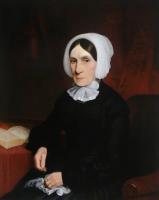


On 17th April 1801 Alfred Curzon was born to Nathaniel Curzon 2nd Baron Scarsdale [aged 48] and Félicité Anne Josephe de Wattines Lady Scarsdale [aged 36]. He married 14th July 1825 Sophia Holden and had issue.


On 17th April 1808 Cecil Chetwynd-Talbot Marchioness Lothian was born to Charles Chetwynd-Talbot 2nd Earl Talbot [aged 30] and Frances Thomasina Lambart Countess Talbot [aged 36]. She married 1831 John Kerr 7th Marquess Lothian, son of William Kerr 6th Marquess Lothian and Harriet Hobart Viscountess Belmore, and had issue.


On 17th April 1829 Vice-Admiral Henry Carr Glyn was born to George Glyn Banker 1st Baron Wolverton [aged 32] and Marianne Grenfell Baroness Wolverton [aged 27].
On 17th April 1832 Robert Loyd-Lindsay 1st Baron Wantage was born to Lieutenant-General James Lindsay [aged 39] and Anne Trotter.
On 17th April 1833 Henrietta Anne Theodosia Vyner Marchioness Ripon was born to Henry Vyner [aged 27] and Mary Gertude Robinson [aged 24]. She married 8th April 1851 her first cousin once removed George Frederick Samuel Robinson 1st Marquess Ripon, son of Frederick John Robinson 1st Earl Ripon and Sarah Albinia Louisa Hobart, and had issue.
On 17th April 1847 Colonel Richard Frederick Meysey-Thompson was born to Harry Meysey-Thompson 1st Baronet [aged 38].
Chronicle of Abbot Ralph of Coggeshall
The Chronicle of Abbot Ralph of Coggeshall (Chronicon Anglicanum) is an indispensable medieval history that brings to life centuries of English and European affairs through the eyes of a learned Cistercian monk. Ralph of Coggeshall, abbot of the Abbey of Coggeshall in Essex in the early 13th century, continued and expanded his community’s chronicle, documenting events from the Norman Conquest of 1066 into the tumultuous reign of King Henry III. Blending eyewitness testimony, careful compilation, and the monastic commitment to record-keeping, this chronicle offers a rare narrative of political intrigue, royal power struggles, and social upheaval in England and beyond. Ralph’s work captures the reigns of pivotal figures such as Richard I and King John, providing invaluable insights into their characters, decisions, and the forces that shaped medieval rule. More than a simple annal, Chronicon Anglicanum conveys the texture of medieval life and governance, making it a rich source for scholars and readers fascinated by English history, monastic authorship, and the shaping of the medieval world.
Available at Amazon in eBook and Paperback format.
On 17th April 1849 Frederic Henley 4th Baron Henley 2nd Baron Northington was born to Anthony Henley 3rd Baron Henley 1st Baron Northington [aged 24] and Julia Peel Baroness Henley. Coefficient of inbreeding 6.25%. He married 20th October 1900 Augusta Frederica Langham.
On 17th April 1864 Admiral Edward Fitzherbert 13th Baron Stafford was born to Basil Thomas Fitzherbert [aged 28] and Emily Charlotte Stafford-Jerningham [aged 29].
On 17th April 1880 James Grimston 4th Earl of Verulam was born to James Walter Grimston 3rd Earl Verulam [aged 27] and Margaret Francis Graham Countess Verulam [aged 26]. He married 27th October 1909 Violet Constance Maitland Brabazon Countess Verulam, daughter of Reginald Brabazon 12th Earl of Meath and Mary Jane Maitland Countess Meath, and had issue.
On 17th April 1880 Alan Ian Percy 8th Duke Northumberland was born to Henry George Percy 7th Duke Northumberland [aged 33] and Edith Campbell Duchess Northumberland [aged 30]. He married 18th November 1911 his fifth cousin Helen Gordon-Lennox Duchess Northumberland, daughter of Charles Gordon-Lennox 7th Duke Richmond and Isabel Sophie Craven, and had issue.
On 17th April 1882 Violet Hyacinth Bowes-Lyon was born to Claude Bowes-Lyon 14th Earl Strathmore and Kinghorne [aged 27] and Cecilia Nina Cavendish-Bentinck Countess of Strathmore and Kinghorne [aged 19]. She died aged eleven in 1893.


On 17th April 1892 Archibald Montagu Stuart-Wortley-Mackenzie 3rd Earl of Wharncliffe was born to Francis Montagu Stuart-Wortley-Mackenzie 2nd Earl of Wharncliffe [aged 35] and Ellen Gallwey Countess of Wharncliffe [aged 29]. He married 24th March 1918 his half fourth cousin twice removed Maud Lillian Elfreda Mary Wentworth-Fitzwilliam, daughter of William Charles de Meuron "Billy" Wentworth-Fitzwilliam 7th and 5th Earl Fitzwilliam and Maud Frederica Elizabeth Dundas Countess Fitzwilliam, and had issue.
On 17th April 1904 Reverend Alfred Maitland 16th Earl of Lauderdale was born to Sydney Maitland [aged 34].
On 17th April 1906 William à Court-Holmes 5th Baron Heytesbury was born to Leonard à Court-Holmes 4th Baron Heytesbury [aged 43].
On 17th April 1912 William Feilding 10th Earl of Denbigh was born to Rudolph Feilding Viscount Feilding [aged 26] and Agnes Imelda Harding [aged 27].
On 17th April 1913 John Patrick Riversdale Glyn 6th Baron Wolverton was born to Maurice George Carr Glyn [aged 41] and Maud Grosvenor [aged 38].
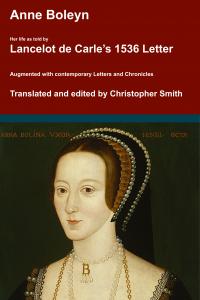
Anne Boleyn. Her Life as told by Lancelot de Carle's 1536 Letter.
In 1536, two weeks after the execution of Anne Boleyn, her brother George and four others, Lancelot du Carle, wrote an extraordinary letter that described Anne's life, and her trial and execution, to which he was a witness. This book presents a new translation of that letter, with additional material from other contemporary sources such as Letters, Hall's and Wriothesley's Chronicles, the pamphlets of Wynkyn the Worde, the Memorial of George Constantyne, the Portuguese Letter and the Baga de Secrets, all of which are provided in Appendices.
Available at Amazon in eBook and Paperback format.
On 17th April 1920 George Harris 6th Baron Harris was born to George St Vincent Harris 5th Baron Harris [aged 30] and Dorothy Mary Crookes Lady Harris.
On 17th April 1920 Roger Edward Lloyd-Mostyn 5th Baron Mostyn was born to Edward Llewelyn Roger Lloyd-Mostyn 4th Baron Mostyn [aged 35].
On 17th April 1926 Henry Gerald St John-Mildmay 9th Baronet was born to Anthony St John-Mildmay 8th Baronet [aged 31] and Violet Hay-Drummond Lady St-John Mildmay [aged 28].
On 17th April 1936 Frederick Smith 3rd Earl of Birkenhead was born to Frederick Smith 2nd Earl of Birkenhead [aged 28].
On 17th April 1946 Robert Tristram Ricketts 8th Baronet was born to Robert Cornwallis Gerald St Leger Ricketts 7th Baronet [aged 28].
On 17th April 1953 Edward Stourton 24th Baron Stourton, 26th Baron Segrave, 25th Baron Mowbray was born to Charles Stourton 23rd Baron Stourton 25th Baron Segrave 24th Baron Mowbray [aged 30] and Jane Faith de Yarburgh-Bateson Baroness-Stourton, Segrave and Mowbray [aged 20].
On 17th April 1968 Ivo Bligh 12th Earl of Darnley was born to Adam Ivo Stuart Bligh 11th Earl of Darnley [aged 26].

On 17th April 1543 William Parr 1st Marquess Northampton [aged 31] and Anne Bourchier 7th Baroness Bourchier [aged 26] were divorced by an Act of Parliament and their children declared illegitimate.
On 17th April 1673 Samuel Grimston 3rd Baronet [aged 30] and Anne Tufton Lady Grimston [aged 19] were married. They had a son and a daughter both of whom died young. She the daughter of John Tufton 2nd Earl of Thanet and Margaret Sackville Countess Isle Thanet [aged 58].
On 17th April 1694 Charles Beauclerk 1st Duke St Albans [aged 23] and Diana Vere Duchess St Albans [aged 15] were married. She by marriage Duchess St Albans. She the daughter of Aubrey de Vere 20th Earl of Oxford [aged 67] and Diana Kirke Countess of Oxford. He the illegitmate son of King Charles II of England Scotland and Ireland and Nell Gwyn.
On 17th April 1734 William Sutherland 17th Earl Sutherland [aged 25] and Elizabeth Wemyss Countess Sutherland [aged 16] were married. She the daughter of David Wemyss 4th Earl of Wemyss and Elizabeth St Clair. They were second cousin once removed.
On 17th April 1780 Thomas Mannock 8th Baronet [aged 61] and Anastasia Browne [aged 30] were married at the house of her brother Reverend Mark Browne 9th Viscount Montagu [aged 35]. The difference in their ages was 30 years.
On 17th April 1795 Charles Cornwallis 2nd Marquess Cornwallis [aged 20] and Louisa Gordon Marchioness Cornwallis [aged 18] were married. She the daughter of Alexander Gordon 4th Duke Gordon [aged 51] and Jane Maxwell Duchess Gordon [aged 47]. He the son of Charles Cornwallis 1st Marquess Cornwallis [aged 56] and Jemima Tullekin Jones Countess Cornwallis.
On 17th April 1800 Joseph Wallis Hoare 3rd Baronet [aged 25] and Harriet O'Brien [aged 25] were married.
On 17th April 1839 John Eardley-Wilmot 2nd Baronet [aged 28] and Eliza Martha Williams Lady Eardley-Williams [aged 26] were married.
On 17th April 1855 William Fitz-Clarence 2nd Earl Munster [aged 30] and Wilhelmina Kennedy-Erskine [aged 24] were married. He the son of George Fitz-Clarence 1st Earl Munster and Mary Wyndham Countess Munster. They were first cousins. He a grandson of King William IV of the United Kingdom. She a granddaughter of King William IV of the United Kingdom.
Annals of the six Kings of England by Nicholas Trivet
Translation of the Annals of the Six Kings of England by that traces the rise and rule of the Angevin aka Plantagenet dynasty from the mid-12th to early 14th century. Written by the Dominican scholar Nicholas Trivet, the work offers a vivid account of English history from the reign of King Stephen through to the death of King Edward I, blending political narrative with moral reflection. Covering the reigns of six monarchs—from Stephen to Edward I—the chronicle explores royal authority, rebellion, war, and the shifting balance between crown, church, and nobility. Trivet provides detailed insight into defining moments such as baronial conflicts, Anglo-French rivalry, and the consolidation of royal power under Edward I, whose reign he describes with particular immediacy. The Annals combines careful year-by-year reporting with thoughtful interpretation, presenting history not merely as a sequence of events but as a moral and political lesson. Ideal for readers interested in medieval history, kingship, and the origins of the English state, this chronicle remains a valuable and accessible window into the turbulent world of the Plantagenet kings.
Available at Amazon in eBook and Paperback format.
On 17th April 1861 Alfred Joseph Doughty-Tichborne 11th Baronet [aged 21] and Theresa Mary Arundell were married.
On 17th April 1874 William Lever 1st Viscount Leverhulme [aged 22] and Elizabeth Ellen Hulme Lady Lever [aged 23] were married.


On 17th April 1877 Henry Merritt [aged 55] and Anne Lea aka Merritt [aged 32] were married. He died three months later. She did not marry again. The difference in their ages was 22 years.

On 17th April 1880 George Manners Astley 20th Baron Hastings [aged 23] and Elizabeth Evelyn Harbord Baroness Hastings [aged 20] were married at the Chapel Royal, Whitehall Palace. She by marriage Baroness Hastings.
On 17th April 1890 Charles Hardinge 1st Baron Penshurt [aged 31] and Winifred Selina Sturt [aged 22] were married. They were first cousins.
On 17th April 1894 Charles James Stanley Howard 10th Earl Carlisle [aged 27] and Rhona Ankaret Estrange Countess Carlisle [aged 26] were married. He the son of George Howard 9th Earl Carlisle [aged 50] and Rosalind Frances Stanley Countess Carlisle [aged 49].
On 17th April 1913 Captain Percy Lyulph Wyndham [aged 25] and Diana Lister Countess of Westmoreland [aged 20] were married at St George's Church, Hanover Square.
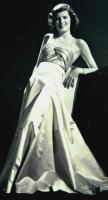
On 17th April 1953 Lieutenant-Colonel Thomas Michael Baring [aged 25] and Sarah Norton [aged 33] were married.
On 17th April 1080 King Harald III of Denmark [aged 40] died. King Canute "The Holy" IV of Denmark [aged 38] was appointed IV King of Denmark.
On 17th April 1331 Robert de Vere 6th Earl of Oxford [aged 73] died. His nephew John [aged 19] succeeded 7th Earl of Oxford.
On 7th or 17th April 1354 Bishop Ralph Stratford [aged 54] died. He was buried in St Paul's Cathedral.
On 17th April 1427 John Valois IV Duke Brabant [aged 23] died. His brother Philip [aged 22] succeeded I Duke Brabant.
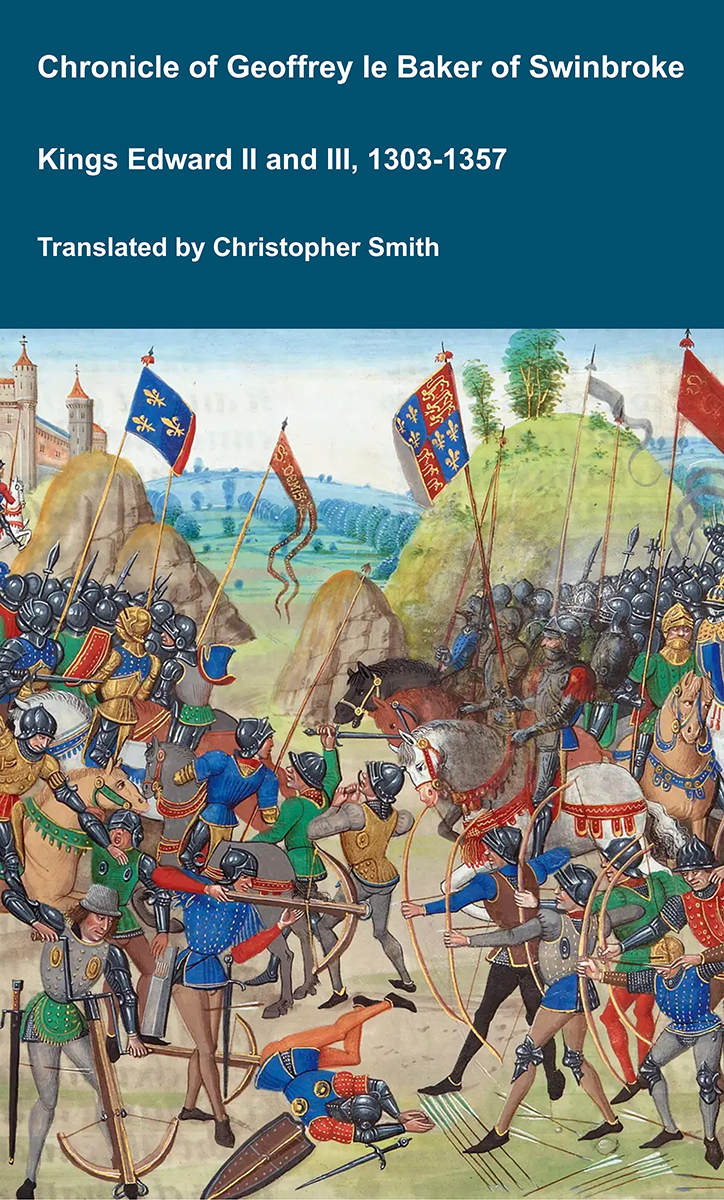
Chronicle of Geoffrey le Baker of Swinbroke
Baker was a secular clerk from Swinbroke, now Swinbrook, an Oxfordshire village two miles east of Burford. His Chronicle describes the events of the period 1303-1356: Gaveston, Bannockburn, Boroughbridge, the murder of King Edward II, the Scottish Wars, Sluys, Crécy, the Black Death, Winchelsea and Poitiers. To quote Herbert Bruce 'it possesses a vigorous and characteristic style, and its value for particular events between 1303 and 1356 has been recognised by its editor and by subsequent writers'. The book provides remarkable detail about the events it describes. Baker's text has been augmented with hundreds of notes, including extracts from other contemporary chronicles, such as the Annales Londonienses, Annales Paulini, Murimuth, Lanercost, Avesbury, Guisborough and Froissart to enrich the reader's understanding. The translation takes as its source the 'Chronicon Galfridi le Baker de Swynebroke' published in 1889, edited by Edward Maunde Thompson.
Available at Amazon in eBook and Paperback format.
On 17th April 1457 Wartislaw Griffins 9th Duke Pomerania died.
On 17th April 1500 Elizabeth Gordon Countess Erroll died.
On 17th April 1524 Edward Stanley 1st Baron Monteagle [aged 62] died at Hornby Castle [Map]. His son Thomas [aged 16] succeeded 2nd Baron Monteagle.
On 17th April 1617 John Carey 3rd Baron Hunsdon [aged 67] died at Hunsdon, Hertfordshire [Map]. His son Henry [aged 37] succeeded 4th Baron Hunsdon. Judith Pelham Countess Dover [aged 26] by marriage Baroness Hunsdon.
On 17th April 1632 Elizabeth Barkham Lady Garrard [aged 39] died.
On 17th April 1643 Elizabeth Bassett Countess Newcastle upon Tyne [aged 51] died at Bolsover, Derbyshire [Map].


On 17th April 1652 Henry Howard 15th or 22nd Earl of Arundel 5th Earl of Surrey 2nd Earl Norfolk [aged 43] died. His son Thomas [aged 25] succeeded 16th or 23rd Earl Arundel, 6th Earl Surrey, 3rd Earl Norfolk, 13th Baron Maltravers, 13th Baron Arundel, 16th Baron Mowbray, 17th Baron Segrave.

On 17th April 1658 Elizabeth Howard Countess Banbury [aged 75] died.
On 17th April 1699 Laurence Barry 3rd Earl Barrymore [aged 35] died. His brother James [aged 32] succeeded 4th Earl Barrymore.
On 17th April 1712 Frances Finch Viscountess Weymouth [aged 62] died. On 3rd May 1712 she was buried at Saints Peter and Paul Church, Longbridge Deverill [Map].
Chronicle of Walter of Guisborough
A canon regular of the Augustinian Guisborough Priory, Yorkshire, formerly known as The Chronicle of Walter of Hemingburgh, describes the period from 1066 to 1346. Before 1274 the Chronicle is based on other works. Thereafter, the Chronicle is original, and a remarkable source for the events of the time. This book provides a translation of the Chronicle from that date. The Latin source for our translation is the 1849 work edited by Hans Claude Hamilton. Hamilton, in his preface, says: 'In the present work we behold perhaps one of the finest samples of our early chronicles, both as regards the value of the events recorded, and the correctness with which they are detailed; Nor will the pleasing style of composition be lightly passed over by those capable of seeing reflected from it the tokens of a vigorous and cultivated mind, and a favourable specimen of the learning and taste of the age in which it was framed.'
Available at Amazon in eBook and Paperback format.
On 17th April 1714 Baptist Noel 3rd Earl Gainsborough [aged 30] died of smallpox. His son Baptist [aged 6] succeeded 4th Earl Gainsborough, 7th Viscount Campden, 7th Baron Hicks of Ilmington in Warwickshire.
On 17th April 1720 James Drummond 2nd Duke Perth [aged 46] died. His son James [aged 6] succeeded 3rd Duke Perth.
On 17th April 1731 Baldwin Conyers 4th Baronet [aged 51] died. His second cousin Ralph [aged 33] succeeded 5th Baronet Conyers of Horden in County Durham. Jane Blakiston Lady Conyers by marriage Lady Conyers of Horden in County Durham.
On 17th April 1732 Pierce Butler 4th Baronet [aged 62] died without male issue. His nephew Richard [aged 33] succeeded 5th Baronet Butler of Cloughgrenan in County Carlow.
On 17th April 1747 Thomas Frankland 3rd Baronet [aged 62] died. His nephew Charles [aged 31] succeeded 4th Baronet Frankland of Thirkleby in Yorkshire.
On 17th April 1751 Henry Petty 1st Earl Shelburne [aged 75] died. Earl Shelburne in County Wexford, Baron Shelburne extinct. His estates were inherited by his nephew John Petty-Fitzmaurice 1st Earl Shelburne [aged 45] who changed his surname to Petty-Fitzmaurice.
On 17th April 1753 Mary Villiers Countess Inchiquin died.

On 17th April 1773 Arthur Saunders Gore 1st Earl Arran [aged 70] died. His son Arthur [aged 38] succeeded 2nd Earl Arran, 2nd Viscount Sudley of Castle Gore in County Mayo, 2nd Baron Saunders of Deeps in County Wexford, 4th Baronet Gore of Newtown in County Mayo. Anne Knight Countess of Arran by marriage Countess Arran.
On 10th February 1780 Samuel Egerton [aged 68] died. On 19th February 1780 he was buried at St Mary's Church, Rostherne, Tatton [Map]. Monument sculpted by John "The Elder" Bacon [aged 39]. Figures representing Hope and Patience.
The monument inscription describes those also buried in the vault: John Egerton, his wife Elizabeth Barbour buried 10th February 1743, her mother Elizabeth Hill [aged 85] buried 17th April 1713 and John and Elizabeth's daughter-in-law Beatrix Copley [aged 22] buried 1st May 1755.
On 17th April 1787 Nigel Gresley 6th Baronet [aged 60] died. He was buried on 21st April 1787 in Bath Abbey [Map]. His son Nigel [aged 34] succeeded 7th Baronet Gresley of Drakelow in Derbyshire.
On 17th April 1799 Robert King 2nd Earl Kingston [aged 45] died. His son George [aged 28] succeeded 3rd Earl Kingston. Helena Moore Countess Kingston [aged 25] by marriage Countess Kingston.
Chronicle of Abbot Ralph of Coggeshall
The Chronicle of Abbot Ralph of Coggeshall (Chronicon Anglicanum) is an indispensable medieval history that brings to life centuries of English and European affairs through the eyes of a learned Cistercian monk. Ralph of Coggeshall, abbot of the Abbey of Coggeshall in Essex in the early 13th century, continued and expanded his community’s chronicle, documenting events from the Norman Conquest of 1066 into the tumultuous reign of King Henry III. Blending eyewitness testimony, careful compilation, and the monastic commitment to record-keeping, this chronicle offers a rare narrative of political intrigue, royal power struggles, and social upheaval in England and beyond. Ralph’s work captures the reigns of pivotal figures such as Richard I and King John, providing invaluable insights into their characters, decisions, and the forces that shaped medieval rule. More than a simple annal, Chronicon Anglicanum conveys the texture of medieval life and governance, making it a rich source for scholars and readers fascinated by English history, monastic authorship, and the shaping of the medieval world.
Available at Amazon in eBook and Paperback format.
On 17th April 1806 Robert Herbert Butler 3rd Earl Lanesborough [aged 46] died. His son Brinsley [aged 22] succeeded 4th Earl Lanesborough.
On 17th April 1811 Alexander Duff 3rd Earl Fife [aged 79] died. His son James [aged 34] succeeded 4th Earl Fife.
On 17th April 1815 Thomas Noel 2nd Viscount Wentworth [aged 69] died without legitmate issue. Viscount Wentworth, Baronet Noel extinct. Baron Wentworth, Baron Despencer abeyant. His sister Judith Noel [aged 64] inherited his estates at which time her husband Ralph Milbanke aka Noel 6th Baronet [aged 67] changed his name from Milbanke to Noel by Royal Licence.
On 17th April 1819 Frances Charlotte Dillon Lee Lady Webb [aged 39] died.
On 17th April 1825 Henry Fuseli [aged 84] died at the house of the Countess of Guildford [aged 55], on Putney Hill
On 17th April 1878 Courtenay Honywood 7th Baronet [aged 43] died. His son John [aged 21] succeeded 8th Baronet Honywood of Evington in Kent.
On 17th April 1891 Mabel Markham Countess Annesley [aged 33] died.
On 17th April 1897 Katharine Buckner McVickar Baroness Grantley died.
On 17th April 1897 Louisa Anne Adams Baroness Aldenham [aged 78] died.
On 17th April 1926 Charles William Noel 3rd Earl Gainsborough [aged 75] died. His son Arthur [aged 41] succeeded 4th Earl Gainsborough, 6th Baron Barham. Alice Mary Eyre Countess Gainsborough by marriage Countess Gainsborough.
This is a translation of the 'Memoires of Jacques du Clercq', published in 1823 in two volumes, edited by Frederic, Baron de Reissenberg. In his introduction Reissenberg writes: 'Jacques du Clercq tells us that he was born in 1424, and that he was a licentiate in law and a counsellor to Philip the Good, Duke of Burgundy, in the castellany of Douai, Lille, and Orchies. It appears that he established his residence at Arras. In 1446, he married the daughter of Baldwin de la Lacherie, a gentleman who lived in Lille. We read in the fifth book of his Memoirs that his father, also named Jacques du Clercq, had married a lady of the Le Camelin family, from Compiègne. His ancestors, always attached to the counts of Flanders, had constantly served them, whether in their councils or in their armies.' The Memoires cover a period of nineteen years beginning in in 1448, ending in in 1467. It appears that the author had intended to extend the Memoirs beyond that date; no doubt illness or death prevented him from carrying out this plan. As Reissenberg writes the 'merit of this work lies in the simplicity of its narrative, in its tone of good faith, and in a certain air of frankness which naturally wins the reader’s confidence.' Du Clercq ranges from events of national and international importance, including events of the Wars of the Roses in England, to simple, everyday local events such as marriages, robberies, murders, trials and deaths, including that of his own father in Book 5; one of his last entries.
Available at Amazon in eBook and Paperback format.
On 17th April 1937 Hugo Denison 4th Earl of Londesborough [aged 42] died. He was buried at St Oswald's Church, Blankney. The Earl had become ill and it was decided to move him to London for treatment; he died on the journey. Earl Londesborough in Yorkshire extinct. His first cousin once removed Ernest [aged 60] succeeded 6th Baron Londesborough of Londesborough in the East Riding of Yorkshire.
The impact of death duties necessitated the sale of Blankney, Lincolnshire to Mr William Parker of Norfolk. The Countess, Marigold Lubbock Countess Londesborough [aged 33], and her daughter Zinnia Rosemary Denison, continued to live on the estate.
On 17th April 1982 Bridget Helen "Biddy" Ruthven Countess Carlisle [aged 85] died.
On 17th April 2018 Rear-Admiral Peter Anson 7th Baronet [aged 93] died. His son Philip [aged 60] succeeded 8th Baronet Anson of Birch Hall in Lancashire.