


02 Feb is in February.
1308 King Edward II and Isabella of France arrive in England
1461 Battle of Mortimer's Cross
1462 Vere Plot to Murder Edward IV
1503 Death and Funeral of Elizabeth of York
1626 English Coronation of Charles I
1685 Death and Burial of Charles II
1874 Wedding of Prince Alfred and Grand Duchess Maria of Russia
02 Feb is the Feast Day of Saint Brigid, Ireland's patroness saint. It is the day she died around 525.
02 Feb is the Pagan Festival of Imbolc. It marks the beginning of spring, and for Christians, it is the feast day of Saint Brigid, Ireland's patroness saint.
On 2nd February 617 Archbishop Laurence died.
On 2nd February 765 Archbishop Jænberht was consecrated Archbishop of Canterbury.
On 2nd February 962 Otto I King Germany I King Italy Holy Roman Emperor (age 49) was created Holy Roman Emperor. Adelaide Welf Holy Roman Empress (age 31) by marriage Holy Roman Empress.
On 2nd February 1141 the army of Empress Matilda (age 38) commanded by Robert Normandy 1st Earl Gloucester (age 42) defeated the army of King Stephen I England (age 47). Matilda's army included Ranulf Gernon 4th Earl Chester (age 42) and Madog ap Maredudd Mathrafal Prince Powys. King Stephen I England, Gilbert Gaunt 1st Earl Lincoln (age 15), William "The Younger" Peverell (age 61) and Ilbert Lacy 3rd Baron Pontefract were captured. William of Blois 1st Earl Albemarle 1st Earl York (age 40) fought for Stephen, his cousin.
Chronicum Anglicanum by Ralph Coggeshall. In the year 1141, a battle took place between King Stephen and Robert, Earl of Gloucester. In this battle, the king [Stephen] was defeated and captured at Lincoln on the Feast of the Purification of Saint Mary, which fell on a Sunday, marked by the letter E in the calendar cycle, on the [2nd February]. However, he was released from captivity on the 18th day before the Kalends of October [14th September], after Earl Robert was captured by William of Ypres.
MCXLI. Bellum factum est inter Stephanum regem et Robertum comitem de Glocestre, in quo victus est rex et captus apud Lincolniam in Purificatione Sanctae Mariae, quae evenit in die Dominica per E litteram stantem, quarto nonas Februarii, et solutus est a carcere octavo decimo kalendas Octobris, capto comite Roberto a Willelmo de Ypra.
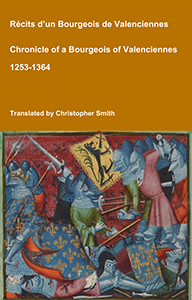
Chronicle of a Bourgeois of Valenciennes
Récits d’un bourgeois de Valenciennes aka The Chronicle of a Bourgeois of Valenciennes is a vivid 14th-century vernacular chronicle written by an anonymous urban chronicler from Valenciennes in the County of Hainaut. It survives in a manuscript that describes local and regional history from about 1253 to 1366, blending chronology, narrative episodes, and eyewitness-style accounts of political, military, and social events in medieval France, Flanders, and the Low Countries. The work begins with a chronological framework of events affecting Valenciennes and its region under rulers such as King Philip VI of France and the shifting allegiances of local nobility. It includes accounts of conflicts, sieges, diplomatic manoeuvres, and the impact of broader struggles like the Hundred Years’ War on urban life in Hainaut. Written from the perspective of a burgher (bourgeois) rather than a monastery or royal court, the chronicle offers a rare lay viewpoint on high politics and warfare, reflecting how merchants, townspeople, and civic institutions experienced the turbulence of the 13th and 14th centuries. Its narrative style combines straightforward reporting of events with moral and civic observations, making it a valuable source for readers interested in medieval urban society, regional politics, and the lived experience of war and governance in pre-modern Europe.
Available at Amazon in eBook and Paperback format.
Chronicon ex Chronicis by Florence and John of Worcester. 2nd February 1141. Stephen made prisoner at the battle of Lincoln. Stephen, king of England, after long toils and sieges of castles, in which he had struggled during five years and six weeks for the peace of the kingdom, at last, on the day of the Purification of St. Mary [2nd February], which fell on Sexagesima Sunday, was, by the just judgment of God, outmaneuvred and taken prisoner at the siege of Lincoln castle by Robert, earl of Gloucester, his uncle's son, and Ranulph, earl of Cheser1, and, being first brought to Gloucester on Quinquagesima Sunday [9th February], was then conducted to the city of Bristol and placed in custody. Many of his adherents were taken with him and thrown into prison.
Note 1. The best account of the battle of Lincoln is given by Henry of Huntingdon, who was a canon of that church, and most probably resident there at the time of the battle. See his History, pp. 273–280, Antiq. Lib. The account in "Gesta Stephani" is singularly deficient in details, ibid, p. 378. Roger of Wendover's is rather more circumstantial, ibid, vol. i., p. 492.
Chronicum Anglicanum by Ralph Coggeshall. In the year 1194, King Richard, having already paid the greater part of his ransom, and having given many hostages for the remainder that was still to be paid, on the feast of the Purification of the Blessed Mary [2nd February]1 was freed from all custody of the emperor, and was permitted to return to his own kingdom. Journeying with his mother and the chancellor through the land of the Duke of Louvain toward the British sea, he waited for a long time at Antwerp for a suitable time to cross. On the Sunday after the feast of Saint Gregory [11th February] he landed in England at the port of Sandwich, with great rejoicing. And at the very hour when the king arrived with his company, namely, the second hour of the day, the sun shining with great brightness, there appeared a most serene and unusual radiance, not far distant from the sun, about the height and breadth of a human body, containing within itself a shining whiteness and a reddish hue, like the likeness of a rainbow. Many who gazed upon this brightness declared that the king had come ashore in England. The king immediately set out for Canterbury, where devoutly he visited Blessed Thomas; then proceeding to London, he was received by the citizens of London with the greatest pomp of joy, the whole city being adorned in many ways and decorated with countless riches in anticipation of the king's arrival. And when news of the king's coming spread, both nobles and commoners hastened eagerly to meet the returning king, longing greatly to see him come back from captivity, whom they had feared would never return.
Anno MCXCIV. Rex Ricardus, maxima jam parte redemptionis suæ persoluta, datisque pluribus obsidibus pro reliqua parte quæ restabat persolvenda, die Purificationis beatæ Mariæ ab omni custodia imperatoris liber effectus est, et ad proprium regnum redire permissus. Qui cum matre sua et cancellario per terram ducis Luvanæ ad mare Britannicum proficiscens, apud Andeworpe aptum tempus transfretandi diutius exspectavit; qui in die Dominica post festum Sancti Gregorii in Angliam cum magno gaudio ad portum Sandwicensem applicuit. Hora autem qua rex cum suis applicuit, scilicet secunda hora diei, sole clarius rutilante, apparuit quidam serenissimus atque insolitus splendor, non longius a sole distans, quasi ad longitudinem et latitudinem humani corporis, candorem præfulgidum atque rubedinem quasi species iridis in se continens; quem splendorem plures intuentes, pronunciabant regem in Anglia fore appulsum. Rex autem illico Cantuariam profectus, beatum Thomam devotus expetiit; deinde Londoniam proficiscens, a civibus Londoniæ cum maxima lætitiæ pompa exceptus est, universa civitate contra regis adventum innumerabilium opum varietate decorata atque multiformiter adornata. Audito autem regis adventu, nobiles pariter et ignobiles adventanti regi cum magna alacritate occurrunt, cernere plurimum cupientes a captivitate regressum, quem pertimuerant nunquam reversurum.
Note 1. The letter from Walter, archbishop of Rouen to Ralph de Diceto has the 4th February: "Let your love know that after we had come to our most beloved lord, the illustrious king of the English, we wrote to no one in England, nor up to the morrow [4th February 1194] of Saint Blaise did we hear anything worth reporting and worthy to be written to you. But on that day the merciful Lord visited his people at Mainz in the liberation of our lord the king. For while we were standing by the lord king until the ninth hour, the archbishops of Mainz and Cologne, speaking before the lord emperor and the lord king and the duke of Austria concerning the king's release, after many anxieties and labours, the same archbishops, who had devoted the greatest effort to securing the king's release, came before the lady queen, and before us, and the bishops of Bath, Ely, and Saintes, and many other nobles, and approached the lord king, bringing him a brief but joyful word. It was this: that the lord emperor signified to him that, though he had long held him in his custody, yet he now released him and set him free, that henceforth he might have power over himself."
On 2nd February 1208 James I King Aragon was born to Peter II King Aragon (age 29) and Marie Montpellier Queen Consort Aragon. He married (1) Violant Árpád Queen Consort Aragon and had issue (2) Teresa Gil Vidaure Queen Consort Aragon (3) his half second cousin Eleanor Ivrea Queen Consort Aragon, daughter of Alfonso VIII King Castile and Eleanor Plantagenet Queen Consort Castile, and had issue.
On 2nd February 1249 Bishop Nicholas Farnham resigned as Bishop of Durham.
On 2nd February 1264 Sancha Burgundy was born to Alfonso III King Portugal (age 53) and Beatrice Queen Consort Portugal (age 22). She a great x 2 granddaughter of King Henry "Curtmantle" II of England. Coefficient of inbreeding 2.41%.
On 2nd February 1294 Louis "Strict" Wittelsbach II Duke Upper Bavaria (age 64) died at Heidelburg. His son Rudolf (age 19) succeeded Rudolph I Duke Bavaria.
Chronicle of Walter of Guisborough. After the death of Lord Edmund, the Earl of Lincoln was placed in command of our forces, with the consent of the entire army. He was a man of charm, great beauty, and exceptional bravery. After restoring the army's morale for a time, he set out around the Feast of Saint John the Baptist and laid siege to the city of Hais for seven weeks, launching assaults against the city nearly every day. But the besieged, confident in their strength and youth, frequently came out to fight and, after some skirmishing, returned again within the walls. At length, when our forces heard that the Count of Artois was coming to aid the defenders, they withdrew to Bayonne. Then, not long afterward, some of our men set out toward the region of Toulouse and burned many towns and cities, returning before winter with a great amount of plunder. At that time, many English soldiers, those who were wounded, weak, or infirm, were discharged, and they returned to England with Lord William de Vescy, who had taken ill. Around the Feast of the Purification of the Blessed Virgin [2nd February 1297], messengers came to our forces at Bayonne from the citizens of Bellegarde and some of our own who had been sent to support them, reporting that they were besieged by the French and that their provisions were nearly exhausted. They warned that unless help came very soon, they would either perish from famine or, something they greatly dreaded, be forced to surrender to the enemy. Hearing this, the earl in command of our forces acted quickly. He made preparations and set out with six hundred armed men and ten thousand chosen foot soldiers, spending that same evening at Perforarde. The next morning, he continued the march until about the eleventh hour, hoping, if possible, to relieve the besieged that same day. All were fully armed and well equipped, as they suspected the enemy to be nearby, though they were not certain. They marched in companies, organized into three distinct divisions, carrying grain and supplies among their ranks. When they were no more than three small leagues from the town, and the day was already well advanced, they hurried to pass through a small forest that lay along the road. Once the first division had emerged from the forest into the open plain, they were met by the Count of Artois, who had 1,500 armed men arranged in four distinct and separate formations. When the two front divisions engaged in battle, our front ranks were pushed back until they reached the second division. But when that division joined the first, and the third also arrived, our forces rallied and turned to face the enemy, and others joined the pursuit.
Post mortem domini Edmundi præficitur nostris comes Lincolniensis, de consensu totius exercitus, homo quidem facetus, pulcherrimus, et strenuissimus. Hic cum aliquantisper recreasset exercitum, circa festum Sancti Johannis Baptistæ egressus est et obsedit urbem Hays per VII ebdomadas, et singulis fere diebus insultum fecit ad urbem. At illi obsessi, de strenuitate et juventute confidentes, multotiens exierunt, et post conflictum aliqualem iterum ingressi sunt. Tandem vero cum audissent nostri quod comes de Arthoys veniret in auxilium cæterorum, reversi sunt usque Bayon. Iteratoque post tempus modicum exierunt quidam ex nostris versus partes Tholosanas, et multas villas et urbes incendio concremarunt, reversique sunt contra hiemem cum præda magna. Tunc licentiati sunt multi ex Anglicis, scilicet vulnerati, debiles et imbecilles, et cum domino Willelmo de Vescy, qui infirmabatur, cum cæteris in Angliam reversi sunt. Circa Purificationem beatæ Virginis miserunt ad nostros qui erant apud Bayon, cives de Belegarde et alii quidam ex nostris qui in eorum auxilio missi fuerant cum obsiderentur a Francis, quod, victualibus fere deficientibus, aut necessario oporteret in proximo eis succurrere, aut obsessos fame deficere, vel, quod abhorrerent in immensum, in manus hostium se tradere. Quo audito, festinavit comes qui nostris præerat, et, præparatis necessariis, profectus est cum sexcentis armatis et x. millibus peditum electorum, mansitque eodem die in vesperis apud Perforarde. Mane autem facto, continuavit inceptum iter usque ad horam undecimam, volens, si posset, eodem die obsessis subvenire. Et erant omnes armati et bene muniti, quia suspicabantur hostes in proximo, non tamen de certo sciebant: gradiebanturque per turmas suas, tribus distinctas aciebus, portantes frumentum et onera inter ipsas suas turmas. Cumque non distarent ab urbe nisi per tres leucas modicas, et esset ipsa dies multum inclinata, silvam quandam modicam, quæ erat in via, transire festinabant. Egressa autem acie prima a silva, occurrit eis in plena planitie comes de Arthoys cum mille quingentis armatis per quatuor acies distinctis et separatis. Congredientibus ergo duabus primis aciebus, retrocedere fecit alios acies nostra usque ad secundam aciem, qua conjuncta cum prima, et superveniente tertia, verterunt se nostri, et alii insequuntur.
John of Fordun's Chronicle. 109. The King of England scours the plains and hills and brings the Kingdom of Scotland under peaceful subjection to himself
In revenge for the foregoing outrages, the king of England (age 63), with a very large force, both by sea and by land, entered Scotland, in the year 1303, with the deliberate design of once for all fully bringing it, and the dwellers therein, under his yoke; or, of sweeping out the inhabitants altogether, and reducing the land itself to an utter and irreclaimable wilderness. Having, therefore, scoured the hills and plains, both on this side of the hills and beyond them, he, in person, reached Lochindorb [Map]; and, after making some stay there, he received the submission of the northern districts, and appointed officers of his in all the castles and fortified towns surrendered to him. Returning thence leisurely, he received the submission of all the communities, as well as fortresses and castles they passed through, with none to withstand or attack him; and, after much winding about through the land, he got to Dunfermline [Map], where he lingered a long time, wintering there until Candlemas. The same year, his son and heir, Edward of Carnarvon (age 18), Prince of Wales, made a long stay in the town of Perth [Map]. Food was in such plenty there, for the whole of the aforesaid time, that a laggen, Scottish measure, of good wine sold for fourpence.
Close Rolls Edward II 1307-1313. 9th February 1308 King Edward II of England (age 23). Dover, Kent [Map]. To Alice, late wife of Roger Bigod, Earl of Norfolk and Marshall of England. Order to meet the king at Dover, Kent [Map] on his return from France with his consort about Sunday next after the Feast of the Purification of St Mary. Witnessed by Piers Gaveston 1st Earl Cornwall (age 24).
The like to:
Elizabeth, Countess of Hereford and Essex (age 25).
Henry de Lancastre (age 27).
Robert de Monte Alto.
Almaric de Sancto Amando[Ibid].
To R Archbishop of Canterbury (age 63). Order to attend the king's coronaion on Sunday next after the feast of St Valentine [14 Feb] at Westminster [Map], to execute what pertains to his office.
To the Sheriff of Surrey. Order to proclaim in market towns, etc., that no knight, esquire, or other shall, under pain of forfeiture, pressure to tourney or make jousts or bordices (torneare, justos seu burdseicas facere), or otherwise go armed at Croydon, Surrey [Map] or elsewhere before the king's coronation.
 Become a Member via our Buy Me a Coffee page to read more.
Chronicle of Robert Fabyan [-1512]. Edwarde, the. iii. of that name, and sone of Edwarde ye seconde and of Isabell the allonly doughter & chylde of Phylyppe le Beawe, or Phylyp the fayre, father to Charlys laste kyng of France, began to reygne as kynge of Englande, his father yet lyuynge, the xxvi. daye of lanuarii, in the ende of the yere of grace. M.CCC. and. xxvi. and the. iiii. yere of Charlys the. v. laste kyng of France, & was crownyd at Westmynster upon the day of the Puryfycacion of our Lady [2nd February 1327] nexte ensuynge.
Chester Chronicle aka Polychronicon of Ralph Higden Volume 8 Chapter 44. Edward, Sonne of kynge Edwarde, after the conqueste the thrydde, of xv. yere in age, was crownede into kynge in the feste of the Purificacion of oure blissed Lady [2nd February 1327] at Westemynstre, his fader beynge in lyve and under kepynge. In the begynnynge of whom the erthe began to ʒiffe moche fruite, the aier temperance, the see tranquilite, the churche liberte.
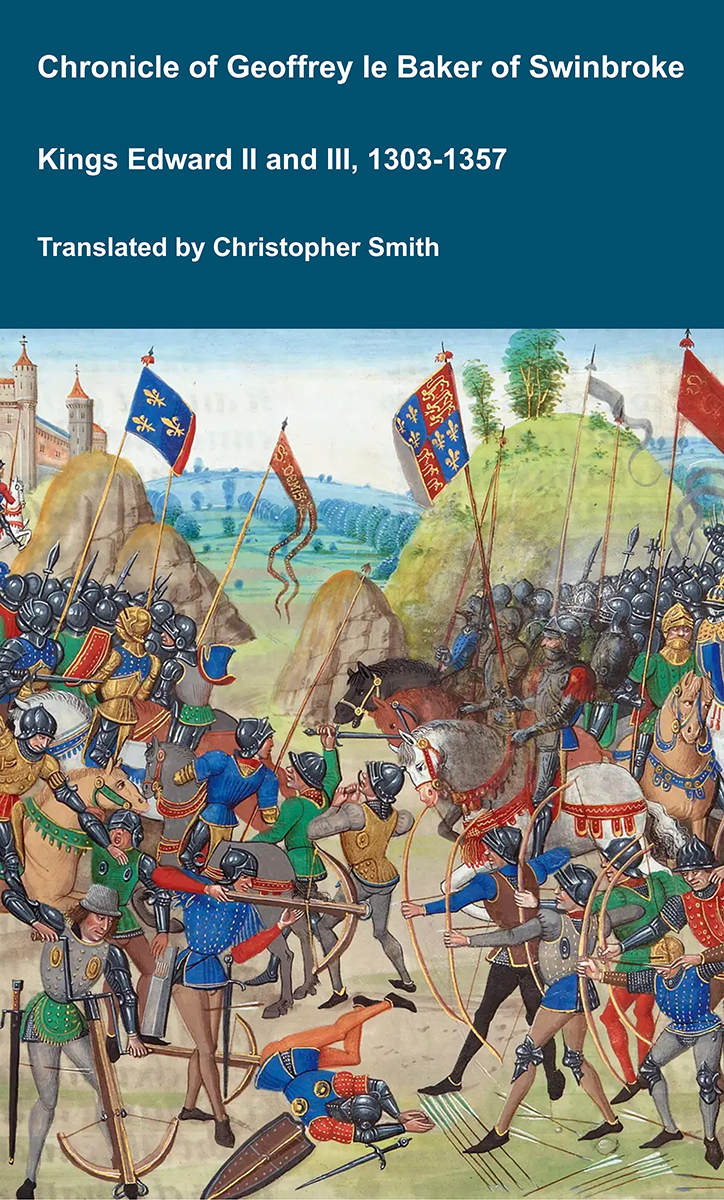
Chronicle of Geoffrey le Baker of Swinbroke
Baker was a secular clerk from Swinbroke, now Swinbrook, an Oxfordshire village two miles east of Burford. His Chronicle describes the events of the period 1303-1356: Gaveston, Bannockburn, Boroughbridge, the murder of King Edward II, the Scottish Wars, Sluys, Crécy, the Black Death, Winchelsea and Poitiers. To quote Herbert Bruce 'it possesses a vigorous and characteristic style, and its value for particular events between 1303 and 1356 has been recognised by its editor and by subsequent writers'. The book provides remarkable detail about the events it describes. Baker's text has been augmented with hundreds of notes, including extracts from other contemporary chronicles, such as the Annales Londonienses, Annales Paulini, Murimuth, Lanercost, Avesbury, Guisborough and Froissart to enrich the reader's understanding. The translation takes as its source the 'Chronicon Galfridi le Baker de Swynebroke' published in 1889, edited by Edward Maunde Thompson.
Available at Amazon in eBook and Paperback format.
Rymer's Fœdera Volume 2. Concerning certain wrongdoers in the city of London.
The King to his beloved and faithful Oliver de Ingham, John Mautravers (age 39), John de Stonore, Robert de Malberthorp, and John de Grantham, Mayor of our city of London, greeting.
Know that whereas it has lately been reported to us that many wrongdoers and disturbers of our peace, from the said city and its suburbs, have bound and confederated themselves together there, and have, with armed force, at various times issued from the said city, and have come with such force against us to our city of Winchester and our town of Bedford; and moreover have committed homicides, depredations, arsons, and other diverse crimes, to our contempt, the terror of the people of those parts, and the manifest injury of our peace, contrary also to the form of the statute lately published at Northampton:
And because our said city of London is our chamber, and by reason thereof the men of the said city are the more strongly bound to the defense of our person and the safeguarding of our rights, we, grievously resenting the premises and wishing them to be punished as is fitting, commanded you, the aforesaid mayor and our sheriffs of London, that you diligently inquire into the premises, and those whom by such inquisition you should find guilty you were to arrest and safely keep until you should have other command from us therein.
And because the premises especially touch us and the state of our crown, and wishing the said inquisitions and all other matters touching them to be duly terminated according to law, we have assigned you to hear and determine the said inquisitions and the indictments made thereupon; and further to inquire concerning the names of such malefactors, and of those who knowingly received them, consented to them, or gave them force, counsel, or aid, or who procured or commanded the said felonies and transgressions to be committed.
And also to inquire concerning those who for bribes have made, and still make, pacts with malefactors and disturbers of our peace, and have hired or do hire them to beat, wound, maltreat, and kill many of our realm in the said city and suburbs, out of enmity and malice. And also to inquire concerning those who have given and still give such bribes, and how much and to whom; and who have received or still receive such bribes, and from whom, and in what manner; and who foster, nourish, and maintain such malefactors in their wickedness within the said city and suburbs.
And also to inquire concerning those who, by reason of their power or lordship, have received, and still do receive, certain persons into their protection and advocacy for payment; and concerning those who have maliciously extorted money or anything else from anyone by grave threats made to them. And also to inquire concerning conspirators and conspiracies, and those who make or have made evil confederacies.
And further concerning oppressions, damages, and grievances in the city of London and its suburbs, committed by various sheriffs, coroners, sub-escheators and their clerks, bailiffs and ministers, constables, keepers of prisons, as well as bailiffs of the said city and suburbs, and their subordinates, under color of their offices, against the men of the said city and suburbs and those coming to them, by false appeals, indictments, imprisonments, heavy ransoms, intolerable distraints on false and unjust pretexts, and by extortions of diverse sums of money and things. And also concerning all other damages and grievances whatsoever inflicted in the city of London and its suburbs. And you shall hear and determine the said transgressions, confederacies, alliances, oppressions, extortions, conspiracies, excesses, felonies, damages, and grievances at our suit, according to the law and custom of our realm.
And therefore we command you that at certain days and places, which you shall appoint for this purpose, you shall examine the said inquisitions and indictments, and hear and determine them, and all and singular the premises, according to the law and custom of our realm, in the form aforesaid—saving, etc.
For we have commanded our aforesaid sheriffs that at certain days and places, which you shall notify to them, they shall cause to come before you as many [jurors] of the said city and suburbs, by whom, etc., and inquiry may be made. And we have also commanded the aforesaid mayor and sheriffs that they shall send to you the said inquisitions and indictments, with all that pertains to them, and that they shall in all and singular the premises aid, obey, and attend you, as you shall notify them on our behalf.
In witness whereof, etc.
Witness the King at Windsor, the second day of February [1329].
By the King himself and the council.
De quibusdam malefactoribus in civitate London.
Rex, dilectis & fidelibus suis, Olivero de Ingham, Johanni Mautravers, Johanni de Stonore, Roberto de Malberthorp, & Johanni de Grantham, majori civitatis nostræ London', salutem.
Sciatis quod cum nuper datum fuisset nobis intelligi, quod quamplures malefactores, & pacis nostræ perturbatores de dictâ civitate & suburbiis ejusdem, se adinvicem ibidem alligârunt & confederârunt, & civitatem predictam armatâ potencia per diversas vices exierunt, & contra nos ad civitatem nostram Wynton' & villam nostram Bedeford', cum hujusmodi potenciâ accesserunt;
Necnon homicidia, depredaciones, incendia, & alia facinora diversa perpetrârunt, in nostri contemptum, & hominum parcium illarum terrorem, ac pacis nostræ lesionem manifestam, & contra formam statuti apud Norhampton' nuper editi; pro eo quod dicta civitas nostra London' camera nostra existit, & eo pretextu homines ejusdem civitatis London' ad defensionem personæ nostræ, & conservacionem nostrorum jurium fortiùs obligantur, premissa molestius referentes, volentesque ea puniri, prout decet;
Mandaverimus vobis, prefate major, & vicecomitibus nostris London', quod de premissis diligenter inquireretis, & illos, quos per inquisicionem hujusmodi culpabiles inveniretis, caperetis, & salvò custodiretis, quousque aliud indè à nobis habueretis in mandatis:
Et quia premissa nos & statum coronæ nostræ specialiter contingunt, volentes inquisiciones predictas, ac omnia alia premissa tangencia, secundum juris exigenciam terminari, assignavimus vos ad inquisiciones, & indictamenta per easdem inquisiciones facta, audiend' & terminand';
Necnon ad inquirend' ulteriùs de nominibus hujusmodi malefactorum, & eorum scienter receptatorum, ac eis consentiencium, aut vim, consilium, & auxilium præbencium, seu dictas felonias & transgressiones fieri procurancium seu præcipiencium;
Et eciam ad inquirendum de illis qui pro muneribus pactum fecerunt, & faciunt cum malefactoribus & pacis nostræ purturbatoribus, & eos conduxerunt, & conducunt ad verberandum, vulnerandum, & malè tractandum, ac interficiendum plures de regno nostro in predictis civitate London' & suburbiis, pro inimicitiâ & maliciâ;
Et eciam ad inquirendum de illis qui hujusmodi munera dederunt & dant, & quantum & quibus, & qui hujusmodi munera receperunt & recipiunt, & à quibus & qualiter & quo modo; & qui hujusmodi malefactores in suâ maliciâ fovent, nutriunt, & manutenent in eisdem civitate London' & suburbiis;
Et eciam ad inquirendum de illis qui, racione potestatis seu dominii sui, aliquos in eorum protectionem & advocacionem pro suo dando susceperunt, & adhuc suscipiunt; & de illis qui pecuniam vel aliud quodcumque ab aliquo, per graves minas eis factas, maliciosè extorserunt;
Et eciam ad inquirendum de conspiratoribus & conspiracionibus, & hiis qui malas confederaciones faciunt, seu fecerunt:
Necnon de oppressionibus, dampnis, & gravaminibus in civitate London' & suburbiis prædictis, per diversos vicecomites, coronatores, subescaetores, & eorum clericos, ballivos ac ministros suos, constabularios, custodes prisonum, necnon ballivos civitatis London', & suburbiorum prædictorum, eorum subministrorum, sub colore officiorum suorum, hominibus de eisdem civitate London' & suburbiis, ab eosdem venientibus per falsa appella, indictamenta, imprisonamenta, graves redempciones, intollerabiles districtiones, ex causis injustis fictis, & diversarum pecuniæ summarum & rerum extorsiones, facta; necnon de omnibus aliis dampnis & gravaminibus quibuscumque in civitate London' & suburbiis predictis illatis, & ad transgressiones, confederaciones, alligaciones, oppressiones, extorsiones, conspiraciones, excessus, felonias, dampna, & gravamina predicta, ad sectam nostram audiend' & terminand' secundum legem & consuetudinem regni nostri.
Et ideò vobis mandamus, quod ad certos dies & loca, quos ad hoc provideritis, inquisiciones & indictamenta predicta examinetis, & ea, ac omnia & singula premissa, secundum legem & consuetudinem regni nostri, audiatis & terminetis in formâ predictâ. Facturi, &c. salvis, &c.
Mandavimus enim predictis vicecom' nostris, quod ad certos dies & loca, quos eis scire faciatis, venire faciant coram vobis, tot, &c. de civitate & suburbiis predictis, per quos, &c. & inquiri.
Mandavimus eciam prefatis majori & vicecom', quod inquisiciones & indictamenta predicta, cum omnibus ea tangentibus, vobis mittant; vobisque in premissis omnibus & singulis assistant, pariant, & intendant, prout eis scire faciatis ex parte nostrâ.
In cujus, &c.
T. R. apud Wyndesore, secundo die Februarii.
Per ipsum Regem & cons'.
Become a Member via our Buy Me a Coffee page to read more.
Chronicle of Geoffrey le Baker of Swinbroke [-1360]. In the year of our Lord 1340, and the fifteenth year of his reign over England, the king celebrated Christmas at Guildford, and afterward held a tournament at Reading. Again, on the feast of the Purification1 [2nd Feb], at Langley of the Boys [King's Langley Priory], on account of the honour of the nobles from Gascony whom he there knighted, he held solemn tournaments. Also in this year, he appointed Sir Robert de Bourchier as Chancellor of England, and Sir Robert de Sadyngton and Sir Robert de Parnynk successively to the office of Treasurer.
Anno Domini MCCCXLJ, regni vero sui Anglie quintodecimo, rex celebravit Christi Natale apud Guldeford, et postea apud Reding hastiludiavit. Iterum in festo Purificacionis, apud Langeley puerorum, propter honourem nobilium de Vasconia quos ibidem cinxit ad ordinem militarem, habuit solempnia hastiludia. Item, hoc anno fecit Robertum de Boursier, militem, cancellarium Anglie, et Robertum de Sadyntone et Robertum de Parnynk, milites, ad officium tesaurarie sucessive ordinavit.
Note 1. Stow Annales 371.
Sir Robert Bourchier was chief justice of the King's Bench in Ireland in 1334. He fought at Cadzand in 1337, and at Crécy in 1346. He was chancellor from the 14th December 1340 to the 27th October 1341. He was summoned to parliament in 1342, and died of the plague in 1349. Robert Parning was a sergeant-at-law only at the beginning of Edward's reign, but in 1340 was rapidly promoted to be justice of the Common Pleas, 23rd May; chief justice of the King's Bench, 24th July; and treasurer, 15th December. On Bourchier's resignation he became chancellor, 27th October 1341; and died 26th August 1343. Robert Sadington was chief baron of the Exchequer in 1337, and treasurer for a brief period, 2nd May to 21st June 1340. He became chancellor in 1343, on the death of Parning, resigned in 1345, and died in 1350. Foss, Judges, 3.
Chronicle of Geoffrey le Baker of Swinbroke [-1360]. In the year of Christ 1351, and the 25th year of the king's reign, after the octave of the Purification of the Glorious Virgin [2nd February 1351], at the parliament held in London at Westminster, Lord Henry (age 41), son of Henry, Earl of Lancaster, himself Earl of Lincoln, Leicester, Derby, Grismond, and Ferrers, was made Duke of Lancaster, receiving liberties and privileges from the royal bounty such as no other earl had ever held. Also Lord Lionel of Antwerp (age 12), the king's son, was made Earl of Ulster in Ireland, Lord John of Gaunt (age 10), his brother, was made Earl of Richmond and Lord Ralph of Stafford (age 49), formerly a baron, was created Earl of the same name.
Anno Christi MCCCLJ et regis XXV post octabas Purificacionis Virginis gloriose, in parliamento Londoniis apud Westmonasterium celebrato, dominus Henricus filius Henrici comitis Lancastrie, ipse comes Lincolnie, Leicestrie, Derbie et Grossimontis atque de Ferrariis, factus est dux Lancastrie, datis sibi libertatibus atque privilegiis munificencia regali qualia nullus comitum habebat. Item, dominus Leunecius de Andewerpe, regis filius, fit comes de Holvestria in Hybernia, et dominus Tohannes de Gandavo, germanus eius, fit comes Richemundie, et dominus Radulfus de Staffordia, pridem baro, comes eiusdem tituli creabatur.
Chronicle of Henry Knighton. [2nd February 1351] In the year of grace 1350, it was a Jubilee Year in Rome, and it began on the Feast of the Annunciation of the Glorious Virgin Mary (March 25). Henry, the noble Earl of Lancaster, was made Duke of Lancaster. He was the first Duke of Lancaster, and before him, no one is known to have held the ducal title in England except in Cornwall. John of Gaunt, son of King Edward, was made Earl of Richmond. Lord Ralph, Baron of Stafford, was made Earl of Stafford. Lord Robert de Ufford was made Earl of Suffolk. And a fifteenth was granted to the king in Parliament. In the same year, John of Valois, son of the King of France, was crowned as King of France.
On 2nd February 1380 King John I of Aragon (age 29) and Yolande of Bar Queen Consort Aragon (age 15) were married. She by marriage Queen Consort Aragon. She the daughter of Robert of Bar 1st Duke of Bar (age 35) and Marie Valois Duchess Bar (age 35). He the son of Peter IV King Aragon (age 60) and Eleanor of Sicily Queen Consort Aragon. They were third cousin once removed. She a great x 3 granddaughter of King Edward I of England.
On 2nd February 1387 King John I of Portugal (age 35) and Philippa of Lancaster Queen Consort Portugal (age 26) were married. She by marriage Queen Consort Portugal. She the daughter of John of Gaunt 1st Duke Lancaster (age 46) and Blanche Duchess of Lancaster. He the son of Peter I King Portugal and Inês Castro. They were half fourth cousins. He a great x 5 grandson of King Henry "Curtmantle" II of England. She a granddaughter of King Edward III of England.
On 2nd February 1426 Eleanor Trastámara Queen Consort Navarre was born to John II King Aragon (age 27) and Blanche Évreux Queen Consort Aragon (age 38). Coefficient of inbreeding 5.57%. She married 1436 Gaston IV Count Foix, son of John I Count Foix and Jeanne Albret Countess Foix, and had issue.
On 2nd February 1432 Elisabetta Visconti Duchess Bavaria (age 58) died.
On 2nd February 1443 Elisabeth Wittelsbach Electress of Saxony was born to Albert Wittelsbach III Duke Bavaria (age 41) and Anna Brunswick Grubenhagen Duchess Bavaria (age 29). She married 19th November 1460 her second cousin once removed Ernest Elector Saxony and had issue.
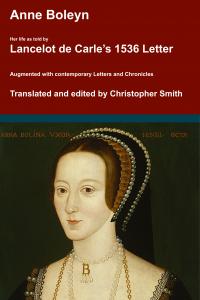
Anne Boleyn. Her Life as told by Lancelot de Carle's 1536 Letter.
In 1536, two weeks after the execution of Anne Boleyn, her brother George and four others, Lancelot du Carle, wrote an extraordinary letter that described Anne's life, and her trial and execution, to which he was a witness. This book presents a new translation of that letter, with additional material from other contemporary sources such as Letters, Hall's and Wriothesley's Chronicles, the pamphlets of Wynkyn the Worde, the Memorial of George Constantyne, the Portuguese Letter and the Baga de Secrets, all of which are provided in Appendices.
Available at Amazon in eBook and Paperback format.
Chronicle of Gregory [1400-1467]. 2nd February 1450. Ande the same year, on Candylmas daye, the King was at Cauntyrbury, and whythe him was the Duke of Excetyr (age 19), the Duke of Somersette (age 44), my Lord of Schrofuysbury (age 67), whythe many moo othyr lordys and many justyces; and there they helde the cessyons iiij dayes, and there were dampnyde many men of the captayne is men for her rysyng, and for her talkyng a gayne the kyng, havynge more favyr unto the Duke of Yorke (age 38) thenne unto the King. And the dampnyde men were drawe, hanggyde, and quarteryde, but they were pardonnyde to be buryde, botlie her quarters of bodys and her heddys with alle.
On 2nd February 1455 John King of Denmark Norway and Sweden was born to Christian I King of Denmark (age 29) and Dorothea of Brandenburg (age 24). He married 6th September 1478 Christina Queen Consort Denmark Norway and Sweden and had issue.
Chronicle of William of Worcester [1415-1482]. 1st February 1461. On the eve of the Purification of the Blessed Virgin Mary [2nd February 1461], a battle took place near Wigmore at Mortimer's Cross, where the Earl of March encountered the Earl of Pembroke with fifty thousand troops against eight thousand, where the Earl of Pembroke (age 29), the Earl of Wiltshire (age 40), and many others fled from the same field. Owen Tudor (age 61) (the father of the said Earl of Pembroke) and John Throckmorton, esquire, along with eight other captains, were beheaded at Hereford.
Vigilia Purificationis beatæ Marias factum est bellum prope Wigmore apud Mortimer Crose, ubi comes Marche occurrit cum li. millibus contra comitem Penbrochiæ cum octo mille, ubi fugerunt de eodem campo comes Penbrochiæ, comes Wyltescire, et multi alii. Ac Owenus Tedere (pater dicti comitis Penbrochiæ), et Johannes Throgmertone, armiger, cum viii. aliis capitaneis decollati sunt apud Herforde.

On 2nd February 1461 at the Battle of Mortimer's Cross at Mortimer's Cross, Herefordshire [Map] the future King Edward IV of England (age 18) commanded the Yorkist forces including William Hastings 1st Baron Hastings (age 30), John Wenlock 1st Baron Wenlock (age 61), John Tuchet 6th Baron Audley, 3rd Baron Tuchet (age 35), John Savage (age 17) and Roger Vaughan (age 51).
In the Lancastrian army Owen Tudor (age 61) (captured by Roger Vaughan) and his son Jasper Tudor 1st Duke Bedford (age 29) fought as well as James Butler 1st Earl Wiltshire 5th Earl Ormonde (age 40) and Henry Roos. Gruffydd ap Nicholas Deheubarth (age 68) were killed. Watkin Vaughan (age 66) and Henry Wogan (age 59) were killed.
Monument to the Battle of Mortimer's Cross at Mortimer's Cross, Herefordshire [Map]. Note Edward IV described as Edward Mortimer. The monument was erected by subscription in 1799.
Gruffydd ap Nicholas Deheubarth: In 1393 he was born to Nicolas ap Philip Deheubarth and Jonet Unknown at Sheffield [Map].
Watkin Vaughan: Around 1395 he was born to Roger Vaughan of Bredwardine and Gwladys ferch Dafydd Gam "Star of Abergavenny" Brecon. Around 1435 Watkin Vaughan and Elinor Wogan were married. The date based on his age being around twenty. The difference in their ages was 29 years.
Henry Wogan: In 1402 he was born to John Wogan at Wiston.
Become a Member via our Buy Me a Coffee page to read more.

On 2nd February 1461 following the battle Owen Tudor (age 61) was beheaded in the Market Place, Hereford [Map]. He was buried thereafter in Greyfriars Church, Hereford in a tomb paid for by his son David Owen (age 2). Somewhat curious that his other son Jasper Tudor 1st Duke Bedford (age 29) didn't contribute although the political situation may have made it difficult to do so.
Memorial to Owen Tudor in the Market Place, Hereford [Map]. Somewhat incongruously between a toddlers merry-go-round and a baked potato stall on the day of our visit.
Chronicle of Gregory [1400-1467]. 2nd February 1461. Alle so Edwarde Erle of Marche (age 18), the Duke of Yorke is son and heyre, hadde a gre jornaye at Mortymer is Crosse in Walys the secunde day of Februar nexte soo folowynge, and there he put to flyght the Erle of Penbroke (age 29), the Erle of Wylteschyre (age 40). And there he toke and slowe of knyghtys and squyers, and of the,a to the nomber of iij M1 [3000]., &c.
Ande in that jornay was Owyn Tetyr (age 61) take and brought unto Herforde este, an he was be heddyde at the market place [Map], and his hedde sette a-pone the hygheyste gryce of the market crosse, and a madde woman kembyd his here and wysche a way the blode of his face, and she gate candellys and sette a-boute him brennynge, moo then a C [Note. One hundred]. Thys Owyne Tytyr was fadyr unto the Erle of Penbroke, and hadde weddyd Quene Kateryn, Kyng Harry the VI (age 39). is modyr, wenyng and trustyng all eway that he shulde not be hedyd tylle he sawe the axe and the blocke, and whenn that he was in his dobelet he trustyd on pardon and grace tylle the coler of his redde vellvet dobbelet was ryppyd of. Then he said, "That hede shalle ly on the stocke that was wonte to ly on Quene Kateryns lappe," and put his herte and mynde holy unto God, and full mekely toke his dethe.
Alle soo the same day that the Erle of Marche shulde take his jornaye towarde Mortymer is Crosse fro Herforde este [Map]b, he mousterd his many without the towne wallys in a mersche that is callyd Wyg mersche. And ovyr him men sayc iij [3] sonnys schynyng.
Note a. So in MS.
Note b. Haverfordwest. [Note. While the note suggests Haverfordwest we believe this is a reference to Hereford?]
Note c. And over him men say three suns shining. A reference to the Parhelion which occurred on the morning of the Battle of Mortimer's Cross.
A Chronicle of London. 2nd February 1461 ... and at Candilmas therle of Marche discomfeited therle of Wiltshire and other at Mortymers crosse;
Chronicle of Edward Hall [1496-1548]. The duke of Yorke, called erle of Marche, somwhat spurred and quickened with these noueltyes, retired backe, & mett with his enemies in a faire playne, nere to Mortimers crosse, not farre from Herford east, on Candelmas day [2nd February 1461] in the mornyng, at whiche tyme the sunne (as some write) appered to the erle of March, like. iii. sunnes [See Parhelion], and sodainly ioined all together in one, and that upon the sight therof, he toke suche courage, that he fiercely set on his enemies, & then shortly discomfited: for which cause, men imagined, that he gaue the sunne in his full brightnes for his cognisaunce or badge. Of his enemies were lefte dead on the ground, iii. M. &. viii. C [3,800]: The erles of Penbroke (age 29) and Wilshyre fled, and syr Owen Tewtber (age 61), father to the sayd erle of Penbroke, which Owen had marled kyng Henries mother (as you have heard before) with Dauid floyde, Morgan ap reuther, & divers other were taken and behedded at the citie of Herford.
Holinshed's Chronicle [1525-1582]. The people on the marches of Wales, for the favour which they bare to the Mortimers linage, more gladlie offered him [the earle of March, now Duke of York] their aid and assistance than he could desire the same; so that he had incontinentlie a puissant armie, to the number of thrée and twentie thousand, readie to go against the quéene, and the murtherers of his father. But when he was setting forward, newes was brought to him, that Iasper earle of Penbroke haife brother to king Henrie, and Iames Butler earle of Ormund and Wilshire, had assembled a great number of Welsh and Irish people to take him: he herewith quickned, retired backe and met with his enimies in a faire plaine, néere to Mortimers crosse [Battle of Mortimer's Cross], not far from Hereford east, on Candlemasse daie [2nd February 1461] in the morning. At which time the sunne (as some write) appeared to the earle of March like three sunnes [See Parhelion], and suddenlie ioineil altogither in one. upon which sight he tooke such courage, that he fiercelie setting on his enimies, put them to flight; and for this cause men imagined, that he gave the sunne in his full brightnesse for his badge or cognisance. Of his enimies were left dead on the ground three thousand and eight hundred.
The earles of Penbroke and Wilshire fled, but sir Owen Teuther father to the said earle of Penbroke (which Owen had married king Henries mother, as yee haue heard before) with Dauid Floid, Morgan ap Reuther, and diuerse other were taken, and beheaded at Hereford.
The History of William Marshal was commissioned by his son shortly after William’s death in 1219 to celebrate the Marshal’s remarkable life; it is an authentic, contemporary voice. The manuscript was discovered in 1861 by French historian Paul Meyer. Meyer published the manuscript in its original Anglo-French in 1891 in two books. This book is a line by line translation of the first of Meyer’s books; lines 1-10152. Book 1 of the History begins in 1139 and ends in 1194. It describes the events of the Anarchy, the role of William’s father John, John’s marriages, William’s childhood, his role as a hostage at the siege of Newbury, his injury and imprisonment in Poitou where he met Eleanor of Aquitaine and his life as a knight errant. It continues with the accusation against him of an improper relationship with Margaret, wife of Henry the Young King, his exile, and return, the death of Henry the Young King, the rebellion of Richard, the future King Richard I, war with France, the death of King Henry II, and the capture of King Richard, and the rebellion of John, the future King John. It ends with the release of King Richard and the death of John Marshal.
Available at Amazon in eBook and Paperback format.
An English Chronicle. The iijde day of Feuerer the same yere [3rd February 1461], Edward the noble erle of Marche faught with the Walsshmen besyde Wygmore in Wales, whos capteyns were the erle of Penbrook and the erle of Wylshyre, that wolde fynally haue dystroyed the sayde erle of Marche.
And the Monday before the daye of batayle [2nd February 1461], that ys to say, in the feest of Puryficacion of oure blessed Lady abowte x atte clocke before none, were seen iij sonnys in the fyrmament shynyng fulle clere, whereof the peple hade grete mervayle, and therof were agast. The noble erle Edward thaym comforted and sayde, "Beethe of good comfort, and dredethe not; thys ys a good sygne, for these iij sonys betokene the Fader, the Sone, and the Holy Gost, and therfore late vs haue a good harte, and in the name of Almyghtye God go we agayns oure enemyes." And so by His grace, he had the vyctory of his enemy es, and put the ij erles to flyghte, and slow of the Walsshemen to the nombre of iiij. M1 [4000].
In 2nd February 1461 John Courtenay 7th or 15th Earl Devon (age 26) was attainted.
Chronicle of Jean de Waurin Books 3-5 [1400-1474]. [2nd February 1461] And the Earl of March knew well that the Earl of Wiltshire had assembled a large force to join the Queen's army. To prevent this, the Earl of March deployed his troops to the fields and went to the place where the Earl of Wiltshire was encamped. He charged straight at him, and six to seven thousand men died on the spot. The queen was greatly displeased by this, as she held great affection for the Earl of Wiltshire.
John Tiptoft by R J Mitchell. 2nd February 1462. Five days before Tiptoft's appointment the Earl of Oxford, his eldest son, John Clopton, Sir Thomas Montgomery, and "William Tyrell were all arrested in Essex on a charge of 'hyghe and myghty treson that they ymagenyd agayne the Kynge'15; it is impossible not to suspect that there was close connection between these two events — the capture of the King's enemies immediately followed by the appointment of his friend and kinsman as their judge. A commission for the arrest of Sir Thomas Tudcnham16, Capgrave's patron, had been issued soon after Edward's accession, and he was captured at about the same time as Oxford and found to be implicated in the plot.
There can be little doubt of Oxford's guilt, though there are two different stories of his plot. The first, and more probable, is that he had been making arrangements for the Duke of Somerset, then in Bruges, to land with an army on the Essex coast; the other, more highly coloured tale, is told by William of Wyrcester17, and in part corroborated by a letter from the Milanese ambassador to the Legate Coppini18. From this account it appears that Oxford and Ins fellow conspirators were to accompany Edward on his expedition to the north and to fall upon his army from the rear as soon as the Lancastrian forces under Margaret of Anjou came within striking distance in the front. Their messenger, bearing Oxford's letter to Queen Margaret and the King in Scotland, became so conscience stricken while attending Mass near Northampton that he took the letter to Edward IV instead. Edwafd had the letters copied, so the story runs, and sent them on again by the hand of this messenger, and then seized Oxford before he had time to carry out his plan.
Note 15. Gregory: Chronicle, p. 218.
Note 16. He had been Keeper of the great wardrobe and Treasurer to the household of Henry VI.
Note 17. Annales, p. 779.
Note 18. Dated 25 March 1462. Calendar of Milanese State Papers, I. 106.
Become a Member via our Buy Me a Coffee page to read more.
On 2nd February 1503 Katherine Tudor was born to King Henry VII of England and Ireland (age 46) and Elizabeth York Queen Consort England (age 36) at the Tower of London [Map]. She died eight days later on 11th February 1503.
On 11th February 1503 (her birthday) Elizabeth York Queen Consort England died from childbirth.


Chronicle of Edward Hall [1496-1548]. 2nd February 1522. The second day of February, the King (age 30) being at Greenwich, came thither the Cardinal with a Legation from Leo bishop of Rome, and also his ambassador, on who waited many a nobleman, the King met them at his chamber door welcoming them as though they had both come from Rome. Then said the Cardinal, high and victorious King it hath pleased our Lord God to indue your grace with a great multitude of manifold graces as a King elect in favour of the high heaven, and so appears presently by your noble person, so formed and figured in shape and stature with force and pulchritude, which signifies the present pleasure of our Lord God wrought in your noble grace. And further he praised his wisdom, prudence and learning, with many other goodly words in the praise of his most noble grace. And finally, the Cardinal declared how the said Bishop of Rome had sent his highness an Act in Bull under lead, declaring therein his grace to be the Defender of the Christian Faith, and his successors for evermore.
And when his grace had received the said Bull and caused it to be read and published, he went to his chapel to hear Mass accompanied with many nobles of his realm and also with Ambassadors of sundry princes, the Cardinal being requested to sing masse, the Erle of Essex brought the Bason with water, the Duke of Suffolk (age 38) gave the assay, the Duke of Norfolk (age 49) held the towel, and so preceded to Masse. And that done gave to all them that heard the masse clean remission and blessed the King and the Queen and all the people: then was the Bull eftsoons declared, and trumpets blew, the shalmes and saggebuttes played in honour of the King's new style. Thus, his highness went to dinner in the midst whereof the King of Heralds and his company began the larges, crying Henricus dei gratia rex Anglie, and Francie, defensor fidei; and dominus Hibernie thus ended the dinner, with much abundance of vittels and wine, to all manner of people.


Become a Member via our Buy Me a Coffee page to read more.
Diary of Edward VI. 2nd February 1550. Sir Anthony Wingfeld (age 63), before visechamberlaine, made controller. Sir Thomas Darcy (age 43) made visechamberlaine.3
Note 3. "On Candlemas day, [Feb. 2] William lord Saint John (age 67) earl of Wiltshire, lord great master, president of the councell, was made Lord Treasurer; John Dudley (age 46) earl of Warwich, lord great chamberlain, was made Lord Great Master; William Parre (age 38), marques of Northampton, was made Lord Great Chamberlain; lord Wentworth was made Lord Cham


Annales of England by John Stow. 2nd February 1550. On Candlemas day, William L. Saint-John earle of Wiltshire (age 67), L. great master, and president of the Counsell, was made Lord Treasurer: John Dudley earle of Warwike (age 46), lord great chamberlaine, was made lorde great master; William Parre Marques of Northhampton (age 38), was made Lorde great Chamberlaine: Lord Wentworth (age 49) was made L. chamberlaine of houshold: Sir Anthony Wingfield (age 63) captaine of the guard, was made comptroller of the kings house; and Thomas Darcy (age 43) knight, was made viz chamberlaine, and captaine of the Guard: and the earle of Arundel late lord Chamberlaine, with the Earle of Southampton (age 44), were put of the counsell, and commanded to heepe their houses in London.
The submission of the D. of Somerset (age 50) prisoner in the tower, made the 2, of Febuary.


On 2nd February 1569 George Talbot 6th Earl of Shrewsbury (age 41) was Keeper of Mary Queen of Scots (age 26) at Tutbury Castle, Staffordshire [Map].


On 2nd February 1597 Lucas van Valckenborch the Elder (age 62) died.
Chronicle of Walter of Guisborough
A canon regular of the Augustinian Guisborough Priory, Yorkshire, formerly known as The Chronicle of Walter of Hemingburgh, describes the period from 1066 to 1346. Before 1274 the Chronicle is based on other works. Thereafter, the Chronicle is original, and a remarkable source for the events of the time. This book provides a translation of the Chronicle from that date. The Latin source for our translation is the 1849 work edited by Hans Claude Hamilton. Hamilton, in his preface, says: 'In the present work we behold perhaps one of the finest samples of our early chronicles, both as regards the value of the events recorded, and the correctness with which they are detailed; Nor will the pleasing style of composition be lightly passed over by those capable of seeing reflected from it the tokens of a vigorous and cultivated mind, and a favourable specimen of the learning and taste of the age in which it was framed.'
Available at Amazon in eBook and Paperback format.

Diary of Anne Clifford. 2nd February 1619. The 2nd my Lord (age 29) went to Buckhurst meaning to lie there private a fortnight or thereabouts.
On 2nd February 1626 King Charles I of England, Scotland and Ireland (age 25) was crowned I King England Scotland and Ireland at Westminster Abbey [Map] by Archbishop George Abbott (age 63). His wife Henrietta Maria (age 16) was not crowned since she being Catholic refused to attend an Anglican service. She watched Charles at a discreet distance.
Robert Radclyffe 5th Earl of Sussex (age 52) carried the Orb.
Francis Talbot 11th Earl of Shrewsbury (age 3) bore the Second Sword of State.
Philip Herbert 4th Earl Pembroke 1st Earl Montgomery (age 41) carried the Spurs.
Francis Manners 6th Earl of Rutland (age 48) bore the Rod with the Dove.
William Cavendish 3rd Earl Devonshire (age 8), James Stanley 7th Earl of Derby (age 19), James Howard 3rd Earl Suffolk (age 6), Roger Palmer (age 49) and Mildmay Fane 2nd Earl of Westmoreland (age 24), John Maynard (age 34) were appointed Knight of the Bath.
John Rayney 1st Baronet (age 25) was knighted.
Become a Member via our Buy Me a Coffee page to read more.
On 2nd February 1645 a Royalist force of Highlanders and Confederate Irish troops under the overall command of James Graham 1st Marquess Montrose (age 32) defeated the forces of Archibald Campbell 1st Marquess Argyll (age 37) who had been camped at Inverlochy Castle.
On 2nd February 1645 Duncan Campbell 2nd Baronet (age 48) was captured and killed at the 1645 Battle of Inverlochy possibly in retaliation for his killing of members of the MacDonald clan at Rathlin Island three years before. His son Dugald (age 20) succeeded 3rd Baronet Campbell of Auchinbreck.
On 2nd February 1650 Nell Gwyn was born.


On 2nd February 1657 Sophie Auguste Oldenburg was born to Ernest Günther Oldenburg I Duke Schleswig Holstein Sonderburg Augustenburg (age 47) and Auguste Oldenburg Duchess Schleswig Holstein Sonderburg Augustenburg (age 23). Coefficient of inbreeding 6.27%. She died aged less than one years old.

Samuel Pepys' Diary. 2nd February 1663. Thence Mr. Povey and I walked to White Hall, it being a great frost still, and after a turn in the Park seeing them slide1, we met at the Committee for Tangier, a good full Committee, and agreed how to proceed in the dispatching of my Lord Rutherford, and treating about this business of Mr. Cholmely (age 30) and Sir J. Lawson's (age 48) proposal for the Mole.
Note 1. Ice-skating.
Samuel Pepys' Diary. 2nd February 1666. Up betimes, and knowing that my Lord Sandwich (age 40) is come to towne with the King (age 35) and Duke (age 32), I to wait upon him, which I did, and find him in very good humour, which I am glad to see with all my heart. Having received his commands, and discoursed with some of his people about my Lord's going, and with Sir Roger Cuttance, who was there, and finds himself slighted by Sir W. Coventry (age 38), I advised him however to look after employment lest it should be said that my Lord's friends do forsake the service after he hath made them rich with the prizes. I to London, and there among other things did look over some pictures at Cade's for my house, and did carry home a silver drudger1 for my cupboard of plate, and did call for my silver chafing dishes, but they are sent home, and the man would not be paid for them, saying that he was paid for them already, and with much ado got him to tell me by Mr. Wayth, but I would not accept of that, but will send him his money, not knowing any courtesy I have yet done him to deserve it.
Note 1. The dredger was probably the drageoir of France; in low Latin, dragerium, or drageria, in which comfits (dragdes) were kept. Roquefort says, "The ladies wore a little spice-box, in shape like a watch, to carry dragles, and it was called a drageoir". The custom continued certainly till the middle of the last century. Old Palsgrave, in his "Eclaircissement de la Langue Francaise", gives "dradge" as spice, rendering it by the French word dragde. Chaucer says, of his Doctor of Physic, "Full ready hadde he his Apothecaries To send him dragges, and his lattuaries". The word sometimes may have signified the pounded condiments in which our forefathers delighted. It is worth notice, that "dragge" was applied to a grain in the eastern counties, though not exclusively there, appearing to denote mixed grain. Bishop Kennett tells us that "dredge mault is mault made up of oats, mixed with barley, of which they make an excellent, freshe, quiete sort of drinke, in Staffordshire". The dredger is still commonly used in our kitchen. B.


Become a Member via our Buy Me a Coffee page to read more.
Samuel Pepys' Diary. 2nd February 1667. So to bed. I am very well pleased this night with reading a poem I brought home with me last night from Westminster Hall [Map], of Dryden's (age 35) upon the present war; a very good poem.


On 2nd February 1673 Thomas Osborne 1st Duke Leeds (age 40) was created 1st Viscount Osborne.
On 2nd February 1675 John Flamsteed (age 28) arrived in London. He stayed at the Tower of London [Map] with Jonas Moore (age 57). He was taken by Silius Titus (age 52) to meet King Charles II of England Scotland and Ireland (age 44).


Abbot John Whethamstede’s Chronicle of the Abbey of St Albans
Abbot John Whethamstede's Register aka Chronicle of his second term at the Abbey of St Albans, 1451-1461, is a remarkable text that describes his first-hand experience of the beginning of the Wars of the Roses including the First and Second Battles of St Albans, 1455 and 1461, respectively, their cause, and their consequences, not least on the Abbey itself. His text also includes Loveday, Blore Heath, Northampton, the Act of Accord, Wakefield, and Towton, and ends with the Coronation of King Edward IV. In addition to the events of the Wars of the Roses, Abbot John, or his scribes who wrote the Chronicle, include details in the life of the Abbey such as charters, letters, land exchanges, visits by legates, and disputes, which provide a rich insight into the day-to-day life of the Abbey, and the challenges faced by its Abbot.
Available at Amazon in eBook and Paperback format.
John Evelyn's Diary. 2nd February 1683. I made my court at St. James's [Map], when I saw the sea charts of Captain Collins (age 40), which that industrious man now brought to show the Duke (age 49), having taken all the coasting from the mouth of the Thames, as far as Wales, and exactly measuring every creek, island, rock, soundings, harbors, sands, and tides, intending next spring to proceed till he had finished the whole island, and that measured by chains and other instruments: a most exact and useful undertaking. He affirmed, that of all the maps put out since, there are none extant so true as those of Joseph Norden, who gave us the first in Queen Elizabeth's time; all since him are erroneous.
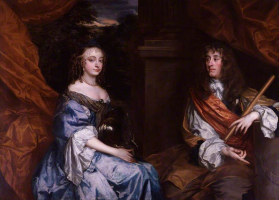


On 2nd February 1685 King Charles II of England Scotland and Ireland (age 54) suffered a sudden apoplectic fit.

John Evelyn's Diary. 2nd February 1690. The Parliament was dissolved by proclamation, and another called to meet the 20th of March. This was a second surprise to the former members; and now the Court party, or, as they call themselves, Church of England, are making their interests in the country. The Marquis of Halifax (age 56) lays down his office of Privy Seal, and pretends to retire.

On 2nd February 1695 James Brydges 1st Duke Chandos (age 22) and Mary Lake (age 26) were married.
On 2nd February 1696 William Borlase was born to John Borlase of Pendeen and Lydia Harris at Pendeen, Cornwall.
On 2nd February 1714 Archbishop John Sharp (age 68) died in Bath, Somerset [Map].
On 2nd February 1725 Francis Scott 2nd Duke Buccleuch (age 30) was appointed 25th Knight of the Thistle.
On 2nd February 1770 George Gordon 5th Duke Gordon was born to Alexander Gordon 4th Duke Gordon (age 26). He married 11th December 1813 Elizabeth Brodie Duchess Gordon.


On 2nd February 1788 James "Athenian" Stuart (age 75) died.
William of Worcester's Chronicle of England
William of Worcester, born around 1415, and died around 1482 was secretary to John Fastolf, the renowned soldier of the Hundred Years War, during which time he collected documents, letters, and wrote a record of events. Following their return to England in 1440 William was witness to major events. Twice in his chronicle he uses the first person: 1. when writing about the murder of Thomas, 7th Baron Scales, in 1460, he writes '… and I saw him lying naked in the cemetery near the porch of the church of St. Mary Overie in Southwark …' and 2. describing King Edward IV's entry into London in 1461 he writes '… proclaimed that all the people themselves were to recognize and acknowledge Edward as king. I was present and heard this, and immediately went down with them into the city'. William’s Chronicle is rich in detail. It is the source of much information about the Wars of the Roses, including the term 'Diabolical Marriage' to describe the marriage of Queen Elizabeth Woodville’s brother John’s marriage to Katherine, Dowager Duchess of Norfolk, he aged twenty, she sixty-five or more, and the story about a paper crown being placed in mockery on the severed head of Richard, 3rd Duke of York.
Available at Amazon in eBook and Paperback format.
On 2nd February 1805 Thomas Banks (age 69) died. He was buried at St Mary's Church, Paddington.
On 2nd February 1846 Frederick John Winston Spencer-Churchill was born to John Winston Spencer-Churchill 7th Duke of Marlborough (age 23) and Frances Anne Emily Vane Duchess of Marlborough (age 23). He died aged four in 1850.
Ten Years' Digging. February 2nd [1848]. - The trenching of the barrow was continued, disclosing, near the centre, a depression below the natural level, which had contained the deposits formerly exhumed. In the course of the day pieces of three different urns were observed, one of coarse material and workmanship, another having been a neatly ornamented drinking cup, and lastly of a kiln-baked vessel of brick-red colour that had been made upon the wheel, and which must be therefore much more modem than the two former. There were also found three more of the bone crescents, part of a large ring of inferior jet or Kimmeridge coal, a small spatula of bone, probably used in the fabrication of pottery; a few instruments of flint, human and animal bones, both burnt and unbumt, and a tine from a stag's horn which has been roughly cut round, most probably with a flint saw.

On 2nd February 1852. Around 1am, following a period of heavy rain, the embankment of the Bilberry reservoir collapsed, releasing 86 million gallons of water down the River Holme. It caused 81 deaths and a large amount of damage to property in the valley leaving many homeless and without work. The buildings and structures destroyed included four mills, ten dye houses, three drying stoves, 27 cottages, seven tradesmen's houses, seven shops, seven bridges crossing the River Holme, ten warehouses, eight barns and stables.
The flood was featured on the front page of the Illustrated London News the following day.
On 2nd February 1866 Enrique Simonet Lombardo was born.
The Times. 2nd February 1874. THE MARRIAGE FESTIVITIES IN RUSSIA. ST. PETERSBURIG. Jan 31 Yesterday the Duke (age 29) and Duchess of Edinburgh (age 20), the Prince (age 32) and Princess of Wales (age 29), and Prince Arthur (age 23) were present with all the Imperial family at the ball given by the Cesarewvitch. The Prince of Wales wore the uniform of the Norfolk Militia and Prince Arthur that of the Rifle Brigade. This evening a grand dinner, to which 400 guests are invited, will be given by the British Ambassador to the Crown Prince and Princess of Germany and Prince Arthur. Later on in the evening all the English Princes will go to the ball given at the Hall of the Nobles at 9:30.
On 2nd February 1880 George Hamilton Seymour-Conway (age 82) died. Monument at Church of St Nicholas, Alcester [Map] sculpted by Prince Victor of Hohenlohe Langenburg Count Gleichen (age 46). Seated figure on Pedestal.
George Hamilton Seymour-Conway: On 21st September 1797 he was born to George Seymour-Conway and Isabella Hamilton. He a great x 3 grandson of King Charles II of England Scotland and Ireland.


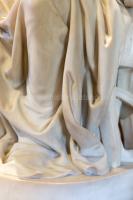


On 2nd February 1882 Andrew Glücksburg was born to George I King Greece (age 36) and Olga Constantinovna Holstein Gottorp Romanov Queen Consort Greece (age 30) at Old Royal Palace. He married 6th October 1903 his fourth cousin once removed Princess Alice of Battenburg, daughter of Prince Louis of Battenburg 1st Marquess Milford Haven and Victoria Hesse Darmstadt Marchioness Milford Haven, and had issue.
On 2nd February 1898 Blanche Katherine Cavendish was born to Victor Christian William Cavendish 9th Duke Devonshire (age 29) and Evelyn Emily Mary Petty-Fitzmaurice Duchess Devonshire (age 27).

The London Gazette 27160. War Office, February 2, 1900. The Queen has been graciously pleased to signify Her intention to confer the decoration of the Victoria Cross on the undermentioned Officers and Non-Commissioned Officer, whose claims have been submitted for Her Majesty's approval, for their conspicuous bravery at the battle of Colenso, as stated against their names:—
The Rifle Brigade (The Prince Consort's Own). Captain W. Congreve. At Colenso on the 15th December, 1899, the detachments serving the guus of the 14th and 66th Batteries, Royal Field Artillery, had all been either killed, wounded, or driven from their guns by Infantry fire at close range, and the guns were deserted.
About 500 yards behind the guns was a donga in which some of the few horses and drivers left alive were sheltered. The intervening space was swept with shell and rifle fire.
Captain Congreve, Rifle Brigade, who was in the donga, assisted to hook a team into a limber, went out; and assisted to limber up a gun. Being wounded, he took shelter; but, seeing Lieutenant Roberts fall, badly wounded, he went out again and brought him in. Captain Congreve was shot tbrough the leg, through the toe of his boot, grazed on the elbow and the shoulder, and his horse shot in three places.
The King's Royal Rifle Corps. Lieutenant the Honourable F. H. S. Roberts (since deceased). Lieutenant Roberts assisted Captain Congreve. He was wounded in three places.
66th Royal Battery, Field Artillery. Corporal G. E. Nurse. Corporal Nurse also assisted.
7th Royal Battery, Artillery Field. Captain H. L. Reed. Captain Reed, who had heard of the difficulty, shortly afterwards brought down three teams from liis battery to see if he could be of any use. He was wounded, as were five of the thirteen men who rode with him, one was killed; and thirteen out of twenty-one horses were killed before he got half-way to the guns, and he was obliged to retire
Become a Member via our Buy Me a Coffee page to read more.

The Times. 2nd February 1905.
Her Royal Highness. Princess Louise (Duchess of Fife) (age 37) and the Duke of Fife (age 55), were invited to luncheon vith Their Majesties The King (age 63) and Queen (age 60) to-day.
His Royal Highness Prince Charles of Denmark (age 32) left the Palace to-day to rejoin tho Danish Cruiser "Heindal," at Southampton, on his return to Denmark.
Mr. Victor Cavendish, M.P, Financial Scretary to the Treasury, Mr. F. P. Horner, Cormnissionor of Woods and Forests, and Lieut. Colonel R. F. Maunsell, R.A., Military Attache at Constantinople, had the honour-of being received by The King.
The Times. 2nd February 1905. The funeral of Lord Henry Vane-Tempest (deceased) took place yesterday in the family vault in St. Peter's [Map], Montgomeryshire. The Bishop of Bangor (age 59), assisted by the Rev J. Williams, rector of the parish, and the Rev. S. J. Evans, officiated. The principal mourmers were the Marquis (age 52) and Marchioness of Londonderry (age 48) (brother and sister-in-law), Lord Herbert Vane-Tempest (age 42) (brother), and Mr. Beaumont (age 44), M.P., and Lady Aline Beaumont (age 41) (brother-in-law and sister). Continues.


Anne Boleyn. Her Life as told by Lancelot de Carle's 1536 Letter.
In 1536, two weeks after the execution of Anne Boleyn, her brother George and four others, Lancelot du Carle, wrote an extraordinary letter that described Anne's life, and her trial and execution, to which he was a witness. This book presents a new translation of that letter, with additional material from other contemporary sources such as Letters, Hall's and Wriothesley's Chronicles, the pamphlets of Wynkyn the Worde, the Memorial of George Constantyne, the Portuguese Letter and the Baga de Secrets, all of which are provided in Appendices.
Available at Amazon in eBook and Paperback format.
On 2nd February 1905 Ernest Louis Hesse Darmstadt Grand Duke (age 36) and Eleonore Solms Hohensolms Lich Grand Duchess were married. He the son of Prince Louis Hesse Darmstadt IV Grand Duke and Princess Alice Saxe Coburg Gotha.
The Times. 2nd February 1907.
Their Majesties the King (age 65) and Queen (age 62), attended by the Countess of Gosford (age 51), the Hon. Charlotte Knollys (age 72), Captain the Hon. Seymour Fortescue, R.N (age 50), and Major F. Ponsonby, left the Palace this morning for the British Embassy, Paris.
Her Royal Highness the Princess Victoria (age 38) accompanied Their Majesties to Calais [Map], and proceeded to Christiania on a visit to Their Majesties the King (age 34) and Queen of Norway (age 37).
Lady Eva Dugdale and Colonel Sir Henry Knollys (age 66) (Comptroller and Private Secretary to Her Majesty the Queen of Norway were in attendance upon Her Royal Highness. The King and Queen are travelling u the Duke and Duchess of Lancaster. The Countess of Gosford has succeeded Lady Alice Stanley as Lady in Waiting to Her Majesty.
The Prince of Wales (age 41), accompanied by Prince Edward of Wales (age 12), was present at Victoria Station, and took leave of the King and Queen on Their Majesties' departure for Paris. The Hon. Derek Keppel (age 43) was in attendance.


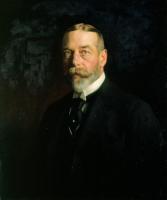


On 2nd February 1907 Colonel Charles Hughes-Hunter 1st Baronet (age 62) died. He was buried at St Edwen's Church, Llanedwen [Map]. His son William (age 27) succeeded 2nd Baronet Hunter of Plâs Côch in Anglesey.
Colonel Charles Hughes-Hunter 1st Baronet: In July 1844 he was born to James Hunter and Jane Gordon. Before 1880 he and Sarah Elizabeth Hughes were married.
William Bulkeley Hughes Hughes-Hunter 2nd Baronet: In 1880 he was born to Colonel Charles Hughes-Hunter 1st Baronet and Sarah Elizabeth Hughes. In 1951 he died. Baronet Hunter of Plâs Côch in Anglesey extinct.


On 2nd February 1910 Anne Wellesley was born to Arthur Charles Wellesley 5th Duke Wellington (age 33) and Lillian Maud Glen Coats Duchess Wellington (age 25). She married 23rd March 1933 Captain David Reginald Rhys, son of Walter FitzUryan Rice 7th Baron Dynevor and Margaret Child-Villiers Baroness Dynevor.


The Times. 2nd February 1911. The Hon. Hugo Charteris, eldest son of Lord (age 53) and Lady Elcho (age 48) and grandson of the Earl of Wenyss (age 92), was married yesterday at St. Margaret's, Westmister [Map], to Lady Violet Manners (age 22), second daughter of the Duke (age 58) and Duchess of Rutland (age 54). The wedding excited much interest, and by the time the bride arrived at the church there was a crowd which extended halfway across Parliament-square. The service was held at 2.15, and by 2 o'clock there was not a vacant seat in the church. The choir stalls and the chancel entrance wetre decorated with flowers, mainly arum lilies. While the guests were assembling the "March" from Trmihauser was played and a guard of honour, supplied by O 'quadron 'of the Gloucestershire Yeomanry, in which the bridegroom holds a commission, lined the. asle.
The bridesmaids, the Ladies Marjorie (age 27) and Diana (age 19),Manners (the bride's sisters), the Hon. Mary (age 16) and the Hon. Irene (age 9) Charteris (sisters of the bridegrom), the Hon. Irene Lawley, Miss Nancy, Lindsay, Miss Elizabeth Manners, and M1iss Felicity Tree awaited the bride by the west door. They were wearing frocks designed from a picture by Botticelli. The gowns of the elder bridesmaids were of champagne; coloured crepe-de-chine with a pink foundation. An embroidery of green leaves showed at the neok and waist. Small roses and daisies were embroidered over the whole frock, and touches ot red velvet appeared beneath the hem and at the elbow. They wore net caps trimmed with red rosebuds. The two younger bridesmaids, who walked immediately behind the bride, wore frocks of pink chiffon, and wreaths of red roses in their hair. The Duke of Rutland accompanied his daughter to the church. The Hon. Guy Charteris (age 25) was best man.
The bride's dress was of white charmeuse with a tunic of old English lace, held in at the waist by a band of gold tissue. The train was of gold brocade mounted on white velvet, at the hem of which were worked in gold the heraldic designs of the Rutland and Wemyss families. The Bishop of Derby officiated, assisted by Canon McCormick and the Rev. F. W. Knox (private chaplain to the Duke of Rutland). A wedding march composed for the occasion by Mr. Raymond Roze was played as the bride and bride-groom left the chut&b.
THE GUESTS.
The Duchess of Wellington (age 62), wearing a dress of old rose velvet with furs and a hat with rose-coloured plumes, brought her daughter, Lady Eileen Wellesley (age 23), who was dressed in sapphire blue velvet, The Duchess of Rutland wore a tunic of grey moire velours over grey chiffon velvet, caught at the shoulders by diamond ornaments, with long tasselled ende falling, in front of the skirt. Her hat was trimmed with flamingo plumes wirith touches of eau-de-nil. The Marchioness of Anglesey wore black satin, witb a hat crowned with many small white plumes. Theh Mfarchioness of Tweeddale wvore a coat and skirt of black braided velvet and a large hat adorned with a royal blue feather. The Prime Minister was present vwith his sister-in-law, Mrs. Oraham Smith. who wore a long black brocaded wrap over a dress of dark material. The Hon. Alfred Lyttelton was accompanied by Mxl. Lyttelton, who was dressed in black satin with touches of bright blue. The French, Germian, and Spanish Ambassadors were also present. Lady Tree wore a dress of Ermine fur, with a hat of green felt trimmed with everlasting flowers; and Lady Lytton wore an embroidered cloak over a dress of grey material, and a small toque with green feathers. Lady Beatrico Rawson, who was wearing pale mauve, brought her daughter, Miss Violet Rawson, who was dressed in navy blue. The Earl and Countess of Wemyss arrived a few minutes before the bride, the latter dressed in soft grey ehil!on voile with marten furs, and wearing a toque trimmed with smalU grey feathers, Lady Beat-rice Hlerbert, who cameo with Viscountess Ingestre, was dressed in black velvet, with a crimson cloak and a collar of old point lace.
Become a Member via our Buy Me a Coffee page to read more.
The Times. 2nd February 1929. Obituary. We regret to announce that Elisabeth Lady Carnarvon (deceased) died yesterday morning at Portofino, to which place she had just come from Albania, the country of which she was so great a benefactor. During the War she was in Egypt and was given special powers of visiting all hospital ships and distributing comforts to the patients. During the last few years she had been living in Albania, where she established hospitals, schools, and anti-malaria clinics, for which she also provided supplies of quinine, which it had been before impossible to secure. She did good work among the people who came down from Northern Albania at the time of the famine, and established a village for refugees, which was called Herbert, after her son, Colonel Aubrey Herbert. She established Boy Scout troops, visited the prisons, and one of the last things she did was to found a library at Tirana. She made an appeal in The Times last August for the Albanian Educational Fund, of which she and Lord Cecil of Chelwood (age 64) were hon. treasurers, asking for books for the students' library and for money to found Albanian studentships abroad. The whole idea in her mind was to continue the work of her son and to forward peace in the Balkans. She was assisted in her work in Albania by Miss Durham and Mrs. Bennington. Lady Carnarvon was Elizabeth Catharine, eldest daughter of Mr. Henry Howard, of Greystoke. She married, in 1878, as his second wife, the fourth Earl of Carnarvon, a states man who, as Colonial Secretary and as Lord Lieuteniant of Ireland, played a notable part in the politics of his day. He died in 1890. Her elder son, Colonel Aubrey Herbert, M.P., traveller, diplomnatist, soldier, and politiciau, who died in September, 1923, was a man of an extraordinarily attractive personality, less rare a century ago perhaps than it is to-day, whose short life was crowded with adventure. His death was a great blow to his innumerable friends; what it meant to his mother can be judged to some extent by her constant devotion to the little country of which he was so faithful a friend. Lady Carnarvon was also a strong supporter of the Vocal Therapy Society, established on Armistice Day, 1918, to provide qualified teachers for ex-Servicemenu in pensions hospitals, and to form them into choirs called King's Services' Choirs. The benefit to the men by the exercise of the healing art of song has been most marked, and Lady Carnarvon was accustomed to appeal for support periodically by interesting letters in The Times. Lady Carnarvon leaves a son, the Hon. Mervyn Herbert (age 46), late of the Diplomatic Service and the Foreign Office. She was the stepmother of Baroness Burghelere (age 65), Lady Margaret Duckworth (age 58), and Lady Victoria Herbert (age 54).


Become a Member via our Buy Me a Coffee page to read more.

On 20th October 1930 Reginald Walkeline Chandos-Pole (age 77) died. Grave with his wife Inez Blanche Marie Clothilde Eva Arent, who died on the 2nd of February 1941, at St Andrew's Church, Radbourne [Map].
Reginald Walkeline Chandos-Pole: On 4th February 1853 he was born to Edward Sacheverell Chandos-Pole and Anna Caroline Stanhope. On 7th March 1882 Reginald Walkeline Chandos-Pole and Violet Catherine Beckett-Denison were married. On 26th October 1898 Reginald Walkeline Chandos-Pole and Inez Blanche Marie Clothilde Eva Arent were married.

2nd February 1934. Bassano Ltd. Photograph of Joan Chetwynd-Talbot (age 22).
Joan Chetwynd-Talbot: On 27th May 1937 Francis Howard Bickerton and she were married. The difference in their ages was 22 years. On 2nd June 1974 Joan Chetwynd-Talbot died.
2nd February 1934. Bassano Ltd. Photograph of Lillian Maud Glen Coats Duchess Wellington (age 49).
Henrici Quinti, Angliæ Regis, Gesta, is a first-hand account of the Agincourt Campaign, and subsequent events to his death in 1422. The author of the first part was a Chaplain in King Henry's retinue who was present from King Henry's departure at Southampton in 1415, at the siege of Harfleur, the battle of Agincourt, and the celebrations on King Henry's return to London. The second part, by another writer, relates the events that took place including the negotiations at Troye, Henry's marriage and his death in 1422.
Available at Amazon in eBook and Paperback format.
On 2nd February 1938. Cover of "Sketch" magazine with Marguerite Rose Bligh aka Tangye (age 24) "face-to-face with her bas-relief".
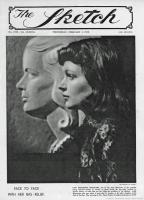


On 2nd February 1970 Bertrand Russell 3rd Earl Russell (age 97) died. His son John (age 48) succeeded 4th Earl Russell of Kingston Russell in Dorset.
On 2nd February 1990 Kathleen Hamilton Duchess of Abercorn (age 84) died.
On 2nd February 1208 James I King Aragon was born to Peter II King Aragon (age 29) and Marie Montpellier Queen Consort Aragon. He married (1) Violant Árpád Queen Consort Aragon and had issue (2) Teresa Gil Vidaure Queen Consort Aragon (3) his half second cousin Eleanor Ivrea Queen Consort Aragon, daughter of Alfonso VIII King Castile and Eleanor Plantagenet Queen Consort Castile, and had issue.
On 2nd February 1264 Sancha Burgundy was born to Alfonso III King Portugal (age 53) and Beatrice Queen Consort Portugal (age 22). She a great x 2 granddaughter of King Henry "Curtmantle" II of England. Coefficient of inbreeding 2.41%.
On 2nd February 1286 Joan Geneville Baroness Mortimer 2nd Baroness Geneville was born to Piers Geneville (age 30) and Jeanne Lusignan (age 26). She married 20th September 1301 her third cousin once removed Roger Mortimer 1st Earl March, son of Edmund Mortimer 2nd Baron Mortimer of Wigmore and Margaret Fiennes, and had issue.
On 2nd February 1349 Joan Montagu Countess Suffolk was born to Edward Montagu 1st Baron Montagu and Alice Plantagenet (age 25). She a great granddaughter of King Edward I of England. She married before 12th June 1376 William Ufford 2nd Earl Suffolk, son of Robert Ufford 1st Earl Suffolk and Margaret Norwich Countess Suffolk, and had issue.

On 2nd February 1383 John Lumley was born to Ralph Lumley 1st Baron Lumley (age 23) and Eleanor Neville Baroness Lumley. He married Felicia Wodecok and had issue.
Jean de Waurin's Chronicle of England Volume 6 Books 3-6: The Wars of the Roses
Jean de Waurin was a French Chronicler, from the Artois region, who was born around 1400, and died around 1474. Waurin’s Chronicle of England, Volume 6, covering the period 1450 to 1471, from which we have selected and translated Chapters relating to the Wars of the Roses, provides a vivid, original, contemporary description of key events some of which he witnessed first-hand, some of which he was told by the key people involved with whom Waurin had a personal relationship.
Available at Amazon in eBook and Paperback format.
On 2nd February 1426 Eleanor Trastámara Queen Consort Navarre was born to John II King Aragon (age 27) and Blanche Évreux Queen Consort Aragon (age 38). Coefficient of inbreeding 5.57%. She married 1436 Gaston IV Count Foix, son of John I Count Foix and Jeanne Albret Countess Foix, and had issue.
On 2nd February 1440 Pierre Savoy was born to Louis Savoy I Count Savoy (age 26) and Anne Cyprus Countess Savoy (age 21) at Geneva.
On 2nd February 1443 Elisabeth Wittelsbach Electress of Saxony was born to Albert Wittelsbach III Duke Bavaria (age 41) and Anna Brunswick Grubenhagen Duchess Bavaria (age 29). She married 19th November 1460 her second cousin once removed Ernest Elector Saxony and had issue.
On 2nd February 1455 John King of Denmark Norway and Sweden was born to Christian I King of Denmark (age 29) and Dorothea of Brandenburg (age 24). He married 6th September 1478 Christina Queen Consort Denmark Norway and Sweden and had issue.
On 2nd February 1503 Katherine Tudor was born to King Henry VII of England and Ireland (age 46) and Elizabeth York Queen Consort England (age 36) at the Tower of London [Map]. She died eight days later on 11th February 1503.
On 11th February 1503 (her birthday) Elizabeth York Queen Consort England died from childbirth.
On 2nd February 1559 Frederick Windsor 4th Baron Windsor was born to Edward Windsor 3rd Baron Windsor (age 27) and Katherine Vere Baroness Windsor (age 19).
On 2nd February 1628 Robert Kemp 2nd Baronet was born to Robert Kemp 1st Baronet and Jane Browne Lady Kemp at Walsingham Priory [Map]. He married (1) 15th July 1650 Mary Kerridge Lady Kemp (2) 20th November 1657 Mary Sone Lady Kemp and had issue.
On 2nd February 1650 Nell Gwyn was born.
On 2nd February 1653 Henrietta Kerr was born to William Kerr 1st Earl Lothian (age 48) and Anne Kerr 3rd Countess of Lothian.
The History of William Marshal was commissioned by his son shortly after William’s death in 1219 to celebrate the Marshal’s remarkable life; it is an authentic, contemporary voice. The manuscript was discovered in 1861 by French historian Paul Meyer. Meyer published the manuscript in its original Anglo-French in 1891 in two books. This book is a line by line translation of the first of Meyer’s books; lines 1-10152. Book 1 of the History begins in 1139 and ends in 1194. It describes the events of the Anarchy, the role of William’s father John, John’s marriages, William’s childhood, his role as a hostage at the siege of Newbury, his injury and imprisonment in Poitou where he met Eleanor of Aquitaine and his life as a knight errant. It continues with the accusation against him of an improper relationship with Margaret, wife of Henry the Young King, his exile, and return, the death of Henry the Young King, the rebellion of Richard, the future King Richard I, war with France, the death of King Henry II, and the capture of King Richard, and the rebellion of John, the future King John. It ends with the release of King Richard and the death of John Marshal.
Available at Amazon in eBook and Paperback format.
On 2nd February 1657 Sophie Auguste Oldenburg was born to Ernest Günther Oldenburg I Duke Schleswig Holstein Sonderburg Augustenburg (age 47) and Auguste Oldenburg Duchess Schleswig Holstein Sonderburg Augustenburg (age 23). Coefficient of inbreeding 6.27%. She died aged less than one years old.

On 2nd February 1677 Peregrine Bertie was born to James Bertie 1st Earl of Abingdon (age 23) and Eleanor Lee Countess Abingdon.
On 2nd February 1696 William Borlase was born to John Borlase of Pendeen and Lydia Harris at Pendeen, Cornwall.
On 2nd February 1719 Edward Coke was born to Thomas William Coke 1st Earl of Leicester (age 21) and Margaret Tufton Countess Leicester (age 18). He married 1st April 1747 Mary Campbell, daughter of John Campbell 2nd Duke Argyll and Jane Warburton Duchess of Argyll.


On 2nd February 1730 Assheton Curzon 1st Viscount Curzon was born to Nathaniel Curzon 4th Baronet (age 54) and Mary Assheton Baroness Curzon (age 36). He married (1) 1756 Esther Hanmer Baroness Curzon and had issue (2) after July 1764 Dorothy Grosvenor Baroness Curzon, daughter of Robert Grosvenor 6th Baronet and Jane Warre Lady Grosvenor, and had issue (3) 1777 Anna Margaretta Meredith Viscountess Curzon Penn Buckinghamshire.


On 2nd February 1733 Louisa Barbara Mansel was born to Bussy Mansel 4th Baron Mansel (age 12) and Barbara Villiers Lady Blackett (age 26). She married 16th July 1757 George Venables-Vernon 2nd Baron Vernon, son of George Venables-Vernon 1st Baron Vernon and Mary Howard, and had issue.
On 2nd February 1744 Horatio Mann 2nd Baronet was born to Galfridus Mann (age 37) and Sarah Gregory. He married 13th April 1765 Lucy Noel, daughter of Baptist Noel 4th Earl Gainsborough and Elizabeth Chapman Countess Gainsborough, and had issue.
On 2nd February 1755 Richard Carr Glyn 1st Baronet was born to Richard Glyn 1st Baronet (age 43).
Abbot John Whethamstede’s Chronicle of the Abbey of St Albans
Abbot John Whethamstede's Register aka Chronicle of his second term at the Abbey of St Albans, 1451-1461, is a remarkable text that describes his first-hand experience of the beginning of the Wars of the Roses including the First and Second Battles of St Albans, 1455 and 1461, respectively, their cause, and their consequences, not least on the Abbey itself. His text also includes Loveday, Blore Heath, Northampton, the Act of Accord, Wakefield, and Towton, and ends with the Coronation of King Edward IV. In addition to the events of the Wars of the Roses, Abbot John, or his scribes who wrote the Chronicle, include details in the life of the Abbey such as charters, letters, land exchanges, visits by legates, and disputes, which provide a rich insight into the day-to-day life of the Abbey, and the challenges faced by its Abbot.
Available at Amazon in eBook and Paperback format.
On 2nd February 1770 George Gordon 5th Duke Gordon was born to Alexander Gordon 4th Duke Gordon (age 26). He married 11th December 1813 Elizabeth Brodie Duchess Gordon.
On 2nd February 1771 Archibald Stuart was born to Francis Stuart 9th Earl of Moray (age 34) and Jean Gray Countess Moray (age 27).
On 2nd February 1771 Francis Stuart 10th Earl of Moray was born to Francis Stuart 9th Earl of Moray (age 34) and Jean Gray Countess Moray (age 27). He married (1) 26th February 1795 Lucy Scott and had issue (2) 7th January 1801 his half first cousin Margaret Jane Ainslie Countess Moray and had issue.
On 2nd February 1776 Bishop Edward Coplestone was born.

On 2nd February 1784 John Fane 11th Earl of Westmoreland was born to John Fane 10th Earl of Westmoreland (age 24) and Sarah Anne Child Countess of Westmoreland (age 19). He married 26th June 1811 Priscilla Anne Wellesley-Pole Countess of Westmoreland, daughter of William Wellesley aka Wellesley-Pole 3rd Earl Mornington and Katherine Forbes Countess Mornington, and had issue.


On 2nd February 1785 John Josiah Guest 1st Baronet was born. He married 29th July 1833 Charlotte Elizabeth Bertie, daughter of Albermarle Bertie 9th Earl Lindsey and Charlotte Layard Countess Lindsey, and had issue.
On 2nd February 1798 Henry Robinson Montagu 6th Baron Rokeby was born to Matthew Robinson Montagu 4th Baron Rokeby (age 35).
On 2nd February 1800 Venerable Carew Antony St John Milmay was born to Henry Paulet St John-Mildmay 3rd Baronet (age 35) and Jane Mildmay Lady St-John Mildmay (age 35). He married 16th December 1830 Caroline Waldegrave, daughter of William Waldegrave 1st Baron Radstock, and had issue.
Abbot John Whethamstede’s Chronicle of the Abbey of St Albans
Abbot John Whethamstede's Register aka Chronicle of his second term at the Abbey of St Albans, 1451-1461, is a remarkable text that describes his first-hand experience of the beginning of the Wars of the Roses including the First and Second Battles of St Albans, 1455 and 1461, respectively, their cause, and their consequences, not least on the Abbey itself. His text also includes Loveday, Blore Heath, Northampton, the Act of Accord, Wakefield, and Towton, and ends with the Coronation of King Edward IV. In addition to the events of the Wars of the Roses, Abbot John, or his scribes who wrote the Chronicle, include details in the life of the Abbey such as charters, letters, land exchanges, visits by legates, and disputes, which provide a rich insight into the day-to-day life of the Abbey, and the challenges faced by its Abbot.
Available at Amazon in eBook and Paperback format.
On 2nd February 1806 William Henry George Wellesley was born to Henry Wellesley 1st Baron Cowley (age 33) and Charlotte Cadogan Marchioness Anglesey (age 24).
On 2nd February 1807 Susan Emily Paton Lady Cunliffe was born. She married 2nd April 1825 Robert Henry Cunliffe 4th Baronet, son of Foster Cunliffe 3rd Baronet and Harriet Kinloch Lady Cunliffe, and had issue.
On 2nd February 1811 Fanny Lucy Shelley was born to John Shelley 6th Baronet (age 38) and Frances Wickley Lady Shelley (age 14). She married 19th May 1834 George Edgecumbe, son of Richard Edgecumbe 2nd Earl of Mount Edgcumbe and Sophia Hobart Countess Mount Edgcumbe, and had issue.
On 2nd February 1815 Francis Needham Viscount Newry was born to Francis Needham 2nd Earl Kilmorley (age 27).
On 2nd February 1816 Marcia Mary Vavasour was born to Edward Marmaduke Stourton aka Vavasour 1st Baronet (age 29). She married 12th November 1835 her sixth cousin William Constable-Maxwell 10th Lord Herries and had issue.
On 2nd February 1827 William Francis Augustus Eliott 8th Baronet was born to William Francis Eliott 7th Baronet (age 35).
On 2nd February 1839 Edward Berkeley Mansel 12th Baronet was born to Major Courtenay Mansel (age 38) and Eliza Sidney.
On 2nd February 1846 Frederick John Winston Spencer-Churchill was born to John Winston Spencer-Churchill 7th Duke of Marlborough (age 23) and Frances Anne Emily Vane Duchess of Marlborough (age 23). He died aged four in 1850.
On 2nd February 1851 James de Hoghton 11th Baronet was born to Henry Bold-Hoghton 8th Baronet (age 52).
On 2nd February 1864 Emma Margaret "Margot" Tennant was born to Charles Tennant 1st Baronet (age 40) and Emma Winsloe Lady Tennant (age 43). She married 10th May 1894 Herbert Henry Asquith 1st Earl of Oxford and Asquith and had issue.


Chronicle of Abbot Ralph of Coggeshall
The Chronicle of Abbot Ralph of Coggeshall (Chronicon Anglicanum) is an indispensable medieval history that brings to life centuries of English and European affairs through the eyes of a learned Cistercian monk. Ralph of Coggeshall, abbot of the Abbey of Coggeshall in Essex in the early 13th century, continued and expanded his community’s chronicle, documenting events from the Norman Conquest of 1066 into the tumultuous reign of King Henry III. Blending eyewitness testimony, careful compilation, and the monastic commitment to record-keeping, this chronicle offers a rare narrative of political intrigue, royal power struggles, and social upheaval in England and beyond. Ralph’s work captures the reigns of pivotal figures such as Richard I and King John, providing invaluable insights into their characters, decisions, and the forces that shaped medieval rule. More than a simple annal, Chronicon Anglicanum conveys the texture of medieval life and governance, making it a rich source for scholars and readers fascinated by English history, monastic authorship, and the shaping of the medieval world.
Available at Amazon in eBook and Paperback format.
On 2nd February 1865 Edward Harvey Williams was born to Frederick Martin Williams 2nd Baronet (age 35) and Mary Christian Law Lady Williams. He married 19th October 1897 Annie Caroline-Molesworth-St Aubyn, daughter of St Aubyn Hender Molesworth-St Aubyn 12th Baronet.
On 2nd February 1866 Enrique Simonet Lombardo was born.
On 2nd February 1871 Edgar Cecil Wolstan Weld-Forester was born to Cecil Weld-Forester 5th Baron Forester (age 28) with his twin brother.
On 2nd February 1871 Francis Henry Cecil Weld-Forester was born to Cecil Weld-Forester 5th Baron Forester (age 28) with his twin brother.
On 2nd February 1879 Rowena Grace Marion Selina Hastings was born to Francis Power Plantagenet Hastings 14th Earl Huntingdon (age 37) and Mary Anne Westenra Countess Huntingdon (age 31). She married 29th July 1901 Graham Paterson and had issue.
On 2nd February 1882 Andrew Glücksburg was born to George I King Greece (age 36) and Olga Constantinovna Holstein Gottorp Romanov Queen Consort Greece (age 30) at Old Royal Palace. He married 6th October 1903 his fourth cousin once removed Princess Alice of Battenburg, daughter of Prince Louis of Battenburg 1st Marquess Milford Haven and Victoria Hesse Darmstadt Marchioness Milford Haven, and had issue.
On 2nd February 1892 Diana Isabel Erskine Lady Fitzherbert was born. She married (1) 15th June 1920 Hugo Meynell FitzHerbert 6th Baronet, son of Richard Fitzherbert 5th Baronet and Mary Anne Arkwright Lady Fitzherbert.
On 2nd February 1898 Blanche Katherine Cavendish was born to Victor Christian William Cavendish 9th Duke Devonshire (age 29) and Evelyn Emily Mary Petty-Fitzmaurice Duchess Devonshire (age 27).
On 2nd February 1909 Arthur Ralph Wilmot 7th Baronet was born to Ralph Henry Sacheverell Wilmot 6th Baronet (age 33).
The Deeds of the Dukes of Normandy
The Gesta Normannorum Ducum [The Deeds of the Dukes of Normandy] is a landmark medieval chronicle tracing the rise and fall of the Norman dynasty from its early roots through the pivotal events surrounding the Norman Conquest of England. Originally penned in Latin by the monk William of Jumièges shortly before 1060 and later expanded at the behest of William the Conqueror, the work chronicles the deeds, politics, battles, and leadership of the Norman dukes, especially William’s own claim to the English throne. The narrative combines earlier historical sources with firsthand information and oral testimony to present an authoritative account of Normandy’s transformation from a Viking settlement into one of medieval Europe’s most powerful realms. William’s history emphasizes the legitimacy, military prowess, and governance of the Norman line, framing their expansion, including the conquest of England, as both divinely sanctioned and noble in purpose. Later chroniclers such as Orderic Vitalis and Robert of Torigni continued the history, extending the coverage into the 12th century, providing broader context on ducal rule and its impact. Today this classic work remains a foundational source for understanding Norman identity, medieval statesmanship, and the historical forces that reshaped England and Western Europe between 800AD and 1100AD.
Available at Amazon in eBook and Paperback format.
On 2nd February 1910 Anne Wellesley was born to Arthur Charles Wellesley 5th Duke Wellington (age 33) and Lillian Maud Glen Coats Duchess Wellington (age 25). She married 23rd March 1933 Captain David Reginald Rhys, son of Walter FitzUryan Rice 7th Baron Dynevor and Margaret Child-Villiers Baroness Dynevor.
On 2nd February 1930 Henry David Shiffner 8th Baronet was born to Henry Burrows Shiffner 7th Baronet (age 27).
On 2nd February 1933 George Frederick Laurence Hyde Villiers 7th Earl Clarendon was born to George Herbert Arthur Edward Hyde Villiers (age 26) and Marion Feodorovna Louise Glyn (age 32).
On 2nd February 1994 Cody Charles Edward Tennant 4th Baron Glenconner was born to Charles Edward Pevensey Tennant (age 36).
On 2nd February 1380 King John I of Aragon (age 29) and Yolande of Bar Queen Consort Aragon (age 15) were married. She by marriage Queen Consort Aragon. She the daughter of Robert of Bar 1st Duke of Bar (age 35) and Marie Valois Duchess Bar (age 35). He the son of Peter IV King Aragon (age 60) and Eleanor of Sicily Queen Consort Aragon. They were third cousin once removed. She a great x 3 granddaughter of King Edward I of England.
On 2nd February 1387 King John I of Portugal (age 35) and Philippa of Lancaster Queen Consort Portugal (age 26) were married. She by marriage Queen Consort Portugal. She the daughter of John of Gaunt 1st Duke Lancaster (age 46) and Blanche Duchess of Lancaster. He the son of Peter I King Portugal and Inês Castro. They were half fourth cousins. He a great x 5 grandson of King Henry "Curtmantle" II of England. She a granddaughter of King Edward III of England.
On 2nd February 1613 Thomas Wilbraham 2nd Baronet (age 12) and Elizabeth Wilbraham (age 27) were married.
On 2nd February 1681 Geoffrey Palmer 3rd Baronet (age 25) and Elizabeth Grantham Lady Palmer (age 17) were married.
Abbot John Whethamstede’s Chronicle of the Abbey of St Albans
Abbot John Whethamstede's Register aka Chronicle of his second term at the Abbey of St Albans, 1451-1461, is a remarkable text that describes his first-hand experience of the beginning of the Wars of the Roses including the First and Second Battles of St Albans, 1455 and 1461, respectively, their cause, and their consequences, not least on the Abbey itself. His text also includes Loveday, Blore Heath, Northampton, the Act of Accord, Wakefield, and Towton, and ends with the Coronation of King Edward IV. In addition to the events of the Wars of the Roses, Abbot John, or his scribes who wrote the Chronicle, include details in the life of the Abbey such as charters, letters, land exchanges, visits by legates, and disputes, which provide a rich insight into the day-to-day life of the Abbey, and the challenges faced by its Abbot.
Available at Amazon in eBook and Paperback format.
On 2nd February 1695 James Brydges 1st Duke Chandos (age 22) and Mary Lake (age 26) were married.
On 2nd February 1739 William Morice 3rd Baronet (age 32) and Lucy Wharton Lady Morice were divorced.
On 2nd February 1761 Bishop Shute Barrington (age 26) and Diana Beauclerk (age 15) were married. She the daughter of Charles Beauclerk 2nd Duke St Albans and Lucy Werden Duchess St Albans.


On 2nd February 1765 William Ullithorne Wray 14th Baronet (age 43) and Frances Bromley (age 24) were married.
On 2nd February 1788 Thomas Noel 2nd Viscount Wentworth (age 42) and Mary Henley Countess Ligonier (age 35) were married. She the daughter of Robert Henley 1st Earl Northington and Jane Huband.
On 2nd February 1821 James Brownlow William Gascoyne-Cecil 2nd Marquess Salisbury (age 29) and Frances Mary Gascoyne Marchioness Salisbury (age 15) were married. He the son of James Cecil 1st Marquess Salisbury (age 72) and Mary Amelia Hill Marchioness Salisbury (age 70).
On 2nd February 1833 George Pitt-Rivers 4th Baron Rivers (age 22) and Susan Georgiana Leveson-Gower Baroness Rivers (age 23) were married at British Embassy, Paris. She by marriage Baroness Rivers of Stratfield Saye in Hampshire. She the daughter of Granville Leveson-Gower 1st Earl Granville (age 59) and Harriet Cavendish Countess Granville (age 47).

On 2nd February 1848 Roundell Palmer 1st Earl Selborne (age 35) and Laura Waldegrave Countess Selborne (age 26) were married. She the daughter of William Waldegrave 8th Earl Waldegrave (age 59).

On 2nd February 1874 Henry Paget 4th Marquess Anglesey (age 38) and Blanche Mary Boyd were married. He the son of Henry Paget 2nd Marquess Anglesey and Henrietta Bagot Marchioness Anglesey.
On 2nd February 1876 James Butler 3rd Marquess Ormonde (age 31) and Elizabeth Harriet Grosvenor Marchioness Ormonde (age 19) were married. She by marriage Marchioness Ormonde. She the daughter of Hugh Lupus Grosvenor 1st Duke Westminster (age 50) and Constance Leveson-Gower Duchess Westminster (age 41). He the son of John Butler 2nd Marquess Ormonde and Frances Paget Marchioness Ormonde (age 59).
Anne Boleyn. Her Life as told by Lancelot de Carle's 1536 Letter.
In 1536, two weeks after the execution of Anne Boleyn, her brother George and four others, Lancelot du Carle, wrote an extraordinary letter that described Anne's life, and her trial and execution, to which he was a witness. This book presents a new translation of that letter, with additional material from other contemporary sources such as Letters, Hall's and Wriothesley's Chronicles, the pamphlets of Wynkyn the Worde, the Memorial of George Constantyne, the Portuguese Letter and the Baga de Secrets, all of which are provided in Appendices.
Available at Amazon in eBook and Paperback format.
On 2nd February 1880 Charles William Noel 3rd Earl Gainsborough (age 29) and Mary Elizabeth Dease were married. He the son of Charles George Noel 2nd Earl Gainsborough (age 61) and Ida Harriet Augusta Hay Countess Gainsborough.
On 2nd February 1881 Tonman Mosley 1st Baron Anslow (age 31) and Hilda Rose Montgomerie Baroness Anslow were married at St Peter's Church, Eaton Square. She the daughter of Archibald William Montgomerie 13th Earl Eglinton.
On 2nd February 1905 Ernest Louis Hesse Darmstadt Grand Duke (age 36) and Eleonore Solms Hohensolms Lich Grand Duchess were married. He the son of Prince Louis Hesse Darmstadt IV Grand Duke and Princess Alice Saxe Coburg Gotha.
On 2nd February 617 Archbishop Laurence died.
On 2nd February 1283 Arnoul Guines III Count Guînes (age 53) died at Guines Castle, Guines. His brother Baldwin (age 40) succeeded 4th Count Guînes.
On 2nd February 1294 Louis "Strict" Wittelsbach II Duke Upper Bavaria (age 64) died at Heidelburg. His son Rudolf (age 19) succeeded Rudolph I Duke Bavaria.
On 2nd February 1347 Bishop Thomas Bek (age 65) died.
On 2nd February 1432 Elisabetta Visconti Duchess Bavaria (age 58) died.
On 2nd February 1461 at the Battle of Mortimer's Cross at Mortimer's Cross, Herefordshire [Map] the future King Edward IV of England (age 18) commanded the Yorkist forces including William Hastings 1st Baron Hastings (age 30), John Wenlock 1st Baron Wenlock (age 61), John Tuchet 6th Baron Audley, 3rd Baron Tuchet (age 35), John Savage (age 17) and Roger Vaughan (age 51).
In the Lancastrian army Owen Tudor (age 61) (captured by Roger Vaughan) and his son Jasper Tudor 1st Duke Bedford (age 29) fought as well as James Butler 1st Earl Wiltshire 5th Earl Ormonde (age 40) and Henry Roos. Gruffydd ap Nicholas Deheubarth (age 68) were killed. Watkin Vaughan (age 66) and Henry Wogan (age 59) were killed.
Monument to the Battle of Mortimer's Cross at Mortimer's Cross, Herefordshire [Map]. Note Edward IV described as Edward Mortimer. The monument was erected by subscription in 1799.
Gruffydd ap Nicholas Deheubarth: In 1393 he was born to Nicolas ap Philip Deheubarth and Jonet Unknown at Sheffield [Map].
Watkin Vaughan: Around 1395 he was born to Roger Vaughan of Bredwardine and Gwladys ferch Dafydd Gam "Star of Abergavenny" Brecon. Around 1435 Watkin Vaughan and Elinor Wogan were married. The date based on his age being around twenty. The difference in their ages was 29 years.
Henry Wogan: In 1402 he was born to John Wogan at Wiston.
Become a Member via our Buy Me a Coffee page to read more.
Abbot John Whethamstede’s Chronicle of the Abbey of St Albans
Abbot John Whethamstede's Register aka Chronicle of his second term at the Abbey of St Albans, 1451-1461, is a remarkable text that describes his first-hand experience of the beginning of the Wars of the Roses including the First and Second Battles of St Albans, 1455 and 1461, respectively, their cause, and their consequences, not least on the Abbey itself. His text also includes Loveday, Blore Heath, Northampton, the Act of Accord, Wakefield, and Towton, and ends with the Coronation of King Edward IV. In addition to the events of the Wars of the Roses, Abbot John, or his scribes who wrote the Chronicle, include details in the life of the Abbey such as charters, letters, land exchanges, visits by legates, and disputes, which provide a rich insight into the day-to-day life of the Abbey, and the challenges faced by its Abbot.
Available at Amazon in eBook and Paperback format.
On 2nd February 1461 following the battle Owen Tudor (age 61) was beheaded in the Market Place, Hereford [Map]. He was buried thereafter in Greyfriars Church, Hereford in a tomb paid for by his son David Owen (age 2). Somewhat curious that his other son Jasper Tudor 1st Duke Bedford (age 29) didn't contribute although the political situation may have made it difficult to do so.
Memorial to Owen Tudor in the Market Place, Hereford [Map]. Somewhat incongruously between a toddlers merry-go-round and a baked potato stall on the day of our visit.
On 2nd February 1558 Katherine le Strange Baroness Hastings (age 59) died.
On 2nd February 1575 Bishop John Parkhurst (age 63) died.
On 2nd February 1597 Lucas van Valckenborch the Elder (age 62) died.
On 2nd February 1614 James Harrington 1st Baronet (age 72) died. He was buried at Church of St Mary Magdalene and St Andrew, Ridlington [Map]. His son Edward succeeded 2nd Baronet Harington of Ridlington in Rutlandshire.
On 2nd February 1645 Duncan Campbell 2nd Baronet (age 48) was captured and killed at the 1645 Battle of Inverlochy possibly in retaliation for his killing of members of the MacDonald clan at Rathlin Island three years before. His son Dugald (age 20) succeeded 3rd Baronet Campbell of Auchinbreck.
On 2nd February 1714 Archbishop John Sharp (age 68) died in Bath, Somerset [Map].
On 2nd February 1740 Edmund Elwill 3rd Baronet died. His son John succeeded 4th Baronet Elwill of Exeter.
On 2nd February 1756 John Trelawny 4th Baronet (age 64) died. His first cousin Harry (age 68) succeeded 5th Baronet Trelawny of Trelawny in Cornwall.
On 2nd February 1759 George Evans 2nd Baron Carbery (age 56) died. His son George (age 26) succeeded 3rd Baron Carbery.
On 2nd February 1775 John Rushout 4th Baronet (age 89) died. His son John (age 36) succeeded 5th Baronet Rushout of Northwick Park in Worcestershire.


On 2nd February 1779 Everard Buckworth 3rd Baronet (age 74) died. He was buried at St Michael and All Angels Church, Sunninghill. His son John (age 52) succeeded 4th Baronet Buckworth of Sheen in Surrey.
The History of William Marshal was commissioned by his son shortly after William’s death in 1219 to celebrate the Marshal’s remarkable life; it is an authentic, contemporary voice. The manuscript was discovered in 1861 by French historian Paul Meyer. Meyer published the manuscript in its original Anglo-French in 1891 in two books. This book is a line by line translation of the first of Meyer’s books; lines 1-10152. Book 1 of the History begins in 1139 and ends in 1194. It describes the events of the Anarchy, the role of William’s father John, John’s marriages, William’s childhood, his role as a hostage at the siege of Newbury, his injury and imprisonment in Poitou where he met Eleanor of Aquitaine and his life as a knight errant. It continues with the accusation against him of an improper relationship with Margaret, wife of Henry the Young King, his exile, and return, the death of Henry the Young King, the rebellion of Richard, the future King Richard I, war with France, the death of King Henry II, and the capture of King Richard, and the rebellion of John, the future King John. It ends with the release of King Richard and the death of John Marshal.
Available at Amazon in eBook and Paperback format.
On 2nd February 1788 James "Athenian" Stuart (age 75) died.
On 2nd February 1802 Charlotte Mainwaring Ellerker Countess of Leicester (age 30) died.
On 2nd February 1802 Welbore Ellis 1st Baron Mendip (age 88) died. His great nephew Henry (age 41) succeeded 2nd Baron Mendip of Mendip in Somerset.
On 2nd February 1802 Armar Lowry-Corry 1st Earl Belmore (age 61) died at Bath, Somerset [Map]. His son Somerset (age 27) succeeded 2nd Earl Belmore in the County of Fermanagh, Viscount Belmore of Fermanagh and Baron Belmore of Castle Coole in the County of Fermanagh. Juliana Butler Countess Belmore (age 18) by marriage Countess Belmore in the County of Fermanagh.


On 2nd February 1805 Thomas Banks (age 69) died. He was buried at St Mary's Church, Paddington.
On 2nd February 1826 Penelope Cooke Countess Cardigan (age 55) died.
On 2nd February 1868 Norton Joseph Knatchbull 10th Baronet (age 59) died. His son Edward (age 34) succeeded 11th Baronet Knatchbull of Mersham Hatch in Kent.
On 2nd February 1877 Georgiana Anne Lumley Lady Milner died.
Abbot John Whethamstede’s Chronicle of the Abbey of St Albans
Abbot John Whethamstede's Register aka Chronicle of his second term at the Abbey of St Albans, 1451-1461, is a remarkable text that describes his first-hand experience of the beginning of the Wars of the Roses including the First and Second Battles of St Albans, 1455 and 1461, respectively, their cause, and their consequences, not least on the Abbey itself. His text also includes Loveday, Blore Heath, Northampton, the Act of Accord, Wakefield, and Towton, and ends with the Coronation of King Edward IV. In addition to the events of the Wars of the Roses, Abbot John, or his scribes who wrote the Chronicle, include details in the life of the Abbey such as charters, letters, land exchanges, visits by legates, and disputes, which provide a rich insight into the day-to-day life of the Abbey, and the challenges faced by its Abbot.
Available at Amazon in eBook and Paperback format.
On 2nd February 1896 Georgiana Susan Pellew Viscountess Sidmouth (age 66) died.
On 2nd February 1902 Geoffrey George Gordon Fitz-Clarence 3rd Earl Munster (age 42) died. His brother Aubrey (age 39) succeeded 4th Earl Munster, 4th Viscount Fitzclarence, 4th Baron Tewkesbury.

On 2nd February 1906 Samuel Cunliffe Lister 1st Baron Masham (age 91) died. His son Samuel (age 49) succeeded 2nd Baron Masham of Swinton.
On 2nd February 1907 Colonel Charles Hughes-Hunter 1st Baronet (age 62) died. He was buried at St Edwen's Church, Llanedwen [Map]. His son William (age 27) succeeded 2nd Baronet Hunter of Plâs Côch in Anglesey.
Colonel Charles Hughes-Hunter 1st Baronet: In July 1844 he was born to James Hunter and Jane Gordon. Before 1880 he and Sarah Elizabeth Hughes were married.
William Bulkeley Hughes Hughes-Hunter 2nd Baronet: In 1880 he was born to Colonel Charles Hughes-Hunter 1st Baronet and Sarah Elizabeth Hughes. In 1951 he died. Baronet Hunter of Plâs Côch in Anglesey extinct.
On 2nd February 1920 Georgiana Macdonald Lady Burne-Jones (age 79) died.




On 2nd February 1929 Georgina Moncrieffe Countess Dudley (age 82) died.


On 2nd February 1937 Walter Shirley 11th Earl Ferrers (age 72) died. His son Robert (age 42) succeeded 12th Earl Ferrers, 18th Baronet Shirley of Staunton Harold in Leicestershire.
On 2nd February 1937 Geoffrey Twisleton-Wykeham-Fiennes 12th or 18th Baron Saye and Sele (age 78) died. His son Geoffrey (age 52) succeeded 13th or 19th Baron Saye and Sele.
Chronicle of a Bourgeois of Valenciennes
Récits d’un bourgeois de Valenciennes aka The Chronicle of a Bourgeois of Valenciennes is a vivid 14th-century vernacular chronicle written by an anonymous urban chronicler from Valenciennes in the County of Hainaut. It survives in a manuscript that describes local and regional history from about 1253 to 1366, blending chronology, narrative episodes, and eyewitness-style accounts of political, military, and social events in medieval France, Flanders, and the Low Countries. The work begins with a chronological framework of events affecting Valenciennes and its region under rulers such as King Philip VI of France and the shifting allegiances of local nobility. It includes accounts of conflicts, sieges, diplomatic manoeuvres, and the impact of broader struggles like the Hundred Years’ War on urban life in Hainaut. Written from the perspective of a burgher (bourgeois) rather than a monastery or royal court, the chronicle offers a rare lay viewpoint on high politics and warfare, reflecting how merchants, townspeople, and civic institutions experienced the turbulence of the 13th and 14th centuries. Its narrative style combines straightforward reporting of events with moral and civic observations, making it a valuable source for readers interested in medieval urban society, regional politics, and the lived experience of war and governance in pre-modern Europe.
Available at Amazon in eBook and Paperback format.
On 2nd February 1951 Richard Morden Harbord 10th Baron Suffield (age 85) died. His son Anthony (age 28) succeeded 11th Baron Suffield, 12th Baronet Harbord-Hamond of Suffield in Norfolk.

On 2nd February 1959 Katherine Mary "Kitty" Hare Marchioness Downshire (age 86) died.
On 2nd February 1970 Bertrand Russell 3rd Earl Russell (age 97) died. His son John (age 48) succeeded 4th Earl Russell of Kingston Russell in Dorset.
On 2nd February 1974 Philippa Fendall Wendell Countess of Galloway (age 68) died.
On 2nd February 1990 Kathleen Hamilton Duchess of Abercorn (age 84) died.
On 2nd February 2001 Patrick Annesley 10th Earl Annesley (age 76) died. His brother Philip (age 73) succeeded 11th Earl Annesley of Castlewellan in County Down, 12th Viscount Glerawly of County Fermanagh, 12th Baron Annesley of Castle Wellan in County Down.