

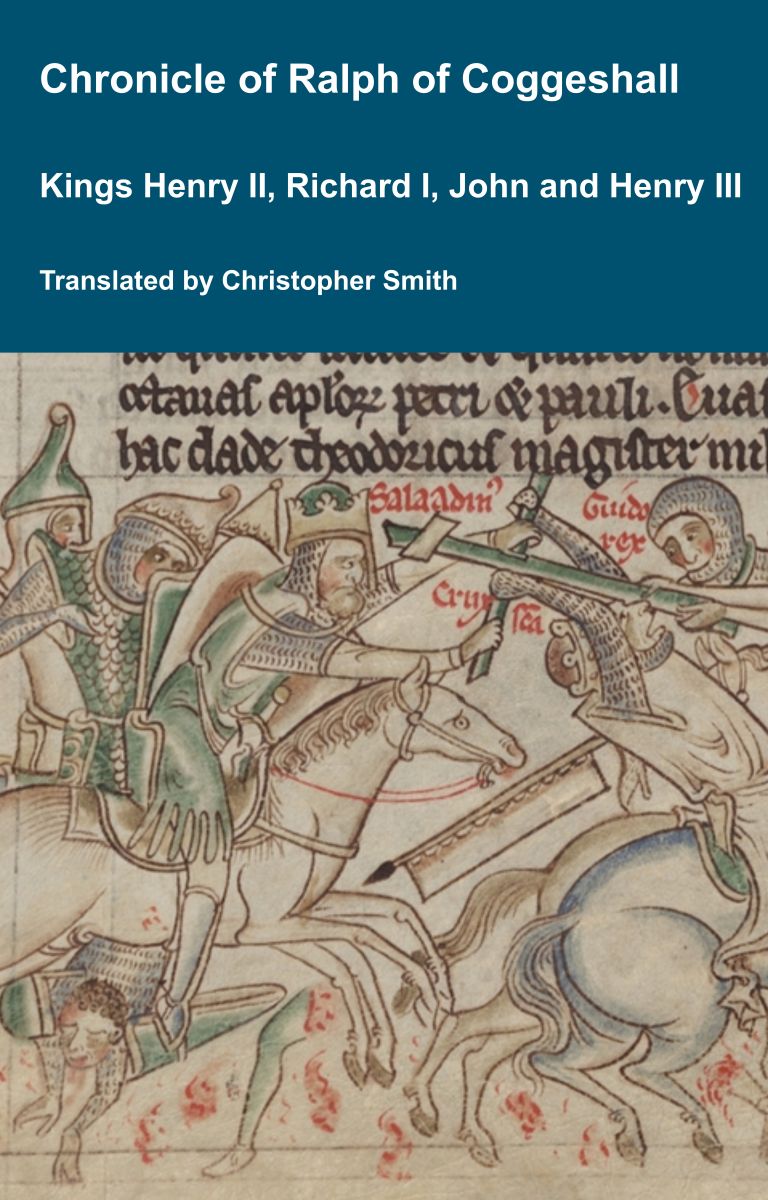
Chronicle of Abbot Ralph of Coggeshall
The Chronicle of Abbot Ralph of Coggeshall (Chronicon Anglicanum) is an indispensable medieval history that brings to life centuries of English and European affairs through the eyes of a learned Cistercian monk. Ralph of Coggeshall, abbot of the Abbey of Coggeshall in Essex in the early 13th century, continued and expanded his community’s chronicle, documenting events from the Norman Conquest of 1066 into the tumultuous reign of King Henry III. Blending eyewitness testimony, careful compilation, and the monastic commitment to record-keeping, this chronicle offers a rare narrative of political intrigue, royal power struggles, and social upheaval in England and beyond. Ralph’s work captures the reigns of pivotal figures such as Richard I and King John, providing invaluable insights into their characters, decisions, and the forces that shaped medieval rule. More than a simple annal, Chronicon Anglicanum conveys the texture of medieval life and governance, making it a rich source for scholars and readers fascinated by English history, monastic authorship, and the shaping of the medieval world.
Available at Amazon in eBook and Paperback format.
03 Aug is in August.
1394 Death and Funeral of Anne of Bohemia
1503 Margaret Tudor's Journey to Scotland
1553 Arrival of Queen Mary I in London
On 3rd August 1057 Pope Stephen IX (age 37) was appointed Stephen IX Pope.
Chronicum Anglicanum by Ralph Coggeshall. 1139. Empress Matilda arrived in England. In the year 1140, King Stephen and Queen Matilda1 founded Coggeshall Abbey [Map], as well as the Abbey of Furness [Map], the Abbey of Longvilliers, and the Abbey of Faversham [Map], where their bodies were later buried. In the same year, a council was held at Coggeshall on the third day before the Nones of August [3rd August].
MCXXXIX. Venit imperatrix Mathildis in Angliam. mcxl. Facta est abbatia de Cogeshala a rege Stephano et regina Mathildi, qui etiam fundaverunt abbatiam de Furneis, et abbatiam de Lungviliers, et abbatiam de Favresham, ubi etiam corpora eorum humata sunt. Eodem anno convenit conventus apud Cogeshala tertio nonas Augusti.
Note 1. Matilda of Flanders, daughter of Eustace, Count of Boulogne, and Mary, daughter of King Malcolm III of Scotland and Margaret of Wessex. She was a sister of Edith aka Matilda, wife of King Henry I of England. Mary and King Stephen were married in 1125. They had three children: Eustace, died aged twenty-three in 1153, Matilda, died young and Marie who married Matthew of Metz in 1160.
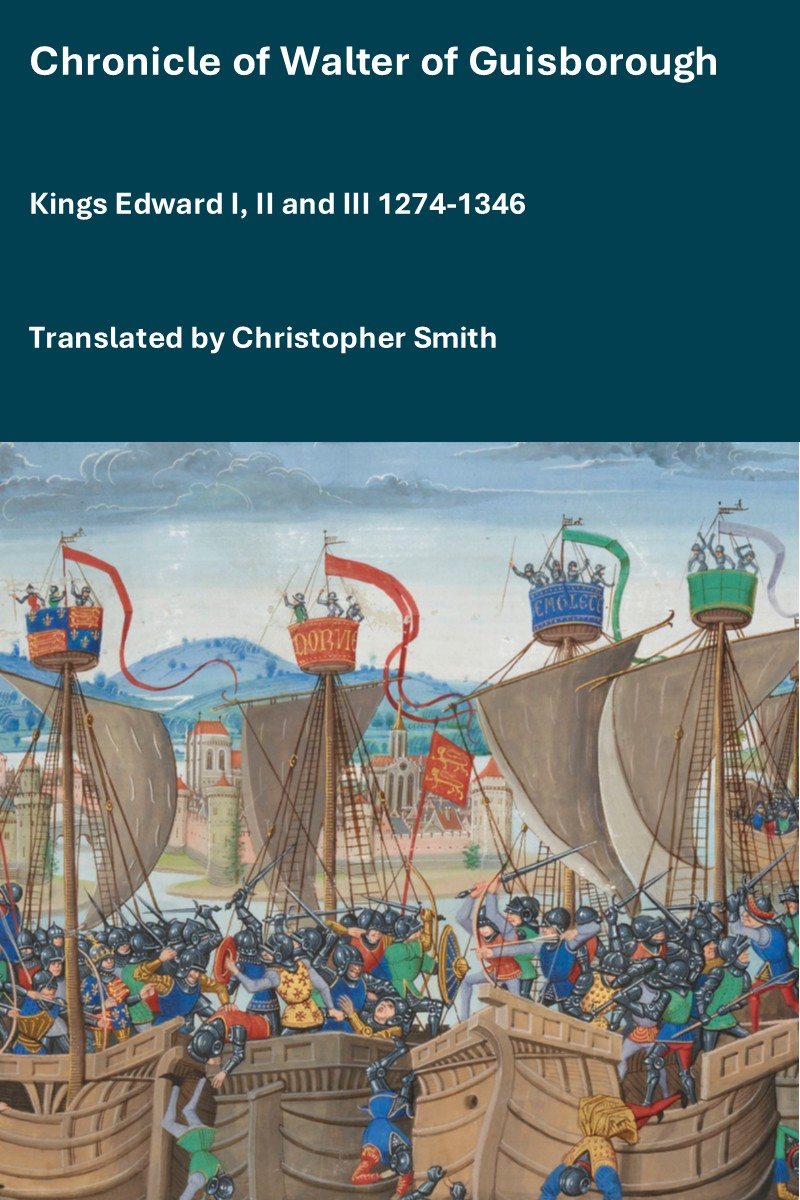 Chronicle of Walter of Guisborough. Upon receiving the news, he rose in the night and departed, arriving at the place which the female scout had predetermined for him to arm himself, a deep valley near the castle. While they were putting on their armour and girding their horses, they heard a noise approaching from afar and were afraid, saying, "Our enemies have been warned, and behold, now they are coming." Immediately they mounted their horses and readied their lances. They formed their battle lines before dawn and proceeded on the road. They came upon the enemy's long supply wagons, which had gone out to gather provisions, and captured them at once. The horses were distributed among the army to replace the tired ones. Advancing further, they charged the enemy at daybreak and found them sleeping in the town and abbey, many of them having been made drunk with wine. After killing many of the common folk, they captured around fifteen chosen standard-bearers and seized much plunder. The younger Simon [de Montfort], who had spent the night in the castle, escaped capture with only a few companions. These events took place on the 2nd of August, in the year of the Lord 1265. Immediately they returned to Worcester. When Edward heard that Earl Simon was advancing toward Kenilworth to join his son's army and make it stronger, he set out to intercept him and met him on the third day near Evesham.
et accepto nuncio consurgens de nocte abiit, et pervenit ad locum quem præordinaverat exploratrix illa ad armandum se, erat enim vallis profunda et prope locum castri; dumque armarent se, et equos cingerent, audiebant sonitum a longe venientem, et timebant, dicentes, "Præmuniti sunt hostes nostri, et ecce jam veniunt;" statimque ascenderunt equos et lanceas in manibus adaptabant; cumque direxissent acies suas ante diluculum et processissent in itinere, venerunt hostium Henry III longæ quadrigæ ut victualia quærerent, et continuo captæ sunt, et equi distributi in loco lassatorum equorum per exercitum: procedentes vero irruerunt in hostes summo diluculo et invenerunt eos dormientes in villa et abbatia, et erant multi muniti sanguine vineæ peremptis ergo multis de communi populo, ceperunt circa quindecim vexillarios electos et spolia multa, Simon vero juvenis qui pernoctaverat in castro sic cum paucis captionem evasit. Gesta sunt hæc IV nonas Augusti anno Domini MCCLXV et statim ad Wircestriam reversi sunt: cumque audisset Edwardus comitem Simonem in veniendo esse versus Kenylworth ut exercitui filii sui se conjungeret et fieret fortior, processit obviam ei die tertio apud Evesham,
On 3rd August 1265 Bishop Walter de Cantelupe (age 74) had dinner with Simon de Montfort 6th Earl of Leicester 1st Earl Chester (age 57) before the Battle of Evesham.
Chronicle of William Rishanger. On the following day, which was the Feast of the Finding of Saint Stephen [3rd August 1265], Edward moved from Worcester, and after crossing the river near the town called Clive1, intercepted the road between the Earl and his son who was at the castle of Kenilworth, thus cutting off the son from the father. The next day, Edward approached the town of Evesham from one direction; and from the two other sides came the Earl of Gloucester with his battle line, and Roger de Mortimer with his troop. Thus the Earl of Leicester, surrounded on all sides, was compelled either to surrender voluntarily, or to engage in battle with them.
Note 1. Called Clinemam in Wats's text. Possibly the Warwickshire River Avon.
In crastino namque, qui erat dies Inventionis Sancti Stephani, Edwardus, movens se de Wygornia, transito fluvio juxta oppidum quod dicitur Clive, viam Comiti versus filium suum, qui erat in castro de Kenelwurthe, filiique ad patrem, interclusit. In crastino vero appropinquavit oppido Evishamiæ ex parte una, veneruntque ex duabus partibus aliis Comes Gloverniæ, cum acie sua, et Rogerus de Mortuo Mari, cum sua turma. Ita Comes Leycestriæ, undique conclusus, necesse habuit, spontanee & dedere, vel cum istis prœlio decertare.
On 3rd August 1347 the English captured Calais [Map] providing England with a French port for the next two hundred years. Thomas Beauchamp 11th Earl Warwick (age 34) commanded, John Lisle 2nd Baron Lisle (age 29), Richard Vache and Henry of Grosmont 1st Duke Lancaster (age 37) fought during the year long siege.
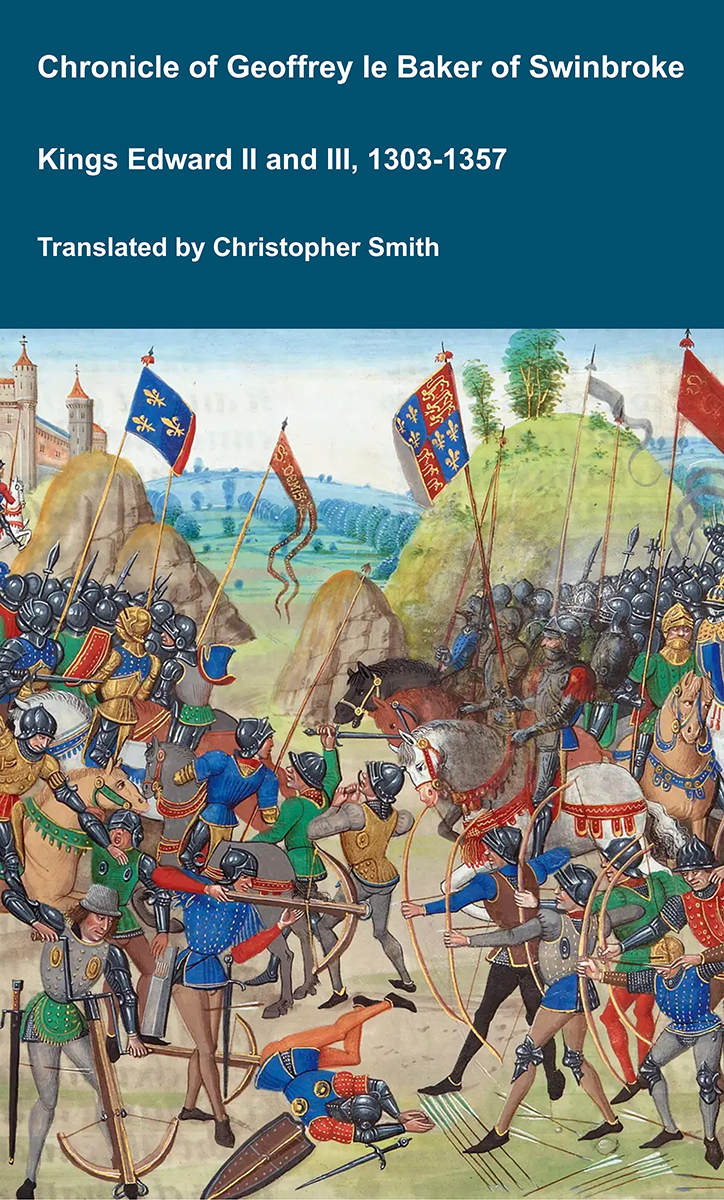 Chronicle of Geoffrey le Baker of Swinbroke [-1360]. When the besieged in Calais learned of the disgraceful flight of the French tyrant, they threw his standard from the tower into a ditch with great sorrow. And on the following Saturday, their captain, an experienced and well-trained soldier in the art of war, named John of Vienne, opened the gates, and seated on a small horse, unable to walk due to gout, with a rope around his neck, came before the king. He was followed by other knights and townsmen on foot, with bare heads and barefoot, also with ropes around their necks.
Turpi fuga tiranni Francorum Calisiensibus obsessis comperta, eius stacionardum cum ingenti luctu de turri in foveam proiecerunt, et sabbato sequenti illorum capitaneus, in bellica praxici miles multum eruditus, vocatus lohannes de Vienna, ianuis apertis, insidebat parvo runcino, impos pre gutta pedes incedere, collum corda constrictus, venit coram rege; quern alii milites et burgenses pedites, nudi capita et discalciati, funes ad colla eciam habentes, sequebantur.

On 3rd August 1355 Bartholomew "The Elder" Burghesh 1st Baron Burghesh (age 68) died at Dover, Kent [Map]. He was buried in the St Catherine Chantry at Lincoln Cathedral [Map] with his father and brother. His son Bartholomew (age 27) succeeded 2nd Baron Burghesh.
On 3rd August 1394 Anne of Bohemia Queen Consort England was buried at Chapel of St Edward the Confessor, Westminster Abbey [Map] with Archbishop Thomas Fitzalan aka Arundel (age 41) presiding. King Richard II of England (age 27) attended. Richard Fitzalan 9th Earl of Surrey 4th or 11th Earl of Arundel (age 48), brother of the presiding Archbishop, and his wife Philippa Mortimer Countess Pembroke, Arundel and Surrey (age 18), arrived late causing Richard, in a rage, to snatch a wand and strike FitzAlan in the face drawing blood.


On 3rd August 1460 King James II of Scotland (age 29) was killed accidentally whilst besieging Roxburgh Castle when a cannon exploded and he was hit by debris. He was buried at Holyrood Abbey, Holyrood. His son James (age 9) succeeded III King Scotland.
William Douglas 3rd Lord Drumlanrig (age 20) was present.

On 3rd August 1482. Brass to Simon Boleyn (age 35) Vicar of Church of St Peter and St Paul, Salle [Map]. Inscription: Orate p. a'i'a. Simonis Boleyn, capellani, qui obt. 3 die mensis Augi. 1482.
Simon Boleyn: Around 1447 he was born to Geoffrey Boleyn and Ann Hoo. On 3rd August 1482 Simon Boleyn died.
On 3rd August 1494 Nicholas Montgomery (age 60) died. He was buried at St Andrew's Church, Great Cubley [Map]. Effigy, if there were one, now missing. Attributed to Harpur and Moorecock of Burton on Trent. Chest with Weepers.
Nicholas Montgomery: In 1434 he was born to Nicholas Montgomery. In or before 1475 he and Joan Delves were married. The difference in their ages was 21 years.


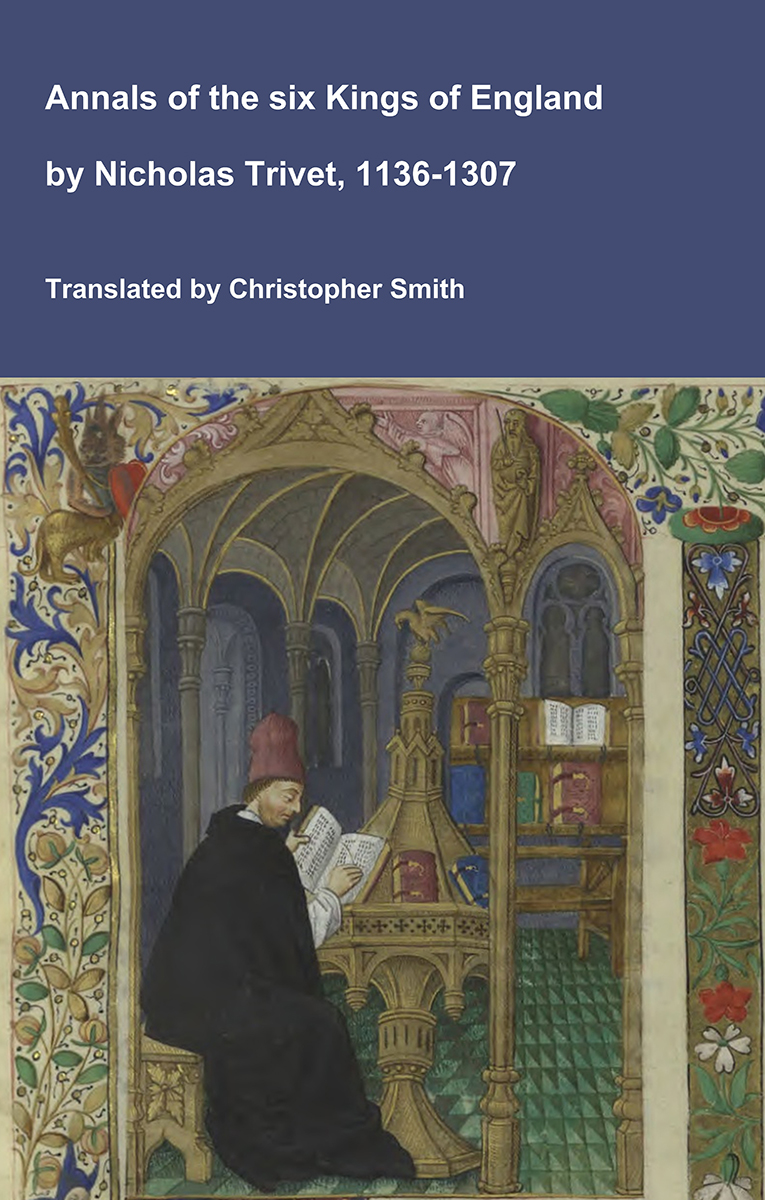
Annals of the six Kings of England by Nicholas Trivet
Translation of the Annals of the Six Kings of England by that traces the rise and rule of the Angevin aka Plantagenet dynasty from the mid-12th to early 14th century. Written by the Dominican scholar Nicholas Trivet, the work offers a vivid account of English history from the reign of King Stephen through to the death of King Edward I, blending political narrative with moral reflection. Covering the reigns of six monarchs—from Stephen to Edward I—the chronicle explores royal authority, rebellion, war, and the shifting balance between crown, church, and nobility. Trivet provides detailed insight into defining moments such as baronial conflicts, Anglo-French rivalry, and the consolidation of royal power under Edward I, whose reign he describes with particular immediacy. The Annals combines careful year-by-year reporting with thoughtful interpretation, presenting history not merely as a sequence of events but as a moral and political lesson. Ideal for readers interested in medieval history, kingship, and the origins of the English state, this chronicle remains a valuable and accessible window into the turbulent world of the Plantagenet kings.
Available at Amazon in eBook and Paperback format.
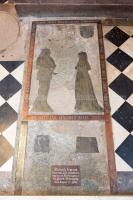
On 3rd August 1496 Richard Curzon (age 84) died at Kedleston, Derbyshire [Map].
All Saints Church, Kedleston [Map]. Brass to Richard Curzon and Alice Willoughby.
Richard Curzon: Around 1412 he was born to John Curzon and Joan Bagot. at Kedleston, Derbyshire [Map]. In or before 1432 Richard Curzon and Alice Willoughby were married.
Alice Willoughby: she was born to Henry Willoughby and Ellen Egerton. In 1523 Richard Draycott and she were married.
Collectanea by John Leland [1502-1552]. The IIJd Day of the said Monneth [3rd August 1503] the Qnene departed from the said Abbay wher sche and her Company had grett Chere, and in fayr Aray and Ordre past thorough the said Towne of Hadington, wher sche was sen of the People in grett Myrthe. And from that sche paffed to hyr Lodyngs to Acquik [Dalkieth].
Half a Mylle ny to the said Towne sche apoynted hyr rychly, and hyr Ladyes and Lordes, and others of hyr Company did the same, and in fayr Ordre entred into the Castell [Map], wher cam before hyr without the Gatt the Lord of the said Place called the Counte of Morton, honnestly apoynted and acompayned of many Gentylmen in presentynge hyr the Kees of the said Castell. And she was wellcomed as Lady and Maistresse.
Betwyxt the two Gatts was the Lady Morton (age 31) acompayned of Gentylmen and Ladyes. The wiche kneeled downe, and the said Qwene toke hyr up, and kyssed hyr, and so she was conveyd to hyr Chammer within the said Castell, the wich was well ordonned and a strong Place.
After that sche was come and well apoynted, and also hyr Lordes, Ladyes, Knyghts, Gentylmen and Gentylwomen, the Kynge cam arayd of a Jakette of Cramsyn Velvet borded with Cloth of Gold. Hys Lewre behinde hys Bake, hys Beerde somthynge long, acompayned of the Rlght Reverend Father in God my Lord th Arch Bischop of Saunte Andrews (age 27), Brother of the said Kynge, and Chaunceller of Scotlaunde, the Bischop of Caslenate, the Erls of Huntley, Argyle (age 54), and Lennos, and the Lord Hambleton (age 28), Cousin of the said Kyng, with many others, Lordes, Knyghtes, and Gentylmen, to the Nombre of LX Horsys.
The King was conveyd to the Qwenes Chamber, wher she mett hym at her grett Chamber Dore, right honorable acompayned. At the Mettynge he and she maid grett Reverences the one to the tother, his Hed belng bare, and they kyssed togeder, and in lykwys kyssed the Ladyes, and others also. And he in especiall welcomed th Erle of Surrey (age 60) varey hertly.
Then the Qnene and he went asyd and commoned togeder by long Space. She held good Manere, and he bare heded during the Tym, and many Courteyfyes passed. Incontynent was the Bord sett and served. They wasched their Haunds in humble Reverences, and after, sett them downe togeder wher many good Devyses war rehersed.
After the Soupper they wasched ageyn, with the Reverences, Mynstrells begonne to blowe, wher daunced the Qwene, acompayned of my Lady of Surrey (age 26). This doon, the Kynge tuke Licence of hyr, for yt was latte, and he went to hys Bed at Edinborg varey well countent of so fayr Metting, and that hee had found the fayr Company togader.
At the Castell and Abbay of Newbottell, halfe a Mille thens, was ordonned Mett and Drynke by the Space of foure Dayes that she was ther, with Liveray of Horsys, as in the Places beforsaid.
Letters and Papers. 3rd August 1536, Vienna Archives. 221. Chapuys (age 46) to Secretary [Perrenot].
Cannot report further news than he has written to the Emperor and our Maecenas (Granvelle), except that the duke of Richmond (deceased), whom the King had certainly intended to succeed to the Crown, after being dead eight days, has been secretly carried in a wagon (charette), covered with straw, without any company except two persons clothed in green, who followed at a distance, into Norfolk, where the Duke his father-in-law will have him buried, "et Dieu scet comme je vous laisser (sic) penser quel honneur, &c." i.e. "And God knows — I leave it to you to imagine what honor [there was]…" Few are sorry for his death because of the Princess. Even Secretary Cromwell has congratulated her in his letters, and thank God she now triumphs, and it is to be hoped that the dangers are laid with which she has been surrounded to make her a paragon of virtue, goodness, honor, and prudence: I say nothing of beauty and grace, for it is incredible. May God raise her soon to the Crown for the benefit of his Majesty and of all Christendom! London, 5 Aug. 1536.
The treasurer Feu Vuillem (Fitzwilliam) has had some spoil of the duke of Richmond, the office of Admiral.
Fr., from a modern copy, p. 1.
Henry Machyn's Diary. 3rd August 1553. The iij day of August, at Rychemond [Map], was my lord Cortnay (age 26) created the yerle of Denshyre of owre nobulle qwene Mare (age 37).


On 3rd August 1553 Queen Mary I of England and Ireland (age 37) made her formal entrance into London.
Strype's Complete History of England describes Mary's entrance to the Tower:
There met her as humble supplicants the Duke of Norfolk (age 80), who had been a prisoner ever since his son the Earl of Surrey was put to death by King Henry the ; Edward Courtenay (age 26), son of the Marquis of Exeter who was executed in the year 1538; Gardiner (age 70), deprived of his Bishopric of Winchester about two years before; and the Dowager Duchess of Somerset (age 56). They presented themselves on their knees, and Gardiner in the name of them all, made a congratulatory speech to the Queen, who kindly raised them one after another, saluted them, saying they were her own proper prisoners and ordered their immediate discharge. The next day she restored Courtenay to the honor of his family. Gardiner not only obtained his bishopric again but on the 23rd of August following was made Lord Chancellor, even though he had formerly subscribed to the Sentence of Divorce against the Queen's mother and had written in defence of King Henry's proceedings.


Henry Machyn's Diary. 3rd August 1553. [The iij day of August the Queen (age 37) came riding to London, and so to the Tower [Map]; making her entrance at Aldgate, which was hanged,] and a grett nombur of stremars ha[nging about the said gate;] and all the strett unto Ledynhalle and unto the [Tower were laid with] graffvell, and all the crafts of London stood [in a row, with] ther banars and stremars hangyd over ther heds. Her grace cam, and a-for her a M1. velvet cotes and [cloaks] in brodere, and the mar of London bare the mase [mace], and the erle of Arundell (age 41) bare the sworde, and all the trumpets [blowing]; and next her my lade Elssabeth (age 19), and next her the duches of Norffoke (age 56), and next her the marqwes of Exseter (age 50), [and other] lades; and after her the aldermen, and then the gard with bowes and gaffylens, and all the reseduw departyd [at Aldgate] in gren and whyt, and red and whyt, and bluw and gren, to the nombur of iij M1. horse and speres and gaffelyns.
On 3rd August 1553 Edward Courtenay 1st Earl Devon (age 26) was finally released from imprisonment after fifteen years by Queen Mary I of England and Ireland (age 37) who was a close friend of his mother Gertrude Blount Marchioness of Exeter (age 50).
Henry Machyn's Diary. 3rd August 1555. The iij day of August the Quen (age 39) and Kynges (age 28) grace removyd from Hamtun Court [Map] unto Hotland [Map], a iiij mylles of: has her grace whent thrugh the parke for to take her barge, ther mett her grace by the way a powre man with ij chruches, and when that he saw her grace, for joy he thruw hys stayffes a-way, and rane after her grace, and sche commondyd that one shuld gyff ym a reward.


On 16th July 1557 Anne of Cleves Queen Consort England (age 41) died at Chelsea Manor [Map]. She was buried at Westminster Abbey [Map] on 3rd August 1557. She was the last of Henry VIII's six wives to die having outlived him by ten years. Hever Castle, Kent [Map] appears to have been appropriated by Edward Waldegrave (age 40), one of the Commissioners for the sale of Crown land, who assigned himself the Castle and estate of Hever.
Henry Machyn's Diary. 3rd August 1557. The iij day of August my lade Anne of Cleyff (deceased), sumtyme wyff unto kyng Henry the viijth cam from Chelsey to be [buried] unto Westmynster, with all the chylderyn of Westmynster and [many] prest and clarkes, and then the gray ames of Powlles and iij crosses, and the monkes of Westmynster, and my lord bysshope of Lo[ndon] (age 57) and my lord abbott of Westmynster (age 42) rod together next the monkes, and then the ij sekturs [executors] ser Edmond Peckham (age 62) and ser (Robert) Freston (age 57), cofferer to the quen of England; and then my lord admerall (age 47), my (lord) Darce of Essex (age 60), and mony knyghts and gentyllmen; and a-for her servandes, and after her baner of armes; and then her gentyllmen and here hed offesers; and then here charett with viij baners of armes of dyvers armes, and iiij baners of emages of whytt taffata, wroght with fyne gold and her armes; and so by sant James, and so to Charyingcrosse [Map], with a C. torchys bornyng, her servandes beyrying them, and the xij bed-men of Westmynster had new blake gownes; and they had xij torchys bornyng, and iiij whyt branchys with armes; and then ladies and gentyll-women all in blake, and horsses; and a viij haroldes of armes in blake, and ther horses; and armes sad a-bowt the herse behynd and be-for; and iiij haroldes barying the iiij whyt baners; and at (the) chyrche dore all dyd a-lyght and ther dyd reseyvyd the good lade my lord of London and my lord abbott in ther myteres and copes, sensyng her, and ther men dyd bere her with a canepe of blake welvett, with iiij blake stayffes, and so browth in-to the herse and ther tared durge, and so ther all nyght with lyght bornyng.
Note. Ibid. Funeral of the lady Anne of Cleves. A very particular narrative of this solemnity, from MSS. in the College of Arms, will be found in the Excerpta Historica, 1831, together with the Will of the deceased. The body of the queen was buried, as Stowe says, "at the head of king Sebert," where "she lyeth in a tomb not yet finished." Engravings of what was erected of this tomb will be found in the Vetusta Monumenta, vol. ii. pl. 35, as well as in Dart and the other histories of Westminster Abbey. In p. 145, for sir Robert Freston read Richard; and in p. 146, for William duke of Cleves read John.
The Bardon Papers 9. (e) Babington (age 24) to Mary (age 43). 3 August, 1586.
Four copies of this letter exist in the Record Office, three in English and one in French (S. P. Mary Q. of S. xix. nos. 9-12). It was the last letter that Babington wrote to Mary before his capture. Babington was probably quite right in accusing Maude of treachery, but it was of course not Maude, but Babington's own letters, which revealed his plans to the English Government1.
Note 1. This man Maude is an elusive fellow, and probably if more could be found out about him, more light could be thrown upon this whole matter. Camden declared that he was one of Walsingham's spies and that he accompanied Ballard on his voyage to France and wrung from him all his secrets (Annals of Eliz. (ed. 1635) p. 302). Robert Poley in his confession (S. P. Mary Q. of S. xix no. 26) said that Babington told him that Maude and Ballard went to France together. This confirms Camden's statement in part. It appears also from the confession of one Tipping, a man who was examined in connection with the Babington plot, that Maude accompanied Ballard when he went north in June 1586 (cf. Summary of Confessions. S. P. Mary Q. of S. xix no. 91 p. 28). Neither of these witnesses however confirms Camden's statement that Maude was a spy of Walsingham. Yet the presumption is that such was the case. The strange silence in regard to him is significant. Though accused by both Poley and Tipping, he was never called into question. This curious neglect of his case struck Edward Windsor, one of those who were more or less implicated in Babington's schemes but who escaped death to suffer imprisonment in the Tower. On the 30th of May 1587 he complained bitterly in a letter to Sir Christopher Hatton that though Maude had been, first to last, deeply implicated in the conspiracy, he had never been brought to trial (R.O. S.P. Dorn, cci, no. 50).


The Letter Books of Amias Paulet Keeper of Mary Queen of Scots Published 1874 Marys Execution. The household of the late Queen were not allowed to depart as soon as Poulet (age 54) expected. They were detained at Fotheringay [Map], from motives of policy, till the 3rd of August, when the funeral of their mistress having been at last performed, they were set free. Some of them were taken to Peterborough [Map] to accompany the corpse and to be present at the funeral ceremonies on the 1st of August. Amongst them, in the order of the procession, it is surprising to find Mary's chaplain, "Monsieur du Préau, chaplain, in a long cloak, carrying a silver cross in hand.1." The account of the funeral from which this is taken, written by one of the late Queen's household, takes care to mention that when they reached the choir of Peterborough Minster, and the choristers began "to sing in their manner in the English language2," they all, with the exception of Andrew Melville and Barbara Mowbray, left the church and walked in the cloisters till the service was finished. "If the English," he says, "and especially the King of the heralds ... were in extreme anger, the more joyful and content were the Catholics".
Poulet left for London, and as long as Mary's servants were detained at Fotheringay [Map], he seems to have retained jurisdiction over them. It was to him, therefore, that Melville and Bourgoin applied in March for leave to sell their horses and to write into France respecting the bequests made to them by the Queen of Scots; and to him that Darrell forwarded in June "the petition of the whole household and servants of the late Queen of Scotland remaining at Fotheringay," begging to be released from their prison and to be allowed to leave the country.
Note 1. Monsieur du Preau, aumosnier, en long manteau, portant une croix d'Argent en main.
Note 2. a chanter a leur fagon en langage Anglois.
Note 3. Si les Anglois," he says, "et principalement le Roy des heraux ... estoit en extreme cholere, d'autant estoient joieux et contents les Catholiques

Diary of Anne Clifford. 3rd August 1617. The 3rd in the afternoon we had much falling out about the house which my Lord (age 28) would have me undertake, which I refused in regard things went so ill with me. This night the Child lay all night with my Lord and me, this being the first night she did so.
On 3rd August 1637 James Stewart 4th Duke Lennox 1st Duke Richmond (age 25) and Mary Villiers Duchess Lennox Duchess Richmond (age 15) were married. She by marriage Duchess Lennox. She the daughter of George Villiers 1st Duke of Buckingham and Katherine Manners Duchess Buckingham (age 35). He the son of Esmé Stewart 3rd Duke Lennox and Katherine Clifton Duchess Lennox (age 45). They were half fifth cousin once removed.

On 25th May 1657 Edward Rodney (age 66) died. On 3rd August 1659 Frances Southwell died. Monument in Church of St Leonard, Rodney Stoke [Map].
Frances Southwell: she was born to Robert Southwell and Elizabeth Howard Countess Carrick. In May 1614 Edward Rodney and she were married at Somerset House [Map]. She the daughter of Robert Southwell and Elizabeth Howard Countess Carrick. They were half fourth cousin twice removed.

Samuel Pepys' Diary. 3rd August 1661. Then parted, and I went to the Rose [Map], and there with Mr. Pechell, Sanchy, and others, sat and drank till night and were very merry, only they tell me how high the old doctors are in the University over those they found there, though a great deal better scholars than themselves; for which I am very sorry, and, above all, Dr. Gunning (age 47).
Chronicle of a Bourgeois of Valenciennes
Récits d’un bourgeois de Valenciennes aka The Chronicle of a Bourgeois of Valenciennes is a vivid 14th-century vernacular chronicle written by an anonymous urban chronicler from Valenciennes in the County of Hainaut. It survives in a manuscript that describes local and regional history from about 1253 to 1366, blending chronology, narrative episodes, and eyewitness-style accounts of political, military, and social events in medieval France, Flanders, and the Low Countries. The work begins with a chronological framework of events affecting Valenciennes and its region under rulers such as King Philip VI of France and the shifting allegiances of local nobility. It includes accounts of conflicts, sieges, diplomatic manoeuvres, and the impact of broader struggles like the Hundred Years’ War on urban life in Hainaut. Written from the perspective of a burgher (bourgeois) rather than a monastery or royal court, the chronicle offers a rare lay viewpoint on high politics and warfare, reflecting how merchants, townspeople, and civic institutions experienced the turbulence of the 13th and 14th centuries. Its narrative style combines straightforward reporting of events with moral and civic observations, making it a valuable source for readers interested in medieval urban society, regional politics, and the lived experience of war and governance in pre-modern Europe.
Available at Amazon in eBook and Paperback format.
Samuel Pepys' Diary. 3rd August 1663. So walked to the Hillhouse (which we did view and the yard about it, and do think to put it off as soon as we can conveniently) and there made ourselves ready and mounted and rode to Gravesend, Kent [Map] (my riding Coate not being to be found I fear it is stole) on our way being overtaken by Captain Browne that serves the office of the Ordnance at Chatham, Kent [Map]. All the way, though he was a rogue and served the late times all along, yet he kept us in discourse of the many services that he did for many of the King's party, lords and Dukes, and among others he recovered a dog that was stolne from Mr. Cary (head-keeper of the buck-hounds to the King (age 33)) and preserved several horses of the Duke of Richmond's (age 24), and his best horse he was forst to put out his eyes and keep him for a stallion to preserve him from being carried away. But he gone at last upon my enquiry to tell us how (he having been here too for survey of the Ropeyard [Map]) the day's work of the Rope-makers become settled, which pleased me very well. Being come to our Inn Mr. Coventry (age 35) and I sat, and talked till 9 or 10 a-clock and then to bed.


Samuel Pepys' Diary. 3rd August 1664. Thence to White Hall to meet with Sir G. Carteret (age 54) about hiring some ground to make our mast docke at Deptford, Kent [Map], but being Council morning failed, but met with Mr. Coventry (age 36), and he and I discoursed of the likeliness of a Dutch warr, which I think is very likely now, for the Dutch do prepare a fleet to oppose us at Guinny, and he do think we shall, though neither of us have a mind to it, fall into it of a sudden, and yet the plague do increase among them, and is got into their fleet, and Opdam's own ship, which makes it strange they should be so high.
Samuel Pepys' Diary. 3rd August 1665. Up, and betimes to Deptford, Kent [Map] to Sir G. Carteret's (age 55), where, not liking the horse that had been hired by Mr. Uthwayt for me, I did desire Sir G. Carteret to let me ride his new £40 horse, which he did, and so I left my 'hacquenee'1 behind, and so after staying a good while in their bedchamber while they were dressing themselves, discoursing merrily, I parted and to the ferry, where I was forced to stay a great while before I could get my horse brought over, and then mounted and rode very finely to Dagenhams; all the way people, citizens, walking to and again to enquire how the plague is in the City this week by the Bill; which by chance, at Greenwich, Kent [Map], I had heard was 2,020 of the plague, and 3,000 and odd of all diseases; but methought it was a sad question to be so often asked me.
Note 1. Haquenee = an ambling nag fitted for ladies' riding.

Samuel Pepys' Diary. 3rd August 1665. Coming to Dagenhams, I there met our company coming out of the house, having staid as long as they could for me; so I let them go a little before, and went and took leave of my Lady Sandwich (age 40), good woman, who seems very sensible of my service in this late business, and having her directions in some things, among others, to get Sir G. Carteret (age 55) and my Lord to settle the portion, and what Sir G. Carteret is to settle, into land, soon as may be, she not liking that it should lie long undone, for fear of death on either side.
John Evelyn's Diary. 3rd August 1665. Came his Grace the Duke of Albemarle (age 56), Lord General of all his Majesty's (age 35) forces, to visit me, and carried me to dine with him.

Samuel Pepys' Diary. 3rd August 1666. The death of Everson, and the report of our success, beyond expectation, in the killing of so great a number of men, hath raised the estimation of the late victory considerably; but it is only among fools: for all that was but accidental. But this morning, getting Sir.W. Pen (age 45) to read over the Narrative with me, he did sparingly, yet plainly, say that we might have intercepted their Zealand squadron coming home, if we had done our parts; and more, that we might have spooned before the wind as well as they, and have overtaken their ships in the pursuite, in all the while1.
Note 1. To spoom, or spoon, is to go right before the wind, without any sail. Sea Dictionary. Dryden (age 34) uses the word "When virtue spooms before a prosperous gale, My heaving wishes help to fill the sail". Hind and Panther, iii. 96.


Samuel Pepys' Diary. 3rd August 1666. At noon home to dinner, and then abroad to Sir Philip Warwicke's (age 56) at White Hall about Tangier one quarter tallys, and there had some serious discourse touching money, and the case of the Navy, wherein all I could get of him was that we had the full understanding of the treasure as much as my Lord Treasurer (age 59) himself, and knew what he can do, and that whatever our case is, more money cannot be got till the Parliament. So talked of getting an account ready as soon as we could to give the Parliament, and so very melancholy parted. So I back again, calling my wife (age 25) at her sister's, from whose husband (age 26) we do now hear that he was safe this week, and going in a ship to the fleete from the buoy of the Nore, where he has been all this while, the fleete being gone before he got down.

John Evelyn's Diary. 3rd August 1668. Mr. Bramstone (son to Judge B), my old fellow-traveler, now reader at the Middle Temple, invited me to his feast, which was so very extravagant and great as the like had not been seen at any time. There were the Duke of Ormond (age 57), Privy Seal (age 62), Bedford (age 52), Belasis (age 54), Halifax (age 34), and a world more of Earls and Lords.


John Evelyn's Diary. 3rd August 1671. A full appearance at the Council. The matter in debate was, whether we should send a deputy to New England, requiring them of the Massachusetts to restore such to their limits and respective possessions, as had petitioned the Council; this to be the open commission only; but, in truth, with secret instructions to inform us of the condition of those Colonies, and whether they were of such power, as to be able to resist his Majesty (age 41) and declare for themselves as independent of the Crown, which we were told, and which of late years made them refractory. Colonel Middleton (age 63), being called in, assured us they might be curbed by a few of his Majesty's first-rate frigates, to spoil their trade with the islands; but, though my Lord President (age 46) was not satisfied, the rest were, and we did resolve to advise his Majesty to send Commissioners with a formal commission for adjusting boundaries, etc., with some other instructions.


John Evelyn's Diary. 3rd August 1690. The French landed some soldiers at Teignmouth [Map], in Devon, and burned some poor houses. The French fleet still hovering about the western coast, and we having 300 sail of rich merchant-ships in the bay of Plymouth [Map], our fleet began to move toward them, under three admirals. The country in the west all on their guard. A very extraordinary fine season; but on the 12th was a very great storm of thunder and lightning, and on the 15th the season much changed to wet and cold. The militia and trained bands, horse and foot, which were up through England, were dismissed. The French King having news that King William (age 39) was slain, and his army defeated in Ireland, caused such a triumph at Paris, and all over France, as was never heard of; when, in the midst of it, the unhappy King James (age 56) being vanquished, by a speedy flight and escape, himself brought the news of his own defeat.

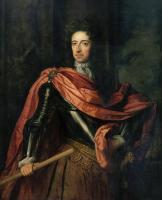
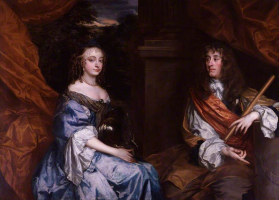


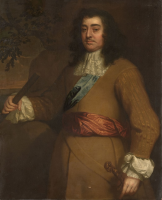
On 3rd August 1692 George Hamilton was killed in action at Steenkerque during the Battle of Steenkerque.
John Evelyn's Diary. 3rd August 1696. The Bank lending the £200,000 to pay the array in Flanders, that had done nothing against the enemy, had so exhausted the treasure of the nation, that one could not have borrowed money under 14 or 15 per cent on bills, or on Exchequer Tallies under 30 per cent. Reasonable good harvest weather. I went to Lambeth [Map] and dined with the Archbishop (age 59), who had been at Court on the complaint against Dr. Thomas Watson (age 59), Bishop of St. David's, who was suspended for simony. The Archbishop told me how unsatisfied he was with the Canon law, and how exceedingly unreasonable all their pleadings appeared to him.

On 3rd August 1703 Louis Bourbon Duke Orléans was born to Philippe Bourbon II Duke Orléans (age 29) and Françoise Marie Bourbon Duchess Orléans (age 26) at Palace of Versailles, Versailles. He a great x 3 grandson of King James I of England and Ireland and VI of Scotland. Coefficient of inbreeding 7.39%. He married Margravine Johanna Baden Baden Duchess Orléans and had issue.
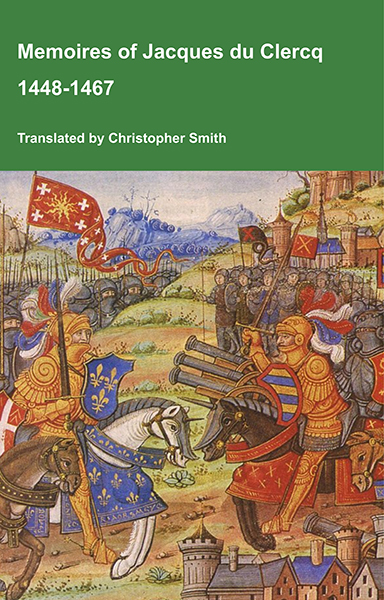
This is a translation of the 'Memoires of Jacques du Clercq', published in 1823 in two volumes, edited by Frederic, Baron de Reissenberg. In his introduction Reissenberg writes: 'Jacques du Clercq tells us that he was born in 1424, and that he was a licentiate in law and a counsellor to Philip the Good, Duke of Burgundy, in the castellany of Douai, Lille, and Orchies. It appears that he established his residence at Arras. In 1446, he married the daughter of Baldwin de la Lacherie, a gentleman who lived in Lille. We read in the fifth book of his Memoirs that his father, also named Jacques du Clercq, had married a lady of the Le Camelin family, from Compiègne. His ancestors, always attached to the counts of Flanders, had constantly served them, whether in their councils or in their armies.' The Memoires cover a period of nineteen years beginning in in 1448, ending in in 1467. It appears that the author had intended to extend the Memoirs beyond that date; no doubt illness or death prevented him from carrying out this plan. As Reissenberg writes the 'merit of this work lies in the simplicity of its narrative, in its tone of good faith, and in a certain air of frankness which naturally wins the reader’s confidence.' Du Clercq ranges from events of national and international importance, including events of the Wars of the Roses in England, to simple, everyday local events such as marriages, robberies, murders, trials and deaths, including that of his own father in Book 5; one of his last entries.
Available at Amazon in eBook and Paperback format.
On 3rd August 1721 Grinling Gibbons (age 73) died.
On 3rd August 1769 or 25th August 1769 James Agar (age 55) was killed in a duel with Henry Flood (age 37) his political rival. James, who missed with his first shot, reputedly shouted "Fire, you scoundrel!": Flood duly fired. Flood was prosecuted for murder, but was found guilty of manslaughter, and spared a prison sentence, as according to the code of the time he had acted honourably. The case, which aroused huge public interest.
On 3rd August 1770 Frederick William III King Prussia was born to Frederick William II King Prussia (age 25) and Queen Frederica Louisa of Prussia (age 18). He married 24th December 1793 his half second cousin Queen Louise of Prussia and had issue.
On 3rd August 1791 Charles Gordon-Lennox 5th Duke Richmond was born to Charles Lennox 4th Duke Richmond (age 26) and Charlotte Gordon Duchess Richmond (age 22). He a great x 3 grandson of King Charles II of England Scotland and Ireland. He married 10th April 1817 Caroline Paget Duchess Richmond, daughter of Henry William Paget 1st Marquess Anglesey and Caroline Elizabeth Villiers Duchess Argyll, and had issue.
On 3rd August 1814 Peter Parker 2nd Baronet (age 28) was killed in action whilst storming the American camp at Bellair near Baltimore. His son Peter (age 4) succeeded 3rd Baronet Parker of Bassingbourn in Essex.

After 3rd August 1824. St Helen's Church Ashby-de-la-Zouch, Leicestershire [Map]. Monument to Thomas John Kirkland (deceased).
Thomas John Kirkland: Around 1760 he was born to Thomas Kirkland. On 3rd August 1824 he died.

On 3rd August 1829 Mathewana Onslow (age 21) died from childbirth at Calwich Hall [Map] three months after giving birth to a daughter. Memorial at St Peter's Church, Ellastone.
Mathewana Onslow: Around 1808 she was born to Matthew Richard Onslow. On 28th June 1828 Bernard Granville and she were married.
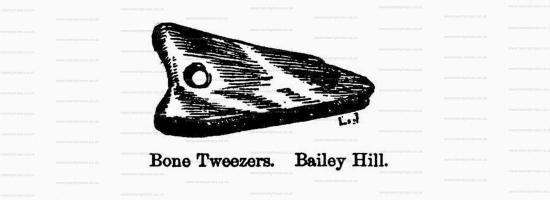
Ten Years' Digging. On the 3rd of August we opened a barrow on Bailey Hill [Map], between the Dove and Bostom, on the Derbyshire side of the stream. It was raised upon a very irregular protuberant rock, which in the middle was cut through the loose upper beds into a kind of grave, the bottom of which, conforming to the dip of strata, was three feet deep at one end, whilst it diminished to nothing at the other. In this were three interments, the most primitive of which had been disturbed by the later deposits, its bones being found at intervals from the surface downwards. The bones were those of a full-grown person, and much decayed. A second skeleton was found undisturbed at the bottom, on which it lay on its right side, with the body slightly curved, the knees contracted, and the head to the west. Before the face was a small plain vase, lying on its side, and at the back of the skull was a very large tusk from the wild boar. The femur measures about 16 J inches. About a foot below the surface was a deposit of calcined bones, containing a very neatly made pair of tweezers of bone, unbumt, and perforated for suspension. The grave was filled up with stone, and the artificial part of the roound consisted of similar materials, amongst which rats' bones so much abounded as to fill up most of the interstices from the surface to the bottom of the grave. A few pieces of two vessels were picked up during the day. The following remarks upon the barrow, made by Mr. Carrington immediately after the opening, are valuable. He says — "I consider this to be the most primitive barrow I ever opened, as the small instrument of bone may have been deposited with the burnt bones at a much more recent period than that in which the mound was originally constructed. The coarse urn, without any decoration — the absence of every other article, with the exception of the boar's tusk — serve to strengthen this supposition. The contents of the cist were examined with the greatest care, yet nothing more was discovered, except one small round piece of ironstone — not a sandstone, or pebble, or charcoal (which are all commonly found in Celtic barrows) — not even one bit of flint was to be seen. This is the first barrow I have opened in which the latter material has not been present".

Ten Years' Digging. On the 3rd of August, we opened a finely shaped barrow [High Field Hlaew [Map]] near Brushfield, upon Lapwing HiU, overlooking Cressbrook valley, measuring seventeen yards across and four feet high in the centre, composed of earth, with a few stones in the middle, where a shallow grave, about a foot deep, was sunk in the rock. In it lay extended the remains of a human body, so very much decayed as to be almost undistinguishable, but which we ascertained to have been deposited with the head to the west. Beneath the remnants of bone were many traces of light-coloured hair, as if from a hide, resting upon a considerable quantity of decayed wood, indicating a plank of some thickness, or the bottom of a coffin. At the left of the body was a long and broad iron sword, enclosed in a sheath made of thin wood covered with ornamented leather.
Under the hilt of the sword, which like most of ancient date is very small, was a short iron knife; and a little way above the right shoulder were two small javelin heads, 4½ inches long, of the same metal, which had lain so near each other as to become united by corrosion. Among the stones which filled the grave, and about a foot from the bottom, were many objects of corroded iron, including nine loops of hoop iron about an inch broad, which had been fixed to thick wood by long nails; eight staples or eyes, which had been driven through plank and clenched; and one or two other objects of more uncertain application, all which were dispersed at intervals round the corpse throughout the length of the grave, and which may therefore have been attached to a bier or coffin in which the deceased was conveyed to the grave, possibly from some distant place. The only specimen of a Saxon sword, which was the weapon of the thegn, previously found in this part of Derbyshire, was singularly enough found with the umbo of a shield on the same farm in 1828; thus indicating the connection of a noble Saxon family with Brushfield in the age of Heathendom, the name of which is perpetuated in a document of the 16th century, preserved in the British Museum1.
Note 1. Mortgage of Lands in Little Longsdon, Monsall Dale, and Brighterighefield (Brightric's Field,) otherwise Brushefielde, between Thomas Shakerley of Derby and Rowland Eyre of Hassoppe; dated May. 37th Elizabeth. B. Mus: Additional MSS. 6702. fol 45.
Ten Years' Digging. On the same afternoon, we examined a mutilated barrow [Brushfield Barrow, location unknown] nearer Brushfield, called the "Gospel Hillock [Map]," perhaps from the first Christian Missionary having taken his stand thereon while exhorting the Saxons to forsake the worship of Woden and Thor; and we were much disappointed by finding nothing more than a few calcined bones and a fragment of pottery.
On 3rd August 1857 Friedrich Wilhelm Oldenburg was born to Frederick Christian Oldenburg II Duke Schleswig Holstein Sonderburg Augustenburg (age 28) and Adelheid Hohenlohe Langenburg Duchess Schleswig Holstein Sonderburg Augustenburg. He died aged one in 1858.
After 3rd August 1860. Memorial to Elizabeth Knight (deceased) at St Mary's Church, Elton [Map] sculpted by George Gammon Adams (age 39).
Elizabeth Knight: On 18th March 1798 she was born to Thomas Andrew Knight of Downton Castle in Herefordshire. On 3rd August 1860 she died.
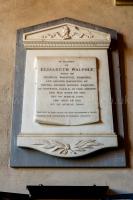
On 3rd August 1861 Anne Webb Countess Newburgh (age 98)
On 3rd August 1872 Haakon VII King Norway was born to Frederick VIII King of Denmark (age 29) and Louise of Sweden Queen Consort Denmark (age 20). He married 1896 his first cousin Maud Windsor Queen Consort Norway, daughter of King Edward VII of the United Kingdom and Alexandra of Denmark Queen Consort England, and had issue.
On 3rd August 1873 a northbound "Tourist Special" excursion train, drawn by two locomotives consisted of twenty-five vehicles by the time it left Crewe, derailed at Wigan, colliding with station buildings, killing thirteen passengers. The train was declared to have been travelling at excessive speed. In the sixteenth coach, the one which derailed, was travelling Florence Sutherland Leveson-Gower (age 18) with her companion Miss Braggs.

On 3rd August 1879 Joseph Severn (age 85) died. He was buried at the Protestant aka English Cemetery, Rome next to the grave of John Keats.
Attribution: Howardhudson at English Wikipedia, CC BY 2.5
Anne Boleyn. Her Life as told by Lancelot de Carle's 1536 Letter.
In 1536, two weeks after the execution of Anne Boleyn, her brother George and four others, Lancelot du Carle, wrote an extraordinary letter that described Anne's life, and her trial and execution, to which he was a witness. This book presents a new translation of that letter, with additional material from other contemporary sources such as Letters, Hall's and Wriothesley's Chronicles, the pamphlets of Wynkyn the Worde, the Memorial of George Constantyne, the Portuguese Letter and the Baga de Secrets, all of which are provided in Appendices.
Available at Amazon in eBook and Paperback format.
On 3rd August 1891 Francis William Henry Fane 12th Earl of Westmoreland (age 65) died. His son Anthony (age 31) succeeded 13th Earl of Westmoreland.
In 1903 Adelaide Ida Curzon Howe Countess of Westmoreland (age 68) died.
Memorial in the Church of St Leonard, Apethorpe [Map] and graves in churchyard.
Anthony Fane 13th Earl of Westmoreland: On 16th August 1859 he was born to Francis William Henry Fane 12th Earl of Westmoreland and Adelaide Ida Curzon Howe Countess of Westmoreland. On 28th May 1892 Anthony Fane 13th Earl of Westmoreland and Sybil Mary St Clair-Erskine Countess of Westmorland were married. She by marriage Countess of Westmoreland. He the son of Francis William Henry Fane 12th Earl of Westmoreland and Adelaide Ida Curzon Howe Countess of Westmoreland. On 9th June 1922 Anthony Fane 13th Earl of Westmoreland died. His son Vere succeeded 14th Earl of Westmoreland.


On 3rd August 1901 William Hicks-Beach (age 74) died in a carriage accident. The day before he was severely injured when the horse of the Hansom cab in which he was riding stumbled onto an unguarded roadworks trench while attempting to avoid a bus on Parliament Street. Beach and the driver of the cab were thrown onto the road, and Beach was taken, unconscious, to Westminster Hospital. He woke around three hours later, and was noted to have suffered several head injuries, including a concussion and several abrasions. After appearing to slowly recover, he succumbed to his injuries the following night, aged 74. An inquiry was opened into his death the following week, and a verdict of accidental death was returned.
On 3rd August 1907 Augustus Saint-Gaudens (age 59) died.
On 3rd August 1907 Antoine Alfred Agénor de Gramont 11th Duc de Gramont (age 55) and Princess Maria Ruspoli (age 19) were married. She by marriage Duchess Gramont. The difference in their ages was 36 years. He the son of Agénor 10th Duc de Gramont.


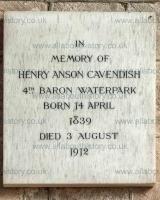
On 3rd August 1912 Henry Anson Cavendish 4th Baron Waterpark (age 73) died. Memorial at St Cuthbert's Church, Doveridge [Map]. His son Charles (age 29) succeeded 5th Baron Waterpark, 6th Baronet Cavendish of Doveridge Hall.
Henry Anson Cavendish 4th Baron Waterpark: On 14th April 1839 he was born to Henry Cavendish 3rd Baron Waterpark and Elizabeth Jane Anson Baroness Waterpark. In 1873 Henry Anson Cavendish 4th Baron Waterpark and Emily Stenning Baroness Waterpark were married. She by marriage Baroness Waterpark. They had five children.
Charles Frederick Cavendish 5th Baron Waterpark: On 11th May 1883 he was born to Henry Anson Cavendish 4th Baron Waterpark and Emily Stenning Baroness Waterpark.
On 3rd August 1585 Thomas Burdett 1st Baronet was born to Robert Burdett and Mary Wilson. He married 1602 Jane Francis and had issue.

On 3rd August 1632 John Hastings was born to Ferdinando Hastings 6th Earl Huntingdon (age 24) and Lucy Davies Countess Huntingdon (age 19). He died aged seven in 1639.
On 3rd August 1641 Hildebrand Alington 3rd and 5th Baron Alington was born to William Alington 1st Baron Alington (age 30) and Elizabeth Tollemache Baroness Alington at Horseheath Chilford.
On 3rd August 1648 William Fermor 1st Baron Leominster was born to William Fermor 1st Baronet (age 27). He married (1) in or before 1697 Catherine Paulett Baroness Leominster, daughter of John Paulett 3rd Baron Paulett and Essex Popham Baroness Poulett, and had issue (2) in or before 1697 Jane Barker and had issue (3) before 1698 his second cousin Sophia Osborne Baroness Leominster, daughter of Thomas Osborne 1st Duke Leeds and Bridget Bertie Duchess Leeds, and had issue.
On 3rd August 1654 Charles I Landgrave Hesse-Kassel was born to Wilhelm "The Just" VI Hesse-Kassel (age 25) and Hedwig Sophia Hohenzollern (age 31). He married before 29th March 1674 his first cousin Maria Amalia of Courland Landgravine Hesse-Kassel and had issue.
Chronicle of Abbot Ralph of Coggeshall
The Chronicle of Abbot Ralph of Coggeshall (Chronicon Anglicanum) is an indispensable medieval history that brings to life centuries of English and European affairs through the eyes of a learned Cistercian monk. Ralph of Coggeshall, abbot of the Abbey of Coggeshall in Essex in the early 13th century, continued and expanded his community’s chronicle, documenting events from the Norman Conquest of 1066 into the tumultuous reign of King Henry III. Blending eyewitness testimony, careful compilation, and the monastic commitment to record-keeping, this chronicle offers a rare narrative of political intrigue, royal power struggles, and social upheaval in England and beyond. Ralph’s work captures the reigns of pivotal figures such as Richard I and King John, providing invaluable insights into their characters, decisions, and the forces that shaped medieval rule. More than a simple annal, Chronicon Anglicanum conveys the texture of medieval life and governance, making it a rich source for scholars and readers fascinated by English history, monastic authorship, and the shaping of the medieval world.
Available at Amazon in eBook and Paperback format.

On 3rd August 1702 Walter Wagstaffe Bagot 5th Baronet was born to Edward Bagot 4th Baronet (age 28). He married 27th July 1724 Barbara Legge Baroness Bagot, daughter of William Legge 1st Earl Dartmouth and Anne Finch Countess Dartmouth, and had issue.
On 3rd August 1703 Louis Bourbon Duke Orléans was born to Philippe Bourbon II Duke Orléans (age 29) and Françoise Marie Bourbon Duchess Orléans (age 26) at Palace of Versailles, Versailles. He a great x 3 grandson of King James I of England and Ireland and VI of Scotland. Coefficient of inbreeding 7.39%. He married Margravine Johanna Baden Baden Duchess Orléans and had issue.
On 3rd August 1708 James Clavering 4th Baronet was born to John Clavering of Axwell 3rd Baronet (age 36).
On 3rd August 1718 John Wallop Viscount Lymington was born to John Wallop 1st Earl Portsmouth (age 28) and Bridget Bennet Viscountess Lymington (age 21). He was educated at Winchester College, Winchester from 1731 to 1734, and Christ Church College, Oxford University from 1739 to 1740. He married 8th July 1740 Catherine Conduit and had issue.
On 3rd August 1753 Charles Stanhope 3rd Earl Stanhope was born to Philip Stanhope 2nd Earl Stanhope (age 38) and Grizel Hamilton Countess Stanhope. He married (1) 19th December 1774 his half second cousin Hester Pitt, daughter of William "The Elder" Pitt 1st Earl Chatham and Hester Granville Countess Chatham, and had issue (2) 1781 Louisa Granville Countess Stanhope and had issue.
On 3rd August 1770 Frederick William III King Prussia was born to Frederick William II King Prussia (age 25) and Queen Frederica Louisa of Prussia (age 18). He married 24th December 1793 his half second cousin Queen Louise of Prussia and had issue.
On 3rd August 1787 Edward Joseph Smythe 6th Baronet was born to Edward Smythe 5th Baronet (age 29).
On 3rd August 1791 Charles Gordon-Lennox 5th Duke Richmond was born to Charles Lennox 4th Duke Richmond (age 26) and Charlotte Gordon Duchess Richmond (age 22). He a great x 3 grandson of King Charles II of England Scotland and Ireland. He married 10th April 1817 Caroline Paget Duchess Richmond, daughter of Henry William Paget 1st Marquess Anglesey and Caroline Elizabeth Villiers Duchess Argyll, and had issue.
On 3rd August 1791 William Williams 1st Baronet was born to John Williams. He married before 25th January 1830 Caroline Eales and had issue.
On 3rd August 1799 Reverend William Astley Cave-Browne-Cave was born to William Cave-Browne-Cave 9th Baronet (age 34) and Louisa Wilmot Lady Cave (age 28).
Anne Boleyn. Her Life as told by Lancelot de Carle's 1536 Letter.
In 1536, two weeks after the execution of Anne Boleyn, her brother George and four others, Lancelot du Carle, wrote an extraordinary letter that described Anne's life, and her trial and execution, to which he was a witness. This book presents a new translation of that letter, with additional material from other contemporary sources such as Letters, Hall's and Wriothesley's Chronicles, the pamphlets of Wynkyn the Worde, the Memorial of George Constantyne, the Portuguese Letter and the Baga de Secrets, all of which are provided in Appendices.
Available at Amazon in eBook and Paperback format.

On 3rd August 1825 Henry Holland 1st Viscount Knutsford was born to Henry Holland 1st Baronet (age 36).
On 3rd August 1835 Maria Howard was born to Henry Howard 2nd Earl of Effingham (age 28) and Eliza Drummond Baroness Howard (age 24).
On 3rd August 1842 Cecil Weld-Forester 5th Baron Forester was born to Orlando Weld-Forester 4th Baron Forester (age 29).
On 3rd August 1842 William Robert Clayton 6th Baronet was born to William Capel Clayton (age 23).

On 3rd August 1847 John Hamilton-Gordon 1st Marquess of Aberdeen and Temair was born to George John Hamilton-Gordon 5th Earl Aberdeen (age 30) and Mary Bailie-Hamilton Countess Aberdeen (age 32). He married 1877 Isabel Marjoribanks Marchioness of Aberdeen and Ternair, daughter of Dudley Marjoribanks 1st Baron Tweedmouth and Isabella Hogg, and had issue.
On 3rd August 1854 Rear-Admiral Algernon Horatio Anson was born to John William Hamilton Anson 2nd Baronet (age 37) and Elizabeth Catherine Pack Lady Anson (age 33). He married before 13th January 1897 his second cousin once removed Adela Venables-Vernon, daughter of Augustus Henry Vernon 6th Baron Vernon and Harriet Frances Maria Anson Baroness Vernon, and had issue.
On 3rd August 1857 Friedrich Wilhelm Oldenburg was born to Frederick Christian Oldenburg II Duke Schleswig Holstein Sonderburg Augustenburg (age 28) and Adelheid Hohenlohe Langenburg Duchess Schleswig Holstein Sonderburg Augustenburg. He died aged one in 1858.
On 3rd August 1858 Geoffrey Twisleton-Wykeham-Fiennes 12th or 18th Baron Saye and Sele was born to John Twisleton-Wykeham-Fiennes 11th or 17th Baron Saye and Sele (age 28). He married 20th February 1884 Marion Ruperta Murray Lawes Baroness Saye and Sele and had issue.
On 3rd August 1861 Edwin Harry Lascelles was born to Henry Thynne Lascelles 4th Earl Harewood (age 37) and Diana Smyth Countess Harewood (age 23).
On 3rd August 1862 Mary Constance Wyndham Countess Wemyss was born to Percy Scawen Wyndham (age 27) and Madeline Caroline Frances Eden Campbell at Belgrave Square, Belgravia. She married 1883 Hugo Charteris 11th Earl of Wemyss, son of Francis Richard Charteris 10th Earl of Wemyss and Anne Frederica Anson Countess Wemyss, and had issue.


On 3rd August 1864 Alexander Frederick Bingham was born to Charles George Bingham 4th Earl Lucan (age 34) and Cecilia Catherine Gordon-Lennox Countess Lucan (age 26).
The History of William Marshal was commissioned by his son shortly after William’s death in 1219 to celebrate the Marshal’s remarkable life; it is an authentic, contemporary voice. The manuscript was discovered in 1861 by French historian Paul Meyer. Meyer published the manuscript in its original Anglo-French in 1891 in two books. This book is a line by line translation of the first of Meyer’s books; lines 1-10152. Book 1 of the History begins in 1139 and ends in 1194. It describes the events of the Anarchy, the role of William’s father John, John’s marriages, William’s childhood, his role as a hostage at the siege of Newbury, his injury and imprisonment in Poitou where he met Eleanor of Aquitaine and his life as a knight errant. It continues with the accusation against him of an improper relationship with Margaret, wife of Henry the Young King, his exile, and return, the death of Henry the Young King, the rebellion of Richard, the future King Richard I, war with France, the death of King Henry II, and the capture of King Richard, and the rebellion of John, the future King John. It ends with the release of King Richard and the death of John Marshal.
Available at Amazon in eBook and Paperback format.
On 3rd August 1867 Stanley Baldwin 1st Earl Baldwin was born. He married 12th September 1892 Lucy Ridsdale Countess Baldwin and had issue.
On 3rd August 1872 Haakon VII King Norway was born to Frederick VIII King of Denmark (age 29) and Louise of Sweden Queen Consort Denmark (age 20). He married 1896 his first cousin Maud Windsor Queen Consort Norway, daughter of King Edward VII of the United Kingdom and Alexandra of Denmark Queen Consort England, and had issue.
On 3rd August 1895 Allen Bathurst was born to Seymour Bathurst 7th Earl Bathurst (age 31) and Lilias Margaret Frances Borthwick Countess Bathurst Sussex (age 24). He married 27th February 1924 Violet Meeking and had issue.
On 3rd August 1917 John St John 20th Baron St John was born to Moubray St John 19th Baron St John (age 39).
On 3rd August 1943 Richard Lindsay Glyn 10th and 6th Baronet was born to Colonel Richard Hamilton Glyn 9th and 5th Baronet (age 35).

On 3rd August 1537 Gregory Cromwell 1st Baron Cromwell Oakham (age 17) and Elizabeth Seymour Baroness Cromwell Oakham (age 19) were married at Mortlake, Richmond. He the son of Thomas Cromwell 1st Earl Essex (age 52) and Elizabeth Wyckes.
On 3rd August 1637 James Stewart 4th Duke Lennox 1st Duke Richmond (age 25) and Mary Villiers Duchess Lennox Duchess Richmond (age 15) were married. She by marriage Duchess Lennox. She the daughter of George Villiers 1st Duke of Buckingham and Katherine Manners Duchess Buckingham (age 35). He the son of Esmé Stewart 3rd Duke Lennox and Katherine Clifton Duchess Lennox (age 45). They were half fifth cousin once removed.
On 3rd August 1706 Marmaduke Langdale 4th Baron Langdale (age 21) and Elizabeth Widdrington (age 17) were married. She by marriage Baroness Langdale of Holme in Yorkshire.
On 3rd August 1799 John Lubbock 2nd Baronet (age 24) and Mary Entwistle were married.
On 3rd August 1833 Henry Willoughby 8th Baron Middleton (age 15) and Julia Louisa Bosville Baroness Middleton (age 9) were married.
On 3rd August 1842 Harry Chichester 2nd Baron Templemore (age 21) and Laura Caroline Jane Paget Baroness Templemore (age 21) were married. She by marriage Baroness Templemore of Templemore in Donegal. They were first cousin once removed.
Henrici Quinti, Angliæ Regis, Gesta, is a first-hand account of the Agincourt Campaign, and subsequent events to his death in 1422. The author of the first part was a Chaplain in King Henry's retinue who was present from King Henry's departure at Southampton in 1415, at the siege of Harfleur, the battle of Agincourt, and the celebrations on King Henry's return to London. The second part, by another writer, relates the events that took place including the negotiations at Troye, Henry's marriage and his death in 1422.
Available at Amazon in eBook and Paperback format.

On 3rd August 1846 George Henry Vane-Tempest 5th Marquess Londonderry (age 25) and Mary Cornelia Edwards Marchioness Londonderry (age 17) were married. He the son of Charles William Vane 3rd Marquess Londonderry (age 68) and Frances Vane Tempest Marchioness Londonderry (age 46).
On 3rd August 1858 Charles Anderson-Pelham 3rd Earl Yarborough (age 23) and Victoria Alexandrina Hare were married. She the daughter of William Hare 2nd Earl Listowel and Maria Augusta Windham Countess Listowel (age 53). He the son of Charles Anderson-Pelham 2nd Earl Yarborough (age 49) and Maria Adelaide Maude Countess Yarborough (age 43).
On 3rd August 1874 Tatton Sykes 5th Baronet (age 48) and Christina Anne Jessica Cavendish-Bentinck were married.
On 3rd August 1876 Bernard Coleridge 2nd Baron Coleridge (age 24) and Mary Alethea Mackarness Baroness Coleridge were married. They were first cousins.
On 3rd August 1905 Eric Chaplin 2nd Viscount Chaplin (age 27) and Gwladys Alice Wilson Viscountess Chaplin (age 24) were married at Warter Hall aka Priory [Map].
On 3rd August 1907 Antoine Alfred Agénor de Gramont 11th Duc de Gramont (age 55) and Princess Maria Ruspoli (age 19) were married. She by marriage Duchess Gramont. The difference in their ages was 36 years. He the son of Agénor 10th Duc de Gramont.
On 3rd August 1912 Charles Henry Alexander Paget 6th Marquess Anglesey (age 27) and Victoria Marjorie Harriet Manners Marchioness Anglesey (age 28) were married. She by marriage Marchioness Anglesey. She the daughter of Henry John Brinsley Manners 8th Duke Rutland (age 60) and Violet Lindsay Duchess Rutland (age 56). They were fifth cousins.


On 3rd August 1928 Francis Rodd 2nd Baron Rennell (age 32) and Mary Smith Baroness Rennell (age 26) were married.
On 3rd August 1270 John Tristan Capet Count Valois (age 20) died.
On 3rd August 1271 John Plantagenet (age 5) died at Wallingford, Oxfordshire [Map] whilst in the care of his great uncle Richard of Cornwall 1st Earl Cornwall (age 62). He was buried at Westminster Abbey [Map].
On 3rd August 1336 Roger Mortimer 1st Baron Mortimer of Chirk (age 80) died at the Tower of London [Map] after four and a half years imprisonment. He was buried at either Wigmore Abbey [Map] or St Augustine's Priory, Bristol [Map]. His son Roger succeeded 2nd Baron Mortimer of Chirk although he was never summoned to Parliament.
Annals of the six Kings of England by Nicholas Trivet
Translation of the Annals of the Six Kings of England by that traces the rise and rule of the Angevin aka Plantagenet dynasty from the mid-12th to early 14th century. Written by the Dominican scholar Nicholas Trivet, the work offers a vivid account of English history from the reign of King Stephen through to the death of King Edward I, blending political narrative with moral reflection. Covering the reigns of six monarchs—from Stephen to Edward I—the chronicle explores royal authority, rebellion, war, and the shifting balance between crown, church, and nobility. Trivet provides detailed insight into defining moments such as baronial conflicts, Anglo-French rivalry, and the consolidation of royal power under Edward I, whose reign he describes with particular immediacy. The Annals combines careful year-by-year reporting with thoughtful interpretation, presenting history not merely as a sequence of events but as a moral and political lesson. Ideal for readers interested in medieval history, kingship, and the origins of the English state, this chronicle remains a valuable and accessible window into the turbulent world of the Plantagenet kings.
Available at Amazon in eBook and Paperback format.
On 3rd August 1355 Bartholomew "The Elder" Burghesh 1st Baron Burghesh (age 68) died at Dover, Kent [Map]. He was buried in the St Catherine Chantry at Lincoln Cathedral [Map] with his father and brother. His son Bartholomew (age 27) succeeded 2nd Baron Burghesh.
On 3rd August 1373 Margaret Pipard Baroness Lisle (age 50) died.
On 3rd August 1460 King James II of Scotland (age 29) was killed accidentally whilst besieging Roxburgh Castle when a cannon exploded and he was hit by debris. He was buried at Holyrood Abbey, Holyrood. His son James (age 9) succeeded III King Scotland.
William Douglas 3rd Lord Drumlanrig (age 20) was present.
On 3rd August 1515 Thomas Butler 7th Earl Ormonde (age 89) died. His first cousin twice removed Piers (age 48) succeeded 8th Earl Ormonde. Margaret Fitzgerald Countess Ormonde and Ossory by marriage Countess Ormonde.
On 16th July 1557 Anne of Cleves Queen Consort England (age 41) died at Chelsea Manor [Map]. She was buried at Westminster Abbey [Map] on 3rd August 1557. She was the last of Henry VIII's six wives to die having outlived him by ten years. Hever Castle, Kent [Map] appears to have been appropriated by Edward Waldegrave (age 40), one of the Commissioners for the sale of Crown land, who assigned himself the Castle and estate of Hever.

On 3rd August 1562 John de Vere 16th Earl of Oxford (age 46) died. His son Edward (age 12) succeeded 17th Earl of Oxford.
On 3rd August 1573 Richard Fiennes 6th Baron Saye and Sele (age 53) died at Broughton Castle, Oxfordshire. His son Richard (age 18) succeeded 7th Baron Saye and Sele.

On 3rd August 1619 Dorothy Devereux Countess Northumberland (age 55) died.
On 3rd August 1686 William Stapleton 1st Baronet died. His son James (age 14) succeeded 2nd Baronet Stapleton of Leeward Islands.
On 3rd August 1696 Elizabeth Bennet Lady Carr died.
On 3rd August 1721 Grinling Gibbons (age 73) died.
On 3rd August 1757 Charles William Frederick "The Wild Margrave" Hohenzollern (age 45) died. His son Charles (age 21) succeeded Margrave Brandenburg-Ansbach. Frederica Caroline Saxe Coburg Saalfeld Margrave Brandenburg-Ansbach (age 22) by marriage Margravine Brandenburg-Ansbach.
On 3rd August 1793 John Hobart 2nd Earl Buckinghamshire (age 69) died. His half brother George (age 61) succeeded 3rd Earl Buckinghamshire, 3rd Baron Hobart, 7th Baronet Hobart of Intwood in Norfolk. Albinia Bertie Countess Buckinghamshire (age 54) by marriage Countess Buckinghamshire. Harriet Hobart Viscountess Belmore (age 31) inherited Blickling Hall, Norfolk [Map].


Henrici Quinti, Angliæ Regis, Gesta, is a first-hand account of the Agincourt Campaign, and subsequent events to his death in 1422. The author of the first part was a Chaplain in King Henry's retinue who was present from King Henry's departure at Southampton in 1415, at the siege of Harfleur, the battle of Agincourt, and the celebrations on King Henry's return to London. The second part, by another writer, relates the events that took place including the negotiations at Troye, Henry's marriage and his death in 1422.
Available at Amazon in eBook and Paperback format.

On 3rd August 1797 Jeffrey Amherst 1st Baron Amherst (age 80) died. Baron Amherst of Holmesdale in Kent extinct. His nephew William (age 24) succeeded 2nd Baron Amherst of Montreal in Kent.
On 3rd August 1804 Henry Cavendish 2nd Baronet (age 71) died. His son Richard (age 39) succeeded 3rd Baronet Cavendish of Doveridge Hall. Juliana Cooper Baroness Waterpark (age 37) by marriage Lady Cavendish of Doveridge Hall.
On 3rd August 1814 Peter Parker 2nd Baronet (age 28) was killed in action whilst storming the American camp at Bellair near Baltimore. His son Peter (age 4) succeeded 3rd Baronet Parker of Bassingbourn in Essex.

On 3rd August 1828 Sophia Campbell Lady de Clifford (age 83) died.
On 3rd August 1876 Matthew Richard Onslow 4th Baronet (age 65) died. His son William (age 30) succeeded 5th Baronet Onslow of Althain.
On 3rd August 1879 Joseph Severn (age 85) died. He was buried at the Protestant aka English Cemetery, Rome next to the grave of John Keats.
Attribution: Howardhudson at English Wikipedia, CC BY 2.5
On 3rd August 1891 Francis William Henry Fane 12th Earl of Westmoreland (age 65) died. His son Anthony (age 31) succeeded 13th Earl of Westmoreland.
In 1903 Adelaide Ida Curzon Howe Countess of Westmoreland (age 68) died.
Memorial in the Church of St Leonard, Apethorpe [Map] and graves in churchyard.
Anthony Fane 13th Earl of Westmoreland: On 16th August 1859 he was born to Francis William Henry Fane 12th Earl of Westmoreland and Adelaide Ida Curzon Howe Countess of Westmoreland. On 28th May 1892 Anthony Fane 13th Earl of Westmoreland and Sybil Mary St Clair-Erskine Countess of Westmorland were married. She by marriage Countess of Westmoreland. He the son of Francis William Henry Fane 12th Earl of Westmoreland and Adelaide Ida Curzon Howe Countess of Westmoreland. On 9th June 1922 Anthony Fane 13th Earl of Westmoreland died. His son Vere succeeded 14th Earl of Westmoreland.
On 3rd August 1907 Augustus Saint-Gaudens (age 59) died.
On 3rd August 1912 Henry Anson Cavendish 4th Baron Waterpark (age 73) died. Memorial at St Cuthbert's Church, Doveridge [Map]. His son Charles (age 29) succeeded 5th Baron Waterpark, 6th Baronet Cavendish of Doveridge Hall.
Henry Anson Cavendish 4th Baron Waterpark: On 14th April 1839 he was born to Henry Cavendish 3rd Baron Waterpark and Elizabeth Jane Anson Baroness Waterpark. In 1873 Henry Anson Cavendish 4th Baron Waterpark and Emily Stenning Baroness Waterpark were married. She by marriage Baroness Waterpark. They had five children.
Charles Frederick Cavendish 5th Baron Waterpark: On 11th May 1883 he was born to Henry Anson Cavendish 4th Baron Waterpark and Emily Stenning Baroness Waterpark.
On 3rd August 1934 Florence Coulston Gardner Countess Onslow (age 81) died.
Chronicle of a Bourgeois of Valenciennes
Récits d’un bourgeois de Valenciennes aka The Chronicle of a Bourgeois of Valenciennes is a vivid 14th-century vernacular chronicle written by an anonymous urban chronicler from Valenciennes in the County of Hainaut. It survives in a manuscript that describes local and regional history from about 1253 to 1366, blending chronology, narrative episodes, and eyewitness-style accounts of political, military, and social events in medieval France, Flanders, and the Low Countries. The work begins with a chronological framework of events affecting Valenciennes and its region under rulers such as King Philip VI of France and the shifting allegiances of local nobility. It includes accounts of conflicts, sieges, diplomatic manoeuvres, and the impact of broader struggles like the Hundred Years’ War on urban life in Hainaut. Written from the perspective of a burgher (bourgeois) rather than a monastery or royal court, the chronicle offers a rare lay viewpoint on high politics and warfare, reflecting how merchants, townspeople, and civic institutions experienced the turbulence of the 13th and 14th centuries. Its narrative style combines straightforward reporting of events with moral and civic observations, making it a valuable source for readers interested in medieval urban society, regional politics, and the lived experience of war and governance in pre-modern Europe.
Available at Amazon in eBook and Paperback format.
On 3rd August 1939 Gerald Shuckburgh 11th Baronet (age 57) died. His son Charles (age 28) succeeded 12th Baronet Schuckburgh of Schuckburgh in Warwickshire.
On 3rd August 1956 John Kennaway 4th Baronet (age 77) died. His son John (age 22) succeeded 5th Baronet Kennaway of Hyderabad.
On 3rd August 1968 Francis Stonor 5th Baron Camoys (age 84) died. His son Ralph (age 55) succeeded 6th Baron Camoys.
On 3rd August 1994 Valerie Mansfield Countess Macclesfield (age 75) died.
On 3rd August 2001 Frank Pakenham 7th Earl of Longford (age 95) died. His son Thomas (age 67) succeeded 7th Earl Longford, 9th Baron Longford, 7th Baron Silchester of Silchester in Hampshire.
On 3rd August 2010 James Bellew 7th Baron Bellew (age 90) died. His son Bryan (age 67) succeeded 8th Baron Bellew of Barmeath in Louth, 14th Baronet Bellew of Barmeath in Louth.